By Julia Ferry
- Beginning
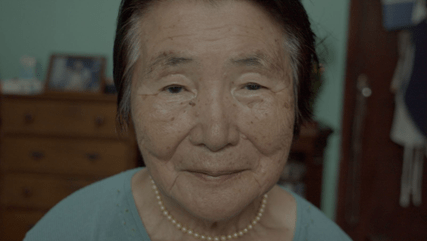
I shrink the size of the image. Now I feel that it reveals too much, even though that was precisely my intention when I photographed my grandmother. It is her daughter, who died when I was only 5 years old, who I wanted to find through this face. For a while I’ve started searching for my mother and decided to start with hers. I wanted to get as close as possible to this person who, to me, is distant and silent.
I’ve never known the name of the city where she was born, who her parents were, or how old she was when she emigrated to Brazil. I don’t know what it was like for her to raise six Brazilian children, all born in a Japanese colony where she lived and worked for 40 years. We’ve exchanged a few words, especially about her second daughter. I think about this silence and wonder whether it is the generations, the languages, the apprehension, or the loss that separates us.
The photo was a rare moment. Perhaps it was the first time we shared a space with just the two of us. The camera, almost a shield, made this closeness possible and gave us an excuse to be together. Even so, it was not able to reveal her stories. I still have no news of her or her middle daughter.
In the image, I see a timid, serious face with slightly tired eyes. On the other side of this photo, I also felt a kind of shyness before this person, who seems to look at me with affection yet does not understand what I want from her.
- Betrayals

My grandmother’s hands catch my attention. She doesn’t like them and is ashamed of her fingers. She always tries to hide them, as if they were too conspicuous, too revealing— qualities that are inappropriate for her.
I grew up watching these hands moving: planting seedlings, making soap from used oil, chopping vegetables for her preserves, or peeling an entire orange, in one long, unbroken peel. I never saw them working in other people’s fields, harvesting cotton and pineapple.
In the photo, they were carrying rice to her husband and middle daughter, at the Shinto shrine in the corner of her room. Her husband, who used to say they married because she was the only woman whose hands could carry a heavy hoe. And her middle daughter, who once said her mother was always victorious in the game her children invented: though she was the last to arrive at the plantation, her hands still harvested more than all others’ hands together.
About this last scene, the most surprising thing is imagining her playing.
Now that she is ill, and I am here, in another part of the world, I think of her hands, worn, resilient, who knows, even competitive or playful. I wonder if they ache from arthritis or if they still feed our dead. These hands that tell the stories she does not. That create this image and even this text.
- The lines
It seems as if this writing were the construction of a thread. The two ends, as if they were two remnants, search for the missing person, the one in the middle, who could bring some kind of sustenance or coherence to this story.
This story that begins with the grandmother, her face, her hands, her now-threatened life, in Japan, in the Japanese colony, in her language, which to me sounds like an inaccessible noise.
And it continues, almost accidentally, here in New York, where I am learning to exist in a third language, one that is neither hers nor mine. Here, where they seem not to notice that my face is half Japanese unless I tell them. Where my hands, generic, could be from Argentina, Portugal, or Korea, as some have suggested to me.
My grandmother, who, in our last conversation, said Estados Unidos in the middle of a sentence she was addressing to me. She said Estados Unidos as if she were saying this word for the first time, knowing that it is a widely used name, full of meaning for others, but indifferent to her. To her, Estados Unidos looks like a fiction, an idea that is not hers. Maybe it is just as the Japanese colony is to me—the world she inhabited for 40 years, and her middle daughter for 14, a little less than half of their lives. A place rarely spoken about, rarely imagined, an idea that only began to belong to me when I set out to write.

- The origins
A latifundium can be small if you consider that it is a place where one works and lives—if it is the entire universe of a person, their family, and several others. And it can be an absurdity if you think that it can belong to a single owner, a surname, and shelter a colony.
The first time I saw a latifundium was when a college friend invited me to spend the holiday at her family’s farm. I remember taking several minutes to drive from the main entrance to the house where we would sleep. We rode horses for a whole afternoon through a eucalyptus forest. This forest was part of the farm, whose main production was corn. I saw vast landscapes of land during this ride, though I didn’t see a single corn stalk—they were in a more distant area, beyond the reach of my gaze.
I was astonished by the scale of that property; it felt as if I were discovering my friend’s secret—a more consistent explanation for her wealth, and that of her parents—an artist and a psychoanalyst—as well as her uncles and aunts, all liberal professionals, filmmakers, and prominent figures in left-wing Brazilian literature. She, too, was discovering a secret of mine: my ignorance regarding a social class I only began to understand there. Until then, the rich people I knew were the emerging bourgeoisie, a rising middle class, the nouveau riche. I was sort of a nouveau riche in that cultural universe.
I think about that moment, about my realization of a scale of wealth and property previously unknown and absolved. Nothing actually surprising when considering the history of this country. Something that perhaps would not have been a revelation to my grandmother and her middle daughter, distant from the university yet well acquainted with the source of certain things.
- Crossings
On my last visit, my grandmother showed me a picture of my mother next to the wife of the Prime Minister of Japan. She exhibited the image as if it were a victory or some kind of reparation. It must have been at the end of the 90s, and my mother was working for the Federal Police in a city in the south of the country that lies on the border between Brazil, Paraguay, and Argentina. I don’t know exactly what her work consisted of; all I know is that she was a public servant working on the border.
One story that her siblings love to tell is that she used to feel furious with bribery offers, but there was one time that she was deeply moved by the case of an illegal woman trying to cross the lines that separate one country from another.
I wish she had felt revolt, or even a lack of sense in forbidding someone to move, transit, and live anywhere, under any condition. Something that her family did, something people have done for many centuries for various reasons. But what came to me is that she felt pity, and that I can’t change in this story.
I think about her work and wonder about her choice. I think about the meanings of a border, for her 30 years ago, for me now. For Brazil, Japan, and the Estados Unidos. Her siblings say that she always fought for financial stability. Like them, higher education was not possible, but unlike them, she managed to get a job and then a marriage that allowed her to maintain a middle-class life. Her death created confusion in me regarding the place I’d inherited, living with her family. Like one afternoon, in a bar next to the university, people were commenting on a lecture about Bourdieu’s legacy, and a friend told me, ‘these things are easily noticeable, I mean, identifiable, but when I met you, I really wasn’t sure if you were rich or poor’.
- History
I trace the face in this picture and find that her name is Kumiko Hashimoto, wife of the Prime Minister Ryutaro Hashimoto who governed Japan from 1996 to 1998. The digital archive on the Brazilian government’s website indicates that the visit took place in August 1996. In a speech signed by the “governmental communication”, someone mentions that it is a great honor to welcome the imperial couple, especially considering the long-standing friendship of the two countries “born from the strength of Japanese immigration in Brazil and, more recently, Brazilian immigration in Japan”. That same year, my mother’s family was experiencing the second wave of immigration. All of her siblings immigrated to Japan as dekasseguis1. We heard that they worked 12 hours a day and seized every chance to do overtime. “The work was tough, but the reward was good”, as they were paid in U.S. dollars.
The photo seems as friendly as the Brazilian government’s discourse. I imagine this moment: perhaps my mother was called to greet Kumiko Hashimoto because she was the only person there who spoke her language, or maybe it was she who had insisted on meeting the First Lady and requested the photo, intending to send it to her parents along with a letter that got lost over time.
In April of that same year, a report in the Washington Post mentions Kumiko Hashimoto saying that she is more comfortable in the shadows, and that it might be different for women in the United States, since she does not interfere in her husband’s business “not with my mouth, hands or legs”.
In the image her hands hold a camera, and my mothers a megaphone. The photo is proof that this moment existed, and it is also a testament of everything I cannot know: the words of my mother in that letter that disappeared, the possible photos taken by the First Lady during this trip to Brazil, the way each one of these two people feels connected to the other.
- Women in two acts
One day, my mother’s younger sister told me she felt shocked upon realizing she had turned 40. She said she remembered her mother at the same age as a “very old woman, I don’t know even if she was really a woman”. My aunt seemed to feel the way children often do when they discover their mothers are also individuals. If my mother is a person, does that mean I am also one, as any other one is?
In my aunt’s case, perhaps her mother was a person, though not a woman. Then she told me my mother hadn’t been a woman for a long time, that people at the supermarket and at school used to ask if Fussayo was a boy or a girl, and that it only changed after her marriage when she started to take care of herself and became a beautiful woman.
This conversation cost me many years on the divan. Back then, I suspected I was neither a ‘real woman’. What was it that defined this act? Do the nails, adopting certain gestures, love, marriage, or worse, a man? I was intrigued, as if there were a trick I was disinheriting. A trick my grandmother has never known, my mother might have known, and that I didn’t want to hear from my aunt because everything pointed to a disappointing answer.
I wondered, what do I have to know to be a woman, what does it mean, expecting my Freudian analyst, who had written a book about women, would be able to tell me. And, in the first act, she told me you disguise very well, it doesn’t seem you aren’t a woman.
I got irritated by that; I was taking this fiction seriously.
I continued insisting when she finally told me let’s pretend a woman who fakes she’s a woman, then she’s a real woman.
- Happenings
One day, my mother’s eldest sister told me she was going to reveal a serious secret to me. She said my mother got pregnant shortly after meeting my father and had an abortion. I asked her more details about it, how she managed, how she felt, since abortion was criminalized, and my aunt replied that she didn’t know anything else because she didn’t want to. She told my mother not to share any more details because she couldn’t bear to hear them. At that time, my aunt was desperately trying to get pregnant, and due to an unfair projection, she felt that my mother was wasting an opportunity that could have been hers. On one hand, I was irritated with my aunt for referring to the happening as a sin, for not being a good confidant to my mother, for not handling the difference in their desires. On the other hand, I was grateful she told me, and I know that if it had just been a secret, and not a sin, she would have never mentioned it to me.
My grandmother had six children. During her last pregnancy, she said she was working in the fields when she felt a sharp pain and was taken to the hospital. My youngest uncle was born that day, and when she woke up, she discovered she had become sterile. Since the birth was risky, the doctor thought it was better to “close the gate” considering “she was a woman with few means who already had too many children.”
I heard that story being told in Japanese, and my aunt translated it for me with some shock. We discovered it together, almost casually, something that seemed to have been said for the first time. In Japanese, my grandmother is not a silent person, and this phrase was one among many others. My aunt translated a block of words and sentences, and I didn’t realize at what moment the happening had been revealed. I couldn’t notice my grandmother’s expression, but I do remember mine.
At the time of this writing, women continue to have illegal abortions in Brazil. In a 2018 report published in one of the most popular Brazilian newspapers, a doctor referred to as “social sterilization” the procedure he “does not force anyone to undergo it”, but he does consider it necessary in many cases for “women with no means of family planning.” Here in the Estados Unidos, women and those who give birth have the right to abortion, although this was one of the major issues in the last elections, where, notably, the current president seems to have a different stance from his wife, who, to the surprise of some, declared that abortion is a fundamental right for women. In the last elections in Brazil, the current president was accused by the former far-right president of being an abortion advocate, to which Lula responded that he was against it, and, to the surprise of some, his wife—who is a declared feminist—was against it as well. The presidents and the first ladies. The opinions of these women, who seem to matter as much as they seem to matter nothing.
I don’t know why my mother and my grandmother shared their happenings with me, in which I feel that these stories could have easily been lost, as if they were happenings of the others, as if they were nonexistent.
- The distances
At the time of this writing, here, from the Estados Unidos, I feel far from them, my mother and my grandmother. Here, in this place they have never been, in a language that is not theirs, nor mine.
For a long time I had insisted to my aunts to tell me more stories of my mother. They used to tell me that they didn’t have much information because, in her last years, she was far away. At that time, both of them were living as dekasseguis on the other side of the world, 12-hours of difference from Brazil, but it was the middle sister who had gone far away.
- The images that didn’t disappear
Me wearing my mother’s pad I found in the bathroom and asking her: mom, do you wear diapers?
She peeling different kinds of fruits.
She telling me that there’s no problem swallowing watermelon seeds, soon a tree will grow inside your belly.
She on the floor of the living room doing origami.
The steam coming out of the mochi she was opening with her two hands, saying atsui, atsui. I, hesitant, watching that soft dough being dipped in soy sauce with ajinomoto. She tells me to have the courage to try.
- The visits
Before coming to The United States, I’d made several visits to my grandmother. There were strange moments for both of us, but I insisted on going there, taking pictures and trying to hear some stories. She, however, didn’t answer what I was asking. During each visit, she’d insisted on a specific sentence, such as: ‘the gohan is ready’, ‘I do so many things because it’s better than standing still’, ‘look at this picture of your mother with the wife of the Prime Minister of Japan.’
So, during each visit, one of those phrases was repeated many, many times, as if she was glued in those words like a magnet. I tried to ask her about how she was feeling, something about her past, but she was fixated on the sentence of the day. She repeated and repeated the same exact selected words.
I didn’t understand her insistence, and wondered if it was due to her age, the language barrier, or if she had always been like that. I realized, then, that I didn’t know how to respond, because we had never really talked, I’ve never asked her things. I realized that I had always been convinced of the idea that I had nothing to hear or say to her.
Now that she is ill and I am far away, I call her often, and our calls follow the same pattern as the visits. But now, the phrase is the same, regardless of the day. She says she is not feeling well, that she’ll get better and make gohan for me when I return.
- The mother tongue
My cousin is often present on the calls to my grandmother. Like me, she also doesn’t know how to speak Japanese, but she is trying to learn now. She tells me my grandmother says she feels strange, but she cannot explain why. She told me it seems as though our grandmother doesn’t know how to represent her feelings in words, and that is very agonizing. It seems the language of pain, for her, is Japanese.
My cousin and I realized that we both entered adulthood without knowing how to speak our mothers’ mother tongue. They both only taught us Portuguese, the language they learned not at home, but at school. Our language is the one our mothers learned later in life, during their early childhood, when they discovered there was another way to say things—a way their parents knew only a little, just enough to sign their names and say specific phrases.
When my cousin’s mother was living in Japan, she said she discovered that the Japanese she knew was different from the Japanese she encountered there. She discovered that her mother tongue was the Japanese of the colony, the language that now only exists in the house of her childhood.
This is the familiar Japanese that remains to communicate with my grandmother now, in her illness. Outside it, there remains only silence and agony, hers and ours.
Here, in the United States, it is the first time in my life that I’ve been living outside my mother tongue. There’s no conversation in which I don’t feel angustiada—this word that is a little different from angsty—which means a kind of agony without apparent or specific cause, or a sensation in which the reason is hidden and dislocated. Or, still, the cause can be obvious, but the way you feel seems bigger than the cause, so that’s why you feel angustiada.
Outside my mother tongue there are many times I don’t express myself as I would like to. There’s no day that I don’t learn a new word, lose a point in a conversation or a joke. Then, I return to my mother tongue and feel saudades2, as if it were the secure territory, as if it were the untouchable place, the definitive heritage.
- Etc
When I was 7 years old, my mother’s friend was watching us do our homeworks and laughed, saying to her husband: “look, so funny, these girls . . . after they learn the word ‘etc’, they use it in every possible sentence. If before they’d said ‘the car is beautiful’, now they say ‘the car is beautiful and etc’, ‘I like bananas, pineapple and etc’, ‘the sea is huge and etc.’
Outside my mother tongue, angustiada with my limited repertoire, I feel as if I were looking for the discovery that tricked these two seven-year-old girls, as if, in front of everything I can’t say, there were a way where I could say everything.
- Hotokesan
Everyday, at the Shinto shrine in the corner of my grandmother’s room, she would bring food for my mother and grandfather. White rice was indispensable, and the first portion was always served for the dead. After that, the living could eat. There is a belief that the food served to the dead brings luck to the living. The living feed the dead who reward them by granting hope.
The hotokesan, this structure that survived the war and immigration, has fed generations of people, connecting the living with their ancestors and death with daily life.
Today, there is a space where my grandfather and mother are. After my grandfather died, my grandmother lost a lot of weight. She said she no longer had the desire to eat and that she couldn’t see the point of using her pans now that he was gone. The only thing that made her cook was the duty to feed the dead. She might not feel hungry, but they could, and they were demanding. She said that when she wanders at the farm market and she sees a shiny mango, she doesn’t feel the desire to eat it, but she buys it anyway because her husband might have wanted it, as he used to. My grandmother feeds the dead, and they feed her.
My cousin tells me I would be scared if I saw my grandmother now, since she is losing more and more weight every day. She can’t eat anything.
These days, she said she wanted to eat sembei and seaweed gelatin. I found the number of a Japanese grocery store near her house and placed the order. My cousin told her that I was sending the food to her from the Estados Unidos. Even though she only ate a little, I can’t be as effective in making her eat as the dead were. I wonder how they are now, how they will be in her absence. So many things continue, end and begin with her.
15. Writing
I wanted to achieve something similar with the relationship of persistence and collaboration between my grandmother and our dead. She through the hotokesan, and I through the text. In fact, this is nothing innovative in terms of writing, which has always crossed the ghosts of a family, the languages, and death.
In order to find my mother, I went after my grandmother, the person I could still see and talk to, across the borders.
When I was afraid, I thought of her, my first word and teacher. My first love and first loss. She was the one who told me to have the courage to try.
Julia Ferry is a psychoanalyst and researcher. She holds a Bachelor’s degree in Psychology from the Pontifical Catholic University of São Paulo (PUC-SP) and a Master’s degree in Social Psychology from the University of São Paulo (USP). She is currently a PhD candidate in School and Human Development Psychology at the University of São Paulo (USP), with a visiting research period in the Department of Anthropology at The New School for Social Research, supported by a PDSE-CAPES fellowship. Her interdisciplinary research, situated at the intersection of Psychoanalysis, Anthropology, and Literature, explores experiences of loss, mourning, and autobiographical narratives of diasporas.
 New Ohio Review