Who knows why the bay was that color

By Rose Auslander

Maybe it was hot, I was out of work & the car actually started, maybe I didn’t
even think to bring a towel, just drove & walked into the water, walked in &
let my feet rise, floating in salt & seaweed, fishlike, minnows darting below me,
maybe that’s why I got to lie like I belonged in a horizon of water smooth as
the sky, a rich silk luxury of blue, early evening in Paris blue, the blue of the
Comtesse d’Haussonville’s opera dress, not the way it was, trapped in fabric,
but how Ingres painted it, the way it still looks even in the print in my room,
faint ripples flowing smooth in reflection, the kind of blue you’d wear & your
bank account would never run low or maybe if it did you wouldn’t notice,
or wouldn’t care, that rich Comtesse blue ferrying me seaward, blurring the
smells of suntan lotion & fries, the echoes of men loud on phones, into the
holiday happiness of striped umbrellas & beach chairs & who knows, maybe
the Comtesse herself sunbathing right here at Sandy Neck, floating in time, sure,
just a day at the beach like any other day, maybe, the way if you didn’t look,
you might think the water was just blue.


Read More

The Windowless Room of Wisdom

By Drew Calvert

Featured Art: Coastal View by Madelyn Bartolone

Jim Dahlberg was eating a bran muffin and reading The New York Times when he saw that Lucas Bloy had won the Joslyn P. Fish Award for New Conceptual Art. Jim put his muffin down. He wondered if there had been some mistake—not that he was an expert in the field necessarily. He wasn’t an artist, or a critic, or a scholar. He didn’t know the first thing about the Josyln P. Fish Award. He did, however, know a thing or two about the recipient. Lucas had been his nemesis.

Years earlier, Jim had entered a sandwich shop in Madison, Wisconsin. He was in his third year of law school at the time and had just completed a lengthy exam on copyright litigation. Whenever he finished a big exam he liked to eat a roast beef sandwich slathered in tangy hot sauce. It was, for him, a kind of joy. And so he was deeply touched when he saw that Joanne Neier—by far the prettiest girl he’d ever seen at Ralph’s—chose the same condiment. On the basis of this connection, he was able to score an impromptu date.

Life is astonishing, he thought. One minute you’re biking through town with a roast beef sandwich on the brain, and the next minute you’re sitting across from a beautiful stranger with hazel eyes, convinced that all your days on Earth were prelude to this fluke encounter. There had, of course, been one or two highlights. Kissing Natalie Finchbaum at the Cineplex was a clear triumph. Receiving his law school acceptance letter—and the scholarship it came with— had opened his life to dewy pastures previously unfathomed. And there had been that interesting brush with nature during a baseball game when he was sixteen. He’d been grazing in a trickle of meadow along the left-field foul line—his team, the Borlyn Reds, were playing in Ripon, Wisconsin, home of the Tigers— sniffing his glove and watching Trent McGinnis mow down batter after batter, when all of a sudden the wind picked up and sent the trees into a frenzy, and he was able to recognize—though he couldn’t say exactly how—that trees are in a struggle against the heavens, just like the rest of us. But between that night on the baseball field and the moment he and Joanne Neier shared the corner booth at Ralph’s, it seemed that very little had happened.

Read More

Residue

By Maria Dylan Himmelman

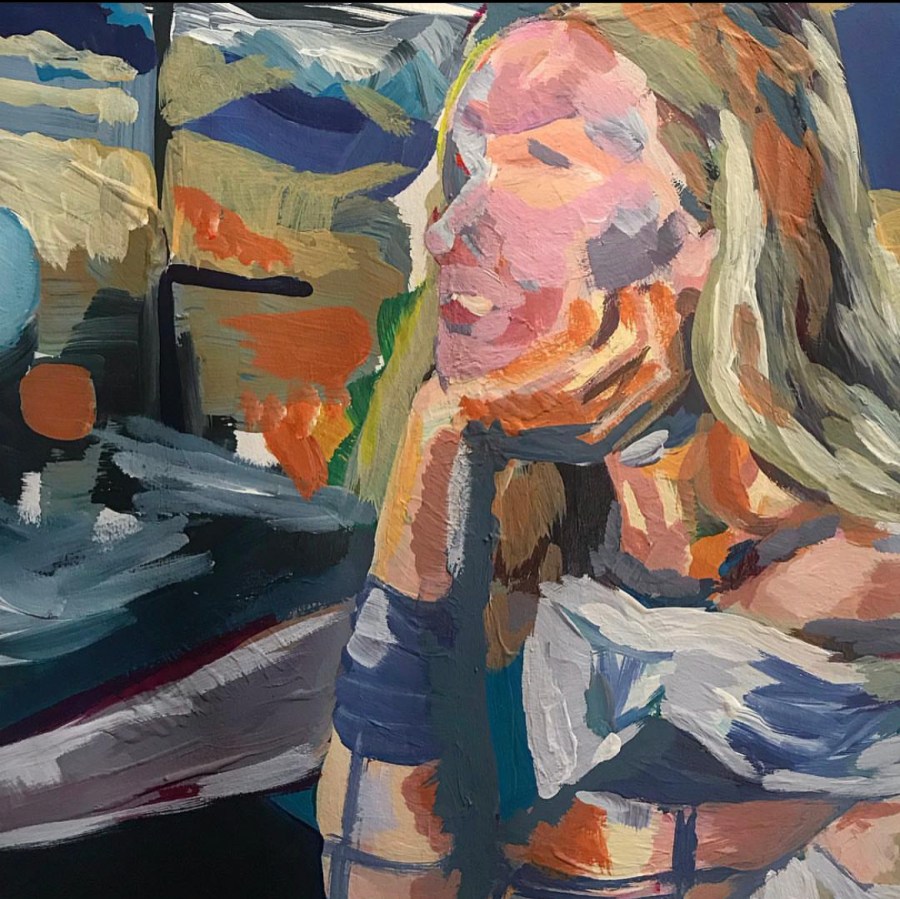
Featured Art: Portrait of Kaitlyn (2018) by Erin Dellasega

Each generation learns from the previous
so said my mother who never left
the house. She would close herself up
in her bedroom for days, only to emerge
in a wig and a dress made of paper on which
she had sketched vague faces and landscapes
with fat pieces of charcoal and spit. Once
I thought I saw her in the street, a fur
hat and hooped earrings, eyes vacant
and no response to my call. Doppelgänger
she would say later, like the thick-boned
villager who helped load the trains
with mothers and daughters
and turned to the camera to swear
it wasn’t her.


Read More

Self-Portrait as a Half-Deserted Town in Germany

By Greg Nicholl

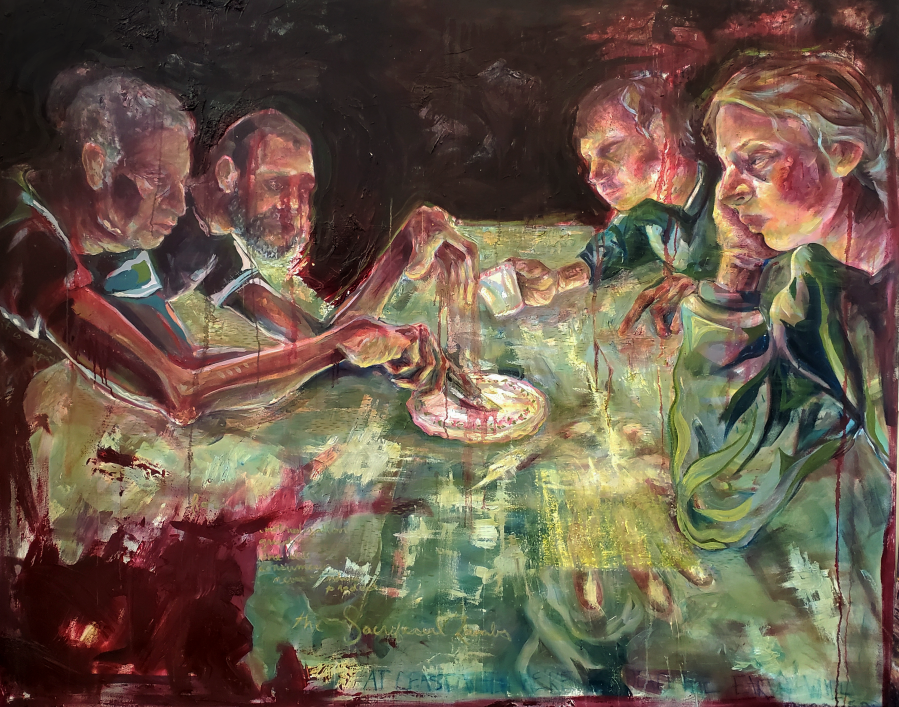
Featured Art: The Sacrificial Lambs by Brooke Ripley

The stores have closed early even though
it is the middle of the week.
The cathedral begs forgiveness, promises
to open tomorrow. No reason is given.
At an intersection, two women
ask for directions to the town square.
They only venture a couple of feet
before they consult their phones, are given
the same instructions: Walk down that street.
It’s not like it is a large town.
If this were a Western, there’d be tumbleweeds.
Despite recent warnings of a thunderstorm,
it hasn’t rained in over a month.
Six years ago a 300-year-old bridge
washed away for good. There have been
three floods in seventeen years. The two women
are still looking for the town center, stop
in the middle of the street to look west,
then east. And it’s clear they’ll never find
the center even though all they need to do
is look up. In the square, employees
from a supermarket chain are camped out
in booths. They carry trays of cubed cheese
and melon that smells like cold cuts.
It is too hot for cheese. The city is building
a new wall to fight future flooding.
Does it matter that the shiny metal gates
rest against centuries-old stone?
Back in the town square, a mime on stilts
waves coupons in the faces of passersby,
bends down to gauge their response.
No one accepts the coupons. The supermarket
employees suddenly appear at every side street,
each dressed in a matching red shirt,
ambushing anyone who dares get close,
calling after them: Excuse me. Excuse me.


Read More

The Pillow Museum

By Claire Bateman

Most people find a trip to the pillow museum so exhausting that afterward they need a long nap to recover from experiencing all the dreams the display items have absorbed from their original sleepers.

Theoretically, anyone could navigate the museum according to taste, steering clear of, for instance, the homicide pillow, the fetish pillow, and the arson pillow, as well as the pillows of Arnold Schoenberg, Charles Manson, and all those dental hygienists and IRS attorneys. Theoretically, one could choose only the pillows of the confectioner, the Olympic surfer, the dolphin-whisperer, and so on, but nobody does this, since it’s common knowledge that every shunned pillow takes offense, vengefully suctioning out a single breath from the visitor’s lifespan as they pass it by on the micro-sleep tour—a tiny, insignificant portion until you start adding up all the individual penalties over the years.

Nevertheless, not only does everyone return frequently, especially when hosting out-of-town guests (the museum is our only tourist attraction), but most of us are employed here as well, sanitizing, repairing, plumping, positioning, and working as docents or gravity-adjusters—there are also the soothers, wakers-and-shakers of visitors, members of the custodial, managerial, and administrative staffs, and the guards who protect the pillows from theft, vandalism, and all possible forms of dishonor.

Read More

O Isn’t This Just Easy

By JC Andrews

Featured Art: Pulse 1.2 by Rachel Ann Hall

The octobered sky. The overarching
evolution of your abdomen. The salutatious
relove we do once we’ve forgiven our
mommas. Let’s go arachnid and eat
our mommas or   ok   we can just
wrap each other in silk. O yes   I am
an aprilfaced king. O yes   I am
a uterus genius. O yes   I bleed
while I walk down Seventh.
O yes & yes & yes
I have made such
a snow of your hands,
an astronomy of your syntax,
an ambulance of your eyes,
and I’ve decided that I
have no issue with meeting
your mother next Tuesday. Wait.
I can wear a green coat like Chalamet
in Little Women or a red tie like
a coach. I should practice my little voice
in my little mirror hi my name is how are you
impressive charming not at all   o yes  afraid


Read More

Sneaking Out to Play House with Ana

By: JC Andrews

the day gathers up     in a blonde     geometry     and we     drive out
    to turn     phantom on DeSalvo’s dock     because we can     because
DeSalvo went dead     and left his pond unattended     so we come     here
    and watch     the moonback     like maybe     it might turn around
and make us     real to somebody     sometimes I wish     I could throw
    her up     in the air     and watch her     spin forever     she’s like
yawning     during the pledge     and missing     indivisible     or picking
    scabs during     catechism     you see     I am stupid as the weather
when she says     Please     like a field waving itself     into the blade     when
    she rubs     her thumb     in circles     in the middle of my palm     I am
honest to god     adjacent to me or     ajar     there is no halo     like leaving
    yourself     ajar     you become a room     so danced     it thumps violet
or you become ready     for another room to enter     you back     she is
    a room too     asking me     if this is alright     like she can’t see
my face     already decided     under this light     we call our space juice
    because we     drink it     we pray for no spoon     in the persimmon
we sit down scared     like substitute teachers     we learn     how to love
    with one hand     and we scrape our backs     on this wood like     we’re
rubbing off velvet     or making     the muscles in our traps     to fight
    and we know     this house     is a gift     even if     invisibled


Read More

Fugitive

By Karen Pojmann

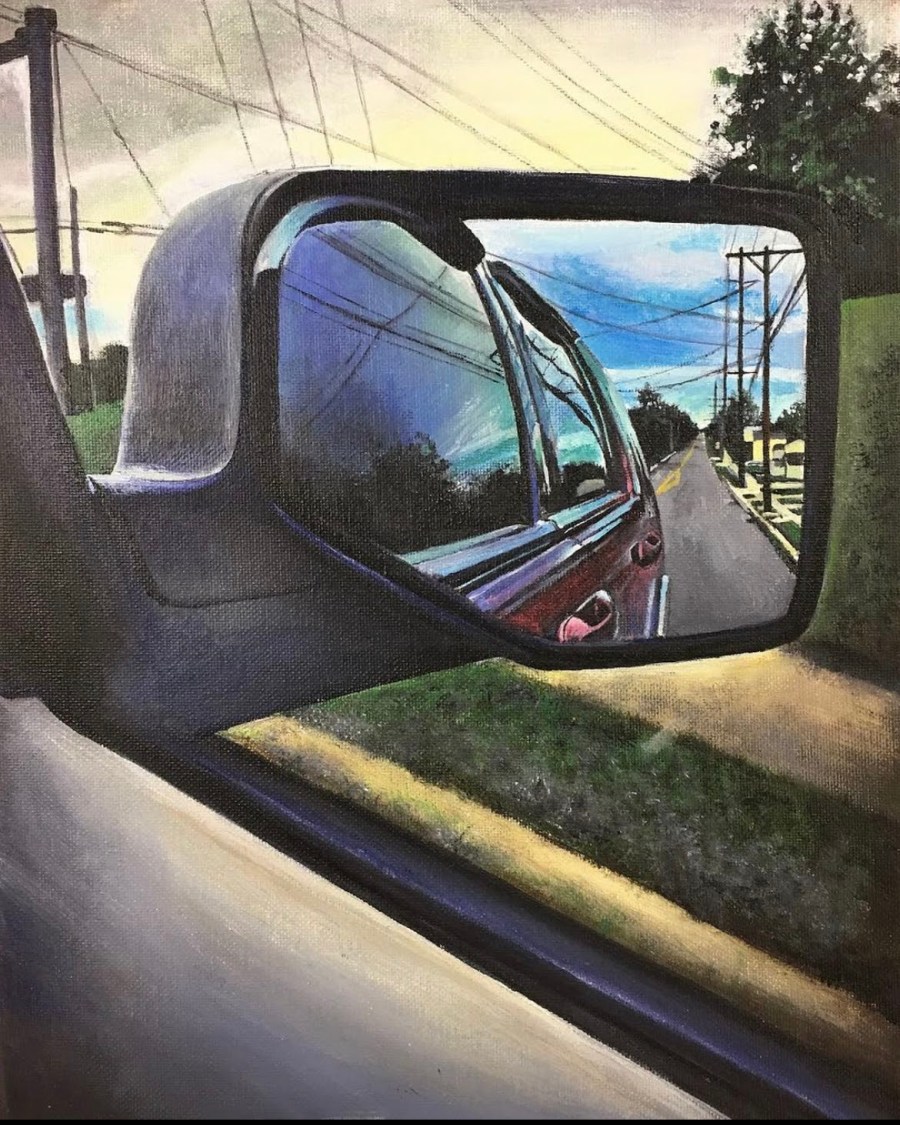
Featured Art: Looking Back by Madelyn Bartolone

If my heart breaks loose and
darts across a lawn—if,
stopped at crossroads,
my heart pries my ribs apart,
takes wing through the open
car window—if my heart
gets away from me—
help me bring it back.
Walk with me, hedge to hedge,
with a butterfly net,
a baseball glove,
a sauce pan. We’ll crunch
over cicada husks, duck
the sprinklers, race
the coming dusk.
When we spot it, cupped
in a daylily or
tangled in chain link, by then,
relieved and grass-stained,
we’ll be laughing and crying
and the streetlights will be just
starting to sputter above us.


Read More

Sometimes Creek

By Steve Fox

Featured Art: I Wish I Knew Of by Brooke Ripley

Our move to Halloween Street was one of necessity, not choice. Following the death of my wife, Sylvia, the home we had rented was sold. The new owners gave us nine months to vacate. And this place, situated on a leafy and wealthy street in the town’s eerie historic district, was the only thing available within walking distance of my daughter Claire’s school. So I took it, despite the steep rent commensurate with the austere economic laws of Supply and Desperation.

An energetic and put-together neighbor tells me I will need somewhere between three and four thousand pieces of candy, treated out one piece per kid, as well as gallons of a stiff grog for parents, to get me through the hours-long Halloween night here on Halloween Street. Based on some simple arithmetic and plot-pointing along a mental timeline, starting with the next paycheck, I have just enough pay periods between now and the end of October to buy a total of four thousand pieces of candy. Or eight hundred pieces of candy each payday, all totaling in the end approximately six hundred American dollars. Candy. For one happy motherless night for our only child more than two months hence.

It is barely August.

Read More

Tails

By William Wenthe

Featured Art: Flow by Rachel Ann Hall

Houses on a bluff; below them, off-limits
to construction, a few acres of watery woods.
A clear simmering of spring water
glazes bright moss and gravel, slows
to a bog, where a marsh wren reveals
its single note. Slow growths of mistletoe
on thick-gnarled limbs of elm and oak.

I’m here with my two wolves—
my daughter and her friend, both twelve,
who’ve tied to their waists lush tails.
They prowl among the folded smells
of leafmold unleashed by winter sun.
They run, they fade behind trees.
From the woods I hear long high howls.

Is it only make-believe? Each day, they feel
an approaching metamorphosis.
They’re at an age for trying things on:
clothes, hair, such baubles that dangle
from pierced ears, language fanged to affront
their parents—whose worst fear remains
the child might be no predator, but prey.

But these two wolves are at play.
Are they too old for this? In Finland,
my daughter tells me, teenage girls
ride stick-horses, in organized events.
It’s like dressage, except the living
and too expensive horse is assumed
into the girl herself. Spine and head convey

the rider’s attentive, upright carriage,
while legs perform the horse’s measured moves.
It’s ignorant to presume an animal
will share a human’s feelings in a human way;
just so, I can’t presume to think I know
the nature of these wolves, or cultivated horses
the Finnish girls become, as if to say

what’s best might just be something else
than human. The houses crowding
the edge of bluffs know nothing
of these changelings, who bark and bay,
wander the unruled ways
of the leftover woods, and in becoming, renounce.
Unless these houses breed them too.


Read More

Little Manifesto

By Jeffrey Harrison

There is always someone who suggests
that his poems would be far better than yours
if he’d only bothered to write them. What’s more,
he would have handled the whole enterprise
with more grace and aplomb than you ever did
had he chosen to write those poems instead of
making a killing in investment banking.
And yet you keep going, even in the knowledge
that the poems you are writing are not as good
as his poems, the ones he didn’t write . . .

and, for that matter, not even as good as the ones
you didn’t write. “Your poems would be better
if you didn’t write them” is either a Zen koan,
a quip by Yogi Berra, an insult, or just nonsense,
which is why no one says it. I hate the idea
that any poem written down is somehow
inferior to a poem that does not exist.
Yes, plenty of bad poems have been written,
but out of all the poems that have gone
unwritten, there’s not a single one I love.


Read More

A Message from Tony Hoagland

By Jeffrey Harrison

I got an email from Tony just now
though he’s been dead for a year and a half,
and in the instant before my rational brain
told me it was spam, I felt the thrill
of seeing his name pop up in my inbox,
the dopamine rush that he was writing me
from beyond the grave. And when I clicked
on his name to open the message, the body
of the email consisted only of my first name
followed by an exclamation mark
(as though he was excited to be writing me)
and, under that, a compressed link
in the electric blue that indicated
it was live. My giddy finger slid
the cursor over it, to see what Tony
was sending me—maybe instead of
infecting my computer with malware
that would harvest my data and require me
to pay a huge ransom in cryptocurrency,
the link would take me to a web page
where I could find all the poems
Tony has written since he died.
I paused a moment and thought about
what those poems would be like,
but my imagination failed me. Then
I clicked “delete,” and went into my trash
and deleted the message again,
which made me feel timid and puny,
as though, like D. H. Lawrence
and his snake, I’d missed my chance
with one of the lords of life.


Read More

Ode to My Father’s Body

By Jeri Theriault
Selected as winner of the 2022 NORward Prize for Poetry by a panel of previous poetry contributors

Featured Art: Lost Moment by Mallory Stowe

I lose my way in the low-note harmonica
of my father’s absence & unfold the map
of his body in the big window of his barbershop

at the corner of Summer
& Gold    where he    slow    stood all-day
poised to conduct    the chorale    clip-clip

of his trade    shears    razor    hot-towel
talc    brush & tonic    Red Sox radio
my father vaguely tidy & distant    not

dissonant. My everyone-knew-him father.
My year-round-bicycle father. My father’s
body at school nights

or Sunday mass    silent    always
silent but singing in the cellar attic
garage & whistling    as he built back-yard

swing-set    lean-to    edged
garden rows    or hosed night after sub-zero
night    the ice rink where I soothed

afternoons    cold & would-be
wild.    His body hunched in the chair
of my mother’s hospital room that time

we thought she would die    thirty years after
they divorced. My father’s corpuscles
& liver    shins & scapula

his semper fi     tough-guy body    his ear
his good eye my self-taught father in the city
of his body my beige & pastel checked-shirt

father in serviceable shoes & trench coat    who left
his copy of Camus’ The Stranger face-down
on the bed in English though his tongue

his lips    his throat    were French.    He left    too
his body    that night    left
what was left of his body    left

his Iwo Jima    his broken birth family
left his untold    his mystery    left me
his daughter    the wilderness

of my own body    that is to say    left me
half-him left the quiet why or who he was
might have been    what he most

loved    so that sometimes    I still walk
the hallways of my father’s body
half the doors gone    half of them still here.


Read More

On Throwing Things Away

By Amelia Mairead McNally

Featured Art by Erin Dellasega

My cat’s corpse is in my dad’s garage. She died four years ago, November of 2017. There was a tumor somewhere in her brain that pressed outward against one of her eyes quite horribly in the end, according to my dad. I had moved to New York by then, a five-hour drive from his northern New Hampshire home, and could only listen, powerless, to his news over the phone. She did one of those animal things where she grew very sick very fast but refused then to just die, prolonging us all in the anxiety of her suffering and the knowledge that we would, finally, have to choose which day she would go.

In some ways, it was okay—she was old. My parents brought her home to surprise me when I was eight (after we had to condemn our last elderly cat the month before), and I was twenty-three at the time of my dad’s solemn phone call. But there’s something undoubtedly terrible about scooping an animal into a carrier, taking them from their home for the last time, telling them, “It’s okay,” as they panic, like on all the trips to the vet before, but knowing that this time it is not.

He called me again after it was done. He said, “They gave me some options on what to do with her.” Cremation and eventual return of remains in a commemorative urn, which cost money; burial out on their farmland gravesite behind the office, with visitation opportunities; or self-disposal at home.

He took her home.

Read More

Winter Solstice

By Natalie Taylor

Jupiter and Saturn closer than they’ve been since the Middle Ages.

Swinging around to check on the puny humans,
see how we’re coping with famine and war and plagues.

How many drinking from a Dom Perignon fountain,
how many grubbing over gritty water.

A celestial shindig of tilts and orbits
arriving, right on time, 800 years later.

Saturn’s lightning storms create giant clouds of
soot that blacken thunderstorm alleys.

After it falls the span of two and a half earths, soot
solidifies to graphite, then diamonds.

Diamond rain melting to sea.
Jupiter’s million-megawatt aurora escorted

by Io’s 400 volcanoes,
gem-crusted Galilean moons.

Now they’re dancing to the compressed heart of an old star
—a 10 billion-trillion-trillion-carat cosmic diamond

that pulses and rings like a gong.
Maybe not much has changed

since last time they rolled in together.
Trolls still digging for buried treasure

when all the dazzle—methane and crystalized carbon
and hot cores transformed to brilliance—

like the persistence of awe, is above. Look up.


Read More

Late, Dark, and Windy

By Kathleen Lee

Featured Art: Mall Series (3) by Doug MacDowell

After you left the party
someone’s dog picked a fight
with the resident ancient hound
and big human hullabaloo ensued
followed by talk of infectious diseases,
tricks for making perfect piecrust,
the battle of Waterloo. Literature
was avoided (too controversial),
as was real estate (too dull). The Sanskrit scholar
refused to recite a poem we yearned to hear
called Remembrance of Songs of the Future.
Everyone wanted to know the truth
about you so I spun one tale after another
about lost items, Cochabamba
(remember the awful soup we ate every single day?),
and the exigencies of soul retrieval.
They toasted your future with pretentious cocktails
while I sat on my heart to keep it quiet.
Without you, my partner in all things stealthy,
I couldn’t slip away early.
Then it was late, dark and windy.
I stepped outside to gaze into the vastness
overhead and the cosmos was as it ever is—
persistent and forgettable.


Read More

Sad As Is

By Kathleen Lee

I’m trying to nap for ten minutes
before swimming laps when two voices

waver as if in a dream. If you died today
we could know everywhere you lived from your bones
.

Because I am alert to death, I listen—
I tend to believe in the neuroplasticity of the human brain

to adapt
—and half-open my eyes to see
two dudes in beards and surf shorts on a bench

poolside. It’s February. There isn’t surf
within 2,000 miles and even if what they say is true,

they make it sound like bullshit. Still, dread
winks at me as if it has spotted my weakness:

insufficient neuroplasticity. I’m not adapting!
Where’s Adam?             Family funeral.

A lozenge of silence dissolves in the room.
He’s a sad boy as is. I know the world

is not ever about me but here I am on a chaise longue
in a too-warm room, the air redolent of chlorine,

while a couple of idle chatty dudes seem,
I’m sorry to admit, to be speaking to me

in an intimate way, and I’m helplessly listening
because what else am I to do with myself inside time?


Read More

Assimilation

By Kelly Rowe

Featured Art: In Remembrance Of by Brooke Ripley

                                                                                 Turku, 1962

Out the window of the tram
stone buildings, cobblestone streets,

the sitter handed back the apple
core for me to eat.

Now, I know her children
went hungry in the war;

then, I understood nothing;
I was four.

But sixty years on, I remember
her hiss—“finish it!”

And how the seeds and stem
caught in my throat,

how I coughed, how I choked,
how I sat silent,

looking out at the snow
in triumph.


Read More

A Good Thing Going

By Marguerite Alley

Sitting at a corner table on the patio of a Lebanese restaurant, I watched Hank Nguyen chew viciously on a hangnail until a sliver of skin came loose. A flash of blood appeared on his teeth before it was wiped away with a brisk dart of his tongue. “You are the worst kind of tourist,” he said, with an elaborate eye roll.

I was working through a mouthful of flatbread and hummus. “I just don’t think it looks that tall.”

Behind him the Burj Khalifa rose into the night sky, glittering intermittently, so large that I had to roll my neck back to behold it. The action reduced it to parts, made it digestible and no longer grand. This was the Dubai Mall, and I knew that if I had marveled at what lay around me—the swarms of tourists, the extravagant fountain show every half hour, the way everything gleamed in the perfect sharpness of fluorescent light—Hank would have mocked me for that, too.

“You’re impossible to please, Berenice,” Hank said. “I take you to the center of the world and it’s not enough.”

“Okay, okay, I have an idea,” I said. “What if they made it taller?”

Read More

Reading Li Bai During Social Distancing

By Jenna Le

Featured Art: Peony – side yard by Kayla Holdgreve

In Tang verse classics, lonely wives rebuff
the orioles that flirt amidst their flowers;
they’d rather climb steep observation towers
and, wrapped in tragic shawls atop a bluff,
command a view of miles on miles of rough
terrain uncrossed by human forms for hours
than lean into the softness of spring showers,
breezes, birdsong, and such sensual stuff.
Or so the male bards of the Tang portrayed them
when writing verses in a female voice;
I cannot blame them for it. Simple boys,
they merely wanted someone back at home
to miss them in their absence, to upbraid them
for being gone, to love them through a poem.


Read More

Dollhouse

By Aneeqa Mazhar Wattoo

Walking around in Central London
I find myself even browner than I remember
feeling when I lived there three years ago
before returning to Lahore

                                                            [and her kind shisham trees
                                                            and the unkind eyes of strangers
                                                            that make my eyes heavy with the second
                                                            pair of eyelashes that grow over the first as I
                                                            navigate her narrow sidewalks]

but London looks exactly the same—
everyone seems hurried, busy
rushing to someplace else, someplace better
where suddenly, violently
like snakes shedding off their skins
they will blossom into
finer versions
of themselves.

Now at a roadside café
I try to gather my
self but I cannot
feel anything.

Instead, I watch myself from a distance—an object clad in
red pants, practical blue Toms, and wristwatch
with a cluster of crystals around the dial

and I wonder
how the faint London sunshine
manages to erase me
so efficiently, so completely
every time

until one of those absurd motorbike rickshaws targeting tourists
races by and the notes of a loud Bollywood song slash the air
and I feel sudden, improbable delight, recognizing in the sound
something I cannot name, but which turns me briefly into
some
body

and it slides into me
the way a ray of sunshine slides perfectly, angularly
into the dark patch on a windowpane

that all of London is a dollhouse
and I am a doll in the dollhouse—
a tiny object in the gloved hands
of a woman in a factory, hunched over an assembly line

                                                            [now she wipes away the sweat on her forehead,
                                                            now she imperceptibly stretches, the muscle in
                                                            her back relaxes by a tiny degree
                                                            and the ache recedes for a bit]

she glues me to one of the
miniature sidewalks
and I sit there
forever afterward
            my wristwatch gleaming
            my new Nikes shining
            sipping a cup of tea
            with petite,
            manicured hands.


Read More

Allegory, NJ

By Julian Koslow

Looking back, perhaps I should have known—
I mean, I had a crossing guard named Hope,
and my third-grade teacher was
Mrs. Schoolman—that life in Allegory
was not as it seemed.

But of course in childhood the marvelous
will greet you as the given,
and the habitus of your natal genre
accommodates even the extraordinary
without interpretation:

The lady on the white mule, trotting through town
followed by a dwarf carrying her purse,
certainly inspired her share of wonder
among the seventh-grade boys out for bagels
at the Jewish Deli. And the knight seen
galumphing after a beast with a thousand tongues
(very Monty Python) prompted serious
concerns among local parents, even
an emergency assembly with the police
at Everyman High. But no one ever thought
to call in the exegetes.

If, in grammar school, we suspected
the gym teacher (Coach Lust, an amateur
taxidermist) and the art teacher (Ms. Seeley,
a talking paintbrush) were having an affair,
we didn’t think to say, “Aha,
the marriage of soul and body!”
We just wondered what they were up to
in the custodian’s closet.

And when the snow fell, it was white
as regular snow, sparkling just as cold
and diamond-bright in the sun. That it
spelled out the word INNOCENCE
in the parking lot of the municipal building,
made no difference to us as we threw
snowballs, built igloos, went sledding,
and peed our steaming names in gold
behind the library.

In high school, my friend Boredom and I
spent weekend nights wandering the town,
keeping clear of Idleness and Vice
who were always hanging around
the Duck Pond of Despair, smoking weed
and listening to The Dead. We roamed
the satyr-haunted golf course and the
foundling-littered park looking for
something to happen to us that we
couldn’t explain. But adventure
in Allegory seemed in short supply.

So when we got tired of killing Time
(even in Allegory, a victimless crime)
we’d head to Music’s house and hang out,
listening to records, poring over lyric sheets
and album covers, pondering the mysteries
of life and death, love and sex, Aqualung
and Stairway. Later we confirmed our
insights by telephone, which was otherwise
useless except for getting busy signals
from the universe and silence
from unrequited crushes, which, in Allegory
felt like having your whole body
stuffed in a pressure cuff.

And if you fell in love it meant
tumbling down a heart-shaped well,
the result of not watching your step
when AMOR walked by in a bright red sash
and silver crown, with a face that no
two victims ever described the same
(and our sketch artists could only
draw visions anyway).

From the bottom of the well, you’d watch
the patch of sky above, an eye
opening and closing, going from day
to night and back to day.

And once they’d pulled you back up,
blinking in the literal sun,

nothing was ever the same again.


Read More

Opportunity

By Robert Wood Lynn

Featured Art: Insomnia by Madelyn Bartolone

There would be more mornings, more
dark pink of sun through closed eyelids.
More people rolling over to check
that the other was still there. The day they left
the rover alone on Mars, most didn’t read
the news and most of those who did
didn’t read about the rover—a wandering
machine supposed to last for only ninety days.
But ninety days passed and still there were more
mornings. People continued to wake up
startled, to churn their ways through the covers
to find someone. Some never did, in beds too big
or apartments too small. There were more
mornings for the rover too—thousands more—
until everyone who wasn’t a computer
lost count, until the rover made mornings
the wrong metric altogether. Back then,

those thousand days ago, you’d wake up
grasping for me in a panic that felt new
each time. Morning always the same dark pink
that Mars looks in that selfie the rover took
just before it stopped responding.
I’m sorry, I love you always
the first things you’d say aloud
until I stopped hearing the comma.
Not something you needed me to know
so much as a ping sent to a wandering
machine worlds away, still listening
for who knows how long.


Read More

Listen

By Pamela Gullard

Featured Art by Mallory Stowe

The day after Marta Holmen’s older sister Iggy called to say she was coming for a visit, Marta cleaned her small house overlooking the historic Santa Barbara library. She washed the kitchen and bath towels in case one of them was stale or dusty, cleaned up stacks of work files on the dining room table, scrubbed the kitchen floor twice, and bought a new lamp from Dorman’s for the guest bedroom. Marta hadn’t seen her sister in seven years. Iggy, a certified, well-tested genius, was hard to reach or predict. Maybe you said the wrong thing; you’d never know. Iggy would frown and leave the room. Marta was now thirty-four, already a respected attorney who could guide her clients through an intricate divorce. Her sister brought her back to being a kid caught up short and tongue-tied.

Marta brought her guitar out of her bedroom and propped it in the corner of the kitchen so Iggy would see it. See she was learning something new.

Read More

What I Could Not Take

By Erin Redfern

I didn’t sneak through a side door. I didn’t leave a note.
I did it so fast that, had you been next to me in his marble kitchen,
you would have thought I was still there.

When I left the abuser—I will not call him mine
I switched a lens. I saw what he did. The last was a little thing,
his making fun of how I wanted to call my dad. A misstep. I thought it,

and clocks remembered their ticking, windows their view.
When I left, I did not take my hairbrush or work shoes
or the green girl I’d been. I did not take

the rabbit peeing down the sides of her cage
because the litter box full of shavings
was the only soft place she had to rest.

And I did not take his nine-year-old in skating skirts,
poking her cavities with a toothpick at breakfast
while no one ever called a dentist—girl so used

to being in his bed I had to lock the door against her.
What I could not take, I left. And woke, walking
between railroad tracks over an open plain,

the sleepers turning to salt as I stepped, a clean wind filling
the raised pillar of my body.
I was not good, or pure; I lived.


Read More

There, There

By: Erin Redfern

If he had just left our books open on the rug where we’d kissed
a little, but mostly done our homework,
if he hadn’t gone and sat in the pink toddler chair
behind the closet door she flung open, mom-radar pulsing, to find him
knees-to-ears and those size-thirteen clodhoppers clutched in his lap.
If she hadn’t pressed herself silent, then
walked out and drove off, leaving us to re-break the rule
about being alone in the house. If I hadn’t met him again the next day,
and the day after that, if she hadn’t rifled my room, my diary,
made his single mom come to our house where she screamed
in front of her and him and my dad, “He just wants to get in your pants!”
If for the next fifteen years I didn’t use men to test this hypothesis. If like a bewildered wave
I didn’t break myself on that rock, and do it again.
Then, our first night, I wouldn’t have signed myself over
in the old abdicating way, my body a quick illiterate “X,”
and waited to know how you’d bend me to your need,
and when you didn’t, when your unhurried hands
barely brushed the fine hairs without touching skin, over and over
until time pricked its ears, one paw suspended,
there would have been no slow wash of pain
as I reentered myself like blood does a frost-bitten limb,
and I would not have been able to go
all the way back, give the good dumb boy his shoes
and send him away, then turn at last to the waiting girl
and say there. There you are. I thought I’d lost you.


Read More

Ode to the White Girl at the Gym

By Shavahn Dorris-Jefferson

White girl with the slender legs, I’ve been measuring myself
by those yardsticks, trying to fit into the cocoon of your skinny
jeans and make this butt a butterfly. White girl with the limpy locks—

angel hair—I’m running behind you on the track, watching your ponytail,
a pendulum, swing back and forth and back again. I bet even the hair
in between your thighs is smooth as thread, your knuckle frizz

a fine, fine filament. You fair thing! The way you stop to stretch,
raising your arms without thinking, bending back without looking
to see who’s behind you. O how I want you and hate you.

Or want to hate you. Or hate to want you. Butter-skinned
beauty, I could swallow you whole and alive.


Read More

Eyrie Hours

By Stephanie A. Pushaw

Featured Art: Pulse by Rachel Ann Hall

The fog arrives at the ordinary hour, filming up the floor-to-ceiling window, threading its gray glow from the sea through the canyons with the slow precision of watercolor paint. The canyons aren’t unbeautiful, their velvety seams byzantine as brainfolds and as tight with kerneled mystery. From this height, which erases the ugly parts—the trafficky roads with their margins of hawk-picked roadkill, the insulting sloppiness of the graffiti on the rockfaces from which car-sized boulders plunge with some regularity—the canyons are soft, gentle. Every angle, opening, and balcony on this property has been designed for appreciating Nature, from the appropriate distance: above the smogline, beyond the reach of honks and sirens and gunshots, with a hard kombucha and a heated blanket close to hand.

Devon and I are in our usual spot: anchored at the far end of the glossy dining room table, surrounded by gilt-framed art of the bucolic, fussy sort her scary dad loves, watching the cursor blink its bland admonishment on the empty screen. She claims to be brainstorming. Hidden speakers leak out a sanitized stream of last month’s top rap singles, arranged in strange, lyric-bleached orchestral arrangements. A gilt-speckled mirror doubles the already spacious room. Beneath it, Devon trails her white sneaker across the edge of an alcove stuffed with unopened bottles of antique wine. Presents from luminaries, criminals, colleagues, clients; a forest of erstwhile grapes worth a year of my salary. The fat cabernet in the front of the pack has recently been turned to face its fellows; a gift from the leading man whose face is on the label, who owns the vineyard, and whose unsavory personal life has recently recoiled on him in the age-old way.

Read More

Before We Rushed Our Daughter to the Hospital

By Lina Herman

It’s 3:10 on Wednesday this past Wednesday three days ago
I’d skipped the Next Steps and Check-Out
sections of my team’s quarterly planning meeting
to get Louisa to Bayview Park early for after-school surf camp
she likes to pull her wetsuit on before they head down to Cole Point
I get home in time to whip heavy cream we are going low-fat high-carb
I mean high-fat low-carb I hear Isabel’s world history teacher on speaker
begging the kids to turn in something anything by Friday
when he lets her class out she comes to the kitchen she zips and unzips
her brown velour sweatshirt with daisies embroidered on the pockets
she asks me what I’m doing now and I tell her about my quick snack
before my 3:30 debrief call I eat the cream with blueberries and pecans
out back under our avocado tree I like the way the sun lands soft
for my few extra minutes I choose between The New York Times Daily
and my urban paranormal fantasy audiobook I can’t remember which I pick
probably the shapeshifter novel that’s what I like when work is piled on
I bring my bowl and spoon and mason jar still half-filled with sparkling water
back to the kitchen Jacob has come home early wearing his navy tie
he picks at the leftover cheese from my ranch salad I had wanted
to at least wash the whisk before my call I hate it when people in this house
leave the whisk in the sink it seems so delicate like it will get crushed
under dirty dishes though it never has but it’s also nice
to lean against the counter and chat about what was it bike riding
at the waterfront maybe or defrosting salmon for dinner
I thought you were in the bathroom he says and I wonder out loud
why heavy cream tastes so much better in its whipped form
when Isabel comes in shaking crying arms crossed
her hair in a low ponytail strands hanging loose
gripping two empty amber prescription bottles
hair falling out of her ponytail all those strands
and tells us she swallowed all the pills


Read More

Mood Lighting

By Lara Egger

Featured Art: Identity by Paige Greeley

Probably it wasn’t your childhood dream
to be a camel on a cruise ship.
And I’m guessing, given the choice, that mime
would have preferred not to open
for a Def Leppard cover band.
                                                        I’m not the person
I’d banked on being either.
Worse for wear, this HazMat suit
is chafing my mojo, and it’s been forever
since any stranger offered to buy me
a glass of wine.
                          Would you still love the moon if I told you
it’s dangling from a hangman’s knot?
My joie de vivre
                               is a solid six when aided
by mood lighting. It’s Luciferian, right?
To be given a body but no gift receipt.
And just as diabolical to be nearing the finish line
wishing I’d fought harder
                                                to have children.
Yesterday, in line at Starbucks,
I noticed the teenage girl ahead of me—
effortlessly taut
                                  in those really short shorts,
her skin, #nofilter flawless.
People like to ask kids what they want to be
when they grow up, but no one ever warns you
there’s an expiration date
                                                on feeling beautiful.
Probably destiny didn’t expect she’d struggle

with a sense of direction. I ignored
the smoke detector, assumed
its batteries were flawed.


Read More

The Age of Reckoning

By Lara Egger

My mother calls
                         my relationship with my body
anti-feminist. In other words, she’s worried
I’ve binge-loved
                             my way to emptiness. And it’s true
I once equated the male gaze
                                                     with praise, felt a certain power
when my own glance
                                     detonated
                                                         like a cherry bomb
across the room.

                               I am moonlighting at the mall
of consequences—
                                  look at those Victoria’s Secret mannequins
being hauled out with the trash.
                                                         As for my appendages,
let’s say fire
                      sale or epilogue or single-use
supernova.
                    The brightness in this? I’m almost never
that woman now, the kind other women
                                                                       should fear.
O lust, its biodegradable
                                           valor. O goat-sucker,
Chupacabra
                      heart.
                                 Didn’t I once maim
a man into leaving his wife? Yes, I’m all blood sport
when I dance. Hindsight is a love-bite, desire’s
                                                                                  busted vessels.
I have a history
                             of getting what I deserve.


Read More

Caveat Emptor

By Lara Egger

Featured Art: Untitled by Kayla Holdgreve

That I rock stilettos to boost my self-esteem—
at least I did until someone pointed out
they accentuate my cankles.

Maybe you can’t put lipstick on a pig
but no one can stop you from trying. Yep,

I’m definitely the whole package.
Roundly addicted to Takis Fuego,
to “let’s be empty together” sex.

My imagination’s fluent
in all of sin’s seven deadly dialects,

and since I’m not French
I look downright trashy when I fire up
a cigarette. That I’m no longer certain

it’s cost-effective to believe in soulmates.
That the horizon, by design, remains interminably

out of reach. Last month, the 7-Eleven cashier
asked how my father was doing.
It took me a second to realize she thought

the guy I’d been dating was my dad.
Clinging hard to my youth

might explain my attachment issues,
though honestly, I think I like older men
because the risk of them leaving me

for someone younger is diminished.
The trick to a quantum leap

is nailing the landing.
The problem with having a body?
All that audience participation.

My yearbook superlative should’ve read:
“Most likely to volunteer when the magician asks:

Who’s ready to be disappeared?


Read More

How Do You Name a Hurricane?

By Amy Lee Scott
Selected as winner of the 2022 Editors’ Prize in Nonfiction by Eric LeMay

First, watch the storm gathering. On the map there is a bustle of white, so much like a twirling petticoat that spins faster and faster. When it gets big enough, the astronauts post photos. News outlets flash warnings. People clear supermarket shelves, hammer up boards, track down batteries. Outside, the wind thrashes.

*   *   *

Arthur. Bertha. Cristobal. And Dolly.

Use old names, like our grandparents’. Names that stick. That is why we began to name them: the old labels—just numbers—were not enough. We needed names to contain such catastrophes.

Why would anyone even live there? someone said after looking at photos of decimated islands. They are destroyed year after year.

We weren’t noticing the hurricanes. Here, we were scrolling and scrolling past black squares. Past Black faces:

George. Breonna. Ahmaud. The list went on.

*   *   *

Read More

To Avoid or to Embrace

By Matthew T. Birdsall

The Children’s Hospital is hyperaware of itself
—all this youthful sickness, sadness everywhere—
so it dons cartoonish decor and displays of smiling families
around every corner, in every poster, on every screen.
It feels so forced, but I get it—no one wants
to be known as the joyless Children’s Hospital.

I can’t decide if I’m reading poems
in my daughter’s room in the Neurology wing
to avoid or to embrace how I’m feeling
about a doctor-ordered-5-days-and-nights stay
with my 9-year-old without her epilepsy meds
waiting for seizures to happen during a pandemic
because we need to record baseline data over time
to make future decisions and this is where we start.

I convince myself it’s not my feelings,
it’s that they’re mixing sentimentality into the recycled air—
pumping hastily wrought emotions into my daughter’s room
because I can’t even read bad poems without tearing up—
maudlin poems about dads dying, mooshy poems
about wading into the ocean to die, high-and-mighty poems
proclaiming they know what’s good for my soul.

I set my book down to get away from the words
watching my daughter watching an animated movie—
an anthropomorphic disguising of humanity’s beautiful flaws
because just like with the children’s hospital decor
adults repackage reality in colorful, shiny cartoons
when they think children will be upset.

A character is ranting at the naive, altruistic protagonist:
Life isn’t some cartoon musical where you sing a little song
and your insipid dreams magically come true!


I wonder if the hospital is listening, smirking,
as my daughter grins, snuggles closer, and disappears
blissfully into a drawn-out song-and-dance number.
For now, she is content and she asks me how I’m feeling.
I smile back and lie, telling her I’ve never been better
and there’s no place I’d rather be
.


Read More

Sand

By Justin Rigamonti

Featured Art: Blurred House by Kayla Holdgreve

On the phone,
Liz says she visited a guy
whose death was scheduled
for the end of June—
same disease,
a little further down the path.
So he chose a day.
So we hold each other
through the phone line and
wonder what it’s like
to blink off forever.
We can’t believe it.
Like a housecat following
a sunbeam’s toasty
path across the kitchen floor,
inch by inch until
there’s nowhere left—
and then? Later that night,
in my sister’s kitchen,
my kindergarten niece insisted
she’d never lived anywhere
but the house we were in.
So I played along,
asked her where she was before.
She closed her eyes for one
slow breath, then sighed
and said in a flat tone,
The Land of Nowhere.
I asked her what it felt like
to be there, and she showed me,
prostrate on the floor,
Just lying on my face in the sand.


Read More

Donation

By Linda Hillringhouse

Featured Art: Undiagnosed by Rachel Ann Hall

I arrive at the moment
when the oncologist tells my brother
that his bones look like Swiss cheese

& that yes this disease will kill him
& my brother shoots up from the table
in a rictus of terror, the undiagnosed Asperger’s
in overdrive, & I jump in & say Of course
the doctor means many years from now


& mercifully the doctor switches scripts
& a year later, after the first transplant fails,
asks if he could test my DNA for a second one

& one day I walk into the hospital
& my sister-in-law, queen of the underworld,
says Great news, you’re a match!
& I want to rip her face off, having just read
about the dangers of donating stem cells

& I pretend to be happy but I’m terrified
& have to tunnel down deep to grab
the cowering little yes by the scruff

but my mother hears about a doctor
who saved her friend’s son who also
had multiple myeloma & the new doctor tells me
a second transplant won’t work
and would be a living hell & I’m relieved

& I have worn this skirt of shame every day
for fifteen years, since I threw
that phony fistful of earth into his grave.


Read More

Intersection

By Linda Hillringhouse

It would’ve taken all the water tanks on all the roofs in New York City
filled with whiskey, all the leaves in Riverside Park telling me how
to proceed every minute of the day. I would’ve needed to punch through
the self-induced coma, a blast so loud it would’ve popped the manhole covers
on Amsterdam Ave. It would’ve taken all the trashcans on all the streets
of the Upper West Side to hold the ashes of all the days I burned.
There were words, turning toward the sun, but I left them at the bodega,
among the plums and oranges, in a booth at Four Brothers, on the bar
of the Gold Rail, where I waitressed and whirled in the coronal flames
of young men’s eyes. I left them on stoops and in doorways, all the way
up Broadway to the little shop on 123rd Street with Maggie and Tina to buy
the Nefertiti necklaces for six bucks. I left words dying on traffic islands
amid the beer bottles and candy wrappers and in the writing class where
I would sit paralyzed, petrified of finding out who I wasn’t. And in the end
I chose safety and had to bend every bone in my body to fit into that tiny chair.


Read More

The Mentor

By Lexi Pandell

Selected as winner of the 2022 Editors’ Prize in Fiction by Patrick O’Keeffe

Featured Art: When Lunches Synch Up by Mallory Stowe

In a shingled house at the edge of the Berkeley Hills—near campus with its bulletin boards covered in smeary flyers for an upcoming Angela Davis lecture and another of a white woman toting a machine gun, and close enough to the Greek Amphitheater that the roar of a concert reverberated through the thin windows—Jane Gardener sat with six other women at a kitchen table. This was a dinner party. She’d forced herself to go with the intention of socializing. Yet she couldn’t stop thinking about how, though Lori said these dinners were about learning from other women in the restaurant industry, her presence felt like a charity. The stench of feet persisted despite the hand-dipped incense wafting in the corner. How could Lori purport to care about food, yet burn out her nose with cheap nag champa?

All of them were restaurateurs, except for Eartha, the German woman Jane employed as sous-chef at Dîner, whom she had invited to help her survive the affair.

“Isn’t spending time with friends supposed to be enjoyable?” Eartha had asked.

They weren’t her friends, though. Not really. Once, there had been more women in this coterie, some she’d actually liked. But, one by one, they had married and turned their attention to their home lives.

Read More

I’ve Always Wanted to Be Truly Alone

By John Sieracki

Rob won’t stop talking.
There’s a word for that: compensatory. No.
Comp something. Rob would be someone to ask.
But I don’t want to encourage him.
My electric lawnmower, on the other hand,
is pretty quiet when I use it to vacuum
up the little pieces in the fall.
Except I can still hear Rob.

He’s got some kind of big dinner he’s doing,
hundreds of people, money floating around,
speeches about different kinds of humans,
even different species that are called human.
Or were; they’re gone now. And to what extent
they interacted, as in mated, he tells me.

Next topic: he’s going to India next week.
He says, “A couple of Indians I know
complain it’s just too crowded for them.”
“What’s the grass in India like in the fall?” I say.
We’re each trying to make ourselves a vacuum.

At one point Rob says the word “excelsior,”
which is not the first time lately.
“It’s a favorite, meaning upward,” he explains.
“Up is overrated,” I say, although
I tell myself that all kinds of humans
have found up to be better, for practical reasons.
For instance, the Dennis someones.
The Dennisors. No. That’s not them.


Read More

O Youthfulness

By Dean Young

You are without age definitionally
Ergo not confined to a single one.
Not to quickly solving the cube
Or standing in pee-stained underwear
Eating microwave lasagna with a spoon
Or diving from a cliff so swift you can’t tell
Flight from impact
Or feeling the heart leap with such fury
You want to kill yourself but know
Why bother?
Not nailing Act III
Or sweeping the temple steps
Or thinking your shadow is a skein of spiders
Or regrettable sartorial choices
O what was I expecting
Or going a bit bonkers with an aquarium
Or running the anchor leg
Or insulting the therapist
Or crying mommy mommy all the way home
Or not really having a home.
The great path goes under ground
Then emerges at a waterfall.
Tiny fibers connect us all,
Electrical wads nervous as car alarms.
Don’t worry about the cherubim.
Just walk right up to the elephant.
That door marked Exit is also the way in.


Read More

Before Poetry Can Save the Planet, It Needs to Shift Our Souls

By Marcia LeBeau

Featured Art: Regrowth by Grace Worley

Every Tuesday morning, I throw a portable white board and some books into my car and drive up the hill to our local nature reserve. There within the 2,000 acres, I squint through the bare tree branches to spot little dots of pink, green, blue, and yellow jumping and climbing—the kindergarteners. When they see me, they start yelling, “Poetry time!” Most are excited; one makes it a point to tell me that he still hates poetry. He’s my favorite.

When I was first asked to teach at the outdoor school, which was completely out of my comfort zone in terms of age and venue, I gathered as many ecological poems as possible. Haiku anthologies, Naomi Shihab Nye’s book Cast Off, and Christina Rossetti’s and WCW’s poems, among others. It only made sense that since our classroom was the forest, I would show my students how poets spin nature into words and have them try to do the same. What I’ve learned, though, is even if I stray from the environment, nature permeates their thoughts and words.

Like the day after they came back from Spring Break. I had them write about a fictitious place they wanted to travel. They came up with Fairyland. “The place smelled like roses. / The air tasted like cherries.” And although they imagined “pillow unicorns,” “lots of leaves lived there,” too. They also begged to write spring haiku after deciding that “The world shouts, I’m / So excited that it’s Spring’s / Googolplex birthday!

Read More

At Home in the Cosmos: On the Poetry of Don Domanski

By Tarn MacArthur

When we talk of “environmental poetry” we are talking of a poetic genre rooted in traditional ideas of nature, a genre which, historically, elevates specific ecologies to invoke the physical and temporal proximity of the living, breathing world. In doing so, environmental poems have tended to prioritize a connection to the local, forging the bonds of intimacy with what can be held in the senses long enough to become reliably known—this forest, those cliffs, that river, these animals—and eventually defining what it means to be considered presently here.

For this reason, environmental poetry, even in its most wild and pessimistic forms, has often provided latent comfort to readers precisely because it functions as a mimetic representation of systemic structures that can usually be scientifically and logically accounted for—think, for instance, how environmental disaster poems center a recognized and measurable subject (forest fire, extinction, global warming) whose presence can be factually explained and vividly described, if not welcomed and praised. If we consider the etymology of the word environment, this poetic process begins to make some definitive sense, environ having derived from the Old French, environer, meaning “to surround, enclose, encircle.”

Such poems that evoke these concretely present and local environmental matters are, therefore, a form of conservation, supporting a given issue by fencing it within the margins of the page, educating readers on the consequences of harmful forces and, with a touch of luck, committing them to action. Both the factual content and actionable qualities of conservationist poems are also what have made them the poster-poems for environmental literature. However, while they certainly inform what environmental matters readers should consider, these poems less often explore ways in which poetry informs how we consider our relation to the world around us.

Read More

Indivisible

By Martha Serpas

Featured Art: Rushing Water by Kayla Holdgreve

I used to joke that Simone Weil could write, “It is better to say, ‘I am suffering’ than to say ‘this landscape is ugly,’” because she wasn’t a poet. Poets create images and metaphors that readers can recognize and make meaning from. But Weil means to move us past projection toward greater self-awareness and vulnerability and away from the aesthetic and moral judgments that destroy our world. Rather than become acquainted with our inmost selves, we ascribe our pain to what we believe is other and treat it as expendable.

I admit a related struggle with the marshes and ridges of southeastern Louisiana, between the Cajun settlement where I was born and the Gulf of Mexico. Very little separates me and the Gulf now: ripped patches of shorn marshgrass, flotante, and snapped telephone poles. Agricultural run-off, oil industry dredging, and leveeing have taken thousands of square miles of ecos, homes for thousands of species. Crossing the long overpass to the last human-inhabited barrier island, my GPS reads, “You are now half a mile away from your current location.” Indeed.

In Brian Teare’s poem “When you come to the end of all ideas, you will still have no definitive knowledge on the subject,” equilibrium is found through meditative attention and acceptance of the kind Weil proffers throughout her writings. Teare describes leaving behind voices of his education that equate illness with failure. What an odd expression: “fell ill.” “Fall” at its root means “to sin,” and the poet rejects that he is complicit in his own banishment from the “delight” (Eden) that is health. Freeing oneself from the Fall—the myth of human disobedience, hubris, and failure from which death and all suffering come—allows equanimity. He rests on his back, but in repose, not as the consequence of a tumble.

Read More

How Blank an Eye? Seeing and Overlooking Nature in Coleridge’s “Dejection: An Ode”

By Matthew VanWinkle

While contemplating an Italian sunset in 1822, Byron couldn’t resist getting in a dig at his friend Shelley’s affection for the previous generation’s poetry: “Where is the green your Laker talks such fustian about? . . . Who ever saw a green sky?”1 The Laker in question is Samuel Taylor Coleridge; the meteorological observation drawing Byron’s ire occurs in “Dejection: An Ode” (1817), Coleridge’s anguished exploration of a damaged response to the natural world and the implications of this damage for his poetic vocation. It’s tempting to attribute Byron’s objection to the zest he takes in stirring things up generally, or to his intermittently vehement distaste for the Lake School of Wordsworth, Coleridge, and Southey specifically. Yet Byron’s snarkiness on this point is far from idiosyncratic. Romantic era poetry frequently and famously evokes Nature with a capital N, but these evocations sometimes lead a reader to wonder if the devotion to the big picture comes at the expense of acute observation. More pointedly, the big picture seems less a landscape with a life of its own and more a portrait of the artist’s own ambitions. Nature is unmistakably present, even prominent, in romantic era poems, but what, or who, is it there for?

Coleridge’s ode presents a range of possible answers to this question. At the very least, the green sky in “Dejection” suggests a considerable degree of attention to the speaker’s surroundings. That sort of chromatic shift can occasionally precede especially severe weather, and the poem begins with the anticipation of an impending storm. Coleridge’s awareness of the phenomenon (perhaps rarer in his day than in an era wrenched by climate change) attests to the sustained cultivation of his local knowledge. On this occasion, however, his awareness leads neither to an appreciation of the celestial palette nor to a self-congratulation on the speaker’s eco-aesthetic refinement:

Read More

Reflections in Lake District Mist

By Alycia Pirmohamed

At an event I once attended titled “Landscape and Literary Culture,” Aimee Nezhukumatathil said something along the lines of, “The trees don’t ask you where you’re from.”

Lately, I’ve been asking myself why I rarely imagine my body, a brown woman’s body, moving through the natural world. It makes me wonder what I have internalized about ecology, about the borders between “natural” and “urban.” About access to green spaces and the bodies that are perceived as belonging within them.

It makes me wonder about what it means to “belong” at all. I think of the ocean I have crossed to arrive at my current home in the U.K. The ocean crossings of my ancestors who migrated under colonial rule. The great sea of separation, the great sea of coming together. All the distances my poetry has traveled, distances seen and unseen, and all the imaginations I have metaphorized to crack through the borders.

Read More

Poetry as a Lakeside Trailer Park

By Tina Mozelle Braziel

Featured Art: Silk Snapper Wild USA, $14.99/lb by Rachel Ann Hall

1.
Poetry is a trailer park on a lake that isn’t really a lake but a dammed river and not on the main channel but along a slough, a fraying edge of a body of water that draws some of us to buy a double-wide, rent a lot, build a pier, and dock a boat in the marina.

The dam “lets the water out” each winter, a phrase conjuring a bathtub whose pulled plug leaves a dirty trickle down the middle. This is a far cry from the face of the deep where light, sky, land, and creatures were spoken into being, yet even such a slough is mysterious, elemental, germinal.

2.
Because of Larry Levis, I think of poetry as a lakeside trailer park.

He says in “Some Notes on the Gazer Within” to “think of poems as . . . landscapes . . . refer to them by the virtue of their places.” I see the virtue of orienting each home and resident, human or mallard or frog or muskrat, toward water.

Read More

To Save a Life

Co-Winner of the Movable / New Ohio Review Writing Contest

by Kari Gunter-Seymour

Featured Art: Aperture, by John Schriner

We did what we could,
hid the bottles, drove what
was left of him deep
into the yawning hollow,
built a campfire, drank water
from a long-handled gourd,
a galvanized bucket.

We set up tents for triage,
counted his breaths, worried
over irregular heartbeats,
sweats, persistent vomiting,
his jacked up adrenal system.

We waited. Listened for a canvas
zipper in the night, each long slow
pull a call to duty, our legs folding
over duct taped camp stools,
tucked tight around the fire,
his gut-punch stories, stenched
in blood and munitions,
overpowering the woodsmoke’s
curling carbons.

Read More

Home Fires

By Anne Kenner

I didn’t want to live on Sonoma Mountain. I was busy in San Francisco, with my job and my children, our friends and activities. Cities had always been my preferred environment; I like the noise and jostling crowds. But Jim needed more room and fewer people, country vistas and wide-open spaces. He wanted privacy and verdure, bike paths and hiking trails. So I agreed to look for them with him, first in Carmel Valley and finally, one afternoon, by myself in Sonoma county.

The real estate agent selected a few houses that fit our careful budget, and pointed to the first on a map, three miles up Sonoma Mountain from the valley floor.

“That one,” I said, “is too remote.”

“Don’t worry,” she assured me, “we won’t stay long.”

Read More

Triage

By Lance Larsen

Featured Art: Fresh Air, by John Schriner

My job is to mow. My job is to coax the prairie
around my  mother-in-law’s house into green
chaos, then decapitate it on Friday till it looks
like carpet. My other job is to say dang
it’s hot and enter the kitchen and sip juice
and nuzzle my beloved at the stove when her
mother’s back is turned—an eighty-seven-year-old
back but still super quick. My beloved
has her own job—open and close the fridge,
push me away, and keep some things
cold like cucumbers and Gouda and yogurt,
and others hot like caramelized onions
and yesterday’s sweet and sour, and pretend
her mother’s Alzheimer’s is a shrine we’ll visit
someday like the Taj Mahal and not daily triage.
I still have other jobs, like having cancer cells
burned from my face at 3:00. Or is it 3:30?
I check my phone. Oh good, 3:30, more time
to decapitate the prairie and sip juice
and maybe swim slippery laps at the rec center.

Read More

Anthropologist of the Apocalypse

By Samantha Krause

Featured Art: Janoski (Deconstructed), by John Schriner

Welcome to the museum of secondhand savings. The journey starts like this: when something is donated to The Thrift Store, the attendants at the store decide whether to sell it there or send it to my department to sell online. In each of the 13 stores in our district, there is a list of items that are always to be sent to us. We get all the jewelry, every musical instrument, any expensive-looking art, all video games, computers, clothes with tags over $75. All brand-name purses, every vinyl record, typewriters from certain years and countries. American Girl Dolls, vintage Barbies, Pokémon and Yu-Gi-Oh! and baseball cards. Stamp collections. Fur coats. LEGOs. Cameras, digital and film. It goes on.

Read More

The Natural World

by Chris Crockett

Featured Art: Cosmic Eye, by John Schriner

The moon rises
to the left of the kitchen sink.

I go outside to check on
the world’s artistry:

Moths and stars;
bats whose blind ping-pings

pinpoint insects,
accurate as an adding machine.

Horses are head down in the soup
of flooded grass fields;

All day long
they solve their hunger.

Everything partners and trades
nutrients. Billions

unseen in the black roots.
Inaudible hum.

My fingers keep time
to a barely comprehended

background beat.


Read More

Buried Fruit

by Robert Stothart

Featured Art: Generations, by John Schriner

I am re-begot
Of absence, darknesse…
Things which are not.
—John Donne

1

Now they’re standin’ in a rusty row all empty
And the L & N don’t stop here anymore.
—Johnny Cash

Winter’s first fuel came cheap, scrap wood, free for the taking, piled along the road next to the sawmill half a mile back toward town from my house. Lying in bed—borrowed mattress on a patched linoleum floor—I listened to wood fires pop and snap taking night chill off my two rooms. Light from the yellow flames pierced through slots in the iron stove’s iron door and danced in reflection across the inside of my front window.  

In September, Mother Annie told me to go get wood at the sawmill. I had no running water, only a well with a handpump and an outhouse at the place I rented. I had electricity and cooked on a hotplate. The potbellied stove stood cold in the center of my front room for two months. 

Read More

Partition

by Carolina Hotchandani

Featured Art: Fissure, by John Schriner


In your version of the story, people butter their fingers 

with notions of God, splitting India into a smaller India, 

a new Pakistan. The way a single roti’s dough 

is pulled apart, the new spheres, rolled in the palms, 

then flattened. The idea of God—the destroyer of human bonds, 

you will say in the diatribe I know well—the reason for new 

borders, new pain to sprout on either side of a dividing line. 

You’ll go on. I’ll picture the edges of your words blurring 

to a hum as I think of how to wrest your rant from you. 

A rolling pin barrels over dough, widens the soft disc, 

makes it fine. You are fragile. Like a story that stretches 

belief. Like a nation. Like a thin disc of dough that sticks 

to a surface, tearing when it’s peeled back. I don’t know 

how to part the story from the person and keep the person.


Read More

Culprit

By Carolina Hotchandani

Featured Art: Hello, Hello, by John Schriner

As you finish your morning cup of tea,
an identity thief rings.

You answer.

Sleep wraps loosely around your mind
like the flannel robe you’re still wearing.

It’s almost noon.

The television is on
but muted.

On the screen, Lieutenant Columbo’s mouth moves
as he pesters his prime suspect.
Soon, he’ll reveal how the murderer
murdered the murdered.

Ahhh, you say to the voice on the phone
that dubs over the episode’s denouement:

Tell me the story behind your name.
So you do.
Can you spell it for me?
So you enunciate:
M as in “money” — A — N as in “Nancy” — O — H . . .
till all the letters of your name go down
into the small holes of the phone.

You were born in India before Partition?
Those were hard times.

When the voice solicits your social security number,
you want to know why,
but the logic you’re offered makes sense:
there’s money to be claimed
by survivors of arduous times.

Columbo lights his cigar.
The murderer’s exposed, and the credits are rolling.

The end is not surprising; we’ve known it from the start.

We won’t learn who trafficked in your memories,
committing this crime.
You aren’t the best witness,
forgetful these days.
But you watch and rewatch your favorite TV sleuth
intuit the culprit, apprehend the truth.


Read More

12th and McGraw

By Hillary Behrman

Featured Art: Epidermis, by John Schriner

I moved fast always hoping to slip into the house and up to my room unnoticed. I made it to the first landing of the wide staircase before I heard the pop pop and grind and looked up. My little brother, Alex, was perched above me, kneeling on the long cushioned window seat. His chicken-wing shoulder blades stuck out on either side of his old fashioned undershirt. The afternoon light, filtered through the two-story stained glass window, hit his pale skin and formed a glowing checkerboard of red, yellow and green patches all across the back of his shorn head and bent neck. He gripped the plastic handle of a large Phillips-head screwdriver with both hands, pumping it like a tiny jackhammer straight out from his concave chest, shattering square after square of swirly rainbow glass. He must have been at it for a while, because by the time I reached him the first three rows of bread-slice sized panes were gone.

My brother was a watchful, wary sort of kid, circumspect in all his actions by the age of six in a way I still can’t manage in my thirties. I gave him a quick once over. I didn’t see any blood, so I left him to it. The snap crackle pop of each new shattered pane followed me up the stairs to the next landing and down the long hallway to my room. I wasn’t an idiot or monster. I was fourteen. I got it, Alex’s desire to expose that house to the elements, chip away at its candy colored Victorian shell.

I kept listening until the sounds of Alex’s demolition project stopped. The silence freaked me out way more than his vandalism. I don’t know why. I should have been thinking about broken glass and the paper-thin flesh on the undersides of his skinny wrists all along. But I wasn’t. He had seemed so preternaturally competent back then. I don’t know why I finally had the sense to sprint back down the hall. Alex was curled up on the window seat, his cheek pressed into bits of colored glass. I don’t know why there wasn’t more blood, why the cuts weren’t deeper. I scooped him up and carried him up the stairs.  He stayed limp and floppy until I reached the third floor, where he wrapped his legs tight around my waist.

Read More

Bumping Around

by Eileen Pettycrew

Featured Art: Vaider, by John Schriner

Then I saw a man sheltering from the rain
inside a concrete circle meant to be
a work of art. I didn’t want to think
he was homeless, just a commuter waiting
for the light rail. Forgive me,
I’ve seen trash spilling from hillsides,
tents popping up like mushrooms in the dark.
Mattresses, ripped tarps, lamps, rugs,
metal and plastic twisted into a pile
reaching the top of a broken-down RV.
Last week I saw a flag flying at half-staff
after another mass shooting,
and underneath the flag, an electronic billboard
that said Walk Away from Joint Pain.
Forgive me for thinking it was a signal
to drag my sorry body up and over the wind,
to rise like vapor, like water cycling
around the earth, sky to land and back again,
one big circle that never ends.
Let me feel a little love for everything.
The steaming pile of wood chips, the barren
stumps, the grove of trees still bearing
open wounds from February’s ice storm.
The days I shivered in a cold house,
bumping around in the dark with a flashlight,
hoping the batteries would last.


Read More

The Year After Jeff

By Andrew Polhamus

February

The evening after Jeff hangs himself my friends and I meet up at Stephen and Danny’s new house. We converge in a neighborhood of brick rowhouses and form a circle of denim in a tired living room. There are six or eight of us, not here to sit vigil, but for lack of better ideas and a nagging feeling that we shouldn’t be alone. We speak in the circular logic of boys, too old to be thinking this way by our mid-twenties, but too inexperienced to handle it any better.

“He could’ve called me,” says Kurt, who is taller and more handsome than the rest of us and was closer to Jeffthan anyone. I’m annoyed with myself for noticing how nicely Kurt’s good looks carry grief, turning him from a jock in a t-shirt emblazoned with the name of a hardcore band into something romantic and world-weary.

“He always used to call me,” Kurt says.

“He didn’t call you because he didn’t want to,” I say. “It wasn’t you.”

“It wasn’t that he didn’t want to,” Michael says. “He just didn’t.”

“We don’t know what he wanted.”

“Well, we know he made up his mind.”

“I think we have bed bugs,” Danny says, his heavy Italian brows furrowing. The conversation drifts to pest control for a while.

Read More

Dear Austin,

By Brian Builta

A year after your death we keep receiving college brochures
telling you how nicely you’d fit at certain institutions, under a
pine I guess, or next to a Doric column. The earth would bear
you up. In youth group one of the leaders reads about Jesus
raising Lazarus from death. Lazarus’ sister says to Jesus, If you
had been here, my brother would not have died. Your sister leans over,
says Same. She may be pissed for some time. Sometimes we
think of you as Judas, hanging there, unused coins scattered at
your feet. For a minute it helped to think that God also lost
His son, but then, you know, the resurrection. I’ve been
assured by Fr. Larry Richards you are not in hell. Something
about full consent of the will. The way you made your grandma
heave, though, I’m not so sure. Still, I said a few hundred
thousand Divine Mercy Chaplets for you, so by now you
should be on some beach in Costa Rica blowing through a
palm toward a new day, rising.


Read More

If

By Marie-Claire Bancquart
Translated from French by Claire Eder and Marie Moulin-Salles

We had a ribbon of words to say
like the machines with their coffers of signs
prêt-à-porter.

We would have finished going over them.

Returned to the first ones
we would pronounce them with our renewed body.

Dead horses climb back up the trails.

Silence.

They would carry us finally toward
            our solemn communion with objects.


Featured Art: Eldridge, by John Schriner

Read More

Evergreen Oak

By Marie-Claire Bancquart
Translated from French by Claire Eder and Marie Moulin-Salles

Standing before these thick trunks that sow our wrinkles
in windbreak

standing before these leaves that persist
in the fuzzy gray-green of a caterpillar
complementary to our bloods

I uprise a contradictory forest

A tree
where the cool flow of water would saturate the sap
with a transience that we would find habitable.

I invent a species:
the short-lived live oak
so pleasing to say, it must exist somewhere.

Read More

Margins

By Marie-Claire Bancquart
Translated from French by Claire Eder and Marie Moulin-Salles

Eating the apple
I eat enigma
and I glimpse us in the mirror the apple and me
inaccurate and profound.

Something trembles inside us with mouths
of saps and metals.

Long trees
go out from us toward the suburbs of the horizon.

Is it us
at the center?

Or the center of the drift?


Featured Art: Reflection, by John Schriner

Read More

Mass

By Jeff Tigchelaar


1. Jana, in for a mammogram 

So they give you these special shirts: 
easy-open fronts. 
Post procedure they herd you 
into this room where others in the same boat 
and shirt
must sit 
and wait. 
I walk in say Oh how embarrassing 
we’re all wearing the same top
to no response. The TV’s tuned 
to daytime talk, nobody watching. I offer 
to change the channel or turn it off. 
No takers. A few seconds later: “Up next! 
How one woman got the news that would 
change her life forever: ‘I found out 
I had breast cancer!’” Then someone 
says Yeah no we’re shutting that off
and gets up and does the deed. 
A minute later this same woman gets 
her results. And they were 
good. Very good. 
They were perfect.
And she jumped, whooped, pumped her fists 
said Praise Sweet Jesus and her boobs 
popped right out of that special shirt 

Read More

When she calls me and confirms it it’s

By Jeff Tigchelaar

not a shock but still
we’d had that three percent
chance that it wasn’t
still I leave work
run home and hug her
before we tell the kids
before we decide to just
get in the minivan
and go see LEGO Batman
in the theater downtown
where we laugh as much as
or more than the kids
one review called it
relentlessly frantically
funny and it is
LEGO Batman’s got a 9-pack of abs
Jana’s got her phone on her lap
when it lights up she sneaks off and takes the call


To the Israeli Soldier—

By Emily Franklin

Featured Art: Sur La Plage, by John Schriner

I believe it’s possible to know someone’s name and have them be a stranger. I know you are Ihran, but in this world of being able to locate anyone (elementary school bully, heartbreaker, former colleague), I cannot find you. There’s the cruelty of having you Un-Googleable and also the relief of you receding in the rearview mirror of my past.

France. Summer, 1988. I’m an American studying in Villefranche-sur-Mer; a teenager unmoored, supposedly learning to be more fluent in French, but really gathering intel—where to buy oversized icy beer down the hill in the dark, a shack where the old French men gather in stained overalls and barely register me—seventeen and desperate to keep from being fully seen. I tuck my face behind a swathe of blonde hair and order beers—ten francs each—for me and the friends I’ve made. Anandi is Canadian-Indian, Caroline is Korean-American, Everly is from the American South with the drawl to prove it.  I’m just blue-eyed and blonde, a master at sourcing beer or soft cheese or finding the hidden beach where we wind up the following day.

Read More

Lonely, Lucky, Brave

By Jillian Jackson

When I hit on the scratch ticket I was at Castle Island with Hannah. We used to go there every Friday. After Hannah finished walking dogs and I finished up my shift at the café, we liked to pack a lunch and watch the planes flying into Logan airport. We always ate turkey sandwiches that I stole from the café and drank wine out of cans. We finished a family-sized bag of salt and vinegar chips.

That afternoon Hannah was wearing my favorite cardigan, a Good Will find, pink and covered in sparkles. She had on pink lipstick that had smudged a little bit on her bottom lip. We were watching the planes, our bare feet in the cold sand. It was April and we were glad we could sit there without our jackets on, even though we were a little cold when the wind picked up.  

“It’s time,” Hannah said. She reached into her bag and dug out the tickets. She dealt them like cards at a poker match, back and forth, one and one. All ten.                     

Read More

Ice Cream

Co-winner of the Movable / New Ohio Review Writing Contest

By Kandi Workman

Featured Art: He’s Got the Works, by John Schriner

“Absolutely unmixed attention is prayer.” – Simone Weil

1
“Drop ’em dead like a dealer.”

“What’s that mean?” I asked.

He turned his slim face away from me, looked toward the muddy Elk River flowing with ease, shifted himself around on the cement ledge, kicking his dangling legs back and forth, bouncing rubber heels off the wall. We’d been sitting there for a while, talking, enjoying the late afternoon in early Spring. In the low light from the sun, the black-lined ice cream cone tattoo on the right side of his face, high on his cheek bone, just under his eye, stood out. I sometimes forget it’s there. 

“Drop ‘em dead. That’s when your sales go up. It’s really fucked up. Addicts find out your shit killed somebody, they want your stuff. That’s just how it works.”

Read More

What We Did at the End of the World

By Sunni Brown Wilkinson

We played charades to words we’d forgotten. We made a fire of them with our hands.
We wrote songs on the piano, gave them names like “Fox and Mouse” and “Lightning Chase.”
We watched our parakeets dance in front of their tiny yellow-framed mirror.
We watched them sleep, three on a perch, with their quick beaks tucked in.
We made bread. The top cracked open and we peeled it back and spread butter on
and ate it. We didn’t wear shoes. We wrapped ourselves in scarves.
We opened birthday cards to listen to the music hiding
behind the plastic button. We opened and closed, opened and closed until the songs grew tinny.
We gathered snail shells from the garden. 47. We saw one naked at the base of the daisies.
We made music with ice and water and glasses. We hummed under the covers at night.
We waved tree branches like arms. We waved at the stars. We waved at our silent neighbors.
We taped song lyrics to doors. We swept the fuzz from the rugs
into piles of gray hair. We lifted them carefully when they huddled together like a nest.
We listened at the door of an uncracked egg.
We watched the quail scurry across the street, that one feather on their heads quivering
in the wind like the feathers of great ladies in the movies we watched at night.
We dreamed of the sea untangling its wide blue braids.
We opened our mouths in the morning and salt leaked out.
We called each other dear and laughed at words like rudbeckia. We planted
rudbeckia. We danced like it. We wore yellow too.
Just before we flew away, we were mirrors. That deep. That true.


Read More

A Mind at Home With Itself

By Marcia LeBeau

My brain is always complaining as it crawls toward
                  El Dorado, eyes upturned waiting for a lightning storm 
to stun it speechless. But the sky never claps

open and there is no silence. Its knees bleeding,
                  mouth running, my brain doesn’t hear the alarm go off
in the morning, forgets to cancel its gym membership

even though it stopped going years ago. I have no choice
                  but to ignore my brain. Walk to the other side
of the street when I see it. Stop answering its whiny

voicemails. I have a vision during a massage of my brain
                  glistening like raw hamburger meat on the pavement
below a flashing motel sign. The meat turns

to blue glitter slime the neighborhood kids
                  sell for fifty cents a bag that smells like cotton candy.
I steal a bag because it’s my brain, after all, and toss it

on the kitchen counter. My brain is petrified I’m going
                  to throw it away and begs for mercy. I pick it up, 
slap it on the table, pound it, then ooze it between

my fingers. It feels smooth and cold and reassuring. I knead it 
                  a little longer before I throw it in the trash. My hands
are stained blue, glitter flecks my clothes, but finally, silence.


Read More

A Covered Dish

By Katie Condon

Instead of attending
The End of Semester Holiday Potluck,
where Kimberly will hold forth
about the unmatched dexterity
of her cat and Jim will call together
his congregation by the hors d’oeuvres
to virtue signal about virtue signaling,
I will stay at home and bleach my mustache
and drink a dirty gin martini and read
the scene in The Corrections where Chip
throws cocktail parties for the academic elite
and I will laugh at them as Franzen intended
and you will laugh at me for reading Franzen
because no one is supposed to like Franzen
except in secret and to bring up Franzen
in conversation would be social suicide
at The End of Semester Holiday Potluck
where now, I presume, Kevin is misquoting
Nietzsche to talk about his sex life and Camille,
who up until this point has said nothing,
says nothing still, raising an eyebrow
with indecipherable anger because Kevin
is just another self-absorbed academic
who got his degrees thanks to grade inflation
in the early 2000s and has made a career
out of complaints and well-timed jokes,
which is more than I can say for myself
whose career is made merely of words
strung together in a clever order, saying
nothing much other than I am happy
I am not at The End of Semester Holiday Potluck
but that if I were I would find a way
to kidnap the cat, poor thing, quarantined
in the bedroom, forced to listen to the muffled
noise of a whole people who forgot about
the night outside, its utter size.


Read More
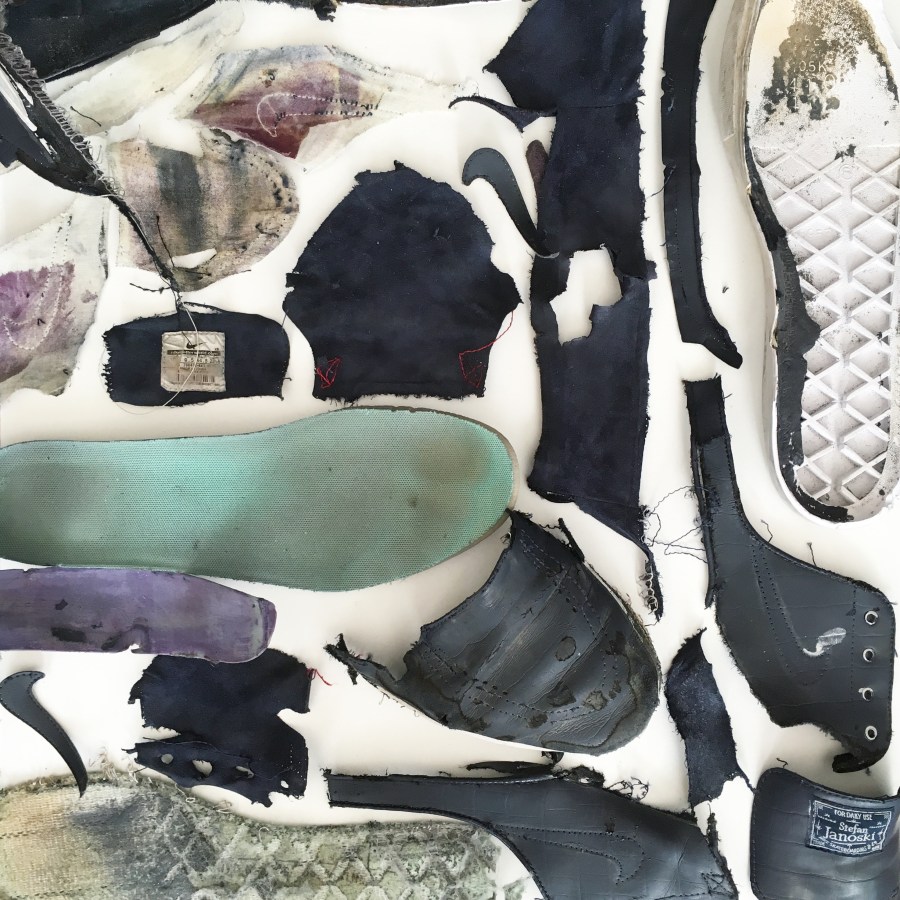
Poem in the Romantic Tradition by American Adult

By Katie Condon

Featured Art: Peach Bloom by Alice Pike Barney

Every morning, I want sex.
Historically, men only give it to me
at night, after we’ve spent the better part

of the evening in the safety of the neon-bruised
dark of an American Sports Bar
that serves eighty kinds of mayonnaise.

In the morning, when I want sex,
I look out at the garden alive despite the frost.
Only gardens have a language

for light that spreads itself across the lawn
like marigolds or molten gold, like footage
of a wildfire with the sound off.

I drive down the highway and am
surrounded by language so American:

Gilded Dildos! Real Gold!
High Fashion Sweatpants Sold Here!

I try to pray, but can’t.
This is my sickness.
I am an American Adult.

Does light have sex
or is light sex?

is something I’d like to learn
while I’m still aboveground.

I hate our American language.
We call our most holy ceremony:
fuck bone nookie cram it in your ass!

Meanwhile, in silence, on fallen logs
the lichen makes ecstatic love to itself,
not to dawn’s wide-eyed dew.

Once upon a time I wanted
to be a viaduct when I grew up
or a lawn, well-kept and wantless.

I know now what Wordsworth couldn’t:

with my mouth on a house-sized
plastic road-side peach I chant,
What I desire this world cannot provide.


Read More

Befuddled

By Kim Farrar

I don’t speak Cantonese
or Mandarin, and she spoke
little English, yet kindly
explained each scroll
adorning the stairwell:
This one happiness. This fortune.
This family. Then she paused,
slightly panicked, and rushed
to her register for a stashed index card.
The creases were soft as fur
from many foldings, and printed
there in all-caps was BEFUDDLED.

This one befuddled.
Our heads cocked in doubt.
Did she mean it befuddled her
or the scroll signified befuddlement?
How had that peculiar word
landed here? What seas had it crossed,
what deserts, to be inked on a card
in the palm of her hand
in Flushing, New York?
Perhaps she copied it
from a battered phrase book,
or when she asked a bilingual friend
he said, I’m befuddled,
and she had him spell it out.

The scroll had six prawns—
four paddling in one direction,
with two turning left—
maybe it meant befuddled after all,
but it easily could have been
knowledge or friendship or destiny
as we searched each other’s eyes
for understanding. Then, in the clarity
of our human need, I said: I’ll take it.


Read More