How Blank an Eye? Seeing and Overlooking Nature in Coleridge’s “Dejection: An Ode”

By Matthew VanWinkle

While contemplating an Italian sunset in 1822, Byron couldn’t resist getting in a dig at his friend Shelley’s affection for the previous generation’s poetry: “Where is the green your Laker talks such fustian about? . . . Who ever saw a green sky?”1 The Laker in question is Samuel Taylor Coleridge; the meteorological observation drawing Byron’s ire occurs in “Dejection: An Ode” (1817), Coleridge’s anguished exploration of a damaged response to the natural world and the implications of this damage for his poetic vocation. It’s tempting to attribute Byron’s objection to the zest he takes in stirring things up generally, or to his intermittently vehement distaste for the Lake School of Wordsworth, Coleridge, and Southey specifically. Yet Byron’s snarkiness on this point is far from idiosyncratic. Romantic era poetry frequently and famously evokes Nature with a capital N, but these evocations sometimes lead a reader to wonder if the devotion to the big picture comes at the expense of acute observation. More pointedly, the big picture seems less a landscape with a life of its own and more a portrait of the artist’s own ambitions. Nature is unmistakably present, even prominent, in romantic era poems, but what, or who, is it there for?

Coleridge’s ode presents a range of possible answers to this question. At the very least, the green sky in “Dejection” suggests a considerable degree of attention to the speaker’s surroundings. That sort of chromatic shift can occasionally precede especially severe weather, and the poem begins with the anticipation of an impending storm. Coleridge’s awareness of the phenomenon (perhaps rarer in his day than in an era wrenched by climate change) attests to the sustained cultivation of his local knowledge. On this occasion, however, his awareness leads neither to an appreciation of the celestial palette nor to a self-congratulation on the speaker’s eco-aesthetic refinement:

Read More

Reflections in Lake District Mist

By Alycia Pirmohamed

At an event I once attended titled “Landscape and Literary Culture,” Aimee Nezhukumatathil said something along the lines of, “The trees don’t ask you where you’re from.”

Lately, I’ve been asking myself why I rarely imagine my body, a brown woman’s body, moving through the natural world. It makes me wonder what I have internalized about ecology, about the borders between “natural” and “urban.” About access to green spaces and the bodies that are perceived as belonging within them.

It makes me wonder about what it means to “belong” at all. I think of the ocean I have crossed to arrive at my current home in the U.K. The ocean crossings of my ancestors who migrated under colonial rule. The great sea of separation, the great sea of coming together. All the distances my poetry has traveled, distances seen and unseen, and all the imaginations I have metaphorized to crack through the borders.

Read More

Poetry as a Lakeside Trailer Park

By Tina Mozelle Braziel

Featured Art: Silk Snapper Wild USA, $14.99/lb by Rachel Ann Hall

1.
Poetry is a trailer park on a lake that isn’t really a lake but a dammed river and not on the main channel but along a slough, a fraying edge of a body of water that draws some of us to buy a double-wide, rent a lot, build a pier, and dock a boat in the marina.

The dam “lets the water out” each winter, a phrase conjuring a bathtub whose pulled plug leaves a dirty trickle down the middle. This is a far cry from the face of the deep where light, sky, land, and creatures were spoken into being, yet even such a slough is mysterious, elemental, germinal.

2.
Because of Larry Levis, I think of poetry as a lakeside trailer park.

He says in “Some Notes on the Gazer Within” to “think of poems as . . . landscapes . . . refer to them by the virtue of their places.” I see the virtue of orienting each home and resident, human or mallard or frog or muskrat, toward water.

Read More

To Save a Life

Co-Winner of the Movable / New Ohio Review Writing Contest

by Kari Gunter-Seymour

Featured Art: Aperture, by John Schriner

We did what we could,
hid the bottles, drove what
was left of him deep
into the yawning hollow,
built a campfire, drank water
from a long-handled gourd,
a galvanized bucket.

We set up tents for triage,
counted his breaths, worried
over irregular heartbeats,
sweats, persistent vomiting,
his jacked up adrenal system.

We waited. Listened for a canvas
zipper in the night, each long slow
pull a call to duty, our legs folding
over duct taped camp stools,
tucked tight around the fire,
his gut-punch stories, stenched
in blood and munitions,
overpowering the woodsmoke’s
curling carbons.

Read More

Home Fires

By Anne Kenner

I didn’t want to live on Sonoma Mountain. I was busy in San Francisco, with my job and my children, our friends and activities. Cities had always been my preferred environment; I like the noise and jostling crowds. But Jim needed more room and fewer people, country vistas and wide-open spaces. He wanted privacy and verdure, bike paths and hiking trails. So I agreed to look for them with him, first in Carmel Valley and finally, one afternoon, by myself in Sonoma county.

The real estate agent selected a few houses that fit our careful budget, and pointed to the first on a map, three miles up Sonoma Mountain from the valley floor.

“That one,” I said, “is too remote.”

“Don’t worry,” she assured me, “we won’t stay long.”

Read More

Triage

By Lance Larsen

Featured Art: Fresh Air, by John Schriner

My job is to mow. My job is to coax the prairie
around my  mother-in-law’s house into green
chaos, then decapitate it on Friday till it looks
like carpet. My other job is to say dang
it’s hot and enter the kitchen and sip juice
and nuzzle my beloved at the stove when her
mother’s back is turned—an eighty-seven-year-old
back but still super quick. My beloved
has her own job—open and close the fridge,
push me away, and keep some things
cold like cucumbers and Gouda and yogurt,
and others hot like caramelized onions
and yesterday’s sweet and sour, and pretend
her mother’s Alzheimer’s is a shrine we’ll visit
someday like the Taj Mahal and not daily triage.
I still have other jobs, like having cancer cells
burned from my face at 3:00. Or is it 3:30?
I check my phone. Oh good, 3:30, more time
to decapitate the prairie and sip juice
and maybe swim slippery laps at the rec center.

Read More

Anthropologist of the Apocalypse

By Samantha Krause

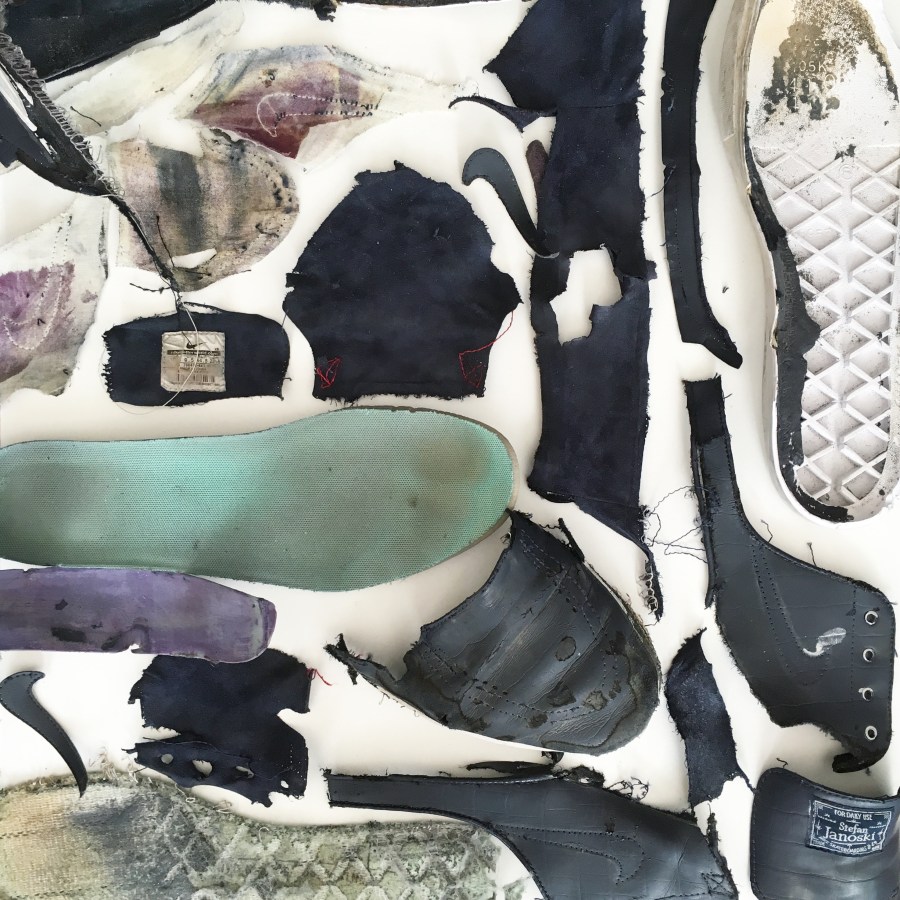
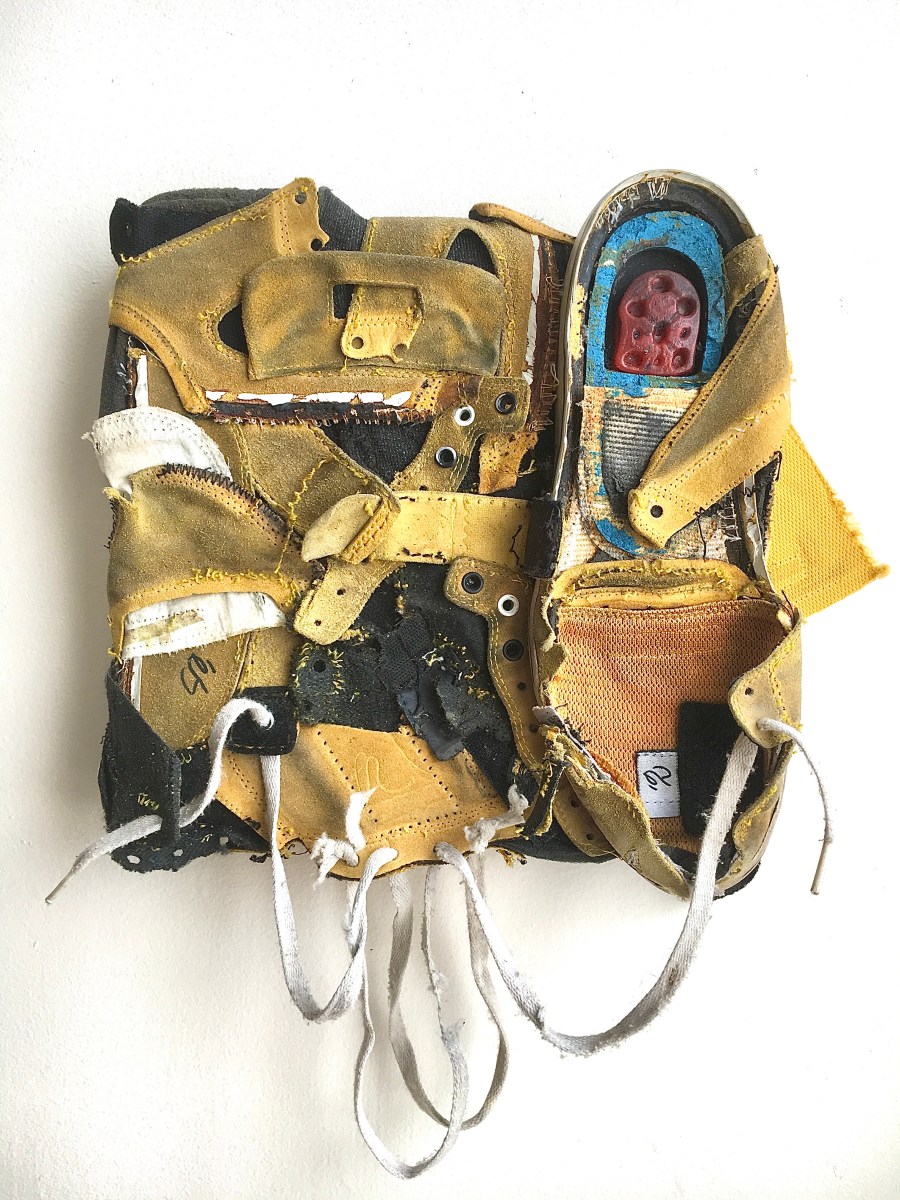
Featured Art: Janoski (Deconstructed), by John Schriner

Welcome to the museum of secondhand savings. The journey starts like this: when something is donated to The Thrift Store, the attendants at the store decide whether to sell it there or send it to my department to sell online. In each of the 13 stores in our district, there is a list of items that are always to be sent to us. We get all the jewelry, every musical instrument, any expensive-looking art, all video games, computers, clothes with tags over $75. All brand-name purses, every vinyl record, typewriters from certain years and countries. American Girl Dolls, vintage Barbies, Pokémon and Yu-Gi-Oh! and baseball cards. Stamp collections. Fur coats. LEGOs. Cameras, digital and film. It goes on.

Read More

The Natural World

by Chris Crockett

Featured Art: Cosmic Eye, by John Schriner

The moon rises
to the left of the kitchen sink.

I go outside to check on
the world’s artistry:

Moths and stars;
bats whose blind ping-pings

pinpoint insects,
accurate as an adding machine.

Horses are head down in the soup
of flooded grass fields;

All day long
they solve their hunger.

Everything partners and trades
nutrients. Billions

unseen in the black roots.
Inaudible hum.

My fingers keep time
to a barely comprehended

background beat.


Read More

Buried Fruit

by Robert Stothart

Featured Art: Generations, by John Schriner

I am re-begot
Of absence, darknesse…
Things which are not.
—John Donne

1

Now they’re standin’ in a rusty row all empty
And the L & N don’t stop here anymore.
—Johnny Cash

Winter’s first fuel came cheap, scrap wood, free for the taking, piled along the road next to the sawmill half a mile back toward town from my house. Lying in bed—borrowed mattress on a patched linoleum floor—I listened to wood fires pop and snap taking night chill off my two rooms. Light from the yellow flames pierced through slots in the iron stove’s iron door and danced in reflection across the inside of my front window.  

In September, Mother Annie told me to go get wood at the sawmill. I had no running water, only a well with a handpump and an outhouse at the place I rented. I had electricity and cooked on a hotplate. The potbellied stove stood cold in the center of my front room for two months. 

Read More

Partition

by Carolina Hotchandani

Featured Art: Fissure, by John Schriner


In your version of the story, people butter their fingers 

with notions of God, splitting India into a smaller India, 

a new Pakistan. The way a single roti’s dough 

is pulled apart, the new spheres, rolled in the palms, 

then flattened. The idea of God—the destroyer of human bonds, 

you will say in the diatribe I know well—the reason for new 

borders, new pain to sprout on either side of a dividing line. 

You’ll go on. I’ll picture the edges of your words blurring 

to a hum as I think of how to wrest your rant from you. 

A rolling pin barrels over dough, widens the soft disc, 

makes it fine. You are fragile. Like a story that stretches 

belief. Like a nation. Like a thin disc of dough that sticks 

to a surface, tearing when it’s peeled back. I don’t know 

how to part the story from the person and keep the person.


Read More

Culprit

By Carolina Hotchandani

Featured Art: Hello, Hello, by John Schriner

As you finish your morning cup of tea,
an identity thief rings.

You answer.

Sleep wraps loosely around your mind
like the flannel robe you’re still wearing.

It’s almost noon.

The television is on
but muted.

On the screen, Lieutenant Columbo’s mouth moves
as he pesters his prime suspect.
Soon, he’ll reveal how the murderer
murdered the murdered.

Ahhh, you say to the voice on the phone
that dubs over the episode’s denouement:

Tell me the story behind your name.
So you do.
Can you spell it for me?
So you enunciate:
M as in “money” — A — N as in “Nancy” — O — H . . .
till all the letters of your name go down
into the small holes of the phone.

You were born in India before Partition?
Those were hard times.

When the voice solicits your social security number,
you want to know why,
but the logic you’re offered makes sense:
there’s money to be claimed
by survivors of arduous times.

Columbo lights his cigar.
The murderer’s exposed, and the credits are rolling.

The end is not surprising; we’ve known it from the start.

We won’t learn who trafficked in your memories,
committing this crime.
You aren’t the best witness,
forgetful these days.
But you watch and rewatch your favorite TV sleuth
intuit the culprit, apprehend the truth.


Read More

12th and McGraw

By Hillary Behrman

Featured Art: Epidermis, by John Schriner

I moved fast always hoping to slip into the house and up to my room unnoticed. I made it to the first landing of the wide staircase before I heard the pop pop and grind and looked up. My little brother, Alex, was perched above me, kneeling on the long cushioned window seat. His chicken-wing shoulder blades stuck out on either side of his old fashioned undershirt. The afternoon light, filtered through the two-story stained glass window, hit his pale skin and formed a glowing checkerboard of red, yellow and green patches all across the back of his shorn head and bent neck. He gripped the plastic handle of a large Phillips-head screwdriver with both hands, pumping it like a tiny jackhammer straight out from his concave chest, shattering square after square of swirly rainbow glass. He must have been at it for a while, because by the time I reached him the first three rows of bread-slice sized panes were gone.

My brother was a watchful, wary sort of kid, circumspect in all his actions by the age of six in a way I still can’t manage in my thirties. I gave him a quick once over. I didn’t see any blood, so I left him to it. The snap crackle pop of each new shattered pane followed me up the stairs to the next landing and down the long hallway to my room. I wasn’t an idiot or monster. I was fourteen. I got it, Alex’s desire to expose that house to the elements, chip away at its candy colored Victorian shell.

I kept listening until the sounds of Alex’s demolition project stopped. The silence freaked me out way more than his vandalism. I don’t know why. I should have been thinking about broken glass and the paper-thin flesh on the undersides of his skinny wrists all along. But I wasn’t. He had seemed so preternaturally competent back then. I don’t know why I finally had the sense to sprint back down the hall. Alex was curled up on the window seat, his cheek pressed into bits of colored glass. I don’t know why there wasn’t more blood, why the cuts weren’t deeper. I scooped him up and carried him up the stairs.  He stayed limp and floppy until I reached the third floor, where he wrapped his legs tight around my waist.

Read More

Bumping Around

by Eileen Pettycrew

Featured Art: Vaider, by John Schriner

Then I saw a man sheltering from the rain
inside a concrete circle meant to be
a work of art. I didn’t want to think
he was homeless, just a commuter waiting
for the light rail. Forgive me,
I’ve seen trash spilling from hillsides,
tents popping up like mushrooms in the dark.
Mattresses, ripped tarps, lamps, rugs,
metal and plastic twisted into a pile
reaching the top of a broken-down RV.
Last week I saw a flag flying at half-staff
after another mass shooting,
and underneath the flag, an electronic billboard
that said Walk Away from Joint Pain.
Forgive me for thinking it was a signal
to drag my sorry body up and over the wind,
to rise like vapor, like water cycling
around the earth, sky to land and back again,
one big circle that never ends.
Let me feel a little love for everything.
The steaming pile of wood chips, the barren
stumps, the grove of trees still bearing
open wounds from February’s ice storm.
The days I shivered in a cold house,
bumping around in the dark with a flashlight,
hoping the batteries would last.


Read More

The Year After Jeff

By Andrew Polhamus

February

The evening after Jeff hangs himself my friends and I meet up at Stephen and Danny’s new house. We converge in a neighborhood of brick rowhouses and form a circle of denim in a tired living room. There are six or eight of us, not here to sit vigil, but for lack of better ideas and a nagging feeling that we shouldn’t be alone. We speak in the circular logic of boys, too old to be thinking this way by our mid-twenties, but too inexperienced to handle it any better.

“He could’ve called me,” says Kurt, who is taller and more handsome than the rest of us and was closer to Jeffthan anyone. I’m annoyed with myself for noticing how nicely Kurt’s good looks carry grief, turning him from a jock in a t-shirt emblazoned with the name of a hardcore band into something romantic and world-weary.

“He always used to call me,” Kurt says.

“He didn’t call you because he didn’t want to,” I say. “It wasn’t you.”

“It wasn’t that he didn’t want to,” Michael says. “He just didn’t.”

“We don’t know what he wanted.”

“Well, we know he made up his mind.”

“I think we have bed bugs,” Danny says, his heavy Italian brows furrowing. The conversation drifts to pest control for a while.

Read More

Dear Austin,

By Brian Builta

A year after your death we keep receiving college brochures
telling you how nicely you’d fit at certain institutions, under a
pine I guess, or next to a Doric column. The earth would bear
you up. In youth group one of the leaders reads about Jesus
raising Lazarus from death. Lazarus’ sister says to Jesus, If you
had been here, my brother would not have died. Your sister leans over,
says Same. She may be pissed for some time. Sometimes we
think of you as Judas, hanging there, unused coins scattered at
your feet. For a minute it helped to think that God also lost
His son, but then, you know, the resurrection. I’ve been
assured by Fr. Larry Richards you are not in hell. Something
about full consent of the will. The way you made your grandma
heave, though, I’m not so sure. Still, I said a few hundred
thousand Divine Mercy Chaplets for you, so by now you
should be on some beach in Costa Rica blowing through a
palm toward a new day, rising.


Read More

If

By Marie-Claire Bancquart
Translated from French by Claire Eder and Marie Moulin-Salles

We had a ribbon of words to say
like the machines with their coffers of signs
prêt-à-porter.

We would have finished going over them.

Returned to the first ones
we would pronounce them with our renewed body.

Dead horses climb back up the trails.

Silence.

They would carry us finally toward
            our solemn communion with objects.


Featured Art: Eldridge, by John Schriner

Read More

Evergreen Oak

By Marie-Claire Bancquart
Translated from French by Claire Eder and Marie Moulin-Salles

Standing before these thick trunks that sow our wrinkles
in windbreak

standing before these leaves that persist
in the fuzzy gray-green of a caterpillar
complementary to our bloods

I uprise a contradictory forest

A tree
where the cool flow of water would saturate the sap
with a transience that we would find habitable.

I invent a species:
the short-lived live oak
so pleasing to say, it must exist somewhere.

Read More

Margins

By Marie-Claire Bancquart
Translated from French by Claire Eder and Marie Moulin-Salles

Eating the apple
I eat enigma
and I glimpse us in the mirror the apple and me
inaccurate and profound.

Something trembles inside us with mouths
of saps and metals.

Long trees
go out from us toward the suburbs of the horizon.

Is it us
at the center?

Or the center of the drift?


Featured Art: Reflection, by John Schriner

Read More

Mass

By Jeff Tigchelaar


1. Jana, in for a mammogram 

So they give you these special shirts: 
easy-open fronts. 
Post procedure they herd you 
into this room where others in the same boat 
and shirt
must sit 
and wait. 
I walk in say Oh how embarrassing 
we’re all wearing the same top
to no response. The TV’s tuned 
to daytime talk, nobody watching. I offer 
to change the channel or turn it off. 
No takers. A few seconds later: “Up next! 
How one woman got the news that would 
change her life forever: ‘I found out 
I had breast cancer!’” Then someone 
says Yeah no we’re shutting that off
and gets up and does the deed. 
A minute later this same woman gets 
her results. And they were 
good. Very good. 
They were perfect.
And she jumped, whooped, pumped her fists 
said Praise Sweet Jesus and her boobs 
popped right out of that special shirt 

Read More

When she calls me and confirms it it’s

By Jeff Tigchelaar

not a shock but still
we’d had that three percent
chance that it wasn’t
still I leave work
run home and hug her
before we tell the kids
before we decide to just
get in the minivan
and go see LEGO Batman
in the theater downtown
where we laugh as much as
or more than the kids
one review called it
relentlessly frantically
funny and it is
LEGO Batman’s got a 9-pack of abs
Jana’s got her phone on her lap
when it lights up she sneaks off and takes the call


To the Israeli Soldier—

By Emily Franklin

Featured Art: Sur La Plage, by John Schriner

I believe it’s possible to know someone’s name and have them be a stranger. I know you are Ihran, but in this world of being able to locate anyone (elementary school bully, heartbreaker, former colleague), I cannot find you. There’s the cruelty of having you Un-Googleable and also the relief of you receding in the rearview mirror of my past.

France. Summer, 1988. I’m an American studying in Villefranche-sur-Mer; a teenager unmoored, supposedly learning to be more fluent in French, but really gathering intel—where to buy oversized icy beer down the hill in the dark, a shack where the old French men gather in stained overalls and barely register me—seventeen and desperate to keep from being fully seen. I tuck my face behind a swathe of blonde hair and order beers—ten francs each—for me and the friends I’ve made. Anandi is Canadian-Indian, Caroline is Korean-American, Everly is from the American South with the drawl to prove it.  I’m just blue-eyed and blonde, a master at sourcing beer or soft cheese or finding the hidden beach where we wind up the following day.

Read More

Lonely, Lucky, Brave

By Jillian Jackson

When I hit on the scratch ticket I was at Castle Island with Hannah. We used to go there every Friday. After Hannah finished walking dogs and I finished up my shift at the café, we liked to pack a lunch and watch the planes flying into Logan airport. We always ate turkey sandwiches that I stole from the café and drank wine out of cans. We finished a family-sized bag of salt and vinegar chips.

That afternoon Hannah was wearing my favorite cardigan, a Good Will find, pink and covered in sparkles. She had on pink lipstick that had smudged a little bit on her bottom lip. We were watching the planes, our bare feet in the cold sand. It was April and we were glad we could sit there without our jackets on, even though we were a little cold when the wind picked up.  

“It’s time,” Hannah said. She reached into her bag and dug out the tickets. She dealt them like cards at a poker match, back and forth, one and one. All ten.                     

Read More

Ice Cream

Co-winner of the Movable / New Ohio Review Writing Contest

By Kandi Workman

Featured Art: He’s Got the Works, by John Schriner

“Absolutely unmixed attention is prayer.” – Simone Weil

1
“Drop ’em dead like a dealer.”

“What’s that mean?” I asked.

He turned his slim face away from me, looked toward the muddy Elk River flowing with ease, shifted himself around on the cement ledge, kicking his dangling legs back and forth, bouncing rubber heels off the wall. We’d been sitting there for a while, talking, enjoying the late afternoon in early Spring. In the low light from the sun, the black-lined ice cream cone tattoo on the right side of his face, high on his cheek bone, just under his eye, stood out. I sometimes forget it’s there. 

“Drop ‘em dead. That’s when your sales go up. It’s really fucked up. Addicts find out your shit killed somebody, they want your stuff. That’s just how it works.”

Read More

What We Did at the End of the World

By Sunni Brown Wilkinson

We played charades to words we’d forgotten. We made a fire of them with our hands.
We wrote songs on the piano, gave them names like “Fox and Mouse” and “Lightning Chase.”
We watched our parakeets dance in front of their tiny yellow-framed mirror.
We watched them sleep, three on a perch, with their quick beaks tucked in.
We made bread. The top cracked open and we peeled it back and spread butter on
and ate it. We didn’t wear shoes. We wrapped ourselves in scarves.
We opened birthday cards to listen to the music hiding
behind the plastic button. We opened and closed, opened and closed until the songs grew tinny.
We gathered snail shells from the garden. 47. We saw one naked at the base of the daisies.
We made music with ice and water and glasses. We hummed under the covers at night.
We waved tree branches like arms. We waved at the stars. We waved at our silent neighbors.
We taped song lyrics to doors. We swept the fuzz from the rugs
into piles of gray hair. We lifted them carefully when they huddled together like a nest.
We listened at the door of an uncracked egg.
We watched the quail scurry across the street, that one feather on their heads quivering
in the wind like the feathers of great ladies in the movies we watched at night.
We dreamed of the sea untangling its wide blue braids.
We opened our mouths in the morning and salt leaked out.
We called each other dear and laughed at words like rudbeckia. We planted
rudbeckia. We danced like it. We wore yellow too.
Just before we flew away, we were mirrors. That deep. That true.


Read More

A Mind at Home With Itself

By Marcia LeBeau

My brain is always complaining as it crawls toward
                  El Dorado, eyes upturned waiting for a lightning storm 
to stun it speechless. But the sky never claps

open and there is no silence. Its knees bleeding,
                  mouth running, my brain doesn’t hear the alarm go off
in the morning, forgets to cancel its gym membership

even though it stopped going years ago. I have no choice
                  but to ignore my brain. Walk to the other side
of the street when I see it. Stop answering its whiny

voicemails. I have a vision during a massage of my brain
                  glistening like raw hamburger meat on the pavement
below a flashing motel sign. The meat turns

to blue glitter slime the neighborhood kids
                  sell for fifty cents a bag that smells like cotton candy.
I steal a bag because it’s my brain, after all, and toss it

on the kitchen counter. My brain is petrified I’m going
                  to throw it away and begs for mercy. I pick it up, 
slap it on the table, pound it, then ooze it between

my fingers. It feels smooth and cold and reassuring. I knead it 
                  a little longer before I throw it in the trash. My hands
are stained blue, glitter flecks my clothes, but finally, silence.


Read More

A Covered Dish

By Katie Condon

Instead of attending
The End of Semester Holiday Potluck,
where Kimberly will hold forth
about the unmatched dexterity
of her cat and Jim will call together
his congregation by the hors d’oeuvres
to virtue signal about virtue signaling,
I will stay at home and bleach my mustache
and drink a dirty gin martini and read
the scene in The Corrections where Chip
throws cocktail parties for the academic elite
and I will laugh at them as Franzen intended
and you will laugh at me for reading Franzen
because no one is supposed to like Franzen
except in secret and to bring up Franzen
in conversation would be social suicide
at The End of Semester Holiday Potluck
where now, I presume, Kevin is misquoting
Nietzsche to talk about his sex life and Camille,
who up until this point has said nothing,
says nothing still, raising an eyebrow
with indecipherable anger because Kevin
is just another self-absorbed academic
who got his degrees thanks to grade inflation
in the early 2000s and has made a career
out of complaints and well-timed jokes,
which is more than I can say for myself
whose career is made merely of words
strung together in a clever order, saying
nothing much other than I am happy
I am not at The End of Semester Holiday Potluck
but that if I were I would find a way
to kidnap the cat, poor thing, quarantined
in the bedroom, forced to listen to the muffled
noise of a whole people who forgot about
the night outside, its utter size.


Read More

Poem in the Romantic Tradition by American Adult

By Katie Condon

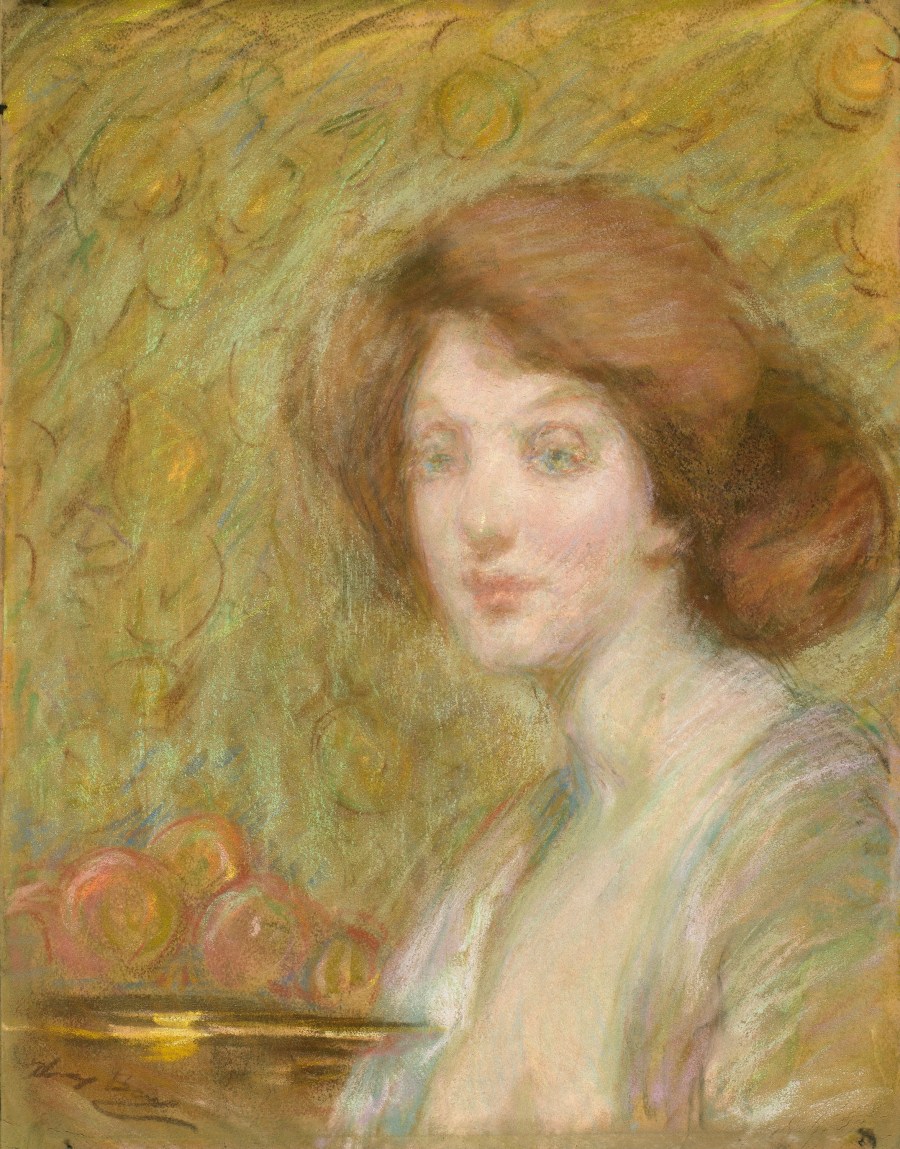
Featured Art: Peach Bloom by Alice Pike Barney

Every morning, I want sex.
Historically, men only give it to me
at night, after we’ve spent the better part

of the evening in the safety of the neon-bruised
dark of an American Sports Bar
that serves eighty kinds of mayonnaise.

In the morning, when I want sex,
I look out at the garden alive despite the frost.
Only gardens have a language

for light that spreads itself across the lawn
like marigolds or molten gold, like footage
of a wildfire with the sound off.

I drive down the highway and am
surrounded by language so American:

Gilded Dildos! Real Gold!
High Fashion Sweatpants Sold Here!

I try to pray, but can’t.
This is my sickness.
I am an American Adult.

Does light have sex
or is light sex?

is something I’d like to learn
while I’m still aboveground.

I hate our American language.
We call our most holy ceremony:
fuck bone nookie cram it in your ass!

Meanwhile, in silence, on fallen logs
the lichen makes ecstatic love to itself,
not to dawn’s wide-eyed dew.

Once upon a time I wanted
to be a viaduct when I grew up
or a lawn, well-kept and wantless.

I know now what Wordsworth couldn’t:

with my mouth on a house-sized
plastic road-side peach I chant,
What I desire this world cannot provide.


Read More

Befuddled

By Kim Farrar

I don’t speak Cantonese
or Mandarin, and she spoke
little English, yet kindly
explained each scroll
adorning the stairwell:
This one happiness. This fortune.
This family. Then she paused,
slightly panicked, and rushed
to her register for a stashed index card.
The creases were soft as fur
from many foldings, and printed
there in all-caps was BEFUDDLED.

This one befuddled.
Our heads cocked in doubt.
Did she mean it befuddled her
or the scroll signified befuddlement?
How had that peculiar word
landed here? What seas had it crossed,
what deserts, to be inked on a card
in the palm of her hand
in Flushing, New York?
Perhaps she copied it
from a battered phrase book,
or when she asked a bilingual friend
he said, I’m befuddled,
and she had him spell it out.

The scroll had six prawns—
four paddling in one direction,
with two turning left—
maybe it meant befuddled after all,
but it easily could have been
knowledge or friendship or destiny
as we searched each other’s eyes
for understanding. Then, in the clarity
of our human need, I said: I’ll take it.


Read More

The Classical Archaeology of My Skeleton

By Michael Derrick Hudson

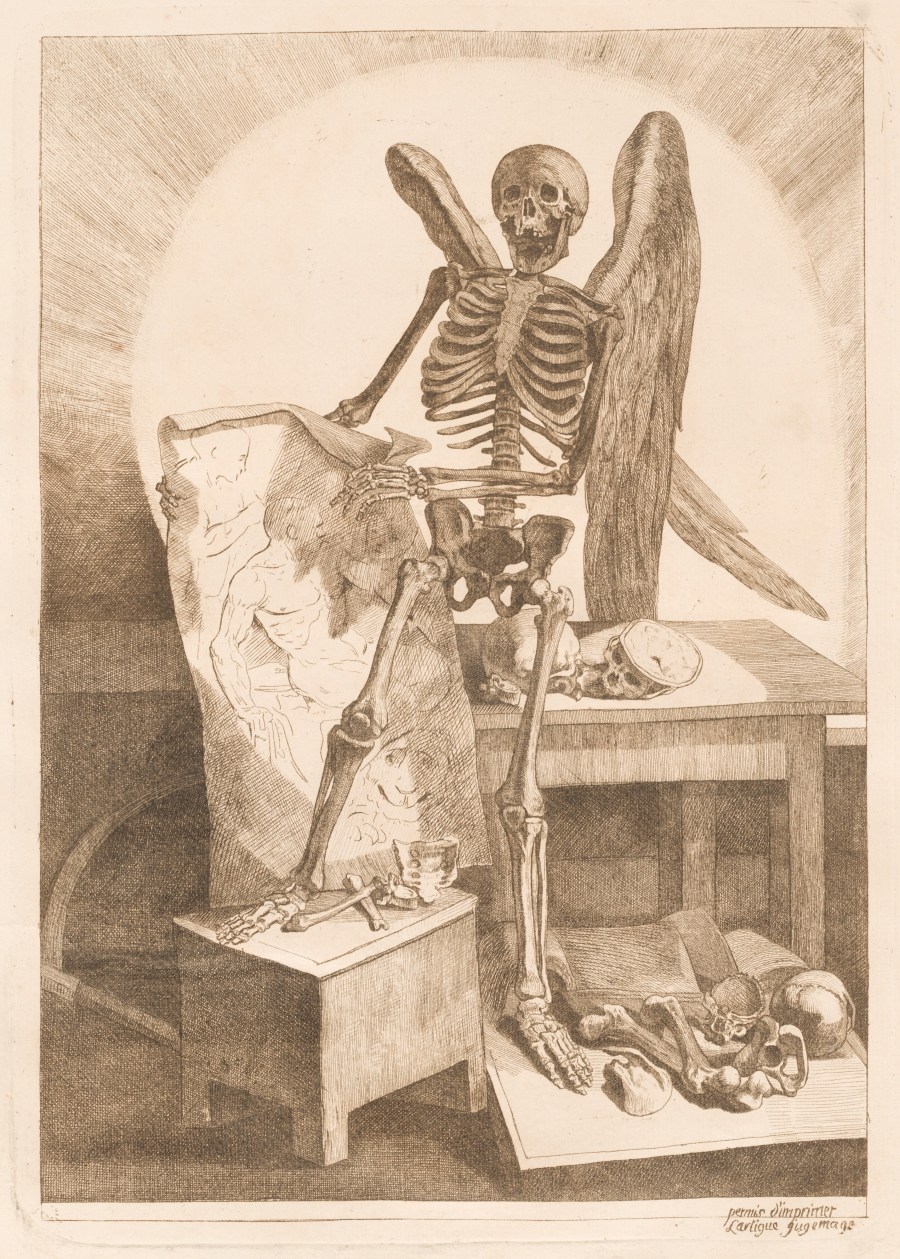
Featured Art: A Winged Skeleton Holding an Anatomical Drawing, 1779 by James Gamelin

You’ll trip over it whenever you stroll the Forum, teeth
and spalled vertebrae, my phalanges

used as pavers, liony yellow and crumbling in situ . . .

It’s so sad, this reduction to time’s kibble. Junked and
recycled, my gravel’s been scattered

citywide: wrists left to the lime-burners, molars sold
for scrap. My jawbone’s a goat corral

up to the hinges in fodder and filth. Of my ribcage
only a few splinters remain, still stuck

to the leathery black rind of Caesar’s heart. Tourists
shuffle through my pelvis, a grotto famed

for the cat-piss stench of centaurs, their pornographic

graffiti and the tarry stalagmites
of wine-dark scat. How their flinty hooves clattered

over the mosaics those nights when they’d gallop off

in pursuit of the virgins. Ah, the virgins! How easily they’d
slip our grasp, gathering up

lingerie and toothbrushes, blowing us kisses goodbye . . .

Scholars took years to identify my skull, the brainpan
fouled with mouse droppings, owl pellets

and busted amphorae, spooky winds shush-shushing

through the cracked dome. O lost luxury! Splendid baths
featuring salons, outrageous

cuisine and twenty-four-hour boutiques. Every niche

its own nude, every spigot its own flavor. Caesar whet
once his exquisite appetites here, a depilated tyrant

up to the jowls in his own broth. So much stale purpose, so
many dead language protocols. The tedium

of yesses and wants. So many same things over and over.


Read More

On Finding Out My Genome Includes About Three Percent Neanderthal DNA

By Michael Derrick Hudson

It explains a lot. The unappeasable nostalgia at sundown. Those oof-oofs
when first I wake up. Or that faraway doggy look

I get when gazing at full moons. Every doggy thing, in fact,
about these eyes: heterochromia, astigmatism, and a remarkable capacity

for registering disappointment. Furry knuckles. Weak chin. A receding
brow too shaggy for such latitudes. A touch of depression and

my susceptibility to tragicomedy. Clownishly splayed
size twelves. Occipital bun. Knock-knees. Gracile shinbones (but robust

pelvic girdle). Hypercoagulation. My adhesive, prehensile lips puckering

around a single grape. A craving to know my whereabouts. A real talent
for sniffing out thunderstorms. How easy it is for me

to spook. My susceptibility to hoaxes, too-good-to-be-true scenarios, and

going-out-of-business sales. Grooveless canines. Skin tags. My tripwire
gag reflex. The prelapsarian nightmares. My prototype

conscience. My poor handwriting. A dread of abstractions. The flowers

I’ve sent to corpses. My shambling gait. Flight always
before fight. My shrugs. A limp handshake. My prophylactic revulsions.


Read More

Sonnet with Acne and Hawk

By Robert Thomas

Wadsworth: the homeliest boy in homeroom.
My acne looked like the gentle foothills
of the Sierra next to his Rockies.
Kenneth, but kids (not me) called him the Wad.
Our class went on a field trip to the snow,
and I, the most romantic of the bunch,
wandered up the frozen river, giddy
screams of rowdy carousers soon eclipsed
by the softer scream of a distant hawk.
Ken came around a bend in the river,
hand in hand with Kate Dunn, her shirt open,
her breasts brazen in the pine-scented air.
No one spoke, but they had no fear, while I
was suddenly afraid of everything.


Read More

Bad News, Baby, Good News, Dog.

By Britt McGillivray

this morning a meme queen reminds me we are living
                 in a hot catastrophe. i’d been dreaming

about an island lover a small puddle away,
                 then woken by propane tanks exploding fire

in next-door’s tent city. where i live, we were in crisis long before
                 this. indoors i receive 2D dispatches, pull myself through

the endless scroll: bad news, baby, good news, dog.
                 slow-build cries of freedom from the vaccinated crowd. a pomegranate,

split just so in a drippy palm. where i live, we’ve been eyes cast up
                 and chins tucked down. masked indifference to ‘save’ our ‘souls’.

this morning a meme queen reminds me: when the world ends
                 grab for whoever makes you happy. they took the quote from O’Hara

in times of crisis, yada yada. i de-seed a pulsing pomegranate.
                 what do you call an unending interruption? limbo,

bardo; a sad sabbatical, turned normal. i double-tap a crisis, offer an orange
                 heart to a public miscarriage, twenty more dollars to mutual aid.

look! more pals engaged, island lover blinking, hot sun hitting
                 face. more touch, deferred. i thumb a gender bomb i don’t believe in,

identity derailed by blast of parental well-meaning. my face burns pink.
                 my veins throb blue. i had decided who i love, this juice

drips from knee to tile floor, again and again, more stains to clean
                 i tried, meme queen, my decision just didn’t want me. bad news, baby.

where i live, we learn to look away. i close my eyes, see speckled
                 skin, a welcome face. pulp slipping through a ripe, plump

laugh. i backtrack through rupture, thick and brutal. then, somehow,
                 passed. a fruit plate, some apple stars. the future

halved, in separate palms. bleeding out. split, just so.
                 a meme queen reminds me: we still live in a hot catastrophe.

yes, but we’ve been dreaming
                 a way out


Read More

Doppel

By Max Bell

Selected as winner of the 2021 Fiction Contest by Anthony Marra

Featured Art: King Lake, California by Albert Bierstadt 

I hear every word. I know exactly where I am. Dr. Shelley, sitting across from me in her white lab coat in her air-conditioned Westwood office, has told me that I have cancer. The pain in my chest does not signal the cancer’s home but its most recent lodging. Each scan and test reveals that it is too late for any combination of surgery and chemotherapy. I should not have ignored the signs. I delayed it all for too long.

Dr. Shelley pauses after delivering the news, searching my face to deduce how soon she can relay more information, how quickly she should speak, how she should modulate her voice. No speed or timbre seems apt. I do not worry about how she will sound after the silence. Taking offense at anything in this moment, or in any other, suddenly seems a waste of valuable time.

Why have the movies lied when depicting the cancer revelation scene? The world does not dissolve into a warm haze. Everything is clear, sharper than before. It’s as though I am someone with astigmatism who’s found the perfect corrective lenses. The sun strikes through the glass of the office’s wall-to-wall window, accentuating the details of each object in the room. The ridges of the lone paper clip on Dr. Shelley’s desk are as clear as the dotted brushstrokes of the purple-red sunset that casts a shadow over the sand in the reproduction of Lemmen’s Beach at Heist, which hangs in a dark brown frame next to her college degrees. I can read the spines of the books on Dr. Shelley’s shelves, the letters on each embossed in muted gold on leather that looks like tanned human skin.

Read More

Deep Nostalgia

By Peter O’Donovan

“Deep Nostalgia™ is the magical MyHeritage feature
that allows you to see the people in old family photos
blink, move their heads, and smile . . . The 10 additional
drivers released today allow you to see your ancestors
express a wider spectrum of gestures and motions,
for example, smile wholeheartedly, blow a kiss,
nod approval, and more.”
—MyHeritage.com

Hard not to fall deep into the fancy,
drawn into the scene as the face unstills,
blinks a bit, looks around at its surroundings,
then smiles vaguely as though just awakened
while decades melt away by our devotion
to those sacred photos, those icons of Them
revived to succor, to help us through.

But then, the illusion slips for a second:
lips open slightly too wide, reveal
dark & indiscreet blight underneath
with the miracle’s seams now visible,
skin jittering under electric current,
dead pixels stitched on an actor’s grin,
a magician’s trick, a carcass shuddering.

Perhaps They wonder where they are now,
trapped in this mannequin afterlife,
looping continually, dimly confused
at these orders received, contorted
to kiss and wink at our demand, to dance
for our nostalgia, to nod with praise
never offered, held greedily in the grave.

And so, They shall be remade to our need,
artifacts of longing shaped to be shared,
for remorse performed by social media,
by tweets and with tears for all of our followers,
as we watch their faces, again and again,
their characters molded as we reclaim
our heritage of old, our cold construction.


Read More

Scene of the Crime

By Peter O’Donovan

A worker appears just before your soirée,
a giant covered in mud and sweat-smell,
who placidly asks where you want the grave.
He won’t be turned away. He’s already been paid
over the phone by some mysterious figure.
You send him off to dig behind the willows
before the guests flit in and admire
your poorly secured rifle collection,
your recently sharpened knives,
your closets filled with elaborate disguises
and family secrets, barely concealed.

The guests mill about the salmon croquettes,
pass oblique glances and disrobe
between drinks, casually,
as though clothes were merely an interlude,
a short break for the flesh to rest itself,
while the waitstaff look on bored, stoic even.
Without your phone’s constant judgment, you breathe
relieved, you loosen up and criticize
the new regime, welfare recipients,
and your second-to-last lover, left for dead
and still a nag about it, won’t let it go.

The night winds on. Some disappearances.
A minor Party member makes a speech
on the need for greater transparency.
You dance to the old songs, those teenage dreams,
then fire a young waiter, capriciously.

The police arrive, but are easily bribed
with nothings, false promises of promotion.
The worker returns, smelling still stronger.
You refuse to leave, but are dragged out, pleading.
The guests applaud politely.


Read More

The Cabbage

By Peter O’Donovan

after Jadeite Cabbage with Insects,
National Palace Museum, Taipei

Stumbling from the Qing exhibit
beauty-drunk on shape and glazes,
those flowing cerulean blues,
I heard a massing up the stairs,
a faint concentration calling
this pack of grannies rushing past,
with little charges almost electric,
an upward flood flowing to a plain
of people, pressing tour groups
enveloping some thing scarcely
visible, some dim verdant smudge.

I waded in, past the stragglers,
the dawdlers, the bored-slow slackers,
past the PRC operatives
skillfully disguised as sightseers
or weeping children, past the pious,
the museum completionists,
past them all, to the front, the fore:
a bok choy cabbage, barely there,
about the size of disappointment.

Mostly stem, a pale translucence
etched with veins, gentle threads curving
up discolored jade, blotchy, cracked
but weaving its flaws into form,
into ruffled leaves of sea-green,
broad blades glistening in half-light
with two grasshoppers in hiding,
revealing themselves by angles,
the slant of a leg not quite part
of that smooth verdure, that soft sway
of the foliage folding down
beneath the insects’ careful weight.

And then, I sensed it. A movement
in the stems. The faintest flicker
in the leaves, and beneath, the eye
of the locust beginning to glide
with all the swiftness of stone, taking in
this crowded, quickened place,
this tempest-blur of a time,
this maelstrom age,
this brief, sudden day.


Read More

The Last Day of America

By Benjamin Grimes

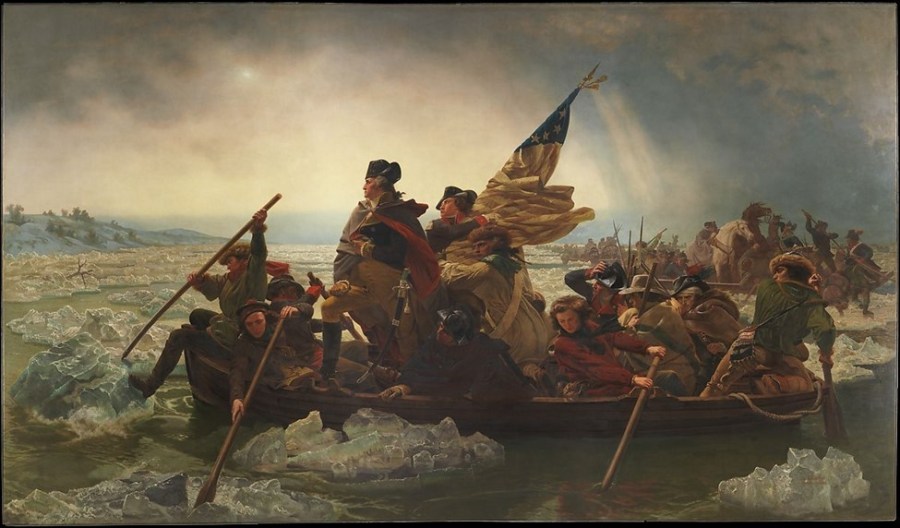
Featured Art: Washington Crossing the Delaware by Emanuel Leutze

I wake up on the last day of America.
There are sirens but a long way off:
I cannot tell if America’s last ambulance
is on its way or has already packed
the last emergency of America into its hull.
In the yard I stand inside American sunlight.
On tiptoe I creep through American grass, I climb
the fence to see what the American sky is doing.
It is making the last cloud, a cloud the shape
of America but not the shape of America
from a map. It is the shape of America as a child
concentrating tight around a crayon might draw America
in the last American kindergarten class. I want
to take a picture to remember the shape, the cloud,
the last day of America but buzz buzz buzz: here comes
the last American phone call. It is an American robot,
calling to let me in on all the Last Day of America
Big Box Giveaways. I agree to the last follow-up
email survey of America to show my appreciation
for the robot’s wherewithal & tact. I click 10 & 10 & 9
& hope it adds up to a raise when the robot’s hauled in
for the last American performance review. Of the last
humiliations of America even robots will not be spared.
For breakfast I toast the last American Pop-Tart
& head out for the last American errands.
There are many like me, wandering the aisles
as the last ghosts of America, unsure what it is
we’re haunting. There are many like me, eager
for one last peek behind the American screen.
I bring home the last shovel of America
& set to digging the last American hole.
I make a list of my ideas, the last ideas of America,
& bury it as deep as I can dig.


Read More

Despots

By Peter Maeck

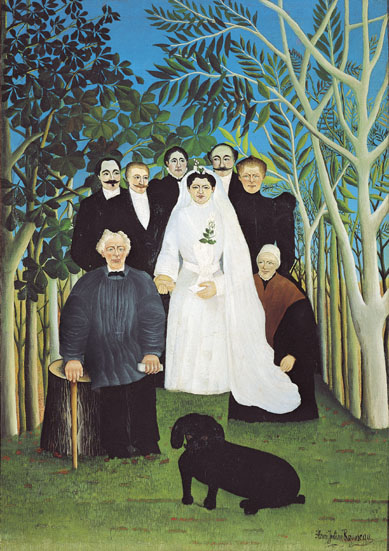
Featured Art: The Wedding Party by Henri Rousseau

It was doggerel, the sappy little poem
or, more aptly put, the limerick
which we’d dashed off in seven
seconds flat: our way of saying—thanks?
Yes, thanks, why not, for all they do for us.
Without them we could not, we let them think, exist.
Reciting such godawful we won’t even call it
verse brought up the bile into our throat but they
like little half-wit schoolkids being read some
nursery rhyme from Mother Goose sat glassy-
eyed, their elbows on the banquet table,
rapt.

Our betrothed and we repaired to
separate rooms that night, tradition
dictates that, and next day bright and early
we were standing face-to-face, you now
may kiss the Holy Book, I do, I do,
and all of that. Out there they sat,
some with, some without hats,
all haunch-to-haunch and sheening
in the monstrous August heat;
some had passed out.

Most heads of state like us will fly
to islands for their wedding night but
we did not, we like to show the common
touch, we took the bridal suite atop the down-
town Marriott. Below our window
they all stood unmindful of the storm
and soot, their lonely eyes imploring
us to step out with our champagne
flutes, post-coital cigarettes between our
milky lips. We did not, and indeed wished
not to disappoint.

Read More

Black Site

By Peter Maeck

Featured Art: The Yellow Books by Vincent Van Gogh

The guards awakened us, we’d barely
gone to sleep, they strip-searched first
the women then the rest of us (trim off the
limp, discolored outer leaves of late-picked
artichokes) but Frank refused to shed his
boxer shorts, not smart, he paid the price
for his recalcitrance.

WHAT HAVE YOU DONE TONIGHT?
WHO HAVE YOU SEEN?
WHERE DID YOU MEET?
WHAT DID YOU TALK ABOUT?

We shrugged, stayed mute.
(The artichoke grows wild in
shallow water, in canoes is
how you harvest it, our good friend
Nancy Sheffer says to trim the stalk,
cut off the limp, discolored outer
such and such.)

IF YOU NAME NAMES
THEN YOU ARE FREE TO GO.

By our silence we said no,
we won’t give up our friends,
that’s not what good friends do.
Then as expected we were hit with
pipes, my kneecap shattered with
one blow. Just think, I thought,
if I just shouted:

Nancy Sheffer!
She’s the one we met!
Here is what we talked about!
then all the blows would stop
and we would be released.
(The way to teach your cockatiel to
play with toys is play with them
yourself thereby to show your
feathered friend the way to
merry-make.) But we were
beaten every hour all that night
and all the rest of that whole week.
(A cockatiel needs time to feel at home
in human space just as, if we were birds,
we likewise would.) Now badly beaten Frank
is in a catatonic state. We do not dare to make
the sound that we would make
if we were fools enough
to weep.

(You want a good read pick up
Nancy Sheffer’s book about the
artichokes of New York State.) Frank
sprawls there on his back and looks
just like a cat run over by a Mack
truck. (Once a bird’s chicks fledge
they’re all pushed out and some
fly free and some are mauled by
catatonic cats in heat all howling
all the night. Trim off the outer part,
it’s blackened now and much too limp
to eat with pipes our best friend Nancy
Sheffer noted in her pioneering book.)

WHAT HAVE YOU DONE?
WHO HAVE YOU SEEN?
WHAT WAS THE SUBJECT OF YOUR CHAT?

We play dumb: What chat?
And then the pipes, the pipes,
she wrote.


Read More

Adrift

By Peter Maeck

The year we were a State Farm agent
we would rather now forget.
We hated scaring folks: Imagine that
your house incinerates or God forbid
you’re stricken with a fatal this or that
(it could be symptomless) or there’s
a workplace accident, you’re dis-
membered then what happens to
your spouse and kids? They’re up
the so-called creek.
Adrift, we turned to animal husbandry but we wept
to slaughter pigs; we planted beets but with the drought
we just gave up the naïve hope of ever making
gentleman farming work. We entered politics
sometime after that, ran for a City Council seat,
lost in a rout. We drowned ourself in drink.
Our spouse absconded with Meg and Mike
the twins and sued us for divorce.
Depressed, to say the least, we drove
out on a ferry boat, the one that goes from
Boxport out to Riley’s Point. We gunned it, shot
straight out the other end, right through the safety
chain, think Thelma and Louise. Our canyon, though,
was harbor water, sludgy, twelve feet deep. We didn’t die,
they pulled us out. The Camry was a total loss,
of course, the motor’s scrap once salt gets in it.
Stupid the attempt to drown ourself
in shallow water, better odds
out farther in the rip.
The blues run there, we caught one
at the age of six, in our father’s
Boston Whaler, never had a
better day than that one since.
One day a life can make.


Read More

A View of the World

By Linda K. Sienkiewicz

Featured Art: Woman at a Window by Casper David Friedrich

I believed I could communicate
with the female mink on my great uncle’s farm
until I put my thumb up to the cage
and she sliced the tip as keenly as a razor.

I believed Pippi Longstocking
could save the world.

I believed I could save myself
from the men my mother warned me about
the ones who might come up through the woods
from the far road by feeding them mud
cakes made with millipedes and spiders.

I believed I could live alone in a boxcar
with a can opener and blanket
and care for six orphans, too.

I believed my father actually would
flush my brother’s head down the toilet.

I believed if I walked three times fast
past the long picture window
my parents would not crash the car
on the way home from Talko and die.

I believed I was exotic when I danced with
two washrag triangles over my flat chest.

I believed germs followed me home
on my shoes when I used public bathrooms.

I believed even after I lied to my mother
about what I showed the boys behind the fir trees
that my heart was made of gold.

I believed my brother when he told me
we have one big eye in our head with two dots
from which we view the world.


Read More

Snapchat at the Magical Arctic Puffin Exhibit

By Shelly Stewart Cato

Maybe he has magic to keep himself
                  alive forever, says my little boy,

palms parallel to the floor,
                  elbows pulled in like a chubby T-Rex.

He grins and flaps and smoochy-lips
                  himself in the aqua glass.

A murder of teenagers captures it all.


Read More

The Dog Run

By Anne Cooperstone

The old adage that dogs look like their owners was not true at our dog run. The one of us with blond hair and collagen-plumped lips had a German shepherd. Another of us was a Persian Jew with a golden retriever. We were bulky with skinny vizslas, hard-looking punks with long-haired dachshunds. One of us was a young man with perfectly drawn eyebrows whose poodle had drawn stares ever since the day it played keep-away with a dead bird. Some of us were thirty-somethings clad in workout wear who paced the perimeter of the park, throwing tennis balls with plastic contraptions so we did not have to touch the slobbery felt. We had French bulldogs, five of them in matching harnesses. We had a corgi named Joy who was known to snap at dogs twice her size.

We did not raise our dogs in our own image. If we had wanted carbon copies, we would have had more kids. But we had dogs.

We were intimate strangers, united only by place and time. We heard everything. There were no secrets among us. Not due to trust, but to proximity. We did not know each other’s names but we knew which of us had to work through lunch, which of us was studying for the LSAT, which of us had no responsibilities at all. We knew who was fighting with their spouse, who was crying silently into their paperback because of their father or their landlord or the closure of their favorite neighborhood haunt and subsequent end of New York as we know it. We were the first to see new haircuts, tattoos, piercings. We were witness to sudden experimental and drastic shifts in fashion, one-night stands who came along for the morning walk. One of us was a short, bald man who wore khakis and spoke loudly to anyone who would listen about his incompetent urologist. Another of us was a woman with curly hair and perpetually crossed arms. We were Pakistani, Taiwanese, second-, third-, fifth-, eighth-generation immigrants who wanted our dogs to be happier than we were ourselves, which is why we spent our free time standing on a concrete island in the middle of the West Side Highway. One of us, fresh out of college, would go the rest of his life recalling the paradoxical remoteness of this park as his induction into adulthood. Fifty-three percent of American households have dogs, twenty-seven percent of New Yorkers. We were not special. We were not unclear about the difference between space and community. Our very unity hinged on our tacit refusal to acknowledge it.

Read More

Graduation Day

By Ian Christopher Hooper

Featured Art: Riders through the Canyon by Frank Nelson Wilcox

There was a time when
I measured the distance from June to August
in the rise & fall of empires, when
each summer night reached

from Jerusalem to Karakoram, when
the abandoned apple trees behind our house
became primeval forest, wild except for the shadow of rows, & as a child I dug

holes in the garden, found
buried treasure,
dredged the creek for the rusted shards of Excalibur,
wandered the streets with Sara & Michael
from the first hiss of the sprinklers
until long after the street lights winked on.

Then time came
unstuck,
the years collapsing into relationships, holidays, family,
formulations,
blueprints,
accidents & horrors, the sudden realization

there was never any age of kings,
just some rusted pennies & a splintered plastic cup buried in the mud.

How on that very last day of childhood, I picked up Sara
from her parents’ house, drove
her over to Columbine,
how we noticed there was no snow left
on the mountains, that it was
oddly hot for May.

Read More

A Flaw in the Mirror

By Ted Kooser

It was at eye-level, a small swirl in the glass.
I had to hold my head just so to see it.
Something had surfaced and seen me there,
and, with a flourish, turned back, leaving
the glare only slightly disturbed. Could it
have been someone I’d hurt years ago, or
a secret I’d kept so long that it had all but
disappeared, settling fathoms deep to lie
in the darkness, waiting, for fifty or sixty,
perhaps even seventy years? It seemed
there was something the flaw sensed in me
that had at last awakened it, and it had
risen up through and into my reflection.
It flashed, just once, and then it sank away.


Read More

A Stained Glass Window

By Ted Kooser

We can imagine this saint as if she were
seen from the side, a shimmering film

of iridescence, like that of a bubble,
those brilliant colors not actually there,

nor she with her golden pan-pipes, robe
like a waterfall, not cast in the glass itself,

but as if reflected from another window,
distant, two thousand years in the past,

yet at the speed of light across a shadowy
sanctuary, empty but for you and I,

the cold pews, rank upon rank of them,
turning their backs to us, facing all that’s

ahead, and the patron saint of music,
not yet ready to put her lips to the notes,

to play against this silence, St. Cecilia,
who sang out to God as she died.


Read More

Dancer

By Ted Kooser

Somewhere along the Front Range of the Rockies
someone who loved you poured you into the wind—
the you I remember, your hair up in pink rollers—

and then, without thinking, turned the carton
bottom-side up and gave it a pat, the dust of you
gone with your baby-talk lisp, the flat sound

of that news taking three years to reach me, over
five hundred miles of Nebraska, word of the you
I remember, on pointe, in scuffed ballet toe shoes

in that duct-taped, cardboard-walled “studio”
I fixed up for you in the stuffy hot attic above your
apartment, sweat on the hard forehead I kissed.

Not like you, the news of your death taking so long
to arrive, you always so quick and light, flouncy,
running away from me, over and over, then gone.


Read More

Alone

By Ted Kooser

One of my oldest friends, widowed a year,
drifts on, riding low in the water, north
into his eightieth year, his rudder
broken away, the stillness of ice fields
ahead, and little aboard but Hershey bars
and Diet Pepsi, as he floats in one of two
twin La-Z-Boys, his late wife’s dachshund
asleep on his lap, a big flat-screen TV like
a billowing sail, pulling them forward
into the years, his choice of the two
recliners now his—if he wanted to choose,
which he doesn’t—hers still with the last
of her flotsam around it, the Christmas
decorations she’d hoped to finish in time,
her hot-glue gun still at the ready,
the empty cardboard toilet paper tubes,
the red and white construction paper,
some of the red already glued in cones—
unfinished Santa hats—and cotton wads
to pinch apart for making Santa’s beard.


Read More

Picking Up After the Dead

By Ted Kooser

This brother and sister have come
hundreds of miles to sort through
the mold and clutter left in the wake
of their maiden aunt, who as the future
closed about her assembled a proof
of the past, heaped in the rooms
she’d played in as a child, her toys,
her picture books, piles of newspapers
nibbled by mice, and over the years
all of the black-and-white issues
of Life, though life for her was there
without having to pay for it, in color:
the bone-yellow ribs of plaster lath
where the ceilings had fallen, some
of the crumbled plaster on her bed,
and in the parlor an upright piano,
dark orange-peel finish clouded
with mildew and half of its keys
stuck down as if a tremendous chord
had been hammered into the silence
to fade only a moment before.


Read More

Winter

By Faith Shearin
Selected as winner of the 2021 New Ohio Review Nonfiction Contest by Jerald Walker

The last day of my old life, the one in which I knew my own identity, was Halloween 2018. I was out walking our dog, Wookiee, a small, flat-faced shih tzu with an underbite, through the streets of our Massachusetts neighborhood, when I felt the presence of my husband, Tom, though he was away, on a business trip in Colorado. It was evening and I was flanked by children wearing masks, capes, and wings, all of them carrying paper sacks of candy. I paused beneath a maple tree decorated with cloth ghosts, near a lawn littered with fake tombstones, and the dog sniffed the air where my husband’s apparition formed. I saw Tom materialize for a moment and he was young again: slender and dark, his hair a mass of black curls; he was opening the window of his dorm room at Princeton; I felt as if he was trying to show me something; I was aware of a rush of velvet air and the full intensity of his love before he vanished again, into the blowing leaves, and pumpkins, and the sounds of children knocking on doors. I was expecting him to fly home in a few hours and thought perhaps he had fallen asleep on a plane and begun dreaming of me; he sometimes came to me in dreams. But when I checked my phone I found no text; instead, there were a series of phone calls from a number I didn’t recognize, which turned out to be a hospital in Colorado, the last from a chaplain who said: your husband has had a heart attack and is being prepared for emergency surgery. I do not know if Tom was awake or under anesthesia when his ghost found me; I don’t know if he was fully alive or if his spirit was already seeping away. All night his Australian colleagues held vigil in the hospital, sending texts while fashioning boomerangs from coffee stirrers. By the following day, Tom’s sisters and mother and I converged in a waiting room, along with his friend Bob, who had flown home to Virginia from the Denver conference, then back again, when he heard Tom was in surgery.

Read More

Mimicry

by: Allison Funk

Last night I heard the barred owls calling 
        from the white pine that brushes

our windowpane, the muffling snow
        falling all around. Where had they been hiding?

For months, silence. Or, perhaps,
        lately distracted by my own weather,

I’d stopped listening,
        having nearly forgotten the nights

we’d wake up together
        to their plaintive cries and caterwauling,

their comic mating of cackles, hoots, 
        and caws. How much

had they been drinking?
        you mused once, imagining a party

of ornithologists in a bar
        slurring the owls’ Who looks for you?

Yoo-hoo, you’d murmur       
        before we joined the full-throated parliament

in their ecstatic racket.
        Now, into the space that echoes

between us, I’m calling,
        though you’re out of hearing.

I’m telling you who still looks for you
        in the snow that keeps falling.


Read More

What Else the Grapefruit Said

By Sharon D. Kennedy-Nolle
Selected as winner of the 2021 New Ohio Review Poetry Contest by Diane Seuss

At the Primrose Gardens’ group home,
the guys share smokes around the picnic table;
the house itself exhales a heavy Lysoled and linty air.
Confined to an asphalt patch,
under the 24/7 eye of Neighborhood Watch
they slouch under overrated stars.

They have time: no AA tonight.
Under the driveway spotlight,
they lean, listening for the fenced dog’s advice.
Brandon swears, “Horror movies put me here,
that and the drugs.”

Back empty-handed from a ShopRite run, Little James explains,
“The grapefruits were talking.”
Grocery voices again,
“They say, ‘Don’t buy me.’”
Never mind the ice pick in somebody’s eye
that sent him up.

Inside, the house hums clean
as the dryers tumble on cycle “fluff.”
They’re like seven Snow Whites,
worn out after another day
of scrubbing, mopping, vacuuming,
as if conscience could be cleared by a good once-over,
and a well-made bed.

Conned on all counts, I’m here to see my son,
—the witch’s apple of my eye—
but they all greet, “Hiya Mom.”
Big Eric wails, “When you gonna bake that lemon meringue?”
I lie easily,
promising, “Next time, next time.”


Read More

Chain of Custody

By Sharon D. Kennedy-Nolle

Item Number EV-69-16 Case Number, CE-1896-16/SJS 64544:
Date, Time, Place of Recovery (12/29/16 @16:30 hours, Shaft 18 by boat launch),
Recovered By Det. Yemena Cortez. I must sign.
I must sign again after the Date, Time, Place of Receival,
From Locker 9 To Det. Carlson, Date (7/10/17).
An invoice, the detective in sunglasses called it.
It came envelope tidy,
and in that, officially sealed,
the last baggy
so hard
to scissor open; but when done,
it breathes the aftermath of you,
one month under, to the day.
(What strange moss-made creature
might you have become
if you had stayed at the bottom?)
Orange dust pimples the wallet,
faintly sprinkling my hands, my lap, like fairy spice.
Awful anointing, odd sachet,
all day I wear the smell of your death.
Must on my hands, old mold sweet,
sweet,
must on my hand, lips.


Read More

October

By Hannah Sullivan Brown

My mother calls to tell me she can no longer 
tell the difference between memory and dream. 
As she talks I walk the backyard—all day

I have watched a fat bee plunder
the same plush marigold, slowly
sinking his velvet face into the pollen, 
raising it up again. My mother has been

dreaming of her dead father, has to ask 
her sister what is real. Next to the bee
the eggplant vine has been fooled
into late flowering, lavender blossoms 
swirled with white. In the warm
slow light I want to say to my mother,

who is still talking, with me it’s memory
and desire, losses that cling to branches
like glossy black clusters of chokeberries
long after the leaves have blown away.

Years ago a friend and I fell out—he insisted
on being in love with me, I couldn’t lie
that I liked his poetry—though I still 
remember the line apricot skin, flush
in the morning.

I wish I had an apricot or an evergreen,
something sweet, cleansing. I like
to walk barefoot on dewy grass 
to greet the day, though I’ve never 
actually done that. I’ve done it
in my mind. Does that count?


Read More

Not Seeing Lorca’s House

By Hannah Sullivan Brown

One hundred and five degrees and everyone wants a taxi. I wait too long at the
stand in Plaza Nueva. The driver gets a call from his wife. He tells her he will
just finish this ride. He turns to me, ¿Entiendes español? His family adopted a
rescue dog that sleeps on a bed next to his daughter. The dog was abused and
has seizures during which he shakes and froths at the mouth. When a seizure
ends, he is disoriented, unable to walk straight. Slowly, the dog begins to smell
again and goes from family member to family member, remembering them. This
morning the seizures are worse than they’ve ever been, coming one after another.
The driver’s wife has tried everything and doesn’t know what to do. The dog
is stumbling around the house—delirious and frightened. I never understood, the
driver says, eyes meeting mine in the rearview mirror, why people were so obsessed
with their dogs, but now—I don’t know what we’re going to do. We have to
let the dog go and my wife, my daughter . . . he shakes his head. Getting out of
the car, I tell him how sorry I am and wish the best for his family and the dog.
He speeds away.

As I enter the museum, the man at the front desk points a thick finger at an
oversized wall clock—I am four minutes late for the last tour of the day and one
may enter only with a guided tour. I ask if there is a group inside and if I may
join late. He responds that yes, there is a group but no, I may not join. Hay un
horario, y hay que respectarlo. There is a schedule, and we must respect it. We
argue. I explain how I’ve tried to visit several times, but the kids, the heat, the
taxi, my last day. He repeats, Hay un horario, y hay que respectarlo. When it is
clear that I will not be allowed to enter, I sit on a bench in the orchard and study
the parched black apple trees. The man and other workers leave the house and
lock it behind them. There was no group; they wanted to leave. Inside the house
where Lorca spent the last summers of his life, his large writing desk remains,
his drawings, his piano—positioned as it was when he lived there. I have read
that it’s very moving. I have read Toda la noche en el huerto, / Mis ojos, como
dos perros. All night in the orchard, my eyes, like two dogs.

By now the taxi driver must be home. He scoops up the dog, wife and daughter
leaning into each other. The driver’s wife will lay a blanket from their daughter’s
bed across the backseat and he will set the dog on it, shushing him calm. The
dog’s heart races, white foam around his mouth. Soon the dog will be in the orchard.
He will see Lorca there and Lorca will take the dog’s heavy, healthy head in
his hands and off they’ll go to sit in a plaza, near a fountain, eating oranges,
trying to breathe in the jasmine so deeply that it will be impossible to forget the
sweetness, the brevity.


Read More

Callejeros

By A.J. Rodriguez

Featured Art: Interiors with View of Buildings by Richard Diebenkorn

“Blood and gore on channel four.” That’s what people said whenever QBZ-4, the station me and Paintbrush Martinez pulled the graveyard at, came up in drunk or sober conversations. It wasn’t really a joke, but we said it jokingly. It was just part of our language—like singing a nursery rhyme or dappin-up your homie at some backyard pachanga. We recited it like scripture, hummed it before sitting down on our sofa pews, before hitting that prayer-book remote, before entering the church of our living rooms or the confession booths of our sorry-ass bars.

“Blood and gore on channel four” was smeared on the streets, projected onto the heavens, and hardwired into the body of everyone in Albuquerque from the picket-fence, northeast-side gabacho, to the straight-out-the-Pueblo Indio, to la chola chingona hustling South Valley. But on the lips of those living lives flooded with fortune and security—culeros on that white-collar, whiter skin shit—it was a punchline, something to say after a sneeze. Lodged in the throats of los demás, all those scared-ass vatos and their families, it was a Hail Mary, a bulletproof vest, a way to savor your breath, remember your heartbeat.

Like them, I grew up on “blood and gore on channel four,” rehearsed the line year after year as I watched folks from the varrio become actors, turn familiar places into TV crime scenes where they played out the role of “meth user,” “gang member,” “tragic shooting victim,” or “drunk driver.” But I never understood it, the reality within the words, the physicality behind the images—not when I ditched home to study film on some diversity-ass scholarship—not while working nights at the Q with Paintbrush—not till the shit with Graci, Tío Albert’s ruca, hit the fan.

Read More

Chiba

By Amy M. Alvarez

My father called me chiba, mi primer hijo
tomboy, my first son—knuckling the crown
of my head. He said I sat too mannish

my knees splayed, forearms on thighs, 
watching the Knicks on the couch
in his apartment. When I began my model

plane phase, he came to my mother’s house
to help me build an A-10 bomber—each piece
primordial green. We labored over landing gear,
inhaled foul rubber cement.

He mentioned boyhood dreams of building planes, 
watching the work of his hands soar instead of clunking
to life like the radiators and refrigerators he worked on.

I told him I was proud of how he fixed what was broken.
My father half-smiled before burying himself in silence
and instructions. We added decals, painted a shark- 
toothed mouth on the plane’s snubbed nose.


Read More

In Jezero Crater

By Kate Gaskin

Whatever was there has gone
         to three and a half billion years
                        of dust. On Mars

a rover picks up a rock
           and turns it over
                  in a river delta webbed

with dried arteries cauterized
             by the sun. Daughter,
                          who lived for only an hour,

I too search for you
           in the most barren places,
                           a vein that rolls before

a needle, a dawn that breaks
             dim and drawn. I wish for you
                        an emerald canopy,

sapphire water, a world
            where belief is a fact
                         that can be held

in my palm like a stone.
           Here on Earth, you disappear
                        starash, sunsoot, moonglow

while somewhere above
            in the red star of another planet,
                         a robot measures

ancient silt into a vial
             for human hands to touch
                           with wonder. What do I do now

                           with all this love?


Read More

Lightning Dragons

By Kate Gaskin

It’s a terrible thing to say,
            but imagining my son’s death
                       comes as naturally to me

as watching a cat trot off
            with a bird clenched in its jaws.
                       Today, there is a crushed

cedar waxwing in the street,
            its golden tail feathers splayed,
                       the red cherry of its chest

popped open like a mouth.
            I found it on my run and thought
                       how impossible it is

to be so small, so easily undone.
            This boy of mine runs
                       away from me into busy streets.

A museum’s noisy crowd
            swallows him whole. At school
                       he cannot sit still or listen.

Once, his teacher said he threatened
            another child with the sharp end
                       of a pencil. I did not

believe her, but what I believe
            will not keep him safe
                       from how others

inevitably perceive him,
            and so I imagine
                       what it would be like to lose him

as he tells me about dragons,
            how there are four types:
                       sun dragons, moon dragons,

rain dragons, and, his favorite,
            lightning dragons that hatch
                       from eggs that erupt

in shocks of electromagnetic
            radiation. See them flying now?
                       He points to the night sky,

its feathery moon and stars
            like puncture wounds, while above us
                       heat lightning unsettles

                                 the dark.


Read More

Mukahara

By Jessica Poli

Yesterday I saw a tree the color
of the sky it stood against
and thought of Rothenberg’s painting 
of the translucent horse
barely outlined in a pink haze—the same color 
that lit the glass buildings some mornings

in Pittsburgh, where I studied photography 
for one misplaced year. There,
in a darkroom, a girl held my hips 
while I mixed chemicals that smelled 
like sweat licked off of skin,
and the shape of her hands
felt like shadows touching me. I told her

about the horse that lived
at the end of the road where I grew up,
how I fed it handfuls of grass
and dandelions from across 
the electric fence. That horse

was a kind of shadow too, forgotten 
by the neighbor who asked for it
for her birthday
and then never rode it. Rothenberg’s horse

is mid-gallop, legs folded,
body suspended
in the pink air. Where is that girl
from the darkroom now? She’d been living 
in a tent in the woods when I knew her.
Her arms were covered in red crisscrossed lines. 
She told me not to worry about her,
and I, young, didn’t. Later, I had dreams

of pink fields, a figure blurring
along the tree line.


Read More

Our Eyes Can See Colors That Don’t Exist

By Lisa Alletson

Magenta is a trick of the brain 
my sister explains, her hair 
abandoned like a trick of God.

I take her photograph as sunlight 
muscles in on her bald head,
her daughter hugging her legs.

She glances at it, laughs. 
Mom will like this one 
because I look like an angel.

She does, backlit near Durham Cathedral 
fourteen strands of golden hair—
a halo of wisps.

I like numbers, so I walk ahead
to read the date on the Statue of Neptune
between the Kate Spade store

and the old pub, looking back to watch
my sister cross the Elvet Bridge.
Her four kids trail behind her

as a busker sings Elton John,
How wonderful life is 
while you’re in the world.

We fight about who will buy lunch, 
not in a teasing way
but a way that makes her cry

big hard ugly tears. 
Nothing makes her cry,
but her youngest is only five.

And I cry too, because 
this is the fourth last time 
I will see her.


Read More

The Hofstetters Go Back to the Hotel

By Will Kelly

Featured Art: Hotel Lobby by Edward Hopper

Dad was reading the encyclopedia from cover of A to back cover of Z right up until the week he died. He had been at it for two years, and was somewhere in the Es that night the tie rods failed. We’d never know exactly which article he left off on, because he could remember page numbers and had no need for bookmarks. He was amazing like that.

If five volumes in two years sounds unimpressive, I should add that this was on top of all his regular reading: all the novels, the popular nonfiction, the medical journals, and every one of those yearbook supplements that went with the encyclopedia itself. I don’t know of anyone else actually reading those things, but he did so every year as soon as they arrived in the mail.

I dream about Dad this morning. I dream he’s alive again, as are Peter and Denise, both of them adults now, though Mom and Dad are still young. Matt and Henry are there too, the former with his shins, the latter fully mobile. All seven of us are having a quaint dinner way up in an Alpine chalet. Halfway through our meal some beams split and the ceiling caves in, but nobody is hurt, just caked in plaster dust, which Dad starts vomiting out. And then laughing, and then taking a big gulp of his wine, even though it’s filled with debris.

Read More

205 Bistro

By Brock Guthrie

Converted historic train station—perfect place
to sit with my family at this reclaimed farmhouse table 
in view of the corrugated-metal-paneled bar
with its bowls of hardboiled eggs 
instead of pretzels or peanuts
and to observe, with the intent to eventually eat, 
this grilled watermelon salad
while waiting for my herb-crusted duck
which was free-ranged in nearby Marengo County 
as Mina redacts with purple crayon
any semblance of the comical panda 
on her coloring placemat
and Brooke says Manny kicked her kidneys 
from inside her thirty-week womb. But look:

there goes Dennis, father of three, newly divorced 
from his wife of fifteen years, and with him’s
old Pete, engaged to a woman we haven’t yet
seen proof of, each carrying a stein of golden lager 
into the warm Thursday evening
of the spring-dappled beer garden
to watch, no doubt, underdog Auburn
take on top-seed UNC in the Sweet 16
on the bistro’s new 85-inch 4K Ultra HDTV.

Read More

Future Perfect

By Susan Kress

This mail is been
writing to you
because I have come
to understand
you want
to have received
your reward for
succeeding to rescue
me, a prince of royal lineage
with seven palaces
and still a wife
of beauty and resplendence
to find.
I will have been awed
by your patience shining
in its box of gold
but for you to stop from living
solitary
in the desert
and to have enter
in a garden of soft green
leaves, all I will have needed
is your name and date
of having been born
and a check you will
have written now to me
care of the federal government of
Nirvania.
Link here to make good
my trouble in sending you
a horde of dollars.
If you will have trusted
in this translucent
arrangement of letters,
I can promise you
a future perfect and
forever joy.


Read More

“You May Want to Marry My Husband”

By Susan Kress

We are at breakfast, he and I, enjoying Sunday
tea and buttered toast, browsing sections

of the newspaper. Here’s a thing, he says, a letter
written by a dying woman
. She’s listed

all her husband’s assets, commending him—
a handsome, smart, kind, loving, pancake-

making man—to some future spouse.
I sip my cooling tea and do not offer any future

letter of my own as I watch him lick his
forefinger to mop up toast crumbs—

see beyond him through the window heavy
heads of peonies bowed down from summer storms.

Here’s the thing:

I most surely do not want my husband
to be happy without me. If I die first, he’s got

to miss me every minute (my cold feet, chili meat
loaf, helpful interruptions when he tries

to make a point). No one else can wear my opal ring,
put on my oven mitts, warm my yellow teapot.

When he turns the pages to another section,
looks up again, he’ll see that I am gone—

my orange chair quite empty—our cross-
word puzzle on the table, one clue left to solve.

Outside, the peonies have straightened up a bit.
With stakes, they’ll last another day or two at least.


Read More

One of Us and The Other

By Lisa K. Buchanan

Featured Art: Studies of Men and Women in Medieval Dress by Byam Shaw

One of us is eloquent at 11 P.M. on unhinged dictators and the threat of nuclear war. The other is half-lidded in pursuit of flannel sheets. Or was, anyway.

One of us is a rowdy sleeper, blankets swirling and pillows airborne. The other babbles. One repels intruders and struggles to defuse a bomb. The other dreams a question: Can the failure of bodily organs be contemplated in random order or must it be chronological? One flails, tossing a wild fist; the other yelps in pain. One laughs without waking up. The other wakes up if a neighbor down the block inserts a bare foot into a fleecy slipper.

One of us wonders whether consciousness came before matter; the other doesn’t. One grapples with matters of spirituality. The other cannot suffer the word. One burns with existential questions: Are we alone in the universe? What happens to our memories after we die? Does evil exist, like radio waves, beyond human will? The other talks to strangers on the bus.

One of us hotly refused to marry a person who didn’t believe in God. The other hotly refused to marry a person who did. Each stomped down the street in the opposite direction. Eventually, one pulled up to the curb and opened the door. The other had crafted a cutting refusal, but slid into the passenger seat instead.

One of us was expelled from Hebrew school. The other preached the gospel to sidewalk strangers. One wore hair grease and played in a rock band at thirteen; the other wore a white robe and hymned as a child of Job. One graduated high school with the titular distinction of Crush; the other, with a distinguished truancy record. One was tear-gassed at an anti-war protest in Berkeley. The other attended martini lunches in what POTUS 40 called “the place where all good Republicans go to die.”

Read More

Nothing Will Happen

By Jeff Tigchelaar

Don’t buy that, nothing will happen
I said to Johnny Cash
played by Joaquin Phoenix
early in that movie
when he was in Germany
when he was in the service
and saw some six-strings hanging in a store
and was like huhh guitars huh
and for some reason my wife cracked up
and had to press pause and use Kleenex
on her eyes and I thought
yes
because I hadn’t made or even heard
her laugh in a while

we were separated almost or mostly
her dad was dying plus Trump and Covid
then about an hour or so later (oh it’s a long one)
Johnny sees June
Carter alone in a diner
and figures what the heck
and starts heading over
and I figure what the heck and say
Don’t talk to her, nothing’ll happen
and my wife didn’t crack up like before
but she did laugh again
a real one not just courtesy
and I was like hell yes but of course
there’d be hard times
and there would be scenes
like the one where he rips
the sink from the wall
though it wasn’t in the script he just
summoned his rage up and did it somehow
and you can hear the gushing of the water off screen
as it all hits the ground
but an hour or so later in the credits
(toward the end but we stuck around)
the real June and Johnny start singing

and sing Maybe we can work this out
Oh honey I think we can


Read More

A Day at the Museum

By Kathleen Holliday

Despite blistered heels
in new shoes,
I can’t seem to leave this gallery
of sarcophagi.

I limp closer to a glass case
where displayed en pointe
a pair of tiny sandals lies
pristine, and I wonder—
never worn?

Parting the stream of visitors
two statues rise monolithic
a man and woman, side by side
each an arm circling the other’s waist.

Look at them, still standing
never turning back.

Look, I’d say, if you were here
how they’ve outlasted us.


Read More

A Fortune in Trades

By Cecilia Hagen

Once, for fixing a car, my husband was paid with a large bag
of small fish—smelt, frozen into a block that was flecked
with scores of silver eyes. I would bring a dull knife
out to the chest freezer and break off a chunk,
let it thaw in the sink and feed it to the cats and dog.

Another customer shaved off some of the cost of her engine rebuild
by knitting my husband wool socks that needed to be washed
a particular way, which I failed to do, because this customer
wanted to do more for him than knit his socks, and maybe did.
After they shrank, I could have but wouldn’t wear the socks myself,

a waste I could live with. In the pantry sat another trade, a jar
of home-canned venison I never dared to open.
Those purplish cubes of meat in their purplish fluid
pushed against the jar’s insides for years.

My favorite trades were the things the metalsmith made:
a hammered a rack for pans, a copper vase,
and three bright numbers that still mark that house—
beautiful things with the tang of the earth inside them.


Read More