Moo

By Chrys Tobey

Featured Art: by Vincent van Gogh

Woman is not yet capable of friendship: women
are still cats and birds. Or, at best, cows.

—Nietzsche

Love, I’m sorry for the time we were walking home with groceries in our
arms—you carried the chicken and potatoes and I held the chocolate. As we

laughed about something I can’t remember, our dog barked
at someone, and I just bolted, ran off. Also, love, there were all

those mornings you’d wrap your arm around me—your hand
spread across my spotted stomach. Good morning, you’d whisper

and I’d reply, Moo. I’m sorry for that. I also hope you’ll one day
forgive me for the time you were weeping, your mom had just died,

and I charged as though you were red. Love, I regret
all the evenings I’d drive home from work and open the door to smell

roasting squash and garlic. We’d sit at our tiny kitchen table, and you’d
say I love you, but then I’d regurgitate the ratatouille. I’m sorry about that, too.

Love, I apologize for my aversion to leather and how we’d snuggle on
the sofa, my nose in your neck, but then you’d cry, Ah, my back

because unfortunately, I weighed 1,000 pounds. And Love, what remorse
I have for leaving you, for wandering away to graze in another pasture.


Read More

Cockadoodledoo

By Chrys Tobey

Our parson to the old women’s faces
That are cold and folded, like plucked dead hens’ arses.

—Ted Hughes

An old woman thought her face was a dead
hen’s arse. Maybe it was all the years
of plucking and waxing. The woman had no idea
what would make her think her face
was a dead hen’s arse and not a live hen’s
arse, and why the arse and not the beak, but
she did. It couldn’t be my age, the woman thought.

It couldn’t be the men, not when everyone knows men
love older women, especially much older, especially
with all the grandma porn, all the old women sex
costumes, all the men who ogle elderly women in walkers.
She had read so many books where men longed
for older women, where old women seduced helpless
wide-eyed men. She saw billboards where old women
modeled teenage clothing, modeled Brazilian
bathing suit bottoms. And she knew the trend: folding
wrinkles into one’s face using a Dumpling Dough Press.

People would stop her and take selfies. You look
like a movie star,
they’d say. They wouldn’t leave her alone.
She’d shrug. Maybe it was the way she’d sometimes cluck
when she made love to her husband? This could be the reason
he’d whisper, One day I may trade you in for an older model.
Or maybe it was all the eggs she ate. Or her penchant for feathers.
Or how her mother used to call her my little chickadee. The woman
was unsure why she thought her face was a dead fowl’s
feces-extruding cloaca. She only knew she was tired
of seeing twenty-year-old men with women who could
be their grandmothers, old women who treated the men
like so many dimpled birds.


Read More

Coach O

By Robert Hinderliter

Featured Art: by Owen Jones

Coach Oberman watched from his office window as a group of students prepared the bonfire by the south end zone. Two kids stacked tinder while another knelt beside a papier-mâché buffalo they would throw on the fire at the end of the pep rally. Oberman couldn’t wait to watch it burn.

He’d just gotten off the phone with Mike Treadwell—coach of the Ashland Buffaloes—who’d called to wish him luck in tomorrow’s game. Mike had been Oberman’s assistant for three years before taking the job at Ashland High. And now, after back-to-back state titles in his first two years, he’d been offered the defensive coordinator position at Emporia State University. This would be the last time they’d face off.

“I’ll miss seeing you across the field,” Mike had said. “Although I sure won’t miss trying to stop that Oberman offense.”

This was pandering bullshit. In their two head-to-head contests, Mike’s Buffaloes had routed Oberman’s Hornets by at least four touchdowns.

“I just wanted to say thanks,” Mike had said. “I couldn’t have gotten this far without you.”

He’d said it like he meant it, with no hint of sarcasm, but Oberman knew there was venom behind those words. In Mike’s two years as assistant, Oberman had treated him badly. Mike had a good mind for the game, there was no denying that, but he was a scrawny wuss with thick glasses and a girlish laugh. He didn’t belong on a football field. Oberman had banished him to working with the punter and made him the butt of jokes in front of the players. When Mike’s brother-in-law became superintendent at Ashland and handed Mike the coaching job, Oberman had scoffed. And now Mike was moving on to a Division II college while he was stuck muddling through another losing season with an eight-man team in Haskerville. He knew the irony wasn’t lost on either of them.

Read More

Women in Treatment

By Theresa Burns

Featured Art by Dante Gabriel Rossetti

Why had I not noticed them
before? The women in treatment
on every block, it seems, leaving
the library, walking their dogs.
Once they hid themselves
beneath wigs, fashionable hats
in the city, or entered softly
in Birkenstocks and baseball caps,
stayed out of the way. Now they
show up, unannounced.
In offices, in waiting rooms,
in aisle seats with legs outstretched,
the women in treatment
flip the pages, reach the end,
bald, emboldened. One
outside a florist today arranges
lantana in time for evening
rush. A bright silk scarf
around her pale round head
calls attention to her Supermoon.
And one woman my own age,
in my own town, takes up a table
right in front. She nurses a chai latte
in a purple jacket, her hair
making its gentle comeback.
What she pens in a small
leather notebook: a grocery list?
Ode to her half-finished
French toast? The kind of poem
living people write.


Read More

My Babysitter Karen B Who Was Sent to Willard Asylum

Winner, New Ohio Review Poetry Contest
selected by Kevin Prufer

By Jessica Cuello

There are only two photos of me as a child.
She took them, she had no child.

She had Kool Cigarettes and a job at the drugstore.
She gave me the Crayola box with the built-in sharpener.

Four hundred suitcases were stored in the attic
of Willard Asylum for the Chronic Insane.

She joined her twin brother there.
She wore her black hair down.

A child could admire it.
She bought me an Easter basket,

a stuffed rabbit whose fur rubbed off.
She walked everywhere.

She painted circles of blush on her cheeks.
Loony, people said so,

I mean grown-ups who saw signs
who passed her on our street before she

started to call and say Remember,
on the phone she said Remember,

Remember the date we killed her brother,
forgetting he’d been committed.

I took her hand and tagged along like an animal.
She was perfect to a child.

Read More
Calculations

By Linda Hillringhouse

Featured Art: by Julia Margaret Cameron

We’re waiting for our copying jobs
at Staples, so she starts chatting me up,
says she’s a retired math teacher.
When I tell her I taught English,
she says that English teachers
are the worst and she always kept
her mouth shut at the book club
because they always wanted
evidence and she just wanted
to talk, have a cup of tea,
what’s the big deal?
And I’m being too nice as usual
making it clear to her I’m not
one of those book bitches.

Now I’m hearing about the math museum
in New York and I can tell she wants someone
to go with. I’m brainstorming excuses
but it’s my turn to say something so I say
how much I like zeros and that I even
tried to read a book about them.

Now she’s telling me how she used to prove
to her students that she can get 2 to equal 1
and keeps saying, Let A=B and it’s like
God’s saying it, but now she’s saying, Anything
can be anything and this is starting to sound
like patent bullshit and she’s droning on
and I’m so glazed out I can only nod and say hmmm
like I’m Bertrand Russell finally grasping the true nature
of mathematics when all she wants is some tea and company
and it’s her bad luck that it had to be me she ran into,
the Queen of Zero.


Read More

An Education

By Molly Minturn

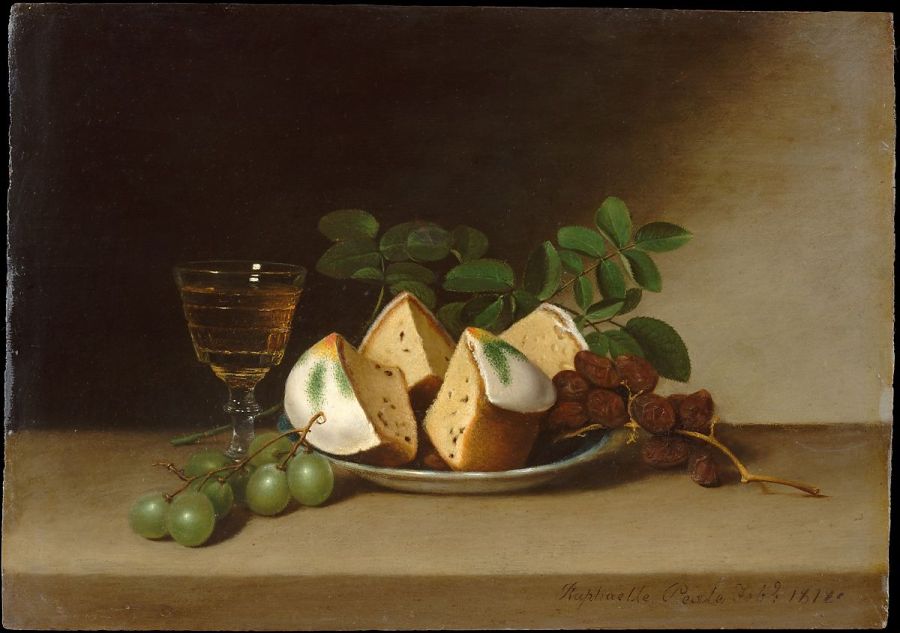
Featured Art: Still Life with Cake by Raphaelle Peale

It was spring and I walked
the streets in the late afternoon
with the best poet I knew.
She was tall with a severe face
like an early New Englander.
Her ancestors survived genocide.
We didn’t discuss our work, only
the weather, how the blossoms
were upsetting. The war was on.
We bought a hefty slice of cake
and walked slowly under a murder
of crows back to my apartment.
This seemed too evocative,
almost to the point of embarrassment.
The cake was coconut. We split
the slice, sitting at the small
table in my living room, away
from the sun. At the time,
it was the present. Here
in the future, I sometimes forget
to breathe, waiting
for the next catastrophe. That cake
was pure in its sweetness, the poet
alive with me, her eyes scanning
my face, both of our histories
neatly bound in our throats.
I wanted to ask if she was frightened
by living, by the change
in the light. Instead, she slid the plate
across to me, a Ouija planchette,
insisting I take the last bite.


Read More

Here Comes Happy

By Shauna Mackay

So, as I understand it, none of your children have died?

They die all the time, she says. Over and over.

The doctor, young as ever-dying sons, suggests a short course of medication and refers her to someone who might help her to change her thoughts.

On the way home her walk’s different: rocking, dodgy. This is how the embarrassed go. Shanks’s pony won’t trot nice: one two, onetwo, no, one, two, for God’s sake. She keeps a Bonaparte hand to pat the phone in the pocket of her shirt, there, there; can’t let it lie at the bottom of her bag, roofed over by crap and the birthday card for Lance. Her middle lad hasn’t answered the text she sent from the doctor’s reception area: he’s got an away game today, rugby, that bloody rugby; he must be injured, quadriplegic, on a ventilator, brain dead. How can she go on? She smoothes out the prescription in her hand, crosses the road to the chemist.

A text comes as she waits for the tablets to be dispensed. Her son is fine, all good, they won. She pictures him downing celebration pints, shots, being a daft sod, succumbing to fatal blood alcohol levels. She makes the pharmacist bide there for payment, stood like a plum, while she texts back. Well done son but mind you go canny x. As soon as the first text has gone she sends another to say on the coach journey home he should sit in a middle aisle seat opposite the driver’s side for she’s heard it’s the safest place in the event of a crash.

Read More

Wex in Totus Taggle

By Owen Doyle

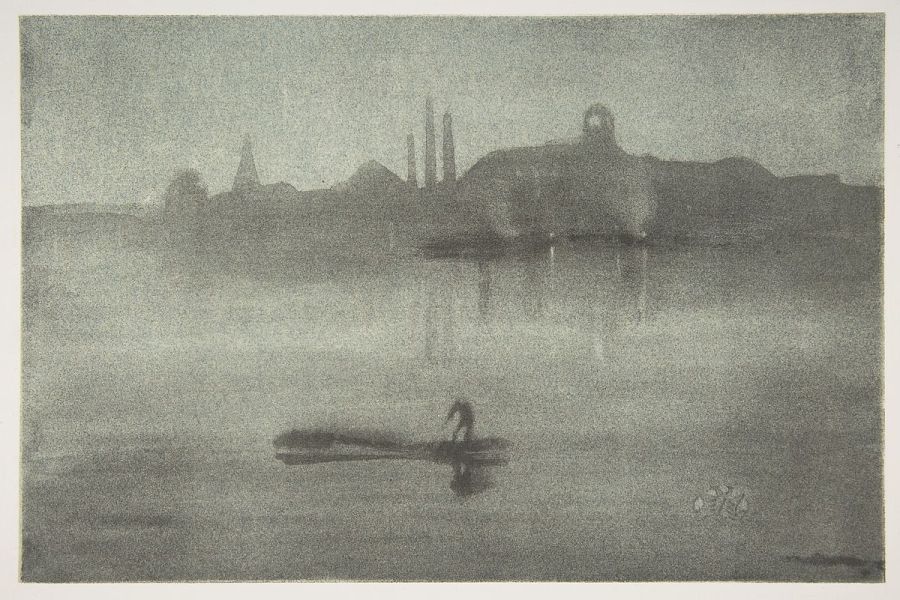
Featured Art by James McNeill Whistler

Words in an old notebook
prove (I was twenty-ish, then)
that mind-mud and dismally
tangled brain material
have causes other than old age
or illness. At the time,
they might have been explained
by the rum or beer in mind-
blowing excess the night before.
I don’t remember.
But surely those episodes
of binge and babble
are far outnumbered
by drier spells of helplessness:
me, frozen
over the neat rectangular form
of a blank page, compelled
to write totus to avoid
writing nothing.
It’s reason enough for terror
or self-pity, the thought
that those very things—the booze-
blasts and blackouts—were then
and are now the efficient
cause of wex and taggle:
furrows of gray matter, tilled
for art and wisdom, laid
waste, and the flood of those young
insults cascading still. But no,
I’ve heard that it’s very common:
this empty gaze, the pen loose
between a finger and a thumb,
its tip hovering
over absolutely nothing. And so,
as tragic as it all may be, finally,
I won’t let it bother me too
too much. Why taggle over wex
totus? I’ll pour myself a glass
of wine and see
what comes spilling out.


Read More
At the Wives’ Coffee

By Abby E. Murray

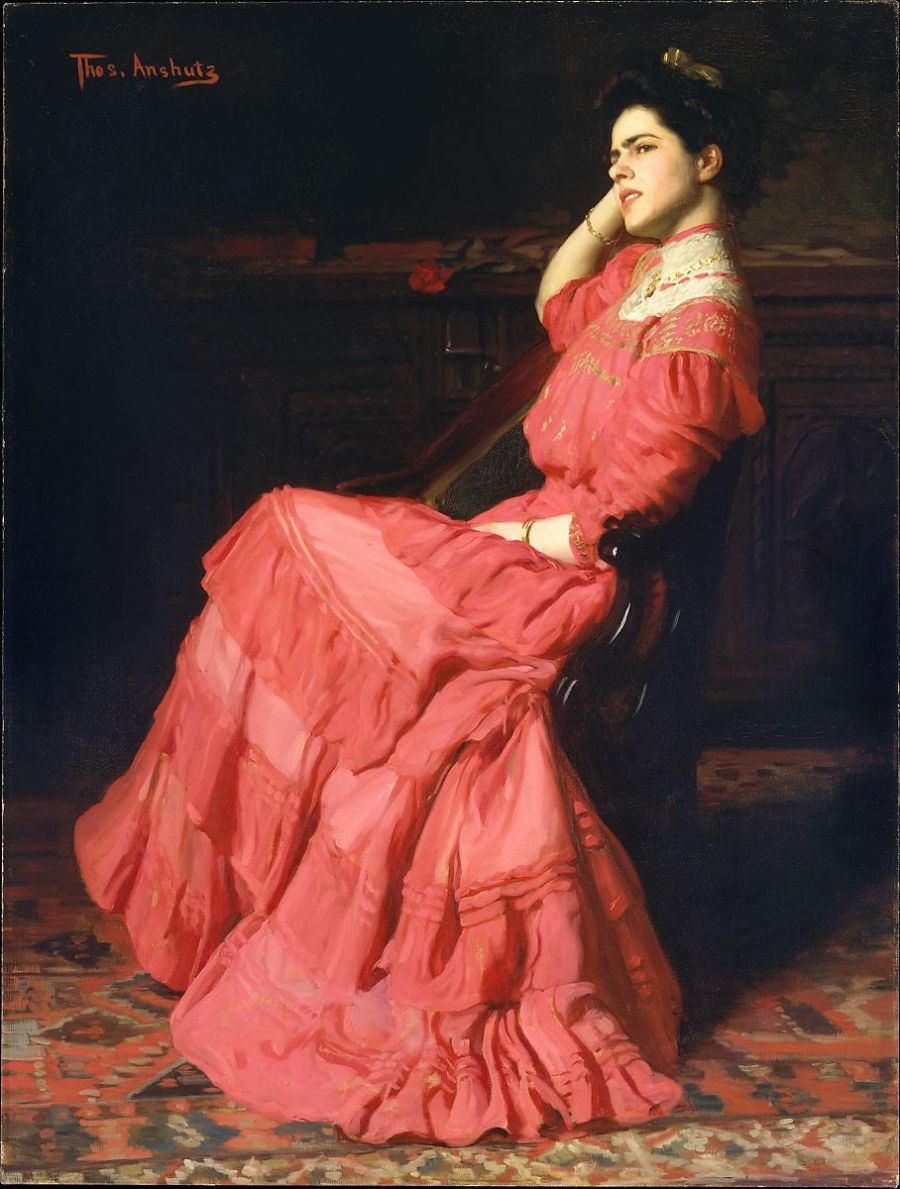
Featured Art: A Rose by Thomas Anshutz

You should know
             there is no coffee
                                at the Wives’ Coffee

There’s prosciutto
               and cream puffs
                               and conversation starters
                                               printed on glossy paper

And here’s a tip
               from the commander’s wife:

Wives who forget
               to wear the crest pin
                              will be fined a dollar
                                          because these pins
                                                             aren’t free ladies

and immediately
                I’m a stump
                      rolled into the river
                                               before a flood
                                                               I am uncooperative

a hollow log sheltering rebel fish
               a disruption of roots

But the conversation starters
                are required and my question is

What discussion topic bores you to sleep every time?

Read More
Language Immersion

By Jeff Walker

Featured Art: by Martin Johnson Heade

Nobody, speaking of fluency, would remember
that party where I told the young woman
seated on the floor: this food tastes good. Nothing untoward.
She surprised me by crawling on all fours, her blouse fairly open
at the top by way of happy gravity, to gently
take the food from my hand with her teeth; alarmed me
because I was not young and
what could she be thinking by doing that?

Around us on sofas and out under the trees hummed
the language I would not understand after years of trying
and also of trying to understand why I couldn’t,
an easy-to-employ tongue with few options and simple
structure but when they speak to each other it’s unintelligible,
a giggle-babble, a bubbly stream of what I guess are words,
vain emptying of thought from one head to another,
like all language, really.

Why not give it up and run silent miles
through the mud and rice paddies with my jogging buddies,
or ride miles on a motorbike alongside a mute, jiggling citizenry,
my face contained and content behind its polycarbonate shield,
my mouth behind its filter mask, and who on the back
not speaking, only chewing?


Read More
Return

Winner, New Ohio Review Fiction Contest
selected by Mary Gaitskill

By Analía Villagra

He was gone for eleven years, and Jackie is still getting used to the idea that Victor is out. Exonerated. His release had warranted a few sentences on the local NPR station, so Jackie knows that he has been at his mother’s place, three blocks away, for a week. She has not yet run into him on the street. Each time she leaves her apartment she scans the sidewalks, and when he does not materialize she feels equal parts relief and disappointment. Thursday afternoon she goes out of her way to walk past his building, willing him to be on the front steps or looking out the window. She slows down. Would he even recognize her now? Her hair is short, with a few stray glints of gray, no longer halfway to her waist and shimmering black. Her eyes have shadows beneath them. Her hips have spread. She’s thirty years old, in good shape she thinks, unless you’ve spent a decade fantasizing about a nineteen-year-old body. Jackie blushes. This is the first time she’s admitted to herself that she wondered—hoped? assumed?—that Victor thought about her while he was away. Eleven years. Maybe he’ll recognize her, maybe he won’t. She can’t decide which is worse, so she stares down at the sidewalk and hurries past the building.

She goes to the Y to pick her daughter up from camp. Graciela is running around the outdoor play area with a group of other kids, their hair wild, their clothes and faces filthy.

“Mama!” Grace shrieks when she sees her.

Jackie waves. She locates the teenagers wearing staff T-shirts, and they hand her the sign-out sheet without pausing their conversation. Jackie half-listens to the latest counselor drama while Grace gathers her things.

Read More
The Blackbird Whistling

By Linda Bamber

Featured Art: by John Frederick Kensett

I do not know which to prefer,
         The beauty of inflections
  Or the beauty of innuendoes,
           The blackbird whistling
                             Or just after.
                    —Wallace Stevens

1. The Beauty of Innuendoes

Meaning in poems comes and goes
like a car speeding down a tree-lined road
sun-shade-sun-shade-sun-shade . . .

Poems’ secret places:
fleeting, hidden, close.

Closer yet I approach you, Whitman warmly says;
and then,
We understand, then, do we not?—never saying
what it is
we understand. As I understand a poem
by my friend
                         but mustn’t tell him
what about the poem makes me feel so
             not alone.


2. The Beauty of Inflections

             Yesterday I called my friend.
He was in a peaceful mood
(which he would be the first to say is kind of rare).
As if bubbles of CO2 some clams or scallops had exhaled
were calmly rising

in a steady/wavering
                                         surface-seeking

kind of way

up through his contentment
effortlessly rose some words of praise for me. Plain

and unadorned; clear; direct.
                                        The blackbird whistling,

you might say.
                                          In fact,

if my friends didn’t tell me plainly that they

love me
              sometimes,
I wouldn’t understand a single thing
I try to read at all.


Read More

Trees in March

By Linda Bamber

We were seated near the back of the Chinese restaurant, and waiters were
rushing in and out of the swinging doors to the kitchen. At the time we had
not as yet so much as brushed shoulders. Resting on the formica table top, my
hand began to feel odd. Not bad-odd; but most unusual. Trees in early March,
aroused, their branches slightly reddened by the slightly stronger sun, may feel
something similar. They have a new sense of their importance in the scheme of
things; they remember (if I may say so) they are divine. He was looking at my
face, not my hand, so I don’t know how my hand, resting near the remains of
the General Gau’s chicken, intuited its sudden access of significance; but it did.
It had aura you could cut with a knife.

Shortly thereafter he took my hand.


Read More

Mango Languages

By Linda Bamber

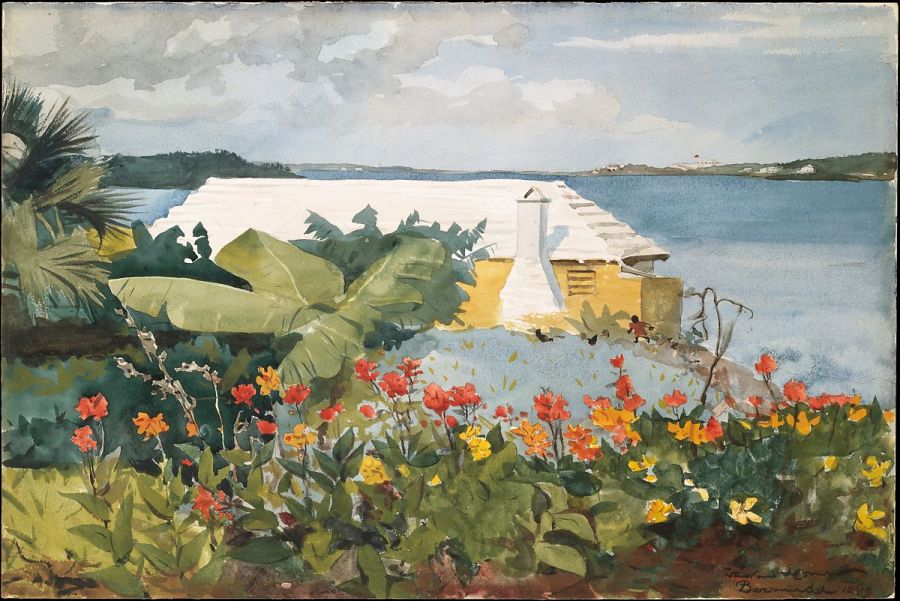
Featured Art: by Winslow Homer

—For Chris Bullock (in memoriam) and Carolyn Bernstein

In that world people are not discussing The End of the American Experiment.

       Yo soy de los Estados Unidos. ¿De dónde es usted?
        (I am from the United States. Where are you from?)

In that world people are not in a rage at their relatives for voting wrong and
sticking to it.

         ¡Tu hermano se parece más a tu abuelito que a ti!
         (Your brother looks more like your grandpa than you!)

People there are not tortured by thoughts of what they should have done to
prevent this; they do not endlessly analyze the causes of the disaster; or notice
how many of their friends are independently coming up with the metaphor of
a tsunami wiping away what is precious from the past and has been defended
by their devoted work.

       No llame a la policía. No es una emergencia.
        (Do not call the police. It’s not an emergency.)

In that world they do not sit glumly when friends excitedly tell of recent
protest marches; they are not thinking, “Great, feel inspired; meanwhile,
they’ve got all three branches of government.”

         ¡Me encantaría que me dejaras accompañarte a la esta de Pablo!
         (I would love it if you would let me accompany you to Pablo’s party!)

People there are not suddenly crossing the border into Canada in the snow
with children in their arms; or trooping out of Jewish Community Centers on
a Tuesday because of death threats; or writing emergency numbers on their
children’s forearms in indelible ink in case Mamacita doesn’t come home from
work that day.

Every morning I cross the border into Mango Languages, my ticket to
oblivion. “Loading your adventure,” says my computer when I boot it up.
Every ten minutes a woman’s joyful voice says, “Isn’t this easy?” to encourage
me, and I admit I feel encouraged.

        Córtalos en pedacitos y échalos al agua que está hirviendo.
        (Cut them in little pieces and throw them in boiling water.)

They are speaking of nothing more precious than carrots and onions; not,
for example, the Constitution or the Bill of Rights. We are learning to use the
imperative mood, that’s all; and today we are making soup.


Read More

Near the Campo Aponal, on My Father’s Birthday

By David Brendan Hopes

Featured Art: A Rocky Coast by William Trost Richards

De Sandro’s café with the orange tablecloths
wades into the one stone street
without tourists, all the Venetians pushing
their big delivery carts at first of morning.
From what I understand of it,
the shouting is voluble,
happy, glad to be alive, almost never
without reference to anatomy.

Nine years after your death it is still your birthday.
I’m treating you to cappuccino and showing off
my lacework of Italian.
Ecco, I cry, pointing to the beautiful faces,
the beautiful things.

Everything was outlandish to you. Nothing is to me.
In that way balance is achieved across the long years.

But I think you would like these people.
They would pull out the orange chairs, sit down,
listen to what you have to say. You would be old
and wise in a city old and wise, and that would be
enough.

I’d better think of something else before the mood
turns heavy and hard to carry over the Rialto Bridge
with the shops just opening.
All those selfie-taking children,
all that brightness bearing down.

Happy birthday, I want to say,
from the last place on earth, where the earth dissolves
and the crazy towers lean out over
watching for what comes—sinuous, flowing,
unexpected—next.


Read More

Of Seeing, the Unseen, and the Unseeable: Technology, Poetry, and “When It Rains in Gaza”

by: Philip Metres

1. I Tap My Cell to See

In the beginning, I did not see but heard: news over the radio about the bombing of Gaza in 2014, triggered by a whole series of events—we say “triggered,” as if history itself were a weapon ready to be fired. Voices untranslated, the tone of panic rising, sometimes breaking into anguished cries, the wail of air raid sirens, and the smooth voiceover of journalists, trying to tuck the adrenaline beneath the language, trying to strike a tone that seems fair and balanced.

Read More

On Language, Bombs, and Other Things That Exist

by: Kimberly Grey

As poets, we often assemble language to disassemble meaning—or we disassemble language to assemble meaning—and this is all an effort to translate the ordinary (a pair of socks, the name of that place, subway car, chair versus shadow, the front of a sparrow, something afloat like a naked rock) into an extraordinary textual or speech act. The result, we hope, is something new and transformative.

Read More

The Technology of the American Sonnet

by: Brian Brodeur

If a poem, as William Carlos Williams claimed, is a machine made out of words, the sonnet can be viewed as a particularly compressed, dynamic, and efficient little gizmo, one that poets have been tinkering with since the 12th century. These tinkerers, of course, have included some of the most foundational poets of Western literature—from Dante and Petrarch through Hopkins and Frost—all of whom have used one variation or another to perform what Phillis Levin classifies as “a mode of introspection, a crystallization of the process of thought.”

Read More

The Transitional Voice: Exploring Susan Blackwell Ramsey’s “Ode to Texting”

by: Claire Bateman

There are currently three kinds of human in the world: the non-digital; digital natives; and adapters who have learned to communicate digitally but still remember an analog society though they cannot fully access that prior consciousness, just as no adult can fully access their sense of self prior to their awareness of death and sex. Susan Blackwell Ramsey’s “Ode to Texting” speaks in the voice of the third kind of human, a member of this historically unique transitional species, embodying a before-and-after in our culture in which babies swipe insouciantly on screens almost before they can sit up on their own. Interestingly, rather than relegating texting to the status of object, Ramsey personifies it as a shapeshifting subject she addresses in order to explore the range and complexity of an adapter’s experience. Consider how she opens the poem:

Read More

Machines, Mortality, and the Lyric Poem

by: Bethany Schultz Hurst

After my mother died, I kept reaching for my phone. I’d talked to her almost daily during the last years of her illness, when she’d been mostly housebound, watching Hallmark movies and BBC mysteries alongside my patient father and an ever-present small plate of toast she couldn’t bring herself to eat. Because I couldn’t reach her now, I found myself instead playing the matching game I’d downloaded in case I needed to occupy my young son on the flight back to Denver for the funeral. For brief periods, the game let me put my grief in the background and focus on the simple task of matching little clusters of fruit or flowers to earn points toward restoring a cartoon estate garden that had fallen into disrepair. The game offered order and arrangement, a small sense of accomplishment when other tasks (or even former pleasures, like reading) seemed to demand too much concentration.

Read More

Yeats and Heaney: The Poetry Without the Pity

by: C.L. Dallat

When W.B. Yeats dismissed Wilfred Owen’s World War I poetry as “all blood, dirt & sucked sugar stick” (and omitted Owen, Sassoon, and Rosenberg from his 1936 anthology), he was making a powerful statement, not just about distaste for sentimental language and the role of pity in poetry, but about the poet’s duties and limits. He had already excluded writing war poetry from his own list of obligations in 1915’s “On Being Asked for a War Poem,” but only later became more coherent on the abjuration of pity as an unfit subject.

Read More

I Second That Emotion

by: Rebecca McClanahan

A few years ago, I attended a literary gathering and heard four poets and memoirists read from their work. They were all accomplished writers, varied enough in their approaches to evoke laughter, sighs, nods of acknowledgment, a collective gasp at one point, and, toward the end of the evening, some tears as well. Tears are not uncommon at readings, of course—I have cried at several—but in this case the tears came not from audience members but rather from one of the readers, who had warned us that she might “choke up” because of the emotional content of the autobiographical piece she was about to read. Her introduction, followed by a tearful presentation, suggested either that the work was too new to share publicly or that she had planned her reaction and was intentionally manipulating us. As she spoke, I sensed listeners growing more and more uncomfortable, as I was. Some leaned back into their chairs, some crossed their arms. The more emotional the reader’s performance became, the less effect it seemed to have, an unfortunate outcome, especially given that the work was potentially moving in and of itself. But it was as if the writer did not trust the work, or perhaps did not trust us to do our job as listeners: to bring our own emotional response to the work.

Read More

Staying with Argos: Odysseus and His Dog

by: AJ Aronstein

Argos, the loyal dog of long-suffering, well-tanned, always-oiled Odysseus, appears only once in The Odyssey. At the sight of Odysseus, who returns to the island kingdom Ithaca after 20 years, Argos dies. Bam! Kaput. Struck down by a Zeusian thunderbolt. At this point in Book 17, no one other than the reader knows the true identity of the disguised and smelly Odysseus, who dresses like a beggar. Escorted by his loyal swineherd Eumaeus, Odysseus pauses to observe Argos from the distance of a few steps. But he can’t even pet the pup before steering back toward his wife’s suitors, whom he’ll slaughter in due course. Argos dies almost immediately after Odysseus turns away. Though the encounter takes fewer than one hundred lines, its brevity should not trick us into thinking about Argos’s death as a merely sad aside. A closer reading reveals how Homer manipulates his audience before the final act, using Argos to orient our empathy toward Odysseus. Moreover, if we stay with Argos a little longer, he reveals something essential about fiction’s capacity to wrap epic emotions into even the tiniest moments.

Read More

New Ohio Review Issue 23. Originally printed Spring 2018.

Newohioreview.org is archiving previous editions as they originally appeared. We are pairing the pieces with curated art work, as well as select audio recordings. In collaboration with our past contributors, we are happy to (re)-present this outstanding work.

Issue 23 compiled by Darby Ricks

Midnight at the Anaconda Wire and Cable Company

By Sandy Gingras

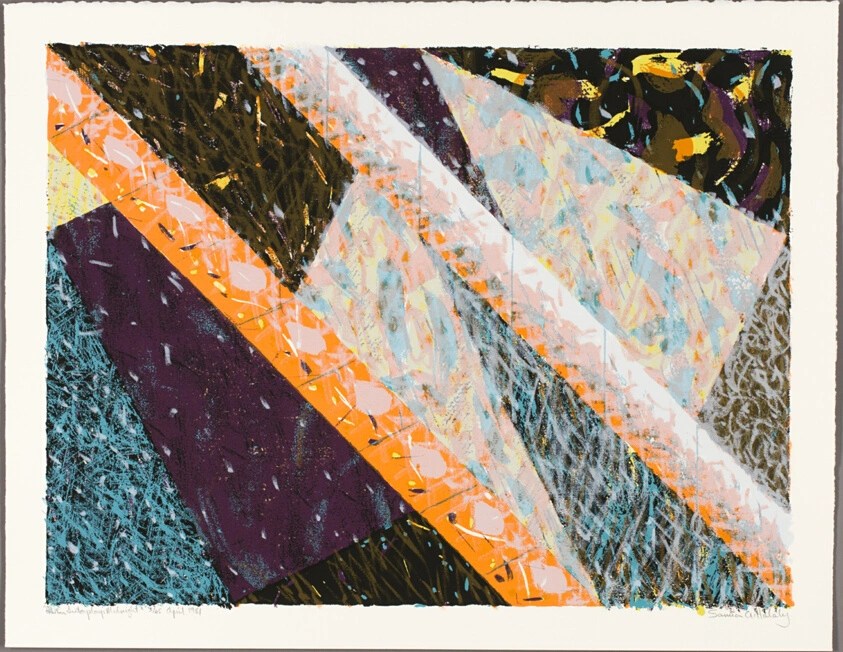
Featured Art: Position Interplay: Midnight by Samia Halaby

The building is boarded up, but we know how to get in.
It’s the end of summer and we’re seventeen. We don’t have a car
and there’s nowhere to go in this town except down

the huge hills gliding our bikes past the A&P,
the Ben Sun store where my mother buys my gym uniform, past
the funeral home and the corner bar where Eddie’s father sits

in the same chair every afternoon. The air is humid,
and the stars look stalled out in the sky. Maybe they’re waiting
for us to try something or to grow up already like my mother tells

me to do. A train goes past and faces stare out of the fluorescent lights.
My flip-flops ring on the metal stairs. Eddie puts his shoulder on
a board, and we’re through. It’s just the way it always is—

the way they left it. Eddie sweeps his flashlight across
the cables and cogs and steel beams, the stacks of papers
next to the stapler. This place is leaking

PCPs into the Hudson River, my mother says, but we don’t know
what PCPs are. All I know is, this is where my father worked
before he left my mother. Eddie and I grew up two brick houses

away from each other. Tonight we’re here to take one last look at
the muscley machines. I’m leaving for school tomorrow.
See, some things last, Eddie says to me. I don’t tell him different.


Read More

Los Angeles, 1990

By Jerry Williams

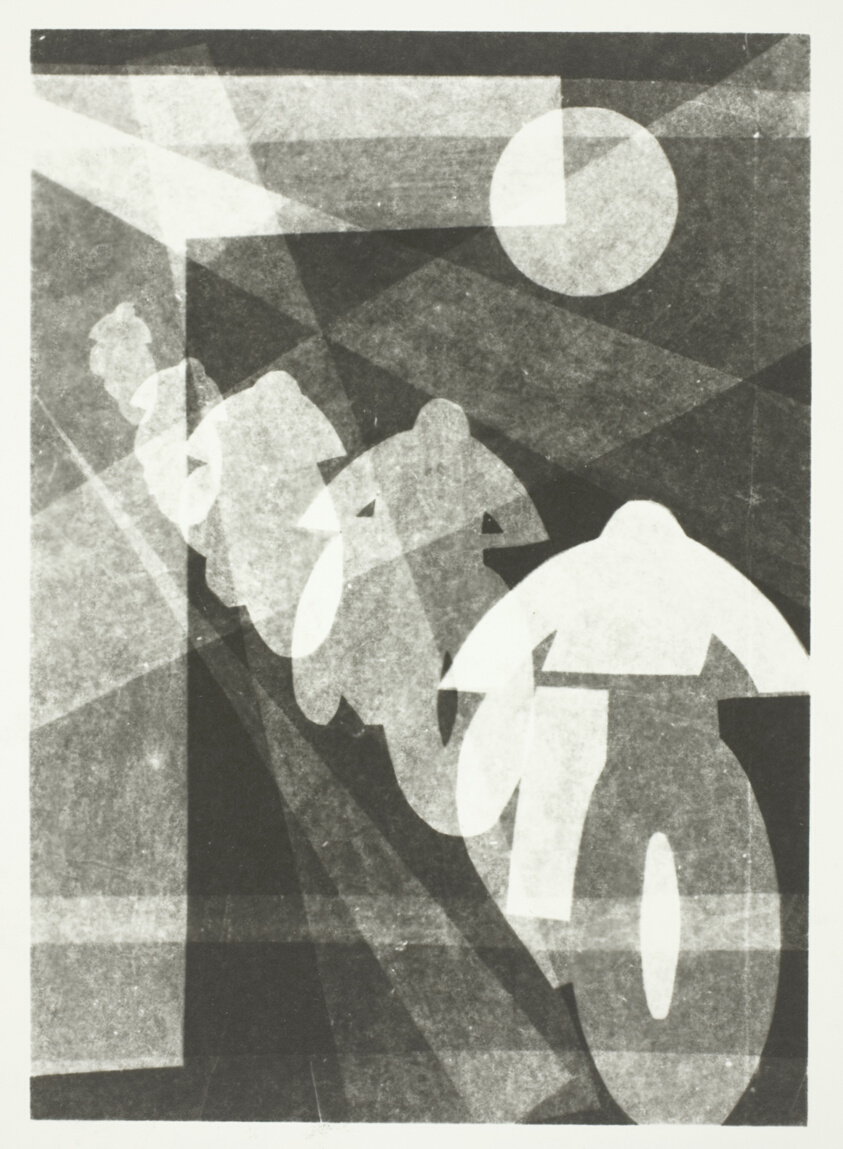
Featured Art: Motorcycle Race (Motorradrennen) by Oskar Nerlinger

I can recall riding a Kawasaki 750
down Sunset Boulevard
on a Saturday afternoon in light traffic.
Cruising along at thirty mph in fourth gear,
I let go of the handlebars,
braced myself on the fuel tank,
and slowly rose to my feet.
Helmetless, I stood like a surfer in the wind
on the imitation leather seat,
my longish hair blown back,
sunshine bursting through my goggles.
A thin membrane of fear lined
the inside of an urn made of pure joy.
After about an eighth of a mile,
I returned to the legal sitting position
and only then did I notice my runaway pulse.
When you’re twenty-three years old
the saddle of a thousand-pound motorcycle
feels as firm as the ground you walk on.
You get full access to your inner maniac.
Nowadays, doctors and sounder reasoning
have rescued me from worldly vices
and a rapid heartbeat often provokes alarm.
But I miss the brash torque of myself,
the quality of light in that urban desert,
all the midnights and years out in front of me
like the beautiful stupid jewels of infinity.


Read More

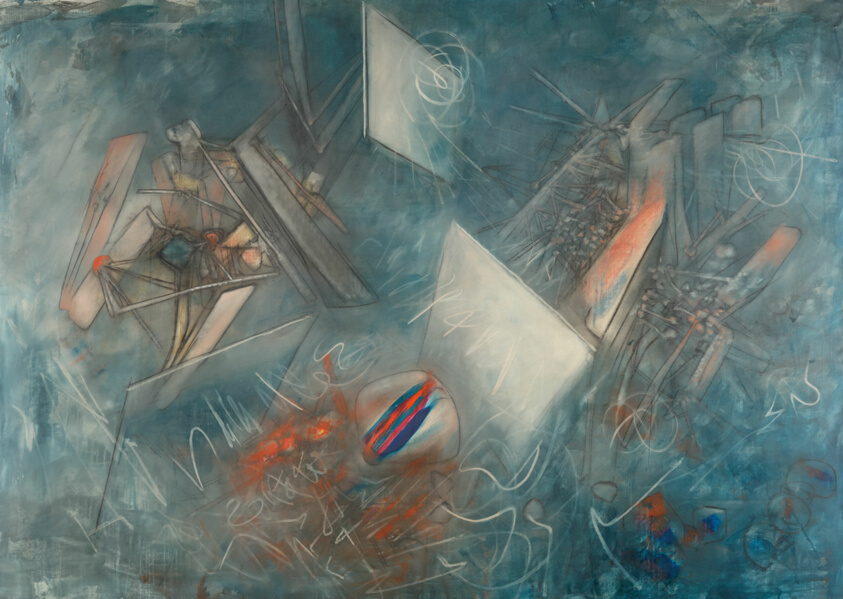
May My Enemy Be Overcome By His Own Glitter

By Laura Paul Watson

Featured Art: Glittering the Being by Roberto Matta

May he wake to an empty house.
May every pleasure
be interrupted. May every wheel squeak.
When he reaches the front of the line
may he return to the end of it
and may everyone before him
pay by personal check.
May he receive a thousand e-mails a day,
none of them personal, every one of them personal. 
May he go nowhere in metaphor
but travel everywhere by bus.
May every road be under construction.
May he lose the last page of every book.
May he find no pillow in the field.
May he find no field.
When faced with stone, may he see only stone.
Because he is narrow, may he hold
no one but himself.
There is power in forgiveness.
There is power in withholding it.
May he have the life he wished for me.
May every way be the dark way home.


Read More

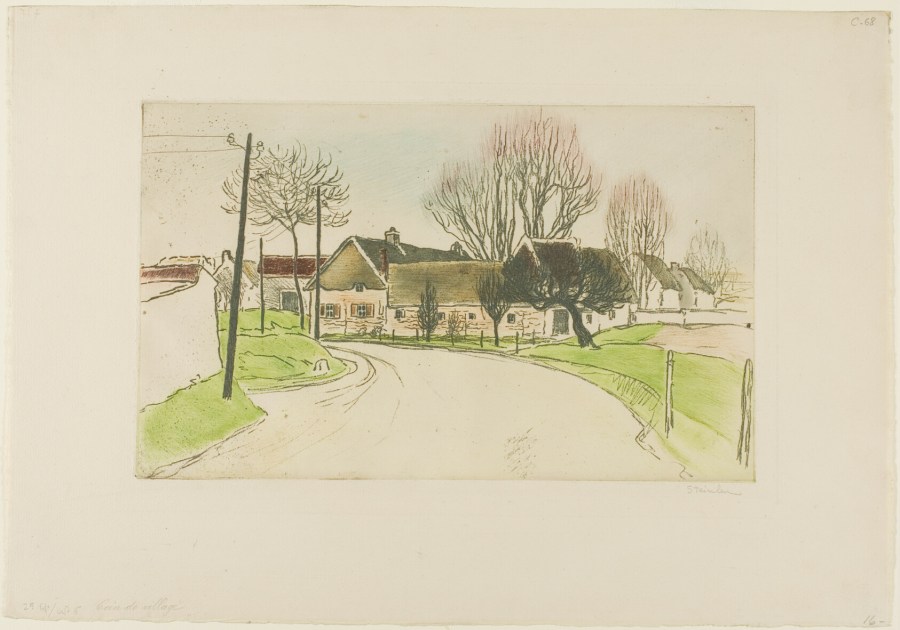
Google Map

By Connie Zumpf

Featured Art: The House on the Edge of the Village by Théophile-Alexandre Steinlen

Today I Googlemapped your address
hoping to catch a glimpse of you.
You weren’t in the picture,

but must have been home because
your truck sat in the driveway.
It all looked calm and still—I was glad

to see the grass had been mowed
and the weeds kept at bay. I rotated
the street view to the little park

just north of your house, the one
where we walked through withered leaves
last November. You weren’t there either.

Of course I know that’s not how it works;
the satellite photo was snapped a few
years ago, a scene from your life that may

no longer be true, a moment
just now opened for me, but long ago
over for you. It’s like staring up

at the Orion Nebula at night,
its light carrying sparks of cosmic news
from 1500 years ago. Here on Earth,

the Roman Empire was crumbling
and Arthur reigned as Britain’s king,
if he ever existed at all. We only know

outer space as it was, just as I can only
measure distance and time
from the us I knew

to who we’ve become. And now
I sit in front of my window
like a God-eye peering in

on your life, hoping
to catch you from a satellite view
at some yesterday-moment

when you were nowhere in sight.


Read More

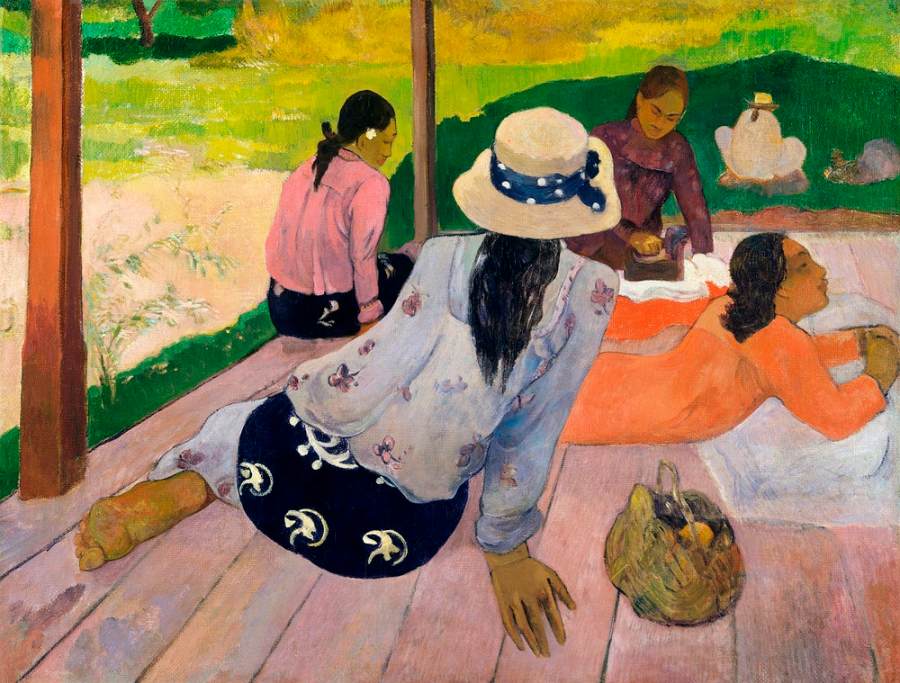
Strangers I Think I Know

By Connie Zumpf

Featured Art: The Siesta by Paul Gauguin

A woman steps off a bus or a train,
and something about her—
the way she holds her shoulders,
that straight-on walk—
swings my head around.

I am here, not over there. But maybe
there’s an occasional breach
where the skin of time thins,
and I glimpse unlived versions
of myself on a crowded street,
or through bookshelves in a library.

Where do lives go
when they peel off in parallel?

I could be the ghost of a small girl
who drowned, now hovering
like an imp over her mother’s life.

Or a woman married, now forty years,
a circle of pale skin under her ring,
eyes dimmed from years
of looking away—

some might-have-been me is a doctor
who teaches psychology and practices
Tai Chi alone on the beach.

Or is this an alternate life I’m in—
my real self’s hologram,
crept in under the tent flap while

embodied me pulls tankards of ale
in a pub in Dublin, relieved
she left Denver and loving her life
as an expat part-time bartender?

Read More

Roland Raccoon

By Karin Lin-Greenberg

Featured Art: Girl by Egon Schiele

Ms. Gardner had not been in support of the plan to drag Roland Raccoon to every middle school science class, but the principal said they’d paid Margery Martin a flat fee for the school visit, and it would be a waste if every student at Grisham Middle School did not have the opportunity to visit with Roland. Ms. Gardner was certain the eighth graders in her sixth period class were too old to learn life lessons about kindness and compassion and giving everyone and everything a chance from a twelve-year-old blind raccoon that was also deaf in one ear. “But he loves to be sung to,” Margery Martin had informed the class, adding, “in his good ear.” She cradled Roland in her lap as if he were a baby.

Margery leaned down, put her lips unsavorily close to Roland’s ear, and sang something that might have been Frank Sinatra. The boys who were sitting against a bookshelf near the rear of the classroom, as far away from Margery as they were allowed, snickered, and Ms. Gardner heard the word “rabies” whispered several times. Margery was in her seventies, wore a baggy sweatshirt with a large cartoon raccoon’s face on it, pink elastic-waist pants, and thick-soled orthopedic shoes. Perhaps the fifth graders might find something charming in her, might think she was similar in some way to their beloved grandmothers, but the eighth graders were surely too jaded to believe that spending an hour sitting cross-legged on the floor surrounding a woman crooning to a raccoon splayed on her lap was a good use of their time. There were twenty-four of them in a semi-circle on the floor. Well, twenty-three of them cross-legged on the ground and then Julia Fredericks in a wheelchair. During the summer, she’d been in a boating accident when she’d gone to visit her cousins on Long Island, and her legs had been crushed. Doctors were unsure if she would walk again. Some of the girls in the class treated Julia as if she were their wounded pet, making sure to follow her everywhere, offering to help her at all times, even when it was clear that she did not need help. These girls were well-intentioned, even though they were mostly unhelpful and in Julia’s way. Julia had been remarkably patient with the girls fussing over her, and Ms. Gardner had thought of nominating Julia for Eighth Grade Student of the Year for this patience and for her resilience in the face of adversity, but she was afraid others would believe Julia’s nomination (and likely win) to be the result of teachers feeling sorry for her.

Read More

Not the Wolf but the Dog

By Jacqueline Berger

Featured Art: Two Human Beings. The Lovely Ones by Edvard Munch

Not the zebra but the horse;
not buffalo but cows,
maybe camels,
who traded the wild for the stable,
a stall lined in straw,
the house with wee gables and eaves,
their name over the door—
Biscuit, Coco. Snowball, Ranger.
Traded the hunt for the daily bowl and dish,
predators for owners, collar and leash;
agreed to be a tool—plow or cart
or confidant—to breed in captivity.

So when the man in the elevator
at the Venetian holding his cardboard
tray of coffees and muffins
heading back to his room
says to no one in particular,
but most likely to the other man,
the three of us strangers,
I better get something in return for this, 
he means fetching breakfast
so his wife can sleep,
I better get something for all of this, 
gesturing with his head,
meaning the hotel, the dinners and shows,
I think about women
who prowl the midnight streets
in their staggering heels,
breasts like missiles
because they’d rather be feral than kept.
And about men who gave up
wilding to name their offspring,
their known code continuing on forever.

I’m carrying my own tray
of coffees and muffins,
will soon press the card against the lock,
open the room, rip off my clothes,
throw back the three hundred
thread-count sheets, waking
my husband. He’s met someone new
and now wants both
of his lives at once.
He can sleep later. These untamed
weeks, we’re savaging,
flesh against flesh, ravishing
our marriage.

Read More

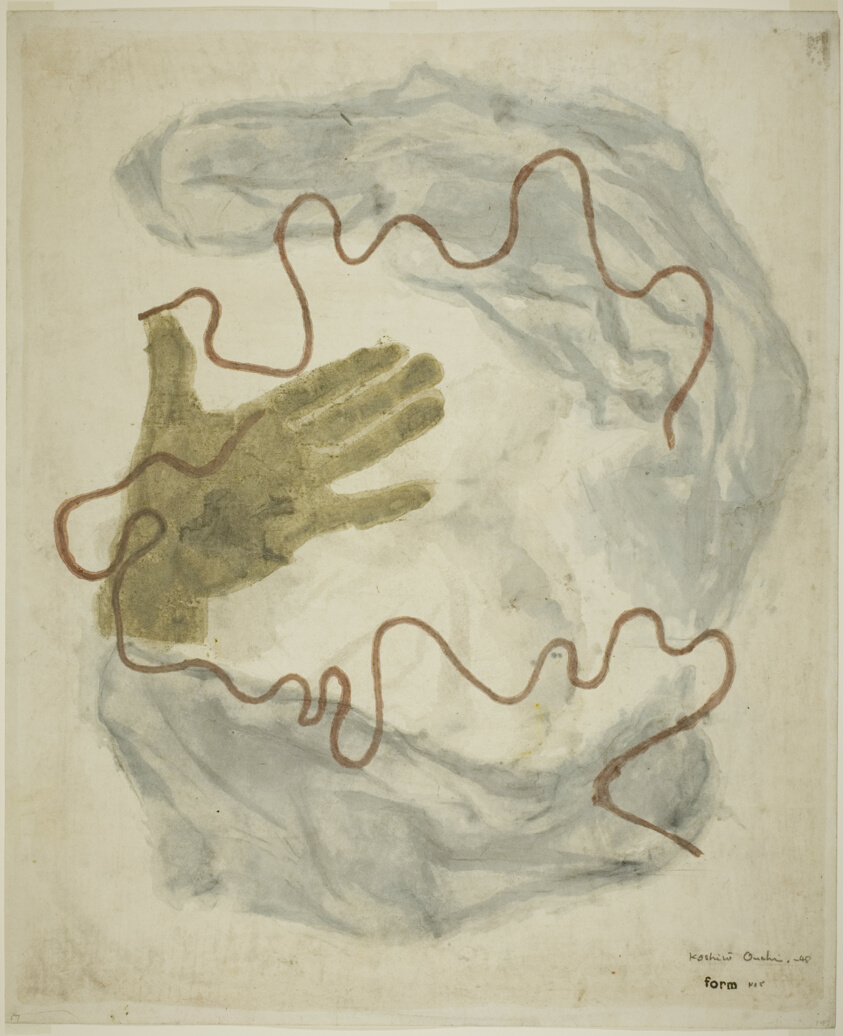
Another Version of My Confession

By Lara Egger

Featured Art: Form No. 5: Affection for Shapeless Things by Onchi Koshiro

My affection is a tabloid on sale at register three.
Citing moral reservations, the produce section

prefers not to get involved. Even the usually forgiving
cauliflower thinks my choices are questionable.

Have you noticed how some days the rush-hour light
makes the world look as if it’s snorkeling?

Stalled in the desperation of the strip-mall parking lot,
I tally my indiscretions, dog-eared romances

steadily expiring like glove-compartment coupons.
What would have been saved had I not agreed to love them?

Some nights my affection petrifies the lake,
a hush of ice tempering what lies beneath, and others,

a storm invites the water to trouble freely.
The clocks will be turned forward and then back.

Darkness falling, yet another way to describe twilight,
another way, dusk. Will you still think I’m a terrible person

if I tell you I meet emptiness everywhere and my heart
slips easily into its pockets? Up and down the supermarket aisles,

past cold-shouldered Kleenex and tight-lipped Lean Cuisines,
past the chorus of deli cuts chanting its condemnation: my affection

is a tabloid on sale at register three. When the night manager closes up
he pulls last week’s scandal from the rack—old stock

but his wife likes to read them. I write Catastrophe’s name
in steam on the shower door. I offer to give him a ride home.


Read More

Day Residue in Winter

By Wes Civilz

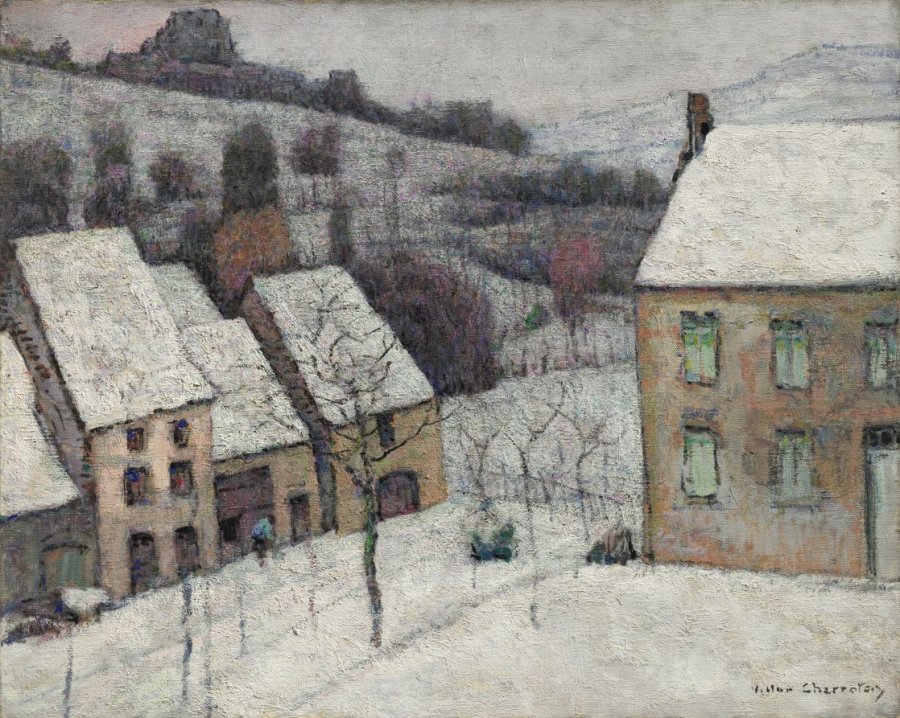
Featured Art: Murol in the Snow by Victor Charreton

« For three days, no coffee;
               there were headaches »

« On the fourth day, I have coffee again »
« My frozen intelligence melts open,
               sizzling with otherworldly light,
               but two hours later a slight sadness
               and a fading of the perfect coffee feeling »
« Then comes a desire for beer »
« Then a quick feeling that now
               is a moment I could be bored,
               if I was a person who got bored,
               but I am not »
« It is, however, too early in the day for beer
               so I do the dishes, and observe that soap bubbles
               are sly jokes told by the goddess of spheres »

« I drive to the dump, aka, the transfer station,
               where I will transfer the waste of my life
               into a cavernous compactor »
« (Other, more privileged things get to be recycled) »
« I behold the shapes of packaging
               that held the things that I used—
               that I used up »
« They are not lacking in beauty if looked at correctly:
               plastic casing with two bulb shapes for headphones;
               wax paper in the shape of a soap bar;
               browning skin of a banana »
« Someone else will worry about them now »

Read More

Of a Burrito de Buche

By Patrick Mainelli

Featured Art: Committed to Tradition (Uberlieferung verpflichtet) by Monika Baer

I’m not drinking anymore. It’s not a court-ordered thing or medical imperative. I didn’t crash a car or assault a neighbor or luridly graze my cousin’s leg at the reception of her wedding. No one has ever even told me to “take it easy there” as I poured three, four, five fingers of scotch over ice. As a drunk, I’m purely congenial. Maybe I’ve tipped over a plate of food here and there, fallen asleep on the toilet once or twice, sung in competing volume with the Midnight Mass choir, but who hasn’t? After a nightful of drinks I am more inclined to turn embarrassingly casual with my affections than to become anything close to mean or combative.

So this is a self-imposed drought. Denial might be the word.

The shit thing is it’s July. Beer’s favorite month. Because after mowing a lawn or trimming a tree there is no reward like the reward of beer, and because to swim in the lake, to rest tired and near-naked on the shore, and to not drink a beer feels an affront to God’s finer generosities—July demands a beer.

Read More

Dragonflies

By Danusha Laméris

Featured Art: Blue-tipped Dragonfly illustration from The Naturalist’s Miscellany by George Shaw

I wish you could see them: two thin blue needles
hovering above a bed of loosestrife and clover,
slivers of electricity, humming, almost invisible—
a glimmer of azure against the hillside. How
do their bodies hold the requisite organs?
Never mind the pull that makes them want
to wend their forms together this way. A tangle
of wires working themselves into union
this Sunday afternoon. Which, come to think of it,
is something I’d like to do with you, the portion
of desire I carry that much greater—as are the consequences
of crossing over into that lush country of dry grass
and end-of-summer weeds, where, if we weren’t
otherwise attached, we could make the most
of our own fleshly burden, lay it down
on the soft earth, its fine dust and buried flint,
the scattered flecks of fool’s gold.
Don’t you want to? Doesn’t it seem unfair
to be outdone by these mere fragments?
Almost more air than matter? But timing,
after all, is everything. And it looks like
I’ll have to appease myself with this tableau:
these two writhing out their little ecstasy
in broad daylight, coming together and then apart
and then together again, as if they had all day.
Which, given the brevity of their lives,
is quite a decadent expanse. Let’s try
and be happy for them, living into their late hours
with such abandon, while we are still
relatively young, the gift of want
stretched out before us, limitless and absolute.


Read More

The Problem

By Grant Clauser

Featured Art: Sketch for Beach Scene by Joaquín Sorolla y Bastida

The town decided
that blowing up the body
was the best way to move it,
but the only explosives expert
was a groundskeeper
who’d planted mines in the war.
Still, people set up beach chairs
and umbrellas on the dune
to watch. When it blew,
slabs the size of picnic tables
crushed cars a quarter mile away.
One man was killed by a bone shard
through the heart.
Another still walks with a limp
from the impact of blubber.

For days the town pretended
this had all been the plan, everything
was good, but then under cover
of night, we rented front loaders
from the neighboring towns,
buried what we could and burned
the rest in smoky mounds
that choked us when the wind
blew in from the ocean.
The beach was unusable all summer.


Read More

Here’s the Plan

By Patrick Meeds

Featured Art: Jacques and Berthe Lipchitz by Amedeo Modigliani

                                                                  —For Amy Dickinson

                                     You be a rubber bullet, and I’ll be fireworks
on TV. You dismantle your prejudices, and I’ll acquaint myself
with all the latest fads. You drag the river, I’ll manage expectations.
You shake your head and say yes, I’ll nod my head and say no.
I’ll call you Texas, and you can call me Nancy.

                                                                 Practical and precise, we
will compile a list of things we will need. Warm clothes
and synchronized watches. Miniature technology and hand-drawn
maps. Invisible ink and antique stationery. The music of Django
Reinhardt and a list of all the patron saints.

                                                                                    Things we will avoid?
Strict adherence to dogma and barbed-wire fences. Left-handed
compliments and uncomfortable shoes. Complex algorithms
and attempts at perpetual motion. Sing-alongs and potluck suppers.

                                                                   We will travel by train under
assumed identities and ride facing backwards. We will explain
ourselves to no one. Let’s be clear about one thing, reinvention
is the key. Look, there’s an abandoned car with a tree growing
through it. There’s an old bathtub with flowers planted in it.
There’s a fence made of old bicycle frames. There’s a car with an
antenna fashioned from an old coat hanger. These things were
one thing, now they are another.


Read More

Wings of Wind

By Eliot Fintushel

Featured Art: West Wind by Duncan Grant

“He goes on wings of wind,” is what a psalm says, one of the psalms. Another one says, “Happy is he who shall grab your babies and hurl them against a rock.” When I try to explain these scriptures to Miriam and Cassie, they look at me like I’m stupid. Do you call that a friend? In the Jesus times, friends even kissed each other on the lips for hello—Miriam would be caught dead first. Cassie, okay, actually, even on the lips, which I am going to tell you about it, except for the fact that she is damned to Hell.

Like, I’m the one who is stupid! This is what the Bible says about sinners like Miriam and Cassie: “They have their reward.” Namely, shit.

Miriam wears this, like, Nazi dirndl, which she thinks is cool, with her curly once-upon-a-time blonde hair and with sunglasses with red rims, and she looks like melted cheese with a worm in it, but she walks like she thinks she is a beauty queen, you know, with, like, her one heel right in front of, like, the toe of her other foot, in a straight line, supposedly, except that it’s crooked!

Read More

Creed for Atheists

By Matthew Buckley Smith

Featured Art: Bright Nothing by Sam Francis

     Let us not speak of God
As if He were the nightmare of a naughty child,
     Or a white lie for a widow,
Or a conscript’s consolation on the battlefield.
     Let us instead be awed
By the nothingness we’ve chosen not to be awed by,
     The shade whose earthly shadow
We’re standing in, the lie cast by a happy lie.
     The face we turn away,
Let us turn it toward the others, let us find them out,
     The ones who know the way
A sure thing looks when rounded with a little doubt,
     The same ones every day
Who, kneeling all together in a common room,
     Pray for their pets and pray
As well for us, their company in a common doom.
     Let’s take no satisfaction,
But concentrate on what we say when we say no:
     That dead we are the same,
That time falls fast across the fading light like snow,
     That man is an anxious motion
Of matter upon matter, liquor upon tongue,
     The neurotransmitter’s flame
Upon the dendrite’s kindling—bright, and not for long.


Read More

The Spiritual Exercises

By Lisa Ampleman

Everyone on television is apologizing.
      I’m sorry I kissed your sister. I’m sorry
I sold the dog. 
We watch, each with our own

TV screen we walk or run toward. The treadmills’
      wheels whine louder and louder.
In the strength training area, a man grunts

and drops a heavy weight. I wish I hadn’t eaten
      so many foods with high fructose corn syrup.
I’m sorry I got you addicted to sugar.

On one wall-mounted TV, two men in an octagon
      with netted sides try to kick each other
in the face. When one pins the other,

he moves gradually, pulling the loser’s arm
      further up, maximum pain. The other
struggles to buck him off. It makes me feel sick.

There are two minutes left in the round.
      I’m sorry I voted against you. I didn’t come here
to make friends. A few men shout

as they play hoops on a half court,
      but the rest of us are silent and alone
in our movement. We must contort our bodies

to give them fitness, here in the kingdom
      of calisthenics, our feet dully hitting
the treads. I’m useless; I can’t get rid of

this stack of Sears Catalogs
      or this broken walking cane. I’m sorry

that the house is full of trash.

“Exercises,” too, Ignatius called
      the spiritual retreats that “have
as their purpose the conquest of self.”

Read More

The Jesus Bus

By Melissa Studdard

Featured Art: Children’s Games by Édouard Jean Vuillard

came early, sputtering and spilling
Kumbaya from the windows,
the little punks inside eating a breakfast
of Pop Rocks and candy cigarettes left over from Halloween
and hiding the wrappers in the creases
between seatback and seat. I never sang
but floated instead in my own world of thought.
All you had to do was look at an issue
of National Geographic to know everything
was extraordinary and people’s bones were full of stars.
Cecil, the driver, got his neighbors
to help paint the Jesus bus into a roll of Lifesavers candies—
all bright and vertically striped—green, yellow, red, and orange, 
Lifesaver in perfect white script across a strip of blue. Cecil,
tenderhearted conveyor of children to the terrible glory of New
Light Baptist Church, Cecil, who after nearly hitting a squirrel,
had to pull to the side of the highway to pray. Who could blame him
for not understanding that the grace he sought was already on his bus,
packed into forty-two little sugar-smacking bodies?
And hadn’t I once killed a frog by trying to save it?
Spilled it hard on the sidewalk like the spoils of an egg?
If the sky had ruptured above me, I would have cleaned up the clouds
and apologized for the mess. But the rebel gods kept
hanging around me like Woodstock hippies, so I dared some revival
to happen with the Christ frog. I was six and still
decades away from translating the voices tiptoeing through my mind.
Everywhere I went, I looked for spiderwebs with secret messages.
Maybe there was a pig to save. And when the bus backfired,
I thought I saw an afterlife emerge. Weeks later,
when I awoke screaming the fourth night in a row, I wanted
my parents to tell me it was possible for us to be alive
without hurting each other. I wasn’t dreaming of squirrels
or frogs. Just the Sunday School lesson on wartime and atheism:
how the good of us, when commanded by soldiers,
refused to stomp on a picture of Jesus
and so had their heads chopped off,
how I too should be willing at all costs
to keep my feet clean of my lord.
I was a good girl and learned my lessons well.
From others’ non-Christian necks would grow something
as secular and boring
as heads. But from my neck, an endless field,
and in that field,
congregations upon congregations of daisies—
all of them wearing the sad face of night.


Read More

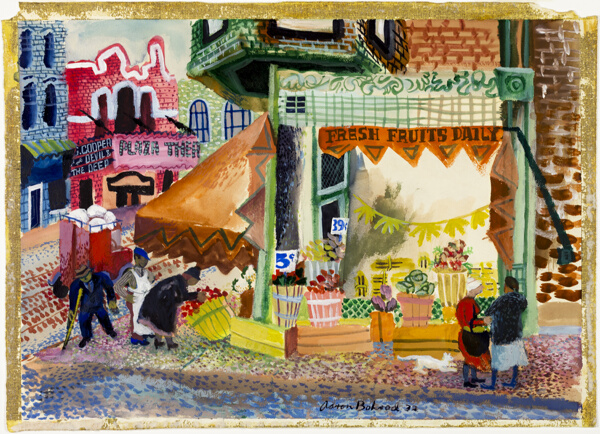
Fez Postcard / Call to Prayer

By Jacqueline Osherow

Featured Art: North Avenue Market by Aaron Bohrod

A jeweler holds a magnet to his silver
to prove its purity (there’s no pull)

A seller wraps a package for a buyer
who’s never quite assented to the sale

A flash and then another as a weaver
shuttles spun agave silk through wool

and then a blast of sound / a change of air
at once the market’s hustle-bustle trivial

Allahu akbar, Allahu akbar
even if business does go on as usual.

The world seems to refine itself, each color
more acute, each syllable, each smell:

the sharp scent of cedar where a carpenter
planes and sands an ornate floral grille

cumin laced with cardamom and coriander
(the spice seller’s stall) rose petal, fennel

or orange blossom just pressed to attar
escaping from a shapely crystal vial

Allahu akbar, Allahu akbar
every vista turns devotional:

the gorgeous rows of vats for dyeing leather
(for yellow, saffron, for red, poppy flower,

spearmint mixed with indigo for teal)
are bright-robed worshippers who’ve joined to kneel

in unison and chant Allahu akbar
God is great and powerful

as stragglers head to fountains to splash water
on hands and feet and face and then unroll

the mats they keep with them, each a small
but resolutely holy house of prayer.

Read More

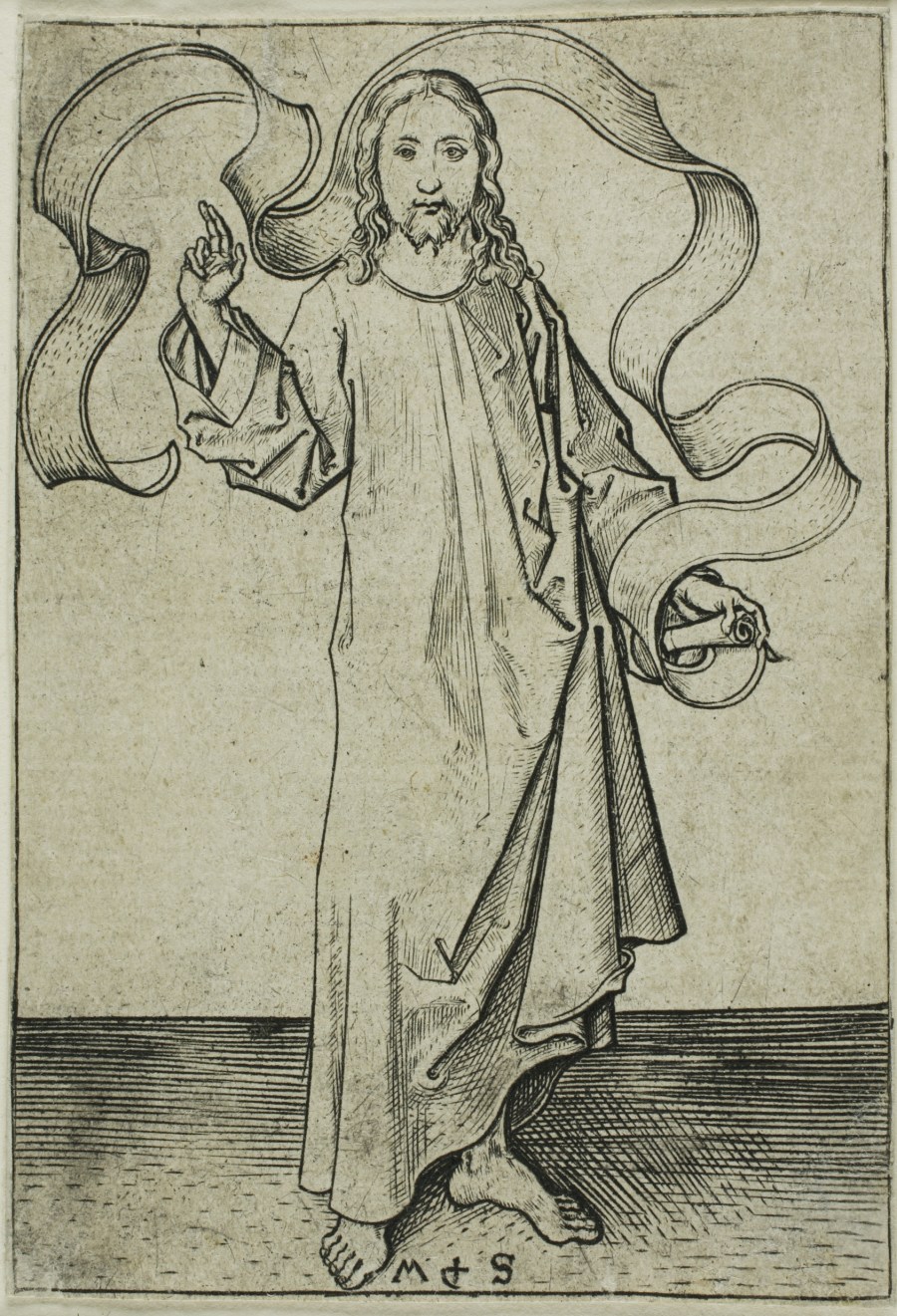
Blessed Is He

By Jeff Tigchelaar

Featured Art: Christ Blessing by Martin Schongauer

How am I?
Blessed. Blessed. I am
just blessed. God is good. Not afraid
to brag on God. Brag all day
on Big Man. My fiancée
just graduated. Junior college right across the street.
Four point O. See? God. He’s good. I’m looking
for work. The other day who do
I happen to meet
but the owner of Huntington Steel.
If that’s not God right there.
You can’t tell me that’s not a God Thing.
He’s workin’ it. Every day. Everywhere. I’m going
to Israel, by the way. Jerusalem. Judah. Judah, you know,
was Jacob’s fourth son. Now
Moses, though—God didn’t let just anybody
bury Moses. Dude was holy. An angel
had to put old Moses in the ground. Archangel Michael.
Jude 9. Look it up. Good Book.
Moses was so holy. Up there
two weeks with God on that mountain.
Gettin’ those Commandments. No Moses, no tablets.
Moses got blessed like nobody’s business.
Love me some Ten Commandments, though.
Love me some Shalt Nots and Covets. Don’t Covets.
God bless Moses. I’m just
blessed to be able to tell you about Moses. Share that
Word with you today. The man was like God’s Number Three.
Maybe Two. Right behind Jesus. Blessed as hell.
I’m about to be blessed with that steel job, though.
Think how hard Moses would work that. Mr. Bulrushes.
Mr. Burning Bush. Mr. Hold Up That Rod,
Throw Down That Staff . . . but now he’s dead and can’t
so I’m the man. Work my ass off get that good reward.

Read More

This Is a .50-Caliber Wound

By Jeff Tigchelaar

Featured Art: The Lonely Farm, Nantucket by George Inness

Knee surgery? Hell no
I didn’t have knee surgery.
That’s a .50-caliber wound.
I got bullet holes
up and down this leg.
Running through rice paddies.
                 Never mind that.
I need people to work. Know anybody?
People don’t want
to work no more. I need people
to throw hay. People can’t
throw hay no more.
Hundred-thirty-eight-pound bales, all day
out in the sun. It’s good work. If you’re strong. I pay
twelve-thirteen dollars an hour
so spread the word. The silt
in the air’s a bitch to deal with, though.
Especially if you’re not used to it. I’m used to it
and still it gives me fits. I got to cough
and puke it out and believe me, it takes a while.
                                   Purple Heart?
No. No I didn’t get one. It’s complicated. I wasn’t that
“good” a soldier, we’ll say.
Purple hearts are for . . .
Never mind. It’s just—it’s not worth it.
Never worth it. Especially today. Kids
come back fucked.
I’d never go. I’d stay,
work the family farm.
That’s where I am. Now.
I’ve got five brothers, four sisters,
and we keep about three guys full-time.
And my dad keeps timberwolves.
Gets ’em from a friend of his in Canada.
We got so many deer out there—we shoot
about ten a year for jerky. I only come into town
to donate plasma. I hate the city.
And I hate people, to be honest.
                 Know anybody
up for throwing hay, though—
send ’em my way.
I need people.


Read More

Reverse Sculpture

By Richard Dey

Featured Art: Untitled by Richard M. Loving

As the stone shrinks, the form expands.
—Michaelangelo

It’s like sculpting in reverse,
       learning about love:
Here’s a Maiden or Aphrodite or Venus,
       naked and polished
or is it the Doryphorus or David or . . .
Isn’t s/he nice? The Ideal in spirit and form?
       Miss or Mister Universe!

Then, in reverse, as you learn
about the apple of your eye
       in revelations you can hardly believe,
       (marble with veins like that!
       granite with such cracks!),
the stone chipped away chips back
       chip by chip, and chunk by chunk,
       all superfluous fugitives reuniting,
and not without the dusty air re-ringing
               with the tap-tapping of
       chisel and mallet, point and hammer,

refilling all the subtle negative spaces
that defined the planes and rhythms—
       mound and hollow, ridgeline and gap—
and the warmth that passed
       from the sculptor’s hands into the work,
all his perseverance, passes back . . .
until before you grandly stands, unhewn
and cold, a breathless, glacial block of stone,
       Lovelessness now reappointed
whose last words (whispered
       with chiseled lips lastly parted) were,
“Darling, are you disappointed?”


Read More

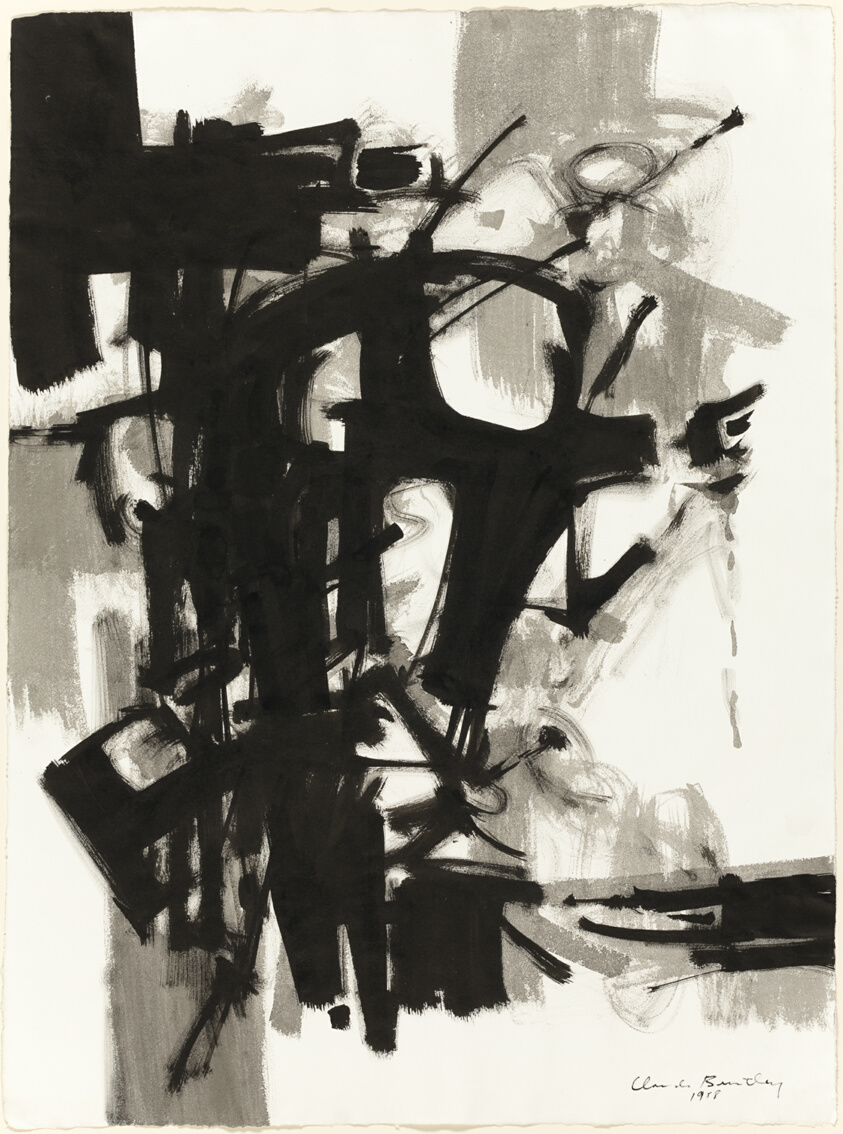
Arrangement in Gray and Black

By Laurie Rosenblatt

Featured Art: Composition with Black and Gray by Claude Ronald Bentley

In the straight-backed chair
for hours for hours after
a drug-stilled night for hours
after dream-hungry sleep she sits
in the straight-backed chair
unmoving for night
after night after leaning spent
against the steel surface
of sleep after staying by habit
on the right side of the bed
as if as if—

although some time does go missing

as if an owl passed like a ghost
its wing-beats deepening the silence
before the milkweed
from that half-dreaming
streams away.

And because the skin knows
after the brain does
and the reptile brain knows
after the self
the arm believes and reaches palm held out flat
seeking that other skin
and animal comfort.

Because the palm is capable
because a limb if lost may still feel
and because it feels may find grass-itch,
wind-brush, the love-mad path of fingers,
and pain. Because this is so

the palm believes
and finds the ghost it seeks
but the streaming milkweed
is carried away by the sun
that leaps onto the bed
and sinks its claws in.

Then dream-hungry she sits
on the straight-backed chair a
figure in gray and black.


Read More

Ye Are of More Value than Many Sparrows

By Elton Glaser

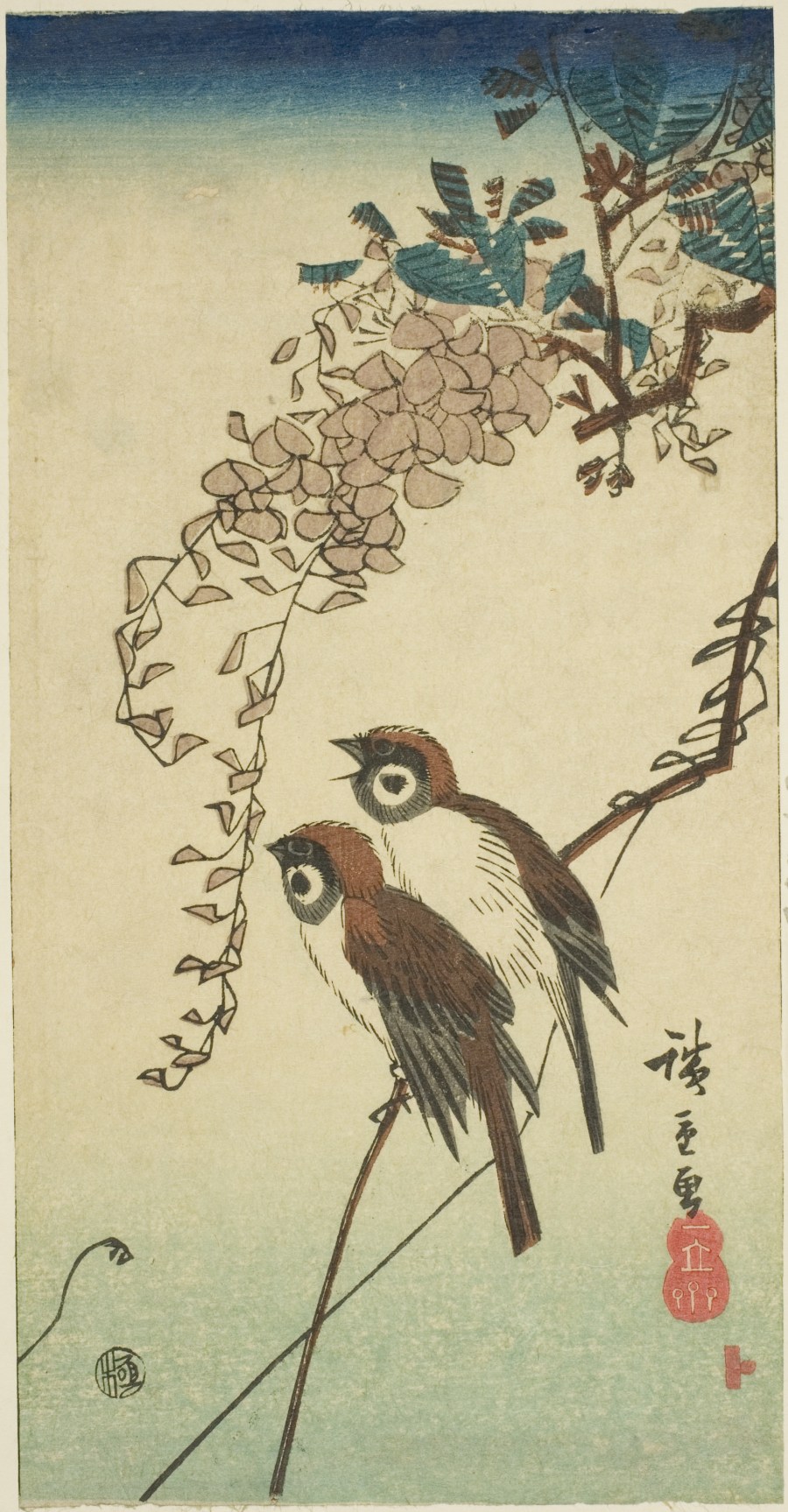
Featured Art: Sparrows and wisteria by Utagawa Hiroshige

Luke 12:7

How many sparrows are enough? I can’t tell
If there are more this afternoon than yesterday.

And if there’s one missing, or two, or eight,
What does it matter? All I know is

They are not so many since I took the feeders down
After your death. They came for the seeds

Your kind hands set out. I give them nothing.
Now, if they come, they come only

For reasons of their own, these quick birds
Dowdy in their grays and browns, and leave behind

That whistle and trill, or the echo of it,
Singing not for me, but for the moment’s pleasure

Of lifting their wings in warm air, alive
To the light. And in their easy glide and sweep,

Oblivious of anything but song, I find myself
A listener outside the choir, and still

Inside those memories of the missing kindness
That drew them here, however many, however few.


Read More

Haunting Houses

By Jacqueline Doyle

Featured Art: The Customs House at Varengeville by Claude Monet

In the movie I’m watching with my husband, “A Ghost Story,” a woman lies in bed with a lover and tells him a story. “When I was little and we used to move all the time, I’d write these notes and I would fold them up really small. And I would hide them.” “What’d they say?” he asks. “They’re just things I wanted to remember,” she says, “so that if I ever wanted to go back, there’d be a piece of me there waiting.”

*

We were in elementary school when my best friend moved out of the red house on the lake. She was moving hundreds of miles away, the rooms had been emptied, and we ran all over the house leaving tiny notes about our enduring friendship. There was a door in the upstairs-hall ceiling with a ladder to the attic, where we tucked notes in hidden spaces under the eaves. There was a small door allowing access to the bathroom pipes on the second floor. A dark basement with several rooms and pipes on the ceiling. Our footsteps echoed as we ran up and down stairs.

*

Read More

April 21st

By Billy Collins

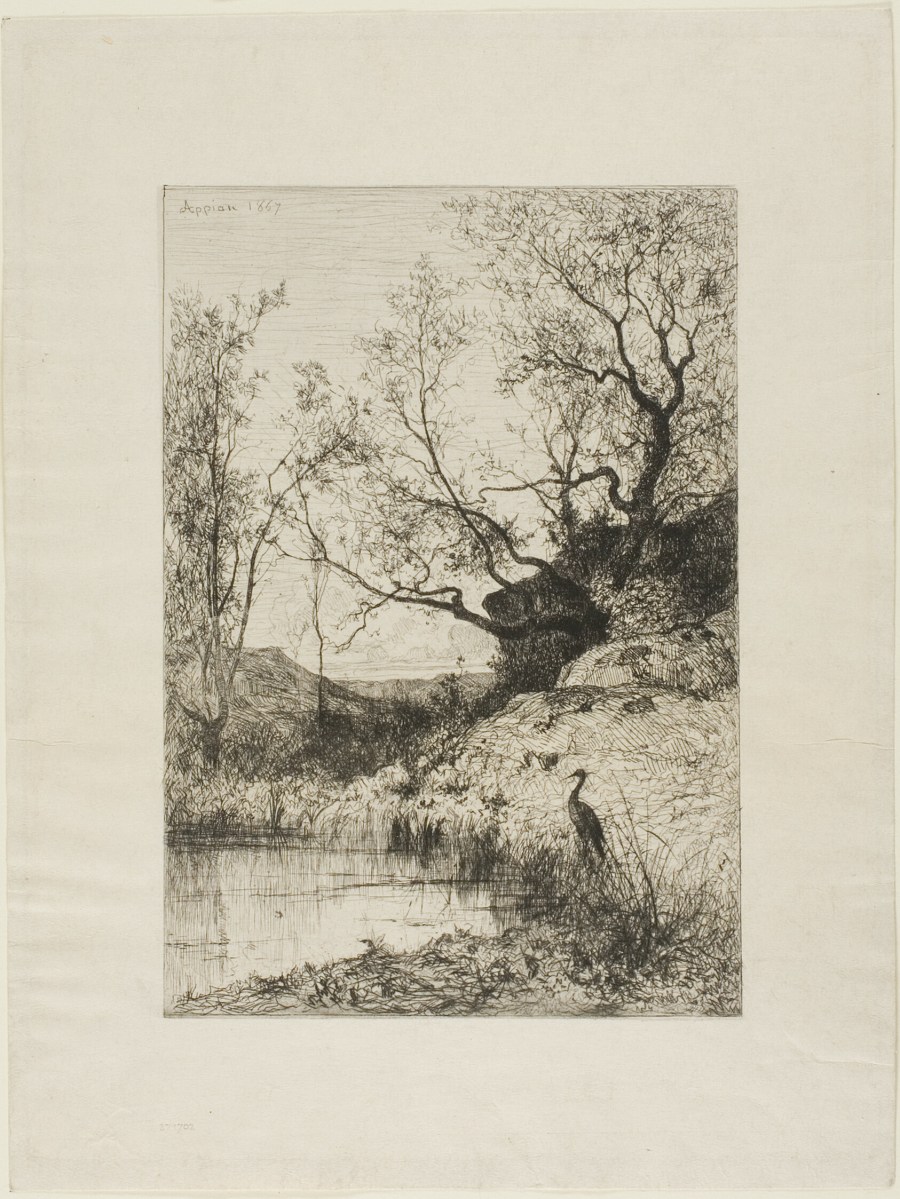
Featured Art: A Pond Near Rousillon by Adolphe Appian

It’s the birthday of John Muir and Charlotte Brontë,
born just 18 years apart,
she in Yorkshire and he somewhere in Scotland,
both in their basinets under the same gray clouds,
but then their lives diverge so radically
you might begin to question the claims of astrologers,
if you haven’t had the sense to do that already.

Muir heads off to Wisconsin (with his parents I guess),
whereas Charlotte is placed in a nearby boarding school.
Muir then stomps all over North America,
exulting in Nature and writing it all down,
while Charlotte stays mostly indoors composing poems
with her sisters, Emily and Anne.
He leaves us Picturesque California, she Jane Eyre.

I don’t have much on my calendar for today,
another April 21st featuring a walk around the lake,
then boxing up the cat and driving her to the vet.
It’s overwhelming to think of all the things
I’m not doing today, including being born.
But I will say that my life, maybe like yours,
falls somewhere between John Muir’s and Charlotte Brontë’s.

My morning walk takes under an hour,
but I do pay attention to the water and the birds,
and here I am writing a poem, just like the Brontë sisters. Muir was blinded for a spell,
Charlotte married then died still pregnant,
and I’ve had the same headache for more than a month.
And if that’s what ends up killing me,

would someone please slide this poem
into a side pocket of the coat they bury me in?
Until then, let us picture John Muir
on a windy mountaintop in Oregon
waving in the direction of the coastal dunes,
while Charlotte Brontë lifts her head
from her morning prayers, recalling that it’s her birthday.


Read More

The Card Players

By Billy Collins

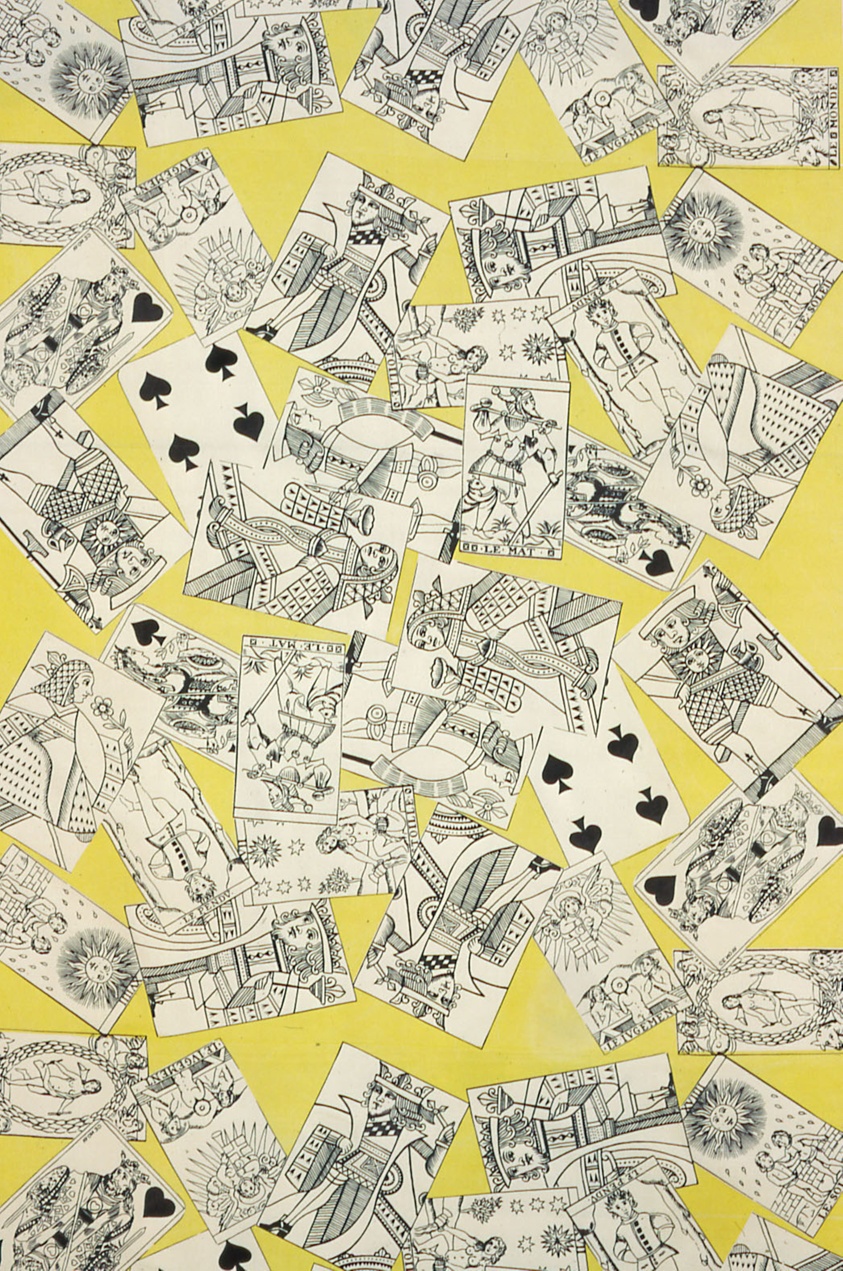
Featured Art: Playing Card by Piero Fornasetti

I’m glad Cezanne was not here in Key West
to set up an easel and paint
the card game I was in last night,
unless he was really good at depicting despondency.

Cezanne once said that a single carrot,
if painted in a completely fresh way,
would be enough to set off a revolution.
I’ll bet he was sitting in a café that day

where such observations are usually made,
but if I had been sitting in that café
across from Cezanne I would have quipped
“Maybe if Bugs Bunny were in charge of things,”

and I would have described in a fresh way
how the famous rabbit might be portrayed
pointing the mob to the Bastille with a carrot.

Beer and chips and more beer and chips
were served at the poker table,
but no carrot soup, a staple on every menu
in the bunny rabbit stories of Beatrix Potter

and a dish that would have warmed me
inside and out the way a good soup does
and made me feel much better
about losing all my money and then some.

But at least now I have found the answer
to the old question of who would you invite
to your ideal dinner party:
Paul Cezanne, Bugs Bunny, Beatrix Potter,

and okay, maybe at the last minute, Gore Vidal.


Read More

Made-up Saints

By Claire Scott

Wile E. Coyote free-falling from a cliff,
Sylvester flattened by an iron safe,
scads of sodden Kleenex at my side.

I put my name on a waitlist for mercy
(a light-year long).
I murmur worn mantras,
send prayers to made-up saints:

Saint Jackson of bankruptcy,
Saint Tiffany of clogged toilets,
Saint Lester of shapeless days
& tedious tomorrows,
Saint Elmer of the toss-and-turn.

Someone else dreams my dreams at night.

Am I missing the point
or was it never there?
A diver yanks a rope,
a wrestler taps out.
I tip over my King.
Checkmate.


Read More

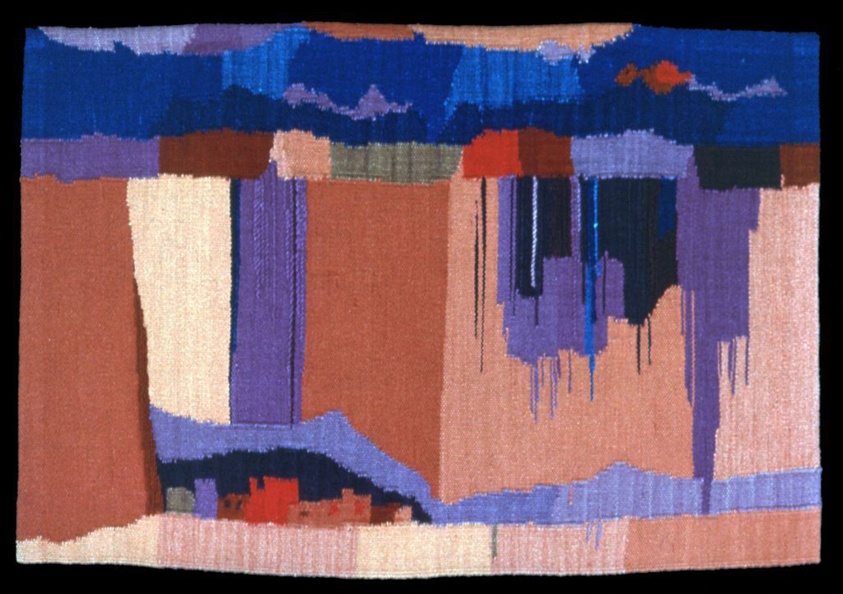
Aubade with Looney Tunes

By Matthew Luzitano

Featured Art: Chelly Canyon by Alice Kagawa Parrott

Your love is a tunnel
painted on a canyon wall.
My love is an Acme,
ripped open despite

certain failure. The TV,
at least, is turned on,
and you say, “Well, that makes
one of us.” Years of this bickering—

can’t Bugs and Daffy
just kiss already? Instead,
the duck marches into the glade
of a dozen cocked rifles.

Why does desire keep ending
in violence? The cat catches
white paint and the skunk
tears apart Paris after her.

You want more thrills? Let’s run
over something in the road.
If the two of us follow the sunset
off a cliff but never look down

are we really falling? In this episode,
lover is a word that means
two people embracing
the same stick of dynamite.


Read More

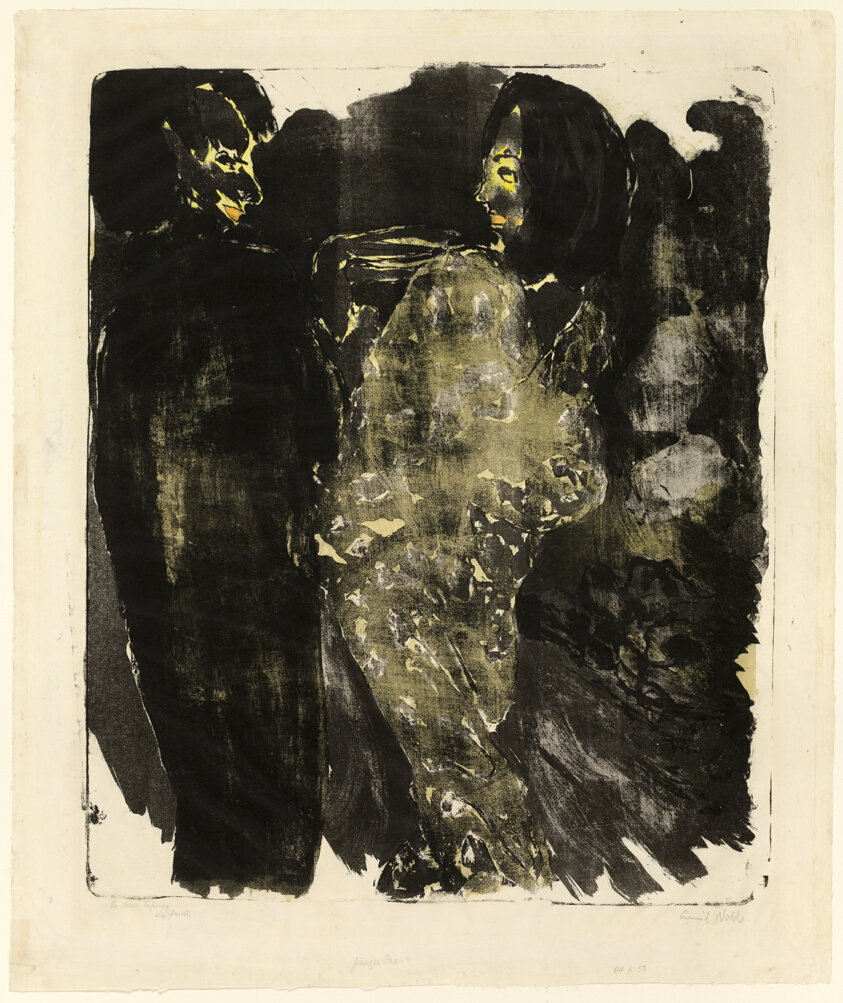
Tightrope

By William Fargason

Featured Art: Young Couple by Emil Nolde

On the TV, a man is attempting
to cross the Grand Canyon by walking
on a tightrope. He holds
a large pole to balance himself,
slippered feet cupped around
the two-inch metal wire. What poise,
balance. We are watching this together
because you’ve driven over
to pick me up for dinner, but neither
of us will turn off the TV
or stand up. By now, we are invested
in the outcome. You pull closer

to me on the couch. Will he make it
across? Will the cameras keep rolling
if not? His family waits on the other
side of the canyon. Your hand
on my leg tightens when the wind
picks up, causes the man to bend
down, pivot the pole to regain balance.
I can smell the perfume you’re wearing
because we are going to a nice place
for once, that French restaurant
with all the candles. Your neck smells of lilacs,
or pancakes burning. I can never tell.

I know you won’t leave him
for me—and the man is halfway across
by now, the wind pushing against him,
forcing him to pause again—but I can
hope. I kiss your cheek. You smile.
Ten minutes of him moving one foot
at a time, holding his weight
against the wire, 1500 feet up
in the air, no safety net. You ask if
your car will be towed if you parked on
the street. I don’t think so. But we have
to leave for our reservation, we are
going to be late. I turn off the TV.
Looking back, how terrible
it might have been if you loved me.


Read More

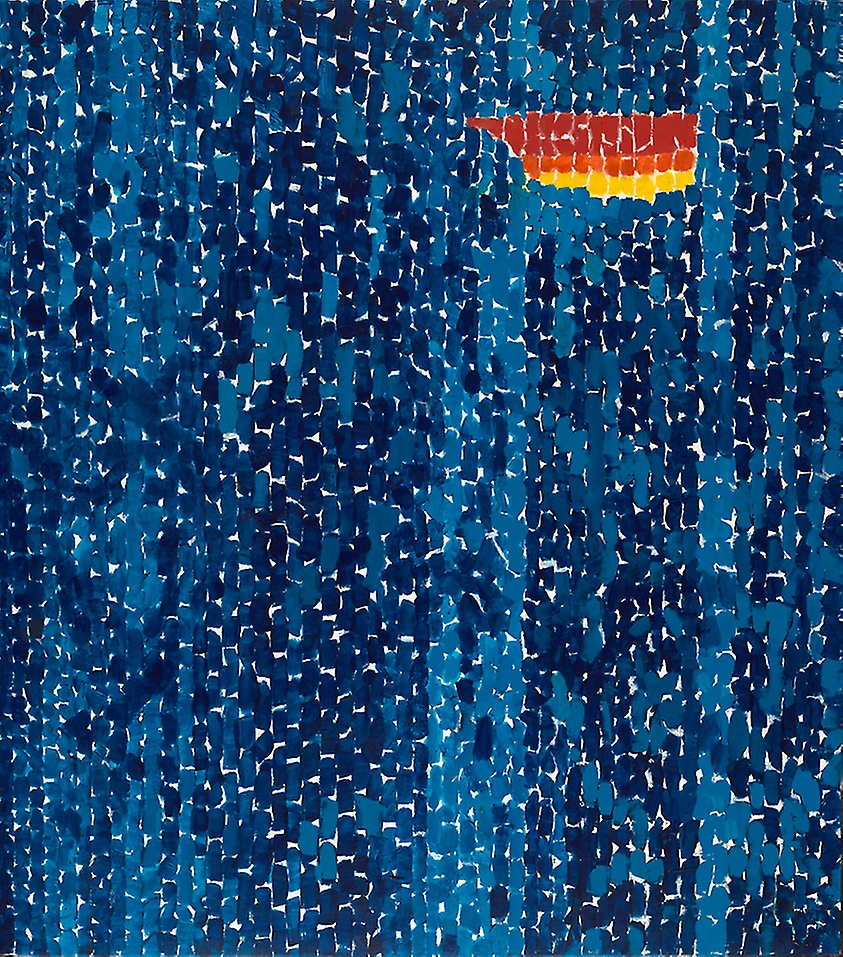
Loose Ends

By Gregory Djanikian

Featured Art: Starry Night and the Astronauts by Alma Thomas

I’ve been pacing the afternoon
like a high-wire walker
from room to room
counting the steps.

Dear Flying Wallendas,
help me reach out across the canyon
of lost connections.
Philippe Petit, speak to me
as if I were your balancing pole.

The letters I’ve written—
let them send me back a sign
they’ve been thumbed.
Let the numbers I’ve called
redial themselves till sun-up.

It’s the neighbor’s pickup driving away
pinging gravel with its tires,
it’s the geese barking the end of summer
that’s got me wishing for binoculars.

The fall leaves are floating down
as if they had something important
to say to the ground.

It’s been Sunday here all week.
I’m holding out for big-box deliveries.
I’m waiting in my soft-soled shoes
for the dog to bark.

Someone, come knock on my door.
Let’s see who’s inside.


Read More

The Blue Goodness

By Maureen McGranaghan

Franklin ducks into the janitor’s closet and mutters into the iPod Greg bought him. The Goodness is here. It is definitely here. Last night, the blue tarp stopped flapping, and it got very quiet. Then the Goodness filled the whole house like heat from the radiators. Greg and Kate stopped fighting and went to sleep. Now it is everywhere: The Blue Goodness

Franklin hears his name on the intercom. He is being called to Mr. Volpe’s office, so he puts his iPod in his pocket and emerges from the closet.

Mr. Volpe greets him, fiddling with his watch chain and rubbing the bald spot on his head. His voice sounds like rocks grinding against each other. Franklin thinks about the rocks when he speaks. How many?

“Your brother—is he sick?” Mr. Volpe asks.

Four rocks. Small. “Yes. He is. He has walking pneumonia.”

“Tell him to get an excuse.”

“Okay.”

“Have your mom write an excuse.”

Kate won’t do this because she says Roger deserves to have the book thrown at him, but Franklin says, “I’ll tell her.”

Read More

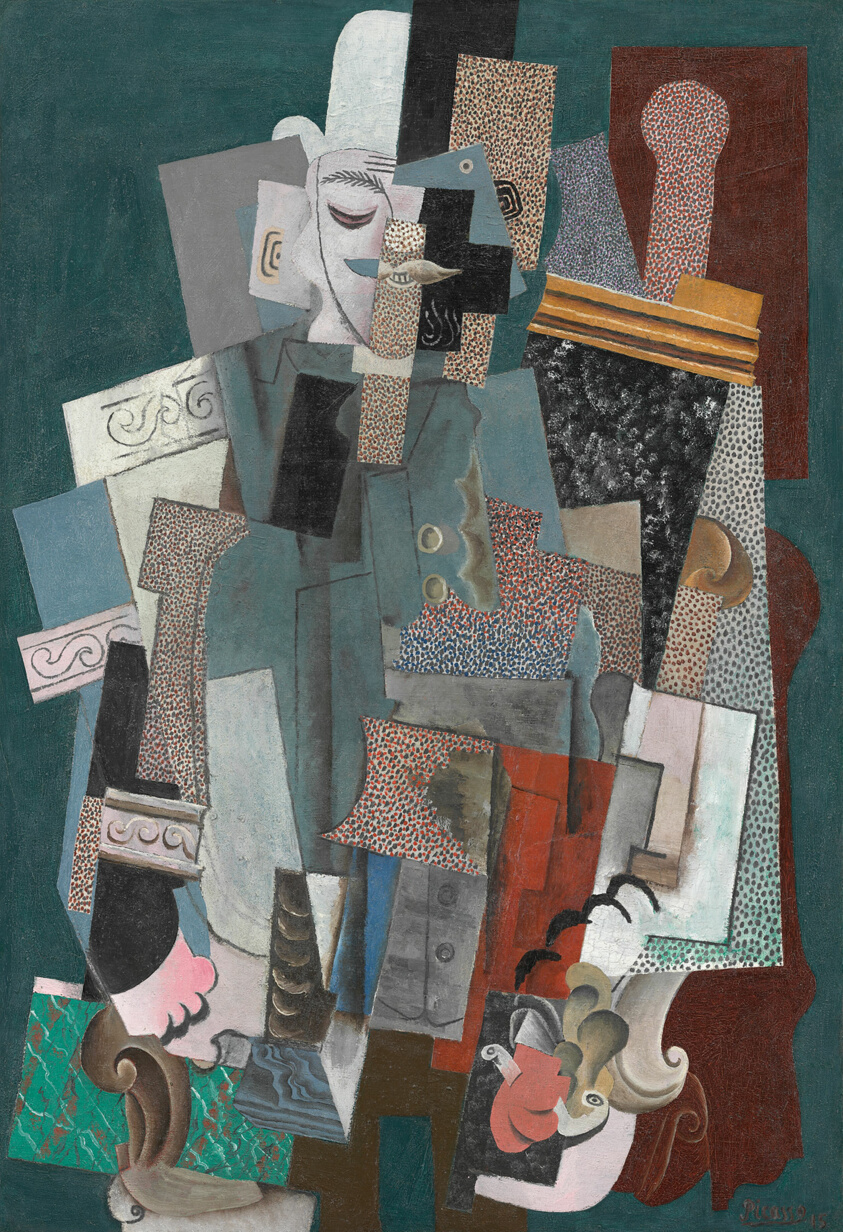
Judgement Call

By James Lineberger

Featured Art: Man with a Pipe by Pablo Picasso

I don’t know why you won’t show
your face maybe you
don’t know how maybe there’s some
rule about it
or you might be still sleeping or lost
somewhere in
between but if that’s the case
then why do you send these butterflies
to land on Barbara’s
arm and make her candle lights
switch on all
by themselves at four a.m.
and Robert said just yesterday
that you pop
up now and then in his dreams hands
in your pockets
leaning against a wall
and when he asks you what
it’s like you shrug and say it’s
okay which
is all right with me I don’t care how
much you share
with everybody else but unless
you mean to shut me out altogether
then isn’t it about
time we decided on something for
ourselves because
the way it is now I close my eyes
and I can’t even make
out your features your face is just a blank
like somebody wearing
a fencing mask or else I’ll try
to call you up

Read More

In the Gas Station Bathroom With My New Son

By Amy O’Reilly

Someone scratched out the C so it reads “Baby hanging Station.”
What isn’t conspiring to kill Baby?
Pillow. Blanket. Mother’s sleeping body like an island
resort battened down for the wet season,
the beds stripped of their festive linens,
clink of glasses beneath the bar while outside
the storm rages.

Motherhood turns out to be
less spot the warning signs,
more choose which ones to heed—

Like this floating table, its baby-sized crater
inundated with other tiny humans’ feces.
Beneath the black safety strap
my son looks sacrificial,
like he’s about to be experimented on.
Even when I’ve chosen right I have surely chosen wrong.


Read More

Guardian

By Rebecca Haas

Featured Art: Angel by Luc Tuymans

The station wagon’s engine’s going faulty. We’re driving 20 mph on the right side of the highway, half in the slow lane, half on the shoulder. Mom’s got both hands clenched on the steering wheel, leaning over the dashboard like she’s urging the car forward with sheer will. The car moves in rhythmic gasps, pausing in between the surges, catching its breath. Mom whispers, quiet so the little ones can’t hear. Bad, bad, bad. This is baaaaaad.

She turns to me and says, “I’ve got the gas pedal pushed all the way to the floor.” Like, can you believe this shit?

We’re just outside of Gainesville, Florida, headed back home to Cincinnati. For ten years—since my brother Kevin was born—we’ve gone on a family vacation to Florida. Mom said it’d be no different this summer, even after the divorce. But we didn’t go to the coast, where we used to go when Dad was with us. We went to Central Florida, to Ocala, where Mom’s sister Florence lives.

“You’re batshit crazy driving four kids down to Florida by yourself,” Flo said.

The air coming in the car windows feels like steam from a hot shower and smells like Kevin’s farts. Sweat has my bare thighs glued to the pleather front seat. The baby’s asleep on a quilt in the way back. My sister Kate is sprawled out on her stomach over most of the back seat, reading Mom’s book, Flowers in the Attic, which she shouldn’t be reading because she’s only eight. Behind me, Kevin is squished against the door so no part of his body will touch Kate’s skin, his feet dancing a jig on the back of my seat.

Read More

No One Dies in Fiction Anymore

By Kaj Tanaka

Featured Art: Heart of Darkness by Sean Scully

I. Sherman Alexie

Once again last night, a dead woman appeared to me. She spoke my name and asked me to help her back into the world of the living. She said she was so close to me; it would only take a small caress and she would be flesh and blood again. I didn’t move. Her face hung over my bed until the dream resolved itself, and I was awake again, and this morning was gray and cold just like yesterday morning and the morning before.

This morning, I heard our neighbors’ little daughter crying in the room above us amid the crashing of furniture while her parents fought. The crying and the fighting were so loud my wife wondered if we should call the police—we decided not to, and then my wife left for work, and the fighting died down. I texted my wife to let her know things were quiet again. She texted me “okay.”

Today, I read Sherman Alexie’s poem “How to Write the Great American Indian Novel” for the first time. I have spent the last three years of my life writing a novel about the time I spent living on an Indian reservation in South Dakota, and when I read Sherman Alexie’s poem, I realized that what I had written, while true, was not useful. No one needed my novel, and I was stupid to think anyone did in the first place. I should have known a year ago when one of my Lakota friends ended our relationship because of this novel—when he heard what it was about, when I told him. We’d been drinking out in the bad-lands; the sun was coming up, and I asked for his approval—“blessing” I think I said. He threw an empty bottle at me. He told me I was selling him out just like all white people do eventually, which is pretty much what Sherman Alexie was saying also. And the next day, we were hungover, and we pretended to have blacked out the entire incident. Even so, we have not spoken since.

Read More

At the Outpatient Clinic

By Andrea Hollander

Featured Art: Free Clinic by Jacob Lawrence

The young woman in the maroon hat
is tapping her left foot as she stares
into her empty lap. She’s kept her coat on,
its collar of fake fur buttoned at her throat.
The woman’s face is pale—blanched is the word
I was about to use, but my mother’s name was Blanche
and I don’t want to think of her, the way at the end
she grew so white and thin, her hair so black
I thought someone had rinsed it with ink. She lay so flat
beneath those hospital sheets, I thought at first
the bed empty, that they had taken her away.

Now a man I didn’t see before gawks at me,
his eyes earnest, green, and stern like my father’s.
“Angela,” he says. “No,” I say, but he keeps staring.
I’m saved when his name is called,
and he turns his head the way my mother did
that last time when I stood at the foot of her bed,
her name on a blue card inserted
into the slot beside the door.
She stirred when she heard my voice,
then turned away.

My mother’s head of ink-black hair
on that bleached white pillow,
her name typed out in block letters
on one of those little blue cards.
What do they do with them
afterwards?


Read More

And Later I Will Forget About the Bread

By Andrea Hollander

Featured Art: From the Kitchen by Ruth Levy

I try to stop glancing at the clock, try
to focus instead on the task at hand, dusting
my palms with flour, lifting the round ball
of dough from the board, slapping it down again.

My son is driving home, his first solo trip,
his teenage eyes partially, I hope, fixed
on the highway’s center line.

From my kitchen radio, Vivaldi’s The Four Seasons.
I can never tell which one, the way I never remember
what Daylight Savings is supposed to save us.

I knead the dough to the music,
pick up the sluggish ball, slap it down,
push the heel of my hand into it,
fold it, pick it up, slap it down.

When my son was born he nearly died.
Now the clock declares him
five minutes late, then ten.

I place the dough into the ceramic bowl
he gave me for my birthday
and cover it with a damp cotton cloth.

The music moves from one season to the next,
the strings vibrant now and airy.
Twelve minutes late, says the clock.

The dough will surely rise. And spring
will come, then summer. But only
if the car pulls into the driveway,
his house key clicks in the lock.


Read More

This Is How It Will Feel

By Jennifer Watkins

Featured Art: Woman and Child by Mary Cassatt

At three years old, you will sit beside me in a rusty Ford as we head south on I-95. The air conditioning will blow lukewarm air, and you will feel hot and sticky. From the carrier in the backseat, our cat will growl long and low. Looking out of the passenger window, you will see stacks of steel lattice speed by, connected by strands of drooping lines. Through the back windshield, a shrinking ribbon of asphalt, lengthening and disappearing into the horizon. After many hours, the dirt will turn from brown to orange.

“I want my daddy,” you will say.

“Daddy’s staying in Maryland,” I will reply.

A few weeks later, after boxes have been unpacked in the Georgia apartment complex called Cherry Tree Hill, a card will arrive in the mail. Tearing open the envelope, you will find a photograph of your father. He’ll be sitting in a leather office chair, smiling for his daughter’s benefit and wearing neatly pressed blues. You will clutch the picture to your chest, pressing your cheek against its sharp edges. You will kiss the photo over and over. I will tell you to stop.

“You’ll ruin it,” I’ll say.

I will hold you as you cry, and you will hear my heart beat as you lie against my chest. At three years old, you will learn: your mother is flesh and blood. Your father is envelopes and stamps.

Read More

Local News

By Christopher Kempf

                   Or dearest theater.
                                                      Aren’t we
all, the premise is, for one
                                    half hour, in tight zoom, suitable
for history? The Lyndhurst couple
         married, this weekend, at the bagel shop
                                                on Central. Who met
               among the jams & pumpernickels.
                                                                           The suspect
who fled the Chevron holdup
                                                on horseback.


                                          Athens, for instance,
was less its democracy—solemn
                  ecclesia, Plato
                                            bent to his parchment—than
the price of goat’s milk in the Way
                                         of Sheepherders. Ahead


           at five—teens
     skipping sleep. Teens
                                        at St. Cecilia’s filling the boot
                            for Alzheimer’s. Teens trend-
                                 huffing. Behind the co-hosts
the city poses on its screen. Sunset
                                       flashes. For a minute
  our sundry lesser dramas—our bodies
            pulled from retention ponds, holiday
                                              toy lineups—form
a single American skyline. Small nation
           of lotto & weather radar.
                                             The ecclesia—they


did so, they believed, to banish
                       the idea of distance—prohibited
                                  star-gazing, so faithful
       they were to the stage
                                         & polis.


                                                      At Taco Bell
yesterday, two men
                     pulled knives on each other because,
            they said, of a woman. One
                                 drove off with her. The other
sacked Troy. We take you
         live, now, to Friday’s parade route. We
                                    will stay with this story
      as it evolves.


Read More