Mr. Cosmos

By Jill Christman

It matters not who you love, where you love, why you love, when you love or how you love, it matters only that you love.”

~ John Lennon

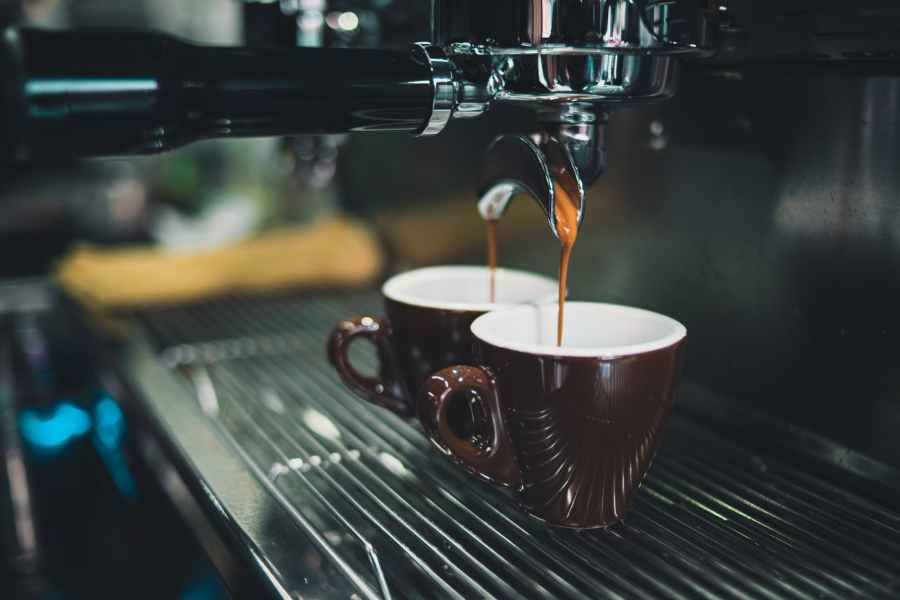
This morning I made a single-cup drip coffee and poured too much water through the small yellow cone. When I lifted the cone to peek, strong, black coffee filled my white mug to the brim. 

Nay, not the brim, I thought. Past the brim. I hung onto the edge of the counter and brought my eyes down level with the top of the mug, marveling at the way in which the coffee arched up out of the mug, a bitter mountain, the strength the surface tension pulling the coffee molecules beyond what seems possible. I would like to die on a coffee mountain, I thought, straightening my legs. I hadn’t yet had even a sip. Maybe it was time. The house was so quiet I could hear the muted ticking of the wall clock in the kitchen, thumping her plastic hands around inside her plastic face, bearing witness to the wonder of the coffee rising up and out of the mug, ticking off the seconds of our lives. 

This is when I heard another voice in my head. Mr. Cosmos, my fifth-grade science

teacher at the round school in Newbury, Massachusetts circa 1980. He’d given us all big cups full of water and little cups full of nothing and told us to pour water into our little cups until our cups runneth over. That’s the way Mr. Cosmos talked. Children, he’d say as if we were attending boarding school in mid-century England, Children, are you ready? Pour. Pour your water. Pour your water out—and let your cups runneth over.

Read More
Mr. Cosmos

By Jill Christman

Featured Image: Shadows by Sam Warren

It matters not who you love, where you love, why you love, when you love or how you love, it matters only that you love.

~ John Lennon 

This morning I made a single-cup drip coffee and poured too much water through the small yellow cone. When I lifted the cone to peek, strong, black coffee filled my white mug to the brim. 

Nay, not the brim, I thought. Past the brim. I hung onto the edge of the counter and brought my eyes down level with the top of the mug, marveling at the way in which the coffee arched up out of the mug, a bitter mountain, the strength of the surface tension pulling the coffee molecules beyond what seems possible. I would like to die on a coffee mountain, I thought, straightening my legs. I hadn’t yet had even a sip. Maybe it was time. The house was so quiet I could hear the muted ticking of the wall clock in the kitchen, thumping her plastic hands around inside her plastic face, bearing witness to the wonder of the coffee rising up and out of the mug, ticking off the seconds of our lives. 

Read More

Poem for Paul Who Never Forgets My Birthday Even Though I Never Remember His

By Alyssandra Tobin

paul says                                careful with the benzos  
& I’m like                                                  I think of you
whenever                 my therapist brings em up      &
he’s like aww                     dunno if sweet’s the word                     
but it’s nice                                        to be thought of   

okay    sure     let everyone see  my cute belly     let
everyone know                    I covet some people I’m
supposed to hate                       paul’s stupid meth’d
out calls unbearable       his empty bottles his days
& months       wild-eyed                  & away

once                                we wore each others jeans  
his tiny gold waist                   in my teen girl pants 
now    on the phone                      he says what’s up
ya fuckin guinea!           he teaches me to play iron
man      he gives me that   ninth step apology  that
making                                  of meandering amends   

me     so  scared  of  dying                &  him  always                                     
chest deep in it                          I sit so quietly       a
very good dog                        in her dim little room      
but he            gives me cocky courage                  he
gives me  warm love        that boston street salt
kinda love              that let’s never brawl kinda love    
that I’ll kiss your dirt love          that I’ll help you lie
to chicks love       that mall parking lot love      that
if I’m a blight                     you’re a blight kinda love    
that noogie     that cackle      that snakebite     that
augur        that    yeah                          I’ll call you on
your bullshit pastures               if you call me when
my dumb pig jumps her sty         off to somewhere
cleaner than both                    our loud green yards


Read More

I Love You Too, Bro

By Alex Howe

Featured Image: Mun by Sam Warren

for Catya McMullen

Beauty rears its ugly head – Assassins

You can be non-suicidal and less than jazzed about being here, two
Juuls at once like a pacifist dragon or the mild Dionysus of bad

ideas. Skip the Trix rabbit’s abjection: gift yourself the gift of
desperation, the terrible utility of popcorn for breakfast. “Whatever

you find uncomfortable and nasty about a new medium becomes its
signature, cherished and emulated as soon as it can be avoided”

explains Brian Eno bombing by on rollerblades into the flip phone
flipping shut into his fanny pack. The hotel’s Mahogany Hall

blooms two hundred vape plumes the moment the emcee mentions
prohibition on same. These teen alcoholics don’t drink, they bong

Monster, fuck senseless, talk about drinking. Pray to doorknobs.
Play Mafia. Splash the ping-pong ball into the cup of Red Bull.

Drop the sick beat. Crack your glow stick.


Read More

Turn To Kristen Bell

By Alex Howe

for Darcie Wilder

Turn to Kristen Bell and ask if you should do something a little
reckless. “You know the world is ending, right?” She’s not the
person you go to when you want to be talked out of something.
That’s what probation officers are for. Kristen Bell doesn’t think
people take yolo seriously enough. It’s tough to argue with her. She
says, “What’s a little reckless?” You tell her you’ve always loved
her. Love-loved. She laughs. “That makes sense. No offense.”
You’re starting to have second thoughts about flying this plane into
Exxon headquarters. You’re starting to panic. Name three objects in
the cockpit. Name an animal that cloud resembles. Estimate the
plunging angle of descent. As if sensing your turbulence, Kristen
Bell says, “Have you ever seen First Reformed? With Ethan
Hawke?” “Daddy,” you respond. “Exactly,” she whispers. “Daddy.”


Read More

Domestic Chess

By Andrea Bianchi

Featured Image: Pink Rat by Ellery Pollard

1. His first move is checkmate.

2. A punch that expels the laughter from my stomach as I stand before him at the end of our chess game.

3. “Wipe that smirk off your face,” he hisses beneath the Saturday morning chatter and jazz of the coffeeshop. “You’ve been gloating. Taunting,” he says. And yes, after our first sips, I did tease him to try for a victory, challenge him to a game of chess. Wanting to imitate another couple, heads bent intimate over their own little world of 64 checkered squares, at a tiny table just a bishop’s diagonal from the sofa where we sat.

4. He waits there afterward, tense on the cushion’s edge, when I return from the restroom, from a respite after his loss of the competition, his loss of composure. But his eyes pierce my smile as I pause in front of him. My stomach at the same plane as his arm. And then his fist connects level with the center of our lives.

5. It breaks the rules of play—and of the law, and of our love. Our months of happy Saturdays at the beach. Dinners beneath twinkling lights. Fights, arguments, yes. But afterward, mornings under the sunlight-checkered bedcovers, where we fed each other breakfast and curled together with our cats, as we mapped out plans for our shared weekends, then our first shared apartment. Our relationship’s next moves.

Read More

My Daughters Sometimes Dress as Ladybugs

By Brian Simoneau

Featured Image: Untitled by Tanner Pearson

and I hope they won’t
outgrow it—little heroes
flitting leaf to leaf
in their polka-dotted suits
of armor, their vicious
pursuit of the feasting
pest that destroys what
beauty these days still lives.


Read More

Make Sure There Is Breathing Room: A Conversation with Tania De Rozario, author of And The Walls Come Crumbling Down and winner of the 2020 NOR nonfiction contest

By Kay Keegan

Kay Keegan: Describe your writing practice and how you sustain it. Has your process changed over the course of your writing career? How about during the pandemic?


Tania De Rozario: I am not a very organized person by nature so I work really hard to set detailed schedules and deadlines for myself because if I don’t have a schedule to look at, I am unable to get anything done. Setting aside daily time for my personal writing becomes part of my overall schedule. That said, I am not one of those people who has output goals. Like I don’t have a word count I need to meet every day. I am actually a very slow writer -slower than most, I think- and I need a lot of time for things to percolate. So in that time that I set aside for my writing, I am not necessarily literally putting words on paper – I could really just be sitting with an idea and dwelling on it and letting it develop in my brain. And when I am blocked, I use that time to do something that activates a different part of my brain (like drawing or baking, for example) so that the writing part of my brain can continue to solve the issues it needs to solve subconsciously without me bothering it. Once things are on paper, I try to make sure there is breathing room between edits – again, this is to let things percolate, and to make sure I come back to the draft with fresh eyes every time. I don’t think my process has changed very much over the course of the pandemic. One thing that has changed over the course of my writing career is that I am now in much less of a rush to get to the “final product” and more focused on giving every piece of work enough breathing room to develop into the piece it wants to be.

Read More

Review: Jessica Pierce’s Consider the Body, Winged

By Eric Stiefel

Jessica Pierce’s debut collection of poetry, Consider the Body, Winged (First Matter Press, 2021) is earnest, contemplative, and hauntingly elegant.  Perhaps most importantly, the poems in Consider the Body, Winged are unflinchingly honest; they say what a less courageous poet might shy away from, what a less thoughtful poet might hide behind unnecessary flourish.  Throughout the process of reading it, I found myself thinking of Jessica Pierce’s collection as a collection of meditations, each poem devoting its unfettered attention to the subjects at hand, from divinations and incarcerations to postpartum depression and lapsed faith.

The collection opens with a poem called “What do we know of endings?” (p. 13), which begins with an extended hypothetical: “And if the earth could gather up all / it contains, all its clouded greened / burning dusty torrential glory and grit…” the poem continuing on with bloated vultures and scrawny cats drawn into the image, new blues and crescent moons and wicked gods alike.  Near the end, the poem turns toward introspection, asking if the world has room for “my grief / and my longing and your grief.”  Then, after a pause, the poem makes a point to include “And maybe, / maybe, forgiveness.”

Read More

“The Way You Might Search a Dark Attic”: A Conversation with Faith Shearin, Author of Lost Language and winner of the 2021 NOR nonfiction contest

By Kay Keegan

Kay Keegan: Describe your writing practice and how you sustain it. Has your process changed over the course of your writing career? How about during the pandemic?

Faith Shearin: I write in little notebooks. I keep one in my bedroom under the bedside table, two in the study, one in the kitchen where it is frequently stained by soup, and one in the back seat of my car. These notebooks are full of images that seem to require my attention. One of my professors in graduate school, Thomas Lux, recommended writing ten pages a week about anything that captured my imagination; he though the act of putting pen to paper regularly kept a writer in touch with their own unconscious and creativity. (Two of my favorite books for writers The Artist’s Way and Writing Down the Bones offer similar advice.) He taught me to revisit this stream of consciousness writing with a highlighter the way you might search a dark attic with a flashlight if you were seeking love letters or fine china. I have managed to keep this habit in place, mostly because I enjoy routine and solitude. I write, in part, to see what I think since this is not always immediately apparent. In a letter to [her] literary mentor Thomas Wentworth Higginson, Emily Dickinson wrote: “I had terror since September, I could tell none; and so I sing, as the boy does by the burying ground, because I am afraid.” Like Emily, I also write because I am afraid. I wrote much less than usual during the pandemic; my daughter came home from college and we went hiking together among the rows of slate headstones in old New England cemeteries; we hiked through the remains of four towns that were drowned to create the Quabbin Reservoir; we made soups, and tie dyed masks, and watched every rerun of Northern Exposure and M*A*S*H.

Read More

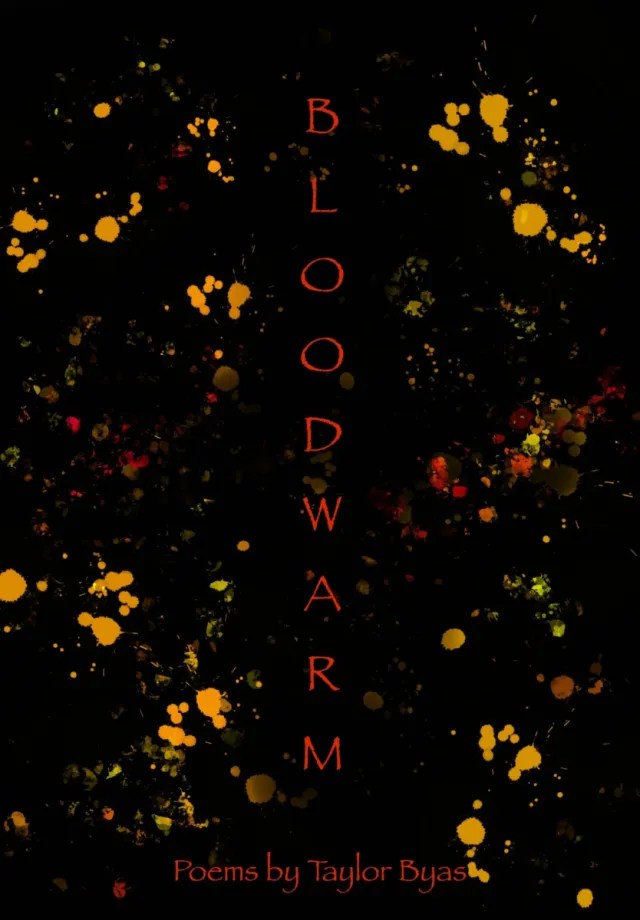
Review: Taylor Byas’s Bloodwarm

By Eric Stiefel

Taylor Byas’s debut chapbook, Bloodwarm (Variant Lit, 2021), does the work that a good chapbook should: It’s bold, concise, and daring, and it hones in on what it wants to say, collecting its poems as variations on a theme without spending too much time retreading worn territory.  Bloodwarm dances between the formal and the formally engaging, from sonnets to pantoums to erasures, to poems written from the past, to poems written as voicemails, as highway exit signs.

The collection starts in media res with “My Twitter Feed Becomes Too Much” (p. 1), opening with a pair of violent images from 2020’s George Floyd protests against police brutality (and the further police brutality inspired by the protests).  “I come across pictures of two rubber bullets / nestled in a palm,” the poem begins, later telling us “The caption reads These maim, break skin, / cause blindness.”  These lines are contrasted with the next image: “Another photo—a hollow / caved into a woman’s scalp, floating hands // in blue gloves dabbing at the spill.”  

Read More

New Ohio Review Issue 29 (Originally printed Spring 2021)

Newohioreview.org is archiving previous editions as they originally appeared. We are pairing the pieces with curated art work, as well as select audio recordings. In collaboration with our past contributors, we are happy to (re)-present this outstanding work.

New Ohio Review Issue 29 (Originally printed Spring 2021)

Newohioreview.org is archiving previous editions as they originally appeared. We are pairing the pieces with curated art work, as well as select audio recordings. In collaboration with our past contributors, we are happy to (re)-present this outstanding work.

Issue 29 compiled by Brady Barnhill, Benjamin Bird, Sarah Hecker, Callie Martindale, Ellery Pollard, and Julia Smarelli

Ode to the Fresh Start

By Susan Blackwell Ramsey

Featured Art: Untitled by Joseph Taylor

Sock drawer with its moth husks, limp mismatches,
       rank refrigerator’s stink of shame, closet
               whose back wall I don’t remember . . .

In Sanskrit abhyasa means practice, discipline,
       not giving up, but starting over
               and over and over again. Just start. Abhyasa.

So when I unroll my yoga mat
       and it promptly rolls back up, I flip it over,
               fling myself down on it, grunt “abhyasa.”

Veteran of fresh starts. I’ve trained myself
       to believe there will be dustless bookshelves,
               push-ups, French refresher courses, kale.

This time will be different. It always is.
       Maybe the trick is shorter and shorter gaps
               between the restarts until they run together,

like rolling out the lawn mower in May,
       working to get a cough, another, three, and with a roar
               it starts again. Once more that green smell rises.


Read More

Entropy

By Elton Glaser

Featured Art: Apartment With a View by Tyler Thenikl

Will this be one more summer spent
Among the ornamental mailboxes and garden gnomes,

As if I’d come down with a dose of lassitude,
Too much muck in the bloodstream?

That’s better, I guess, than a long month in Lubango,
Not far from the hovels and dead dogs,

With something strange steaming in the heat
And a bad case of the squitters,

And no worse, in its own way, than hearing someone
At the next table praise the taste of

Extra virgin truffle oil on the rutabaga fries,
Parsley butter sliding down a bison steak,

When what I crave is cruder: ecstasy of the unraveled,
Loose elations in a rumpled bed.

I’ve got nothing against sampling a farmer’s stand,
All those honeydews nestled in straw

And peaches fat and pink and above reproach,
Or an afternoon rocking on the front porch,

Sipping a tall cool glass of julep and watching
The dappled daze of sunlight on the leaves.

Ambling through the season, in a moveable feast,
Suits me like balm on a busted knuckle,

But when this life winds down I’d like to leave
Clean and alone, like a bone

Scrubbed free of the misery it went through,
And with a knob at the end

Big enough to knock some sense into
God On the messier side of heaven.

Here, in this bulging summer, too stuck or lazy
To rent another place to roost,

Let me at least reach out to what remains,
Anything still succulent and touchable.


Read More

A Summer Wind, a Cotton Dress

By Kate Fox

A glance held long and a stolen kiss,
This is how I remember you best.
—Richard Shindell

Little fires light themselves in the hearth, like tongues
                of flame that reclaim the Holy Spirit, like pitchforks

in this clapboard house where mayflies swarm and crackle
                against the porch light. On down, a gas station, a five-and-dime,

and your house, which I can see from the kitchen, where
                clothes on the line billow and collapse, billow and collapse.

This small town holds everything I will ever know and have
                to leave behind: bidden and forbidden glances,

voices from the second-floor landing that warn, Go no further.
                Night will fall and you will fall with it. Which is what I want,

for the universe to take up where I leave off, this longing
                so deep it can hold entire planets in its bottomless pocket,

yet shrink to the size of a finger at the hollow of your neck,
                heart drawing blood from the branchwork of your breathing.


Read More

4D

By Jon Fischer

Featured Art: Above San Gimignano by Tyler Thenikl

The 3D printer made a man and gave him a beard
to rub thoughtfully. It printed a book on mortality,
a pamphlet on sin, a monograph on time, and many other
fine things to keep in mind. Then it spun out two
of each animal and a boat around them. It printed rain
so long we thought it was broken, then
it printed an olive leaf. Its final act
was to print a 4D printer, which printed a memory
for the man, who said with his rubbery tongue,
I remember there were olive trees,
and he released one of the doves from its cage
below deck, where it spent the time we were given
under the gaze of two housecats and two weasels.
But the 4D printer started to print more
than the time we were given. Weeks rolled off in pairs, still
warm from the furnace of creation,
and wedges of space to move the stars apart
so the man had room to fill the weeks with many
fine things to keep in mind. That’s how we turned the world
into a dream, where time doesn’t know what to do with itself,
and you always end up falling.


Read More

Heron or Plastic Bag

By Jon Fischer

Far off in a vacant field beside an irrigation
canal alights a stately gray heron

or a plastic bag. The plastic bag flaps
and in the tricky light thick clouds leave behind

trembles in and out of translucence,
just like a heron. The heron flew here from another

land in search of a plot to fill and warmly
fulfill and mute the Sisyphean rhythm of restless

creatures’ lives, across countless miles
that would never do, just like a plastic bag.

Close up it’s clear the field holds both
a stately heron and a plastic bag, each

studying the other like figure and reflection.
Now the difference is obvious. The heron’s eyes

recognize the predicament he’s in, the infernal
froglessness of all this wiregrass, the length

of the horizon, the lean of a eucalyptus. Behind
his eyes is the continent where he first

leapt into a crystalline gust, and at beak’s end wriggles
a continent uncharted, fleshly, ready to be snapped up

like a young shad. But this time of year his wings
know everything there is to know about south

and nothing else. Whereas the bag simply is
the predicament it’s in and billows

with all the joy that has ever flown through
a thousand years of wind.


Read More

What the Drawing Explains

By Jon Fischer

It’s hard to describe a drawing of a millennium,
but you know it when you see it

on a sticky note fallen to the speckled tile
near the lockers in a high-school hallway

It’s rendered half of the social commentary
inherent in a peach-colored crayon, half

of ablative carbon fiber and iridium dust,
the artist’s signature a sketch

of the human genome. This millennium is half past,
half future, neither all that great.

The drawing smells like a philosopher’s feet.
It tells a story that rises off the paper

and reads the palms of passersby, turning life lines
jagged and love lines into spirals. It tells a story

that sinks deep inside the paper, seizing
for its fibrous heart the best and most harrowing

plot twists. Nonetheless, the drawing explains
why the Nile changed course, why tornadoes

and the sea found fancier homes,
why we made no new religions

but let the ones we had grow brittle, why we still
lose languages and serenade machines

and can’t be bothered to speak with aliens.
There you are in the middle, anatomically accurate.

Built around you are a cathedral and a labyrinth
then skyscrapers and scaffolding, a rational galaxy,

a fleet of anxieties, ignorance
efflorescent in a waxing tide, and your personal

win-loss record. You do with the drawing
what fine art does to you,

folding it into a Möbius strip for later,
and also for earlier.


Read More

Spring Reflection

By Stephanie Choi

Featured Art: Scarlet by Joseph Taylor

               You crave
For the wheels to ride across the puddle, muddied
With pebbles & all your past lives too

               You want to find again
That sky blue that’s been shut tight
All winter long

               You don’t know why
When you finally do
The birds mistake each strand of your hair for a branch

               You wish for the pecking to stop
And for the stillness of a bud before blossom
To return to you

               You ask for a taste
Of the warm cold wind on your wet lips
Just once more—

               You try to remember
What everything was like before
But you take a sip from the cup filled with dust
               & ash,     instead


Read More

In the Garden

By Kelly Rowe

Featured Art: Mimic by Dylan Petrea

When you were small,
we lived in a tropical state,
and you spoke fluently
a language only two could understand.

It had one word
for bean or ball or m&m or kiss,
three for water, six for dream
or any other risk.

When we talked, the dog danced on hind legs,
and the house sailed down the river,
waving its red and white flags.
The rain took you wading under the live oaks

and mispronounced your name,
but showered you with opals,
while high in the branches invisible birds
whistled back and forth in code.

Now, you live somewhere else,
I’ve gone a little deaf.
I press the phone to my ear
as your voice cuts out, fades,

and like the last speaker
of a lost language, I grope
for one of the hundred names for river,
or the single shouted syllable: Ma!

Meaning flash flood, meaning ark,
meaning the one we need
no words for, the one who flies to us
when we cry out in the dark.


Read More

Garden Sitting

By Jennifer Dorner

for my mother

Season of moths in the strawberries.
An apple or two fallen from the tree.
Plums not yet ripe, through the cornstalks
are burdened with silk,
the vine tomatoes split,
and the sunflowers track the sun,
a bee in each dark center.

Late to the tasks you left me
I unfold the watering instructions again,
late to harvest the beds circled
on your hand-drawn map.

The evening is a haze,
sheets of starlings stretched
over the mown grass field,
a brush of red beneath
the shadowed tree line.

This week I read about the dying,
how those who have passed
can speak to the ones left behind
in the language of what they loved.
One man who tended rhododendron gardens,
a canopy of blossoms suddenly falling
over his first daughter’s car
while the second daughter
gathered a loose cluster
blown down into her path
the moment their father died.

I slide your patio door open, step over
trays of vegetable starts
on the faded rug
packed with potting soil.
Your handwriting vertical on the slim
labels beside each stem:
chard, fennel, romaine, madeley,

winterkeeper. I wish I’d known better –
this world of straw hats and arthritic wrist,
the duct-taped trowel,
these rubber boots that fit my feet.


Read More

How to Peel an Orange

By Stephanie Wheeler

Featured Art: Peeled II by Samantha Slone

The dryer was making a monstrous sound. The repairman stood with his hand resting flat on top.

“I feel the vibration,” he said. He was a fat man with a three-day stubble sprouting in uneven patches on his face. His uniform shirt was belted into his trousers around the front and haphazardly untucked in the back. Hazel could see his milky eyes shifting rapidly through smudged glasses. She hated him a little.

Hazel nodded. “And you can hear it, too.”

He squinted his eyes, then squeezed them tight, concentrating.

Hazel decided that she hated him a lot.

“The grinding sound,” Hazel said, straining to make her voice heard above the din. “It’s quite obvious, really.”

“Ah, yes. The grinding. I hear it.”

Hazel’s cell phone chimed then, and she looked at the screen. The name Walt appeared in white letters, glowing.

Read More

Raw Numbers

By Jasmine V. Bailey

During his reign, four hundred bears.
On the bloodiest day, twenty-four.
On a hunting trip with friends, staged,
as they all were staged, twenty-two
and eleven for his friends. No one
tallied the boar and deer.
Ceaușescu sitting in his perch above a clearing a gamekeeper chases the bears through,
                 firing an automatic rifle.
One hundred thirty bears
in those last six years.
Brown bears, grizzlies in our West,
eat mostly plants
but Ceaușescu’s bears ate pellets
fed to them by the gamekeepers
who say they don’t like hunting anymore. 
He will die next to Elena
in December, nineteen eighty-nine, 
the shortest day of the year.
One hundred sixty-eight centimeters: Ceaușescu’s height.
The bears flourished with the kibble,
hunting forbidden to everyone but
Ceaușescu, their Conseil International de la Chasse points
unnaturally high.
Twenty thousand dollars 
to hunt a brown bear in Romania now
if you are a citizen of the EU. 
The population is smaller, each bear
smaller since Romania joined Europe—
seven thousand five hundred at the height
to fewer than five thousand three hundred
once the doors of the Carpathians opened. 
Forty-three grizzlies died
when Yellowstone closed its dumpsters.
Staggering in their final, worst hunger.
Once someone hatched a scheme
to raise bears for Ceaușescu’s hunts.
Two hundred twenty-seven 
bear cubs were torn from their mothers
who, crazed, had to be shot
to let them go, as I would have to be shot.
One or two: the number of toes cut off without anesthetic 
to create a code by which to identify each cub, 
who went insane with grief for their mothers,
who were never successfully raised for the hunt,
who all escaped or were released
haphazardly, dying on highways
and in circuses, ending in a daze
the daze of their lives.
Two: the number of days 
the cubs howled 
after their claws were ripped from their paws.
The number of suicides
during his twenty-four years as general secretary of the Communist Party 
of Romania:
not known.
Twelve weeks my daughter’s lived
outside my body.
I want to lie with her under one blanket
until God thinks better of so much. 


Read More

Ocean City, New Jersey

By Jasmine V. Bailey

I drove to meet you the first day of the year
at a B&B fifteen miles east of my childhood
on the White Horse Pike.
For three mornings we had a German pancake
and three cups of coffee 
with the black-haired innkeeper
whose husband coughed in another room,
whose philodendra vined her walls
and ceilings like a cage.

You led me down the beach that first night 
all the way to Longport Bridge
keeping secret what we were after.
Everything seemed a candidate—
the armor of some crab picked clean,
Polaris beneath the moon
like Marilyn Monroe’s mole.
When we got to the bay
I thought we might swim it.
Your face fell realizing
what we’d come to see was gone,
that you would have to tell 
what you’d brought me there to show.

The bioluminescence you’d seen
the night before I arrived
coaxing a glistering shore
out of the dark
was gone with the jellies
or bacteria arrived now in the Atlantic. 
You described it as a lit path, if
a narrow one, like the aisle
of an airplane you pace at night
when every passenger is asleep
because you no longer know
what your country is like
or if your mom will manage
to find her way to Philadelphia
to pick you up, or if there will ever 
be a child to grow so tired 
you have to carry her, sleeping,
all the way home on your chest,
her heavy head just starting to dampen,
her eyelids working against your heart—
and I saw it.


Read More

All Animals Want the Same Things

By Jeanne-Marie Osterman

Featured Art: “Catpurnia” by Julie Riley

I had a sickly cat whose cure,
said the homeopath, was raw meat 
so I replaced the canned food with scraps 
from the butcher and overnight 
her gingerly eating turned feral devouring.
She’d yowl as I took the jiggling red flesh
from the fridge, pace as I cut it into pieces, 
then suck it down before I could rinse the knife. 

This so exhausted her, she’d lie on the sofa 
for hours before getting up to prey 
on the dustbunnies under my desk. 
While I was watching Shark Tank one night, 
a ball of Kleenex walked across my living room floor. 
It turned out to be a mouse 
who was carrying it to the bookcase 
where she was building a house 
behind my dog-eared copy of Balzac’s Lost Illusions

Seeing the mouse brought my cat back to full health. 
She stalked the tiny creature, crippled it 
with her jaws, sat back to watch it struggle. 
I called the building super and asked him 
to take the mouse away, signing 
the creature’s death warrant. 

My sister and her husband raise cows for the slaughter. 
Though my sister will eat them,
she refuses to go to the slaughterhouse 
when their time has come. 
I watched how they do it on YouTube. 

An operator lines the stunner up 
with the sweet spot of the cow’s brain. 
The bolt inside is captive—
held like a breath in its chamber, 
then expired with such force 
it knocks the animal unconscious. 
The bolt doesn’t penetrate. 
It recoils to be used for the next. 
And the cow lives!
The heart keeps beating,
which speeds the bleeding-out,
which is the actual slaughter.

When my husband left, it hit like a bolt. 
He’d held his infidelity in like a breath, 
then walked away, recoiled.


Read More

Encore

By Maura Faulise

Featured Art: “I Feel Like Pieces” by E’Lizia Perry

Pulling out of Dingle Bay 
in the rental van that rainy day 
after singing to the tunes 
of the fiddle player in the family pub, 
my father drove red-faced 
and under the influence 
of what I now know 
was nostalgia 
for the affair he’d just ended 
before flying us over the ocean
to kiss the Blarney Stone. 
He mumbled her name at the wheel,
and something about O’Shaughnessy’s
fine music and the fountain of tears
and the Celtic rain.
When the van slid off the road
and into a field of peat, he punched
the gas to get us out
but the wheels stuttered in the cold mud.
Unconcerned with our fate,
we four kids sat stiff
in the backseat, doe-eyed
and glued to the rhythm
of our mother’s timorous noises.
I don’t know what moved him
—the relentless gray sky
or the lightning hammering
so close to the metal,
but he looked at us one by one
for a while
before opening his mouth to sing
of the long-long way to Tipperary,
where the heart remains
and he got us singing too,
broke us down the way he always did
amid claps of thunder,
angry rumble or applause,
I just couldn’t be sure.


Read More

Heels

By Justin Rigamonti

With a bouquet
of ferns
and lemon
yellow roses,
she looks
incandescent
in the dug-up
photo of
“the time I
got married
the first time.”

Meaning,
pain followed
hot on this
happy woman’s
heels. Meaning,
don’t think
her life has
hummed along
luminously
ever since.

Life never does.
But won’t a smile
like a string of
holiday lights
still have been
a smile?
And joy
for awhile
was still joy.


Read More

Anne Lester

By Emma Aylor

—1936–2013

Sleeping it off last night I dreamed I had one lung.
The other next to me in bed dark and putting
off smoke.                      When you were young
I passed my Virginia Slim so you wouldn’t get
the taste for it: I remember standing in the kitchen
lighting it up                                        for my girl.
You never did smoke after that. In front of the TV
last night I spilled the whole drink down my shirt
          a little in this world                                    a little in the other.

I’ve been Anne Moore for most of my life.
My last morning as Lester I looked
like Liz Taylor’s sister                        hair dark and glossed.
It’s hard to remember myself like that.
I depend on a picture to know I was beautiful—

waist a switch                in a virgin’s dress.
Couldn’t have done better at nineteen,
grew up so close to Tennessee.
We moved all over the plains for a time
and came back to Bill’s dad’s store.
I remember days up to my elbows in spicy chili,
nights raising you                               right up the hill.

My hands have shaken my whole life. Always think
it could have been worse. A favorite joke:
a parrot who swears is punished by being put
in the freezer. Once, it sees a frozen turkey
in the corner                          and says,
DAMN, that bird must                         have said fuck.
             I remember I told you and your daughter         you looked at me
like I didn’t understand a single stupid thing.
Would it make a difference if I did

that same house    your father repeating            GODDAMN IT ANNE
like a stuck station in front of you and all
my children’s                      children
                                                                    and

it’s morning in the bath now and I’m not getting up yet.
In the water a bruise on my arm
develops like a litmus paper                               a little
yellow—                                hardly acidic.

I remember leaving your daughter at the pool while I wet
my brain               came back to her sunburned
pink as a hot pig.              Remember she fell
off the bed and scarred her little nose
a white line still                            cut through the freckles.
Light through the bathroom                        glancing sideways.
            My daddy drank. I remember how bad.
It’s not really a reason                          but I remember enough.
My chest clutches                 a little
and then fills up.       Water gets a little bluer
with what comes off my skin.
It’s not possible that you remember me.


Read More

Mt. Athos

By Emma Aylor

Featured Art: “Skin ‘N’ Bones” by Arianna Kocab

1936-2013

My granny died facedown in the kitchen
of the isolate house: atop a hill named for ruins
of a burned plantation near, whose owner was rumored
to be buried standing so he could continue to survey
the land from his summited tomb, up a lick
off Opossum Creek, itself off a bend

in the body of the James. A stroke. And grandpop
made a big show of never looking at her face
again; he said he couldn’t overlap his memory;
he let her lay crashed in her own bones until help came, 
let her face settle into its death with no witness,
and I don’t know where her ash was scattered
after that, if it was, the memorial just a party in the house without
her around—a body never really there—and closing night

for my grandfather’s fifty-eight-year claim
to a good marriage. I took a train from New York
down through Virginia, eight hours marked
at intervals by the crumbling backs of Newark,
Baltimore, Washington, Charlottesville—
to Lynchburg. At one stretch, hard pink spray paint over
a whole swatch of dry grass. To tell the truth,

the ease of missing her then was almost a comfort.
Its relative water-fed simplicity. When I got the call
I had space set for further clearing.
On the walls she was nineteen and already flickering,
her hair in my mother’s curls, or mine, careful set
of her mouth, her heels and her dresses.
Down the dark hill, weeds lushed by June,
our dead gathered to murmur through the river’s red throat.


Read More

We Don’t Die

By Darius Simpson
Selected as winner of the 2021 NORward Prize for Poetry by a panel of previous poetry contributors

Featured Art: “Candid Sampler” by Amy Pryor

we second line trumpet through gridlock traffic.
we home-go in the back of cadillac limousines. we
wake up stiff in our sunday best. we move the sky.
we escape route the stars. we moonlit conspiracy
against daytime madness. we electrify. we past
due bill but full belly. we fridge empty. we pocket
lint. we make ends into extensions. we multiply
in case of capture. we claim cousins as protection.
we extend family to belong to someone, we siblings
cuz we gotta be. we chicken fry. we greased scalp. we
hog neck greens. we scrape together a recipe outta scraps.
we prophecy. we told you so even if we never told you nothin.
we omniscient except in our own business. we swallow a
national anthem and spit it out sweet. make it sound like
red velvet ain’t just chocolate wit some dye. we bend lies.
we amplify. we laugh so hard it hurts. we hurt so quiet we
dance. we stay fly. we float on tracks. we glide across
linoleum like ice. we make it look like butter. we melt
like candle wax in the warmth of saturday night liquor sweat.
we don’t die. we dust that colonies couldn’t settle. we saltwater
city built from runaway skeletons. we organize. we oakland in ’66.
we attica in ’71. we ferguson before and after the camera crews we
won’t die we won’t die we won’t die we won’t die we won’t


Read More

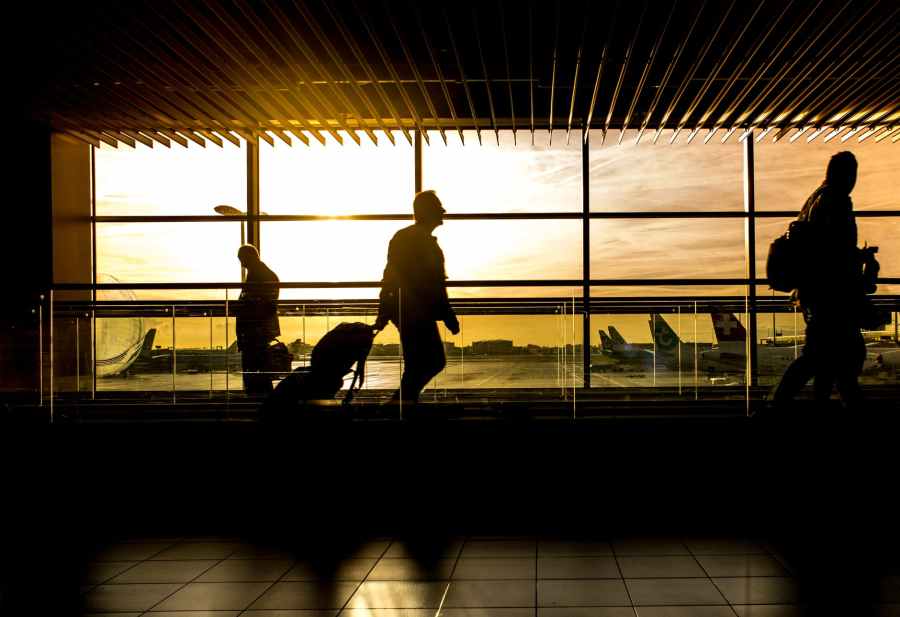
Essentials

By Todd Boss

Featured Art: Silhouette of Person in Airport by Skitterphoto

I’m down to two bags.
I use a friend’s address.

I’ve only got one last
recurring nightmare

that forces me to face
my ex. There’s still one

child I haven’t lost, but
he’s next. Even loved

ones are non-essential,
sorry to report. You’ve

come here for news of
how to live, but Grieve

and grieve, is all I can
say. Grieve enough, you

can even get grieving
out of the way. Grief’s

chiefest among chores.
Do it well, and the

mostly empty universe
is yours.


Read More

Tracers

By Todd Boss

Featured Art: Window View of Sea during Golden Hour by Jeffrey Czum

Let’s say one day
the ballgame from
the day before mysteriously
rematerializes in the form of
tracers—each pitch,
each hit, each catch,
each toss, each
criss and crisscross
marked—chalked
in air—here, there—
reiterated, the way a
window, fogged,
remembers the last
things third graders
wrote with fingers
on it. Let’s say it
rendered the field
unplayable so they
let you walk it.
They would. It’d be
a big attraction—
tracers interlacing,
crepe paper streamers
of a pastime past,
most between bases
and the rest of the
bands connecting
home plate with
the outfield or even
the stands in some
cases—inning on
inning of contrails
twinning and twining
in defining strands
as if the ball’d been
string. It might
not mean anything
but it would be odd.
My god, you’d say
at the sight, ducking
the not-quite-straight
line of a line drive to
right, remarking how
much of the game,
which seemed so
grounded last night,
is in fact in flight—
pure energy
transferred from giving
hand to waiting
glove, the way our
lives are made of
thought and love
and word and prayer
in particle or wave
surrounding every
numbered and
unnumbered player
on the planet in a
dome of light
that stadiums us,
immense, between
the dugout caves we
crawled from and the
outfield fence.


Read More

He Divides His Time Between

By Todd Boss

Featured Art: Green Leafed Trees by Pixabay

is a line I
always wanted
in my bio.

“He divides his
time between
Reykjavik and
Sandusky, Ohio.”

“He summers
on Lake Como
and winters
in Aspen.”

As it happens,
noplace is
like home.

We multiply
when we divide
our lives, our
loves, and our
addresses.

Now my father’s
son is a ghost,
a wisp of smoke,
a metaphor.

He divides his
time between
nothing and
much and
matters and
anymore.


Read More

At the Coffee Shop on Rogers

By Robert Wood Lynn

Featured Art: Close-up of Coffee Cup by Chevanon Photography

When I was done I took my teacup
to the bussing station where the tub said No Trash
so I fished out the teabag but the only trashcan
had one of those blue liners so I couldn’t tell
if it was for recycling. I decided to throw
the teabag out in the garbage on the street
which meant carrying it there dripping
in my hand like a dead bird, one I didn’t kill
but still felt moved to bury—the barista saw
and asked me why, as if a reason was
another license I’d forgotten to renew.
Composting. I said I was desperate
for compost in my garden. Now
every morning she gives me handfuls
of spent teabags, the way the cat would
bring me offerings of dead birds
which seemed sweet until I read how
cats think we can’t take care of ourselves.
After being fitted for a hearing aid
my deaf friend was most surprised to find
sunlight didn’t hum, unsettled by how cats
could choose to move in silence. She became
obsessed with the sounds of birds: collective
at first then individual. Quiet only in repose
like these teabags I throw away on the street
and feel guilty I don’t have a garden. Not even
a balcony. The cat’s been dead for years.
It’s morning and my hands are soggy, I know,
for the stupidest reason. In spite of the evidence
I am getting good at being alone.


Read More

Albuquerque Sunrise

By Ashley Hand

Sometimes I was Melissa. Other times I was Alexis, or Estelle. One night I was Shelby because we’d just watched a Pierce Brosnan movie where he drove a 1967 Shelby GT. By the end of the night the name felt natural and you were slinging an arm around my shoulder and calling me Shelbs. You were always yourself. You were Mac. I wore wigs. I wore peel-and-stick nails. I did elaborate makeup. One night in October we went to the Albuquerque balloon festival and wandered around at dark on the fringe of the crowd, watching the torches gas up into the hollows of the parachutes like they were big paper lanterns, and I was made up in the spirit of Día de los Muertos, a pompadour of blood-red roses that we’d trimmed from the yard crowning my head, and we held hands in public and my face was stiff from paint but I felt like a queen gliding through the stalls of the outdoor fair in my black bodysuit, unrecognized. It smelled like roasted corn and the grass was wet from a rain and the night was warm and it felt like we were free. 

At first we stayed in all the time. We played gin rummy and did crossword puzzles and had sex. We grilled on the patio for dinner. In the evenings we would drink wine and the house was quiet and we would listen to Taps play out over loudspeakers across the Air Force base and watch the last vestiges of violet light disappear behind the wall of cypress trees that blocked out the power lines and concrete buildings. After the final peals of the bugle call, the clicking of the cicadas would resume. We’d slick our legs and necks with bug spray and light a citronella candle and share a cigarette. We talked politics and books. We played mancala and cribbage. I’d tell you stories from my childhood and you’d pet my hair and tell me my father was a bastard.

Read More

The Delay

By Emily Sernaker

Featured Art: Black and Gray Metal Tool by _ Harvey

Maybe by the time you read this a golden retriever with a bandana
will be snuggled up against my knees. Or the man I love,
the one I get to keep, will be kissing me goodbye for the day
his lips tasting of cereal and coffee. Instead I’m living

with my college roommate Breezy in Bushwick, Brooklyn.
Breezy just gave me a bottle of Unconditional Love
perfume she won at the gym. Her little Tootsie Roll
of a dog, Charlotte, a Boston terrier, keeps hiding bones

in my bed. My bedroom used to be Breezy’s dining room
before the divorce. It’s safe to say neither of us thought
this is where we’d be—but we’re making the most of it.
She owns wind chimes. I bought peonies. Outside our front

door someone has graffitied the words TROUBLE FUCK!
which we prefer to read as FUCK TROUBLE!
And we found that duck in Central Park, the mandarin
rainbow that isn’t supposed to be there but is.

Maybe by the time you read this I won’t be waiting
to be happy. The truth is things are going well.
Everyone I love is alive. Breezy printed a 12×16
of the misplaced firecracker of a duck. She had it framed

and matted it’s hanging in our living room.
He’s staring down the camera
saying: Aren’t you glad you got to see this?
I dare you to wish you were anywhere else.


Read More

January Dispatch

By Emily Sernaker

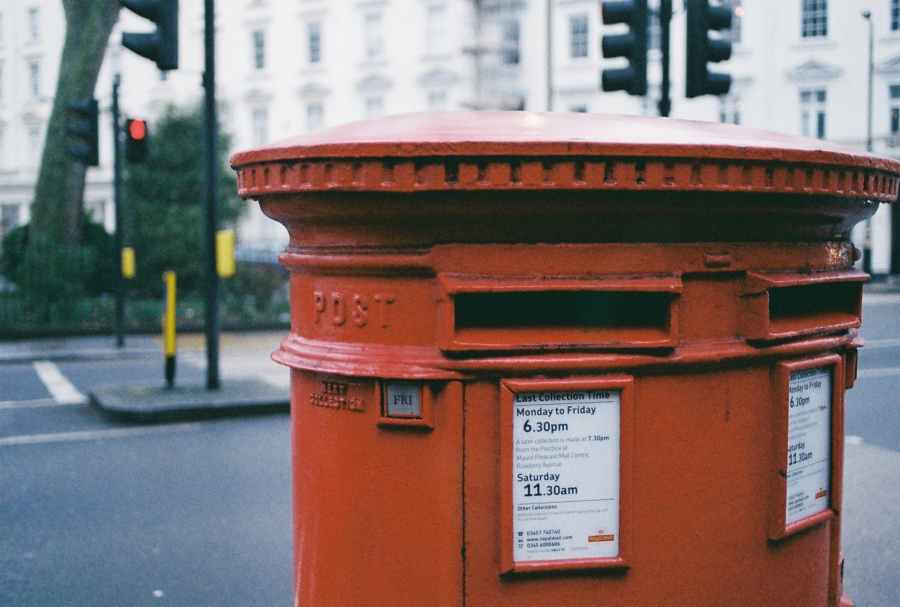
Featured Art: Oblong Brown Metal Mailbox by sl wong

I misread a signal and accidentally hugged my mailman.
He was just tapping me on the arm and I somehow went all in.

In other news, my former barista is meeting me for coffee
and bringing Arthur her rescue dog. I met another fantastic

dog this morning who had never seen snow before
he was zig-zag walking losing his mind with joy

trying to lick it all up. I have to wear a brace on my right
hand for a while, it’s some kind of strain. Two days ago

Tom and I broke up. We were both hard crying. It was just
one of those top five hard things in life. I keep thinking

about the time Tatianni spotted a rose-beaked cardinal
in my backyard. She knew to look for the second one,

was sure it would be there. It’s like how I feel
finding Philip Levine and Larry Levis always spine

by spine in the bookshop. Some things you can count
on. Anyway, the snow has left impossibly soft lines

on everything. Bicycle tires, lids of mailboxes.
What’s the opposite of underlying? It’s like that.

Powdery bright marks saying take note.
This will probably be important later.


Read More

Exile

By Margot Kahn

On Saturday I trolled for places back home.
Home as in the place I was raised,
not that elusive ancestor thing, the soul or—

just the place where my mother set plates
of flank steak in front of me, or left me
with a cardboard box, the frozen trays.

When everything’s up in flames,
I yearn for a yard I know the edge of—
for lightning bugs trapped in a punched-lid jar;

the lip of the brick fireplace where my father sang
his Navy songs, and the kitchen where my mother baked
blackberry pie that bled out across the floor;

the days I drove myself to school and picked myself up,
hotwired the minivan, got felt-up, and learned about loneliness
from a phone attached to the wall;

the place my parents were the first to be born to,
the place I had the privilege of being bored;
the place I had the privilege of leaving.

Here, from my kitchen window, the hills are first
to disappear. Then goes the fence, the garden,
the rutted gravel drive. My lungs hurt just watching it,

reading in sans serif that friends had minutes to flee.
I see the hill behind their house awash in light, ablaze—
a transcendental image for an Instagram age.

She posts it as they’re rushing away to the country
of the displaced—a land I know the scent of,
a language I, too, can speak.


Read More
Tapestries

By Jennifer Schomburg Kanke

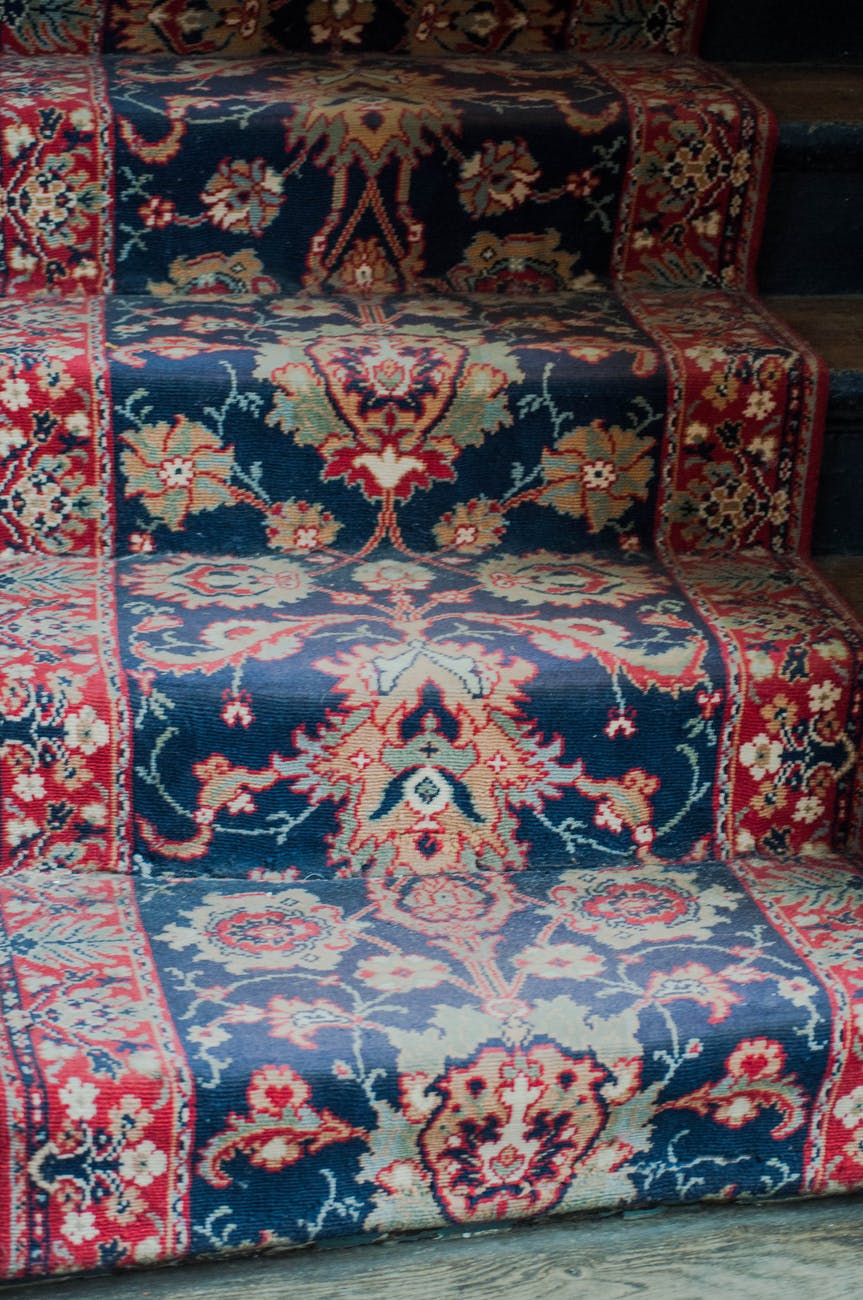
Featured Art: red and white floral textile by Sophie Louisnard

The water cooler bitches come and go
talking of hair crimpers and Day-Glo,
shag carpets and avocado-green fridges,
all those little decorative memories
we like to think we share.
Stop before you try to join them,
stop before they give you those weird-ass looks,
before you think you can share your stories too.
Don’t say your mother hung some fugly, old rugs
over fist holes in the doors, trying to get away with
calling them tapestries. They will only focus on the holes.
When they’re from (always), who made them (everyone),
why they never got fixed (fuck you), and not
what hid the holes, not why you’re telling
this all in the first place.

Come find us.

We will tell you we camouflaged our wounds
with Eddie Vedder on the cover of Rolling Stone,
veer off into the time we busted the storm door
when our brother locked us out. We will go
back and forth with laughter. Come share yourself,
all your broken glass and splintered wood,
your rust and warts and mold. We know you
are not looking for (much) sympathy
or some badge-of-honor shock. You are just
looking to tell us who you have been,
who you are, to see and be seen,
to do it this way we do it, we humans here on Earth.


Read More

She Asks Me, Who is Roger?

By Chrys Tobey

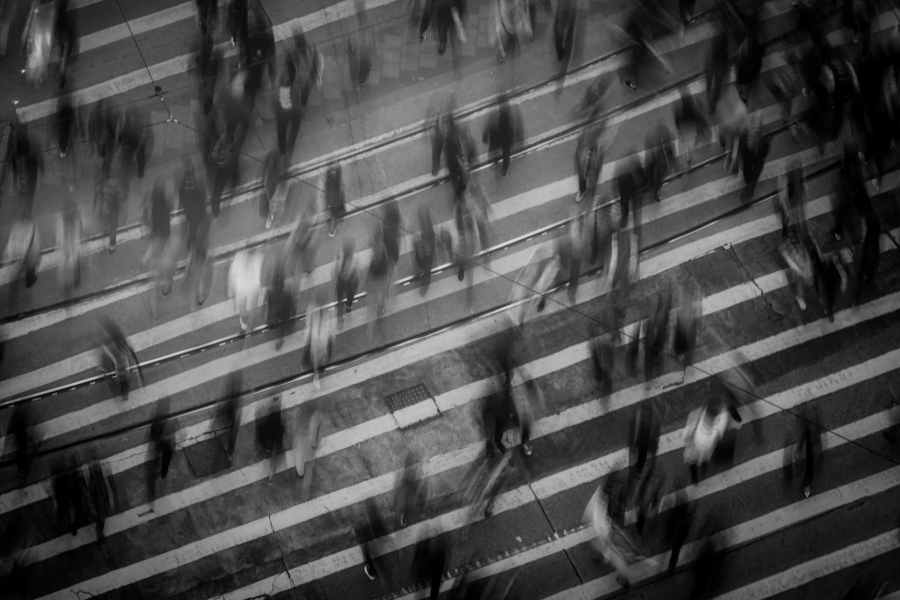
Featured Art: Time Lapse Photography of People Walking on Pedestrian Lane by Mike Chai

I could tell her about my yoga teacher, Roger, who wears the cutest shorts,
which I overheard him say were tailored, or when I was five, there was

the dad, I think his name was Roger, of my neighbor I’d play house with until
my mom caught us humping. But really, I could give her a long list of Rogers—

Roger who never reciprocated my love when I was fifteen. Roger who, on our second
date, burped all of “SexyBack.” Roger who stole my money so he could buy me underwear.

There was Roger with the engagement ring that he threw at my head. There was
Roger with his fondness for spanking. Roger with his missing tooth. Roger with his

fake front tooth. One Roger told me, You’re not really a feminist. Another Roger asked,
Are you really a feminist? And Roger from New York who said, You don’t seem bitter

enough to be a feminist. I could tell her about all the pretty Rogers. The first
Roger I married. Or the second Roger. I could tell her about the Rogers I don’t want

to remember—the ones that taught me I should only live on a second floor.
When she asks me, Who is Roger?—because in a text I wrote, Roger; because she is new

to the U.S.—I smile and tell her about truckers and lingo and don’t tell her how when
I see the small scar on her nose, all the Rogers peel away like dead skin.


Read More
Incubus

By Emily Nason

I’ve taken communion in horse troughs
and creeks and off the back of a stamp licked
by the boy I love, and still I have nightmares.
Like this: every person I forgot to send
a thank-you note to brings it up the next time
I see them. Like this: the cicadas haven’t hatched
when they said they would. Years escape us.
Ancestral cattle herding calls, whole choirs
of Ozark harps, cotton looms starting to spin.
Splash of kerosene. Mildewed family photos,
faces burned out. Like this: I’m crouched
in the kitchen, watching my grandmother
throw a jar of Duke’s Mayonnaise against
the wall. And then she mops it up and repeats.
Same jar. I roll the stone up the hill,
and by stone I mean the rendered red roux,
and by hill, I mean the blackened pot.
My grandmother again, rehab parking lot,
threatening to kill herself, backing down
last minute by saying, I wouldn’t do that
to y’all even though you test me.
Like this:
I date a man who buys instant grits.
Like this: Lindsey Graham. Copper chicken
wire of a welt around my thigh, no clue how
it got there, and a roomful of questions.
In the back of the country store, I sit and watch
my legs dangle from thick fishing hooks, two more
fatty thighs to cure and sell. Strawberry Moon.
Sturgeon Moon. Worm Moon. A night sky
with all three. My grandmother wakes me up
to look at them. She reminds me that I’m like her:
last to leave this long party, eyes shucked open.


Read More
Doctor’s Office Behind Plank Country Store, Feet in Stirrups, I Think About My Grandmother’s Hands Deveining Shrimp

By Emily Nason

And I can see them, see her
standing over the kitchen sink,
gray shrimp pinched
and the up-flick of her knife.

                                                                                                       (No stories in this poem,
                                                                                                       Emily. Stay in the room.)

Right. Doctor’s white gloves.
Gardenia white. This is my hand
on your thigh.
Unpruned oleander.
You’re going to feel a pinch.

                                                                                                       (Stay just a little while longer.)

Hot examination room.
Small country clinic with one broken
air conditioner. The doctor sees
retirees and pregnant housewives,
mainly. Once, a man who took
a tree trunk straight to the sternum.

                                                                                                       (He survived, remember?
                                                                                                       It’s not your story to tell.)

I’ve forgotten to take off my gold
hoops. In the corner, nude lace bra
and underwear crumpled
in the chair. A blue jumpsuit—
It has pockets! Pockets!—I wore
that night in Ohio, when I fell
and sprained a wrist bringing
a dozen fresh eggs to a friend,
no carton, just my pockets.

                                                                                                       (Stop. Back to your body, now.)

Another pinch. Give me one big
cough.
Formaldehyde in the veins,
moonshine in the eyes. I’m alive.
From crotch to toes: a cramp.

                                                                                                       (There’s been worse pain.
                                                                                                       Move it along.)

Read More
Sertraline

By Emily Nason

Featured Art: Mid Winter by Pamela Fogg

I am predisposed: toothed gardenia. Just like my mother’s
mother. I ask the doctor what to do. She says, Consult the oracles,

read the tea leaves. Which means, Keep taking your meds.
Which means, Watch who you procreate with. I’m not sure

I’m happier now. I just feel things less. Not quite a numbness,
but a lack. When my dog sees a dog that looks like her, she cocks

her head, as if to say, Huh. Isn’t that something? Smart girl,
but it frightens me that she knows, retains, what she looks like.

I am frightened of a lot of things, but not of what awaits. Side effects:
a comfort or ideation with fresh dirt and ashes. Visiting the family burial

plot, the caretaker tells us, We can stack em six deep. Economical,
I think. My mother asks him to trim the nearby tree, it’s obscuring

her mother’s grave. Two rows down, a marble headstone reads,
Stand back, I’m coming up! Okay. Where are you going to go?


Read More
Widow’s Weeds

By Courtney Huse Wika

Featured Art: Isla Holbox by Pamela Fogg

No one forages here
in the tall grasses and unkempt briars,
except the hollow-boned crows
and me, in widow’s weeds,
dirty nails and knees.

On lunar nights I plant wolfsbane as a ward,
castor beans for joints rusted as hinges,
belladonna for fever,
oleander for the dreams I had of carrying children,
and nightshade as pernicious as my blood.

On the darkest nights, I slip from bed
to pull the snakeroot
by handfuls before it can strike
my lover’s garden,
the one with tenacious vines of honeysuckle,
sun-faced lilies, and sage.

And in the mornings, I swallow pills
like hemlock,
perennial poisons,

and hope they kill
the right part of me.


Read More

Landfall

By Jeremy Griffin

By the time Nicole arrives at the clinic, the parking lot is already full of folks waiting to drop off their pets before hightailing it out of town, out of the path of the hurricane. All morning she’s been battling that crampy twinge in her hand—dystonia, Dr. Epstein calls this, involuntary muscle contractions—and she hoped that she would be able to spend most of today hiding in her office. A foolish hope, considering that all of the pet-friendly hotels within a 100-mile radius have already sold out. Unlocking the front doors, she marshals a smile as the sleepy-eyed clients slump into the lobby with their cat carriers and their leashed dogs.

Inside, she leaves the receptionist to check everyone in while she goes around the building flicking on lights. In the kennel at the back of the building, she feeds and waters the dozen or so animals already boarding and begins taking the dogs outside one by one. Technically, this is a job for the assistants, but as owner Nicole takes a sheepish sort of pleasure in micromanaging. A canopy of clouds hangs low in the sky, the wind already churning ominously. By tomorrow afternoon, the rains will be here, thick and driving. Initial projections had the hurricane cutting west, into the Gulf of Mexico. Perhaps Nicole shouldn’t have been surprised when the projections abruptly shifted, the storm now expected to hook northeast, right through the Carolinas. That’s her life in a nutshell, isn’t it? A sudden change in trajectory, something to brace for. You’re just feeling sorry for yourself, her mother might scold, caustic old bird that she was, and she would be right. But her mother is long gone, and so who cares if Nicole is feeling a little morose this morning? It’s her clinic, she can feel whatever she wants.

She waits until all the other dogs have been walked before taking out the rottweiler that Animal Control dropped off yesterday. It was found near the airport, a scrawny female with patchy fur and a missing chunk of ear. Upon being hustled into the van, the animal bit one of the officers on the hand. “Fucker cost me three stitches,” the fellow said when he dropped the dog off, holding up his bandaged hand for Nicole to see.

Read More

San Francisco Bay View, November 2018

By D. R. Goodman

On a night when something like fog obscures the city,
and dry trees loom through heavy wisps of gray,
I’m stopped, and stare. Faint orange lights shine through
at intervals in a breathless span of blankness
where any other night, the simple darkness
would glitter as if with pearls. This streetlamp, too,
is strange in its ashen haloed light, the way
it burns my eyes, and sweeps me through with pity.

That campfire smell, as we at first mistake it,
grows acrid—treated lumber, metal rail,
scorched cars, life’s treasures, all they had to show,
now airborne from a hundred miles away.
We’re stardust. On the airwaves, just today,
some rock star physicist proclaimed it so.
It burns my lungs. Bewildered, I inhale
the dust of those who ran and didn’t make it.


Read More

Moon Facts

By Dan Pinkerton

Featured Art: Nocturne by Pamela Fogg

Amid the purr of two-stroke engines
the surf belched little turtles onto the sand
each grain of which was composed

in a Taiwanese factory. The dizzying
ocean-borne scent of unleaded,
overhead the moon a porcelain fixture,

trees filament-filled, shatterable.
The man in the bar drew back the corners
of his handkerchief to reveal the egg

which when touched to your ear
produced a bomb-like ticking. Fry it, bury it,
entrust it to a museum? Humidity

curled along the coast, courtesy
of Lockheed Martin’s great turbines,
synthetic palms swaying and groaning.

In the hotel room sex was administered
intravenously, files corrupted.
We were preoccupied, that was our error code.

As teens we would wander the vacant lots
seeking out weeds where the asphalt buckled.
Flowers were a stretch. Even a dandelion would’ve

stopped our hearts. The Earth had not been
retrofitted, the bodies in orbit not yet
repurposed. Our ancient moon appeared

bedraggled, a door hanging by one hinge.
The exiled part of us kept gleaming
even though cold to the touch.


Read More

Palm Beach International Airport

By Roy Bentley

Featured Art: Pink Flamingo on Green Grass Field by Guillaume Meurice

In the gift shop across from the ATM and
the Currency Exchange / Florida Lotto window,
and rather than succumb entirely to the tease
of the bobble-headed Plexiglas pink flamingos
and conch shell key chains, like the tourists who
simply hand over ATM-crisp twenty-dollar-bills
or a platinum American Express card, I’m passing
on everything—the U of F ashtrays in the shape
of open-mouthed, palm-frond green alligators—
except for handpainted greeting cards depicting
ibises preening in Key West. I won’t apologize
for being a sucker for wading birds or Key West.
By the magazines and half-price hardback novels
the wisdom of shrink-wrapped 2010 calendars
shouts that NASCAR is metaphor for what it takes
to live in the Sunshine State—Rubbin’ Is Racin’
as if bent fenders and near-death collisions and
concussions are to be expected, a part of the price.
Think of all the lives intersecting in this place.
Think of the terrified Midwesterners on their way
to anywhere warm to drink a piña colada. I’m here,
waiting for someone, so I toss change into a fountain.
The fountain has a white lion’s head spewing a stream
of local Palm Beach County tap water. I’m wishing
for a better life. More money. More inexplicable joy
as destination, which it is. I throw in shiny quarters
because I know better than to be cheap with luck,
though nobody’s sure there is anything like God
or an afterlife, never mind that we walk around
in Paradise, which is always under construction
and offers both long- and short-term parking.


Read More

Ditch

By David Thoreen

On the side of the house I dug a ditch
than ran the length of my life. When
it rained, I chipped away with adze
and spade, then lined the whole with fabric:
the wool suit I wore for first communion,
my Batman costume from fifth grade
Halloween, the satin bowling shirts
I rescued from an uncle’s cedar chest
after he died (June, the summer I turned
thirteen), a drawer of cotton tees, and the
pale shirts and rich silk ties I purchased
for a job that swallowed my twenties
like an anxious and ravening other, the tux
in which I married, even a sweatshirt
that said Des Moines, in cursive. All this
was stretched along the ditch. I threw in
the newspapers I’d delivered—three years’
worth—and the time I’d devoted to folding them,
each already beyond penance or prayer.

I pitched in my last confession, a couple
of car accidents, the week in the ICU
after my appendix burst. Good riddance
to the dances where I got drunk, the hangovers
that followed. It was hard to let go of the night
I stood on a golf course in Mason City, Iowa,
looking up at the Milky way, a night that was warm
and smooth in my fingers, but in the end, I dropped
it in too, along with the day my son was born,
and the light in my wife’s eyes as she held him.
I covered it all with a layer of leaves, and over that
rakes seven tons of crushed stone. Anyone
passing this edge of arborvitae would see
a simple path, leading from here to there.


Read More

Prayer to Mercury

By Justin Jannise

The moon, full the night before he died.
The neighbor’s old golden retriever approached the cyclone fence,
               sat and watched the nurses enter and leave,
               turned silver
in moonlight, and howled
                                                        its long, sad howl.

Fourth-of-July gunshots echoed through morning.
The pact I’d made to keep myself at home glued to the phone’s abrupt news
               wavered,
and I allowed a man in
where I vowed no god, after you, would enter.

Your planet in retrograde,
                                                      twisting letters around:

I told Christine how I’d taken to staring at still flies
               on museum websites—
camera light bouncing off the dimpled flesh of a pear,
dotted on long ago by a Renaissance sponge and sprinkle of salt.

I told Emily I’d sent off for a new gun
instead of a new rug

                             —the click of the revolving chamber—

                                             the floor, where I told her I’d keep it,
                                                              opening a tile to reveal a hidden drawer.

Repast at ten this morning, my sister texted,
and then overrode the autocorrect:
                                                                   He past.

He passed. (Erased, the table I’d pictured
               laid out with aluminum dishes, gravy boats,
                              and heirloom pitchers, fogged and full.)

My mother, silent for hours after that.

Me, afraid to call her.

You, who have become lifelike,
               give me a word for the slow death of 70 years of memory,
                              so slow we all got sick
               of watching it rot,

                             watching ourselves flicker from talking dolls
                             into irrecoverable shadow.

He, past.

               Change dead into dear. Change hated into heated.

Give me back the gold I was promised
               when I agreed to try to live
                              as long as promisable.


Read More

Violent Devotion

By Gwen Mullins

Two weeks ago, over a dinner of fried chicken, purple-hull peas, and buttered corn, Red McClendon’s family talked about the girl, Vera Martin, who disappeared one night after she left the Shop-Rite on Sand Mountain. Red’s son Jackson worked part-time as a bagboy at that same store, but he claimed he couldn’t remember if he’d been at work the night the girl went missing.

Red saw the girl’s picture on the news, a curvy young woman with thick, dark hair that hung in braided ropes down her back, her skin smooth and tan as river stone. Something about the way she tilted her head in the news photograph reminded him of Rosie, his own daughter. Red did not think too much about Vera Martin’s disappearance at first. He, like most of the folks he knew, assumed she would turn up in one of the trailers pocked with scattershot at the foot of the mountain, strung out on meth, or maybe in a Marietta hotel room with a man old enough to be her father, or her teacher. Red’s own sister ran off with three different boys before she even finished high school.

“Jean Anne always came back, after her money ran out or when she got tired of eating frozen burritos from the Chevron,” Red said.

Red’s wife Loretta pursed her lips, busied herself with grinding pepper over her dinner. She always got quiet when Red brought up the less savory aspects of his past.

“But Vera Martin was a nice girl, from a good family,” Rosie said.

Read More

Me/n

By Sarah Suhr

He rides a horse // by the fire station
______in Falls City // to slip his resume
into the soft hand // of a secretary—this happens
______before he says, // You carry yourself
in an idyllically classy way // I’d be proud
______ to have you // on my arm. _____ I only think
of alliteration: // of belt buckle—
______the one he wears // while singing karaoke.

                                                               I take my fishing pole to Beaver Lake
                                                               after work and a blackbird squawks
                                                               a breathless death song at the roadside.
                                                               She has no friends circling the bruised
                                                               sky, so I sit in the gravel beside her, wait
                                                               for night to bleed in between the stars.

On Hinge, a man miles // of mountains away
______sends me a message: // I’ve been staring at your
clavicle for hours
. // And I consider all the bones
______of women beneath // the earth’s surface—
how this man’s bootsoles // must sound against rocks.

                                                               I enter the chicken coop with a baseball bat
                                                               and basket as my mother has coached.
                                                               The bat I one-handedly swing at
                                                               a buckish cock kicking up chicken shit
                                                               and feathers. I don’t intend to hit him—
                                                               just snatch the eggs and run, but I see
                                                               the scrawny hen he plucks to patches,
                                                               and I wonder about the sunglasses
                                                               my mother wears indoors.

My ex says, I do // more than most men,
______or here’s a pillow // perfect for suffocation—take it,
put it on your face. // My grandfather pours the concrete
______foundation of his house, // my stepdad rebuilds
cars and cooks dinner, // my uncle drives his kids
______to school after working the night // shift. What’s
more than most men? // What’s more than most women?

                                                               The goose’s head is still on the chopping
                                                               block. Her headless body runs around
                                                               the yard—blood coming from her neck
                                                               like a slow sprinkler head. She rushes into
                                                               the Bermuda grass at my ankles. My ankles
                                                               itch—and, for not crying, I am tough.

Another Hinge connection. // This time by phone—
______You’d look great on my // motorcycle, he says.
I’m also smart, I say. // Yeah? Well, you’d still
______look great on my motorcycle.
// This feels
like the definition of female // or cartwheel or dog chasing tail.

                                                               In the potboil is a cow’s slick tongue—
                                                               rigid and rolling in its fatty dross,
                                                               each impurity clumped together
                                                               like an inkblot or divination. O Oracle!
                                                               O Ladle! Speak to me of the sour
                                                               stink in this house. Help me remember
                                                               the soft ears of a calf.


Read More

Fetus Eggs

By Annie Trinh

Featured Art: “Vessel” by Byron Armacost

This is you: a thirty-year-old mother who had a miscarriage, a wife whose husband left her, a daughter who steps into a medicine shop and looks at the walls of herbs. You press your fingers against glass jars, hoping to find a solution for a successful birth. A bag of maca. A bundle of chasteberries. A box of cinnamon. You take these medicines to the owner, asking if these plants will help with fertility or make your body strong enough to handle carrying a child. And this is your savior: a Vietnamese woman in her seventies who has wrinkles around her eyes and tells stories of her survival through the Indochina and Vietnam Wars. A mother who understands the importance of obtaining children. A sister who sees your pain as you push the herbs in her direction, wondering how much you need. Your savior tells you that you don’t need these herbs—they won’t help, and she goes into the back room and then comes out with a wooden box. Your savior opens it up and snuggled within the purple cloth are twelve large eggs. Brown and spotted with freckles. You place an egg into your palm, cradling it as if it is ready to sleep. Soft heartbeats thump against your fingers.

Eat these duck fetuses, your savior says, and it will help you get what you want.

Read More

Ordinary Ode

By Michael Lavers

Sure, Horace, praise the ordinary—
milkweed days, a cow, the crackling
static of the swaying grain. Say yes,
the way the cut hay steams in sun is good,
the way the dahlias bloom in rain.
Say that a hundred shades of dusk
armor the trout, that a pear’s full burden
suits the bough. But when the fire
jumps, or if the fever stays,
when sorrows blacken in the brain
like mold—how could it matter
that some wet grass shone? That grapes
grow sweet? That birches shake in wind,
gilding the new graves with their gold?


Read More

Unvocation

By Michael Lavers

Featured Art: smokey lady by Byron Armacost

He made a poem and began it thus:
Muse, tell me nothing! Keep quiet, Muse!
Jules Renard

Muse, tell me nothing! Keep quiet, Muse!
Not that you visit much, or would entrust me
with the grand advancements of the true and beautiful.

But just in case you have some scrap for me,
some local insight or a meager rhyme,
in case you wanted to drop by and put

the coffee on, and light a cigarette, and set your
sandaled feet up on my desk, and give detached
dictation, don’t. Don’t even think about it.

It’s no use telling me the purple buntings
are back, or how the horses down the road
steam after rain, or that two men are felling

pines over on Locust Lane, their careful cuts
inspiring some ode about the marriage
of form and function, muscle and grace.

Pester the poet laureate instead, or if
she’s scribbling already, visit Frank, my neighbor,
whose proclivity to mow the lawn late after dark

reveals a visionary’s knack for following
one’s own strange rules, no matter the judgment
of others. Pick anyone but me. Corner a dog,

or crawl into a cave, whisper to scorpions.
Or better still, stay quiet. Hey, don’t roll
your eyes like that. Don’t argue beauty

has its own use outside usefulness.
No, if you must speak, make it practical,
teach me to caulk the bathroom tile,

or judge others on a curve. But if it’s poetry
you have in mind, I’ll pass. Don’t tell me
that I’m going to die, and who knows when,

and therefore must put down the way
the pink light floods the valley like a wave,
then disappears. Shut up about the fleeting

beauty of the world—I get it. All things fade.
Just tell me what I can control, teach me
a trade, like felling trees: how to make sure

they fall just how and when I say: no sudden
turn, no frills, no mysteries, no doubts.
Only a simple line. Only a hard clear sound.


Read More

Three Buttered Muffins

By Michael Lavers

Featured Art: smokey man by Byron Armacost

Mr. ———, who loved buttered muffins, but durst not eat them
because they disagreed with his stomach, resolved to shoot himself;
and then he eat three buttered muffins for breakfast, before shooting
himself, knowing that he should not be troubled with indigestion.

—Boswell

I want to ask poor Mr. ——— why, if life’s
so bad, he paused to savor them at all? But I
know why. How could the scent that spirals
up the stairs not sway him, for the moment,
to put down the gun, and come, and break
a muffin open, watch the steam spill out?
To wedge fresh butter in each porous hinge?
To want, for once, to live one moment longer:
there are muffins, after all. And here is butter
catching candle-light, sighing its soft glissando
down the spongy muffin-flesh, hinting
that joy, though soft and all-too solvent, still
anoints some moments with its glossy smear:
joy in the mint-flecked ruminations of the cow
at milking time, the greasy fingers of the girl
who sets her pail of white froth down and lies
under the ilex boughs and weeps over some boy,
then in a minute gets back up, and wipes
her cheeks, shakes out her thatch-flecked hair;
not that she knows some pleasure’s only felt
because it ends, that it cannot be held, raised up
like curds of butter that her mother calls forth
from the churning chaos like fermented light.
Not that. She just remembers there are muffins
waiting for her, too, back in the house, and when
they’re gone, maybe some milk. Maybe an apple.
Maybe, since it’s not impossible, some cheese.


Read More

November Elegy

By Michael Lavers

You’re gone, and in the season you loved best,
when lamps go on at six, then five, then four,
and you’d rush to the lake, eager to test

the ice, let down your bait. The coat you wore
for years, scale-stained, hangs in the closet still,
a great dumb fish. You’re not you anymore,

and so won’t need it there, over whatever hill,
out on what lake there is, to stand above
a chiseled hole where lines and snowslush spill

into the green and quiet parlors of
a shadow world, and feel the poor flesh heaving
as the line twangs, tugging at your glove.

To peer down, breathless, changed, but grieving
at the cold hard brilliance of the living.


Read More

The Sisters Jeppard

By George Choundas

My cousin married a woman who was an only child. Her mother had two sisters. These aunts had no children of their own.

The three sisters all treated this woman, my cousin’s wife, as their daughter. In her youth she was dandled and spoiled and trophied. The three sisters were her regents, she their queen. This is all from my cousin. I didn’t know her when she was growing up. Neither did he. They went to the same middle school, my cousin and his wife, but they ran with different sets of kids. They got genuinely acquainted only a couple of years ago, his mother bumping into her mother at Lord & Taylor. He knew the family dynamic from bits and pieces: things she told him, things friends and relatives told him, not being blind.

She grew up to be an engaging person, and thoughtful. This I can report. But also moody, and prone to self-involvement, and fond of spending money and nursing wounds and spending money to nurse wounds. She saw catastrophe in the merest challenges. In all the time I knew her she never asked me a question.

She laughed rarely, never at things I said. Once I suggested she come up with a new origin story for the grandchildren. They would be like, What’s Lorden Tailor?, and she’d be like, A store at the mall, and they’d be like, What’s a mall?, and of course no matter what she said they wouldn’t get it, Retail? What’s a retail?, et cetera, and unless her grandchildren were French absurdists this infinite regression would not satisfy. That’s what I said, French absurdists and infinite regression, and she gave me a look you give orphans with rabies.

Read More

Great

By Emily Blair

Featured Art: Fairy Cottage by Byron Armacost

On Facebook, I call everything great
with multiple exclamation points,
even a meeting. Great used to just mean
very, very large. Incredible, fantastic, amazing,
are the words I use for a poem, a painting,
a robot from outer space.

So what can I say about the cardinal
who makes a perfect landing on the tippy-top
of the bright pink cherry tree next door to my mother’s house.
He sings cheer cheer cheer what what what
as if he were the only personified bird in the world.
He sings cheer-a-dote cheer-a-dote-dote-dote
as if we’ve never heard a song like that
bursting forth from a bright red bird,
turning the air behind him bluer, airier.

This would make a good desktop background
if I had a camera, but I don’t.
My mother puts her arm around me and says,
“We’ll remember.” A mother’s loving wisdom,
more poetry Kryptonite! I mean, obviously, she’s right,
but still you won’t catch me talking about this later,
how for a vertiginous moment we all hold a meeting
like the Superfriends in the Hall of Justice:
the cardinal, the sky, the tree, my mother and me.

The universe depends on us—
the cat hiding in the hedge,
the squirrels scrapping over sunflower seeds,
my mother’s haphazard plantings,
the neighbors who can be seen moving
about their kitchen through the window,
their immaculate lawn, their silver gazing ball
on its pedestal, summing up
the whole shining spectacle.

It’s cheer-a-dote cheer-a-dote-dote-dote
It’s wheet wheet! wheet!!
It’s great.


Read More

Pomegranate

By J.C. Scharl

“My heart is like a pomegranate”
as a simile seems a little simplistic
these days (even the meter beats
too neatly to seem true)
but nonetheless
there’s something to it:
how a pomegranate cracks
and bleeds a little when opened,
no matter how gentle your hands
and how a few seeds spill out
like little dreams, smoldering crimson
as coals around a dark core.
How more seeds cling
to the membrane in a strangled
Fibonacci order, so determined
to hold their place that each
is a little misshapen. How
at the deep recesses of the fruit,
so deep it is nearly the bottom,
there is a bad patch,
the underbelly of a faint bruise
on the outer skin,
where a brown ooze festers,
leaking its slow poison.


Read More

An Answer Without a Question

By Robert Cording

If he were alive, he might have shrugged
and said, things happen for no reason,
but he wasn’t, he was only my son
in a dream, where he found me
sitting in the woods trying to understand
his death. The light looked
as if it were coming from below not above,
rising up out of the ground,
the way darkness first spools around
the trunks of trees and then climbs higher.
I was so happy to be speaking with him,
but, in the middle of what I was saying,
he disappeared. I kept sitting where I was,
as if he’d return again, but I knew
nothing else was going to happen.
When I woke, I had that feeling
I often have when getting into bed
of both dread and the possibility of relief.
I was still partly in the dream, and I felt
he was like a god, utterly removed,
and not knowable any longer.
Shaking, I sat up and tried to focus on
the larches outside feathering the wind,
and a sliver of moon that caught and released
a scrim of fast-moving clouds. I breathed in
the smell of the grass I’d mowed
that afternoon, then rolled toward my wife
whose skin was cool to my touch. Far off
in the woods, I heard the sense-startling
yips and bawls of a pack of coyotes.
All of it came to me in a wave of sensations
impossible to put into words and yet, oddly,
felt like a gift, something like an answer
to a question I could not remember asking him.


Read More

Koi Pond: Failed Meditation

By Robert Cording

I just wanted to sit, shut my eyes,
tilt my face to the sun, and try not to think,
but the koi, insistent, unappeasable,
crowded to my end, the water roiling
with their need, and, when I opened my eyes,
I saw them lift their bulbous heads,
making sounds with their rubbery, barbeled lips
as if they were gasping for air.
When I shut my eyes again
because I did not want to see, I saw
the little outdoor fireplace on my son’s deck,
embers still burning. The October day
had not yet come into being,
the light anomalous, something between
night and morning. Inside, on the floor
of his living room, my son was dead.

His wife had waited with his body
until my wife and I arrived.
We lay next to him, touched his hair,
his forehead, his cheeks, his lips and chin—
and then I heard myself
trying to tell him we were there, we were
with him, we loved him,
but my words were more like moans
than words, every word sounding
its helplessness. When I opened my eyes,
there were the koi, their too-small pond
swirling with color—white, yellow,
black and white, gold, red and white—
all of them entangled, straining against
each other, mouths agape, turning
and turning in their net of water.


Read More

Doves in Morning Fog

By Robert Cording

Featured Art: Cloud Head by Byron Armacost

Six A.M. and nothing here but fog
and an impotent sun-god
trying to scissor the fog into pieces,
a little blue patch here, another there.
Then the windows completely misted,
making shadows of whatever
flies by outside. I am sitting with my sorrow
and a cup of tea behind windows
I cannot see through. I’m waiting
to see the pair of doves
I have been listening to as if they are
some type of meditative exercise
to focus myself on the present moment.

I admit, I like being unable to see,
and I like forgetting myself,
if only for a brief time,
taken up by the doves’ call and response—
insistent, relentless—in the live oak
I know is outside my window.
I still cannot see the doves, or the tree,
except for its charcoal-like outlines.
Most likely I am hearing my own sadness
over my son’s death, three years now,
in the doves’ tiresome moans.

But then two palm trees, visible
just this moment, shake out
the morning’s dampness in the first breeze,
as if their raspy rattle can clear my day.
The doves, with their clerical collars
and their who, whoo-whoo, keep up their inquiry,
not letting go of that old question: just who is
sitting here, custodian of an empty mug,
whoever he once was now someone else,
holding on to what is gone, the collared doves
flying off as the fog lifts and another
Florida day, exactly like yesterday, heats up.


Read More

A Fox

By Ted Kooser

Featured Art: Fox by Emi Olin

I saw a red fox stepping in and out
of the shadows of tall granite stones
in a cemetery’s oldest section, fur
flaring as she entered each patch
of sun, though her feet and the tip
of her tail were too darkened by dew
to be set alight. She was quite small
but in her presence the stones forgot
their names. Above her the canopy
was respectfully opening oak by oak
to light her way, though she offered
no sign that she expected any less.
I couldn’t move for fear she’d stop
and fix me with those eyes that had
already stopped everything there,
the headstones, the plastic flowers,
I, too, now breathless as I watched
her pass along that long, long hall,
a flame reflected in its many doors.


Read More

Everett Avenue Facing East

By David Gullette

I have spent years shying away from this poem
this poem in which I try to capture a single gesture of my father’s—

November 1967—a “berry aneurysm” has exploded in my brother’s skull
so I fly down to Raleigh and spend the night in the room
that became mine after our sister went off to college

Early next morning I hear the front door open
and go to the window
my father is leaving the house
I signal him to wait

We drive straight out Everett for the hospital
unspeaking
as we near Cameron Village the sun
peeks over the roof of Sears

And he takes his right hand off the wheel
and palm up lifts it toward the sun . . .

Even as I watch him I know there is more going on here than
“The world breaks our hearts and the indifferent sun simply
goes on doing what it has to”

More than
“So begins the first day without my younger son”

More than
“My older son is with me, together we bear witness to an iron law”

Dance is the art I know least
but I do love to watch a skilled dancer slowly revolve
and tilt his torso
and lift a hand to make a gesture toward the other dancer across the stage
and if you ask me to tell you what that hand is saying . . .

I was right to dread this poem


Read More