Cabbages Across from the Manitou Islands

By William Olsen

The earth is the subconscious of the subconscious.
—Bachelard

1.
Half a block inland and safe from genius gulls
local and alone in their dishwater droves,
up out of reach from beach inland-eaten

by gutless waves,
opposite the passage from two fresh green-furred
ursine islands, one lighthouse-flicker lit, one not,

safe from shark-toothed sails and trolling trolls,
unseen by one old crow
patrolling a fire-log-charcoal-pitted shore,

innocent, green, unschooled, dimwitted, featureless,
foregrounded by the imponderable plumpness
of the crimson motherships, summer’s end’s tomatoes,

encephalitic, all intelligence,
stupidly, yet astonishingly so,

Read More

Indoor Municipal Pool

By Alan Shapiro

The circulating disinfectants
make it an unearthly blue
or earth’s blue seen from space,
or what pooled from the steaming
of the planet’s first condensing.
In which case the pumps
and filters could be thermal
vents, and the tiny comet trail
of bubbles rising from the vents
could hold within it—if it isn’t it
already—the first blind chance,
if not the promise of
the hint of the beginning
of what at long last would
emerge into the eye which
being mostly water sees
only water signaling to itself
beyond itself in accidental
wormy quiverings over
the sea floor of the ceiling.


Read More

Downtown Strip Club

By Alan Shapiro

Its night is all day long;
the neon GIRLS out front go dark in sunlight,
while inside the cruciform stage
has stripped down to blackness,
in which the vertical
poles at the end of each transverse arm
stand naked and lonely.
Cold here is the cold on the faces of the presidents
on bills the absent hands
have pushed toward each body bending over
in a gown of brightness;
cold is the heat of the shadowless
shadow play of hands and legs
up and down along the poles,
and the hands retreating from the money,
and the hands in pockets dreaming,
or dreaming later on another body;
the heart of the cold is the opposite of what it is,
cold as the fire
through the day of its night
in the firing line of bottles
waiting for orders
on the shelf above the bar.


Read More

The Wet Jade Someone

By George David Clark

Years ago my father and I smuggled Mandarin
Gospel tracts and Jesus videos through customs in
Beijing, that labyrinth of marble lions and silk,
of pearl hawkers, of the Muslim Quarter’s narrow walks
confused with fruit and butchers’ racks in the open air.
At the night market I watched two geese dangling by their
necks in a darkened window while Father disappeared
into the neon dazzle of bald rabbit heads smeared
with candy glaze, scorpions and black locusts by
the shish kabob. A woman touched my arm. “You want I
give you bath?” she asked. Her eyes were the wet jade someone
lost off a bridge. Wry smile half-disguising her rotten
teeth, she whispered, “You like warm bath?” again in my ear,
branding the taste of fried starfish on my fifteenth year.
Often now, in the hotel of bad sleep, she leads me
down a hallway to a room with a golden tub. We
slip into the bath together. Her small breasts are white
as fresh apple flesh. First I kiss them, then take a bite. Read More
To a Rose

By Kim Addonizio

Bone-stick
partially stripped

I hang you upside down
with your sisters
above my mirror—

all drooping heads all trophies of desire

O rose thou art past-tense

Even your brother the worm
has shriveled and gone

Your silks are best
like this unkiss-

able
and therefore bearable


Read More

Yes

By Kim Addonizio

Do you sometimes drink alone?
Have you ever woken up the next morning
after a night of heavy drinking?
Does your cat wander through the house
meowing inconsolably,
despite having fresh food and water?
Hunger, thirst, friendship, love.
Green Bee, Russian Quaalude, Redheaded Slut:
IEDs on the supply route to pleasure.
There’s a gala in your hypothalamus,
helium balloons rising to the rafters,
the fizzy ricochet of laughter.
There’s a stumblebum in your cerebellum.
That empty feeling crawling toward you—
should you kill it with a wadded paper towel
or trap it in a jar and shake it out
and send it flying into the grass?
Is your head full of frozen tamales
and a vodka bottle curled on its side?
How do you get through the interminable evenings?
Are they really interminable?
Have you considered the alternative?
Now get out of your car,
stand by the side of the road
and take a step. Now recite
The Waste Land, backwards,
beginning with that sexy Sanskrit word.


Read More
Pediment

By David Gewanter

Like backtalking teenagers sent to their rooms,
__the boyhoods
of husbands dangle in closets, or bulge a locker,
__ancient toys

awaiting the senile hand—here inside the trunk,
__the Furry Freak Brothers
rub the benighted sovereignty of
__Big Ass Comix

or nuzzle the Up Against the Wall
__Street Journal, where
a sweaty financier is pictured with a purpley,
__squash-sized penis—

Why grow up? The basement monarch
__palms his relics:
the crumbled essay on pacifism, scrawled
__to the Draft Board’s

faustian query, Let’s say you see your mother
__being raped.
What would you do? The brochure, “Amputating
__Your Small Toe Safely.”

Read More
Teddy Agonistes

By Teddy Macker

Summer after high school I lived alone on my family’s farm in Carpinteria,
California.

I didn’t know a hoe from a spade but still reveled in the new role, begging my
mother to send money so I could rent a tractor and disc the field.

I disced the field, had my neighbor take pictures of me discing the field, then
sent those pictures to my ex-girlfriend.

Right before the photo I mashed hay into my hair.

At night I put on my Walkman and drove the tractor up and down the
lightless street, the speed of the machine shocking, the sycamore branches
raining down their sweet womanish incense. . . . I’d listen to Emmylou Harris
sing, You think you’re a cowboy but you’re only a kid, never once thinking I
was a kid.

During the day I spent hours not working but prayerfully wandering the
barn trying to be spellbound by every mote in every last shaft of light, then
scrawling T. S. Eliot on the walls of the hayloft.

Once I found a dead owl and for some reason washed it with a hose.

And late at night, lying on my back, the sounds of the coyotes pinned me to
my bed till I became an infinitely petalling blossom of strange clear dread.


Read More

Inheritance

By Harrison Candelaria Fletcher

I inherit the sword. Before my father dies, he decides that I, not my big brother, will receive the ceremonial blade from the secretive Masonic Order, to which the men in his family belonged. My brother will get the gold ring stamped with the family coat of arms—a broad gray shield emblazoned with a black cross, four white shells, and four silver arrowheads.

I’m proud of my heirloom. I sneak into the hallway storage closet to play with it while my mother prunes her rose bushes. I slip the dull-edged weapon from its tarnished brass sheath, grip the chipped black wooden handle with the knight’s helmet hilt, and run my finger along the clouded chrome surface etched with vines. My brother slides beside me into the cool darkness.

Read More

Truck

By Jerry Williams

When I was twelve years old, during the summer months when I was off from school, my father used to get me to ride around in his truck with him. The truck was a hospital-gown blue, three-quarter-ton Ford automatic with a wide bench seat, heaping ashtray, and a loaded .38 Smith & Wesson in the glove box. I guess he had a permit for the gun, but if it ever looked like the police might pull us over, he made me transfer it from the glove box to the seat between us, and with one hand he emptied the bullets onto the cracked vinyl and laid the gun across his thigh, evidently trying to impress me with his intricate knowledge of Ohio gun laws.

Read More
Outbound Fall River 1967

By David Rivard

Well, you know how it is
when you’re thirteen, & deep
in the factory bosses’ graveyard—your hair
damp, atmospherically

violet in the August dusk—the children
you run with calling back
over gravestones & wrought-iron Grand
Army of the Republic

picket fences—in this cemetery
catty-corner
from the China Inn (Catholic chow mein
sandwiches

served there Fridays,
Wayne Yee’s family cooks them)—
you know all those
grassy family plots you walk over, strongholds

Read More

Wordsworthian

By David Rivard

The brain bounces forward too, right?
so why return to what yesterday seemed to be becoming
before it became today?—
there’s no need for meanness or envy
when waking in the morning, no reasons for fear—
just an unlikely Rose of Sharon blooming by the branch library
and the balanced light of a warming
late October as it shines on a sheet of week-old social studies homework only recently
dropped from the book bag of a wandering Violet Neff
(5 points extra credit—according to Ms. DiNardo, a “nice job”):

nice job say the Tibetans by lugging the rolled-up rugs to air
in front of Yala Carpets mostly the smaller
prayer mats that are colored with clairvoyant vegetable dyes,
nice job says the scent of heavenly inventions like the breakfast plantains frying,
well done says the toddler with the jelly-fish haircut,
all answers perfect say the hedgerows of boxwood left
untrimmed by the vestry at St. Augustine’s

(a coven of swallows with attention deficit disorder muttering one-liners within),
perfect say the chicken legs in the freezer case at Fresh Killed Poultry,

while you wait for the 91 to the Green Line at Lechmere,
a vaguely Wordsworthian subway stop you think
(because the brain knows it’s well within its rights to do so)
a second or two before it occurs to you
to wonder if Ms. DiNardo’s grading is strict—

so what if it is? thinks the brain,
I can still imagine her first name is Julie whenever
I need to.


Read More
Free Period

By David Yezzi

___Outside study hall,
it’s me, my girlfriend, and a guy
named Rob—bony kid, klutzy
at games, fluent in French.
___He’s behind her;

___I’m asleep or half-
asleep (it’s morning), and, as I
squint into the trapezoid of light
breaking on the bench and me,
___I see him raise

___his hand to her head
from the back, so gently
she doesn’t notice
him at first, but stands there,
___carved in ebony

___and beaten gold:
Stacey’s straight black hair
falling in shafts of sun.
He smoothes it down,
___firmly now,

Read More

I’m sorry it has nothing

By Sydney Lea

to do sweet Jeanne with you this wild urge to leave behind
all that I treasure by zooming away on my old silver Norton
road bike with clip handlebars and mean engine never mind

that the two of us did that so often and country towns’ small winking
street lamps briefly lit us as we rumbled and roared below them
though we were lit up already by our idiot epical thinking

that we’d be the first ones ever to outspeed what kept on chasing us
which I suddenly ache to race from again as though we hadn’t
learned this was hogwash because even we in our garish glamorous

leathers could see how we played a script that in fact was an old one
familiar to lord knows how many people before us who’d enacted
their own absurd escapist narratives complete with explosive

trappings like the famous instance of the late Jimmy Dean who’d run
his fantasy Porsche right into something that turned out to be
much bigger than he of course and that’s not to mention my drunk

unfamous friends Mike Knott and Harry Robichaud
but wait I meant to be saying that this had nothing really
to do with you since just now I wish I could ride out solo

Read More
Early Life

By Sydney Lea

All the pastor’s years of serving God
and humankind—they’re nothing now.
His congregation has long resigned itself
to anecdotal, meandering sermons.
But how forgive his mixing the liturgy
of welcome to a new church member
with the ceremony—however it may be related—
of baptism? The poor young parents

blush and fidget while veteran members feel
something between impatience and rage.

The minister and infant, robed and sleeping,
appear serene, above it all,
the one too young, even awake, to know
what’s going on and the other unable
to keep intact his thinking. Painful pauses.
Autumn rain on the roof like gunfire.

Read More

The God-Blurred World

By Joe Bonomo

Recently I looked at newspaper coverage of the 1969 Apollo 11 lunar mission: front page after front page of banner headlines, screaming two-inch type, giddy editorial cartoons, all reported manner of visionary enthusiasm and tearful astonishment for a new future where moon creatures have been disproved and NASA will rescue us all. Writer and sci-fi visionary Ray Bradbury wanted to create a new calendar, beginning with “Year One of the New Era.”

In Section One, on page two of the July 20, 1969 edition of the Chicago Tribune—barely noticeable in the lower-left corner, the insubstantial pica-width dwarfed to near extinction by the booster power of Apollo media coverage—ran a small item:

Read More

New World

By David Baker

—Yellow gingkoes, awash on the sidewalks.
But we can’t have them. Blue sky like a just-
thrown vase. Bright plain blue side still glowing.
Autumn air. Warm as a bath. We can’t say so.
We did not see the horses nuzzling
in the field, in the muddy pen, in the big acres
hidden by trees in the middle of the financial city,
nor whisper through a night in a booth. In
a room. In no hurry atop sheets of many gone loves.
This was not us, nor will be, nor ever will I
forget you when the broken histories are
told. Expenditure and loss. Collateral and gift.
. . . no where shall Wee Be known. How
many leaves. How much wind in the new world—.


Read More

Saint Monica and the Devil’s Place

By Mary Biddinger

At school they were too polite to call it hell, though she heard the word on her
mother’s eight-tracks, seeping between damp towels in the bathroom, hover-
ing in the silver of the old hall mirror. Monica knew who went there and why,
regardless of time spent fluffing the chrysanthemums outside the rectory. She’d
go to the Devil’s Place herself if it meant one hour alone with Kevin McMillan
in the falling-down barn. Sister Rita said it was hot, but Monica could live
with that. Mrs. Dettweiler next door crushed cigarettes out on her daughter’s
back. She was on her way to the Devil’s Place, along with the Simmons twins,
and Monica’s uncle who thought he could piss out an electrical fire, ended
up burning down the Kroger instead. There were, of course, exceptions. If he
was mean enough you could take a cinderblock to your husband’s head in the
middle of the night, as long as you called the police afterwards, produced the
notebook of grievances when officers arrived. You could sign your husband up
for a war, then dash your face with mauve lipstick on the night they handed
him a gun. If you were married to one of the Simmons twins you could toss
the car keys down a sewer grate, sprint to JC Penney for a white sale bonanza
with the charge card, knowing you’d be safe until Randy or Ricky made it
out of the sludge. Monica would not go to the Devil’s Place over shoplifted
Raisinets or hair gel, but she would sign away her soul for an afternoon swim-
ming with Kevin McMillan in the pond at Raccoon Park, as long as they could
both be naked and the water above fifty-five degrees. Perhaps there was hope
for Monica’s uncle, provided he sold the Firebird, wheeled the recliner to the
curb and found a job. If they ever married, Monica would never torch Kevin
McMillan while he read the newspaper in his slippers and flannel boxers, or
dig a six-foot three-and-a-half-inch hole in the backyard while the children
planted daffodil bulbs. She would not include the Devil’s Place on her college
application list, as Rhonda Phillips did the day she broke her sister’s arm play-
ing darts. When the Simmons twins winked at her, Monica looked away. When
Kevin McMillan winked at her, Monica unbuttoned her shirt, showed the hot
pink swimsuit underneath.


Read More

Barbeque

By Roberta Allen

If I were to write a story about a barbeque in Stone Ridge, would I change the location to Willow? To Olive? Would I change the number of guests from six to five or maybe seven? Would I add another female? Would I exclude the odd-numbered male? Would I change the profession of the annoying architect swatting big fat flies at the table while we were eating to lawyer? Or pilot? Or yoga instructor? Did the architect swat flies while we were eating? Or was it later, after we had finished and taken the dishes and burnt buns back inside the house? Were the uneaten buns “burnt”? Or do I just like the sound of the words “burnt buns”?

Read More

Camouflage

By Richard Robbins

For a long time, I never understood how fish could live in that creek in the first place. It measured barely six feet across in most spots, and except for the rare place where a pool had developed, it never seemed deeper than a half-foot. My grandfather first stood me on the sandy bank across from our cabin when I was five. He put a salmon egg on my hook, locked a lead shot into place with his teeth a short way up the line, and showed me how to drop the bait gently into the flow and allow it to sink partway to the creek bed. The speed of the water would keep it from snagging in the rocks below. I should hold a small slack of line with my left hand between my thumb and index finger, waiting for the slightest nibbling of a trout to let it be pulled away and, as the slack tightened, set the hook in the fish’s mouth. I should not cast—high grass and sage and willow branches waited eagerly to snag my hook. I should not jerk the end of my rod if I felt a strike. If I did everything right, the trout would nibble, the slack would set the hook, I would keep the tip of the rod slightly in the water as it bent and danced and I reeled in my line slowly and evenly, and then before the lead shot reached the first eyelet I would carefully lift the rod-tip while backing away from the bank so that the fish would, in a swinging motion, be brought over dry earth, where it was free to flop off the hook and flail in the dirt until I pinned it down with foot or hand. These were my instructions every spring we returned to Rock Creek. Each spring the routine felt more familiar, something a long winter could never wipe away.

Read More

Sparrow

By George Bilgere

On the bricks of the patio
A sparrow is struggling with a used tampon
It half-flew, half-dragged here
From a dumpster across the street.

The tampon resembles a wounded rat.
Those of us enjoying our coffee
And New York Times in the spring morning
Pretend to ignore it.

But all the suns in all the galaxies,
And all the planets around our own paltry star,
Are turning on the same invisible pulleys
That drive the sparrow
To build a cozy little crib
In the eaves under somebody’s gutters,

And to find, sooner the better,
Another sparrow who hears
The same music of the spheres.

You can’t argue with that.

And though some of us on the patio might believe
That what the sparrow is wrestling with
Is the blight man was born for,
The curse Adam fell for,

For the bird
It’s an engineering problem: the tampon’s
Too stubbornly stitched together
For a tiny beak to tear apart,

And too heavy
With human blood to carry off
Into the blue air of the future.


Read More

Whirlpool

By George Bilgere

In the morning, after much delay,
I finally go down to the basement
To replace the broken dryer belt.

First, I unbolt the panels
And sweep up the dust mice and crumbling spiders.
I listen to the sounds of the furnace
Thinking things over
At the beginning of winter.

Then I stretch out on the concrete floor
With a flashlight in my mouth
To contemplate the mystery
Of the tensioner-pulley assembly.

And finally, with a small, keen pleasure,
I slip the new belt over the spindle, rise,
And screw everything back together.

Later, we have Thanksgiving dinner
With my wife’s grandmother, who is dying
Of bone cancer. Maybe,
If they dial up the chemo, fine-tune the meds,
We’ll do this again next year.

But she’s old, and the cancer
Seems to know what it’s doing.
Everyone loves her broccoli casserole.
As for the turkey, it sits on the table,
A small, brown mountain we can’t see beyond.

That night I empty the washer,
Throw the damp clothes into the dryer.
For half an hour my wife’s blouses
Wrestle with my shirts
In a hot and whirling ecstasy,

Because I replaced an ancient belt
And adjusted the tensioner-pulley assembly.


Read More

Faculty Lounge

By George Bilgere

There’s my friend Miles, reading the paper.
Looking at him, you’d never guess
He’s a world-class ichthyologist.

And there’s Graciella, still attractive,
Letting herself go gray. I remember
All the fuss about her groundbreaking treatise
On neutrinos created back in the early nineties.
She’s reading a book entitled, simply, Neutrinos.

And there, of course, is Marty. He’s always here,
With his flip-flops and his laptop.
His cappuccino and his shorts.
He’s the number one guy,
In this hemisphere, anyway,
In antimatter. What Marty doesn’t know
About antimatter isn’t worth knowing.

He’s talking with Lewis
Who is sweeping the floor.
Lewis knows his back hurts
When it’s going to storm. He knows
We don’t have any pitching this year,
And he’s right about that
And Marty knows he’s right
And there’s no point arguing about it.


Read More

From the Life of a Project Manager

By Tom Whalen

One rumor had it that Leslie was working from home for NorSpek, commuting occasionally from Mannheim to Erlangen, another that she was in a clinic in Cologne. But on IDS I couldn’t afford to over-empathize, though I well understood the risk in not empathizing. I knew my business. I told the PM at BodKom (a new kid assigned to IDS only a month ago) he had no reason to worry. The metadata had been restored. Everything was go. The project would meet its deadlines, including the supersedes. Team’s, more or less, intact.

Leslie’s failure (ostensible failure) to produce an accurate SOW (statement of work) was neither my nor BodKom’s fault, nobody was responsible for that unfortunate fiasco, the time-on-task as lost as Leslie herself now to the project. Let’s forget about it, I said. But BodKom’s outrage at the SOW mishap (twice escalated to Maidenhead where issues resolve themselves by means beyond my ken) still haunted me. Always, I knew, they could keep throwing the SOW issue back in my face, no matter how many times I insisted the past was past, SOW a memory not worth remembering. . . . We’re not sure who to hold accountable, I told them. No one, really. But we did, after all, let an employee go and at the moment we’re a little shorthanded. What else could I say?

Read More

The Meeting

By Catie Rosemurgy

They were deep in it and about to vote on what it was.
The leaves above them began to drip and blur
the proceedings. Thumper, Miss Peach, the yellow pile of wax
that was the Candlestick Maker, all of them
batted whatever lashes they had at the middle distance and recited
possible recipes for what was leaking out of their eyes.

The Black Coat read from The Official Complaint:
for years everything has been about itself, the music
about music, the light about light. In the small patch of woods
on the south end of town, someone played with a rock and a feather
and was never seen or heard from again.

3 parts: dirt thrown at the moon___1 part: other people’s bodies

Miss Peach straightened her lichen vest, lay down,
and pretended she was dead. Thumper sang a cappella about berries
and knowing what to do, the Black Coat swatted patchy bluebirds
from Miss Peach’s eyes. Everyone’s mouth craved the irritation of dirt,
but their faces, all mere surface damage and glow,
spoke of more. Of a time when things happened
and led quickly to other things. Of a place beyond the trunks of trees.

Soon they would lose the light filtering in from the big game down the road.
No matter. They could feel their faces
beginning to cave in and didn’t need to see.

3 parts: footsteps approaching your nest
1 part: your head held above the crowd on a satin pillow

1 part: wild mint___2 parts: your mother seeing you walk into a clearing
after you’ve been dead for so many years


Read More

How She Lost Her Mind

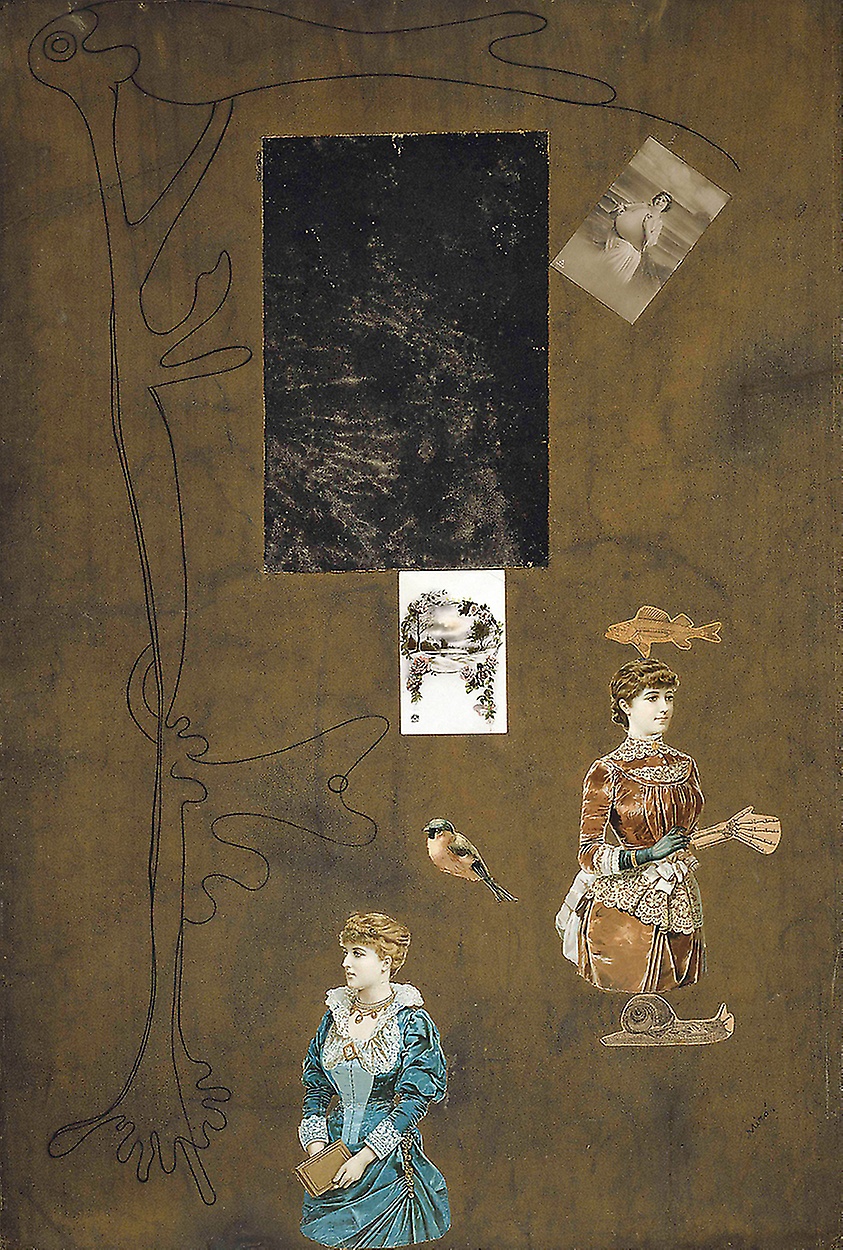
By April Lindner

Featured Art: Drawing – Collage by Joan Miró

Slowly at first, the arteries
in the brain’s finely spun net
narrow one by one
_____________to dead ends;
like the hand’s delicate motion,
__________a series of strokes

erase what took decades to write.

Difficult tasks forgotten first:
_______________how to merge onto a highway,
___________________knit a sweater,
_______________________buy a stamp.
Then the simpler ones,
___________________how to turn on an oven,
_______________________what goes in a cup.

Read More

A Moment

By Wisława Szymborska
Translated from the Polish by Joanna Trzeciak

I’m walking on the slope of a hill newly green.
Grass, small flowers in the grass,
just as in a children’s book.
Hazy sky, already turning blue.
A view of other hills spreads out in silence.

As if there had been no Cambrians or Siluries here,
rocks growling at one another,
upthrust abysses, no fiery nights
nor days in clouds of darkness.

As if no plains had moved through here
in feverish delirium,
in icy shivers.

As if only elsewhere had the seas been churning,
tearing apart the edges of the horizon.

It is nine-thirty local time.
Everything is in its place and in genial accord.
In the valley, the small stream as a small stream.
The path as a path from always to ever.

Woods in the guise of woods world without end amen,
and on high, birds in flight as birds in flight.

As far as the eye can see a moment reigns here.
One of those earthly moments
implored to linger.


Read More

The Three Strangest Words

By Wisława Szymborska
Translated from the Polish by Joanna Trzeciak

When I utter the word Future,
the first syllable is already headed for the past.

When I utter the word Silence,
I destroy it.

When I utter the word Nothing,
I create something no non-existence can contain.


Read More

Little Girl Pulling Off the Tablecloth

By Wisława Szymborska
Translated from the Polish by Joanna Trzeciak

She’s been in this world for over a year,
but not everything in this world has been examined
and brought under control.

Now being probed are things
that cannot move on their own.

They need to be nudged,
slid, shoved,
moved from one place to another.

Not all of them want it: not the wardrobe,
the cupboard, the unyielding walls, the table.

But already the cloth on the stubborn table
—when firmly grasped by the hem—
reveals an urge to roam.

On the tablecloth, glasses, plates,
a creamer, spoons, a bowl
all quiver in anticipation.

It’s interesting,
what move will they make,
as they teeter on the edge:
a journey across the ceiling?
a flight around the lamp?
a leap to the windowsill, and from there to the tree?

Read More

The Puddle

By Wisława Szymborska
Translated from the Polish by Joanna Trzeciak

I remember well this childhood fear of mine.
I’d step around puddles,
especially the fresh ones, just after it rained.
For one of them might be bottomless,
even if it looked like all the rest.

One step and it would swallow me whole,
I would start ascending downward
and even deeper down,
toward the reflected clouds
and maybe even farther.

Then the puddle would dry,
closing over me,
trapping me forever—but where—
and with a scream that cannot reach the surface.

Only later did I come to understand:
not all misadventures
fit within the rules of nature
and even if they wanted to,
they could not happen.


Read More

A Note

By Wisława Szymborska
Translated from the Polish by Joanna Trzeciak

Life—the only way,
to grow over with leaves,
catch a breath on the sand,
soar on wings;

to be a dog,
or to pet one;

to tell pain apart
from everything that isn’t pain;

to fit into events,
to vanish in vistas,
to search for the minutest of errors.

It’s an excellent opportunity
to recall for a bit
what was talked about
with the lamp turned off;

and if only once
to trip over a rock,
to get drenched in the rain,
to lose keys in the grass,
to follow a spark on the wind;

always not knowing
something important.


Read More

ABC

By Wisława Szymborska
Translated from the Polish by Joanna Trzeciak

I’ll never find out, what A. thought of me.
Whether B. ever finally forgave me.
Why C. pretended it was all okay.
What was D.’s part in E.’s silence.
What F. expected, if anything.
Why G. pretended, though she knew full well.
What H. had to hide.
What I. wanted to add.
Whether my being there
mattered in any way
for J. or K. or the rest of the alphabet.


Read More

Considering Wislawa Szymborska

Wisława Szymborska was born in Poland in 1923 and has lived in the city of Krakow since childhood. Her first published poem appeared in 1945, and her first book of poems in 1952, followed by books in 1957, 1962, 1967, 1972, 1976, 1986, 1993, and 2002. In 1996 she was awarded the Nobel Prize for Literature.

Read More

Vaster: Wisława Szymborska and Elizabeth Bishop

By Kathy Fagan

“A Speech at the Lost and Found,” a poem published by Szymborska in 1972 (translated by Joanna Trzeciak in Miracle Fair, 2001), is remarkable for its wit, its polymorphic leaps, and its cosmic vision; equally remarkable is the resemblance it bears to its younger sibling, “One Art,” published by Elizabeth Bishop in her 1976 collection Geography III. These are of course not the only charming poems on the subject of relinquishment to be published in the 1970s. The 1970s were, after all, the moon-stone-bone era, and use of the autobiographical “I” was for many progressive and/or restless poets becoming passé as they raged against the excesses of rampant confessionalism. In Szymborska’s case, of course, political circumstances fostered reticence and inventiveness as much as, if not more than, aesthetic taste, but each poet struggles and thrives within the constraints she’s given, whatever those may be.

Read More

Thinking Out Loud

By Lawrence Raab

One of the ways a poem can be eloquent is by pretending to have nothing to do with eloquence. This strategy has many dangers. If we catch the writer cultivating modesty, putting on airs by pretending to do the opposite, the poem’s plain clothes will appear calculated for effect. Of course we know that all good art has been calculated for effect. Nevertheless, the directness of certain poems can seem wholly natural, as if the poet desired only to speak in the clearest possible way, saying just what needs to be said.

Read More

On Szymborska

By Carl Dennis

Go in fear of grand generalizations is the usual advice we give our students; let particulars carry the thematic burden, not abstractions. But we all know many poems that defy the rule successfully. One that I particularly enjoy is a poem by Wisława Szymborska entitled “A Contribution to Statistics,” in her most recent collection in English, Monologue of a Dog. This poem is of special interest in this regard because the will to generalize is itself part of the subject of the poem, and seems, on the first reading at least, to be treated critically, as the poet gives us the statistics about the prevalence of various character types in the population at large. Here is the opening:

Read More

“Non Omnis Moriar”: Reading Szymborska in Translation

By Jennifer Clarvoe

I go back again and again to one of the first poems of Szymborska’s that caught my attention, “Autotomy.” In it, she incorporates a Latin phrase, from Horace’s Ode III.30, “Non omnis moriar,” which means (the notes tell us helpfully), “I shall not wholly die.” The slightly disorienting pleasure of finding a Latin phrase in a Polish poem stands in part, for me, for the continuously disorienting pleasure of reading any poetry in translation—at least as much pleasure in what carries over as in wondering what is lost. The “I” in “I shall not wholly die” seems to me to be the phrase itself speaking, the poem speaking from the page, even more than it speaks for the poet, either Horace or Szymborska. In my facing-page text (in Krynski and Maguire’s translation), the Latin remains untranslated, identical, on both pages—the part I don’t entirely get in the English version, and the part I recognize with relief amid the Polish.

Read More

On Szymborska’s “Travel Elegy”

By William Olsen

Wisława Szymborska has the practical self-regard I imagine an anthropologist might have, all that much more functional for being a little off to the side. She does not deal in ironies as cosmic betrayals, as Milosz does, but in ironies as human fictions. Her poems are often written in a mood I’d describe as defenseless yet deliberate. They may maintain comic perspective on mood, but they do undergo their emotions. They can wince and smile at once, if doing so makes things clearer.

Read More

New Ohio Review Issue 4 (Originally printed Fall 2008)

Newohioreview.org is archiving previous editions as they originally appeared. We are pairing the pieces with curated art work, as well as select audio recordings. In collaboration with our past contributors, we are happy to (re)-present this outstanding work.

Issue 4 compiled by Julia Robertson.

Chefs

By Claire Bateman

Featured Art: The White Tablecloth by Jean-Baptiste-Siméon Chardin

So there the world was, right smack up against the proverbial edge of time. No one was surprised that some people were leaping from skyscrapers while others were attempting pointless last-minute conceptions of offspring; & that in every city & town, acts of extraordinary altruism & vindictiveness had become so common as to go unreported. And no one was surprised that there was a spike in the number of couples suddenly eager to be married, but the spike was so dramatic, in fact, & the usual officials (rabbis, priests, justices  of the peace, notaries public, & ships’ captains) were so beleaguered, that a squadron of kamikaze chefs had to be deployed to perform emergency nuptials for the multitudes of entities & identities demanding official union before the end of all things. Everyone knew someone who was calling for the chefs, those professionals capable of creating the alchemical events these transformations required, some of which would almost certainly release such molecular & ontological ferocity as to create titanic conflagrations, thus depriving some of the chefs of their precious last few weeks of life.

Read More

At the Dinner Party

By Stephen Dunn

Featured Art: A Family Meal by Evert Pieters

As usual, we were trying to please each other,

so Ryan told a story about a water buffalo,

a lion, and a crocodile, which reminded

Julie about a coyote and a groundhog, and

I could not help but offer my favorite of

this kind—involving the tarantula

and its natural enemy the digger wasp. The

problem was that each story was true,

therefore that much more difficult to tell,

and each had in it an element of the fabulous,

and therefore the promise of a moral.

Linda, the contrarian, asked us if we had heard

the one about the priest and the rabbi,

but was booed, and kept quiet for a while.

In each story an animal was in danger, one

always slightly more sympathetic

than another. The water buffalo rescued

her injured calf from first the crocodile

then the lion, the coyote got bored

with the groundhog and returned to the woods,

and the tarantula just stood there, frozen,  while

the digger wasp dug its grave.

Ryan and Julie selected their details well,

paced and arranged them, as I hope I did,

and it wasn’t that our intent was to avoid

a moral, but that there was none to be had,

this being nature we were talking about

with its choiceless whims and atrocities.

Linda, of course, said she forgave none of it.


Read More

Mercy

By Stephen Dunn

Featured Art: Improvisation No. 30 (Cannons) by Wassily Kandinsky

The music was fidgety, arch,
an orchestral version of a twang.
Welcome to atonal hell,
welcome to the execution
of a theory, I kept thinking,
thinking, thinking. I hadn’t felt
a thing. Was it old-fashioned
of me to want to? Or were feelings,
as usual, part of the problem?
The conductor seemed to flail
more than lead, his baton evidence
of something unresolved,
perhaps recent trouble at home.
And though I liked the cellist—
especially the way
she held her instrument—
unless you had a taste
for unhappiness
you didn’t want to look
at the first violinist’s face.

Read More

’69

By Kathy Fagan

Featured Art: Alfred Sisley by Pierre-Auguste Renoir

If it’s been ten times it’s been forty-five
I’ve checked the man out in the car behind
mine, teeth bared, laughing in my rearview.

I cannot stop myself from watching him,
sun full on his face. He’s all alone—
we are, among our fellow rush commuters—

and then it dawns on me: it’s Mr. Cahill
from sixth grade, my first male teacher (heart, be still!),
who taught sex ed to us in ‘69,

in Catholic school, till someone narked and he
was gone for good. Those days, we venerated
the venereal, reciting sex words right

Read More

Constant Craving

By Kathy Fagan

Featured Art: Café Concert (The Spectators) by Edgar Degas

When Peter Byrne of the 80s synthpop duo, Naked Eyes, played for me his acoustic cover of k.d. lang’s “Constant Craving” in his studio over-looking Los Angeles, the peacock—not the NBC peacock but a real peacock among the many on the grounds—opened his fan as if the music were a potential mate. He strutted and shirred. He shimmied his many eyes. He’d been drawn to the music, then spotted himself in the sliding glass doors. He leaned in and turned for us like a Vegas show girl. He brought tears to my eyes. When the song was over I could barely muster, “What a tender version, Peter,” though tender wasn’t the word for the primitive if aimless seduction on the lawn.

Read More

Birth Day Party

By Jack Myers

Featured Art: Houses at Murnau by Wassily Kandinsky

Memory in her drab gray dress was the first to arrive.
She sat there bored, with nothing to remember,
so she talked to herself, her mind streaming
like a black-and-white dream full of words.

Upstairs, Regret circled and circled her mouth
in hard red, ironed the wrinkles out of an old
embarrassment, and doused herself in lavender.

After humping Memory’s leg, Happy
rolled over and over, his little thoughts
like the insides of a Scrabble box.

Hard Work trudged downstairs
to the basement to soak and snooze
in the anesthetizing glow of the cathode tube.

Part of me was there too. The omniscient narrator.
A you without a mouth. A mist of a face
in a black-on-black painting.

The rest of me, never having tasted or seen
or heard or been held before, was about to arrive.
Everyone cried and was glad somebody had the chance
to be anything again. That was the occasion.


Read More

My Life

By Jack Myers

Featured Art: October Day by Jean Charles Cazin

was never large enough even for a B movie
though I think I’ve felt as deeply as Brad Pitt.
No one I grew up with ever became famous
or notorious on that spit of land that ended in the sea.
But we became as adept at reading storm warnings
in the muscle and color of water as we did in a face.

In the cold-war doldrums of the 50s, all my teachers
hated teaching. We were such little shits back then
I thought who could blame them, and became a teacher
so I could show these younger versions of myself
how to open their hearts and enter into a different,
richer kind of darkness that exists in them.

We were an obstinate desert people given a single animal
which we rode and milked and roasted and skinned.
The stories strangers told us about fabulous places
we’d never get to taught us how to open a door in rock
and go inward, how to widen our hearts with longing
and a song and bang along on a drum skin and a string.

Read More

Plans

By Jack Myers

Featured Art: Houses of Parliament, London by Claude Monet

I thought of my soul as something like a scent,
like an air of kindliness. That my selfish heart
would grow enormous in battle. I thought I could help
the troubled because I was troubled. I wanted my humility
to be large, to float like a balloon above the parade I was in.

But you know how it goes. My epic turned out to be
a miniature self-portrait painted on a brick from a wall
in me that had fallen in. My oxen were small as bugs.
My arrows that I imagined shredding the sky like black rain
in a Japanese ink print melted back into brushstrokes.

So it’s good to feel small once more, to bow at the end
of a long line of becoming everything again. No more
struggling to fit in after wind-light sweeps me up or a dying
ember takes me in as easily as I thought my life should have been.

Or maybe what’s next will be harder or nothing or I’ll be
totally surprised without there being a me. I always felt like
that anyway. But the place in me where all of this is missing
has turned sacred over time. That’s the best explanation I have
for why we aren’t allowed to know even the simplest things.


The History of Forgetting

By Lawrence Raab

Featured Art: Eve by Lucas Cranach the Elder

When Adam and Eve lived in the garden
they hadn’t yet learned how to forget.
For them every day was the same day.
Flowers opened, then closed.
They went where the light told them to go.
They slept when it left, and did not dream.

What could they have remembered,
who had never been children? Sometimes
Adam felt a soreness in his side,
but if this was pain it didn’t appear to
require a name, or suggest the idea
that anything else might be taken away.
The bright flowers unfolded,
swayed in the breeze.

It was the snake, of course, who knew
about the past—that such a place could exist.
He understood how people would yearn
for whatever they’d lost, and so to survive
they’d need to forget. Soon
the garden will be gone, the snake
thought, and in time God himself.

These were the last days—Adam and Eve
tending the luxurious plants, the snake
watching from above. He knew
what had to happen next, how persuasive
was the taste of that apple. And then
the history of forgetting would begin—
not at the moment of their leaving,
but the first time they looked back.


Read More

The Weed Whacker Makes Me Yearn for the Scythe

By Lawrence Raab

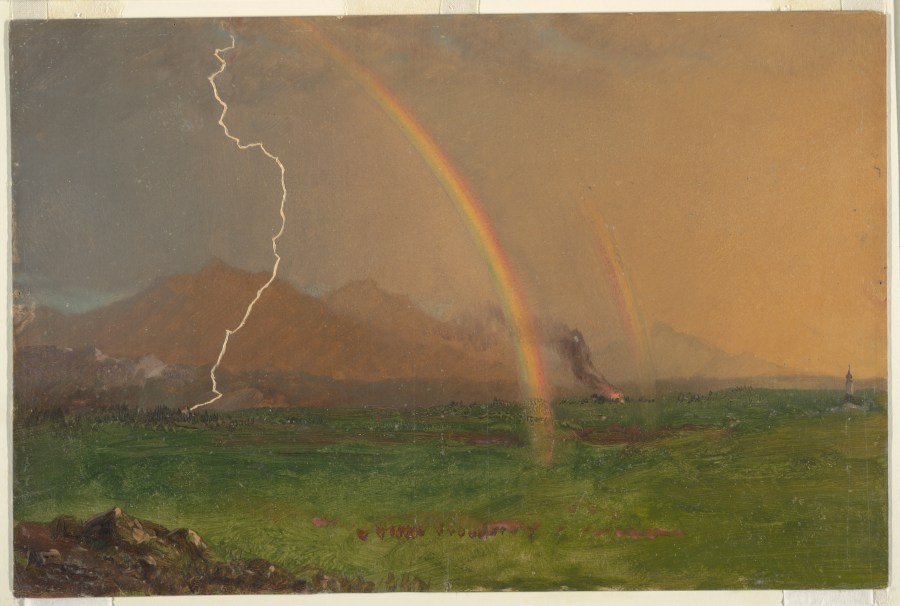
Featured Art: Valley of Aosta: Snowstorm, Avalanche, and Thunderstorm by Joseph Mallord William Turner

and all the other instruments of silence,
lawns mowed by sheep, for example,
their soft eyes fixed on the earth,
the small sounds of their labor never rising
to the upper floors of some vast country house
where, centuries ago, I’m hard at work
on a new poem for my patron. Right now

I’m distracted by the extravagant view,
which reminds me of the many consolations
of great wealth, although my subject
this morning is neither privilege
nor pleasure, but time—his choice,
following yesterday’s underappreciated ode
on virtue. Tell me, he said, what you think
I should feel, and I wanted to suggest

how much more inspiring I would find
a slightly larger room, one farther away
from the servants, and their whispering.
Ah, the wanton hours—they turn, they laugh! No,
personification irritates him. I must be wary
of the sea itself, restless and unfathomable,
though birds in flight may work, even those sheep

whose ceaseless munching I’ve been trying
all morning not to imagine. The scythe
glides silently through the bending grass.
Or should it be wheat? Yet always it glides.
And clouds pass, as all things will
in this world, I might add, but do not, since death

pleases him only if the thought of it
reminds someone pretty how foolish she is
to cherish that which worms too soon
will take without asking. A good point,
he’ll tell me later, perhaps noting
that “the soft eyes of sheep” strikes him
as unnecessary—too poetic, or else too common,
like the unmown fields, or the scythe
some weary laborer has left gleaming
out there in the noonday sun.


Read More

Little Bird

By Lawrence Raab

Featured Art: Seascape by Pierre-Auguste Renoir

One cloud was following another
across a blue and passionless sky.
It was the middle of summer, far enough
from December for a man to feel indifferent
to the memories of cold, not yet close
enough to autumn to be caught up
in all its folderol about death.
Neither cloud looked like a whale
or a weasel, or any kind of fanciful beast.
All morning I’d felt my life dragging me down.
The view from my window refused to lift my heart.
The sight of a blank piece of paper
filled me with sadness. I wanted to set
my life down in a comfortable chair, tell it
to take a long nap, and walk away as if
I were somebody else, somebody without a house
or a family or a job, but somebody who might
soon feel with a pang precisely the absence
of everything I had. A cool breeze lifted
the curtains in the room where I was sitting.
A bird was singing. Had it been singing for long?
Far off there were mountains, but I didn’t
wish to go there. Nor did I yearn
to be standing by a lake, or walking
beside the tumult of the sea.
The little bird kept repeating itself.
I filled a glass with water and watched it tremble.


Read More

Failight

By René Houtrides

Featured Art: Tree Trunks (study for La Grande Latte) by Georges Seurat

When he was thirty-eight years old, he decided not to see. It was a clear decision, and he was aware of its unfolding inside him. He was standing in the small, small bedroom—luckily, he was not claustrophobic—with the bunk beds, the high-piled desks, the tiny walking corridor within the room. He was stretching his arms outward and realized he could not straighten them without meeting an obstruction. A lamp to his right. A heavy window curtain to his left. It was only possible to walk into the room, climb into one of the beds, sit at one of the desks, or walk out of the room. It was not possible to walk around within the room. He was standing in the walk channel, his arms horizontal, bent at the elbow, and decided not to see. He had two reasons for deciding this.

First, not seeing would encourage him to turn inward, where he could build a secret chamber hushed, but with just enough elbow room. Others would be able to enter only if he permitted it. He needed to form this architecture because he lacked the sedative of space in his daily life. For even this bedroom, small though it was, was not his. If it were, he would have cherished it, in all its close airlessness, for its privacy. No. This room was where his children slept.

He slept in the living room, where a narrow red chair folded out for his nights. From there he could hear his wife, in her own small room, play out her illness in silences and exhaustion and screams and cruel words. Something was growing in her brain. Something that would not kill her. But something that the surgeons determined they could not excise. Perhaps the doctors were wrong. Perhaps what was growing in his wife’s brain was not a thing, but a process. A reverse alchemy: emotional gold transmuting to base metal.

Read More

So Near Yet So Far

By Angie Estes

Featured Art: The Holy Family with the infant Saint John by Valerio Castello

At the edge of the apparent
        disk of a celestial body, known

as its limb, is the border
        between light and dark, there

and not. First a gradual dimming,
        then small crescent shapes appear

on the ground under trees as
        the temperature sharply drops

and birds become quiet, the stars,
        visible: when the sun and moon

come face to face, small beads
        of sunlight shine through the valleys

Read More

Here Lightning Has Been

By Angie Estes

Featured Art: Bathers by Paul Cézanne

buried across the barren plateaus
of Provence, where stone altars
chiseled with FVLGVR CONDITVM
mark the point where lightning entered
the ground. Around each site, a wall
remains to keep the divine
fire of Jupiter’s signature within
the shafts and passageways
of the earth. According to Plutarch,
whoever is touched
by lightning is invested with divine
powers, and anyone slain by
its bolt is equal to the gods, their bodies
not subject to decay because
they have been embalmed
by celestial fire. Light,
                                         when it leaves
the air, is the color of blood
that has entered a vein:

Read More

Anderson Inside the Hurricane

By Stefi Weisburd

Featured Art: A Vagabond Walking Along a Lane by Alphonse Legros

The wind has come to remind us of our wings — Mississippi artist Walter
Anderson, who tied himself to trees in order to experience hurricanes

Lashed to the mast, ears thrashed
             by sirens in the eyewall, Anderson
is the squall’s canvas, ravaged
             by wind that wants to strip
his skin from skull
                          and howl.

      Only yesterday he sank
                             to hands and knees
to understand the guano of green heron, to paint
                        the violet frog. Lying by a quiet
      lagoon, inking a white-throated
                        sparrow, he saw cadmium and red madder happily
flare in foliage. In the slash pines of Horn Island
where imagination fills the space between trees, art
     defers the evil moment. Contour of bark
     or butterfly is ballast; it calms the

                   gale within him, bulrush pool, always a balm until

     a storm makes land.
                             Then it froths and spits, rain
         needles him, ankles deep in the surge.
         How will he paint the sting
                    of maddened sand, the batter of root
    torn from loam, blue strafed from
                               sky? Titanium whitecaps throttle
the mangrove beach. All around him, palms
                                flash and flinch like broken
              umbrellas in brash light, the shed
                                       in shivers under

         the blotted sun. A locomotive
                  in his ear, wind
                                    wrenches his breath from
                           its palate, whips
         him beyond himself, out
                  of his sleeve of pain, sopping

                                          and so close, so
                                 close to capsizing . . .
                        Something in the cyclone
        cries out.

                        Something wheels

                                                 and sings.


Originally appeared in NOR 4

Degeneration

By Stefi Weisburd

Featured Art: Stoke-by-Nayland by John Constable

Through the forest’s dark persistence, hugging
the relentless road, you search the inevitable
for the sad address, then find yourself paused

in front of the driveway, just
before your halogens startle the dim
windows, the porch out of joint, in that moment

before you are knotted irrevocably
to the future, to her avocado refrigerator whining
like a beast, its gullet full of Ice Age ice cream and the odd

trap-sprung mouse in a Ziploc, before the legions
of art magazines piled in solemn cairns and the Old Countries
purpling her arms, her throat’s

dry drapery and the keys to abandoned
rooms clutched
like a crucifix. In that moment

before her body slips
out of itself and she dampens the floor, before
her ears traffic in the static of her dead

father’s scolding, before her dull
doe eyes fever with fury and shadows hunch like Dante,
before she calls you “Mother,” demanding

you wipe her ass, before her heart cherries and
Tolstoys, in that moment, turned in the driveway, before
all that, back out. Gun it.


Read More

Eight Photographs

By Kim Adrian

Featured Art: The Child’s Bath by Mary Cassatt

The current set of complications involves a three-unit bridge—the kind a dentist puts in your mouth. Actually, I’m talking about half of a six-unit bridge that at some point during my mother’s cleaning rituals got cracked down the middle. In any case, my mother swallowed this thing while she was driving out from Chicago after my sister kicked her out. She was taking a handful of pills when the bridge, which was loose, dislodged and got swept down her esophagus.

You see, already, how complicated?

Three-unit bridges are weighty little constructions made of porcelain and gold. At the base, where they fit into the gumline, they are, as my mother puts it, “sharp as razors.” I don’t think they are actually that sharp, but that the metal tapers to a very thin point is certainly the case.

Read More

Reunion

By Bruce Weigl

Featured Art: Woman at Her Toilette by Edgar Degas

Now, as the popular girl walks among us with the microphone,
most of the stories are about loss,
or include exquisitely precise medical and pharmaceutical details,
as if the words could suture the wounds, or save us even one last breath.
I came here to dance with the Puerto Rican women
of my class of 1967, and to remember a few pals lost in the war,
who had been so beautiful, you were happy just to look upon them,
and one more
lost to his own drunken wildness
under a moon who doesn’t remember us.
It’s not a going back we long for, but a staying still
for one incomparable moment, all the lost loves’ faces
spinning in the mirrored ball.


The Last One

By Bruce Weigl

Featured Art: Two Plant Specimens by William Henry Fox Talbot

The anonymous brown song bird
        is annoying in her insistence
             on repeating the same three syllables
in exactly the same way, endlessly.

        She must know something
             about inevitability,
                       to sing so long,
        no one else in sight.

        The persistence of nature;
         the blind and infinite dedication to a thing
                       in the face of emptiness and silence
        that won’t let you believe that you are the last.


Read More

Travel: Choler

By Neil Shepard

Featured Image: Old Sarum by David Lucas

For Robinson Jeffers

We had come to the Great Wall’s end
in the desert of Jiaguyuan. Our tempers flared
across the crumbled battlements, out into the red heat.
There were weeds, thorns, a few hard-
shelled bugs. Love reduced to a black
carapace, under which a stinger,
a biting mouth, a reflex, a poison.

Heat withered our patience. Our bowels,
stung by a virus, made us say words we’d regret—
peevish, pernicious—wo yao, wo yao,
I want, I want, and nothing else.
We both stormed off—“stormed”
could have brought some moisture
to this desert, but no, this storm

was a hot wind, stinging sand
in the face, chipped sandstone
from the last outpost, that would cut
and bury us. Wei guoren. Barbarian.

Read More

Watchman, Tell Us

By Michael Chitwood

Featured Image: Mountain Brook by Albert Bierstadt

The thief was none other than the wind.

The thief was the color of nickels.

The thief hummed in the downspouts, around corners.

I’ve already told you.

You should know better.

Mister Know-it-all. Mister Hands-in-your-pockets. Mister Sleep-for-the-morning-is-coming.

The thief had the cinnamon of fallen leaves on his breath.

The thief put a tear in our eyes.

Read More

Facing

By Maya Jewell Zeller

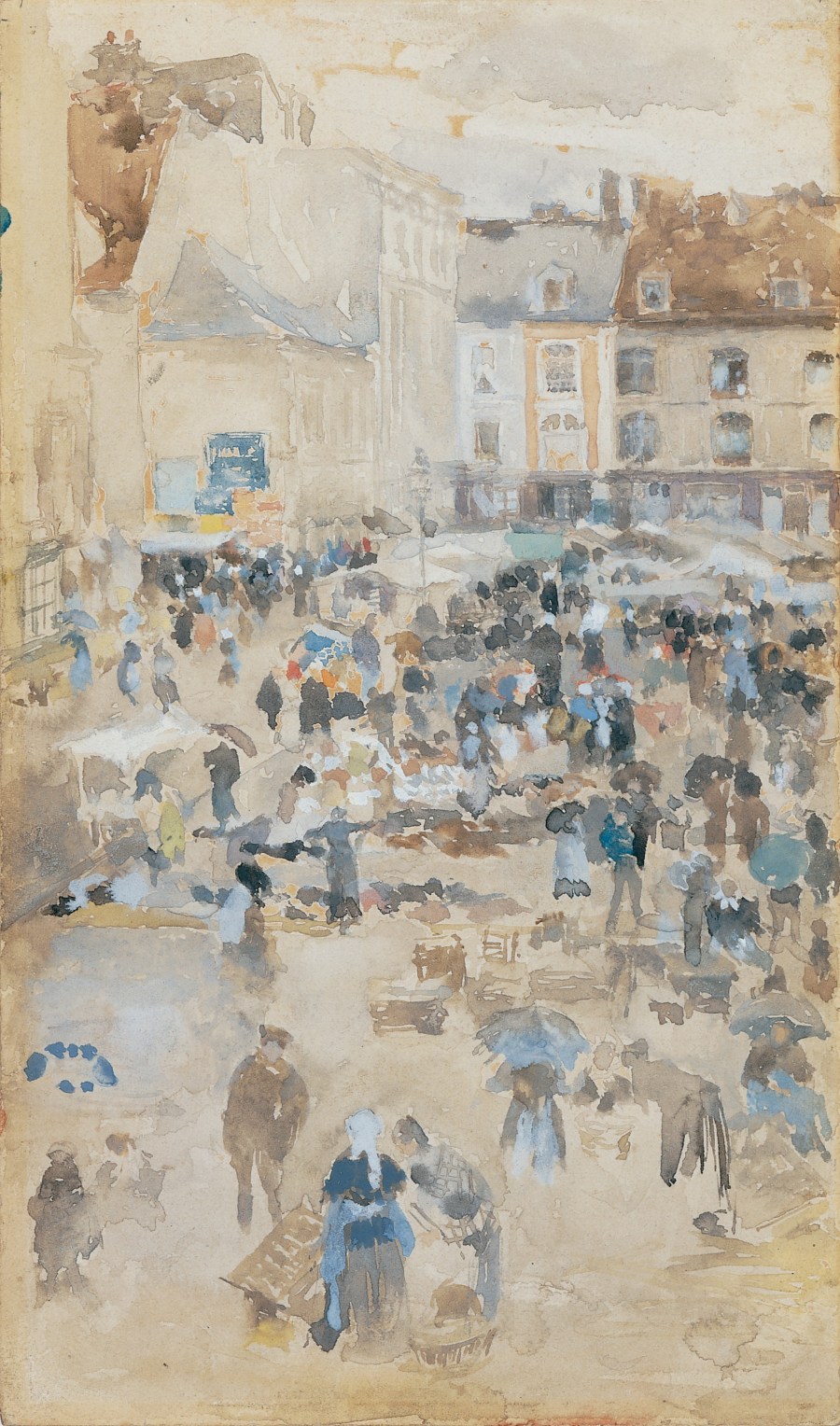
Featured Image: A French Market Scene, possibly Boulogne by David Cox

At seventeen I worked after school
and most weekends for a local grocery,
and when it was slow I would straighten
the shelves—we called it facing—
which helped me memorize where everything was,
right down to the canned loganberry topping
Eleanor loved for her cheesecakes
or the clam juice or the coriander
or the yellow food coloring I knew could give people
impotence, and really what would be so bad
about that, I was familiar with most of the customers
who came in and frankly it wouldn’t hurt them
to have fewer babies, the way they laughed
at the Mexicans who brought vans on Saturdays
to fill three grocery carts with tortillas, bagged
chilies and metal-clipped tubes of ground beef,
the way they would ask me what I was doing
when I got off, did I want to come out
to their campground where they were fishing
and no, I didn’t, but I’d smile, ring up
their hot dog buns and Coors Lights,
while they grinned at what little skin I had showing
beneath a black apron that said Okie’s and a button shirt
and I wished instead of their eyes it was wind
at my collarbone, thistle-sweet air while I ran
the road toward Altoona, birds
following my legs with their call,
those honest phlox faces lilting in the wet ditch.


Read More

Tableaux Vivants

By Katherine Lien Chariott

Featured Image: Icebound by John Henry Twachtman

1: Winter

Here is the beginning. I’m walking down the sidewalk and then the curb, sidewalk and curb again, under a sky full of tiny sad stars that light up this city  as well as they can, but not as well as the neon signs all around me, not as well as the rainbow glitter of the Strip, just five miles away, I’m walking with the glitter and the neon and the stars, in front of the Sav-On Drugstore and then past it, towards the Dottie’s—video poker and snacks, cheap smokes and booze, twenty-four hours a day. I go into the Dottie’s, with money in hand for two packs of Reds, and a hey there to the man working security. I’ve seen him before, know that brown skin and that smile, so I can look at the carpet instead of at him while I tap my hands on the counter, waiting to be rung up. He’s watching me, I think, and when I look at him, I know. Just like I know he hasn’t seen or doesn’t care that I came in with someone. 

Read More

Uh-Oh Time

By Kenneth Hart

Featured Image: Odalisque by Jules Joseph Lefebvre

It’s uh-oh time again when a woman asks me out
after a year of being on my own
and her number on the bar napkin is the permission slip
to stop hating myself

Stop walking around all day in sweat pants, stop leaving
a nest of dental floss stuck to the tiles
where it missed the garbage can

I’ve got to start taking better care of myself
is what her voice on the answering machine suggests
Got to get back on the StairMaster Got to learn new recipes

Read More

Having Not Heard Back from You

By Kenneth Hart

Featured Image: The Print Collector by Honoré-Victorin Daumier

I suspect you must be dead.

If you are reading this,
then you are not dead—

after I chose the wine,
and teased the waiter for spilling a little on my good shirt;

after the appetizers arrived,
and I told the joke about the priest and the porcupine

Read More

The Way Things Look

By Kenneth Hart

Featured Image: Pity the Sorrows of a Poor Old Man! by Jean Louis André Théodore Géricault

Some things are easier than they look
and some things are harder than they look.
Riding a bike, for example, is easier than it looks,
unless you are five and your feet don’t reach the pedals.
Playing guitar is harder than it looks, as is milking a cow.
Fall down when you are skiing,
forget someone’s phone number, be used by others as a bad example—
failing is easier than it looks.
Read More

Damn the Manacle

By Alix Anne Shaw

Featured Image: David in Prayer by Rembrandt van Rijn

Don’t give up Hopkins, my brouhaha. The manacle is crafty, oh yes. He has his agent oranges. There are some he trains to look just like Jung and Mead. But we will thwart the manacle. Thwart him at every turn-on.

When the manacle comes, we will open our windpipe. We will turn on our air mail. We will seal the crackerjack with Marxist tape recordings. We will hide our topaz under the doorjamb. We will make a blow job by putting dryer sheet music into a cardboard tube rose. We will not answer the doorjamb when the manacle knocks.

Read More

Heroine in Repose

By Rick Bursky
Featured Image: The Vase of Tulips by Paul Cézanne

I wasn’t sure if she kissed me
or simply used her lips
to push my face away. Yes,
the moist warmth was enjoyable,
but when my head was forced
back over the top of the sofa
the intention grayed.

Earlier that day I planned
to quit my job and pursue
a career writing romantic novels
that would be confused with memoirs.
But if I couldn’t distinguish
between a kiss and a push
what chance do I have
of writing romantic novels
that would be confused with memoirs?

After the kiss, and I prefer
to think it was a kiss,
she sank back into the pillows
and watched me
out of the corner of her eye.


Read More

The Reversal

By Billy Collins

Featured Image: The Annunciation by George Hitchcock

It’s so beautiful outside today
and we’re all going to die,
especially me,

is an observation that drenches
the pages of every anthology of poetry.

The trees are brilliant in crimson,
and I am one day nearer the grave
would be one way to put it.

Red and white tulips are swaying
in a mild breeze this morning,
and just look at the dark gullies under my eyes
would be another.

So many variations,
you have to wonder how would it be
if the picture were flipped the other way

and poets never tired of declaring
in poem after poem
that the world is a mound of ashes
and that they will never die.

How crummy the flowers look!
How well I feel!
How hideous the mountain range!
How handsome I will always be!
How fine to live forever in the midst
Of such relentless and unspeakable ugliness!
Which brings us to the question:
how much more of that would you have to hear
before you longed for
a bead of dew on the tulip
and that cough that will be your undoing?


Read More

Bathtub Families

By Billy Collins

Featured Image: Beach at Cabasson by Henri-Edmond Cross

is not just a phrase I made up
though it would have given me pleasure
to have written those words in a notebook
then looked up at the sky wondering what they meant.

No, I saw Bathtub Families in a pharmacy
on the label of a clear plastic package
containing one cow and four calves,
a little family of animals meant to float in your tub.

I hesitated to buy it because I knew
I would then want the entire series of Bathtub Families
which would leave no room in the tub
for the turtles, the pigs, the seals, the giraffes, and me.

It’s enough just to have the words,
which alone make me even more grateful
that I was born in America
and English is my mother tongue.

Read More

Chicken

By Stephen Cramer

Featured Image: For Sunday’s Dinner by William Michael Barnett

At the festival when we were celebrating
harvest with pumpkin tarts & cider,
an older farmer asked what I was into
& maybe my answer was muffled a bit
from the cider’s tang because he started
talking passionately not about his favorite poet
or the use of weather in haiku
but about his chickens: White Leghorns,
Silkie Bantams, Rhode Island Reds,
Plymouth Rocks, how, in Corporate Agriculture
the birds are bred so big that their legs
cripple beneath them & isn’t that a shame.
I tried to break in, to tell him he misheard.
But he shook his head & held up his finger.
That’s not the case with his birds.
When his hens are laying he puts oyster shells
in their grit to give them extra calcium
for their own shells. His birds are free range—
not debeaked & stuffed two dozen
to a pen. No, his birds can go anywheres they want
from the barn to the bog & even in the house.
Read More

The Effects of Laudanum

By William Todd Seabrook

Featured Image: Blasted Tree by Jasper Francis Cropsey

name this particular spot after me. I don’t know where I was going with that. I have a tendency to lose track of things, as Mom used to say. I think it’s just impossible to focus and live in Laudanum at the same time. Laudanum’s the name of my town, not that you’ve ever heard of it since it is mostly just the one intersection of Chillicothe and Route 87 out in Ohio Amish country. No ones calls it Route 87, they call it Boulevoux Road, after some guy named Boulevoux, whom I never met. The rest of the town is Amish people and strip malls and the two rarely conflate. I stand next to the Marathon station and across from the Dairy Queen, 197 feet from where Boulevoux’s daughter died, and I am positioned so that when five-speeds come off a red light they down-shift as they pass me, as if I’m the catalyst for their propulsion instead of just a cow, or a guy in a cow suit with a high school diploma and a sign that reads Ranchero’s Restaurant in lazy letters.

Read More

The Night I Proposed

By Peter Stokes
Featured Image: The Kiss IV by Edvard Munch

This is a whole new world to us, and
We drove up to some rooftop parking garage
To look out on the Western night
There up above the Terminal Bar & Grill
And later moving on down darkened East Colfax
Past all the whores with their narrow old asses
And bars wide open with their doors bent back
I thought I saw Bo Diddley
At the wheel of a cream-colored Cadillac
Like out of some wet dream from my Visions of Kerouac
And I knew that at last we had arrived.

Read More

Haircut Talk

By Peter Stokes
Featured Image: Baby (Cradle) by Gustav Klimt

Lenny’s elbows jut from the sleeves
Of his blue barber’s shirt
And carve the air about my head
In a series of unreadable signs
That I trace in the glass of his square barber’s mirror
Where I watch myself watching his face give expression
To the subtlest whir from his scissors and comb.
Or we talk for a moment
About a change in the weather
And I realize for the first time
That Lenny is gay.
“So how’s married life?”
He says through the silence,
The strange edge in his voice
Like a barb on a wire
In the point-blank talk of our new acquaintance,
And I smile a smile that communicates nothing
And it’s suddenly clear that Lenny is drunk.
How much, then, I wonder, does he want to know
About my wife in the hall
With the bread knife in her hand,
Or the one about me,
It was midnight at Tim’s place,
Falling down drunk from the top of the stairs,
Or the sub-zero talk in the car outside Lena’s
And making her cry until 3:00 a.m.
And I talk to myself,
Three speeches in the silence,
And all of this world,
On the still point of a pin,
Spins through the minutes
With nobody talking
As we confess to ourselves
Everything we conceal
And the hair from my head just falls to the floor.


Read More

Third Street Muscles and Fitness

By Mark Kraushaar
Featured Image: The Drinkers by Vincent Van Gogh

It’s rained all night,
and it’s rained all day, and by evening
when I get to the gym it’s started to thunder.
Still, here we are anyway, all of us, all the regulars,
George, and Phil, and Johnny B, and Bob,
and me and the big guy, the lifter from Janesville.
So first off George (who’s zipping his coat)
asks Phil who’s on the treadmill and the only
one raising a sweat, will he run a mile
for every beer last night.
Which very funny, but Phil follows with, Hey,
I’m not drinking any more in ‘08
(beat, beat) but I’m not
drinking any less either which, again,
very funny except we all know Phil has
problems with alcohol, but since he’s getting no laughs
he looks up and on the tv over the rowing machine
there’s the real life trial of a woman, blond
and twenty-three, a teacher who’s 
had sex with an eighth-grade boy. 
Are you kidding, says George,
Are you kidding, says Phil, I’d clap her erasers,
and someone else, I’d polish her fruit,
and everybody’s nodding yes and yes again
until, at last, George who’s had problems with school
and problems with money and women and work tells
us he’d have majored in meredial reading
which is where the tv goes to an ad
and George waves once and steps into the weather.
So as the rainy wind flips his cheap rug straight
off his head like a flattened cat
it’s strange, nobody’s laughing, in fact, we’re quiet finally,
Phil with his crashed marriage and the daughter
on drugs, and even handsome Bob
and Johnny B, even the big guy
with those silly disproportionate arms,
and for a moment, for a discrete, small portion of
what I will one day refer to as the past, there’s
the five of us facing three
double-door sized panes
of rattling glass:
rain on the awnings, rain over the windows,
rain over the gutters and rain
in soft, sparkling ropes along the curbs,
and into the drains and under the ground.


Read More

Interview with Frederick Barthelme

By Gary Percesepe

Featured Image: Seated Youth Writing in Book by Raphael

Gary Percesepe: You wrote an essay for the New York Times Book Review in April 1988, back when the “minimalism slash postmodern” discussion in literature was still in vogue. It had a wonderful Veronica Geng title, “On Being Wrong: Convicted Minimalist Spills Bean.” Your essay sparked a lively discussion among academic folk which was published in Critique in 1990 as “Postmodernism: The Uninhabited Word, Critics’ Symposium.” Looking back twenty years later, what has changed, and what remains the same?

Read More

New Ohio Review Issue 3 (Originally printed Spring 2008)

Newohioreview.org is archiving previous editions as they originally appeared. We are pairing the pieces with curated art work, as well as select audio recordings. In collaboration with our past contributors, we are happy to (re)-present this outstanding work.

Issue 3 compiled by Ellery Pollard.

Nothing Stays Buried, Hector Flores

By Andrew Michael Roberts

Featured Art: Daedalus and Icarus by Giulio Romano

Not your sad little sister nor the boy of your youth some doors down who shot himself twice. Not even dirt. It churns for years and surfaces as something alive. We name it old names we know by their taste on our tongues. Humus and bone, a song in the blood. Hector, we’re all descendants of conquistadors and graveyards. If you were thrown a sword, you’d know how to hold it. Know which tombstones to walk behind, whistling. Which mountain to climb and when to take flight. How heavy your tired arms. Hector, look down on us tenderly before crossing over and descending into the desert. Remember us as the sand swallows and sings you. Before the sun takes you, cast your winged shadow across it. We are the grains in your grave. We are buried there with you.

Read More

There Was a War

By Andrew Michael Roberts

Featured Art: I Saw it, plate 44 from The Disasters of War by Francisco de Goya

and it wasn’t ours because we didn’t believe in it, but they shot at us anyway because we stood somewhere in the middle of them killing each other. What could we do but lie down and wait? We lay a long time, thinking, the grass like trees shooting into the sky. Bullets like birds shooting across it. Too many hours of sun in our eyes. We were thinking: if we had guns we’d use them to get the hell out of the middle of this war.

Read More

Dunes

By Mark Cox

Featured Art: Sand Dunes, Harlech, North Wales by George Elbert Burr

Despite the curvatures adapted each to the other,
The slackening skin that in sleep feels lost without that other’s;
Despite the slatted fencing that marks their yard from others’,
And the offspring at play within, their testament to others;
Despite all the others they have embraced and refused;
Despite all otherness between them
They’ve acknowledged and recused;
They can no longer in mystery come to each other,
With the quickening and total surrender to another
That both empties each and fills the other.
And so they go on, because each goes on, despite the other:
To each their own wind-ironed waters,
To each their own bruised sky and horizon,
Their own shames, their own redemptions,
Awakening to each night’s newly shifted sloping,
Each day by unremitting day’s abiding,
Without need for another day or lover,
They endure side by side, in their time, no other.

Read More

In which I first discovered

By Emily Pérez

Featured Art: Woman Writing by Zabitz

Quite suddenly, at least it seems in retrospect
Though I still seek a complete

My relationship to my past
It was as if my past had taken

Without warning, understand,
Had slipped in such a way that it uncovered

No, that’s not right, for it suggests a lack of deliberate
It wasn’t that I didn’t try

Read More

Miss Peach Considers #8: Reproduce

By Catie Rosemurgy

A paperweight of sorts.
A shiny genetic clip for the stack of notes she’s become
on carbon dating, lozenges, and “getting over it.”

On a park bench she could lean over
to the other stunned, unmade-up mothers
who stare like cruelly unfinished paintings.
She could say, we are the giant price tags
that once hung off them.

A penny to toss in the well.
Mindlessness held together by bones.
Something that happened once in the distance,
like a war or an arctic expedition.

A list of ways she would try not to feel about a son or a daughter.
A list of choking hazards and a list
of times she will have peeled back the curtain
for him or her by age seven.
A list of golf courses and shades of blue.

Her penmanship begins to pile up and look like sticks,
like an attempt at a tiny fire left on a stone.


Read More

Miss Peach Considers the Human Condition

By Catie Rosemurgy

Featured Art: A Bouquet of Flowers by Clara Peters

It’s OK to feel important.

The swelling between our legs
indicates we are the rarest of flowers.

We bloom in only the most
idiosyncratic conditions: rubber,

misery, great shoes. The other day

I realized that we can’t spit
without hitting grass or something else

that implies the necessity
of our experience, of our greatness.

Read More

The Disappeared

By Blake Butler

Featured Art: The Sick Child I by Edvard Munch

The year they tested us for scoliosis, I took my shirt off in front of the whole gym. Even the cheerleaders saw my bruises. I’d been scratching in my sleep. There were bugs coming in through cracks we couldn’t find. There was something on the air. Noises from the attic. My skin was getting pale.

I was the first.

The several gym coaches, with their reflective scalps and high-cut shorts, crowded around me blowing whistles. They made me keep my shirt up over my head while they stood around and poked and pondered. Foul play was suspected. They sent directly for my father. They made him stand in the middle of the gym in front of everyone and shoot free-throws to prove he was a man. I didn’t have to see to know. I heard the dribble and the inhale. He couldn’t even hit the rim. The police showed up and bent him over and led him by his face out to their car. You could hear him screaming in the lobby. He sounded like a woman.

Read More

The Bad Wife

By Elizabeth Powell

The door’s made of gingerbread that the rats have eaten through.
You finger your record albums like cold, frigid women.
You could be more silent than silence without much of a fight.
I float, a birthday party balloon you let go into the deepening sky.
How I once felt my life against yours, two pieces of burnt toast.
The town had zoned me for you, now I’m a wetlands—
You can’t run your cable under my land anymore.
There’s nothing wrong with you, just as there is nothing wrong with the sky.
At my core, a humming gas heater, rusted, though still useful.
Nothing loves the world as a mortal soul can.
Yet the very word domestication sounds like a zoo for housewives.
Let’s see—what prayer was it we were saying?
Yes (of course), the one that got us here.
Once I loved you madly, like a girl pirate,
Now I use my sword to pick up moldy, low-loft towels from the floor.
Now we wear headsets because we can’t hear our own music.
Once I was your bride, now nothing more than a mermaid nun,
And the sea is so choppy, torrential, wild, biblical with sadness.
Oh, once you smelled of mint, of truth.

Read More

Unearthing the Sky

By Claire Bateman

Featured Art: Masury Versus Sky by Arnold Wiltz 

It was filthy, of course,
with red clay streaks & embedded chips of loam,
as well as boulder-scored, chipped,
& even fractured in places,
a great big glorious suffering thing
further damaged
by the very means of its rescue,
the violence of pulleys & clamps.
Areas that had been dredged from under water
were warped & bowed
where detonation had been necessary
to dislodge them.

Read More

Intellectual Property

By Claire Bateman

Featured Art: Rank Badge with Peacock by unknown

The day the trucks began arriving
with the materials for my Big Idea,
it’s not that I wasn’t delighted,
rare as it is to behold your very own
Big Idea beginning to take shape
in your back yard—
& it’s not that I wasn’t grateful
for that segment on “All Things Considered,”
for the honorary doctorate from Stanford,
& for the offers from think tanks
both progressive & neocon—
but all the same,
I couldn’t help feeling uneasy;

Read More

April 1: Dropping & Carrying

By Claire Bateman

Featured Art: Spring Blossoms by Winslow Homer 

The second-graders just don’t get it,
those 10s diving invisibly
into the blank space between
the columns, only to bob up
at the very top, one line over,
displacing each other
westwardly in wave reaction,
but on the children’s smudged pages,
disappearing altogether, or showing up
in the wrong place.
One child has found his way
to the wrong conference room,
& sits there alone;
I send a child to find him,
who also doesn’t return.
This morning, my grocery bag ripped
bottom to side, eggs cracked
& oozing in their styrofoam nests,
apples careening around the parking lot
like gleeful winos.
In spring, you can’t hold on
to anything.
Read More

He and I

By Natania Rosenfeld

Featured Art: The Couple by Charles-Edouard de Beaumont

He: patient, methodical, can spend hours at the computer figuring something out.

I: Impatient, messy, shout, “It’s broken! I broke it! Come fix it!”

“Hang on, Griselda!” he says to me. Or: “Keep your hair on!”

/

I say, “You have no sense of time. You’re always running late.” It isn’t true.

He says, when I really overdo it, “You stupid woman!” I start laughing, admiring him for saying it just like that.

I’m a curser, full of epithets when angry. Cruel, even abusive. I hate this about myself.

Read More

Hampstead Heath: A Sketch

By Natania Rosenfeld

Featured Art: Hampstead Heath, London by Bertha E. Jaques

Recovering from a stomach flu like a hurricane, I board a double-decker bus for Hampstead Heath. I want fresh air, and to see other people enjoying themselves. My man and I hold hands, and I sit very still.

On a twisting street somewhere between Bloomsbury and Hampstead, I look out and see a woman leaning from an upstairs window, slightly above my eye level. A girl, really, in bright pink pjamas, the top a camisole edged in black lace. A cross hangs from her neck. Shall I add a cigarette to the description? There might well have been one.

Read More

Election Day

By David Gullette

What dragged me out of sleep was a nightmare about chaos:
I was trapped in rising water, and some idiot had lost the key
that would free the hatch or gridwork, the woven net of chains
in which I roared like a beached sea creature, but

I groped in the ship’s belly only to find
mis-mitred joints, screws without threads, seams oozing caulk,
and behind the last partition a cabal of mutinous carpenters
pissed at me for discovering flaws that were after all

clearly within the province of their fallen craft,
spelled out in terms precise on a typed bid
I somehow couldn’t find, rummage as I might
in Silver’s seachest, and even in the light of the real day,

the crows scattered off-key-cawing as I pushed out the door:
they knew my mind was unforgiving hornets,
they could smell a man disorder had enraged
to a cluster of snarling buckshot,

and the people of the city shrank back
as I strode toward the Capitol, chanting
a mantra vengeful and Sicilian, sixguns and grenades
clanking against my polished chainmail vest.


Read More

What It Feels Like to Be This Tall

By Dobby Gibson

Featured Art: Giraffe by Max Rosenthal 

Not one of my costumes is believable.
I’m constantly away on business.
The morning, chiropractic, saddles me
beneath its colossal gravity.
In search of a breath, kneeling at the shallows,
the minnows scatter.
Wind farms hum atop the prairie.
Wilt Chamberlain’s bones groan from their earthen locker.
In my most private thoughts,
radio signals from distant lands
argue invisibly over static,
and like an ice-cream headache,
the only thing worse than feeling this way
is not having a reason to feel this way,
hoping against hope, against nature,
versus self—I miss you all so much. Send money!
Read More

Why I’m Afraid of Heaven

By Dobby Gibson

Featured Art: (Illustration for Rubáiyát of Omar Khayyám) The Throne of Saturn by Elihu Vedder 

If you stand on Venus,
where the atmospheric haze
is so thick that it bends light,
it theoretically would be possible
to stare at the back of your own head.
Which would mean you’d never
again have the pleasure
of helping a beautiful woman
fasten the clasp on her necklace.
On Jupiter, a beautiful woman
would weigh 400 pounds,
but you would, too,
and you’d be far more worried
about suffocating to death
on poisonous gas.
We’ve all desired what we can’t find here.
We’ve all left our gum beneath the seat.
Read More

Wrong Time for Caution

By Eric Freeze

Featured Art: (Autumn Mountain Landscape) by unknown

The gas station where I work is a 7-11 that sells Slurpees even in the middle of January, which, if you don’t know Crowsnest, can be cold, sixty below Celsius with a wind chill. We have customers all day, and we’re open twenty-four hours, and the night till carries only fifty dollars as a policy, although I’ve never had occasion to suspect we needed caution much. Past midnight, the only people passing through are truckers and skiers, and sometimes Benny the Indian comes in for a plug of Chattanooga Chew. Benny goes to the Mormon church in town because they will pay his rent if he says he’ll stop smoking. He hangs around the pop machine and fills a small Gulp with ice that he sucks on with his mouth open until we tell him to find some money or get out.

Put Crowsnest Pass anywhere urban, Vancouver or Toronto, or even Calgary, for that matter, and what you have is a four-lane road, a freeway, but without the traffic. Here it’s just a road for hikers or skiers or loggers to make their way up into the mountains. My station is past Frank Slide, near Blairmore, just after the limestone boulders that cover the valley, at the mouth of the Pass. I work regular hours during the winter and then take off time during the summer to volunteer at the Frank Slide Interpretive Centre, where I tell folks, kids or senior citizens mostly, about when Turtle Mountain shed its limestone face and crushed the min- ing community of Frank below. In the winter, the centre is closed, and the boulders are covered with snow, and the valley looks like a huge, lumpy blanket. Only on the side of the road where the plow trucks spray salt as they pass can you see the boulders underneath.

Read More

104

By Rodney Jones

Featured Art: White Lines by Irene Rice Pereira 

I studied philosophy at the dream university.
Nietzsche, Kant, the less algebraic Whitehead.
Honors the first year, but the second began badly.
The room was missing when I went to the first class.
Each Monday, Wednesday, and Friday,
I would go and find 103 and then 105.
When I asked, advisement insisted the room was there.
When I phoned the professor’s house,
she was on sabbatical in another country.
This is how I learned it was an independent study.
I read Tolstoy’s Christian writing and Bertrand Russell.
After that, both church and philosophy went to hell.
Just as well, I thought finally, to think without direction—
Better than the class before, when I was the only one naked.


Read More

Feelings, by Ashley Higgins

By Rodney Jones

For every true emotion there is an objective
correlative; a rainy day, for instance,
might mean a person feels a little gloomy.
Or the convertible that carries the Peach Queen
from the parking lot of Kroger West
to the front lawn of the junior high school
could suggest a person’s innermost feelings
about how the war goes on right in front of her
every night on CNN and all the other channels
and no one says what a dumb war it is,
the way no one comes right out and says
that the convertible girl became the peach queen
because she slept with one of the judges, Roy,
who maybe happens to be the ex-boyfriend
of the person writing the poem. I mean
many poems do not come right out and say
the feeling. They just give you the things.
Read More