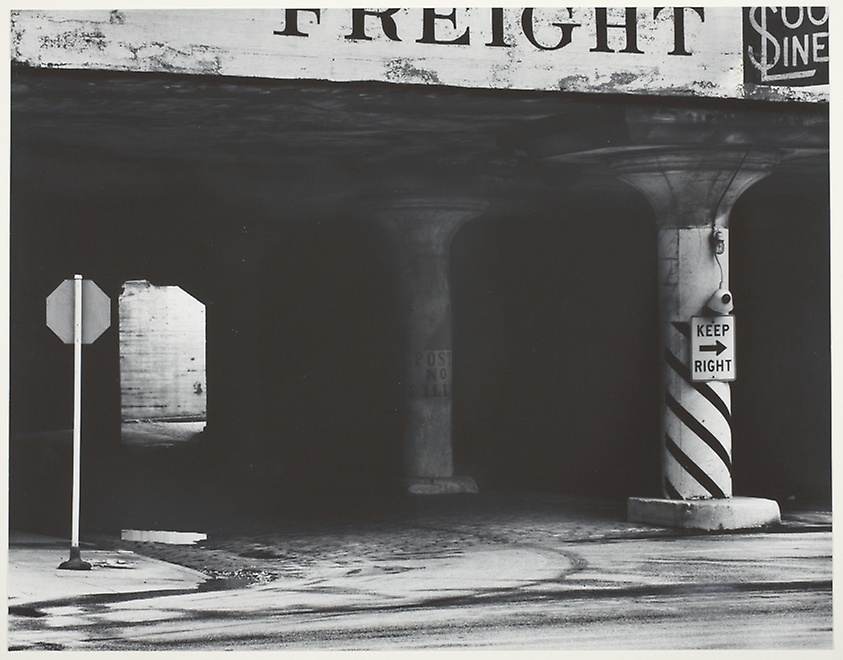
At the Grave of Sadie Thorpe

By Miles Harvey

Featured Art: A Graveyard and Steel Mill in Bethlehem, Pennsylvania by Walker Evans

Time forks, perpetually, into countless futures. . . . In most of these times, we do not exist;
in some, you exist but I do not; in others, I do and you do not; in others still, we both do.
—Jorge Luis Borges, “The Garden of Forking Paths”

“Was she a relative of yours?” the old man asks, leading me toward your grave.

“Well, not exactly,” I begin to reply. “She—”but then I pause. In the middle of my sentence, in the middle of my life, in the middle of some small-town cemetery in the middle of the Midwest, I pause, unable to explain who you are or why I’m here. What I would tell the man, if it didn’t sound so absurd, is that although I am not your descendant, although I only recently learned of your existence, although you barely left a mark on the world, and although your corpse was buried here more than forty years before I was born, I can’t get you out of my mind. What I would recount, if I could figure out a simple way to do it, is the history of happenstance that connects me to you across the years, a bond that at this moment feels almost as strong as the ties of blood. What I would confess, if I wasn’t worried he’d laugh in my face, is that I woke up this morning, a couple months shy of my fiftieth birthday, certain I had to drive more than one-hundred miles from Chicago to visit a total stranger’s grave in this tiny hamlet of Dana, Illinois.

A dog barks in the heat of this August afternoon. A killdeer swoops in on slender wings, offering its distinctive call: kill-dee, dee-dee-dee, kill-dee, deedee-dee. And still I pause.
Read More

Hook and Eye

By Sarah Barber

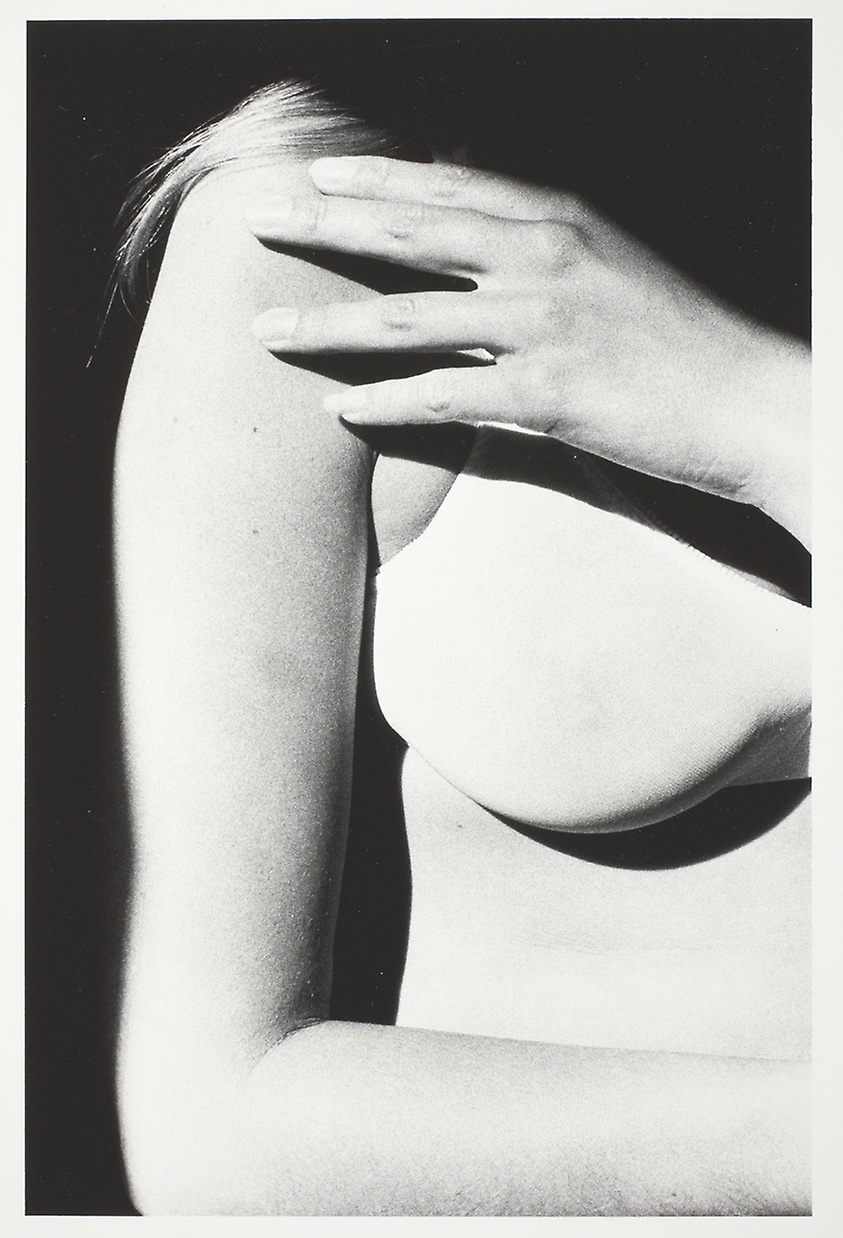
Featured Art: Untitled (Woman’s Arm and Bra) by Ralph Gibson

Often I have unfastened it myself
without tragedy. But I wanted you
to stand behind me—in fact
a fourteenth-century town
of needle manufacturers crocheted
loops from wire because they wanted
your hands just so terribly
close and a little bit slow
at the closure too aggressively
latched to unhook at the will
of its wearer
, which is what was said
to sell it to nineteenth-century ladies,
not quite promising exactly such
an unhooking of their dresses
and all those garments, and indeed
as early as 1643 a woman in Maryland
traded £10 worth of tobacco for hooks
and eyes only because she wanted
you to stand behind me
as the fastening came undone.


Read More

Rome in Us

By Thomas Grout

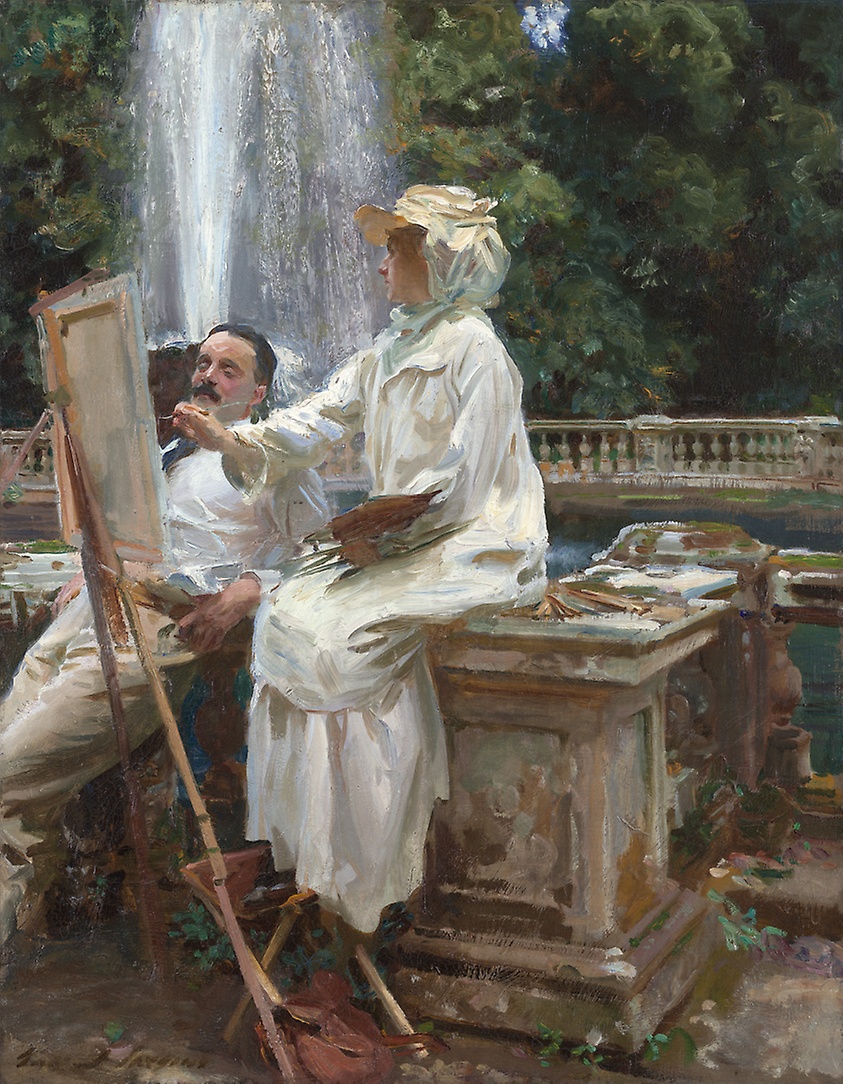
Featured Art: The Fountain, Villa Torlonia, Frascati, Italy by John Singer Sargent

It’s funny isn’t it—the way Rome still comes at you
fast like a bat breaking past your head from memory.
At the Roman pace the body takes the city better than the mind.
A cathedral ceiling’s fireworks shoot up
once the sermon’s fireworks stop. And when
the ceiling finally stills, the piazza outside overfills
with new fruits and vegetables and etymologies.
Stimulation’s cheap as wine and your horse
is more than happy to take it in by trough.
But it flies by so fast—

only just now it’s slowed enough to hatch a feeling
similar to how it is to listen through the dark over our bed
for a half-caught sound to sound again.
That given one more chance I could make easy sense of it.

It’s often that I sleepwalk down our subdivision’s version
of the Spanish Steps thinking I left something unnamable
inside the Trevi. Is that it at the end of the tube-slide?
I never know. It all gets hazy after the Flaminian gate
though I’m absolutely certain I wake up at the refrigerator.
Rome is in us like unfinished business—

that’s why half of me is still sauntering the cobbles.
I guess we’ll always live our lives possessed
by the ancient Roman sense that down any old left turn
suddenly one of our dreams might find its title.


Read More

Connect

By Glen Pourciau

Featured Art: Mall of America, Minnesota by Melanie Einzig

We were in a Mexican restaurant at the mall, and my husband, as is his habit, was looking at everything but me. I still had half an enchilada left, but Boyd’s empty plate had already been removed and he’d ground through all the tortilla chips and salsa on the table, leaving his eyes and mind free to survey the room. His attention was drawn to the occupants of a booth across and at a slight angle from ours. He could see them better than I could, but I peeked back and saw a man and woman, presumably married, and a young intellectually disabled boy, the boy seated on the man’s side, which may have appealed to Boyd. The three of them were a picture of happiness, talking and smiling and enjoying one another. If the boy was their son they’d likely been married at least ten years, and I admit I couldn’t help comparing how they seemed to how we were after fifteen years. Read More

Pythagoras

By Bruce Bond

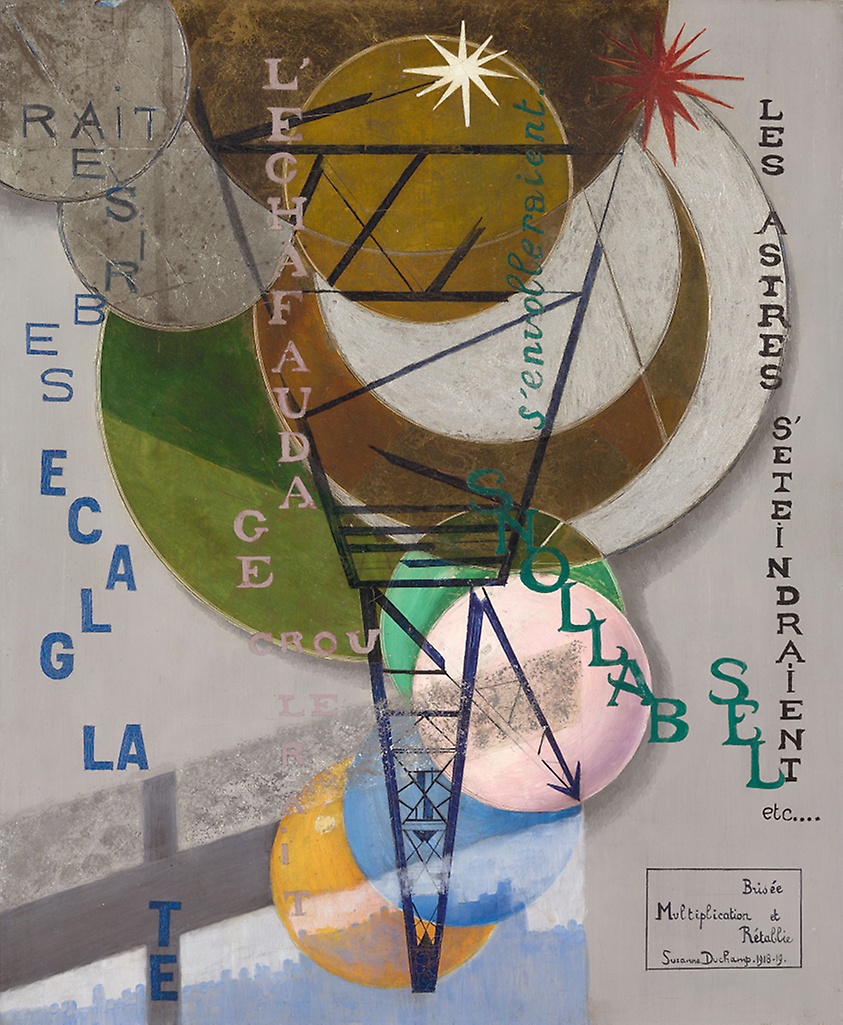
Featured Art: Broken and Restored Multiplication by Suzanne Duchamp

Somewhere beneath the crematorium
of stars, the mystery and the boredom,
the vacuum that every space abhors,
you might stop to listen to no one there
and hear the words of a dead man, a Greek,
who measured nights in increments of music.
The sky then was a calliope of numbers
whose tune was everywhere and therefore far
away as dead men are. No such thing
as solitude among them. It takes a string
of intervals on heaven’s monochord
to pull the sounds from one another, the choir
of which must be silent, surmised, and yet
each ghost note dies into the next to hear it.


Read More

Bobcat

By Mikko Harvey

Featured Art: Forest by Werner Drewes

Walking through the woods / at midnight / we were on our way / to the pond / where we
would skinny dip / when two yellow eyes / appeared on the path / we froze / they didn’t
blink or move / the body was / hidden by the dark / there was something / sinister in its
stillness / we turned back / you said it was probably / a bobcat / but better not / to take
that chance / we shared a bed / untouching as usual / you fell / asleep first and I wondered
what kept us / apart really / that night / and the others / the distance between us / maybe six
inches / felt like a shadow / I couldn’t step out of / my two open eyes / the only light
in the room / I thought of the animal / blocking our path / and it occurred to me / she was
only a hostess / welcoming us / to the world of risk / smooth and lovely / water hugging
your naked body / the animal said / are you ready / but we walked away / I had an urge
to shake your body / awake and take you back / to the animal and say / confidently yes
table for two / but instead I just lay there / in the perfect / quiet / country / darkness / and
imagined the outline / of your chest rising / and falling / rising / and falling as you slept.


Read More

At the Metropolitan

By Ellen Devlin

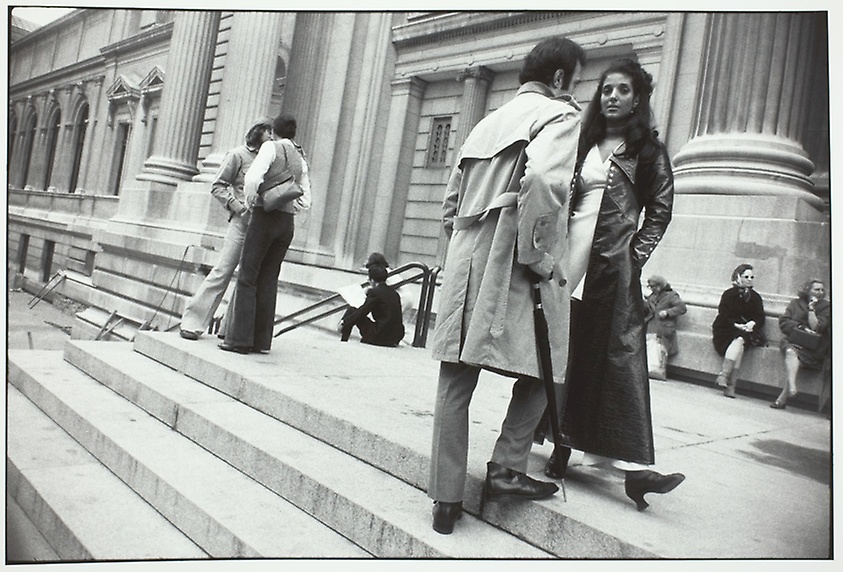
Featured Art: New York (Couple on Steps of Metropolitan Museum of Art) by Garry Winogrand

I once saw a Persian sword, in a museum,
glass-boxed, lighted. Warriors on winged
horses charged, lifted scimitars, hundreds of them,
carved in the blue white breath inside the hilt.
I leaned my head on the glass, helpless.


Read More

The Museum of Might-Have-Been

By Anne-Marie Fyfe

Featured Art: Art Institute of Chicago by Thomas Struth

Opens its doors one Sunday a month
in winter. The queues back up for decades.

If you’re lucky and your number’s called
you can have any tour: Your Charmed Life,
Your Regrets, The Prodigal You, every second
slip-road at the intersections of the possible.

The exhibits are stark and infinite
under strip neon, long hallways
of lost opportunity, slow clocks,
stopped clocks, rooms where even now
a thought might wither: the attic storeroom
is out-of-bounds to all but the curators,
though artifacts are still donated by the hour.

Standing in line is no guarantee
of admission: some days
word spreads that when you
reach the queue’s head, pass through
the double doors, it’ll be stripped out,
even lightbulbs, with only packing materials
and discarded drapes left. Yet critics insist
The Multiple-Choice Foyer, The Roads-Not-Taken
Gallery, The Back Burner Café
are stunning.

Every room’s a tasteful shade of apple-white
apparently. Waxworks and living statues
rehearse at intervals for The Balcony Scene,
The Shining City, The Reconciliation
, over
and over, night by night. As in the finest operas.


Read More

A Gift From Wales

By Carl Dennis

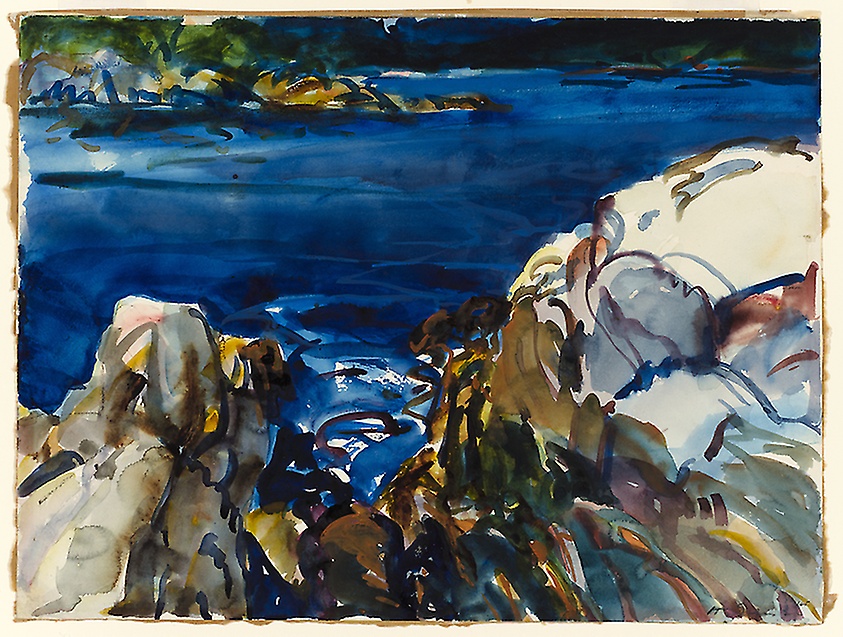
Featured Art: Shore Line by Howard Giles

Having lingered, on my first trip to Europe, longer
In Paris than I expected, I had to forgo
Walking in Wales. But that didn’t keep me
From becoming deeply indebted to Wales
When I phoned the hotel in Cardiff
To cancel my reservation and save my deposit.
“There’s a letter for you,” the desk clerk said,
In a rich contralto. “Would you like us to send it on?”
“Better read it to me, if you have time,
Since I keep moving.” And that’s how it happened
I heard, as I sat in a booth at the Gard du Nord,
Awaiting the train to Brussels, my mother’s sentences,
Penned in Missouri, delivered with Welsh intonations.
That’s how her usual mix of family news,
Tips about healthy eating, and encouragement
To visit any noteworthy local garden,
Took on an undercurrent of mystery.
That’s why they seemed imbued with the suggestion
My travels were more than a summer’s entertainment,
Were in fact a quest for something just as meaningful
As whatever a knight went searching for
When he rode out from a castle in Wales.
Some truth more practical than a grail
And more surprising would soon be mine
Once I learned to listen to people whose words
I regarded before as predictable and forgettable.
And I had questions about the desk clerk,
Who’d read the letter as if she’d composed it herself,
Inspired by a sincere concern for my well being.
What did it mean, her convincing performance?
If it wasn’t part of her job at the hotel,
Was it part of some other calling
Defined in a legend I didn’t know yet
But would want to learn if the chance were offered?


Read More

Three Houses and a Wish

By Linda Bamber

Featured Art: House by a River by Edward Hopper

1. Chevy Chase

Choked up to see the in-ground cellar door
behind the house
I was born in long ago

then had doubts, cell handy,
called older sister far away.

She said, wrong house!
Original had front yard oaks,
big porch . . .

found right house, had no
response at all. Used up tears on
house that didn’t know me from Adam! Read More

My Grandmother the Mohel

By Barbara Hamby

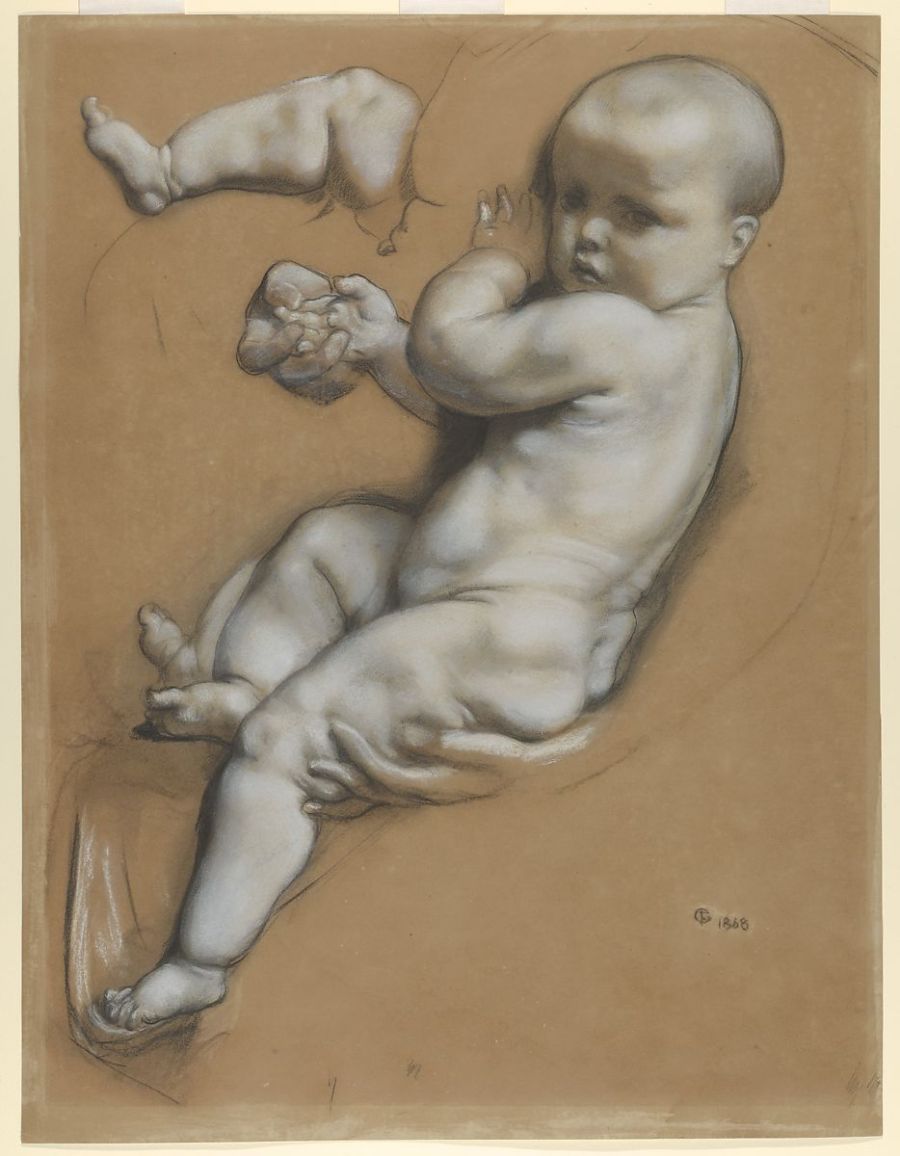
Featured Art: Study of a Baby by Fredrick Goodall

When I tell my mother that a man I know pickets the local hospital
              about what his wife calls “his topic” that is, circumcision
and its evils, she tells me this was my grandmother’s specialty
              as a nurse, and I say, “You’re kidding.” “No. The doctor
she worked for couldn’t stand it, so she did all his circumcisions.
              She loved it!” Loved it? I think—cutting the tips off
boys’ penises? Loved what? The precision? The power? The cries?
              I remember sitting with my mother and grandmother
when I was seven or eight, pretending to play, so I could listen
              to them talk in front of my grandparents’ house
in Washington, 328 Maryland Avenue, and down the tree-lined street
              you could see the Capitol dome looming. A couple
were walking on the sidewalk, and they waved at my grandmother,
              who smiled and waved back. “Are they married?”
my mother asked when they passed. “No,” my grandmother
              answered, “they’re just shacked up.” The cups of my ears
gathered around those words like ravenous Venus Fly Traps,
              because this was just what I had been waiting for,
though I had no idea what it meant, and I knew I couldn’t ask
              or my doll dressing and tuneless singing would be exposed
for the subterfuge they were, and I’d be exiled into the house,
              and this was before my grandfather died, who didn’t think
a woman should drive, but my grandmother taught herself,
              her two little girls in the back seat screaming
as the car jerked over the dirt road behind their house in Kentucky,
              and then after he died, she went to school and became a nurse,
but fifty years later I’m chatting with a man on a plane, who’s returning
              home after spending the day in New York because
he is a mohel and has made this long trip to snip the tip off
              some little boy’s penis, and I think of Mantegna’s painting
of the circumcision of Christ at the Uffizi and kosher laws which
              forbid eating crustaceans, which would mean a sacrifice
of gumbo, boullabaisse, cioppino and fish soups the world over,
              and it was the fried Apalachicola shrimps that broke
the back of my vegetarianism, what in Louisiana they call
              “sramps,” and I’ve heard them called “pinks,” “prawns,”
and sometimes when I’m standing over the stove making a roux
              my life seems to be a kind of gumbo, and if you don’t burn
the water-and-flour paste, then it doesn’t much matter what else
              you throw in, but okra is a must and a couple dozen
oysters, andouille sausage, all your dark mistakes mixed in
              with the brilliant medals and diamond tiaras,
and my grandmother told me she went to her wedding
              in a horse and buggy, a seventeen-year-old girl,
probably a virgin, and little did she know where that road
              would lead her, from canning tomatoes and corn
to snipping the tips off thousands of penises to the nursing home
              where she died, shacked up with all her selves,
that particular gumbo stewing in a body withered by 93 years,
              not knowing anything but that she’d rather be eating
ice cream, driving to Memphis, frying chicken, mashing
              potatoes, baking a cake with blackberries
her daughters picked that morning before walking to school.


Read More

All Ages

By Conor Broughan

Featured Art: Canal Street, Chicago by Harold Allen

The Statistics played three shows in four days and Chris McCann—all of sixteen and the founding member, lead singer, guitarist and de facto manager of the band—wasn’t ready for the tour to end. All summer, Chris had only wanted to get out of his Springfield, Virginia house and on the road. Unsolicited, Chris’s father had told him that his mother’s erratic behavior over the past six months hadn’t been his fault. Until his father brought it up the night before the tour, Chris had never considered the possibility. Stray raindrops cried across the windshield when he drove over the Turnpike and into Asbury Park, New Jersey for the final show of the tour. The Bowery Club on Ocean Avenue.

Kyle—rhythm guitar—was the first to step out of Chris’s father’s 1989 Dodge Caravan. At the beginning of the tour, he announced that he’d grow out his beard. Deemed a failure on all fronts, Kyle still considered it a work in progress.

Read More

If You See Something

By Billy Collins

Featured Art: Dove in Flight by Pablo Picasso

On my morning walk along a cinder path
that follows the shore of a lake,
I saw a good-size, solitary rabbit,

seven mourning doves who rose to the top of a fence
at my approach,

two anhingas, one drying his extended wings
like a pope on a balcony,
the other not doing anything at all,

also, a loud bird who refused to identify himself,

then ten young ducks in a huddle
by the vegetation near the water,
some sleeping, others preening their feathers,
all not quite old enough to be on their own,

oh, and a squirrel who headed up a tree
when he heard me coming down the path.

Read More

Kickboxing with God

By Jeffrey H. MacLachlan

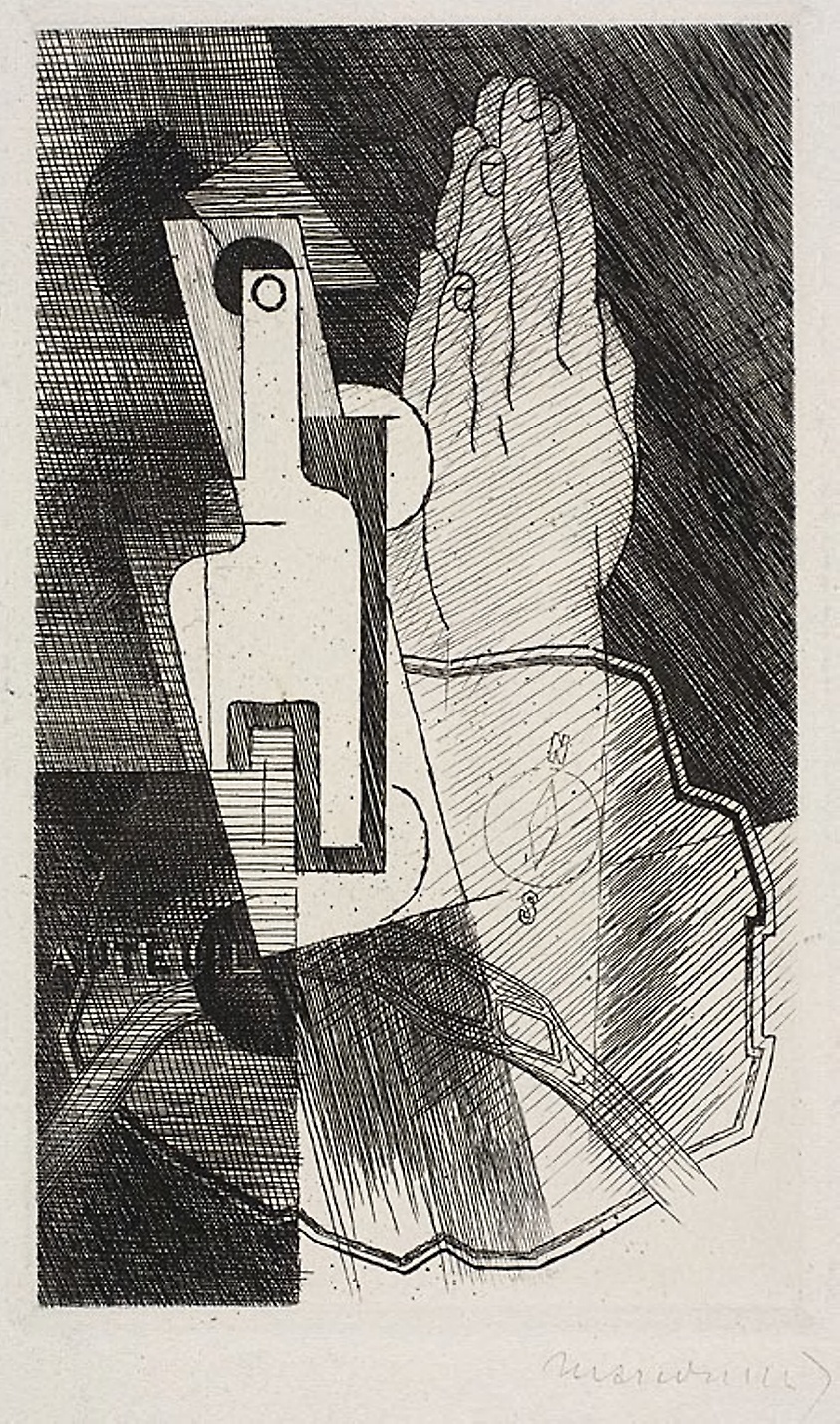
Featured Art: Vendémiaire, plate 34 from Alcools by Louis Marcoussis

On my way home from an empty happy hour, God shoved me so I punched his
chin with a half-formed fist. He laughed and asked me if I knew who snapped
dinosaur tails like breadsticks. God was all effort like old dudes at pick-up
games. Leg-kicks striking thighs and elbows to the windpipe. My uppercut let
out a Hallelujah choir from the sky. He punched my liver and said I should get
some rest for once. You can’t keep this lifestyle forever. He pointed to his chin
and dodged a knockout swing. Why not go visit your kids? God headlocked me
like Mom’s boyfriends did after parole. I’m behind schedule so just fix your life.
He was right but that didn’t stop the stomping he had coming for not showing
up till that night.


Read More

The Ideal Budweiser Customer Watches a Budweiser Commercial

By Danny Caine

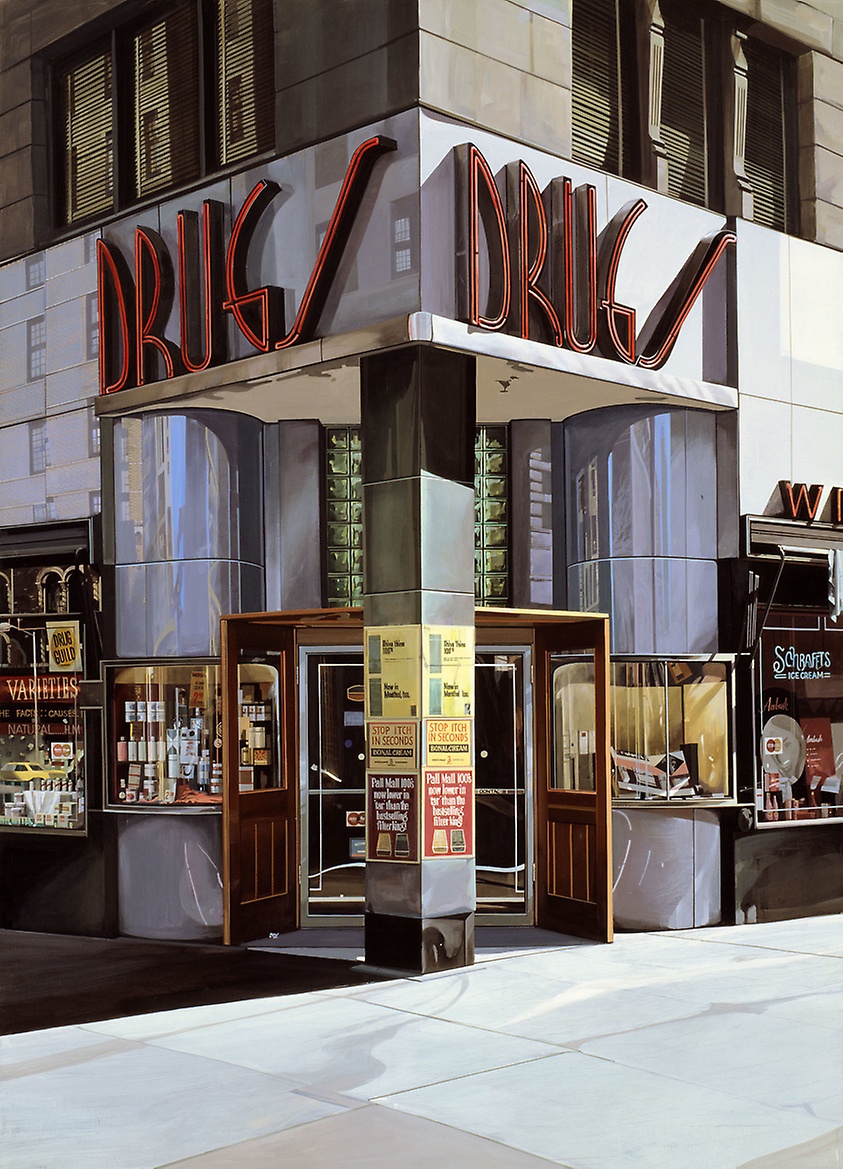
Featured Art: Drugs by Richard Estes

Oh shit I love “Landslide.”
I was going to get up to piss but then I heard me some Fleetwood Mac.
Hey that’s a pretty farm, too. Farms are dope.
Wait, oh goddamn it it’s a baby horse lying in some fucking sawdust.

That baby horse is so cute I can’t even handle it right now.
I am literally unsure how to proceed.
And now the horse is being fed from a bottle?
The hell am I supposed to do with that?

Dammit now the horse and the dude are playing and stuff.
Fuck me if I don’t love a playful goddamn horse.
Look! A Budweiser truck. Budweiser!

I should like this brand on Facebook.
I should follow this brand on Twitter.
I really should make an effort to engage
with this brand on social media.

Wait, that’s a horse trailer. And our dude
is shaking hands with the driver? Is he—

DUDE YOU CAN’T SELL THAT FUCKING HORSE!

YOU’RE GOING TO MISS HIM SO MUCH!

Somebody get me a Budweiser.


Read More

Unemployable

By Dustin Nightingale

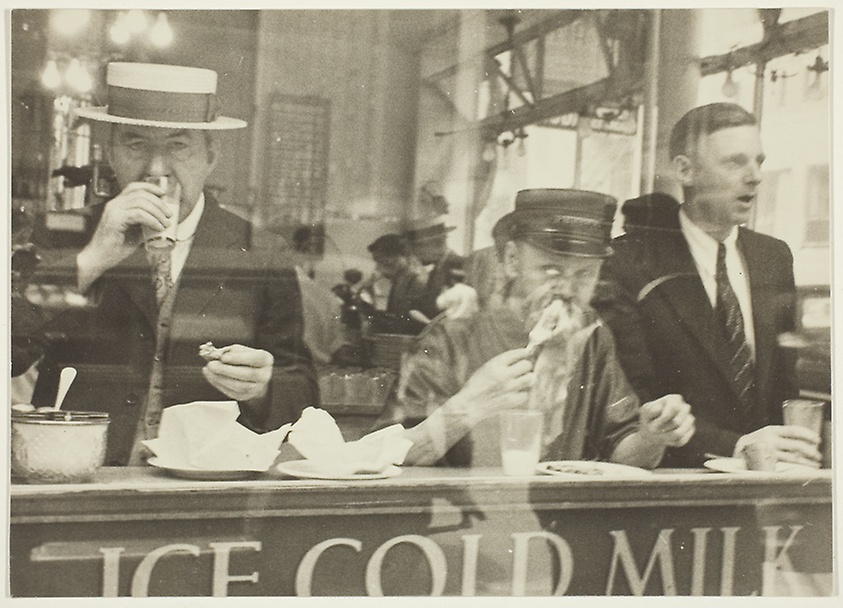
Featured Art: New York Lunch Counter by Walker Evans

Needs and Hopes

I want $50,000 a year with insurance, incentives such as stock
options, 401K, paid paternity leave, sick days, two months off
in the summer, and a company car with a gas card. I expect a
healthy work environment, void of inspirational quotes like
Inspiration overtop of an eagle in the snow. My colleagues
will not try and josh me, nor will they throw potlucks or invite
me to 4th of July cookouts and then think I’m an uppity jerk
when I don’t attend. They will not show me pictures of
something they recently pushed or pulled out of their uterus.
Nor will they tell me about the book they want to write based
on their own life. What they will do is mumble lines of Emily
Dickinson to themselves while staring out a window. They
will bring in a bag of cayenne peppers they grew this summer,
leave it on the break-room table with a sign that says Free
—take what you want
. And I will take three. I will let them
dry, grind them up, and place them in the plastic of a cigarette
wrapper, which I will pinch into stir-fries during a very
long and cold winter. And I will try to do the same for them.

Previous Experience

Oh I’ve done that. I’m not proud of it, but I’ve done that.
Have you? Well you should try it sometime, just to see what
you’re capable of and for how long. I mean, why not see what
it takes to make you wake up crying. And then of course, what
it takes for you to stop. So when can I start? Or have I already?

Read More

At the Precise Moment of Your Awakening

By Matt Morton

Featured Art: Time Transfixed by René Magritte

It will be raining. You will be watching
TV when your son walks
into the room. He will be crying

and holding the stuffed gazelle you bought.
What’s that noise? he will ask,
sounding scared. On the screen,

an armadillo singing show tunes. To humor him,
you’ll pretend to listen:
Outside, down the street, coming closer,

a sound like a train. It’s just a train
you’ll shrug. Here, look at this armadillo.
A flashing red banner scrolling from right

to left across the screen. Such tiny print.
You will squint. Undoubtedly,
you’ll have left your glasses in the other room

with your credit cards and shoes. Turning
your attention back to the show,
you will gather up your son. Front door

rattling against the jamb. All of the windows
black. But you said there aren’t any trains.
He won’t stop sobbing. You said they—

Hush you will say, annoyed
at missing your show. Where is your wife?
By now, the sound has become a roar. The gazelle

lying on the carpet, your son’s mouth
stuck open like a doll’s. When the portraits drop
to the floor and break, you will shake

your head: He is so small for his age, the world
will be hard on him. T-R-A-I-N
you’ll mouth, as if he’s deaf, when the windows

start to blow out. You’ll be shouting
It’ll pass, it’s just a train
as the roof is ripped from the house.


Read More

Telling the Truth

By J. Anna Luz

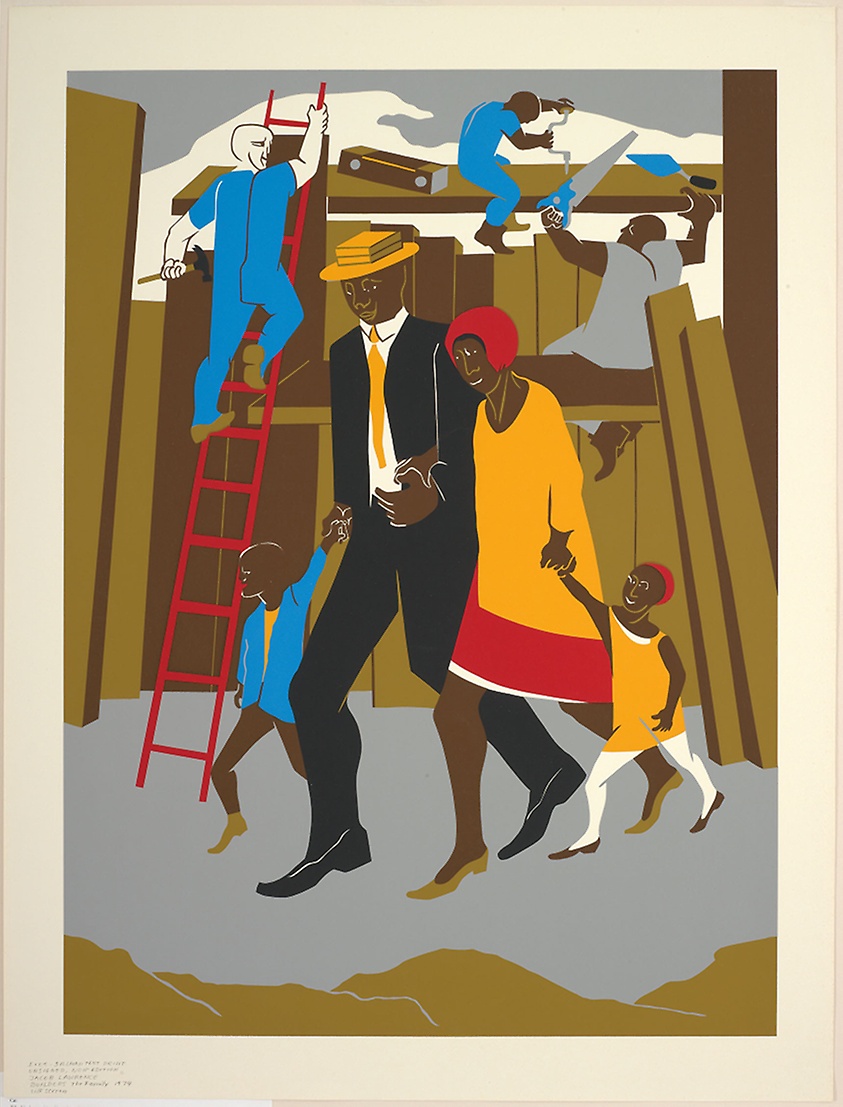
Featured Art: The Builders by Jacob Lawrence

Observing my boyfriend’s
niece and nephew
kick each other
under the table
at Thanksgiving dinner,
blasting each other
in the shins
and knees,
bone against bone
drawing bruises
and welts,
done in such fury
and with such power
yet no sound,
faces not affected,
not a hint
of a wince
of pain, so little
movement at all,
I thought
that’s how my sister
and her husband
love each other,
and how my father
regards his job
and how my mom feels
about all of us,
and how
I see my body.

These children
with pink Keds
and black and
green striped Nikes
underneath a crisp
ironed tablecloth
of fall colors,
didn’t
lie once.


Read More

À la Carte

By Denise Duhamel

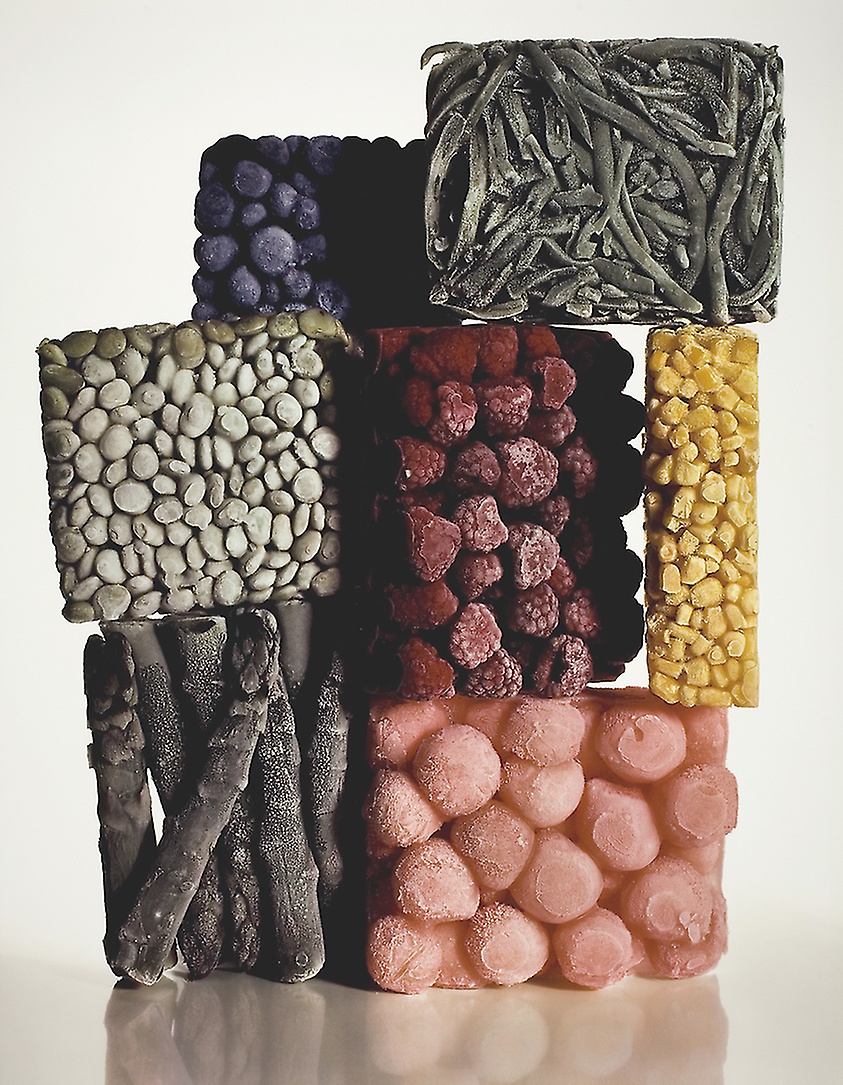
Featured Art: Frozen Foods with String Beans, New York by Irving Penn

We stopped at a restaurant that advertised steak dinners for $3.99. My father
was excited—he loved red meat. We were on vacation. My sister, my mother, my
father and I were all going to splurge. My father double-checked his billfold and
said, “Let’s go!” The waitress asked if we wanted the special. Yes indeed. Would
we like potatoes? Sure, why not? And creamed spinach? And bread? You bet.
When the bill came, my father blanched. He whispered to my mother he didn’t
have enough in his wallet. He called the waitress to our table and reminded her
of the sign outside. She explained that each steak was indeed $3.99, but that all
the sides we ordered were another dollar each. My father said she should have
been more forthcoming. She brought us a menu. My father asked to see the
manager, who pointed to the phrase à la carte. My mother dug in her purse, but
my father told her to stop. He stood up and put sixteen dollars (a ten, a five, and
a one) on the table—not even covering the tax and certainly no tip. “I’m not being
swindled for a baked potato,” he said to the managerand walked out. “I’m
sorry,” my mother sulked, pulling my sister and me out of the booth. I looked to
the floor, the swirly carpet. “Sir, you can’t do that,” said the waitress. “Ma’am,
I’m serious. You can’t do that,” echoed the manager. “Hey, come back, we’ll
take a personal check.” All the way to the Cape, I thought the police would
pull us over, the unpaid-for potatoes and spinach making me full and groggy.
My mother and father fought—“I’ve never been so embarrassed . . . ” and “Too
bad. I’m no chump.”—before all went silent. My sister and I dug out the steak
from between our teeth with our tongues. After a day or so, the shame turned
to laughter. My mother said, “I guess you showed them.” And my father said,
“I sure did.” By the end of the week we were proud, our story about standing
up to touristy rip-offs, about snobs only pretending to be French, about how we
were living le rêve américain.


Read More

Aftermath in Brine

By Elton Glaser

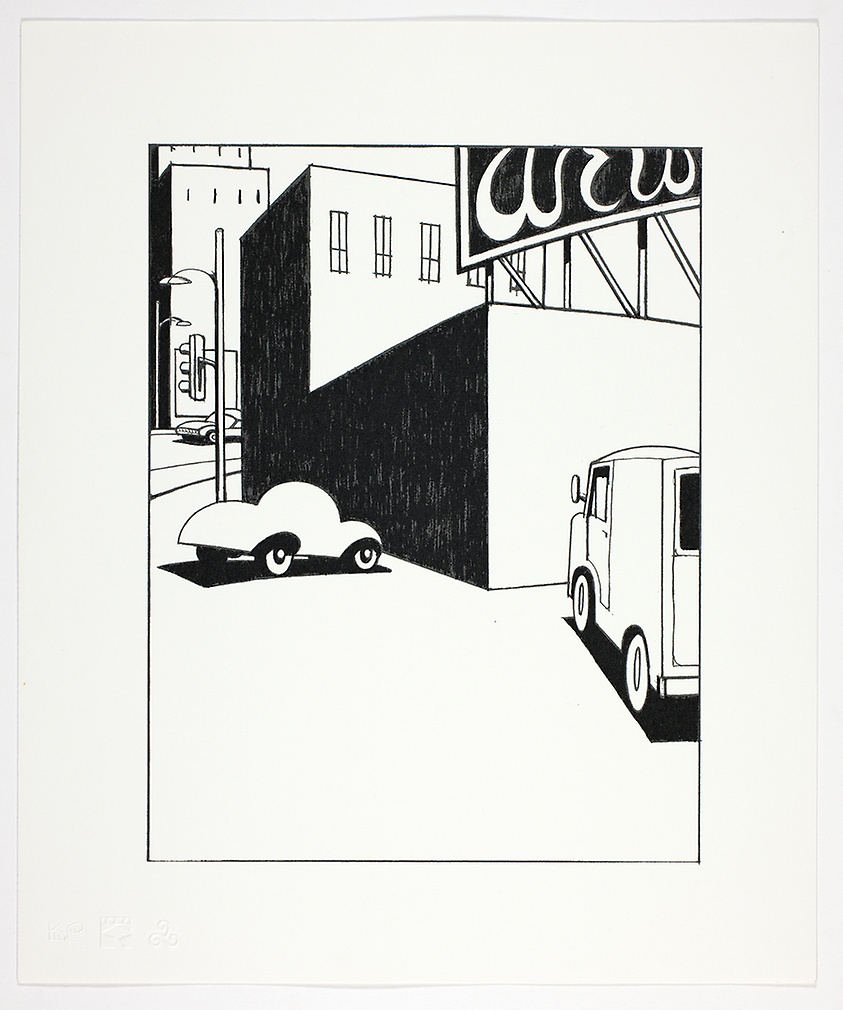
Featured Art: Parking Lot, from The Plain of Smokes by Kenneth Price

I can’t stand here all day, glands in a wrangle,
Like some brimstone preacher
Beating the bejesus out of his ratty Bible.

Parvenu and undermensch, slave to enabling vices,
I’m lost in a lanky rhetoric,
Simplicities on the fritz.

But you can’t make laws for monkeys, or poems
From some eruption in the nuts,
Every complication its own Vesuvius.

Poems: or as the Chinese warn,
Disasters that come from the mouth.
Sometimes there’s no wild honey at the end of the beeline,

Only these terse tercets
With no mercy on the rubes
Or the lithe appreciators of gilded tea sets.

There’s always some bother in the Balkans,
And tantrums among the voluble Italians. There’s always
A dent in the fender where the force fields meet.

Read More

On the Opening of Lauren Groff’s “L. DeBard and Aliette”

By Caitlin Horrocks

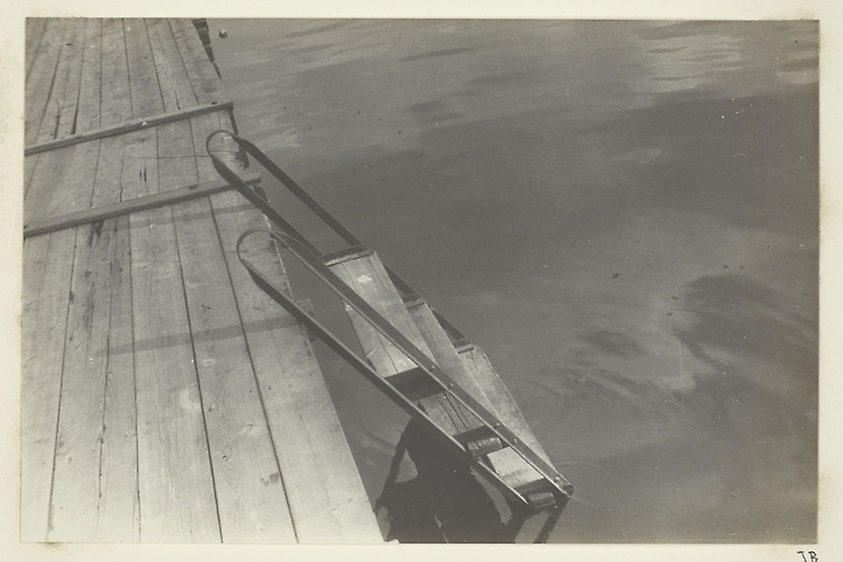
Featured Art: Steps in Swimming Pool at Main River, Badeanstalt, Frankfurt by Ilse Bing

I originally read this story in the 2006 Summer Fiction Issue of The Atlantic, a magazine whose student writing contest I had won the previous winter. I was wandering the aisles of a grocery store in a strange city, where my boyfriend had just abandoned me to run an errand to an ex-girlfriend’s house. I perused the magazine rack, scanned the table of contents of The Atlantic. My winning story had been considered for publication, but had not made the cut. The famous authors listed I could forgive for bumping me, on grounds of their fame. But who was this “Lauren Groff”? I’d never heard of her. A newbie, like me. Surely, she was the one who had taken my spot.

Of course, editing doesn’t work like this. I knew that even then. But my jealous, shriveled heart still commanded me to buy the magazine, take it to the seating area of the grocery’s little coffee shop, and sniff out the supposed inferiority of this Groff-person’s fiction. I am not proud of my attitude. Writers hope that readers will approach our work with excitement, with patience, with a willingness to be moved. My state of mind, when I began Groff’s story, was instead darkly, nakedly adversarial.

Read More

On the Opening of Edward P. Jones’s “The First Day”

By Marjorie Celona

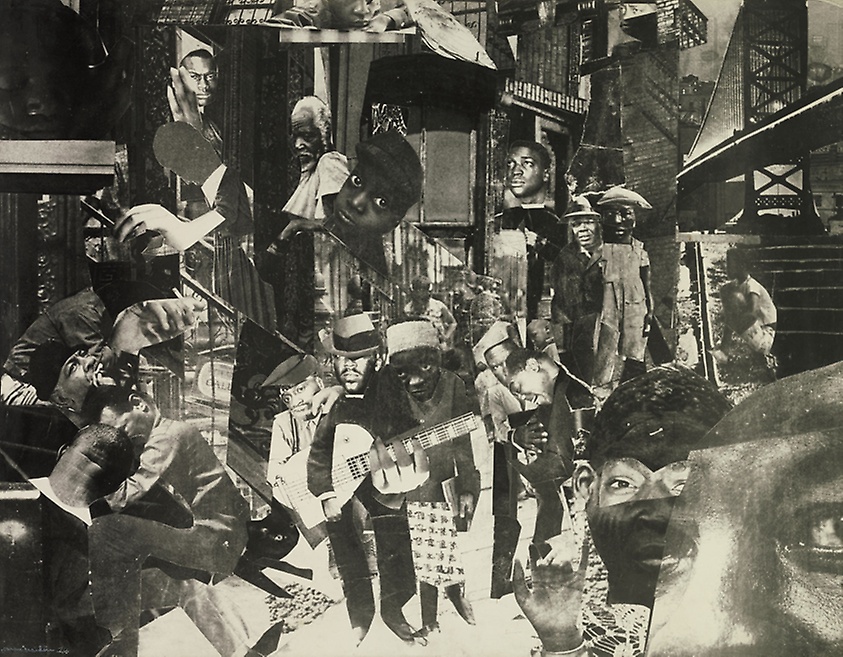
Featured Art: Street by Romare Bearden

It is, at first, a linguistic seduction:

                                   On an otherwise unremarkable September morning, long before I learned
                                   to be ashamed of my mother,

If you’ve ever lived near the ocean, perhaps you, like me, equate one or more dependent clauses at the beginning of a periodic sentence to a wave gaining amplitude before it crashes on the shore. It’s a rudimentary metaphor: the wave builds, and by the time we get to the period at the end of the sentence it has crashed. There is a rhythm to the periodic sentence, and it’s near impossible not to be pulled into it. With its sly promise to deliver something remarkable, that first dependent clause—On an otherwise unremarkable September morning—   is a somewhat seductive lead in its own right. But it is the second dependent clause—long before I learned to be ashamed of my mother—that gives us our first glimpse into the story’s retrospective, mournful heart. If you’re anything like me (lousy metaphors aside), even at this early point the story has you in its grasp. The rest of the sentence, in conjunction with the story’s title, fulfills the tension by providing a simple explanation for what the story will be about:

                                   . . . she takes my hand and we set off down New Jersey Avenue to begin
                                   my very first day of school.

Read More

On the Opening of William Maxwell’s So Long, See You Tomorrow

By Maura Stanton

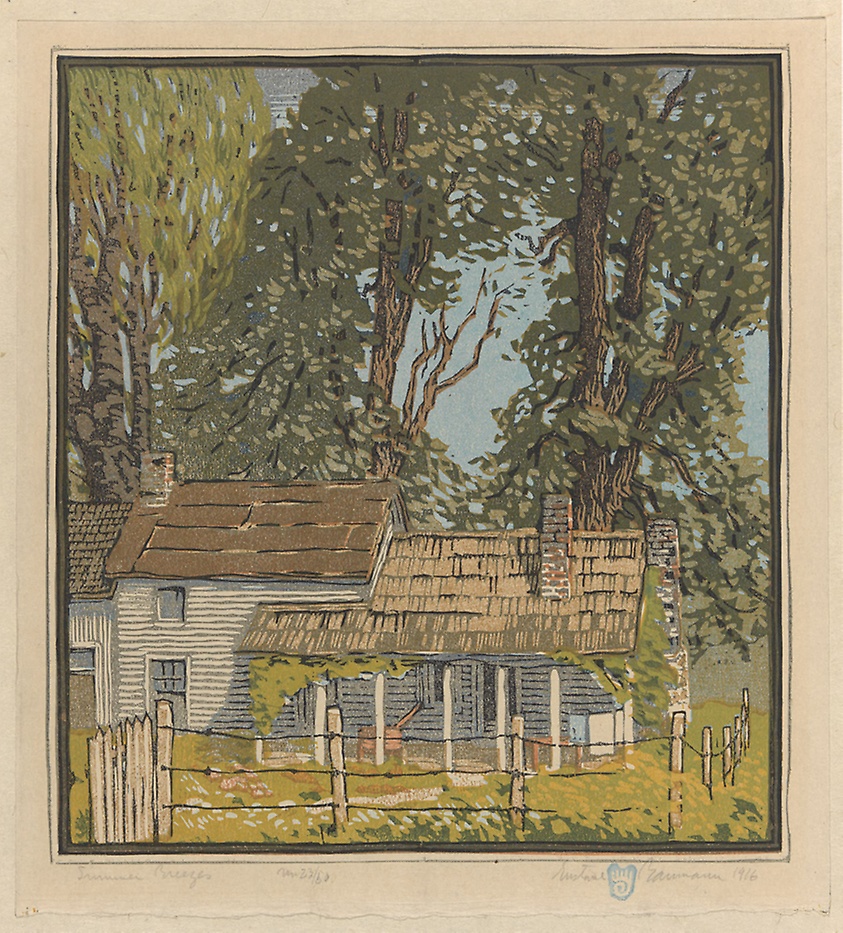
Featured Art: Summer Breezes by Gustave Baumann

William Maxwell’s great short novel, set in the farm country of central Illinois, where I, too, grew up, pulls us into the story of a murder with such force that we can’t stop reading.

The first chapter is called “A Pistol Shot.” Maxwell begins with the setting: “The gravel pit was about a mile east of town, and so deep that boys under sixteen were forbidden by their parents to swim there.” This sentence tells us that we’re out in isolated country. But it also suggests that this is a novel about “boys under sixteen.”

The next sentence introduces the narrator. “I knew it only by hearsay” he says of the gravel pit. And then we get to know something about his imagination as he tells us why boys like him are forbidden to swim there—“It had no bottom, people said, and because I was very much interested in the idea that if you dug a hole straight down anywhere and kept on digging it would come out in China, I took this to be a literal statement of fact.” Read More

On the Opening of Graham Greene’s “Under the Garden”

By David Lehman

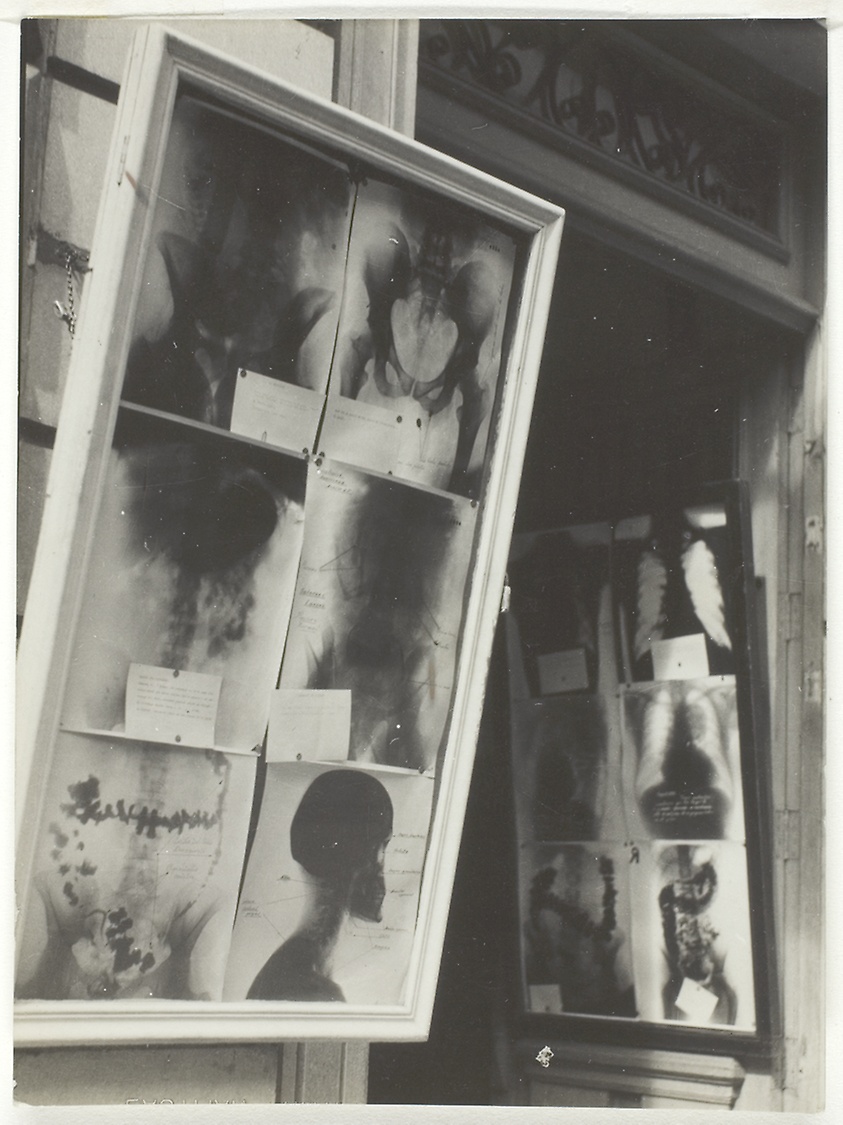
Featured Art: Ventana de Radiografías by Manuel Alvarez Bravo

The first paragraph of “Under the Garden,” Graham Greene’s finest story, consists of just two sentences:

                                  It was only when the doctor said to him, “Of course the fact that you
                          don’t smoke is in your favour,” Wilditch realized what it was he had been
                          trying to convey with such tact. Dr. Cave had lined up along one wall a
                          series of X-ray photographs, the whorls of which reminded the patient of
                          those pictures of the Earth’s surface taken from a great height that he had
                          pored over at one period during the war, trying to detect the tiny grey seed
                          of a launching camp.

With the indirection that passes for a physician’s professional “tact,” the masterly opening sentence reveals that the protagonist, a man named Wilditch, has just been handed a death sentence. Greene’s opening dwells on the doctor’s discomfort with speaking the bald truth (“what it was he had been trying to convey”), his determination to skirt the subject, with the result that the bitter prognostication of the man’s demise dawns on the reader in the same way that it dawns on Wilditch: belatedly, like the answer to a riddle or trick question. Or so it feels: Greene gets us right into the mind of his protagonist at the moment of revelation. Read More

On the Opening of Barbara Comyns’ The Vet’s Daughter

By Maud Casey

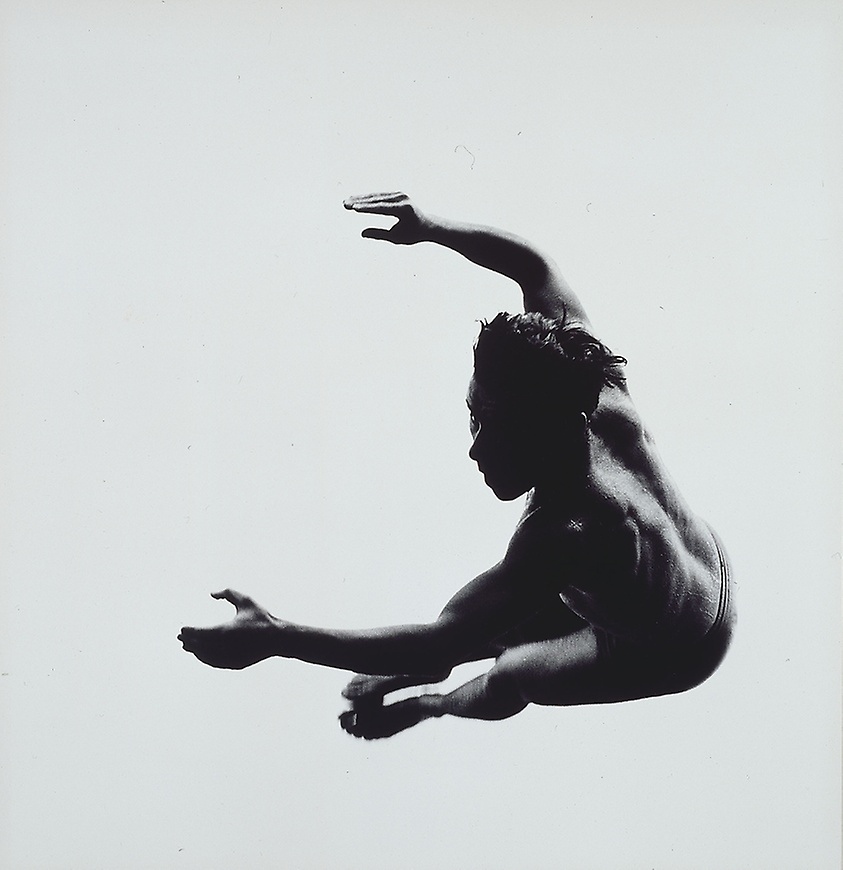
Featured Art: Falling by Aaron Siskind

A man with small eyes and a ginger moustache came and
spoke to me when I was thinking of something else.

I have thought about the first line of Barbara Comyns’ novel The Vet’s Daughter since 1993. I was in graduate school and my wonderful professor, the writer Mary Elsie Robertson, suggested I read Comyns. I did and I have been forever grateful for the recommendation. Comyns is that variety of obscure writer who is a secret literary password. To love her is to enter into a speakeasy filled with levitating teenagers, floods, plague, and the occasional monkey. She authored eleven novels between 1947 and 1989 before her death in 1992, with notably captivating titles, such as Who Was Changed and Who Was Dead and Our Spoons Came From Woolworths. When, in the late Fifties, her original publisher—Heinemann—sent her odd fairy tale of a novel, The Vet’s  Daughter, to Graham Greene for a blurb, he responded, “Please, send me no more lady novelists.” I’m not sure precisely which part of The Vet’s Daughter Graham objected to, which part he found too lady-ish—its concern with things domestic? Its girl protagonist? In any case, I’m happy to report, he came around because there’s his effusive blurb on the most recent effort to save it from obscurity, the beautiful edition put out by The New York  Review of Books with a foreword by Kathryn Davis and a painting by Louise Bourgeois on the cover that, at first, you might mistake for lovely red stockings hanging on a clothesline but, look closer, those aren’t lovely red stockings, that’s bloody sinew and bone. (The painting’s title is Untitled (Legs and Bones).) Read More

On the Opening of Flannery O’Connor’s “Good Country People”

By Alyson Hagy

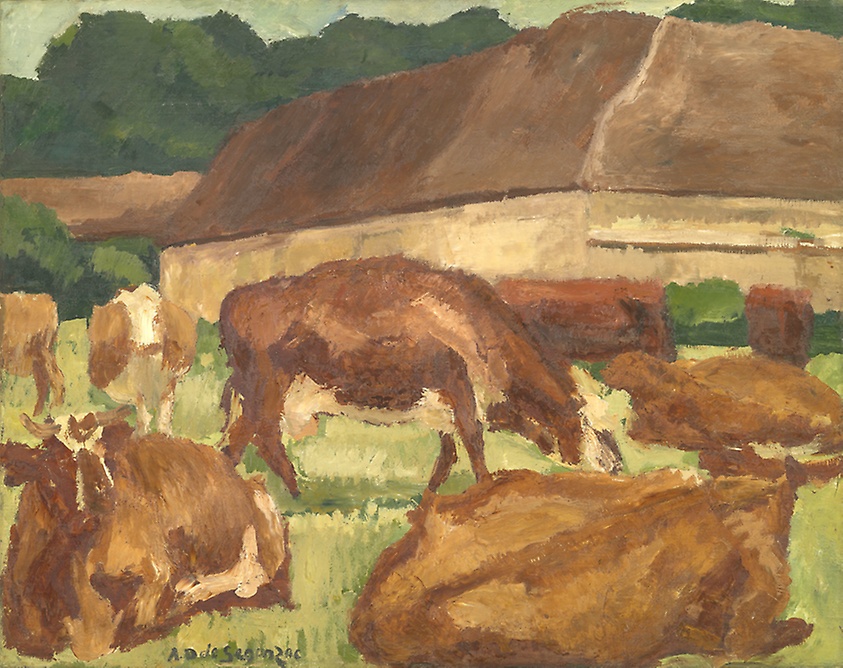
Featured Art: Pasturage by André Dunoyer de Segonzac

                                                                                                      Besides the neutral expression that she wore when she was 
                                                                                                      alone, Mrs. Freeman had two others, forward and reverse, that
                                                                                                      she used for all her human dealings. Her forward expression 
                                                                                                      was steady and driving like the advance of a heavy truck. Her
                                                                                                      eyes never swerved to left or right but turned as the story turned
                                                                                                      as if they followed a yellow line down the center of it. . . .

                                                                                                                                        —“Good Country People,” Flannery O’Connor

I’m sorry to say I’ve experienced my share of bible salesmen. And I can’t think of the names Joy or Hulga without wincing with delight. But why have I never gotten over the way O’Connor begins “Good Country People”?

I blame front porches.

Read More

On the Opening of Stanley Elkin’s “A Poetics for Bullies”

By Tom Noyes

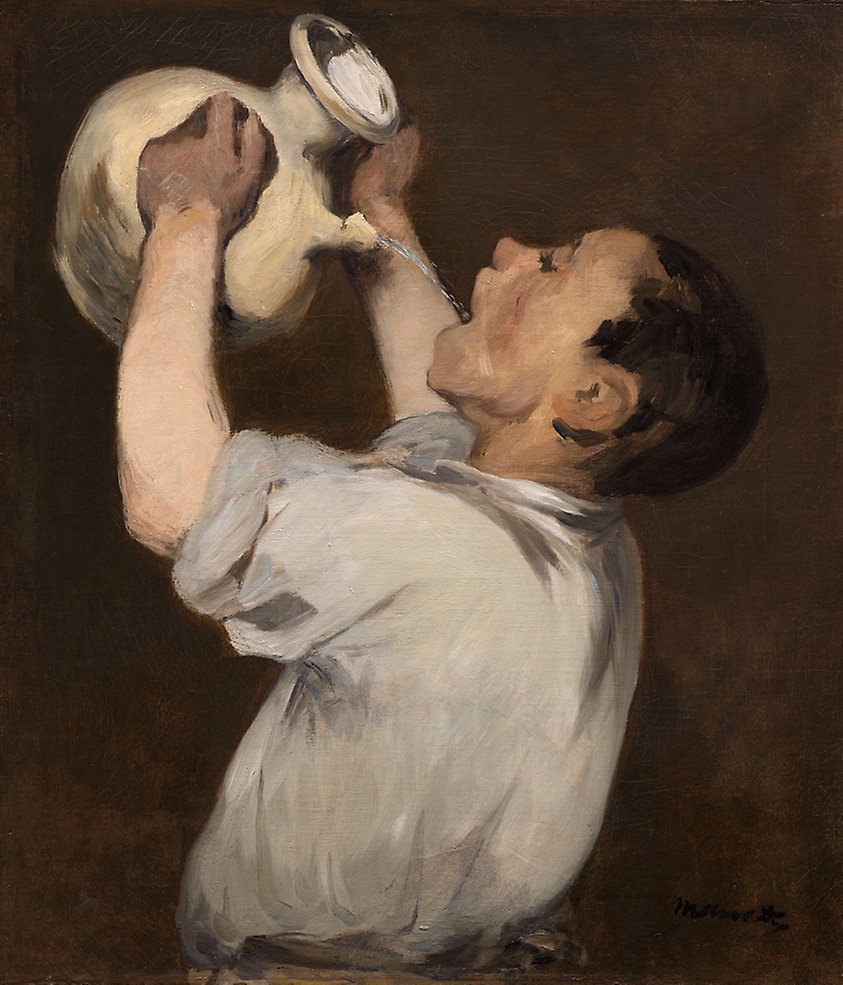
Featured Art: Boy with Pitcher By Édouard Manet

                                                                                                   I’m Push the bully, and what I hate are new kids and sissies,
                                                                                                   dumb kids and smart, rich kids, poor kids, kids who wear
                                                                                                   glasses, talk funny, show off, patrol boys and wise guys and
                                                                                                   kids who pass pencils and water the plants—and cripples, espe-
                                                                                                   cially cripples. I love nobody loved.

In Aspects of the Novel, E.M. Forster writes about the necessity of “bouncing” the reader. At the beginning of a work of fiction, he suggests, the writer must win the reader’s attention in such an immediate, all-encompassing way that the reader has no choice but to forget herself and her “real life” circumstances in order to abide fully and uninterruptedly in the imagined world of the fiction. If the writer can’t bounce the reader from the one world to the other right quick, all is lost.

Read More

New Ohio Review Issue 14 (Originally printed Fall 2013)

Newohioreview.org is archiving previous editions as they originally appeared. We are pairing the pieces with curated art work, as well as select audio recordings. In collaboration with our past contributors, we are happy to (re)-present this outstanding work.

Issue 14 compiled by Andrea Gapsch.

The Best Man

By Brian Trapp

Selected as winner of the 2013 New Ohio Review Fiction Contest by Stuart Dybek

Featured Art: Chinese Garden by Cooper Hewitt

Outside the bride’s village, I lean against the side of a silver Audi with Mr. Wu, my boss’s businessman friend. I thought we were going to his wedding, where  I will be his best man, but I guess as per Chinese custom, we are going to the bride’s house first. We have traveled twenty-five minutes into the Chinese countryside, where we wait for the rest of the wedding caravan. The second half of the dancing lion is late, and the head walks around with its neon-red body dragging behind, a giant mutant worm.

On the ride over, tall buildings gave way to dingy shops. The road narrowed, going from the usual off-white tiled apartments to the old-timey black-tiled Chinese roofs— the tops curved into crescent moons. Smoke spewed from small factories and then green patches of farms appeared, pieces from two different puzzles jammed into one another’s edges.

Read More

Feeling Sorry for Myself While Watching a Really Bad World War II POW Movie on TV

Selected as winner of the 2013 New Ohio Review Poetry Contest by Barbara Hamby

By Michael Derrick Hudson

The rest of them pinwheeled out of the dirty sky somewhere
over Schweinfurt. They burned as I clung

to my shroud lines huffing in a panic through the slobbery
fog of my oxygen mask, the frost stiffening

my collar’s wet fur. Three years later, what have I to show
for my long time in the bag? Bleeding gums,

a hacking cough, another button sewn? I thumb silk maps

and compasses that’ll tuck into a nutshell, learn to curse
in tunnel-rat’s German: Achtung, Fünf!

Dummkopf! Amerikaner Schweinhund. Schnell, buddy . . .

Not once did I try to make it over the wire, into the forest
and its perils where the beautiful Slovak partisan

lugs basketfuls of her beer bottle grenades
hip-deep through the snow. I never spent the night thawing

my boots while she sang old peasant songs and poked a rag

down the bore of her revolver. Ach du! The tarnished brass
of my captain’s bars will never in the firelight

glint for her! She’ll never grant me tomorrow’s password
or love me in my Army Air Corps leather, sleeves

scorched and pockets stuffed with the chocolate
I’d toss godlike and American to all the kids in her village . . .

Damn all my Switzerlands! Damn all of these neutral years!


Read More

Looking on the Bright Side

By John Brehm

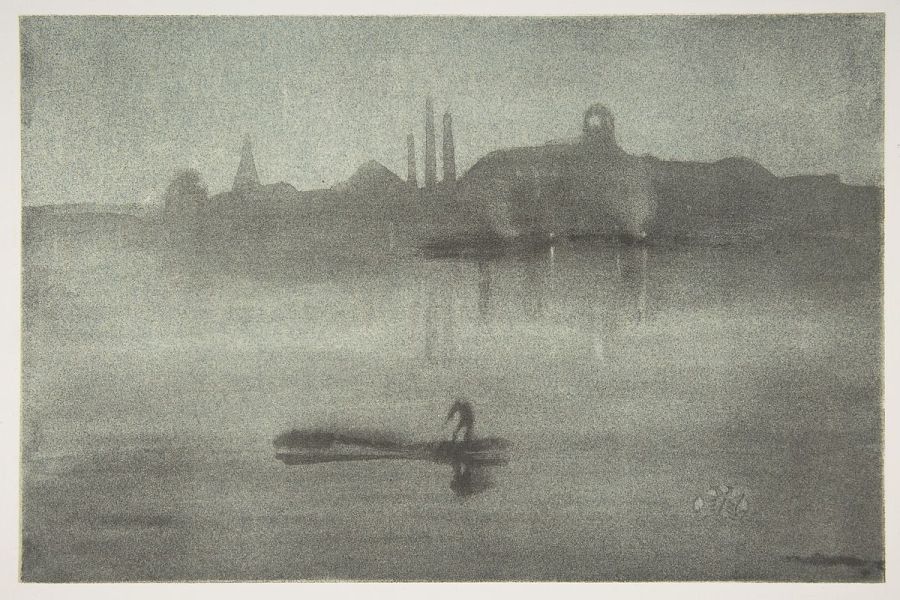
Featured Art: Nocturne by James McNeill Whistler

Death: at least it’ll give me a chance to catch up
on my sleep. No more tossing and turning
worrying about what’s going to happen next.
Unless of course my dreams of dancing girls
and hookah parties come true.
In which case it’ll give me a chance
to catch up on all the fun I missed
being too tired from lack of sleep.
A win-win situation.
Unless of course the dancing girls turn out to be
my former lovers, flitting before me
with vengeful or disdainful expressions
on their still painfully lovely faces.
In which case I can go on writing the poems
of failed love that failed to make me
famous when I was alive.
A suitable way to while away eternity.
Unless of course the hookahs are filled
not with tobacco but with heavenly peyote,
(food of the gods the gods left for us)
in which case it’ll give me a chance
to catch up on the deathless
bliss of boundless mystical oneness
my fear of death always kept me
from fully experiencing
here and now.


Read More

Back Then

By John Brehm

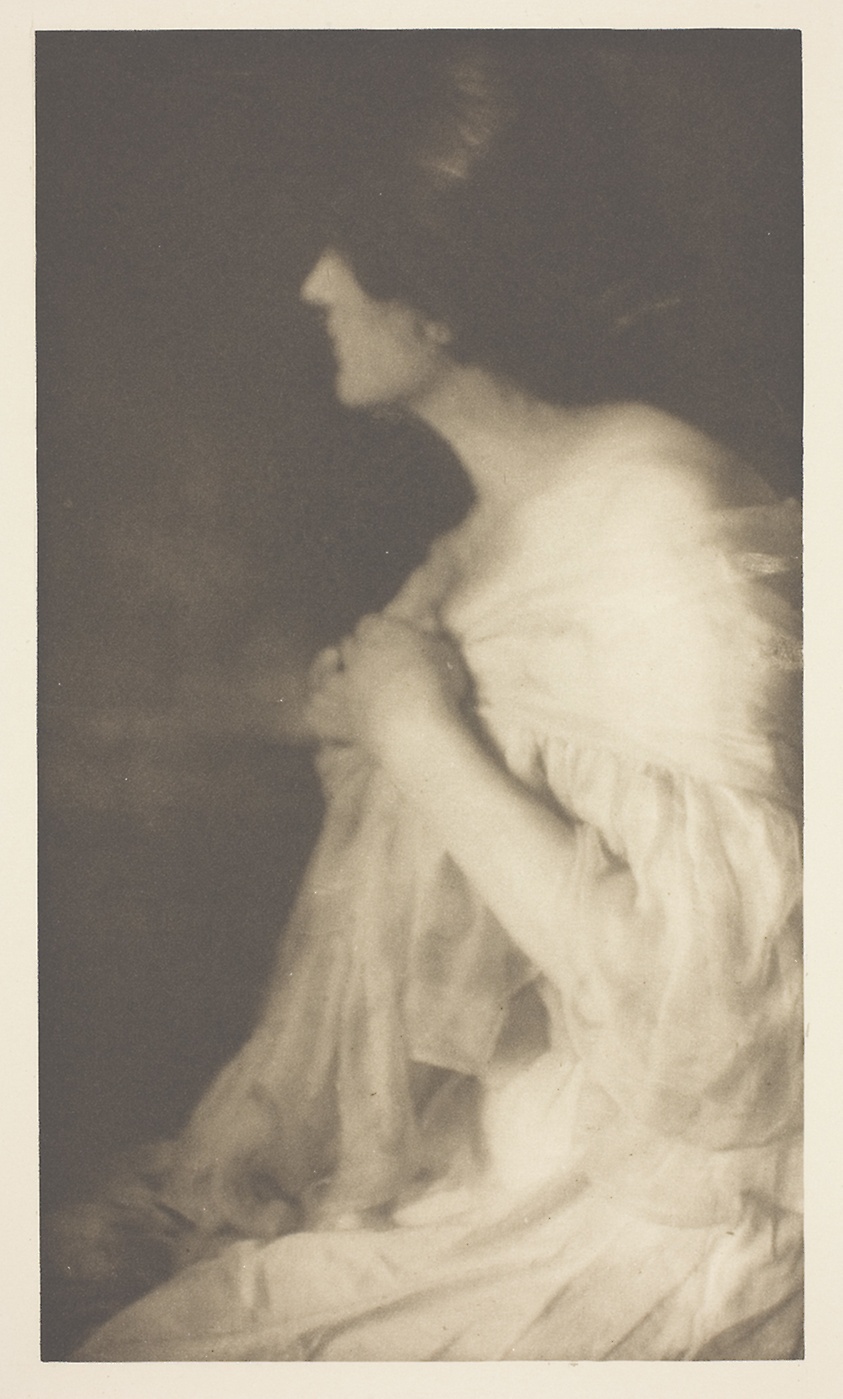
Featured Art: Miss M. of Washington by Rose Clark

Everything was better back then.
Even my nostalgia was better,
more piercing, more true.
I miss missing things that much,
but not as much as I missed
missing things back then.
Even my anxieties about the future,
which have indeed come to pass,
were more vivid back then,
more real. Reality itself seemed
more real back then—this clanking
stage-play only a fool could find
convincing—I fell for it all,
and it killed me, again and again.
Ghosts of myself wander
the cities I’ve lived in, thinking
of other cities, imagining me
here imagining them.
We nod to each other across
the years, the way the last line
of a poem will sometimes
look back, wistfully,
at the first.


Read More

Irgendwo, Nirgendwo

By Dave Madden

Featured Art: Abstract Landscape by H. Lyman Saÿen

They sit like lumps at the kitchen table covered by a worn and graying cloth, milkdregs ghosting the glass of two tumblers. Their four feet dangle inches above the floor as Opa sucks his horehound. They can hear it slopping around, see it burrowing there behind his potato jowls. They smell the burnt-tire funk of it. It’s July and the brothers are long enough out of school that their stretched and empty afternoons have become kind of boring, they say. Nowadays, the two are mostly bored. Opa’s fat hand claps the table. He tongues his candy to the far end of the mouth and cries nonsense. There is no mostly, he tells them. No kind of. Either you are bored or you are not and if you are it is only you who is to blame. From the other room come the strangled words of their mother shouting at her mother. Opa nudges the boys out to the front porch. There he lowers his flanks onto a teak rocker. There’s an oomph and a curse and the old man begins to teach the boys a game.

Read More

Late January Protest Against The Betrayers of The Dream

By David Rivard

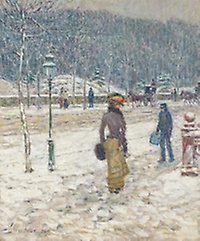
Featured Art: New York Street, 1902 by Childe Hassam

In his leather snap cap & undertaker’s suit of
shiny polyester black, one of those resisters
of the transmitted order—an aging Marxist lost boy—
alarm all over his shyly determined, axe-sharp face,
tho a shadow falls upon that face, a gloom
cast by the screen flash of corporations gaming
the go-flo of dollars & broadband—he stands
with umbrella outside Starbucks & silently
hands out pamphlets, shucked by cold tourists.
Does he have set rounds at subway stations
and parks full of volatile sleepwalkers? Maybe
he haunts the doorway of Filene’s at tag end
of Presidents’ Day sales? Does he have a day
job? wife or boyfriend? For change of pace
does he sit in his kitchen obsessively scanning
the box scores of road trip double-headers?
Or is he always thinking how the world should
be honorable, justice at hand?—like my old
teacher in the dim Boston University lecture hall
Howard Zinn—your life, he said, drives
history—you can’t be neutral on a moving train
he died yesterday at 87 but left with his view
still alive & intact of liberation possible for all.


Read More

Scooter

By David Rivard

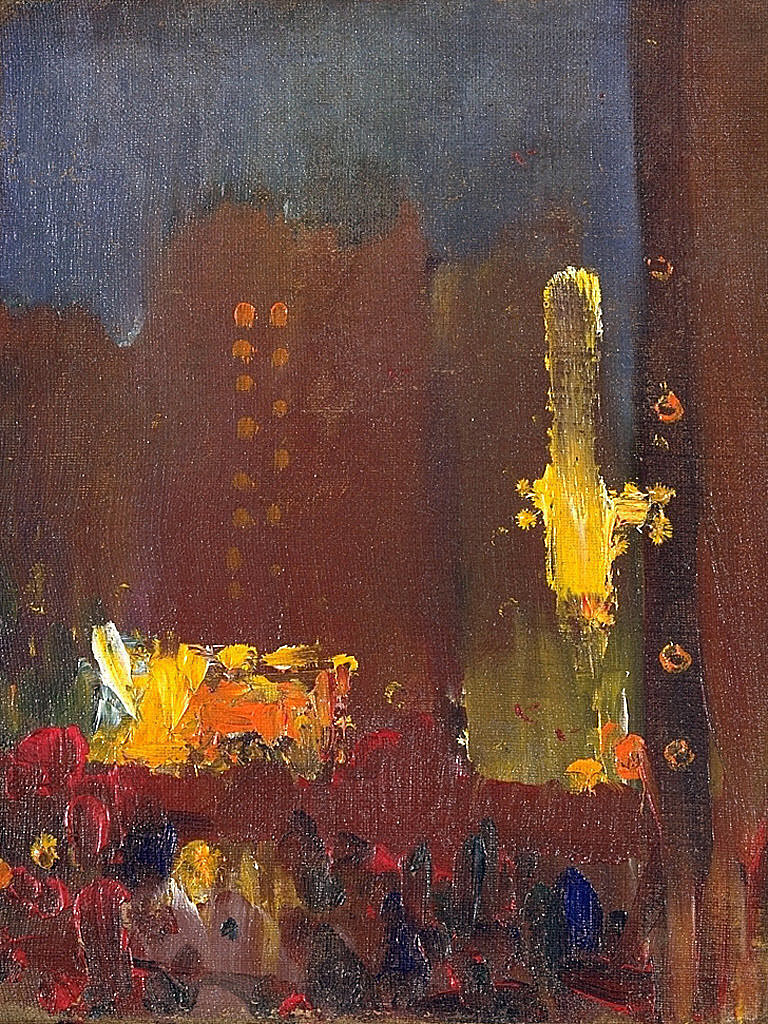
Featured Art: City at Night by Arthur B. Carles

Phil Rizzuto, shortstop, the Yankees’
Scooter & play-by-play announcer & The Money Store’s
man of a certifiably trustworthy nature,
but invented for me first in war stories told
by my father—
on a South Pacific island naval air station
maybe it’d be fun to put Scooter
in the game, brass thinks
a sports star visitor to war zone
great theater of operations P.R.—
but basketball, not
civilization-beating baseball, basketball
my father’s game—
“I could take him,
he couldn’t get by
me”: sayeth Norman
Rivard, testimony of
a former All-State point guard
1942 season Mass state champs
team captain
Durfee High School Fall River;
his torpedoed destroyer sunk
by a two-man Japanese sub
(a sake brewers’ assistant & an Imperial War College ensign?),
a few days earlier their suicide mission
had sent my father
to the base, rescued
just in time for Scooter’s morale boosting
visit, the two together on an asphalt court
in cosmic time Holy Cow!
an immortal, lucky accident—
but will, pride, intensity
count more for Norman—“don’t depend on luck
OK, why don’t you just apply yourself?”
my father’s question, frustrated by
his distracted, blurry
son—
apply yourself, stay on track,
stick to it, that’s the thing,
you’ll adhere
successfully to whatever you want
(not sure I know what the wanting is for even now),
you can be
an architect, trial lawyer, oncologist, surveyor,
if only you apply yourself—
like a wing decal on the model
of a Mustang P-51 Fighter
or whiskey dried in a glass-sized ring
on a liquor cart?—
skim the ear wax off your eardrums,
Dad—here is your poet, & here
is your poem.


Read More

At a Pet Shop

By Tom Whalen

Featured Art: Red Parrot on the Branch of a Tree by Ito Jakuchu

When the parrot took the cracker I offered, it said:

“Thank you, my friend. You’re the first person to give me anything to eat in decades. There is no a priori order of things. I thought I had been living the good life, but what did I know? The poet fell sick, traveled to the capital, needed words, painted his curtains bright green. A sumptuous village girl threatened me with a cheap lighter. Night after night watching the corpses of rodents turn to bone. I remember when my mother took me to the city, remember how her perfume gave me a high. After that it took me years to find a mate. Night work. Elocution lessons. A treatise on Gorgias’ Encomium of Helen. I kept to the plan I started with. Death is not an experience, food is.”

Then it fell from its perch with a thump, and from its beak an ant exited soaked in the parrot’s blood.


Read More