Three Sacraments
By Brooke Champagne
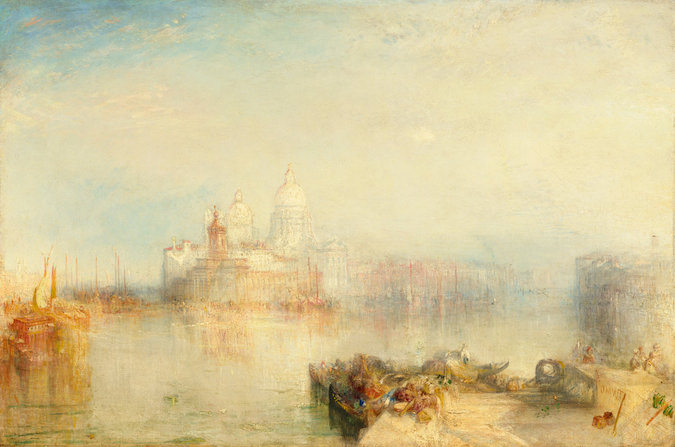
Featured Image: The Dogana and Santa Maria della Salute, Venice by Joseph Mallord William Turner, 1843; Courtesy National Gallery of Art, Washington
The Eucharist, although it is the fullness of sac-
ramental life, is not a prize for the perfect but
a powerful medicine and nourishment for the
weak . . . Frequently, we act as arbiters of grace
rather than its facilitators. But the Church is not
a tollhouse; it is the house of the Father, where
there is a place for everyone, with all their prob-
lems.
—Pope Francis, “The Joy of the Gospel”
The true vision and knowledge of what we seek
consists precisely in not seeing, in an awareness
that our goal transcends all knowledge and is
everywhere cut from us by the darkness of in-
comprehensibility.
—Gregory of Nyssa, Life of Moses
Holy Unction
I’m nine years old the day my mother dies and comes back to life and, if I ever believed at all, it’s the day I give up on Christ.
The reverse might be expected—miracles, the power of prayer—but when I make my final judgment, I don’t know yet, won’t know for a long time that she has died and returned. At that point, I’m only told she is pregnant and there are complications. The baby, my would-be half-sister, is gestating at twenty-three weeks and because my mother is sick, must be delivered. Everyone waits and prays. Doctors work and pray. At school, my teacher’s hand on my shoulder a few seconds too long in that comforting way, her eyes say: I’ll pray for you. Before bed I press my hands into a teepee and try earnestly at first, then only pretend to pray.
Read More
At the Narrows
By Meredith Davies Hadaway
Featured Image: The Gulf Stream by Winslow Homer, 1899
Now, when even midday sun holds shadows,
and only the wooden boats are left, bless
scarred hulls and splintered pilings.
Bless the hands that still twist eel into lines
of hard commerce. Bless the motor’s stutter
declaring, yes, we will go out. Bless the foul
mud that peppers the gunnel, the ascent
of the bait, its twitch as it goes over the roller.
Bless the slow crab, too greedy for stink to see
the net coming and the basket, slats leaking
a scrabble of claws. Wanda J, Alice Rose,
Edna—grubby river angels, decks swollen
with rain, smelling of brine and rot, all divot
and slop—bless your deadrise, your hard
chine, your rudder. In the morning, all will
blur into mist. Crabs will begin their exodus
to deeper waters. We tell ourselves they will
be back. May this, too, be true.
Read More

We Buy, Sell, Trade
By Betsy Sholl
Featured Image: A Farm in the Sunlight by Meindert Hobbema, 1668
Courtesy National Gallery of Art, Washington
Ideas are one thing and what happens is another.
—John Cage
Weather or axe—who neglected or hacked
to make this bag of piano keys, this
clatter of loose scales in a paper sack,
fifty-two whites, the yellow of stained teeth,
a few of them chipped: some upright or grand,
its music collapsed in a racket of chainsaws
cutting up belly and legs for scrap.
Warped wood, the thunk of stuck notes—

Summer Night
By Suzanne Carey
Featured Image: Jetty and Wharf at Trouville by Eugène Boudin, 1863
Courtesy National Gallery of Art, Washington
Teen boys shoot hoops
a few yards from my open door.
The night’s nearly moonless,
yet they persist,
thunka-thunka of ball on blacktop
driving me to the verge of complaint,
like some old woman caught
in a numbing net of loneliness,
the old woman I suddenly am.
Today, the man I love told me
how he happened to leave Michigan
and mused how different
his life would have been if he’d stayed—
no degrees;
running a string of burger stops
or clocking in as a machinist like his dad;
never meeting his wife—
this last said with a shaky smile,
like someone who, by turning back
to retrieve a forgotten umbrella,
dodged death, and I realize finding her
is something he will never regret.
No matter how much he loves me
or how many cracks in his soul I caulk,
she is the rock he’s built his life on.
Summer fades like worn denim,
yellowing leaves grow frail.
I close my door.
Outside the boys ceaselessly aim
at shadowy baskets
that cannot hold a thing.
Read More

One Solid Chassis Among Us
By Susan Blackwell Ramsey
Featured Image: Giant Magnolias on a Blue Velvet Cloth by Martin Johnson Heade, 1890
Courtesy National Gallery of Art, Washington
We praised the gray car for being a good little mule
the day before it roared demands. The labs
for my sister’s knee surgery came back showing dual
heart chambers out of whack. And right-left jabs
of exploding joints and breast removal for me
came one year after both my husband’s eyes
lost cataracts, gained corneas. The knee
still needs to be replaced, of course. So why
not buy a new car? Certainly we could
transport our patchwork selves in our patchwork car,
all very apt, and prudently get the good
of what’s left. Or, while granting how things are,
we could fling cash, climb in with gleeful smiles,
and ride shiny the remaining miles.
Read More
Looney Tunes
By Nathan Anderson
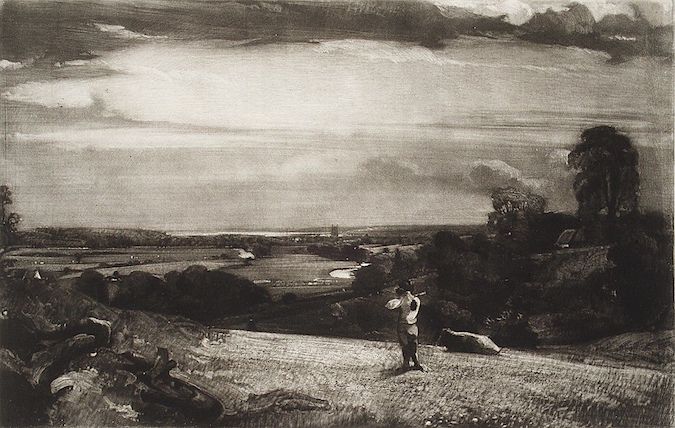
Featured Image: Summer Morning by David Lucas, 1830
Nah, it’s not that, I wouldn’t call it that, I mean molested
that’s like TV stuff, and Brenna
she’d be real nice sometimes like flesh and blood should.
Bring me back a chocolate frosty just because.
Anyway, I’d just as soon say we’re done,
or you want I should go through it all like I did in June
with the last one? Twice now—and this just goes to show
the system’s jacked—twice I’ve waited, asked the front desk ladies
and waited, I said people I need a little help and you’re telling me two hours?
In all this hospital you’re telling me there’s no one I can talk to now?
I said what about the dude mopping floors? Is he around?
Can I talk to him? Or do I go ahead and slit my wrists right here?
So they hauled me up to you, another white coat
working the psych ward. A woman. What’s up with that?
No offense or nothing. That’s just how they do me
down on first-floor, where everyone else on earth is. You ever one of those
ER docs I see running around? The way I figure it, a woman like you
doesn’t need to run. You’re all put together—you know, like a car
that’s just come off the line . . . . But okay, this isn’t about you.

Inspiration
By Mark Kraushaar
Featured Image: Mountain Landscape with Bridge by Thomas Gainsborough, 1783/1784
Courtesy National Gallery of Art, Washington
Intellectual: Anyone who can listen to Gio-
achino Rossini’s William Tell Overture with-
out thinking of the Lone Ranger.
—Laurie Taylor, sociologist
Sometimes I picture that foppish, fat Gioachino Rossini—
with his brocade shoes, his velvet-collared jacket and his satin vest.
But mostly I think of him stepping over the ocean, smiling
and rubbing his chubby palms and then, inexplicably,
standing on the porch of a modest family farm
and looking out at Bald Rock Dome or Sugar Pine Peak.
Beside him a poorish, but kindly, but cowardly widower
explains that just that morning a band of filthy varmints
burned his barn and shook him down for the last of his cash
and his only cow. Rossini listens but begins to hum
and just as he turns from the farmer to gaze back at the mountains
two handsome men gallop up and dismount.
The first, the one with the matching six-guns,
and black mask and elegant horse,
hands the farmer his recovered money.
The second man, his sidekick, a quiet Indian
dressed in buckskin and moccasins says:
Bad men go jail.
We ride kemo sabe?
Yes, Tonto, says the mysterious rider
and pausing only to wave
the two men speed away in a cloud of dust.
Once again the Italian Mozart looks out at the mountains
and begins to hum. Who was that stranger with the mask?
he asks, I wanted to thank him.
Read More
That’s Me Smiling in the Back Row
By Elton Glaser
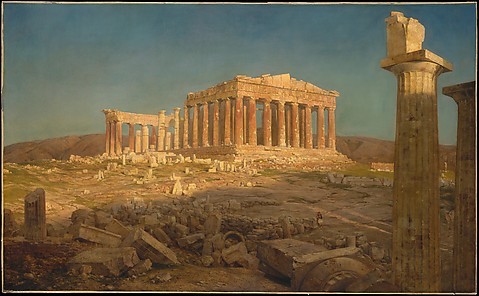
Featured Image: The Parthenon by Frederic Edwin church, 1871
The day warms up fast,
Like leftovers in a microwave, odors of dawn
Still rising from the dead lilies,
From dry grass bleached to blonde and now
Heading toward platinum.
In the slow burn of midsummer,
The nose takes you where the mind won’t go.
There’s bad juju all over the place.
Light clings like cellophane
To the limp leaves. Nothing will budge
That carpet of shadows on the back porch.
I’m watching a spider
Rappel from the blades of a broken fan.
Somebody needs to fix it soon,
Somebody who knows how to work a miracle
With Juicy Fruit and a steak knife.

May B
By Lois Taylor
Featured Image: Young Ladies of the Village by Gustave Courbet, 1851-2
The last thing May B ever wanted was to be stuck with Tweety, who is standing there in her halter top and shorts, frowning at the yowling cat.
“Run that by me again, where you got her?” says Tweety.
May B explains how the stray came to the door just before her mom got sick and the aid car had to take her away again, and her mom said the cat was pregnant but way too young to have kittens.
Now the cat begins to twitch. “She’s going to die,” says May B. “She doesn’t even have a name.”
“Who’s talking about dying,” says Tweety. “Help me get that baby ready.”
Read More
Venus Out on the Town
By Shakira Croce
Featured Image: Charlotte, Lady Watkin Williams-Wynne by Daniel Gardner, 1775
Courtesy National Gallery of Art, Washington
Yes, you may buy me
A drink
It has been a long week for me too
At work trading, you said?
No, you haven’t had much?
Experience in social enterprise
Isn’t it great we live in a country
Where you and your partners can pull such fine bootstraps
One of the brightest, yes
I’ve been told I have a nice smile among other things
Your lines show in a few more years
Your advances will be harmless, cute even
Thank you for the champagne
What did you say your name was?

The Tenants of Feminism
By Denise Duhamel
Featured Image: The Valley of the Seine, from the Hills of Giverny by Theodore Robinson, 1892
When the interviewer mishears “tenets”
I know my gals are not in a villa,
never mind the United States Senate.
My heroines crowd in drab tenements,
their image scaring even Attila
the Hun. The interviewer hears “tenants”—
bad asses, public housing. Bob Bennett
wakes sweaty from a nightmare, Guerrilla
Girls rushing the United States Senate;
Gloria Steinem, bell hooks, and Joan Jett
stuffing manifestos in manila
mailers. The interviewer hears “tenants,”
sees kitchens where women cook venomous
dishes. His lady smells of vanilla,
minding their house, not the U.S. Senate.
My principles are not set in cement,
nor are they adrift on a flotilla.
I call upon all feminist “tenants”—
Steer your U-Hauls to the U.S. Senate.
Read More

We Are All Beyond Disgusting
By Jill Kato
Featured Image: Breezing Up (A Fair Wind) by Winslw Homer, 1876
Courtesy National Gallery of Art, Washington
I like to get to the ship early. You’ll usually find a couple of old-timers waiting by the bar, itching to sip a Tom Collins or a whiskey sour on the rocks and get their vacation started right. This is the best time to build rapport and I’m their gal. At this point, they’re still excited about their trip and have a thick wad of cash in their billfolds. Their wives are in their cabins getting settled or making appointments at the spa or booking excursions for when we dock. The bar is quiet and they have me all to themselves. They can pour out all their troubles, and I can pour them all the liquor they need, at heavily marked-up prices. I haven’t even finished restocking the tabasco and maraschino cherries when a salty dog of a guy walks in. His name is Jerry and he’s on board to celebrate his wife’s sixty-fifth birthday. I ask him what he does, and he says he used to own a manufacturing company in the fashion district but now he’s retired. Left the business to his son. He says he built his company from scratch. Even though his shirt is ugly and has hula girls on it, I tell him I like it. I tell all men I like their shirts. I garnish his glass with an orange slice and tell him I admire men like him, self-made men who do things like run their own companies. And I do.
Read More
The Lake
By Billy Collins
Featured Image: Lumber Schooners at Evening on Penobscot Bay by Fitz Henry Lane, 1863
Courtesy National Gallery of Art, Washington
As usual, it was easy to accept the lake
and its surroundings,
to take at face value the colonies of reeds
along the shore, a little platoon of ducks,
a turtle sunning itself on a limb half submerged,
and the big surface of the lake itself,
the water sometimes glassy, other times ruffled.
Why, Henry David Thoreau or anyone
even vaguely familiar with the role
of the picturesque in American
landscape painting of the 19th century
would feel perfectly at home in its presence.
And that is why I felt so relieved
to discover in the midst of all this
a note of skepticism,
a touch of whimsy,
or call it a bit of Dadaist playfulness;
and if not a remark worthy of Oscar Wilde
then surely a sign of the human was apparent
in the casual fuck-you attitude
so perfectly expressed by the anhinga
that was drying its extended wings
in the morning breeze
while perched on a decoy of a Canada goose.
Read More

Regarding Isabelle Huppert
By Tom Whalen
Featured Image: The Unicorn Rests in a Garden (from the Unicorn Tapestries), 1495-1505
Yesterday as I reread Hubert Hoskin’s translation of C. A. van Peursen’s Leibniz (1966/69), I couldn’t help but think of Isabelle Huppert. As with Leibniz, experience alone cannot account for her performances, but I don’t think, regarding Isabelle Huppert, I need concern myself with eternal truths residing in the mind of God. Judge advocate, nun, prostitute, mother, dressmaker, postal clerk, piano teacher, scientist, abortionist, war bride, writer, hostage, thief—whatever the role or source (Euripides, Diderot, Goethe, Dostoyevsky, Flaubert, Maupassant, Conrad, James, Zamyatin, Crnjanski, Genet, Bataille, Duras, Highsmith, Bachmann, Rendell, Jim Thompson), energies feed the performances of Isabelle Huppert from without and within.
Have you seen many of her over one hundred films? Retour à la bien-aimée, for example, or Eaux profondes, Pas de scandale, Sans queue ni tête, La séparation? Are you older or younger than Isabelle Huppert?
At the door to the house of Isabelle Huppert one stands as if before a tabernacle of dreams. Have you, too, stood before the tabernacle of Isabelle Huppert, or perhaps even entered its elegant chambers, which others before and after you have also entered? I confess I have not, though I am convinced I can say without equivocation that the house of Isabelle Huppert is capacious, albeit modestly so.
Read More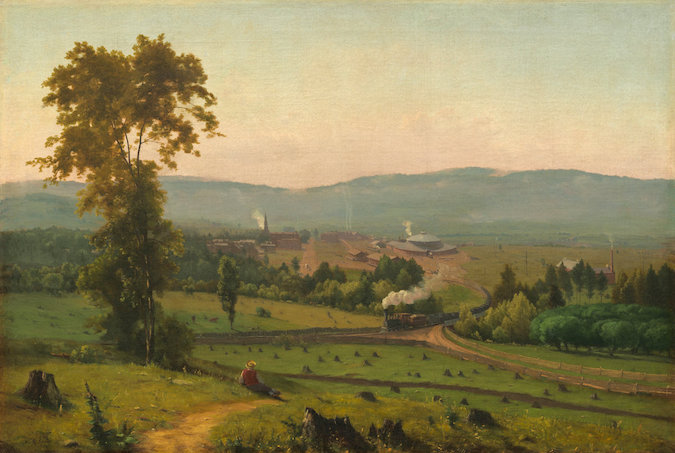
On His Way in Finding the World
By Dennis Sampson
Featured Image: The Lackawanna Valley by George Iness, 1856, Courtesy National Gallery of Art, Washington
He was a person. He put
one foot in front of the other and often
thought of himself before thinking of others,
tried at times to ask a woman whom he loved
what he had done wrong and sobbed
during a counseling session in a back room of
a Catholic church when his wife made it clear she
did not want him to touch her. He smoked,
wrote in enclosures that were cold, that were sweltering,
and celebrated his modest accomplishments
by drinking alone in a bar in Cleveland,
infuriating those who did not like his kind
of frankness. When his mother
died slowly after a stroke he felt nothing. The singularly
vivid iridescent streak of sunlight in late afternoon in October
inspired him to write. He never forgot
the aroma of Mennen after-shave permeating the hallway
when his father left the bathroom, or the sweet fragrance
of lilacs growing in all corners of their yard. A person.
And he once held a leopard frog in his palms and was
startled by how desperately it wanted to get out.
Read More

Rumors About Dread Mills
By Rodney Jones
Featured Images: Rouen Cathedral, West Façade by Claude Monet, 1894, Courtesy National Gallery of Art, Washington
1974
At last they have him in church, a short service and the family silent, but the moments after the funeral are like a test.
True: The new base-tube press at Lockland Copper weighed sixty-seven tons. When they had completed the building and brought it in the door, six engineers agreed they would have to lift the roof to get the crane in and lower it into the pit. He heard from Tip Smith, a drinking buddy, a welder on the job, and wrote the board, saying he would do it for 10,000. Went to the ice plant, ordered eigh- teen blocks, filled the pit, rolled the press onto the ice; then, as the ice melted, pumped out the water.
True: Drunk every day for sixteen years. False: Mostly homebrew or moon- shine.
True: Every morning Maurice Orr’s rooster pissed him off. False: He caught the rooster in a sack, dug a hole behind the house, buried it with just the neck and head sticking out, cranked the mower, and mowed the lawn.
False: The story that besotted on the back lawn he ordered Jawaharal to dance and choreographed the steps with a Colt revolver. (Gunsmoke.)
True: Jawaharal inherited his logic gene and argued when he called him “Jerry.”
False: He never hit a lick at a snake. Once he pruned the grapevine. Twice, after midnight, he picked roasting ears from Leldon Spence’s garden.
True: When the money from the press job ran out, he wrote bad checks until his name was published on the glass doors of every business from Cold Springs to Decatur. It hit him then one day: go from store to store, copy all the names, print the list of deadbeats twice a year and sell subscriptions to each store for fifty dollars.
True: His Deadbeat Protection Flier taking off before the Credit Protection Act: drinking Jim Beam in the air over Georgia and Louisiana, he was a sloppy man who made a million dollars.
True: The gay son home from Palo Alto. The wife, a holy roller in a sari. His brilliant, inebriated redneck math, marks in the chicken yard. The liver. The heart—details of the unannotated life: grease-prints on Erdös in Combinator- ics, unused tickets to see Conway Twitty—Cliffs Notes for Abyss Studies—
His mind at the end like a hand reaching for a pocket when he wasn’t wearing a shirt.
“I would kill myself if there were anyone better.”
Read More

The Ends of Stories
By Karen Loeb
Featured Image: Soir d’hiver à Montmartre (Winter Evening in Montmartre) by Jean-Alexis-Joseph Morin-Jean, 1910; Courtesy National Gallery of Art, Washington
At the finish of the meal, your father left. And that was that.
I led a reckless life, but when the accident happened, I reformed.
So I discovered that the bananas had to be really ripe.
The bouquet was a wet bathing suit moldering in a gym bag
tossed in the corner last month.
The lost earring with the green stone turned up years later
when they moved the dresser. She’d thrown out the matching one
a decade earlier.
The smell was a casserole forgotten on the counter. Something with tuna
and onions. It greeted them when they returned from vacation.
I plan to beat the odds and live forever, he declared.
The cat was hiding in the top drawer of the bureau, flattened
as thin as a comic book, eyes peering up, blinking, when we
finally found him.
Turned out it was a moth as big as a bat making those shadows
on the cabin wall.
She went shopping for a jacket covered in feathers, just as it had
appeared in her dream.
Read More

BBC
By Mike Wright
Featured Image: View of Toledo by El Greco, 1599-1600
I leave the World Service
on at night, snoozing through
the British iteration of gang rape
and kidnapping. I’ll stir sometimes
to hear a few moments of economic
collapse, but it’s really white noise,
blanching the laughter of drunks outside.
Sleeping to tragedy helps tamp down
my father’s last days, his morphine speech,
how my mother sent me to Kentucky
Fried Chicken with a coupon
for his last meal, and how shame
drove me to throw the coupon out.
If his death were broadcast in the night,
his of thousands of dying fathers,
and you slept well, how could
I begrudge you a night of rest?
Read More

Where My Father Went
By Sandy Gingras
Courtesy National Gallery of Art, Washington
When the funeral director hands my father’s ashes to my mother, she puts the little cardboard box into her pocketbook—the one with all the zippers and buckles. My mother says she’ll hold off on scattering the ashes until maybe the next time my brother comes down from his farm and we’re all together. Maybe we’ll scatter them in the ocean.
“But, for now,” I ask, “Where are you going to put him?”
“In my bedroom closet,” she says.
My parents never shared a bedroom. My father’s room was the converted attic, my mother’s, the converted garage. As far away as they could get from each other within the same house. Putting him in her bedroom closet seems, at once, too remote and too intimate, but I don’t say anything.
Two years pass.
My brother only visits on Christmas and Thanksgiving, which is not the right time to scatter the ashes. It’s never the right time to scatter the ashes.
Read More
Someone Else
By Sandy Gingras
Featured Image: Roses by Vincent Van Gogh, 1890
Courtesy National Gallery of Art, Washington
When my mother was dying, we started calling her “Grammy” as if she’d become someone else. She was eighty-five pounds. She looked like a shrinkydink of herself. She wore a diaper and a hospital gown. The diaper looked enormous on her. It was one of those pull-up ones. If you yanked up her diaper when she was trying to stand, you could lift her right off her feet. “Whoa,” she’d say to you. “Whoa there.” Grammy was a good sport. She was nothing like my mother.
She was on morphine, so a lot of the time, she made no sense. “You know,” she’d tell me earnestly, “I gotta get me a Louie-Louie.”
“Okay,” I’d tell her, but I didn’t have a clue what she meant. “I’ll buy you one.”
“Don’t get it too small,” she’d say. “Oooh,” she’d kind of shiver with excitement, “That will be lovely.” Lovely. As if my mother would ever say a word like that.
Read More
My Mother Comes to Dinner
By Sally Bliumis-Dunn
Featured Image: Green Plums by Joseph Decker, 1885
Courtesy National Gallery of Art, Washington
We leave the dining room and she remains
alone at the table; the plates need washing,
we prepare dessert. I still wait for her
questions, half-buried in dish-clatter,
her broken tones in the hot kitchen air,
though these days she sits mostly silent.
And larger than the room and yellow walls, her silence—
as though it were strung to the sky,
to the air that too has been washed and washed
like a bed sheet in the relentless sun,
colors and patterns mostly faded
like all the meals enjoyed then washed
from these brown earthenware plates.
Read More
Jester’s Cap
By Brandon Amico
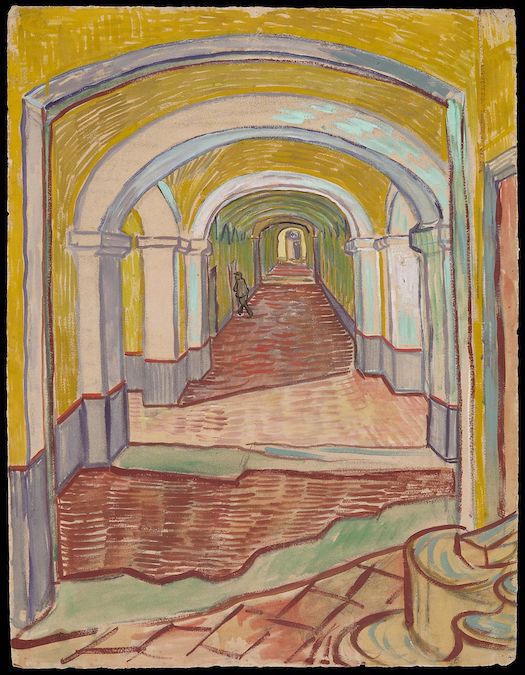
Featured Image: Corridor in the Asylum by Vincent Van Gogh, 1889
Three rabbits walk into a bar. The third rabbit carries a shotgun.
Three rabbits walk into a bar. The third rabbit carries a shotgun and the first
rabbit a vase of imported flowers.
One of the rabbits is already drunk.
Three rabbits walk into an orgy but only for the pre-orgy hors d’oeuvres.
Three rabbits walk into a bar with masks on but their ears give them away.
Knock-knock. (Who’s there?) No one, it’s just the second rabbit, the one with a
free hand, rapping his knuckle on the bartop.

Banality
By Gregory Djanikian
Featured Image: Tullichewan Castle, Vale of Leven, Scotland by Sir James Campbell of Strathro, 1855
Courtesy National Gallery of Art, Washington
There’s something to be said for banality,
the way it keeps everything on a level plane,
one cliché blithely following another
like cows heading toward the pasture.
How lovely sometimes not to think
about Russian Futurism, or the second law
of thermodynamics, or how thinking itself
requires some thoughtfulness.
I’d like to ask if Machiavelli
ever owned a dog named “Prince.”
I’d like to imagine Rosalind Franklin
lounging pleasantly by a wood stove.
Let the mind take a holiday,
the body put its slippers on.
It’s a beautiful day, says the banal,
and today, I’m happy to agree
with its genial locutions.
Nowadays
By Judy Rowe Michaels
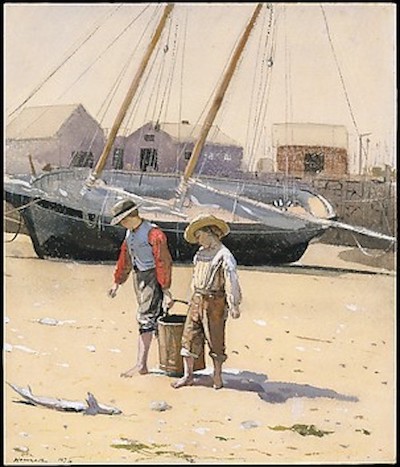
Featured Image: A Basket of Clams by Winslow Homer, 1873
And is that everything
since you? Since meaning
posthumous.
Here melancholy’s
interrupted by brief flirt
with dictionary: originally
postumas, no hint
of burial in living earth.
Dicking around again with
missing you, post this and that—
coital, colonial, menopausal,
Mesozoic, coitus interruptus . . .
Nowadays sex is catch-all for
almost anything, god, war,
cupcakes, abs and apps, the boat
is listing.
Poet Gilbert, Jack, said
“the erotic matters not as pleasure
but a way to get to something
darker.” He’s restless
when people laugh a lot,
he prefers Greek fishermen,
who “do not play on the beach.”
Is it so wrong to heft
an inflatable ball, twirl it
on a finger, think circus seals?
Wasn’t sex mostly three-ring
circus—three or more, given
the presence of memory, fantasy,
irony, flattery, usury, syzygy—
that’s sun, moon, earth aligned,
and then there’s the all-but-impossible
synergy, two becoming a
greater third,
yes, Nowadays
is everything since that.
Read More

Harping
By Judy Rowe Michaels
Featured Image: Cattleya Orchid and Three Hummingbirds by Martin Johnson Heade, 1871
Courtesy National Gallery of Art, Washington
While most of us are grieving
something—cold spring lost child dead-end
lyrics that won’t resolve,
the spadefoot toad, who bears
a gold lyre-mark on her back,
is crazy-busy with what science calls
explosive breeding. Rain says Go,
and up from culvert cistern over porch and patio across roads
the fraught migration of spadefeet slowly breaches
our borders to breed in our ponds.
Flood of toadlets in just three weeks, pop pop,
with tiny golden harps, how will this
end? We run them down
coming or going, then pronounce them
rare, so we
love them, make posters, poems—
(Old moss-grown pond—a
toad jumps in to breed pop pop
poppoppoppoppop)
We can’t say they’re unnatural, or blame
the job rate bad schools gang wars (unprotected
sex?), but tiny golden harps
seem suspect artsy irresponsible un-American.
All night trill thrills,
while most of us are grieving.
Read More
Feature: Uses & Abuses of Dialogue
The following is a collection of essays and writings on the subject of dialogue within fiction. Including an essay from author Rebecca Makkai (Music for Wartime, The Hundred-Year House) about a college assignment of eavesdropping to craft realistic dialogue. As well, audio of Robert Anthony Siegel reading “I Deserve Two Firing Squads: Dialogue and Conflict in Fiction.”

A Trompe L’Oeil for the Mind’s Ear
By J. Robert Lennon
Featured Image: Lady Lilith by Dante Gabriel Rossetti, 1867
The key to writing realistic dialogue in fiction is to abandon all presumption of authenticity and acknowledge the necessity of total fakeness in achieving the illusion of truth.
Human speech is not simple. The words we say in conversation convey, at best, 25% of what we mean,1 with the remaining 75% taken up by body language, volume and tone, facial expression, and prior understanding between parties. The fiction writer has access to these conversational elements, of course, and may fill in back story, provide stage direction, and apply (judiciously, lord help us) descriptive dialogue tags to convey the intended meaning. But a good writer can evoke the character of a speaker, his or her intended and actual meaning, and even very subtle contextual clues, using only the words within quotation marks.
Among the tools the writer has at her disposal when writing dialogue: Sentence length. Punctuation. Rhythm (along an axis of consistency, from entirely smooth to completely broken). Syntax and diction (specifically, its breadth, expressive sophistication, and degree of formal correctness). The reader should be able to understand who is speaking in the same way that he requires no assistance to identify, by sound alone, the voices of his friends in a crowded room.
Read More
Inside the Cave-Speak of Saunders
By Leslie Daniels
Featured Image: Still Life by Henri Fantin-Latour, 1866, Courtesy National Gallery of Art, Washington
The setting in George Saunders’ story “Pastoralia” is a theme park where two characters—the narrator and Janet—live and work in a simulated cave. Their job is to perform for the occasional tourist the skinning and roasting of a goat. Theme park rules dictate that employees must not speak English at any time so as not to destroy the illusion of being cave people. The narrator abides by the rule, but Janet flouts it, which is a major concern of the narrator’s. On this occasion the freshly dead goat has not been delivered. There are no tourists present.
Janet comes in from her Separate Area and her eyebrows go up.
“No freaking goat?” she says.
I make some guttural sounds and some motions meaning: Big
rain come down, and boom, make goats run, goats now away, away
in high hills, and as my fear was great, I did not follow.
Janet scratches under her armpit and makes a sound like a mon-
key, then lights a cigarette.
“What a bunch of shit,” she says. “Why do you insist, I’ll never
know. Who’s here? Do you see anyone here but us?”
I gesture to her to put out the cigarette and make the fire. She
gestures to me to kiss her butt.
“Why am I making a fire?” she says. “A fire in advance of a goat.
Is this like a wishful fire? Like a hopeful fire? No, sorry, I’ve had it.
What would I do in the real world if there was thunder and so on and
our goats actually ran away? Maybe I’d mourn, like cut myself with
that flint, or maybe I’d kick your ass for being so stupid as to leave the
goats out in the rain.”

I Deserve Two Firing Squads: Dialogue and Conflict in Fiction
By Robert Anthony Siegel
Featured Image: Landscape with Trees and Water by James Bulwer
Courtesy National Gallery of Art, Washington
The world I grew up in was full of hyper-verbal people for whom talk was the medium of both ambition and feeling, the tool they used to try to shape the world around their desires. For that reason, when I began writing fiction, I found that characters were never completely real to me until they spoke: when they started talking I finally knew what they wanted. So I started writing the dialogue first. I would get two characters talking to each other and then build the scene out from their conversation. The dialogue was the trunk, and everything else branched out from it: thought, feeling, memory, sense perception, action.
In those days, when a scene worked, I thought it was because the dialogue was good. It took years for me to realize that it was the other way around, that dialogue was just helping me to uncover the underlying conflict that actually drove the story. What I know now is that dialogue doesn’t have to be fancy or quirky or unusual in order to do its job effectively. It just has to arise freely and naturally from the characters’ experience of conflict.
Read More
A Brief Personal History of Dialogue
By Kelly Luce
Featured Image: The Great Statue of Amida Buddha at Kamakura, Known as the Daibutsu, from the Priest’s Garden by John La Farge, 1887
Not everyone says what they mean. But they do
always say something designed to get what they
want.
—David Mamet
1987: Ms. Voyeur, my first-grade teacher, tells my mom I’m too quiet and should be seen by a psychiatrist. But I prefer listening! Other people are interesting. They tell you more secrets when you’re quiet.
1992: My Language Arts teacher accuses me of plagiarizing a short story I wrote about volleyball tryouts. Why? “The dialogue is too realistic.” When I tell her that’s because I just tried out for volleyball myself and remembered how the girls sounded, she says, “No one learns to write dialogue by listening to real people talk.”
1997: I read Salinger’s “A Perfect Day for Bananafish” for the first time. Remember the conversation between returned soldier Seymour Glass and the young girl, Sybil, on the beach? Sybil is being perfectly herself, still possesses her childlike ability to say just what she means. Seymour is a couple hours away from—. Their chatter is innocent. Or is it terrifying? Take this exchange about a rubber raft:
Read More
The Dialogue of Gesture and Silence
By Alyce Miller
Featured Image: Rouen Cathedral, West Façade, Sunlight by Claude Monet, 1894
Courtesy National Gallery of Art, Washington
What people don’t say is often as important as, or even more important than, what they do say. Too much exposition, or what I call “soap opera dialogue” (e.g. “You remember my brother John who tried to murder Tiffany, before she was caught stealing from Marsha’s cousin who changed her name….”), or its opposite, too little, as is often found in the “generic social glue” of the how’sthe-weather variety, can undermine the progression of story and essential character development (unless, of course, weather is key to the story).
We often think we learn about people through what they say and how they say it, but other forms of communication are just as crucial. Dialogue can happen without speech. Words can fail. Gesture can summon meaning beyond language.
In Hemingway’s dialogue-rich story set in an empty train station in Spain, “Hills Like White Elephants,” the two traveling protagonists he calls respectively “the man and the girl” carry on what might sound to the untrained ear like a conversation about nothing when, in fact, they are about to make an important decision as to whether “the girl” should have an abortion. Whichever path they choose, it is clear that the course of their life together will be forever changed. At one point, after a good deal of back and forth, the girl says, “Then I’ll do it because I don’t care about me.” When the man counters with “I don’t want you to do it if you feel that way,” the girl doesn’t respond. Instead she stands up and walks to the end of the station. Her choice to substitute action for speech and distance herself momentarily from the man says more than anything she could at that moment. Her attention drifts instead to the landscape, the river on one side of the track and the mountains on the other, while she stands in that place of in-betweens and uncertainty. No conversation could convey her dilemma more precisely at that moment.
Read More
Dialogue: The Footfall of Its Wandering
By Darrell Spencer
Featured Image: The Card Players by Paul Cézanne, 1890-2
You might not have it in mind to go a particular
direction and you might end up going that way.
—tapper Jimmy Slyde
Well, that ain’t what art does. It makes things.
—Stanley Elkin
1. Full Disclosure
For my entry into a discussion of dialogue I can’t think of a worthier writer to cite than Amy Hempel. The magician and maestro. Hempel’s narrator of Tumble Home opens the novella as one ought: “I begin this letter to you, then, in the western tradition. If I understand it, the western tradition is: Put your cards on the table” (69). Here are my cards: I like fiction that feels off-shot and shaggy, that seems to have fallen from the sky and is banged up thanks to re-entry. I like my fiction jerry-rigged and clumsy. Stanley Elkin uses the word baggy to describe his novels. Perfect.
Screw Poe: “A skillful literary artist has constructed a tale. If wise, he has not fashioned his thoughts to accommodate his incidents; but having conceived with deliberate care, a certain unique or single effect to be wrought out, he then invents such incidents—he then combines such events as may best aid him establishing this preconceived effect.” Oy. Rube Goldberg schooled me; he’s my guy. I want, as I read, to experience the acrobatics, to hear the pop and the hiss and the whiz-bang of the performance. A Goldberg contraption might get you somewhere but you will most likely be too dizzy to appreciate your arrival. You’ve seen those spaceships wobble across the screen in the crackly black-andwhite Flash Gordon flicks. That’s what I’m talking about. Look closely and you see the wires.
Read More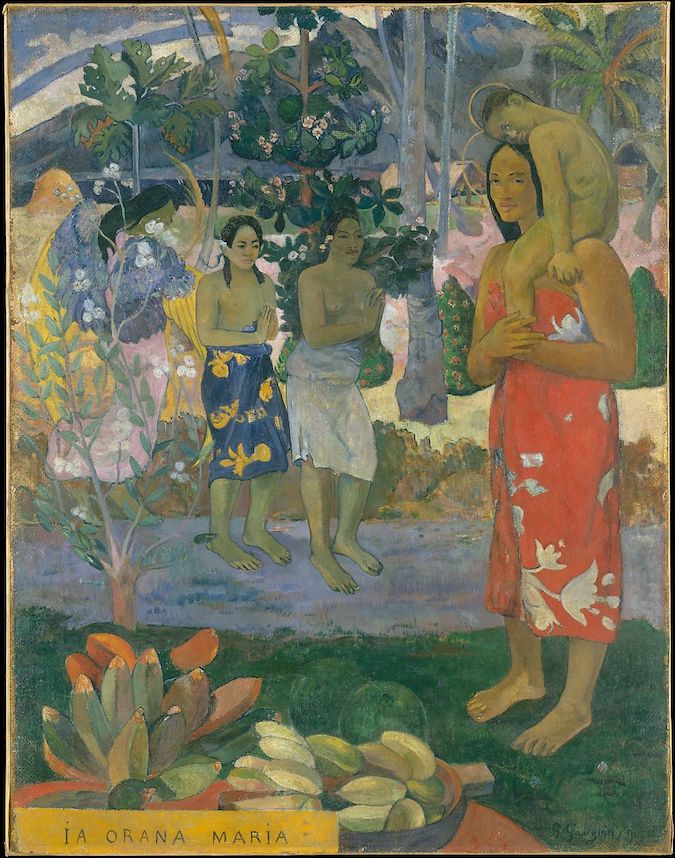
That Dialogue Assignment
By Rebecca Makkai
Featured Image: la Orana Maria (Hail Mary) by Paul Gauguin, 1891
I first got The Assignment in a college playwriting class. You might have gotten it in high school, or picked it up from a writing exercise book (somewhere between Keep a Dream Journal and What Color Is Your Character’s Toothbrush?): Eavesdrop on strangers, and write down everything they say. The idea is that this will help you write better dialogue, more realistic dialogue. Because realistic must equal better.
To be honest, I fudged the college assignment somewhat. I listened in on two campus maintenance workers, thinking they’d say hilarious and off-color things. Mostly, they grunted about paneling. I cherry-picked my hour of listening for the best phrases, crunching them together into what sounded like three minutes of witty banter, adding a few lines of my own. I did this partly to make my classmates laugh (I knew we’d be reading this aloud the next day) but also because I sensed that there was something deeply unsatisfying about actual dialogue—uninspired, disorganized, mundane dialogue.
Read More
The Light Factory
By Sandy Gingras
I work the night shift at the light factory.
The gears of the conveyor belt slip
silently, and emptiness goes by me
one segment at a time. I have to take
the dark in my gloved hands and make
something of it, then connect it to something else.
Someone further along the line bends
it, I think. Nobody really knows much about
the other guy’s job here. We just do our part.
There are no windows in this factory.
The air is like milk, and they pump in
music that has a beat, so we don’t fall asleep
on the job, but we still do. My mother says
I should get a real job, make something solid
out of my life. “There’s enough light
as there is,” she lectures me. “There’s the sun
and the stars,” she says, as if I don’t know this already.
“What do you DO in there?” she asks. I don’t want
to tell her how much we joke around, tell stories,
talk about men. “I can’t really describe it,”
I tell her. “I do it mostly by feel.” Sometimes,
I bring one of the seconds home
with me after my shift. They don’t like it
when you do this, but everyone sneaks some.
I go home at dawn, put it on my dresser
next to the open window, watch it fan
out like a wild thing into the pink sky.
I don’t know why it feels so good to let it go.
Read More
POOF
By Sandy Gingras
My mother wants her head to be frozen
after she dies. I’m against it, but
there’s no talking to her. She has a brochure.
On the cover, there’s a picture
of a white building with no windows.
I tell her, I go, “I’m never gonna visit you there.”
She says, “Fine, fine,” the way she does.
She reads me the whole brochure.
She’ll be maintained at something-something degrees
until they come up with the technology to defrost
her. The, she says, “POOF. It’ll be like
being microwaved.” I go, “Think about
what happens to popcorn.” She keeps on reading
about how they’ll just fiddle around with her DNA,
and she’ll grow a whole new body. I don’t get that part.
I go, “What if they can’t grow you a body,
and you’re stuck being an alive head forever.”
She says, “Then you’ll have to carry me around.”
I knew it. I knew it.
Read More

The Undersized Negative
By Robert Glick
Selected as winner of the 2014 New Ohio Review Fiction Contest by Aimee Bender
Sometimes the day after Mom’s miscarriage, a chemistry teacher with chin-only stubble interrupts class to tell you he is dying. There were so many reasons not to be anywhere. I, Dr. Watermelon, convened everyone at the abandoned house, which I insisted on calling the sketch house, on account of the Etch A Sketch I had found in a toy chest. My buddy Filbert plopped himself down on one of the oyster chairs; the air clouded with dust mites and dried skin. “Finders, keepers,” he said. We demanded answers of the Harris family from phone bills and colanders, from the oregano scent of the bathroom cleaner, from a postal sack half-full of gas caps. The throat to the fireplace was choked; perhaps a bird’s nest. Rob and Ron each kept one eye perched on the doorless front door, wary of the patriarch Dustin Oskar Harris barging in to reclaim what he once owned. They thought the sketch house itself was sketchy, as if its waxy kitchen linoleum had been responsible for mawing open and swallowing its former occupants. Ron suggested that we get sizzled on the freon from the fridge. Rob agreed; they were repurposers. “Highly toxic,” Filbert said, reluctantly we transitioned to flicking matches at the shelves—flyfishing magazines, nautical books – knowing damp, expecting sulfur, anticipating cartwheels of burn through the air. Filbert, nicknamed for the teratomic testicle lodged like a moon above his kidney, had a talent for fire: me, not so much. I was a Pisces; I went as long as I could underwater.
Filbert’s lit match flew through the air and landed on my crotch. I didn’t want to move. I felt crowned, blinkered by a halo of marsh fog. I observed the flicker of little flame, a prickle of warmth on my jeans. “Huh,” I said. That was my best eloquent admiration for the trajectory of heat and light.
Read More
The Egg
By Eric Nelson
We’re sitting at the table the way people do
When a family member dies and a stream of well-wishers
Arrive with sympathy and food.
Everyone is concerned for the widow, 70, tough, wiry,
Who now seems weak and befuddled, staring at people
She’s known for years without answering,
Rising and walking out the back door, staring at the woods
At the far end of their land.
Returning to the table without a word.
We’re all thinking how often one spouse dies
Soon after the other, dies of nothing
But lack. Because we are surrounded by guns, her husband’s
Sizeable collection—pistols in glass cases, rifles
In racks and corners—talk turns to their value, the merits
Of revolvers versus semi autos, plinking, protection.
Now, for the first time, the widow speaks, remembering
That she went to the coop this morning and found curled
In a nesting box a snake, unhinged mouth filled
With a whole egg, disappearing a swallow at a time.
She walked back to the house, pulled her .410
Off the rack, returned to the coop and blew its head off.
A hog-nose, she says. A good snake. But I had to.
She shrugs her shoulders. I had to. Glancing
At each other, we nod in agreement, relieved.
Read More

Gun on the Table
By Eric Nelson
My favorite scene in Body Heat has nothing
To do with the intricate plot
That William Hurt and Kathleen Turner
Devise to kill her rich, oppressive husband.
My favorite scene, maybe ten seconds long,
Shows Hurt getting into his car as an antique
Convertible drives by, a fully costumed clown
At the wheel, waving. Hurt stares, slightly
Bewildered, while the clown passes and disappears.
That’s it. Cut to Hurt and Turner in another
Sweaty sex scene and post-coital planning,
The foregone noir conclusion closing in. Meanwhile,
Since we know there are no meaningless details
In art, we keep expecting the clown to reappear
Or at least figure indirectly yet clearly in the action.
Like Chekhov said—if there’s a gun on the table
In act one, it had better be fired by act three.
But no, the clown is random, there and gone, an odd,
Unrelated moment like any of the ones that pass us
Every day and we barely notice
Because life isn’t art, isn’t revised for coherence,
Not until our lives collapse around us
Like a circus tent in flames
And we begin to look for the alarm we missed.
Read More
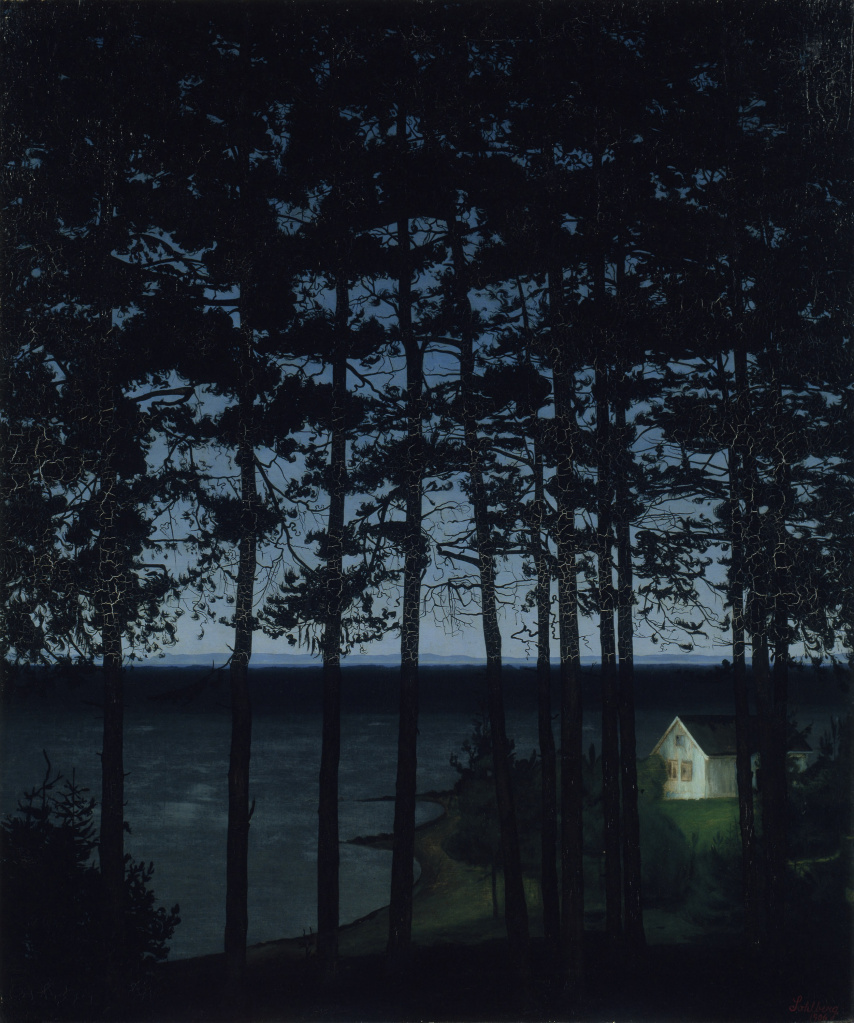
My Life with Pines
By Tom Wayman
1
In the glow of a fluorescent, I sit leaning
over a table to sort through parts of
a jigsaw puzzle, working hard to recreate
a picture displayed
on the box I purchased
while outside
great pines have moved in the darkness
down the ridge to surround my house, many of the trees
taller than the roof. A fierce wind
causes the pine trunks to sway, their limbs
churning the dark in wild
and pitiless gestures.
2
Pines thrive in arid soil, mostly sand,
little else will grow in. These trees regard cedars
who love the damp, who must be surrounded by relatives,
as gloomy, phlegmatic,
timid. Cedars, according to pines, are simple-minded
about safety, suffusing themselves with water
as protection from fire. Cedars might as well be,
pines jeer, a fern. Whereas pines
only reproduce in the heart of a blaze,
their cones needing the insatiable rage of flames
to climax, open, release.
3
No matter how many nights, months, decades
I pore over my jigsaw
the one piece that remains to be found
is a pine.
Read More

Activity Room
By John Bargowski
My mother wants nothing to do with the puzzle
two other residents,
whose wheelchairs have been rolled up
to a folding card table,
are trying to put together—
a west side shot of the New York skyline
broken up into a thousand pieces,
the stubborn morning smog
she could see from the apartment
she had to give up photo-shopped out,
the OT insisting Mom join in the fun,
taking my mother’s stroke-locked hand
and guiding it to
a corner piece that’s an easy fit,
 New Ohio Review