Misterioso

By Sydney Lea

John Ore stood up his bass and Frankie Dunlop laid his sticks on the snare.

They walked offstage but Monk stayed on hunch-shouldered and with one finger

hit a note and stared at his keyboard a long long time, then another

and stared and another and stared, not rising to whirl as he often would do

when he played this club or any other. He didn’t smile as usual,

benign, whenever he danced like that. He wore his African beanie—

I mean no disrespect, Lord knows, just don’t know what you’d call it— his

face beneath it both blank and rapt. I was rapt myself as I’d been

for the whole first set and in fact for years even then, but for other reasons.

I believed he was speaking to me somehow, that he knew my inmost sorrows,

my expectations. Of course I guess a lot of people thought so.

I was looking for eloquent mystery in those odd plinkings, which may have

been there,

though if so, it wasn’t for me to fathom. With the noise of chatter and movement, I

couldn’t have heard my heart lubdub but did. The last set ended,

he sat the same way after, playing lone notes as if contemplating

just where each came from. Right there in front of you! I thought. Who knew

that in front of him too lay those interludes of speechlessness,

his piano hushed, till he died like anyone else? I don’t want to riff

on what I dreamed Monk meant to my life, so small and young, comprising

only things that any man that age is bound to go through.

I don’t want a poem all full of lyric triteness, smoke-softened light

that glanced off bottles behind the bar, the sorrowful looks of his sidemen

as they left him—which may have been only quizzical. It was 1963.

I won’t go into history today, or politics,

or whatever else might make something grander than they truly are of my

thoughts.

There was only Monk. There was sound then quiet.


Sydney Lea’s ninth collection of poems, Young of the Year, will appear in 2011.  A former Pulitzer Prize finalist, he teaches in the graduate faculty of Dartmouth College.

Originally appeared in NOR 8.

Opera, or: Longing

By Natania Rosenfeld

Opera has the power to warn you that you have wasted your life. You haven’t acted on your desires. You’ve suffered a stunted, vicarious existence. You’ve silenced your passions. [Y]ou have used only a fraction of your bodily endowment and your throat is closed.

Wayne Koestenbaum, The Queen’s Throat: Opera, Homosexuality, and the Mystery of Desire

From the time I was twelve, my father, a German professor at a small college, took a group of students to Germany every three years for the spring semester,  and my mother and I stayed behind in Ohio. My mother was too big,  too inwardly alive and desirous, for our small town, and I was filled with the itchiness of puberty. Two restless females, we entertained ourselves together as best we could. Sometimes we drove out into the country just to get away from home. We’d leave our little town to coast through the landscape of cornstalks and flat brown fields. We talked about life. Sometimes we drove past a collapsing gray barn that said “Ma ouch obacc” in faded letters. On a bright day you could make out the missing “il” and “P” from “Mail Pouch Tobacco.” A boy I was in love with lived on the same road as the Ma ouch barn. His father was an air-traffic controller and his mother was an Asian war bride, and Phil was a pimply beautiful boy with a sad face, who trapped animals on the weekend and shot them. When I gazed at him in the school hallway, I felt he was meant for some other destiny, and I wanted to rescue him from his life of dreariness and violence. The problem was that he ignored me completely, was only dimly aware of my existence, my great longing.

On Saturday afternoons, my mother and I always listened to the live Metropolitan opera broadcast on the radio. We’d turn it on in the car and continue listening when we got home. We hated to miss any parts of the program, and were particularly fond of the quizzes and synopses between acts. “I re- member the opera in Vienna when Papa and I were students,” my mother told me more than once. “He wouldn’t spend a schilling on seats, and we had to stand the whole time. Afterward I wanted to buy marroni—roast chestnuts— from one of the old men selling them in the winter streets, but he always said we couldn’t afford them.” My mother was ashamed of having given in to my father, and couldn’t stop resenting him for making her feel like a beggar. In my mind, I saw him with a long, unhappy face, unable to splurge even a little after watching Mimi die of tuberculosis for two hours. “Let’s try to guess the answers to the quiz,” I said, to cheer her up; and I was amazed at how many of them she got right.

Most of all, I remember the applause at the end of the final act, the continuous shouts of “Bravo!” or “Brava!” with a long, triumphant, trailing emphasis on the second syllable—and the announcer saying, “Now Dame Sutherland has picked up a bouquet of roses. Smiling, she holds her arms out to the adoring audience.” The diva blew kisses, and the applause went on and on like a great dark sea. My mother and I quivered and turned up the radio just for  the applause; we were still weeping for the noble, self-sacrificing, gorgeous lady who had just died—who had gone down singing, her very sobs sublime music—and now we wept for the singer, and for the joy of the audience. Singer and audience merged together, their satiety filling our house those gray Ohio Saturdays.

Thirty years later, my mother and I finally attended the Metropolitan Opera in New York City. We were such different people by then! No longer girl and frustrated grown woman, now two women, one elderly, the other verging on middle age. Both of us had brushed against death; we’d been laid open and operated on within six months of one another, each visiting the other’s bedside. We’d traveled to Italy in December of 2001, when no other Americans were traveling, and reveled in the artistic and culinary offerings of Florence. Now we were going to realize a long-held dream. Because my mother’s plane was late—she was coming from Ohio, I from Illinois—we missed the first act of The Marriage of Figaro. We watched what was left of it on the little television downstairs, drank champagne and toasted one another. When we got into the

hall at last, we squeezed hands in frissons of delight. Cherubino singing of   his multiple loves—poor polymorphic, adolescent Cherubino, who cannot go near a woman without trembling all over—made us laugh and cry at once. The duchess singing “Dove Sono”: oh, we’d been there! The opera’s triumphant finale, with its reconciliation of all opposing parties, filled us with joy—yes, it can be that simple, joy! Afterward, we walked up Broadway in a light, warm rain, sharing an umbrella, looking up at the lights, gazing at the people who passed us, planning our next days in the city.

Two nights later, we went to see the bizarre French opera La Juive, cited in Proust whenever Marcel encounters his friend Saint-Loup’s mistress, the Jewish prostitute Rachel. Produced by a Viennese company, the piece was staged awkwardly, tendentiously, and rather stupidly. The bizarrerie of that opera and that production deserves its own chapter, which perhaps someone has written elsewhere. My mother and I were a little tired, and I was annoyed by her strong breath and her continual uncomfortable shifting in her seat; it is quite possible she was annoyed by me, as well. I am well past supposing children aren’t as irritating to parents as parents can be to children, and adult love is often an exercise in toleration. In short, it was an unromantic night at the opera. Instead of a sublime eighteenth-century fol-de-rol, we had nineteenth-century Jewish self-hatred in all its knotty mess, and we felt messy ourselves. The audience around us, at least a third Jewish I’m sure, was confounded. As far as we could tell, Vienna’s black-and-white notions about staging the Gentile-Jewish conflict were not appealing to anyone. The music was pretty, but lacked depth. Only one aria bowled us over, the famous “Rachel, quand du seigneur,” in which the father figure, a Barrabas, sings of his mixed feelings toward his daughter: should she die as a Jewish martyr, or should he reveal her true identity as his adopted Gentile daughter and thereby save her from the burning cauldron? Diva-like, Neil Shicoff had let it be known at the start of the performance that he had a slight cold and would not be singing up to par—and succeeded in making the entire audience feel, “If this is singing below par . . . !” We fulfilled our ultimate fantasy then: shouting “Bravo!” with full throats, weeping with excitement, surrounded by a sea of ecstatic listeners. Not cut off, not insulated in a car in the cornfields, or lonely in a Midwestern house; not far, far away from the world, but in the world, at last. Again, we walked home in the rain, talking this time about all the thorny questions the opera had raised—and again, planning the full days and nights in the week that remained to us.

It seems to me that if opera is about anything, it is about longing—longing for the place where life truly happens (“Moscow!”), for the exotic lover, the husband who will bring us the golden fleece, or at least pour marroni in our laps; or for possession of a singular talent. My mother and I are divas disguised as professors at provincial colleges. When we stand—in her case, stood—before the classroom, sometimes an eloquence pours from our mouths that disconcerts the students. They sit in silence, and I can see on their faces, Where did this come from?

Unappeasable longing. And now, these brown fields of Illinois.


Natania Rosenfeld is an associate professor of English at Knox College and the author of Outsiders Together: Virginia and Leonard Woolf (Princeton, 2001). Her poetry, fiction and essays have been published widely in journals, and she is the recipient of an Illinois Arts Council Literary Award for her prose poem, “Bodies,” published in Another Chicago Magazine in 2007.

Originally appeared in NOR 8.

Too Much

By Natania Rosenfeld

I am a person of excess. When I open my mouth, I say too much, too loudly; I put in too much food, too quickly; I gulp my wine and burn my tongue on coffee. When I eat hard candy, I crunch it all down immediately. I say what I feel at the moment of feeling, and sometimes, because I am a teacher, I say more than what I feel so my meaning will penetrate. You must do this as a teacher and even so, feel sometimes that your mouth has opened and closed for an hour and nothing audible has emerged. So, I am loud; I exaggerate. I am one of those creatures of whom it is said, “She doesn’t know her own strength,” like a lion cub or a small orangutan. The last time I visited my in-laws, I broke their china teapot. I didn’t mean to break it; my big hands dropped it on the floor without volition. It was at a moment when no one was listening to me, and I grew agitated; my hands shook.

My husband is a man of careful, clean movements, an ectomorph with the great, sad eyes of a giraffe. My clumsiness surely pains him, and I am pained by the difference between us. He deserves a daintier sort, a woman named Fiona or Lily who flits through life. I believe I should go away for a while so he can find this Lily or Fiona. I should live with a big man, a loud man, a man who spills on himself and bumps into furniture. With a man like that, I’d be at home. His flesh would deflect my unintended barbs and his noise would drown out mine.

Today a friend told me of just such a man, a friend of hers she says is pining because no one wants him. He is enormous, she said, like a bear or a gorilla, but so deft with his hands that he sculpts tiny figures, figures you can hold in your hand and stroke with one fingertip. These tiny sculptures, my friend said, are world-famous, but the artist is terribly lonely. Year by year, he has become more enormous, and year by year, he has grown less able to part with his tiny figures. He surrounds himself with them, but he is beginning to have financial troubles because he won’t sell them, though buyers beat at his door.

I want to meet him, I told my friend. I was not thinking of his brittle heart, only of resting against that body, being cradled in those paws she described as so deft, though so huge. And of soothing him as I fail to soothe my angular, pensive husband, or all those friends and relatives to whom my every word is like a slap, or at least, the sting of an annoying insect. Lately, there has been a silence between me and my husband, a silence that booms through the house. I must get away and leave him be.

My friend took me to see the man where he lives in a white house by the gray sea. I had never seen so large a man: he towered over both of us, and when he embraced my friend, she was engulfed by his chest and belly. His hair and beard were shaggy and red, his sea-gray eyes were deep and glittering in their casements of craggy flesh. Enclosed in his ursine body, he seemed far away, unreachable. He served us tea at a table by a large window. The cups were porcelain and nearly transparent. How careful I was! And yet still I dropped my cup; it shattered, and splashed tea on my legs. Never mind, he said, it doesn’t matter. I got up to look for a towel, but he waved me back to the chair: Leave it. I watched him drink his own tea from a cup cradled in his paw like an egg.

After tea, we went to his studio.

“Here,” he said, “is my menagerie.”

All over shelves, tables and windowsills were the tiny figures. I cannot describe them, partly because you had to touch them to fully understand. I was terrified when he picked up a sculpture not much larger than a thimble and handed it to me.

“But I already broke your cup!” I said.

He shook his head. “It doesn’t matter.”

For many minutes, he handed me the tiny figures. I held them, looked at them, became lost in the features of their half-animal, half-human faces, and handed them back to him. It was a kind of dance, like the movement of the midwife who takes the baby from its mother’s womb and hands it to the at- tending nurse.

“I have no children,” he said. “They are my real children.”

“I have no children, either,” I answered.

“Then you must find your real children,” he said. “And you mustn’t smother them.”

“Do you smother yours?” I asked.

“Maybe. I can’t give them up. When others come to take them away, I feel as though I’m sending them into exile.”

“But even real children leave eventually,” I said.

“I know,” he said. “If I could part with my children, I’d have real ones. Look,” he said, pointing to his own great bulk. “I’m pregnant all the time. The more I eat, the more children I have inside. They’ll have to remove these with a knife!” He laughed. We all three laughed.

“Come on,” he said, “let’s dance.” He put on wild, whirling gypsy music and reached for a bottle on a high shelf. The bottle had a picture of a plum, and next to it stood a group of tiny, glass carafes.

“Oh no!” I said, when he tried to hand me one. “This I will drop, I’m certain.”

“Ah!” he said, “That’s the beauty of it. When you’ve finished drinking, you throw it over your shoulder. Then you take a new glass. We drink until the corners of the room are filled with shards.”

So we drank, and between the tinkling of tiny breaking bottles, we danced like crazed gypsies. Distantly, at some point, I heard the ringing of my phone; I pretended not to notice, and the other two gave no sign of hearing. I was wild with the excitement of permission to break things.

Suddenly, after about an hour, a terrible thing happened. The sculptor had drunk at least ten of the carafes of plum brandy; he was lurching about. With his enormous hand, he swiped a whole group of his figurines from a shelf onto the floor. “Damn you!” he shouted. “Damn you bloodsuckers, I’m finished!” He started to laugh like a maniac.

“Bernard!” said my friend. “Bernard, stop! You’ll destroy yourself.”

He stared at her like an elephant shot in the knees; then he crumpled to the floor and began to sob. He buried his face in his hands, and the tears flowed through his fingers. My friend went to him, squatted down, patted his shoulders, made soothing sounds. The gypsy music ended suddenly, and in the silence I could hear my telephone. I ran from the room, but before I did so, I swiped two broken figures from the floor and put them deep in my pocket. I kept my hands around them the whole way home to my husband, even though their chipped edges hurt me.

Read More

Minneapolis

By Campbell McGrath

Let’s get drunk and drive someplace, way too fast and loving it. Let’s get drunk and listen to the radiator hiss. Let’s get drunk and toss important stuff out the window—there goes the toaster, there goes a lamp. Let’s get drunk and go see the Replacements, already on stage and torching the amps with flamethrower guitars and Paul Westerberg’s broken heart, oh gee whiz, worth living and dying for, worth working in salt mines or harvesting asteroids whose metal- lic cores might be smelted into alloys from which to fashion a robot able to invent a language in which we could speak of such music without diminish- ing it. Break. And after intermission they’re so messed up they can hardly play “Unsatisfied” or even their ironically riveting versions of “Angel of the Morning” and TV theme songs and commercial jingles from childhood as we crowd forward on the dancefloor shouting “Free Bird!” but Westerberg won’t sing it, even when fifty people have taken up the chant, even as they’re winding down, discordant, stumbling and complicit, and then a quick encore—“Left of the Dial”—honey-drenched, magnificent—before we’re back out in the cold streets drinking cans of beer ensleeved in paper bags as so many are, were, and ever after shall be.

Surely this is the form and the body of the world I have known,

entirely American,

and surely America’s golden dreams shall yield to the sober and diminished light of dawn, all the bars of the Twin Cities arrayed like Nehi bottlecaps on a checkered tablecloth, bars of the lost or damaged, bars of the utterly glorious in failure, pickled eggs and smeared lipstick, cornsilk and taxi-smoke over- flowing the gutters, the avenues and arteries,

a highway we think of as a river of molten tar,

wanting to get right down and bathe in it, partake of its stench and plenitude, such is the nature of that grief, such the love for its wild aortal rush. And if you could harness all that, if you could mainline it or hook it to a turbine, you could power the world, you could live forever and rule the planet, you could flip the switch on the immensity we’ve created, jack up the volume on the damage we have wrought, blow the amps, fuck them all, every follicle, every corpuscle of their folly. Let the world eat the dust in the wake of our wicked ride, let them beg us for mercy, for succor or salvation, for the cuds of chaw or spent rifle shells we deign to bestow as they chase the shadows of our horses through empty streets, like the dusty Mexican children at the end of the movie, calling out Oye, Caballero, Mr. Cowboy, come back!


Campbell McGrath is the author of many books of poetry, including Shannon, Seven Notebooks, Capitalism, American Noise, and Spring Comes to Chicago. His awards include the Kingsley Tufts Prize and fellowships from the Guggenheim and MacArthur Foundations. He teaches in the Creative Writing Program at Florida International University in Miami.

Originally appeared in NOR 8.

New Ohio Review Issue 6 (Originally printed Fall 2009)

Newohioreview.org is archiving previous editions as they originally appeared. We are pairing the pieces with curated art work, as well as select audio recordings. In collaboration with our past contributors, we are happy to (re)-present this outstanding work.

Issue 6 compiled by Ellery Pollard.

Fame

By David Gullette

Featured Art: Reading by James McNeill Whistler

Half asleep he saw clearly his own failures
and by the light of that hideous clarity
made a poem hard sleek and simple.

As he strung the words out from the bobbin
of his waking mind still half dreaming
he knew what he had seen, saw what he had felt

and each word rang a new bell
or bruised an old wound to bleeding
but he pushed on to finish it all the same.

When it was done he held it up and read
the triumphant chronicle of defeat
at his own hands: the craven appeasements

the months of capitulations
the years of friend after friend dying away
and vices equal to his sorrows.

He sent it off, within days came word
they would be glad to print it,
the season shifted and he slept late.

Read More

Objective Correlative

By Ann Keniston

Featured Art: The Letter by Alice Pike Barney

All I could do was think of her face.
Or not think of it, the way
after receiving her letter I felt
relief, gratitude, and then
lost the actual note she wrote,
the tiny, lovely photograph
of her children I’d vowed to cherish.
And then I saw: my grief was
the objective correlative, a hook
on which I could hang all the scraps
of whatever other sadnesses
I was more frightened of. And the grief,
like a person, like her in her solicitude,
almost prevented me from seeing this


Read More

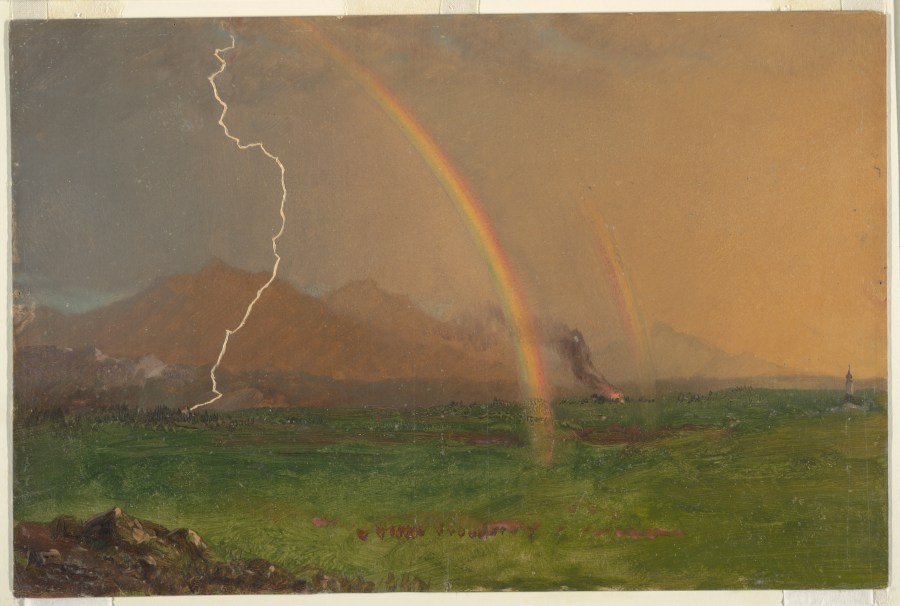
Quite a Storm

By Brenda Miller

Featured Art: Alpine Scene in Thunderstorm by Frederic Edwin Church

You can see storms in the desert from a long way off: dark clouds building, wind picking up, lightning bolts flashing and touching ground. You listen for the thunder growling up behind, wait for the moment when everything will be synchronized—and then you’re in it, in the thick of it, trees bending and shaking, something rattling the roof, the lightning and thunder now one animal trying to get in. The only thing between you and the storm is the sliding glass door, and you see the jackrabbits going for cover, and you know the power will go out, and you know you’ll have to find the flashlight and batteries and candles and matches, and you’ll try to eat all the food in the fridge before it spoils, before your boyfriend gets home and blames you for the storm. You’ll still have to get up at 4 a.m. and drive your truck into town, dash from the cab in the rain and wind, knock at the locked glass door frantically for the baker to let you in, the baker who had looked you up and down, said: why does a college girl like you want a job like this? You had no answer for that question, but you still got the job because you were white and sober and scared, and so now you run inside, put on the big white apron, start pressing fresh donuts into frosting, sprinkling them with chocolate jimmies and coconut, scooping out the powdered sugar and glaze.

Read More

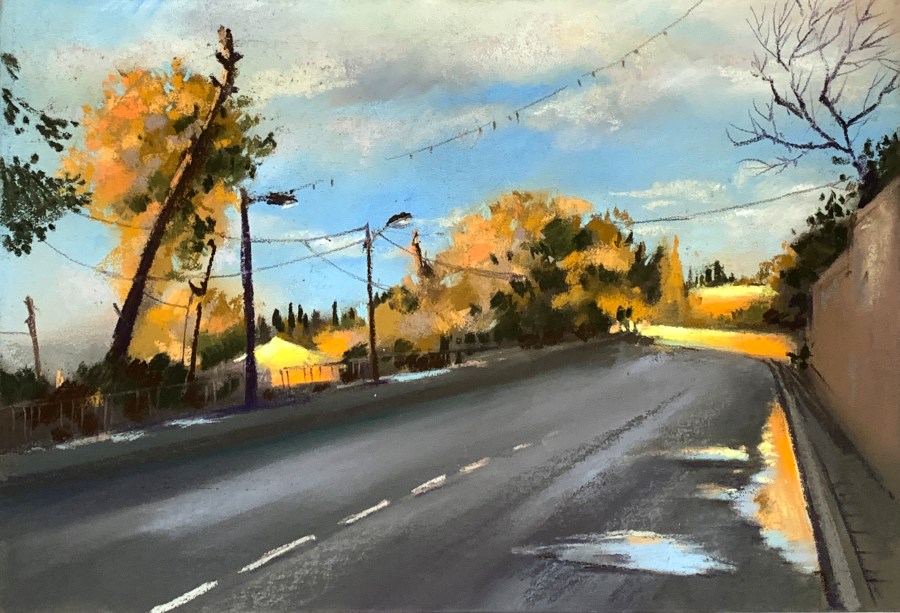
Takeout, 2008

By Denise Duhamel

Featured Art: Puddles by Sophie Rodionov

My sister, my brother-in-law, and I order Chinese takeout
on New Year’s Eve and my fortune reads
“You have to accept loss to win.” This makes me almost hopeful—
and maybe, for a moment, even gives me a way
to make sense out of 2008. I am going to keep that fortune, I think,
but then promptly, accidentally, I throw it in the trash.
Later my sister says that she thought my fortune might have read,
“Only through learning to lose can you really win.”
Or “Maybe accepting loss makes you a winner.” I can’t search
through the trash because I threw the bag of leftover Chinese
into the condo’s chute which crushes whatever thuds to the bottom.
Yesterday I held my childhood drawings in my hand
except they had been drenched in sewer water, so it’s more accurate to say
that I scooped Crayola pulp in my work gloves. The apartment
my sister and brother-in-law and I bought is gone, except
for the cement floor. Even the moldy walls must come down.

Read More

Grimace

By Heather June Gibbons

Featured Art: The Ouroboros by Theodoros Pelecanos

Regret does not descend in a cinematic miasma.
It hits like nausea, creaks back and forth
on a limited axis like one of those vaguely
eggplant-shaped metal cages you used to see
in fast food playgrounds across America.
Meanwhile, the sky unfurls its violent ribbons
and karate kids spar on the green. I am driving
or rinsing a dish, or picking zucchini, or whatever it is
I do now that I’ve outlived my misspent youth,
confused by the hair-trigger pairing of regret
and nostalgia, the head and tail of a snake stuck
swallowing itself in the relentless ouroboros
of endings that beget other endings, memory
like a waterwheel that we’re tied to, half-drowned
and just trying to make it around one more time.
Grimace, I embrace you from the inside.
The place is empty, let me stay awhile.


Read More

The Briefcase

By Mark Cox

Featured Art: Leaves by Sophie Rodionov

They bought it early in their courtship, at one of the
estate or moving sales they avidly frequented, piecing
together a life from the treasures and trash of other
couples—young then, oblivious, able to profit from
others’ losses, to foresee utility and beauty in the
discarded and worn. “Contents a mystery,” the
tag said, “Combination unknown.” Even so, it was
a bargain—a sleek, hard-shelled executive model, its four
dials frozen at 0009, the point of boredom at which someone
stopped trying. Even recounting this story, he aches with
methodical sequential labor, feels the idea overcome by
thought, the way her dinged muffin tins and Jell-o molds
signaled an end to each merged ingredient—became, finally,
intractable result, which, like good children, they shut up
and ate, year after year. When it finally clicked open at
9998, all he found within was another tag, one that showed
the combination he now knew, and directions for customizing
that code, making it their own, for which, obviously, it was
too late, there being nothing left of their early hope to
entrust there, that trapped air of possibility belonging,
now, to others—perhaps you, parking on their weed-ravaged
lawn as you have, walking arm in arm up the drive toward
the heaped folding tables and the garage door propped open
with a brand new broom.


Read More

All That Shimmers and Settles Along the Roads of our Passage

By Mark Cox

Featured Art: Portrait of a Lady with a Dog (Anna Baker Weir) by J. Alden Weir

After seventeen years, I return home to my ex-wife,
without the cigarettes and bread,
without the woman and children I left her for,
older, empty-handed, and yet
to the same clothes
still in the same drawers,
as if nothing has changed.

My torn T-shirt is still splotched with paint
across her left breast,
her hair has not gone gray at the temples,
and she does not ask a single question:
not where have you been,
not how could you,
not where were you when I needed you,

just, hey baby and a smile,
the Vermont air cold,
the old mattress flat on the floor,

because the frame and box springs are still in the Ryder truck,
because my first students have not entered the classroom,
I have yet to fall in love with my own bourbon-soaked voice,
our dog has not died arthritic and stroke-plagued,

there is, instead, the kitchen faucet still running,
the beans rinsed and splayed in the colander,
and there isn’t the slightest anger in her voice,
that I have missed a good dinner,
that I will have to warm it up if I want any,
it’s ok, in fact, if I let the dog out
one last time and just come on to bed.

Read More

A Permanent Home

By Nicole Walker

Featured Art: Houses at Murnau by Vasily Kandinsky

We had been in Michigan only five months when we heard the people we sold our house to back in Salt Lake City had decided not just to remodel but to start completely over. They were tearing it down.

Erik had painted every wall of that house. He painted the moldings with enamel paint—hard enough to last forever. That’s the house Zoe was born in. It’s the house where Erik first brought me oysters and the house where I first made him salmon. It’s the house we brought Zoe home to—where I first nursed her and where I first fed her puréed sweet potatoes. That house was where I learned to make cassoulet and where I made my mom her favorite vichyssoise. 

Read More

A Discreet Charm

By Stephen Dunn

Featured Art: Luncheon Still Life by John F. Francis

Our good friends are with us, Jack and Jen, 
old lefties with whom we now and then share
what we don’t call our wealth. We clink our
wine glasses, and I say, Let’s drink to privilege . . .

the privilege of evenings like this.
All our words have a radical past, and Jack
is famous for wanting the cog to fit the wheel,
and for the wheel to go straight

down some good-cause road. But he says
No, let’s drink to an evening as solemn
as Eugene Debs demanding fair wages—
his smile the bent arrow only the best men

can point at themselves. I serve the salad
Barbara has made with pine nuts, fennel,
and fine, stinky cheese. It’s too beautiful to eat,
Jen says, but means it only as a compliment.

Read More

Superman at 95

By Gregory Djanikian

Featured Art: The Collector of Prints by Edgar Degas

It was never a question of age, finally.
Time for him had always moved
too slowly, wasn’t he faster than time,
outrunning it whenever he wished?
Even now, he could hear the sound
of every second before it clicked.

Oh, he was powerful enough,
still wildly aerodynamic, able
to leap imagination itself.

But he’d grown weary of it all,
the adoring looks, the caped crusading
in the name of righteousness and truth:
hadn’t it frayed a little, lost
its gleam through the turbulent years?

Nothing had changed really,
annihilation, ruin, the horsemen
of every apocalypse still riding through
like bad cops and pestilence,
knowing where everyone lived.

And his own life, emptier now
with so many friends gone
or on the way, Jimmy, Lois,
doddering in their last stages
in a metropolis of fear.

Read More

Life As Lucy

By Lisa Bellamy

Featured Art: Jonge vrouw met een sigaret by Antonio Zona

The famous poet misheard my name after her reading:
“Lucy?” she asked as I introduced myself.
My ears perked up like an anxious dog off the leash
hearing the Beloved Friend call her name, suddenly alert
in the midst of the city’s distraction and babble:
fragrant pigeons just out of reach, sirens,
couples growling face to face in the street.
There’s nothing soft or vague about “Lucy.”
Lucy’s a dachshund digging under the rosebush
someone’s grandmother planted,
salivating for scraps of tasty mole,
ignoring cries and folded newspaper swatting behind her.
Lucy’s a bookie, porkpie hat on her head,
cigar clamped in her mouth.
She’s running on spit, playing the odds
for more time to make good on her bets.
Lucy is—bucky.
“You’re getting bucky again,” my mother would say.
Snapshot: brown silky hair chopped at the ears,
bangs cut razor-straight. A Buster Brown,
they called it at the beauty salon.
Jaw set, lower lip ready for battle:
I am seven, in a fringed cowgirl suit
I wear even to bed,
cap pistols ready to go, in the holster.

Read More

Don’ Like

By Charles Harper Webb

Featured Art: The Miser by James McNeill Whistler

The Arabs who invented Algebra can’t have known
Miss Seitz would teach it, any more than Einstein
knew he’d be the Father of Catastrophe.

The Miss which prefaced her name proudly
(would no man have her, or would she have no man?)
brought to mind Mistake, Mischance, Misshapen,

Miserable, Misfit, Missing Link, Lord of Misrule.
Only the fiends who stoked the furnace of 8th grade
were glad to see her hunched at her desk, gutting papers

with her bloody pen. X’s identity was nothing to her,
next to perfect headings: student’s name, class name
and period, her name, and the date in that order,

starting exactly three lines from the top, margins
one inch, paper creased in perfect thirds (no
crooked ends, no refolding), or she would fix you

in a basilisk stare, shove back your work, and snarl,
in a decades-past-post-menopausal croak, Don’ Like.
What math we gained is gone now as Del Shannon’s

“Runaway”—as Billy Tilly’s spit-shined shoes,
and the blade Ray Montez applied to my throat, hissing,
“Gimme all your cash, you little fruit”—gone

as the mush-burgers Ms Hairnet slapped
on our lunchroom trays—as Teddy Jones,
falling between the granite blocks at Freeport Jetty,

crawling back up, extending the glass stump
of his new Pfleuger rod, groaning, Don’ like.
The words remain: an anthem as I near Miss Seitz’s age.

Hip hop and bottles crashing next door after 9:00—
the candidates, woman and man—
the way my clothes fit, and the barber cuts my “hair”—

hot salad and cold soup served by a pretty waitress
who thinks my (old) manhood’s a dirty joke—
Time’s scaly hand, Xing, in red, my dwindling days . . .


Read More

Dismantled for Goodwill, Our Son’s Crib Leans

By Charles Harper Webb

Featured Art: Trailing Vine by Cooper Hewitt

against our bed. The ship-of-slats that ferried him
through his first years, traps us, tonight,
in its floating cage as my wife and I slip down

sleep’s muddy stream. That crib spent hard time
in the Don’t Wear closet with outmoded pants, shirts, shoes,
while we argued the merits of another child.

When my wife passed her fertile crescent,
and entered the dry scrub-lands, we kept the crib
for sentimental reasons, like a teddy bear in a flash flood.

Change fear’s long e to o, and you have four kids,
the crib’s white gloss four times more
scratched, scraped, chewed, the house swollen

with four times the cacophony, four times the chaos,
four chances for an Einstein, Mozart,
Shakespeare, Ruth, but also a Goebbels, a Night-Stalker,

a bag-man chattering to Martians as he shoves
his shopping cart along—four chances to buy
a small coffin to fill a little grave—four creditors

hammering at our door, garnishing our energy
and self-centeredness, which is why we waited
too long, and the Magic Kingdom closed.

But let’s not talk about that. Let’s talk about the crib
re-built inside another home, a new father
fitting the pieces as I did the day my son was born,

my wife waiting with him for doctors to say, “The tide
has turned. The wind is right as it will ever be.
The ship waits. Take your new life home.”


Read More

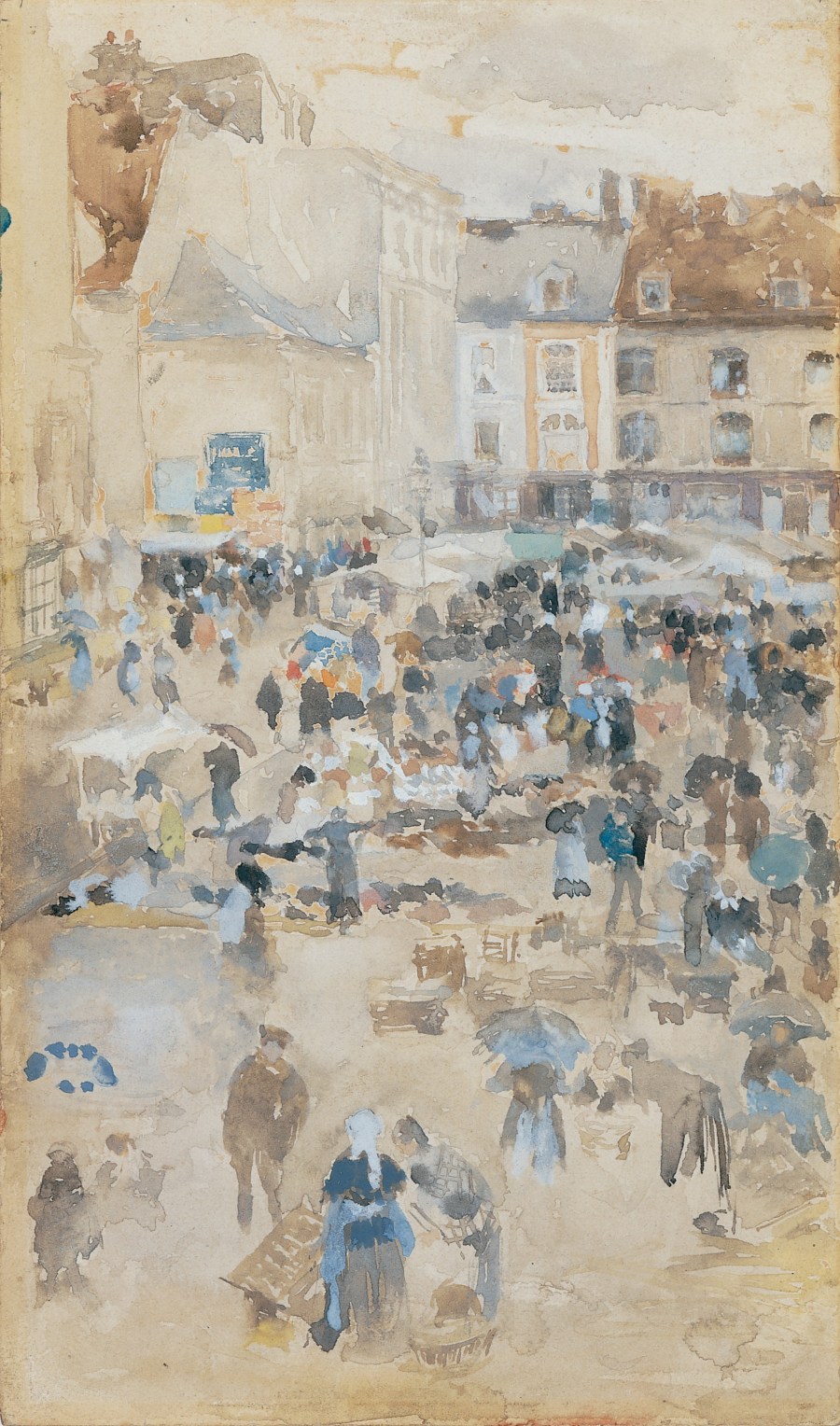
Here

By C. Wade Bentley

Featured Art: Variations in Violet and Grey—Market Place, Dieppe by James McNeill Whistler

It’s not so much a heaviness,
the oppressive weight of wet wool;
instead, it’s as though my molecules
are moving outward from the center,
mimicking the universal flight
from the Big Bang—though I hear
how grandiose that sounds.

It’s just that the edges become indistinct
and you may begin to see the busy streetlife
right through me, in patches
of color and noise and volition. And soon
I am mixing with the pollen of elms,
the billion billion motes of skin cells
catching fire in the afternoon.

So when I tell you it is almost painful
to see that precariously pregnant young woman
climb the steps to her brownstone, hear
the cans of olives and jars of ragu
clatter and shatter against the wrought iron
because some idiot failed to double-bag,
and that now here I am stooping to help,

here I am cursing bag boys the world round, insisting
that she (Antonia) sit; when I tell you I can actually feel
my joints re-knitting, cells lining up again
with their proper organelles, feel gravity
pulling on these coalescing and corporeal tissues—
you will understand, perhaps, that I am not altogether
happy to be back, but I am here.


Read More

The Animal Trade

Winner of the 2009 New Ohio Review Prize in Fiction (selected by Peter Ho Davies)

By Christine Nicolai

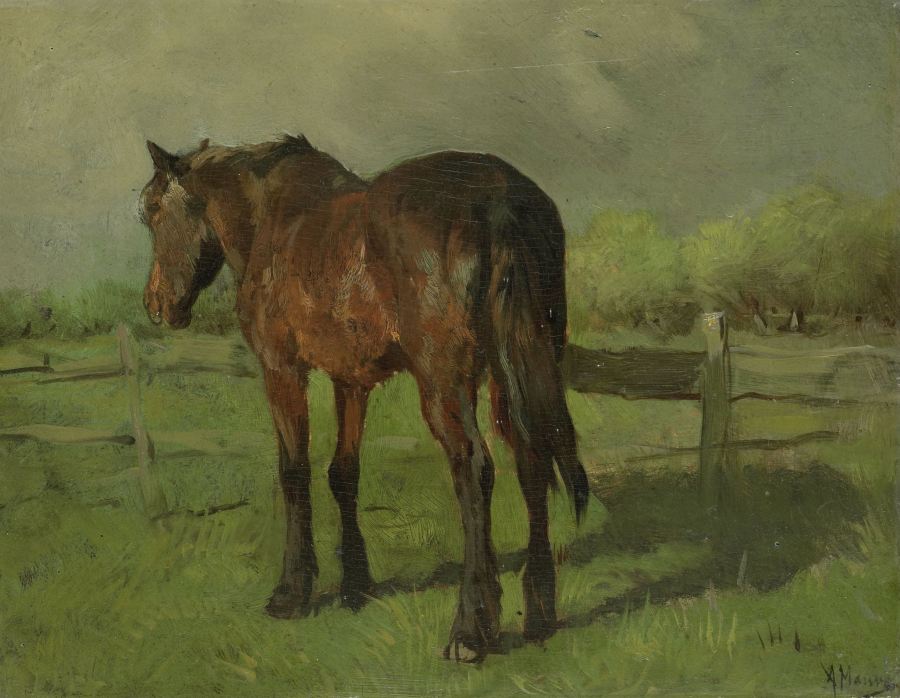
Featured Art: Paard by Anton Mauve

It was close to midnight when Vic heard a shotgun echoing somewhere nearby. If Sue were still around, he’d have put on his boots and stomped out to the porch in his bathrobe, scanning the front yard and street in the twilight. If she were here, he’d have seen that it was all clear and come back to bed where she’d have been frozen under the blankets, breathing those shallow, rabbitty breaths, like she was flattened in a clump of weeds, waiting for the fox to move on. Without Sue, Vic told himself it wasn’t a shotgun he’d heard, because shots at midnight usually meant someone was doing something they shouldn’t.

This was midsummer, humid and hot. Even though it was long after the fourth, the noise could have been an M-80 or Salute, picked up from the reservation. Every couple of weeks one of the guys at the restaurant complained about kids lobbing cherry bombs into front lawns and tearing off down the street, yelping at the stars. That was an explanation he could almost hold in his hand, except that he knew it was the sharp-edged sound of a shotgun that had crackled through the night. His jeans were on the floor. He put them on in the dark and went to check the doors, sticking his head out the back, trying to make out more than just the outline of the barn against the dark sky. The gate leading to the back pasture appeared to be shut, which meant that Toby, the gelding Sue had left behind, should be all right. He closed the door.

Read More

Reverend Tyree (excerpted from the novel Haints)

By Clint McCown

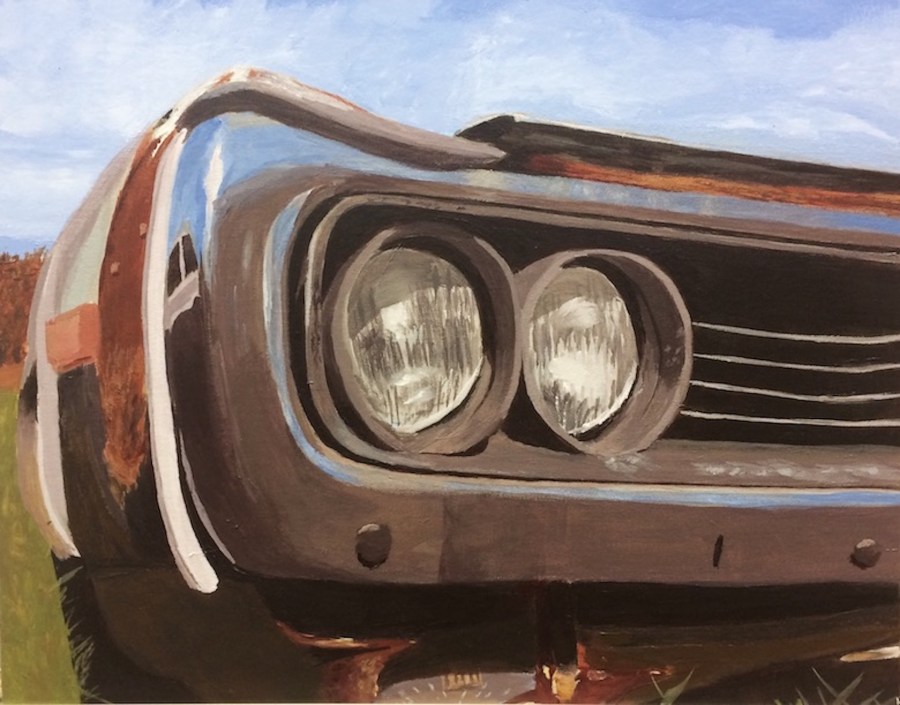
Featured Art: Rusty Car by Ellery Pollard

As Reverend Tyree settled himself onto the torn front seat of his rust-spotted DeSoto and turned the ignition, he had a brief moment of hope. The motor sputtered, coughed, and whirred without catching. He turned the key again, with the same result. The old rattletrap was trying to give him a night off, it seemed. One more failed attempt and he would be justified in staying home with Mildred and his mother and listening to the radio for a change. And why shouldn’t he stay at home? The clean-up crews hadn’t fully cleared the streets after the tornado, so driving could be dangerous, especially on the side of town where the county jail was located. The inmates wouldn’t care if he skipped a visit. But when he turned the key a third time, the engine caught, and that was it, he was trapped for yet another Saturday night.

He dreaded the jailhouse even more than the hospital. The hospital was relatively cheerful, especially in the evenings, and he had learned that if he made his rounds about an hour after dinnertime, many of the patients he was supposed to visit would have already drifted off to sleep. Then he could sit by their beds and read magazines. He would always leave evidence of his visit—a printed card with a picture of Jesus on it and a passage from St. Luke: Rejoice, because your names are written in heaven.

Read More

Good God

By Mark Jarman

Featured Art: Girl With Apple by Ellery Pollard

Instead of casting them out of paradise,
Instead of making them labor in pain and sweat,
Instead of instilling tristesse after coitus,
Instead of giving them fire to burn their house down
And light their way into the outer world,
He could have split them, each with a memory of the other,
And put them each into a separate world.


Read More

Aphorism Aporia

By A. E. Stallings

Featured Art: Study for “An Aragonese Smuggler” by William Turner Dannat

What else should I do
But cry for what is spilled?
Not for the fresh glass,
Frothy, newly filled,
Safe on the tabletop
Beside the slice of cake,
Still untouched and chilled,

But for this little lake
The cat laps on the floor,
The glass poured for your sake,
That you would have me pour,
Negative of ink
Filling in the blank
Indelible mistake—

Sweet where tears are salt,
White as oblivion
The souls must learn to drink—
To watch it now escape—
With just myself to thank,
Out of the glass’s tall
Pure transparent shape,

What cannot be put back
And what is past recall:
Secret we couldn’t keep,
Hint I had to drop,
Fall turned into fault.
It’s done, but it won’t stop.
What’s there to do but weep?


Read More

How Someone Can Not Recognize You

By Aja Gabel

Featured Art: Paris Bridge by Arthur B. Carles

Six days after my father dies, seven blind masseurs hold hands and leap from the Han River Bridge in downtown Seoul, into the shallow water beneath the lighted apex, their bodies a disruption in a mirror they’d never seen. I read about this in the newspaper I collect from the front of my father’s house, all damp and bleeding ink from the past week’s frost. In my father’s office I spread the papers out on his desk and trace my fingers down the pages, to see if I’ve missed anything. I’m looking for murders, plane crashes, natural disasters, economic collapse, impending apocalypse. I stop at the society pages, the comics, the crosswords. For several minutes I consider an eight-letter word for “felicity.” The only answer I can come up with is, “felicity.” Sometimes it happens that way.

The Korean masseurs’ story catches my eye because they have a large color picture of the bridge. It must be one of those time-lapse photos, where the car lights ghost into a gold blur and the surface of the river is steely and reflective. Four vaulted columns rise from the river and hold a statue of a torch, under which I imagine the masseurs must have jumped. How could they have jumped from anywhere else on that bridge? But then, how would they know? How would they know that that was the center? Did they feel the wind die down under the canopy? Did they hear it slice through the steel cables? Did a sighted woman lead them there and say here, here is where you would jump if you were going to jump, not that you are, and then they laughed, and took off their glasses, wiped their eyes of sleep, or of drink, said thank you, you’re kind, leave us now, we just want for a moment to enjoy the view.

Read More

Cherry Pop-Tarts®

By Heather McNaugher

Featured Art: Sweet Tooth by Dylan Petrea

I decide this will be it, my last pop-tart, cherry,
as I stand at the circ desk of the college library
and tear up your number
which I had written on a Post-it®, Hello Kitty®,
and then stuck to my ID.
The computer says I love you I owe 29 dollars
for Frank O’Hara and that thesaurus
I borrowed when I taught the class
how to find a synonym. I’m sorry. Hello Kitty’s ears
are burning—so tiny, so pink,
and so I pulverize them.
Read More

Only Hat

By Julie Hanson

Featured Art: The Purple Dress by William Glackens

My sadness has the texture of a dime store balloon;
when I slide my hand across it, I get no pleasure from it.

My sadness has no merit whatsoever.

My sadness is a pose I cannot hold a moment longer, but I must
because I am in yoga class where this pose in particular would be
impossible to do had I understood it in advance,
yet when fed instructions bit by bit while bending back . . .
I can believe I just might get the hands.

My sadness stems from a bottomless blame. It knows
that it doesn’t matter, does it, if the reason is legitimate.

My sadness is lonelier the longer I sit with it.

My sadness comes back to me; it is all my own.

My sadness has three corners, three corners has my hat.
I have chosen this, my sadness, over all available hats.
Firemen hats and nurses’ hats, telephone line
repairmen hats. Military, ski, and Napoleon’s only hat.


Read More

Sex

By Michael Madonick

Featured Art: Nude Lying On Bed by Anders Zorn

nobody is asking but I’m ready to say there are things we should not speak of the private convoluting movements of embrace that is why there is night for the unspoken the unspeakable the sand lily’s up-turn of its cup in darkness moisture makes much of itself enough said enough unsaid but there cannot be an end to it the need to lose the self find the self escape to matters consequential involving arms legs the mouth attaching in certain and uncertain ways fingertips toes the octopus’ obsession with its den the Egyptian threaded membrane behind the knee a gasp that pleads for god though nobody really wants a god to show recline on the chaise-lounge score such a thing though god knows we do the best we can ducks are different nearly drowning in it the neck bite back-driven furious flurry of it a kind of underwater consecration of a devious sects’ commingling no one should watch such a thing be vigilant in fact to not observe that should be a given that we should close our eyes to it be under the covers lights off candles blown only during an eclipse be the prisoner moving to a courthouse our cuffs shielded by the daily news hide in a raincoat from the paparazzi the fabric of our lust the uncontainable stupor that brings us to our innocence our knees our inexhaustible innocence unknowing in its rhythms over and over again and again


Read More

The Vacuum

By Julie Hanson

Featured Art: Woman Bathing by Mary Cassatt

Don’t ask what it was all about.
Ask instead how sudden it was, how complete.
One minute I was an ordinary woman
vacuuming, a thing it seemed I had too recently done,
and the next minute sobbing,
emitting sounds loud, rapid, and long.
It was the kind of sobbing that makes you feel five—
five years old, or housing a feeling five people wide.
I was seated, my left elbow on my left knee,
my glasses hanging from my left hand
as if they were the problem,
(no use in wearing them, no use in putting them down)
and the vacuum, part pet, part sculpture,
sprawled awkwardly, still shrieking
on the floor in front of me.
The sorrow seemed pulled from outside, unselectively,
as if I had swallowed a magnet.
Each time I felt that I could silence this,
that something had been spent, something settled,
I opened my eyes to that canister,
attachments on its back, hose, and extension,
reality-piece which had withstood the worst of me,
had witnessed, and was unaffected.


Read More

The Mixer

By Leslie Daniels

Featured Art: Cock and Hen by Kawabata Gyokushō

When I was a child of two and my mother was mixing my birthday cake, she let me pull my pants down and sit in a plate of cake flour. I remember the paper plate on the floor, and her pretty ankles going between countertop and stove. She was a child psychologist and she understood that you need to feel things to know them. The bottom test was my own invention. I remember the exquisite sensation, and the hum of the mixer.

Many years later I was the mother making the birthday cake, the oven preheating, mixing with an electric mixer. It was the morning of the party and I was making All-Occasion Downy Yellow Butter Cake from The Cake Bible. It’s the only cookbook I own for which I have too much respect to mess around with the recipes. I don’t care much about cakes, though they are a good meeting place of butter and sugar, but to other people in my life—my daughter who was turning three—cake is important.

Read More

Bad

By Steven Cramer

Featured Art: Bolete & Bird by Dylan Petrea

It got bad; pretty bad; then not
so bad; very bad; then back to bad.
Jesus, let’s let things not get even worse.

A weird fall. Nearly ninety
one day, leaf mold making our house
all red eyes and throats. Don’t think

about Thanksgiving, but hope
for a decent Halloween. Everywhere
gas-powered leaf-blowers growling—

Christ, let’s let things not get even worse.


Read More

November

By Richard Cecil

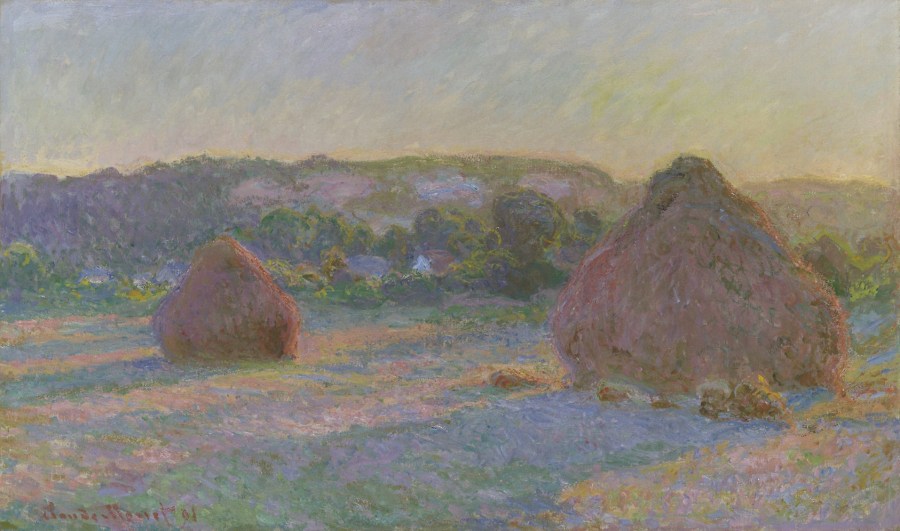
Featured Art: Stacks of Wheat (End of Summer) by Claude Monet

November is the time between conviction
and sentencing, when you’re still out on bail.
You’re sort of free, pending the rejection
of your appeal, but you are bound for jail.
There’s no point pleading that your weren’t guilty
of stealing pleasure from warm summer air—
you were caught, grinning, on camera. The penalty
is ninety days in winter’s prison. Unfair!
I only did what everybody does
when tempted irresistibly to strip
wool socks and parkas off and take a dip
in summer heat. You can’t tell bees, “don’t buzz.”
November shrugs in answer to your pleas:
Ninety days for you. Death for the bees.


Read More

Climber

By Richard Cecil

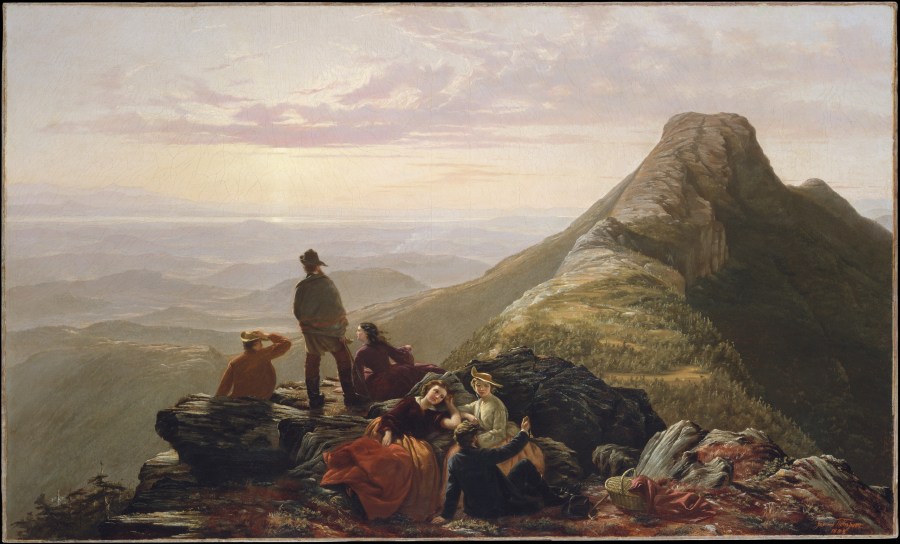
Featured Art: The Belated Party on Mansfield Mountain by Jerome B. Thompson

I set out from Poor Valley to climb Mt. Rich.
Light’s failing now. I’ll have to stop to rest
somewhere below the summit. But my palms itch
to clutch at higher handholds, though, at best,
I’d claw up to an outcrop of a cave
to hole up in. I’ll never reach the peak.
Why not just plant my flag here, grin and wave
at my camera set on auto-shoot? Why seek
a slightly higher level of success?
I’ll never, never make it to the top.
I’m told the middle of the mountain’s best.
The slope grows steeper past halfway; the drop
precipitous. But oh, to be one of the few!
Although they die and lose their money, too.


Read More

Yet

By Eric Torgersen

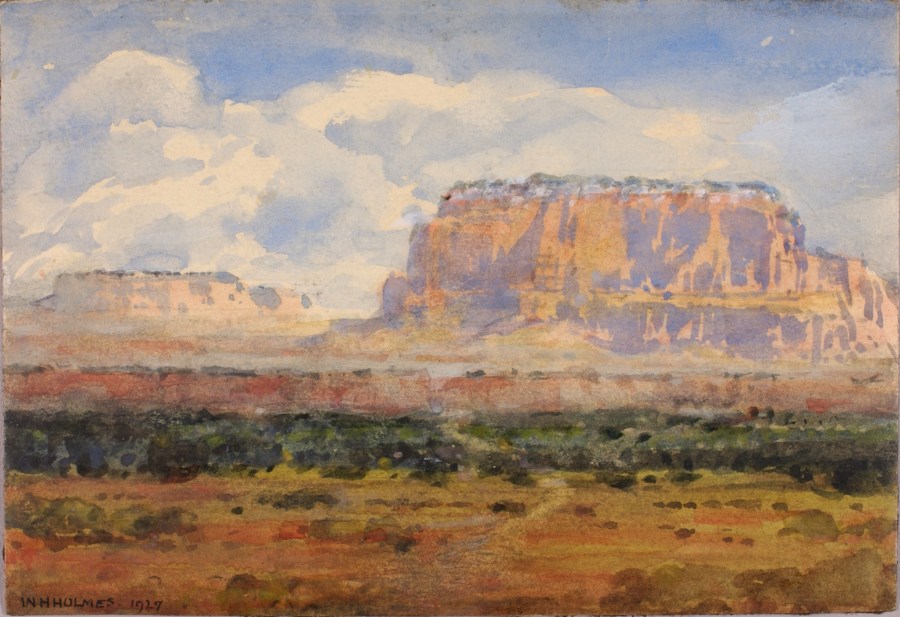
Featured Art: The Enchanted Mesa by William Henry Holmes

a voice I haven’t sung from yet
—Bruce Springsteen

Hang him from a tree he hasn’t hung from yet.
Fling him off a bridge no one’s been flung from yet.

Send succor, in whatever dark disguise:
a hornet’s nest he’s not gone running, stung, from yet.

He’d have it be a tower, not a steeple—
the height in him no bell has rung from yet.

Early fall, and not one branch the wind
has not stripped every leaf that clung from yet.

Recess. Winter. Second or third grade.
A frozen pipe he hasn’t freed his tongue from yet.

The drought seems endless. Spring. No drop of rain.
Just parched soil no shoot has sprung from yet.

Find it in some corner of the workshop,
some damp rag no last drop has been wrung from yet?

Probe the dank recesses of the cellar—
not one cask he hasn’t yanked the bung from yet.

Not by wit or rhetoric alone
will Eric find a voice he hasn’t sung from yet.


Read More

Scenario

By Eric Torgersen

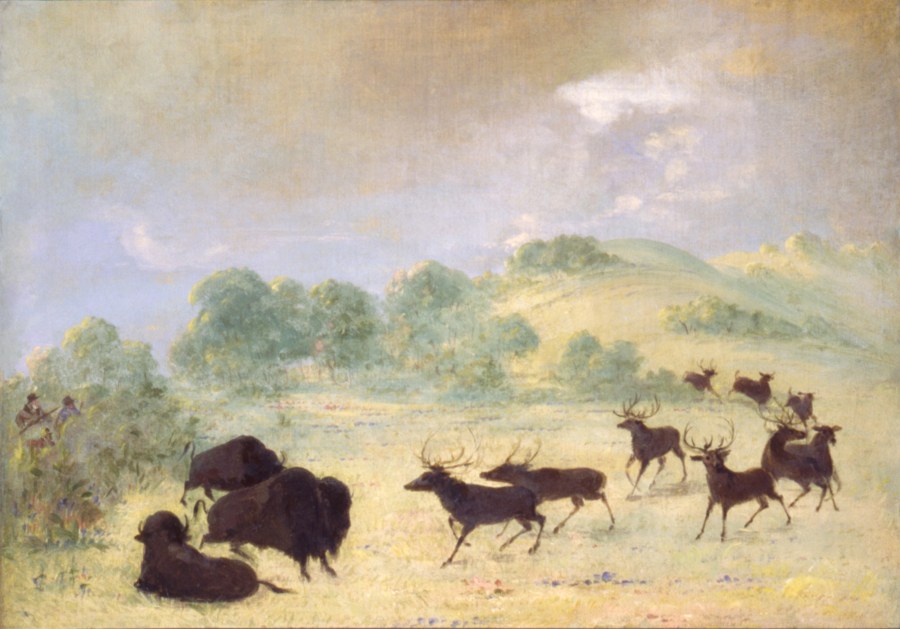
Featured Art: Elk and Buffalo Making Acquaintance, Texas by George Catlin

Had enough of the old lonesome-and-blue scenario?
Up for a shot at the old I-love-you scenario?

Man enough to leave your comfort zone
in the good old get-drunk-and-screw scenario?

Let’s be real. Love hurts. Even you, you stud, you.
Sure you can handle the old boo-hoo scenario?

Don’t even try to guess what she really wants;
be ready for the old you-don’t-have-a-clue scenario.

Tell her, “I’ll always honor your personhood.”
What’s more of a drag than the old I’m-a-person-too scenario?

It’s never not a good time to say, “My bad.”
Don’t lean too hard on the old I-never-knew scenario.

Read More

Pharaoh

By David Wojahn

Featured Art: The Great Pyramid, Giza by Adrien Dauzats

We had eaten the placenta in a soup that someone based on a family recipe 
      for menudo, though someone else—
it was Bill, I think—joked that it tasted just like chicken. This Year’s Model 
      was brand new & the needle stuck
on “Lipstick Vogue,” Costello snarling not just another mouth, not just 
      another mouth, until Joe

set down the bong & flicked the tone arm forward from the scratch. 
      & anyway, by this time
Amy was shouting from the bedroom that she’d finally gotten Star to sleep, 
      that the music should be
Mozart or something. I’ve forgotten the midwife’s name, but she sat 
      sprawled on a patio lawn chair,

the distant blink of Tucson down the mountainside. She held an iced Corona 
      & told us she was too worn out
to drive the snaking foothill two-lanes home. Good dope, cheap champagne, 
      a soup of afterbirth:
everybody but the midwife garrulous & now Pappagino was flapping 
      birdman wings in his mating dance

around fair Pappagina. So the talk turned to duets—scholastic in the way 
      that stoner conversations go.
Whose placenta was it we slurped down with cilantro & a dash of cumin, 
      telling ourselves the taste
was not half bad—Amy’s or Star’s? & what about Derek, who now 
      had moved to Mykonos,

leaving his storied seed behind: what portion of the recipe was owed 
      to him? Now came the tricky part—
where did the soul inhere? The midwife rimmed her longneck with
      a lemon slice & allowed
that we’d ingested perfection, the body’s all-in-one: liver, kidney,
      blood supply,

Read More

Foreign Excellent

By Michelle Herman

Featured Art: The Last Dance by Mackenzie Siler

It wasn’t that I didn’t like her. I liked her fine—that’s what I would have said if anyone had asked me. But I knew better than to get too attached to the women who dated my next-door neighbor, John. Women cycled through his life pretty quickly, and so far all the ones I’d met had been crazy, anyway—too crazy for me, if not for him. John pursued crazy; he thought crazy was charming. And while she didn’t necessarily seem crazy, I’d learned that you couldn’t always tell at first (that actually you could hardly ever tell at first).

Did she like me? It was impossible to judge. She was friendly enough, always polite if not warm. Certainly she was more guarded than I (but then just about everyone I have ever met is more guarded than I). I could not have read her even if I’d tried. But I didn’t try, because we weren’t friends.

And then she cracked her skull—she almost died—and suddenly we were.

Read More

Why Men Don’t Write About Their Wives

By Dennis Sampson

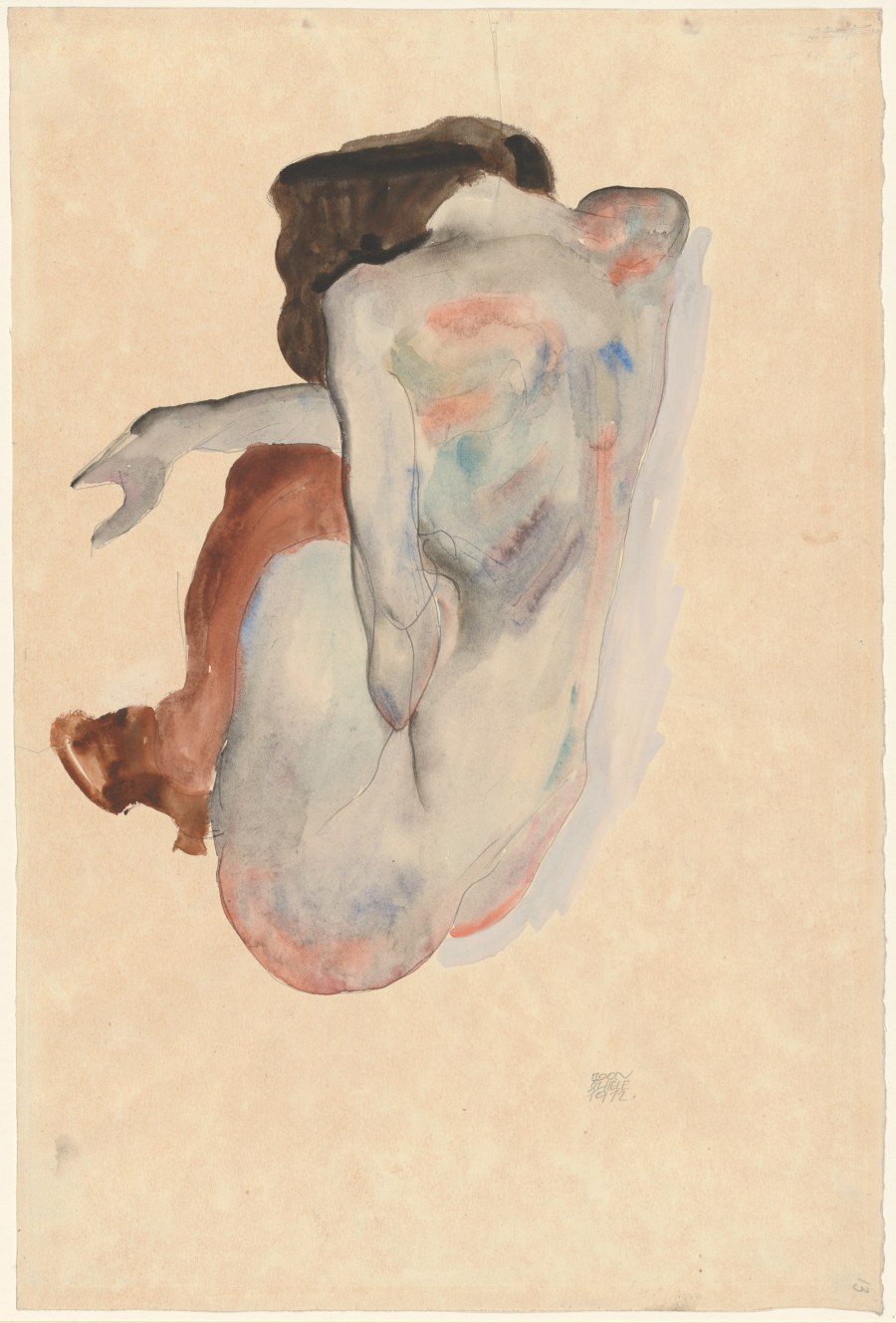
Featured Art: Crouching Nude in Shoes and Black Stockings, Back View by Egon Schiele

It took him a lifetime to figure out
he hadn’t the slightest idea
who she was. Rereading
Milton’s Paradise Lost one night,
he elected to set things right. He would recall

what had never dawned on him
in an epithalamion of all their vows,
her face as gray and drawn and haunted now
as that which miraculously appeared
to Milton in his sonnet “Methought I Saw.”
He’d been blind

and completely missed what she’d put up with for so long,
his cigar smoke stinking up the whole house
composing his small diatribes,
his holding court on everything
from Boccaccio to the state of the art.

Hadn’t she once confessed to him
when they were courting,
cuddled in his loft with the fire down to a hush,
she had waited all of her life
to be touched like this? What was that called?

Three days he labored over his encomium
—a litany of his own faux pas
until he had to admit he could not get it right,
this catalogue which kept coming up
against forgetting absolutely everything from the start.


Read More

My Daughter’s Narcolepsy

By Keith Taylor

Featured Art: The Public Viewing David’s “Coronation” at the Louvre by Louis Léopold Boilly

Before we received the official
diagnosis, we loved to recount
her sleep episodes. My favorite:
the Louvre, in front of those gigantic
paintings David made celebrating
the coronation of Josephine
and Napoleon before the French
nobles. My daughter drooled on the bench.


Read More

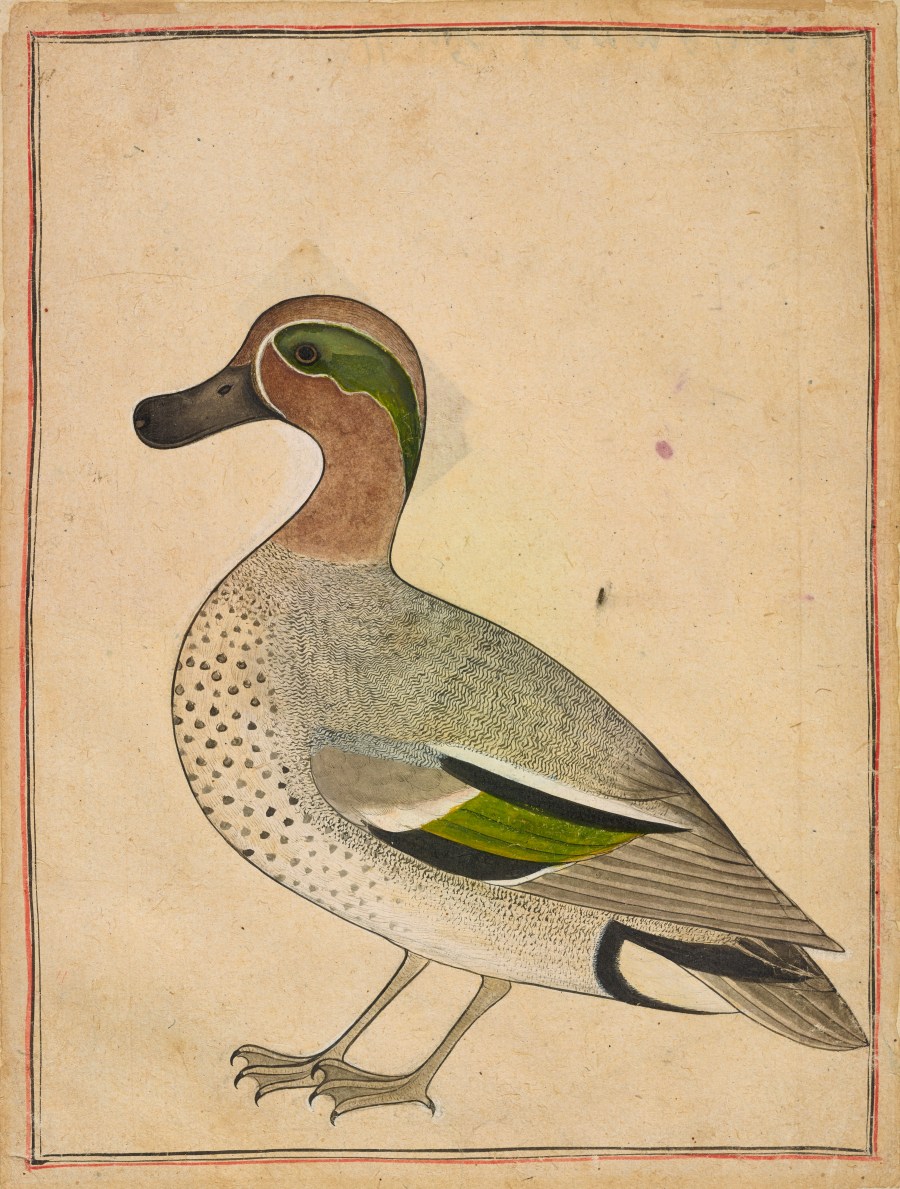
Anthropomorphic Duck

By Robert Wrigley

Featured Art: A Green-winged Teal by Jagdish Mittal

Every morning, the solitary blue-winged teal drake
swam the east-to-west length of the high mountain lake
in silence. Every evening he’d fly back
uttering on his way a single sad quack.
What we wondered, my sons and I, was why.

Why here, an otherwise duckless nowhere? The sky
was wide and blue above him; surely the flyways beckoned.
Though we also knew we had no way of reckoning
what kind of inner life he might have possessed,
if inner life is what instinct is, or if he was lost,

or if—and this, we understood, was as much about ourselves—
there was something he himself had lost. Was our blue wing
blue because, like certain geese, his kind mates for life?
This was how we came to refer to her as his wife,
as Mrs. Teal, the missing one, for whom he mourned,

whose absence had led him, with the terrible wound
of his grief, to come to this place of refuge and learn
—well, what? To be a duck again, since our theory’d turned
him into something else? The last morning, my sons climbed
a nearby peak on their own, and I passed the time

alone and was, after an hour that way, so lonely
I could find no escape. I wanted nothing, except to have them
back with me, and then I saw Mr. Teal on his morning swim.
He was stopped not far from camp. I could tell who it was
though he was ass-up among some reeds

in the shallows. I watched him feed
for a long time, just the two of us, until I was hungry
and ceased for a little while to worry.
And later, when the boys came back, he took again to the sky,
uttering as he did his single inconsolable cry.


Read More

Horse, Alone, November

By Joyce Peseroff

Featured Art: Prancing Horse by Jean Louis André Théodore Géricault

She’s teaching him
no harm will slither up his legs
like chilly steam above a pond at night,
or plummet from almost leafless trees
when she saddles his pasture-mate
and they swish between the pointed firs
into spectral woods. Left behind,
alone, he paces the golden perimeter
of fence post and electric wire,
a fragment of eternity falling
red on his rolling shoulder
when he jars the ground beneath
the gnomon in a field
a single maple makes.


Read More

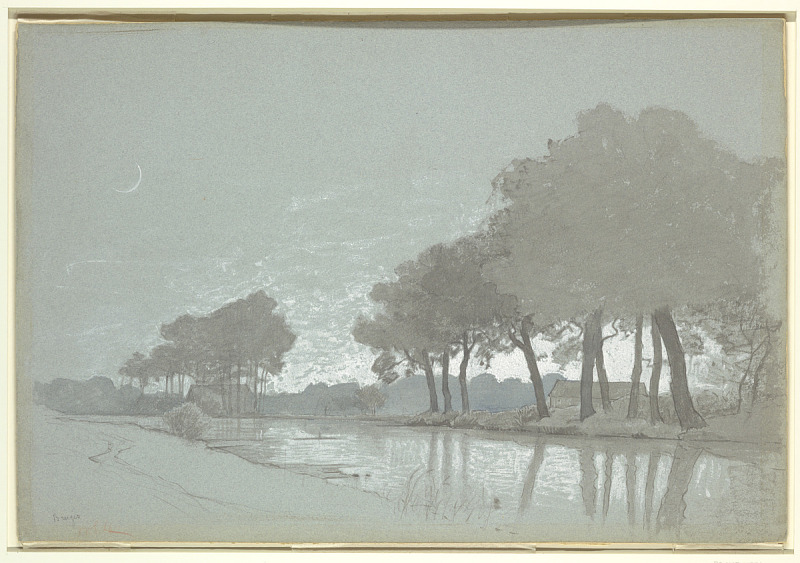
The Gray Museum

By Sydney Lea

Featured Art: Canal Scene Near Bruges, Belgium by William Stanley Haseltine

Flat on their tapestry, hawks and hounds
and a corps of horsemen showed that much flatter
for the sleeted windows. All of Manhattan
seemed a great gray museum.
Our words went blurry. It was never romance.
Or do you insist?
I thought how mountains sag into deltas

with time. From a sill outside drab pigeons
flushed into haze—and were erased.
The horsemen’s woven reins went slack.
In a hotel bed
later that night, even sleep turned gray:
in my dream, a train
huffed till the station misted like glass;

in yours, you reported, fogged coastal Maine.
To me your report proved unintriguing,
I knew you’d never seen that shore.
Our breakfast eggs
looked hueless, yolkless. Attempted speech
bleared in our mouths
and the morning newspaper faded, smearing

the sodden pulp it faded into.
I haven’t thought in years of that day,
so little to draw me back to then.
You wouldn’t know me,
grown vivid, colorful! And you?
You’ve leached away.
So what, you might ask, is bringing this on?

But how could you ask? What would I say?


Read More

Feature: Stories You May Have Missed

We asked 15 writers to reflect on under-appreciated contemporary short stories. Their responses follow.

Lydia Davis
Stuart Dybek
Carol Anshaw
Max Apple
Alan Cheuse
Erin McGraw
Robert Cohen
Nicholas Delbanco
Lynne Sharon Schwartz
Tracy Daugherty
Steven Schwartz
Andrea Barrett
Francine Prose
Jim Shepard
Rosellen Brown

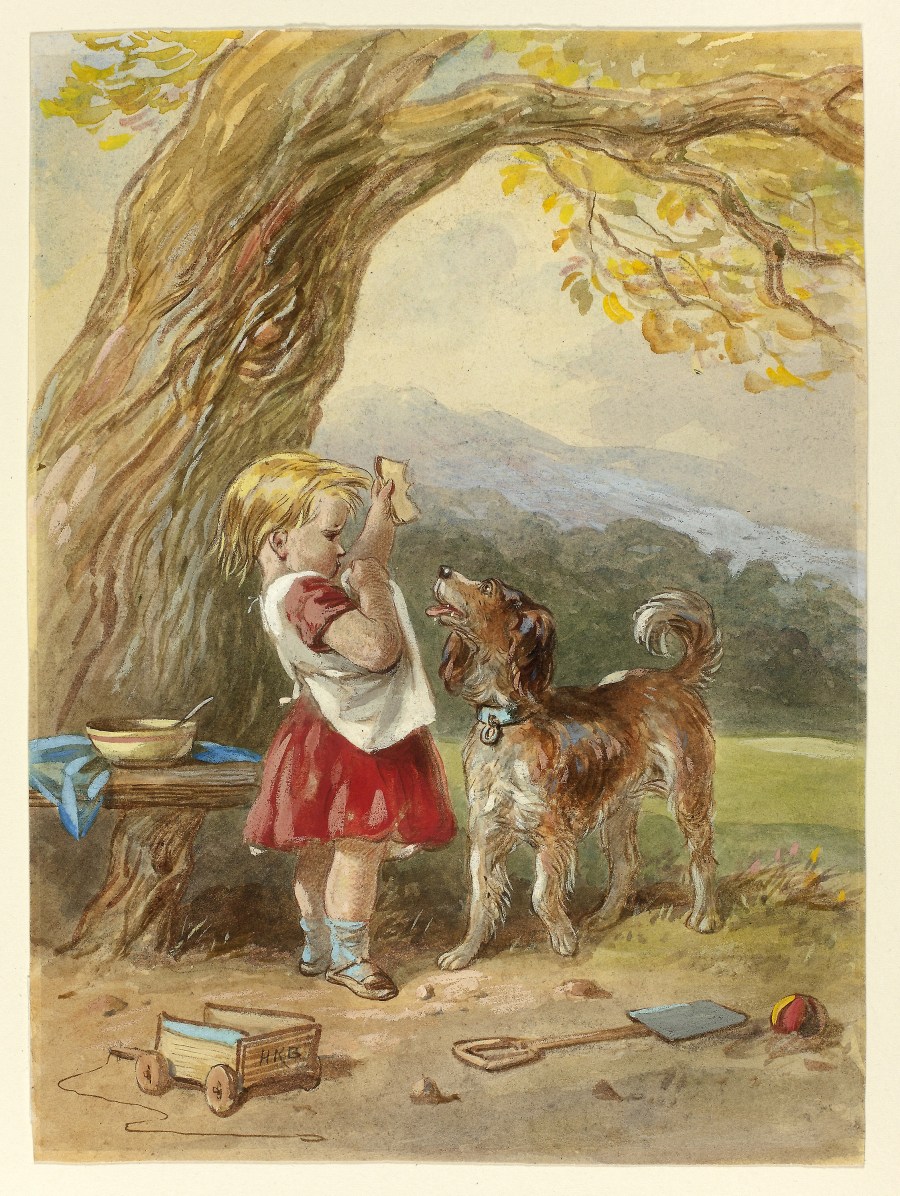
“Dog Heaven” by Stephanie Vaughn

By Carol Anshaw

Featured Art: Little Girl and Dog by Hablot Knight Browne

I could have chosen this story for its first line alone:

“Every so often that dead dog dreams me up again.”

But much more awaits the reader in this tightly controlled yet seemingly casual narrative. Gemma, the story’s protagonist, goes on to say, “It’s twenty-five years later, I’m walking along 42nd Street in Manhattan, the sounds of the city crashing beside me—horns, gearshifts, insults—somebody’s chewing gum holding my foot to the pavement, when that dog wakes from his long sleep and imagines me.

“I’m sweet again. I’m sweet-breathed and flat-limbed. Our family is stationed at Fort Niagara, and the dog swims his red heavy fur into the black Niagara River.” [all Sweet Talk, 176]

Read More

“The Moon In Its Flight“ by Gilbert Sorrentino

By Robert Cohen

Featured Art: Monk Meditating near a Ruin by Moonlight by Frederik Marinus Kruseman

I first came upon “The Moon In Its Flight” as a graduate student in my mid- twenties, in a book called Many Windows, a now long out of print anthology put together by Ted Solotaroff from his seminal literary magazine of the seventies, New American Review. It’s fair to say it blew my mind. This was not entirely unusual. I had my mind blown pretty regularly at that time: the rest of me wasn’t getting much, and I was nothing if not impressionable. But twenty-odd years later, having reread the story for teaching and other purposes, oh, about a hundred times now, it still blows my mind—if anything more so than before. What this says about me I’m not sure I even want to think about. But what it says about “The Moon In Its Flight” I do want to think about, if not emulate, if not imitate, if not crassly and slavishly steal.

Read More

“The Ebony Tower“ by John Fowles

By Nicholas Delbanco

Featured Art: Sunset Over Tower and River by Arnold William Brunner

Post-mortems in prose fiction are risky to pronounce; the dead do have a way of quickening again. This week’s much-celebrated text will be, in thirty years, forgotten; what’s lost may reappear. And in this particular instance I’m not rescuing arcana; Sir Laurence Olivier played the protagonist of John Fowles’s “The Ebony Tower” for a television film. Too, the short story collection of which this is the title piece lodged comfortably on the New York Times Best Seller List for six full months in 1974-75.

It’s possible, however, that Fowles’s reputation as a “serious” author has been undermined by commercial success; in England particularly, it would seem—though I have only anecdotal evidence for this—he was thought of as a popular and therefore unimportant writer. “If you’re so smart, why ain’t you rich?” gets transformed, in critical discourse, to, “If you’re so wealthy, how could you be smart?” and Fowles has been devalued in part because of fame.

Read More
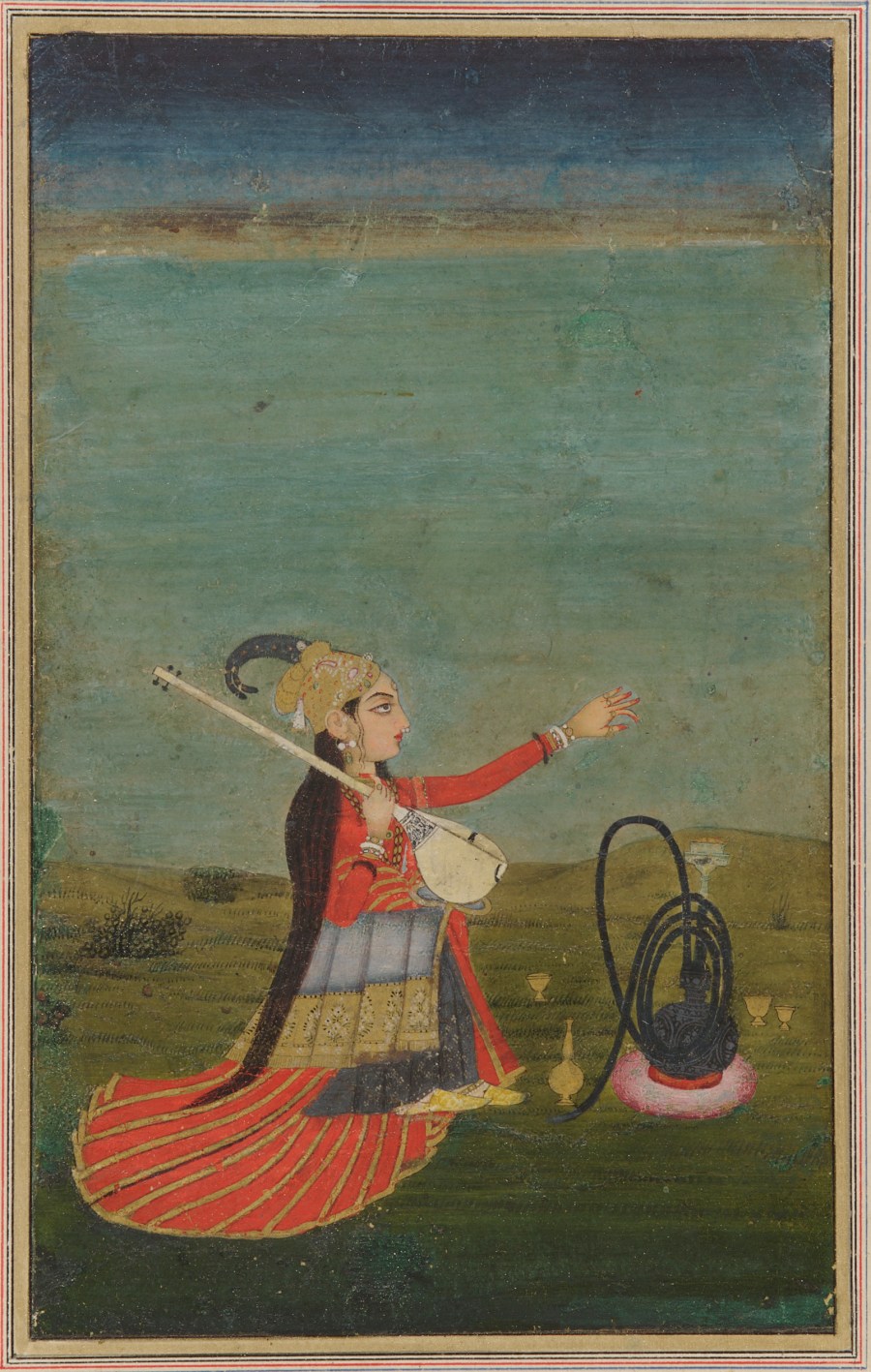
“The Accompanist” by Anita Desai

By Lynne Sharon Schwartz

Featured Art: Female performer with tanpura by Unknown

For a short story to linger in the mind as long and as tenaciously as “The Accompanist” has in mine, it must hit a sensitive nerve. So in revisiting the story, which I first came upon years ago in Anita Desai’s early collection, Games at Twilight, I looked for what had struck me so keenly in this first-person account of an Indian musician from a poor background who dedicates his life to the most humble of accompanying instruments, the tanpura.

The narrator’s father makes musical instruments and music is “the chief household deity.” Soon after Bhaiyya’s lessons begin at the age of four, his talent is obvious: “My father could see it clearly—I was a musician . . ., a performer of music, that is what he saw. He taught me all the ragas, the raginis, and tested my knowledge with rapid, persistent questioning in his unmusical, grating voice.” The father is stern and rough, never offering praise or encouragement, only calling his son a “stupid, backward boy.”

Read More

“Enough” by Alice McDermott

By Tracy Daugherty

Featured Art: Wild Femininity Series: Giraffe by Mackenzie Siler

It is always fascinating when a novelist tries her hand at short fiction. If the endeavor succeeds, it is because the novelist’s expansiveness finds expression in its opposite: intense compression. On April 10, 2000, Alice McDermott, best known for such novels as The Bigamist’s Daughter, That Night, At Weddings and Wakes, and Charming Billy, published a short story called “Enough” in the New Yorker. In nineteen carefully-orchestrated paragraphs, the story traces the life of a middle-class American woman, from childhood to old age, using such rich domestic imagery, the reader feels as if an entire era has been fitted into a neat container, like a child’s shoebox full of keepsakes.

Every Sunday after dinner, a Catholic girl, the youngest child in a family of six, is tasked by her mother with cleaning the ice cream bowls, a “good set” of bowls, “cabbage roses with gold trim.” Her mother has taught her that a lady, when eating ice cream, always “takes a small spoonful, swallows it, and then takes another.” Her own habit, to “load the spoon up,” run it in and out of her mouth, and study the shape “her lips have made” with the stuff that remains on the spoon, is strongly discouraged. “A lady doesn’t want to show her tongue at the dinner table,” her mother tells her.

Read More

“In Miami, Last Winter” by James Kaplan

By Steven Schwartz

Featured Art: Untitled (Seascape with Houses on Beach) by Unknown

I was worried. Thirty years had passed since I looked at the story. Every writer has a list of stories he carries around in his head, if only he were to put together that anthology of personally selected hits. To go back and pick one . . . well, a lot rested on it.

“In Miami, Last Winter,” by James Kaplan, was first published in Esquire in 1977. I came across it then—at twenty-six years old—and then again the following year when it was anthologized in Best American Short Stories 1978. The second—and last time—I read it I admired it even more, a sure test of a story’s staying power. You know the plot, you know the characters’ dilemmas, you know the story’s stakes, yet you’re still dazzled by its force to catch you up in its immediacy. Indeed every story works toward establishing a renewable present: the ability to make the reader experience its effects anew. In short, you fall helplessly under its spell once more.

Read More
“The Remission” by Mavis Gallant

By Andrea Barrett

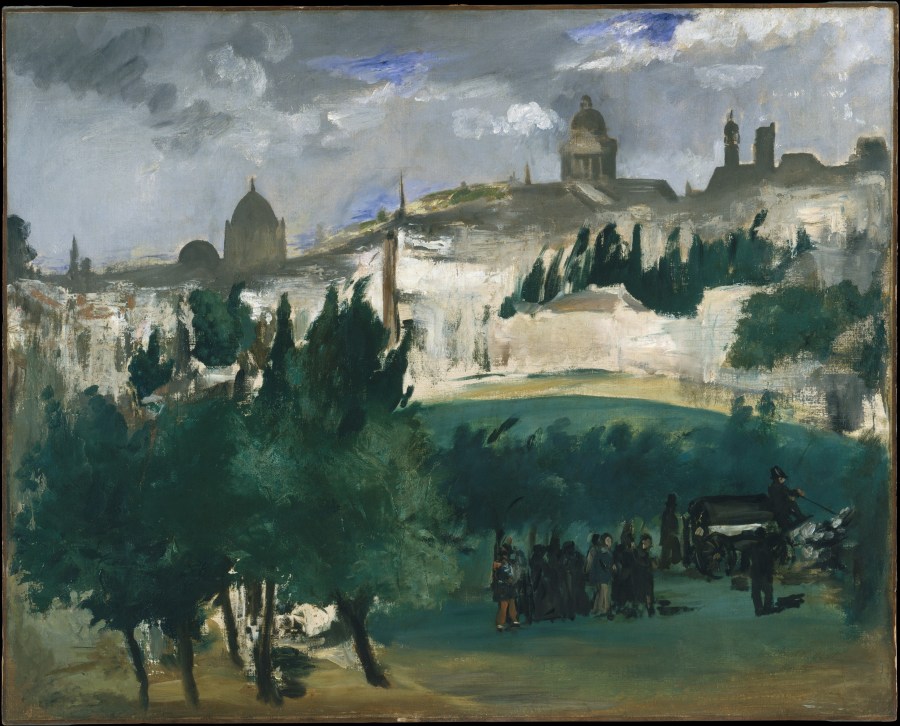
Featured Art: The Funeral by Edouard Manet

One of my favorite stories is Mavis’ Gallant’s “The Remission,” which is set in the early 1950s but was written in the late 1970s. Superficially straightforward, it reveals its virtuosity slowly and deviously, stating its premise outright in the first line:

When it became clear that Alec Webb was far more ill than anyone had cared to tell him, he tore up his English life and came down to die on the Riviera.

Read More
“Mlle Dias de Corta” by Mavis Gallant

By Francine Prose

Featured Art: Vegetarian Appetizer by Ellery Pollard

To my mind, Mavis Gallant’s “Mlle Dias de Corta” is the most brilliant example of a story that focuses on a protagonist who might seem initially “unsympathetic” or at least problematic—in this case, an elderly French woman, the story’s narrator—and performs the magic trick of making the reader’s heart just break and break for her. It’s written in the second person, the potentially trashiest point of view, yet manages to persuade us that no other choice of perspective would have been appropriate or even possible. It’s framed as an unsent—and unsendable—letter from the unnamed narrator to the eponymous former boarder in the narrator’s Paris apartment and (incidentally, though of course not incidentally at all) the former lover of the narrator’s son. It’s a family drama, of course, but also a thrilling examination of xenophobia and nationalism; our narrator is always accusing Mlle Dias de Corta of pretending to be French—that is, of claiming to belong to that most favored and elite breed of human, at the very apex of culture and civilization—and not really being French, but rather Portuguese or something equally inferior and suspect. By the end of the story, we understand the insecurity and terror, the loneliness and disappointment, all the painful emotions that translate into suspicion of, and prejudice against, the other, the outsider—indeed, into fear of change of any sort. It moves effortlessly across decades and through time, and addresses large societal and political issues (from abortion to racism) without ever venturing very far from the narrator’s claustrophobia-inducing flat. Its rhetoric is vertiginously passive-aggressive (though it does make you wonder what exactly is the passive part of that equation) and consequently hilarious. There’s a family dinner in front of the TV (French TV at its most pompous and absurd) that makes one’s blood run cold. Finally, it rewards close reading and rereading, since there’s so much subtext that can be missed—the narrator’s anxiety about her son and his sexuality, to take just one example—unless you pay the story the patient, exacting attention that it earns and deserves. It’s one of my very favorite stories to teach; you can watch the light blink on and come up in your students’ eyes.

Read More