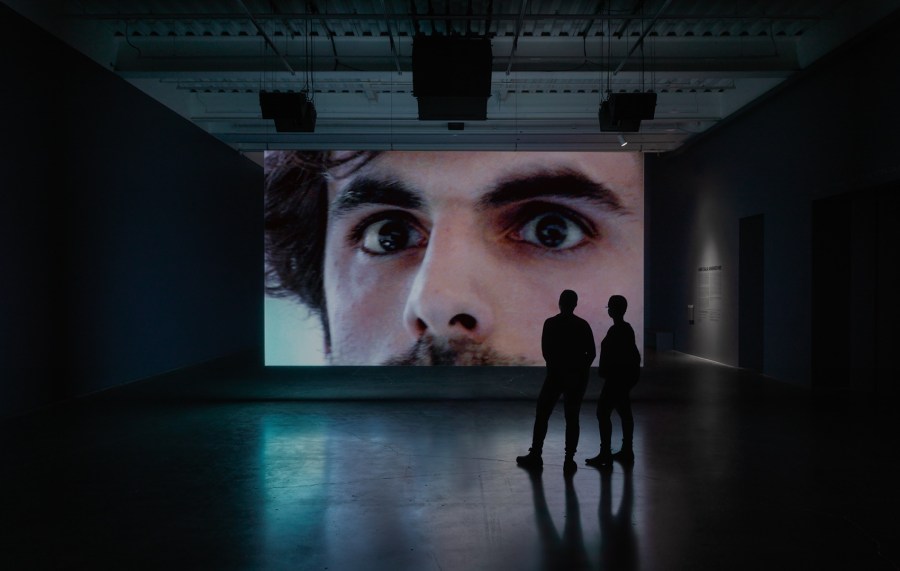
Let Me Bore You With My PowerPoint
By Lee Upton
Featured Art: Answer Me by Anri Sala
—after Peter Porter’s “Let Me Bore You With My Slides”
I’ll say it and I’ll say it and I’ll say it again
and here it’s said for us, illuminated. Do you like my wave effects?
The technology will be bypassed any day now. I know. So?
How did that get in? That’s my kid.
Ha ha. That’s a goat Brenda and I saw blocking the road in Brixton.
Look at the head on that.
Oh—Brenda. Sorry. There goes my job. Just kidding.
That’s not really Brenda. That’s her best friend. No, just kidding.
We were on a wildflower walk, you know? Walking by a stream and
they had these
statues that look amazingly real? I don’t know how they do it.
Carve mushrooms or something and magnify them into these enormous—
we’re moving on. Oh, here we go, our Venn diagram—
why is Brenda wearing antlers?
Okay. On track.
You know, I say something and then what I say is right up here.
I might as well just give away handouts and leave the class.
Tempting. I mean I could go home right about now.
Right when it’s least expected.
Except I’m a professional. I meant to crop that.
That shouldn’t be embedded.
Nice 3-D effects, if I do say so myself.
Read More
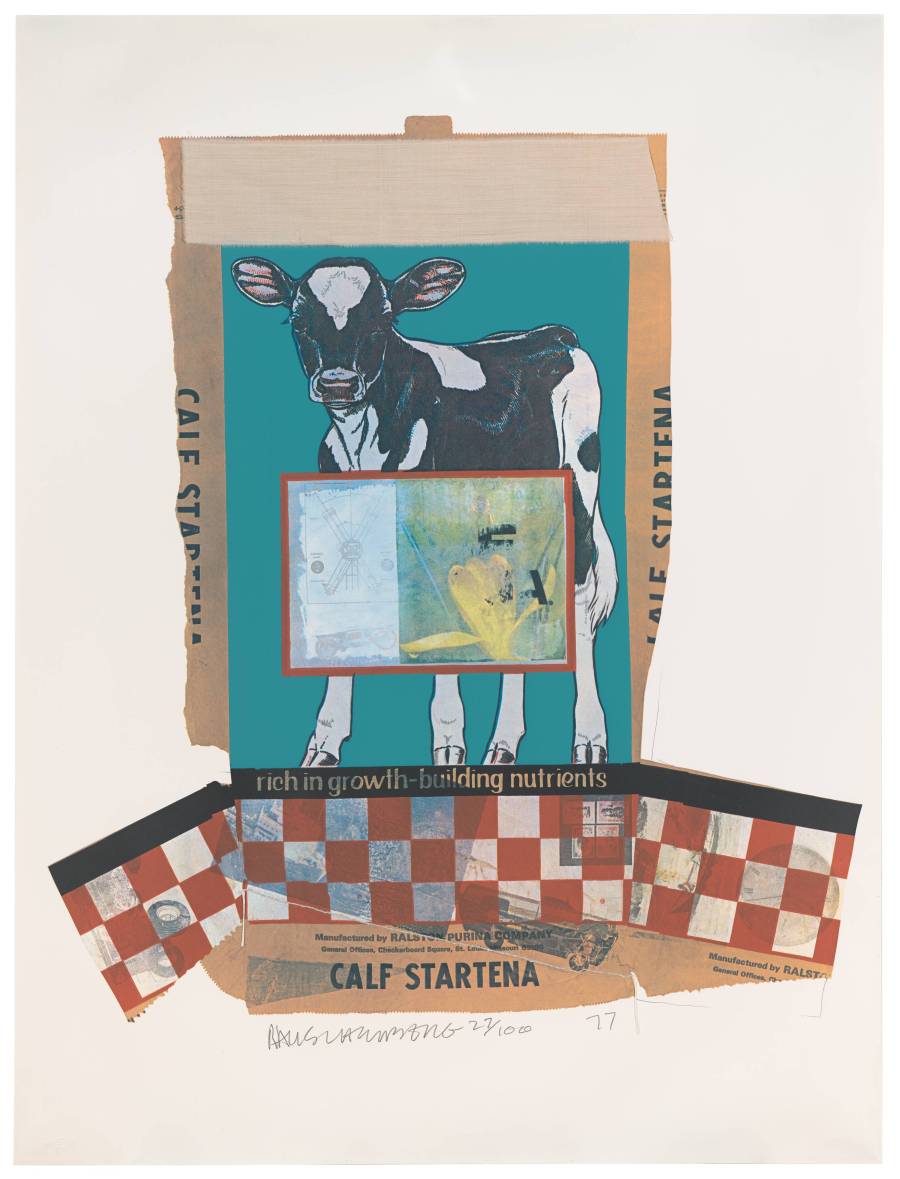
Animal Science
By Michael Davis
Featured Art: Calf Startena by Robert Rauschenberg
It was hot. That was foremost in my thoughts. A sheer, raw, violating hotness that wobbled on the cement quad and in the still dry air above it. I focused on getting across without fainting. I fixed it in my mind. I didn’t have to ask why there weren’t any birds in the Flushing sky. I knew they all had heatstroke, carpets of passed-out sparrows under the campus trees. Even the shade pulsed with heat. I’d accepted the hottest day in Michigan history the way one accepts an incurable disease or a prison term or a bad marriage. I stopped fighting. I let it own me.
As I reached the rusted double doors of Animal Science, the world seemed to tilt. Darkness rushed into the edges of my vision, and the numbness of heat prostration began to twist through my skin. Panting, I sat down on one of the benches in the building atrium, wondering if my three-mile hike from the adjunct lot was destined to put me in the hospital. The central A/C was broken, but there were box fans every thirty yards, and I felt truly grateful to the Animal Science secretaries for providing the hot air current. Hot air that moved felt better than hot air that didn’t.
Read More
From The Secret Correspondence: A Novel of Novels
By Tom Whalen
Featured Art: Nan and Brian in bed, New York City by Nan Goldin
The Solution
For the life of me, I can’t understand why The Solution has been marketed as a crime novel rather than simply one of a failed marriage; not a single head is severed from its body, not one of the novel’s protagonists dies. He loved her, it seems, and she loved him and then didn’t, while his love lingered like a bad dream. She worked in the business sector of a nameless city in southern Germany, he spent his days writing a treatise on Hegel’s early years and thought. When they met by chance in Vienna seventeen years earlier coming out of a revival of In the Realm of the Senses, she was studying Wittgenstein in Munich, he finishing an MBA in Bern. As he remade his life to accommodate hers, she remade hers to accommodate his. But where is the crime in that? I find here no commission of an act forbidden by public law. Neither she nor he stole one another’s innocence, as far as I can tell, much less raided each other’s savings. Pages of meticulous detail about the German financial industry, reams of notes about Hegel and Napoleon, Napoleon and Hegel, first a paragraph about Napoleon, then a paragraph about Hegel, then a paragraph on both. Once, yes, at a company party, he believes he sees her flirting with her manager, her hand remaining perhaps a bit too long on his shoulder, his eyes glittering with a sort of bemused rapture, and then his hand on her shoulder, followed by the tilt downward of her head, quickly upraised. Had she only been steadying herself, having drunk too much champagne? The husband doesn’t seem to know any more than I do. And how pitiful the novel’s climax! He returns without any advanced warning to an apartment vacant of all her things, including the furniture she had inherited from her grandmother. Room after room, closet after closet, cabinet after cabinet, drawer after drawer emptied of all that once was hers, no farewell note on the kitchen table or left on a pillow, only the stale, sour scent of an emptiness grown suddenly emptier. Good God, what unfathomable creatures we are. Why do we even bother to marry?
Read More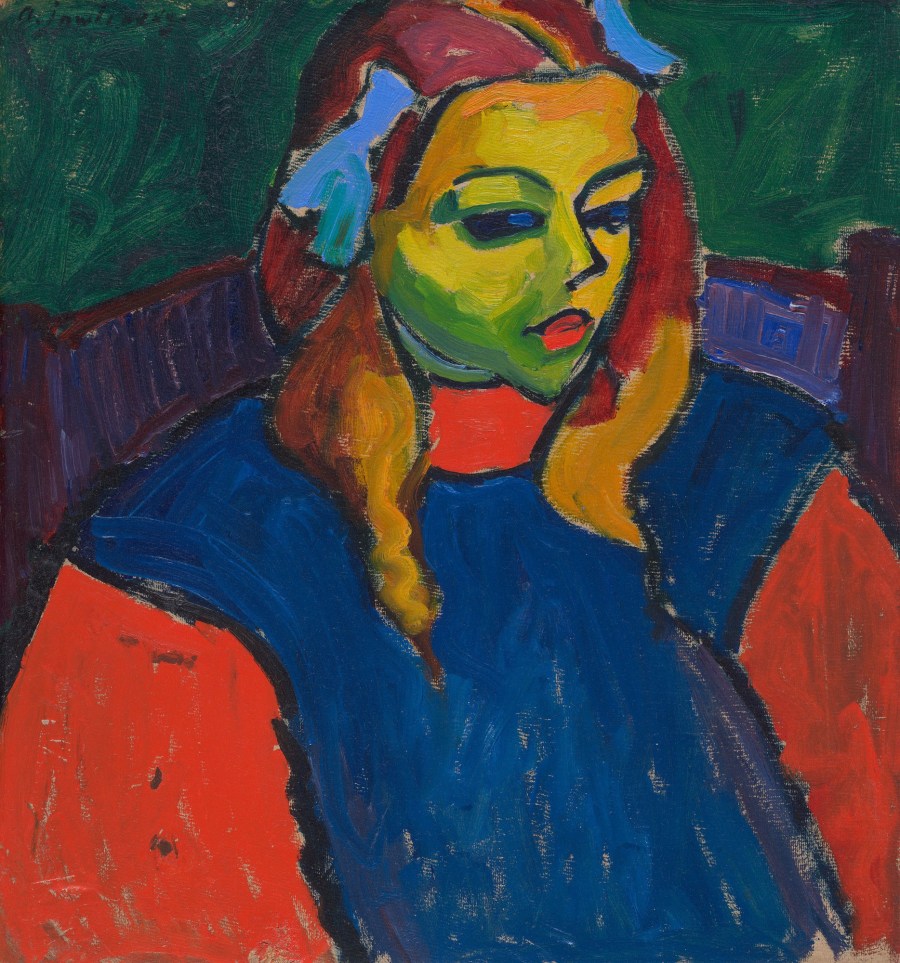
On a passage from Alice Munro’s Lives of Girls and Women
By Ann Harleman
Featured Art: The Girl with the Green Face by Alexei Jawlensky
Since our arrival at my house had not been signaled by the noise of the
truck we were able to go around to the side and crush up against the wall,
kissing and loving. I had always thought that our eventual union would
have some sort of special pause before it, a ceremonial beginning, like a
curtain going up on the last act of a play. But there was nothing of the
kind. By the time I realized he was really going ahead with it I wanted
to lie down on the ground, I wanted to get rid of my panties which were
around my feet, I wanted to take off the belt of my dress because he was
pressing the buckle painfully into my stomach. However there was no
time. I pushed my legs as far apart as I could with those pants tangling
my feet and heaved myself up against the house wall trying to keep my
balance. Unlike our previous intimacies, this required effort and attention.
It also hurt me, though his fingers had stretched me before this time.
With everything else, I had to hold his pants up, afraid that the white
gleam of his buttocks might give us away, to anybody passing on the
street. I developed an unbearable pain in the arches of my feet. Just when I
thought I would have to ask him to stop, wait, at least till I put my heels to
the ground for a second, he groaned and pushed violently and collapsed
against me, his heart pounding. I was not balanced to receive his weight
and we both crashed down, coming unstuck somehow, into the peony
border. I put my hand to my wet leg and it came away dark. Blood. When
I saw the blood the glory of the whole episode became clear to me.
—Alice Munro, Lives of Girls and Women
Last Night Ferguson’s Caught Fire
By. Laura Read
In the paper you can see the red booths
turned on their sides, their stuffing
leaking out. The fire spread next door
to the Milk Bottle, which is shaped like one
so you think of the bottles that clinked
on the porch in the first blue light
of morning, at the end of milkmen,
at the beginning of your life.
I went there once with a boy too sweet
for desire, after the Ferris Wheel
and The Octopus and trying not
to throw up on the grass and trying
to be sweet too, the kind of girl
you want to win a stuffed bear for,
one of the big ones that she’ll have trouble
carrying, so you keep handing
the skinny man your dollars and his eyes
glint and you wonder what he’s thinking
when he folds them in his pocket,
where he’s going when he gets off,
not the Milk Bottle for scoops of vanilla
in small glass bowls. His heart is a book
of matches, his mind clear as the sky
in the morning when it’s covered its stars
with light. In the winter, he’ll hang
a ragged coat from his collarbone.
He’ll think only of this year, this cup
of coffee, as he sits alone in his red booth.
If he walks along a bridge,
he might jump. And the river will feel
cold at first but then like kindness.
Last night a boy named Travis
killed himself
like young people sometimes do.
He told people he would do it.
They tried to stop him.
Now he’ll have a full page in the yearbook,
his senior picture where he’s wearing
his dark blue jeans and sweater vest,
leaned up against the trunk of a tree.
I wonder if he felt the bark
pressed against him
when he had to keep staring into the lens,
his cheeks taut from trying.
I wonder if he thought about the tree,
how could it keep standing there
without speaking,
storing all those years in its core.
Laura Read has published poems in a variety of journals, most recently in Rattle, Mississippi Review, and Bellingham Review. Her chapbook, The Chewbacca on Hollywood Boulevard Reminds Me of You, was the 2010 winner of the Floating Bridge Chapbook Award, and her collection, Instructions for My Mother’s Funeral, was the 2011 winner of the AWP Donald Hall Prize for Poetry and will be published this fall by the University of Pittsburgh Press.
Originally appeared in NOR 12.
On a passage from F. Scott Fitzgerald’s The Great Gatsby
By Ralph Lombreglia
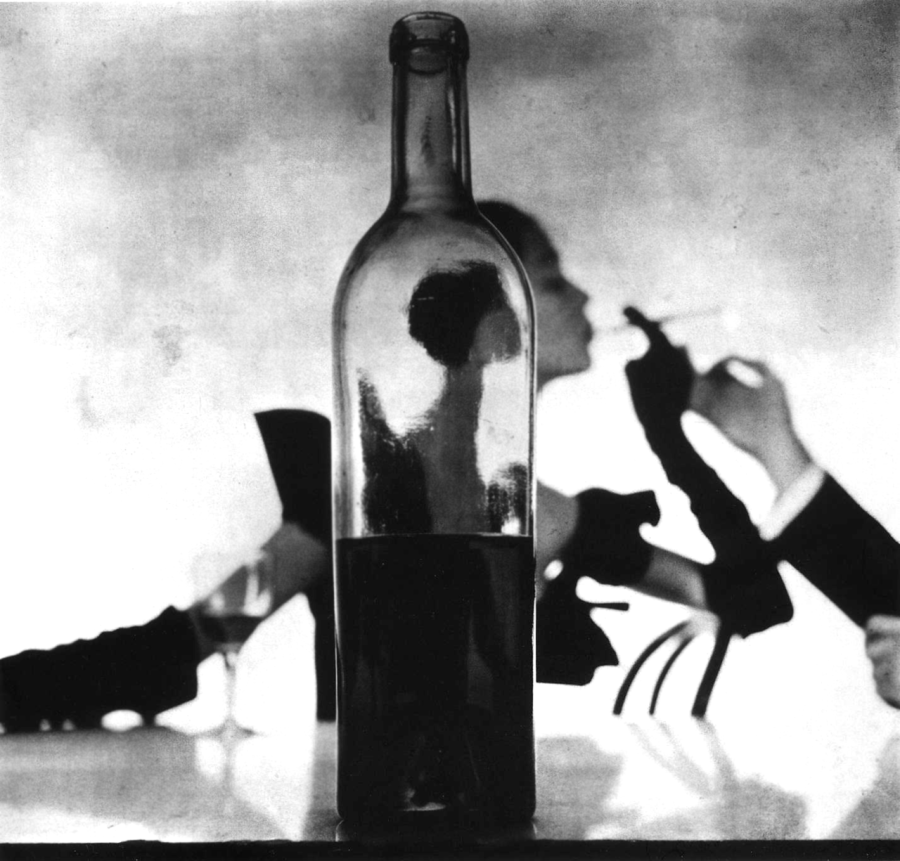
Featured Art: Man Lighting a Girl’s Cigarette by Irving Penn
[Tom Buchanan] “…Daisy loved me when she married me and she
loves me now.”
“No,” said Gatsby, shaking his head.
“She does, though. The trouble is that sometimes she gets foolish
ideas in her head and doesn’t know what she’s doing.” He nodded sagely.
“And what’s more I love Daisy too. Once in a while I go off on a spree
and make a fool of myself, but I always come back, and in my heart I love
her all the time.”
“You’re revolting,” said Daisy. She turned to me, and her voice,
dropping an octave lower, filled the room with thrilling scorn: “Do you
know why we left Chicago? I’m surprised that they didn’t treat you to the
story of that little spree.”
Gatsby walked over and stood beside her.
“Daisy, that’s all over now,” he said earnestly. “It doesn’t matter
any more. Just tell him the truth—that you never loved him—and it’s all
wiped out forever.”
She looked at him blindly. “Why—how could I love him—possibly?”
“You never loved him.”
She hesitated. Her eyes fell on Jordan and me with a sort of appeal,
as though she realized at last what she was doing—and as though she had
never, all along, intended doing anything at all. But it was done now. It
was too late.
“I never loved him,” she said, with perceptible reluctance.
“Not at Kapiolani?” demanded Tom suddenly.
“No.”
From the ballroom beneath, muffled and suffocating chords were
drifting up on hot waves of air.
“Not that day I carried you down from the Punch Bowl to keep your
shoes dry?” There was a husky tenderness in his tone . . . . “Daisy?”
“Please don’t.” Her voice was cold, but the rancor was gone from
it. “There, Jay,” she said—but her hand as she tried to light a cigarette
was trembling. Suddenly she threw the cigarette and the burning match
on the carpet.
“Oh, you want too much!” she cried to Gatsby. “I love you now—
isn’t that enough? I can’t help what’s past.” She began to sob helplessly. “I
did love him once—but I loved you too.”
Gatsby’s eyes opened and closed.
“You loved me too?” he repeated.
—F. Scott Fitzgerald, The Great Gatsby
Read More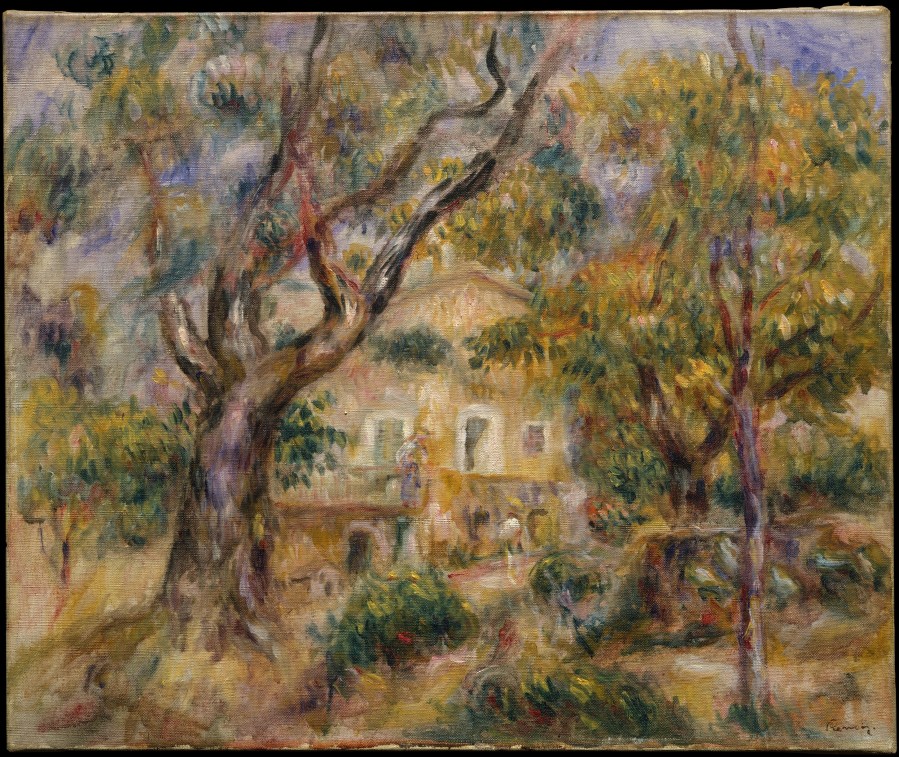
On a passage from Raymond Carver’s “Chef’s House”
By Bret Lott
Featured art: The Farm at Les Collettes, Cagnes by Auguste Renoir
Wes, it’s all right, I said. I brought his hand to my cheek. Then, I don’t know, I remembered how he was when he was nineteen, the way he looked running across this field to where his dad sat on a tractor, hand over his eyes, watching Wes run toward him. We’d just driven up from California. I got out with Cheryl and Bobby and said, There’s Grandpa. But they were just babies.
Raymond Carver, “Chef’s House”
I remember vividly the day I first read a story by Raymond Carver. I was standing in the front room of a minuscule apartment in Northampton, Massachusetts reading “Chef’s House” in The New Yorker—only two pages in the magazine. I then looked up and out the window at the bare trees there, full of wonder and awe at discovering that what mattered in a story was not, as I had thought it to be, the writer of the story and how wonderfully he performed his magic tricks. Rather, what mattered in a story were the lives of the people involved.
Read MoreNew Ohio Review Issue 11 (Originally printed Spring 2012)
Newohioreview.org is archiving previous editions as they originally appeared. We are pairing the pieces with curated art work, as well as select audio recordings. In collaboration with our past contributors, we are happy to (re)-present this outstanding work.
Issue 11 compiled by Peter Russ.

Unicom
By Tony Hoagland
Featured Image: Deer from Momoyogusa-Flowers of a Hundred Generations (1909) by Kamisaka Sekka
Set in the large public hallway and various spaces of a courtroom building. Drinking fountain, a pay phone on the wall, various benches where people eat their lunch or sit, and a few nooks and crannies where they stand and speak. The play is a sequence of monologues from alternate sides of the stage. All the speakers are connected to the trial, but nothing of the trial itself is ever shown.
PROLOGUE
(professional woman wearing glasses, reading from a clipboard, her voice bu- reaucratic and oracular)
Unicom officials denied knowledge of the events of June ’95. Somehow an entire forest had disappeared.
2nd PROLOGUE
Those erasures were committed, they said, by an irresponsible subsidiary
who didn’t know the right way to make a jungle disappear.
Read MoreBeach Towel
By Alan Shapiro
Imagine sitting on some towels on a beach, and
suddenly it’s raining, and you scramble up,
hurrying over the sand with all the towels
to a stall inside the bathhouse where
the towel you choose to dry yourself off with
is only a little dryer than you are,
and then, as you continue drying, isn’t,
it’s wet too, too wet, wetting as much as drying.
You pick another towel up but it’s damp
too, in fact they all are, every one as wet
as you are, towel and skin exchanging
the same dampness—
if the sun were shining you could run outside
and dry yourself, or find another towel
and pass the wetness on
in a one-way tradeoff of damp for dry.
But now imagine that the doors are locked,
the stall door and the bathhouse door, and you,
you can’t get out, you have only these towels,
you can’t escape these towels, you can’t get new ones,
there’s no way to make one thing go one way or
another: imagine energy as dampness,
the jiggling accidents of energy
spread out like dampness over everything
so evenly that there is nothing left
of any kind of more of this for less of
that to balance or redress, no one
to help or call to, nobody else to touch:
Now picture everyone locked up with you,
each in his own stall, having waited there
so long inside that chilly damp enclosure
that the world beyond it may as well not exist,
or ever have existed, and you’re all shivering in
the cold air, but since no warmth remains,
there is no shivering, nobody is there.
Alan Shapiro will publish two books in 2012: Broadway Baby, a novel from Algonquin Books, and Night of the Republic, a book of poems, from Houghton Mifflin Harcourt.
Originally appeared in NOR 11.
Old Love Poems
By Denise Duhamel
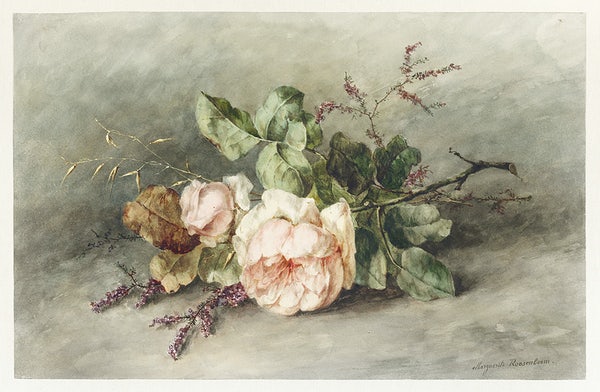
Featured Image: “Rozen” by Margaretha Roosenboom
I can burn the pictures, but not the poems
since I published them in books, which are on shelves
in libraries and in people’s homes. Once my cousin told me
not to write anything down because the words would be there forever
to remind me of the fool I once was. My cousin
was the little dog on the Tarot card, barking at the Fool’s heels
as I headed right toward the cliff.
When James Taylor and Carly Simon
broke up, I was shocked. Taylor’s drug use or not,
couldn’t they work it out? I was in college
and, though I didn’t really believe in marriage,
I believed in them. How could they part
having written those love songs? And how could they go on
singing those love songs after the divorce?
But now, I know.
After time, when they reached for those notes,
there wasn’t really a beloved there anymore,
just a strand of hair each left behind
on the other’s scarf or pillow, a cologne trigger that transcended
into something more real than they were,
the lovers themselves ephemeral muses.
It’s still hard
for me to accept the notion of love outliving the lovers—
a notion so romantic, it’s unromantic. Hard to accept
that those big lumps of affection
would find alternate places to stick,
that Simon and Taylor would be swept away and marry
others. That need is not so much a deficit
as an asset,
like a wallet that keeps manufacturing its own dollar bills even after it’s been robbed of everything.
Or to say it another way: the plant that will bloom
despite being uprooted. The new seedling that will pop up.
It’s hard to believe when you are down to your last penny,
when the soil is dry and rocky and full of weeds,
when your love
is freeze-dried into a metallic pouch and you are full of snarky rage.
You look back at a love poem you wrote and ask:
did I really feel this way? Even if you no longer remember tenderness,
even if the verse was simply artifice, your idea of love, a subspecies
you made up to tag and define that one poor sap, you read the poem
again, grateful, holding the words in your hands like a bunch of flowers.
Read More

Clear and Cold
By Lisa Ampleman
Featured Image: “The Red Kerchief” by Claude Monet
Though already setting,
the sun in late afternoon
in late December revels
in its power—how it,
though meager, can set
red-brick façades ablaze,
glorify an oak’s moss—
the only green thing—
and later sear far clouds
deep purple, more sky
exposed because the trees
are bare. Meager, too,
what you could give
me, what you called fondness—
but I let it dazzle me for a time.
And, though the room
is darkening, the last light
brightens the metallic edge
of the window screen
before it goes.
Read More

The Muse of Work
By Ellen Bass
Featured Image: “Portrait of Mrs Marie Jeanette de Lange” (1900) by Jan Toorop
If I could choose my muse,
she’d have red hair, short, spikey,
and green cateye glasses with rhinestones at the tips.
She’d wear a sleeveless white blouse, ruffled
over shallow scallop-shell breasts.
Can you see how young she is?
I think she’s the girl Sappho loved,
the one with violets in her lap.
When she opens the door, a flurry of spring,
apple blossoms and plum, sweeps in.
But I’ve been assigned the Muse of Work.
It turns out she’s a dead ringer for my mother
as she scrambles the eggs, sips black coffee,
a Marlboro burning in a cut-glass ashtray.
Then she opens the store. The wooden shelves shine
with amber whiskeys and clear vodkas,
bruise-dark wine rising in the slender necks.
What You Find, If You Find It
By Jeff P. Jones
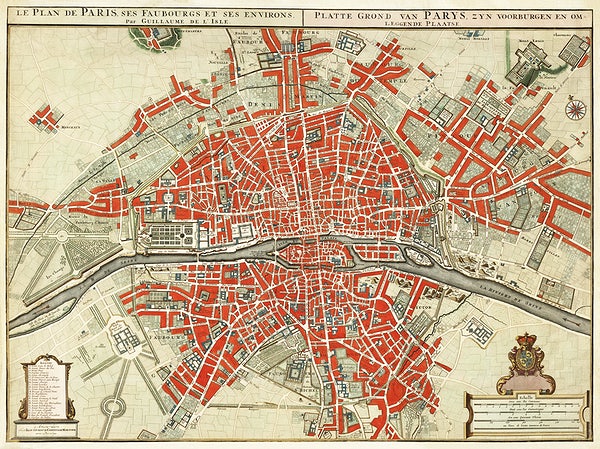
Featured Image: “Paris Map in Dutch” by Guillaume Delisle
As a letter carrier, she delivered non-urgent messages to people’s houses. Her work brought her past gates, across yards, onto porches, into foyers. She never looked in windows or rang doorbells but on request would hand mail to a resident encountered outside as she exchanged small talk. She would then move on, readying the next house’s letters and advertisements, imagining fingertips releasing sealed flaps, creases tearing, messages sliding into waiting hands.
Each week her teenaged son caused some new havoc. One night he stole her car and was stopped by police forty miles away, coursing a college town’s streets with three friends and a bottle of vodka. The four boys cleaned her gutters the next weekend as she grilled hamburgers and made jokes about her prematurely gray hair.
She sipped her morning coffee and pretended to read the paper as she watched him eat toast.
In his last year of high school he had to transfer schools because of attendance problems. He brought home a stray mutt that he forgot to feed. He began to take phone calls from a man with a comically gravelly voice named Staff Sergeant Thigpen. The son carried the receiver into his room and shut the door. Posters of grimfaced warriors appeared on his walls. He exterminated the squirrels and birds from the backyard with an air rifle. He rarely answered her in a full sentence. In the summer she drove him to the airport. He wore a new pair of running shoes and carried no suitcase.
Read More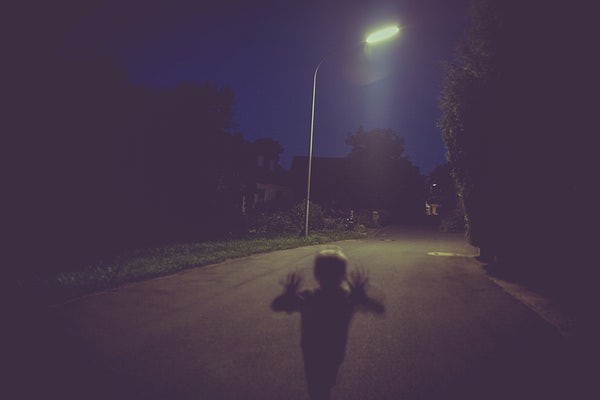
Dispatches From the Interior
By Geoffrey Brock
Featured Image: “A Lone Child Walking Down the Street at Night“, Unknown Artist
Like the one where you stumble along happily drunk
after closing a bar and reach your car only to find it
surrounded by militia who take you in to question you
about why you left your son alone in the car so long
and you say I lost track of time though that’s not true
and Can I see him and they refuse and Is he okay and
you’re panicking and thinking What if he died in there
or the one the very next night when you find yourself
atop some posh hotel listening to some poet speaking
and realize you haven’t seen your son since morning
when you let him go down to the lobby alone to play
despite the warnings you now recall about the natives
and you race for the elevator but there is no elevator
and so you find the stairs and descend floor by floor
and each landing is a shabby apartment living room
and though you can sometimes tell someone is home
water running for instance or light under a shut door
you never see anyone or gain any real insight into this
country of ancient dearth and modern resentment
what country is this anyway? and after the gauntlet of
these empty private foreign lives you emerge at last
into a brightly lit and darkly paneled colonial lobby
and scramble frantic now through the patrician crowd
looking for help but when you ask a giant suited man
if he speaks English he replies in the plummiest nasals
I don’t just speak it I am it and merely cocks one brow
about your son so you race outside where a boy squats
alone in the penumbra by a bush and you tilt his face
to the light but he isn’t yours too small and dark and
you keep looking and see others and scream one name
and then oh god you see his hunched familiar shape
rise out of the pile of dead leaves he had hidden under
and stumble toward you arms extended the pajamas
he was wearing this morning now tattered and filthy
and when you scoop him up you discover obscenities
and anti-American slogans scrawled in black marker
on his face and blood or something caking his nostrils
and he doesn’t speak or cry and nothing shines forth
from those eyes and you carry him cradle him through
this endless third-world night trying to comfort him
but knowing you will never be able to comfort him but
cooing You’re safe now Daddy’s here or the one where
Read More

Strapless
By Z.Z. Boone
Featured Image: “Breton Girls Dancing, Pont-Aven” (1888) by Paul Gauguin
I don’t know what happened, but last night I just lost it. Just fucking lost it.
It’s eleven o’clock at night, I’ve been doing inventory in my store all week, I’ve barely made a dime, and this is when my fourteen-year-old daughter decides it’s a good time for defiance.
“You have no idea what it’s like!” she screams.
I’m lying on my still-made bed, full dressed except for my shoes, and she’s standing with a hand on each side of the doorway as if to prevent my escape. I’m not going anywhere. I’m just trying to hear the TV, trying to get the news about how screwed up the rest of the world is, but I can’t make out a word.
Read More
Zigzag. Yeah.
By Scott Kreeger
Featured Image: “Flowers on a Footpath from Bijutsu Sekai” by Watanabe Seitei
Zigzag down the stairs. Yeah. Zigzag to the trash can and toss the bag in. Yeah.
Zigzag through the gate and into the pool area. Yeah. Zigzag between the chaise lounges. Yeah. Zigzag down the steps and into the pool. Yeah.
Zigzag too cold, too cold. Yeah. Zigzag out of the pool. Yeah.
Zigzag out the gate. Yeah. Zigzag onto the bike. Yeah. Zigzag past apart- ments 4, 3, 2, 1, and into the alley. Yeah. Zigzag down the alley and out to the street. Yeah. Zigzag wait for traffic. Yeah.
Zigzag across the street. Yeah. Zigzag off the bike and into the store. Yeah. Zigzag past the smiley man behind the counter. Yeah. Zigzag smile back, wave, say hello. Yeah.
Zigzag to the candy. Yeah. Zigzag to the Zagnut bars. Yeah. Zigzag pick out a Zagnut. Yeah. Zigzag Zagnut. Yeah.
Zigzag say that again three times fast. Yeah. Zigzag Zagnut zigzag Zagnut zigzag Zagnut. Yeah.
Read More
Throw It Up
By Suzanne Richardson
Featured Image: “The Fallen Angel Spreads His Black Wings” by Odilon Redon
Heroin made Tristan’s breath sweet like mangoes. When we kissed it felt like licking the inside of a kiwi: fragrant, indulgent, the tangy saccharine rolling around my tongue. I didn’t know why he tasted like that, but I liked it. At the time I didn’t know I was sleeping with a heroin addict. He would sit up in bed and scratch his arms and face for hours. I would call his name, shake him even, but he wouldn’t answer. In all four years I’d slept with him, he had never acted that way before. I would put on a robe and pace the apartment, or sit on the couch, and think about my family. My brother. My parents. I had never felt this scared with them despite our differences. Sometimes I would grab fruits or vegetables from the fridge and nervously practice peeling, or dicing until dawn. I think I did this out of some compulsion to better myself even in the darkest of hours. My mother could always chop and dice things perfectly. I taught myself to peel mangoes in one motion so the peel piled into one long strand in the sink drain. I couldn’t think of anything that would make him act that way. One night, lying on the couch, staring at the ceiling, I recalled a conversation I’d had at a party with an EMT.
Read More
Dhaka Nocturne
By Tarfia Faizullah
Featured Image: “Tête-á-Tête” by Edvard Munch
I admit that when the falling hour
begins to husk the sky free of its
saffroning light, I reach for anyone
willing to wrap his good arm tight
around me for as long as the ribboned
darkness allows. Who wants, after all
to be seen too clearly? Still, the heart
trusts, climbs back down the old
mango tree outside the bar to marvel
at the gymnast tornadoing forward,
electrifying the air with her soaring
body on the TV, even as the friend
beside me asked, But how could you
sleep in the same room as your dead
sister’s things? Once, a man I loved
told me I was stunning. It terrified
me, the way grief still can, rising
above us in the bar, seeking its own
body. I told her the body, exhausted,
does what it must, as it does now,
suturing itself to his, saying, I’ll be
yours forever, with all its secretive
creases turning to steam in this heat
flustered city, wet fever of the nape
of my neck chiffoning beneath his
lips galaxying across it. I could have
told her about the shelves of porcelain-
cheeked dolls tarnished lavender by
falling light, the ebony abundance
of my mother’s hair varnished blue
as she slid my sister’s child clothes off
the old wooden hangers then back on—
but what else is mine, if not all this
strange beauty? Look, I say to him,
running my own hands down my own
body: night-rinsed anaglyph of muscle
and bone holding against everything
yet to plunder this or any twilight’s
nameless and numinous unfurling.
Read More

Overflow
By David Gullette
Featured Image: “Proposed Broadway Underground Railway” by Unknown Artist
The first of February 1855
Thoreau skates up the river:
it swells beneath its crust
making a musical cracking,
running like chain lightning of sound
athwart my course.
The rising of the mass
lifts the ice in one place
but drops it in another
the low patch filling with water
to form quite a lake there where he has passed
and he imagines
another skater two hours later
his successor who with wonder and alarm
will see Henry’s twin tracks
disappear in one side of it
and come out the other.
Sometimes I glide across
the brittle glaze of sleep
and am above and in and beneath
the dark currents
and wonder at dawn how did I drown
only to glance back and see my tracks
coming up and out and going on.
Read More

Birds In Cemeteries
By George Kalogeris
Featured Image: “Two Cockatoo and Plum Blossom” by Ohara Koson
It must be the shade that draws them. Or else the grass.
And it seems they always alight away from their flocks,
Alone. It’s so quiet here you can’t help but hear
Their talons clink as they hop from headstone to headstone.
Their sharp, inquisitive beaks cast quizzical glances.
The lawn is mown. The gate is always open.
The names engraved on the stones, and the uplifting words
Below the names, are lapidary as ever.
But almost never even a chirp from the birds,
Let alone a wild shriek, as they perch on a tomb.
And then they fly away, looking as if
They couldn’t remember why it was they came—
But were doing what our souls are supposed to do
On the day we die, if the birds could read the words.
Read More

Pelicans
By Robert Cording
Featured Image: “Australian Pelican” by Elizabeth Gould
Last evening, another sunset party:
drinks, laughs, ironies, hidden desires.
All of us tanned and glowing, we exchanged
jokes and gossip, fresh and stale, self-conscious
that something larger was missing
when we turned to best watches, shoes, cigars.
So much time is lost trying to agitate
the envies of others and monitor one’s own—
the thought that crossed my mind as I watched
six pelicans rise and fall with the water’s flux.
The winds had quieted, and just before the sun plunged
below the sea, the pelicans rose in a wind-hung line
and flew off, silent as a council of gods
in the pinkish sky. Palm trees scratched
their cuneiform shadows on the sand.
I wanted to say something about the pelicans,
who I knew, for no known reason, choose to live
their lives as near total mutes, as if they’d decided
simply to be done with the fecklessness of speaking,
but I kept quiet, the light draining from the sky,
the others going inside. I felt like a child in hiding,
alone on the deck, made fearful and alive
by the darkened Gulf, the stretch of beach
now entirely empty, the palm trees,
the sliver of moon rising directly opposite
of where the sun had set. If I had been called
to come in, I would have kept silent.
Read More

Crow
By William Kelley Woolfitt
I’ve been told Crow’s story so many times I remember it better than my own memories. It was my bedtime, naptime, and story-time story. I think my parents told it to each other too, in whispers, in each other’s arms, striped with moonlight coming in through the blinds, too tired to say anything new.
There was a storm the night my parents drove me home from the hospital. I was a few hours old. Mother says that the rain was too fast for the windshield wipers, that Father pulled over three times. Father says that Mother sat in the backseat and held me the whole way. When we got home, we had to wait almost an hour for the rain to die down. Father found some jazz on the radio, climbed into the back to be with Mother and me. That was the first time he held me. Mother fell asleep, and dreamed she was a passenger in a boat.
Wind toppled the elm in our front yard, though later on some neighbors claimed it had been hit by lightning. It just missed our house. One branch scratched our bedroom window. Crows spent the night on our porch, their nest in the elm ruined.
Mrs. Yamato across the street saw the crows on our porch swing, screamed and dropped her chopsticks. An omen of death, she thought. She came running over with a broom. All the crows flew away, except a baby. Father put the baby crow in a shoebox and thanked Mrs. Yamato for her concern. Mother went into the yard, walked around the fallen elm and its jagged stump, poked into the fallen nests and found shiny things: bottle caps, bits of tinfoil, Father’s screwdriver, her own gold pendant necklace.
Read More
Yet
By Eric Torgersen
Featured Image: “Study for “Le Bain”: Two Women and a Child in a Boat” by Mary Cassatt
You’ve got to act, and soon, but you don’t dare yet.
There’s one big load you don’t think you can bear yet.
You chose to dive this deep; it’s not for me
to tell you why you can’t come up for air yet.
You had big plans. You’re running out of time.
There’s no excuse to contemplate despair yet.
All that time and trouble spent on you.
For all the rest, you don’t have much to spare yet.
The world should find some meaning in your work?
You haven’t shown us why we ought to care yet.
Don’t give me that I-don’t-get-it look.
Sixty-five, and still not self-aware yet.
You might just want to start to pack your bags.
You may not have enough to pay the fare yet,
but that doesn’t mean the taxi’s not on its way.
Look out the window. No, it isn’t there. Yet.
Call it what you will, but thank something, Eric.
There’s one stiff suit you haven’t had to wear yet.
Read More
Awake
By Richard Schiffman
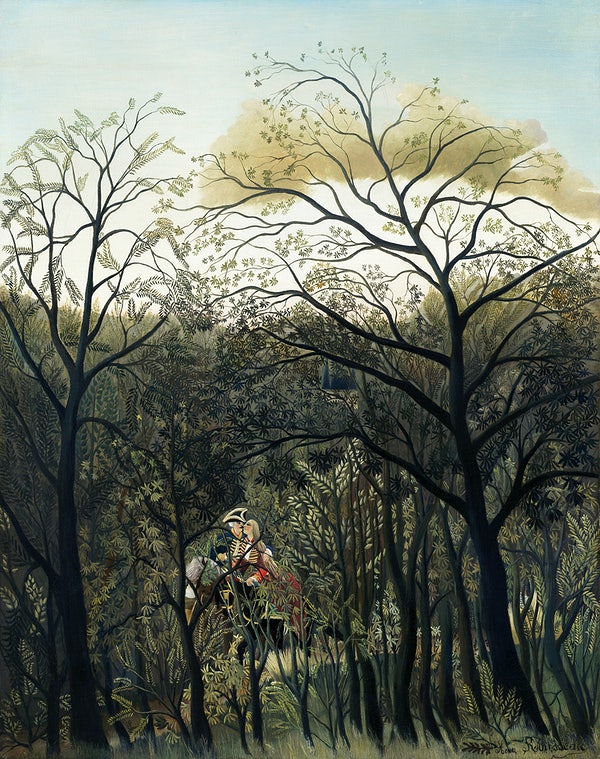
Featured Image: “Rendezvous in the Forest” By Henri Rousseau
Already morning ignites
the high wicks of the pine.
A few birds trilling,
don’t ask me their names,
or my own as I stumble
out of bed on sea legs,
rub my eyes until stars appear
like ships still foundering
on the reef of night.
But when I open them again, day
is fully rigged and sailing off
with me on it.
Read More

Unfinished
By Richard Schiffman
Featured Image: “Houses of Parliament, London” by Claude Monet
“It is not known why they were not finished,”
the curator noted of two hundred later canvases.
Turner’s work becoming increasingly unhinged—
cyclonic sunbursts, hills skipping like rams, crepuscular
curtains, reeling cliffs and brimstoned cities.
“I did not paint it to be understood.”
Was he mad, as some critics alleged?
Were these “mere freaks of chromomania,”
posters of a private apocalypse, flotsam
and jetsam from the shipwreck of a soul?
“I only wish I had any color to make them blacker.”
A glutton for whirlwinds and monster blizzards,
snow funnels and conflagrations. The lakes abysmal,
the seascapes either black or blinding—
a roller coaster few Victorians could ride.
“Indistinctness is my forte.”
Prophet for a world unravelling at the speed of light.
With hands as “fast as lightning,” when he sketched,
organs of creation, and equally destruction,
all churned together in the cement mixer of his palette.
“It is not known why they were not finished.”
Yet surely he knew that finishing would be a lie
in a world where the waxing / waning moon
is unfinished, the river ends, but does not finish,
nor the bronking sea, nor the calving sea-ice,
nor life itself, which only knows—
again and again and again—how
to begin.
Read More

Take Your Trash and Make it Fly
By Devin Murphy
Featured Image: “Shoes” by Vincent Van Gogh
One night a month, people in my hometown outside of Buffalo, New York, put their large trash items on the curb for the sanitation department to pick up the next morning. Our neighbors would drag out old Whirlpool appliances, ironing boards, and whatever else the weekly garbage route couldn’t take. On those evenings, my Dutch immigrant mother loaded me into her rusted-over white 1970 Chevy Caprice station wagon with its vinyl side panel, and we’d slowly cruise the streets picking through the refuse.
From where I was slouching low in the passenger’s seat I’d get this fishbowl feeling as she slowed down and parked in front of those houses. Each home gave off a sense of neatness and order that seeped into their lawns. It always made me feel as if strangers were looking out their windows at us—or worse, people we knew. The idea of being watched made me want to pull my lower lip over my head and swallow myself whole. But my mother was unfazed as she picked discarded rabbit-ear antennas, steel rods, sheet metal, chicken wire, aluminum siding, rebar, large bolts, coffee cans, aluminum fruit cans, and every scrap of metal or iron and tossed them in the back of the Caprice.
She walked from lawn to lawn on the sidewalk while I inched the car along beside her. I nudged the gas pedal and braked with my tiptoes. I wasn’t big enough to see over the steering column, so I navigated through the line-of-sight between the dashboard and the top of the enormous steering wheel. When we had to cross an intersection, she’d get back in, drive across, and we’d start down the next block.
Read More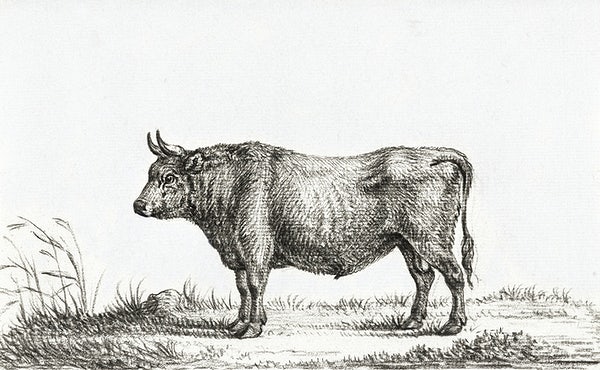
Tauromaquia
By Deborah Casillas
Featured Image: “Standing Bull” by Jean Bernard
The days dragged on, steady ticking of the clock.
My mother’s cancer; surgery, injections, drugs.
Long afternoons I sat in my grandfather’s library
looking at books. Shelves of books about bullfighting—
la lidia, combat; la corrida, the running of the bulls.
Books on Manolete, Belmonte, Joselito,
his copies of The Brave Bulls, Blood and Sand,
Death in the Afternoon. Books aficionados collect,
those fanatic followers of the taurine subculture.
I stacked volumes beside me, looked at pictures
of the black bulls, studied their deadly horns,
the ritual sacrifice. Here were portraits of the famous
matadors, their lives venerated like the lives of saints.

The Swans
By Anamyn Turowski
Featured Image: “Woman with a Butterfly at a Pond with Two Swans” by Jan Toorop
She bought the swans because of the empty pond. Lonely; that’s why, really. She saw two swans in profile in a poultry magazine she’d picked up at the dentist’s. She paid $1500 for a pair. As if swans could change anything. Her husband says she needs birds like she needs a hole in her head. A lobotomy, she thinks, that’s what I need. Every time she stares out the window toward the pond, the empty water makes her cry. She charged the pair on a new credit card that came in the mail that day. What’s the interest on that card? You never read the fine print.
She isn’t the sexiest wife. She’s aware of this. Since the operation he hasn’t touched her. That was three years ago. They’ve the house and the dog and their two grown children who call on birthdays, Christmas.
Read MoreStanding on the Desk
By Donna L. Emerson
I am twelve years old in Mr. Ody’s art class and he’s teaching me to use an
eraser on my watercolor of rain and sun. To make the sun stream like spotlights
through the clouds. He moves the eraser by placing his hand over mine. He rests
his hand on my wrist a little longer.
I start to back away.
He asks me to be a model for the class. He lets me stand on his desk. He says,
Don’t take your eyes off her. Let your pencil try to draw her without ever stopping
your looking and drawing. I’m glad I wore my new turquoise skirt and
flowered blouse. Mr. Ody pulls his chair out to see better.
While Danny Sessa makes jokes, I can feel Mr. Ody’s eyes. He’s staring. I turn
red, start to joke back and Mr. Ody says, Just stand still and be quiet.
This was the beginning of the first time.
Read More

The Jaguars of Southtown
By Amos Jasper Wright IV
Featured Image: “The Repast of the Lion” by Henri Rousseau
Forty days passed without landing a sale. For a while, I felt sorry for myself, and then self-pity shifted gears and boiled into a rage that curdled everything I touched. The BP spill down in the Gulf had put a damper on auto sales. The economy in general was in shambles, but this town hadn’t prospered much since the Red Mountain cut. Meanwhile, we’re dumping good, hard-earned USD into foreign countries and our Harvard-educated Kenyan president was doing all of jackshit about it. Instead of buying new cars, people just drive them longer. Used to I could sell forty cars in a month. You don’t need a Harvard degree to do that.
When DOT took a slice out of Red Mountain, most of downtown Birmingham reverted to a giant used-car lot, a smooth asphalted prairie where trash and news blew before the winds. I managed a downtown lot on 20th Street. My office was in a portable trailer stacked on cinder blocks. Long strands of razor wire outlined the perimeter of the lot like a concentration camp. The warehouse next door had probably been abandoned since I got my driver’s license. Sale banners flapped and whipped in the hot winds and the flat air in that metal can was tight as my collar. We parked cars on the sidewalk. On Saturdays, when the urban prairieland was empty and dead, looking more and more like a southern Detroit, instead of getting hung up on by irate voices, I played lonely games of golf, as blue and red klaxons dopplered by.
Read MoreThe Open Door
By. Alan Shapiro
For Peggy Rabb
What did it mean when she said at last, “All day I
have been running to the open door”—
What door was it she ran to, opening to what?
From what? And did she reach it and get through?
No one was there with her, it seems, inside or out, no
one she mentioned, no solving light or phantoms
calling in parental voices, urging her
to come, child, run; and that she ran “all day”—
was that the joy of being able now
to run in some way none of us could see, a
bodiless release imagining a body
if only to feel how free of it she was?
Or was it desperate running, running to
get out of the nightmare room that was all day
uncrossable, the door like a horizon
a stride away with every stride she took?
And if she reached it, running, what did it feel like
then, that moment, being nothing but
the motion of herself without herself,
over that threshold into nothing else?
Alan Shapiro will publish two books in 2012: Broadway Baby, a novel from Algonquin Books, and Night of the Republic, a book of poems, from Houghton Mifflin Harcourt.
Originally appeared in NOR 11.

Trust
By Liz Kingsley
Featured Image: “Pattern from L’ornoment Polychrome” by Albert Racinet
First he slept with someone else and later while he was busy sleeping, she slept
with someone else. No, before he slept with someone else, she slept with the
lawyer across the street who gave good oral argument. She did not tell him
about the lawyer. Their time together was privileged and she knew her rights.
While she was with the lawyer, he slept with the decorator. When she found out
about the decorator, she confronted him and said I trust that you know about
the lawyer. He said he in fact did not know about the lawyer, but that now he
no longer trusted her. She said that she had stopped trusting him after a flirty
consultation they had with the decorator about their living room, which is why
she slept with the lawyer in the first place. He said she had no reason not to
trust him, but that he sensed she didn’t, so he figured he might as well go ahead
and sleep with the decorator. She said that’s exactly why she can’t trust him
anymore. He slept with the decorator on the outgoing living room sofa. She
said the lawyer has a trust account, into which she deposited the money they
were planning to pay the decorator for the incoming living room sofa because
she didn’t trust him to go through with the renovation in light of their domestic
destruction.
Read More
The Farm
By Spencer Wise
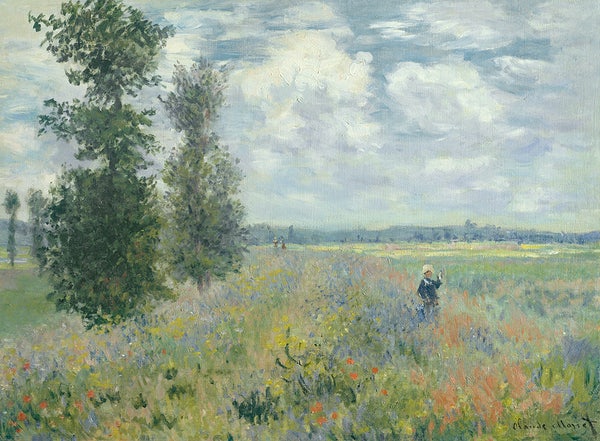
Featured Image: “Poppy Fields near Argenteuil” by Claude Monet
We’re on our way to meet Charlene’s family for the first time, listening to Townes Van Zandt in the car, and Charlene’s saying, “‘Pancho and Lefty’ is me and my Daddy’s song,” when I suddenly smell fire. All along Highway 33, the smell of wood burning. She laughs. “Don’t laugh,” I say, “might be a forest fire.” She says, “First time south of the Mason-Dixon, and now you’re Woodsy Owl.”
“I feel vigilant,” I tell her, gripping the wheel tight with both hands, as we come over a hill and, on the horizon, points of orange flames burst from the tree line. “What the hell is that?” I say. “Those are laurel oaks. Those are pitch pines,” she says. “Not the damn trees,” I say. “The fire. We got to call your parents, tell them it’s time to evacuate. We got to get the hell out of Georgia.” She puts one hand on my knee and points to the parallel rows in the woods alongside the road, explains how the fire is burning in even rows, how it’s controlled. “Doesn’t look controlled,” I tell her. “Looks way the hell out of control.” Nacreous black smoke rises above the pines. She says her parents live about ten miles from here. “Correction,” I say. “Used to live. It’s all burned. You can’t go home again. Home is a marshmellow.” “Mallow,” she says. “If you’re talking about the spongy confection that you northerners eat two times a year when you go camping—that’s a marshmallow.”
Read More
When People Watch You
By Nathan Anderson
Featured Image: “Tingletangle” by Edvard Munch
I’m not like those crazy people.
The people that watch me
are real. I can see them.
Never mind the mailman. That blue coat
nearly swallows him. You never know
what’s under there—and he’s, well,
rather strange looking,
like a boy with a bald spot
bent over thick black shoes
and that bag he cradles
like a smooth gray animal
he does not recognize
is dead. Sometimes I believe
he really is a little boy
and I have to stop myself
from running after him.
Isn’t the mind amazing?
I’d like to know
what he’s doing when he’s not
walking through front lawns
or talking to the man
across the street. I’d like to know
what he’s delivering,
if it will require a deep breath
and more wine
than I’m willing to drink. If it’s even worth
the paper cut I’ll get
opening the envelope. And what about
that man across the street?

Stupid Sandwich
By Nathan Anderson
Featured Image: “The Grocer’s Encyclopedia” by an unknown artist
So yeah, we all have these moments that suck
because what they mean
is like a mystery, like the Mariners last year
good a team as any, traded
what’s-his-name, the fat one, for that Puerto Rican dude
with a wicked right arm
and didn’t even make the playoffs.
Anyway, I can see you’re a man of the world like me,
standing here I don’t know how long and still
no damn bus. But like I was saying
we all have these moments and last week
there I was after work, making a stupid sandwich,
the kind of stupid-ass food people like me always make
when I can’t figure out what I’m feeling
and I feel like being true to myself
is about the dumbest thing a man can do,
knowing how easy it is for the truth to mess things up.
Opening the Cottage
By Christina Cook
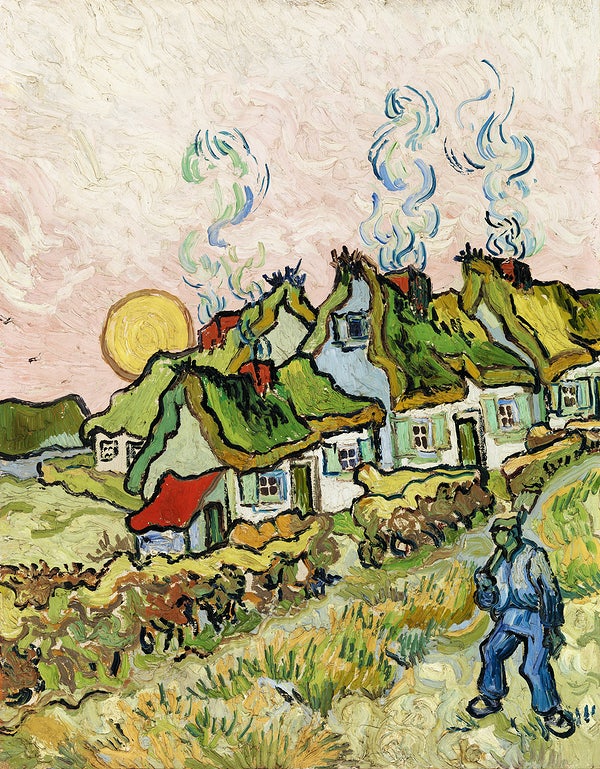
Featured Image: “Houses and Figure” by Vincent Van Gogh
Jays scrap in the maple
while I sit with my absence
of sound, and a bottle
of last summer’s wine.
I should be bleaching
the mouse-scat floor,
scraping their fur
from the spaces
left naked for plumbing.
I should be finishing off
the half-raked woods
or mending the hole
in the porch screen.
Sun’s still striking
the stretch of land
across the cove, where
the Frank-Lloyd-Wright-like
house has nestled in oaks
since my grandfather first
built our cottage.
Remembered Grace
By Jim Daniels
My mother rolls her walker through the rug
like pushing a dull reel mower through high grass.
She cannot see, so maybe the simile should be sound instead—
like bad jokes from a dull boor. The brittle thread of escape
snapped long ago, sewing kit trashed, needles only and constant
from pain—knee/back/hip. Blurry edges of God rim
her miraged vision. She burns a sandwich on the grill
but not herself—thrill enough to earn a pill. Today
she’s skipping church, and it’s just next door. She calls me
from the kitchen to carry her cup back to her chair—no free
hands. She must watch where she lands when it’s all freefall
and whiffs of Jesus not happy with her. I’m a tourist
with a bad map. She’s a local with time. She waves her hand
as she talks, one graceful thing. She flirts with air.
Read More

Speed of Light
By Mark Irwin
Featured Image: “Blossoming Cherry on a Moonlit Night” by Ohara Koson
Married in Beijing, they had their names carved on
a grain of rice. Mai wore a yellow silk gown. He wore
a black suit. Embraced in the photo turned sideways
they resemble a tiger scrambling through strewn mums.
That evening they ate salted mango and shrimp. He
can still taste that, see the tortoise-shell clip sun-
splintered in her hair. That evening continues, stalled
like the sea-filled drapes in their room. For twenty
years he worked at a lab that accelerated protons. Here
are photographs of their two girls on Lake Michigan,
then in Zermatt, standing before the Matterhorn,
whose moraines, cirques, and ravines resemble those
through two names magnified on a grain of rice, or
of that shadow looming through the CAT scan of her brain.
Read More
Everything Equal
By Joseph Holt
Featured Image: “Vintage European Style Key” by Paul Poiré
NOTE: When “Everything Equal” was posted to the NOR archives in Spring 2021, the author requested to revise and resubmit it to correct some issues of vulgarity and biased gender politics. His revision, titled “Futon Life,” appears below the original.
Three summers ago Ted Dexter flew standby to San Francisco with the vague intention of getting even with his ex-girlfriend. He and this girl, in only a couple months together, had argued, lied, cheated, had proven themselves in every way incompatible. Their final argument initiated with the most mundane of subjects—that he had worn “hideous, unstylish” carpenter jeans to the bars on a Saturday night—and escalated into a blowout that saw them thrown into the Cedar-Riverside streets, stumbling and shouting. At the sound of nearby sirens, Ted beat it back to his apartment and soon passed out drunk on his futon. He slept. The next morning he woke to find that sometime in the night this girl had come and gathered her belongings, most notably the blanket with which he had been covering himself. Sitting at the edge of his futon, slowly regaining his wits, he realized she had also gathered many of his belongings—his PlayStation, his baseball cards, his toaster, even the few bottles of Grain Belt from his crisper drawer. Also gone: his car. It would turn up several days later in Fargo, empty of gas and stripped of its stereo.
Read More
Should I Take it as a Sign
By Sue D. Burton
Featured Image: “Ancient of Days Setting a Compass to the Earth” by William Blake
that the Don’t Bore God note taped
to my desk just fell to the floor,
that I dreamt you gave me
a sandwich wrapped in a glove
& I ate the glove,
that I was mortified even
in my dream?
That the pony I always wanted
I never got. Piebald.
I would’ve called her Cowboy.
Was that the problem?
That I feel you sweating in the night
& I’m afraid.
That I’m afraid to tell you
in the morning.
That my friend Lewis says
my name in Mandarin
is shuōbùtōng, which
means talk no communicate.
That Samuel Beckett
& I have the same initials.
(Let’s go. We can’t. Why not?)
Both born April 13.
That my fortune cookie says, Bite me.
That I hear you crying in the night.
That a shaman in the Colombian rain forest
told my friend Megan,
I’ve been waiting for you.
That once a psychic told me
she saw piles of paper under my desk.
That once a guy at a bar said,
Don’t I know you from someplace?
That years after the funeral
my father says he misses me,
that I still see him
walking down the street.
His back always to me.
That the famous Lama said to Lar,
What took you so long?
God, I don’t want to bore.
Just give me some kind of sign.
Read More

The Suggestion Box
By Billy Collins
Featured Image: “Cupid Inspiring Plants with Love from The Temple of Flora” by Robert John Thornton
It all began fairly early in the day
at the coffee shop as it turned out
when the usual waitress said
I’ll bet you’re going to write a poem about this
after she had knocked a cup of coffee into my lap.
Then later in the morning I was told
by a student that I should write a poem
about the fire drill that was going on
as we all stood on the lawn outside our building.
In the afternoon a woman I barely knew
said you could write a poem about that,
pointing to a dirigible that was passing overhead.
And if all that were not enough,
a friend turned to me as we walked past
a man whose face was covered with tattoos
and said, I see poem coming!
Why is everyone being so helpful?
I wondered that evening by the shore of a lake.
Maybe I should write a poem
about all the people who think
they know what I should be writing poems about.
It was just then in the fading light that I spotted
a pair of ducks emerging
from a cluster of reeds to paddle out to open water,
the female glancing back over her russet shoulder
just in time to see me searching my pockets for a pen.
I knew it, she quacked, with a bit of a brogue.
But who can blame you for following your heart?
she went on.
Now, go write a lovely poem about me and the mister.
Read More
Collaboration
By Billy Collins
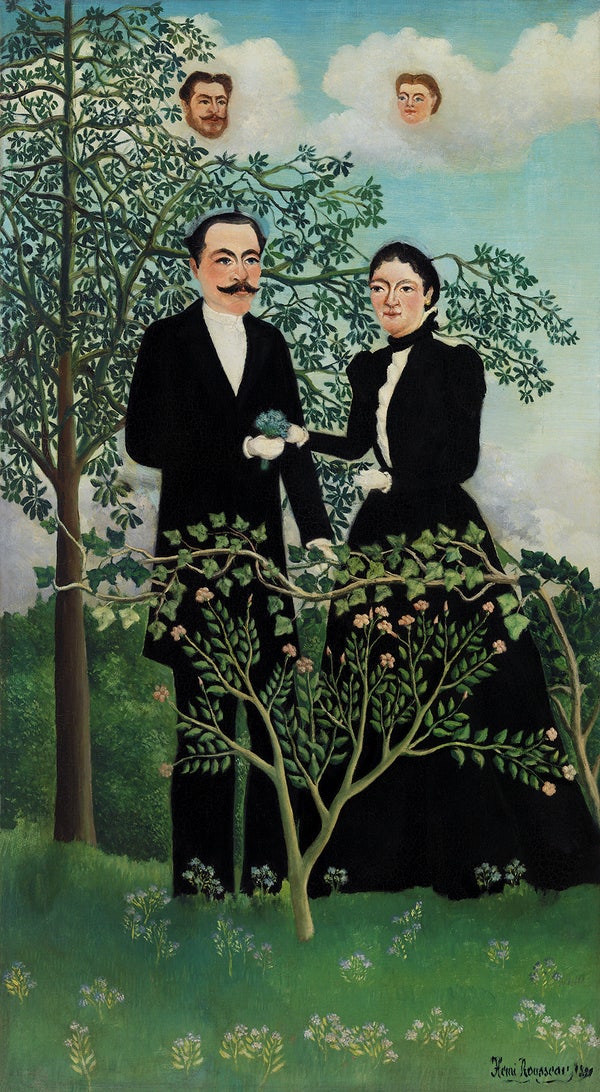
Featured Image: “The Past and the Present, or Philosophical Thought” by Henri Rousseau
The fox collaborates with the chicken.
The motorcycle collaborates with the tree.
The knife collaborates with the throat,
and you want to collaborate with me.
Your watercolors and my poems,
side by side for all to see.
You say it will be interesting and fun.
There you stand, ready to collaborate with me.
The lemming collaborates with the cliff.
The propeller collaborates with the manatee.
The wineglass collaborates with the floor,
and you’re all about collaborating with me.
Your photographs and my poems,
facing each other for all to see.
It will be experimental and fun, you say,
since the time has come to collaborate with me.
The hammer collaborates with the thumb.
The razor collaborates with the goatee.
The mousetrap collaborates with the mouse.
Are you sure you want to collaborate with me?
Your poems and my blurb,
together in a chapbook for all to see.
You say it would make you feel better.
I see why you want to collaborate with me.
Read More

Preface to Making It Up
By Ron Padgett
Featured Image: “Antique Illustration from The Grammar of Ornament” by Owen Jones
I don’t remember who suggested the idea of an evening of spontaneous poetry collaborations by Allen Ginsberg and Kenneth Koch, but I think it came up during a taxi ride the three of us took, six or so months before the event, in which Allen and Kenneth started joking about and even parodying each other’s work. This playful conversation culminated in their public performance of Wednesday evening, May 9, 1979, at the St. Mark’s Poetry Project.
As the date approached, both Allen and Kenneth—who had never taken part in such an event—started to express some misgivings, as did I. A month before the event, I wrote to them, “I’ve been wondering about some details of your May 9 extravaganza here, and I thought I would ask you about the format of the evening. Do you want to set any rules? Or would it be better to set none and just let fly?” Both poets thought it best to have some structure to work with, but they left it up to me. So I drew up a list of poetry “assignments” to surprise them with.
Read More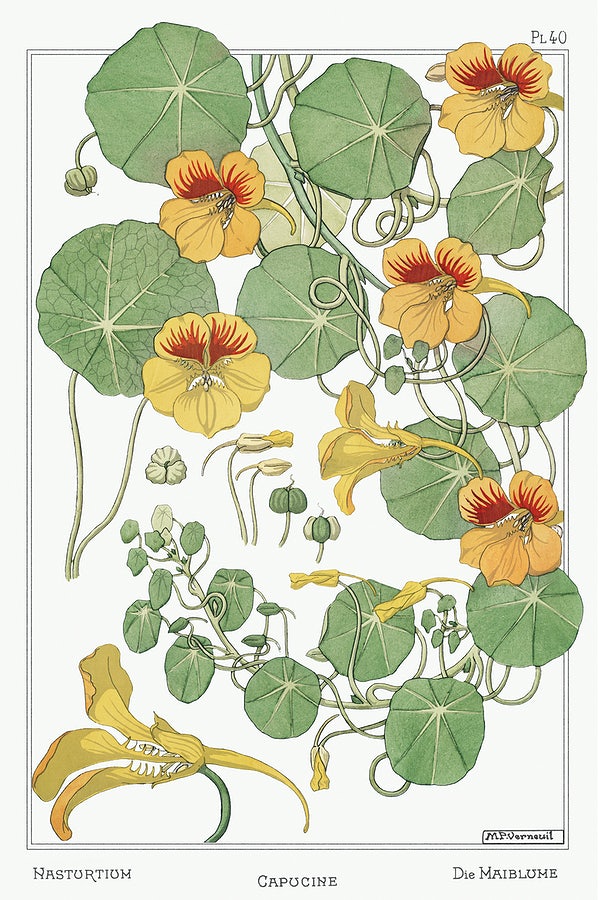
Some Remarks on Collaboration
By Tom Whalen
Featured Image: “Capucine” by Maurice Pillard Verneuil
- I’m trying to think what isn’t a collaboration, but when nothing comes to mind, I wander about my Arbeitszimmer, scanning the shelves, lost in thought, before returning to my remarks concerning activities requiring, if not a multitude, at least one other mind.
- “To be a fly on the wall,” thinks the narrator of a nonexistent novel on her way to her mother’s wedding to a fifth husband, clear indication the mother knows a thing or two about collaborations.
- Translators raise their heads from dictionaries now and then to ponder how to translate, for example, a sentence by Robert Walser that I’m convinced demanded of him a close collaboration with nature: “Den Fischen fehlen die Arme.” Should I and my more experienced collaborator (Susan Bernofsky, in this case) choose the concise “Fish lack arms” or more closely mirror the music, e.g., “On fish one finds no arms”?
- Proust in one hand, Ionesco in another, I strolled along the Champs-Élysées as if I were the saddest flâneur on the road to everything.

Collaboration Queens (Or How the Chapbook, ABBA: The Poems, Came to Be)
By Denise Duhamel and Amy Lemmon
Featured Image: “The Seasons” by Alphonse Maria Mucha
As we wrote “Class Action,” our first poem together (alternating one line at a time, on email), Amy noticed we were writing in abba rhyme, which gave her the idea of writing tangentially about ABBA, the pop group. This lucky association led us to begin a series of poems with two constraints: the stanzas had to be written in abba rhyme, with a mandatory mention of ABBA, the singing group, in each. As we built up our confidence, we sometimes added a third constraint. In one poem, each line had to end in a long “o” sound; and in another, each line had to contain a palindrome, as ABBA is a palindrome. Although we stuck with the rhyme scheme (with allowances for occasional, or more-than-occasional, slant rhymes), we liberated ourselves from metrical restrictions. While Denise is comfortable in the prose poem and free verse, Amy tends to write almost unconsciously in a loose iambic pentameter or tetrameter. But we didn’t insist on uniformity of rhythm. This gave us the leeway to go with the flow, quoting lyrics or song titles, creating dialogue between characters, and injecting other bits of pop culture into the poems.
Read More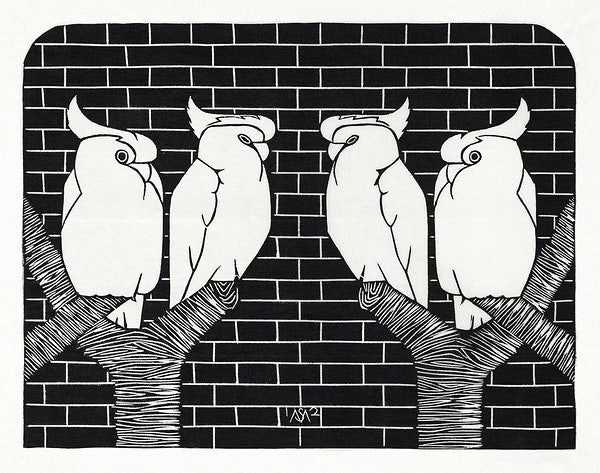
Changing the Record: A Poetry Collaboration in the ’70s and ’80s
By Ron Horning and David Lehman
Featured Image: “Four Crowned Cockatoos” by Samuel Jessurun de Masquita
We met late in 1972, when we lived two blocks from each other on Riverside Drive. Though Ron’s room in his apartment was easily quieter than David’s room in “The Barracks,” thus named because of the decibel levels achieved by the inhabitants (David’s roommates were a jazz disc jockey and poet, a veteran of the Marine Corps just back from Vietnam, and a TV-watching, football-twirling specialist in East Asian studies) and their many guests, Ron’s room was also less private, more subject to interruption, and did not have its own bathroom. The first poem we wrote together was written at the Barracks, and so were most of the others in 1973 and 1974. From almost the beginning, the idea was to write a book of poems, but the book never really gelled, either because there were too many other things to think about or because we didn’t know what, if anything, the poems and lines we were typing and writing added up to. We had a working title, or at least we toyed with some candidates. (A Phone of One’s Own captured David’s fancy for a time.) Many poems we started were left unfinished, and even the attempt to write poetry together stopped abruptly in 1975, when we both married for the first time, David in January, Ron in July.
Read More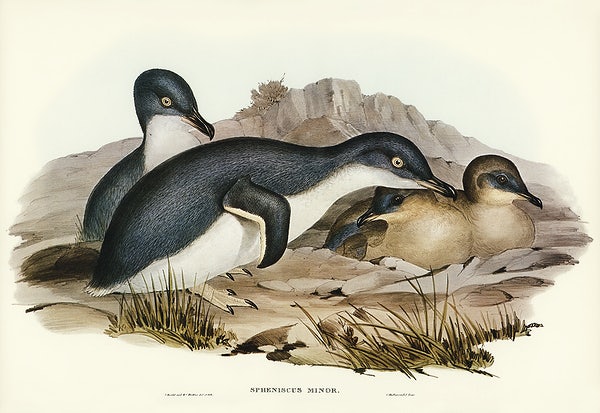
The Story Behind “Penguins”
By Patty Mitchell
Featured Image: “Little Penguin” by Elizabeth Gould
Located in Athens, Ohio, Passion Works Studio supports collaborations between artists with and without developmental disabilities. The studio began as an experiment in 1996: what would happen if I set up a collaborative art studio within a sheltered workshop, a supported work place for people with developmental disabilities? A grant from the Ohio Arts Council allowed us to put the idea in motion, and through additional grants and sales a second professional artist was added to the staff, Wendy Minor. Wendy and I brought to the table our understanding of materials and our art process; the participating individuals brought with them their unique way of experiencing the world and a natural ability of fearlessly jumping into art-making. For fifteen years now, Passion Works has offered a relaxed and informative environment for people to collaborate and investigate ideas. The synergy of excitement and discovery is conveyed in the resulting artwork: playful, vibrant, unpredictable.
Read More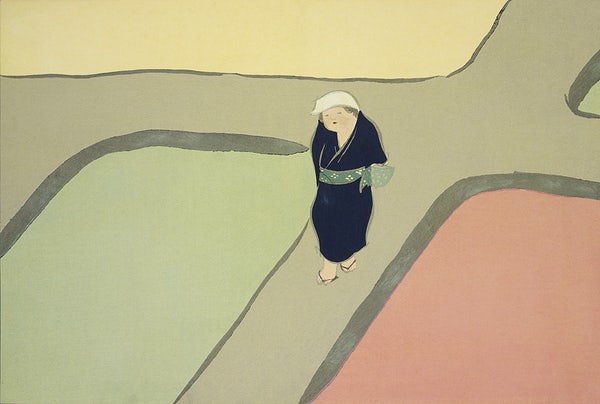
Where the Path Leads: Collaboration, Revision, and Friendship
By Lawrence Raab
Featured Image: “Path Through the Fields from Momoyogusa-Flowers of a Hundred Generations” by Kamisaka Sekka
Many years ago—and I really don’t want to remember exactly how young we were—Stephen Dunn, a friend but not yet a collaborator, was traveling from New Jersey to Yaddo, the artists’ colony in Saratoga Springs, New York. He stopped for the night at our house. During the course of the evening I recall bemoaning the fact that I hadn’t written a poem—maybe not even tried to write one—in over a year. I had writer’s block, I announced, as if it were an identifiable disease. I had not yet learned the wisdom of William Stafford’s famous—or infamous—remark that there is no such thing as writer’s block; all you have to do is lower your standards.
Of course Stafford didn’t mean you ultimately aim for less. You just have to give yourself a break to get started, and accept whatever occurs to you because “something always occurs” to us, as Stafford says in his essay, “A Way of Writing.” Let the act of writing carry you beyond your first inevitably dull words, to better words, better sentences that may give you access to something waiting in your mind “ready for sustained attention.” This is the writer’s daily work—putting some words down, then rearranging them, adding, then subtracting, looking for a shape, a focus, “the poem’s informing principle,” as Stephen Dunn puts it in his wonderful essay, “The Good, the Not So Good.” If that’s inspiration— and I like to think so—it’s earned by the work of writing, not given as a gift of the gods, like an autumn leaf fluttering down significantly on the poet’s head.
Read MoreNew Ohio Review Issue 10 (Originally printed Fall 2011)
Newohioreview.org is archiving previous editions as they originally appeared. We are pairing the pieces with curated art work, as well as select audio recordings. In collaboration with our past contributors, we are happy to (re)-present this outstanding work.

The Last Speaker of the Language
by Carol Anshaw
Featured image: Fernand Lungren. In the Café c. 1882-1884. The Art Institute of Chicago.
All right. Here we go.
Darlyn teeters high on a swayback wooden ladder she has dragged in from her mother’s garage. From here she can reach around blindly on top of the kitchen cabinets. She has struck pay dirt—a tidy arrangement of small, flat bottles. She doesn’t have to look to know they will all be pints of 5 O’Clock vodka.
She backs down the ladder, finds a grocery bag, goes back up and tosses in every bottle she can reach. Then she moves the ladder further along the way and clears out the bottles above those cabinets. She pours the liquor down the drain in the sink. 5 O’Clock is not for the amateur drinker. When she has the presence of mind, Darlyn’s mother filters it through a Brita, then mixes it with lime juice and ice and ginger ale, her version of a Suffering Bastard. After a while, though, she drops the lime and the niceties and in the end skips even the glass.
Read More
Layover
by Erica Dawson
Featured image: Henri de Toulouse-Lautrec. The Englishman (William Tom Warrener, 1861–1934) at the Moulin Rouge, 1892. The Metropolitan Museum of Art.
I’ve half a mind to make a move.
I stayed in Archer City where
I made Larry McMurtry proud
by downing one too many shots
of ice-cold vodka, tumbler-sized,
then yelping all alone to “Sweet
Home, Alabama” while the band
reprised “Knockin’ on Heaven’s Door,”
packed up, and quit the Legion dance.
I thought I didn’t know that song.
I two-stepped with a cowboy, kissed
a Yankee (wrong), regretted it,
and found my cowboy once again:
the Yankee looking like a young
Paul Newman and the cowboy like
I’ll bed you, hard and hot in jeans.
What was it in the Texas air
that brought Delilah out of me?
Was it the quail and wild hogs?
The memorial on the Court House lawn?
The BBQ cooked from a cow
that tasted like a slaughtered cow?
What hiked my temperature? It climbed
the diving board and took its clothes
off, piece by piece, as if last May
were my last picture show, last chance
to sweat with strangers in a Spur
Hotel room, quaint with double beds
and Byron on the table, me
as Cybill Shepherd, starring in
her first movie as Jacy Farrow,
walking in beauty like a night
too much for such a little place
where the town Indian said she
was the town Indian; and, my
sweet cowboy said I gave him eyes,
said I was high-heeled trouble, said
I have the tendency to lead.
Read More
Entropy
by Tracey Knapp
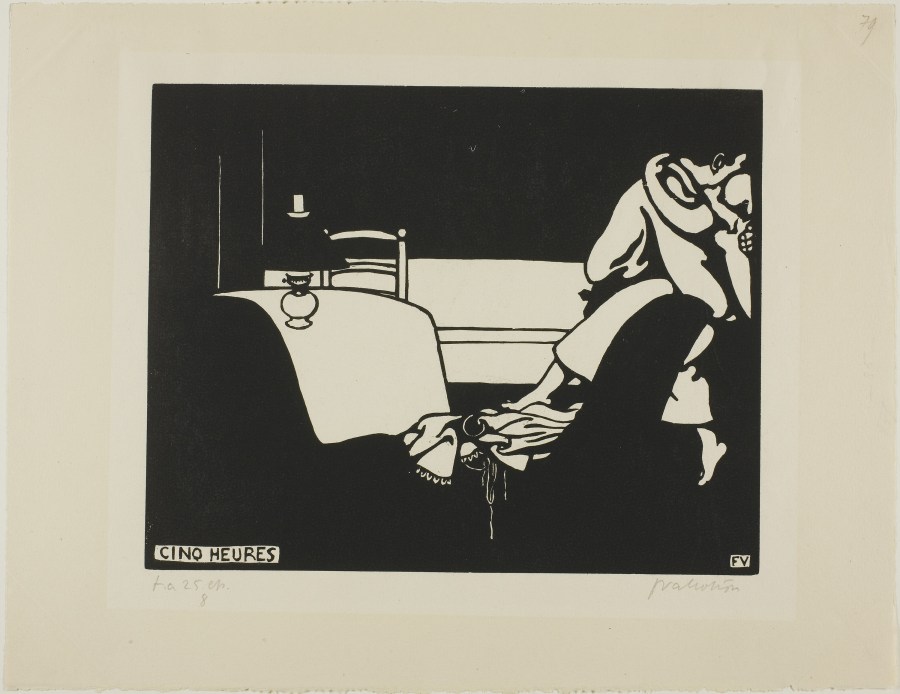
Featured image: Félix Vallotton. Five O’Clock, Intimacies VII (Cinq Heures, Intimités VII), 1898. The Metropolitan Museum of Art.
All those times I crossed the bridge to see you
and not one lap dance. We haven’t held hands
since that time in the rain forest, chanting Lord
knows what in Sanskrit. I saw my first wild boar there
but even he took off for the brush. Someone always ends
the moment. Another call dropped on your iPhone,
the cosmic forces at work. My dog sighs and stares
at my flip-flop from his pillow. At work, the office
is separated into orderly earth-toned cubes.
My friends, we gather here today
to sit exactly ten feet apart. I am exactly
one hour away from being drunk enough
to call my psychic in Tuscaloosa, two
commercials away from another headache
and Nova on TV. The universe expands, shifting
its contents accordingly. There was a time when
we were closer. Helen Keller learned to speak
by holding her teacher’s face, feeling the words form
and fall out of her mouth, the throat buzzing with thought.
I also like to touch people while they talk,
but not about professional sports. I love
and hate eye contact, don’t you? One glance
from the Girl Scout and I get the thin mints. I don’t get
all that crap about divine connection,
but there is something to be said about
a collective consciousness if you consider how
everyone likes vampires again. If I had a spirit
animal, I think it would be the wild boar.
We never talk about it anymore and I miss that
about us. The only thing that could prevent
a greater distance forming between two stars
hurtling though space would be some entropic net,
a giant wet towel. While you’re crossing
the state line on your last gallon of gas,
a streetlight deteriorates over the Safeway
parking lot. A shopping cart rolls
into my Dog Chow and the whole bag
splits open, the pellets skidding and colliding
across the pavement, two strangers scrambling
to gather them, to fill the bag together, to make it right.
Read More

Women’s College
by Kenneth Hart
Feature image: Antoine Watteau. Head of a Man, ca. 1718. The Metropolitan Museum of Art.
I didn’t think of myself as a sex offender
or as someone whose sex was offensive
until I walked across the campus
of the women’s college. I tried to be
as inconspicuous as possible, looking away
when someone jogged past with a scrunchy holding back her hair
and breasts bouncing just a little beneath a sports bra,
making believe I had some business there
by putting a purposeful stride in my step.
I know I carry the chromosome of hatchet murderers and rapists,
it’s no wonder my hands felt like mallets
at the ends of my arms.
After awhile I sat on a bench
and tried to look at the oval pond,
the trees and manicured shrubbery in front of the study hall,
as passing girls gossiped in the late-January sunlight,
some of them tanned from winter break, or slightly heavier
after a month of their mother’s cooking.
So I got up to leave,
making sure my shoulders looked slumped and unathletic,
a little afraid of myself now,
and massively unaware
that one of them might consider my presence
a welcome relief.
Read More

When It’s That Time for Piranhas
by Michael Derrick Hudson
Featured image: Utagawa Hiroshige. Swallow and Wisteria, mid-1840s. The Metropolitan Museum of Art.
Everything has already blossomed: my neighbor’s wisteria
has gone hog-wild across the ragged frontier of
our mutual fence, the soft green tendrils
of it violating international borders
and breaking treaties. Achtung! So let me tell you about
my neighbor’s wife: she’s delicious! And every morning
I hear all the birds in Fort Wayne, Indiana, go
Yippee-yee! Yippee-yee! Which is how spring jibber-jabbers
while her husband blows the leafy detritus
off their depilated lawn. Something’s missing. I want to be
indigenous with her, something somehow prehistoric—
I want her in Brazil. I want a quiver full of spindly arrows
to fetch our breakfast’s blue-tailed skink or
supper’s three-toed sloth. I want ritual scarification, coherent
rites of passage. I want grandpa’s thighbone
whittled down to a splinter
and dangling around my neck.
I want to help her stitch banana leaves, scorch
grubs against a rock. I want her to smile at me like a jaguar,
each incisor filed to a point. I want poisonous frogs, seashell
currency, enemies who make sense, a copper
plug through my lip. I want
a shameless squat. I want mumbo-jumbo witches to shun and
screeching ghosts to appease. I want her to take me
down to the river where we’ll knot and
inch our way across. I want her to trust me to be the lookout
for piranhas. I want to know when it’s that time for piranhas.
Read More

Sixteen in Vegas
by Anastasia Selby
Featured image: Edvard Munch. The Girl by the Window, 1893. The Art Institute of Chicago.
It’s Vegas and I’m sixteen years old. I’ve been playing in the arcade for hours; I’m leaning on the console of Mortal Combat, pushing the quarters my stepdad has given me into the slot one after another, wearing the tips of my thumbs down with their ridged edges. I’m bored as hell and my parents have abandoned me in this wasteland, I can practically see the tumbleweeds and hear western music as I walk across the patterned carpet. I pass all the men and women with their heads almost touching the bright lights of the slot machines, their hands like lobster claws around the levers, as if they’re waiting for the secrets of life to come pouring out when they hit the right combination. The secrets must be what they see on billboards, what they see in magazines. The arcade smells like the sweat of children and sounds like broken glass.
Starting at the Excalibur, a gaudy Disney imitation that should have been torn down years ago, I walk from casino to casino, reveling in the transition from air-conditioning to the surreal heat that cloaks everyone who ventures outside in a thin layer of plastic wrap. I stare back at the men who gawk at me on the sidewalk as I walk past them, men who are over twice my age and probably have daughters half my age. They must give their daughters baths and put them in their pajamas at night, patting their heads as they tuck them into bed. I can’t remember one time my father actually tucked me into bed. He left when I was two.
Read More
After Rosenkavalier
by Natania Rosenfeld
Featured image: Goya (Francisco de Goya y Lucientes). Lovers Sitting on a Rock; folio 24 (verso) from the Madrid Album ‘B’, 1796–97. The Metropolitan Museum of Art.
We talked about her,
the Marschallin, only
thirty-two, and her lover,
seventeen, though the singers
were fiftyish, and we ourselves
are approaching there, though our
lives have not reached their
pinnacle. Will we ever
roar with our whole voice
and soul, cry out that way
with all life crying through us,
or will we walk on, obedient
and tired in our traces, as the round
orange sun goes down
across the long, white prairie?
In our little warm car, we drive
into the pale arms of the fields,
leave behind the mall and
the Marschallin, return to the small
town to lie under the glassy moon
and dream of a gold curtain,
of young limbs entangled,
and renunciation clad in violet.
Read More
The Ante
by Rodney Jones
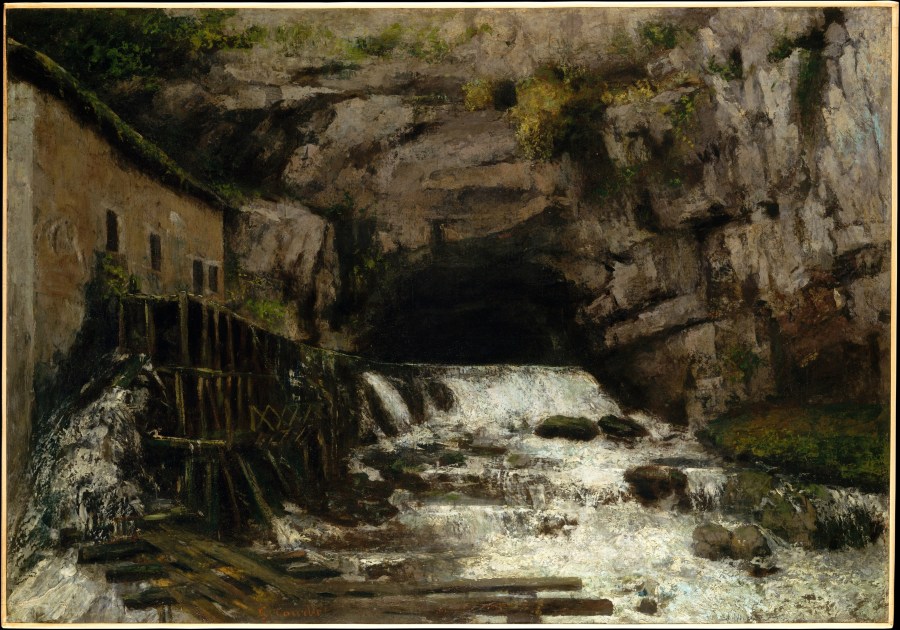
Featured image: Gustave Courbet. The Source of the Loue, 1864. The Metropolitan Museum of Art.
A few sonnets about nature and the Greek gods.
Many free-verse poems in all lowercase letters.
Huey wrote of madness, Maddox of possums.
John played the sadness of empty stadiums.
Two berets, one silver-tipped cane, tweedy blazers.
In most Natalie poems, she took off her clothes.
The year of the Tet offensive. Wallace in Montgomery.
We read James Wright, Richard Wilbur, Anne Sexton.
One Friday an ex-guidance counselor from Jasper
leapt through the window of the cafeteria, shouting
“I am the son of Jesus Christ! Behold the rapture!”
But nothing much happened in Poetry Writing 301
until Walter C. Avery wrote that a black swan,
born in the infralapsarian brain of a garbage dump,
would crack the codes of the Southern Baptists.
And for this jack-surreal, mildly apocalyptic truffle
was taken for near-genius material, practically
a second Edgar Allan Poe, until Sam Maisel
submitted his “Poem for The Worksheet Typist,”
which made everyone consider how scandalous
it must have seemed for her, a local woman,
a seamstress, and mother of Christian athletes,
to run across “I know you think you’ve seen it all before,
but this is duck rape, feathered love.” And some
in the critique afterward, praised the line-endings;
one person even mentioned “The Second Coming,”
which, admittedly, made me blanch with envy,
so I wanted to say something about how
sometimes the subject is not what you think
or the ones you imagine you are talking about
stand abruptly and begin to talk back to you,
but spring was bearing down on the workshop,
ripping out pages, grinding the opinions to nubs.
So much energy in the streets—demonstrations,
happenings, awakenings—so many instances
of sudden and involuntary enlightenment,
though mostly my friends and I spent our nights
on Sixth Street drinking beer at The Chukkar
or crouched in a huddle around a record player.
By the time I thought of Sam’s duck again,
May had slipped into June and June into July,
and what is poetry in a copper tubing factory?
A cloud would fan out around the tubes
as the crane lifted them from the soaping vats
after they had softened in the furnace.
My job was to crimp a point on each of them.
Then the next man would carefully run them
through a die. Down the line I could see
the process repeating: the furnace, the point,
the die—the tubes and men diminishing.
All night the saws screeched and whined.
The pointers clattered. The press roared.
That was the beauty of it. You could sing.
No one would hear. You could say anything.
Read More

The Rush of Losing
by Daniel Larkins
Selected as winner of the 2011 New Ohio Review Fiction Contest by Don de Grazia
Featured image: Henri de Toulouse-Lautrec. At the Moulin Rouge, 1892–1895. The Art Institute of Chicago.
10. The race is over before it ends.
7. Tim leans forward. His blue dress shirt is untucked, unbuttoned, and his stomach shoves the undershirt out of his pants. When he loses it’s like a win, because when he wins he doesn’t want to keep on betting. Losing answers the question, Why continue? When he loses, he likes to think he can parlay that into a victory, persevere to make up for the loss.
All the TVs are muted. In his shoes he can feel the rumble of Holland Tunnel traffic from a couple blocks away. His twin boys are twelve and his fingertips are black. His nails are short and dull. His wife Meg used to have monthly manicures and the designer kitchen she wanted, but no more would she get a stupid room for hanging pots and pans and whatever else she liked to hang from racks and nails.
Tim leans forward. He has a hangnail, and it bleeds and stings, and his left hand balls into a fist on his thigh and his other wraps around a rolled-up Racing Form. It’s a tool, a bat, a weapon.
Read More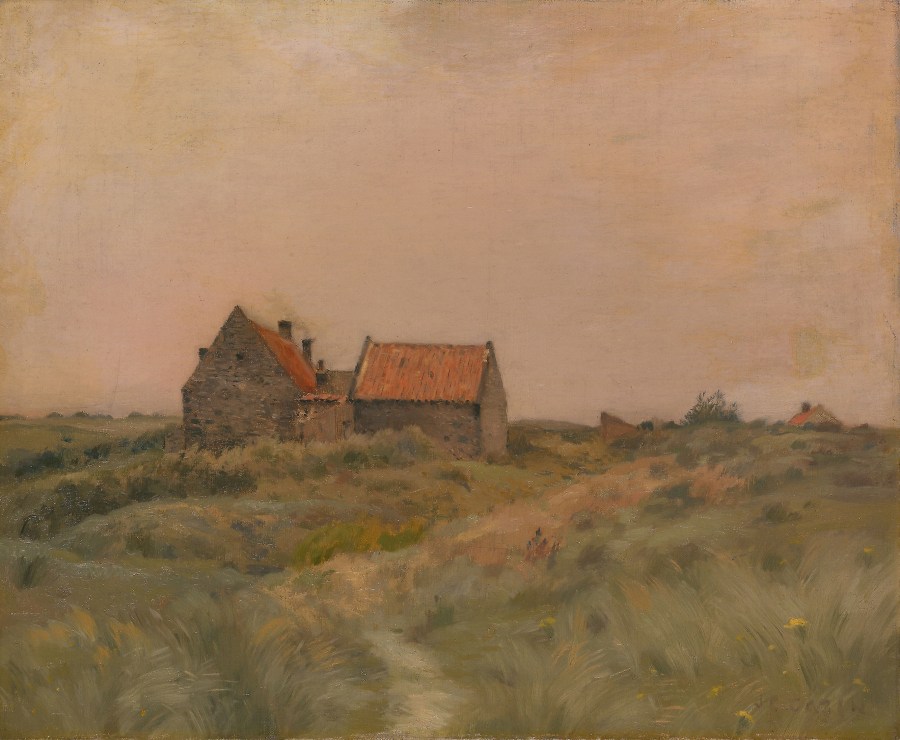
Times Pieces
by Susan Morehouse
Feature image: Jean Charles Cazin. October Day 1890-1891. The Art Institute of Chicago.
My husband is walking out the door with an expensive watch, carrying it in the box it came in. “Are you getting it fixed,” I ask.
“I’m going to see what it’s worth at the pawnshop on Main,” he says. “You could just get a Timex,” I say, “if you want to know what time it is.”
“Sure,” he says, “or I have that watch you gave me. It just needs—”
“Batteries,” I say.
“Yeah,” he agrees, “and a band.”
The expensive watch was a gift from a man whose biography he wrote on spec, a book no editor has taken yet, even though Henry, the man behind the success of a major tabloid, implied it was a done deal. That was before the financial collapse. Henry gives these watches to anyone he needs a gift for. He buys them in bulk. Need something for a sheik? Here’s a Millage.
We’re broke.
Read More
On the Strand
by Dave Kim
Feature image: Edgar Degas. Beach at Low Tide (Mouth of the River), 1869. The Art Institute of Chicago.
My mother’s boyfriend was a man named Bang. I never learned his first name. He’d been an officer in the Korean army before coming to the States, and he would yank me out of bed at six-thirty every morning to do jumping jacks. I was a doughy nine-year-old and he was trying to make me leaner and tougher. If I got angry, he would dare me to hit him and stand up for myself, get it out of my system. On Sundays we’d go to his boxing gym to watch the men pound each other to pieces, which terrified me at first and then made me dream of days when I’d be big enough to put on gloves and whomp Bang in the gut. I needed a good ass-kicking, he would tease me in his throaty Korean. Anytime I wanted, I could challenge him. Mom didn’t get involved.
The three of us went to Santa Monica Beach one Saturday afternoon to ride our bikes on the Strand. Bang would take me fishing on the pier sometimes and when we rode past it that day, I thought about how much I would rather be out there with a basket of calamari and a cherry Icee, watching our poles nod on the railing. It was one of those perfect afternoons when the California coast looked way better in real life than on the glossy postcards they sold on the boardwalk. Couples were stretched out on the sand, half-hidden under candy-colored parasols. The sky was ablaze in orange light. But I didn’t care about the scenery. All I really saw was this endless bike path and its dashed yellow divider. The back wheel on my hand-me-down Schwinn was grazing the brake pad with every rotation and I lagged at least a hundred yards behind.
Read More
Saying Goodbye to Dad
by Kate Fetherston
Feature image: Pierre-Auguste Renoir. Near the Lake, 1879-1880. The Art Institute of Chicago.
My dad died alone in a VA hospital
as July sun beat without mercy into the raw
seesaw of breath busting seams between
each cell. Third spacing doctors call it
when cell walls no longer sustain
boundaries with integrity, fluid
sluices into interstitial no-man’s
land and overpowers whatever little
plans were made for a garden and some
trees. When my brothers and I got
the news and flew in from the various
places to which we’d fled, I’d just split
on my first lover after years of her
threatened suicide, bouts of drunken
depression, and refusals to take
her medicine too numerous
to recount. Her view: I’d been trained
strictly for fixer-uppers, too stupid
or stubborn to leave, but, waxing
romantic, she’d croon, “You’ll do me
for a rough old mate.” The day she smashed
my stuff into the carpet and poured
ten pounds of flour over
everything, I might have stayed for
more of the same, but I threw
crumpled clothing into my pack,
startled when she whispered, “I’m
just like your crazy
old man, aren’t I?” I didn’t
answer because we both knew
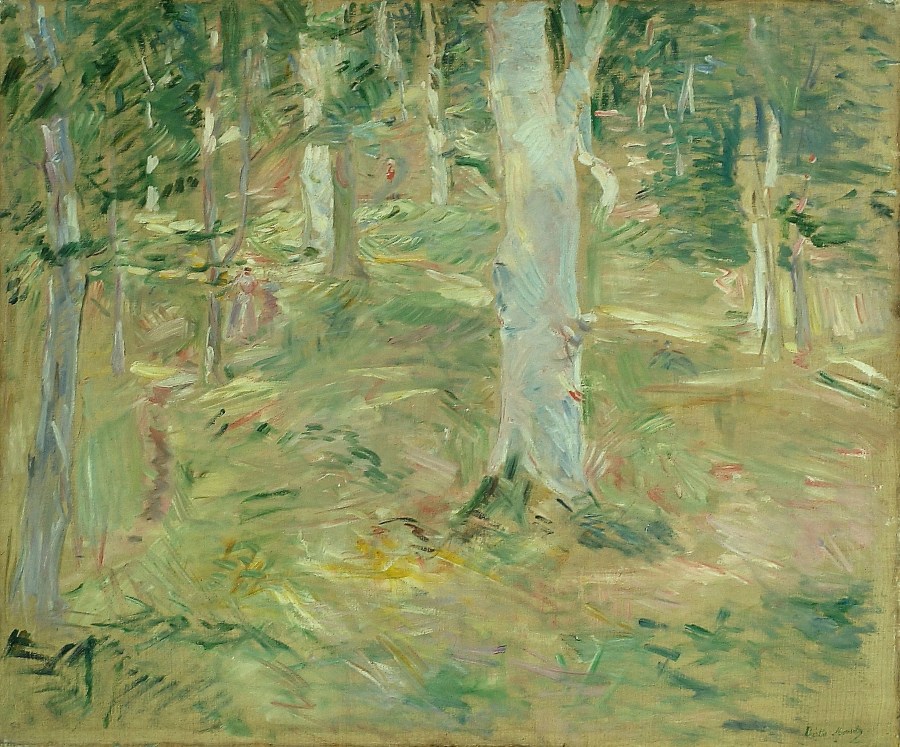
Home Movie
by Mark Kraushaar
Feature image: Berthe Morisot. Forêt de Compiègne, 1885. The Art Institute of Chicago.
Saxophone, and trombone, trumpet,
trumpet, trumpet. And there’s Roxanne
and Dick, and Betty Mayfield and the Laurie girls.
And there’s George Betts on clarinet.
Of course, it’s so jerky and grainy though,
which is just as it should be,
and here we suddenly actually
are, or, and isn’t that
Malcolm Sproul and Claudia French and isn’t that,
or wouldn’t that be Dick Benck, and there’s
Kit Powell, and Kathy Frey.
And now, somehow, look,
someone in somebody’s yard,
a boy in a foot-deep plastic pool,
skidding sideways and pitching forwards,
euphoric in jaunty fedora, a giddy private eye
in blue shirt and shorts,
waves once and as his mother laughs
she turns, and with her, wistful, and trying,
and troubled by longings, here’s
Jim Jahovic with my best
friend’s strange father Dr. Callahan, and quickly
someone else, and someone and someone and then,
no, yes, that’s, that’s What’s-Her-Name,
judicious and afflicted, nice enough,
yes, and yet, there’s a way she tips forward,
or inwardly anyway, as if picking up the faintest
oracular tappings.
There’s the Roundies and the Levi boy.
And there’s that flirty, sparking Mrs. Archer—
and I want to run it all again.
Oh friends, where were we going
in that shaky dawn?
Read More

Maritime
by Mark Kraushaar
Feature image: James McNeill Whistler. Nocturne: Blue and Gold—Southampton Water, 1872. The Art Institute of Chicago.
My wife was nodding, Yes, sure, and, Yes,
and I was thinking of my parents, their sadness
and silence, their every evening’s weeping,
whispery buzz beside the stove.
My wife was nodding, Yes,
and leaning forward when the pastor said, You’re
like two ships passing in the night, and he seemed so
pleased I thought, So one’s a brig-sloop the other a tug?
Or one’s a tanker the other a trawler?
Troop ship and submarine?
Grain barge and gunboat?
I was quiet though.
It was August,
and there were two fans working,
and I thought of those salt-washed gray gulls
with their weird pink feet, and I thought of moonlight
shooting down the starways and cooling the decks.
I thought of two cruise ships next,
couples waving by the railings,
the faintest, farthest sounds of bands and laughter.
But there was nothing funny here.
He was talking or maybe she was, but
here we were, the two of us, our long, horizontal
journey almost over, no frenzied waves,
no reckless wind.
We were quiet, and she was crying,
or we both were, but we were perfectly still.
Read More

Hurricane Season
by Julia Jackson
Feature image: Winslow Homer. Breaking Storm, Coast of Maine, 1894. The Art Institute of Chicago.
Itchy in November, right before Thanksgiving. It was my first winter sober, when you were living on the top floor of that six-story apartment building overlooking the river, back before the neighborhood was converted into condos.
“Hurricane season,” you said when you saw me looking out your window in that blank way. “When the temperatures drop, us drunks get restless.”
Your hands got busy stacking up wood in the fireplace. I’d seen people who had come into the same meetings every week suddenly stop showing up, seen the way that the ones who did come back would raise their hands, announcing their day counts, differently this time. “I’ve got five days.” “Nineteen days.” “I’ve got forty-one days back,” they’d say, the “back” added to show that this wasn’t their first time at the rodeo. It didn’t look like it was any easier, though: their hands shook like any newcomer’s, their eyes wandered the rooms the same way, rabid.
Read More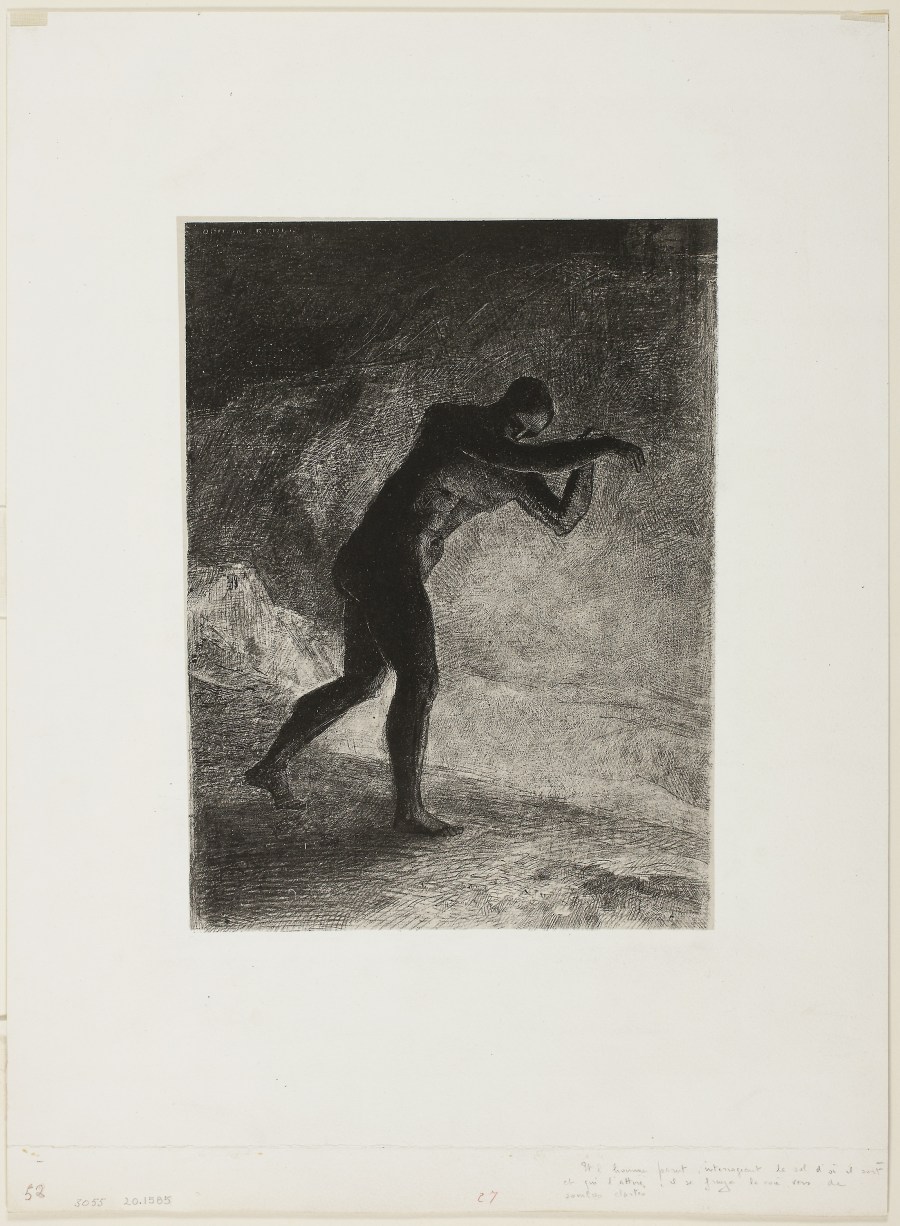
Downloading the Meltdown
by Elton Glaser
Feature image: Odilon Redon. And Man Appeared; Questioning the Earth From Which He Emerged and Which Attracted Him, He Made His Way Toward Somber Brightness, plate 8 of 8 from “Les Origines”, 1883. The Art Institute of Chicago.
Rumple of clouds at sunset, low and pink,
Underbelly of heaven in the summer slack, and me
Depressed as a backdoor detective on a case of slow clues.
I’m never lonely as long as I have my own body
To interrogate, my mind with its whips and pincers.
I buckle at the slightest threat; I confess
In the high pure pang of a choirboy singing
At some ceremonious occasion for the faint of heart.
And now the hot night, the moon cool as a bishop
In a boudoir. What you can’t get over,
You must get past. Through a haze of smoke and rum,
What’s left of me squints at the odds and ends.
Read More

In the Season of Early Dark
by Elton Glaser
Feature image: Claude Monet. Rocks at Port-Goulphar, Belle-Île, 1886. The Art Institute of Chicago.
1
The wind sassy and half mad,
The clouds knocked up with rain—
Another feral afternoon in the Midwest,
Fall, and the trees like Salome, ready
To ask, when the last leaf drops,
For my unresisting head.
2
I’m going to spring all the little traps
Set by silence
And call it mercy. I’m going to let loose
Every thought caught by its hind legs
And screaming for release.
Out of the jaws and sharp teeth,
The tongue comes, loving
The taste of its own blood, gush of words
Hurt into eloquence.
3
Gray day. Raincoat weather.
Raw wound that would weep over me,
Nasty stuff from so deep inside
It could make the scarecrows gag
Among the stooks and stubble.
Whatever I did to deserve this,
I deserve it.
4
All the numbers add up—
Mortgages, body count, Lincoln pennies
In a plaster pig my grandfather gave me.
And the years, too, though no one
Knows how many, not the saints,
Not the drugged and corrupt. I have these
Fingers to figure with. They tell me
The end is always at hand.
5
Misbegotten month
Rushing from bluster to bare bark.
The geese get out of town.
Even the seedy weeds die back,
Brittle slippage of the unloved.
I stack firewood against the stone wall
And plant the last tulips, bonemeal
In their shallow holes. Lights rise
From the windows and fall
On the dark grass, so black
My footprints sink down to the roots.
Read More

A Gift
by Patricia Ann Sanders
Feature image: Henri de Toulouse-Lautrec. The Passenger in Cabin 54—The Cruise, 1896. The Art Institute of Chicago.
It’s called the “verbal tip.”
You’re the greatest waitress we’ve ever had. We’re going to ask for you every time we come here. We had such a good time because you were our waitress. Yada yada.
Then they leave, like, three dollars on a thirty-dollar ticket.
Like I was going to call up the electric company and tell them they were the greatest electric company I’d ever had.
When I got divorced, my ex-husband was supposed to give me the Jeep. That’s what we agreed. My plan was to sell it if I couldn’t find a job right away in Phoenix. Instead, he wanted me to have the Acura. He was being generous, because it was a better car, practically new. Except that he never signed the title over to me. So I couldn’t sell it, and I couldn’t drive it, because I couldn’t afford insurance or gas. I was living in a godforsaken studio and buying food for one day at a time, stealing toilet paper from the bathrooms at the mall, with a twenty-three-thousand-dollar car parked under my window.
Read More
Solo in the Skeleton Key
by Elton Glaser
Feature image: After Gerard de Lairesse. Copies after Illustrations of Statues and Paintings (recto); Measurements for a Man’s Skeleton (verso). The Art Institute of Chicago.
Who would plant, in this stony ground, narcissus and love-lies-bleeding?
It’s too late to be young among the primitives. Winter withers the stalks.
The air reeks of it, decay and the odor of innocence gone to seed.
The time for riots and tattoos is over. Who dances the Dazzle now, or the Swerve?
Long before the armada and the asp, Antony must have tired of Cleopatra,
Those heavy breasts, that midnight skin, a name that thickened in his throat.
In the heat from eating an incandescent pepper, there’s neither passion
Nor apocalypse, just tongues in hell, just retching and the runs.
What honey comes from old drones? Forget the hoodoo and the holy water.
Pray only in Jerusalem, at the Church of Our Lady of the Spasm.
Love’s no trick of ecstasy, no lightning strike in the mind. Each new child
Struggles out, bloody and stunned, one more last chance to get it right.
Read More

One Day Your Parents Confess You Have a Twin
by Todd Boss
Feature image: Ugo da Carpi. The Sibyl and a Child Bearing a Torch, 1510-1530. The Art Institute of Chicago.
who was given up for adoption early on, when it was
clear they couldn’t manage him. It was, says your father,
the worst decision they’d ever made. (It’s you and your
parents at the kitchen table. Between you, the steam
from the teapot uncurls in a kind of breathing statuary.)
He was your inverse, your yin: When you went to sleep,
that’s when his terrorizing of everyone would begin.
He went from home to home to group home, and then
to prison, half mad, a drug-addled teen, with your name
tattooed over the veins in both forearms. “That’s when
we moved to Minnesota,” says your mother, but of course
he found you here, at the end of an abbreviated sentence,
and slit your throat while you slept. This was last year.
You’ve been dead ever since. We know this must be hard
for you to hear: but you don’t exist. You’re your own twin
brother’s obsession with you. (Can it be? Instinctively,
you reach to touch yourself about the shoulders, the neck,
but everything’s . . . identical.) It’s like a mad dream—
yes, the recurring one you’ve had since you were a child,
in which you go from door to door, trying to trade
your life for another’s, but nobody will trade, and you go
on and on, pounding, until, impossibly, you finally find
someone willing, and you wake. Your mother reaches
through the figure of steam to lift the teapot and pour
from out its only portal a little stream into her cup, her
husband’s cup, the cup in front of you. She sets the teapot
down, and now there are four apparitions dwindling there,
silken, gesturing. One of them says, We love you the same.
But you can hardly hear them as you push up your sleeves
—one at a time—and read, and reread, your name.
Read More
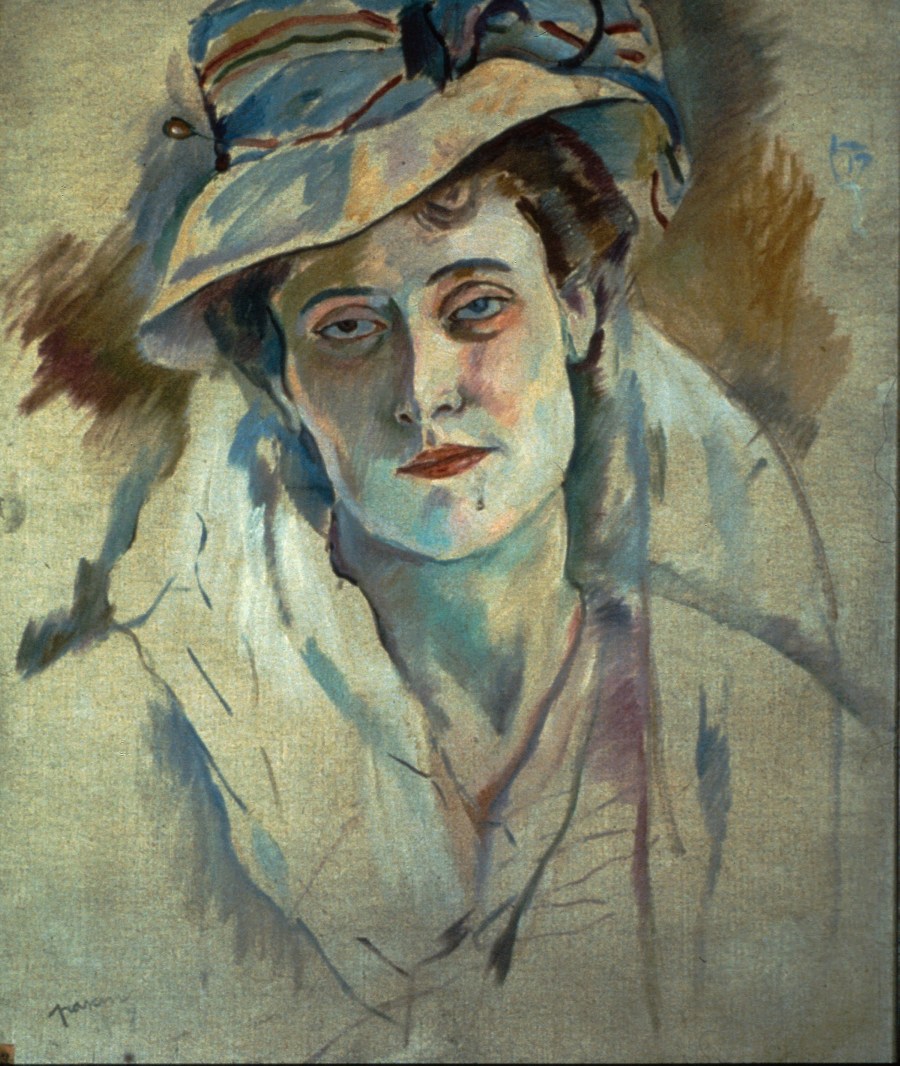
I Love Your Sunhat
by Patricia Foster
Feature image: Jules Pascin. Hermine David, 1907. The Art Institute of Chicago.
I didn’t know what to do with my breakfast tray. I’d gone through the line, had just spooned scrambled eggs onto my brisk white plate when I noticed two of the tables were already full and I’d have to sit alone. Alone. I’d only been at this artists’ colony for fourteen hours, but inevitably the old thought seeped in, “I’ll never be asked to sit with the popular group.” Now I stared not at the writers and artists dawdling over sectioned grapefruit and blueberry pancakes, but at the shiny surface of the coffee urn.
Nonsense! I nodded to my distorted reflection. What could really be wrong with eating your eggs alone at 7:30 in the morning at a table for eight? I’d eaten alone many times in the last ten years at my home in Iowa. And I was way too mature—too old, I didn’t dare say—for these sudden fits of inadequacy. I shifted my gaze to the window where light shimmered above the crepe myrtle, where, in the distance, horses grazed and cows lumbered across the driveway. As I turned to pick up a glass of orange juice, I heard a trill of laughter from one of the tables and all my newfound certainty slipped again: sitting alone was a curse.
Any normal person would have assumed that being “new” to the group, you should give yourself a few days to acclimate, to get to know people, to talk to the tall, gregarious composer dressed in plaid shirts and khaki shorts and the small, clever woman with red hair who spoke so softly. Any normal person would have plunged into small talk, would have laughed when others laughed. Instead, anxiety charged through my body, wreaking havoc with my girlish hopes for friendship while an abject loneliness loomed above the coffee cups. What would I do? How would I survive?
Read More
Elegance
by Fleda Brown
Feature image: After Luca Cambiaso. Sibyl in the Clouds, after 1570. The Art Institute of Chicago.
I thought I had hold of something elegant, a luminescent glow
on the lake, a flicker’s flash of headdress high on the tree.
I thought I heard a conversation from over water, someone saying
laissez faire, or Toulouse Lautrec, but it was only guys fishing,
a mishearing that came to me like a ray of light through stained glass,
a shimmer like a fine line of Milton’s, or a landscape by Monet,
applied in layers.
What I wanted was something privately
apprehended, something slowly and privately understood:
elite, yes, I admit it.
A pontoon boat came by and I remembered how old I am,
how I would rather be on one of those, studying the accommodating
landscape as if it were a museum, than on water skis, for example,
terrifyingly public and sudden, which is why I’m fond of
the Turneresque, or of an aspen leaf, half-unhinged over and over,
a sibilance of rhythm that works the atmosphere the way
Noah wavers the sailboat rudder back and forth to inch toward
the gust.
I don’t know the name for this maneuver.
And when the wind completely stops, there’s the small slurp
against the side of the boat that’s exactly what I mean,
the delicacy of the mundane, observed
and properly incorporated in service to the whole.
Another example at present: the gull has adroitly
caught in its beak the tiny bass Noah just tossed back,
and is carrying it flapping, sunward.
Read More

Spring Cleaning
by Laura McCullough
Feature image: Vasily Kandinsky. Houses at Murnau, 1909. The Art Institute of Chicago.
When we moved the couch
we found the pumpkin,
the tiny one we’d picked that day in the run-up to Halloween
with the kids at the apple-picking farm.
It was small to begin with, smaller than an apple,
and now it is desiccated
though not as much as you might imagine;
it’s top-sunken, and wrinkled, the bottom flatter
but the whole of it soft
as if it might be full of rot or even of crème,
as if you might pry it open
along one of the long wrinkles or fissures,
that autumn orange color gone pale,
and out might come some wonderful and unexpected thing.
I don’t pry it open, but can’t bear to throw it out.
Instead I place it by the little handle of its stem onto the mantel.
It is happy there, and I too feel happy,
a little survivor, not blazing,
but brilliant in my still-here-ness,
a bit proud of myself.
In spring I can never remember fall
and I talk myself through the laughing-at-you days of spring
that never deliver what they promise.
Only July gives you everything.
Then August begins to take it away.
And there’s not enough to lose anymore.
Which is why we always pick so many more apples
than we could ever eat, bags and bags full,
and why so many will go bad,
that sticky odor coming up from the produce drawer,
the ooze that always gets on your hand
when you reach in without looking.
Read More
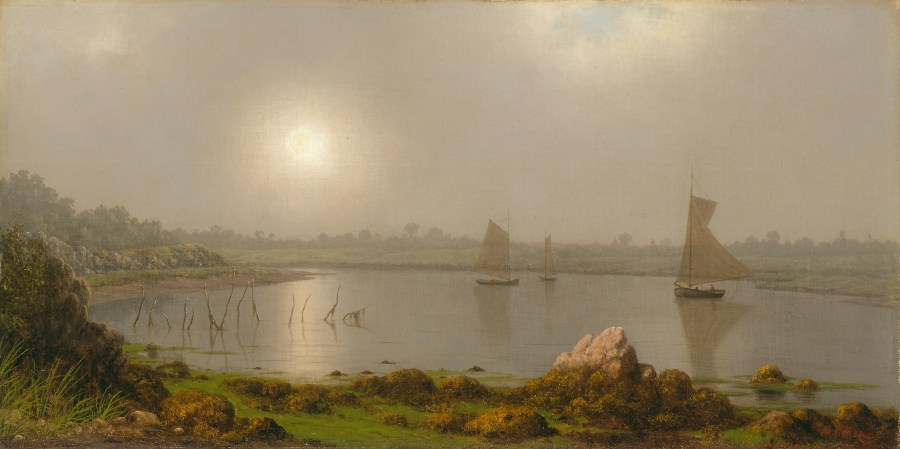
The Truest Thing
by Emily Nagin
Selected as runner-up of the 2011 New Ohio Review Fiction Contest by Don de Grazia
Feature image: Martin Johnson Heade. York Harbor, Coast of Maine, 1877. The Art Institute of Chicago.
In January, Nancy burst out laughing during the Shapiro funeral. She started laughing during a eulogy, though the eulogy itself was not funny. It was about deer hunting. The man giving it was stocky, red-cheeked, and blond, his buzz cut so close that from a distance, he looked bald. He spoke directly into the lectern, as if it had asked him to recall his father’s life. From her spot at the back of the chapel, all Nancy could see was the top of his head.
Her coworker, Lenny Faberman, sat across the aisle from her. Out of the corner of her eye, Nancy could see him fidgeting with his cufflinks. Last week, Lenny had caught Nancy crying while she embalmed an old woman. He’d stood in the basement doorway for a full minute, then said, “Did you know her?”
Nancy sniffed and wiped her eyes on her upper arm. She shook her head.
Read More
Traverse City
by George Bilgere
Feature image: Odilon Redon. Still Life with Flowers, 1905. The Art Institute of Chicago.
On my way to the conference in Traverse City
I drive by the toy lake where my family came
for summer getaways from steamy St. Louis.
The tiny cottages on the shore are still there.
There is the white sand where I played with my sisters
and learned how to swim from a teenaged lifeguard
whose beauty put my child’s mind in confusion.
My mother sat at a card table with her friends,
smoking and playing gin rummy. Weekends,
my father flew up from the mystery
of his job and his life without us.
My father dead now, my mother dead,
along with the friends she played cards with.
My sisters are middle-aged women,
children and divorces behind them.
I am older than my father ever was.
Yet there are the cottages and the beach
where we played with our buckets and shovels,
as the children on the sand are playing now.
No one can explain this.
Read More
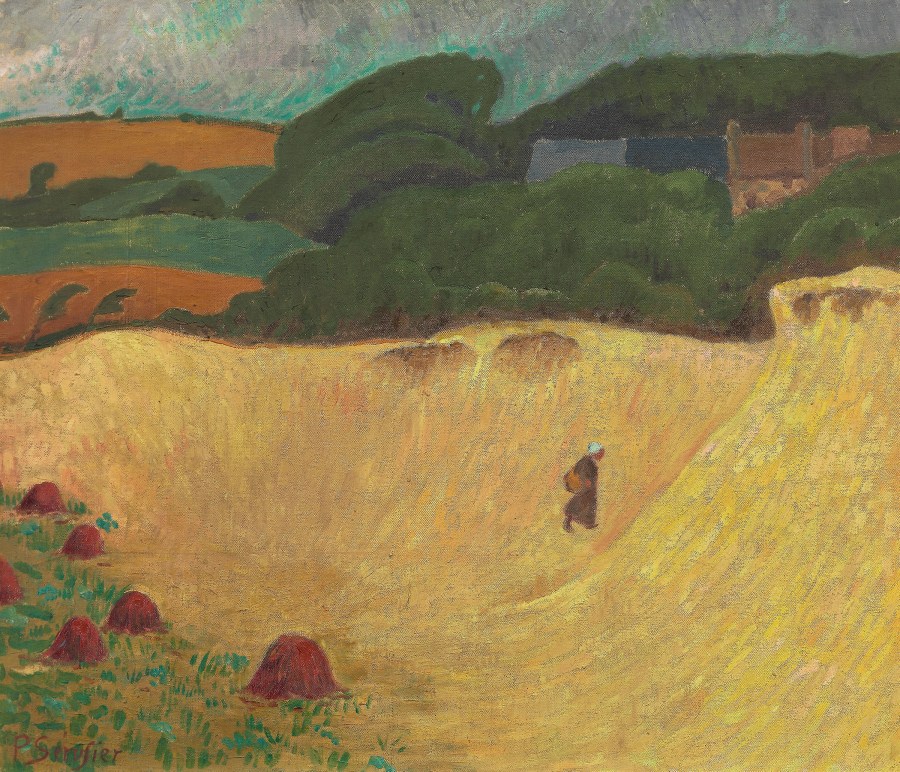
Journal
by George Bilgere
Feature image: Paul Sérusier. The Beach of Les Grands Sables at Le Pouldu, 1890. The Art Institute of Chicago.
Now we’re on this tourist island and I am going to rent a golf cart.
That would be a good way, a very good way, to start a novel.
But this is not a novel, it’s my life.
It must be written down so that later, when I’m old,
barely able to walk around whatever fearful place
I finally end up in, I’ll look in my journal
and there will be my writing,
my own hand, bolder and darker than the trembling scrawl
age has dealt me. I will stand at the window
looking at the new kinds of cars—mostly Chinese, I’m guessing—
zooming past in a world I no longer get on any level.
I will think about the 58-year-old self
who rented a golf cart that day,
his beautiful young wife beside him
as he talked to a nice Mexican guy named Ernesto
about insurance and late-return policies,
and not one of us—my wife, Ernesto, me—
recognizing the enormity of this, the sorrow,
the hugeness of the moment
in all its beautiful ordinariness
as it leaned so temporally,
so irrecoverably against the void.
And I will stand there weeping impotently.
I can see it coming. Already I’m prone
to saccharine effusions, and it’s only going to get worse with age.
I write this down in my journal: saccharine effusions—don’t worry about them.
Which will make my 88-year-old self smile,
then weep all the harder.
Read More

Royalty
by George Bilgere
Feature image: Odilon Redon. The Beacon, 1883, reworked c. 1893. The Art Institute of Chicago.
So this young couple, overweight
and seriously tattooed, comes into the café,
and each of them is actually wearing a baby
in one of those tummy-papoose things,
and they have two enormous dogs
designed to kill elk and wolves,
not sit under the table at a coffee shop,
and as I watch them smile at their babies
which are now screaming bloody murder
while the great slobbering mastiffs
begin earnestly licking their own privates,
something terrible happens to me:
it’s like The Manchurian Candidate,
when Lawrence Harvey suddenly realizes
the reason he’s been acting so strangely
is because he’s been brainwashed by Soviet agents:
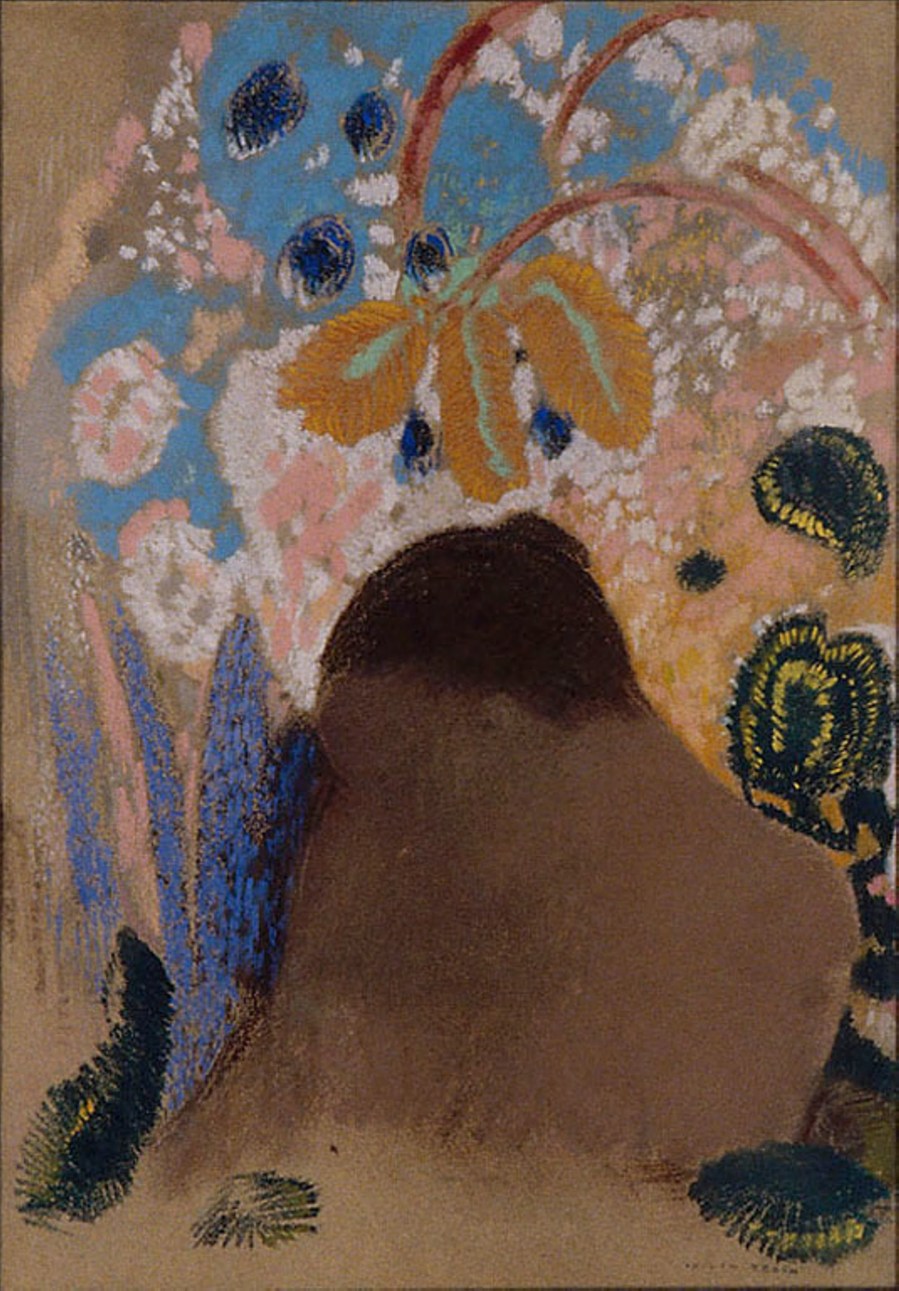
The Usual Way
by Sydney Lea
Feature image: Odilon Redon. Ophelia, 1906. The Art Institute of Chicago.
Our bus streaks bullet-fast by the soaring Crowne Plaza Hotel
and the sundry Hartford insurance companies’ towers
where millions of dollars are made and lost,
for all I know, in an hour.
I don’t care. I’m searching for something else as I cross
Connecticut for New York City to greet my daughter’s
newborn twins. We should think of a child
as constituting the highest form that spirit can know,
and I’m headed south to witness such spirit, twofold!
Still I’m petty, comparing myself to the mannerless
couple—young and loud—
who bellow laughter from a seat behind me, perhaps at the latest
YouTube clip. What can their futures hold?
But what, after all, of my own?
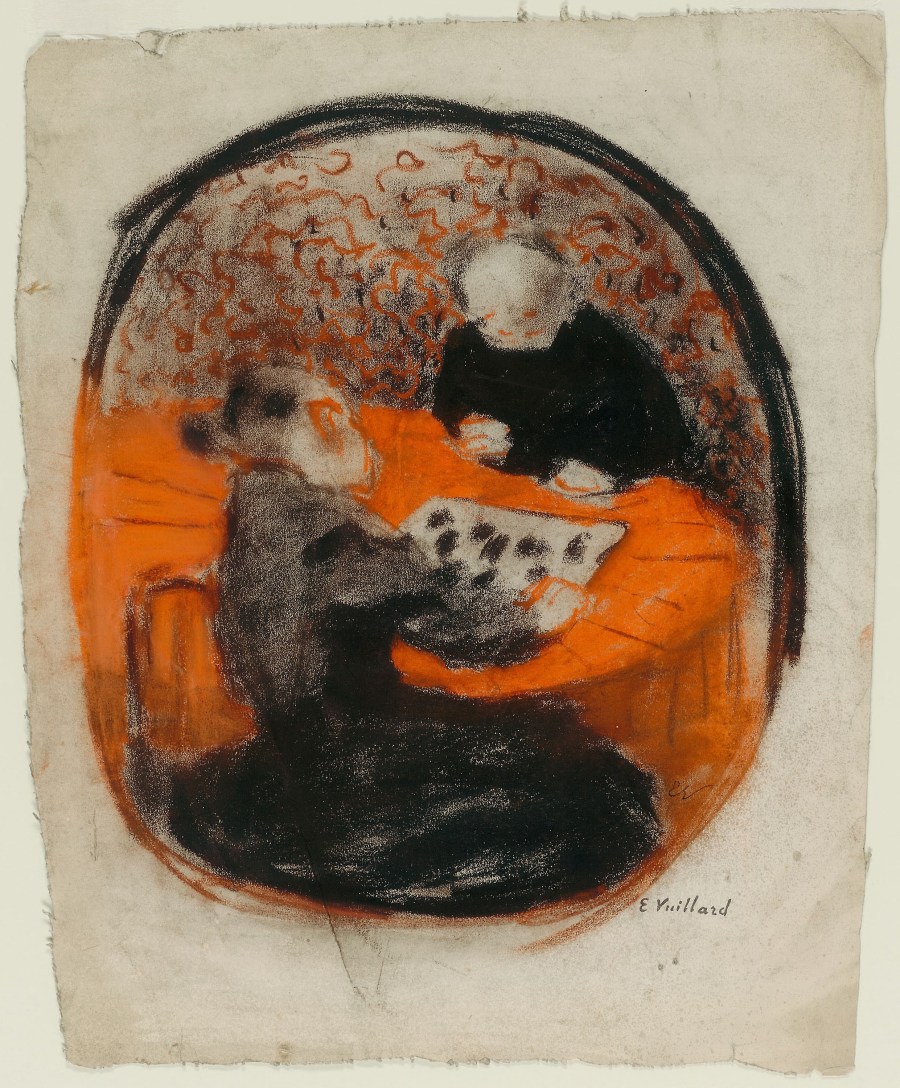
Fuchsprellen
by Rob McClure Smith
Featured image: Edouard Jean Vuillard. The Artist’s Mother Playing Checkers, c. 1890–91. The Art Institute of Chicago.
vulpes vult fraudem, foemina laudem—Publius Syrus, Fragments
It is claim’d that these little Pamphlettes which have passed from me formerly have got me some little Credit and Esteem amongst all of the Female Sex who delight in or be desirous of good Accomplishments. But there being so much time elaps’d since the last came forth methinks I hear some of you say “I wish dear Mr. Wooley would present some new Instruction.” To say the truth, I have been importun’d by divers of my Friends and Acquaintance to do so. To which end being very desirous still to serve you, I offer this Fuchsprellen, which I assure you worthy for the very precious things you will find there.
There are an hundred Divertissements harmless enough, which a young Lady may find suitable to her Inclination; but give me leave to find out one for her which hath the attendance of Profit as well as Pleasure that is a Toss. To speak the Truth, a Toss is a most excellent qualification for a Gentlewoman to exercise and please her Fancy therein and the best and readiest way to put the Body into a graceful Posture. The chiefest thing to consider is how to govern and behave your selves in this laudable and ingenious Art. For how will you blush when you come into a mixt Society, where each Person strives to shew her utmost Art and Skill, and you for the want thereof must stand still and appear as one whose Body wanted Motion, or a very Soul to actuate it. Yet the Mode and Humour of these times look upon it not only as a generous and becoming Property, but upon Gentility illbred if not thorowly acquainted therewith. Ladies, it is presumed you know the rudimentary grounds of Tossing, else your resort amongst wellaccomplisht gentlewomen would not only be improper but much hazard your Repute and good Esteem among them; and as you can toss, so I would have you learn other Formalities. By this Assistance, you will be enabled to give proper Directions for preparing every necessary Entertainment and be directed also how to act as Hostess in manner as befits your rank.
Read More
Slip
by Jeffrey Harrison
Feature image: Charles Émile Jacque. Seated Boy, n.d. The Art Institute of Chicago.
If I call my son by my daughter’s name
or vice versa; or if I call one of them
by the dog’s name, or the other way around—
all of which I have been known to do—
it’s funny, and only means I’m spaced out.
But when, while talking on my cell phone,
I walked past my new African-American colleague
and distractedly said hi, using the name
of another black colleague, it was stupendously
unfunny. It felt like I’d been punched
in the stomach, which is probably what
I deserved, even if he shrugged it off,
as he seemed to do when I caught up with him
and apologized too fervently,
my assumption that I’d caused him pain
itself a kind of racism, no doubt. It’s so
complicated!—though it doesn’t seem to be
for my teenage son and daughter,
and I’m glad of that, and admire their ease.
As for me and my colleague that day,
he absolved me with offhand grace,
doing his best to nudge me away
from my floundering shame, then
gently steered the conversation elsewhere
the way one does to protect a child.
Read More

Commuter Buddhist
by Jeffrey Harrison
Feature image: Alfred Stieglitz. Car 2F-77-77, 1935. The Art Institute of Chicago.
I’m learning to be a Buddhist in my car,
listening to a book on tape. One problem
is that, before I’ve gotten very far,
my mind gradually becomes aware
that it has stopped listening, straying from
the task of becoming a Buddhist in my car.
I’m also worried that listening will impair
my driving, as the package label cautions,
but I haven’t noticed that, at least so far.
In fact, I may be driving with more care.
There’s a sensation of attentive calm
that’s part of becoming a Buddhist in your car.
A soothing voice drones on until the car
is transformed into a capsule of wisdom
traveling at high speed, and you feel far
from anywhere but where you really are . . .
which is nowhere, really. The biggest problem
is getting the Buddhism out of your car
and into your life. I’ve failed at that so far.
Read More

Queenie
by Jeff W. Bens
Feature image: Johann Christian Reinhart. Lying Goat, from Die Zweite Thierfolge, 1800. The Art Institute of Chicago.
Dr. Frank Shire had never been down to Athlone before, hadn’t been back to Ireland to see the Kennelly brothers in the decade since he’d finished his fellowship at the University College of Animal Surgery, had seen them just the one time when they’d visited New York. The only American at the Fisherman’s Rest, the only American in all of Athlone for all he knew at that time of year, November, in the wet cold, driven straight to their father’s fisherman’s hotel by the Kennellys before he’d even had a chance to eat breakfast after the all-night flight to Shannon from JFK.
“She may be dying,” is all Robbie K said.
His brother Michael added, “She may be dead.”
Read More
A Mile In
By Julie Hanson
Selected as winner of the 2011 New Ohio Review Poetry Contest by Nancy Eimers
Feature image: Claude Lorrain. View of Delphi with a Procession, 1673. The Art Institute of Chicago.
The snow had been with us for awhile
and was dingy and not well lit.
But the sun promised to come out.
The light fog lifting
against the skinny tree trunks
and the grounded limbs they’d lost
and the thick, half-detached vines
would lift off,
dissolved, by the end of our walk.
We’d taken the footbridge
across the creek and followed the bend
away from traffic and toward the west ridge.
We’d gone a mile in,
to where usually I begin to listen to
our progress in the twigs and gravel of the path,
and past this, and past my own
periodic reminders to the dog
to the short, uncomplicated songs
of winter birds. And there,
near the spill of rocks in the creek
where the fog was still passing through branches
and a little farther and to the right
where a stretch of tall grasses
received a wide gift
of sunlight and several cows,
the air that stood still
between the trees and shimmered
over the grasses filled with sound—
a big voice moving through
a hundred thousand habitats—
and it said, “Attention in this area.
The following is a regular monthly
test of the Outdoor Warning System . . .”
It spoke from the west first,
sounding closer than it could be.
And it spoke from the southeast next.
“This is a test,” it said, “only a . . .
“This is a test . . . ” it began again
from somewhere else.
The dog returned to me, cowering.
I’d wondered before
without much curiosity,
where were those speakers housed,
were they towered, did they revolve?
Ordinarily heard in the yard
while I stood pinning laundry to the line,
the broadcast soon plunged and sank
into the noise of passing cars
and blown and rolling garbage cans
and faded like the little ringing
that emanates from construction sites.
But here, it seemed full minutes long
before my breath was back again in my chest,
and my dog’s breath,
steady and rough, was back in hers,
when the voice had left the air
between the trees, as had the fog.
At last a bird sounded from a twig.
At last a squirrel came down
and sent the dog. And then,
made up of other sounds
I could not have singled out,
a normalcy rolled in.
Infinitesimal bits is all it was
—quick beaks breaking up the peat,
the slow collision of a leaf landing, scooting
half an inch along a big flat rock,
a splat of excrement in white,
a flinch, a flap, a flick. But as it came it felt
to be a counter-vigilance. Or like
the sound of consciousness. The is.
Read More
Pretending to be Asleep
by Angie Mazakis
Selected as runner-up of the 2011 New Ohio Review Poetry Contest by Nancy Eimers
Feature image: Jean François Millet. Sleeping Peasant, c. 1865. The Art Institute of Chicago.
is like knowing exactly what you
are saying to me, but nodding,
yes, what else? anyway, as though,
I have never heard what you are saying before.
I have to purify from my appearance
appraisal and purpose,
my face distilled to stillness.
I have to guess when to genuinely tremble,
never having seen myself in sleep,
moving aimlessly beneath
awareness—I wager one
hand from the sheets,
toward nothing.
How does one believably breathe?
It’s like hearing words I was not
supposed to hear and just turning
in my chair as though I needed to reach
my arm this way, toward this phone,
toward anything, as if to say,
I am occupied; I was before.
It is all now exactly as I meant it.

Owen and Paul
by Angie Mazakis
Selected as runner-up of the 2011 New Ohio Review Poetry Contest by Nancy Eimers
Feature image: Sir John Everett Millais. Study for the Head of the Rescuing Lover in Escape of the Heretic, 1857. The Art Institute of Chicago.
It’s any two strangers’ conversation.
The proportions of the tall one’s face
make him look like an Owen.
The other one, easily a Paul.
Owen makes a face, a gesture—
his forced half-smile squints one eye,
as he barely shrugs in a way that falsely
means tentative, in a way that pejoratively
leans and says, I’ll give you that much,
a gesture which says entirely,
You know, it’s like this. Maybe I’m wrong,
but it’s something to think about.
The maybe I’m wrong suggested by some
softening of his eyes that kept him from
a face that said, nice try or dubious—
something he had to lose.
I catch my eye just beginning to imitate
the gesture, try it out, here in this coffee shop.
Maybe I’ll start wearing this look after saying things like,
Yeah, I’m pretty sure that’s the city rock ‘n’ roll was built on.
Or after anything ending in most people don’t know that.

Antonioni at Nineteen
by Jeffrey Harrison
Feature image: Adriaen van de Velde. Pastoral Landscape with Ruins, 1664. The Art Institute of Chicago.
I saw Antonioni’s The Passenger in September or October 1976, at the beginning of my freshman year at Columbia. It was the first “art house film” I ever saw, well before I’d heard that term. I was from Cincinnati, where apparently they didn’t have such things. I had just turned nineteen, or was about to. I was taking a writing class with Kenneth Koch, discovering Frank O’Hara and Rimbaud, and doing everything I could to peel or dissolve the suburban Midwestern scales from my eyes. In that pursuit, this movie was as important as the LSD I would drop for the first time a few weeks later. Not that it was hallucinatory—just the opposite, in fact . . . though in both cases, perhaps, it was “the visuals” that I liked best.
The film was playing at an auditorium on the Barnard campus, and I remember walking over there alone, being completely amazed by what I saw, and hurrying back to my Spartan dorm room to write excitedly about it in a notebook that is now long gone. I don’t remember what I wrote, but I know it wasn’t focused on Jack Nicholson, who plays a television reporter disillusioned with his life and work. Nor did I write much about the plot involving switched identities, riveting though it was. If I wrote about these things at all, it would have had to do with the way Antonioni de-emphasized Nicholson’s movie-star status and took the weight off a plot that would have been handled ponderously in a Hollywood movie, accompanied by ridiculous, tension-building background music. (I’d seen Jaws just the year before, which suddenly felt like ages ago.)
Read More
Death, Cashews, and “No Country for Old Men”
by George Bilgere
Feature image: John Clerk of Eldin. Sheriff Hall, n.d. The Art Institute of Chicago.
I saw No Country for Old Men (Academy Award winner, 2008) ten times on the big screen at close to twenty bucks a pop (including popcorn by the bushel and cola by the quart). If that ain’t obsession, to paraphrase Tommy Lee Jones’s oracular Sheriff Ed Tom Bell, it’ll do till the obsession gits here.
When the movie left the theaters I bought the DVD and raised my madness to a new level by slipping the disk into my stereo and listening to it. Cormac McCarthy’s dialogue, as adapted to the screen by the Coen brothers, has an understated lyricism and humor, thrillingly true to the laconic rhythms of the southwest (I lived in Oklahoma for a few years and I know my laconic rhythms). In fact, the soundtrack is one of the film’s most striking features, which is odd, given that there is no music whatsoever. Just the pitch-perfect dialogue and the silence of the plains, where the smallest sounds—the squeaking of a hinge, the unscrewing of a light bulb—acquire an ominous eloquence.
Read More
