
A Brief Personal History of Dialogue
By Kelly Luce
Featured Image: The Great Statue of Amida Buddha at Kamakura, Known as the Daibutsu, from the Priest’s Garden by John La Farge, 1887
Not everyone says what they mean. But they do
always say something designed to get what they
want.
—David Mamet
1987: Ms. Voyeur, my first-grade teacher, tells my mom I’m too quiet and should be seen by a psychiatrist. But I prefer listening! Other people are interesting. They tell you more secrets when you’re quiet.
1992: My Language Arts teacher accuses me of plagiarizing a short story I wrote about volleyball tryouts. Why? “The dialogue is too realistic.” When I tell her that’s because I just tried out for volleyball myself and remembered how the girls sounded, she says, “No one learns to write dialogue by listening to real people talk.”
1997: I read Salinger’s “A Perfect Day for Bananafish” for the first time. Remember the conversation between returned soldier Seymour Glass and the young girl, Sybil, on the beach? Sybil is being perfectly herself, still possesses her childlike ability to say just what she means. Seymour is a couple hours away from—. Their chatter is innocent. Or is it terrifying? Take this exchange about a rubber raft:
Read More
The Dialogue of Gesture and Silence
By Alyce Miller
Featured Image: Rouen Cathedral, West Façade, Sunlight by Claude Monet, 1894
Courtesy National Gallery of Art, Washington
What people don’t say is often as important as, or even more important than, what they do say. Too much exposition, or what I call “soap opera dialogue” (e.g. “You remember my brother John who tried to murder Tiffany, before she was caught stealing from Marsha’s cousin who changed her name….”), or its opposite, too little, as is often found in the “generic social glue” of the how’sthe-weather variety, can undermine the progression of story and essential character development (unless, of course, weather is key to the story).
We often think we learn about people through what they say and how they say it, but other forms of communication are just as crucial. Dialogue can happen without speech. Words can fail. Gesture can summon meaning beyond language.
In Hemingway’s dialogue-rich story set in an empty train station in Spain, “Hills Like White Elephants,” the two traveling protagonists he calls respectively “the man and the girl” carry on what might sound to the untrained ear like a conversation about nothing when, in fact, they are about to make an important decision as to whether “the girl” should have an abortion. Whichever path they choose, it is clear that the course of their life together will be forever changed. At one point, after a good deal of back and forth, the girl says, “Then I’ll do it because I don’t care about me.” When the man counters with “I don’t want you to do it if you feel that way,” the girl doesn’t respond. Instead she stands up and walks to the end of the station. Her choice to substitute action for speech and distance herself momentarily from the man says more than anything she could at that moment. Her attention drifts instead to the landscape, the river on one side of the track and the mountains on the other, while she stands in that place of in-betweens and uncertainty. No conversation could convey her dilemma more precisely at that moment.
Read More
Dialogue: The Footfall of Its Wandering
By Darrell Spencer
Featured Image: The Card Players by Paul Cézanne, 1890-2
You might not have it in mind to go a particular
direction and you might end up going that way.
—tapper Jimmy Slyde
Well, that ain’t what art does. It makes things.
—Stanley Elkin
1. Full Disclosure
For my entry into a discussion of dialogue I can’t think of a worthier writer to cite than Amy Hempel. The magician and maestro. Hempel’s narrator of Tumble Home opens the novella as one ought: “I begin this letter to you, then, in the western tradition. If I understand it, the western tradition is: Put your cards on the table” (69). Here are my cards: I like fiction that feels off-shot and shaggy, that seems to have fallen from the sky and is banged up thanks to re-entry. I like my fiction jerry-rigged and clumsy. Stanley Elkin uses the word baggy to describe his novels. Perfect.
Screw Poe: “A skillful literary artist has constructed a tale. If wise, he has not fashioned his thoughts to accommodate his incidents; but having conceived with deliberate care, a certain unique or single effect to be wrought out, he then invents such incidents—he then combines such events as may best aid him establishing this preconceived effect.” Oy. Rube Goldberg schooled me; he’s my guy. I want, as I read, to experience the acrobatics, to hear the pop and the hiss and the whiz-bang of the performance. A Goldberg contraption might get you somewhere but you will most likely be too dizzy to appreciate your arrival. You’ve seen those spaceships wobble across the screen in the crackly black-andwhite Flash Gordon flicks. That’s what I’m talking about. Look closely and you see the wires.
Read More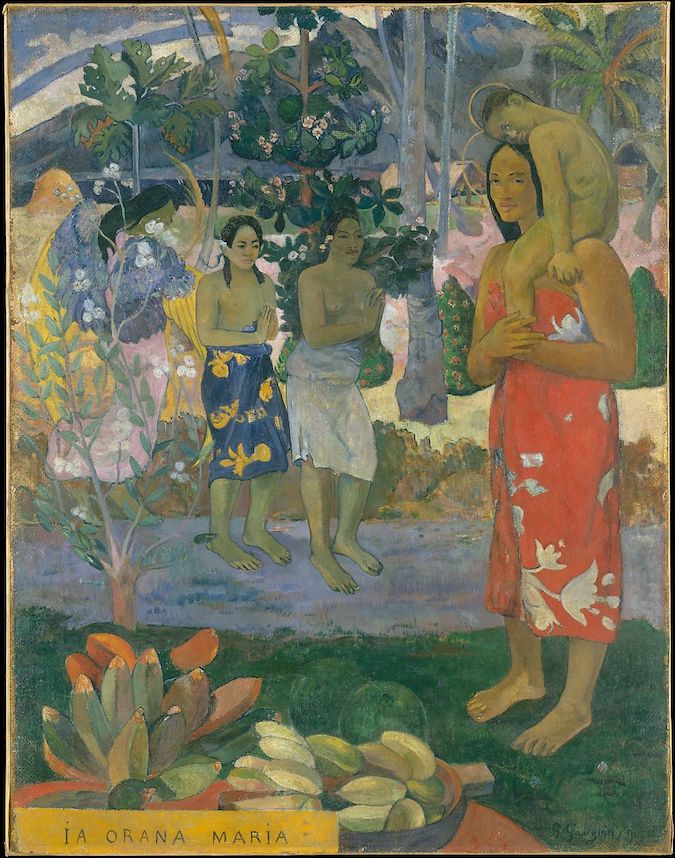
That Dialogue Assignment
By Rebecca Makkai
Featured Image: la Orana Maria (Hail Mary) by Paul Gauguin, 1891
I first got The Assignment in a college playwriting class. You might have gotten it in high school, or picked it up from a writing exercise book (somewhere between Keep a Dream Journal and What Color Is Your Character’s Toothbrush?): Eavesdrop on strangers, and write down everything they say. The idea is that this will help you write better dialogue, more realistic dialogue. Because realistic must equal better.
To be honest, I fudged the college assignment somewhat. I listened in on two campus maintenance workers, thinking they’d say hilarious and off-color things. Mostly, they grunted about paneling. I cherry-picked my hour of listening for the best phrases, crunching them together into what sounded like three minutes of witty banter, adding a few lines of my own. I did this partly to make my classmates laugh (I knew we’d be reading this aloud the next day) but also because I sensed that there was something deeply unsatisfying about actual dialogue—uninspired, disorganized, mundane dialogue.
Read More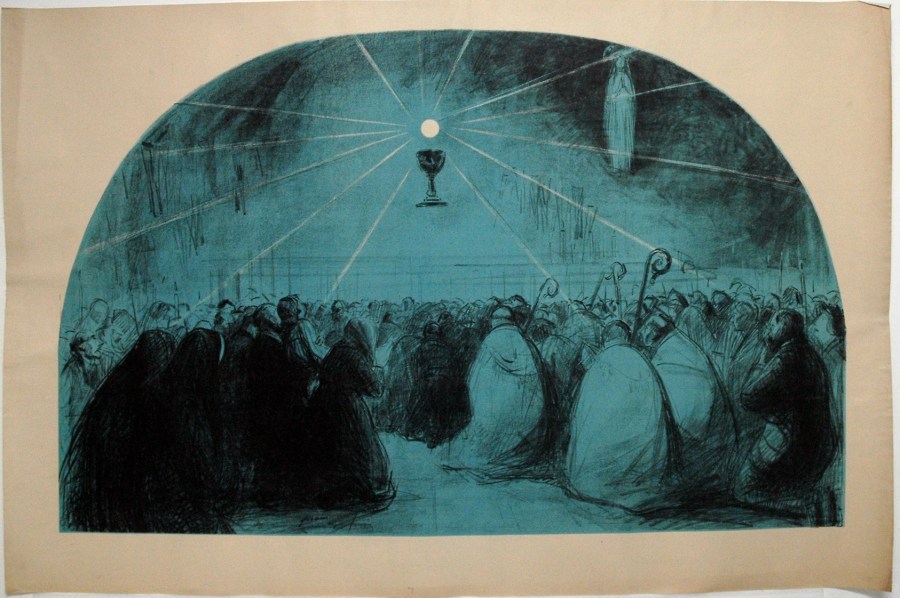
The Light Factory
By Sandy Gingras
I work the night shift at the light factory.
The gears of the conveyor belt slip
silently, and emptiness goes by me
one segment at a time. I have to take
the dark in my gloved hands and make
something of it, then connect it to something else.
Someone further along the line bends
it, I think. Nobody really knows much about
the other guy’s job here. We just do our part.
There are no windows in this factory.
The air is like milk, and they pump in
music that has a beat, so we don’t fall asleep
on the job, but we still do. My mother says
I should get a real job, make something solid
out of my life. “There’s enough light
as there is,” she lectures me. “There’s the sun
and the stars,” she says, as if I don’t know this already.
“What do you DO in there?” she asks. I don’t want
to tell her how much we joke around, tell stories,
talk about men. “I can’t really describe it,”
I tell her. “I do it mostly by feel.” Sometimes,
I bring one of the seconds home
with me after my shift. They don’t like it
when you do this, but everyone sneaks some.
I go home at dawn, put it on my dresser
next to the open window, watch it fan
out like a wild thing into the pink sky.
I don’t know why it feels so good to let it go.
Read More
POOF
By Sandy Gingras
My mother wants her head to be frozen
after she dies. I’m against it, but
there’s no talking to her. She has a brochure.
On the cover, there’s a picture
of a white building with no windows.
I tell her, I go, “I’m never gonna visit you there.”
She says, “Fine, fine,” the way she does.
She reads me the whole brochure.
She’ll be maintained at something-something degrees
until they come up with the technology to defrost
her. The, she says, “POOF. It’ll be like
being microwaved.” I go, “Think about
what happens to popcorn.” She keeps on reading
about how they’ll just fiddle around with her DNA,
and she’ll grow a whole new body. I don’t get that part.
I go, “What if they can’t grow you a body,
and you’re stuck being an alive head forever.”
She says, “Then you’ll have to carry me around.”
I knew it. I knew it.
Read More

The Undersized Negative
By Robert Glick
Selected as winner of the 2014 New Ohio Review Fiction Contest by Aimee Bender
Sometimes the day after Mom’s miscarriage, a chemistry teacher with chin-only stubble interrupts class to tell you he is dying. There were so many reasons not to be anywhere. I, Dr. Watermelon, convened everyone at the abandoned house, which I insisted on calling the sketch house, on account of the Etch A Sketch I had found in a toy chest. My buddy Filbert plopped himself down on one of the oyster chairs; the air clouded with dust mites and dried skin. “Finders, keepers,” he said. We demanded answers of the Harris family from phone bills and colanders, from the oregano scent of the bathroom cleaner, from a postal sack half-full of gas caps. The throat to the fireplace was choked; perhaps a bird’s nest. Rob and Ron each kept one eye perched on the doorless front door, wary of the patriarch Dustin Oskar Harris barging in to reclaim what he once owned. They thought the sketch house itself was sketchy, as if its waxy kitchen linoleum had been responsible for mawing open and swallowing its former occupants. Ron suggested that we get sizzled on the freon from the fridge. Rob agreed; they were repurposers. “Highly toxic,” Filbert said, reluctantly we transitioned to flicking matches at the shelves—flyfishing magazines, nautical books – knowing damp, expecting sulfur, anticipating cartwheels of burn through the air. Filbert, nicknamed for the teratomic testicle lodged like a moon above his kidney, had a talent for fire: me, not so much. I was a Pisces; I went as long as I could underwater.
Filbert’s lit match flew through the air and landed on my crotch. I didn’t want to move. I felt crowned, blinkered by a halo of marsh fog. I observed the flicker of little flame, a prickle of warmth on my jeans. “Huh,” I said. That was my best eloquent admiration for the trajectory of heat and light.
Read More
The Egg
By Eric Nelson
We’re sitting at the table the way people do
When a family member dies and a stream of well-wishers
Arrive with sympathy and food.
Everyone is concerned for the widow, 70, tough, wiry,
Who now seems weak and befuddled, staring at people
She’s known for years without answering,
Rising and walking out the back door, staring at the woods
At the far end of their land.
Returning to the table without a word.
We’re all thinking how often one spouse dies
Soon after the other, dies of nothing
But lack. Because we are surrounded by guns, her husband’s
Sizeable collection—pistols in glass cases, rifles
In racks and corners—talk turns to their value, the merits
Of revolvers versus semi autos, plinking, protection.
Now, for the first time, the widow speaks, remembering
That she went to the coop this morning and found curled
In a nesting box a snake, unhinged mouth filled
With a whole egg, disappearing a swallow at a time.
She walked back to the house, pulled her .410
Off the rack, returned to the coop and blew its head off.
A hog-nose, she says. A good snake. But I had to.
She shrugs her shoulders. I had to. Glancing
At each other, we nod in agreement, relieved.
Read More

Gun on the Table
By Eric Nelson
My favorite scene in Body Heat has nothing
To do with the intricate plot
That William Hurt and Kathleen Turner
Devise to kill her rich, oppressive husband.
My favorite scene, maybe ten seconds long,
Shows Hurt getting into his car as an antique
Convertible drives by, a fully costumed clown
At the wheel, waving. Hurt stares, slightly
Bewildered, while the clown passes and disappears.
That’s it. Cut to Hurt and Turner in another
Sweaty sex scene and post-coital planning,
The foregone noir conclusion closing in. Meanwhile,
Since we know there are no meaningless details
In art, we keep expecting the clown to reappear
Or at least figure indirectly yet clearly in the action.
Like Chekhov said—if there’s a gun on the table
In act one, it had better be fired by act three.
But no, the clown is random, there and gone, an odd,
Unrelated moment like any of the ones that pass us
Every day and we barely notice
Because life isn’t art, isn’t revised for coherence,
Not until our lives collapse around us
Like a circus tent in flames
And we begin to look for the alarm we missed.
Read More
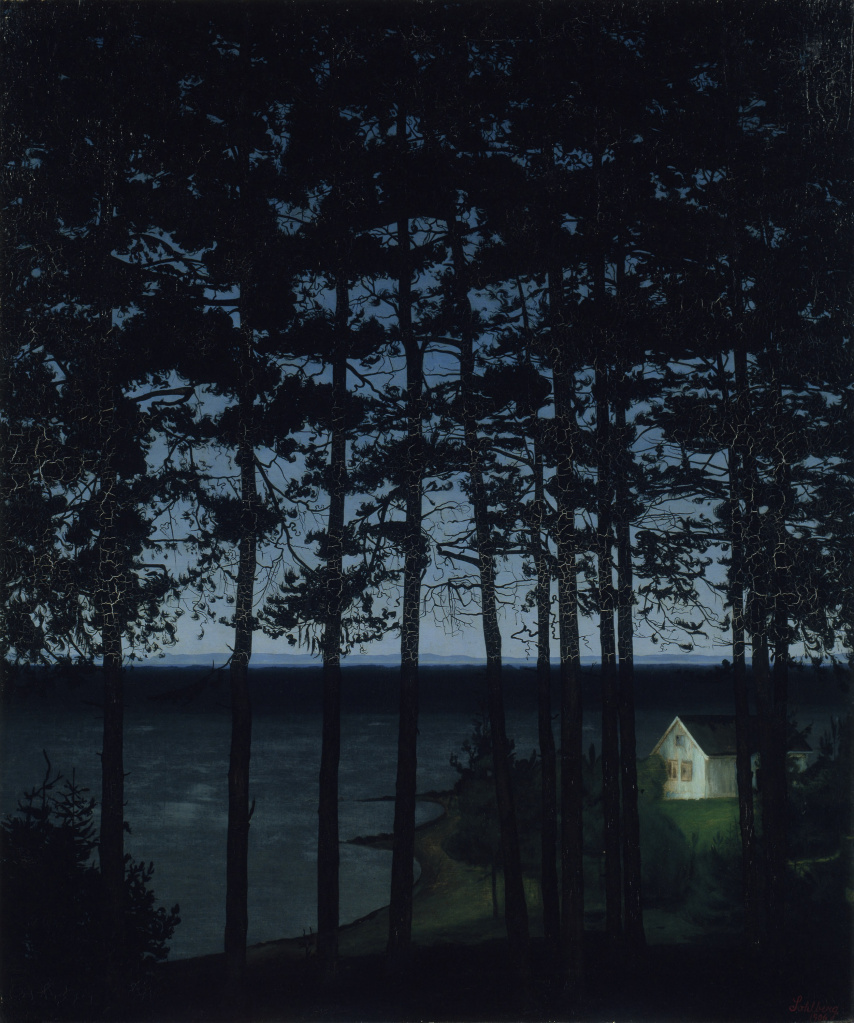
My Life with Pines
By Tom Wayman
1
In the glow of a fluorescent, I sit leaning
over a table to sort through parts of
a jigsaw puzzle, working hard to recreate
a picture displayed
on the box I purchased
while outside
great pines have moved in the darkness
down the ridge to surround my house, many of the trees
taller than the roof. A fierce wind
causes the pine trunks to sway, their limbs
churning the dark in wild
and pitiless gestures.
2
Pines thrive in arid soil, mostly sand,
little else will grow in. These trees regard cedars
who love the damp, who must be surrounded by relatives,
as gloomy, phlegmatic,
timid. Cedars, according to pines, are simple-minded
about safety, suffusing themselves with water
as protection from fire. Cedars might as well be,
pines jeer, a fern. Whereas pines
only reproduce in the heart of a blaze,
their cones needing the insatiable rage of flames
to climax, open, release.
3
No matter how many nights, months, decades
I pore over my jigsaw
the one piece that remains to be found
is a pine.
Read More

Activity Room
By John Bargowski
My mother wants nothing to do with the puzzle
two other residents,
whose wheelchairs have been rolled up
to a folding card table,
are trying to put together—
a west side shot of the New York skyline
broken up into a thousand pieces,
the stubborn morning smog
she could see from the apartment
she had to give up photo-shopped out,
the OT insisting Mom join in the fun,
taking my mother’s stroke-locked hand
and guiding it to
a corner piece that’s an easy fit,
When Time Slows Down
By Lawrence Raab
Now I’m lying in a narrow hospital bed,
waiting for the first tests to come back,
raising the cup of apple juice to my lips,
then setting it back on the table
very carefully. I’ve been watching
a large round clock, so much like
the clocks in the schoolrooms
of childhood, where the big hand clicked
loudly as another minute was forced into place.
Was it fourth grade or fifth?
The Road
By Lee Ann Dalton
I left, not looking back. I was afraid.
I left the things he bought me, just in case.
I had to close my eyes to find the road.
I carried names and numbers, tucked inside
a pocket in my purse, and not much else
to leave and not look back. I was afraid
of corners, entryways, store windows, hid
and dodged whole neighborhoods, memory’s curse.
I had to close my eyes to feel the road.
Nights, phone off, lights on, I stood guard
on the balcony, wrapped in please. Worse
than leaving, is not looking back. I was afraid
he’d come slash my tires, stage his suicide
or mine, since I refused to witness his.
Sometimes I closed my eyes to see the road.
I’m still ashamed to say how much I lied
to make him step away, give me the keys
so I could leave, not look back though I was afraid.
I closed my eyes to walk the open road.
Read More
Intercession
By Jennifer Leonard*
When, years later, I learn Kevin Miller,
the boy who grew up next door, is in jail
for drugs and a stolen car and a gun,
I think of eighth grade:
Kevin with his buck teeth and buzz cut
always getting into fights, Kevin suspended
once for carving the F-word into a church pew
during Wednesday Mass, then again
for slinging walnuts against the windshield
of Mrs. Sabatino’s car.
And that one time, on the field at the end
of the street, where the boys gathered after school
to pick teams, Mark McGarity said,
We don’t want the retard,
meaning my brother—
and Kevin said, What the fuck, man,
and Mark said, Well then prove he can catch a ball,
and when Kevin shrugged and said Fine,
and told my brother to go out for a pass,
and my brother did, but did not catch the ball—
when it bounced twice off the ground,
and my brother looked down at his sneakers,
and Mark told Kevin, Yeah dude, there’s no way,
and all the other boys stood
in a sort of ring, and waited for someone
to hurt someone else—
but instead, Kevin thumped my brother
on the back and said, Let’s go. And my brother—
who may not ever be able to memorize equations
or read, but knows when a man risks himself
for another—
he followed Kevin home to our back yard,
where Kevin threw my brother the football,
and though the ball passed again and again
through my brother’s hands,
Kevin kept throwing, telling my brother
where to move and when, and I can picture, now,
my brother’s face so serious and filled
with concentration—
and Kevin, throwing until their shadows
fell long over the yard.
Read More
Pavlov’s Dog
By Derek JG Williams
I chase my shadow all morning. The neighbors watch
from between drawn curtains.
I tear up clumps of lawn until my blood churns how it does
when the bell rings. I sit in the sun and pant.
Next time I’ll lunge for his throat. But the bell sounds
and I love him still. When I run away, it’s to nowhere
special. There’s a certain slant of moon
I seek. It changes the angle of my longing.
Hunger is the pain I can’t be free of—when I’m sitting
in the sun I love him.
I’m never free. I’ll lunge for his throat. The neighbors will say
I told you so.
Read More

Photograph Albums
By George Kalogeris
“We finally got all of our family photos
Onto our home computer,” Quentin was saying,
Just as we entered the Asian fusion place.
And that’s when it hit me: all those leather albums
With their matted pages and bristly hides,
In their mundane way as archly ceremonial
As the Golden Dragon preening against
The restaurant window. All those cumbersome tomes,
In a decade or so defunct as the dinosaur.
But once their images have all been scanned,
Why should it matter? By then the cherished snapshots
Will have all gone into the world of light—
Or at least into cyberspace. Ancestral faces
That once unfurled from trays of salty water
As dark as Lethe, and then were pinned on strings,
Ex-voto like, and left to dry, will seem
A little less spooky-stern without the shades
Of their twentieth century negatives to haunt us.
And pantheons of illumination so vast
They promised we’d see ourselves reflected in
Their image forever—Olympus, Polaroid, Kodak—
Will shrink to the candle-watt stature of household gods:
Preservers of birthday parties and graduations,
Penátes of pointed hats and obnoxious horns.
For My 1st Ex-Lover to Die
By Francesca Bell
I heard this morning my old lover died, and I cannot say I loved him, though I may have said it at the time, cannot say he was a good person or lover or anything other than a man who called me in the small hours, driving back roads drunk in his Ferrari, when I was 23 and he was 50, who bought me books and a Lalique clock that’s been broken 20 years, who was the dumbest smart person I ever knew, crying in his car at 4 in the morning, wearing a coyote skin coat that reached to his shoes, and I didn’t want his money or his cocaine or to be his 7th wife, and I’ve seldom thought of him except to remember a dark animal crossing his driveway at night, and the 2 staircases in his grand house, going up, going down, and how I held him, deep in my body, and he made a small, sad sound.
Read More

Dialing The Dead
By Mark Kraushaar
I’d never call.
First of all, I’d be intruding, and besides
I can see my dead friend with all his dead friends
even now, translucent, weightless, winging
through a cloud or sitting in a circle
on some creaky, folding chairs—
Hello, my name is Peter and I’ve
been dead ten years, car wreck.
Hello my name is Edith and I’ve
been dead a week, pneumonia.
Hello, my name is Frank and I’ve been . . . .
Oh, I know they’d all be friendly but even
dialing later when I guess he’d be alone
I’d have too many questions:
If you’re nowhere now and nothing
is this the same as everywhere and everything?
And, Peter, do you sleep in heaven?
Do you eat up there?
What’s the weather anyway?
And that tenderness of heart we try so hard
to keep a secret: in heaven we’re
wide open, aren’t we?
Stay in touch.
No, don’t.
Read More

Last Call
By Penny Zang
Each night, after work, we changed our names. We were trying on new identities, seeing which ones fit. Serena and I would throw off our aprons and get undressed in the car, wiggling into tight black pants and shirts thin as napkins. Sometimes we wore red lipstick, sometimes eye glitter. Then we’d find a new bar with the same tattered barstools we were used to balancing on, the same veil of smoke and low light that felt like home. To the men who approached us, we turned into different girls, ones who knew how to charm even without the promise of making a tip.
Our new names were decided on the spot, never the same name twice. They were names we’d once used for our baby dolls, names we’d wished our moms had given us: Isabel, Deanna, Lily. Everything else came later—our stories, our new personalities—fueled by beer and tequila, a practiced game of improvisation. Sometimes men invited us home or out to their car. Sometimes the night just fizzled and we’d stumble out to the street in the wrong direction, too lost to even know it. We’d stop to eat greasy pizza and compare notes, our throbbing feet the only part of us that wanted to give up.
Read More
Sitting in a Simulated Living Space at the Seattle Ikea
By Abby E. Murray
Finalist, New Ohio Review Poetry Contest
To sit in a simulated living space at Ikea
is to know what sand knows
as it rests inside the oyster.
This is how you might arrange your life
if you were to start from scratch:
a newer, better version of yourself applied
coat by coat, beginning with lamplight
from the simulated living room.
The man who lives here has never killed.
There is no American camouflage drying
over the backs of his kitchen chairs,
no battle studies on the coffee table.
He travels without a weapon,
hangs photographs of the Taj Mahal,
the Eiffel Tower above the sofa.
The woman who lives here has no need
for prescriptions or self-help:
her mirror cabinet holds a pump
for lotion and a rose-colored water glass,
her nightstand is stacked with hardcovers
on Swedish architecture. The cat who lives here
has been declawed, the dog rehomed.
There are no parking tickets in the breadbox,
no parakeets shrilling over newspaper
in the decorative cage by the desk.
When you finish your dollar coffee
and exit through the simulated front door,
join other shoppers with chapsticks
in their purses and Kleenex and receipts,
with T-shirts that say Florida Keys 2003
and unopened Nicorette blisters in their pockets,
you will wish you could say this place
is not enough for you, that you are better off
in the harsh light of the parking garage,
a light that shows your skin beneath your skin,
the color of your past self,
pale in places, flushed in others.
Read More
The Game
By Steven Cramer
Let me clarify some things about the game.
First rule: think about the game, you’ve lost.
No tiles, cards, currency, whirling dials: all pieces
are included, space has been cleared at the table.
Join in. Your turn. Kids learn the game in school
corridors, score it in red along their forearms,
new staves on old. It doesn’t end when the day ends:
race for the stairs, dodging the geeks and slow kids,
thunder of fists on lockers, last push to the streets.
The old hands they become play all night, by daylight
a winner still in doubt. Friction Ridge, Lake of Enclosure,
Dot and Spur: its variants can wear a pencil to its nub.
Wedded to the game, couples bop to the Heart-Flip,
the Mind-Winder, later to lie on sheets deliberately
left blank. Who invented the game? Who made up
the jokes passed from laugh to laugh? Black suit
for weddings, same for the funeral. In between, quick
as a nail sparks an Ohio Blue Tip, it fixes in its sights
the boy who puffs, walks; leaves in a down of frost
crushed beneath his feet. At the ridge he’ll climb,
sun warms the girl expecting him, curve of her hand
moist to take him. When he comes, the game beats
in his heartbeat thumped by the wallop of her heart
beating against his; and like a spider tumor, spins
webs in his brain, in love now with how it’s played.
Read More

A Theory of Violence
By Jennifer Perrine
Selected as runner-up of the 2014 New Ohio Review Poetry Contest by Alan Shapiro
In the museum of sex, the video loops
its cycle of common bonobo behavior:
penis fencing, genital rubbing, whole groups
engaged in frenzied pairs, their grinds and shrieks
playing for the edification of each patron
passing through the room. We all summon
our best poker faces. One woman speaks
softly, reads from the sign that describes
all the various partner combinations,
the multitude of positions, how relations
lower aggression, increase bonding within tribes.
We linger over this way of making peace,
wonder to each other if we would cease
our litany of guns, bombs, missile strikes
if we spent more time in wild embrace.
The exhibit doesn’t mention our other cousins,
chimpanzees, who form border patrols, chase
strangers in their midst, leave mangled bodies as lessons.
That’s the story we already know
and want to forget through the release
of these erotic halls, where we seek the thrill, the bliss
of these animals who hold us captive
while we lament what traits we’ve found adaptive.
Read More
Embarrassment: from baraço (halter)
By Jennifer Perrine
Selected as runner-up for the 2014 New Ohio Review Poetry Contest by Alan Shapiro
All he found when he came looking for us was the home my mother wanted to leave behind: newspapers stacked knee-deep in the hallways, every corner redolent of cat piss, linoleum caked with dried mud and dust, tangles of hair matted to the tub, dried scabs of meals coating plates and bowls piled high in the sink, on counters. Everywhere: the stink, the rot and mold, the great heaps of unwashed clothes, all the filth my mother never let anyone see. No friends allowed inside. Even her dates didn’t get in the door. She spent her nights at their dubious dens, leaving me alone to toss hamburger wrappers and soda cups on the living room floor, our one trashcan so full I couldn’t empty it. My father, finding all this mess, assumed the worst, took photos, jotted notes, thinking the house had been ransacked, that we’d been robbed, killed or kidnapped, though police assured him there were no signs of struggle. How she’d let the house go, he couldn’t imagine. Before the divorce, I heard her shout: I’m no one’s maid. Years later, when my father asks how we lived in such squalor, I tell him I never noticed at the time, though once I did: My best friend, Heather, and I were playing outside when a sudden shower drove us to huddle under the eaves. Soaked, I took pity, opened the door, disobeying my mother’s one rule. Inside, Heather didn’t ask questions about the mildew, the crumpled paper bags she had to brush aside to sit. She refused the towel I handed her to undo the work of the rain. I saw it then: tatty, gray, stained. Heather left, and later, when my mother found the couch still wet, I told the truth. Her face flushed; I tried to bolt. She reined me in with one hand, unfastened her belt. If they see this, they’ll take you from me, she screamed through the volley of blows. My back grew a rope of welts. They’ll call me unfit. Is that what you want? I tell my father none of this, judge it best not to show him the last bits of how his ex fell apart once they were unhitched. I don’t say how I, too, was the mess, tether she yearned to slip, so she could careen unimpeded through life, how I held tight as she zoomed away, raced toward a place where she’d be no one’s mother, no one’s wife.
Read More

Envy
By Patricia Horvath
The sign on the door says: Children Under 18 Not Admitted to the Chemotherapy Suite Under Any Circumstances.
They call it a suite, this room at St. Luke’s Roosevelt Hospital where chemotherapy is administered, as though its occupants were members of some elite group, which in a sense I suppose they are. For reasons that elude me, the chemotherapy suite is located on the same floor as maternity services, and the elevator is often crowded with an odd mix of cancer patients and pregnant women. The cancer patients are generally hairless, elderly, their skin ashy, their bones prominent. The pregnant women are all flesh and smiles.
On Jeff’s first day of chemo, three months earlier, a couple made out during the entire ride to the eleventh floor. Teenagers practically, they wore tight jeans, cropped vinyl jackets. Her back hard against the elevator rail, her distended belly pressed into her partner. They made little moaning noises as they kissed. I tried to give Jeff my “What the fuck is this?” look, but he was too preoccupied—or maybe too polite—to notice. The other passengers looked away. I watched them not watching and then I stared at the floor.
Read More
Seafood
By Amanda Williamsen
Baltimore, Maryland
My uncle calls from the wharf; his freighter is in;
he’s walked to the nearest food and I find him
in a crab shack at a table by the window.
Waitresses carry crabs on trays, whole piles of them—
stiff, blue, dead—and the restaurant patter crackles
with the brittle speech of small mallets on their shells.
Elena, his wife—she’s from Colombia, my age—
wants a divorce. She’s living in Miami
with some Cuban, he says; she’s got his TV and his car.
When his crabs come, I order grilled cheese,
tell him about karma, how I’ve removed myself
from the chain of suffering and he says, shit,
picks up a crab and whacks it squarely on the back.
He tells me about winters on Superior, ice boats
cracking a path through December until the solid freeze
of January, how he shoveled iron ore from the hold
until the red dust rose in clouds from his clothing,
rinsed from his body in the shower like a gallon of blood;
and before that, how he went to Vietnam while my father
went to college, how he bombed the jungle beneath him
without ever looking down while my father dropped
out of college without ever looking ahead;
and before that, before the war, how the two of them
hit a tree one night while driving on River Road.
You’d have thought we wanted to be that tree, he says.
It broke the car, broke seven of his ribs, nearly broke
my father’s heart but in the end it just broke his spleen
and ripped him open from shoulder to hip.
My great aunt—the whole family tells the story now—
came from Kansas and prayed him back from the dead.
Crisis on Infinite Earths, Issues 1-12
By Bethany Schultz Hurst
I. I’m at a poetry convention and wish I were at Comic Con. Everyone is wearing boring T-shirts.
When I give the lady my name, she prints it wrong onto the name tag. I spell it and she gets it wrong again. Let’s be honest: it’s still my fault.
II.
Japanese tsunami debris
is starting to wash up
on the Pacific shore. At first,
they trace back the soccer balls,
motorcycles, return them
to their owners. That won’t last.
Coins for the Ferryman
By David Denny
Marlene and Ralph walked up Kaanapali Beach about half a mile from their hotel. They sat in a corner of an outdoor restaurant with a floor of sand. Each of the small, round tables was shaded by an umbrella made of palm leaves. A row of tropical greenery, punctuated with orange and red hibiscus, separated the restaurant from the boardwalk. They could hear the waves hitting the sand about forty feet away.
Marlene slipped off her sandals and wiggled her toes in the cool sand as she looked over the menu. Mahi was her new favorite; however, she’d eaten it two days in a row and thought she should try something else. Up next to the bar, a local singer was nearing the end of his lunchtime set. He took a slug of water, traded his guitar for a ukulele, and began crooning the popular island version of “Somewhere Over the Rainbow.” Marlene wasn’t all that hungry. A shrimp cocktail and a Diet Coke might do the trick. Her husband had his cell phone out on the table in front of him, checking their reservation for the dinner cruise out of Lahaina harbor. He had decided before he left the hotel that he would order a burger; he was tired of fish already.
Read More
Whatever I Might Say
By Sydney Lea
Though to touch its flame would surely be as painful as when it burned brighter, the candle’s low now. On the table, just prior to guttering after dinner, it vaguely illuminates friends.
The glow takes me to Creston MacArthur, one son’s and one grandson’s namesake, and to our many evenings as a campfire ebbed. Just now I’m remembering a particular night, the two of us seated next to a favorite river, swapping stories. His were better.
A bleakness sinks into me despite the patent pleasures of this later interlude with other people I care for and admire. I’ve long savored their camaraderie, their conversation, their gifts for wit. The lateness of the hour has turned our talk to rote murmuring, something like the water of that river, which always flows right below my consciousness.
I should do more now than merely prattle with these good companions, just as I should have said more to Creston, gone almost forty years, and perhaps he to me. Or maybe not: deep in the woods, barred owls started to chatter that night. “Like a good pack of hounds,” Creston said, and that woodsy locution seemed perfect, seemed pinpoint accurate.
Still I’m unsettled. It’s as though I were looking on these people here, on my children, on my children’s children, on my past—I’m looking from above. Having failed to put the right words together, I’ve risen over our group like smoke. The chill in my spirit has something to do with feeling removed, and feeling removed because I’m tongue-tied, tongue-tied for fear that any speech of mine will sound formulaic.
It’s late. The guests will leave. The candle’s wick whispers. I must hope I’ve found a way of being with loved ones that’s better than any talk I could grope for, than any I craved as those old fires grayed, a way that bespoke me better than whatever I may have said, whatever I might say now.
Read More
The Pain Suit
By Claire Bateman
If you happen to live in a broad and open place,
you can watch as it comes flying in your direction—
not really a suit, of course, just the mask and gloves,
though considering its effect, the term is apt.
You can’t hope it’s hunting some stranger, since everyone knows
that it’s visible only to its destined bearer;
you can’t clutch at bystanders, seeking a human shield,
since it passes through every obstruction without even slowing.
It’s probably best to become a city-dweller,
surrounded by walls, oblivious to its approach,
unless you’re one of the those fools who step forward to meet it,
flexing their fingers to feel for the cleanest fit.
Read More
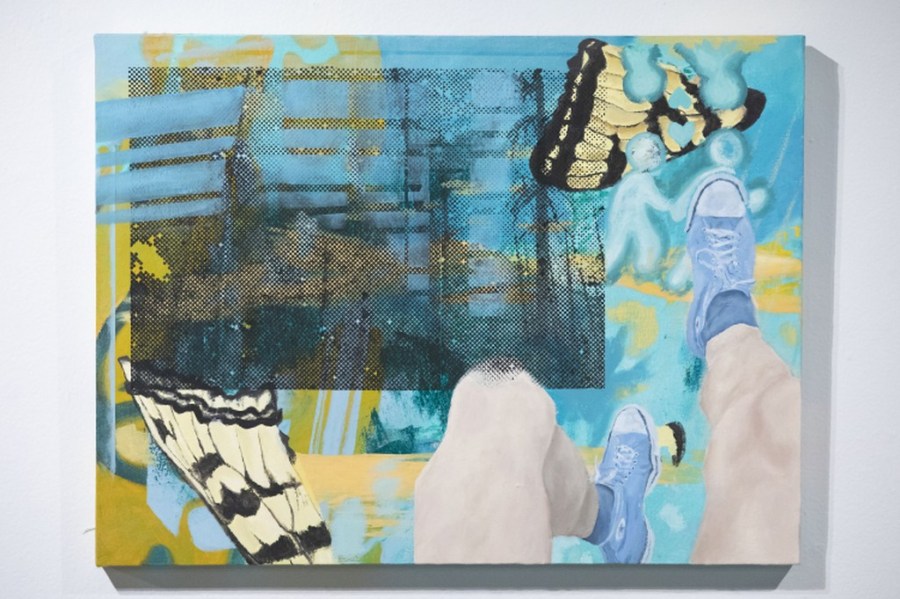
Tropospheric
By Claire Bateman
For all the times
we’ve checked the weather,
why won’t it reciprocate,
inquiring into our condition,
our immediate and long-term forecasts?
Is it oblivious, incurious,
self-absorbed?
Maybe it can’t distinguish us
from other natural features—
the wind gap, the echo hall.
Maybe it can’t perceive us,
not even as spaces
between the spaces,
though its least breath is epic,
having passed through
each of us
as we labor to articulate
all that we’re determined
to withhold.
Read More
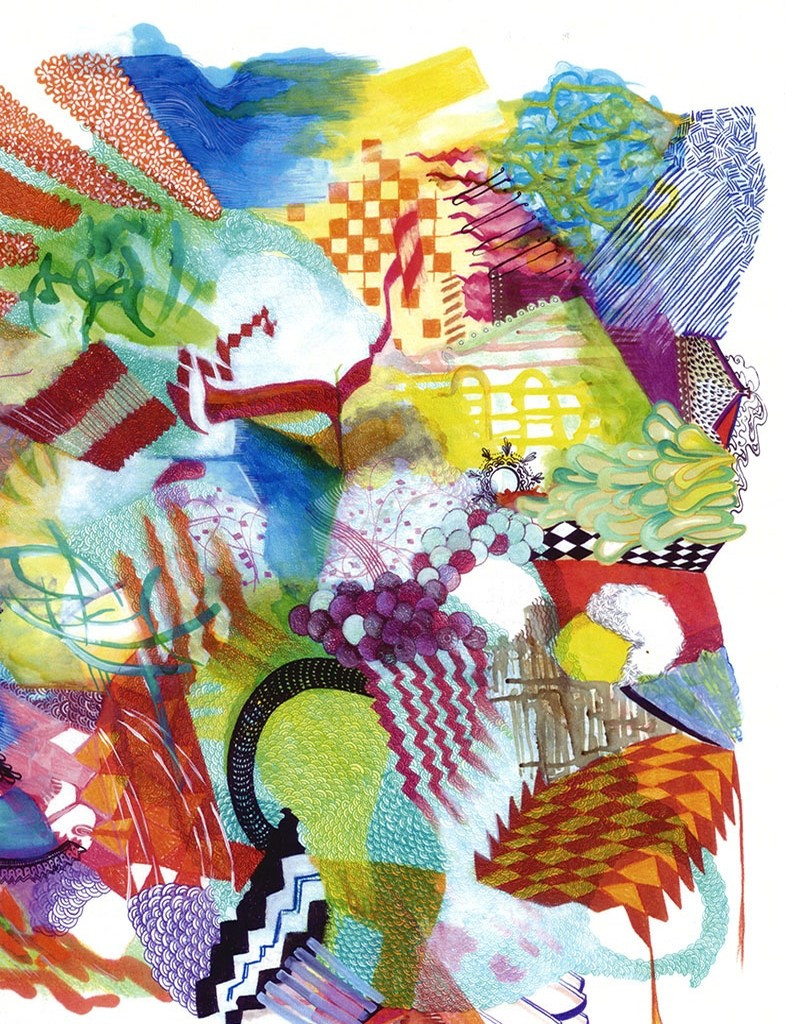
Purchase
By Claire Bateman
At last the heirloom china rides
cupboardless, exposed and free
upon Suspension™.
Books float alphabuoyantly unshelved
upon Suspension™.
Bartenders slide their brews
frictionless
along Suspension™.
At the Louvre,
tourists circumnavigate
the Mona Lisa
enthroned in sheerness now
upon Suspension ™.
Even the lowly toothbrush
rests its bristles, moist,
upon Suspension™.
And though we still shape
our shirts on hangers
as in days of yore,
now we’re free to set them dangling
everywhere,
just as we arrange our limbs
to sleep upon transparency
anywhere.
Nevertheless,
we can’t agree:
is there less
or more clutter
since we unanimously opted
for Suspension™?
Read More

Tutti Frutti for Me
By Andrea Simon
I’m watching The Adventures of Ozzie and Harriet on the giant Admiral 21-inch console television, and I can’t wait for the commercial to raid the freezer and see if there’s any ice cream. My father, mother, and sister are in the living room; and it’s no use asking them because my father would not answer me, my sister would order me to bring her a bowl of whatever I find, and my mother would say that I should look myself if I want anything that badly. Besides, what I’m longing for does not exist in this small Brooklyn apartment. I need to find tutti frutti ice cream, and the only flavors my mother buys are butter pecan for my father and chocolate for my sister. Every time I tell my mother that I don’t have the same taste as my sister, she seems surprised and says, “Why, I thought chocolate was your favorite.” I always answer her with the truth, “I love vanilla.” But it may as well be tutti frutti because she never listens to me.
The reason I’m crazy with the tutti frutti is because in the show, the Nelsons see a story in the newspaper about a police sergeant who was keeping a lost boy happy with a large tutti frutti cone, entertaining him until his parents showed up. This is the one night the Nelsons decided to forgo dessert in order to cut down on calories. Ricky, the troublemaker, wants tutti frutti badly. Darning socks, wearing a high-necked sweater with a double strand of pearls, Harriet Nelson says, “I haven’t tasted tutti frutti in years.”
Read More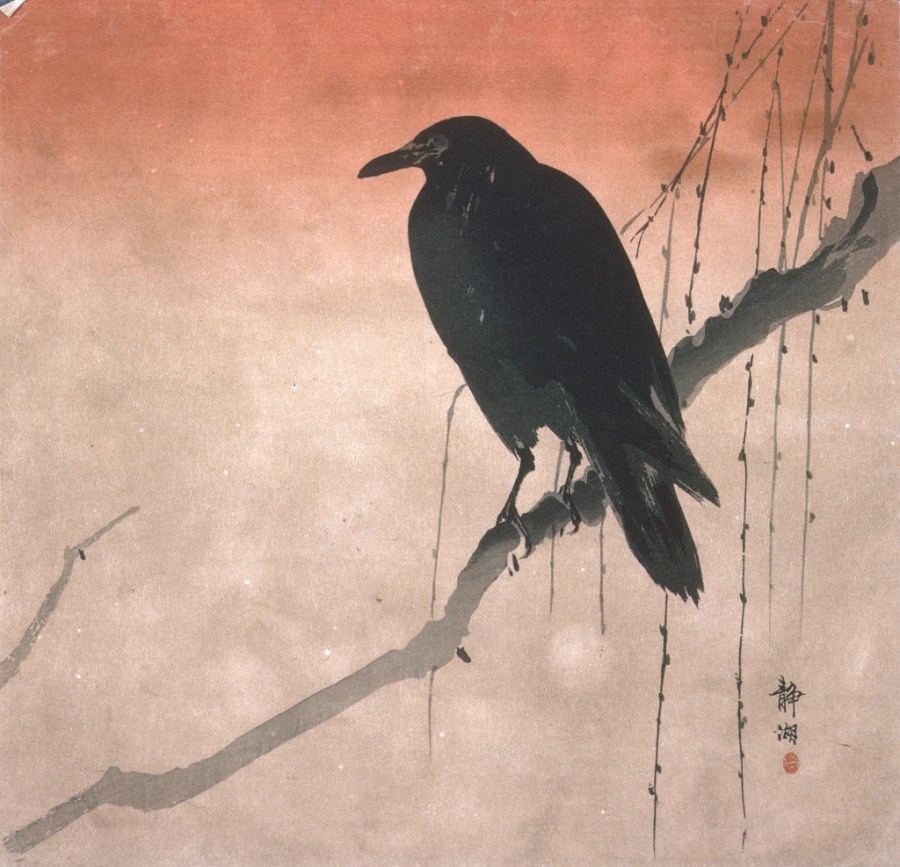
Feature: Should Poems Tell the Truth?
By Lawrence Raab
Mid-way through my freshman year at college, my roommate, Roger, asked if I would read a poem he’d written and tell him what I thought. I was pleased to be considered a literary person whose opinion might be valued. And my roommate, who would major in geology, had previously shown no interest in poetry. “Of course,” I said.
The subject of the poem was the death of Roger’s father, and I felt a small shock in reading it, since no one I knew had yet lost a parent. Unfortunately, Roger’s poem was a very bad poem. I don’t now remember the various ways in which it failed, but there seemed no doubt in my mind. Given the subject, however, what kind of criticism would be appropriate or bearable?
I began by expressing my condolences, and Roger interrupted quickly to say, No, his father hadn’t really died. That was just the subject of the poem. “But you can’t do that!” I exclaimed. Perhaps I didn’t actually exclaim, or even say it directly. But it was what I felt. This was wrong, a violation of some rule or code. You couldn’t do it, or you shouldn’t.
Read More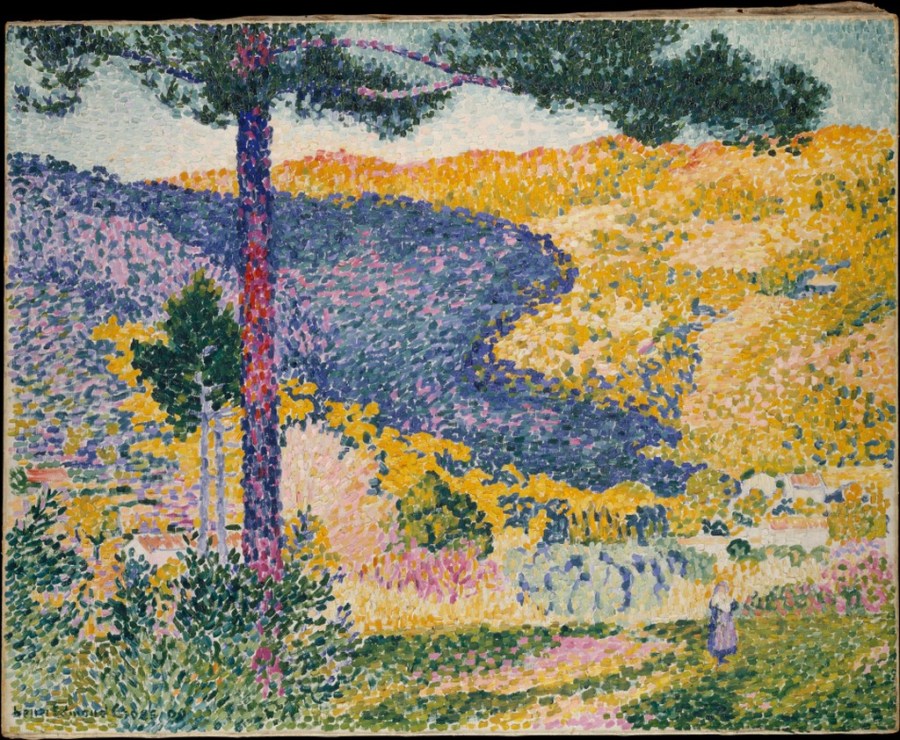
Feature: Where Are You Really From? Reading and Writing Place and Experience
By Adrienne Su
Maxine Kumin’s poem “Encounter in August” describes a standoff between gardener and black bear over a crop of beans:
Inside the tepee that admits
sunlight to the underpart
he stands eating my Kentucky Wonders.
Downs pod after pod, spilling the beans,
the ones I’d saved for shelling out
this winter, thinking soup
when he’d gone deep, denned up.
The speaker stands ten feet from the bear and watches him devour her beans. The bear doesn’t notice her while he polishes off the season’s yield. The danger to the gardener goes unstated; mainly, we feel her indignation and loss. The encounter ends with the bear’s oblivious departure and the speaker’s effort to make peace with what has happened:
At last he goes the way the skunk
does, supreme egoist, ambling
into the woodlot on all fours
leaving my trellis flat and beanless
and yet I find the trade-off fair:
beans and more beans for this hour of bear.
Feature: A Brief Response
By Louise Glück
Frankly, I have no idea why this should be any sort of problem. I love discovering that a reality, or what I experienced as a reality, is invented, that a world has been contrived to provide context for a set of perceptions, or for a voice that is almost by definition other than the poet’s in some way. Pretty much nothing I write is literally true, and very little is borrowed from someone else’s stories, which seems to me immoral. A voice presents itself and around that voice events form. I love this in fiction and assume it In poetry. Otherwise we’d all be hopelessly limited.
Read More
Feature: Telling the Truth in Poetry
By Carl Dennis
All good poems must be truthful, but the truthfulness they embody is not that of accuracy to historical fact but fidelity to what might be called the facts of the human condition. In the service of discovering and expressing fundamental attitudes toward life, poetry is allowed, with some qualifications, a license similar to that accorded to fiction and drama: the freedom to substitute imagined materials for those it finds ready-made in the world. Poetic license means that William Wordsworth would have been free to write a poem about meeting a leech-gatherer even if he had never met one in the flesh, that Matthew Arnold would have been free to write a poem about standing on the beach at Dover with his sweetheart without ever having been to Dover, that Robert Frost would have been free to write a poem about picking apples even if he had never picked apples, if, say, a bone spur in his left foot had made it too painful for him to use a ladder. The demands of the poem itself are allowed to take precedence over any demand for strict autobiographical accuracy.
Read More
Feature: “Father”
By Michael Ryan
Like almost every other MFA graduate then and since, I couldn’t get a teaching job in 1972 after I earned my degree. My teachers—Marvin Bell and Donald Justice—kindly offered to let me stay and work on The Iowa Review if I enrolled in the PhD program and thereby qualified for graduate student support. So I did. The magazine was staffed mostly by workshop students like me and to entertain ourselves we tacked on the office bulletin board particularly psychotic submission cover letters. My favorite was a five-page letter handwritten in red ink whose salutation was “Fuck you, Iowa Review Pig” and went on from there with further compliments about the quality of our magazine and our excellent judgment concerning previous submissions that we had declined to publish. I’d go into the office a couple afternoons a week and screen poems. There were a mountain of them (the magazine was already getting thousands of submissions a year). After a few weeks of this, I developed the skill to reject poems based on cover letters ranging from the aforementioned “Fuck you, Iowa Review Pig” to “I enclose some Christmas verses my pastor enjoyed so much.”
I still remember opening an envelope that contained no cover letter at all and this poem:
Read MoreNew Ohio Review Issue 15 (Originally published in Spring 2014)
Newohioreview.org is archiving previous editions as they originally appeared. We are pairing the pieces with curated art work, as well as select audio recordings. In collaboration with our past contributors, we are happy to (re)-present this outstanding work.
Issue 15 compiled by Jade Braden.

Fear of the Bird Migration
By Darren Morris
Featured Art: Bird by Peter Takal
I was attempting
the old familiar,
the regular slog,
when I slipped into
missing her again,
the child my wife and I
would never have.
Sometimes she was
a girl and sometimes
a boy. But like heaven,
I held her there
in my mind, a place
of light where nothing
is done, but all is felt.
She was a multitude.
The great uncapturable
plasm of love. Often
she was only
a finch’s thin line across
a rice-paper sky, tearing
through all stations of life.
The way she might
have worn her hair,
or adorned the surprising aspect
of surface-self for appeal.
Or how the supremacy
of personality might emerge,
wriggling out as it does.
Or the first run-in with
terrible, terrible sexuality.
Cups
By Cecilia Pinto
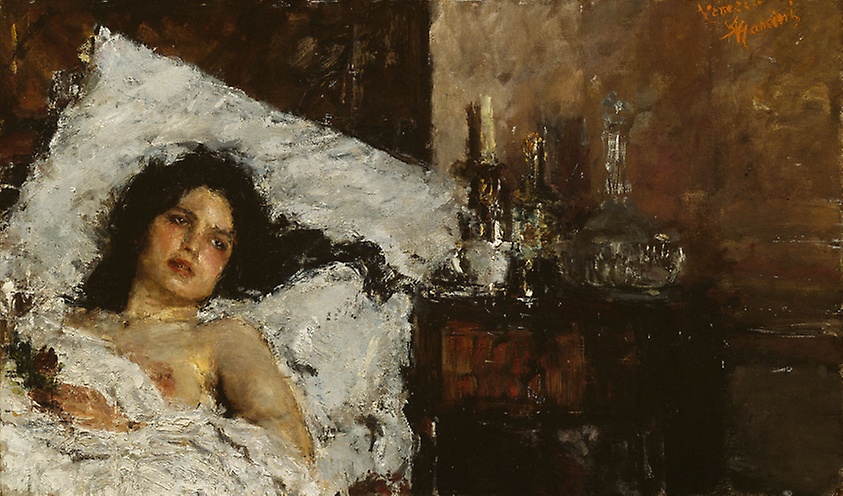
Featured Art: Resting by Antonio Mancini
Many years ago I watched a documentary about people with mental illness. One of the patients presented was a young woman who had been institutionalized. Despite being an adult physically, she acted like a little girl and lived in a room filled with dolls. She wanted more than anything to be spanked because she equated this with love. No one would comply with her request which made her desperate and upset.
I have remembered this.
In another documentary I learned of a girl who had been kept in severe isolation and abused for most of her young life. Her deprivation left her sensitive to light and without language. Partial rehabilitation was achieved but it was noted that the girl felt it absolutely necessary to keep multiple glasses of liquids in her room.
When I think about the first young woman, I see her story line in a candy-colored palette, baby pinks, blues and soft yellows. The curtains billow, the bedclothes pool, there are fat, dancing animals with little eyes.
The second girl’s images are black, white and gray. The girl moves through her story like an animated charcoal drawing; sketchy, vibrating lines, electric black hair, skittering movements. I think of black crows flapping into the sky, the glint in their eyes, the glint in the water in all the glasses. She carries glasses of water in front of her as if she is a priestess.
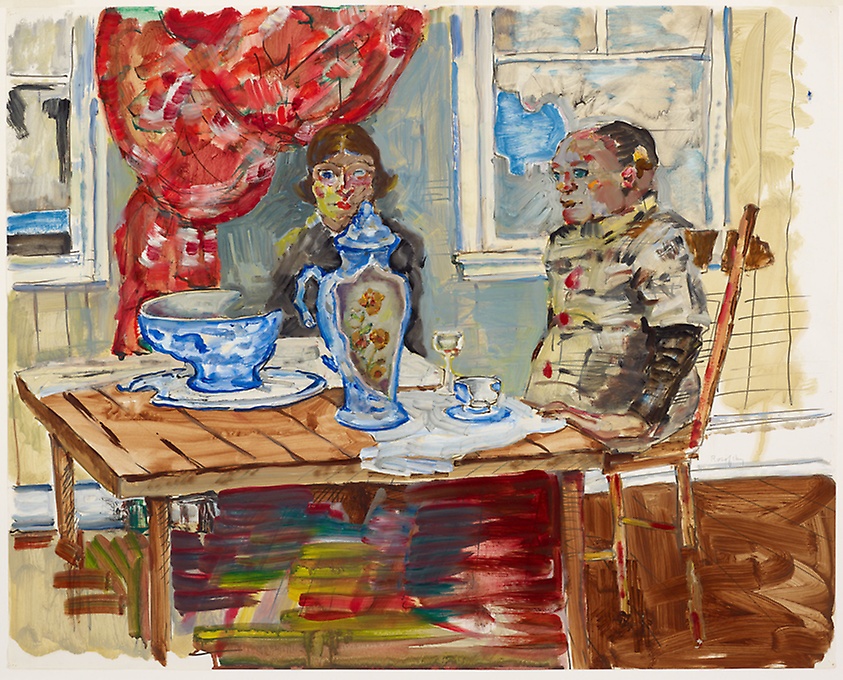
My Keats Year
By James Davis May
Featured Art: Tea Party with Open Pottery by Seymour Rosofsky
Shouldn’t it be I’m disappointed by (or because of) and not in you?
We were watching Stellar’s jays—I didn’t know their names then,
I addressed the first one as “Monsieur Mohawk”—watch us,
or watch our meal rather. I don’t know if birds feel disappointment,
but as they flitted around the perimeter of the patio
with an odd combination of aggression and timidity,
their feet on the sun-bleached railing
making sounds like a hand searching a filled drawer
for something that’s not in the drawer,
the diminishment of cereal must have been processed
as the bird-equivalent of disappointment.
When I picked up Chelsea’s bowl and took it inside to the sink,
I thought of California (it was my first time in the state),
and then of Robinson Jeffers,
and then of the time Jeffers realized
he was older than Keats when Keats died, and then I realized
I was older than Jeffers when he realized this.
He was taking firewood back to his house and had to walk over a very narrow
bridge, one that his dog seemed reluctant to cross again. So he left the bundle,
carried the dog over, and then went back for the wood when he was hit by his
age, and then the “insignificance” of what he had written.
And yet we say, “I’m disappointed with myself,”
which sounds redundant.
The woman eating dinner with us the night before told us there was no age she
wanted to go back to. Someone pointed out that she was still young.
Read More
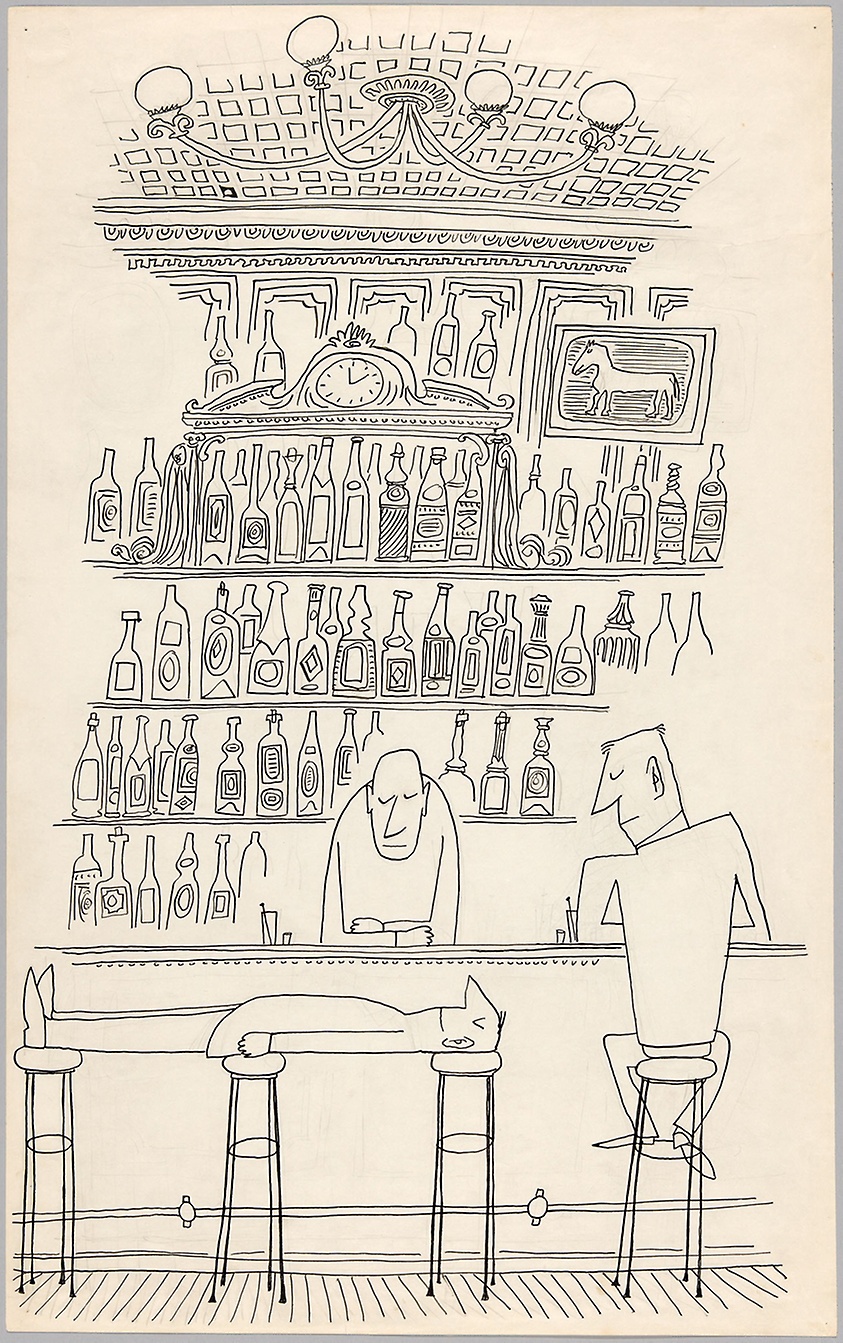
Mystery Object
By Sarah Galvin
Featured Art: The Art of Living by Saul Steinberg
You come out of the room where everyone is doing karaoke
and ask why I’m ignoring you.
I want to say something that suggests I’ve endured
some exotic, indescribable torture
but a completely mundane thing has happened,
which is you have stopped loving me.
So, even though your body is here, you are gone
and bodies are becoming less like a procession of individuals
than a texture like wet cement, but also like words that say,
“Why would you subscribe to such a mystery object”
and I think, it’s funny the cement forms words, especially these words
but something isn’t right about the word “subscribe” in this context
and I can’t tell if the sentence is a question or a statement—
Why is there no punctuation?
I want to run, but I’m already travelling in every direction at once.
Read More
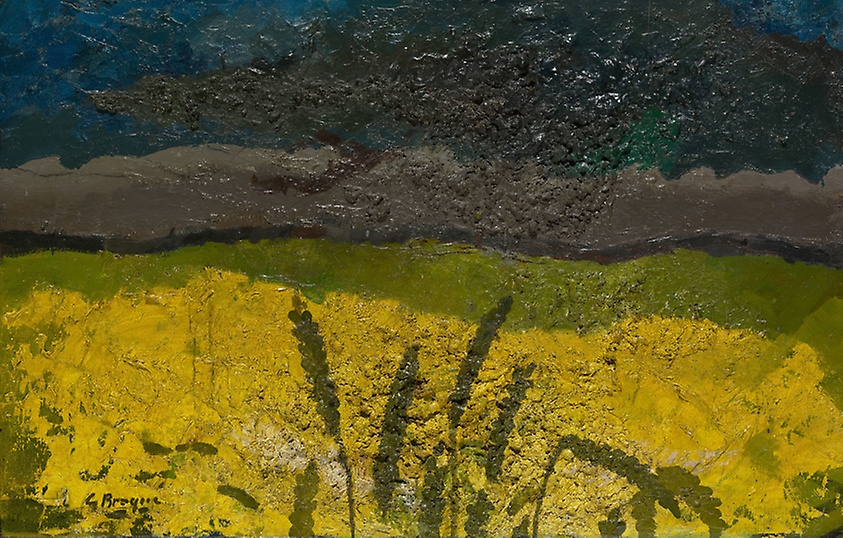
The Darkest Part of the Cloud
By Jessica Langan-Pack
Featured Art: Wheatfield by Georges Braque
My daughter is nine, and she has recently grown taller and lost most of her softness. Now she’s a thin and delicate thing with very straight, very smooth hair that she wears in bangs across her forehead. She is afraid of bees. She is afraid of forest fires, and of strangers, and of a book she read called The Face on the Milk Carton, which is about a little girl who sees her own face on a missing children poster. She is articulate and serious and very imaginative. When she finds out, at the beginning of her summer vacation, that her father is losing his memory, not slowly, or gracefully, but at a possibly alarming rate, what she decides to do is remember everything.
“So that you can tell him?” I ask her. For a few weeks I have been thinking of my head as an empty room of some kind, and sometimes my voice reverberates off its walls. We are sitting in the kitchen eating cereal.
She shrugs. “Just so I don’t forget.” She is at a stage where she has trouble differentiating between other people, real or fictitious, and herself. I wonder if she is afraid of losing her own memory.
The Professional
By Michael Bazzett
She arrived in a dark suit and a mask-like smile, explaining
her services in a manner so polished it almost put us off.
This is my specialty, she soothed. Both mind and house
will be empty as a mountain wind once I’m done. I sensed
she’d said those words before. We sat at the kitchen table,
you and I, looking at one another, hoping the other felt more
certain, more assured. Once we signed, it would take years
before we acknowledged our mistake. She’d left the whole day
open, and could begin immediately. Was there perhaps a guest
room where she could change? Her assistant arrived with
a black duffel, fresh white towels, and a stainless-steel basin.
I didn’t know the basin would be so big, I murmured. We looked
at one another uncomfortably. It is not always a clean process,
she reassured. You do understand, once I’m sequestered, it is
very important that I not be disturbed. We nodded. She closed
the door with an audible click. For the first few hours, it seemed
okay. Her assistant sat out in the van, with the windows down,
reading. We sat in the living room and tried to do the same,
ignoring the sounds coming from the guest room, sighs that
sharpened into cries. When a few faces started disappearing
in the photographs above the piano, you leapt to your feet.
This isn’t right, you said. These things shouldn’t be removed.
But what about the pain? I asked. Don’t you want it gone?
No, you said, pointing to the image of a child, suddenly frantic.
The eyes had faded to nothing. From forehead to cheekbone
was just smooth skin. I ran to the window. The van was gone,
as was the tire-swing that had been there an hour earlier. I looked
and saw the elm losing its limbs, one by one. Maybe we can still
get some of our money back, I said. And then you said: I want her
gone. The assistant had sealed the door shut with tape. It came
off with a spattering sound, and the shrieks from inside paused.
Then the voice came, a strangled croak as I opened the door
and saw her, smaller than I remembered, perched on the dresser,
her suit pooled on the floor beneath her. Her face had become
a sort of beak, hinged open and hissing. But it was the children
that were upsetting, sitting in a circle at her feet, quietly singing.
Read More
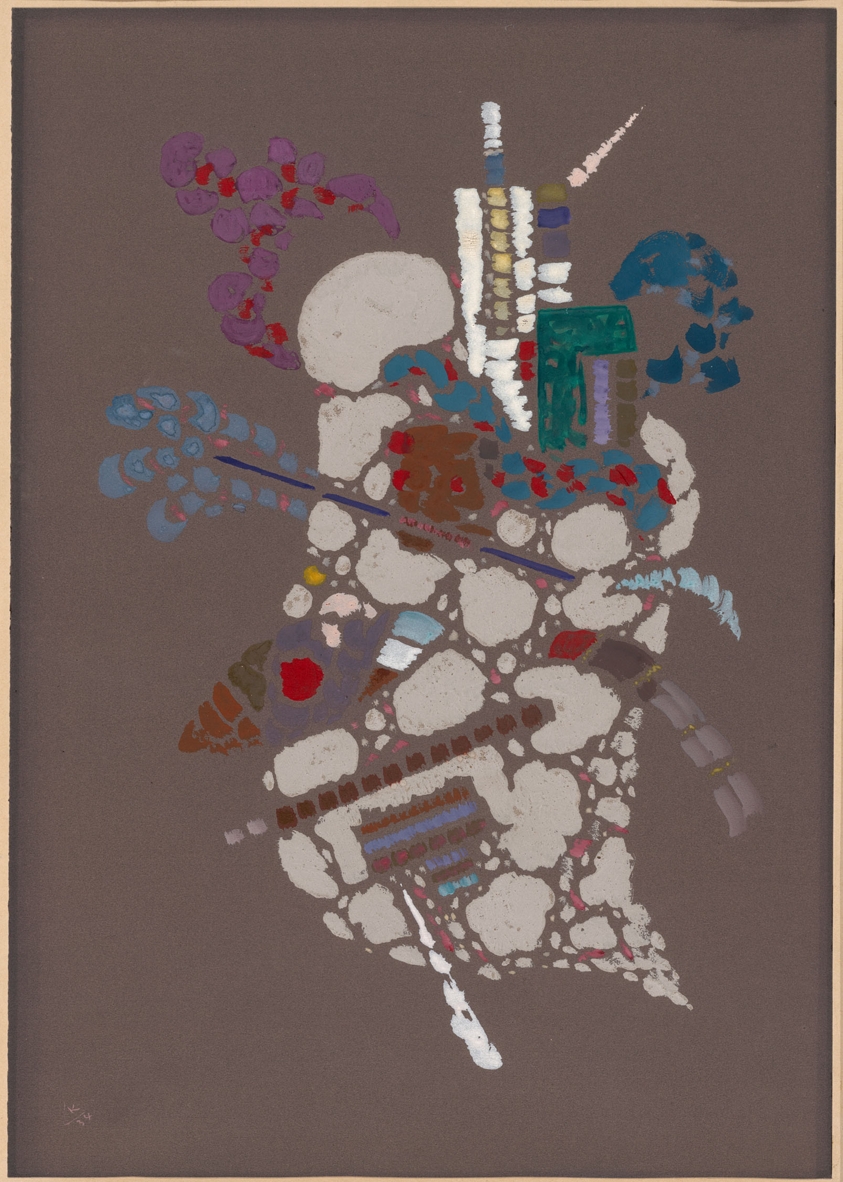
Fastball Shy
By Mike Schneider
Featured Art: Gray Spots by Vasily Kandinsky
Hot roller to the shortstop,
me—lean machine
of summer, scuffling
in ballfield yellow dirt.
Off like a hound I go
with my three-finger
Warren Spahn, neatsfoot-
oiled cowhide glove
to gobble that scorched
grounder & fire it
across the diamond
to Tub McMullin’s
fat-handed mitt at First.
Little League? Shit.
This is ultimate Big Time.
Who knew that stitched
leather ball could baffle
hand & eye? Wild
chance, wicked hop,
they said, nasty chop
direct to the cartilaged
bulge of my Adam’s Apple
dropped me flat, washed
me in starlight. Nerve
& muscle inscribed
with solid-state physics,
I learned to flinch & never
could unlearn that secret.
One rainy afternoon
on Heckman’s front porch
we unraveled it, yards
& yards of yarn down
to the inscrutable rubber
pill, unforgiving hard
center of the world.
Read More

Still Listening
By Robert Cording
Featured Art: Confusion of Christmas by Julia Thecla
I. Hospice Jumble
The Jumble in the paper too hard for him to read,
my mother suggested we make up our own: Dear,
she said to her husband, your first word is life.
Reduced to words we jumbled, he joked file
it. My brother offered another, mean,
thinking perhaps of his diabetes, a name
like cancer to our family. Then, lamp,
lit at his bedside, and the one palm
visible outside his one windowed room.
My father got them quickly, the last, moor,
said with all the sadness of being far from shore . . .
A grandchild solved that one—horse,
she blurted, noticing that he had left
us for a while. By his bed, my mother felt
his hands and face and eyes. Bob, please,
she said, but he was already asleep,
snoring, not dead. My mother sighed, O God.
My brother, in the spirit still, said dog. Read More
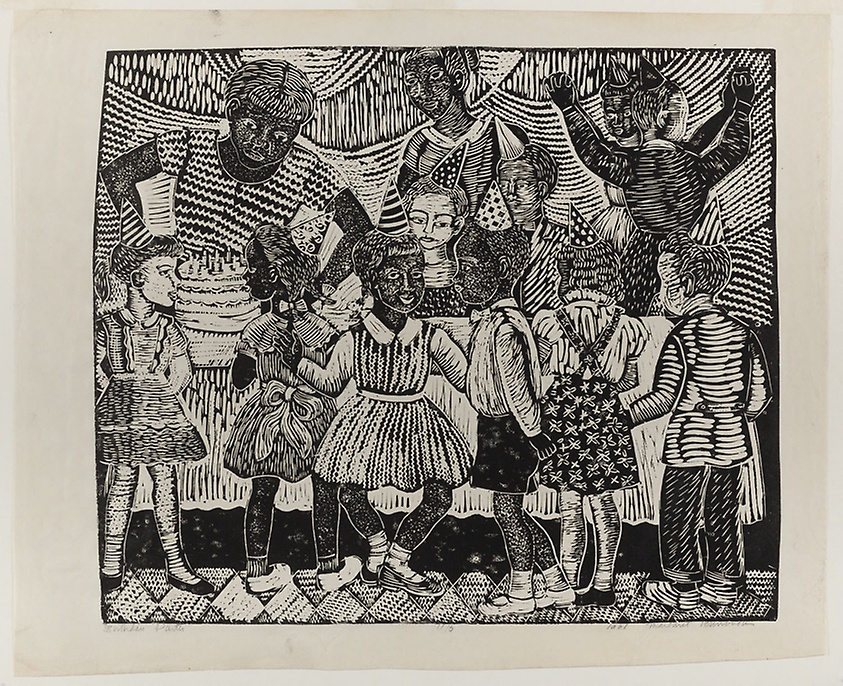
My Dead Father Remembers My Birthday
By Lesley Wheeler
Featured Art: Birthday Party by Margaret Burroughs
Dream-phone rang and I thought: that’s exactly
his voice. I haven’t forgotten. Then: but I could
forget, because he’s dead. Hi, sorry it’s been so long,
but I was sick and the doctors messed everything up.
He made that shrug-noise, dismissive but pained,
meaning he’s lying or leaving something out.
It’s snowing here, and then a click, click, over the line,
and a neutral woman’s voice, slightly officious:
This recording was intercepted. If you wish to replay
this message, dial this number now, and she recited
a blizzard of digits while I flailed
for a pen then found myself tangled in blankets.
The window a bruise beginning to fade.
Here mist wreathes the trunks. In a few months
snow will crisp the grass, insulate and numb the oaks
with feathery layers that would soak and freeze
a human being. When and where is he? Snug,
maybe, watching weather through double panes.
Or wanting to be. I heard a bead of doubt
suspended in his voice, a cool guess he’d missed
something, before my operator intervened,
reason declaring: This is memory. The line is cut.
Read More
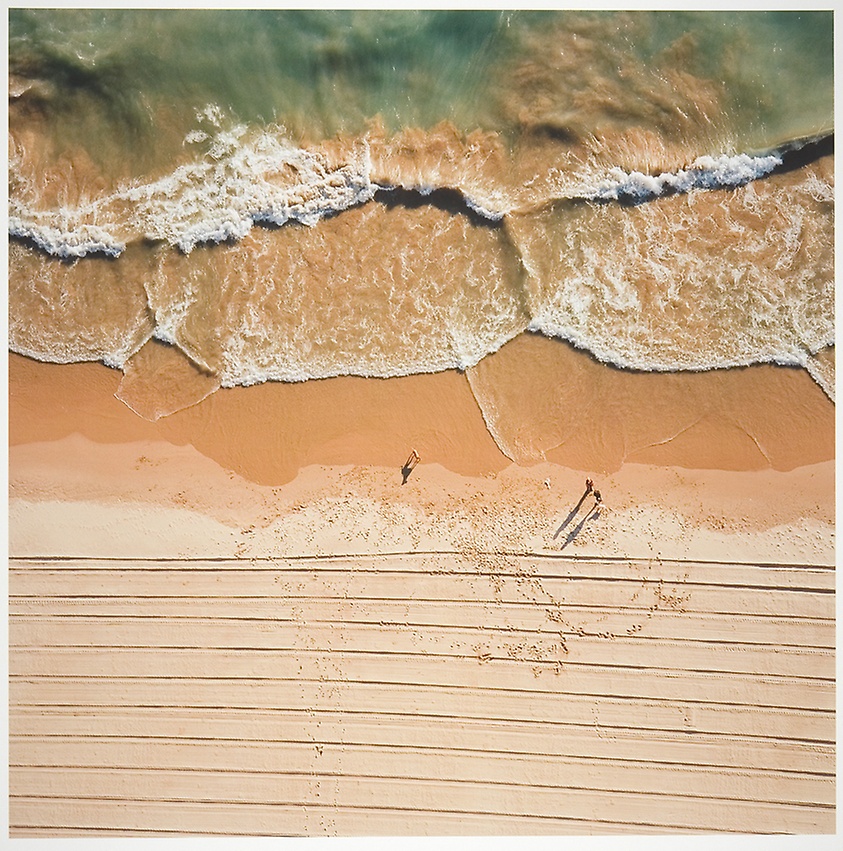
A Toast in Cancun
By Charles Haverty
Featured Art: Oak Street Beach, Chicago by Terry Evans
Everyone in his new life warned Ferris not to go to Cancun. They said Cancun was to drinking what Las Vegas was to gambling. “They even drink in the swimming pools,” his sponsor Leonard told him. “No shit. They belly up to the bar right there in the water.” He’d been sober for four months, a week, and three days, but Caitlin was his only sister and he her only brother and this was her wedding. So there he stood, sweating on the beach in the wrong suit, the darkest figure in the sand-colored crowd. With the ceremony behind him, only the reception, the night, and a taxi ride to the airport separated Ferris from the plane that would carry him back to Indiana and his quiet, normal life.
It was five o’clock, with two hours to kill before the beachside reception, and as guests blew soap bubbles in lieu of throwing rice, he felt an arm encircle his waist, his father’s arm, steering him back through the bubbles toward the empty rows of white chairs. His father was a well-kept man of fifty-nine, youthful and perpetually tan, and though he’d been all smiles walking Caitlin down the makeshift aisle, he looked ashen now, diminished. “We need to talk,” he said. “Not here. Alone. Mano a mano.” They agreed to meet poolside once his father was through posing for photos with the wedding party. He took hold of Ferris’s sleeve. “Don’t fail me, Son,” he said, and that Son frightened Ferris more than anything. As he followed the concrete path that ran alongside the beach, the urge to drink, to counteract his renewed sense of dread, was near irresistible. He had to call Leonard.
Read More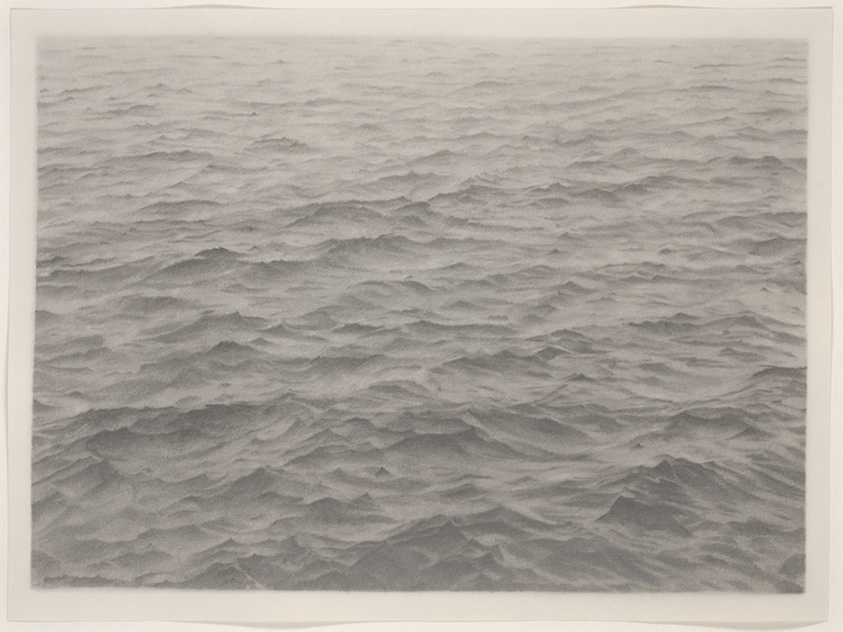
Patina
By Mark Cox
Featured Art: Untitled by Vija Clemins
In your prime, shape presents itself first,
the angle and curve of one thing,
the size of something else,
or the way her hair flows volcanically
along each subtle slope and swell.
It is crazed, intense, super-heated,
even the soles of your boots feel sticky,
because she’s entered you, you know this,
she charts the very map of your blood,
and that eyelid twitch you have going,
they’ll claim is stress and dehydration,
but it’s her, pal, all her, she floods places
you’ve never named in yourself,
she proffers the pulse, the duende, the élan,
that jackhammer of lust
outside the Fiesta Ware outlet. . . .
But one day, it just happens,
a man’s eyes cloud and change,
you don’t feel with the same ardor
the way she moves, her confident posture,
no, suddenly it is color you notice,
the grays, the yellows, the bruised surfaces
tinged with a silver-green, almost a tarnish,
as if her skin were a metal,
and not such a precious one, either,
more like pewter or the common alloys
of soot-smudged medieval artisans,
something to be re-shaped, hammered thin,
become useful and used.

Finality
By Mark Cox
Featured Art: Jonny Dunn’s Sandwich Shop, Paducah, Kentucky by Walker Evans
She did not fit her body anymore—
she was lost inside it—
not like some punished child
wincing in the corner of a vast room—
not, either, like a ring fitted snug in its box—
more like the single yellow pill
in her white medicine cup—
that’s how she was, waiting—
carving precise cubes
from a thin lamb chop, chewing
with such listless fatigue,
I feared she might never finish,
and so pretended that by looking away
I was preserving her dignity.
Chewing and swallowing—
that’s how I remember her—
not as a face or even sequence of faces,
but as a complex montage,
a simultaneous superimposition
of every face she’d worn since birth. Read More
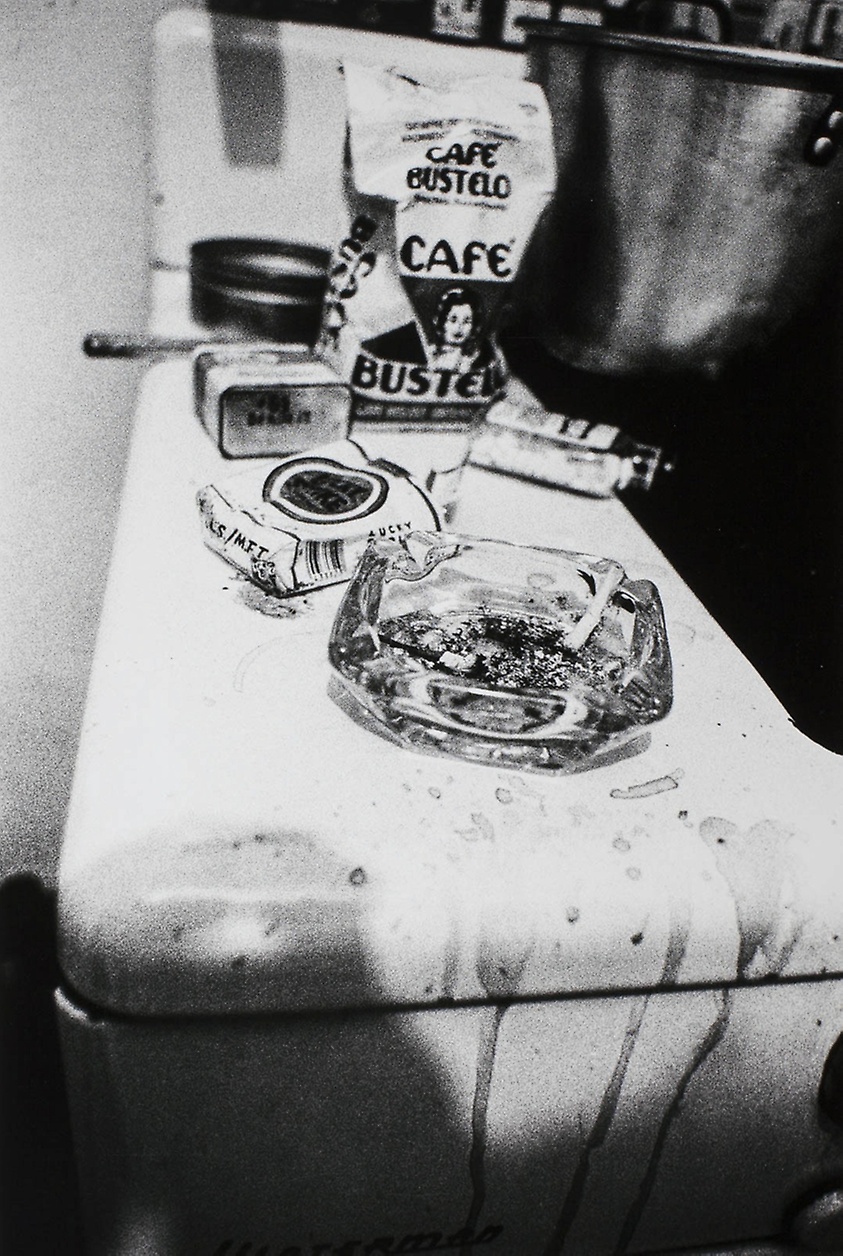
A Distant Relative
By Ryan Meany
Featured Art: Coffee and Cigarettes by Ken Schles
Mom called Friday to say Linda died.
At least two people I don’t like at work
I know better than Aunt Linda. I carried her
casket yesterday, because my grandmother asked,
along with younger cousins, strangers I recognize from childhood,
tough men I see only as the children they were
in bony faces, stubble. The babies they were
they’ve locked up deep: Dusty on military disability
with three kids, and Billy, who used to be Little Billy,
with a court date for driving 137. My grandmother
looked like a Treasure Troll in tired skin, white broken
hair refusing to go down. When I hugged her the life in her was small
as a niece, her lineage drained out all around her. She reminded me
I was her first grandbaby in that smoky Southern Baptist
vibrato. A few days before, on Sunday, when I’d come to her house,
she talked like she’d long ago forgiven me for mostly staying away
for twenty years. I was glad she didn’t know the trouble I’ve caused, especially
because I doubt she’d love me less. My senior picture hung in her living room
as if I were as important as all these grandkids and great grandkids
who wondered who I was. Soon she’ll be dead and I won’t be so important.
So many people took turns holding her
the funeral seemed to be hers. I had no right to want to save her
from thinking, when I was helping to carry her daughter’s body,
that I’d soon be carrying her body, as I’d carried my grandfather’s body
just a couple years before, which was actually six years before.
We were not sad that, to time, we were like grass
under the feet of pallbearers. I was sad because
the time I had in common with this side of the family
we’d mostly forgotten, another thing my grandmother would die knowing.
The last time I saw Aunt Linda was outside the hospital
in the courtyard for smoking. I was there visiting someone
who’d mixed Vicodin and vodka to find out who cared. I can’t remember
why Aunt Linda was there, her heart or her brain. Her brain
would cause the most trouble later, a popped vessel, then
another, the top of her skull removed, screams
from the headaches and so many drugs, according to my grandmother
as we smoked outside Sunday morning. She’s at peace,
I said. Already we were down to our last words.

At the Grave of Sadie Thorpe
By Miles Harvey
Featured Art: A Graveyard and Steel Mill in Bethlehem, Pennsylvania by Walker Evans
Time forks, perpetually, into countless futures. . . . In most of these times, we do not exist;
in some, you exist but I do not; in others, I do and you do not; in others still, we both do.
—Jorge Luis Borges, “The Garden of Forking Paths”
“Was she a relative of yours?” the old man asks, leading me toward your grave.
“Well, not exactly,” I begin to reply. “She—”but then I pause. In the middle of my sentence, in the middle of my life, in the middle of some small-town cemetery in the middle of the Midwest, I pause, unable to explain who you are or why I’m here. What I would tell the man, if it didn’t sound so absurd, is that although I am not your descendant, although I only recently learned of your existence, although you barely left a mark on the world, and although your corpse was buried here more than forty years before I was born, I can’t get you out of my mind. What I would recount, if I could figure out a simple way to do it, is the history of happenstance that connects me to you across the years, a bond that at this moment feels almost as strong as the ties of blood. What I would confess, if I wasn’t worried he’d laugh in my face, is that I woke up this morning, a couple months shy of my fiftieth birthday, certain I had to drive more than one-hundred miles from Chicago to visit a total stranger’s grave in this tiny hamlet of Dana, Illinois.
A dog barks in the heat of this August afternoon. A killdeer swoops in on slender wings, offering its distinctive call: kill-dee, dee-dee-dee, kill-dee, deedee-dee. And still I pause.
Hook and Eye
By Sarah Barber
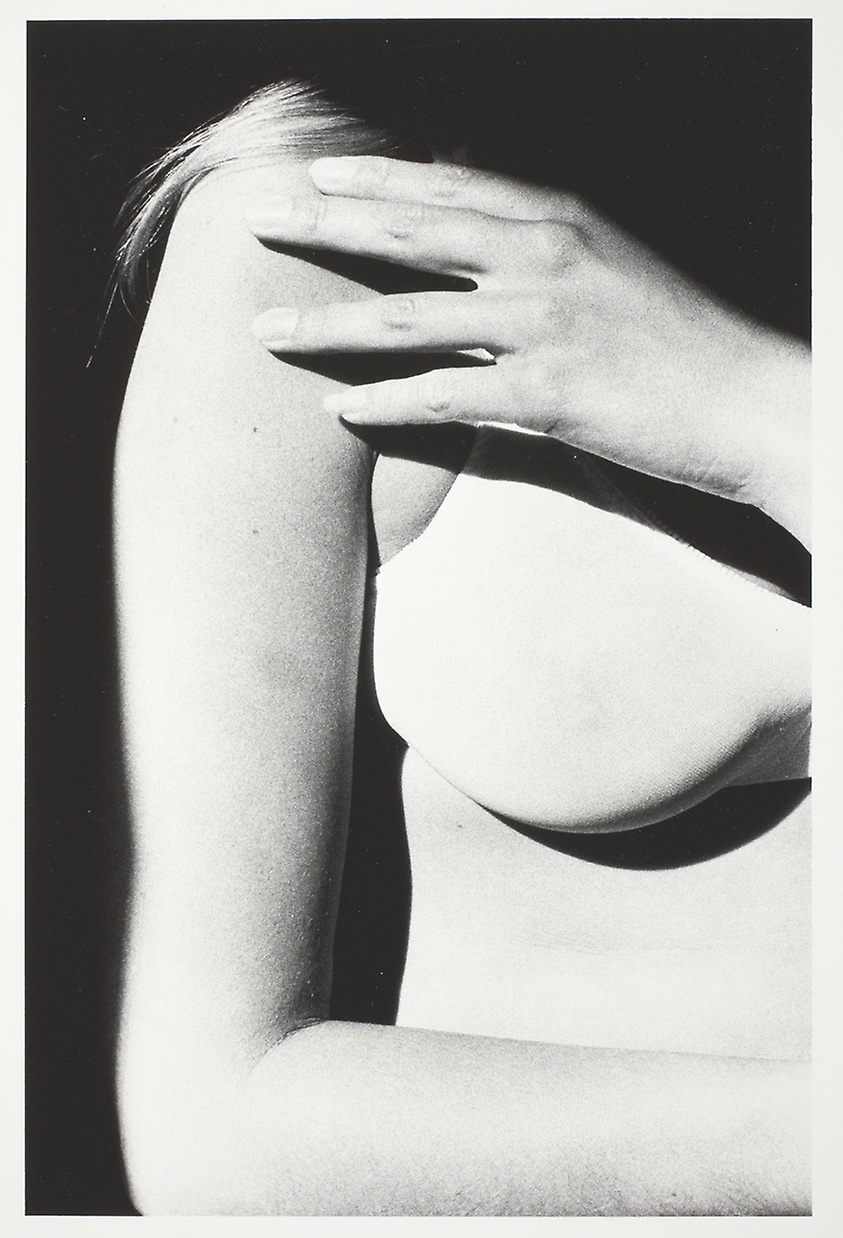
Featured Art: Untitled (Woman’s Arm and Bra) by Ralph Gibson
Often I have unfastened it myself
without tragedy. But I wanted you
to stand behind me—in fact
a fourteenth-century town
of needle manufacturers crocheted
loops from wire because they wanted
your hands just so terribly
close and a little bit slow
at the closure too aggressively
latched to unhook at the will
of its wearer, which is what was said
to sell it to nineteenth-century ladies,
not quite promising exactly such
an unhooking of their dresses
and all those garments, and indeed
as early as 1643 a woman in Maryland
traded £10 worth of tobacco for hooks
and eyes only because she wanted
you to stand behind me
as the fastening came undone.
Read More
Rome in Us
By Thomas Grout
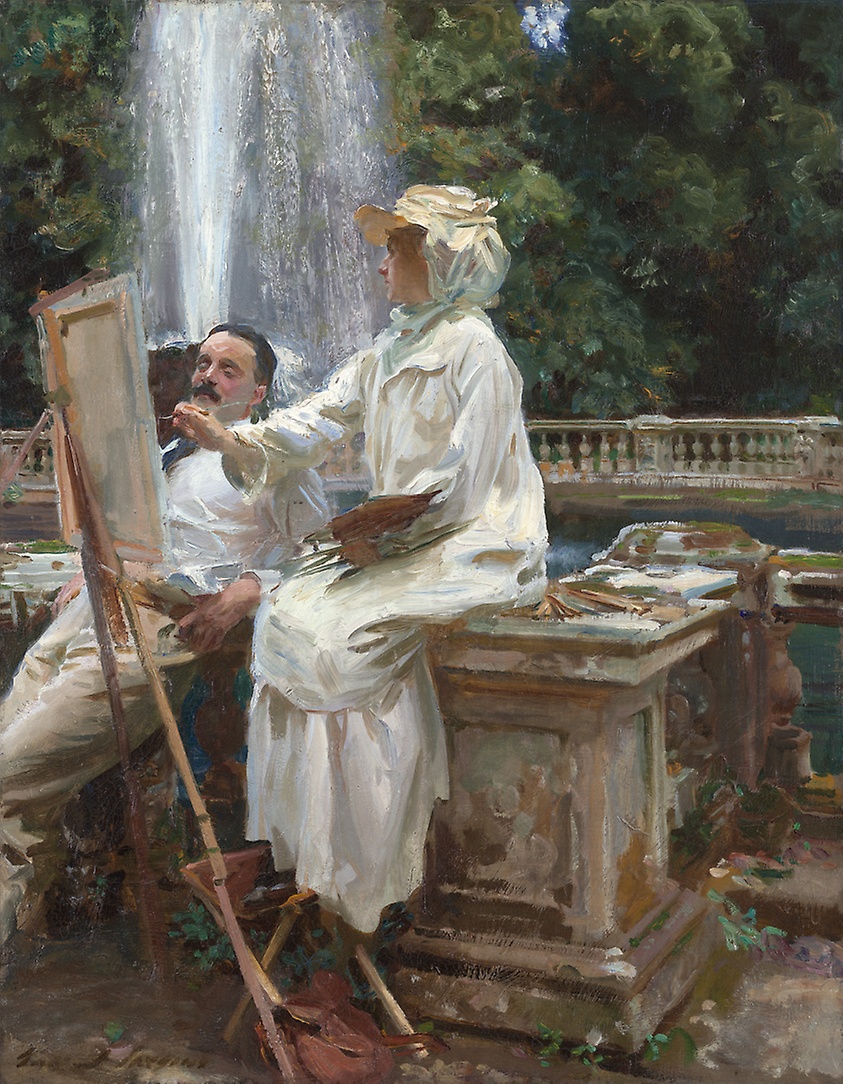
Featured Art: The Fountain, Villa Torlonia, Frascati, Italy by John Singer Sargent
It’s funny isn’t it—the way Rome still comes at you
fast like a bat breaking past your head from memory.
At the Roman pace the body takes the city better than the mind.
A cathedral ceiling’s fireworks shoot up
once the sermon’s fireworks stop. And when
the ceiling finally stills, the piazza outside overfills
with new fruits and vegetables and etymologies.
Stimulation’s cheap as wine and your horse
is more than happy to take it in by trough.
But it flies by so fast—
only just now it’s slowed enough to hatch a feeling
similar to how it is to listen through the dark over our bed
for a half-caught sound to sound again.
That given one more chance I could make easy sense of it.
It’s often that I sleepwalk down our subdivision’s version
of the Spanish Steps thinking I left something unnamable
inside the Trevi. Is that it at the end of the tube-slide?
I never know. It all gets hazy after the Flaminian gate
though I’m absolutely certain I wake up at the refrigerator.
Rome is in us like unfinished business—
that’s why half of me is still sauntering the cobbles.
I guess we’ll always live our lives possessed
by the ancient Roman sense that down any old left turn
suddenly one of our dreams might find its title.
Read More

Connect
By Glen Pourciau
Featured Art: Mall of America, Minnesota by Melanie Einzig
We were in a Mexican restaurant at the mall, and my husband, as is his habit, was looking at everything but me. I still had half an enchilada left, but Boyd’s empty plate had already been removed and he’d ground through all the tortilla chips and salsa on the table, leaving his eyes and mind free to survey the room. His attention was drawn to the occupants of a booth across and at a slight angle from ours. He could see them better than I could, but I peeked back and saw a man and woman, presumably married, and a young intellectually disabled boy, the boy seated on the man’s side, which may have appealed to Boyd. The three of them were a picture of happiness, talking and smiling and enjoying one another. If the boy was their son they’d likely been married at least ten years, and I admit I couldn’t help comparing how they seemed to how we were after fifteen years. Read More
Pythagoras
By Bruce Bond
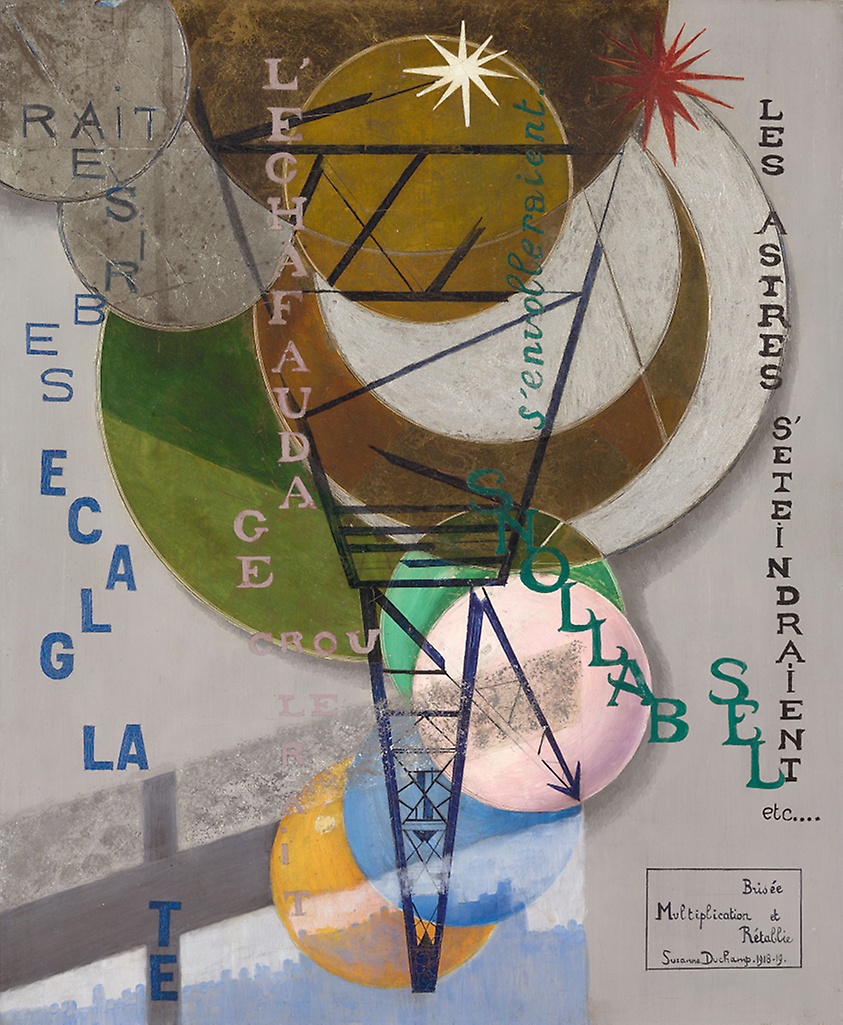
Featured Art: Broken and Restored Multiplication by Suzanne Duchamp
Somewhere beneath the crematorium
of stars, the mystery and the boredom,
the vacuum that every space abhors,
you might stop to listen to no one there
and hear the words of a dead man, a Greek,
who measured nights in increments of music.
The sky then was a calliope of numbers
whose tune was everywhere and therefore far
away as dead men are. No such thing
as solitude among them. It takes a string
of intervals on heaven’s monochord
to pull the sounds from one another, the choir
of which must be silent, surmised, and yet
each ghost note dies into the next to hear it.
Read More

Bobcat
By Mikko Harvey
Featured Art: Forest by Werner Drewes
Walking through the woods / at midnight / we were on our way / to the pond / where we
would skinny dip / when two yellow eyes / appeared on the path / we froze / they didn’t
blink or move / the body was / hidden by the dark / there was something / sinister in its
stillness / we turned back / you said it was probably / a bobcat / but better not / to take
that chance / we shared a bed / untouching as usual / you fell / asleep first and I wondered
what kept us / apart really / that night / and the others / the distance between us / maybe six
inches / felt like a shadow / I couldn’t step out of / my two open eyes / the only light
in the room / I thought of the animal / blocking our path / and it occurred to me / she was
only a hostess / welcoming us / to the world of risk / smooth and lovely / water hugging
your naked body / the animal said / are you ready / but we walked away / I had an urge
to shake your body / awake and take you back / to the animal and say / confidently yes
table for two / but instead I just lay there / in the perfect / quiet / country / darkness / and
imagined the outline / of your chest rising / and falling / rising / and falling as you slept.
Read More
At the Metropolitan
By Ellen Devlin
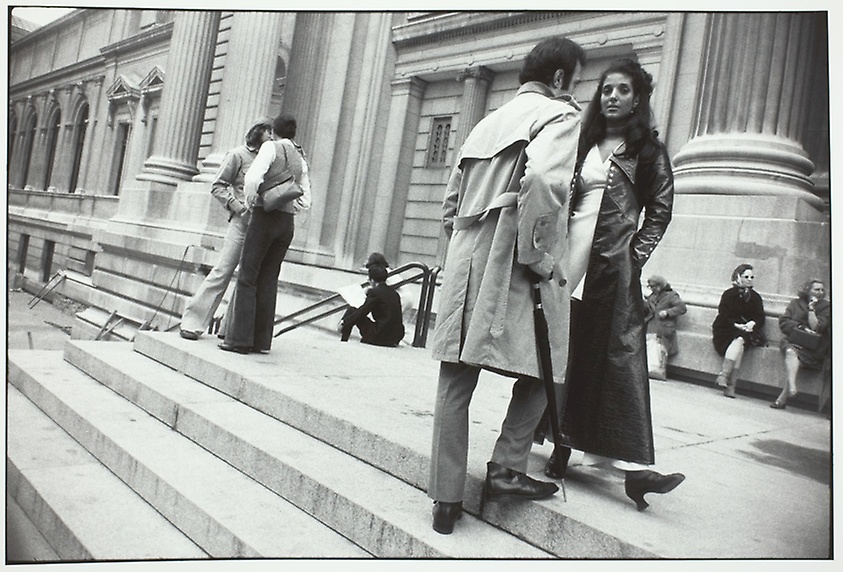
Featured Art: New York (Couple on Steps of Metropolitan Museum of Art) by Garry Winogrand
I once saw a Persian sword, in a museum,
glass-boxed, lighted. Warriors on winged
horses charged, lifted scimitars, hundreds of them,
carved in the blue white breath inside the hilt.
I leaned my head on the glass, helpless.
Read More

The Museum of Might-Have-Been
By Anne-Marie Fyfe
Featured Art: Art Institute of Chicago by Thomas Struth
Opens its doors one Sunday a month
in winter. The queues back up for decades.
If you’re lucky and your number’s called
you can have any tour: Your Charmed Life,
Your Regrets, The Prodigal You, every second
slip-road at the intersections of the possible.
The exhibits are stark and infinite
under strip neon, long hallways
of lost opportunity, slow clocks,
stopped clocks, rooms where even now
a thought might wither: the attic storeroom
is out-of-bounds to all but the curators,
though artifacts are still donated by the hour.
Standing in line is no guarantee
of admission: some days
word spreads that when you
reach the queue’s head, pass through
the double doors, it’ll be stripped out,
even lightbulbs, with only packing materials
and discarded drapes left. Yet critics insist
The Multiple-Choice Foyer, The Roads-Not-Taken
Gallery, The Back Burner Café are stunning.
Every room’s a tasteful shade of apple-white
apparently. Waxworks and living statues
rehearse at intervals for The Balcony Scene,
The Shining City, The Reconciliation, over
and over, night by night. As in the finest operas.
Read More
A Gift From Wales
By Carl Dennis
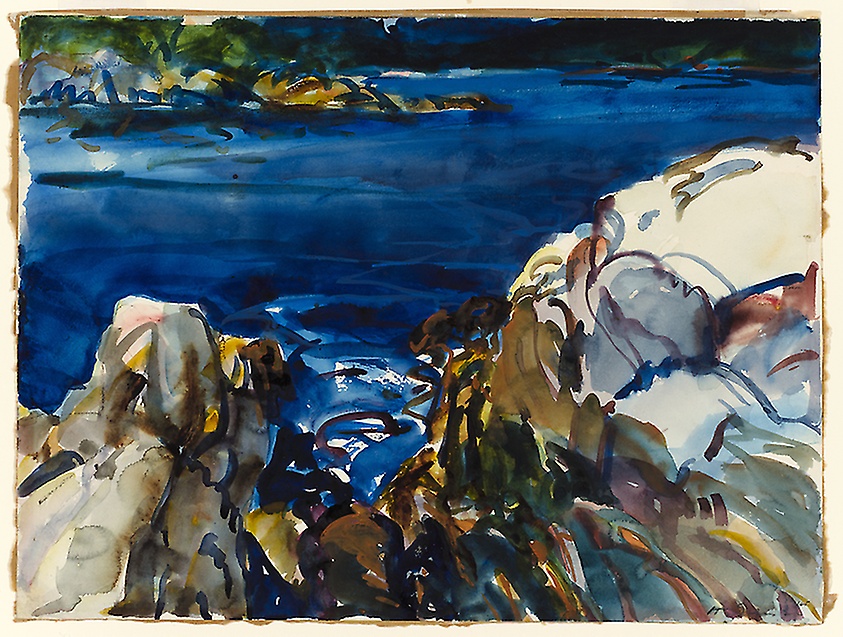
Featured Art: Shore Line by Howard Giles
Having lingered, on my first trip to Europe, longer
In Paris than I expected, I had to forgo
Walking in Wales. But that didn’t keep me
From becoming deeply indebted to Wales
When I phoned the hotel in Cardiff
To cancel my reservation and save my deposit.
“There’s a letter for you,” the desk clerk said,
In a rich contralto. “Would you like us to send it on?”
“Better read it to me, if you have time,
Since I keep moving.” And that’s how it happened
I heard, as I sat in a booth at the Gard du Nord,
Awaiting the train to Brussels, my mother’s sentences,
Penned in Missouri, delivered with Welsh intonations.
That’s how her usual mix of family news,
Tips about healthy eating, and encouragement
To visit any noteworthy local garden,
Took on an undercurrent of mystery.
That’s why they seemed imbued with the suggestion
My travels were more than a summer’s entertainment,
Were in fact a quest for something just as meaningful
As whatever a knight went searching for
When he rode out from a castle in Wales.
Some truth more practical than a grail
And more surprising would soon be mine
Once I learned to listen to people whose words
I regarded before as predictable and forgettable.
And I had questions about the desk clerk,
Who’d read the letter as if she’d composed it herself,
Inspired by a sincere concern for my well being.
What did it mean, her convincing performance?
If it wasn’t part of her job at the hotel,
Was it part of some other calling
Defined in a legend I didn’t know yet
But would want to learn if the chance were offered?
Read More

Three Houses and a Wish
By Linda Bamber
Featured Art: House by a River by Edward Hopper
1. Chevy Chase
Choked up to see the in-ground cellar door
behind the house
I was born in long ago
then had doubts, cell handy,
called older sister far away.
She said, wrong house!
Original had front yard oaks,
big porch . . .
found right house, had no
response at all. Used up tears on
house that didn’t know me from Adam! Read More
My Grandmother the Mohel
By Barbara Hamby
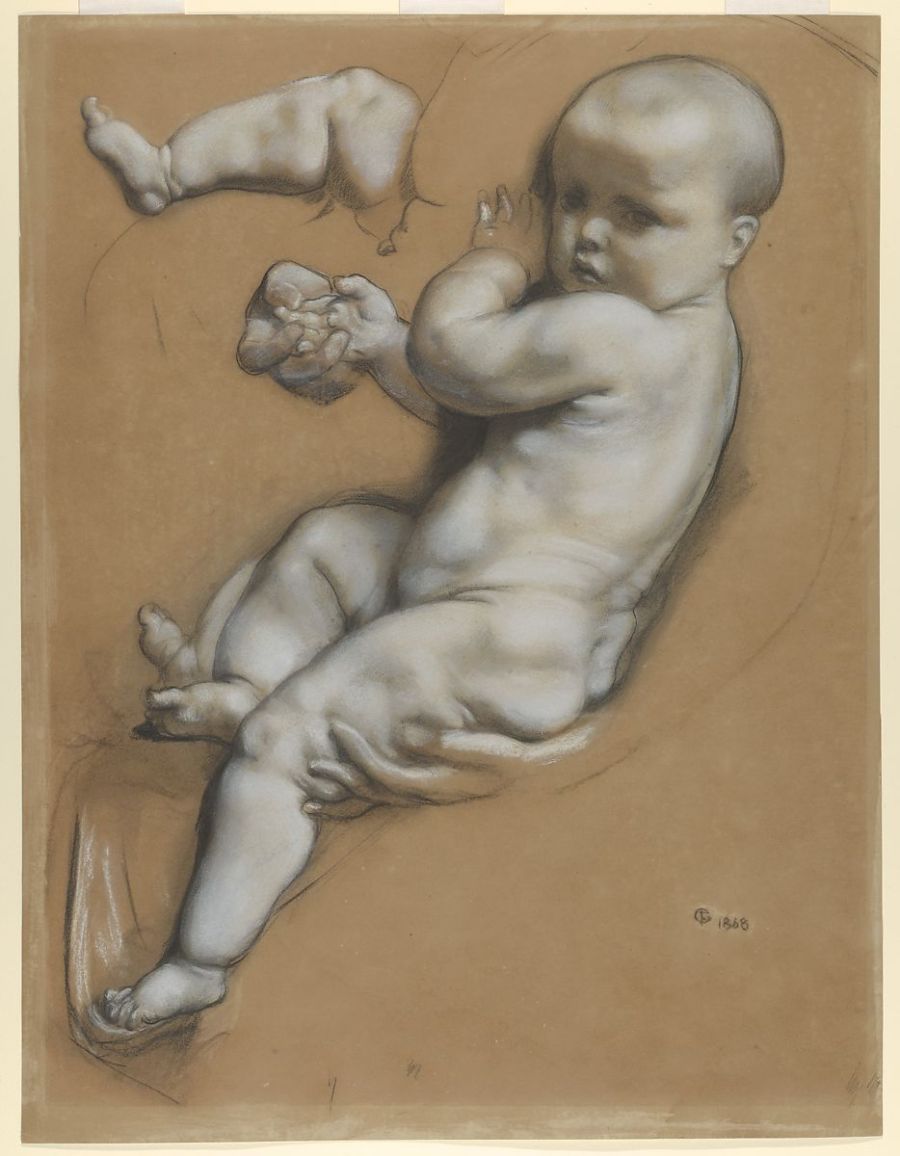
Featured Art: Study of a Baby by Fredrick Goodall
When I tell my mother that a man I know pickets the local hospital
about what his wife calls “his topic” that is, circumcision
and its evils, she tells me this was my grandmother’s specialty
as a nurse, and I say, “You’re kidding.” “No. The doctor
she worked for couldn’t stand it, so she did all his circumcisions.
She loved it!” Loved it? I think—cutting the tips off
boys’ penises? Loved what? The precision? The power? The cries?
I remember sitting with my mother and grandmother
when I was seven or eight, pretending to play, so I could listen
to them talk in front of my grandparents’ house
in Washington, 328 Maryland Avenue, and down the tree-lined street
you could see the Capitol dome looming. A couple
were walking on the sidewalk, and they waved at my grandmother,
who smiled and waved back. “Are they married?”
my mother asked when they passed. “No,” my grandmother
answered, “they’re just shacked up.” The cups of my ears
gathered around those words like ravenous Venus Fly Traps,
because this was just what I had been waiting for,
though I had no idea what it meant, and I knew I couldn’t ask
or my doll dressing and tuneless singing would be exposed
for the subterfuge they were, and I’d be exiled into the house,
and this was before my grandfather died, who didn’t think
a woman should drive, but my grandmother taught herself,
her two little girls in the back seat screaming
as the car jerked over the dirt road behind their house in Kentucky,
and then after he died, she went to school and became a nurse,
but fifty years later I’m chatting with a man on a plane, who’s returning
home after spending the day in New York because
he is a mohel and has made this long trip to snip the tip off
some little boy’s penis, and I think of Mantegna’s painting
of the circumcision of Christ at the Uffizi and kosher laws which
forbid eating crustaceans, which would mean a sacrifice
of gumbo, boullabaisse, cioppino and fish soups the world over,
and it was the fried Apalachicola shrimps that broke
the back of my vegetarianism, what in Louisiana they call
“sramps,” and I’ve heard them called “pinks,” “prawns,”
and sometimes when I’m standing over the stove making a roux
my life seems to be a kind of gumbo, and if you don’t burn
the water-and-flour paste, then it doesn’t much matter what else
you throw in, but okra is a must and a couple dozen
oysters, andouille sausage, all your dark mistakes mixed in
with the brilliant medals and diamond tiaras,
and my grandmother told me she went to her wedding
in a horse and buggy, a seventeen-year-old girl,
probably a virgin, and little did she know where that road
would lead her, from canning tomatoes and corn
to snipping the tips off thousands of penises to the nursing home
where she died, shacked up with all her selves,
that particular gumbo stewing in a body withered by 93 years,
not knowing anything but that she’d rather be eating
ice cream, driving to Memphis, frying chicken, mashing
potatoes, baking a cake with blackberries
her daughters picked that morning before walking to school.
Read More
All Ages
By Conor Broughan
Featured Art: Canal Street, Chicago by Harold Allen
The Statistics played three shows in four days and Chris McCann—all of sixteen and the founding member, lead singer, guitarist and de facto manager of the band—wasn’t ready for the tour to end. All summer, Chris had only wanted to get out of his Springfield, Virginia house and on the road. Unsolicited, Chris’s father had told him that his mother’s erratic behavior over the past six months hadn’t been his fault. Until his father brought it up the night before the tour, Chris had never considered the possibility. Stray raindrops cried across the windshield when he drove over the Turnpike and into Asbury Park, New Jersey for the final show of the tour. The Bowery Club on Ocean Avenue.
Kyle—rhythm guitar—was the first to step out of Chris’s father’s 1989 Dodge Caravan. At the beginning of the tour, he announced that he’d grow out his beard. Deemed a failure on all fronts, Kyle still considered it a work in progress.

If You See Something
By Billy Collins
Featured Art: Dove in Flight by Pablo Picasso
On my morning walk along a cinder path
that follows the shore of a lake,
I saw a good-size, solitary rabbit,
seven mourning doves who rose to the top of a fence
at my approach,
two anhingas, one drying his extended wings
like a pope on a balcony,
the other not doing anything at all,
also, a loud bird who refused to identify himself,
then ten young ducks in a huddle
by the vegetation near the water,
some sleeping, others preening their feathers,
all not quite old enough to be on their own,
oh, and a squirrel who headed up a tree
when he heard me coming down the path.
Kickboxing with God
By Jeffrey H. MacLachlan
Featured Art: Vendémiaire, plate 34 from Alcools by Louis Marcoussis
On my way home from an empty happy hour, God shoved me so I punched his
chin with a half-formed fist. He laughed and asked me if I knew who snapped
dinosaur tails like breadsticks. God was all effort like old dudes at pick-up
games. Leg-kicks striking thighs and elbows to the windpipe. My uppercut let
out a Hallelujah choir from the sky. He punched my liver and said I should get
some rest for once. You can’t keep this lifestyle forever. He pointed to his chin
and dodged a knockout swing. Why not go visit your kids? God headlocked me
like Mom’s boyfriends did after parole. I’m behind schedule so just fix your life.
He was right but that didn’t stop the stomping he had coming for not showing
up till that night.
Read More
The Ideal Budweiser Customer Watches a Budweiser Commercial
By Danny Caine
Featured Art: Drugs by Richard Estes
Oh shit I love “Landslide.”
I was going to get up to piss but then I heard me some Fleetwood Mac.
Hey that’s a pretty farm, too. Farms are dope.
Wait, oh goddamn it it’s a baby horse lying in some fucking sawdust.
That baby horse is so cute I can’t even handle it right now.
I am literally unsure how to proceed.
And now the horse is being fed from a bottle?
The hell am I supposed to do with that?
Dammit now the horse and the dude are playing and stuff.
Fuck me if I don’t love a playful goddamn horse.
Look! A Budweiser truck. Budweiser!
I should like this brand on Facebook.
I should follow this brand on Twitter.
I really should make an effort to engage
with this brand on social media.
Wait, that’s a horse trailer. And our dude
is shaking hands with the driver? Is he—
DUDE YOU CAN’T SELL THAT FUCKING HORSE!
YOU’RE GOING TO MISS HIM SO MUCH!
Somebody get me a Budweiser.
Read More
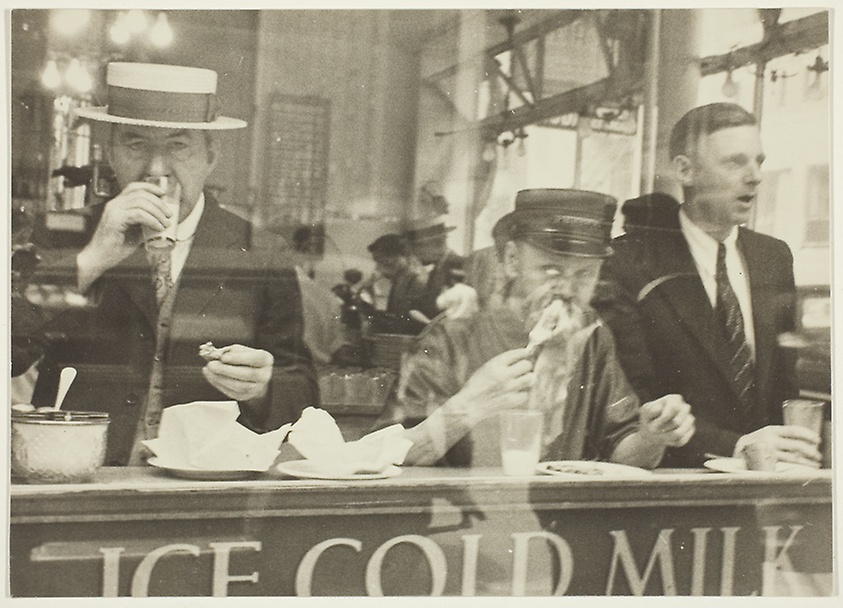
Unemployable
By Dustin Nightingale
Featured Art: New York Lunch Counter by Walker Evans
Needs and Hopes
I want $50,000 a year with insurance, incentives such as stock
options, 401K, paid paternity leave, sick days, two months off
in the summer, and a company car with a gas card. I expect a
healthy work environment, void of inspirational quotes like
Inspiration overtop of an eagle in the snow. My colleagues
will not try and josh me, nor will they throw potlucks or invite
me to 4th of July cookouts and then think I’m an uppity jerk
when I don’t attend. They will not show me pictures of
something they recently pushed or pulled out of their uterus.
Nor will they tell me about the book they want to write based
on their own life. What they will do is mumble lines of Emily
Dickinson to themselves while staring out a window. They
will bring in a bag of cayenne peppers they grew this summer,
leave it on the break-room table with a sign that says Free
—take what you want. And I will take three. I will let them
dry, grind them up, and place them in the plastic of a cigarette
wrapper, which I will pinch into stir-fries during a very
long and cold winter. And I will try to do the same for them.
Previous Experience
Oh I’ve done that. I’m not proud of it, but I’ve done that.
Have you? Well you should try it sometime, just to see what
you’re capable of and for how long. I mean, why not see what
it takes to make you wake up crying. And then of course, what
it takes for you to stop. So when can I start? Or have I already?

At the Precise Moment of Your Awakening
By Matt Morton
Featured Art: Time Transfixed by René Magritte
It will be raining. You will be watching
TV when your son walks
into the room. He will be crying
and holding the stuffed gazelle you bought.
What’s that noise? he will ask,
sounding scared. On the screen,
an armadillo singing show tunes. To humor him,
you’ll pretend to listen:
Outside, down the street, coming closer,
a sound like a train. It’s just a train
you’ll shrug. Here, look at this armadillo.
A flashing red banner scrolling from right
to left across the screen. Such tiny print.
You will squint. Undoubtedly,
you’ll have left your glasses in the other room
with your credit cards and shoes. Turning
your attention back to the show,
you will gather up your son. Front door
rattling against the jamb. All of the windows
black. But you said there aren’t any trains.
He won’t stop sobbing. You said they—
Hush you will say, annoyed
at missing your show. Where is your wife?
By now, the sound has become a roar. The gazelle
lying on the carpet, your son’s mouth
stuck open like a doll’s. When the portraits drop
to the floor and break, you will shake
your head: He is so small for his age, the world
will be hard on him. T-R-A-I-N
you’ll mouth, as if he’s deaf, when the windows
start to blow out. You’ll be shouting
It’ll pass, it’s just a train
as the roof is ripped from the house.
Read More
Telling the Truth
By J. Anna Luz
Featured Art: The Builders by Jacob Lawrence
Observing my boyfriend’s
niece and nephew
kick each other
under the table
at Thanksgiving dinner,
blasting each other
in the shins
and knees,
bone against bone
drawing bruises
and welts,
done in such fury
and with such power
yet no sound,
faces not affected,
not a hint
of a wince
of pain, so little
movement at all,
I thought
that’s how my sister
and her husband
love each other,
and how my father
regards his job
and how my mom feels
about all of us,
and how
I see my body.
These children
with pink Keds
and black and
green striped Nikes
underneath a crisp
ironed tablecloth
of fall colors,
didn’t
lie once.
Read More
À la Carte
By Denise Duhamel
Featured Art: Frozen Foods with String Beans, New York by Irving Penn
We stopped at a restaurant that advertised steak dinners for $3.99. My father
was excited—he loved red meat. We were on vacation. My sister, my mother, my
father and I were all going to splurge. My father double-checked his billfold and
said, “Let’s go!” The waitress asked if we wanted the special. Yes indeed. Would
we like potatoes? Sure, why not? And creamed spinach? And bread? You bet.
When the bill came, my father blanched. He whispered to my mother he didn’t
have enough in his wallet. He called the waitress to our table and reminded her
of the sign outside. She explained that each steak was indeed $3.99, but that all
the sides we ordered were another dollar each. My father said she should have
been more forthcoming. She brought us a menu. My father asked to see the
manager, who pointed to the phrase à la carte. My mother dug in her purse, but
my father told her to stop. He stood up and put sixteen dollars (a ten, a five, and
a one) on the table—not even covering the tax and certainly no tip. “I’m not being
swindled for a baked potato,” he said to the managerand walked out. “I’m
sorry,” my mother sulked, pulling my sister and me out of the booth. I looked to
the floor, the swirly carpet. “Sir, you can’t do that,” said the waitress. “Ma’am,
I’m serious. You can’t do that,” echoed the manager. “Hey, come back, we’ll
take a personal check.” All the way to the Cape, I thought the police would
pull us over, the unpaid-for potatoes and spinach making me full and groggy.
My mother and father fought—“I’ve never been so embarrassed . . . ” and “Too
bad. I’m no chump.”—before all went silent. My sister and I dug out the steak
from between our teeth with our tongues. After a day or so, the shame turned
to laughter. My mother said, “I guess you showed them.” And my father said,
“I sure did.” By the end of the week we were proud, our story about standing
up to touristy rip-offs, about snobs only pretending to be French, about how we
were living le rêve américain.
Read More
Aftermath in Brine
By Elton Glaser
Featured Art: Parking Lot, from The Plain of Smokes by Kenneth Price
I can’t stand here all day, glands in a wrangle,
Like some brimstone preacher
Beating the bejesus out of his ratty Bible.
Parvenu and undermensch, slave to enabling vices,
I’m lost in a lanky rhetoric,
Simplicities on the fritz.
But you can’t make laws for monkeys, or poems
From some eruption in the nuts,
Every complication its own Vesuvius.
Poems: or as the Chinese warn,
Disasters that come from the mouth.
Sometimes there’s no wild honey at the end of the beeline,
Only these terse tercets
With no mercy on the rubes
Or the lithe appreciators of gilded tea sets.
There’s always some bother in the Balkans,
And tantrums among the voluble Italians. There’s always
A dent in the fender where the force fields meet.
On the Opening of Lauren Groff’s “L. DeBard and Aliette”
By Caitlin Horrocks
Featured Art: Steps in Swimming Pool at Main River, Badeanstalt, Frankfurt by Ilse Bing
I originally read this story in the 2006 Summer Fiction Issue of The Atlantic, a magazine whose student writing contest I had won the previous winter. I was wandering the aisles of a grocery store in a strange city, where my boyfriend had just abandoned me to run an errand to an ex-girlfriend’s house. I perused the magazine rack, scanned the table of contents of The Atlantic. My winning story had been considered for publication, but had not made the cut. The famous authors listed I could forgive for bumping me, on grounds of their fame. But who was this “Lauren Groff”? I’d never heard of her. A newbie, like me. Surely, she was the one who had taken my spot.
Of course, editing doesn’t work like this. I knew that even then. But my jealous, shriveled heart still commanded me to buy the magazine, take it to the seating area of the grocery’s little coffee shop, and sniff out the supposed inferiority of this Groff-person’s fiction. I am not proud of my attitude. Writers hope that readers will approach our work with excitement, with patience, with a willingness to be moved. My state of mind, when I began Groff’s story, was instead darkly, nakedly adversarial.
Read More
On the Opening of Edward P. Jones’s “The First Day”
By Marjorie Celona
Featured Art: Street by Romare Bearden
It is, at first, a linguistic seduction:
On an otherwise unremarkable September morning, long before I learned
to be ashamed of my mother,
If you’ve ever lived near the ocean, perhaps you, like me, equate one or more dependent clauses at the beginning of a periodic sentence to a wave gaining amplitude before it crashes on the shore. It’s a rudimentary metaphor: the wave builds, and by the time we get to the period at the end of the sentence it has crashed. There is a rhythm to the periodic sentence, and it’s near impossible not to be pulled into it. With its sly promise to deliver something remarkable, that first dependent clause—On an otherwise unremarkable September morning— is a somewhat seductive lead in its own right. But it is the second dependent clause—long before I learned to be ashamed of my mother—that gives us our first glimpse into the story’s retrospective, mournful heart. If you’re anything like me (lousy metaphors aside), even at this early point the story has you in its grasp. The rest of the sentence, in conjunction with the story’s title, fulfills the tension by providing a simple explanation for what the story will be about:
. . . she takes my hand and we set off down New Jersey Avenue to begin
my very first day of school.
On the Opening of William Maxwell’s So Long, See You Tomorrow
By Maura Stanton
Featured Art: Summer Breezes by Gustave Baumann
William Maxwell’s great short novel, set in the farm country of central Illinois, where I, too, grew up, pulls us into the story of a murder with such force that we can’t stop reading.
The first chapter is called “A Pistol Shot.” Maxwell begins with the setting: “The gravel pit was about a mile east of town, and so deep that boys under sixteen were forbidden by their parents to swim there.” This sentence tells us that we’re out in isolated country. But it also suggests that this is a novel about “boys under sixteen.”
The next sentence introduces the narrator. “I knew it only by hearsay” he says of the gravel pit. And then we get to know something about his imagination as he tells us why boys like him are forbidden to swim there—“It had no bottom, people said, and because I was very much interested in the idea that if you dug a hole straight down anywhere and kept on digging it would come out in China, I took this to be a literal statement of fact.” Read More
On the Opening of Graham Greene’s “Under the Garden”
By David Lehman
Featured Art: Ventana de Radiografías by Manuel Alvarez Bravo
The first paragraph of “Under the Garden,” Graham Greene’s finest story, consists of just two sentences:
It was only when the doctor said to him, “Of course the fact that you
don’t smoke is in your favour,” Wilditch realized what it was he had been
trying to convey with such tact. Dr. Cave had lined up along one wall a
series of X-ray photographs, the whorls of which reminded the patient of
those pictures of the Earth’s surface taken from a great height that he had
pored over at one period during the war, trying to detect the tiny grey seed
of a launching camp.
With the indirection that passes for a physician’s professional “tact,” the masterly opening sentence reveals that the protagonist, a man named Wilditch, has just been handed a death sentence. Greene’s opening dwells on the doctor’s discomfort with speaking the bald truth (“what it was he had been trying to convey”), his determination to skirt the subject, with the result that the bitter prognostication of the man’s demise dawns on the reader in the same way that it dawns on Wilditch: belatedly, like the answer to a riddle or trick question. Or so it feels: Greene gets us right into the mind of his protagonist at the moment of revelation. Read More
On the Opening of Barbara Comyns’ The Vet’s Daughter
By Maud Casey
Featured Art: Falling by Aaron Siskind
A man with small eyes and a ginger moustache came and
spoke to me when I was thinking of something else.
I have thought about the first line of Barbara Comyns’ novel The Vet’s Daughter since 1993. I was in graduate school and my wonderful professor, the writer Mary Elsie Robertson, suggested I read Comyns. I did and I have been forever grateful for the recommendation. Comyns is that variety of obscure writer who is a secret literary password. To love her is to enter into a speakeasy filled with levitating teenagers, floods, plague, and the occasional monkey. She authored eleven novels between 1947 and 1989 before her death in 1992, with notably captivating titles, such as Who Was Changed and Who Was Dead and Our Spoons Came From Woolworths. When, in the late Fifties, her original publisher—Heinemann—sent her odd fairy tale of a novel, The Vet’s Daughter, to Graham Greene for a blurb, he responded, “Please, send me no more lady novelists.” I’m not sure precisely which part of The Vet’s Daughter Graham objected to, which part he found too lady-ish—its concern with things domestic? Its girl protagonist? In any case, I’m happy to report, he came around because there’s his effusive blurb on the most recent effort to save it from obscurity, the beautiful edition put out by The New York Review of Books with a foreword by Kathryn Davis and a painting by Louise Bourgeois on the cover that, at first, you might mistake for lovely red stockings hanging on a clothesline but, look closer, those aren’t lovely red stockings, that’s bloody sinew and bone. (The painting’s title is Untitled (Legs and Bones).) Read More
On the Opening of Flannery O’Connor’s “Good Country People”
By Alyson Hagy
Featured Art: Pasturage by André Dunoyer de Segonzac
Besides the neutral expression that she wore when she was
alone, Mrs. Freeman had two others, forward and reverse, that
she used for all her human dealings. Her forward expression
was steady and driving like the advance of a heavy truck. Her
eyes never swerved to left or right but turned as the story turned
as if they followed a yellow line down the center of it. . . .
—“Good Country People,” Flannery O’Connor
I’m sorry to say I’ve experienced my share of bible salesmen. And I can’t think of the names Joy or Hulga without wincing with delight. But why have I never gotten over the way O’Connor begins “Good Country People”?
I blame front porches.
Read More
On the Opening of Stanley Elkin’s “A Poetics for Bullies”
By Tom Noyes
Featured Art: Boy with Pitcher By Édouard Manet
I’m Push the bully, and what I hate are new kids and sissies,
dumb kids and smart, rich kids, poor kids, kids who wear
glasses, talk funny, show off, patrol boys and wise guys and
kids who pass pencils and water the plants—and cripples, espe-
cially cripples. I love nobody loved.
In Aspects of the Novel, E.M. Forster writes about the necessity of “bouncing” the reader. At the beginning of a work of fiction, he suggests, the writer must win the reader’s attention in such an immediate, all-encompassing way that the reader has no choice but to forget herself and her “real life” circumstances in order to abide fully and uninterruptedly in the imagined world of the fiction. If the writer can’t bounce the reader from the one world to the other right quick, all is lost.
Read MoreNew Ohio Review Issue 14 (Originally printed Fall 2013)
Newohioreview.org is archiving previous editions as they originally appeared. We are pairing the pieces with curated art work, as well as select audio recordings. In collaboration with our past contributors, we are happy to (re)-present this outstanding work.
Issue 14 compiled by Andrea Gapsch.

The Best Man
By Brian Trapp
Selected as winner of the 2013 New Ohio Review Fiction Contest by Stuart Dybek
Featured Art: Chinese Garden by Cooper Hewitt
Outside the bride’s village, I lean against the side of a silver Audi with Mr. Wu, my boss’s businessman friend. I thought we were going to his wedding, where I will be his best man, but I guess as per Chinese custom, we are going to the bride’s house first. We have traveled twenty-five minutes into the Chinese countryside, where we wait for the rest of the wedding caravan. The second half of the dancing lion is late, and the head walks around with its neon-red body dragging behind, a giant mutant worm.
On the ride over, tall buildings gave way to dingy shops. The road narrowed, going from the usual off-white tiled apartments to the old-timey black-tiled Chinese roofs— the tops curved into crescent moons. Smoke spewed from small factories and then green patches of farms appeared, pieces from two different puzzles jammed into one another’s edges.
Read MoreFeeling Sorry for Myself While Watching a Really Bad World War II POW Movie on TV
Selected as winner of the 2013 New Ohio Review Poetry Contest by Barbara Hamby
By Michael Derrick Hudson
The rest of them pinwheeled out of the dirty sky somewhere
over Schweinfurt. They burned as I clung
to my shroud lines huffing in a panic through the slobbery
fog of my oxygen mask, the frost stiffening
my collar’s wet fur. Three years later, what have I to show
for my long time in the bag? Bleeding gums,
a hacking cough, another button sewn? I thumb silk maps
and compasses that’ll tuck into a nutshell, learn to curse
in tunnel-rat’s German: Achtung, Fünf!
Dummkopf! Amerikaner Schweinhund. Schnell, buddy . . .
Not once did I try to make it over the wire, into the forest
and its perils where the beautiful Slovak partisan
lugs basketfuls of her beer bottle grenades
hip-deep through the snow. I never spent the night thawing
my boots while she sang old peasant songs and poked a rag
down the bore of her revolver. Ach du! The tarnished brass
of my captain’s bars will never in the firelight
glint for her! She’ll never grant me tomorrow’s password
or love me in my Army Air Corps leather, sleeves
scorched and pockets stuffed with the chocolate
I’d toss godlike and American to all the kids in her village . . .
Damn all my Switzerlands! Damn all of these neutral years!
Read More
Looking on the Bright Side
By John Brehm
Featured Art: Nocturne by James McNeill Whistler
Death: at least it’ll give me a chance to catch up
on my sleep. No more tossing and turning
worrying about what’s going to happen next.
Unless of course my dreams of dancing girls
and hookah parties come true.
In which case it’ll give me a chance
to catch up on all the fun I missed
being too tired from lack of sleep.
A win-win situation.
Unless of course the dancing girls turn out to be
my former lovers, flitting before me
with vengeful or disdainful expressions
on their still painfully lovely faces.
In which case I can go on writing the poems
of failed love that failed to make me
famous when I was alive.
A suitable way to while away eternity.
Unless of course the hookahs are filled
not with tobacco but with heavenly peyote,
(food of the gods the gods left for us)
in which case it’ll give me a chance
to catch up on the deathless
bliss of boundless mystical oneness
my fear of death always kept me
from fully experiencing
here and now.
Read More
Back Then
By John Brehm
Featured Art: Miss M. of Washington by Rose Clark
Everything was better back then.
Even my nostalgia was better,
more piercing, more true.
I miss missing things that much,
but not as much as I missed
missing things back then.
Even my anxieties about the future,
which have indeed come to pass,
were more vivid back then,
more real. Reality itself seemed
more real back then—this clanking
stage-play only a fool could find
convincing—I fell for it all,
and it killed me, again and again.
Ghosts of myself wander
the cities I’ve lived in, thinking
of other cities, imagining me
here imagining them.
We nod to each other across
the years, the way the last line
of a poem will sometimes
look back, wistfully,
at the first.
Read More

