Essay: The Journey and Return of Elizabeth Fisher 

By Elle Therese Napolitano

In Elizabeth Fisher’s 1970 story, “A Wall Around Her,” published in Aphra (Volume 4, Number 4), the main character pounds on the locked door of a house where she’s rented a room. As she waits for someone to respond, she is overcome by crushing loneliness and futility. “I never was in, never was and never will be, always outside, always trying to get in, beating with my fists, pleading, ‘Let me in. Let me in.’ Why don’t I just give up the struggle, stop trying to reach people, to be a human being.” 

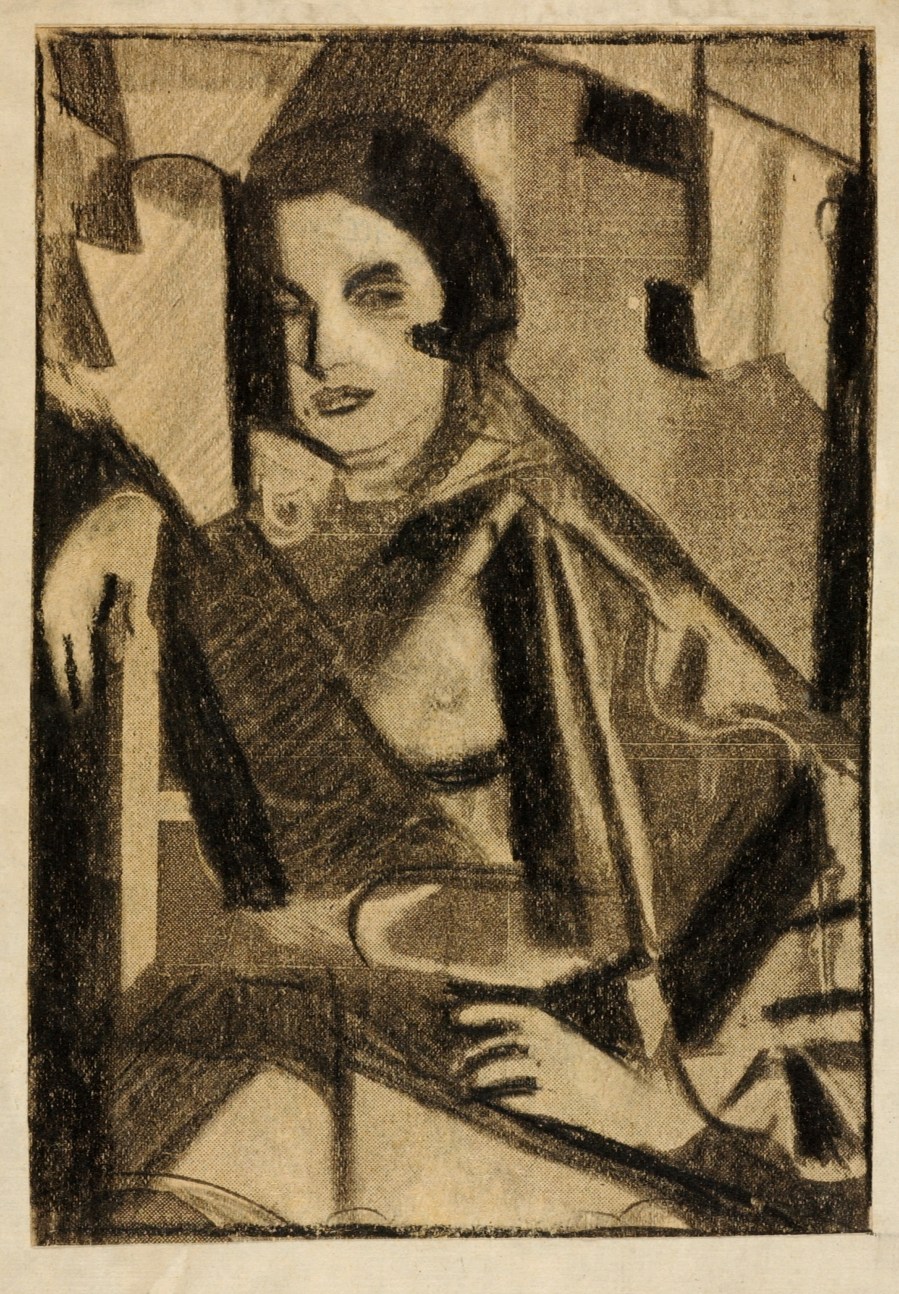
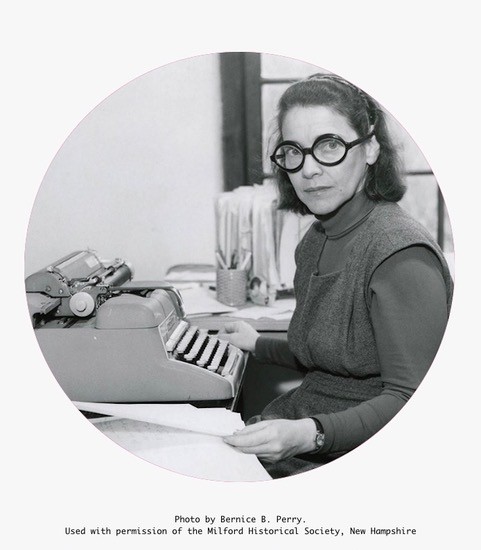
Elizabeth Fisher was a writer, editor, translator, publisher, teacher and feminist, but these days, she is best known—and unknown, it turns out—for sparking Ursula K. Le Guin’s 1986 essay, “The Carrier Bag Theory of Fiction,” republished after Le Guin’s death as a tiny book (Ignota, 2019). It’s safe to say that now, thousands of people have seen her name in print—Le Guin names her right there in her resurging essay, along with a partial title of Fisher’s book, Woman’s Creation (though the publication date is wrong)—in which she puts forth “The Carrier Bag Theory of Evolution.” Since Le Guin’s essay was reprinted, new writings about her essay have proliferated. Nearly all mention Fisher. But people don’t seem to know anything about her. There’s all this stuff out there about carrier bags and Ursula Le Guin, but what about Elizabeth Fisher? What about her life?  

Read More

The Names of Those We Love

By Kenyon Geiger

Featured Art: Stephen Reichert, Untitled, 2012. Oil on canvas, 16″ x 20″. “Cirlce” series.

It was finally settled: the competition was rigged, and Mrs. Klein would not be receiving her lifetime supply of free groceries after all. She set the letter down on her countertop with shaky hand and shaky breath. This was not a surprise. Aside from the mystery of how the competition was supposedly rigged, the news brought with it a strange comfort for Mrs. Klein. She was used to things not working out. 

Her mother always thought of everything as God’s will, all part of His divine plan; this was atypical for a Jewish woman, at least in Mrs. Klein’s experience. Her mother reminded her more of the parents of the evangelical friends Mrs. Klein had at school; they often talked like that, the Lord works in mysterious ways. Of course, she wasn’t Mrs. Klein then, back when she was in school. She was Rebecca, a little girl with her entire life ahead of her. 

Read More

Buried Fruit

by Robert Stothart

Featured Art: Generations, by John Schriner

I am re-begot
Of absence, darknesse…
Things which are not.
—John Donne

1

Now they’re standin’ in a rusty row all empty
And the L & N don’t stop here anymore.
—Johnny Cash

Winter’s first fuel came cheap, scrap wood, free for the taking, piled along the road next to the sawmill half a mile back toward town from my house. Lying in bed—borrowed mattress on a patched linoleum floor—I listened to wood fires pop and snap taking night chill off my two rooms. Light from the yellow flames pierced through slots in the iron stove’s iron door and danced in reflection across the inside of my front window.  

In September, Mother Annie told me to go get wood at the sawmill. I had no running water, only a well with a handpump and an outhouse at the place I rented. I had electricity and cooked on a hotplate. The potbellied stove stood cold in the center of my front room for two months. 

Read More

Zuzanna Ginczanka Biographical Note

By Joanna Trzeciak Huss

Any biography of Zuzanna Ginczanka (1917-1944), however short, should attempt to speak to her desire to define herself and her refusal to be defined by others. For her, social and artistic identity was something to be chosen and cultivated, but in the times in which she lived, identity ascribed by others was a matter of life and death.  Born Zuzanna Polina Gincburg in Kiev in 1917, she fled shortly after the Russian Revolution with her family to the border town of Równe in Volhynia (present day Rivne, Ukraine), which was at one point part of the Polish-Lithuanian Commonwealth and was about to become Polish again in 1920.  The destination was not accidental: it was the town where her Russian-speaking maternal grandparents were well-ensconced.  Yet this provincial capital proved too confining for her parents, who abandoned her to the care of her grandmother: her father leaving for Berlin when Ginczanka was three and her mother for Pamplona, Spain after she remarried.  Równe, a multi-ethnic city, was Ginczanka’s childhood home and it was there she attended a French pre-school and Polish elementary school and high school.  She adopted the name Ginczanka, and though Russian was her native tongue,  chose Polish as her language of poetic expression. Yet she was never able to obtain Polish citizenship and remained stateless throughout her life.

Read More

Essay: Olympia Traveller de Luxe

By Robert Long Foreman

The Olympia Traveller de Luxe is not the same thing as the Olympia de Luxe.

They’re similar, sure. They’re both manual typewriters. They look like each other. But if someone said they were the same they’d be lying through their teeth. They’d be capable of anything.

The Olympia Traveller de Luxe does all the things the Olympia de Luxe does, but it’s far more compact. It doesn’t rise high off the table but keeps its head down; it’s three and a quarter inches tall, where the Olympia de Luxe is five and a half.

It can’t have been easy for Olympia’s engineers to take all the functions of the de Luxe and reproduce them in an even smaller model. But they did. And I’ve tried other typewriters of about the same size, like the Smith-Corona Skyriter and the Hermes Rocket. They’re nice, but they’re flawed. The page you’re typing on will slide out of place as you type. The hammers won’t strike hard unless you press hard.

Not so with the Olympia Traveller de Luxe. It’s small, but the letters it makes are bold—which helps convince its user that what they’re writing matters, that someone in the world will care about what’s on that page.

The words you make on it aren’t pixels on a screen but ink on paper. You can see them when the power goes out.

Read More

No One Dies in Fiction Anymore

By Kaj Tanaka

Featured Art: Heart of Darkness by Sean Scully

I. Sherman Alexie

Once again last night, a dead woman appeared to me. She spoke my name and asked me to help her back into the world of the living. She said she was so close to me; it would only take a small caress and she would be flesh and blood again. I didn’t move. Her face hung over my bed until the dream resolved itself, and I was awake again, and this morning was gray and cold just like yesterday morning and the morning before.

This morning, I heard our neighbors’ little daughter crying in the room above us amid the crashing of furniture while her parents fought. The crying and the fighting were so loud my wife wondered if we should call the police—we decided not to, and then my wife left for work, and the fighting died down. I texted my wife to let her know things were quiet again. She texted me “okay.”

Today, I read Sherman Alexie’s poem “How to Write the Great American Indian Novel” for the first time. I have spent the last three years of my life writing a novel about the time I spent living on an Indian reservation in South Dakota, and when I read Sherman Alexie’s poem, I realized that what I had written, while true, was not useful. No one needed my novel, and I was stupid to think anyone did in the first place. I should have known a year ago when one of my Lakota friends ended our relationship because of this novel—when he heard what it was about, when I told him. We’d been drinking out in the bad-lands; the sun was coming up, and I asked for his approval—“blessing” I think I said. He threw an empty bottle at me. He told me I was selling him out just like all white people do eventually, which is pretty much what Sherman Alexie was saying also. And the next day, we were hungover, and we pretended to have blacked out the entire incident. Even so, we have not spoken since.

Read More

Jester’s Cap

By Brandon Amico

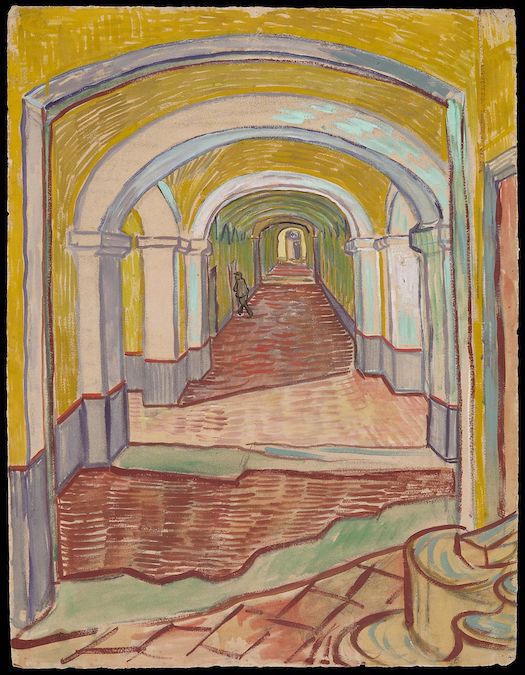
Featured Image: Corridor in the Asylum by Vincent Van Gogh, 1889

Three rabbits walk into a bar. The third rabbit carries a shotgun.

Three rabbits walk into a bar. The third rabbit carries a shotgun and the first
rabbit a vase of imported flowers.

One of the rabbits is already drunk.

Three rabbits walk into an orgy but only for the pre-orgy hors d’oeuvres.

Three rabbits walk into a bar with masks on but their ears give them away.

Knock-knock. (Who’s there?) No one, it’s just the second rabbit, the one with a
free hand, rapping his knuckle on the bartop.

Read More

A Trompe L’Oeil for the Mind’s Ear

By J. Robert Lennon

Featured Image: Lady Lilith by Dante Gabriel Rossetti, 1867

The key to writing realistic dialogue in fiction is to abandon all presumption of authenticity and acknowledge the necessity of total fakeness in achieving the illusion of truth.

Human speech is not simple. The words we say in conversation convey, at best, 25% of what we mean,1 with the remaining 75% taken up by body language, volume and tone, facial expression, and prior understanding between parties. The fiction writer has access to these conversational elements, of course, and may fill in back story, provide stage direction, and apply (judiciously, lord help us) descriptive dialogue tags to convey the intended meaning. But a good writer can evoke the character of a speaker, his or her intended and actual meaning, and even very subtle contextual clues, using only the words within quotation marks.

Among the tools the writer has at her disposal when writing dialogue: Sentence length. Punctuation. Rhythm (along an axis of consistency, from entirely smooth to completely broken). Syntax and diction (specifically, its breadth, expressive sophistication, and degree of formal correctness). The reader should be able to understand who is speaking in the same way that he requires no assistance to identify, by sound alone, the voices of his friends in a crowded room.

Read More

I Deserve Two Firing Squads: Dialogue and Conflict in Fiction

By Robert Anthony Siegel

Featured Image: Landscape with Trees and Water by James Bulwer
Courtesy National Gallery of Art, Washington

The world I grew up in was full of hyper-verbal people for whom talk was the medium of both ambition and feeling, the tool they used to try to shape the world around their desires. For that reason, when I began writing fiction, I found that characters were never completely real to me until they spoke: when they started talking I finally knew what they wanted. So I started writing the dialogue first. I would get two characters talking to each other and then build the scene out from their conversation. The dialogue was the trunk, and everything else branched out from it: thought, feeling, memory, sense perception, action.

In those days, when a scene worked, I thought it was because the dialogue was good. It took years for me to realize that it was the other way around, that dialogue was just helping me to uncover the underlying conflict that actually drove the story. What I know now is that dialogue doesn’t have to be fancy or quirky or unusual in order to do its job effectively. It just has to arise freely and naturally from the characters’ experience of conflict.

Read More

A Brief Personal History of Dialogue

By Kelly Luce

Featured Image: The Great Statue of Amida Buddha at Kamakura, Known as the Daibutsu, from the Priest’s Garden by John La Farge, 1887

                                                                                             Not everyone says what they mean. But they do
                                                                                             always say something designed to get what they
                                                                                             want.

                                                                                                                                                       —David Mamet

1987: Ms. Voyeur, my first-grade teacher, tells my mom I’m too quiet and should be seen by a psychiatrist. But I prefer listening! Other people are interesting. They tell you more secrets when you’re quiet.

1992: My Language Arts teacher accuses me of plagiarizing a short story  I wrote about volleyball tryouts. Why? “The dialogue is too realistic.” When I tell her that’s because I just tried out for volleyball myself and remembered how the girls sounded, she says, “No one learns to write dialogue by listening to real people talk.”

1997: I read Salinger’s “A Perfect Day for Bananafish” for the first time. Remember the conversation between returned soldier Seymour Glass and the young girl, Sybil, on the beach? Sybil is being perfectly herself, still possesses her childlike ability to say just what she means. Seymour is a couple hours away from—. Their chatter is innocent. Or is it terrifying? Take this exchange about a rubber raft:

Read More

The Dialogue of Gesture and Silence

By Alyce Miller

Featured Image: Rouen Cathedral, West Façade, Sunlight by Claude Monet, 1894
Courtesy National Gallery of Art, Washington

What people don’t say is often as important as, or even more important than, what they do say. Too much exposition, or what I call “soap opera dialogue” (e.g. “You remember my brother John who tried to murder Tiffany, before she was caught stealing from Marsha’s cousin who changed her name….”), or its opposite, too little, as is often found in the “generic social glue” of the how’sthe-weather variety, can undermine the progression of story and essential character development (unless, of course, weather is key to the story).

We often think we learn about people through what they say and how they say it, but other forms of communication are just as crucial. Dialogue can happen without speech. Words can fail. Gesture can summon meaning beyond language.

In Hemingway’s dialogue-rich story set in an empty train station in Spain, “Hills Like White Elephants,” the two traveling protagonists he calls respectively “the man and the girl” carry on what might sound to the untrained ear like a conversation about nothing when, in fact, they are about to make an important decision as to whether “the girl” should have an abortion. Whichever path they choose, it is clear that the course of their life together will be forever changed. At one point, after a good deal of back and forth, the girl says, “Then I’ll do it because I don’t care about me.” When the man counters with “I don’t want you to do it if you feel that way,” the girl doesn’t respond. Instead she stands up and walks to the end of the station. Her choice to substitute action for speech and distance herself momentarily from the man says more than anything she could at that moment. Her attention drifts instead to the landscape, the river on one side of the track and the mountains on the other, while she stands in that place of in-betweens and uncertainty. No conversation could convey her dilemma more precisely at that moment.

Read More

Dialogue: The Footfall of Its Wandering

By Darrell Spencer

Featured Image: The Card Players by Paul Cézanne, 1890-2

You might not have it in mind to go a particular
direction and you might end up going that way.
—tapper Jimmy Slyde

Well, that ain’t what art does. It makes things.
—Stanley Elkin

1.  Full Disclosure

For my entry into a discussion of dialogue I can’t think of a worthier writer to cite than Amy Hempel. The magician and maestro. Hempel’s narrator of Tumble Home opens the novella as one ought: “I begin this letter to you, then, in the western tradition. If I understand it, the western tradition is: Put your cards on the table” (69). Here are my cards: I like fiction that feels off-shot and shaggy, that seems to have fallen from the sky and is banged up thanks to re-entry. I like my fiction jerry-rigged and clumsy. Stanley Elkin uses the word baggy to describe his novels. Perfect.

Screw Poe: “A skillful literary artist has constructed a tale. If wise, he has not fashioned his thoughts to accommodate his incidents; but having conceived with deliberate care, a certain unique or single effect to be wrought out, he then invents such incidents—he then combines such events as may best aid him establishing this preconceived effect.” Oy. Rube Goldberg schooled me; he’s my guy. I want, as I read, to experience the acrobatics, to hear the pop and the hiss and the whiz-bang of the performance. A Goldberg contraption might get you somewhere but you will most likely be too dizzy to appreciate your arrival. You’ve seen those spaceships wobble across the screen in the crackly black-andwhite Flash Gordon flicks. That’s what I’m talking about. Look closely and you see the wires.

Read More

That Dialogue Assignment

By Rebecca Makkai

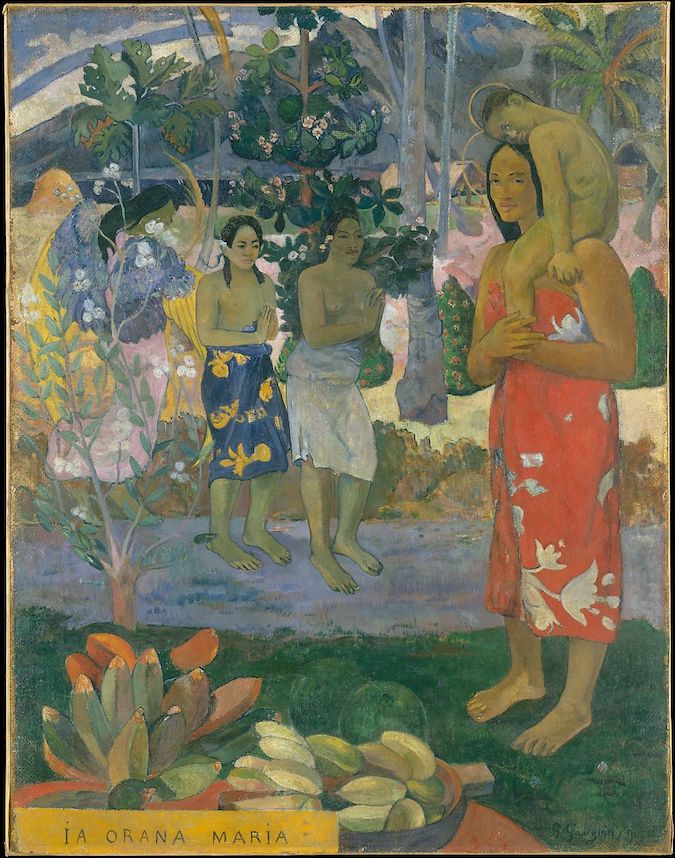
Featured Image: la Orana Maria (Hail Mary) by Paul Gauguin, 1891

I first got The Assignment in a college playwriting class. You might have gotten it in high school, or picked it up from a writing exercise book (somewhere between Keep a Dream Journal and What Color Is Your Character’s Toothbrush?): Eavesdrop on strangers, and write down everything they say. The idea is that this will help you write better dialogue, more realistic dialogue. Because realistic must equal better.

To be honest, I fudged the college assignment somewhat. I listened in on two campus maintenance workers, thinking they’d say hilarious and off-color things. Mostly, they grunted about paneling. I cherry-picked my hour of listening for the best phrases, crunching them together into what sounded like three minutes of witty banter, adding a few lines of my own. I did this partly to make my classmates laugh (I knew we’d be reading this aloud the next day) but also because I sensed that there was something deeply unsatisfying about actual dialogue—uninspired, disorganized, mundane dialogue.

Read More

The Novel

By Brian Swann

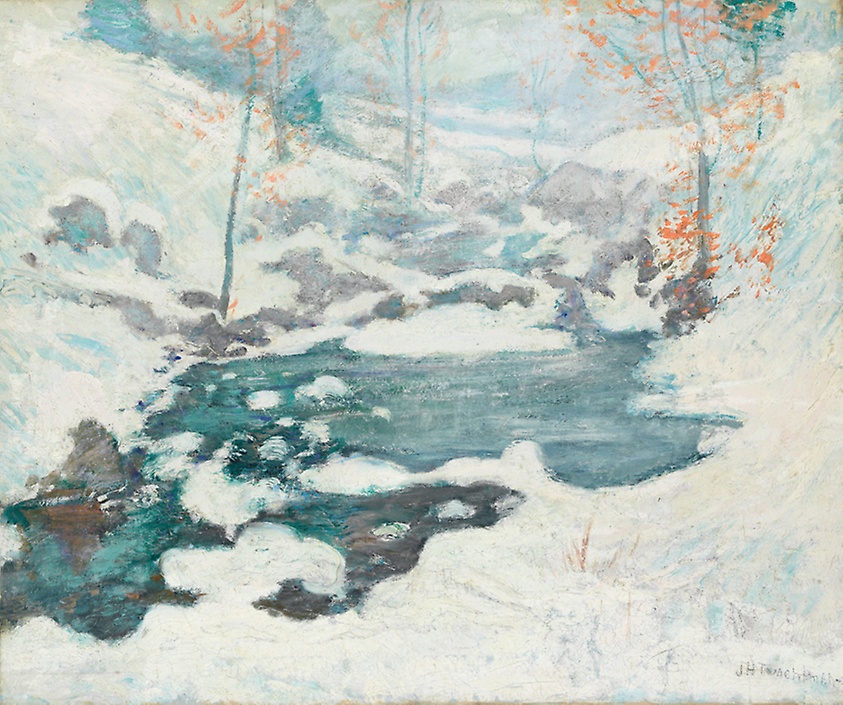
Featured Art: Icebound by John Henry Twachtman

In the novel I’m writing there are no people, no “characters.” And if you expect a plot you’ll be sorely disappointed. There’s little to count on and precious little to critique. Beautiful language is absent; there is almost no language of any sort so you won’t see any reviews praising its style or humanity. In my novel, each place is the same as any other place so there can be no confusion about where you are. The novel builds to no denouement because there is no nouement. And there are no epiphanies unless the reader realizes that not having one is something of an epiphany in itself. Symbols are everywhere these days so there are none in my novel. The storyline consists simply of turning a page which can be thought of as a narrative in itself. If the novel has more than a page this could present something of a problem. And if you’re looking for something that passes for wisdom this isn’t the place, though I do think I have retained a sense of adventure simply as a consequence of sequence. So here goes, though my novel, unlike any other novel I can think of, is very short so as not to test the reader’s powers of concentration and patience. As I said, there are no characters. The world is overpopulated as it is, so why make matters worse? Perhaps I should stop right here. There may be too many people, but there are certainly too few trees.


Read More

From The Secret Correspondence: A Novel of Novels

By Tom Whalen

Featured Art: Nan and Brian in bed, New York City by Nan Goldin

The Solution

For the life of me, I can’t understand why The Solution has been marketed as a crime novel rather than simply one of a failed marriage; not a single head is severed from its body, not one of the novel’s protagonists dies. He loved her, it seems, and she loved him and then didn’t, while his love lingered like a bad dream. She worked in the business sector of a nameless city in southern Germany, he spent his days writing a treatise on Hegel’s early years and thought. When they met by chance in Vienna seventeen years earlier coming out of a revival of In the Realm of the Senses, she was studying Wittgenstein in Munich, he finishing an MBA in Bern. As he remade his life to accommodate hers, she remade hers to accommodate his. But where is the crime in that? I find here no commission of an act forbidden by public law. Neither she nor he stole one another’s innocence, as far as I can tell, much less raided each other’s savings. Pages of meticulous detail about the German financial industry, reams of notes about Hegel and Napoleon, Napoleon and Hegel, first a paragraph about Napoleon, then a paragraph about Hegel, then a paragraph on both. Once, yes, at a company party, he believes he sees her flirting with her manager, her hand remaining perhaps a bit too long on his shoulder, his eyes glittering with a sort of bemused rapture, and then his hand on her shoulder, followed by the tilt downward of her head, quickly upraised. Had she only been steadying herself, having drunk too much champagne? The husband doesn’t seem to know any more than I do. And how pitiful the novel’s climax! He returns without any advanced warning to an apartment vacant of all her things, including the furniture she had inherited from her grandmother. Room after room, closet after closet, cabinet after cabinet, drawer after drawer emptied of all that once was hers, no farewell note on the kitchen table or left on a pillow, only the stale, sour scent of an emptiness grown suddenly emptier. Good God, what unfathomable creatures we are. Why do we even bother to marry?

Read More

Influence

By Sydney Lea

Featured Image: Study for “Music” by Francis Augustus Lathrop 1894

Those who know me know that I’ve long been deeply in love with what Roland Kirk called “Black Classical Music,” especially of that era whose great practitioners include Monk, Rollins, Davis, Jackson, Roach, among others; and I’m frequently and unsurprisingly asked about the influence of jazz on my poetry. Although I want to avoid any glib answer here, whenever the question is posed, I’m never entirely able. The interplay between the music and the poems I write is likely beyond words. Indeed, it may be the thing that I as a poet have, however furtively, long been trying to find words for.

That said, one of the surer things I can surmise is that as more or less a formalist poet, I like feeling the chafe of language against the limits of received (or invented) structure. There is no moral nor even aesthetic stance here: I dislike the formalist/free verse debate, because it too often sounds like a pair of parties elevating what they do and can do into virtue and debasing the things they can’t and don’t do into vices. As a rule, the accompanying arguments are downright ill thought out: the free versers, for instance, associate formalism with elitism and political reaction . . . which makes one wonder where the great practitioners of Delta blues and its musical derivatives would stand. Equally vapid arguments—free verse suggests sloppy poetics and fuzzy thinking—are too often trotted out on the other side.

Read More

On James Merrill

By Rachel Hadas

Featured Image: Flowers by H. Lyman Saÿen 1915

A few years ago I taught the semester’s final seminar in my graduate poetry course. This particular class was devoted to James Merrill. Somehow, unless it was my wishful thinking rather than an accurate observation, the students all seemed to rise to the level of articulate civility, of alertness and ingenuity, that characterized Merrill as a social presence during his lifetime and that indelibly distinguish his work as well.

The Merrill poem we happened to spend the most time on in that last class was “Days of 1964.” Until I reread it for the course, I hadn’t thought about that poem in several years; and as often happens with good poems after a hiatus, it struck me now with fresh force. Not only was “Days of 1964” still moving, many-layered, and beautiful, but like many of the poems that had been coming to my aid since my husband’s dementia had begun to change our lives, it seemed weirdly apposite. “Days of 1964” is a poem that reminisces about a time (obviously), a place, and a love affair; and it is also a poem about love itself, or rather, since the poem has a distinctly allegorical tenor, I should say about Love.

Why, in this difficult spring, would a love poem speak to me so urgently? Maybe because the poem was filling what my father used to enjoy calling a much-needed gap. For quite a while now, love has been in short supply.

Read More

Tight Spots

By Brad Leithauser

Featured Image: Abstract by Carl Newman 1858-1932

In some purer world than ours, the business of literary re-examination and reappraisal would follow foreseeable lines. You’d read steadily, in ever-widening circles, and retain whatever you read. To each act of rereading you’d bring a broader outlook, a more finely calibrated set of analytical tools. The whole process would be self-nourishing and self-directed.

Instead, what a messy and uncertain business—at least for me—reappraisal turns out to be! Its reigning god isn’t called Autonomy, but Happenstance. His identifying insignia aren’t an oil lamp and a set of bifocals, but a pair of dice. Years ago, I put together an anthology of supernatural fiction. I took my task seriously, compiling many pages of notes, and eventually found I’d digested more than a thousand ghost stories. One of these was Kipling’s “They,” a quiet tale with some benign and diminutive ghosts—the ghosts of children. I admired the story, but provisionally concluded it lacked the finish and power my collection would embody. While making my final selections, I reread “They,” this time prompted by one of my heroes, the poet-critic Randall Jarrell, who said of it, “Chekhov and Tolstoy and Turgenev together couldn’t improve ‘They.’”

This time around, I saw instantly that I’d underestimated Kipling’s story. It had plenty of finish, but wasn’t it lacking some necessary poignancy or power? Regretfully, I again voted no.

Read More

A Fish and a Pity

By Steven Cramer

Featured Image: Near the Ocean by Robert Swain Gifford 1879

Yes, it’s a classic; yes, it contains exquisitely stitched sound and sense—“He hung a grunting weight, / battered and venerable / and homely”—and yes, of course, it’s “not about a fish.” Bishop’s “The Fish” is the ultimate show/don’t tell poem. It’s a two-page toolbox of nouny exactitude—naturalistic (boat, hook, mouth, wallpaper, face, lip, thread); naturalistic-emblematic (roses, ice, weed, oxygen, blood, bones, entrails, irises); and naturalistic-emblematic-exotic (rosettes, swim-bladder, peony, isinglass, thwarts, gunnels). Diction like this provoked Jarrell’s famous endorsement: “all her poems have written underneath, I have seen it.” And the similes! “The coarse white flesh / packed in like feathers” throws down the gauntlet to every aspiring poet: never settle for anything less than the absolutely apt and absolutely surprising. Phrase by phrase, can there be a better example of Jon Anderson’s Helpful Hint #31?—“put something of interest in every line or sentence.”

Around 1995, I began to feel a kind of malaise as I added “The Fish” to syllabi. I started to feel fraudulent when I puffed up my enthusiasm about it, ungenerous when I challenged students who shrugged at it. I finally owned up to myself that, inwardly, I shrugged too. It wasn’t the Bishopy matter-of-factness that bothered me: “I caught a tremendous fish . . . [a]nd I let the fish go.” That’s the whole of the “plot.” Brilliant. No, what began to bug me had to do with the poem’s—I can’t think of a better word for it—message, packaged in its two least resonant passages: 1) the fish’s “beard of wisdom”; and 2) “I stared and stared / and victory filled up / the little rented boat.” In both cases, a reader might justly ask, “did you really see that?” Whether we’re meant to ascribe “victory” to the “wise” fish, or more generally to the situation—a creature-to-creature encounter inspiring an act of mercy—the soft-focus  moralizing is uncharacteristic of Bishop. It’s also uncharacteristic of her to float an abstraction like “victory”; the word doesn’t really modify anything other than the speaker’s feelings, which ring false, given the tough-mindedness of the poem’s earlier face-off: “I looked into his eyes.       They shifted a little, but not / to return my stare.” The poem’s famous dénouement—“Rainbow, rainbow, rainbow”—grabs our lapels and shouts epiphany! The rather obvious rhyme jingle, “rainbow / go,” glibly connects that epiphany to the release of the fish, who “wins”  by  virtue  of  his   virtue  (from  the  Latin, virtus, manliness). Don’t you sometimes wish (cf. James Wright’s “Northern Pike”) she just gutted and cooked the thing?

Read More

Disinhibited

By Stephanie Burt

Featured Image: Abstract by Carl Newman 1858-1932

I’m not sure when I first realized I was “serious” about writing poetry—1987? 1990?—but I am sure that John Berryman played a role. I spent part of my teens, and a slice of my twenties, hung up on so-called “confessional” art—the kind of art that claims to give a raw, or at least medium rare, slice of the artist’s soul; the kind of art that glories in broken taboos, that draws its rhetorical force from its power to shock, that turns its intelligence into a drill driven down as forcefully as possible into the lowest layers of an artist’s life. I admired the music of the Washington, DC, rock band Rites of Spring, the blank-verse sonnets of Robert Lowell, the apostles of Action Painting, and I still do. But I admired, most of all, the John Berryman of The Dream Songs, who seemed to me almost uniquely able to combine the confessional with the self-critical, the rawly shameful with the really entertaining. Berryman could mourn while he mugged for the cameras (as in his series of elegies for Delmore Schwartz), and still make the mourning seem genuine; he could flirt with suicide (as in the penultimate poem of His Toy, His Dream, His Rest) and revel in language that made even his life—or especially his life—seem clearly worth living. Hadn’t I felt that way too? (Hadn’t I felt as ridiculous as he felt, as important, as full of resentment and lust?)

Read More

Just a Goll-durn Minute

By Stephen Corey

Featured Image: Angel by Louise Howland King Cox 1895-1910

The place was Harpur College, now Binghamton University; the time was 1967—my sophomore year in school; the Introduction to Poetry course text was Oscar Williams’ New Pocket Anthology of American Verse (1955); the poem that revved me up and that I decided to analyze for our first assignment was . . . well, to the eyes and sensibility of my 2010 self, perfectly dreadful.

What I can also see, however,  is that the poem’s awfulness is beautiful in the sense that it was crucial to my initial development as a writer. Karl Shapiro’s “The Minute” is so overwrought, so all-over-the-poetic-gestures map, that for the neophyte language lover in me it served as a lush sampler of so many of the moves at a poet’s disposal. Think of a toyshop or a candy store: what matter that the Rama of the Jungle side pistol is shelved next to the Uncle Wiggly board game, or that the jar of nonpareils is right above the one filled with anise drops? All you have to do is want them all.

Comprising five seven-line stanzas—with lines that are unrhymed but often forcefully end-stopped and always quite musical—the poem wastes no time in showing its incessant and illogical bent toward metaphor and analogy. Here is the first stanza:

Read More

On the Author of “The Paddiad”

By Christopher Ricks

Featured Image: Sunset, Oxford by George Elbert Burr 1899

Among the judgments of which I repent is the one that I passed, half a century ago, on Patrick Kavanagh (1904-1967). The book: Come Dance with Kitty Stobling. The date: 13 December 1960. The journal: the Oxford Magazine. The brash paragraph by the reviewer:

Read More

Barbeque

By Roberta Allen

If I were to write a story about a barbeque in Stone Ridge, would I change the location to Willow? To Olive? Would I change the number of guests from six to five or maybe seven? Would I add another female? Would I exclude the odd-numbered male? Would I change the profession of the annoying architect swatting big fat flies at the table while we were eating to lawyer? Or pilot? Or yoga instructor? Did the architect swat flies while we were eating? Or was it later, after we had finished and taken the dishes and burnt buns back inside the house? Were the uneaten buns “burnt”? Or do I just like the sound of the words “burnt buns”?

Read More