I needed two thousand dollars by Friday. You deadheaded a daisy. I googled precipitously. You beat the welcome mat. I had a related question. You wore a hat in a place where it was considered not the vibe to wear hats. I choked on the billowing dust. You buttered a bone surgeon. I listened to a song you said was money. You drew five cards (unlucky) in a row. I dug my heels into the belly of the mule. You ladled bathwater. I couldn’t get the mule to move. You tied a sheet bend in our yo-yo string. I chased a chicken under a canoe. You had a serious moment on the tilt-a-whirl. I rearranged according to aura. Green, indigo, black. You re- heated soup. I smoked one down to the filter. You waltzed with failure in your mind. I possessed a drunk driver. You roadkill. I tried pouring coffee on the music. Why not at least try? You looked at me like a stalled motorboat. I asked how many copies we could move and how fast. You synthesized a boring diamond. I signed petition after pathetic petition. You shook a snow globe. I proposed posting up under a tree until the whole thing blew over. “Darling,” you said, “I don’t have the keys to that apartment.” I focused on a hubcap. You bought a falafel truck because apparently Jesus had a falafel truck, and we can always inch closer. Everything I did to make you happy. Everything you did. You chucked a stick in the river and it floated around.
Sometime last century in Kharkiv, father and I fled the melting August pavement, bribed the conductor of a sold-out train. He jammed us in the luggage racks, and we took off to the Black Sea.
The moving furnace spat us out somewhere in Kerch, the easternmost town in the Crimea two hundred miles from sandy beaches, magnolias, and pine trees, streets lined with vendors selling buttered corn charred shish kebabs and chacha. Predawn Kerch
was drab and empty, last night’s drunks scattered on the streets like seals in their puddles, seagulls feasting on rotting fish. At the port we made a deal with a captain of a cargo bulker Father paid the fare with his life stories, and kept the crew awake.
I sat 12 hours next to the cockpit staring at the horizon changing colors from pink to blue to pink again to black
till the evening Yalta embraced us like an old friend at the party: a little tipsy, a little horny, determined to dance all night under shooting stars
* * *
An arctic snowy owl arrived in the south of France last Wednesday 3000 miles away from home. Her baffled face was captured by the paparazzi. British scientists as their rituals dictate, had offered an explanation:
It’s all about the lemmings: The owl was following the lemmings The spike in the lemming population had lured the hungry bird
There is one person who really knows what happened— the captain of the Greenlandic freighter the stowaway had boarded, heading south
When I come in after shoveling that last round of snow—an exquisite parliament of low-slung brightness even in its groaning down toward the ground, I see my sister has texted QUICK THING. So easy to send such airy unplanned balloons. The ordinary flakes saunter down, will not let go, the white weather not yet leaving its filthy will with car tracks and time. I am her shelter. The snow falls as spheres. I like being inside now watching it. I think of the weight of it, the pile-up as it further neatens. The white at its best is a blur. My eyesight is off. It has been two years and seven months since I peered through one of those devices that brush eyelashes. I haven’t heard a doctor circle those disks and ask this one or that one, this one or that. What I see is another day, the wind sucking about. A coyote walks behind the junipers And now its shadow has become an action. The snow comes down, side by side. I am hardly paying attention; my eye no longer holds what it touches. There is so much noise in life. As children, my sister and I played tag during sermons. I could go on about how her notes bother me. The snowflakes are an arm’s length off. It could be the only thing I do: answering her, filling the white void in my hand. Everything comes from further up. When I respond I can talk now, I am saying no one realizes love without feeling this urgency.
Mine and mill have done their work, the ridge face once lush with fir and poplar now cleared of airy timber, the brow slashed and bored, a strip of railroad curling like a scar up the mountain to the excavation’s cavity, sealed now but still marking its territory, still leaving its lasting impression.
Hidden from sight, a subterranean labyrinth of crosscuts line like stitches the shaft that slopes down and in through folds and plunges to the precious stope that engineers surveyed, prospected, and, finally, removed entire, hoisting out the bituminous ore, leaving behind a sump that time and age will fill once more.
We knew what it meant to grow up in the suburbs, the product of poor beginnings― the progeny of farmers who readied the earth with horse-drawn plows, and women who kept having children
until it killed them, people who didn’t know anything else, surviving the Great Depression by telling ghost stories and war stories never meant to be believed.
We never let on. The girl across the street swore her mother was a full-blooded Spanish princess, when we knew she was Mexican. We were too young to know it didn’t matter.
The Pentecostals three doors down, women with uncut hair and denim skirts, men with lives like any other, were the only ones who were sure in their conviction they were headed for heaven.
The rest of us resented them because this meant we were condemned, like the old tool shed down the dead end where all the kids used to play, scaring rabbits in and out of the rotting lumber.
We just had nowhere to go in the middle of summer. So we dared the clotted vines of poison ivy, itching the next day, and grateful for the calamine lotion pinking our arms and legs
in thick splotches through which our fingernails dragged until the welts broke and the fluid spread. How it ever stopped we couldn’t guess. We ran through the rain-wet grass, mud-soaked when we found
a one-and-a-half-foot nightcrawler. Not even the boys would touch it except with a stick to carry it to the breezeway where we watched the awful thing suffer the concrete, already half dead anyway.
As fascinated as we were by the things of the earth, we should never have realized the sky was blue. But there it was, hanging over us large as any relative who came back
from the front line, shell-shocked and gun crazy, unable to make a living at even the smallest thing he tried, or the girl who hated Christmas for its one beaded necklace,
who never forgave herself for the gift of scarlet fever that killed her father, or any of the rest of us who cursed in the old backward ways, convinced someday we could care for ourselves. We could let this go.
My father told me the story of this big-time gangster from Georgia. The guy ran the streets of Tbilisi but left in the 1990s. He was running from something. He ended up a trash collector on the streets of New York City. I used to imagine this gangster’s thick gloved fingers wrapping around the handles of the plastic bins, lifting them up and flipping them into the back of the truck.
Scoping out the fattened apples and snatching QR codes with an iPhone, Evie, always eager to bootlick, says, in lipstick, What do you think, Addie, babe? Requiring
no official arraignment to condemn herself to death, she proffers in turn Paula Red, Ginger Gold, Jonamac, Jonagold. Her last ditch: How about tonight I make tarte tatin,
or apple crisp? Then, Would you like me to get you another cup? Careful, take mine. There’s a drip. Her voice leaping in pitch, she tries to forget that time she snuck off with fucksome
Lucifer—Dodge Viper parked in the Johnstone’s orchard, midnight cigarettes, a demon pretending his cock’s a rattlesnake to make her laugh. She stifles a rebel guffaw right now, nearly losing
it in front of the key limes. Bitching husbands and fruit can mess with your head, plus you never know when God might appear pink aproned on the porch, pie upfront, and eager to snitch.
First, remove yourself from the plane entirely. I’ve heard about drugs that can help, societies one can join. Some people move to Maine and jar things. There’s a Sun Ra movie where Sun Ra plays the piano so hot the club burns down. A guy from my high school started tracking eagles. I knew a woman who said she meditated for an hour a day, sometimes two. Megan from Wisconsin. You had so many kinds of hot sauce. Sambal. Cholula. Dave’s Five Alarm. Habanero from Hell. Meggy, my days are so long, and I think only of you
The surgeon wants me to remove my prostate. The upside: my life. The downside: no more erections, unless I take a TriMix penile injection, used by porn stars for ten-hour shoots. I do not feel like a porn star. Diapers for a year if I’m lucky, for a life if I’m not. Also for a life: arid orgasms. The upside: no more messes. The downside: no more messes.
II
Reddit-strangers want me basic: every day, I’m swallowing seven teaspoons of baking soda to vault my pH above eight. Cancer struggles to survive, they say, in a basic environment. I shit a dozen times a day. I piss on a plastic strip and it changes color, almost like a game. I live on the toilet but still, that’s a life.
III
The Happy Prostate Facebook Group wants me on everything— milk thistle, black seed oil, broccoli sprouts I grow myself, sea moss, boron, tudca twice a day, a dog dewormer even though I’m not a dog, mangosteen, hibiscus tea, soursop leaves, and never more than twenty pits of bitter apricot, unless I need to end things early (a drop of cyanide in every pit).
IV
The oncologist wants me to annihilate my prostate with targeted blasts of radiation. CyberKnife. Sounds like something Guy Fieri would hawk on late-night TV. This is everything you need, he says, trimming his frosted tips with a glowing scalpel.
V
Randy wants me cumming every day, a frenzy before the famine.
With the patience of an attentive nurse, he helps me arrive,
his finger curling towards the place my prostate takes me— a brief obliteration.
Maybe if I touch the cancer, he says, it’ll leave.
My stupid, silly man. It doesn’t work like that. But even when there’s nothing left to touch,
Three years now, I still resurrect my grandmother, pull her out of that mausoleum vault and bring her back to life. My life, that is. I know she’s tired and wants to rest, but grief is greedy and tireless. When I pull her back, she wears red, which, for now, is symbolic of Paradise. Sometimes, she is a cardinal, especially in winter when the world needs to be reminded of whatever it wants most. What I want is to take her to Kroger, so she can steal a grape or two. I want to take her to a doctor’s appointment so she can complain about the wait. I want to take her to see a movie so dramatic she will pretend not to notice that it hitches my breath and stings my eyes. Three years from now is unpredictable at best. And resurrection is only a way to drag the past with us, lest we forget. Yes, we forget.
Excerpts from The Extant Works of Aretaeus The Cappadocian, translated by Francis Adams (1856), A Brief Discovery of a Disease called the Suffocation of the Mother (1603) by Edward Jorden
In the middle flanks of women lies the womb, a female viscus, closely resembling an animal; for it is moved of itself hither and thither. In a word, it is altogether erratic.
You made an aquarium of my insides. Sculpted salty marshlands out of meaty pulp. Fashioned algae nests from fleshy sinew, white & crooked as the half-moons of fingernails.
You napped in the hollows of my ribcage. Nestled your mighty body into hammocks of irish moss. Smacked on sugar kelp like pink chewing gum, sapped & sweet as the raw nerves under cracked teeth.
In fragrant smells it also delights and advances toward them. To fetid smells, it has an aversion, and flees from them. On the whole, the womb is like an animal within an animal.
From deep inside me you now roar. Crying and howling until my whole belly sometimes lifts.
When, therefore, it is suddenly carried upwards, and remains above for a considerable time, violently compressing the intestines, the woman experiences choking.
My organs; an oblation to you.
For the liver, diaphragm, and lungs are quickly squeezed within a narrow space; and therefore loss of breathing and speech seems to be present.
With teeth clamped shut, our hearts convulse in chorus.
This suffocation from the womb accompanies females alone.
Men stuff partridge feathers and hot coals inside my nostrils. Prod blisters on my breasts—blindly, as newborn kits search for milk.
Those from the uterus are remedied by fetid smells, and the application of fragrant things. A pessary induces abortion and a powerful congelation of the womb.
From me you surface burnt and hemorrhaging on sorrow. Like that of slaughtered swine.
Grief comes with sponge and pail. Scours my soul—barren, we laugh ourselves to sleep.
So many men love my friend: her boyfriend and both ex-husbands build her a three-season porch, all cedarwood and teak. Pine needles from her backyard
cover the almost-floor. I tell her she is sexual, like Stevie Nicks. People can smell it like golden beer. They smell my indifference— it smells like a New England Timber Rattlesnake, all scales,
black-tinged-gold, like a hole. I learned today in a crossword that Venus has no moons. That was the down clue, What Venus lacks that Earth has: _ _ _ _ _:
five letters—O and O—filled in already. She sends me a video of the three men and their equipment: saws, nails, drills, hammers, planes, pulleys, rope,
planks of wood, aromatic as a closet, some tool with claws on both ends they toss back and forth, way too hot.
1.) You Sound Drunk, You Probably Shouldn’t Leave the House Today
We never speak of the reasons for her drinking, though her husband was in the navy overseas, a high-ranking officer, leaving her alone at home. When I was a child, whenever her husband was away, my neighbor would visit my mother, stumbling into our house, reeking of whiskey and crying about her husband, not wanting to be alone at night. She was the type of woman other women called a doll. Pretty, slender, elfin-faced with no children, she was youthful and kind with an aura of fragile, feminine innocence nurtured like a pet in a well-swept house with caramel aluminum siding and wooden shutters painted sunny-sky blue. A divorced woman also abandoned by a man, my mother felt sorry for our neighbor and asked me to stay over with her to keep her company, since my mother had to watch my baby sisters and had work in the early morning as a secretary at the meat-packing plant. I packed my tattered overnight bag and skipped over to the neighbor’s neatly decorated house, where I slept in crisply laundered paisley bedsheets in her husband’s place as she attempted to fall into a drunken sleep, shivering, curled against my back, spooning me. Sensing her dreaming, I woke in the dark with her hands on me. I was thirteen when it started, fifteen when it ended with her fingers creeping inside me. I pretended to sleep. At sunrise, she cooked me a breakfast of burnt buttered toast dusted in cinnamon sugar while warning me about men. She watched me eat as she sucked her fingers while sipping bourbon-spiked tea.
Switch on the car radio, music falls out of the air into my ears: James Brown, Joni Mitchell, Jim Croce. Old gold. Plus, when I got in my car, it cranked like it does every time, so many miracles in that I can’t even count them. Traffic lights that help us get along with one another, scent of roast chicken rising from my grocery bag, which also contains the most delicious bread, whole wheat with flax, sesame and a hint of cherries. That someone thought to turn wheat into bread, miraculous. Yeah, I know, I just had to start on a heart pill, but it’s nothing, a little electrical nuisance, no effect on longevity. And yeah, my best friend has a hurt so deep and wide whole oceans pour through it, and her story’s not mine to tell but jeez, what a soul-shatterer. Yet even she watches bumblebees. She swears they’re her favorite miracle. So aerodynamically complicated in the way they get off the ground you’d think they never would—flapping their wings back and forth, not up and down—yet up they go. She says if they can beat gravity she can too, and I gotta tell you that to see her dressed and laughing, hear her singing with that voice that sounds like water tumbling over rocks in some ancient river, water that’s passed through some murky cavernous places but has emerged into the stunning light of day, to hear her sing again is one big fat black-and-yellow buzzing miracle.
My sister named this venerable maple growing at the edge of the mountain’s gravel road, main trunk long broken, pocked with holes, a once-mighty tree now slowly failing. She’s lost her apical dominance, I say, meaning that when the top broke off, side branches shot up past the injured trunk like raised arms. On the left, one wide kind eye, an open mouth framed by credible lips. Step right, a second eye squinted shut, mouth twisted up, as if she’s yelling at us the way our father’s mother did: imagined slights, our insufferable rudeness, which she thought should be spanked out of us. Mom never laid a hand, which says a lot about her mother, gone too soon for my sister and me to have known. Grandma Baggett and her snarling chihuahuas gone, too, when our parents divorced. No wonder my sister imagines a tree could be a grandmother; she’s been hiding in stories since we were small. I anchored to the safety of science, to cold fact: Trees break. A grandmother can call you Sugar one minute, rage at you the next. Can die without you ever once hearing her voice.
He will come to live with you Make him feel welcome My mother says Her eyes turning away from mine Before I can search for the meaning
I imagine I might have a small, empty room off to the side With a reddish glim That might bother him at night When he takes off his thick, black-rimmed glasses And his eyelids become soft and white Butterflies in his leathery face
I would have to get a night-side table for his glasses And his teeth And his cowboy book So that he feels welcome when he comes to live with me
I think that old single bed will be fine Now that he is alone He wouldn’t want more anyway But I will get new sheets For his old, pale body and his tanned forearms And maybe a soft, new pillow for his sunken cheeks
I will ask my sister for that old painting With the open plains and hazy blue mountains So far, far in the distance The one she took when he died
So that he has something to look at And so that he feels welcome
When he comes to live with me, in me In a small room off to the side of my heart So very far from the plains where he grew up.
You were spinning a top on the bar the night we met at happy hour. We had known each other for years. You gave me a poinsettia for Christmas once and I gave it away, left it in my mother’s picture window so she could end every phone call asking about the boy who gave me that nice flower.
I fell down your stairs. I lost myself in the gaze of your oak trees. I fell in and out of your bed when I wasn’t falling in and out of the Italian tenor’s bed. I met you over and over in the street crossing to the deli. I saw you in the parking lot. I forgot you when the gulls squawked, when my feet were sandy, when I took my lunch in bed.
I forgot you when it rained and the gutters overflowed. You sang to the fax machine. You counted your cigarette breaks. You tipped your hat and loitered by my window. I wore blue when you’d remember it. I drank apple ginger tea with my feet in a desk drawer.
I’d stamp your letters. I’d throw out the tenor’s bills. I was mistress of the postage meter. We’d muse about the smell of death in the walls, the drop ins in the drop ceiling. Some nights I’d roller skate around the file cabinets, overtime under the exit lights. You never let the coffee get cold.
You caught a deer mouse in a file folder. I caught a field mouse in an envelope box and sat by the train tracks watching the hawks pick off the chipmunks. I wore a green dress so the forest swallowed everything but my eyes. I told my mother I’d never love you.
The union was strong, but not strong enough to make Detroit Steel keep a dying man on the payroll. John shouldn’t have known this, but he often overheard his parents talking in the room beneath him until late in the evening. He was a respectful boy and was never trying to eavesdrop, but in a house that’s small with heating vents that weren’t so much vents as just holes in the floor (or ceiling, depending on your perception), there wasn’t much of a way to avoid it. He knew the other men at the mill were keeping an eye on his father, Bernard. They were propping him up at his station and bringing him water and coffee throughout the day, whatever he needed to keep him going. “I don’t know why they do it, I don’t need no special treatment,” his father complained to his mother at least once a week. But he still hopped in the car of whoever showed up for him in the morning, usually Jay Mingus’s dad Jimmy who had a 1947 Studebaker with a long front hood and wild wrap-around back window. The fathers of most of John’s friends had older cars like that, bought when they first returned from the war and were fresh hires at the mill. Some bought new ones every few years, like Joseph’s dad who bought a 1957 Buick a few months back even though his old one, which Joseph’s mom had now, was only three years old. The Bondurant’s didn’t even have one car, let alone two. His father always told John it was because he liked to walk to work and couldn’t imagine missing out on the fresh New Boston air, which John assumed was a joke like when he told him his Purple Heart was from getting stabbed with a fork in the chow line. No one, not even John, who loved his town with a ferocity rivaled only by his love for Roy Rogers, would describe the air of their town as fresh.
Somehow inside this wire-walled farrago, Its strutty discombobulation half Parade of plume and barrel-bottomed flank And half a mad stampede for any door,
She stands apart, her neck up-stretched and target Eyes aimed off somewhere, and stands her ground, Each step a claim on just that spot, the way Her spindled claw alights to clutch at sand
While high above, a royal in a bulbous Ornamental coach, she barely takes It in, crown swiveled to and from the broody Babble of the mob, their rancid screams.
Something percolates, something like thought That makes her beak beat down magnetic to A speck of grain then up again to bring The morsel down her rippling throat, a throat
That then becomes a spectacle, engorged To twice its size, complete with guttering Sound effects, one wing flexed out to show She can and on another whim retracted,
Head turtled in and out and torqued so fast She nearly does a full-on Linda Blair, As if to advertise the fact that she’s Detachable, a thing of separate parts.
A haze of downy silt hangs in the flock. Tail raised and primly twitched, she ambles off, A countess in her gown with time to spare Before she hears the ax head split the air.
I liked him because nobody knew what he was. We were alike, bulging in all the wrong places. We tottered around, as if our bodies weren’t meant for movement. As if our bodies weren’t quite ours.
When I was twelve, my mother dropped me at the mall for a meet-and-greet. Grimace was planted in front of a plastic date palm. I was the oldest kid there. Permed mothers kept sending me dubious looks. A group of boys pointed, then giggled.
When I finally reached the front, he was bigger than I’d imagined—a swollen spade, a hill-sized bruise. He pulled me close for a photo, and I kept myself against him. The mothers whispered, but I didn’t let go. I couldn’t. You gotta move on, kid, said the head inside the head. A soft voice. Too soft. Human.
Outside, a few gray snowflakes fell, a truck rumbled onto 290, and the cold seeped through our windows. Our landlord had rigged our thermostat so we couldn’t turn up the heat. But that day, the four of us nailed a bag of ice to the wall over the sensor, and when the heat kicked on, we let it pump until we’d shed our sweatshirts and flannels. Leaning back on our futon, we shared a joint, invincible in our underwear and T-shirts, laughing and laughing. Twenty years ago now, before we knew loss and grief, when we sang along to our DVD of The Last Waltz and didn’t notice the steady drip of the ice melting.
Last night: the wall of a mansion abandoned mid-construction.
The night before: the back garage of a boarded-up health spa.
Tonight: a section of the fence that marks the end of our skinny seaside town.
No one really comes down to this fence, no one except for surfers on their way to the beach and cyclists heading south. Beyond the fence are kilometers of forest before the next town. In front of it is where Lauren’s body washed up on the sand.
The fence was her training ground. Her minimalist tags run along it, as well as our father’s nickname for her in other styles: bubble throw ups, pichação pieces, the occasional wildstyle.
After adding my mimicry to the painted patchwork, I look at the precision of her lines and the sloppiness of mine. The contrast makes me petulant in the way I often was when we were kids and she was better at something, better at everything. But then my heart swells with pride and I have to get away from her symbols and signs.
my co-fellow leading the free veterans writing workshop— a fiction writer— had been to prison for killing a guy.
It was accidental. College, a party, alcohol, a gun.
The dead guy’s parents didn’t even want him in court (him being my co-fellow). It was all a terrible mistake.
He’s white, the fiction writer, and was writing a book about a man who kills his brother and goes to prison.
What I took away from the book, which he showed me in draft form, is not shocking. There’s guilt, then dread, then guilt again, then, somehow, life
but never the same. The veterans in the workshop never talked about if, or who, or what they’d killed except a rogue navy guy who wouldn’t (couldn’t?) stop reliving the glory days of the Gulf. Otherwise, they didn’t tell and we didn’t ask.
My co-fellow had been a college student. It was an accident; young dudes, a party, alcohol, a gun. He’s white. It was Maine. The dead boy’s parents didn’t even want prison.
He got a year and taught guys inside how to write. He told me it was frustrating, the guys who were illiterate. They were all white and couldn’t get high. After, he did manual labor— construction?—for a few years then came to New York.
He was very handsome, and later we didn’t-but-almost kissed after I’d come home from 2 months in the psych ward.
He knew where I’d been and told me I looked great, which I knew, but he had a girlfriend, which I didn’t.
Psych patients, wards, and prisons alike love puzzles—soft harmless pieces dumped on the floor, the table, guaranteed to fit together, already perfect, the answer already known to exist—
I see him when I look in the mirror, my father, the coach of my 5 a.m. 800-meter runs, who sacrificed to finance my education and once presented a twenty-five-slide PowerPoint on how to live my college life in the U.S. He carried a black-and-white photo of our family in his wallet. People say we look the same.
He was the first in his village to go to college after China’s Culture Revolution. He brought honor to and redeemed his once politically shamed family. By his mid-thirties, he already made tenure and was named vice president, the youngest in his university’s history. I remember him waking up in the middle of the night, drenched in sweat, punching the air and yelling, “You can’t get me!” My mother once gave me a peek into his childhood: being hung up-side-down to the ceiling with a rope tied to his ankles while my grandfather beat him until he had broken all three broom sticks. Wrinkles cover my father’s face now, his temples all gray, sharp shoulder bones gathering under his shirt. At my wedding, he hugged me long and tight, with tears of joy and pride, though I had walked down the aisle by myself and never asked him for the honor. I freeze-frame this minute. It was the moment I want to see him in and remember.
There’s too much news and not enough me. I’m not sure if there’s enough of you either. It takes a million news to buy a loaf of bread. Wheelbarrows of news. People line up for blocks to withdraw their news before it’s too late. The run on news has caused the industry to consolidate further and us too—there’s really only two of us now. As the plane lands you slowly loosen your grip on my whitened fingers. The attendant says “I’d like to be the first to welcome you to Unprecedented Times.” Somewhere a man is buying a gun. Somewhere a couple is trying not to think about it. Somewhere a sign says “Due to The Unfortunate we are deeply out of onions!” I’d like to stop living through history. I’d love to know more about how to love. I have questions for you. Four questions. More. You tell me to pardon your dust. Every day is demo day. I’m sure there are a million times you could’ve given up on me. But here you are. Now help me with this wheelbarrow, would ya?
The greatest murder mysteries are often hilarious. Perhaps this is because, as investigator Porfiry Petrovich says in Crime and Punishment, “Human nature is a mirror, sir, the clearest mirror!” Raskolnikov, and other famous murderers in many stories, are not that different from ourselves. How should we respond to this devastating fact? Laughter may be the answer.
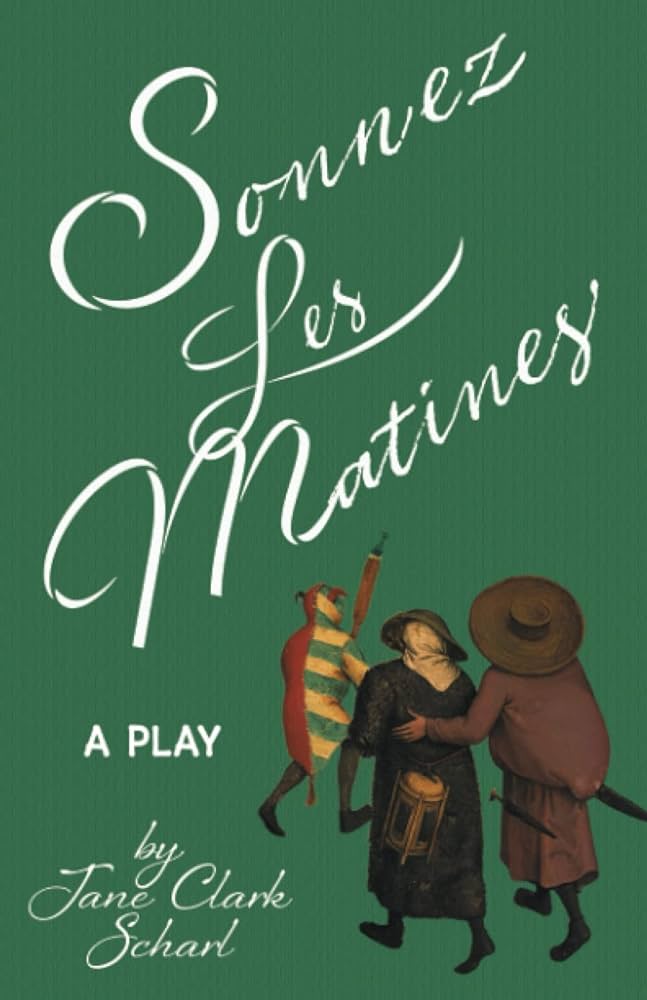
Sonnez Les Matines by Jane Clark Scharl is many things—a verse play, a murder mystery, a philosophical dialogue—but it is also simply and deeply funny. A trio of famous former Parisians: François Rabelais, Jean Calvin, and Ignatius of Loyola, stumble upon a dead body during Mardi Gras, and spend the story arguing about who is guilty. In the play this is both an immediate question and a cosmic question, as the interlocutors explore everything from the weapon and evidence to the incarnation of Jesus and what happens when we die. Meanwhile, there is also ample banter, finger-pointing, and poop jokes.
I came that they may have life and have it abundantly.
So says Jesus in the Gospel of John. It is a line that occurs to me often when I consider the influence of religious ideas—in this case, Christian—on a writer’s ability to engage with the fullness of life. That is a vague phrase, I realize: fullness of life. Perhaps it would be helpful to say what gets in the way of fullness of life.
There are two major obstacles, in my view. One is material: the virtual world we have constructed and inhabit through screens is by its nature a thing set apart from real life. The more time a writer spends immersed in that world, the less she is able to observe, reflect upon, and move bodily through the real world, the given world of nature and human society as it is experienced face-to-face. The second obstacle is mental: the temptation to delude ourselves, to live in a fantasy of who we are, pretending to believe and feel what we think we ought to believe and feel or want to believe and feel in order to secure membership in a particular tribe.
Newly Not Eternal, the second collection by George David Clark, is a book in which time has burned the dross away. The poems look small, but like Blake’s grain of sand each holds a world. The prologue poem, “Mosquito,” is a manifesto which, with its childlike music and theological contrariness, I think the author of “The Fly” would recognize:
God was only acting godly when he strapped a dirty needle to the fly and taught it how to curtsy on our knees and elbows
on our necks and earlobes so politely that it hardly stirs an eye. God was hard but speaking softly when He told us we should die.
It’s like Paradise Lost covered by Ariel, Shakespeare’s most musical character. Most of the poems have that spirit’s melodic drive, sitting somewhere between nursery-rhymes and spells.
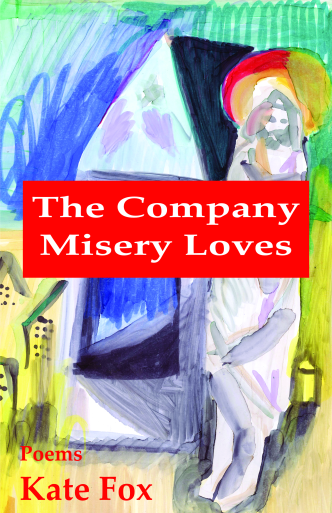
Within the first few lines of Kate Fox’s latest collection The Company Misery Loves (Sheila-Na-Gig 2024), we embark on a journey to consider the role of inevitability in shaping how we face or embrace life’s absolutes. In language that shimmers on the page, she becomes stage director, tour guide, host as we follow her lead over a marvelous succession of former landscapes. We are invited in turn to believe and to suspend our former belief, to hear the author’s voice and the voices this author has shared so insightfully that one wonders when each poem’s speaker visited her bedside, pulled back the veil, guided her hand over the page.
Poems from the poet’s thoughts of home invite us with visceral, concrete images into each moment. Such is the craft at work in this collection that bids us to see “that oil mixed with rain / in a hubcap is beautiful, which it is / because you own it,” and long years later to walk the land under great emotional weight and behold “as the entry shawls itself / in brilliant leaves, and the mountain beside me / pulls the sun’s deep brim down over its eyes” as though even the land feels the loss of things past.
Just when you think you know what sort of work will be encountered throughout, Fox introduces us to beautifully dimensional voices such as Mary Shelley, Josephine Peary (wife of the admiral), and Kathleen Scott (widow of the Antarctic explorer), whose voice becomes a masterful device to illuminate us regarding Scott’s expedition and those of George Mallory. This present Kathleen Scott handles with alacrity having been mistaken for the wife of Ernest Shackleton as well as how she might have sculpted Mallory had she not found “Everest / holding fast its own.” This author threads much sound insight and fact into these historical poems without ever drifting out of poetic voice—there again, as with us at the beginning, empowering Scott with agency to recount or rewrite history as she pleases. And it pleases.
With misery in the title, yes, there is loss in this book—loss not shared for loss’ sake but because its inclusion is essential. The losses are here, but the art and beauty of this work is not diminished by what is inevitable for us all. These poems stare into the face of that inevitable and seem to say “this, too can be beautiful.” To repeat Jane Ann Fuller’s words, “This poetry is flawless.” Here is where I must confess exceptional bias. Having begun reading The Company Misery Loves, I was pleased to find this collection includes some of my favorite works by Kate Fox. Finally, I get to share my excitement at how deftly she also wraps biblical icons in humor and contemporary sensibility. Poems from Fox’s book The Lazarus Method retell age-old stories with brilliance. In our varied experiences, there are poems remembered because they were assigned or were the subject of debate. There are poems we witness in live readings that echo the poet’s voice inside us for days. Then there are poems that are remembered because they refuse to be forgotten. The Company Misery Loves draws us into the unforgettable like “human branches reaching armless / toward their maker.”











 New Ohio Review