Irish Nocturne

By Derek Jon Dickinson
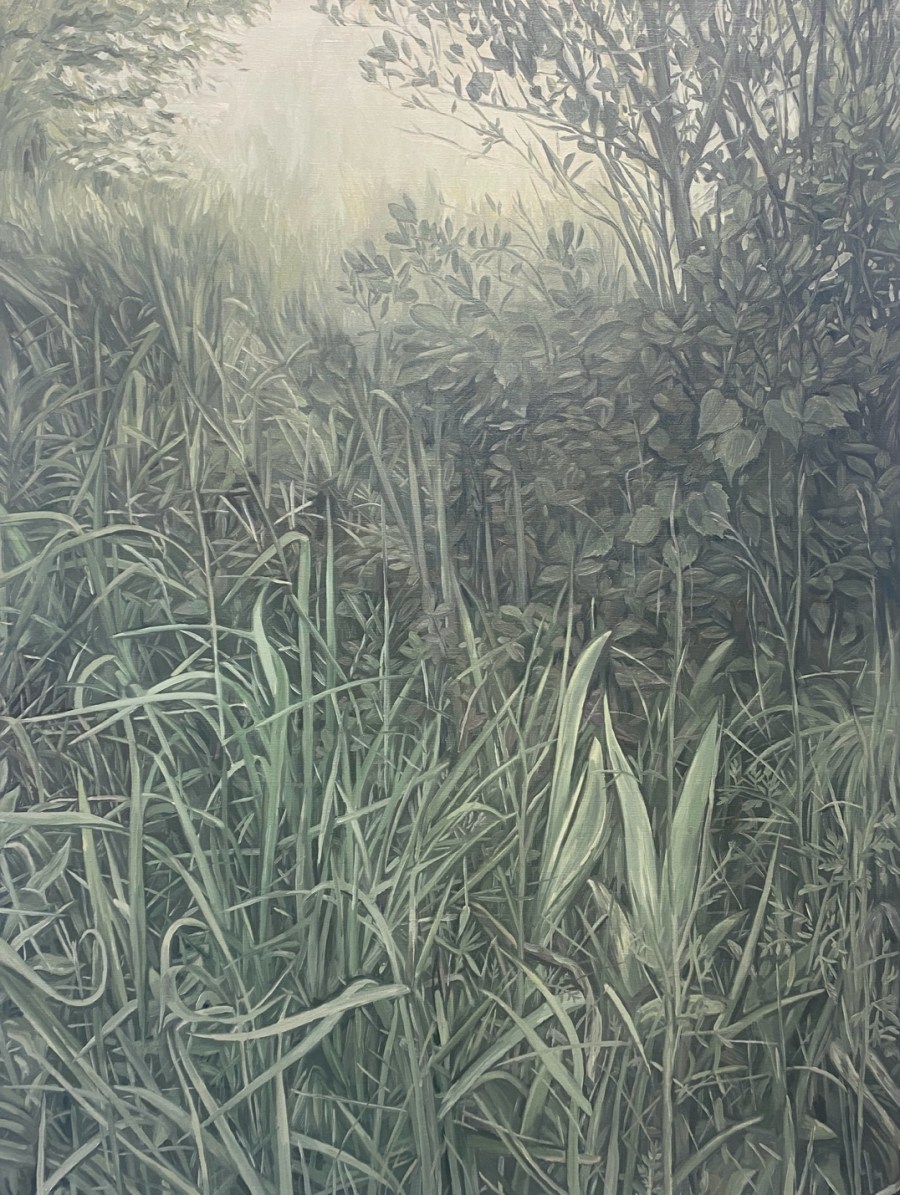
Featured Art: “Grass Pathway” by Madelyn Bartolone

I lift myself, pinch my hat, splash some coins against my debt. Crusts of dried swallows in the emptied pint-glass. Outside, the moon is a wooden button through its slit of Gaelic wool. The pub is a cask of fermenting voices, windows oily with yellow light; night melting inside me, like a given kiss, or warm wobble of whiskey. South—my soles scuffed with work, clicking the dew-glistening cobble, the brook-straddling bridge; water, fragile as flute-glass, tinkling the stone sluice. Moonlight stitching the fraying salmon; lidless eyes, cold as premonition; tails pulsing like sunken sails. The coming car-light snips me like scissors from the black pitch night, its red taillights trailing-off as errant sparks. Home—wafts of sweet peat-smoke, a tune rolling around like a marble in my mouth. With sun-chipped hands, I work the turf-stove’s iron latch; strip-off my clothes, naked as a wet salmon, strumming the sheets upstream; thumb denting the clay slab of my wife’s hip. 


Read More

Hymenoptera

By Joanne Dominique Dwyer

This is not a poem about insects of the family Hymenoptera.
It’s not a poem about pounding nails.
It’s not a poem about flashlight tag.
It’s not a poem about famous writers addicted to laudanum.
This is not a poem about the burial of a baby raccoon.
This is not a poem about the core of the sun becoming unstable
   and everything going black and cold.
This is not a poem about the definition of Hymenoptera.
Hymenoptera: derived from the ancient Greek words
hymen and pteron—membrane and wing.
This is not a poem begun in silence.
Before dawn the wolf dogs howling inside the pen.
And a 5:30 am text from a man who says another man
entered his bedroom while he slept—
   and a threat of beating the intruder to death.
This is not a poem about cannonball splashing.
This is not a poem about the softening and weakening of bones in children.
It’s not a poem about parachutes
It’s is not a poem about being born in a field of horses.
This is not a poem about oxygen.
It is a poem about the migration
   of ruby-throated birds and the effects
of artillery on tongues.


Read More

The Natural World

by Chris Crockett

Featured Art: Cosmic Eye, by John Schriner

The moon rises
to the left of the kitchen sink.

I go outside to check on
the world’s artistry:

Moths and stars;
bats whose blind ping-pings

pinpoint insects,
accurate as an adding machine.

Horses are head down in the soup
of flooded grass fields;

All day long
they solve their hunger.

Everything partners and trades
nutrients. Billions

unseen in the black roots.
Inaudible hum.

My fingers keep time
to a barely comprehended

background beat.


Read More

Sharp Shin

By John Bargowski

Featured art: brittle decay by Zero Jansen

I found it grounded on the road edge
near the town ball fields where my old man

hit pop-ups to me in my little league years.
The bird hopping through snakeroot

and catchfly, dragging a skewed wing
maybe busted by a low dive into a pickup

headed into our burg on the county two-lane.
That hawk always a few steps ahead of me,

raised the hackles on its cocked neck,
turned a pain-crazed dark eye, then clicked

its beak and snissed, flexing talon-spiked
claws whenever I came close enough

to grab it from behind and clamp my hands
over both wings, the way my old man did

the times he slow-climbed the ladder
up to the loft after his shift at the D&J Bar

and culled his prized flock of homers.
Sometimes reaching inside the wire coop

at twilight for a blue ribbon winner
that wouldn’t leave home to wheel over

the ball fields and D&J with the rest
of the team on the day’s last stretch.

An old favorite, whose inner compass
age had scrambled, clutched in those nimble

calloused hands that taught me the gift
of the sacrifice, the grip of the curve.


Read More

American Horror

By Jessica Alexander

You should have seen me then, under those yellow stadium bulbs, my lips so
full they’d burst in your fingers. I had this top on: a floral print and ruffles, red,
to match my lips, and my tight Levi jeans. And my sun-kissed cheekbones and
the sun-kissed bridge of my nose. And my smile was just like America—like
a cornfield stunned by its own golden beauty—my gorgeous delight! I went
braless, wore no makeup. It rained and the grass was slick. The way it goes is
that something happens next. It happens by a lake or in a parked car. You take
one look and know I’ll never survive it. My teeth were like a horse’s. A feeling
they mistake for a girl. A feeling they write songs for. The kind of songs that
played in pickup trucks and there’s me standing in the bed of one, hurling my
top into traffic. Could be a hitchhiker. Some guys carry knives. What is it about
blonde girls and America? Blonde girls and wherever? I was so all–American.
So cute I could have murdered my own goddamn self. What is it about a blonde
girl that breaks the world’s heart? I miss those days. Not Bobby or Leo or
James. Just miss that particular ache, which was not unlike a bulge in shorts,
that summer rage that could break my chest apart and hurl my beating heart
into the bleachers. Like them I could not keep myself. There is the stadium
again. There is Bobby, cheering. Isn’t that how it happens in America? Topless
in Texas. My little red shorts. In the back of a pickup, again. The window
breaks. In Tennessee? In Indiana? The sound of a power drill, a chainsaw. The
sound of summer. The bleachers, those bright white lights waiting to throw 
my shadow to the ground, and there I am, arriving, and it’s always like what
happens to me next has everything to do with every one of us.


Read More

Grace

By Craig van Rooyen

Featured Art: Pine Tree by Giovanni Segantini

The History Channel’s playing “The Gold Rush” again.
All those bearded men looking at reflections
of themselves on the surfaces of creeks and rivers and lakes.
They’re so beautiful coming out of ramshackle cabins,
thumbs tucked into suspenders, wading into streams
the color of cheap whiskey. That golden light
on their shoulders, in their beards, dripping
from the brims of their hats, high on
“howdy” and “rough and ready,”
around every bend in the river, expecting
life to begin. The flash of light in a silver pan
full and overflowing. All that hope. Out of
the river, there’s always more earth.
There’s always the scooping and sifting and
throwing away. Everything left behind—out of
frame: The women in their calico, waving goodbye.
The steaming cows in their barns. Now just
the sloshing desire of this moment and the next.
Sure, you have to be willing to kill a few Indians.
But as long as you’ve got a pan and a river
to dip it in, you can forget the rest.
At least that’s what I tell myself before the first
commercial break. Before those attractive
late-middle-aged people clutch each other
in honey light and the baritone voice-over tells me
to go to the emergency room if I experience
an erection that lasts more than four hours. I wonder
if anyone ever panned for gold in terrycloth—
my fabric of choice for watching “The Gold Rush”
in bed at 10 a.m. on a Wednesday. I wonder
if any of those bearded men had a bottle of
Prozac back in the cabin next to the straight-blade
razor underneath the cracked mirror—something
to take the edge off all that failure, something
to dull the regret of walking out on their women
and cows. Of course they’d have another name
for Prozac, like maybe “nerve pills,” as in:
“Durn near forgot to take my nerve pills this morning, Jake.
Christing Jesus, sure don’t want to start sawing
at my wrists again, now do I?” I love the way
there’s no word for shame in the language
of gold miners. All that hope is contagious.
In fact, I believe if I really tried, I could get up
and shuffle to the bathroom and brush my teeth
during the next commercial break. I love
the History Channel! It’s so inspirational.
Right now, the sad banjo music is playing—
the plinking of catgut string over doe-skin,
a sound so Californian it makes you weep for
the all-night diner in Auburn where it’s 6 a.m.
and the sun is lighting up the foothills and
the American River is still frothing to get wherever
it’s been trying to go all night long. All the gold’s dug out
of the hills but the waitress is calling you “love” as she
puts down a cup of awful coffee and sits in your booth—
night shift done. It’s as if she knows you. As if she’s
made the same mistakes and she’s telling you it’s okay.
Now she’s taking out a bobby pin.
Now she’s letting down all that golden hair.


Read More
Bobcat

By Mikko Harvey

Featured Art: Forest by Werner Drewes

Walking through the woods / at midnight / we were on our way / to the pond / where we
would skinny dip / when two yellow eyes / appeared on the path / we froze / they didn’t
blink or move / the body was / hidden by the dark / there was something / sinister in its
stillness / we turned back / you said it was probably / a bobcat / but better not / to take
that chance / we shared a bed / untouching as usual / you fell / asleep first and I wondered
what kept us / apart really / that night / and the others / the distance between us / maybe six
inches / felt like a shadow / I couldn’t step out of / my two open eyes / the only light
in the room / I thought of the animal / blocking our path / and it occurred to me / she was
only a hostess / welcoming us / to the world of risk / smooth and lovely / water hugging
your naked body / the animal said / are you ready / but we walked away / I had an urge
to shake your body / awake and take you back / to the animal and say / confidently yes
table for two / but instead I just lay there / in the perfect / quiet / country / darkness / and
imagined the outline / of your chest rising / and falling / rising / and falling as you slept.


Read More

Royalty

by George Bilgere

Feature image: Odilon Redon. The Beacon, 1883, reworked c. 1893. The Art Institute of Chicago.

So this young couple, overweight
and seriously tattooed, comes into the café,
and each of them is actually wearing a baby
in one of those tummy-papoose things,
and they have two enormous dogs
designed to kill elk and wolves,
not sit under the table at a coffee shop,
and as I watch them smile at their babies
which are now screaming bloody murder
while the great slobbering mastiffs
begin earnestly licking their own privates,
something terrible happens to me:
it’s like The Manchurian Candidate,
when Lawrence Harvey suddenly realizes
the reason he’s been acting so strangely
is because he’s been brainwashed by Soviet agents:

Read More