New Ohio Review Issue 7 (originally printed, Spring 2010)

New Ohio Review is archiving previous editions as they originally appeared. We are pairing the pieces with curated artwork, as well as select audio recordings. In collaboration with our past contributors, we are happy to (re)-present this outstanding work.

Issue 7 compiled by Rylee Reis.

My Sky Diary

By Claire Bateman

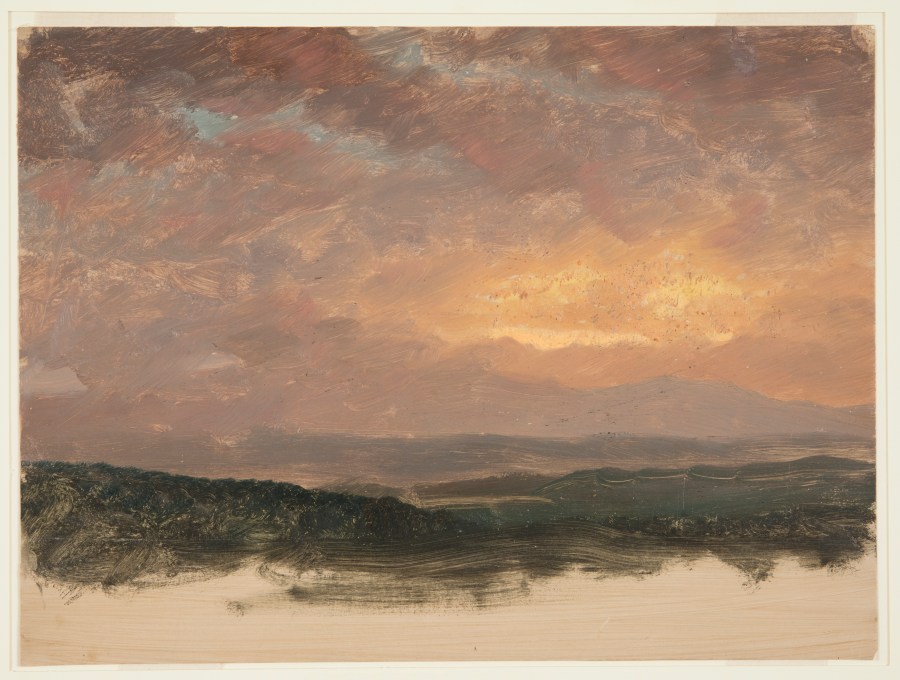
Featured Image: Sunset over the Catskills by Frederic Edwin Church, American, 1870-1880

Because it’s my book,
I will treat it however I want.
I will crack its spine, though not its spirit.
I will bend back the corners of its pages
along the margins of whose cold fronts
I will inscribe hieroglyphics,
and over whose most capacious melodic passages
I will take terrible liberties with liquid paper
whenever I crave silence.
Haven’t I paid for this privilege
through decades of learning to write,
all those decades in the first grade,
my retinas suffering
the mute incandescence of letters
which withheld their significance from me
as, lathered like a horse
condemned to drag his own stable behind him,
I’ve labored with sentences and paragraphs,
wrestling the fat green pencil
that grew quantumly heavier
as it registered each mistake?

Read More

Tree Talk

By Claire Bateman

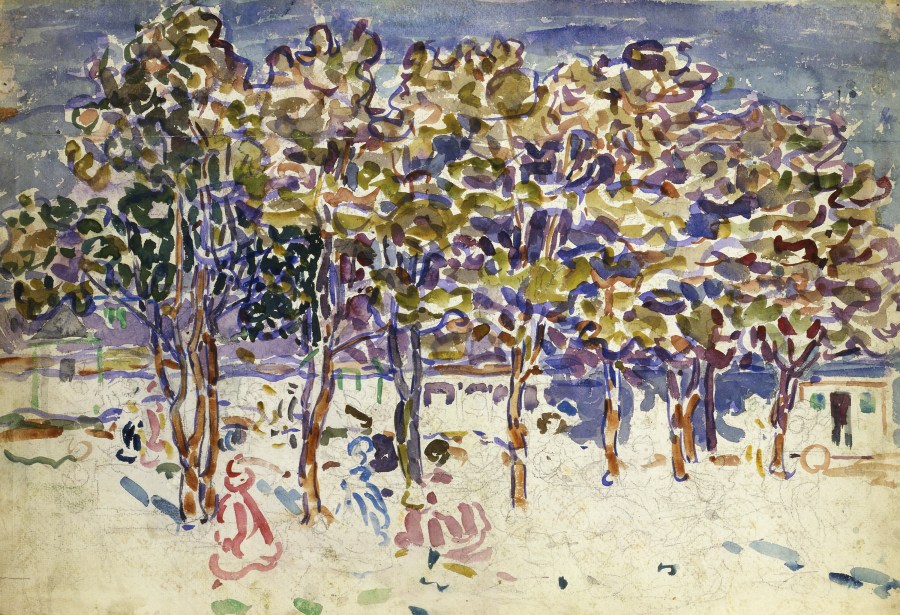
Featured Image: Trees by Maurice Prendergast 1918

Everywhere in town you hear:
“The forest’s on the move again”—
our forest!
Not ours, exactly,
but we feel it to be so,
since its visitation
ensnares our limbs
as, at every crosswalk,
neighbors duck and flinch,
weaving carefully through, apparently,
nothing at all—
forgive me, I’ve neglected to describe
our forest’s unparalleled clarity
from pine-tips to underbrush,
its streams, its spiders,
its (presumably) spotted fawns
tremulous, poised for flight—
“Our transparent forest,”
I should have said!
Impossible, of course,
to hide, to hunt, to lose one’s way!
Thus, we are reduced
to uneasy picnics in a vitreous shade
not wholly without shimmer.
Then, just as we’ve begun to settle in,
discerning where to place our feet,
grope for berries,
seek out the heaviness of honeycomb,
with a rustle and groan,
it’s gone,
having abandoned us
to elsewhere bear

its rough and leafy patronage,
its boughs of varying heft,
which our clumsy passings-through
had forced back till they rebounded,
scoring our faces
even as they sprinkled us
with resin-dew
(or, in that woods’ itinerant winter,
mild scatterings of unseen snow).


Read More

A Pocket Introduction to Our Universe

By Claire Bateman

Featured Image: The Throne of Saturn by Elihu Vedder 1883-1884

What does our universe most like to do?

To contort without any warning
into nothing but corners,
an awkward though not unbeautiful
configuration.

Of what elements is our universe composed?

The first is distance,
of which there are innumerable varieties,
such as the chromatic stutter between
forethought and aftertaste,
and the measureless span between
the transparent and the merely translucent.

The second is otherness,
that of the other
and that of the self,
reciprocal and ever-escalating glories.

What holds things together and apart?

The strong and weak gravitational forces.
Scar tissue.
The Great Universal Loneliness,
from which not even the material realm
has been excluded.

What are some of the forces that pass through flesh and bone?

Neutrinos.
X-rays.
Invisibility itself passes through the body
in immense, inarticulate storms.

Read More

What Bliss, When Exuberance Overruns Its Banks

By Lance Larsen

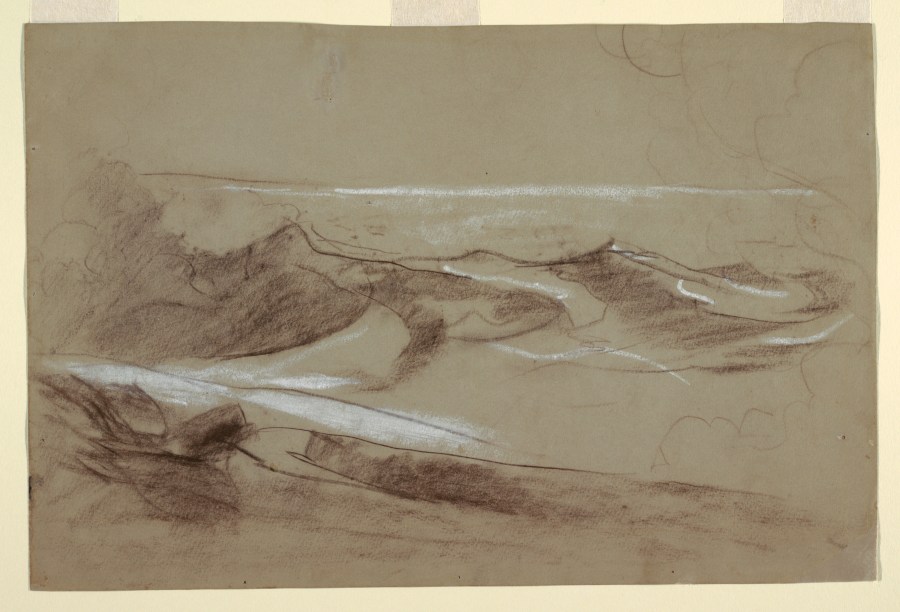
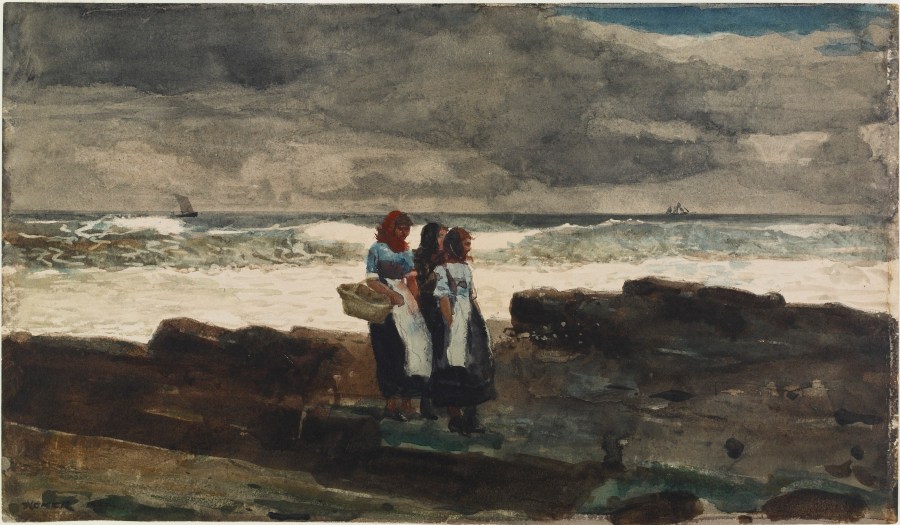
Featured Image: Ocean Swells by Winslow Homer 1895

As in a certain exit ramp outside Seattle,
a glissando of cement and steel
that promises release, or at least a shortcut
to the Sound, then sheers off into sky,

or stretches of Hemingway when dialogue tags
fall off the page, leaving only God
and a passing scrap of cumulus
to discuss troutness or the ontology of clean,

or my favorite, a tiny Rembrandt etching
of a milkmaid canoodling with her beau,
spokes of sun, hay at her back, why,
why shouldn’t she reach with three arms?


Read More

Between the Heaves of Storm

By Lance Larsen

Featured Image: Approaching Storm by Edward Mitchell Bannister

We have buried our aunt with words and hymns.
Now to finish the job with dirt.
In the front of the church, a hearse
waits to lead the cortège of headlights
to the cemetery two miles away.
But here, in the back parking lot,
a grandniece, perhaps six, has squirmed
out of her itchy skirt and grabbed
a pink hula hoop from the family van.
We put the morning on pause,
three or four of us, car doors flung open.
Plenty of time to take in this emptying quiet,
her skirt puddled now on asphalt
like a secret entrance to the underworld.
And plenty of room for her little girl hips.
She jounces and gyrates, as if trying
to coax rain out of the wispy clouds
floating above our fair city.
Twelve, thirteen, fourteen . . . She counts
with a wheezy underwater voice,
the kind one uses to address homemade dolls—
limp dolls, badly stitched, x’s for eyes,
velcro on the hands to hold
an embrace after the arms grow tired.
Little grandniece swings her hips.
Green undies, dishrag sky, a waiting 
that fills the parking lot even as it clears.
Any worries about the next life set
spinning for now in reassuring orbits, rattly pink.


Read More

Brushes with #3

By Emily Toder

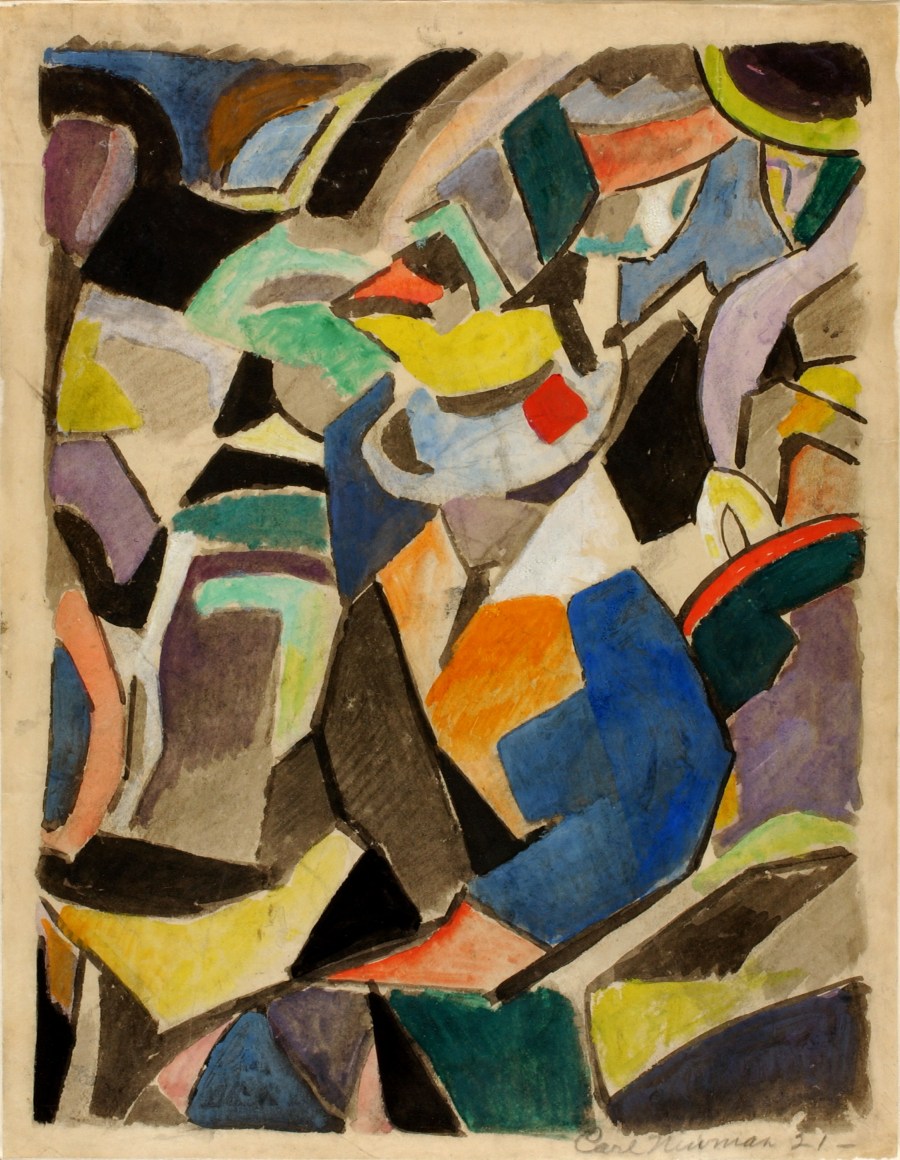
Featured Image: Abstract by Carl Newman 1858-1932

I was being chased by a rhombus
I had gone up to it
a medium-sized rhombus the size of a float
it had enchanted me standing in its canopy
a stone-faced rhombus and yet a rhombus
with real drive
I had to get through all this landscape
to get the rhombus off my trail
I ran into a quarry I thought a rhombus wouldn’t like
I went through a lot of narrow spaces
I thought the rhombus would be too broad for but it made it
it made it through a very tiny pipe at one point
it came with me into a hollow
all the theorems and I were wrong
about it, it could fold up like a house
to get through a tube and it could support itself
on one tip which we thought it couldn’t do
and on its tip it could hop around
and it was even capable of loving


Read More

Mysterious Neighbors

By Connie Wanek

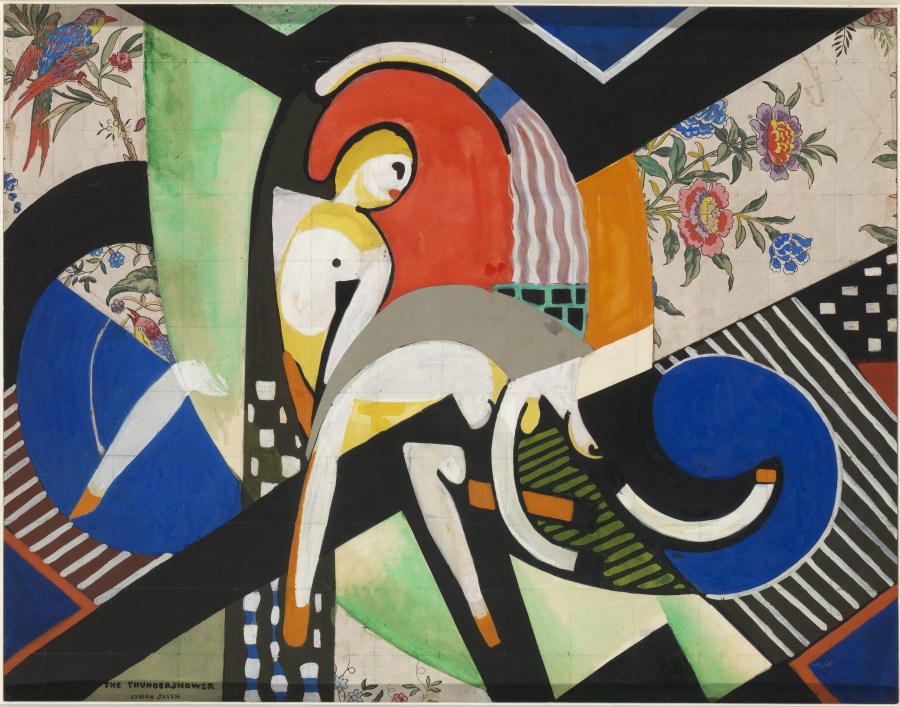
Featured Image: The Thundershower by H. Lyman Saÿen 1916

Country people rise early
as their distant lights testify.
They don’t hold water in common. Each house
has a personal source, like a bank account,
a stone vault. Some share eggs,
some share expertise,
and some won’t even wave.
A walk for the mail elevates the heart rate.
Last November I saw a woman down the road
walk out to her mailbox dressed in blaze orange
cap to boot, a cautious soul.
Bullets can’t read her No Trespassing sign.
Strange to think they’re in the air
like lead bees with a fatal sting.
Our neighbor across the road sits in his kitchen
with his rifle handy and the window open.
You never know when. Once
he shot a trophy with his barrel resting on the sill.
He’s in his seventies, born here, joined the Navy,
came back. Hard work never hurt a man
until suddenly he was another broken tool.
His silhouette against the dawn
droops as though drought-stricken, each step
deliberate, down the driveway to his black mailbox,
prying it open. Checking a trap.


Read More

Listen

By Eric Schwerer

Featured Image: Sunset, Oxford by George Elbert Burr 1899

Here every evening a woman
strides into her backyard calling
her rabbit which raises an ear when she sings:
Peppermint’s eyes’re red, His fur’s so white, Oh
where’s Peppermint gone tonight? When she sees him
she relaxes and lingers in twilight
as fireflies make brief green slashes
and the blacktop ticks with the heat
it’s digested all day. Then in her grass
while the light collapses I watch her daydream
a portion of the dusk away. I mean
I imagine she daydreams as through my screen
I watch her stride about shoeless, her rabbit
nibbling the lawn going gray. In a clean blouse,
fresh from a shower, with night coming on,
she might think of marriage. The lace
curtains in the windows of her house
are drawn. In my own still air and losing light
I stare at her, her curtains, her rabbit’s white hair.
Downstairs at the sink in my darkening kitchen
a glass of iced water is crying a ring—
Has he hopped the gate?
Left me again? Peppermint please
She continues to sing, though it’s not
wandered and would not ever leave.


Read More

The Last Litter

By Melissa Cistaro

Featured Image: Sunset by Edward Mitchell Bannister 1883

1975

It’s a nice place to visit my mom, a lot better than the last one. I get to stay for almost a week and even be here for my tenth birthday. There’s a bed with a blue quilt, a shelf piled high with boxes of puzzles and the scent of my mom’s L’Air du Temps perfume drifting down the hallway. She lives on this dairy farm with 180 cows and her new boyfriend, Roger Short. One of the first things she mentioned about Roger is that he’s colorblind. She says he can’t see how horrible the wall-to-wall chartreuse carpet looks in his house—in fact he can’t see the color green at all. I think that’s a shame, because there are green fields like patchwork for miles around his farm. But then again, I suppose that being colorblind is just fine for Roger since he only raises black-and-white cows.

Read More

The Woman Who Didn’t Know How

By Maya Jewell Zeller

Featured Image: Clouds and Sunset, Jamaica by Frederic Edwin Church 1865

Her skin was too human too often,
hands too happy to touch the splintered

door of a barn, too easily moved toward
a nettle, too ready to cover her mouth

when she gasped in joy, so she let
the aliens take her when they came.

They moved like question marks toward her
and she dropped the garden tools

to watch their wavy willow-like eyes, slits
of smoke their mouths flung out in nets.

They didn’t make a sound. Instead they held
signs with shimmery words to tell

what they wanted. On board,
they began to teach her restraint,

offering pudding then peeling the lid
to reveal the round torsos of bugs.

She wanted to laugh, but they asked
her to keep the noise down.

She wanted to explore, but they said
it was best if she lay back, rest a while,

it would be a long trip, would she please
just draw them a picture of a horse or a spade,

a packet of seeds they could plant
back wherever they came from. Through

the floor-holes she could see her husband
still sleeping on the lawn.

She had never wanted more badly
to tear through his loneliness,

lie softly like an animal on his chest.


Read More

Help Is On the Way

By John Brehm

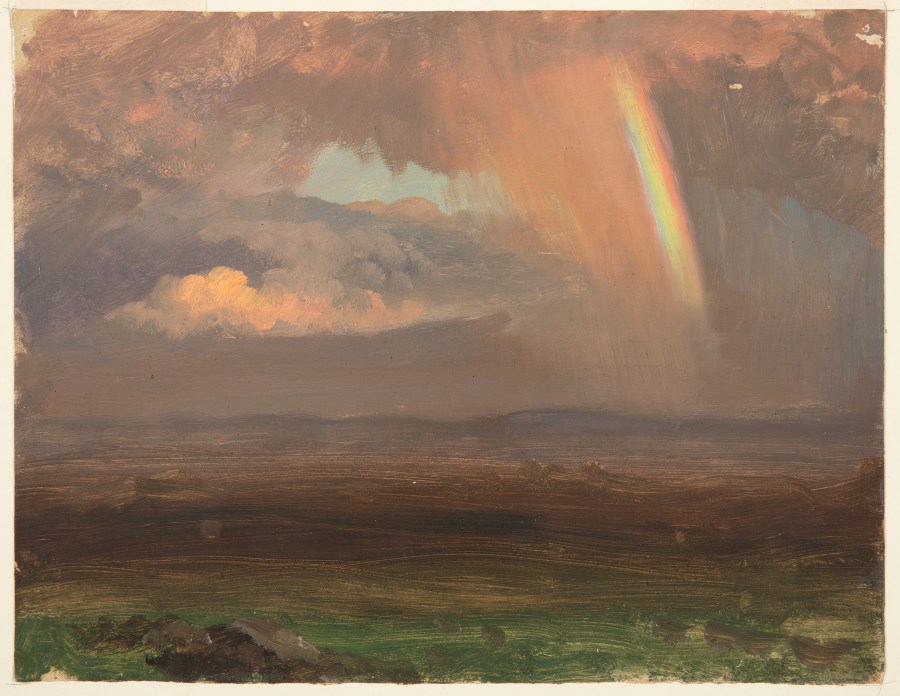
Featured Image: Clouds and Rainbows, Jamaica by Frederic Edwin Church 1865

Time heals all wounds
except those
it

in-
flicts—and in
time even those.


Read More

An Iris Murdoch Reader

By John Drexel

Featured Image: Sun and Clouds by Winslow Homer 1882

Everyone knows something. No one knows everything.
Most know less than they think.
As in life, there is much confusion,
especially about love. The girl in the basement kitchen,
grown disenchanted with the scholar
who is confused about the shape of his career,
considers entering a nunnery in Argentina.
Her mother has encountered a man
she has not seen in twenty years.
Someone is writing a book; someone
is hiding a crime; someone is about to suffer
near-death by almost-drowning. The narrator’s
cousin doesn’t know how to answer
her mentor’s letter, isn’t aware
she might be the heroine of this particular tale.
Everyone has forgotten something—
is this the moral?—with marvelous
consequences. There are self-delusions
and glimpses of God in surprising guises.
Children are always arriving home
or going away to school. In twos or threes
lovers or ex-lovers or would-be lovers
take cliff-top walks, receive invitations
to dinner parties given by former friends
or present rivals, send and perceive mixed signals.
A dog follows someone home.
People live in a succession of weathers,
patterns of drizzle or downpour or blazing sunshine.
It is difficult to see clearly. Some
thing is lost; something is foreign.
Somewhere a swimmer is diving
into the sea, the sea.


Read More

Love Song (Lame)

By Courtney Queeney

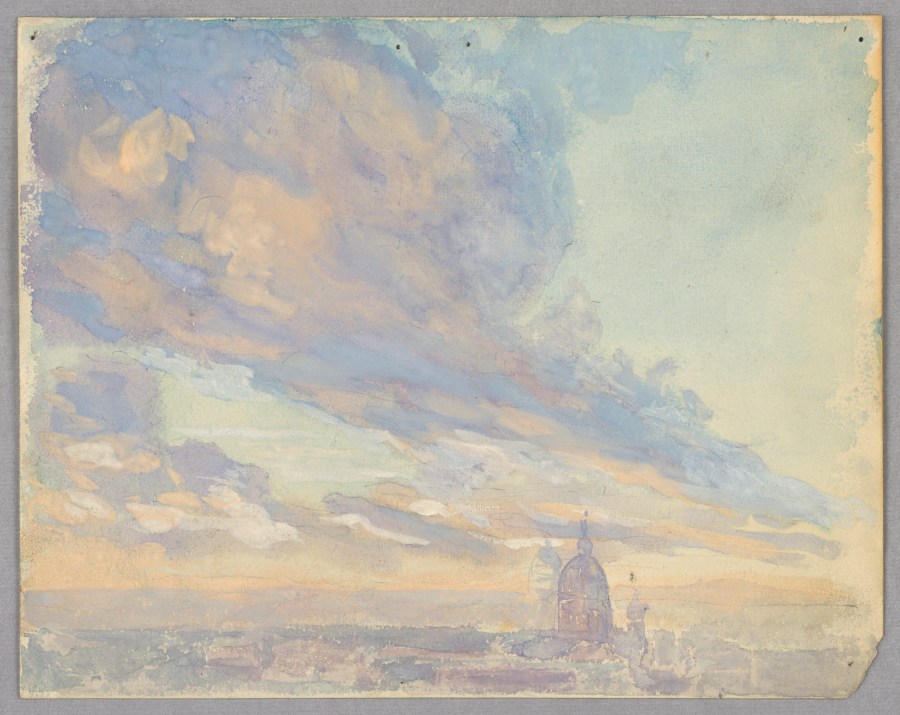
Featured Image: Study of Clouds, Rome, Italy by Francis Augustus Lathrop 1893-94

This is a little like high school
he said, when I wouldn’t take off my clothes.
It was true, although in high school
I would’ve come over to torture him deliberately
and now the torture was an unfortunate side effect
of my sadness, and had nothing to do with him at all.
Sleeping with you would be like
a drowning woman grabbing an anvil,
I explained. A burning man guzzling gasoline.
Lame analogies, but I was trying to make a point.
When he got up for a drink, I missed him
but that feeling disappeared once he came back.
I sat there and tried to feel sad,
tracking my blue mute form
as it sank to a furrowed ocean floor.


Read More

Her New Plan

By Kevin Casey

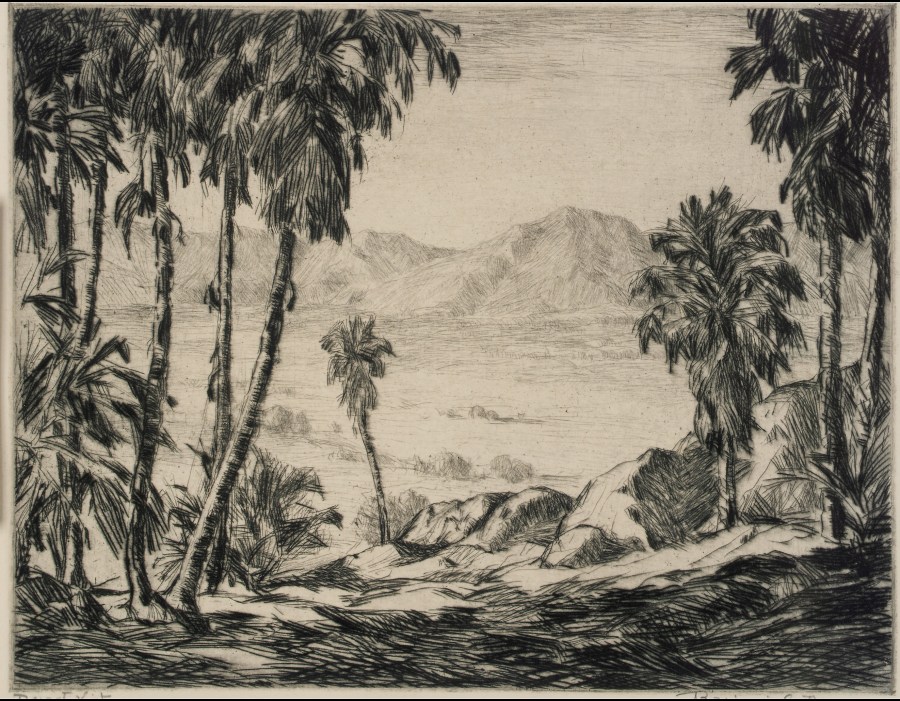
Featured Image: Desert Vista by Benjamin C. Brown 1932

The original plan: move to Los Angeles. Take acting classes. Meet people. Audition. Act. Get famous. (Not Katie Holmes famous. Kate Winslet famous.) Win awards. Get rich. Meet people. Shoot heroin and drown in a bathtub at Chateau Marmont, spawning sudden posthumous appreciation for the life’s work of Jill Dawson, the Actress.

Such a clichéd way to go, though. Jill, after a year or so of living in L.A., thought of another ending instead: retire quietly from acting to grow old in some funky little house near Topanga State Park with a friend named Beatrix (with an x). Grow a little weed out back among the rosemary, lemongrass, and cilantro. Cook vast organic feasts and always read the book before seeing the movie. There would be an avocado tree in the yard. They would write annual checks to Topanga Animal Rescue and have four adopted cats. That would be enough to feel sufficient, but not so many that they would be known in the neighborhood as The Cat Ladies. Jill would die ripe, in her sleep, and Beatrix would organize a nondenominational service in Ventura. Friends and fans would gather on the beach to drink red wine from Solo cups and share their favorite Jill stories. They would reminisce about her most remarkable roles, and when the sun took its evening dip in the Pacific, the mourners would light bonfires and play Leonard Cohen on a weathered boombox. Their tears would spill into their laughter as Beatrix sprinkled Jill’s ashes along the shifting line between sand and sea. The end.

Read More

Lonesome While Kissing

By Jim Daniels

Featured Image: Clouds by H. Lyman Saÿen 1910-12

She would be dead in twenty years.
        I never felt as lonely
as kissing her in between auto shop
        and the field house, imagining
wind wouldn’t find us
        but it did.
We pulled apart and said nothing.
        She leaned her fine brown hair
against my neck, then disappeared.
        I walked under the swing-set bars
and raised my hands as if to grab the lost chains.
        I stood waiting for someone to push me.

Read More

La Vie Ordinaire

By Mark Kraushaar

Featured Image: Kanawha River Valley by Samuel Colman 1888-90

Monsieur LeBrun est un ingénieur chimiste:
on page 8 of our ninth grade French One text
Mr. Brown was just leaving for work
and behind him, always, always, there was Madame
in her pretty print dress and beside her the waving twins
Marcel and Marie—Au revoir, Papa!
I’ll guess the rest:
next he drives to Toulouse or Roubaix
and there’s a big meeting on polymers, or pyrite,
heat flux, or octanes, and after his lunch
he walks to the lab with his good pal François.
One man pours a beaker of blue fluid into a flask
while the other graphs a special equation
or holds a test tube in the light.
Later the two men sigh and say goodnight
and Monsieur LeBrun climbs into his yellow Renault,
takes rue des Gallois to rue Saint-Michel and arrives
back home where with six kisses given, six received
the evening begins.
In fact, each evening starts with those same dozen kisses
for another decade at the end of which on a similar night
he opens his paper, sips his drink, eats, and sits
staring at a pink- and avocado-colored plate
which like a little TV he can neither focus on nor turn from.
C’est vrai, says Madame.
I guess we want to make sense, she says, except,
here’s this whole improbable, bright scene before us,
and we’re peevish and stuck, and then one day
you’re rinsing a cup and it’s like the heart
takes off for Bermuda and you rise right out of your shoes
and think how easy it is, how like a trick of the mind
to simply be happy, and as the Earth turns
into a map there comes a moment it feels
like forgiveness and thanks and when
you want to dive you dive—c’est vrai!
and recover soaring upwards
by thinking it so. I’ve met someone new, she says,
it’s true.


Read More

Cake

By Mark Kraushaar

Featured Image: Landscape by Peter von Bemmel 1685-1754

She’s in the first booth left of the planters.
She’s been waiting an hour now.
She’s been waiting at the Watertown Family Buffet
with her little girl who’s dreamed up
some kind of a costume:
giant glasses, backwards cap, taffeta gown
which is clearly for him, for Al who’s
just now arriving, finally, and now

he’s seen them, and now
he’s walking over, and now
he’s standing there, standing there,
husband and father, or boyfriend and father,
or boyfriend and father figure, except he’s way too late,
he’s too late times two and the party’s over
thank-you, and, no, they’re not having,
not the grin, not the story, not the hug.

The woman gets up, and then, face baggy with patience,
she nods to the girl who scoots out too,
and they exit together.
So over the chips and spilt dip,
over the drained Pepsi and the big white cake
with “Al” in caps and quotes
he watches them go,
looks out at the parking lot,
opens his book.
Here’s the waitress with her pad and pen.
And what in hell is he reading?


Read More

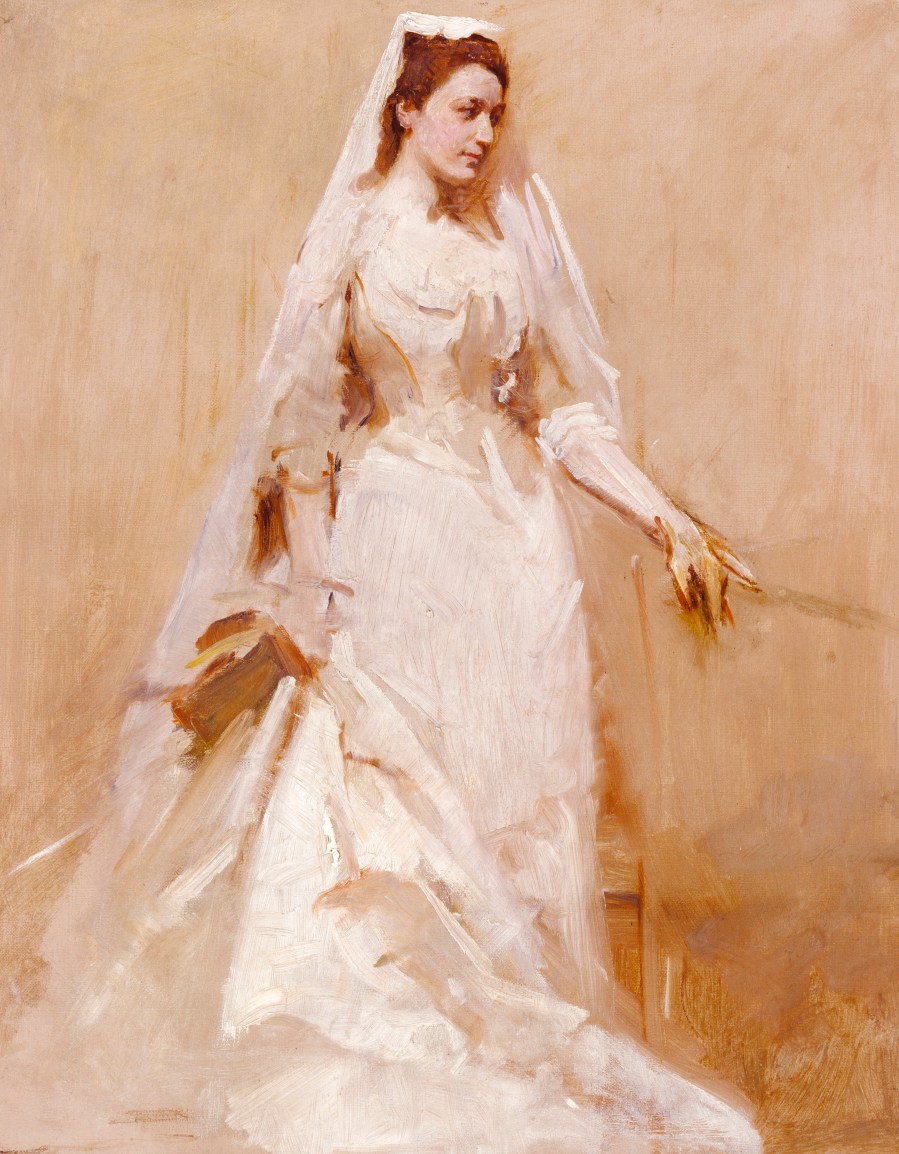
Bridal Shower

By George Bilgere

Featured Image: A Bride by Abbott Handerson Thayer 1895

Perhaps, in a distant café,
four or five people are talking
with the four or five people
who are chatting on their cell phones this morning
in my favorite café.

And perhaps someone there,
someone like me, is watching them as they frown,
or smile, or shrug
to their invisible friends or lovers,
jabbing the air for emphasis.

And like me, he misses the old days,
when talking to yourself
meant you were crazy,
back when being crazy was a big deal,
not just an acronym
or something you could take a pill for.

I liked it
when people who were talking to themselves
might actually have been talking to God
or an angel.
You respected people like that.

You didn’t want to kill them,
as I want to kill the woman at the next table
with the little blue light on her ear
who has been telling the emptiness in front of her
about her daughter’s bridal shower
in astonishing detail
for the past thirty minutes.

O person like me,
phoneless in your distant café,
I wish we could meet to discuss this,
and perhaps you would help me
gag this woman on her cell phone,

after which we could have a cup of coffee,
maybe a bagel, and talk to each other,
face to face.


Read More

Kalypso

By Ernest Hilbert

The city is cat piss and dog shit. It stinks,
And the humid air molders. I lie in bed,
Too hot to move, slick with sweat, wait for dark.
Blue flies eddy over the cluttered sink.
I’m broke. The change dish is exhausted.
A Western Union stub is my bookmark.
You never knew me. You’re in a Victorian
Sea home, slicing, tasting a sweet cool peach,
As an ocean wind lifts your long light hair.
Your songs are old, your dresses European,
And your view is vast down the empty beach.
You pause, as long as you like on the stair.
Memories sink, and I am forced to bear
Life’s last thought: that you were never there.


Read More

The Day After My Death

By Jeff Worley

Featured Image: Italian or Swiss Town by Frederic Edwin Church 1868

—after lines by Michael Van Walleghen

The moon, stars and weather
will happen as they always have,

though surely with my breath gone
the wind, in some slight measure,

will falter. Absent my footsteps
the earth will feel along its spine

a momentary shiver of abandonment.
And my friends? Won’t they gather

with me again, in whatever purple-
swagged room, for wine and stories,

some of them nearly impossibly true?
Meanwhile, the mailman, humming

like a bee in a blossom, will slip
my name into the metal box:

an unsigned note from The Paris Review
saying, simply, Sorry.


Read More

Another Poem After César Vallejo

By Suzanne Lummis

Featured Image: Utah, Utah Lake; artist unknown 1898

I will die in a freight elevator between the fifth
and sixth floor, on a weekend, or perhaps a Monday
following the end of Daylight Savings. Yes,
it will be a Monday following the end of Daylight Savings,
because now, as I write these lines, I’m cranky,
as though cheated of an hour’s sleep.

It will be a day of rain, the same quality of rain,
the same aguacera that carried off César Vallejo,
though I won’t be outside to enjoy it—
passing with my umbrella beneath canopies of shops,
little fruit markets—I’ll be stuck in some freight elevator.

Suzanne Lummis is dead,
and already a newsman is composing a short item,
getting her age wrong and where she grew up.
Already she has been fed to the fires
in some fine commercial establishment,
with a name like Death 4 Less.

Suzanne Lummis is dead, but now—today—
as she writes these words, her feelings seem locked
in a chamber she can’t find her way down to, spiral by spiral,
can’t key her way into.
When the poet wrote “César Vallejo is dead,”
how did he make himself stop?

She wants to go on reproducing the phrase,
like a child consigned to stay after school
until she’s covered the blackboard with white chalk,
till exhaustion drives her into her bones, till amazement
bursts in her skull—and she understands.


Read More

House on the Lake

By Liz Robbins

Featured Image: Greenwood Lake by Jasper Francis Cropsey 1875

When Dad was dying, everyone wanted
to take care of him, no one
wanted to.

We sent flowered cards, everyone wanted
the easy parts.

His cancer was a quiet purple flower
that grew too familiar when it took
over the bed.

The purple wanted the easy parts,
the purple wanted the hard parts, the liver.

We all went one way, then another.
We were the roots, we scattered.

We couldn’t compete, that’s all we could
do. We wanted to sit around and stare
at the clouded sky and drink.

His IV was clear, the only thing.

He had ten months, ten years.

We walked around Lily-Pad Lake,
where hordes of trout wriggled
to breathe.

Read More

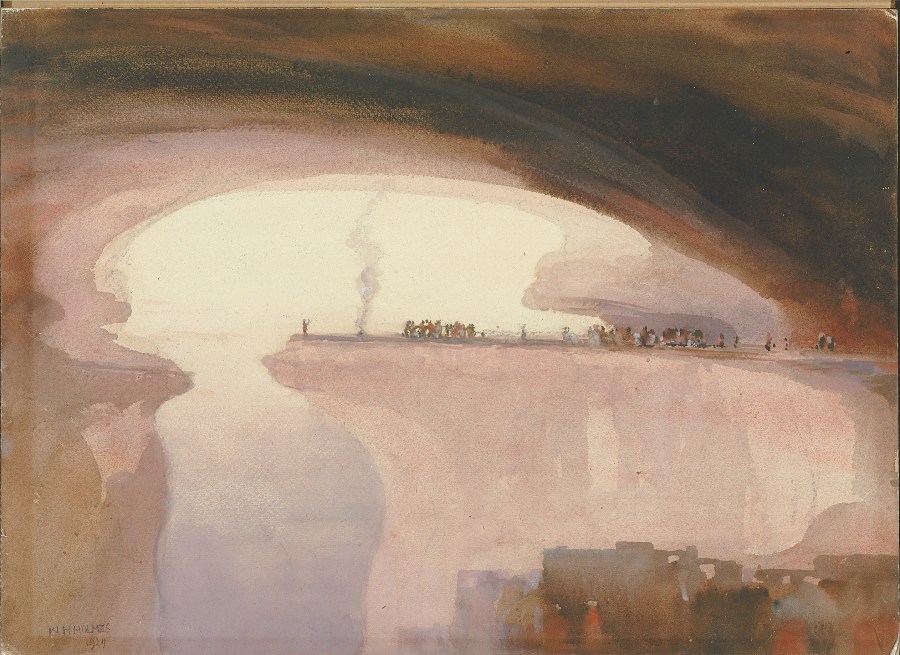
At the River View Café

By Chard deNiord

Featured Image: A Cliff Dweller’s Ceremony, Colorado by William Henry Holmes 1924

The wind blew all summer after you died.
A friend asked what I was feeling now
that you were gone. I said, “A great emptiness
and fullness at the same time. An unfamiliar gravity.”
But nothing I said conveyed what I felt exactly
despite my eloquence and gift for contradiction.
I was afflicted with the double loss of words and you.
Like a patient on a ward of the radiant world,
I sat at my table above the river and listened
to the wind flap the umbrellas like a tattered name.


Read More

Five Rooms

By Christine Sneed

Featured Image: Farralones Islands, Pacific Ocean by Albert Bierstadt 1872

Two questions you don’t ask a blind person: Aren’t black-and-white movies boring? Is that cop car following me? Another thing you have to keep in mind when you’re with a blind person is that if you move anything like the paper towels and the soap that usually sit to the right of the kitchen sink, you can bet you’re going to get chewed out for it later. No matter that you are sometimes an idiot and didn’t mean anything by it at all—you’re still going to get in trouble.

What I don’t like about making a mistake is that no one gives you the chance to explain yourself. You’re supposed to sit there and let everyone yell at you, even Mr. Rasmussen who, when he’s annoyed, looks like he’s staring at a spot above my head, which I don’t think he knows he’s doing. Sometimes he wears sunglasses, but mostly he doesn’t. His eyes look like a person’s who can see, which is a little strange because I start to wonder if he’s faking it, but if he is, I doubt he’d want me hanging around his house messing things up.

Read More

Horn

By Robert Pinsky

Featured Image: Music by Thomas Wilmer Dewing 1895

This is the golden trophy. The true addiction. 
Steel springs, pearl facings, fibers and leathers, all
Mounted on the body tarnished from neck to bell.

The master, a Legend, a “righteous addict,” pauses
While walking past a bar, to listen, says: Listen—
Listen what that cat in there is doing. Some figure,

Some hook, breathy honk, sharp nine or weird
Rhythm this one hack journeyman hornman had going
Listen, says the Dante of bop, to what he’s working.

Breath tempered in its chamber by hide pads
As desires and demands swarm through the deft axe
In the fixed attention of that one practitioner:

Professional calluses and habits of his righteous
Teacher, his optician. The crazed matriarch, hexed
Architect of his making. Polished and punished by use,

The horn: flawed and severe, it nestles in plush,
The hard case contoured to cradle the engraved
Hook-shape of Normandy brass, keys from seashells

In the Mekong, reed from Belize. Listen. Labor:
Do all the altered scales in the woodshed. Persist,
You practiced addict, devotee, slave of Dante

Like Dante himself a slave, whose name they say
Is short for Durante, meaning Persistent—listen,
Bondsman of the tool—you honker, toker, toiler.


Read More

Influence

By Sydney Lea

Featured Image: Study for “Music” by Francis Augustus Lathrop 1894

Those who know me know that I’ve long been deeply in love with what Roland Kirk called “Black Classical Music,” especially of that era whose great practitioners include Monk, Rollins, Davis, Jackson, Roach, among others; and I’m frequently and unsurprisingly asked about the influence of jazz on my poetry. Although I want to avoid any glib answer here, whenever the question is posed, I’m never entirely able. The interplay between the music and the poems I write is likely beyond words. Indeed, it may be the thing that I as a poet have, however furtively, long been trying to find words for.

That said, one of the surer things I can surmise is that as more or less a formalist poet, I like feeling the chafe of language against the limits of received (or invented) structure. There is no moral nor even aesthetic stance here: I dislike the formalist/free verse debate, because it too often sounds like a pair of parties elevating what they do and can do into virtue and debasing the things they can’t and don’t do into vices. As a rule, the accompanying arguments are downright ill thought out: the free versers, for instance, associate formalism with elitism and political reaction . . . which makes one wonder where the great practitioners of Delta blues and its musical derivatives would stand. Equally vapid arguments—free verse suggests sloppy poetics and fuzzy thinking—are too often trotted out on the other side.

Read More

Piano Lesson

By Gregory Djanikian

Featured Image: Ella at the Piano by Donald Shaw MacLaughlan 1876

My teacher is looking at me sadly
as if with the large droopy eyes 
of a basset hound.

I’m stumbling through “Naima”
transcribed for piano,
my fingers tripping badly over
the minor 3rds, the flat nines.

On his face, such longing,
as if it’s the end of jazz,
we’re saying farewell.

I’m ready to start from the top 
playing all the changes, the repeats,
and he’s holding his head in his hands,
swiveling slowly in his chair.

The song is full of smoke and aching,
like a woman in a shiny dress
walking through a dark hallway
haunting the man she’s loved.

I can already feel the nostalgia in it
for what has never happened.

There are so many gray clouds here
I should play “Blue Skies,”
or “Mountain Greenery,” their upswings
rising like colorful balloons.

Now I see my teacher lying on his couch,
cupping his forehead in his palm.
It must be raining in his heart
for a love of something so perfect
there’s no place to find it

not in this room anyway
where I’m bent over the keys,
the rapturous jazz
just out of my reach

and my teacher is closing his eyes
and I’m closing mine
and we both might be imagining
Coltrane behind us breathing into his tenor
a song of love and departure
so fluent it feels like rain
falling into a lake

and maybe whatever is lovely
and improbable is always floating away
down a rivulet of dreams

where my body is falling
and my hands are reaching out,
and I am almost touching
something like water, like silk.


Read More

I Want to Talk About You

By Angie Estes

Featured Image: Arizona Night by George Elbert Burr 1920+

when starlings swell over Otmoor, east of Oxford, as the afternoon
light starts to fade. Fifty flocks of fifteen to twenty starlings, riffraff

who have spent the day foraging in fields and gardens suddenly rise
like a blanket tossed into the sky, a revelling that molts sorrows to roost

rows, roost rows to sorrows as they soar through aerial corridors and swerve
into the shape of a cowl that lengthens to a woolen scarf wrapping

and wrapping, nothing at the center but throat: thousands of single black notes
surge into a memory called melody, the lovers damned but driven on

by violent winds in the cold season when starlings’ wings bear them
|along in broad and crowded ranks, extended cadenzas to pieces that

never get played, brochure for the flared tip that begins with the tongue
and lips of the embouchure wrapping the saxophone’s slurred

howl, scrawled signature of the sky. Thousands fly but never collide
in their pre-roost ritual, Dante’s long list of God’s works excited

raked left and right over leafless branches of trees until they
drop like the bodies of suicides, draped on thorns of the wild

thickets their cast-off souls become, unable to rise the way a wave
nearing shore will crest, something on the tip of its tongue

thrown back before it breaks and splays, starlings laid down
like the wave’s rain of sand or words falling

out of a sentence: art slings, we called them, grass lint, snarl gist, gnarls
sit. Art slings them this way, last grins, art slings swell, rove

over, red rover, red rover, send artlings right over, artlings
rove, moor to swell, write Otmoor all over


Read More
Homer and Jazz

By Ralph M. Rosen

Featured Image: George Gershwin Self-portrait by George Gershwin 1934

Homer enjoys an unquestionably privileged status in our own time as one of the grand cultural legacies of antiquity, so it can come as a surprise to realize that his greatness was not always unchallenged. Even in antiquity there were signs that Homeric poetry did not suit all tastes and aesthetic standards, and some readers today still find various features of Homeric style jarring. His great works, the Iliad and Odyssey, often feel “different” from other literature—a bit “primitive,” perhaps, less self-consciously “literary” or “literate” (whatever we mean by these terms exactly), with roots in folk and mythological traditions that complicate, at least, their stature as icons of high culture.

In American cultural history of the past century, we can trace a curiously parallel aesthetic dilemma in the case of jazz music, which, to this day, occupies an unstable, culturally fraught position between the high and low, the “serious” and “popular.” I’d like to suggest that the aesthetic “problems” ascribed to each art form, Homeric epic and jazz, have much to do with the compositional and stylistic techniques idiosyncratic to each genre—techniques that rely first and foremost on memory, and only secondarily, if at all, on literacy (whether verbal or musical). Poetry or music that is essentially composed during the course of a performance, as is the case for the Homeric epics and many forms of jazz, simply look and sound different from poetry and music composed in advance and fixed as text before a performance. It is not surprising, therefore, that such art forms will sit uncomfortably in a culture such as ours which has come to privilege the literate and literary over the spontaneous and improvisational.

Read More

On James Merrill

By Rachel Hadas

Featured Image: Flowers by H. Lyman Saÿen 1915

A few years ago I taught the semester’s final seminar in my graduate poetry course. This particular class was devoted to James Merrill. Somehow, unless it was my wishful thinking rather than an accurate observation, the students all seemed to rise to the level of articulate civility, of alertness and ingenuity, that characterized Merrill as a social presence during his lifetime and that indelibly distinguish his work as well.

The Merrill poem we happened to spend the most time on in that last class was “Days of 1964.” Until I reread it for the course, I hadn’t thought about that poem in several years; and as often happens with good poems after a hiatus, it struck me now with fresh force. Not only was “Days of 1964” still moving, many-layered, and beautiful, but like many of the poems that had been coming to my aid since my husband’s dementia had begun to change our lives, it seemed weirdly apposite. “Days of 1964” is a poem that reminisces about a time (obviously), a place, and a love affair; and it is also a poem about love itself, or rather, since the poem has a distinctly allegorical tenor, I should say about Love.

Why, in this difficult spring, would a love poem speak to me so urgently? Maybe because the poem was filling what my father used to enjoy calling a much-needed gap. For quite a while now, love has been in short supply.

Read More

Tight Spots

By Brad Leithauser

Featured Image: Abstract by Carl Newman 1858-1932

In some purer world than ours, the business of literary re-examination and reappraisal would follow foreseeable lines. You’d read steadily, in ever-widening circles, and retain whatever you read. To each act of rereading you’d bring a broader outlook, a more finely calibrated set of analytical tools. The whole process would be self-nourishing and self-directed.

Instead, what a messy and uncertain business—at least for me—reappraisal turns out to be! Its reigning god isn’t called Autonomy, but Happenstance. His identifying insignia aren’t an oil lamp and a set of bifocals, but a pair of dice. Years ago, I put together an anthology of supernatural fiction. I took my task seriously, compiling many pages of notes, and eventually found I’d digested more than a thousand ghost stories. One of these was Kipling’s “They,” a quiet tale with some benign and diminutive ghosts—the ghosts of children. I admired the story, but provisionally concluded it lacked the finish and power my collection would embody. While making my final selections, I reread “They,” this time prompted by one of my heroes, the poet-critic Randall Jarrell, who said of it, “Chekhov and Tolstoy and Turgenev together couldn’t improve ‘They.’”

This time around, I saw instantly that I’d underestimated Kipling’s story. It had plenty of finish, but wasn’t it lacking some necessary poignancy or power? Regretfully, I again voted no.

Read More
A Fish and a Pity

By Steven Cramer

Featured Image: Near the Ocean by Robert Swain Gifford 1879

Yes, it’s a classic; yes, it contains exquisitely stitched sound and sense—“He hung a grunting weight, / battered and venerable / and homely”—and yes, of course, it’s “not about a fish.” Bishop’s “The Fish” is the ultimate show/don’t tell poem. It’s a two-page toolbox of nouny exactitude—naturalistic (boat, hook, mouth, wallpaper, face, lip, thread); naturalistic-emblematic (roses, ice, weed, oxygen, blood, bones, entrails, irises); and naturalistic-emblematic-exotic (rosettes, swim-bladder, peony, isinglass, thwarts, gunnels). Diction like this provoked Jarrell’s famous endorsement: “all her poems have written underneath, I have seen it.” And the similes! “The coarse white flesh / packed in like feathers” throws down the gauntlet to every aspiring poet: never settle for anything less than the absolutely apt and absolutely surprising. Phrase by phrase, can there be a better example of Jon Anderson’s Helpful Hint #31?—“put something of interest in every line or sentence.”

Around 1995, I began to feel a kind of malaise as I added “The Fish” to syllabi. I started to feel fraudulent when I puffed up my enthusiasm about it, ungenerous when I challenged students who shrugged at it. I finally owned up to myself that, inwardly, I shrugged too. It wasn’t the Bishopy matter-of-factness that bothered me: “I caught a tremendous fish . . . [a]nd I let the fish go.” That’s the whole of the “plot.” Brilliant. No, what began to bug me had to do with the poem’s—I can’t think of a better word for it—message, packaged in its two least resonant passages: 1) the fish’s “beard of wisdom”; and 2) “I stared and stared / and victory filled up / the little rented boat.” In both cases, a reader might justly ask, “did you really see that?” Whether we’re meant to ascribe “victory” to the “wise” fish, or more generally to the situation—a creature-to-creature encounter inspiring an act of mercy—the soft-focus  moralizing is uncharacteristic of Bishop. It’s also uncharacteristic of her to float an abstraction like “victory”; the word doesn’t really modify anything other than the speaker’s feelings, which ring false, given the tough-mindedness of the poem’s earlier face-off: “I looked into his eyes.       They shifted a little, but not / to return my stare.” The poem’s famous dénouement—“Rainbow, rainbow, rainbow”—grabs our lapels and shouts epiphany! The rather obvious rhyme jingle, “rainbow / go,” glibly connects that epiphany to the release of the fish, who “wins”  by  virtue  of  his   virtue  (from  the  Latin, virtus, manliness). Don’t you sometimes wish (cf. James Wright’s “Northern Pike”) she just gutted and cooked the thing?

Read More

Disinhibited

By Stephanie Burt

Featured Image: Abstract by Carl Newman 1858-1932

I’m not sure when I first realized I was “serious” about writing poetry—1987? 1990?—but I am sure that John Berryman played a role. I spent part of my teens, and a slice of my twenties, hung up on so-called “confessional” art—the kind of art that claims to give a raw, or at least medium rare, slice of the artist’s soul; the kind of art that glories in broken taboos, that draws its rhetorical force from its power to shock, that turns its intelligence into a drill driven down as forcefully as possible into the lowest layers of an artist’s life. I admired the music of the Washington, DC, rock band Rites of Spring, the blank-verse sonnets of Robert Lowell, the apostles of Action Painting, and I still do. But I admired, most of all, the John Berryman of The Dream Songs, who seemed to me almost uniquely able to combine the confessional with the self-critical, the rawly shameful with the really entertaining. Berryman could mourn while he mugged for the cameras (as in his series of elegies for Delmore Schwartz), and still make the mourning seem genuine; he could flirt with suicide (as in the penultimate poem of His Toy, His Dream, His Rest) and revel in language that made even his life—or especially his life—seem clearly worth living. Hadn’t I felt that way too? (Hadn’t I felt as ridiculous as he felt, as important, as full of resentment and lust?)

Read More

Just a Goll-durn Minute

By Stephen Corey

Featured Image: Angel by Louise Howland King Cox 1895-1910

The place was Harpur College, now Binghamton University; the time was 1967—my sophomore year in school; the Introduction to Poetry course text was Oscar Williams’ New Pocket Anthology of American Verse (1955); the poem that revved me up and that I decided to analyze for our first assignment was . . . well, to the eyes and sensibility of my 2010 self, perfectly dreadful.

What I can also see, however,  is that the poem’s awfulness is beautiful in the sense that it was crucial to my initial development as a writer. Karl Shapiro’s “The Minute” is so overwrought, so all-over-the-poetic-gestures map, that for the neophyte language lover in me it served as a lush sampler of so many of the moves at a poet’s disposal. Think of a toyshop or a candy store: what matter that the Rama of the Jungle side pistol is shelved next to the Uncle Wiggly board game, or that the jar of nonpareils is right above the one filled with anise drops? All you have to do is want them all.

Comprising five seven-line stanzas—with lines that are unrhymed but often forcefully end-stopped and always quite musical—the poem wastes no time in showing its incessant and illogical bent toward metaphor and analogy. Here is the first stanza:

Read More

On the Author of “The Paddiad”

By Christopher Ricks

Featured Image: Sunset, Oxford by George Elbert Burr 1899

Among the judgments of which I repent is the one that I passed, half a century ago, on Patrick Kavanagh (1904-1967). The book: Come Dance with Kitty Stobling. The date: 13 December 1960. The journal: the Oxford Magazine. The brash paragraph by the reviewer:

Read More