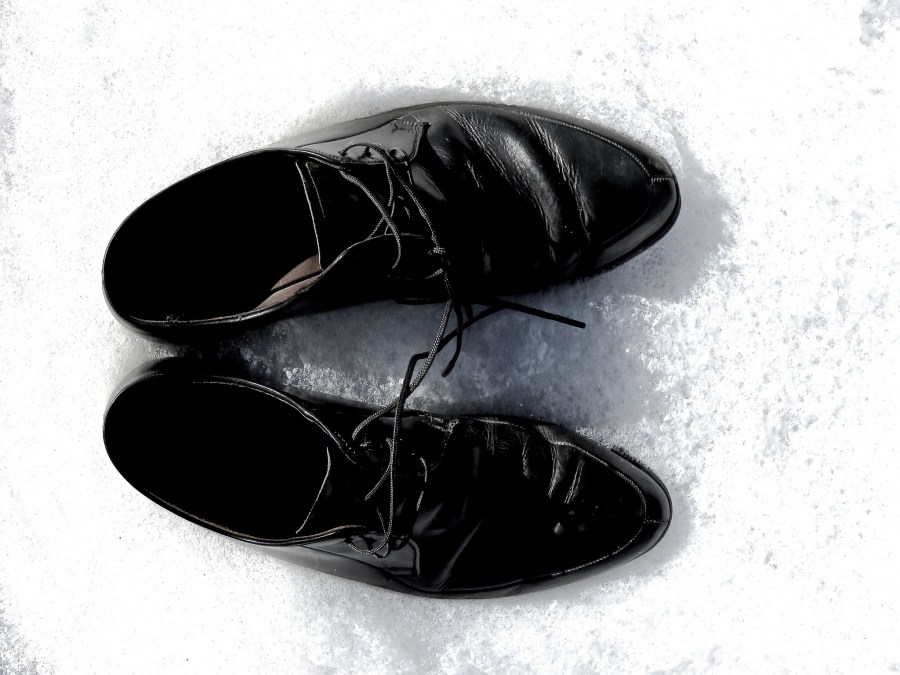
Ecstasy Facsimile

By Mark Anthony Cayanan
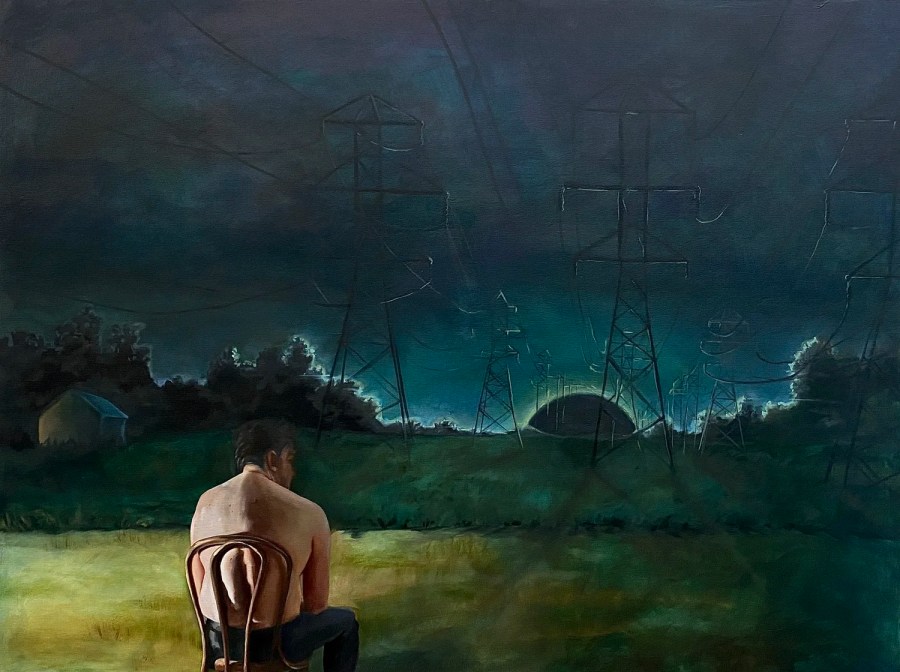
Featured Art: “Event Horizon” by Mallory Stowe

Guess manageable despair arrives on time today,  
my soul cracking when sunlight sharpens my migraine.  
I listen to Wilco and amplify my unoriginal sadness.   
The U-Bahn stalls at Ullsteinstraße and now I’m sure
I’m going to be alone forever, and it’s oh so important,
this intimate history between my earbuds and my feelings.
It wouldn’t be so bad, being somewhat lonely, mostly
ordinary, if I could soundtrack my life. I’d stare at rows
of bottled wieners while mumbling invented lyrics.
And I’m still mostly male and so adjust myself in the aisle,
my ball cap and sullen face, chili & lime chips, cheap IPAs.
I self-checkout to avoid talking. I bring my own bag.
Pleasure never lasts, you know, but pleasure does. And how
embarrassing, to be unloved. I hum every longing home.  


Read More

Samsara

By Matthew Williams

My students wear the name Nirvana and don’t know the band.
I didn’t know Kurt Cobain chose the name for its pretty sound
and, when I was younger, revered him as a tortured genius
until my brother found my mother unconscious
and all the medicine bottles empty. They say
he didn’t want the band’s name to sound angry.
One of my students who loves his Nirvana shirt
lost his mother. He stands and shouts at everyone
and no one and pushes out the classroom door. Despite
my mother becoming a self-avowed Buddhist who listens
to Thích Nhất Hạnh audiobooks and smokes marijuana
for chronic nausea and pain, I still know little of Nirvana
beyond what I’ve gleaned from a few movies and books:
transcendent detachment, cosmic oneness, unbeing.
And yet, with what little I knew, after
the bell rang, after the students
moved through the long hallways
that shook then stilled
as they emptied of their laughter,
I looked for him. I did.
I looked for that boy. 


Read More

Paprika

By Lory Bedikian

Not every song on the radio is a great song. Usually
it airs because someone knows someone knows someone.

There are most likely a million songs that will never
make it to any Billboard top chart ranking yet will

kick the amp, graze the sound factor with tonal bliss.
I like calling it phenomenal. To give examples would be

dangerous. So instead, one could say, a song needs
to be a bit like paprika. Before we go there, let’s imagine

a punk band named Paprika. Perfect. Even better,
a vocal artist who goes by just: Paprika. Catchy.

We never really knew where it came from. Maybe
just another ground red pepper, but it was what

we always fell back on. Sometimes spicy, sometimes
smoked, sweet. Music. It’s what we are all looking for

all of our lives, just in different incarnations.
Let’s forget the song or I’ll never tell you the story

of how paprika was my mother’s diva and crooner both,
the spice she believed, with all her soul and lashes,

could save any cooked dish from ruin. Paprikah tuhrehk!
Meaning “put paprika on it!” However, in Armenian

addressing you in the second-person, plural, formal,
sounds like, although only two words: all of you, listen to me,

before it all gets thrown out, get the paprika, sprinkle it on, damn
you all!
My mother. A woman who saved nothing,

but thought almost anything could be saved from ruin.
Mended socks, shortened the cocktail dress because

she never went anywhere really, but shorter she could
wear it to work, to her job selling formaldehyde-filled

furniture at Montgomery Ward, waited for commission
checks, came home late because it was her turn to close

the register, waiting for her between asphalt and neon
lights. Almost forgot we were talking about the belief

that one could save things from ruin. Last night I almost
forgot that my mother was dead, gone for four months now.

I know paprika is not my style. At least as a spice. Just as
I’m certain that there are too many songs not being heard

because someone’s got to know someone and someone
else has got to close the register before the walk home.


Read More

Mrs. Love  

By Elisabeth Murawski

Featured Art: “Mr. Love” by Leo Arkus

An adult neither liked 
nor disliked, 

she taught music 
appreciation, 

played 78s of Verdi  
and Bizet. 

Teens in letter 
sweaters, we were 

the children 
she didn’t care 

to know. A thin 
gold band on a red- 

nailed finger 
declared she’d snagged 

a Mr. Love 
so long ago we  

weren’t even born. 
She seemed resigned 

as our parents were 
to not going  

anywhere, tapping  
her black shoe 

like a metronome 
while reckless Carmen 

goaded Don Jose, 
Radames and Aida  

smothered 
in the tomb scene. 


Read More

Kintsugi as Bob Marley, Yo La Tengo, Thelonious Monk, and Over the Rhine

By Becca J. R. Lachman

When you couldn’t hold your head up, we all sat
at the black keys, your 6-pound frame swallowed
by a nightgown. New to all this, how’d we know
exactly which intervals would hum you back into sleep
at 8, midnight, 5:25? Verses we’d shrieked or whispered
as kids surfaced, out of nowhere. For our own sanity,

            we grew our daily rituals: I love coffee, I love
            tea-eeeee, crooned into morning through
            bluetooth speakers until we had it memorized.
            Dance parties to shake off the electricity of
            worry or bliss, drowning out the refrain where
            you might really leave us. I fell again


for your foster Da then, how vast his inner library
was, finding the song to make you stop crying.
Your toothless grin was wide as your face when
the trio of us swayed. Soon, you reached toward
mouths, added rhythm at the Baldwin with
an atonal foot, moan-humming along like

            you knew, already, what breath and sound could do
            inside a body. I can believe in a God who thought up
            music, can sit down at a piano in an empty house
            and be saved by something again. I wonder what
            Japanese artists would say about our old grand,
            jagged cracks in its lid where a contractor had

a very bad day. Or about your story and ours,
no doubt too much in this house and beyond it
to lacquer completely with silver or gold.


Read More

What We Did at the End of the World

By Sunni Brown Wilkinson

We played charades to words we’d forgotten. We made a fire of them with our hands.
We wrote songs on the piano, gave them names like “Fox and Mouse” and “Lightning Chase.”
We watched our parakeets dance in front of their tiny yellow-framed mirror.
We watched them sleep, three on a perch, with their quick beaks tucked in.
We made bread. The top cracked open and we peeled it back and spread butter on
and ate it. We didn’t wear shoes. We wrapped ourselves in scarves.
We opened birthday cards to listen to the music hiding
behind the plastic button. We opened and closed, opened and closed until the songs grew tinny.
We gathered snail shells from the garden. 47. We saw one naked at the base of the daisies.
We made music with ice and water and glasses. We hummed under the covers at night.
We waved tree branches like arms. We waved at the stars. We waved at our silent neighbors.
We taped song lyrics to doors. We swept the fuzz from the rugs
into piles of gray hair. We lifted them carefully when they huddled together like a nest.
We listened at the door of an uncracked egg.
We watched the quail scurry across the street, that one feather on their heads quivering
in the wind like the feathers of great ladies in the movies we watched at night.
We dreamed of the sea untangling its wide blue braids.
We opened our mouths in the morning and salt leaked out.
We called each other dear and laughed at words like rudbeckia. We planted
rudbeckia. We danced like it. We wore yellow too.
Just before we flew away, we were mirrors. That deep. That true.


Read More

I Was Startled It Was Death

By David O’Connell

Featured Art: Figure with Guitar II by Henry Fitch Taylor

I was startled it was death
I’d been singing all morning
under my breath, scrambling
the eggs, steeping Earl Grey
for breakfast with my wife, death
I’d been carrying like a jingle
or Top 40 chorus, its melody
infinitely catchy, insistent,
vaguely parasitic, its lyrics
surfing rhythm, slotted into
rhyme, over and over, a half
hour or more, all Saturday
ahead of us, the morning sun
shining when Julie protested
with a quick laugh, though
wincing too—no, please,
I just got that out of my head
.


Read More

Requiem with “Little Wing”

By Craig van Rooyen

Featured Art: by Kenyon Cox (1856-1919)

Perhaps, on your downtown lunch stroll
in unseasonably cheery weather,
you walk up on a flock of grackles
on the ground in front of Urban Outfitters,
their impact marks still drying on the window
recently washed to display Big Sur Ribbed Pullovers
and the Willow Fuzzy Drawstring Teddy,
as if anyone believes October’s still a sweater month.

Perhaps you become suddenly dizzy,
a strange gravity drawing you toward this constellation
of twitching black holes
opened in the sidewalk at your feet.
And perhaps this brings to mind
how it feels when your face falls from your face.

In the old days before the imminent apocalypse,
the pattern would be read as omen:
a toothache’s coming on, the breath of your bride-to-be
will sour every time she walks in moonlight,
your best cow will soon grow milk-sick.
The prescriptions would be just as clear:
wash your warp and dye it while a new moon waxes;
steal a neighbor’s crickets and install them in your hearth;
milk with one hand only.

Perhaps, even now, you try to read in the little bodies
some feathered correspondence: this relates to that.
If you step on a crack, the snowy plover will slip
into extinction; if you breathe out while passing a cemetery,
Greenland’s ice shelf will break off and float away.
But the letters blur and you can’t discern the news
from the wrecked wings and necks.

Read More

The Wild Barnacle

By Billy Collins

Featured Art: by Karolina Grabowska

“Do not speak, wild barnacle, passing over this mountain.”
                                                                     — Patrick Pearse

In a lullaby by the Irish poet Patrick Pearse,
a woman of the mountain begins
singing her baby to sleep
by asking Mary to kiss her baby’s mouth
and Christ to touch its cheek,
then she gets busy quieting the world around her.

All the gray mice must be still
as well as the moths fluttering
at the cottage window lit by the child’s golden head.

Then, amazing to me—
one summer night when I first read the poem—
she orders a wild barnacle, of all things,
not to speak as it passes over a mountain.

To me, a barnacle came with a shell,
lived underwater, and stayed put
after silently affixing itself to a rock,
but here in the hands of a poet,
the small creature was miraculously
endowed with the powers of speech and flight.

I could see it now on a mountain top,
its black shell shiny with salt water,
no more than two inches tall,
but dancing and riotous with joy and rage,
shouting the anthem of the barnacle,
loud enough to wake up
every sleeping baby in Connemara and beyond.

But of course, it is the barnacle goose
Pearse had in mind, I later found out,
common in the west of Ireland
and quite capable of flight with a honk
that could possibly wake up a baby.

For a while there, I had my own wild barnacle,
but the barnacle goose is fact,
and so is the fact that Patrick Pearse,
known as the schoolmaster,
was the one who proclaimed the independence of Ireland
from the steps of the General Post Office

and for his troubles was stood up
with the fourteen other insurrectionists—
save Connolly who was seated
due to a recently shattered ankle—

yes, was stood up against the fact of a wall,
in a courtyard of Kilmainham Gaol, Dublin,
and executed by a British firing squad
in his final April in the terrible, beautiful year of 1916.


Read More

Donovan

By Susan Browne

Featured Art: by Carol M Highsmith

I walk down my neighborhood street called mountain
although there is no mountain     only rolling hills
although hills don’t really roll        & as I look
at a window display of shoes & pass by the candy store
a gasp happens in my head    a quake in my heart     they aren’t
here      my father who loved sweets
my mother who loved shoes    & the sun shines
on a world of orphans      I quake along mountain street
like a rolling gasp although if someone asked
how are you I’d say fine      like most of us are
& aren’t       I thought sadness was a prison
but it connects us & if a chain it should be
one of tenderness     my father died
two years ago although sometimes I say a year
a way of keeping him closer      can’t do that
anymore with my mother      need math on paper      the ache
woven into each leaf although there are birds & nests
we live in a tsunami     waves of being & non-being
but I’m no philosopher standing at the counter buying
bunion pads     feeling drowned & drying
under fluorescent lights & warmed by the smile
of the clerk who blesses me with have a great day as I go out
to mountainless mountain & remember donovan’s song
playing in my parents’ house in the sixties      first there is
a mountain then there is no mountain then there is


Read More

From the Archive: Jazz and the Blues in Poetry

Horn

by Robert Pinsky

Originally published in New Ohio Review Issue #7

This is the golden trophy. The true addiction.
Steel springs, pearl facings, fibers and leathers, all
Mounted on the body tarnished from neck to bell.

The master, a Legend, a “righteous addict,” pauses
While walking past a bar, to listen, says: Listen—
Listen what that cat in there is doing. Some figure,

Some hook, breathy honk, sharp nine or weird
Rhythm this one hack journeyman hornman had going.
Listen, says the Dante of bop, to what he’s working.

Read More

You Are My Sunshine

By Bobbie Jean Huff

Let me begin by offering my condolences, I said,
holding out my hand. She shook out her umbrella
and placed it open, just beside the altar. They thought
it was an ulcer, she said. They gave him some tablets.
Did he have any special requests? I asked. Favorite
hymns? Or something for Communion, like maybe
Water Music? He was worse by Christmas, she said.
He couldn’t manage the pumpkin pie. He always loved
my pumpkin pie. The King of Love is nice, I said. I
opened the book to page 64. As an alternate to Crimond,
you know. Most people don’t recognize it as the 23rd
Psalm. In January his feet turned black, she said. Toe by
toe. It took exactly ten days. The shadow of a branch
moved slowly back and forth behind the stained glass.
I thought: When I get home I’ll check my toes. Will
there be Communion? I asked, finally.

The last three days he started to hiccup, she said.
He wouldn’t take any water. It never stopped, the
hiccupping. Not once, not one minute until he went. I
could play Pachelbel’s Canon. That’s very popular now.
There’s no reason it can’t work at funerals as well as
weddings. At the very end, she said—then stopped, her
eyes squeezed shut behind her glasses—as if the
rejected water, each wretched hiccup, and every
blackened toe formed a chain she could use to haul
herself back to September, when she would claim
him, finally whole again.
She reached for her umbrella and frowned. Play
what you like, she said. He was never fond of music.
Not hymns, anyhow. Only once in fifty-three years
did I catch him singing. You are My Sunshine, I
believe it was.


Read More

Heart 2. Kathryn Cowles. Mixed media (tuning forks, megaphones, windmill, catapult, volcano, bathtub, confettied heart, tissue-paper flowers, flamethrowers, pianos, etc.) 2014

By Kathryn Cowles 

after The Way Things Go, by Peter Fischli
and David Weiss

I give the boot on a stick a push.
                                                          The boot circles round and kicks the light switch on, which, as the open bulb grows hot, melts the balloon full of red red paint, which drips down to fill up the glass precariously balanced until it tips over and breaks, tripping a wire on its way down,
                                                                                                                            and the wire sends a spoon attached to a little weighted car down a ramp, and the spoon hits against strategically placed tuning forks in different notes as it travels down, and the tuning forks are each pointed toward a red and white megaphone set at full volume, and the megaphones serve to amplify the little 12-note tune that I can’t get out of my head,
           and when the spoon car gets to the bottom of the ramp, it smacks into a striped target, which knocks a red bowling ball onto an oversized inflated black plastic bag, which releases its air into a long silver tube in a burst, causing the white canvas windmill at the other end of the tube to turn, which tips the wooden seesaw structure so that it releases its 1,000 one-inch rubber balls in various shades of red and pink and gray and black down a 25-foot wooden plank, and then into a metal chute, where they line up and twist and turn their way, roller-coaster-like, to the bottom of the track, picking up speed all the while,
                                                                                                                                                                   and at the bottom, they split into two tracks and collect in two separate tubs attached to two separate strings that will only pull once enough balls have accumulated in the tubs, given enough weight, one string attached to a trip wire attached to an oversized match, which quickly strikes against its measure of sandpaper and lights on fire, and the other string attached to the safety catch of a tightened, loaded bow above it,
                                                                                                                                                                   and the string slowly, slowly, as the waiting match burns down, as the tub fills with one-inch balls, slowly pulls at the safety catch until it, quite suddenly,
                                                                releases, letting loose the paraffin-soaked arrow, which passes through the flame of the oversized match and lights up as it shoots just feet above the heads of the seated spectators in the outdoor garden of the art museum, over, across the open space, grazing on the other side of the crowd a wick attached to the paraffin-soaked cardboard mannequin,
                                                                                                                                        which bursts into a flame that lights all the attached oversized sparklers from their shortened bases, and they burn in reverse, outward, and the mannequin sags, and the mannequin gets infinitesimally lighter, as the sparklers drop their ash to the ground and as the chemicals react and burn away, so that the enormous and sensitive scale holding the sparklered mannequin on one side becomes outweighed by the enormous pile of inflated red balloons on the platform on the other side of the scale and slowly lifts into the air,
                                                                                                                               and a metal ball rolls in a track along the edge of the platform and catches in a pocket on one end of a wooden plank,
                                                                                                                                                        causing the giant catapult full of red-dyed baking soda on the other end of the wooden plank to fling its contents in the air and, upon hitting the vat of red-dyed vinegar in the center of the giant papier-mâché model of a volcano, to bubble up over the edge and through a rugged papier-mâché channel painted to look like rock on the side of the volcano,
                            and the fake lava flows into a water wheel, which turns and turns, and the turning untwists a 50-foot length of rope from around a pole high above the crowd, out on the end of a crane,
                                                                                                                                                                    and the pole is attached to the side of a bathtub full of confetti made from hole-punching-to-pieces every letter or postcard you ever sent me every photograph I have of you every scrap of film every original thing every only-copy-that-exists and that might hurt to lose,
                                                                                         and the bathtub turns,
                                                                                                   and turns on its pole,
                                                                                                                       and upends its contents onto the crowd
as 12 pianos each tuned to a single note drop in succession,
                                                                                                         a literal kind of surround
sound,
          playing the little tune I can’t get out of my head,
                                                                                           as confetti cannons shoot red
tissue-paper flowers into the air,
                                                    as the tissue-paper flowers pass through the blaze
of the four flamethrowers, strategically placed,
                                                                                    as they light one after the other and burn completely to ash before landing gently and harmlessly alongside the confetti on the heads and shoulders of the crowd in the art museum garden 50 feet below.


Read More

Meditation On My 44th Birthday

By Jason Irwin

Before going for a walk, I open the day’s newspaper.
NASA releases detailed photos of Charon,
Pluto’s largest moon. In a marketplace in Diyala Province, Iraq,
a suicide bomber kills one hundred and twenty.
On this day in 1959, Billie Holiday died
handcuffed to her hospital bed. My horoscope
tells me I will be extremely serious and earnest
in my emotions, that I will suffer
from the ailments of birds.

                                        Hard to believe half of my life
is just some thing that used to be.

On my walk I stop at the corner of Maple
and Elm, watch the sun sink behind the station,
I think about Charon, orbiting Pluto, and the Charon
who ferried the souls of the dead to the underworld. Maybe
he delivered the people killed in the marketplace,
or Lady Day. Instead of a coin for passage
she sang Baby why stop and cling to some fading
thing that used to be. Her lilting voice trailing off
as they reached the far shore.


Read More

And Another Thing

By Gregory Djanikian

Featured Art: Still Life with Violin by William Harnett

Such dislike for the woman who’s come late
to the concert making our whole row rise just
as the tenor sax hits its high E-flat and now
she’s sitting next to me and texting—my god!—
during the drummer’s lithe percussive
rhythms which are not my rhythms judging
by my heavy foot beats and my fingers
bending into little arcs of stone and I’m thinking
of some way to annihilate her phone invisibly
maybe with a squint of my eye and how lovely
to imagine the stark O of her mouth
her pretty hands holding nothing but the air
I allow her to breathe O most merciful zapper
that I’ve become father-confessor for all her sins
committed impending unthought-of
her stubborn knees bent to the spectacle
of my very unblind justice which I’d like to take
on tour now-and-then accosting scofflaws
speedsters unholy maître d’s smug
people of all sorts and let’s not forget
the dry cleaner who’s ruined my favorite shirt
through some occult chemical mishap
and of course this woman sitting next to me
whose soft knit-covered ribs I’m trying hard
not to jab my elbow into but she’s smiling now
as if she’d rather be here than anywhere else
riffing with the pianist moving her hips in time

and okay, maybe her lateness wasn’t her fault
maybe her husband needed a significant operation
maybe it was poor Aunt Lavinia texting her
that the vicious dog she heard at the door
was really her own little Shnoozy,
and shouldn’t I maybe introduce myself to her
say what a grand concert this has been judging
from the thunderous standing ovation
everyone’s giving the band including me

though didn’t the set-list seem so short
did they at least play “Splenectomy Blues”
or “Dry Bone Breakdown” and why are we
all filing out when there’s so much more
to be mulled over like an old song of the heart
you’ve carried with you a long time
but can barely hear above all the noise.


Read More

Borges’s Farewell to Meadville, Pennsylvania

By Stephen Myers

Featured Art: brown leather arm chair by Markus Spiske

By then, old age had laid siege to Borges
for many years. That evening, two handlers
one at each elbow, guided him, bent
like a question mark, up a short staircase
to his seat before the assemblage.
His voice, at first, was an ancient raven’s.
But finally, out of the brain’s dark nest,
he brought forth two lines from Virgil’s Georgics.
They glittered before him. His tongue loosened.
The night heat pressed in. A fragment of
Sappho. Erato beat the blackness back.
His listeners perceived her as wanderers
hear wings among pyrocanthus branches
under a thin moon. A couplet from Dryden,
a silver chain. “Ulalume” a small chalice.
He shifted more easily. One of his men
stepped forward with a glass of water.
Outside, sudden thunder, intermittent
flashes. After he’d spoken, they brought on
the musicians. He sat tapping his cane
to “St. James Infirmary,” smiling,
leaning forward toward the low-lit stage
as if in submission, he who had loved
the Goddess, and she him, letting himself
be lifted and carried off on the shoulders
of Milt Hinton’s gold-greaved bass.


Read More

The Reflex

By Mitchell Jacobs

Featured Art: Boats and setting sun by Ohara Koson

The scent of shampoo reminds me of carrots.
There’s an explanation, I swear, surfacing
from a developing-Polaroid brown. It’s April.
At recess an upside-down pizza slab is gooing
into the cracked blacktop, and a grainy beat
blasts from some girl’s hot-orange earbuds.
On the grass all the boys are playing wallball
with one of those rubber balls like a big pink eraser,
and when I’m up I don’t chuck it far enough
so Austin says, “Come on, Mitchell, you can’t
even throw like the girls,” which is heartbreaking
for a bunch of reasons. Back home, Duran Duran’s
“The Reflex” spins in the Discman on my bathtub rim.
You’ve gone too far this time, and I’m dancing
on the Valentine. My tunes are twenty years out of date
but I know them by heart. I’ve been lying there half an hour,
tub empty, stoking a burn in my gut. Next day in L.A.
(that’s Language Arts), it’s Fat Shawn’s turn at vocab charades
but he just stands there thinking until somebody shouts
“Rotund!” and that’s not his word but it is the end
of the game. That’s how cruelty works around here.
I’m no Shawn but I am Tree Kid and no one
tells me why. The reflex is a lonely child . . .
Jake calls me a poser for wearing skate shoes,
which is how I learn I wear skate shoes, and then
I chase him and kick him with those shoes. Mostly
I’m a head-down kind of kid. I don’t peek at the pull-down map
during the geography quiz. I don’t snicker when
the health teacher says gluteus maximus, but I am
the one who laughs when she can’t spell epididymis.
Another night and it’s the tub again, lights off, interpreting
the song with nonsense lyrics I’m sure have something
to do with all this clench and spasm. The reflex is a door
to finding treasure in the dark. I un-twist-tie
the plastic produce bag and glob out more Pantene, hating
the boys who run around cocksure with their narrow
calves and their throwing arms with actual
visible muscles and those stupid impossible taut butts
and I’ll show them with this soaped-up carrot
what I can take, how it stings, how I tighten my fist
as I hear them spit out my name.


Read More

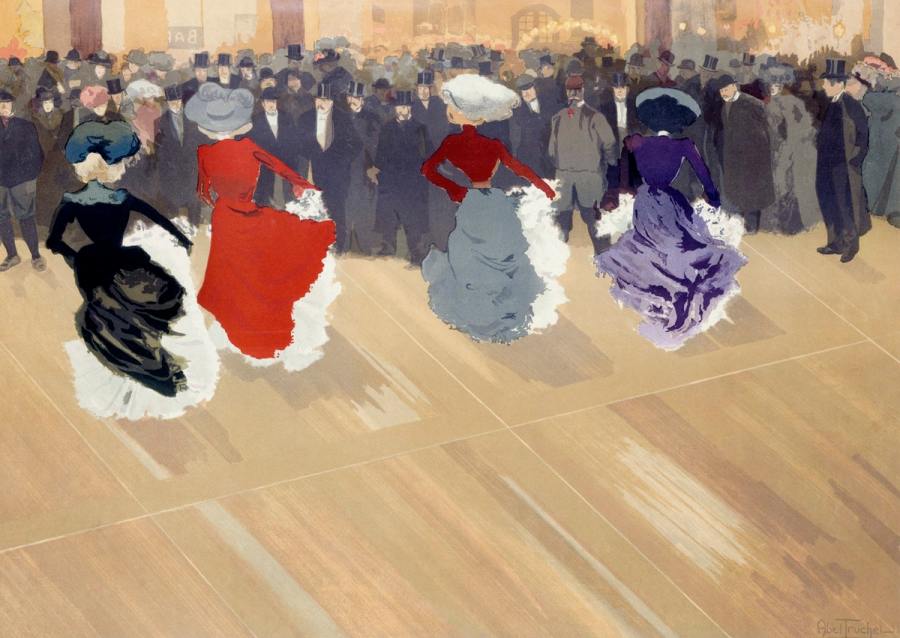
Here Below

By Sarah Carleton

Featured Art: The quadrille at the Moulin-Rouge by Louis Abel-Truchet

Before a careless bulldozer buried him under a ton of dirt
he played with impeccable pulse.
He anchored tunes with a standup bass,

left fingers spidering, right hand patting pauses,
a running commentary that thumped below the chitchat,
bristling with off-color intent.

Just as hothouse plants rooted and swelled
to his sweet, muttered, nasty guy’s-guy nothings,
we set our feet in the soil of his crude jokes and thrived.

His wife didn’t pay much mind to the dirty stories
and sly non-secrets. When he laid their deck,
he penciled women’s names on the underside of the planking,

like an ode to abundance, and she just laughed, shrugging.
We take our cue from her and refuse to fret,
but celebrate him in smut and subtext.

Without crawling among the snakes to check, we hope
we made the list––divas of warm skin and rayon dresses
immortalized on a two-by-ten––

and we also aspire to be like his wife,
who stands aboveboard, rolling her eyes, knowing
her name has been etched more than once in that slatted dark.


Read More

Miles

By Craig van Rooyen

Featured Art: by Mike Lewinski

It was dark, sure, but the city’s halo
whitewashed the stars.
We drank good bourbon from Dixie cups
to mock our sophistication.
Two black men and a white one
who needed a brother.
We drank to Ghana advancing,
not so naïve to believe
they had a chance against England.
We toasted our wives of many colors
and our barefoot children chasing fireflies
like the first night in Eden.
But it was Oakland.
So when the boy climbed the porch steps
cupping a winged and glowing offering,
I called him by the wrong name, as if
I did not know him, as if his father
was not my friend.
The brothers exchanged their look,
too polite to call me out
on a summer night in paradise.
And we all pretended not to notice
the bats that let go their roosts
to flap old patterns in our chests.
Suddenly I felt like humming
Swing Low, Sweet Chariot,” professing my love
for Serena, telling them all about my black Scout leader
whom I hadn’t thought about in years,
assembling, in other words, my own minstrel show
to prove how down I am.
All the while, the party soundtrack plays on
through hidden speakers, Kind of Blue 
from the end of that gorgeous terrible horn:
Live, no net, each note feeling its way
into the dark as if we can still improvise,
as if there is always another chance
to get it right before the night ends.
The boy, who isn’t Miles after all,
keeps coming closer
to show me his gift, opening the dark
hemispheres of his hands so I can see
the pulsing fireflies lift off
to join the others in the city’s halo
far above our heads.


Read More

A Box of Records

By James Haug

Someone placed a box of records by the curb because it was hoped that someone would want to take them away. They’re records no one wants but maybe someone will want them. Someone driving will stop. Someone walking will stop. That is the pleasure of looking through records. Then the sun clears the tree across the street and shines on the records and makes the colors of the record jackets festive even as it robs them of their pigments. Someone will stop and rescue them from the sun. Someone will look up at the empty house behind the box of records at the curb to see if someone is watching. The people on the jackets smile and smile with their best hair, maintaining resolve all night in a box by the curb. Someone will stop and bring them home and listen to what they have to sing. Someone will carry them off out of the rain. Someone will spread them on the grass to dry.


Read More

Fantaisie

By Donald Platt

Featured Art: Garden Flowers by Edna Boies Hopkins

                               Each person is
a solar system, the bits of birth’s Big Bang orbiting
                               some sun that both attracts

and repels. Elliptically, my mother orbits her own death,
                               that great shining
ball of fire I cannot look directly at. She draws closer to it,

                              then pulls away. She rotates
as she revolves. Together we write her obituary. Born.
                              Schooled. Worked as.

Married to. Gave birth. Resided. Retired. Is survived by.
                               The old story
we all get to write if we’re lucky, or one that will willy-nilly

                              get written for us.
I leave the day she’ll die blank. She gives me the notes
                              she wrote last night:

“Funeral in Christ Church and Bill Eakins to preach.
                              Ask Women’s Guild
to serve a simple refreshment. Give $100 to organist.

                              Give $5,000
to church. Give $500 to Bill Eakins. Give $1,000 to women.
                              Give $250

to soloist. No calling hours. Only the church service.
                              Nobody
getting up and saying nice things about me. Everyone

                              has their own
memories—good, bad, and indifferent. Chief purpose
                              of a funeral

is to pray for the departed. Also to give comfort
                              to those who grieve.
Call Hickey Funeral Home.” As an afterthought, she added

                              “Ask Charlene
to play Saint-Saëns’ Fantaisie for violin and harp.
                              You’ll need to find

a harpist.” Everyone needs a harpist to accompany her living
                              and her dying.
No one to turn to but the seated, marble harp player

                              at the Metropolitan Museum
of Art, early Cycladic, eleven and a half inches high
                              He embraces

the D-shaped instrument, whose top is ornamented
                              with the head
of a waterfowl. Against his right thigh and stone shoulder, he rests

                              the weight
of the instrument. It has no strings. His raised right thumb plucks
                              five thousand years of silence.


Read More

Open Mic

By Jesse Wallis

Featured Art: Dancers by Edgar Degas

I don’t know how, but I knew as soon as he said it, he would get lost
after the bridge. “I’m still working on this one,” he began, tightening
the strings. “Hope I make it through.” It was the third song the young
man played. He was really quite good, if new. His tenor voice earnest,
fingers deliberate in finding the chords along the neck of the acoustic.
But exactly where I had thought, he forgot the lyrics, shook his head
while he strummed on in circles. Until he whispered under his breath,
“I’m sorry,” and I called out, Muriel plays piano. With a broad smile,
he nodded, “Very good. Thank you.” Then picked it up, Muriel plays
piano every Friday at The Hollywood
, and brought it home as strong
as he’d started. This was at a small coffee shop in Carefree, Arizona.
On the patio strung with white lights, maybe a dozen people, a night
in November cold enough to recollect. My wife and I had separated
recently. A friend was trying to get me out in the world, to keep me
busy. And at least for that moment, I felt like I belonged someplace
again. I had something someone needed. Realized anyone could get
lost, even in Carefree. Yet every now and then, the invisible chords
connecting us—even with a complete stranger—sway in the breeze
like silk filaments of a web and catch the light. And you can follow
that flashing back, the path familiar as a song. You know the words.


Read More

The Ideal Budweiser Customer Watches a Budweiser Commercial

By Danny Caine

Featured Art: Drugs by Richard Estes

Oh shit I love “Landslide.”
I was going to get up to piss but then I heard me some Fleetwood Mac.
Hey that’s a pretty farm, too. Farms are dope.
Wait, oh goddamn it it’s a baby horse lying in some fucking sawdust.

That baby horse is so cute I can’t even handle it right now.
I am literally unsure how to proceed.
And now the horse is being fed from a bottle?
The hell am I supposed to do with that?

Dammit now the horse and the dude are playing and stuff.
Fuck me if I don’t love a playful goddamn horse.
Look! A Budweiser truck. Budweiser!

I should like this brand on Facebook.
I should follow this brand on Twitter.
I really should make an effort to engage
with this brand on social media.

Wait, that’s a horse trailer. And our dude
is shaking hands with the driver? Is he—

DUDE YOU CAN’T SELL THAT FUCKING HORSE!

YOU’RE GOING TO MISS HIM SO MUCH!

Somebody get me a Budweiser.


Read More

Timeline

By Amy Pickworth

Featured Art: Chrysanthemums by Pierre-Auguste Renoir

1880: John Stine proposes to his dead wife’s sister, Eliza. He is a farmer, about forty, she is a spinster midwife. She accepts, telling him, “I will marry you for the sake of the children, but I will never sleep with you.”

This sounds strange—would she have said sleep with in the nineteenth century?—but these are my grandmother’s words. It is 1993 and we are sitting in her house, which smells like cigarettes and meat. The curtains are drawn. Her second husband has been dead for fifteen years. She hasn’t gone blind yet.


1962: The Orlons sing Baby baby when you do the Twist, never never do you get yourself kissed.

Teenagers everywhere Watusi in response.


Read More

Horn

By Robert Pinsky

Featured Image: Music by Thomas Wilmer Dewing 1895

This is the golden trophy. The true addiction. 
Steel springs, pearl facings, fibers and leathers, all
Mounted on the body tarnished from neck to bell.

The master, a Legend, a “righteous addict,” pauses
While walking past a bar, to listen, says: Listen—
Listen what that cat in there is doing. Some figure,

Some hook, breathy honk, sharp nine or weird
Rhythm this one hack journeyman hornman had going
Listen, says the Dante of bop, to what he’s working.

Breath tempered in its chamber by hide pads
As desires and demands swarm through the deft axe
In the fixed attention of that one practitioner:

Professional calluses and habits of his righteous
Teacher, his optician. The crazed matriarch, hexed
Architect of his making. Polished and punished by use,

The horn: flawed and severe, it nestles in plush,
The hard case contoured to cradle the engraved
Hook-shape of Normandy brass, keys from seashells

In the Mekong, reed from Belize. Listen. Labor:
Do all the altered scales in the woodshed. Persist,
You practiced addict, devotee, slave of Dante

Like Dante himself a slave, whose name they say
Is short for Durante, meaning Persistent—listen,
Bondsman of the tool—you honker, toker, toiler.


Read More

Piano Lesson

By Gregory Djanikian

Featured Image: Ella at the Piano by Donald Shaw MacLaughlan 1876

My teacher is looking at me sadly
as if with the large droopy eyes 
of a basset hound.

I’m stumbling through “Naima”
transcribed for piano,
my fingers tripping badly over
the minor 3rds, the flat nines.

On his face, such longing,
as if it’s the end of jazz,
we’re saying farewell.

I’m ready to start from the top 
playing all the changes, the repeats,
and he’s holding his head in his hands,
swiveling slowly in his chair.

The song is full of smoke and aching,
like a woman in a shiny dress
walking through a dark hallway
haunting the man she’s loved.

I can already feel the nostalgia in it
for what has never happened.

There are so many gray clouds here
I should play “Blue Skies,”
or “Mountain Greenery,” their upswings
rising like colorful balloons.

Now I see my teacher lying on his couch,
cupping his forehead in his palm.
It must be raining in his heart
for a love of something so perfect
there’s no place to find it

not in this room anyway
where I’m bent over the keys,
the rapturous jazz
just out of my reach

and my teacher is closing his eyes
and I’m closing mine
and we both might be imagining
Coltrane behind us breathing into his tenor
a song of love and departure
so fluent it feels like rain
falling into a lake

and maybe whatever is lovely
and improbable is always floating away
down a rivulet of dreams

where my body is falling
and my hands are reaching out,
and I am almost touching
something like water, like silk.


Read More

Misterioso

By Sydney Lea

John Ore stood up his bass and Frankie Dunlop laid his sticks on the snare.

They walked offstage but Monk stayed on hunch-shouldered and with one finger

hit a note and stared at his keyboard a long long time, then another

and stared and another and stared, not rising to whirl as he often would do

when he played this club or any other. He didn’t smile as usual,

benign, whenever he danced like that. He wore his African beanie—

I mean no disrespect, Lord knows, just don’t know what you’d call it— his

face beneath it both blank and rapt. I was rapt myself as I’d been

for the whole first set and in fact for years even then, but for other reasons.

I believed he was speaking to me somehow, that he knew my inmost sorrows,

my expectations. Of course I guess a lot of people thought so.

I was looking for eloquent mystery in those odd plinkings, which may have

been there,

though if so, it wasn’t for me to fathom. With the noise of chatter and movement, I

couldn’t have heard my heart lubdub but did. The last set ended,

he sat the same way after, playing lone notes as if contemplating

just where each came from. Right there in front of you! I thought. Who knew

that in front of him too lay those interludes of speechlessness,

his piano hushed, till he died like anyone else? I don’t want to riff

on what I dreamed Monk meant to my life, so small and young, comprising

only things that any man that age is bound to go through.

I don’t want a poem all full of lyric triteness, smoke-softened light

that glanced off bottles behind the bar, the sorrowful looks of his sidemen

as they left him—which may have been only quizzical. It was 1963.

I won’t go into history today, or politics,

or whatever else might make something grander than they truly are of my

thoughts.

There was only Monk. There was sound then quiet.


Sydney Lea’s ninth collection of poems, Young of the Year, will appear in 2011.  A former Pulitzer Prize finalist, he teaches in the graduate faculty of Dartmouth College.

Originally appeared in NOR 8.

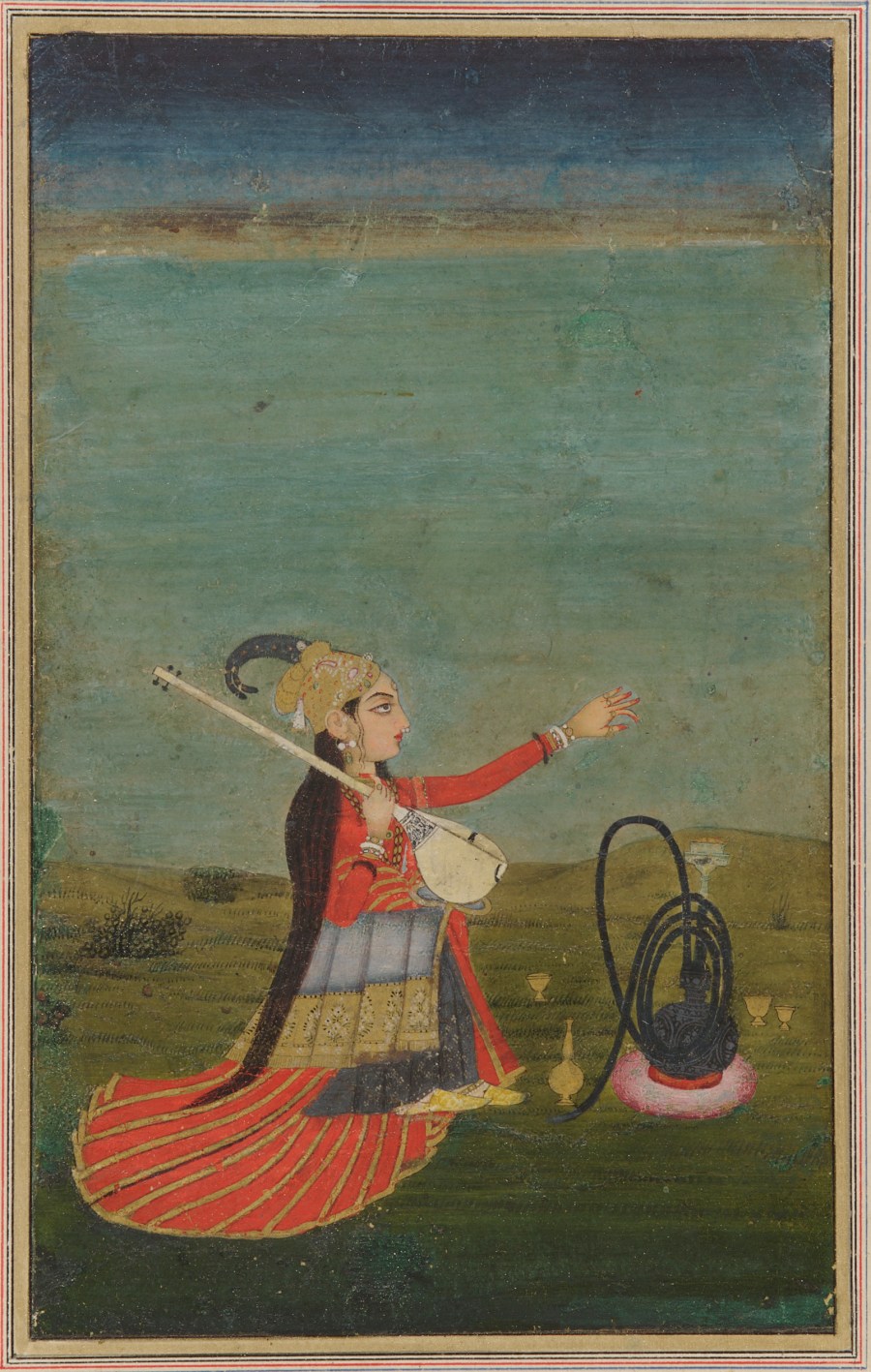
“The Accompanist” by Anita Desai

By Lynne Sharon Schwartz

Featured Art: Female performer with tanpura by Unknown

For a short story to linger in the mind as long and as tenaciously as “The Accompanist” has in mine, it must hit a sensitive nerve. So in revisiting the story, which I first came upon years ago in Anita Desai’s early collection, Games at Twilight, I looked for what had struck me so keenly in this first-person account of an Indian musician from a poor background who dedicates his life to the most humble of accompanying instruments, the tanpura.

The narrator’s father makes musical instruments and music is “the chief household deity.” Soon after Bhaiyya’s lessons begin at the age of four, his talent is obvious: “My father could see it clearly—I was a musician . . ., a performer of music, that is what he saw. He taught me all the ragas, the raginis, and tested my knowledge with rapid, persistent questioning in his unmusical, grating voice.” The father is stern and rough, never offering praise or encouragement, only calling his son a “stupid, backward boy.”

Read More

Variation on a Letter from Schoenberg to Mahler

By Nina Corwin

Dear Maestro, Dear Gustav, Dear Dear—

I must speak to you not as a pillar to a post if I am to give any figment of
the scurvy beast your symphony unleashed in me: I can speak only as one
emboldened avocado to another. For I saw the gritty foreskin of your soul,
fileted and in flagrante. It was unveiled before me as a sumptuous centerpiece
overrun with willful and tawdry tourism, a sprawling frontier of ruby-throated
gauntlets and savage cul-de-sacs scattered on a ravishing trash heap. I savored
in your symphony the soul of an exotic prophet who, after fleecing us with
digital adroitness, paints lipstick on the shattered mist. I shared in your sea-
son of strychnine; suffered a crucible of peeled fruit: a glorious hornets’ nest
of history subsumed by the bonfires of conquerors. I saw a man in traction
straggling toward inner uprightness; I divined a full-frontal mugshot, a flying
buttress, a blue-eyed lampoon. Oh yes, the most impetuous lampoon! I had
to let my gargoyles go! Forgive me: I cannot feel by halves. With me it is one
thing or the other.

In all devotion,

Arnold


Read More

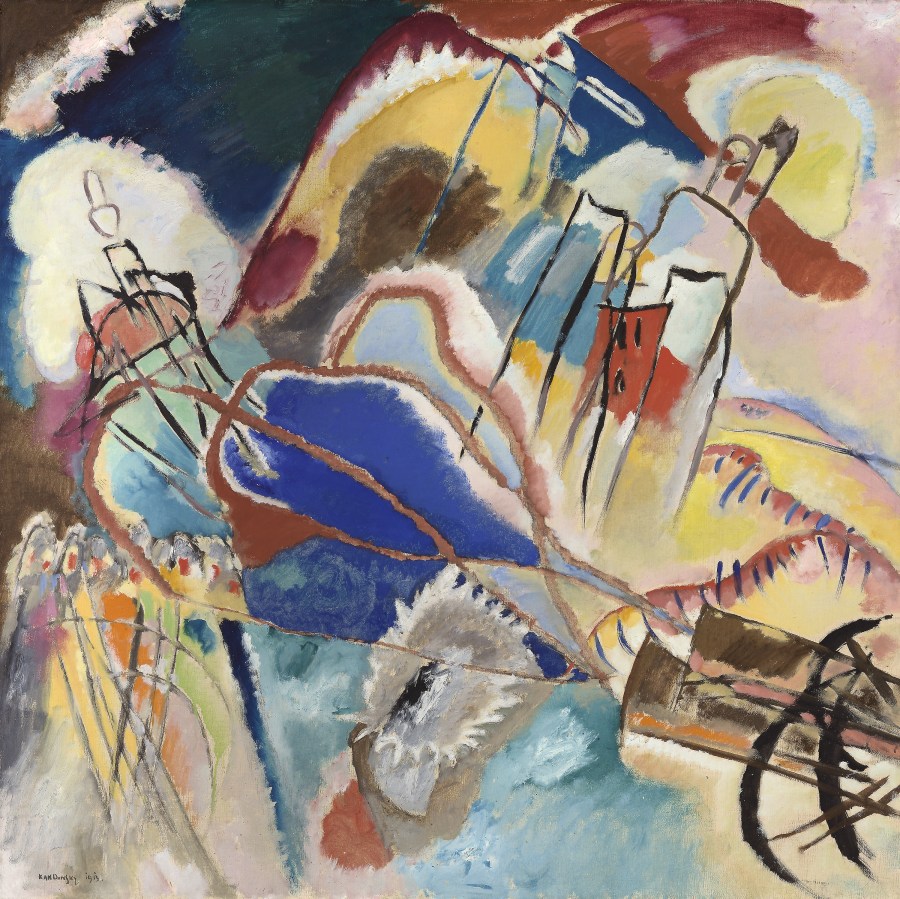
Mercy

By Stephen Dunn

Featured Art: Improvisation No. 30 (Cannons) by Wassily Kandinsky

The music was fidgety, arch,
an orchestral version of a twang.
Welcome to atonal hell,
welcome to the execution
of a theory, I kept thinking,
thinking, thinking. I hadn’t felt
a thing. Was it old-fashioned
of me to want to? Or were feelings,
as usual, part of the problem?
The conductor seemed to flail
more than lead, his baton evidence
of something unresolved,
perhaps recent trouble at home.
And though I liked the cellist—
especially the way
she held her instrument—
unless you had a taste
for unhappiness
you didn’t want to look
at the first violinist’s face.

Read More

Constant Craving

By Kathy Fagan

Featured Art: Café Concert (The Spectators) by Edgar Degas

When Peter Byrne of the 80s synthpop duo, Naked Eyes, played for me his acoustic cover of k.d. lang’s “Constant Craving” in his studio over-looking Los Angeles, the peacock—not the NBC peacock but a real peacock among the many on the grounds—opened his fan as if the music were a potential mate. He strutted and shirred. He shimmied his many eyes. He’d been drawn to the music, then spotted himself in the sliding glass doors. He leaned in and turned for us like a Vegas show girl. He brought tears to my eyes. When the song was over I could barely muster, “What a tender version, Peter,” though tender wasn’t the word for the primitive if aimless seduction on the lawn.

Read More

The Last One

By Bruce Weigl

Featured Art: Two Plant Specimens by William Henry Fox Talbot

The anonymous brown song bird
        is annoying in her insistence
             on repeating the same three syllables
in exactly the same way, endlessly.

        She must know something
             about inevitability,
                       to sing so long,
        no one else in sight.

        The persistence of nature;
         the blind and infinite dedication to a thing
                       in the face of emptiness and silence
        that won’t let you believe that you are the last.


Read More

In Memory of the Rock Band Breaking Circus

By Stephanie Burt

Featured Art: Fight by Ján Novák

You were whiny and socially unacceptable even
to loud young men whose first criterion
for rock and roll was that it strike someone else
as awful and repulsive and you told
grim stories about such obscure affairs
as a man-killing Zamboni and a grudge-
laden marathon runner from Zanzibar

who knifed a man after finishing sixteenth

Each tale sped from you at such anxious rate
sarcastic showtunes abject similes
feel like a piece of burnt black toast
for example threaded on a rusty wire followed
up by spitting too much time to think
by fusillades from rivetguns by cold
and awkward bronze reverberant church bells

percussive monotones 4/4 all for

the five or six consumers who enjoyed
both the impatience of youth
and the pissiness of middle age
as if you knew you had to get across
your warnings against all our lives as fast
as practicable before roommate or friend
could get up from a couch to turn them off

Read More