Duplex (Gray-blue Staircase) 

By Theo Jasper

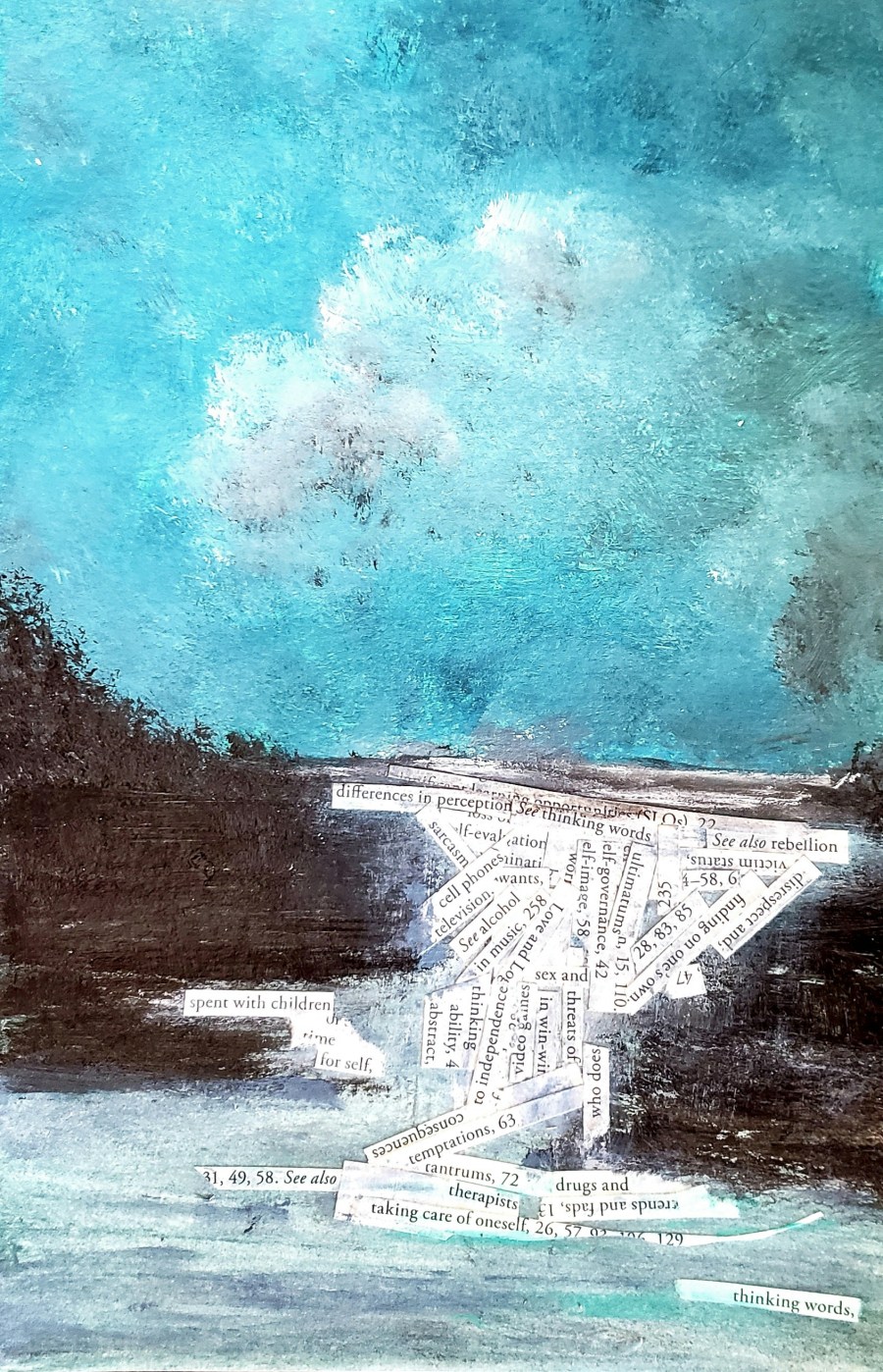
I feel small at the bottom of the gray-blue staircase, 
the one where she didn’t die, even when I visit it in my memory. 

Even when I visit it in my memory, the duplex where she tried to die, 
I can never reach the top of that staircase. 

The light hits the blood on the floor, (why can’t God see the staircase?) 
and my childhood cat has escaped, like she knew what was coming. 

And in my memory I have escaped because I know what is coming. 
But memory is not reality and the reality is this: there was blood on the windowsill. 

Memory is whichever wine goes down the easiest. Reality is the staircase, the windowsill. 
In a duplex on Orange Street, there’s blood all the way up the stairs. 

In a duplex on Orange Street, I never move from the bottom of the stairs. 
Maybe God sees me. Maybe he doesn’t. But in my memory, I never go up. 

I keep my head bowed. My blood is like wine. I never, ever grow up. 
I stay small at the bottom of the gray-blue staircase.


Read More

Of A Million Earths

By Susan Browne

One million earths could fit inside the sun
The thought of a million earths

makes me want to be a bee falling asleep inside a flower
It’s a fact: sometimes while gathering nectar bees get tired

& put their three pairs of legs over their five eyes
to block the sun which is halfway through its journey

of ten billion years
My mother loved sunsets at the beach

I remember once in Santa Barbara
our chairs close together on the sand

There’s no way to fact-check this
or that we chewed Juicy Fruit gum

& talked about things we’d never shared before
or that I kept looking at the freckles

on her knees because they made me
feel peaceful as a bee dreaming inside a dahlia

A billion years since that day with my mother
or seems like it

Her middle name was Marie
I brought a boombox to the church to play Ave Maria

A cold morning although the sun was shining
on the only known planet in the universe where life exists.


Read More

On My Sister’s Buying Twin Plots for Herself and Steve in Greenwood Cemetery Not Far from Elmore Leonard

By Nancy Eimers

You say you like the thought of graves being visited.
As the older sister I fear I won’t be available.

But I’d want to go on leave, take a trip back down or up
or away from the utterness of being gone

twice, in a way, since you will be gone too, we gone from each other,
I’d want my being gone to imagine you having company

and allow me to visit the little graveyard near where you lived,
though maybe I’d find myself standing there—hovering?—

in a sort of bewilderment: what was the reason, does grief
even remember me, remember having a body,

and did I want to make it my business to say something
to you—over you—(quietly

in case one of the nearby houses was listening)
or maybe sing some little song we knew, that the silliest part

in each of us might have been comforted, or confronted
by who knows how far apart we have traveled and when

or if we arrive (from ariver, “to come to land”).
But it touches me, even so, to think of you wanting

graves to be visited (though maybe not as strangers visit
Elmore Leonard, Dickens of Detroit, on Greenwood’s public tours)—

that sense of somewhere to go, small space marked on a map
of a park-like place with houses all around.


Read More

 Trying Not to Lump Together More Unknowns

By Matthew T. Birdsall

       “We know what we are, but know not what we may be”
                        -Ophelia, Hamlet, Act IV, Scene 5

Uncertainty looms heavy before sunrise.
Dark driving, she calls it, at 5:00 AM
to the hospital for her surgery,
when she mentions losing our dog,
Penny, a few months ago—
anxiously lumping together unknowns—
and I had trouble focusing
but I tried to turn the conversation around
with compliments—her outfit, hair, shoes—
but I shut down when she said,
It’s okay, Dad, I know that living is dying

Stuck in the white shock of her wisdom
I wanted to say something to redirect us
but I couldn’t decide whether
she was that conscious of her own mortality
or if she was just being a child—
redirecting gravity away from her upcoming operation
toward something more certain.

At the last minute, the operation was canceled.
As we walked out, my daughter took my hand
because she knew I needed it telling me she felt good.
She said she still missed Penny,
and she would miss her as long as she was alive
me too I said but holding back on diving deeper
trying not to lump together more unknowns,
as we headed home with just enough sun
to get all the way there without headlights.


Read More

We Were Talking About Words We Didn’t Like

By Jessy Randall

We were talking about words
we didn’t like. One of us
was making a list, and we all
wanted our words on it.

“Leverage” came up, and the
overuse of “awesome.”
(We were distracting ourselves
from the reason we were together—

or not distracting, exactly, but
giving ourselves a breather
from grieving and thinking about loss.
We were in town for a funeral.)

My turn came and I didn’t
want to say, didn’t want my mouth
to make the word, but I screwed up
my courage and said it: “meatball.”

The others laughed, not at my word, I think,
but at the face I made when I said it.
The conversation turned to social justice,
but “meatball” had been said aloud

and it imbued the rest of the visit,
for me, with ridiculousness, and maybe,
much as I hate “meatball”—my god—
with hope.


Read More

Keats

By Robert Cording

After my son died in October, I lived
with Keats’ Autumn in my head—
not the relish of lingering summer warmth
in mid-fall, but his one-line imperative:
Think not of the songs of spring.
I watched summer’s hummingbirds
fly off, then the gold of finches turn
dull green. But I couldn’t live with
the music of fall. I heard only those
first words—think not—which I did very well.
How much more Keats had demanded
of himself. And how many more falls I had
yet to undergo before I could hear,
just outside my door, hedge crickets sing.


Read More

Driveway Toad

By Rob Cording

A year after my brother died,
I told my daughter about
the toad that once lived
in the hollowed-out knot
of an apple tree
in the center of my childhood
driveway. My brothers and I
liked to visit it after school,
but the tree came down
in a snowstorm, and my parents
graveled-over that spot.
When my daughter
asked what happened
to the toad, I explained that
it probably moved
under a rock, or to the woodpile
along the side of the house. “Or,”
she responded, “it died.”
Then, she skipped into the house
and left me outside.


Read More

Old Black Water

By Dion O’Reilly

Suzie, I want to tell you
how frequently I pass the apartment
behind the supermarket
where we street-danced
to the Doobie Brothers,

light shifting as the fog
lifted, front-yard roses
iridescent in the salt-gray
seaside morning.

You died, what, ten years ago?
Not at once, really, though pills
took you quickly. It began, I think,
when we were children: without
knowing why, we wanted out

of that rural beauty—the narrow
valley and gleaming stream,
summers spent diving off
crumbling cliffs, as if nearness
to death was the closest
we came to leaving

your stepdad’s beery fingers,
my Mother who loved
to touch the sweaty chests
of her daughters’ teenage lovers.

Nowadays, everything
is a different kind of dangerous:
rain stays away. June mist
sucks away too soon,
sunlight breaks through
before it should.

What I want to say, Suzie,
is a moment, gone
fifty years, is just a moment,
but you’re still here, unfleshed
in brightness—elfin, jittery, wan—

our arms looped as we turn
tight circles, round and round,
your eyes locked on mine.


Read More

Any Single Thing

By Meryl Natchez

A week past the twenty-ninth anniversary of your death
I read Seamus Heaney’s poem about the kite,
and my first thought is to show it to you.

So I stumble again
into the hole death leaves,
unfillable.

Another morning
of a day that promises
to be beautiful
without your presence
except for this faint ache
because you loved kites,
their unpredictable dialogue
with the wind
transmitted to your hand.

That hand gone
and gone again
each time
I reach for it.


Read More

I Look for You

By Jen McClanaghan

Featured Art: “In the Garden” by Tina Moore, Tiffany Grubb, Alexis Rhinehart, Casey Collins, and Wendy Minor Viny (Passion Works Studio)

I look for you in travel plazas.
In claw machines. In corn husks, crank
shafts, coils and pumps, in funnels.
I look for you at breakfast
and again at dusk. I look in
weather, in dust, in bird song, in barking.
In the magnetic field of the wildflower.
In sockets, in closets, in strangers.
In Spanish, in rain’s silver fringe.
In the hawks that land to look at me.
In the splinter that entered my thumb
from a drawer that belonged to you,
could it be? I hold the cheap pens
in your purse. I spend money on shoes
to make myself feel like you.
I dreamt you were on my deck
with your eyes closed.
In your dresses I fold
for someone else, I see how tiny you were.
I watched the intern take your pulse
and wondered if he was shy or right
when he said you were gone.
On the form for your flight from ICU
to morgue to mortician to oven, to me,
I guessed you were a hundred pounds,
so light you could be made of helium.
You could be made of air
and be everywhere.
Of a world made of so many unlikely things,
of the mongoose’s ability to kill
the cobra, of consciousness,
of time before the beginning,
before the two of us, of death, I see you
enter the light above my shoulder
and read what I’ve written.
All this for you. This alphabet
you shed in June, this word
and the next and this final sentence
a fence of roses that can only be you.


Read More

Unifying Theory

By Steve Coughlin

When John Coughlin sings
Joey and Steven are tigers
while driving the backroads
of Hingham, Massachusetts
it is of particular significance
because Joe has been dead
three years
and his name has not been mentioned
in any of John Coughlin’s
invented songs
with borrowed melodies
since his oldest son
was murdered.
But of similar significance
is that as John Coughlin
continues to sing
in the fading twilight
with his still-living son Steven
beside him
there’s a sudden understanding—
a distinct comprehension—
that if they keep driving
with the windows down—
if John Coughlin keeps singing
the names of his sons—
the winding road before them
will never end.


Read More

Who I Passed While Running

By Kenneth Tanemura

I ran after the siren’s light,
past retirees in bright tank tops
and tank dresses,

reclining on lawn chairs.
The woman in carefully
crafted beach body standing

in a bikini, parts of her spilling
out of it. She was looking
at the sea, past the kids bodyboarding

in the shallow surf. The kids stood
calmly in a calm pool unscathed
by the waves coming to shore,

then going in reverse.
They didn’t move outside
their zone to catch a wave

to the sand. Currents travel out
to the ocean faster than Olympic
swimmers, in Volusia County,

where the front desks at the hotels
lining the beaches don’t warn
the guests about high surf

and rip risks. I ran
in my touristy linen shirt, a white
affair I could wear

to a wedding. My arthritic knee
tightened. I saw my stepson
on his back, the young woman

pressing down on his chest,
searching for his pulse.
“Was he alone?” a shirtless lifeguard said.

“He was alone,” I said.
I shouldn’t have left the boy alone,
I thought. I was tired of watching

my tired, elderly parents
awkwardly stand on the beach like
they didn’t belong there.

It was hot and there was nowhere
to sit. It was boring to wait
and watch the baby

in the summer heat. A sheriff
noted my name
on a notepad, scribbled

‘stepfather’ on the thin line.
Go home and get your wife,
then head to the Halifax Hospital.

On the drive home a man
jogging passed me.
Someone walked her dog

on the trail by the Halifax River.
In the parking lot, Dezree
was showing an apartment

to a young couple
with Illinois license plates.
She waved to me

from the golf cart. My wife came out
when she saw our white
Sentra pull up.

In the lobby, a bored
security guard scanned
our IDs, a woman

behind us complained
she had to get another
pass to get upstairs?

Good lord. If it’s not
one thing, then it’s another.

A smiling nurse in blue

scrubs smiled. “We were waiting
for you, please follow me.”
The boy’s eyes jolted open.

The ventilator pumped
oxygen into his lungs.
There was nothing behind

his eyes. His pupils
didn’t move. My wife cried
beside the hospital bed. I put

my arm around her shoulder.
She did not lean into me.
The sheriff stood in the hall.

Behind him, someone walked
by, a cell phone pressed
to his left ear.


Read More

Grief Mentor

By Kenneth Tanemura

She dresses up anyway, the long blue
cardigan drapes her form. Finished
a bit of work, she snaps her fingers.
The boy she once bathed and changed, lost
to what? The surf? Is rip risk a thing?
Locally, everything changes. She lets
herself crave—noodles, a drive
around the neighborhood, Ella crooning,
Billie grieving. Is that it? Anguish,
or just some annoyance? Not that word,
not anguish. Describing anything is a stretch.
Palm trees and ghosts, full moon, skeletons.
Grand, the way she stood by the crematorium,
her body shaking. Deep sobs in the shower
like any creature. Primate mothers carry
their dead infants for days, weeks,
knowing what? The soul passed
into another realm?


That’s not it—less drama, less fanfare.
See what you can get away with
if you undercut yourself? She gives
a clownish smile to the surviving
toddler, holds her hands high,
palms open. The boy eats it up.
She shares the crazy inner thoughts
most keep to themselves: rebirth,
the soul hungry for burgers, waiting
in an intermediary space between here
and there. So many ways to split hairs
about there. Is that a secular stance?

She would make a grief therapist’s
eyes roll with her talk of the pure land.
Those eyes so used to performing
sadness to mirror grief. She doesn’t want
to blame anyone. Better to explain
as fate, design—master plan.
She plans with colored pens, makes
sense of the random—why do I want to say
‘Fall days,’ as if the season matters?
Monotony calms grief: write down every
word that starts with k, the counselor said.
Is anger better? Pin it on someone,
this boy’s drowning. She wants to.


The coffee drinks change with the weather.
She doesn’t say words a character
in a TV series would say. She kneels
before the altar, chants, thanks
her partner for putting his hands
together in prayer. No, she wouldn’t thank her
mother, who’s supposed to sit
cross-legged on hardwood. The man,
the husband, somewhere between stranger
and who?—blood relation?
She wears childish sweatshirts, makes
her feel closer to the boy she lost.
Or it’s another look—the grieving,
or past that. She stays with the one
who was supposed to watch
the boy in the surf. Supposed to
save him? Her ring catches
light. His ring a band
the saleswoman said a chainsaw
couldn’t cut through. She liked that,
something unbreakable.


Read More

Go, Went, Gone

By Sara T. Baker

Communication, never our forte:
in the ER, I tell you you will be admitted
upstairs for observation. You let out
an anguished cry worthy of the London stage—
This is it, Sara, I’m going upstairs!
Your forefinger points up as you give me that knowing eye.
It takes me a minute. Not that upstairs!
But you swear, this is it, your curtain call,
your swan song, the end of your road,
your bucket kicked. Still, once on that heavenly
floor, you cow the nurses, charm the doctor,
vacuum up every last crumb
of hamburger and fries.


Years later, on your actual deathbed,
you turn red-rimmed eyes to me, barely
managing to mouth, I have to go!
You can go, Mom, we rush to assure you.
Leaning over, I whisper, We’ll be okay.
Your face gathers into the shadow of a glare
as you try to swing your legs out of bed.
The toilet, you gasp, not having the strength
to say you idiot. But we can’t let you out of bed;
we’ve become de facto jailers, your most private
functions now public property, input and output
duly recorded, your dignity the last casualty
of this war. You give no easy victory
to thieving death; not used to losing,
you snatch back the breath we think
has left you. Laboring for days,
your sunken chest rises again and again,
while we, your children, fall around
you, exhausted. Then you are gone,
giving us the slip at the devil’s hour.
As we wash your cooling body,
your hazel eyes pop open like a doll’s,
as if you want to see, as if to insist
you are still a part of things.


Read More

Steal a Grape

By David B. Prather

Featured Art by Paulette Hall

Three years now,
I still resurrect my grandmother,
pull her out of that mausoleum vault
and bring her back to life.
My life, that is.
I know she’s tired and wants to rest,
but grief is greedy
and tireless. When I pull her back,
she wears red,
which, for now, is symbolic of Paradise.
Sometimes, she is a cardinal,
especially in winter
when the world needs to be reminded
of whatever it wants most.
What I want is to take her to Kroger,
so she can steal a grape or two.
I want to take her to a doctor’s appointment
so she can complain about the wait.
I want to take her to see a movie
so dramatic she will pretend not to notice
that it hitches my breath
and stings my eyes. Three years from now
is unpredictable at best.
And resurrection
is only a way to drag the past with us,
lest we forget. Yes,
we forget.


Read More

The Grandmother Tree

By Pam Baggett

My sister named this venerable maple
growing at the edge of the mountain’s gravel road,
main trunk long broken, pocked with holes,
a once-mighty tree now slowly failing.
She’s lost her apical dominance, I say, meaning
that when the top broke off, side branches
shot up past the injured trunk like raised arms.
On the left, one wide kind eye, an open mouth
framed by credible lips. Step right, a second eye
squinted shut, mouth twisted up, as if she’s yelling
at us the way our father’s mother did: imagined slights,
our insufferable rudeness, which she thought
should be spanked out of us. Mom never laid a hand,
which says a lot about her mother, gone too soon
for my sister and me to have known. Grandma Baggett
and her snarling chihuahuas gone, too, when our parents divorced.
No wonder my sister imagines a tree could be a grandmother;
she’s been hiding in stories since we were small.
I anchored to the safety of science, to cold fact: Trees break.
A grandmother can call you Sugar one minute,
rage at you the next. Can die without you ever once
hearing her voice.


Read More

A Small Room Off To The Side

By Ockert Greeff

Featured Art by Karen Renee

He will come to live with you
Make him feel welcome 
My mother says 
Her eyes turning away from mine 
Before I can search for the meaning 

I imagine I might have a small, empty room off to the side 
With a reddish glim 
That might bother him at night 
When he takes off his thick, black-rimmed glasses 
And his eyelids become soft and white 
Butterflies in his leathery face 

I would have to get a night-side table for his glasses 
And his teeth 
And his cowboy book 
So that he feels welcome when he comes to live with me 

I think that old single bed will be fine 
Now that he is alone 
He wouldn’t want more anyway 
But I will get new sheets 
For his old, pale body and his tanned forearms 
And maybe a soft, new pillow for his sunken cheeks 

I will ask my sister for that old painting 
With the open plains and hazy blue mountains 
So far, far in the distance  
The one she took when he died 

So that he has something to look at 
And so that he feels welcome  

When he comes to live with me, in me 
In a small room off to the side of my heart 
So very far from the plains where he grew up.


Read More

What’s With All These Foxes

By Gwendolyn Soper

First I found the trapped fox and then we let it go
and I wrote a poem about that and then in my weekly
online writing group Pamela in Scotland says your fox
poem reminds me of Ted Hughes’ animal poems

and I think cool and then I read a poem in the LRB
written by Nick Laird about praying with his little boy
and I like it so much I order his book Go Giants and
I print up his bio admiring his amazing hair envious

that his hair’s thicker than mine and then my brother dies
and it’s the second worst day of my life and I need to think
I have to think the fox that gorgeous beast appeared
a few days earlier to guide him to an afterlife and I
keep thinking of metaphors about cages and freedom
from his schizophrenia and then my husband’s employer
sends me sympathy flowers from a company named
Foxglove see another fox and then

I solve a Wordle to subdue my traumatic responses
to my brother’s death and the word is SNARL
which is what I thought that trapped fox would have done
like a dog but didn’t but it is what I feel like doing
some of the time or bingeing shows or snacking or doing
nothing and then I see a book by Julian Barnes on top
of my stack of books at the top of the stairs so I start
to read it since I’d meant to for years because
I love his books and Ted Hughes

is mentioned in the first chapter now more Ted Hughes
so I figure it is high time I read more of his poetry but
his collected work is so thick it’s a brick on my shelf
instead I look up his work online and the first poem
is about a fox what
what’s with all these foxes and there’s a hyphen
in his title so I add one to mine because it needed one
I see that now and then I receive that book by Nick Laird
in the mail and he gives credit to Julian Barnes for a couple
of lines and then I receive an unexpected parcel

in the mail with Billy Collins’ new book Musical Tables
inside and in the front he quotes a line by
Nick Laird more Nick see these mystifying links between
Hughes Barnes Laird and Collins and then my friend
in Manhattan texts me a photo he took of a window display
full of stuffed toy foxes see more foxes but these are dressed
in plaid after Macy’s unveiled their windows for Christmas ’22

and then I see a new photo online of Billy Collins
giving a reading for his new book wearing a scarf with
illustrated foxes on it more Collins more foxes and
a few days later he mentioned on his poetry broadcast
that the Prairie Home Companion Christmas Show would be
playing that night so I tune in virtually and Garrison Keillor
welcomes everyone to The Fabulous Fox Theater more foxes

still plus the brass fox door knocker Ada Limón just posted
on Insta my God how many more fox sightings are there
going to be in my future it wasn’t my brother’s style
to pester me like this I have no answers and yet I thank
the gods for each and every reminder of that
living warm animal my husband and I let go which may
who knows be the thing that peacefully accompanied him

to some afterlife and now it’s 3AM where all this stuff is
swirling in my thoughts like pistachio-colored seed saucers
that I used to watch from a bridge caught in the local river’s eddy
on my early morning walks hoping to clear my head which
sometimes worked or didn’t and I just lie here thinking
about pistachio-green and how its complementary color
is a certain shade of purple and then I think of purple hearts

and how valiant my brother was see my brother and then
I recall the framed album cover I gave him of a vinyl record
we used to play The Valiant Little Tailor because Taylor is
our family name and I remember how he was his own kind
of sixty-three-year-old soldier rescuing his other
selves for decades from battlefields that were visible
to him but not to me no matter how hard I squinted.


Read More

Red Tulips

By Stephanie Coyne DeGhett

We meet near the bunches of tulips
and bags of apples, a pair of women
whose old professor husbands have died:
our first Christmas in a frozen snow bank
without them is behind us, the northern spring
is near, but the path to it is still snowing over.

I’m rattled in the way that only
chance encounters in a grocery aisle
can undo me—my slipping armload
of groceries is going to spill
and while I hold the red tulips
in their slick transparent sleeve
yet more tightly—it’s all going to cascade:
I want very much to get this right.

I want to staunch her grief with my own
for this moment: no sense us both suffering,
take a minute’s breather—I’ve got this thing
covered for the both of us is what I want to say—
but for all the intimacy of loss,
we are just long-time acquaintances.

A woman—ornithologist husband dead
decades ago—moves past us:
the Academic Bereavement Society
has called a surprise meeting in produce
and my hold on myself is getting more slippery.
Three women walk into a grocery store,
I think, but the joke won’t tell itself.

Clumsy with grief, catching at the flowers,
catching at words—I think to settle for saying
hang on because that’s what I’m trying to do
with this goddamn sleeve of red tulips, just trying,
for this moment, to make it all the way to the register.
In a few minutes I catch a glimpse of her
heading out the automatic door:
one of us through, I think—and take heart.


Read More

On Our Way Home

By Jill Michelle

Selected as winner of the 2023 NORward Prize for Poetry by a panel of previous poetry contributors

We speed down the expressway in funeral-thick silence
miles increasing between us

and the hospital, its doctors and nurses
our son, his too tiny body.

Lost in a one-way argument with a god
I can’t quite believe in anymore

flinging how-could-you, how-could-you-nots
at the windshield’s low-slung clouds

I don’t hear my husband ask at first
Where would you like to go?

and when it registers, picture the baby
things, waiting on our dresser at home

that rubber ducky hat I couldn’t resist
the stack of bunny onesies, Christmas presents.

Anywhere but there, I think but ask instead
How about the Starbucks drive-thru by work?

And that is how I end up a grenade
at the intersection of MetroWest and Kirkman

biting my pin of a tongue
while Neil slides into the straight lane

instead of the more efficient left-turn one.
We toddle past the corner BP, take a left

at the tire shop, another left onto a feeder street
where I see what I wouldn’t have

if we’d gone my way—
Meaghan, the Comp. II student from Valencia

the one who’d answered the icebreaker question
one thing she’d do on her last day on Earth

Kiss my son’s ultrasound picture,
tell him, I’ll see him soon.


There in the Starbucks window
where I didn’t know she worked

was the only woman I knew who’d lost her baby
after twenty weeks

who knew without me saying a word
wrapped me in her arms on sight

and while it was far from the miracle we wanted
it was the one we got.


Read More

Ode to My Father’s Body

By Jeri Theriault
Selected as winner of the 2022 NORward Prize for Poetry by a panel of previous poetry contributors

Featured Art: Lost Moment by Mallory Stowe

I lose my way in the low-note harmonica
of my father’s absence & unfold the map
of his body in the big window of his barbershop

at the corner of Summer
& Gold    where he    slow    stood all-day
poised to conduct    the chorale    clip-clip

of his trade    shears    razor    hot-towel
talc    brush & tonic    Red Sox radio
my father vaguely tidy & distant    not

dissonant. My everyone-knew-him father.
My year-round-bicycle father. My father’s
body at school nights

or Sunday mass    silent    always
silent but singing in the cellar attic
garage & whistling    as he built back-yard

swing-set    lean-to    edged
garden rows    or hosed night after sub-zero
night    the ice rink where I soothed

afternoons    cold & would-be
wild.    His body hunched in the chair
of my mother’s hospital room that time

we thought she would die    thirty years after
they divorced. My father’s corpuscles
& liver    shins & scapula

his semper fi     tough-guy body    his ear
his good eye my self-taught father in the city
of his body my beige & pastel checked-shirt

father in serviceable shoes & trench coat    who left
his copy of Camus’ The Stranger face-down
on the bed in English though his tongue

his lips    his throat    were French.    He left    too
his body    that night    left
what was left of his body    left

his Iwo Jima    his broken birth family
left his untold    his mystery    left me
his daughter    the wilderness

of my own body    that is to say    left me
half-him left the quiet why or who he was
might have been    what he most

loved    so that sometimes    I still walk
the hallways of my father’s body
half the doors gone    half of them still here.


Read More

Dear Austin,

By Brian Builta

A year after your death we keep receiving college brochures
telling you how nicely you’d fit at certain institutions, under a
pine I guess, or next to a Doric column. The earth would bear
you up. In youth group one of the leaders reads about Jesus
raising Lazarus from death. Lazarus’ sister says to Jesus, If you
had been here, my brother would not have died. Your sister leans over,
says Same. She may be pissed for some time. Sometimes we
think of you as Judas, hanging there, unused coins scattered at
your feet. For a minute it helped to think that God also lost
His son, but then, you know, the resurrection. I’ve been
assured by Fr. Larry Richards you are not in hell. Something
about full consent of the will. The way you made your grandma
heave, though, I’m not so sure. Still, I said a few hundred
thousand Divine Mercy Chaplets for you, so by now you
should be on some beach in Costa Rica blowing through a
palm toward a new day, rising.


Read More

Icarus

By Robert Cording

After our son died, my wife found him
in coincidences—sightings of hawks, mostly,
at the oddest of times and places, and then
in a pair of redtails that took up residence,
nesting in a larch above our barn, and how
their low, frequent sweeps just a few feet above us
before rising over our kitchen roof
made it seem as if they were looking in on us.
In a way, it all made sense, our son so at home
in high places—the edges of mountain trails,
walking on a roof, or later, after he became
a house painter, at the top of a forty-foot ladder.
So many mornings we woke to the redtails’
jolting screeches and, even if I was a casual believer,
their presence multiplied my love
for the ordinary more every day. We never thought,
of course, any of those hawks was our son—
who would ever want that?—but, once,
watching one rise and rise on a draft of air,
I thought of Icarus soaring toward the sun—
as if an old story could provide the distance
I neededwaxed and feathered, his arms winged,
and remembered a babysitter’s frantic call
to come home, immediately, after she’d found
our ten-year-old nearly forty feet up
in an oak tree. I can almost hear him again, laughing
high up in the sky, throned on a branch,
his feet dangling, knowing nothing but the promise
of heights as he waved to me—
and I must have looked very small
calling up to him, staying calm
so falsely as I pleaded with him
to come down, to come down now.


Read More

Anachronism

By Therese Gleason

One week after
the clock in your chest
clenched and froze forever
at half past fifty,
a crow careened through the door,
grazing my temple
like a stray bullet.
In the aftermath
of shock and startle,
irony registered
bitter in my craw.
I used to think a bird
crossing the threshold
was a harbinger of death,
but by the time
this transgressor
cut a crooked line
through the living room,
our windows
were already draped
in black crepe.
The old wives,
their feathered omen
arrived late, clucked
their tongues
and rent their garments.


Read More

Thursday Night, DivorceCare

By Jana-Lee Germaine

Featured Art: Faceless ballerina resting on floor with shade by Khoa Võ

Next to the Lost and Found,
our church basement folding chair circle.
Ten of us, week to week, scratch
words in workbooks, read copies
of How to Survive the Loss of a Love.

We pass or fail stages of grief.
Video clips from the other side:
a smiling blonde manages
her checking account, living debt-free;
gray men navigate dating and children.

Stories cycle in Share Time:
Billy the missionary served 25 years
with Kazakhstani orphans—
one day, home on furlough,
his wife drove to Walmart, never returned.

Dan’s wife ran off with the superintendent,
and Sharon’s husband left her at Denny’s
eating Moons Over My Hammy.
She hasn’t had an egg since.
I don’t know why, they said.
Blame always a stick to be thrown.

Not your fault, we agreed.
But maybe the fault was mine,
the unsupportive wife, the wastrel.
I drove 1700 miles, and still his voice,
obscured by barroom backnoise,

Insufferable woman, come home.
Each week I shift seats
on the circle’s farthest curve.
I’ve lost the knack for talking,
afraid the other eyes will shinny up my face
then flick away.

At Trader Joe’s, before group,
while cashiers flip French bread
into paper bags like a magic trick,
I practice words.
How to say I’ve left him,
that he was mean to me.
So I will be believed.


Read More

The Measuring

By Veronica Corpuz

Featured Art: Vintage notebook among photo cameras on table by Rachel Claire

A married life is measured:
each grain of rice, coffee bean, and tea leaf,

ice cubes crackling in a glass of water upon the nightstand,
even the pinheads of steamed broccoli,

every hour of sleep lost when the baby is born
each hour you slept in before him,

the time you say, I am going to remember this walk forever
the neon color of lichen after a long, hard winter,

how your son wobbles, falls down,
how you swoop him off the ground.

Until you walk into the Social Security office,
until you see the words printed in dot matrix—

the date your marriage begins, the date your spouse dies—
until you see what you did not know declared in writing,

then, you have new language for this feeling—
how your heart has become a singularity:

Your marriage has ended in death.


Read More

sisters

By James Lineberger

Featured Art: Children Playing on the Beach (1884) by Mary Cassatt

As I get you down from the closet shelf
and unwrap the brown shipping paper
to the square white box inside
I lift the lid for the first time and stick my fingers
deep inside you /
What does she feel like Barbara says and I say go on
see for yourself but she shushes me
and leads the way out back
to where the creek used to run
and we just do it quickly without any words
because words are a foolish way of asking forgiveness
for these five years we’ve left you
up there stacked amid the empty shoe boxes
and children’s playthings /
But now with both hands
I swing the box like sand in a pail
and scatter you
into the overhead cave of the old Judas tree
where your tiny parts
glow for a flickering moment
like early snow /
And Barbara whispers
yes Patsy I know
still trying to find your way home again
just like the whole rest
of your life
without somebody’s arm to hold on to


Read More

Long Division

By Jessica Tanck

Featured Art: Green and White Press Drill on Table by Lisa Fotios

We have split the phone plan,
emptied the safety deposit box.

My dad is moving out of the house:
gone, the sentinel from his office

in the basement, plastic Star Wars
figurines tipped into a box.

It is hard not to imagine all of us
in our old places, hard not to fill

the house with past. Alesha (sister,
I still think, not ex-. ex-step.)

cross-legged on the futon, remote
in hand, a bowl of macaroni

in her lap. She peels home
on repeat, inside in a jangle

of keys, stays up with me all night,
perpetually lights and leaves.

Myranda (blood sister) half-absent
in her eyrie, moves from floor to desk,

floor to desk. My stepmom flickers
in the dark bedroom, in the mirrors,

on the stairs, in the corners of halls.
I am always underneath all of this,

in the skin of the basement or crossing
the yard. How many times do I tread that

bed of needles, climb to the freshly sawn-off
branches, wish a kinder mending, wish

an absence gone? Press my hands to trace
the drip of sap, what cannot be divided,

to touch what bubbles forth, what empties,
amber, from the knotted heart.


Read More

The Arachnologist

By Benjamin Gucciardi

Featured Art: Untitled (Hourglass) by Mary Vaux Walcott

When he told me his teeth felt too heavy
to study history, I excused him.
I knew he was headed for the aqueduct,

or the boarded-up houses choked
by trumpet vine where he found them.
Martel collected spiders with the discipline of a surgeon.

He kept them in empty soda bottles
under his bed. On his way into sixth period,
he touched my fist with his fist,

announced the genus of his catch,
Latrodectus, and his total, that’s nine this week!
Through this tally of arachnids captured

in sugary plastic, we learned to trust each other
the way men on tankers far out at sea
confide reluctantly in gray rippling water.

When his best friend broke the news,
they found Martel last night, her voice quavering,
stray bullet off International,

I went to his house to adopt a spider.
I imagined the red hourglass
on the female’s abdomen emptying itself

slowly, her segmented body imprisoned
in the glow of the green-tinted bottle,
but no one was home. Now when I hear

the old women gathering cans at dawn,
half-swallowed by blue waste bins,
I think of Martel finding containers

to bring to the canyon, Martel
inspecting stones, placing his fingers
delicately around the thorax,

the eight legs angry at the morning
as he lifts the arrowhead orb weaver
toward the sun, offering

what he loved to the old, hungry light.


Read More

We Can Fry Anything

By Abby E. Murray

Featured Art: Sunshine by Bill Dooley, John Marquis, Wendy Minor Viny

I’m at the fair to test

   how American my blood cells are

      and whether my heart

is the monster pumpkin I forced

   from the mouth of a flower,

      big as a tractor and thirsty AF.

When I say give me something fried

   I don’t mean cubes of cheesecake

      or spools of battered bacon,

I mean give me what I never thought

   could be skewered in the first place,

      give me executive orders,

give me stolen land

   served on a stick and wrapped

      in white paper smeared with oil.

I want to put my failures

   on a Ferris wheel then watch them

      pause at the top, ready to jump.

Read More

Sonnet with Hound and Sequins

By Robert Thomas 

Featured Art: Yak by Mary Alice Woods, Jason Licht, and Tibetan Monks Visiting Passion Works Studio

I didn’t lose you to a matador
in flat slippers and a sequined jacket.
I didn’t lose you to a match’s glow
you followed into a hummingbird’s nest.
I didn’t lose you to Bruce or Abby,
though Bruce could bawl blues like a baying hound
and Abby danced like a leaf in a storm.
I didn’t lose you to a silent drum
or a curtain call or a summer sheen.
No, I lost you to incomparable
suave death in tights and tank top, his slick
disco two-step. While he took you for a spin
in his roadster, his red Alfa Spider,
I rode in the rain on his rumble seat.


Read More

The Universe is Just One of Those Things That Happens from Time to Time

By Jacob Griffin Hall

Featured Art: Stacked Animals by Jonathan Salzman

I deposit my tired universe of bones
beside the farmhouse. Discrete, the butterfly weed
with its leaves tapered to a soft point
leans against the lower stem of a coneflower.
I eat sweet bread and strawberries
and stare into the pocket of oaks dawdling
at the far edge of the field. I draw rings in the clouds
with my outstretched finger, the posture
not unlike accusation, the hair erect at the brush
of a spider against an exposed ankle. The only choice
is how far to carry a burden. I’ve known
the most ordinary people, autumn, untamed piles
of burning leaves. I’ve watched from a safe distance
and disregarded the intensity with which I scratched
my wrist, the skin slick and glinting
beneath a series of similar suns. I’ve negotiated
my right to fathom the bodies of insects.
It’s going well so far. I’ve given up
chocolate bars and late nights and thoughts
of making my life a metaphor. Still the coneflower
is nimble atop its spread of fibrous root.
I wait for the sun to stain the clouds
that shade of rattled yellow that announces evening,
the low light, a thing I know but still need to parse.


Read More

The Pasture Ponds

By John Bargowski

Featured Art by Kieran Osborn

You know the spot, that sharp left
off the county road to Hope

that passes the roadside shrine her
classmates built to our youngest,

the blank stones that mark the old
Presbyterian graveyard,

then on past the last rusted knob
of safety rail

where a graveled lane cuts through
swampy woods.

The pair of wood drake decoys
Hubert anchored to the bottom

riding out every weather on the big pond,
the splotch of white on their sides

that catches in our high beams
as we round the curve.

The twiggy wrack of alder and sumac
clipping the sideviews

as we pass through streaks of moonlight
burnishing the shields

on the skeletoned ruins of our friend’s
red Massey Ferg.

A place we’ve gone to many times
trying to nudge the season ahead,

we crack open the side window, crank
the heater up a couple notches,

sit with the lights clicked shut, side
by side in the front seat,

strain for the first callers crawled free
from March mud, the hyla crucifer,

no bigger than a fingertip, noted in our
dog-eared Peterson’s for shrill voices

that rise then fall, and those dark little crosses
they carry on their backs.


Read More

Knife and Salt

By Justin Hunt

Featured Art: by Markus Spiske

At sundown, we sit at our garden’s edge,
speak of thinkers and their theories—

what’s real, if something follows
this life, the ways of knowing

the little we know. An owl swoops
the creek below, swift as death. I shift

in my lawn chair, pick at my knee—
an old wound I won’t let heal.

Do you wonder, I ask, if Descartes
ever said, I feel pain, therefore I am?

You sigh, run your eyes to a remnant
of light in the oak above—as if,

in your drift, you could re-enter the time
of our son, inhale his dusky scent.

I honor your silence. But what I feel,
what I know, what I want to say is,

we have no choice but to watch
September settle on our garden.

And look! All these tomatoes
that cling to withered vines—blushes

of green and carmine, waxen wines
and yellows, the swollen heirlooms.

When the next one falls, my love,
I’ll pick it up, fetch us a knife and salt.


Read More

Donovan

By Susan Browne

Featured Art: by Carol M Highsmith

I walk down my neighborhood street called mountain
although there is no mountain     only rolling hills
although hills don’t really roll        & as I look
at a window display of shoes & pass by the candy store
a gasp happens in my head    a quake in my heart     they aren’t
here      my father who loved sweets
my mother who loved shoes    & the sun shines
on a world of orphans      I quake along mountain street
like a rolling gasp although if someone asked
how are you I’d say fine      like most of us are
& aren’t       I thought sadness was a prison
but it connects us & if a chain it should be
one of tenderness     my father died
two years ago although sometimes I say a year
a way of keeping him closer      can’t do that
anymore with my mother      need math on paper      the ache
woven into each leaf although there are birds & nests
we live in a tsunami     waves of being & non-being
but I’m no philosopher standing at the counter buying
bunion pads     feeling drowned & drying
under fluorescent lights & warmed by the smile
of the clerk who blesses me with have a great day as I go out
to mountainless mountain & remember donovan’s song
playing in my parents’ house in the sixties      first there is
a mountain then there is no mountain then there is


Read More

Elegy with Two Portraits

By Dan Clark

Featured Art: “Basa de Maya” by Madara Mason

The priest swings a thurible. Incense,

swirling and nebulous, encircles the cremation urn.

A few feet away, a husband weeps.

He’s not thinking how Oregon came to fill the ocean

of itself, how island arcs docked like icebergs

against the Idaho shore, where Mesohippus,

diminutive proto-horse, grazed beneath the juniper.

He’s not considering how Oregon drifted through

several versions of itself—savanna, jungle, desert—

then settled for a time as a placid, inland lake.

Instead, he’s remembering forty years ago,

a dance floor, a promise emerging,

all red-haired and smile, in the same way Da Vinci

painted Ginevra, young woman in three-quarter view,

whose eyes engaged like none before,

the part of her braided hair revealing noble forehead,

the background a green halo of juniper.

And he’s not considering how the continent

has yet to finish arranging itself—Pacific plate

subducting from the west, Sierras

pressing north, rotating Oregon like a cogged wheel.

Yet he finds himself in the second pew, rearranging:

how that red-haired promise faded into

the drinking, the stolen meds, the swerving

between fallen arms of railroad crossings,

this version of her unrecognizable

like Willem de Kooning’s Woman I,

full-frontal view: terrible, Paleolithic,

brandishing eyes of knives, breasts challenging,

margin of her body dissolving into background.

The priest swings incense, swirling and nebulous.

Twenty miles above Earth, Hubble steadies its gaze

the way he studies the pink of his thumbnail.

He watches himself in the pew,

feels himself disappearing—

he cannot hold the red-shifts steady, cannot keep

the margins from dissolving to ground.


Read More

Told You So

By Craig Bernardini

If I had a choice
between being wrong
and the world dying—
you know, the oceans
turning into lemon juice, the air
to Lysol, the forests
cinder, tundra
swamp, shipping lanes
jammed with dead
polar bears, Manhattan
a gondola, the world,
a Gondwana of dengue—
I would, of course, choose
the latter.
And maybe, just maybe,
clinging to the last
antenna of the last
skyscraper to be swallowed
by the waves, pointing
my big fat finger
at the dead world,
and at all the mother-
fuckers who did it,
shouting, Told you so,
Told you so—maybe,
as the water was closing
over my mouth, I’d understand
how we got into this mess
in the first place.


Read More

Aphorisms for a Lonely Planet

By Lance Larsen

1

Conception, gamete meeting gamete, cells dividing and differentiating. Who wants to imagine themselves coming into the world this way? Instead think of your parents as amateurs lying down in the enchanted dark and rising up as seasoned weavers of light.  Picture fire, with sparks flying off. One was lucky enough to catch—and now pulses inside you.  Listen to yourself breathe.

2

Like a rolling billiard ball we touch the world one green millisecond at a time.

3

A good story possesses its own magnetic north, to which every vibrating sentence must point.

4

To live is to doubt.

5

At the exit of the Paris catacombs, which houses the remains of six million sleepers, the guard looked me over, then fanned a flashlight into my backpack: Any bones, any bonesNo, I said, then smuggled my skeleton into the morning.

6

Should I read Descartes or listen to Motown? Depends whether I want to interrogate my doubts or slap them on my feet and dance them under the table.

7

The young are young. The old are young and old at the same time. You have to be old to know this—that’s the problem.

8

Seek labor which both tires and renews.

Read More

If Your Spouse Dies First

By Stephanie Johnson

Featured Art: Lady Lilith by Dante Rossetti

Option One

              Move to a different country.
              Take a new spouse.
              Make beautiful different-country babies
              with soft, different-country hair

and only speak your old-country language
late at night in between dreams.
Your new husband will ask the following morning
who this person is; you keep repeating his name.

              Oh, you say, in your new language.
              Don’t worry about it. Just an old friend.

Option Two

Build a house. Bake your late spouse’s remains
into the walls. Like the spectrophiliac Amethyst Realm,
feel paranormal hands on your legs and back
as you rub yourself on the corners of the foyer.

              Moan the name
              your ears haven’t heard
              since you reopened the coffin
              and saw silver bones.

Option Three

              Meet a woman with dark hair
              and patience longer than yours.
              Tell her a lie:
              you’ve never done this before.

                             She’ll grin and say, “Sure you haven’t.”
                            Later, in her shower, pressed against
                            the pink tile wall, you can’t help but notice
                            she uses his same shampoo.

Read More

Near the Campo Aponal, on My Father’s Birthday

By David Brendan Hopes

Featured Art: A Rocky Coast by William Trost Richards

De Sandro’s café with the orange tablecloths
wades into the one stone street
without tourists, all the Venetians pushing
their big delivery carts at first of morning.
From what I understand of it,
the shouting is voluble,
happy, glad to be alive, almost never
without reference to anatomy.

Nine years after your death it is still your birthday.
I’m treating you to cappuccino and showing off
my lacework of Italian.
Ecco, I cry, pointing to the beautiful faces,
the beautiful things.

Everything was outlandish to you. Nothing is to me.
In that way balance is achieved across the long years.

But I think you would like these people.
They would pull out the orange chairs, sit down,
listen to what you have to say. You would be old
and wise in a city old and wise, and that would be
enough.

I’d better think of something else before the mood
turns heavy and hard to carry over the Rialto Bridge
with the shops just opening.
All those selfie-taking children,
all that brightness bearing down.

Happy birthday, I want to say,
from the last place on earth, where the earth dissolves
and the crazy towers lean out over
watching for what comes—sinuous, flowing,
unexpected—next.


Read More

Hilltop Cemetery

By Brendan Cooney

Featured Art: River Village in a Rainstorm by Lu Wenying

How many of you said,
“How I prayed for the day to pass quickly.”

How many said,
“I didn’t care about the result
even if I did achieve it.”

How many of you said,
“I dreamed of making them like me,
if only for my elevation of thought
and unmistakable wit.”

How many of you said,
“I was ridiculously exaggerating the facts,
but how could I help it?”

How many said,
“I could not control myself and
was already shaking with fever.”

Who said,
“Then followed three years of gloomy memories.”

Did anyone say,
“If it’s gonna be shame, bring it;
if it’s gonna be disgrace, I’ll take it;
if it’s gonna be degradation, welcome;
the worse it is, the better.”

How many of you said,
“Strangeness is not a vice.”

How many said,
“I needed a friend, so much.”


Read More

I Tie My Shoes

By George Bilgere

Featured art: ‘Sorrowing Old Man (At Eternity’s Gate)’ by Vincent Van Gogh

I’m walking home late after work
along Meadowbrook Road when I realize
the guy half a block ahead of me
is Bill, from Religious Studies.
I recognize his bald spot, like a pale moon
in the dusk, and his kind of shuffling,
inward-gazing gait. Bill walks
like a pilgrim, measuring his stride
for the long journey, for the next step
in the hard progression of steps.

And while I like Bill, and in some ways
even admire him (he wrote something important
maybe a decade ago on Vatican II),
I slow down a little bit. I even stop
and pretend to tie my shoes, not wanting
to overtake him, because I’m afraid
of the thing he’s carrying, which is big
and invisible and grotesque, a burden
he’s lugging through the twilight, its weight
and unwieldiness slowing him down,
as it has for five years, since a drunk
killed his teenaged son, and Bill’s bald spot
dawned like a tonsure and his gait
grew tentative and unsure, and his gaze
turned inward as his body curled itself
around the enormous, boy-shaped
emptiness, and the question
he spends his days asking God.

And if I caught up with him
and we walked together through the dusk
he would ask me about my own son,
who is three, and the vast prospect of the future
onto which that number opens, involving
Little League and camp-outs and touch
football in the backyard would hang there,
terrible and ablaze in the autumn twilight,
and the two of us would have to slog
down Meadowbrook Road like penitents,
adding its awful weight to the weight of his son
on our backs, our shoulders, and so I fail
Bill, and stop and pretend to tie my shoes.


Read More

Detective Story

By James Lineberger

Featured Art: by sir Edwin Landseer

When I worked as a janitor at the courthouse
I met a detective in the Sheriff’s department
whose son, I learned, had committed suicide
some months earlier. Having lost a son myself
in a car-train collision, I tried to offer my condolences.
“Your boy kill himself?” the detective asked bluntly.
“We never knew,” I replied. The detective grunted
noncommittally and opened his desk drawer to take out
a photo of his son, a young man in his twenties, kneeling
and embracing a dog as he grinned for the camera.
“Two days before it happened,” the detective said.
“About the same age as our son,” I said.
The detective stared at the photo for a moment.
“You got a dog?” he asked.
“Two,” I said.
“Thing about a dog,” he said, “a person can screw up
a hundred ways, and his dog will love him when he can’t
even love his self.”
“Our son’s dog still sleeps at the foot of his bed,” I said.
The detective turned the photograph over on its face
and glanced up at me, his eyes as cold as stars.
“Ain’t his dog,” he said. “It’s mine.”


Read More

The Pale Man

By Michael Pearce

Featured Art: We Both Saw a Large Pale Light, plate 2 of 6 by Odilon Redon, 1896

Last time I saw my dad was at
the cemetery on Pilgrim Hill,
pale as a ghost but he wasn’t dead.
He stood over the grave of his grandfather,
the hero of our family.
I called out to him and waved and
he turned my way—he looked sad
and then he looked ashamed and
I felt bad for him until I understood
that his shame was directed at me.

No point in pondering his disappointment,
I know I’m a failure in his eyes and
there’s no way back to the sunshine of his pride—
the boy of great promise is long dead and here I am.
And there he was—he turned away from me
and peered right through the gravestone
and into a glorious dream of the past
where a brave man stood against the mob
and brought reason to our torn-up town.

I tried to smile because I love him so much
and because I know he’ll be the next to go—
that’s why he was there on Pilgrim Hill
and in fact as I stood there watching
he got even paler and I could see
the silhouette of a fencepost behind him,
dim x-ray of a thick dead spine.

A full moon rose in the afternoon sky.
Oh Daddy, said the scream inside my head,
oh Papa, please don’t go without giving me
your blessing, the sweet sneeze of your blessing.
And then I knew that he didn’t have it in him
and never had, that he was too faint and frail
and too scared to issue blessing or curse.
And I forgave him, I did my best to forgive him
and when I wake up on these fullmoon nights
that’s what I do, I forgive him as best I can
because now I can’t see him anymore
that’s how pale he’s gotten but I know
he’s alive and still walks this town.


Read More

Little Red Book

By Jeffrey Harrison

Featured Art: Le Code Noir by Pierre Prault

I unearth it while cleaning up my office,
The Little Book of Common Sense Investing
that my father sent me two years before he died,
its bright red cover like an accusation,
a yellow Post-it bearing his cheerful
half-script still attached: “Jeff—even if you read
only the first part of this book, you’ll get the gist.
Return it some time, no hurry. Love, Dad.”
I chose to place the emphasis on “no hurry”
and hadn’t cracked its little crimson spine
when, a year later, he asked me what I thought.
When I told him I hadn’t gotten to it yet,
he said he wanted it back, so he could lend it
“to someone who might actually read it.”
“But I might still read it,” I said half-heartedly.
“No, you won’t.” Which made me all the more
determined not to read it, so I said fine,
I’d send it back. But I never did—and then
he got sick, and our investment
in that particular contest seemed pointless.

But here it is again, this little red book
so unlike Mao’s, as if my father were making
a move from beyond the grave. Okay, my turn.
Is it because I need to prove him wrong
even now, or that I want to make amends
belatedly for disappointing him yet again
that I open the book and begin reading?
Or am I doing it in his honor? And is he
still trying to tell me I invested
in the wrong things?—poetry, for instance.
“Counting angels on a pin,” he said once.
Which is just the kind of cliché I find in the book.
Later, though, he claimed to like my poems,
the funny ones at least. And if we drew a graph
of our relationship over his last decades
it would look a lot like the Dow: a steady ascent
with several harrowing jagged downward spikes.
The little red book says nothing about those,
though it does advise not getting too caught up
in the market’s dramatic nose-dives.

Unless, perhaps, you’re trying to realize
your loss—another topic that the book,
with its rosy perspective, blithely avoids
as it enthuses on “the miracle of compounding.”
But instead of getting annoyed I feel an odd
joy: my father could have written this book.
He too was an optimist who liked to talk
about money, and so I used to ask him questions—
What’s the best kind of mortgage to get? Is life
insurance a good idea?—and those led
to some of our least fraught conversations.
That’s why he gave me the book. And he
was right: I get the gist after two chapters.
And the suggestions seem helpful, if limited—
I even underline a few sentences.
Still, that other book, the one about losses,
would be more complicated, and harder to write,
its author finally coming to understand
that, no matter what the future brings,
he won’t be able to ask his father’s advice.


Read More

We Remember You for Now

By Stephanie Rogers

Featured Art: Figurative Abstraction by Unknown

Now when my heart beats, it sounds like
crunched leaves skittering, the revving up

of a broken-down Honda. I can’t visit him
at a cemetery, or even the park. Scatter

my ashes there, he asked, and then injected
god knows how much, enough to warrant

a coroner call. Hahaha. Joke is Heather said nope,
stuffed and stored him in the back

of our mother’s closet. He lives there now,
sucking up the radiator heat. Joel, damn,

man. Come back and lick the spilt fizz off
the Budweiser can again. No one here

is going anywhere if I have a say, and how
didn’t I have a say with you? You plunged,

you syringed, each time needling—gentle,
I hope, as my grandmother crocheting

a winter hat for your oldest girl. I won’t
for long torture myself for you, I thought,

biting into a string of candy hearts around
my neck, your kid insisting, eat it, the sick-

sweet sticky hands of a two-year-old with
a dad resting inside a shoebox next to

a bowling ball. You did it. Congratulations.
I’m elated. I’m devastated. I’m a copycat

singing your songs to your girls to sleep.
Listen, creep: we remember you for now,

but now is a ragged dog, dragging its bum
leg along the buzzing halls of a new house.


Read More

Believe that Even in My Deliberateness I Was Not Deliberate

By Gail Mazur

Featured Art: Butterfly by Mary Altha Nims

Believe that even in my deliberateness I was not deliberate
—The end words form this line from Gwendolyn Brooks’
poem, “the mother”

We’d be calm, we’d be serene, as long as we could believe

in the blue dragonflies and balletic monarchs that

hovered near us in a kind of peaceable kingdom even

while my love’s illness menaced the peace in

the summer yard, in the fragile house, in the air I breathed in my

deliberateness. My only stratagem, deliberateness:

to accept our lot in that pathless time. I

thought I’d know what he’d want; what I’d want was-

n’t any different. Wouldn’t it be, wouldn’t it finally be, not

to consider how finite our August? Not to deliberate?


Read More

After the Funeral

By Holly Day

Featured Art: A Funeral by Jean-Paul Laurens

When my father was ten, his mother died
and he went outside into the street after her funeral and screamed
at God. He said, “Take me,
you fucker!” to God, and his younger brother, my
uncle, was so scared he ran
into the room they both shared and hid. Later, when
my father came back, my uncle asked him what Hell was like,
why God had let him come back, if he had seen
their mother, what she was wearing.


Read More

BBC

By Mike Wright

Featured Image: View of Toledo by El Greco, 1599-1600

I leave the World Service
on at night, snoozing through
the British iteration of gang rape
and kidnapping. I’ll stir sometimes
to hear a few moments of economic
collapse, but it’s really white noise,
blanching the laughter of drunks outside.
Sleeping to tragedy helps tamp down
my father’s last days, his morphine speech,
how my mother sent me to Kentucky
Fried Chicken with a coupon
for his last meal, and how shame
drove me to throw the coupon out.
If his death were broadcast in the night,
his of thousands of dying fathers,
and you slept well, how could
I begrudge you a night of rest?


Read More

The Egg

By Eric Nelson

We’re sitting at the table the way people do
When a family member dies and a stream of well-wishers
Arrive with sympathy and food.

Everyone is concerned for the widow, 70, tough, wiry,
Who now seems weak and befuddled, staring at people
She’s known for years without answering,

Rising and walking out the back door, staring at the woods
At the far end of their land.
Returning to the table without a word.

We’re all thinking how often one spouse dies
Soon after the other, dies of nothing
But lack. Because we are surrounded by guns, her husband’s

Sizeable collection—pistols in glass cases, rifles
In racks and corners—talk turns to their value, the merits
Of revolvers versus semi autos, plinking, protection.

Now, for the first time, the widow speaks, remembering
That she went to the coop this morning and found curled
In a nesting box a snake, unhinged mouth filled

With a whole egg, disappearing a swallow at a time.
She walked back to the house, pulled her .410
Off the rack, returned to the coop and blew its head off.

A hog-nose, she says. A good snake. But I had to.
She shrugs her shoulders. I had to. Glancing
At each other, we nod in agreement, relieved.


Read More

Dialing The Dead

By Mark Kraushaar

I’d never call.
First of all, I’d be intruding, and besides
I can see my dead friend with all his dead friends
even now, translucent, weightless, winging
through a cloud or sitting in a circle
on some creaky, folding chairs—
Hello, my name is Peter and I’ve
been dead ten years, car wreck.
Hello my name is Edith and I’ve
been dead a week, pneumonia.
Hello, my name is Frank and I’ve been . . . .

Oh, I know they’d all be friendly but even
dialing later when I guess he’d be alone
I’d have too many questions:
If you’re nowhere now and nothing
is this the same as everywhere and everything?
And, Peter, do you sleep in heaven?
Do you eat up there?
What’s the weather anyway?
And that tenderness of heart we try so hard
to keep a secret: in heaven we’re
wide open, aren’t we?
Stay in touch.
No, don’t.


Read More

Fear of the Bird Migration

By Darren Morris

Featured Art: Bird by Peter Takal

I was attempting
the old familiar,
the regular slog,
when I slipped into
missing her again,
the child my wife and I
would never have.
Sometimes she was
a girl and sometimes
a boy. But like heaven,
I held her there
in my mind, a place
of light where nothing
is done, but all is felt.
She was a multitude.
The great uncapturable
plasm of love. Often
she was only
a finch’s thin line across
a rice-paper sky, tearing
through all stations of life.
The way she might
have worn her hair,
or adorned the surprising aspect
of surface-self for appeal.
Or how the supremacy
of personality might emerge,
wriggling out as it does.
Or the first run-in with
terrible, terrible sexuality.

Read More

Finality

By Mark Cox

Featured Art: Jonny Dunn’s Sandwich Shop, Paducah, Kentucky by Walker Evans

She did not fit her body anymore—
she was lost inside it—
not like some punished child
wincing in the corner of a vast room—
not, either, like a ring fitted snug in its box—
more like the single yellow pill
in her white medicine cup—
that’s how she was, waiting—
carving precise cubes
from a thin lamb chop, chewing
with such listless fatigue,
I feared she might never finish,
and so pretended that by looking away
I was preserving her dignity.

Chewing and swallowing—
that’s how I remember her—
not as a face or even sequence of faces,
but as a complex montage,
a simultaneous superimposition
of every face she’d worn since birth. Read More

Saying Goodbye to Dad

by Kate Fetherston

Feature image: Pierre-Auguste Renoir. Near the Lake, 1879-1880. The Art Institute of Chicago.

My dad died alone in a VA hospital
as July sun beat without mercy into the raw

seesaw of breath busting seams between
each cell. Third spacing doctors call it

when cell walls no longer sustain
boundaries with integrity, fluid

sluices into interstitial no-man’s
land and overpowers whatever little

plans were made for a garden and some
trees. When my brothers and I got

the news and flew in from the various
places to which we’d fled, I’d just split

on my first lover after years of her
threatened suicide, bouts of drunken

depression, and refusals to take
her medicine too numerous

to recount. Her view: I’d been trained
strictly for fixer-uppers, too stupid

or stubborn to leave, but, waxing
romantic, she’d croon, “You’ll do me

for a rough old mate.” The day she smashed
my stuff into the carpet and poured

ten pounds of flour over
everything, I might have stayed for

more of the same, but I threw
crumpled clothing into my pack,

startled when she whispered, “I’m
just like your crazy

old man, aren’t I?” I didn’t
answer because we both knew

Read More