One Sunday evening my sister blue-calls asking if she can drive out to have me dig a dead bird out of the grille of her car.
Once, we spoke every day, then never, then occasionally. Now, only when.
If she were a cat, which at times she seems, a cat you can only rub a certain way, a way I cannot seem to learn, I would know this trapped dead bird is an offering, a gift.
And so, I say yes, ready to wait however long it takes, because that is something, the only thing, I know how to do.
I think of her as the bread lady. Every day she carries it, new bread, simple white loaf, bouquet of crumpled plastic pinched in her right fist, down Church Street singing I’m just a station on your way, I know I’m not your lover. She brings her tattered heel down on the instep of my droning preoccupation with dinner and laundry and whether or not the dog has pissed in the house again. The cold holds her breath so that she is a mirage in its wake. A common face, my grandmother would have said. Now she says only my fingers hurt. Only I miss being alive. Is the loneliness hardest? Or the not knowing which way is home? Every day, the bread lady pays with cash in order to be touched. Every day my grandmother catches more in the cracks. I know you are heartbroken. I, too, lay awake some nights, wincing. But I’ve made an ordinary life of it: unfettered love. Hot metal singe and all. And you can’t do much better than that if you happen to find yourself here, and human.
Note: This is a golden shovel. The line “It pinched your instep and the common / Hurt which touched you made / You human” is from Eavan Boland’s “Ode to Suburbia.” The italicized lyrics in lines 3 and 4 are borrowed from Leonard Cohen’s “Winter Lady.”
The only reason we’re having this conversation is she’s dying of lung cancer, but she’s decided to have cataract surgery anyway. It’s a she’d like to see clearly as she’s dying kind of thing. So, we’re sitting in the waiting room of the surgical center, and this nurse comes out with a clipboard. She asks my mother, “When did you have your heart attacks?” Her pen is poised. My mother looks at her. I can tell that my mother sees the nurse very clearly. Like the cataracts are totally gone for a second. But she doesn’t respond. Her lips go all thin the way they do. There is silence. The I’m not talking to you kind. Her go-to. The nurse looks at me. I shake my head. I’d like to help out here, but this is the first I’ve heard of my mother having heart attacks. Plural. The nurse walks away. I’ve been trying to be better with my mother these days as she’s dying and all, so I don’t say, What the fuck? And I give myself points for not saying What the fuck. Atta girl. We just sit there on our plastic chairs aiming forward. Then my mother tells me, “You just press your hands together very, very tightly.”
My mother blows cigarette smoke up the fireplace every time we stay at her brother’s one-bed, one-bath, one-hole-in-the-television where he shot the 9mm after too many fingers of Scotch because “I’m not a Kevin Costner fan.” My mother goes on again about my father clanging his spoon in the cereal bowl. “I don’t reckon I would’ve married Kimble if I’d seen him eat a bowl of bran.” I sip my three-day-cold cup of coffee and sit on the mustard-plaid couch where the pistol is tucked between two cushions. When my father calls us home on the phone, we walk out past busted glass: a poster of Catherine the Great, who took a slingshot to the head. As we pass, my uncle asks how fast my fingernails grow. I cut them once a week. “Good,” he says. “Good.”
By David Thoreen Featured Art: “Field Within a Field” by Thad DeVassie
For her, by then, the news was nonsense, names she did not know, public policy proposals she could not follow. Ugh, the weather girl, she’d say, before she stopped talking altogether. What are windows for? She still sat with a book in her lap but rarely opened it. Why basketball, I wondered, until I watched her watch a game. There was no plot, no morally murky postwar setting, no confusing characters, no Monsieur Poirot, no Miss Brodie, no exposition, no dialogue filled with subtext and subterfuge, no metaphors or motifs. No past and no future, only this: ten men running full tilt coast to coast, one catching a pass and spinning at the top of the key, stuttering, feinting right, then driving and in three quick steps rising and floating to the rim, a flick of his fingers releasing the ball that spins just so against the backboard and drops through the hoop, riffling the net.
She couldn’t remember her husband or grown children, but when the Golden Gophers scored and the screen filled with close-ups of anonymous fans draped maroon and gold, pumping fists, blowing kisses, waving their beer, she knew it was her turn to cheer.
of trading okra for clear-eyed bass, passed through Miss Judy’s truck window still smelling like lake,
and of nicknames and namesakes like when Bubba’s shut down on the blunt edge of town, the new guy reopened as Wuz Bubba’s—what Mama called
a honky-tonk, shifting her cigarette and Scotch for a quick spin around the kitchen with my father— who had switched on the Glenn Miller Band
in his head. Her immaculate manicure in his rough rancher hands, rougher with the cornmeal and bits of fried catfish—their inspiration making us all
a little tipsy, sweeping us up in the abundance and supper had to simmer itself for a minute. Is it fair to say it was a setup?
All their barefoot jitterbugging and kissing in the kitchen, late-night laughing to the light riff of ice tinkling in their drinks. It looked . . . so easy
that rowing away from the mirror-surface of their marriage, not without its dark spots, its chipped silvering of drink and debt.
I never saw the mists rising—risky water has its warnings—but tipped rock-blind over and over the lusty falls. Still, they danced
at all three of my weddings, shimmering in beautiful new clothes, holding their flutes high, determined bubbles rising
behind their eyes, tired from smiling at everyone, again.
I could sense their coveted power from my mother’s daily devotions to her thin straight hair, the pink foam curlers she’d clip tight with white pins until she looked less herself, and more like an awkward flower, her green robe like a stem. Was this when I began to feel her envy’s invisible rain fall in every room? My head was covered in curls. I could slip a restless fingertip into one of their magic tunnels or straighten a stray ringlet like the corkscrew cord on a telephone. Scientists believe curls grew from our early hominid heads and cooled the scalp so the prehistoric brain could enlarge to human size. To this day, I am swept through with an electric charge after a shower as I stand before the mirror in the wash of their waves, the ghost of my mother’s envy still rising from the tiled floor in spirals of steam.
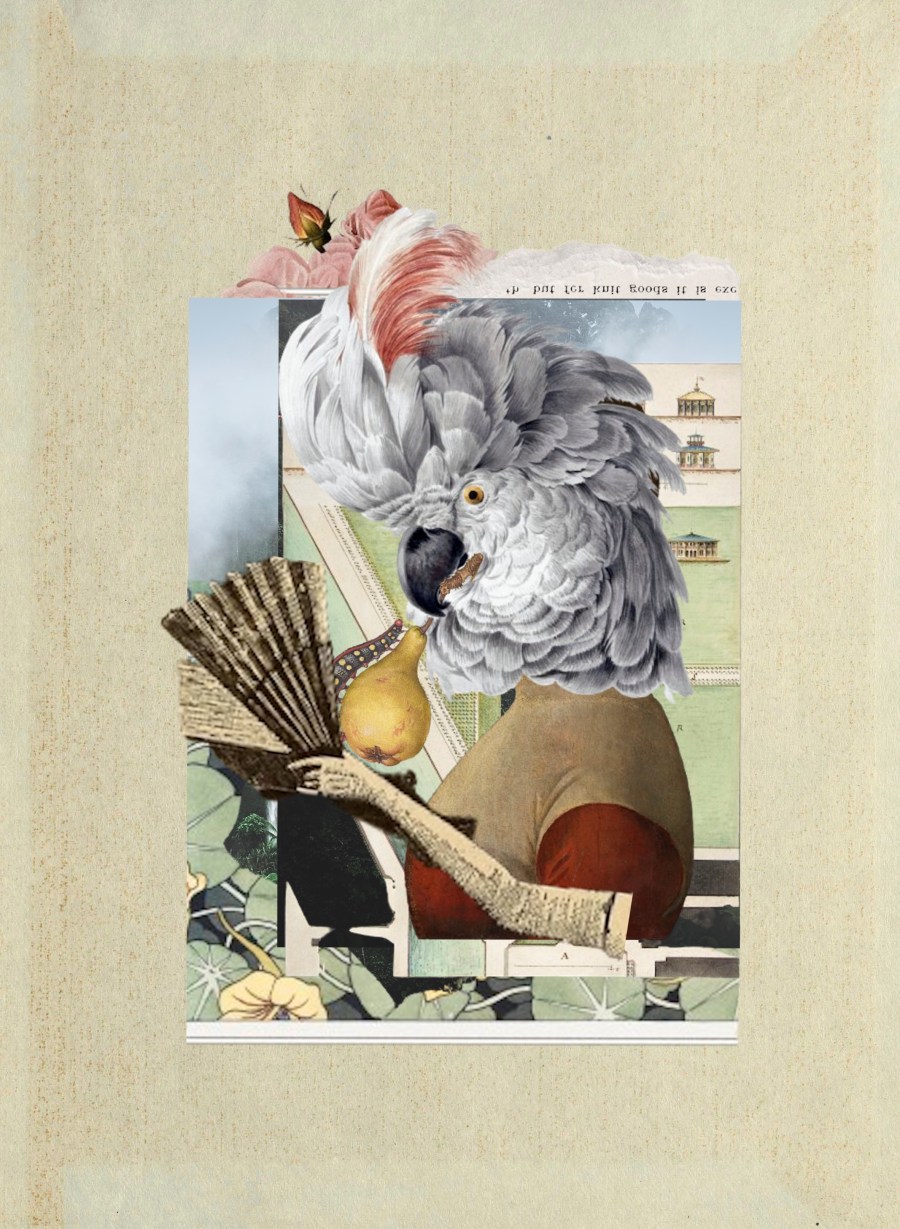
By George Bilgere Featured Art: “Lady Perroquet” by Ana Prundaru
I love this picture of Michael and Alex on our visit to Scotland, what, three, four years ago? Alex is missing his front teeth, so I think that makes him four, or five.
They’re standing with my wife before a palace in what I now realize is Düsseldorf, not Edinburgh, although it might also be outside Lyon, I forget the town’s name and the name of the palace,
but an 18th century king built it as a gift for his wife, who was mad—or no, the king was mad, or possibly they were both mad, although it could be I’m thinking of a palace we saw in Copenhagen,
as I recall there was something about the way the turrets were constructed, or the battlements, that identify it as Danish, I forget what century, but I do remember
the cozy little restaurant we stopped in afterwards, how cold the wine was, how delicious the mussels,
back when the boys were little and we were all together that sunny, long-ago afternoon in now I’m thinking Amsterdam.
Before her stroke, my mother used it to grab a fallen tissue, or the newspaper crossword when it slipped off her lap. Now it’s mine, sitting in my study near an artist’s easel unfolded for years. Squeeze the handles and the grabber’s bite picks up anything light, even a paperclip, with its magnetic lip. Don’t want to stoop? The grabber pulls underwear out of the dryer, or lifts the catch-and-release mousetrap so I can see if it’s still empty. It swipes the ceiling cobwebs, or picks up an M&M or a grape rolled under the fridge. On autumn walks I could use the grabber to yank more yellow leaves off the trees to let me see the architecture of winter below the froth, or maybe, sitting by a window some dark night I might grab a distant star out of the sky, one of those little pinpricks from a galaxy far from our own, where life’s more cheerful. The tiny star would tremble on its way, gleaming and giving off blue sparks as I pulled it down with the grabber, and made it mine.
Hard to pick the moment—first smudge of my smile when my nephew, learning the Earth’s age, told his teacher Grandpa’s old as dirt! so serious, so proud to connect eons with epochs with his own long span.
No antidote for grief, Just walk straight through, mom always said, don’t stop to smell the self-pity. My heart pushing its wheelbarrow dirt and rocks across the overgrown lawn,
Sisyphus New England–style, until one morning I flip through the comic-a-day calendar and laugh, though months and months too late.
Hard to pick where—to untangle one katydid note from the rest in September, synchronous scrumming legs like insect Rockettes. Easier to say it was that first leaf in autumn to orange: unexpected flash among reams of still-
green, precocious student of temperature shifts you can’t unsee, can’t unfocus on once your eye lights it, signal flare that means not help anymore, but a spot to mark, here. The end of something approaches,
I learn first to drop, allot each piece to patchwork air, branches lift, shuck down to simplest selves so you can see them stretch, lengthen, then second: to stand,
in an attitude suggesting peace, not understood by the ever-grinding mind, but held in the core, learning still, learning know that I am, in a far country, meditate on the merits of snow.
His mom and I are slow to form attachments. (We have met your kind before—juniper on pulse points, malt-conditioned hair.) But if you are his last last drink, then welcome to the family. We’ll receive your gifts beneath the tree, set white meat on your plate. There will be no politics at dinner, and I’ll fight to forget you as the Danube— a frothy current pushing those swan-boat kill-me pills across his lips, which landed, by grace, hapless, like a drift of cygnets tickling his gut. If you swear you are his last last drink, then I will pay a cantor and a priest. Father you, as I have failed to father him. Take you at the elbow. wedding march you as my dire daughter, and let him lift the veil.
Saturday night, fourth quarter underway of a close Packers game. Bart Starr era. My dad and I were sitting on the couch in my Grandma Mabel’s apartment. My legs barely reached the footstool that my great-grandmother and I played Chinese Checkers on. But that night, I was watching football with my dad.
He played left end in high school. Leather helmet. No face-guard. When I was seven or eight, he bought a white football so we could play catch in the dark. He taught me how to throw a spiral. Fingers here. Thumb there. But that night, I was watching football with my dad.
It must have been near seven o’clock, Vince Lombardi on the sideline, when we heard footsteps coming down the hall. It’s time for the Welk show! Grandma shouts before she, my great-grandmother Torsie, and my great-aunt Pauline entered the room like an offensive line. That night, my dad and I stopped watching football
so they could watch Lawrence (an’ a one, an’ a two . . . ), his Champagne Music Makers, The Lennon Sisters, and Myron Floren as, no doubt, Jim Taylor went for ten and Max McGee went deep. I never played football, though sometimes when I think about the past I feel like I’ve been hit. But on nights like this, I am watching football with my dad.
When a potato you’re frying hops out of the pan into the unknown space between the wall and the oven you know it’s gone forever. And sure you could get the broom and do a blind sweep, see if you could rustle-up more than a disturbing amount of hair, but you won’t. At least not today, but really not ever because you’ve already moved on. The phone rings, it’s your dad telling you you need to pick up the snowshoes for your trip and he’s making white bean soup with the ham hock he’s been saving in the freezer for this moment said he thought he could throw it in whole but mum said no no you need to cut it off the bone and he sees now how right she is sees now that it’s better this way like the beans he soaked overnight you still have to cook them he says I say yes, I know, the soaking only reduces the cooking time but what I think he means is separately, you still have to cook them separately from the rest of the soup which is another truth. Now, it’s tomorrow and I’m thinking I need to ask him how the soup turned out.
In the photograph that my father has me take of him with the woolly mammoth, he’s pointing to himself. He asks
to see the selfie. I don’t correct his terminology. Next, the triceratops, then the sabertooth tiger. He takes the same stance
throughout the Extinction Exhibit. With the 4000- year-old beetle, 300-million-year-old coelacanth, the dodo. She was beautiful,
he sighs at the butterfly, and I get the sense he’s thinking about Mom. Earlier, in his kitchen, he posed with a jar of mayonnaise
with the expiration date from 1998, also pointing to himself. At the cemetery, he stands on his plot, next to my mother, because I refuse to let him
lie down. Back at his apartment, he says it’s nice to have some company. I know he’s referring to his defunct card game, so we go
down to the game room. He sits at their once regular table and points around the empty chairs, Billy, Dick, Harold, Nat, Frank, hey Joe. He deals
them in. I take the picture of him squinting at the cards, fanned tight to his chest. He tosses a chip to the center of the felt. In the shot, it really looks like
this cheery fever feels like a temporary insanity I was safer in the country of control doling out small pleasures to myself like a wily jailer like a loosie peddler like a guppy’s sphincter this morning I washed tiny newborn bloomers there were no fates scuttling in the washing machine no sheep livers on the drying rack later in the shower when I felt her moving like a bag of cats between my hip bone and my heart I painted a cobweb of Silly String around my fat belly cupped my veiny breasts and crowed not long ago I grew my certainty fresh every day like a liver asked the doctors to look deep at the pieces of my child sparkling in my blood her stars her tattoo I hummed a boy scout is always prepared my daughter heard me through my navel and laughed lying slathered in aspic I clutched at every skeletal preview each glimpse of augury fading too fast a stick of incense on a dark stair I always wanted to be a mother but I thought I’d be an armory a phalanx her stillsuit in a gray shitty world instead I see her hiccup on a monitor and I break open into sunshine completely
Before the suck and stutter of the first breath, even before the first cells hook up for an amniotic float in if not primordial bliss then something just this side of it, there was the want, the desire that begat the pre-child then stuck in a world impossible to remember, impossible not to feel sorrow mixed with joy over my newborn’s eviction from her Eden, her tenderest of faultless flesh now to know the endless hunger, the deep cold of alone, the body a riot of wants, wants unto the last gasp of my mother’s four-foot-nine-inch fierce frame, every inch railing railing against the bait-and-switch trickster’s scythe, her only wish the hunger for more days, more life, and so someone from hospice calls me to come get this inconvenient, angry woman who will not go gentle into that good night.
Maybe he wanted to ask about our cats and dog. Maybe he was curious about how many colleges I now teach for, curious about my job prospects as a poet in a pandemic. I didn’t send him a message— didn’t tell him I saw you on the beach this summer walking with your new partner, didn’t tell him how you looked somewhat happy, how I felt excited for you— I almost ran up to say hi, but I was in my bathing suit and it was our anniversary, or what would have been our anniversary, anyway. Maybe I should write your dad, I’m okay. I don’t know if he would care that our old man cat is dying, that I give him IV fluids, or that I finally fell in love with someone, but she broke like the coffee cup I once threw on the kitchen floor in front of you. Perhaps he’d like to know that I had a biopsy in my vagina and even though I felt like a plank of wood was on my chest with someone standing on it while I waited for the results, it came back fine. I could share how some days I feel this sadness that can make it difficult to bake a potato or how, once, I almost burned your ear with a wax candle or how I still think about the time you gave me a bag of socks with grips on the bottom because I kept falling down our bedroom stairs. You were so afraid I’d break my leg or hit my head or worse, especially after I bruised my butt purple, but love, I knew then what I’d tell your dad now—I’ll be all right.
You remember the evening chill of New Hampshire in the middle of summer and your parents not fighting—your father not packing a suitcase to spend three months among stained carpets at the Willow Motel— but sitting with your mother on the front porch of the small A-frame cabin by Echo Lake where the water was not dangerous and the gathering clouds remained rumbling upon a distant shore while from inside a radio played big band music as your father shuffled cards and your mother tapped her foot and you knew as long as you sat on the front porch swing— as long as you continued rocking with quiet ease— there’d be no cracks in the safety of this feeling that promised if you moved through life so lightly—if you stepped with care upon the thinnest layers of discontent— your parents’ shadows gently cast by the porch light would remain distinct and real and forever before you.
When John Coughlin sings Joey and Steven are tigers while driving the backroads of Hingham, Massachusetts it is of particular significance because Joe has been dead three years and his name has not been mentioned in any of John Coughlin’s invented songs with borrowed melodies since his oldest son was murdered. But of similar significance is that as John Coughlin continues to sing in the fading twilight with his still-living son Steven beside him there’s a sudden understanding— a distinct comprehension— that if they keep driving with the windows down— if John Coughlin keeps singing the names of his sons— the winding road before them will never end.
The four of us—Kathie, Ruth, our mom, and I—drove down to Maryland to visit Annie in the coma hospital where she’d been sent after she opened her eyes and moved one finger. The place was great—therapy six hours a day and nurses like strong, funny angels swooping around her railed bed. One terrifying thing— every week, the team tested Annie to see if she’d made enough progress to stay another week, and if she hadn’t she’d be moved elsewhere, somewhere not so great but nobody knew where, there was no where—we should call our congressman and tell him to do something.
That day was bright and cold. We wheeled Annie outside and sat on a bench by the parking lot, squinting into the winter-low sun amid pocked mounds of plowed snow that had hardened to ice. We chatted in Annie’s direction— about a cardinal in the naked dogwood, about mom’s poodle barking hysterically at a snow woman in the yard, about the balls of yarn slowly morphing into a crocheted afghan on the recliner. I heard us packing the silent spaces, cramming them full of news and pictures. Annie didn’t have many words but she could still make her famous bird face to show a little sarcasm so that made the conversation feel familiar and less desperate. Annie began to fixate on our mother. “She is scary,” she stammered. A kind of miracle— Annie speaking a complete sentence. Our mother blanched, then made a goofy-ugly face. “Scary,” she chimed, waving her gloved fingers. It was the most adult thing I’ve ever seen, the way she swallowed that pain and turned it into a sweet lick of icing, a joke, a little nothing. God it was awful.
Halfway home we stopped for the night at a freeway motel, the four of us in one room. In the lobby, we scarfed down a buffet—honeyed ham and gloppy macaroni salad, dinner rolls spongy and soft as an old man’s belly. There were two double beds in the room and when I plopped on the corner of one, the whole mattress flew up toward the ceiling in a way that I cannot explain the physics of to this day. But I kept doing it, the mattress jack-knifing in the dim room until we were all laughing and laughing—we laughed until we cried we were laughing so hard.
Communication, never our forte: in the ER, I tell you you will be admitted upstairs for observation. You let out an anguished cry worthy of the London stage— This is it, Sara, I’m going upstairs! Your forefinger points up as you give me that knowing eye. It takes me a minute. Not that upstairs! But you swear, this is it, your curtain call, your swan song, the end of your road, your bucket kicked. Still, once on that heavenly floor, you cow the nurses, charm the doctor, vacuum up every last crumb of hamburger and fries.
Years later, on your actual deathbed, you turn red-rimmed eyes to me, barely managing to mouth, I have to go! You can go, Mom, we rush to assure you. Leaning over, I whisper, We’ll be okay. Your face gathers into the shadow of a glare as you try to swing your legs out of bed. The toilet, you gasp, not having the strength to say you idiot. But we can’t let you out of bed; we’ve become de facto jailers, your most private functions now public property, input and output duly recorded, your dignity the last casualty of this war. You give no easy victory to thieving death; not used to losing, you snatch back the breath we think has left you. Laboring for days, your sunken chest rises again and again, while we, your children, fall around you, exhausted. Then you are gone, giving us the slip at the devil’s hour. As we wash your cooling body, your hazel eyes pop open like a doll’s, as if you want to see, as if to insist you are still a part of things.
as she takes off her bra to put on a hospital gown. She motions for me to pick it up off the floor, which still has spots of blood or plasma on it. I glance at her breasts, small-nippled like my own, although one is dented where they did the biopsy. She tells me about that every time, how they deformed her. Then she climbs, regal, into the hospital bed. In the bed, she is pale under the fluorescent lights, although her diamonds wink on either side of her face. Her bedazzling smile is at rest, her cheekbones rise over sunken cheeks, her brow is furrowed, her hazel eyes flutter behind purple lids, her roots need touching up. She’s had work done, but dementia has elided that fact, which seems to me the best of all possible worlds. The gorgeous male doctor comes in with a homely male nurse to report The tumor is bigger and you have to do something. His cobalt eyes lock intently on mine across my mother’s supine body. I imagine swimming in that blue, freestyling, one rhythmic stroke after the other. My weary voice explains We have been waiting weeks to see the oncologist, even as my body is flipturning in his eyes, my nostrils full of chlorine and Coppertone.
None of which my mother hears, as, mercifully, she isn’t wearing her hearing aids. But when the men leave, she slides her eyes over to me and asks Which one was the doctor? The tall one, I answer. She cocks an eyebrow. Fit? The bluest eyes? Yes, I say, that one.
Not that I noticed, she adds, with a shrug and a laugh.
Fifty years ago, a tramp came to our door. I didn’t see him, just heard the rumor ascend the stairs with my clamoring brothers; by the time the three of us thundered down again, there were only wet footprints leading from door to kitchen and back. My mother had fed him, a woman alone with six children in an alien land, wisteria dripping from the porch roof, a green April rain drenching everything. It is the grape-like must of blooming wisteria, its decadence, and the dark empty house, and those glistening tracks that I remember, and the woman with her fierce, generous heart, so that when my doorbell rings today and a large man looms on my porch with his empty belly and full story, I do not hesitate.
She was going in for new valves and a bypass later that week, so my mother asked me to drive her to the bank where she signed a log the branch manager initialed before he swung the vault open and let us into that metallic space walled with rows of numbered doors. His key first in the one with her number, then hers in the other slot, and the steel box she’d earned by her loyalty slid from its shelf. He led us to a private closet with a chair and small table, and when she lifted the box lid there they were—the deed for a remnant of the family farm, the cancelled house mortgage, a copy of the title for the last car my father owned, his 30-year plaque from the slaughterhouse, and a pinky ring with his initials, a certificate for a stock gone bust, her mother’s gold wedding band, the Silver Anniversary bracelet she wore only to weddings, a lock of hair from my first haircut, and under it all, her bridal corsage, wrapped in yellowed cellophane, and while I stood near she peered inside the manila envelopes that held the legal papers, touched each piece of jewelry, the curl of hair, and tattered remains of the corsage she’d worn just above her heart, a desiccated rosebud pierced with a rusted pin.
When you couldn’t hold your head up, we all sat at the black keys, your 6-pound frame swallowed by a nightgown. New to all this, how’d we know exactly which intervals would hum you back into sleep at 8, midnight, 5:25? Verses we’d shrieked or whispered as kids surfaced, out of nowhere. For our own sanity,
we grew our daily rituals: I love coffee, I love tea-eeeee, crooned into morning through bluetooth speakers until we had it memorized. Dance parties to shake off the electricity of worry or bliss, drowning out the refrain where you might really leave us. I fell again
for your foster Da then, how vast his inner library was, finding the song to make you stop crying. Your toothless grin was wide as your face when the trio of us swayed. Soon, you reached toward mouths, added rhythm at the Baldwin with an atonal foot, moan-humming along like
you knew, already, what breath and sound could do inside a body. I can believe in a God who thought up music, can sit down at a piano in an empty house and be saved by something again. I wonder what Japanese artists would say about our old grand, jagged cracks in its lid where a contractor had
a very bad day. Or about your story and ours, no doubt too much in this house and beyond it to lacquer completely with silver or gold.
but in this moment, from your ginger head dipped toward the song of the faucet to your pinked glossy landscape showing off its recent growth rings, what could I be but yours? “To bring up”—
that’s what fostering can mean. And it’s like this: a poem I knew by heart once, framed or carried in the wallets of priests and au pairs and waitresses dared “let the soft animal of your body / love what it loves.” It was written as a simple exercise, not as any lifeline—meant to show a friend how a breath can choose
to break open or rest at the end of a line. Just think what that means for any of us: our beginning can be what we need to keep swimming, or our bodies themselves can turn into dry land.
Selected as winner of the 2024 NORward Prize for Poetry by a panel of previous poetry contributors
After tucking in the kids, we tucked in the house— dishes, laundry, prepping the next day’s meals. When the hush finally settled, we’d get in bed read Endurance out loud to each other.
The ship became trapped in ice the night before his surgery. All that week I tried to get back from the hospital in time to kiss the boys but I failed. I sat on their beds, watched them sleep. The day we got the pathology report,
the men, running low on food, put down their dogs. Radiation all summer. The boys played soccer. The oncologist told him to join a gym, get a trainer, go hard because she was going off-label, tripling the usual dose.
They threw everything overboard, but the ship sank anyway. Anemia turned his skin yellow-gray. His body became smooth as a seal. I watched as he denied fatigue, struggled to untie his shoes, get up the stairs.
Shackleton split the crew, sought help: everyone survived. After we finished the book, we never opened it again. I wonder where it went. Years it sat on the bedside table under the clock: last thing we saw at night, first thing every morning.
Perhaps the last two or three of the type I remember— a tank for the water and ice, and a labyrinthine steel rack to hold the necks of the bottles, a cold flap that a nickel would unlock so you could pull out a bottle— haven’t been placed on prominent display in one of those sadly under-funded, just-off-the-highway, Butler-tin county museums, but, on their broken-down casters have been shoved and scraped over the floor to the back to be stored with a surplus of other heartfelt donations, none really rare, and none of much historical interest— the one-hill-at-a-time hand-operated corn planters, grease-stained lard presses and treadle sewing machines— the pop coolers’ heavy lids closed over stale summer air from the late Forties, their bottle openers still functional, cap receptacles hanging below, though containing no pop caps—no Oh-So Grape, Nehi Orange, Cream Soda— all of those caps pitched up onto the top of the bluff that casts a cool shadow over the Standard Oil station owned by my Grandfather Moser, who as a young man played ball for the township team, who is still throwing those bottle caps, one after another, from the oil-spotted cracked pavement in front of the station, showing off, showing his grandchildren his pitching arm, winding up, lifting a knee, then sailing a cap high into a lost world, partially sealed by the dried rubber strips in the cooler.
When I come in after shoveling that last round of snow—an exquisite parliament of low-slung brightness even in its groaning down toward the ground, I see my sister has texted QUICK THING. So easy to send such airy unplanned balloons. The ordinary flakes saunter down, will not let go, the white weather not yet leaving its filthy will with car tracks and time. I am her shelter. The snow falls as spheres. I like being inside now watching it. I think of the weight of it, the pile-up as it further neatens. The white at its best is a blur. My eyesight is off. It has been two years and seven months since I peered through one of those devices that brush eyelashes. I haven’t heard a doctor circle those disks and ask this one or that one, this one or that. What I see is another day, the wind sucking about. A coyote walks behind the junipers And now its shadow has become an action. The snow comes down, side by side. I am hardly paying attention; my eye no longer holds what it touches. There is so much noise in life. As children, my sister and I played tag during sermons. I could go on about how her notes bother me. The snowflakes are an arm’s length off. It could be the only thing I do: answering her, filling the white void in my hand. Everything comes from further up. When I respond I can talk now, I am saying no one realizes love without feeling this urgency.
Three years now, I still resurrect my grandmother, pull her out of that mausoleum vault and bring her back to life. My life, that is. I know she’s tired and wants to rest, but grief is greedy and tireless. When I pull her back, she wears red, which, for now, is symbolic of Paradise. Sometimes, she is a cardinal, especially in winter when the world needs to be reminded of whatever it wants most. What I want is to take her to Kroger, so she can steal a grape or two. I want to take her to a doctor’s appointment so she can complain about the wait. I want to take her to see a movie so dramatic she will pretend not to notice that it hitches my breath and stings my eyes. Three years from now is unpredictable at best. And resurrection is only a way to drag the past with us, lest we forget. Yes, we forget.
My sister named this venerable maple growing at the edge of the mountain’s gravel road, main trunk long broken, pocked with holes, a once-mighty tree now slowly failing. She’s lost her apical dominance, I say, meaning that when the top broke off, side branches shot up past the injured trunk like raised arms. On the left, one wide kind eye, an open mouth framed by credible lips. Step right, a second eye squinted shut, mouth twisted up, as if she’s yelling at us the way our father’s mother did: imagined slights, our insufferable rudeness, which she thought should be spanked out of us. Mom never laid a hand, which says a lot about her mother, gone too soon for my sister and me to have known. Grandma Baggett and her snarling chihuahuas gone, too, when our parents divorced. No wonder my sister imagines a tree could be a grandmother; she’s been hiding in stories since we were small. I anchored to the safety of science, to cold fact: Trees break. A grandmother can call you Sugar one minute, rage at you the next. Can die without you ever once hearing her voice.
I couldn’t wait to leave town when I was young. After that, I’m not sure I have much of a story. It’s true I met someone. We had a child together. In between I walked across a frozen lake. I drove over a frozen mountain. I ran up a hill to find a pay phone. I closed down the city for extended action scenes to the tune of 290 million dollars. No— I’m thinking of the latest Mission Impossible movie with Tom Cruise. I get confused. I should be writing domestic poetry, but I don’t want to. What more do you need to know? Our family of three live in a third floor apartment. Sometimes we also meet up outside. I guess leaving town is still the most exciting thing I’ve done. The other day I asked another mother on the playground how to clean bathroom grout. I said Stephanie, what’s your secret? Then we ripped off our latex masks, revealing our true identities. No— that mask thing happened in the first Mission Impossible movie, the one I saw with my friend Michelle. I leaned over to say something snarky, but she was fast asleep. It must have been the whirring of the helicopter blades. There’s nothing duller than an overblown action sequence. The secret to having an exciting life is the people you meet. The secret to battling a helicopter in a tunnel is explosive chewing gum. The secret to cleaning grout is a magic eraser from Mr. Clean.
I am reading my book manuscript to my mother in her backyard. She tells me that was probably a catbird I saw earlier. She tells me bleach is the real way to get stains out of grout. The narrative urge is a strong one, she says. She had an invisible horse, but never said she wanted to be one. On that last point, we disagree. Perhaps it was only a feeling I had when we were watching horses in a field. That blurring of beings. Like the colors in a Vuillard painting. A dress turning into a table or an orchard. My college painting teacher said edges are important, but never explained how best to create them. I wanted us to be old ladies together, I say to my mother, meaning me and her. Now we know it isn’t going to happen. But she says she was dreading it—she didn’t want to be here to see me grow old. We decide death comes too soon, in the second section of my manuscript— And speaking of death, how can the deck chair cushions still have a cat hair side, I ask her, now that the cats have been dead for years. Because we’re disgusting old people, she replies with a laugh, meaning herself and my stepfather. Though the truth is I’m the sloppy one. This redbud tree is a new redbud tree and I didn’t even notice. I didn’t notice the new flowers she potted either, lined up with their brilliant blossoms, waiting to be put on the front porch. It’s all one to me: the backyard, the flowers, my mother, me. How can any of it exist without the rest? We agree that I’ve written too many poems, and they don’t go together.
First I found the trapped fox and then we let it go and I wrote a poem about that and then in my weekly online writing group Pamela in Scotland says your fox poem reminds me of Ted Hughes’ animal poems and I think cool and then I read a poem in the LRB written by Nick Laird about praying with his little boy and I like it so much I order his book Go Giants and I print up his bio admiring his amazing hair envious
that his hair’s thicker than mine and then my brother dies and it’s the second worst day of my life and I need to think I have to think the fox that gorgeous beast appeared a few days earlier to guide him to an afterlife and I keep thinking of metaphors about cages and freedom from his schizophrenia and then my husband’s employer sends me sympathy flowers from a company named Foxglove see another fox and then
I solve a Wordle to subdue my traumatic responses to my brother’s death and the word is SNARL which is what I thought that trapped fox would have done like a dog but didn’t but it is what I feel like doing some of the time or bingeing shows or snacking or doing nothing and then I see a book by Julian Barnes on top of my stack of books at the top of the stairs so I start to read it since I’d meant to for years because I love his books and Ted Hughes
is mentioned in the first chapter now more Ted Hughes so I figure it is high time I read more of his poetry but his collected work is so thick it’s a brick on my shelf instead I look up his work online and the first poem is about a fox what what’s with all these foxes and there’s a hyphen in his title so I add one to mine because it needed one I see that now and then I receive that book by Nick Laird in the mail and he gives credit to Julian Barnes for a couple of lines and then I receive an unexpected parcel
in the mail with Billy Collins’ new book Musical Tables inside and in the front he quotes a line by Nick Laird more Nick see these mystifying links between Hughes Barnes Laird and Collins and then my friend in Manhattan texts me a photo he took of a window display full of stuffed toy foxes see more foxes but these are dressed in plaid after Macy’s unveiled their windows for Christmas ’22
and then I see a new photo online of Billy Collins giving a reading for his new book wearing a scarf with illustrated foxes on it more Collins more foxes and a few days later he mentioned on his poetry broadcast that the Prairie Home Companion Christmas Show would be playing that night so I tune in virtually and Garrison Keillor welcomes everyone to The Fabulous Fox Theater more foxes
still plus the brass fox door knocker Ada Limón just posted on Insta my God how many more fox sightings are there going to be in my future it wasn’t my brother’s style to pester me like this I have no answers and yet I thank the gods for each and every reminder of that living warm animal my husband and I let go which may who knows be the thing that peacefully accompanied him
to some afterlife and now it’s 3AM where all this stuff is swirling in my thoughts like pistachio-colored seed saucers that I used to watch from a bridge caught in the local river’s eddy on my early morning walks hoping to clear my head which sometimes worked or didn’t and I just lie here thinking about pistachio-green and how its complementary color is a certain shade of purple and then I think of purple hearts
and how valiant my brother was see my brother and then I recall the framed album cover I gave him of a vinyl record we used to play The Valiant Little Tailor because Taylor is our family name and I remember how he was his own kind of sixty-three-year-old soldier rescuing his other selves for decades from battlefields that were visible to him but not to me no matter how hard I squinted.
I don’t care what the tastemakers say — you can’t beat nostalgia for a flightless bird worth riding a little.
It’s still a hayabusa running the underbelly of thunderheads or weaving through the innerbelt. Or it’s the corner kid freestyling through a smile as silly and joyful as a French horn solo.
What I’m saying is I’ll run with any good thing, and now I’m reckless in my empathy. I’m more than a budding corpse in the wild waiting to be born into this ceremony of dust.
For tonight, my heart’s the size of a wedding and I’m in league with the last of the lamplighters because my son is still alive and nothing’s coming for his lungs as I slow dance him to sleep.
In the photograph my mother is ten; she poses in a ruffled dress and hand-me-down coat that swallows her arms the way shame swallows people whole.
Lost in the oversize. Standing near a clapboard porch. She knows she is poor, one of the poorest; her shoes are too tight. Other children tease her about the key around her neck.
My mother makes drawings of what she can’t buy; it will take years, and thousands of dollars, for her to learn that money does not make her happy.
In the photo, my mother smiles upward like the glamorous people in magazines. She tapes sketches of stars to her wall, studies them before she falls asleep.
II.
My grandmother sews clothes for my mother; she doesn’t need patterns, she has learned to make things on her own from what her mind can see. My grandmother is a bank teller, on her feet all day; tellers are not allowed to sit. Only night belongs to her. My mother hears the machine, an animal that growls in the dark.
III.
My mother’s walls are rich in the way my daughter’s walls will be, covered in desire. My daughter will labor over vision boards, collage pictures of people and places to help dreams come true, what vision boards can do.
My daughter will stack magazines by her bed, take scissors to girls playing sports with those beautiful bodies, magnificent boys with interested eyes. Picnics – dances – all the weddings – cut out –
IV.
Sometimes, awake with my own futility, what I can’t do for my child, I will picture the grandmother I never knew, bent over small light, laboring. How many hours to stitch ruffles?
V.
Standing, my mother crosses her legs, an awkward pose, perhaps one she has seen in a star. Balanced forever. Pinned to a wall.
My job is to mow. My job is to coax the prairie around my mother-in-law’s house into green chaos, then decapitate it on Friday till it looks like carpet. My other job is to say dang it’s hot and enter the kitchen and sip juice and nuzzle my beloved at the stove when her mother’s back is turned—an eighty-seven-year-old back but still super quick. My beloved has her own job—open and close the fridge, push me away, and keep some things cold like cucumbers and Gouda and yogurt, and others hot like caramelized onions and yesterday’s sweet and sour, and pretend her mother’s Alzheimer’s is a shrine we’ll visit someday like the Taj Mahal and not daily triage. I still have other jobs, like having cancer cells burned from my face at 3:00. Or is it 3:30? I check my phone. Oh good, 3:30, more time to decapitate the prairie and sip juice and maybe swim slippery laps at the rec center.
And he admires that probability. It’s far more likely than the chance of us being here as who we are; someone calculated that as about 400 trillion to one. He admires this, too, and how the sun
sits on our shoulders right now. Under the eaves of that sturdy-as-hell roof, the common ariel hornet tucked her nest for the summer. I was about to describe the season as brief,
but that is only how my stuttering synapses process time. So, I assure myself that my father will live damn close to forever, with a quick sidestep to knock on the closest tree and shush
any wisp of a god still hovering nearby. The bit of sun moves, so we move. Dolichovespula arenaria probably notes where our ungainly grounded bodies take up space
I cut the crowd loose, I stack the deck twice I feed you shrimp cocktail I sort through the loose mail When it rains, it worms and we blow the house down Wishing on the wick I am the boss of this clique!
My uniform is a pebble, my mouth Hums trouble. All I do is stay inside One-legged, I hide In the clutter of my mothers Turning red with permanent marker Wasting hours with Colonel Mustard
Eating ring-dings for dinner Singing happy birthday forever On Facebook, searching father Then deleting my browser Faceless, I cower and wave to the mirror Eating the angel hair of the dog
I am learning to bake curses the way my mother did with paprika and clotted cream. Her recipe book lists fifteen steps and she’s added three more, her instructions scrawled on pages brittle as phyllo dough. I trace my fingers over every word and try to understand the significance of Simmer on Low. I’ve heard that if you heat a kettle gently, a frog can’t feel the water boil. But what to do about the grumble from the dining room, the hungry command to hurry up? Nothing my mother served could please my father, who poured Tabasco into a slow-cooked stifatho and called her a stupid cow. I lean against the round shoulders of the old refrigerator and listen to her murmur. I’m grown now and married and need to know–– When is it time to whisk, when to fold, when to toss with newts and toads?
Not the baby but the baby’s clothes defeat me— the cunning socks, the piles of onesies. A descant to the washer’s thrum, the strains of Pagliacci drift in from the study, dislodging a memory: a stormy weekend stranded at my cousin’s, the window wells filling with snow like the heaps of dirty laundry my aunt was sorting in the other room. Around us spread the scraps of paper dolls we’d wangled in the market, peeled now, and finished like our tangerines. We’d tired of mimicking Corelli whose whooping rose above the drone of the dryer where my aunt and uncle’s shirts embraced. “There isn’t anything to do,” I whined until my aunt emerged, a bar of Naptha gripped in her raw hand. What struck me was not her slap, nor even the stunned giggle before my cousin got hers like a portion, but the tenor’s voice dissolving in sobs, and the Clorox, smelling as a perfume might, if she had splashed it against her wrist.
After our son died, my wife found him in coincidences—sightings of hawks, mostly, at the oddest of times and places, and then in a pair of redtails that took up residence, nesting in a larch above our barn, and how their low, frequent sweeps just a few feet above us before rising over our kitchen roof made it seem as if they were looking in on us. In a way, it all made sense, our son so at home in high places—the edges of mountain trails, walking on a roof, or later, after he became a house painter, at the top of a forty-foot ladder. So many mornings we woke to the redtails’ jolting screeches and, even if I was a casual believer, their presence multiplied my love for the ordinary more every day. We never thought, of course, any of those hawks was our son— who would ever want that?—but, once, watching one rise and rise on a draft of air, I thought of Icarus soaring toward the sun— as if an old story could provide the distance I needed—waxed and feathered, his arms winged, and remembered a babysitter’s frantic call to come home, immediately, after she’d found our ten-year-old nearly forty feet up in an oak tree. I can almost hear him again, laughing high up in the sky, throned on a branch, his feet dangling, knowing nothing but the promise of heights as he waved to me— and I must have looked very small calling up to him, staying calm so falsely as I pleaded with him to come down, to come down now.
I’m up at 6 A.M. to write, but all I do is stare at the rain and the trees and watch the wind strip away what remains of November’s leaves. Somewhere in Virginia, my father is dying. Not on the sidewalk of a sudden heart attack from shoveling snow, or in a hospital room monitored by nurses and beeping machines, but at home, alone, and almost imperceptibly from a sluggish, inoperable form of cancer. That man was never satisfied with anything. When leaves were green he wanted them red, when red then brown, when brown then fallen and gone. Once, after making me rake them into a curbside pile, he tossed in a cinderblock meant for the local punk who’d been plowing his 1982 Camaro through the heaped up leaves of our neighborhood. Two days later, the kid blew through our pile without suffering a scratch. My father didn’t realize that I, fearing for him as much as for the boy, had fished out the brick and chucked it in the ravine behind our house. As punishment, I had to climb down in there, retrieve the cinderblock, and bury it in the leaves after I’d raked them back into a mound. My dad said that was nothing if I dared to take it out. I can still see him, stationed at the window, watching and waiting for that boy to return— but he never did, because I tipped him off the next day after spotting him at 7-Eleven. Decades later and hundreds of miles away, a malignant brick buried deep inside him, my father still waits at the living room window, listening for the death rumble of that blue Camaro.
Sundays they’d meander down from surrounding hills to the watering hole just south of French Creek, where it joins the Allegheny, maybe twenty, thirty on a good day in summer, the fog in no hurry to lift off the river, & if I were visiting, my father-in-law would take me along, because this was the rhythm of Venango County men, week after week, season on season, for the members who hadn’t lost wives to dementia, cancer, or a cheating heart, a chance to get away from the women, bullshit, maybe win some money in the big drawing,
the Iron City flowing & Wild Turkey, not yet noon, a thumb-flicked Zippo, cover clicking back, scratchy rachet of the wheel, flame-sputter, flame, head bowing, a face sudden, illuminated, the long fhhhhhhhhhhh, with smoke stream, & a story would begin:
an Army jeep bouncing into a bombed-out Rhineland town, & in an old church cellar, great shattered wine casks, you drank as you sloshed through it, dark, fuck-cold; someone’s uncle down the Mon Valley, the Gold Gloves boxer who lost an arm; a lieutenant’s first whorehouse. That was the talk, and everything was Eddie, almost whispered, a shibboleth: duck boots, fly rods, the Eddie Bauer Ford Bronco—Elks Masonic to the nth degree.
Laugh, move among them, wear the flannel, stand them a round—still, I carried the scent of a distant country. One slight shift of wind & heads would lift, the circle tighten.
My sister says I greeted the swarm along the backyard slope, crawling, fat mouth slack, sodden Pampers saggy with supplication. Evidently, she scooped me up while they chased us through our father’s lavender azaleas where he dropped his shears and smashed yellow jackets against my skin, yanking off the diaper and waving it around his head like a lasso. We won’t get spanked again until winter. Everyone watches my sister declaim the tragic tale at family gatherings for decades as if she’s Dame Judi Dench. They love her nuanced performance, the lively hand gestures and operatic voice, how she tousles my hair before her triumphant finale: I got stung on my mouth, but he got stung in his asshole! I’m always grateful Dad isn’t here to witness this, or my marriage, or my career, or my incompetent gardening, the limp cosmos. I can’t believe you, a cousin smiles, shaking his head. Me neither, I reply. I don’t even know what I did.
Featured Art: Children Playing on the Beach (1884) by Mary Cassatt
As I get you down from the closet shelf and unwrap the brown shipping paper to the square white box inside I lift the lid for the first time and stick my fingers deep inside you / What does she feel like Barbara says and I say go on see for yourself but she shushes me and leads the way out back to where the creek used to run and we just do it quickly without any words because words are a foolish way of asking forgiveness for these five years we’ve left you up there stacked amid the empty shoe boxes and children’s playthings / But now with both hands I swing the box like sand in a pail and scatter you into the overhead cave of the old Judas tree where your tiny parts glow for a flickering moment like early snow / And Barbara whispers yes Patsy I know still trying to find your way home again just like the whole rest of your life without somebody’s arm to hold on to
By George Bilgere Winner, Editors’ Prize in Poetry: selected by J. Allyn Rosser
Featured Art: Mounted Model of a Polar Bearfrom United States National Museum Photographic Laboratory
A father died heroically in some Alaskan park while trying to save his kids from a polar bear.
Long ago, when his mother gave birth one summer afternoon in Bakersfield, California, could anyone have prophesied, as in an old myth, that the baby crying at her breast would one day be killed and partially eaten by a polar bear?
Has anyone from Bakersfield, California been killed and partially eaten by a polar bear? Yet her son was. He looked up from making camp, pitching the tent or lighting his Coleman stove, and there it was, white and immense. His fate.
And he died heroically and was partially eaten.
Of course, the bear had to be killed. The rangers shot it, which makes sense. You can’t have polar bears running around in the wilderness! The wilderness is a place for dads and kids and Coleman stoves. Polar bears just . . . they just kind of ruin the whole thing.
As for the bear, it didn’t die heroically. It just got shot and fell over and was sent to a lab for testing.
Featured Art: Bats by Jason Douglas and Wendy Minor
I worry what it says about my character, that I cannot picture the reality of sickness, I just wake and read Whitman and watch the sun on the brick of the next-door apartment. I have three cans of chickpeas, freezer-burned strawberries, half a bottle of wine. You have a stronger sense of the anthropocene. You buy soup, talk with your father. You know microbes are alive as they move across the grid. And in France each small town has a street named for Pasteur, who made men dig drains, convinced them to stop spitting. I wash my hands with hot water. I don’t want to be clean. What does it say that I am fully on my knees to this, that I admit such weakness willingly, that should you want company after any of your transatlantic flights I would take a cab immediately to your red and burning door.
You start to grow old so fast, you notice how much you love home. Home means a local mall, it means a place with a little Thai stand with all the world in the pocket.
You walk in with mystery. People ask you with curiosity if you’re a student, if you work, if you have kids.
You laugh with charisma. You say you’re looking forward to all your time in the world. London, maybe, next week. But next week never comes. Today just has too much of you in it.
But you’re adventurous, right? You order a new thing everyday. A meal that can be held in your hands, it is the best part of your day. It’s the biggest pillar of your lunchtime.
One day, you have a beautiful combo. Pineapple and shrimp, rice and chopped veggies. It’s perfect. It’s yours,
you eat it more and more each next month, every other day, every day. You gorge yourself in it, you start to smile more and more each time,
they start to cheer whenever you come over. You ask, do you know me, and they say yes! of course we know you! They’re all so happy, you’re family now.
But they stop asking about London. They stop asking where you’re going, they suddenly have all the jokes of a lifetime to tell you.
And they stop asking for your name, they don’t need to know what it is to know who you are.
It contained home movies where he wore goggle-sized glasses, a toweled shoulder holding a small redhead at a birthday party, three hours
of ripped paper like static on a radio, the sun flaring off the ripples of the neighborhood pool. What do those thieves think of your soccer games,
the Go girl! and the rain that drove him cursing to the car? What about last Christmas? He was too tired, so you held the camera instead and closed in on his drooped head
nodding while everyone opened gifts. Would they tear up thinking of their fathers, would it convince them to call more? Ripped from your life, just a plastic box in a bag of stuff.
Maybe before wiping it clean, they will browse your home movies and say, What a good father, what a good life.
He’s in one of his funks again, my stepmother’s warned me, hair shaggy and mussed, baggy clothes afloat on his skinny frame.
My father makes hardly a dent in the overstuffed sofa he’s sitting on.
No, he’s not hungry. No, nothing in the paper interests him. No, there’s nothing I can do
but stare blankly into the distance where he’s staring
as I did sixty years ago when we hunched shivering and silent on five-gallon buckets flipped upside down on the ice of Cedar Lake, waiting for a tiny red plastic flag to snap to attention.
Now and then, we would stand up stiffly, huffing and hugging ourselves, stamping our feet, then skim the slurry from the augured holes and sit down again, nothing to do but wait, testing our wills against the deadening cold
and the wily old lunker pike we pictured
in the black, still depths below, impervious to the booted thunder rumbling overhead, hunkered down, hovering in its singular darkness, grim, stubborn, defiant.
We walk in on Thanksgiving, trash bags filled with clothes slung over our shoulders. Heather insists I break a twenty at McDonald’s. I buy a dollar cheeseburger, eat it as the cashier counts out the nineteen dollars’ worth
of quarters. No one else is there. Neither of us bothers to separate the whites from colors or obey the posted sign that says we shouldn’t
sit on top of the washers. So, we lie back, discuss the different shapes the ceiling stains resemble: a butterfly, atomic bomb explosion, ruffled
curtain, deep red crayon melting down the wall. We don’t want to go home. Three streets over, our parents wash the dishes, hit their joint again, and pack the leftovers
away, while their two daughters hope the dryers won’t really dry the clothes in fifty minutes. We drag them out. Heather insists we fold the underwear.
After talking with him for thirty minutes, as he lay cocooned in a thin wool blanket, I told my father I had to head back to Conway.
He turned his ashen head a bit and said, Conway . . . that’s where my son lives. I met my sister’s eyes before fixing his in mine to say, Father, I am your son.
His eyes widened in that way that makes us say, You look like you’ve seen a ghost, or as if he’d found himself the quarry of a hunt.
I touched his hand before I left to show him I was real. I think I could have walked through walls to get to my car, so grateful was I to be that ghost.
I walk down my neighborhood street called mountain although there is no mountain only rolling hills although hills don’t really roll & as I look at a window display of shoes & pass by the candy store a gasp happens in my head a quake in my heart they aren’t here my father who loved sweets my mother who loved shoes & the sun shines on a world of orphans I quake along mountain street like a rolling gasp although if someone asked how are you I’d say fine like most of us are & aren’t I thought sadness was a prison but it connects us & if a chain it should be one of tenderness my father died two years ago although sometimes I say a year a way of keeping him closer can’t do that anymore with my mother need math on paper the ache woven into each leaf although there are birds & nests we live in a tsunami waves of being & non-being but I’m no philosopher standing at the counter buying bunion pads feeling drowned & drying under fluorescent lights & warmed by the smile of the clerk who blesses me with have a great day as I go out to mountainless mountain & remember donovan’s song playing in my parents’ house in the sixties first there is a mountain then there is no mountain then there is
Heads thrown back after one bubbly sip—the young in soft drink commercials seem as lavishly happy as lottery winners. They look the way we imagine ourselves on the stages of our dreams—glamorous, anointed, spotlit—our luck about to spill into graciousness.
And even in ads for walk-in bathtubs, incontinence pull-ups, stair chairs, dementia care, the actors don’t merely grin and bear it, but almost chortle, like Cheshire cats who just swallowed these amazing canaries, though the old they represent are more like expiring birds.
But the worst soft pitch: the “personal” Christmas pictures taken in the dementia wing of my father’s “retirement home.” In another life, his face would say This is ridiculous, even if he played along, and sat in the appointed armchair by the tree, and hugged the enormous white teddy bear prop, as instructed. But he is in this current life, and guilelessly presses his warm cheek against the bear’s fuzzy one, and stabilizes the bear’s plump feet with his free hand, as if they were a child’s.
Featured Art: Ancient Roman Ruins by Giovanni Paolo Panini
–Rome
1.
My father fills a syringe with insulin, pushes the needle through his shirt into belly skin, looks through the window at his dying lawn. He writes a note to me: Summer’s early here, bud. Your mom’s still on me to lay off the Snickers. She means well, of course. The oak tree’s about to go—groans all night long. Caravaggio is one of my favorites. A sensitive scoundrel. Go see Conversion On The Road To Damascus. All is of Grace, Dad.
2.
Four lions stick out hollow tongues in the middle of Piazza del Popolo. Each tongue spews water—spilling down stepped plinths into four collection pools whose surfaces are mildly disturbed but never overflow. With their perspective of stone, the lions have remained unmoved for 200 years. How, I wonder, can they gaze without weeping at the sun-burned stoner strumming a distorted “Stairway To Heaven.” I stumble from one to another, dropping coins until my pockets are empty.
3.
When he baptized me, my father’s robe floated up around him like the wings of a manta ray, revealing the soft skin of his shins to the believers. We stood in a glass tank, with nothing to hide. He covered my eyes with a handkerchief, dipped me backwards into new life. I trusted his strong arms more than God.
4.
Fountains fill my photographs: pissing cherubs, horses with fish tails. Granite seashells emerge amid glistening mermaids— breasts taut in the exquisite way stone has of lying about flesh and time.
Featured Art: Evocation of Roussel by Odilon Redon
The letter came back from the post office so mangled it was as if the mailman had plucked it out of my box before being jumped by a clot of street thugs. Then, still carrying his mail bag, stumbled into a bar because it was the third time this year that he’d gotten jumped in my neighborhood, and why do guys gotta pick on him just because he’s short (under five-six don’t make a man, his father always said). Then drank scotch and soda until the bartender made him stop, walked the dimming summer streets in search of his truck, slept in a doorway, woke up and vomited into his mailbag, found his truck and skulked home to his wife, who had sent all four children to the neighbors and was waiting up in yesterday’s clothes, with a suitcase and a left hook brewing. Because she hated the late hours the USPS forced him to carry, and by “late hours” they both know she meant his cheating with the tiny Castilian woman two zip codes over, and this thought that poisoned her days now propelled her to stomp on his mailbag and kick it off the porch for all that the mailbag stood for: the overtime, the philandering, the childless Castilian with the twenty-two inch waist. But then when she saw his face with his eyebrows tipped and sorry, and she knew that he hadn’t been sneaking around, but had gotten into trouble, she sat him down, fed him coffee, and washed his wounds before sending him back out for his morning shift, because they both needed him to keep this job (there was a pension attached, she had secretly started divorce proceedings, was hungry for the alimony). And so he got back to work and wiped off the fouled, wretched letters in his bag, feeding them through the system before getting called into the supervisor’s, and because the letter was wet, it got mangled in the maw of a sorting machine, the address smeared and clotty, the stamp curled and dystonic, and three weeks later, once the mailman was off probation, the letter came back to him, smelling like machine oil and vomit, clawed and shredded, stamped “Return to Sender,” and he shoved it back in my mailbox with bite marks from the beast that had mauled it, this letter to my father on his deathbed, explaining why I wouldn’t be going to see him.
As my father hands me a bouquet of roses dyed the shade of a dozen sinking suns, my mother grasps his steady arm, teetering. Her body has begun its slow revenge for what it begrudged all along, and she’s afraid to walk since her last fall, which snapped her hip in half. My father is tired of holding her up. He scolds, Just take it. Her hand shakes as she holds the iPhone to get a photo of me in my mortarboard and hood. Let go and take it, he says, and she tries a one-handed snapshot, her trembling arm still looped through his.
I stitch a smile across my face. The phone flashes. As she grips his wrist, I can hear him in Greek, the language reserved for anger and, once, for sex. The language they speak and still think I don’t understand. Can I live this way, Tia? he asks.
I clutch my bouquet to my chest, trying to pretend these flowers aren’t lopped off at the stems. Trying to move into the next phase of realization that love is unsteady on its feet. That two people can resent each other, but care for their daughter and each other enough to stay put. Refusing to wilt into that place I’d go as a child—when I’d hear their fights and retreat to the backyard to play with cats, praying to make something else of myself, however small—I stand tall. How can I live like this? he says to her again. Still, I’m posing, smiling into the face of their slow decline. And all three of us trying, best we can, to hold each other shakily, and steadily upright.
By the third martini, he’ll ask her to marry him. She’s a tourist, he’s a captain, home by chance. I stand at the window, watching. I want to walk into that bar, order an ouzo, and tell them that, together, they’ll create a new generation of pain. I want to tell him to court the island girl, the one who, forty years later, will see him, run to the restroom, and return with a fresh coat of lipstick. I want to tell my young mother, in the words of the great North American philosopher, Pamela Anderson, “Never get married on vacation.” But this is long before Pam and Tommy Lee, before I existed. Before Reagan reigned over his long line of wreckage, and couples shot themselves, together, in their cars. The Vietnam War has ended, but here I am standing at the window, watching while they meet, both oblivious of wars they’ll wage. They’ll move from Greece back to the Midwest—she’ll drink, alone, in her kitchen. He’ll return to the island every chance he gets. When he’s back in Illinois, he’ll stare into the aquarium and long for water. She’ll look at him, frozen, behind her highball glass. Still, I stay at the window of the bar, wanting to use Pam’s biting wit. But this is long before Baywatch, and they’re gazing at the bay. I tap the glass like Morse code. Sealed in my own tank of silence, I say, Please let go. But as they take each other’s hands, I softly touch the pane and turn away. Because they, too, have the right to plunge. Even if they’ll swim out too deep: holding onto each other until death.
Written on the side of a payphone lashed to the wall of the bathroom in a Montreal café is Annie Oakley’s telephone number. I see it while I’m peeing. That’s how close the payphone is. Annie Oakley in black marker and then her number. I’ve only touched a gun once. Or maybe I didn’t touch it, I just thought about touching it and then said, No, thank you. It was my father’s gun. It was small, perfect for fitting into a lady’s hand. Is that called a .38 Special? Annie Oakley would know. I didn’t grow up with guns. I didn’t grow up with my father. People sometimes think that is a great tragedy. I did grow up near a little lake, beside which lived two goats and a horse. In spring and summer I would walk with my sisters the dirt trail overlooking the mountain to the gravel path to the stables. If the goats were out, we’d pass them cabbage through the fence. Back then I thought the greatest tragedy was August ending or my eighth-grade crush dumping me for a girl with nearly my same name. I’ve always had trouble locating the appropriate level of sadness about the father thing. I’m not saying it doesn’t register. I’ve just known from a young age there was nothing to do about it. Here is me. Here is my father. The distance between us could be as close as me to this payphone or as far as the mountain felt from the lake. Either way it changes things. Either way it’s done. Annie Oakley shot a squirrel’s head clean off at age eight. It was her first shot. Here is me, I hear her saying. Here is the squirrel. Right through the head or right through the thigh or right through the gut. Either way it’s done.
They’re so meticulous, aren’t they? They take such care that I am ashamed for my country, that impatient farm boy, that factory hand with the sausage fingers. First there’s the fragile object itself—vase, jewel, ornament—then tissue, stiff paper, bubble wrap, tissue again, tape, a beautiful bag made from something more like gift wrap than the stern brown stuff we use here in the States, then the actual carry bag
that has a little string handle but which is, in many ways, the loveliest part of the package except for the object you can barely remember, it’s been so long since you’ve seen it. In America, we just drop your trinket in a sack and hand it to you. Oh, that’s right. We have cars in this country: whereas Stefano or Nathalie has to elbow his or her way down a crowded street and take the bus or subway,
you get in the car, put the bag on the seat next to you, and off you go, back to your bungalow in Centralia or Eau Claire. Of course, this doesn’t mean you’re culturally inferior to Jacques or Magdalena just because, as Henry James said in his book-length essay on Hawthorne, we have no sovereign in our country, no court, no aristocracy, no high church, no palaces or castles or manors, no thatched cottages,
no ivied ruins. No, we just do things differently here: whereas Pedro and Ilsa take the tram or trolley, you have your car, and now you’re on your way home to Sheboygan or Dearborn, probably daydreaming as you turn the wheel, no more aware of your surroundings than 53-year-old Michael Stepien was in 2006 when he was walking home after work in Pittsburgh, which
is when a teenager robbed him and shot him in the head, and as Mr. Stepien lay dying, his family decided “to accept the inevitable,” said his daughter Jeni, and donate his heart to one Arthur Thomas of Lawrenceville, NJ, who was within days of dying. That’s one thing you can say about life in the U.S.: we have great medicine. Mr. Thomas recovered nicely
after the transplant, and he and the Stepiens kept in touch, swapping holiday cards and flowers on birthdays. And then Jeni Stepien gets engaged to be married and then thinks, Who will walk me down the aisle? No cathedrals in America, says Henry James, no abbeys, no little Norman churches, no Oxford nor Eton nor Harrow, no sporting class, no Epsom nor Ascot.
Since my dad was blind by then, when David and I led him from his apartment to the tee of the shrunken one hole golf course that served as kitschy courtyard for the complex of retirees only well-off enough for this unironic aping of the rich, it was by habit only that he looked down at the ball he couldn’t see, then up and out into the void of stunted fairway and green while first this foot then that foot patted the fake grass, almost kneading it cat-like till the tight swing arced the ball up high
as the second-story windows and I swear it was like a trick ball the pin on an invisible line reeled in straight down into the hole—his first and only hole in one, on the last swing of a club he ever took, though we didn’t know this then, and how we whooped my brother and I as we jumped and capered throwing the other balls up into the air while the old man baffled said what? what happened? what? already wistful for this best moment of a life it was his luck the blindness made him miss.
And now it’s my luck, isn’t it just my luck, to be the last one remembering, as if I’m not just there with them but also far removed above it all and watching as through the block glass of an upper-story window high enough for the ruckus not to reach me but too low not to see the filmy blur of bodies hugging one another pumping fists as arm in arm the three of them head out across the fake grass of that single hole.
Wind hits the cliff face and climbs the palisade as three men at a slatted table play cards. Two wear hats. A third faces the sun and smokes. All three are gray-haired, but none is my father. He wouldn’t have played without scotch on a Sunday or sat on a park bench, anyway.
2.
A man holding a child speaks to her in Mandarin as he touches a small seat attached to the back of a bike. He pats handlebars and points to spokes, saying bike every twenty words or so, then taps the front wheel gently, the way you would touch the shoulder of an old friend.
3.
Some Sundays even if I’m not near the bay, I imagine my father playing solitaire at a slatted table as I lean over the cliff rail, watching waves that grapple with the beach as they leave it.
On the bike path below, grit spins under a stream of cyclists as a man wipes a child’s tear with the edge of his sleeve and speaks to her in a language so soft and low the bay curves like an ear to hear it.
Featured Art: The Bathing Hour, Chester, Nova Scotia by William James Glackens
This morning, doing the laundry, smoothing collars and shirt plackets before placing it all in the dryer, I saw the ghost of my recently dead mother, her red-capillaried face looking on approvingly in the steam.
I didn’t expect to see her, and some of this must be pretend, but she was there, making a place for herself over by the baskets, in the light that fell through the windows at an angle that never seemed to change.
We got to talking—who doesn’t want to talk with the dead again when it’s morning and mostly sunny?— about the telephone pole in our old backyard, and the sound of the pulleys and ropes that carried the wash in and out.
I was lingering over the way a drying sheet took in a breeze and released it as if it were breathing, but my mother chattered away non-stop, moving as she always did, from topic to topic without transition,
only pausing here and there to punctuate with one of her sayings— Doing the wash makes you happy. It says you can begin again. And unlike when she was alive that seemed true. As the light’s angle
sharpened, none of our mistakes, our fights or failures, the old argument about Dad—or even the ridiculous, proper way to fold a bottom sheet—held us back as we finished the first load of darks.
And by the time she held a shirt by the shoulders, folded it in thirds, then flipped the bottom half under the top and laid it in the pile for the living, I was whistling, caught up entirely in the rhythm and pace of our task.
Someone has to identify the body. The funeral facilitator, Jeanne, gestures me into the room and clicks the door shut behind me.
You finally got your wish, I say to my mother. She’s wearing a shade of lipstick that unbecomes her, a subtle peach she would have hated. Her face is her face and of course is not, her hair parted in the middle, a new look. Her hands, composed across her sternum, are the color of parchment, skin thin as vellum.
I don’t stroke her arm. I don’t kiss her forehead, as I thought I would. Instead, I wonder, oddly, if the funeral people use the same gorgeous quilt that covers my mother now, with its sunbursts and bluebirds, for everybody.
When I think I have stayed long enough, Brahms trailing off in the corners, Jeanne is sitting outside the door, her long fingers forming a steeple. I want to say to her I have no idea who that is, I’m sorry, but levity isn’t encouraged here. Although I would only be speaking the truth: Alzheimer’s riddled her brain and sucked the marrow from her spirit; she became a stranger and a stranger to herself. What else was there to do but believe along with her that Hoss and his Bonanza brothers were indeed aliens from another planet, that Pat Sajak was “in on it,” along with everyone else who came and went in Mom’s room, stealing her clothes, her makeup, the nursing home grand conspiracy . . .
I’m sorry it’s taking me so long, Mom said in a rare lucid moment last week, and I had nothing to say, and I tugged the blanket snugly under her chin, and I handed her the plastic cup full of water which she waved away.
By George Bilgere Featured Art: Long Exposure Coupleby Jr Korpa
I walk past Erin’s house at dusk and there she is at her kitchen table, working on her book about the Reformation.
She needs to finish it if she wants to get tenure, but it’s slow going because being a single mom is very difficult what with child care and cooking dinner and going in to teach her courses on the Reformation, which I can see her writing about right now, her face attractive yet harried in the glow of her laptop as she searches for le mot juste.
Meanwhile Andrew, her nine-year-old son, shoots forlorn baskets in the driveway under the fatherless hoop bolted to the garage by the father now remarried and living in Dayton, as Andrew makes a move, a crossover dribble, against the ghost father guarding him, just as I did when I was nine, my daddy so immensely dead, my mother inside looking harried and scared, studying thick frightening books for her realtor’s exam.
And although I hardly know Erin, I feel I should walk up, knock on her door, and when she opens it (looking harried, apologizing for the mess) ask her to marry me. And she will smile with relief and say yes, of course, what took you so long, and she’ll finish her chapter on the Reformation and start frying up some pork chops for us
as I walk out to the driveway and exorcise the ghost father with my amazing Larry Bird jump shot, and tomorrow I’ll mow the lawn and maybe build a birdhouse with the power tools slumbering on the basement workbench where the ghost father left them on his way to Dayton.
I will fill the void, having left voids of my own, except that my own wife and son are waiting down the street for me to come home for dinner, and so I just walk on by, leaving the void unfilled, as Erin brushes her hair from her face and types out a further contribution to the body of scholarship concerning the Reformation, and Andrew sinks a long beautiful jumper in the gloom.
Featured Art: [Villa d’un Chiffonier (Ragpicker’s Shack)], 1920by Eugène Atget
I saw you, daughter, sneaking a garbage bag of my treasures into your car. Those heaps of eyeglasses are art.
Never mind the cracked lenses and broken hinges, the bent frames. Some day I’ll make a sculpture or hanging lamp. I’ll make a mobile.
The broken picture frames and dried-out pens. Even the bottle caps beg to be known. And how patient those stacks of hotel soap. Waiting. Just in case.
Yes newspapers haystack the walls. But it’s all there: knowledge at my fingertips. The postman will bring more.
There is an ocean liner inside my heart that waits to set sail. The crowds wave at the dock. My shades are drawn. Bring me, daughter. Don’t take. Bring me a basket brimming with words.
Not fester, not filth— fang words that surgeon my heart. Bring me gossamer, lagoon, violet-crowned hummingbird. Bring me, daughter, elixir of cloud.
Featured Art: Three Dogs Fighting by Antonio Tempesta
They are big and smelly and mean, and they’re living in her basement. I think they are dogs, but they might be wolves. Eight or eighteen of them, something like that. They all would bite me if I gave them the chance, so I’m really careful when I herd them out into the yard. What is it with my mother? Most families just have pets—usually one dog and a cat, nothing like this. How did she let this happen to her?
She’s living in some decrepit house now on Rt. 9 in the next town over and she’s evidently lost her taste in furniture. Everything is gold with rickety legs. She and I watch the dogs patrol around the yard from behind a glass sliding door. My mother is angry now that she’s old, and I think that maybe she and the dogs deserve each other, but I can tell that my mother is scared too, and I want to help her out because I’m the problem-solver in our family.
The dogs don’t play like normal dogs, they just move around the yard like big bullet-headed missiles. We have to get rid of them somehow, I tell my mother who is suddenly smaller than she was, and then I hold her in my arms and she’s a little girl. Whatever you do, don’t let them in, I whisper, but she’s already dead of lung cancer.
Featured Art: Buste van een oude vrouw by Anonymous
There are five recliners in a circle, each with a spongy blanket. The lights have been dimmed, but an aide has left behind her walkie-talkie and it sounds like it’s ready to lift off. My mother is in one recliner, I’m in another, an easy way to spend time now that she’s afraid of the color red and distrusts windows as if the glass weren’t there and the fingers of the dwarf palmetto would reach in and pull her down into its dark center to cut out the last cluster of syllables huddled beneath her tongue.
I look over to see if she’s sleeping and her eyes are open as though she’s forgotten to close them. Maybe she’s on some dusky street where half-drawn figures drift and sounds almost blossom into meaning. Maybe she opens a door and her aunts from Brooklyn are there and clutch her to their mountainous breasts where she could stay forever.
She tries to inch out of the recliner but an aide intercedes with a cup of apple juice which my mother examines closely for poison and studies her hand as if it’s screwed to her wrist. Then she brings the cup to her lips as if it’s the last thing left from the world when she was Shirley and carried keys, lipstick, cash.
And I hope that the cold, sweet liquid brings a moment’s pleasure, but how can it be that it comes to this, that at the end you get thrown in the ring for one more brutal round without enough stamina to put on your shoes or enough strength to say Thank you or Go to hell.
I unearth it while cleaning up my office, The Little Book of Common Sense Investing that my father sent me two years before he died, its bright red cover like an accusation, a yellow Post-it bearing his cheerful half-script still attached: “Jeff—even if you read only the first part of this book, you’ll get the gist. Return it some time, no hurry. Love, Dad.” I chose to place the emphasis on “no hurry” and hadn’t cracked its little crimson spine when, a year later, he asked me what I thought. When I told him I hadn’t gotten to it yet, he said he wanted it back, so he could lend it “to someone who might actually read it.” “But I might still read it,” I said half-heartedly. “No, you won’t.” Which made me all the more determined not to read it, so I said fine, I’d send it back. But I never did—and then he got sick, and our investment in that particular contest seemed pointless.
But here it is again, this little red book so unlike Mao’s, as if my father were making a move from beyond the grave. Okay, my turn. Is it because I need to prove him wrong even now, or that I want to make amends belatedly for disappointing him yet again that I open the book and begin reading? Or am I doing it in his honor? And is he still trying to tell me I invested in the wrong things?—poetry, for instance. “Counting angels on a pin,” he said once. Which is just the kind of cliché I find in the book. Later, though, he claimed to like my poems, the funny ones at least. And if we drew a graph of our relationship over his last decades it would look a lot like the Dow: a steady ascent with several harrowing jagged downward spikes. The little red book says nothing about those, though it does advise not getting too caught up in the market’s dramatic nose-dives.
Unless, perhaps, you’re trying to realize your loss—another topic that the book, with its rosy perspective, blithely avoids as it enthuses on “the miracle of compounding.” But instead of getting annoyed I feel an odd joy: my father could have written this book. He too was an optimist who liked to talk about money, and so I used to ask him questions— What’s the best kind of mortgage to get? Is life insurance a good idea?—and those led to some of our least fraught conversations. That’s why he gave me the book. And he was right: I get the gist after two chapters. And the suggestions seem helpful, if limited— I even underline a few sentences. Still, that other book, the one about losses, would be more complicated, and harder to write, its author finally coming to understand that, no matter what the future brings, he won’t be able to ask his father’s advice.
Featured Art: Crumpled and Withered Leaf Edge Mimicking Caterpillar (study for book Concealing Coloration in the Animal Kingdom) by Emma Beach Thayer
Unable to sleep, I imagine a blob of ants, erupting from a faucet.
If they puddle, that will mean sleep.
But if each ant descends on a crumb, steals what it can and lumbers robotically off, which they do, branching in veins across the tile floor, then I’m left listening to the sound of my two sisters downstairs in the summer kitchen where they’re making my mother laugh without me again, carrying their prize over invisible trails.
Featured Art: Figure with Guitar II by Henry Fitch Taylor
When I got the phone call, I listened to my sister’s voice give no hint, at first, that overnight, like that, her life had changed. I said hello and flipped through a book on the nightstand, knowing deep down, from all my missed calls, that she was preparing to tell me something important. How are you? I asked, trying to delay what I knew already I didn’t want to hear. And after her silence, then, I sat straight up—I was still in bed—my eyes blinking awake, the automatic coffee pot dripping into the quiet, and I said it: What’s wrong, Heather? expecting for one singular moment the death of our father, the sniffed pills, the heroin finally ending his life. But when she said nothing, I demanded, this time, hearing the pitch of her voice fill with the sound a brass instrument might make breathing a low note, barely audible, into the crashing, noisy universe. And she said it: Joel killed himself last night, choking on “killed,” and when I said, Oh my god Heather oh my god, she understood, she told me later, for the first time, that her husband was never coming back. The sun peeked through the window blinds. It flashed across the framed faces of his daughters, who I pictured, for a second, on the swing set behind their house, their father pushing them higher each time they swung back to him, further away each time, further away.
Featured Art: Horse Race, Siena, Italy by Walter Shirlaw
I asked about the old days, when they were my age—my mother scrambling eggs, Dad and I at the table. He aimed a glance sidelong at her, then took a shot toward me:
We’ve been very lucky, Son.
He must have meant their gamboling, teenage marriage after weeks of jitterbug jokes and getting-to-know-you’s in the Abilene Lady Luck pool hall in 1941.
Her silence like the hush of a tournament match, the cue’s tip skittish at the ball, probing for angle and spin, velocity, the all-important leave and follow-on.
By now—both gone so long, both unlucky— I understand his game, how words can travel in disguise, their spin covert, as on that morning when his mumbled plea
caromed off me—sharply, as off a felted cushion—and spun toward her, determined at the stove:
Come on, Honey, let’s play. Let’s keep the run alive.
Featured Art: Dog with pups by India, Rajasthan, Ajmer, probably Sawar school
That damn dog. Which one, Ma? The first one. There is no first one, there was always a dog, Ma. The shepherd, the one who kept the baby from rolling in to the road down the hill in front of the house. That was me, Ma. I was the baby. I know that. Rex. Rex. And what about your father’s, who jumped out the car window at a toll booth, headed for the hills. Skippy, ungrateful mutt. Then we got Duchess, because of Lassie on television. Duchess was weak. Duchess didn’t last. The toy poodle came in a hat box. She matched the décor! I swear to god, she did. Your chateau phase. What about your dogs? My dogs? My dogs, Ma? The fear biter who darted in the dark at the ankles of my bad choices? The herder who swam himself spent, circling me circling me when I was at sea? The too-happy dog, who I couldn’t keep, I forget why? Now this one, the big one, this horse of a dog who braces himself so I can stand? Who, the slower I go, the stronger he gets? Who can’t rest until I rest? This dog, Ma? This last one? Ma?
Featured Art: Edge of the Woods Near L’Hermitage, Pontoiseby Camille Pissarro
“We’d invite you in,” my mother said, “but where would we put you?” I must have seemed enormous squatting before her door, third drawer from center.
If not for the marble nameplate, I might’ve seen a diorama of Jacobean chairs, tiny forks and spoons, and my stepfather’s bonsai.
“There’s barely enough room for the two of us,” my mother went on. Deep inside the granite walls, my stepfather growled, “I blame the Realtor.”
Dogwoods fluttered, casting stained blossoms into the fountain. Down the hill, a procession of bagpipes let out a skirl. “She promised us a view,” my mother shrilled.
I think my parents imagined themselves still at the retirement home, rolling along a tulip-edged path from the Independent Wing, past Assisted Living,
over to Memory Care, where the Admissions Lady touched my arm and whispered, “Don’t worry. We’ll help them downsize.”
When my father was ten, his mother died and he went outside into the street after her funeral and screamed at God. He said, “Take me, you fucker!” to God, and his younger brother, my uncle, was so scared he ran into the room they both shared and hid. Later, when my father came back, my uncle asked him what Hell was like, why God had let him come back, if he had seen their mother, what she was wearing.