Schnitzel Wants the Good Stuff

By John Jay Speredakos

Schnitzel is my cat. He wants the good stuff.
He wants to sink his wobbly canines into the flank
of a fleeing caribou and bring it down personally.
He wants to choke lightly on the late-afternoon dust
kicked up by the flailing hooves of his desperate prey.
Not for him the aluminum aftertaste of the Open Can.
The kidney-friendly, renal-supporting, veterinarian
recommended swallow of bland that constitutes
the diet of the challenged, the compromised, the one
foot in the grave. To strip a carcass down to its essence,
down to a splinter of bone, a whiff of intestine, a fragment
of its former self. A shadow of what was, and will never be again.
To ingest, digest, and divest. That remains his all-consuming
goal. And a cat should have goals. Beyond a well-groomed
sternum and a perfectly manicured footpad. And of course
the requisite twenty-three hours of quality slumber. A cat should
devour for the sake of devouring all that can be devoured.
All warmth and joy, laughter and light. Everything bright, vital,
and alive, destined to be none of the above.
That is a goal for a cat. And Schnitzel, resplendent in his
Maine Coonness, understands. For life is to be swallowed whole.
Regurgitated if necessary, consumed in installments if required,
but most definitely swallowed whole, kicking and screaming,
in all its bloody, sweaty, glorious, and temporary self.


Read More

Widowhood (with Clouds and Fish)

By Bridget Bell
Featured Art: “Two of a Kind” by Ana Prundaru

The next morning, the sky stitches itself back
into its routine arrangement of blue, and this,
too, is a type 

of betrayal. The absurd nonchalance of
cumulus clouds. Their fluff a fuck you of
evaporated rain, and how dare 

the bluegill gather in the dock’s shadow, dumb
mouths falling open and closed, with something
like blood in the seams 

of their gills. And there, too, in the lake’s reflection, those ridiculous
clouds, so the slim fish bodies flash through the water and sky, flaunting
their life from every visible angle.


Read More

Grief in the Potting Shed

By Allisa Cherry
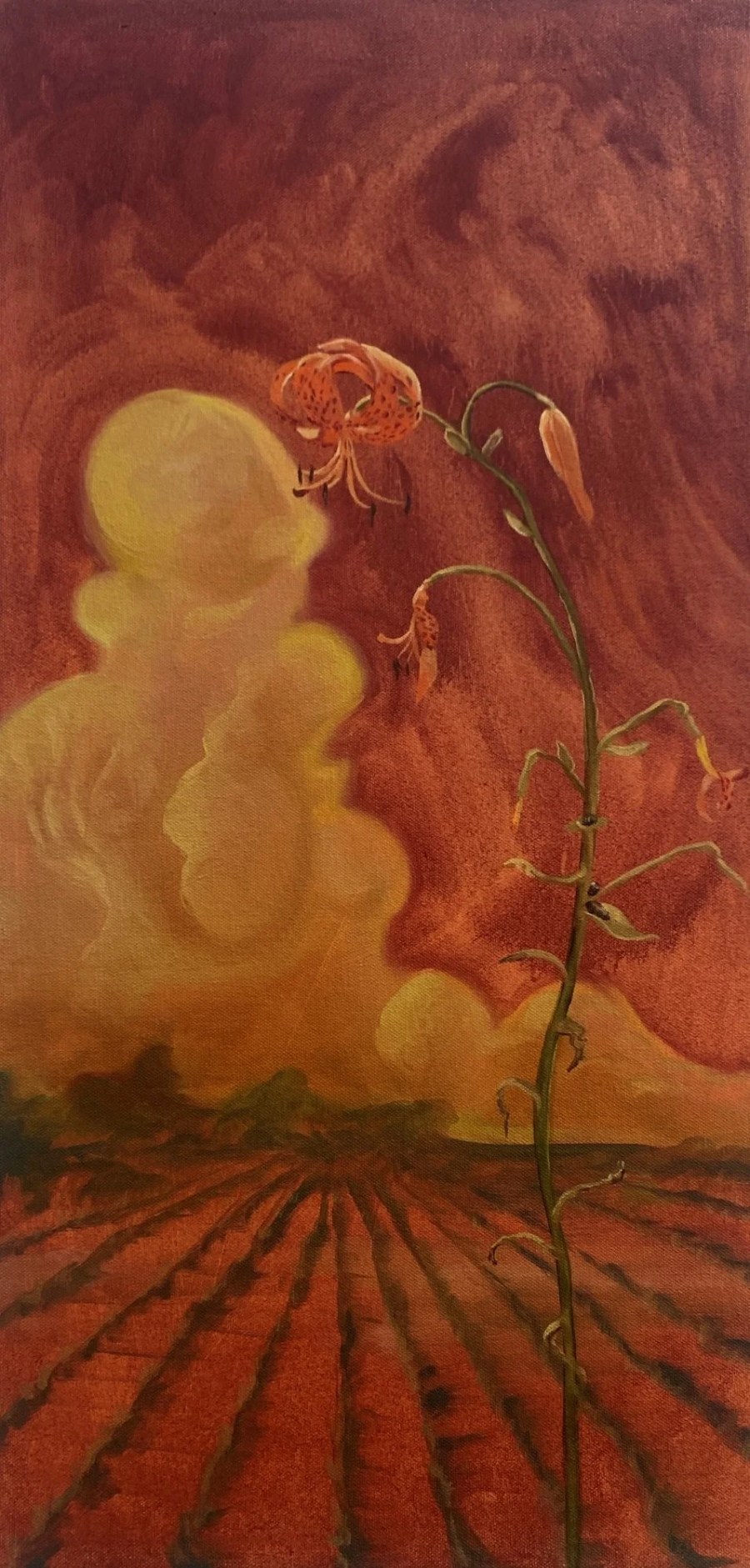
Featured Art: “Lily, Out of Breath” by Mallory Stowe

I startle a deer mouse 
squirreling straw into a pile of burlap.  
It freezes then returns to its instinctive labor 
caring for its litter of pups–still deaf and blind. 
Each as small and pink as a baby’s toe.  
How miniscule my reflection must be,  
turned upside-down in the gloss of its dark eye. 
At the beginning of the war in Ukraine 
a woman approached a Russian soldier, 
gave him a handful of seeds,  
and told him to carry them in his pocket  
so when he died on Ukrainian soil  
at least sunflowers would grow where he fell.  
At least. No matter how great the devastation,  
it requires a small act of resistance for scale.  
Consider those moments Roland Hayes  
stood in a resolute silence while members  
of the Nazi party booed and cursed 
his blackness. Alone under a spotlight on stage  
in a concert hall buzzing with hatred.  
And still his throat softened  
and a song—Du Bist die Ruh—rose  
from his throat until every fascist heart  
had been stroked by the finger of its beauty.  
But I have never been brave.  
I’ve only ever waited out the clock  
in those moments when I was afraid.  
So, when my older sister asked me 
—the apostate daughter—to help her  
dress my mother’s dead body  
in her temple robes, tie the fig leaf apron,  
fasten her bonnet and veil, I couldn’t  
take in the tenderness of her heresy  
all at once. Instead, I narrowed my focus  
to the industry of my fingers, 
half expecting them to snap into flames  
as I pushed each pearl button  
through its braided hoop.  


Read More

Elegy

By S.J. Stover

In my dream they want to wash you, 
lather you up and rinse away  
all grit, all gravel gathered  
in the quick of your claws, 
brush the dust, the dirt  
from your fur, snip off 
the prickles, pluck the brambles  
tangled in the black of your belly,  
sweep the violets violently from your ears.  

But you— 
wolf-minded ever— 
slip their grip, dive tooth first 
into the woods’ waking whoop, 
your brain’s blue furnace  
alive, alight 
with the genius of your idea:  

to weld yourself to the world’s wild welter— 
to burrow, frog-mad, 
in morning’s muddy unending,  
cling deathless, tough as kudzu,  
to hours, minutes, days—  
a tick on the skin of time.  

Dew-footed you fly 
through thick and thistle,  
to chase the needle-eyed dawn— 
you the burr, life the fur. 


Read More

The Foremothers

By Maria Dylan Himmelman

sharpen knives with their teeth, adjust their shawls
to hide their tails and make tiny feather quilts
to keep the birds warm. They char quail eggs
with their breath, serve them on bone China
with sucking candies, then ask if you’re certain
you turned the stove off before you left the house
Their closets are filled with carpets and spice, bolts
of silk and roast chicken. Their medicine chests
are stuffed with opium, hemlock and baby aspirin
In response to most questions they say—
Turn it, turn it, for all is in it, and for this it is said
their price is far above pearls 


Read More

Self Portrait as Horse Mouth

By Laura Vitcova

Featured Art: Stephen Reichert, Untitled, 2012. Oil on canvas, 12″ x 12″. “Cirlce” series.

My lips spread open like the doors of a carnival
ride flashing to reveal a narrow-gauged rail
of teeth that jut from my mouth, pink gums
wedged between white enamel planks,
a freak show, a long tongued chasm
in a distorted body, a chamber of horrors,
a tiger’s bladed mouth about to rip out
your last thought with a laugh.
But you said mine looked like a horse’s mouth
that deserved a bit, maybe a bridle, definitely
a saddle. I was broken before I knew my flesh
would stretch to accommodate a lifetime
of acorns in my cheeks, that I would learn
to survive the wild winter.

Read More

Infinity

By William Olsen

Nancy and I had been talking with him about whether infinity is, or
is only mathematical delusion? Like, say, between irrational numbers,
where nothing is too small for infinity. And whether mathematics itself
will end in a last, absolute prime number that won’t be divided. All
we could say, though, was this, that the universe has a finite life and,
while the light of the stars knocks about for another 40 billion years,
a finite ghost-life. We put it simply when there is no simple. Finite
like us. It will die like us. Isn’t that weird? His face lit up despite
the Never Again. He cried out in joy, “the universe is an ANIMAL!”


Read More

 Trying Not to Lump Together More Unknowns

By Matthew T. Birdsall

       “We know what we are, but know not what we may be”
                        -Ophelia, Hamlet, Act IV, Scene 5

Uncertainty looms heavy before sunrise.
Dark driving, she calls it, at 5:00 AM
to the hospital for her surgery,
when she mentions losing our dog,
Penny, a few months ago—
anxiously lumping together unknowns—
and I had trouble focusing
but I tried to turn the conversation around
with compliments—her outfit, hair, shoes—
but I shut down when she said,
It’s okay, Dad, I know that living is dying

Stuck in the white shock of her wisdom
I wanted to say something to redirect us
but I couldn’t decide whether
she was that conscious of her own mortality
or if she was just being a child—
redirecting gravity away from her upcoming operation
toward something more certain.

At the last minute, the operation was canceled.
As we walked out, my daughter took my hand
because she knew I needed it telling me she felt good.
She said she still missed Penny,
and she would miss her as long as she was alive
me too I said but holding back on diving deeper
trying not to lump together more unknowns,
as we headed home with just enough sun
to get all the way there without headlights.


Read More

Hymenoptera

By Joanne Dominique Dwyer

This is not a poem about insects of the family Hymenoptera.
It’s not a poem about pounding nails.
It’s not a poem about flashlight tag.
It’s not a poem about famous writers addicted to laudanum.
This is not a poem about the burial of a baby raccoon.
This is not a poem about the core of the sun becoming unstable
   and everything going black and cold.
This is not a poem about the definition of Hymenoptera.
Hymenoptera: derived from the ancient Greek words
hymen and pteron—membrane and wing.
This is not a poem begun in silence.
Before dawn the wolf dogs howling inside the pen.
And a 5:30 am text from a man who says another man
entered his bedroom while he slept—
   and a threat of beating the intruder to death.
This is not a poem about cannonball splashing.
This is not a poem about the softening and weakening of bones in children.
It’s not a poem about parachutes
It’s is not a poem about being born in a field of horses.
This is not a poem about oxygen.
It is a poem about the migration
   of ruby-throated birds and the effects
of artillery on tongues.


Read More

Feeling Sorry for Myself After Failing to Tame a Unicorn 

By Michael Derrick Hudson

At first it was sublime, all her medieval tapestry qualities,
her plangent, gracile profile against a field

of heraldic green, the silvery trill of her neighs. My life
has purpose now, so I told myself happily

shoveling fodder and greasing the tackle. An obligation
to myth and legend, so I told myself, 

is worth the hassle. So I showered and shaved every day, 
expelled vulgarity and embraced the necessity

for an orderly household. And yet she still craps the halls,

and crap is crap even when it shimmers like the rainbows
on an oil slick and smells an awful lot

like butterscotch candy. She’s moody! And an incurable
insomniac keeping me awake gobbling stardust and

moonbeams in the middle of the night, her dainty hooves
clip-clop-clip-clopping across the kitchen tiles. 

She leaves the refrigerator door open half the time, uses up
the ice cubes. Every day it’s something, poking

her narwhal horn through the porch screen or another divot
gouged out of the drywall. Come the weekend,

she inevitably lays her head in the laps of my lady visitors, 
pestering them to scratch her ears and 

pat her dazzling pure white withers while she knocks over
beer cans and ashtrays. Some Knight Errant

or another is always pounding on the front door demanding
proof of her existence, as if I’m the Fairytale Ogre

keeping her locked away. Ha! She hides the whole time
in her bedroom like a teenager, ear pressed

against the door. Everything I say mortifies her. She plays
the same sad Joni Mitchell song over and over

on her little portable record player and mopes at suppertime

and smudges eyeliner all over the vanity. And each morning
she reproaches me over waffles with her doleful 

little nickers, and I still have no idea how I got this so wrong.


Read More

Sanctuary

By Alan Shapiro

Early mornings as I turned onto the gravel road to the bird sanctuary,
you’d start panting, pacing in the back seat, whining,
impatient to be let out and hit the ground at a dead run,
head cocked slightly to the side as if to query the sight or scent
of what I couldn’t see or smell of what you never stopped believing you would catch,
and never did. Always ahead of me or behind but never stride for stride,

you plunged, rustling, into and out of brush, you barked or didn’t,
you sniffed the freshest rumors of what had happened there while we were gone.
When you’d disappear, I’d call. And you only reappeared when I’d stop calling—
you must have thought my Here boy, come here boy was how I told you
not to worry, take all the time you need. Which is to say,

we each had our own experience of the experience we shared.
Our separate truths grew up inside those finite mornings.
They leaned on each other. But the mornings themselves?
Nothing outside them proves our ever having once been in them,
traceless as the sound of my calling after you
who rustled only as far into the understory as my voice would reach.


Read More

The Mouse

By Michael Pontacoloni

I watch him drop from the pinch-thin slot
above the dishwasher, scale the tube-steel legs
of the baker’s rack, skirt the sink’s slick edge
and grow brazen: sortie over the runner
by noonlight, champion of bagged bread,
banana, pizza crust. At night I trap him
with a paper-towel tube and peanut butter,
whisper apologies and name him Jeff,
then knowing nothing of care release him
into a brush pile at the edge of the park.
I hope against owls and foxes, pray
that he finds the dark brownstone basement
of Saint Joseph’s Church and lives forever
on the unblessed wafers loose in cabinets.
At the rehearsal of my first communion
Father Las Heras declared them worthless,
tossed handfuls at us like tiny frisbees,
slid them across the floorboards where he
crushed them under his old black Reeboks,
and spun one neatly into the chest pocket
of my first white button-up dress shirt.


Read More

It’s Not Always About the Lemmings

By Olga Maslova

Sometime last century in Kharkiv, father
and I fled the melting August pavement,
bribed the conductor of a sold-out train.
He jammed us in the luggage racks,
and we took off to the Black Sea.

The moving furnace spat us out somewhere
in Kerch, the easternmost town in the Crimea
two hundred miles from sandy beaches, magnolias,
and pine trees,
streets lined with vendors selling buttered corn
charred shish kebabs and chacha. Predawn Kerch

was drab and empty, last night’s drunks
scattered on the streets like seals in their puddles,
seagulls feasting on rotting fish. At the port
we made a deal with a captain of a cargo bulker
Father paid the fare with his life stories, and kept
the crew awake.

I sat 12 hours next to the cockpit
                                                            staring
    at the horizon changing colors
                                                                    from pink
                                to blue
                                                   to pink again
                        to black

till the evening Yalta embraced us
like an old friend at the party:
a little tipsy, a little horny, determined
to dance all night
under shooting stars

                * * *

An arctic snowy owl arrived
in the south of France last Wednesday
3000 miles away from home. Her baffled face
was captured by the paparazzi. British scientists
as their rituals dictate, had offered an explanation:

It’s all about the lemmings:
The owl was following the lemmings
The spike in the lemming population
had lured the hungry bird

There is one person
who really knows what happened—
the captain of the Greenlandic freighter
the stowaway had boarded, heading south

But he won’t tell

                     nor will the owl

                                   nor the lemmings.


Read More

Miraculous

By Pam Baggett

Featured Art by Eliza Scott

Switch on the car radio, music falls out of the air
into my ears: James Brown, Joni Mitchell,
Jim Croce. Old gold. Plus, when I got in my car,
it cranked like it does every time, so many miracles
in that I can’t even count them. Traffic lights
that help us get along with one another,
scent of roast chicken rising from my grocery bag,
which also contains the most delicious bread,
whole wheat with flax, sesame and a hint
of cherries. That someone thought to turn wheat
into bread, miraculous. Yeah, I know, I just
had to start on a heart pill, but it’s nothing,
a little electrical nuisance, no effect
on longevity. And yeah, my best friend
has a hurt so deep and wide whole oceans
pour through it, and her story’s not mine to tell
but jeez, what a soul-shatterer. Yet even she
watches bumblebees. She swears they’re her favorite
miracle. So aerodynamically complicated
in the way they get off the ground you’d think
they never would—flapping their wings
back and forth, not up and down—yet up they go.
She says if they can beat gravity she can too,
and I gotta tell you that to see her dressed
and laughing, hear her singing with that voice
that sounds like water tumbling over rocks
in some ancient river, water that’s passed through
some murky cavernous places but has emerged
into the stunning light of day, to hear her sing again
is one big fat black-and-yellow buzzing miracle.


Read More

No One Wants To See Mourning Doves Fucking

By Patrick Kindig

yet here we are, watching
one gray dove fleece & fluster
another. We watch the pecan tree

shiver, shaken alive by
fluttering wings, those grim birds
bumping uglies. For ugly they are

& ugly the thing they are
doing: no slow caresses, all
rough tumbling & the touching

of fronts. In between:
the sad, low call that tells us
it is mourning doves doing it,

even when they vanish
among the clumps of green pollen
& pecan leaves. There is something

awful about it, something
profane, the way, the day we received
the ashes of our dog, two weeks

dead, we cried on the couch
& I laid my head in my husband’s lap
& suddenly there was something

moving there, pressed against
my ear, & when I opened his fly
the dog was still there, still sitting

in his urn in the middle
of the coffee table, waiting
for a permanent place, watching all.


Read More

HEN

By Steven Winn

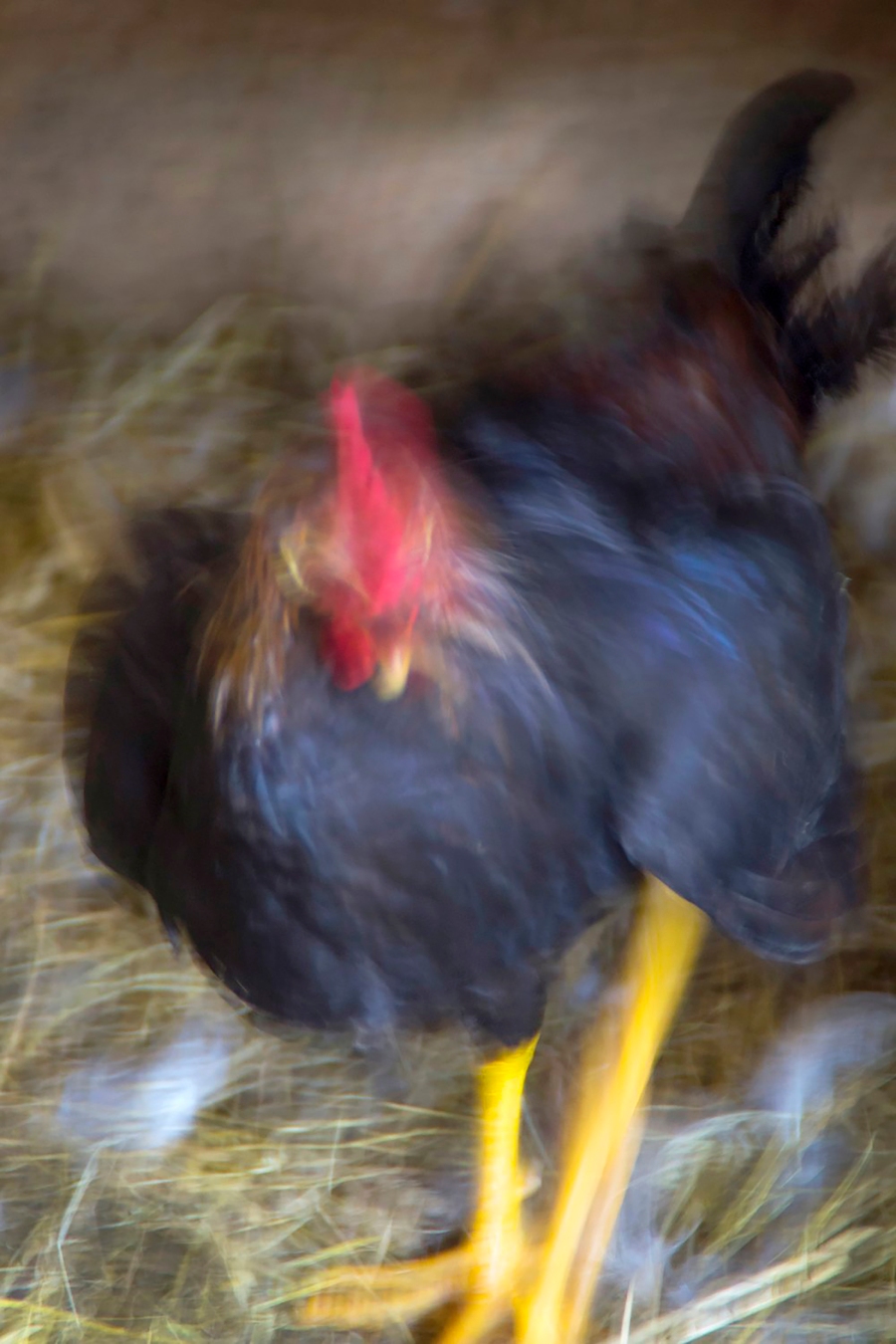
Featured Art by Gary Cartwright

Somehow inside this wire-walled farrago,
Its strutty discombobulation half
Parade of plume and barrel-bottomed flank
And half a mad stampede for any door,

She stands apart, her neck up-stretched and target
Eyes aimed off somewhere, and stands her ground,
Each step a claim on just that spot, the way
Her spindled claw alights to clutch at sand

While high above, a royal in a bulbous
Ornamental coach, she barely takes
It in, crown swiveled to and from the broody
Babble of the mob, their rancid screams.

Something percolates, something like thought
That makes her beak beat down magnetic to
A speck of grain then up again to bring
The morsel down her rippling throat, a throat

That then becomes a spectacle, engorged
To twice its size, complete with guttering
Sound effects, one wing flexed out to show
She can and on another whim retracted,

Head turtled in and out and torqued so fast
She nearly does a full-on Linda Blair,
As if to advertise the fact that she’s
Detachable, a thing of separate parts.

A haze of downy silt hangs in the flock.
Tail raised and primly twitched, she ambles off,
A countess in her gown with time to spare
Before she hears the ax head split the air.


Read More

What We Did at the End of the World

By Sunni Brown Wilkinson

We played charades to words we’d forgotten. We made a fire of them with our hands.
We wrote songs on the piano, gave them names like “Fox and Mouse” and “Lightning Chase.”
We watched our parakeets dance in front of their tiny yellow-framed mirror.
We watched them sleep, three on a perch, with their quick beaks tucked in.
We made bread. The top cracked open and we peeled it back and spread butter on
and ate it. We didn’t wear shoes. We wrapped ourselves in scarves.
We opened birthday cards to listen to the music hiding
behind the plastic button. We opened and closed, opened and closed until the songs grew tinny.
We gathered snail shells from the garden. 47. We saw one naked at the base of the daisies.
We made music with ice and water and glasses. We hummed under the covers at night.
We waved tree branches like arms. We waved at the stars. We waved at our silent neighbors.
We taped song lyrics to doors. We swept the fuzz from the rugs
into piles of gray hair. We lifted them carefully when they huddled together like a nest.
We listened at the door of an uncracked egg.
We watched the quail scurry across the street, that one feather on their heads quivering
in the wind like the feathers of great ladies in the movies we watched at night.
We dreamed of the sea untangling its wide blue braids.
We opened our mouths in the morning and salt leaked out.
We called each other dear and laughed at words like rudbeckia. We planted
rudbeckia. We danced like it. We wore yellow too.
Just before we flew away, we were mirrors. That deep. That true.


Read More

Some Kind of Palace

By Chrys Tobey

My old man cat is, unfortunately, getting old.  Kidneys failing.

Asthma.  Arthritis. A tongue that won’t go back inside his mouth. 

Seizures.  The last one made me think he was a goner.  But then he blinked

and hobbled around me in circles. Pretty disoriented.  My old man

cat has started eating books and this may be due to the fact

that I’ve had my old man cat for seventeen years Read More

Sharp Shin

By John Bargowski

Featured art: brittle decay by Zero Jansen

I found it grounded on the road edge
near the town ball fields where my old man

hit pop-ups to me in my little league years.
The bird hopping through snakeroot

and catchfly, dragging a skewed wing
maybe busted by a low dive into a pickup

headed into our burg on the county two-lane.
That hawk always a few steps ahead of me,

raised the hackles on its cocked neck,
turned a pain-crazed dark eye, then clicked

its beak and snissed, flexing talon-spiked
claws whenever I came close enough

to grab it from behind and clamp my hands
over both wings, the way my old man did

the times he slow-climbed the ladder
up to the loft after his shift at the D&J Bar

and culled his prized flock of homers.
Sometimes reaching inside the wire coop

at twilight for a blue ribbon winner
that wouldn’t leave home to wheel over

the ball fields and D&J with the rest
of the team on the day’s last stretch.

An old favorite, whose inner compass
age had scrambled, clutched in those nimble

calloused hands that taught me the gift
of the sacrifice, the grip of the curve.


Read More

The Secret

By Bridget O’Bernstein

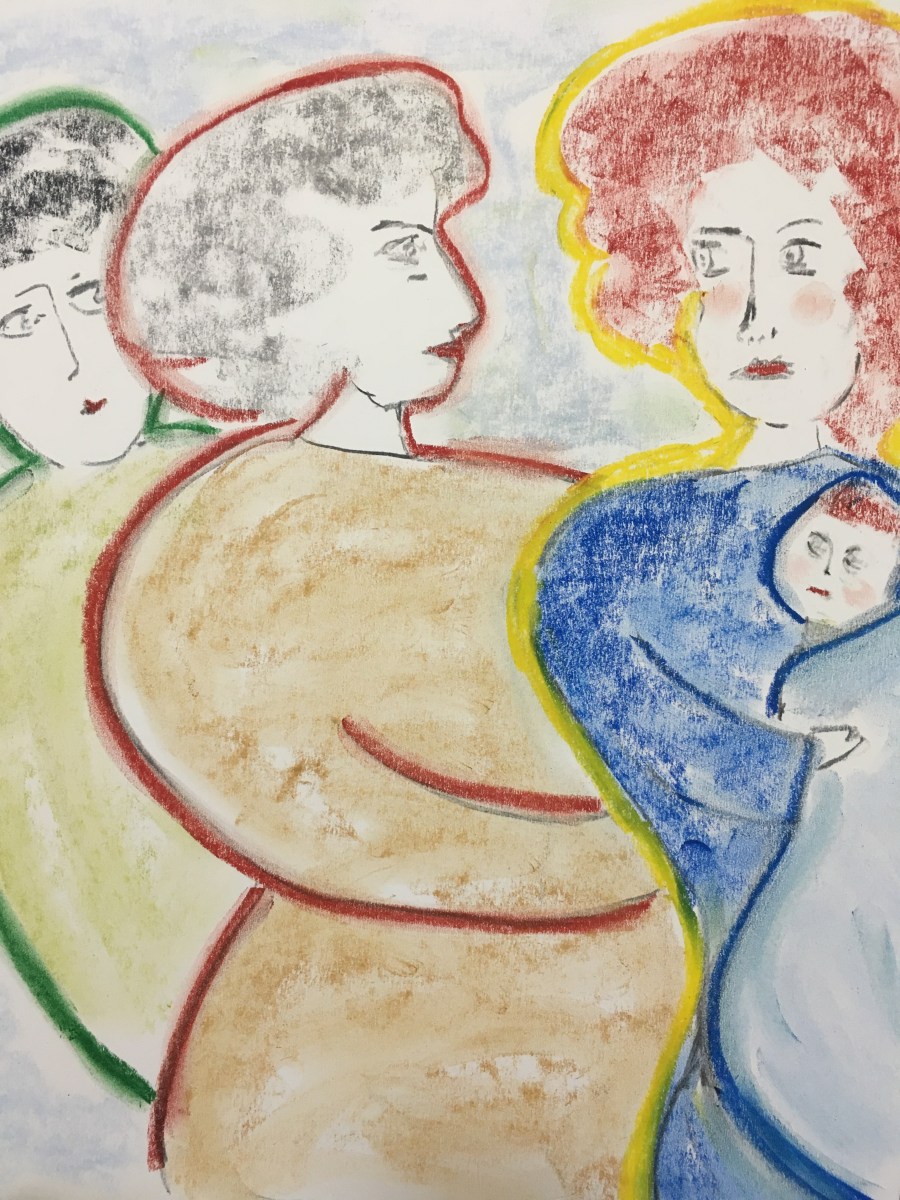
Featured art: Women in Groups by Jesse Lee Kercheval

As a child, I flew alone to California
to spend the summer with my mother’s three sisters.
Aunt Moe made a soup out of bones and covered me
with a canvas blanket in the rock garden.
I played with Aunt Sheila’s cat under the willow for hours.
She walked over with a brush in her hand and said,
You can speak to cats, too? I nodded.
Before I left, Aunt Kate gave me a green velvet book
into which she’d taped a stick of spearmint gum
for my plane ride home.
When I arrived in Brooklyn with my secret,
my father pouted when I wouldn’t share it.
And when I said, It’s private,
his face made a face of such hurt surprise,
like I’d cut him, that I immediately gave it away.
I said, I can speak to cats,
at which point he laughed and went out to the deck
with his coffee, shaking his head.
What a mistake!
To extend to my father
the wonder of my secret, like a rose,
for safekeeping.
I stood there afterward, shocked
at the way I’d invaded myself by sharing it.
Now I had nothing. Read More

Why You’re Going to Eat That Pelican

By Jon Fischer

Your lunch at the French bistro was more essence

and foam and reduction than food, and that pelican

is the size of your remaining hunger.  He surely tastes

like the history of the sea and especially the doubloons

nestled in the sand in busted buccaneer sloops. Read More

A Coyote Runs Down Michigan Avenue

By Sara Ryan

Featured Art: “The Bridge: Nocturne (Nocturne: Queensboro Bridge)” by Julien Alden Weir

and she is a phantom. gray blur on
gray pavement. green lights flicker

their rhythmic patterns. in the right building,
at the right angle, she becomes one

thousand coyotes shimmering in glass.
she screams and Chicago screams

back. howls. scavenges the oily corners
of the train stations. the river gulps

through its channels and feeds the lake.
she is a wild thing. she crosses high bridges.

she becomes the color blue. she becomes
the color blood. the city is haunted

now. by the trees. by women, their mouths
full—bulging, really—with fur. she is one

of the lucky ones. she runs unjailed without
worry for traffic, turn signals, speed limits.

ghosts wearing masks yell from
their windows. they’re warning her.

they’re warning her.


Read More

Chickens in Your Backyard

By Miriam Flock

They come, like the dishwasher, with the house.
“No trouble,” swears the seller, and—presto change-o—
for handfuls of Layena every morning,
the pair of hens trade one or two brown eggs.
The chick, if we approach with proper coos,
will let itself be stroked. This we learned
from our new bible, Chickens in Your Backyard.
Like neighbors of a different faith, we practice
tolerance, let them grub among the bulbs,
ignore the way their droppings singe the mulch.

Meanwhile, we are intent on our own nesting.
My husband paints the nursery; I quilt
a golden goose with pockets shaped like eggs.
We hardly register the added squawking
from the coop or look for more than tribute
when we rob the nesting boxes. Then
one dawn, I’m roused by what can only be
a cock-a-doodle-doo. And in the breaking light,
our chick-turned-rooster struts, ruffed as Raleigh,
shaking his noble scarlet comb. What waits

inside me to astonish like this male?
Such sudden majesty, sudden red.


Read More

Icarus

By Robert Cording

After our son died, my wife found him
in coincidences—sightings of hawks, mostly,
at the oddest of times and places, and then
in a pair of redtails that took up residence,
nesting in a larch above our barn, and how
their low, frequent sweeps just a few feet above us
before rising over our kitchen roof
made it seem as if they were looking in on us.
In a way, it all made sense, our son so at home
in high places—the edges of mountain trails,
walking on a roof, or later, after he became
a house painter, at the top of a forty-foot ladder.
So many mornings we woke to the redtails’
jolting screeches and, even if I was a casual believer,
their presence multiplied my love
for the ordinary more every day. We never thought,
of course, any of those hawks was our son—
who would ever want that?—but, once,
watching one rise and rise on a draft of air,
I thought of Icarus soaring toward the sun—
as if an old story could provide the distance
I neededwaxed and feathered, his arms winged,
and remembered a babysitter’s frantic call
to come home, immediately, after she’d found
our ten-year-old nearly forty feet up
in an oak tree. I can almost hear him again, laughing
high up in the sky, throned on a branch,
his feet dangling, knowing nothing but the promise
of heights as he waved to me—
and I must have looked very small
calling up to him, staying calm
so falsely as I pleaded with him
to come down, to come down now.


Read More

Ode to the Impossible

By Matthew T. Birdsall

A cerulean warbler scrambled up and down the shaggy spine
of an elderly bitternut hickory whose reach darkens half of my backyard
and I tried to follow it, but it became impossible as the bird
vanished and appeared in the shadows numberless—
the futility of finding the bird again sharpened my focus
because I’ve always longed to experience the impossible

because looking for the impossible in blotters of LSD during high school classes
and staring out the window at the animated, neon leaves on oak trees
didn’t just make me look at leaves differently, it made me want
to whisper tales of anarchy in the waxy ears of greedy marketing majors,
to digitally protest the World Bank, to distribute loose doobies at Christian chemo clinics,
to dole out dollops of ranch dressing at the homeless shelter on Saturdays,
to slide in and out of varied segments of society looking for pieces of my dull brain

searching for winding, mossy ways to get into the Hegelian principle
far enough to see the overarching irony of oppositions and how
they are the mortar between the bricks of what I really want
to say since mostly my truth is tucked into an ellipsis
holding together fast-flying flippant phrases,

however,
my focus fled when a red-shouldered hawk alighted
on an adjacent ash tree and I lost the warbler entirely,
but I still readied myself for another round of watching
the viewless fringe of fantasy and chasing shadows I imagined
only Keats and I could see, because O, John, I want to hold on
to my trippy teenage faith that there is fractally-hued life
beyond interpretation, to believe in full-throated ease
and sunburnt mirth, that I’m awake and above ground,
which is only possible until it isn’t.


Read More

(R)egret

By Danusha Laméris

I see the word egret, but read, instead,
                regret. A trick of the mind. Its reversals. One,
a white slash, rising from the marsh. The other

a stone, strapped to the heart. The way I’ve carried
                all the would-haves, all the ifs. Each alternate
exhausts. The egret wades in the dark water,

seeking fish. The heart, constancy. I doubt the egret
               has regrets. Hatch, fledge, breed, hunt.
And besides, a lovely name that comes from French.

“Aigrette,” for brush, after the long feathers
               that stream down its back. How do its legs,
bent reversed, move ahead? Who wouldn’t want

to walk like that? There are days I step
               outside my body, arise, fly over the field
of my life, and glimpse—not error—but river,

rock, and oak, a wide expanse. Here and there
               a meadow, dry grass dotted with—could
they be poppies?—some bright-blurred, orange flame.


Read More

Anachronism

By Therese Gleason

One week after
the clock in your chest
clenched and froze forever
at half past fifty,
a crow careened through the door,
grazing my temple
like a stray bullet.
In the aftermath
of shock and startle,
irony registered
bitter in my craw.
I used to think a bird
crossing the threshold
was a harbinger of death,
but by the time
this transgressor
cut a crooked line
through the living room,
our windows
were already draped
in black crepe.
The old wives,
their feathered omen
arrived late, clucked
their tongues
and rent their garments.


Read More

The Bees

By Rick Viar

Featured Art: Bees on Purple Flower by Pixabay

My sister says I greeted the swarm
along the backyard slope, crawling, fat mouth slack,
sodden Pampers saggy with supplication.
Evidently, she scooped me up while they chased us
through our father’s lavender azaleas
where he dropped his shears and smashed yellow
jackets against my skin, yanking off the diaper
and waving it around his head like a lasso.
We won’t get spanked again until winter.
Everyone watches my sister declaim
the tragic tale at family gatherings for decades
as if she’s Dame Judi Dench. They love her
nuanced performance, the lively hand gestures
and operatic voice, how she tousles my hair
before her triumphant finale: I got stung
on my mouth, but he got stung in his asshole!

I’m always grateful Dad isn’t here to witness
this, or my marriage, or my career,
or my incompetent gardening, the limp cosmos.
I can’t believe you, a cousin smiles, shaking his head.
Me neither, I reply. I don’t even know what I did.


Read More

North River Shad, c. 1910

By Lindsay Atnip

Featured Art: Green Fish About to Eat the Fish Hook Wall Art by The Lazy Artist Gallery

William Merritt Chase painted numerous versions of fish still
lifes, many of which were quickly purchased by museums across
the country. Because of the popularity of these works, the artist
worried that he would be remembered only “as a painter of fish.”
—placard, Art Institute of Chicago

The real thing rots. Corrupts,
               Decays, time-lapses, hollow to holes.

But yours—immortal, silver-scaled, so round
               (Why should its roundness be wrenching?)

               Realer than the real.

You were afraid this was what they’d remember you for.
               Afraid—as if there were somehow more than this.

Here one sees, forever, how it could fill the hand—
               How it would feel, filling one’s hand.

               One could do worse than be a painter of fishes.


Read More

Life Through Glass

By Jonathan Duckworth

Featured Art: by Giuseppe Barberi (1746-1809)

—for Kat Flinn

blurs become faces & eyes for me

as I see through layers of glass

& now that my fiancée is half

a continent away we speak through

a tunnel of light bound by twin

screens, more layers

& there are boats with bottoms

that let you see the underwater

in perfect safety & I wonder if the fish

in my fiancée’s tanks see us that way

huge ugly misshapen things safely

on the wrong side of the pane

lyretail mollies harlequin rasboras

bettas of swish & swirl green blue red

how they circle & gape & watch us

watch them & maybe sometimes

they wonder if we are happy & maybe

they see her on her couch as she

cradles my glowing face & they think

that’s how the finless frolic

& navigate this the sometimes

joy of being


Read More

Polar Bear

By George Bilgere
Winner, Editors’ Prize in Poetry: selected by J. Allyn Rosser

Featured Art: Mounted Model of a Polar Bear from United States National Museum Photographic Laboratory

A father died heroically in some Alaskan park
while trying to save his kids from a polar bear.

Long ago, when his mother gave birth
one summer afternoon in Bakersfield, California,
could anyone have prophesied,
as in an old myth, that the baby crying
at her breast would one day be killed
and partially eaten by a polar bear?

Has anyone from Bakersfield, California been killed
and partially eaten by a polar bear? Yet her son
was. He looked up from making camp,
pitching the tent or lighting his Coleman stove,
and there it was, white and immense. His fate.

And he died heroically and was partially eaten.

Of course, the bear had to be killed. The rangers shot it,
which makes sense. You can’t have polar bears
running around in the wilderness!
The wilderness is a place for dads and kids
and Coleman stoves. Polar bears just . . .
they just kind of ruin the whole thing.

As for the bear, it didn’t die heroically.
It just got shot and fell over
and was sent to a lab for testing.


Read More

Gothic

By SM Stubbs

Featured Art: Bird by Robert Frederick Blum

Upon a hill, a house. Upon the house,
a roof. On the roof, a bird. The bird—
oiled feathers, beak like an awl—grooms
the roof’s moss, subsists on ticks
and silverfish. Inside the house, a man
without a tongue and a woman
who loves him. The woman grooms
the house, subsists on potatoes and rice
and whatever rodents roam the slope.
The man hunts every day until noon.
Every day he returns empty-handed,
his shoulders tense as flywheels,
his jaw the floor of a collapsed cave,
crowded with everything he cannot say.
She brews his tea. She washes the corners
of the house. She chases the bird away.
At sundown the man leaves again, hunting.
Upon another hill, another house. Another
woman waits inside. The man without
a tongue feasts on rabbit she trapped
in a pit. From fireplace ashes she makes lye
and scrubs his back. She fills his canteen with it.
By the time her sister misses him, his body
has sunk to the bottom of the pond.


Read More

The Arachnologist

By Benjamin Gucciardi

Featured Art: Untitled (Hourglass) by Mary Vaux Walcott

When he told me his teeth felt too heavy
to study history, I excused him.
I knew he was headed for the aqueduct,

or the boarded-up houses choked
by trumpet vine where he found them.
Martel collected spiders with the discipline of a surgeon.

He kept them in empty soda bottles
under his bed. On his way into sixth period,
he touched my fist with his fist,

announced the genus of his catch,
Latrodectus, and his total, that’s nine this week!
Through this tally of arachnids captured

in sugary plastic, we learned to trust each other
the way men on tankers far out at sea
confide reluctantly in gray rippling water.

When his best friend broke the news,
they found Martel last night, her voice quavering,
stray bullet off International,

I went to his house to adopt a spider.
I imagined the red hourglass
on the female’s abdomen emptying itself

slowly, her segmented body imprisoned
in the glow of the green-tinted bottle,
but no one was home. Now when I hear

the old women gathering cans at dawn,
half-swallowed by blue waste bins,
I think of Martel finding containers

to bring to the canyon, Martel
inspecting stones, placing his fingers
delicately around the thorax,

the eight legs angry at the morning
as he lifts the arrowhead orb weaver
toward the sun, offering

what he loved to the old, hungry light.


Read More

Requiem with “Little Wing”

By Craig van Rooyen

Featured Art: by Kenyon Cox (1856-1919)

Perhaps, on your downtown lunch stroll
in unseasonably cheery weather,
you walk up on a flock of grackles
on the ground in front of Urban Outfitters,
their impact marks still drying on the window
recently washed to display Big Sur Ribbed Pullovers
and the Willow Fuzzy Drawstring Teddy,
as if anyone believes October’s still a sweater month.

Perhaps you become suddenly dizzy,
a strange gravity drawing you toward this constellation
of twitching black holes
opened in the sidewalk at your feet.
And perhaps this brings to mind
how it feels when your face falls from your face.

In the old days before the imminent apocalypse,
the pattern would be read as omen:
a toothache’s coming on, the breath of your bride-to-be
will sour every time she walks in moonlight,
your best cow will soon grow milk-sick.
The prescriptions would be just as clear:
wash your warp and dye it while a new moon waxes;
steal a neighbor’s crickets and install them in your hearth;
milk with one hand only.

Perhaps, even now, you try to read in the little bodies
some feathered correspondence: this relates to that.
If you step on a crack, the snowy plover will slip
into extinction; if you breathe out while passing a cemetery,
Greenland’s ice shelf will break off and float away.
But the letters blur and you can’t discern the news
from the wrecked wings and necks.

Read More

I propose we worship the mud dauber

by Jessica Pierce


The female in particular seems worthy.
She carries mud in her jaws to make her nest
one mouthful at a time, setting up
in a crevice or a corner. One egg,
one chamber. One egg, one chamber.
It’s better to keep them apart, as larvae don’t
know the difference between food and
a brother or a sister. They aren’t wicked,
just young and hungry. She has pirate
wasps to battle—they want her young
to feed their own offspring—and she does this
alone, drinking flower nectar to keep
herself going. Let’s just try

and see what happens when we raise up
this winged thing who will hover by your feet
without attacking. Covered with dense golden
hair and sometimes described as singing while
she works, all she wants is bits of damp dirt.
She has a slender thorax and two thin
sets of wings to carry her and
her earth. She is exactly strong enough
for what she needs to do. She doesn’t burn
or proclaim or fill your head with visions
as she hunts crab spiders and orb
weavers and black widows. Yes, let’s ask

her to pray for us as she stings
a black widow, brings it to its knees,
and sets off to feed her children,
singing as she holds up the world. Read More

The Dog in the Library

by Catherine Stearns

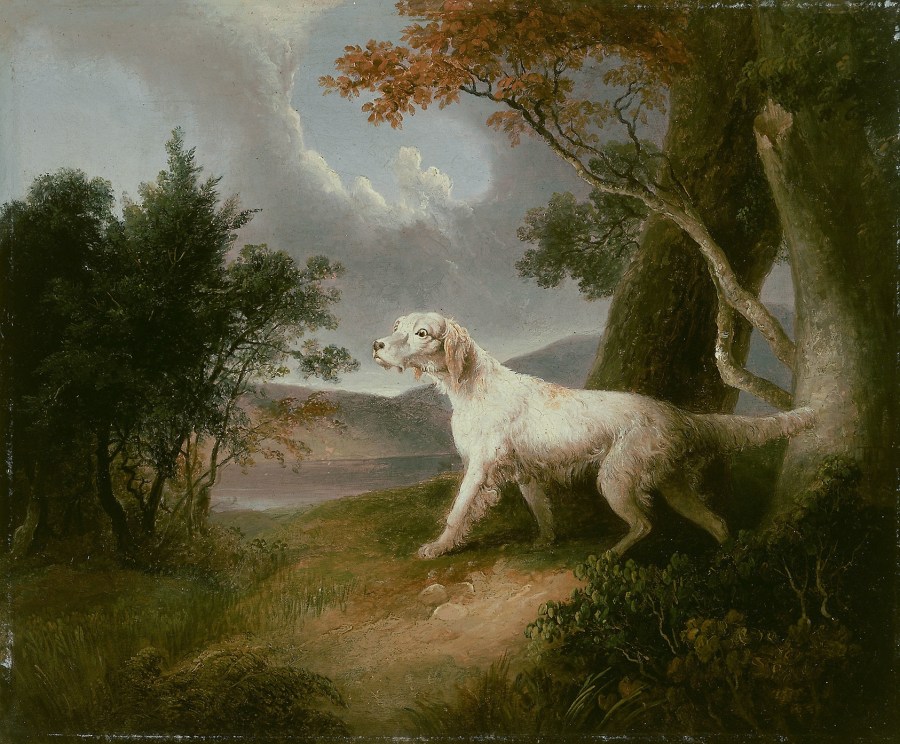
Featured Art: Landscape with Dog by Thomas Doughty


“We may be in the universe as dogs and cats are in our libraries, seeing the books and hearing the conversation, but having no inkling of the meaning of it all.”William James


On sunny, cerulean days I go all the way
to eleven when I stretch and sniff among the leaves,
whereas you stay inside, hunched over
your moral universe. Old girl, if you
stopped trying to decipher those fossil bird tracks,
you might see the thermal-gliding hawk above
or that zaftig possum gnawing on fallen
persimmons under the window. I’m just saying
your preference betrays a certain fear
of your own nature. Remember
last summer when you left me in the car
to pick up a book they were holding for you,
and a page or two in you recognized
your own penciled and may I say
obsessive marginalia, although you had
no memory of the text itself?
Whatever made you think your mind
could be disenthralled with words?
As a pup, I once took Mark Strand’s
injunction in “Eating Poetry” to heart,
devouring one or two slim volumes,
but soon realized I prefer the raw
material of life, what e e cummings
calls “the slavver of spring”: smells
of fresh earth, the ghostly scent of
rabbits, even the mounds of dirty laundry
piled up on your bed. If you found answers
to your questions, do you truly believe
those answers would transform you?
So many of your species seem
susceptible to revelation. We’re all
browsers, old girl, without an inkling,
waiting by the door for a treat or to be forgiven
until our unleashed immortal part bolts
for that hit of dopamine. Then
all good dogs go to heaven.

Read More

Ekstasis

by Erika Brumett

Featured art: Summer: Cat on a Balustrade by Théophile-Alexandre Pierre Steinlen

                       “One by one—in convents across medieval Europe—nuns began to believe they were cats.”

                          –Michael Garerda (Shared Hysteria: Group Madness and the Middle Ages)

Happened after mass
last sabbath.  We broke
fast (curdmilk, cabbage),

sat rigid in our hair-
shirts and worship. But heard
then—urgent as prayer

by the dais—a purr-
purring rise from Sister
Mary Iris.  Since then, Read More

Octopus on Ecstasy

by Geneviève Paiement

Featured art: from A Picture Book of Practice Sketches by Rinsai Ōkubo

-In September 2018, Johns Hopkins University neuroscientist Gül Dölen
published a scientific study wherein she dosed octopuses with MDMA
to see if they would react like humans and become more cuddly. They did. 


She hypothesizes that humans are more closely related to octopuses
than we think. Fills a tank with ecstasy. Plunks in us two octopuses.

Just five hundred million years of evolution between us, she muses.
Surely what MDMA does to humans it will do to us octopuses.

Surely we’ll break out in the same cold-sweat/hot-flash, will twist-grind
our visceral humps, bump beaks, squish-entwine our fellow octopus.

Oh wow. I’m at the other’s central axial nerve pump in a house beat,
sucker-to-sucker, lights-out smoke machine to my sister sextapus. Read More

Birds in Cemeteries

by George Kalogeris

It must be the shade that draws them. Or else the grass.
And it seems they always alight away from their flocks,

Alone. It’s so quiet here you can’t help but hear
Their talons clink as they hop from headstone to headstone.

Their sharp, inquisitive beaks cast quizzical glances.
The lawn is mown. The gate is always open.

The names engraved on the stones, and the uplifting words
Below the names, are lapidary as ever.

But almost never even a chirp from the birds,
Let alone a wild shriek, as they perch on a tomb.

And then they fly away, looking as if
They couldn’t remember why it was they came—

But were doing what our souls are supposed to do
On the day we die, if the birds could read the words.


Originally appeared in NOR 11

Monarch

by Kathleen Radigan

Featured Art: Abstraction on Concrete by Howard Dearstyne

In the garden I cup a hand
before you, strain my wrist,
willing you to perch.

A nearby woman grips her cane.
“Young lady. If you touch them,
they die.”

Born again from a gauze
coffin, you’re blackwinged,
fragile on a wax leaf. Read More

The Last Litter

by Melissa Cistaro

Featured art: A Farm in Brittany by Paul Gauguin

1975

My mom pours the warmed milk from the stove into oversize plastic bottles, then pops on the giant caramel-colored nipples.

“Do you want to feed one of the little ones down in the calf barn?” she asks.

I cannot contain my smile. My Keds are on in three seconds.

I follow her down the grassy path, holding the warm milk bottles against my chest and trying to copy the sway of her hips. She explains how the calf barn is the holding place for the young Holstein calves who are being weaned from their mothers’ milk.

“Roger likes to wean them young,” she tells me, “so that the mother cows can get back to their job of being milk cows.”

The calves cry and bleat like goats when they see us with the milk bottles. A black-and-white calf shoves his head through the wood slats of the stall and stares up at me with his big polished eyes. I put the rubbery nipple close to his mouth. He grabs and tugs fiercely at the bottle.

“Hold on tight,” my mom says. “That guy is a tough little sucker.”

My calf slurps as he drinks, then yanks at the nipple like he’s mad at it. Milk splatters across his soft black face. When he’s done with the milk he wants to keep chewing and sucking on the rubber tip, but my mom says that will put too much air in his stomach.

“Just stick two fingers in his mouth,” she tells me from across the aisle.

“What?” I say.

She walks over to my calf and sticks her middle and pointer finger right into his mouth. He latches on and starts making sucking sounds.

“There are no teeth in there, just gums,” she says.

I hesitate. I am not certain about this. She grabs my hand and pulls it toward the calf’s mouth. He latches onto my two fingers with such force that I am startled. His mouth is strong and smooth inside. I feel his tongue, like fine sandpaper polishing my fingers. I start to laugh. My mom laughs. I don’t want this to stop. I want to learn as much as I can about living on a farm in case I ever get to live on one. I take my other hand and rub the calf’s face, swirls of
thick black velvet, a perfect white diamond on his forehead.

My mom says she’s got a few chores to do back up at the house, and I ask if I can stay here in the calf barn for a while.

“I like it here,” I tell her.

“I’m glad,” she says. She smiles at me, pushes an unlit cigarette into her mouth and gathers up the empty milk bottles.

My fingers get a little sore from staying in the calf’s mouth so I pull them out. The calf seems okay because after a minute he buckles down on his wobbly legs and flops onto the straw floor. I decide to do a little exploring around the barn. There are dusty bird’s nests tucked all around the rafters and small birds like starlings that swoop down to gather bits of straw from the ground. I find a place to sit in the feed room where there are burlap sacks filled with
cracked corn and molasses-covered oats. I push my hands deep into the open sacks and pull the molasses oats close to my nose. It smells good enough to eat.

I take a walk to the far end of the barn aisle where the calf stalls are empty. There are two tall white buckets with lids on them, the plastic kind that painters use. They look out of place to me for some reason, like maybe they were set down there and forgotten. I pry the lid off the bucket closest to me. There is no particular smell.

I am not sure if what I am seeing is right or true. Kittens. Piled up to the brim. Clean white fur. Brown, black, tan, orange. Small paws with fleshy pads as soft as apricot skin. Wiry tails. Tiny pink noses. Whiskers, as fine as fishing line, almost transparent.

It is not a dream. I push the lid back on. I think there must be more than a dozen piled up in there. I pry open the other bucket only because I want it to be something different. But it’s not. One all black, one striped orange, one smoky gray, more colors underneath. Soft triangle ears, thin as potato chips. I want to stop staring but I can’t. A small calico kitten lies across the top of the heap. Its eyes are closed, but the shallow part of its belly moves—barely, up and down like it’s in a deep sleep. I want to touch it, but I am afraid. I don’t know what to do. I put the lid back on.

I walk back up the hill toward the farmhouse, my heart pounding underneath my yellow T-shirt, the tall wet grass soaking the bottoms of my jeans. When I open the screen door, I see my mom at the table with her New York Times crossword puzzle, her coffee and a cigarette. She’s smart with words. I’m not. I’ve got a throat full of gravel that usually keeps me from saying what I want to say.

But I know what my question is.

“Why are all those kittens in the white buckets?”

She keeps looking down at her crossword puzzle like she’s just about to figure something out. Her dark bangs hang like a frayed curtain across her forehead. For twenty seconds, I don’t even think she’s going to answer my question.

“Oh, that,” she says with a frown. “You weren’t supposed to see that.
Roger was supposed to dump them.”

I wait for her to say something more.

“I’m sorry you had to see that, darlin’. It’s the way of the farm here.”

She smashes the clump of soft ashes down with the filter of her cigarette. There is sparkly pink polish on her fingernails. I hate it when she’s so matter-of-fact.

“There were just too many kittens.”

“What do you mean too many?” I ask.

“Those were feral kittens, wild and inbred—just the ugly ones. Believe me. I can tell the inbred ones right away, their eyes are wide-set and slightly askew. Their heads are oversized.”

“But how did they die?”

My mom gets up from the table with her ceramic coffee cup, and goes into the kitchen. I can tell she doesn’t want to listen to my questions.

“Chloroform is what Roger said to use.”

She measures out a heaping spoonful of sugar into her cup.

“But power steering fluid works just as well. It’s very quick. They don’t suffer.”

I feel my throat tighten up like a fist. My legs are as wobbly and uncertain as the calves down in the barn.

“Mom, I saw one breathing on the top, a calico one, not an ugly one, but a long-haired calico.”

“There were no calicos,” she says, slamming the garbage can lid down. “And, you did not see any kittens breathing.”

“I did, Mom. I definitely saw that one on top.”

“None of those kittens were breathing, you understand?”

I am strangely afraid of her. She knows how much I love kittens. I try to stop the image of her hands pushing those kittens into the white buckets. I know there was a calico. I know that she killed them.

She heads out the screen door, says she’s got to grab a few fresh eggs and she’ll be right back.

I watch her outside the window, walking through the tall grass. I recall what I once overheard her say—that she thought about drugging my brothers and me when we were small because she didn’t want us to suffer. She had an emergency plan in case there was an awful natural disaster. She would give us all sleeping pills. We wouldn’t suffer. But I am almost ten now. I am too big to trick like that.

I wait at the window for her to come back. I wait because I want to feed the calves with her again. I wait because I want to swirl the sugar and cream into her coffee and breathe in her L’Air du Temps perfume. I don’t know when the next time I’ll see her will be. I scratch my fingernail along the thin white paint that covers the window sill. I remind myself that there are things I am not supposed to talk about or remember. I am not supposed to remember the day she drove away in her baby-blue Dodge Dart. Everyone tells me that I was too young to remember. But I remember everything. “Too many,” she said. I know this phrase. I heard her screaming it late one night before she left my brothers and me.

I reach into my jean pockets and I push the secrets in as far as they will go. Between my fingers I roll around a soft piece of gray lint. I don’t want anyone to know that my mom killed those kittens. I push my hands into my pockets even deeper. I make room for the kittens, because they are a new secret.


Originally appeared in NOR 7
Roost

by Janice N. Harrington

Featured Art: Crows in a Tree by Charles François Daubigny

Circling above bare limbs, like Dalí’s wild and articulate capes,
black wings undulate. Raucous hundreds settle and splat
their stench. A murder of crows, a give-a-fuck mob,
stirs the air above ash and oak and hackberry, milling
and loud with news: day heralds, unwelcomed Cassandras.
Dawn light pinched by a crow’s beak, pieces of light falling
everywhere, bright meat that the crow pecks, strips away.

The crows know my neighbor’s face. Knowledgeable birds,
they know the way I hurry each morning, the way my eyes try
to read their dark signs: articulate smoke, curtains
of a confession booth. Blessing? Pardon? Mercy?
The stories say that crows suffer scorched wings, that they
are cursed for stealing from the gods. But the stories, as always, err,
wind-running, wings wide, a-glide on a slide of air,
black bodies, bituminous-black, cosmos-black rising to soar.
There is no damnation in their dizzying speed, the break-wing
improvisations of their flight. God–blessed and black,
their sharp notes strike my skull like hailstones or chunks
of sky, dark bodies that lift my eyes and scorn gravity, a lesser law.

Read More

The Good Life

By Susan Allison

The thing about good living

is that it happens, despite

plotting and planning, it happens

contrary to all devices. It happens

when you are renting the only room

you can afford and you somehow

catch the way the light is coming through

the broken dirty windows.

The door is open

and the wind blows in like balm.

It’s warm and you see the colors of the

faded gray frame of the door

against the rust-colored leaves

in the small patch of jungle

down by the alley.

The good life

comes through your eyes

and your ears and your skin,

the way a wild animal comes at you

when it is just curious.

Read More

I propose we worship the mud dauber

By Jessica Pierce

Featured Art: by Pieter Holsteyn

The female in particular seems worthy.
She carries mud in her jaws to make her nest
one mouthful at a time, setting up
in a crevice or a corner. One egg,
one chamber. One egg, one chamber.
It’s better to keep them apart, as larvae don’t
know the difference between food and
a brother or a sister. They aren’t wicked,
just young and hungry. She has pirate
wasps to battle—they want her young
to feed their own offspring—and she does this
alone, drinking flower nectar to keep
herself going. Let’s just try

and see what happens when we raise up
this winged thing who will hover by your feet
without attacking. Covered with dense golden
hair and sometimes described as singing while
she works, all she wants is bits of damp dirt.
She has a slender thorax and two thin
sets of wings to carry her and
her earth. She is exactly strong enough
for what she needs to do. She doesn’t burn
or proclaim or fill your head with visions
as she hunts crab spiders and orb
weavers and black widows. Yes, let’s ask

her to pray for us as she stings
a black widow, brings it to its knees,
and sets off to feed her children,
singing as she holds up the world.


Read More

Tackle

By John Bargowski

Featured Art: by Teerasak Anantanon

Weeks after the cops cut Bill down
and the squad sheeted his body,

bore it out to the street, his mother
leaned over her sill and called us

upstairs to share the flies he’d wrapped
and knotted, labeled

with names we could never
have dreamed up, and arranged

in small wooden boxes next to coils
of tapered leader and packs

of hooks barbed along their shanks,
the button-down shirts

and bank teller suits in his closet
screeched and swayed

on their hangers when she elbowed
her way in for the split bamboo pole

he’d hand-rubbed to a gloss
and mounted with a reel cranked

full of line, nothing we could ever use
when we biked down

to the Hudson piers and bait-fished
for river eels and tommycod,

but we took it all, every piece
of tackle we could carry down

to the stoop to divvy up among us—
his canvas vest, his shoulder bag,

spools of waxed line, the bamboo poles,
his hip waders and creel,

and those boxes of flies—
the Zebra Midge and Gray Ghost,

his Black Woolly Bugger,
Pale Morning Dun.


Read More

The Dog in the Library

By Catherine Stearns

Featured Art: Sleeping Bloodhound, 1835 by Sir Edwin Henry Landseer

“We may be in the universe as dogs and cats are in our libraries,
seeing the books and hearing the conversation, but having no
inkling of the meaning of it all.” —William James

On sunny, cerulean days I go all the way
to eleven when I stretch and sniff among the leaves,
whereas you stay inside, hunched over
your moral universe. Old girl, if you
stopped trying to decipher those fossil bird tracks,
you might see the thermal-gliding hawk above
or that zaftig possum gnawing on fallen
persimmons under the window. I’m just saying
your preference betrays a certain fear
of your own nature. Remember
last summer when you left me in the car
to pick up a book they were holding for you,
and a page or two in you recognized
your own penciled and may I say
obsessive marginalia, although you had
no memory of the text itself?
Whatever made you think your mind
could be disenthralled with words?
As a pup, I once took Mark Strand’s
injunction in “Eating Poetry” to heart,
devouring one or two slim volumes,
but soon realized I prefer the raw
material of life, what e e cummings
calls “the slavver of spring”: smells
of fresh earth, the ghostly scent of
rabbits, even the mounds of dirty laundry
piled up on your bed. If you found answers
to your questions, do you truly believe
those answers would transform you?
So many of your species seem
susceptible to revelation. We’re all
browsers, old girl, without an inkling,
waiting by the door for a treat or to be forgiven
until our unleashed immortal part bolts
for that hit of dopamine. Then
all good dogs go to heaven.


Read More

An Unordered List of the Not-Beautiful

By Katie Pyontek

Featured Art by Courtney Bennett

Beauty depends on magnitude and order.
Hence a very small life cannot be beautiful,
for the view of it is confused.

 — Aristotle

Not the green bellies of hummingbirds, not

one set of wired bones shown behind glass.

Not the plump folds of tardigrades, not quarks,

not marbles on carpet, not pinhole stars.

Not the improbable orderliness

of ants, not feverfew or curls of hair,

not quick love notes left out on the counter.

Not a dozen kumquats, not an average

of six minutes. Not the intricate coils

of a snail’s shell, inching down the sidewalk.


Read More

In the Borderlands

By Kateri Kosek

Today on the back-roads, where Connecticut
and Massachusetts bleed together unnoticed—
the large, gangly silhouettes of two llamas
weaving across the road ahead of me, not
where they are supposed to be, where I always
pass them, stoic and shaggy amid a spread
of crumbling outbuildings.

A young woman has stopped.
She gets out of the car and I stop too,
and more llamas rush out from the broken gate,
ears erect like horns on their pert pedestal heads.

I wonder for a moment, could they hurt us?
These animals we usually see standing still,
chewing dumbly while we gawk?
We forget their long legs, forget
they can move.

But they head for the field
and there’s something exhilarating
about their sudden temporary glory,
the larger world asserting itself
in the form of llamas on the loose, llamas
spreading through a whitened February field
and no one around who can stop them.
I should mention, I had been crying.

Starting for the door of the farmhouse,
I hear someone coming out.
Fucking cocksuckers, he drawls, this older man
we can’t see, as if the llamas plotted this breakout
on a regular basis. Jesus Christ Almighty—
adding a new dimension to my image of the cluttered
farmyard, hushed and exotic, too much to take in
though I always slow down, riveted
as I am now, but I drive away
and leave him to it, lifted.


Read More

Roost

By Janice N. Harrington

Featured Art: Nude Figures by Cape Creus by Salvador Dalí

Circling above bare limbs, like Dalí’s wild and articulate capes,
black wings undulate. Raucous hundreds settle and splat
their stench. A murder of crows, a give-a-fuck mob,
stirs the air above ash and oak and hackberry, milling
and loud with news: day heralds, unwelcomed Cassandras.
Dawn light pinched by a crow’s beak, pieces of light falling
everywhere, bright meat that the crow pecks, strips away.

The crows know my neighbor’s face. Knowledgeable birds,
they know the way I hurry each morning, the way my eyes try
to read their dark signs: articulate smoke, curtains
of a confession booth. Blessing? Pardon? Mercy?
The stories say that crows suffer scorched wings, that they
are cursed for stealing from the gods. But the stories, as always, err,
wind-running, wings wide, a-glide on a slide of air,
black bodies, bituminous-black, cosmos-black rising to soar.
There is no damnation in their dizzying speed, the break-wing
improvisations of their flight. God–blessed and black,
their sharp notes strike my skull like hailstones or chunks
of sky, dark bodies that lift my eyes and scorn gravity, a lesser law.


Read More

Spring

By Lauren Shapiro

Featured Art: The Cock Sparrow by George Edwards

The nice teachers at the kindergarten open house
point out the Unifix cubes and color game;
they are professional in their analysis of play. Later
at Lainy’s party the operators of Jump ’N Bounce
just look away while the kids wrestle into an idyllic
sense of self. A mother tells me, hushed, how
one November morning Jason’s father parked the car
and blew his head off. Then it’s time for cake.
The kids are sweaty, tumbling over each other
for a spot at the table. I search Jason’s face
for a sign, a scar, but don’t find it—he’s waving
a noisemaker in Sean’s face, his mother chatting
pleasantly in the corner. Cue the birthday music.
Next day, we’re late, and I walk my distressed son
into school. “We might miss the eggs hatching!” he yells,
bounding down the stairs. The class is huddled
around the incubator, the glow from the heat lamp
flushing their faces. This must be a rite of passage,
watching a chick’s birth surrounded by friends.
It’s on the docket, tailored to the lesson plan, deemed
developmentally appropriate. It’s March, after all,
when the world glosses over its losses.


Read More

In Dog Dreams

by Karla K. Morton
Featured Art: 

I run,
palms like paws on the earth,
muscles, long and sinew.

I smell wet clover,
the musk of home,
cooking meat.

I do not think about tomorrow
or yesterday,
but I remember the cactus
and the snake,
and the music of your voice
even when language fails.

And when I wake, I roll
to the nest of your shoulder.

Your arm does not reminisce
when it first wrapped my waist,
yet it comes to me;
heals even as you sleep.

I feel the peace of gravity;
the subtle spin of planet;
the rise of the mountain.

In Dog Dreams,
I have known no other hand;
no other time
when I wasn’t yours,
or you, mine.

Whoop! you call in the deepening forest.
Whoop! my descant back.

Read More

Monarch

By Kathleen Radigan

Featured Art: Actaeon Nude by Jean Antoine Watteau

In the garden I cup a hand
before you, strain my wrist,
willing you to perch.

A nearby woman grips her cane.
“Young lady. If you touch them,
they die.”

Born again from a gauze
coffin, you’re blackwinged,
fragile on a wax leaf.

In the heat
of a weeklong life
you batter between

fluorescents and dahlias, legs
thinner than wires,
and float over tendriled

chrysanthemum heads.
Tease everything—hands,
canes, stem, with a feathery

suggestion. I want
to chew you.
Taste the metallic

powder of each wing.
If only to become
so beautiful

that being
touched just once
would kill me.


Read More

Quail on the Airfield

By Ellen Seusy

Winner, Editors’ Prize for Poetry, selected by Bianca Lynne Spriggs

In Texas, near the Gulf, a man wakes up
and pulls on coveralls and heavy boots.
He drives his truck along a narrow road
to the strip where jets line up for fuel,
heat already shimmering near the ground.

He works alone all day in the exhaust
and roar of jets, as planes take off and land.
He’s paid to save their engines from the birds.
All day, the heat accumulates; his clothes
go dark with grime and sweat, while sickening

fumes waver in the air. He knows this dance;
the quail softly tumble in his net.
He closes it to carry them across
the runway to where the tarmac ends, then
frees them in the sedge where he knows they nest.

Some mornings, when I would rather sleep
than go to work, I remind myself that
in Texas, near the Gulf, a man wakes up
and pulls on regulation boots, then goes
to sweep the quail gently in a net.


Read More

Bird

By Danusha Laméris

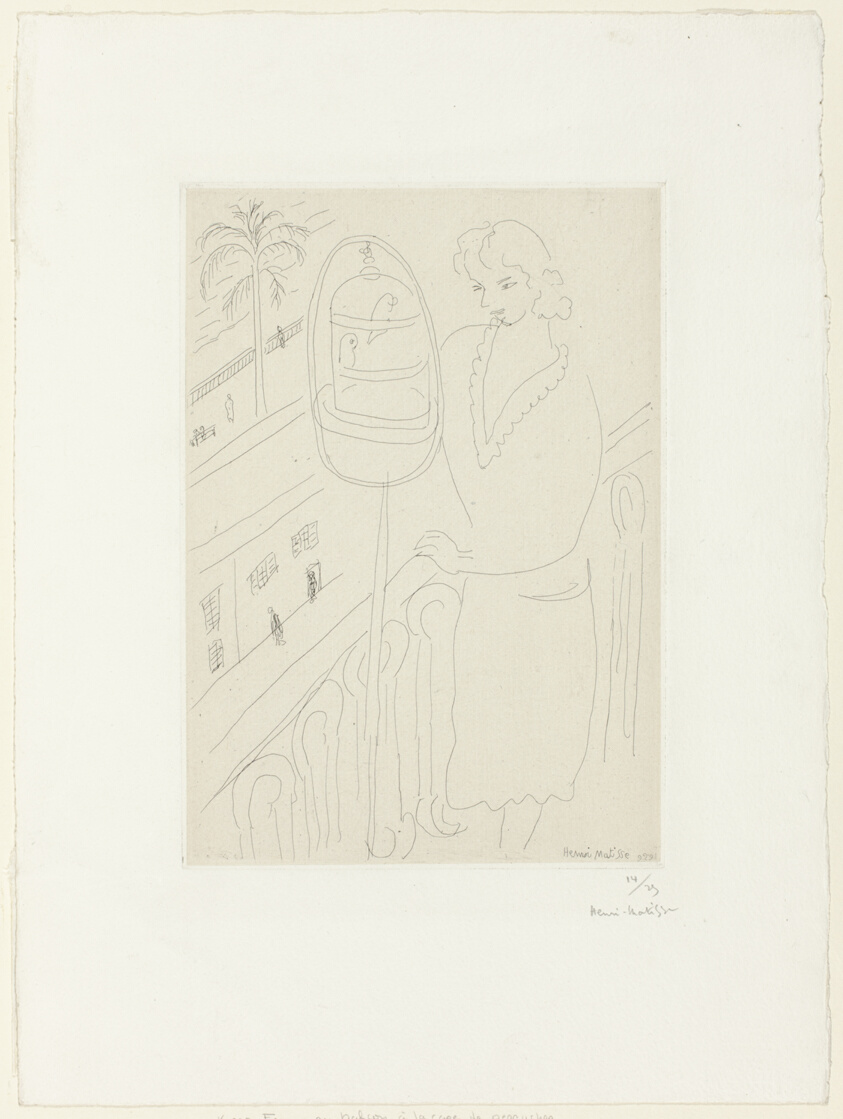
Featured Art: Young Woman on a Balcony Looking at Parakeets by Henri Matisse

We were sitting on the couch in the dark
talking about first pets, when I told him how,
as a girl, I kept a blue and white parakeet I let
y around the house and, sometimes, outside,
where he’d land on the branches of pine
and eucalyptus, balancing between seedpods
and spines. Only, while I was telling it,
my companion began to stroke, very lightly,
the indent of my palm, the way you do when you’re
sitting in the dark with someone you’ve never kissed
but have thought about kissing. And I told him
how my bird would sit on a high branch and sing,
loudly, at the wonder of it—the whole, green world—
while he traced the inside of my arm with his fingers,
opening another world of greenery and vines,
twisting toward the sun. I loved that bird for his singing,
and also for the way his small body, lifted skyward,
made my life larger. And then it was lip-to-lip,
a bramble, and it was hard to say who was who—
thumb to cheek to chest. The whole ravening.
When I told him I did not clip my bird’s wings,
I was talking about hunger. When he pressed me
hard against the back of the couch, named a litany
of things he’d do to me, I wanted them all.
I, too, have loved to live in a body. To feel the way
it lifts up the octaves of sky, cells spiraling
through smoke and mist, cumulus and stratus,
into that wild blue. And though I knew
there was always a hawk somewhere in the shadows
ready to snatch his heart in its claws, still,
I couldn’t help letting that parakeet free.


Read More

Naked, Fierce, Yelling Stone Age Grannies

By Lisa Bellamy

Featured Art: by Evelyn De Morgan

I shudder when I think of the giant beavers—
tiny-brained, squinting Pleistocene thugs—
they bared rotting incisors longer than a human arm,
they infested ponds and rivers, smothered
gasping sh with their acid-spiked, toxic urine,
they slapped their murderous tails—bleating,
they dragged themselves up the riverbank,
spied sweetgrass; they charged the crawling babies,
the tiny baby bones, trampling, they didn’t care—
hurray for the naked, fierce, yelling Stone Age grannies—
they dropped their hammer stones, they grabbed
sharp sticks. Who can forget their skinny, bouncing breasts?
They beat the giant beavers, they speared; they smeared
hot, thick beaver blood over each other’s faces,
their bony, serviceable buttocks—who can forget the grannies—


Read More

Not the Wolf but the Dog

By Jacqueline Berger

Featured Art: Two Human Beings. The Lovely Ones by Edvard Munch

Not the zebra but the horse;
not buffalo but cows,
maybe camels,
who traded the wild for the stable,
a stall lined in straw,
the house with wee gables and eaves,
their name over the door—
Biscuit, Coco. Snowball, Ranger.
Traded the hunt for the daily bowl and dish,
predators for owners, collar and leash;
agreed to be a tool—plow or cart
or confidant—to breed in captivity.

So when the man in the elevator
at the Venetian holding his cardboard
tray of coffees and muffins
heading back to his room
says to no one in particular,
but most likely to the other man,
the three of us strangers,
I better get something in return for this, 
he means fetching breakfast
so his wife can sleep,
I better get something for all of this, 
gesturing with his head,
meaning the hotel, the dinners and shows,
I think about women
who prowl the midnight streets
in their staggering heels,
breasts like missiles
because they’d rather be feral than kept.
And about men who gave up
wilding to name their offspring,
their known code continuing on forever.

I’m carrying my own tray
of coffees and muffins,
will soon press the card against the lock,
open the room, rip off my clothes,
throw back the three hundred
thread-count sheets, waking
my husband. He’s met someone new
and now wants both
of his lives at once.
He can sleep later. These untamed
weeks, we’re savaging,
flesh against flesh, ravishing
our marriage.

Read More

Zenyatta

By Grady Chambers

Featured Art: French Knight, 14th Century, by Paul Mercuri

              Breeders’ Cup, November 2010

In a different life she wins.
In a different November in Kentucky she leans
into the last curve of the brown-combed track
as she passes the thick of the field. In that one,
in a bar far away, in our lucky coats
and muddy white sneakers, we rise
with the televised crowd as she quickens
at the flick of the jockey, as the grandstand churns
at the distance beginning to close, as the line comes closer.

And we know it as her rider leans forward,
as Zenyatta knows it in her legs
as the horse before her turns
and knows it’s over, the brown mane flying by
in a whip of color and dust, as the stands become a flicker
of white tickets, as her name is spoken skyward like a chant.

Read More

A Brief History of Hunger

By Mary Jo Firth Gillett

Up from the mire of the primordial soup
came one-celled, tiny cavernous bits
whose innards knew a hollow ache only cured
when their shape-shifting borders engulfed
smaller bits, and came a world more complicated,
the paramecium with its oral groove,
the surprising planaria—nick its frontispiece
and the split becomes two hungry heads!—
then came, as ever, competition begetting variation,
to move or not to move, that was the question—
whether it was more propitious to see
with eyes multitudinous or on stalks or both,
whether it was better to be safely anchored,
waiting in camouflage, or to mount an assault,
evolution’s choices simple, almost biblical—seek
and ye shall find or lurk with bait in the hope that all
will come to him who waits, and then came
specialized beaks and teeth, fanciful horns
and coloration prompting procreation,
as well as a multitude of eating adaptations—
the water bird’s fused nostrils, air sacs in head and neck
to absorb impact as the feathered darts, pillaging
angels, plummet—and came homo sapiens with a myriad
of tastes and ways to cook—sear and braise, sauté
and soufflé, pickle and brine—came table manners, the urge
to gorge, to purge, came sorbet and gourmet, foods
delectable and indigestible, epicurean delights, food fights,
and all the ravenous mouths of tomorrow and tomorrow.


Read More

Florida Man Throws Alligator into Wendy’s Drive-Thru Window

By Mitchell Jacobs

Featured Art: Alligators by John Singer Sargent

The attendant hands him a soda and turns her back, thinking
of straws—how she’s running low, and their candy-red stripes,
and the way everything here comes wrapped up in paper, and

then a 3½-foot alligator is clawing the air.
                                                                          As if she pressed
the wrong button on the register. Or maybe, during lunch rush,
she’d ignored an oncoming hurricane tossing them about.

In any case, she shrieks, finding for this alligator non sequitur
no earthly explanation. Back when the heavens functioned
with less subtlety, she might have turned to the logic of myth.

The god of rapacity took the shape of a lizard
to penetrate the food hall’s oil-glossed aperture.

Perhaps the oracle of Jupiter, FL on his faux-leather throne
delivers this cold-blooded message to confront corporate greed
teeth to teeth.
                        Not that the police have succeeded

in extracting a motive. The culprit’s Frosty-smeared lips are sealed.
His charge: assault with a deadly weapon. Yet it rings untrue.
For Florida Man, we need a more particular punishment:

accused of wielding a projectile reptile,
the defendant shall be flung naked
into the Loxahatchee Slough.

If indeed he is a criminal, there will be no proper dunking.
If he is a hero, he will don no duckweed laurel as he rises
from the mud. But the surveillance camera remembers:

it’s not so wide, the gap between the actual and the possible.
About the space from Nissan Frontier to take-out window
where an alligator, bewildered, sees the kitchen’s steam

like fog over a marsh in red bloom, smells the billows
of meaty fragrance, hears the gatekeeper’s yodel of welcome,
and for a moment
                                 flies.


Read More

Parrots Over Suburbia

By Craig van Rooyen

Featured Art: by McGill Library

There are two,
as if some ark came to rest
on the high school football field
and Noah flung them through an open window
to test whether this cement-skinned town
can sustain life.
See them there, trimming
lava-dipped wings in the sky above Costco,
bills curved like question marks.
And what do they ask, out of earshot
of the man with sunflower seeds?
Do you know what it means
to circle, to draw and redraw the tightening
circumference of your life
above the grid of 50-year roofs,
in steak smoke risen from backyard barbecues?
The parrots’ owner is no prophet.
Summer evenings, he wrenches
on a ’67 Mustang that drips its innards
onto his Avenue L driveway.
And at dusk, he makes his arm a perch,
takes the two from their cage,
feeds them from his lips, knowing
if they love him he need not maim their wings.
So they fly in circles
and on every pass above the fenced playground,
swoop near to watch the girl in high-tops and earbuds
swinging, head thrown back to reveal
her pale and wild throat.


Read More

My Mother’s Dogs

By Sandy Gingras

Featured Art: Three Dogs Fighting by Antonio Tempesta

They are big and smelly and mean,
and they’re living in her basement.
I think they are dogs, but they might be wolves.
Eight or eighteen of them, something like that.
They all would bite me if I gave them
the chance, so I’m really careful
when I herd them out into the yard.
What is it with my mother?
Most families just have pets—usually one dog
and a cat, nothing like this. How
did she let this happen to her?

She’s living in some decrepit house now on Rt. 9
in the next town over and she’s evidently lost
her taste in furniture. Everything is gold
with rickety legs. She and I watch
the dogs patrol around the yard
from behind a glass sliding door. My mother is angry
now that she’s old, and I think that maybe
she and the dogs deserve each other, but
I can tell that my mother is scared too,
and I want to help her out because
I’m the problem-solver in our family.

The dogs don’t play like normal dogs,
they just move around the yard
like big bullet-headed missiles. We have to get rid
of them somehow, I tell my mother who is
suddenly smaller than she was, and then I hold her
in my arms and she’s a little girl. Whatever you do,
don’t let them in, I whisper, but
she’s already dead of lung cancer.


Read More

Catpants

By Richard Allen

Featured Art: The cat at play, c.1860-1878 by Henriëtte Ronner

dead cat on the shoulder
my heart aches for a moment
until I realize it is only
a balled-up pair of sweatpants

why would I feel compassion
were it a cat lying dead there
and not a balled-up
pair of sweatpants

I think it is because
cats are defenseless
and innocent then
I re-evaluate

they are neither
the average housecat
has injured several people
in its short life

just for laughs
the person who had to throw
his sweatpants out the window
a moment’s thought for him

for his sweatpants
and for the sad conflict
that must have unfolded
between them


Read More

Detective Story

By James Lineberger

Featured Art: by sir Edwin Landseer

When I worked as a janitor at the courthouse
I met a detective in the Sheriff’s department
whose son, I learned, had committed suicide
some months earlier. Having lost a son myself
in a car-train collision, I tried to offer my condolences.
“Your boy kill himself?” the detective asked bluntly.
“We never knew,” I replied. The detective grunted
noncommittally and opened his desk drawer to take out
a photo of his son, a young man in his twenties, kneeling
and embracing a dog as he grinned for the camera.
“Two days before it happened,” the detective said.
“About the same age as our son,” I said.
The detective stared at the photo for a moment.
“You got a dog?” he asked.
“Two,” I said.
“Thing about a dog,” he said, “a person can screw up
a hundred ways, and his dog will love him when he can’t
even love his self.”
“Our son’s dog still sleeps at the foot of his bed,” I said.
The detective turned the photograph over on its face
and glanced up at me, his eyes as cold as stars.
“Ain’t his dog,” he said. “It’s mine.”


Read More

Black Ants

By Fay Dillof

Featured Art: Crumpled and Withered Leaf Edge Mimicking Caterpillar (study for book Concealing Coloration in the Animal Kingdom) by Emma Beach Thayer

Unable to sleep,
I imagine a blob
of ants, erupting
from a faucet.

If they puddle,
that will mean sleep.

But if each ant
descends on a crumb,
steals what it can
and lumbers robotically off,
which they do,
branching in veins across the tile floor,
then I’m left
listening to the sound
of my two sisters
downstairs
in the summer kitchen
where they’re making
my mother laugh
without me
again,
carrying their prize
over invisible trails.


Read More

Talking to My Dead Mother About Dogs

By Stephanie Gangi

Featured Art: Dog with pups by India, Rajasthan, Ajmer, probably Sawar school

          That damn dog.
Which one, Ma?
          The first one.
There is no first one, there was always a dog, Ma.
          The shepherd, the one who kept the baby
          from rolling in to the road down the hill in front of the house.
That was me, Ma. I was the baby.
          I know that. Rex. Rex.
          And what about your father’s, who jumped
          out the car window at a toll booth, headed for the hills. Skippy,
          ungrateful mutt.
          Then we got Duchess, because of Lassie on television.
          Duchess was weak. Duchess didn’t last.
          The toy poodle came in a hat box. She matched the décor!
          I swear to god, she did.

Your chateau phase.
          What about your dogs?
My dogs? My dogs, Ma?
The fear biter who darted in the dark at the ankles of my bad choices?
The herder who swam himself spent, circling me circling me when I was at sea?
The too-happy dog, who I couldn’t keep, I forget why?
Now this one, the big one, this horse of a dog who braces himself
so I can stand? Who, the slower I go, the stronger he gets?
Who can’t rest until I rest? This dog, Ma?
This last one? Ma?


Read More

Gray Whale

By Sally Bliumis-Dunn

Featured Art: Submarine Series Introductory Lithograph by Eric Ravilious

When they read the metal tag
on her pectoral fin—
a surprise of dark Cyrillic letters

on this Gray Whale
who had swum some fourteen thousand miles,
inter-braiding continent

with continent—
strange that I think of you now, father
though you too had lived

mostly below a surface,
the breadth of which we could not know—

until they read her tag,
the cetologists had thought
the gray whales off the coast of Baja

were of a different species
from the ones in Minsk.

When I found your lacquer boxes,
so small they fit into my hand,
with their depictions of our home,

the pots above the stove,
their odd discolorations,
the cheerful curtained window

that looked out at the pines,
I felt sad I had not known your heart
would swim such distance for us—

you had never shown us one.
And how small you had to make yourself
to see each scene and paint it

like an ant stepping carefully along
one of those dark passages
in its hill of dirt that nobody sees inside.


Read More

A Theory of Violence

By Jennifer Perrine

Selected as runner-up of the 2014 New Ohio Review Poetry Contest by Alan Shapiro

In the museum of sex, the video loops
its cycle of common bonobo behavior:
penis fencing, genital rubbing, whole groups

engaged in frenzied pairs, their grinds and shrieks
playing for the edification of each patron
passing through the room. We all summon

our best poker faces. One woman speaks
softly, reads from the sign that describes
all the various partner combinations,

the multitude of positions, how relations
lower aggression, increase bonding within tribes.
We linger over this way of making peace,

wonder to each other if we would cease
our litany of guns, bombs, missile strikes
if we spent more time in wild embrace.

The exhibit doesn’t mention our other cousins,
chimpanzees, who form border patrols, chase
strangers in their midst, leave mangled bodies as lessons.
That’s the story we already know

and want to forget through the release
of these erotic halls, where we seek the thrill, the bliss

of these animals who hold us captive
while we lament what traits we’ve found adaptive.


Read More

Bobcat

By Mikko Harvey

Featured Art: Forest by Werner Drewes

Walking through the woods / at midnight / we were on our way / to the pond / where we
would skinny dip / when two yellow eyes / appeared on the path / we froze / they didn’t
blink or move / the body was / hidden by the dark / there was something / sinister in its
stillness / we turned back / you said it was probably / a bobcat / but better not / to take
that chance / we shared a bed / untouching as usual / you fell / asleep first and I wondered
what kept us / apart really / that night / and the others / the distance between us / maybe six
inches / felt like a shadow / I couldn’t step out of / my two open eyes / the only light
in the room / I thought of the animal / blocking our path / and it occurred to me / she was
only a hostess / welcoming us / to the world of risk / smooth and lovely / water hugging
your naked body / the animal said / are you ready / but we walked away / I had an urge
to shake your body / awake and take you back / to the animal and say / confidently yes
table for two / but instead I just lay there / in the perfect / quiet / country / darkness / and
imagined the outline / of your chest rising / and falling / rising / and falling as you slept.


Read More

If You See Something

By Billy Collins

Featured Art: Dove in Flight by Pablo Picasso

On my morning walk along a cinder path
that follows the shore of a lake,
I saw a good-size, solitary rabbit,

seven mourning doves who rose to the top of a fence
at my approach,

two anhingas, one drying his extended wings
like a pope on a balcony,
the other not doing anything at all,

also, a loud bird who refused to identify himself,

then ten young ducks in a huddle
by the vegetation near the water,
some sleeping, others preening their feathers,
all not quite old enough to be on their own,

oh, and a squirrel who headed up a tree
when he heard me coming down the path.

Read More

The Ideal Budweiser Customer Watches a Budweiser Commercial

By Danny Caine

Featured Art: Drugs by Richard Estes

Oh shit I love “Landslide.”
I was going to get up to piss but then I heard me some Fleetwood Mac.
Hey that’s a pretty farm, too. Farms are dope.
Wait, oh goddamn it it’s a baby horse lying in some fucking sawdust.

That baby horse is so cute I can’t even handle it right now.
I am literally unsure how to proceed.
And now the horse is being fed from a bottle?
The hell am I supposed to do with that?

Dammit now the horse and the dude are playing and stuff.
Fuck me if I don’t love a playful goddamn horse.
Look! A Budweiser truck. Budweiser!

I should like this brand on Facebook.
I should follow this brand on Twitter.
I really should make an effort to engage
with this brand on social media.

Wait, that’s a horse trailer. And our dude
is shaking hands with the driver? Is he—

DUDE YOU CAN’T SELL THAT FUCKING HORSE!

YOU’RE GOING TO MISS HIM SO MUCH!

Somebody get me a Budweiser.


Read More

At a Pet Shop

By Tom Whalen

Featured Art: Red Parrot on the Branch of a Tree by Ito Jakuchu

When the parrot took the cracker I offered, it said:

“Thank you, my friend. You’re the first person to give me anything to eat in decades. There is no a priori order of things. I thought I had been living the good life, but what did I know? The poet fell sick, traveled to the capital, needed words, painted his curtains bright green. A sumptuous village girl threatened me with a cheap lighter. Night after night watching the corpses of rodents turn to bone. I remember when my mother took me to the city, remember how her perfume gave me a high. After that it took me years to find a mate. Night work. Elocution lessons. A treatise on Gorgias’ Encomium of Helen. I kept to the plan I started with. Death is not an experience, food is.”

Then it fell from its perch with a thump, and from its beak an ant exited soaked in the parrot’s blood.


Read More

2 Fuzzy Bees

By Maura Stanton

Featured Art: A Gentleman Who Wanted to Study the Habits of Bees too Closely, plate 6 from Pastorales by Honoré Victorin Daumier

“La créateur est pessimiste, la création ambitieuse,
donc optimiste.” —René Char

Because I feared I’d only make a mess
Sticking yellow pom-poms onto black ones,
Or bungle wings as I tried to shape the white
Pipe-cleaners into an outline of flight,
I never opened this kit I got one Christmas
In my stocking—a joke from my sister:
Create A Critter. Since I’m cleaning house
I could throw it away. But all I need
To make 2 Fuzzy Bees are glue and scissors.
Everything’s here—the velvet-tipped feelers,
Button noses, and eyes with moving pupils.
Ages 6 and Up—well, that’s me, isn’t it?
And as an Adult, too, I can Supervise
Myself. So why do I still hesitate?
If I make a bad bee I can toss it out.
Look at this package. The cellophane’s intact,
Directions printed on the cardboard backing.
Even the little loose eyes seem to twinkle
Inviting me to stick them to the heads
Where they belong. Yes, they’re Choking Hazards,
But I’m alone right now, no cats or babies,
And the dining room table is cleared of junk.
And so I do it. Soon my Fuzzy Bees
Are finished, bouncing on their wire legs,
Looking up at me, cute as their photos,
Ready to begin their lives as . . . what?
What have I done? I’ve given them existence.
Their wings will never lift them to the sky,
Their red noses will never scent a rose,
But look at them! Ambitious, optimistic.


Read More