Depleted Uranium and Other Facebook Posts

By Okla Elliott

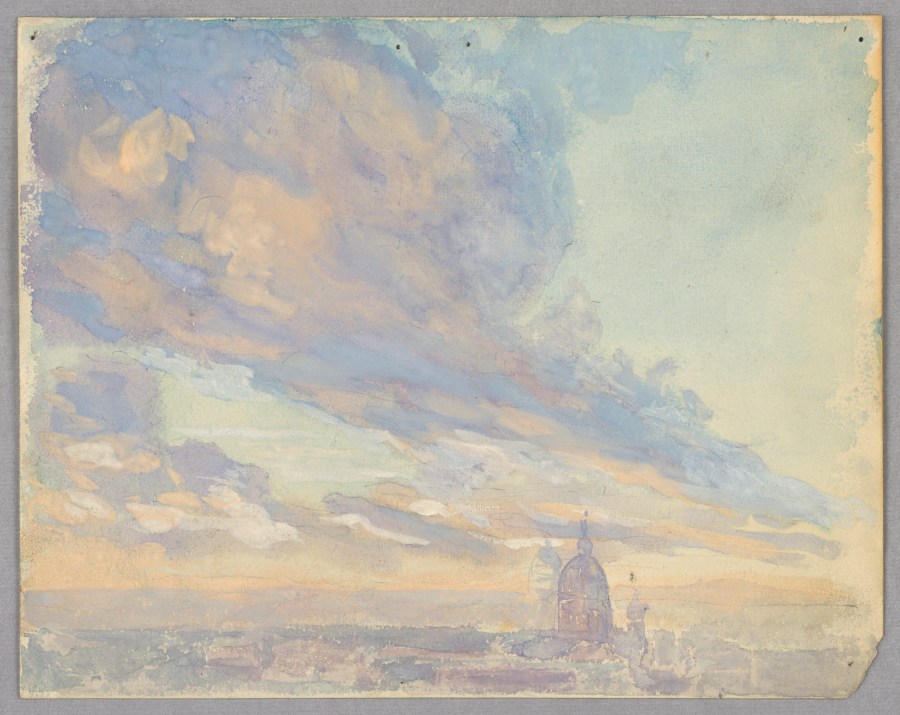
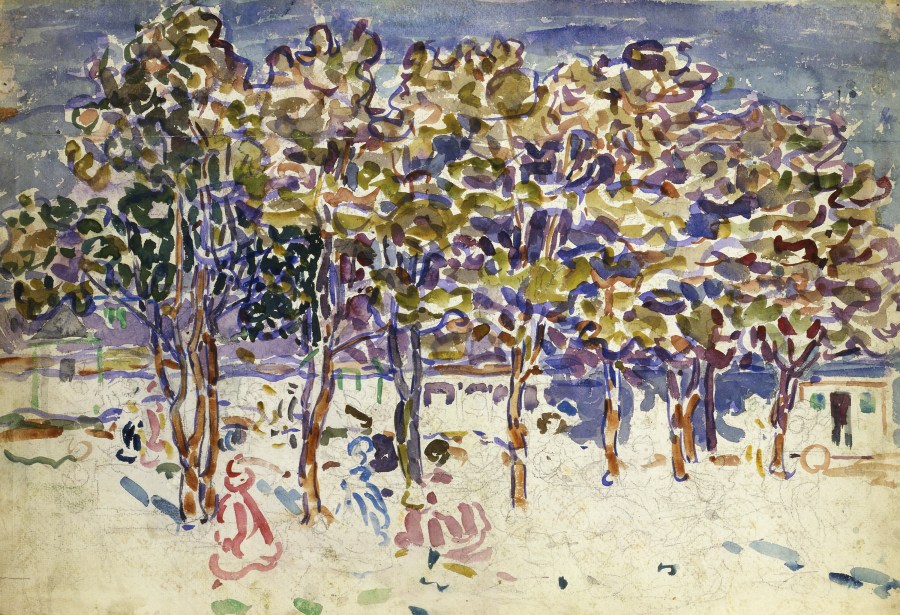
Featured Art: Evening Tones by Oscar Bluemner

We read about depleted uranium
and try to imagine the scientific facts
about depleted uranium.
What does depleted even mean in the context of uranium?
So we Google it and learn something horrendous.
Or rather something interesting
that has been turned to horrendous purpose.
And so we join a protest against depleted uranium
even though our friends tell us there are more pressing
matters right here at home. How can you post
on Facebook about depleted uranium?
our friends ask.
And so we post on Facebook about whatever
our friends have told us is most important to post
on Facebook about, and people stop thinking
about depleted uranium, though it still decays
its way into the cells of Iraqi children—and adults too,
but it is less effective to post on Facebook about the suffering
of adults, so I’ll only mention the children whose lymph nodes
and livers and lungs are mutating
due to depleted uranium. Or rather, I won’t,
since my friends tell me there are more pressing matters
here at home.


Read More

Chemistry

By Micheal George

Featured Art: Steps by Manierre Dawson

Sunday at one o’clock, my sister Denise arrives at my father’s house in Elizabeth, New Jersey. We don’t hug; I know that many siblings engage in this ritual, but it’s never been our way. Instead we share a kind of wry, shy smile, a brief flash of eye contact that’s almost like flirting. I ask her how she’s doing, and she says she’s great.

“And Dad?” She nods toward our father, who is reclined in his La-Z-Boy, watching the Cooking Channel.

“He’s great too.”

Denise doesn’t ask about me; such questions we probably both understand as unnecessary formalities. I can see through the window of my father’s one- story bungalow that her camera crew has arrived behind her, and are unloading equipment.

Read More

Night Blind

By David Yezzi

Featured Art: (Untitled) Nightscene of Park in a City by Unidentified

There’s a spot
at the top
of the street,
where the lamp

is out, that’s
the darkest
part of the
block. I don’t

go that way
at night, though
it would be
all right,

I’m sure. No one’s
there, just
a chained-up dog
in the damp air,

and branches
too dark to see
like black water
churning.


Read More

Aubade

By David Yezzi

Featured Art: (Untitled) City Scene with Playground by Unidentified

Some mornings I wake up in my old house,
half-conscious, squinting at the seam of light
gilding the edges of the flowered curtains.
I can imagine—actually feel, in fact—
that I am back there, where three flights down
the city’s up before me making noise:
a woman in green unchains the gated park
and the cross street fills with taxis. The light turns.
And in my half-lit bedroom, I am held
by a taut web of untold activity.
It surrounds me and carries on without me.
I breathe it in, smiling, lightened somehow.
For a moment then, I recognize myself,
before I’m back here where not all that much
goes on and the day begins its long goodbye.


Read More

Face to Face

By James Lineberger

Featured Art: Bowl of Flowers by Morton L. Schamberg

Back when our son died
I already suspected
that you and I would be having these
conversations sooner or later
but what I had not anticipated was your laughter,
the role-playing and costumes
and all the faces-on-parade,
as if you can’t decide which one to wear,
for there’s hardly a moment
when the one I’m talking to
is not some other you
like last night before I even had my apnea headgear
fastened securely
there you were peering at me up close
through the plastic mask,
only suddenly you weren’t you at all
but the image of my father
struggling to maintain his balance as he pisses
on the kitchen floor,

which forgive me I have a hard time accepting because
just ask yourself,
how are we supposed to have a serious conversation here,
where I come begging your forgiveness
for all the years of pain and deception you were married to,
when geez louise I just be damned if I owe that falling down alkie bastard
a single goddamn thing hear me
and answer me this:
if you’re so content being wife and daddy and everybody else,
what is it in there that sends out
your bird calls,
wears the hoodie, conveys itself behind the arras
and summons forth every one of you
who?


Read More

Here’s My Love Poem

By James Lineberger

Featured Art: Flowers from the Mesa, by Mary Vaux Walcott

If I didn’t love you
would I stand
there holding the car door so you
don’t hit yourself in
the head with it no I could just
step back and let it
happen and who would know the difference
except me cause you wouldn’t
remember what
went on anyway and when
we finally hobble inside Hardee’s with you
holding on for dear life until
I get you seated while
I order and then I surprise you by
bringing us a couple of cinnamon raisin
biscuits you think if I didn’t
love you I would sit there unprotesting while
you ignore your bacon and eggs
and gobble down both cinnamons dripping
the icing all over your fingers
and brand new sweater
you insatiable self-centered helpless child
what else to do but
dip a napkin in my water cup and wash your hands
until you start to cry saying why
don’t you just leave me I’m not worth anything to anybody
and I say me too


Read More

Old Married Couple

By Robin Messing

Featured Art: (Untitled–Group of Flowers) by Mary Vaux Walcott

They couldn’t part with things, so in the end, they lived with everything. Two toaster ovens, two coffee makers, two waffle irons, two sets of dishes, two couches, two coffee tables, two beds. Their former spouses would not have tolerated it. But together, something different happened.

Ben toasted an English muffin in his toaster oven, and Sophie toasted a piece of leftover challah in hers. Ben poured coffee from the percolator pot that his former wife, Edna, had bought decades before at a hardware store on Avenue J. Sophie brewed coffee in a Mr. Coffee pot that her former husband, Sam, had purchased after their glass percolator pot, slippery with soap, splintered in the sink when Sophie dropped it.

Sam died first, four years earlier. Six months later, Edna passed, both from cancer. Two years ago, Sophie and Ben married—a small ceremony in a shul on Coney Island Avenue.

Read More

They Used to Be So Valuable They Were Free

By Susan Blackwell Ramsey

Featured Art: 2019 Ohio State Map by Ohio Department of Transportation

Road maps may have gone to slide-rule heaven,
      but they were king. Swelling huge in glove compartments,
refusing to be refolded, snickering
      as we wrestled them wider. Marriages
foundered: thin lips, insults, tears,
      shouts as The Map went hurtling through the window
to pirouette in the car’s diminishing wake
      before drifting down to tent the roadside weeds.

Now GPS. Oh, there are always holdouts,
      Luddites who cite the morons who drove off cliffs,
glitch-guided, who claim it’s lousy in the Loop.
      And I grant that maps are glamorous, the world
wide in your lap, manageable, all places
      there simultaneously. Your past. Your future.

But that paper map can’t tell you where you are,
      which is half of navigation. Wasn’t that
always the problem? By the time you’d figured out 
      where you were and found it on the map,
you’d missed your exit. GPS lives in the moment.

Sometimes the good ones let you look ahead,
      pan out, zoom in, even overlay
a bird’s eye view of real trees, rivers, rooftops,
      but the beating heart is still that small blue dot,
like our planet seen from space, that stands for you,
      and the quiet voice that guides you through confusions,
absorbing your mistakes without reproach,
      recalculating a way to bring you home.


Read More

Query

By Sandy Gingras

Featured Art: Vase of Flowers by Unidentified 

(double space between paragraphs and indent throughout)

Use polite address: Dear Mr. Neil Augustus,

      How you picked aforementioned specific agent: I met you at a “A Hook for Every Book” writing workshop at the Holiday Inn and we made an interpersonal connection: At the opening reception, we both took an orange cheese cube from the buffet, and I said, “Hi.” I hope you remember me.

      Show that you’ve read this specific agent’s guidelines: I wrote 75,000 words exactly and used the font, Times New Roman, just the way you said to. Plus, I took out all the mentions of Tarot cards, trailer parks, and vampires in my book as your guidelines say you have a thing about them. I also spell-checked.

      Your novel is about: a serial killer. The sub-plot is about: another serial killer. It stands out from other novels in this genre because it has: two serial killers in it. Also, it has some good recipes. Your novel’s title is: Bodies and Brownies.

      The main character is: me except with shorter hair. The essence of the story is: I almost get killed a bunch of times and all sorts of hijinks ensue, but, in the end, I don’t die. So, no worries.

      The setting is: a hot climate. But I’m flexible and could switch it to a cold climate if you want that, Mr. Augustus. I’d just have to change the characters’ clothes and add snow and stuff.

      Your style of writing is: extremely marketable. Your novel compares favorably to: all of Stephen King’s novels. I’m like a female version of him, but I’m unique because my book is in all my own words.

      You are equipped to market your novel because: I enjoy travelling to other locales, particularly tropical vacation spots. For example, Orlando, Florida and/or The Bahamas. Your blog reaches: potentially millions of people worldwide.

      Who will like this novel? I know most people usually only read nonfiction nowadays, but I know plenty of people will like this fiction novel because it seems like it really could have happened.

                                                                                                            Sincerely or Respectfully,
                                                                                                            Your full name goes here: Ima Case


Read More

When We Were Neanderthals

By Chrys Tobey

Featured Art: Peacock in the Woods (study for book Concealing Coloration in the Animal Kingdom) by Abbott Handerson Thayor & Richard S. Meryman

I hunted deer for you. I scratched your back with stone tools
and we swaddled each other in fur from sabre-tooth cats

and laughed as we said, burp me. We’d say things like, You know
what they say about a large cranium.
I’d chase a woolly mammoth

just because you thought it was sexy. We’d snort chamomile
and talk about how after we’re dead others will ponder our

big toes and our inability to ice-skate. When we were Neanderthals,
you’d make me necklaces of shell, and because this was a few years

before the Pill, we had a kid, but because this was also a few years
before the Catholic Church, we eventually mastered when to pull out.

When we were Neanderthals, we had no buses to take, no offices
to be at, no flights from Germany to wherever. I was never

lonely. You’d run and hide in the woods and I’d try to spot you.
We thought the stars were ours. We thought the earth was square.

We thought the sky was a song, and then the Homo sapiens came.


Read More

Like a Fish Needs a Bicycle

By Ösel Jessica Plante

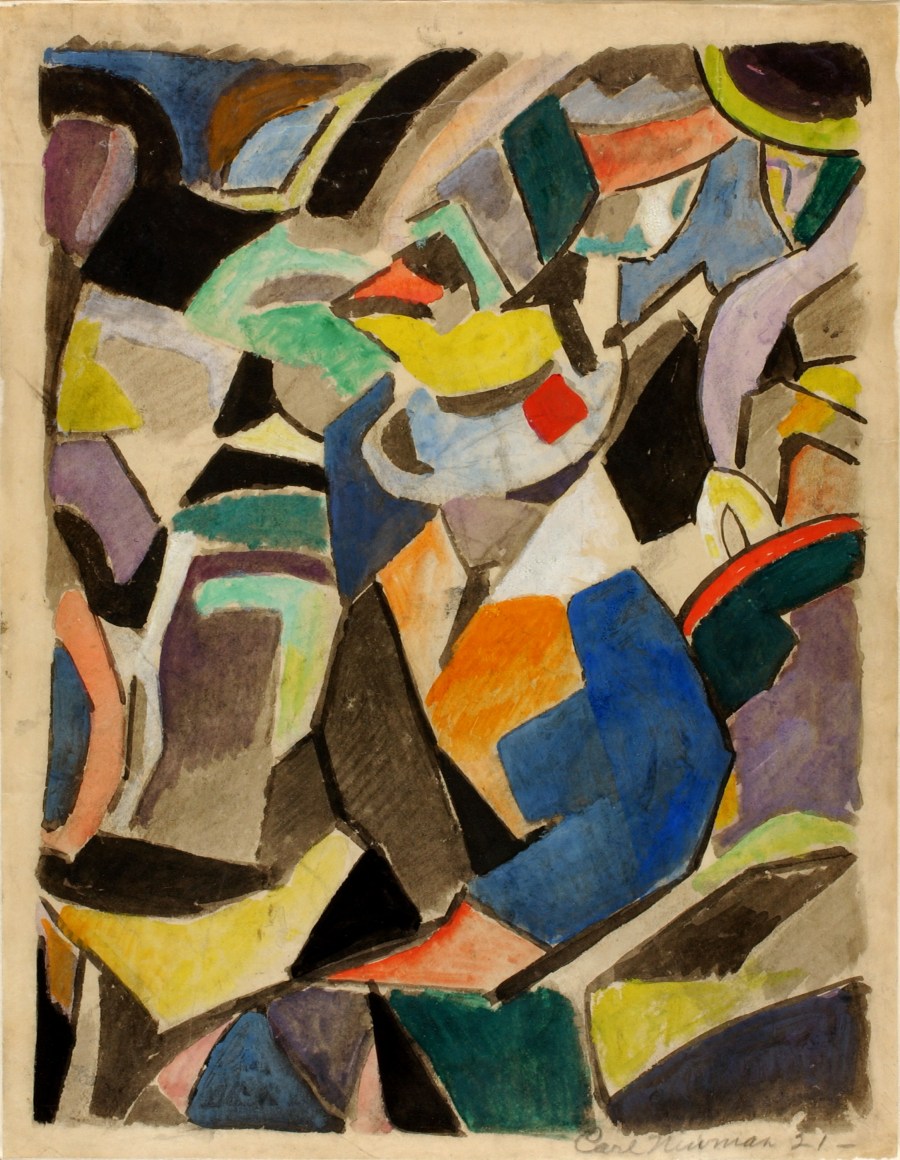
Featured Art: Group of Abstract Nudes by Carl Newman

There is something crooked about his mouth,
and though he’s obviously going to go bald soon,
his eyebrows are like kind, squat
temples above his eyes, one pupil dilated slightly
more than the other. This is what’s it’s like
to be single—to stare at a picture of a man online
and wonder, what does he smell like? What
would it feel like to wake up beside him
after two years of living together? I want
to believe that all relationships are mistakes
waiting to happen, have that built-in obsolescence
and are the reason why I finally like that saying
about the woman, a fish, and a bicycle. I like
imagining that fish upright underwater with its fins
spinning in loose circles the same way we pedaled
our feet in the air today during yoga to warm up
our thighs. Love’s made a fool of me once
too often. It’s like standing over a car engine—
I don’t know the rules for recalibrating
or even how to change the oil. It’s just that
every man looks like laundry and concession, even
the doctor with great abs my sister tells me she’s seen
at the soccer field with his son. I wonder if he wakes
in the morning and cooks his kid oatmeal,
I wonder where his ex-wife is now and whether she’s felt
it, how love is at first a greening, how even the bright
trees shuddering their shadows across our faces seem
a delicious sensation, I wonder that we’re able to hold
in abeyance the blade that will come to cut away all
that softness and leave in its place the ribs of something
enormous like the hull of a shipwreck, love having split
a way for something new, the bones of the world exposed.


Read More

Critical Learning Period

By Chelsea Biondolillo

Featured Art: Designs for Wallpaper and Textiles: Birds

1. CRITICAL LEARNING PERIOD

Songbirds, or suboscine Passeriformes, with fixed song repertoires learn to sing in four steps. The steps are studied, in part, because many linguists believe that these same four steps describe human language acquisition.

The first step in song acquisition is called the critical learning period. This is when chicks begin to recognize their parents’ voices along with neighbors of the same species, and they differentiate between those voices and other sounds.

*

My parents were married for three years before I was born, and they lived together for almost three years after. The shape and sound of their love is unknown to me. I have no idea how he courted her or when the courting became something else. I do not remember the words they spoke to each other in the days and months while I lay in my crib, listening.

I know what my mother said to me and what I said back. These are stories I’ve heard often. Before I could talk, I had night terrors, she tells me. I would scream inconsolably in my sleep. The pediatrician said this was normal for some babies. She tells me about the day I choked on bottle milk while lying in my crib, and how the sound of it sent her running to me; how afterwards, I would choke and gag whenever I wanted her to pick me up. It was a sound she could never ignore, she says, eyes squinted theatrically at the memory of my manipulation.

I would stand in my crib and yell (so early! so advanced!) MOM. MOM. MOM. MOM. And then one day, after a moment, DARLENE. I wonder, now, if I sounded like my father when I said it.

Read More

Bank Shot

By Greg McBride

Featured Art: Horse Race, Siena, Italy by Walter Shirlaw

I asked about the old days, when they
were my age—my mother scrambling eggs,
Dad and I at the table. He aimed a glance
sidelong at her, then took a shot toward me:

             We’ve been very lucky, Son.

He must have meant their gamboling, teenage
marriage after weeks of jitterbug jokes
and getting-to-know-you’s in the Abilene
Lady Luck pool hall in 1941.

Her silence like the hush of a tournament
match, the cue’s tip skittish at the ball,
probing for angle and spin, velocity,
the all-important leave and follow-on.

By now—both gone so long, both unlucky—
I understand his game, how words can
travel in disguise, their spin covert,
as on that morning when his mumbled plea

caromed off me—sharply, as off
a felted cushion—and spun toward her,
determined at the stove:

             Come on, Honey, let’s play.
             Let’s keep the run alive.


Read More
Cousin Scott on His Lizard

by Anders Carlson-Wee

Featured Art: A Lizard, Jamaica by Frederic Edwin Church

-In memory of Scott Christopher Maxwell,
1961 – 2007

You ever had some loose screw try to tell you
your friends is the family you choose?
Well I wouldn’t bottle the breath of the minister
that delivered the message. The family you got
is the only family you’re gonna get,
take it or leave it. Wanna know what I got?
I got myself sisters. Two of em. But that’s all I got
to say about that. That’s all I ever knew
to say about my sisters: There’s two of em.
I bet I coulda stomached a brother better.
Even when I was a little grommet I wanted
a brother, so I practiced on this pet lizard I had.
He was one of them color-changers that could
change his skin to blend in with whatever’s
below him. I named him Tony and took him
around with me. Showed him how to do
whatever I was doin. Talked to him and tried
to explain things. I remember wearin tie-dyed shirts
and puttin Tony on my shoulder so I could
watch him change. One day I had him on the back
of my hand while I was hot-wheelin down the street
and he jumped off and I ran right over him.
What do you say about something like that?
Afterwards he was so flat he looked like one of them
outlines of a lizard in a coloring book. No blood
or nothin, like nothin was in him. I’ll be damned
if I know what else to say about that.
I don’t even know why I told you about it.
Would you believe me if I said I never got over it?
Never got over the fact that when he died
he was the color of my hand? You think that’s funny?
I can’t even look at a goddamn lizard anymore.


Read More
Cousin Scott on Doomsday

By Anders Carlson-Wee

Featured Art: Burning Oil Well at Night, near Rouseville, Pennsylvania by James Hamilton

It don’t matter what you believe. All the Christians
know it’s comin, all the scientists know it’s comin.
Could be a chunk of the sun wipin out the grid
just as likely as the Lord Himself snuffin us out
one by one like a bunch of candle wicks.
Could be a oil shortage. Or the souls of the dead
come back to reckon. My buddy Critter figures
it’ll be the Lake of Fire––all the flesh dripping off
our dicks while we drown at the same time
over and over forever––like it says in the Bible.
But most folks won’t tell you what they believe.
My ma, she never broke silence on the issue.
My old man, he says I’m crazy. Says I’m gonna drink
myself to death before anything else gets the chance.
Me myself, I got my chips pushed in for somethin natural.
A meteor maybe. Or a polar flip. But like I said:
when you’re throwin pies, it don’t matter much what the flavor is.
It’s more folks thinkin like me than you’d think.
And like most of us, I got a bug-in plan for stayin put,
but I also got a bug-out plan for gettin gone.
Not that I’m gonna tell you where I’m goin.
It’s high in the mountains––I’ll say that much––
but that’s all the scat this cat’s gonna leave in the sand
for you to track by. Let me ask you somethin:
You think I’m crazy to have a hundred pounds of Spam
buried in caches? You think I’m crazy to have Critter
shoot me with a .22 so I know what it feels like
to get hit in a bulletproof vest? Well, you know what?
I hope I am crazy. I hope I’m the craziest son of a bitch
you ever met.


Read More
White Earth, Minnesota

By Anders Carlson-Wee

Featured Art: Hudson Valley, New York in Winter by Frederic Edwin Church

The volunteer staff at Saint Vincent de Paul
made too many sandwiches, expecting more.
When the drunk Indian came in from the winter
wearing some kind of neck-warmer pulled up
over his nose, they were able to give him
three for now and seven in a Ziploc bag. He sat down
at a fold-out table by himself and began eating
all of them. The icicles in his wild eyebrows
melted slowly. He mumbled orders as he chewed,
demanding bacon and a woman. From his pocket
he unfolded a photo of heck horses and held it up
whenever someone dared to look at him.
Partway through the meal he overheated
and took off most of his clothes. There was a hole
in his neck clearly made by a bullet, and made
recently. The rush of blood should never have clotted,
but it had. Maybe from the unbearable cold.
When the cop showed up he knocked back his hood
and pulled off his gloves to rub his nose.
He asked the staff if anyone had come in wearing
a ski mask. They shook their heads in unison
and kept shaking as the officer described the rough
features of the drunk Indian sitting by himself
with a hole in his neck eating sandwiches.


Read More
A Million Tigers Who Aren’t Mad at You

By Sandy Nietling

Featured Art: Abstract–Flowers in the Left by Carl Newman

My Mexican boyfriend cannot tell me if he’s ever killed a person. This is not because of a language barrier on either side. I asked my question clearly enough, and he is a good conversationalist with a decent English vocabulary. Still, Raf furrows his dark brows for a long moment, apparently needing time to puzzle through the facts as he knows them. Finally he frowns. “I’m not sure.”

When I ask my American boyfriends if they’ve killed someone, they laugh the way that they’re meant to laugh. Then, while they’re busy being surprised or trying to work up a clever response, I can worry about the papers I have to grade or how much longer the sliced pineapple in the refrigerator will last before I have to give it to the orioles in my backyard. That’s why you ask about death in the first place. It’s supposed to buy conversational elbow room, but Rafael has done the unexpected and provoked my attention instead of letting it drift away. It is not until later, in the dark of my bedroom, that he is relaxed enough to explain his crime.

Read More

Jenny Perowski is Ahead of Me in the Grocery Store Line

By Julie Danho

Featured Art:  (Untitled–Flower Study) by Mary Vaux Walcott

If an Amish family can forgive the man who burned
their land, surely I can say hello to Jenny Perowski,
who used to call me “fattie fat” in seventh grade math
and had boys call my house, pretending to ask me out.
That was twenty years ago. Now Jenny, if not fat exactly,
is puffy as a slightly overstuffed chair. I’m thinner than her,
and my pleasure feels more whiskey than cream, makes me
want to pour out her Kors bag to rifle for candy, then slowly
eat it in front of her like she once did to me. I know
her cruelty was, at best, a misdemeanor. But anger
is like a peppermint in a pocketbook—everything inside
takes on its smell and taste. I could break it in my teeth,
make it disappear. Instead, I savor the mint, let the sugar
line my mouth like fur, linger far past what can be called
pleasure. How good it would be to be better than this.


Read More
Grammar School

By Mark Belair

Featured Art: Project for an Overdoor by Carlo Marchionni or Filippo Marchionni

Through the municipal green, overpainted wire mesh
obscuring the grammar school basement windows

comes the spank of a basketball not engaged in any game,
just pounded in place in an empty, echoing cafeteria, then

an outside metal door gets gut-punched open to release
gruff-voiced janitor, belt keys jangling, cursing at the world

while from a first-floor office a stretch of plastic packing tape
screaks off a roll as a phone rings and a copy machine whumps

as if providing a bass line to a class that, upstairs,
bursts into a trebly, mocking laugh, after which,

yet farther up, in a distantly reverberant bathroom, a toilet
flushes and keeps running even after a door slams shut and

all the old, hard memories flood
back enough for me to know

that if a documentary film was made
about daily life in grammar school—

with shot after shot of small, solemn faces
taring out at us—

its scoreless soundtrack
would be this.


Read More

When Mr. Bridges Died

By Mark Kraushaar

Featured Art: (Children Swimming) by Unidentified 

When Mr. Bridges died I knew
the whole eighth grade would have to gather
in the gym and sit there on those cheerless,
folding metal chairs set up by string-bean
Donny Graf the constant burper.
Mr. Bridges was a substitute,
we hardly knew him, but
I knew that there we’d be, all of us,
and there would be our stiff-grinning
twitchy principal, Mr. Albert Fraze, to slowly,
slowly stand and tell us what a deep
and lasting loss this was for all of us.
And later, sitting there three rows from the exit
by fatso Robert Randall who’d socked me
in the stomach on the 8 bus once,
I knew that Mr. Fraze would drill us
with the first long look that said, Every one of you
should be ashamed, ashamed for even thinking about,
for even thinking about thinking about
turning your gaze away one ten
thousandth of an inch:
a man is dead today.
And then would come this clumsy, freighted
metaphor and though I doubt I knew the word
(metaphor) I knew our Mr. Fraze: Mr. Bridges
was a kind of bridge, he’d say,
or found a bridge, or formed a bridge, or built
a bridge, or was a bridge from ignorance to wisdom,
from confusion to compassion, blah, blah, blah,
which is exactly what he said so that
sitting there I thought of that four-cabled
quarter-mile Roebling tower bridge
and I thought of its glittering
river city Cincinnati since we’d studied it all week.
I pictured its reaching, curving waterway, the great
Ohio and I thought of the circling terns and swirling slicks
and chemical froths and then I thought of a row of houseboats
and a paddlewheel steamer with a single, smiling
tourist, anyone and no one, waving once.


Read More
Siccità

By Stephan Jarret

Featured Art: The Hills by Preston Dickinson

To my grandmother, Francesca, the cliffs of Wilmerding, Pennsylvania resembled Italy’s Amalfi coast. Only, when she looked over the edge, the valley was waterless. Not even a polluted stream that dried out in the summer months. “Siccità”—drought—she used to say, when she led me into our backyard and squinted with high-angle menace toward the neighboring town of Pitcairn. At night, the phosphorescent sign of Randy’s Brew House shrouded the valley in faux-oceanic cobalt blue, offering “HOT GIRLS” and “FREE PRETZELS.” Still, the lower hillside was anything but arid—peppered with trees, I thought— so I tried to mention that something was sustaining them. “What?” she’d say, either incredulous or deaf.
Read More
If I Could Have Your Attention

By Jonathan Louis Duckworth

Featured Art: Sunrise or Sunset (study for book Concealing Coloration in the Animal Kingdom) by Abbott Handerson Thayer

-To S. S.

              and if I could make of my hands a hammock
for the sinuous long-S slope of your spine
              if I could flocculate moonlight into a salve
to rub away our fears as fingers smooth a bedsheet’s creases         
              if I could scan the abjad calligraphy of your curls
and wake with long strands coiled lamia-like under my tongue
              if we could lie enmeshed under night’s aspect
our spooned bodies a crescent luna under the folds
                if I could rise first to cook you breakfast
and convince you basil pesto is morning fare
               
if I could recite to you all sixty-three octaves
of Keats’s Isabella with pungent pesto breath
                if we could exhume for each other our buried poems
to pry vital marrow from those discarded bones
               
and if we could distill the essential incanti
like sweet incense extracted from fetid agarwood
               
if I could breathe my favorite words to you:
“gloaming,” “Ewigkeit,” “azimuth,” “garrigues,” “laverock”
               
if I could settle into entire stillness
while you whisper your own treasured motes into my ear
               
and if I could only compose the words
that could incite in you half what yours have in me
               
I could be with you, or else write no more


Read More

Directions

By Matthew J. Spireng

Featured Art: Village Street by Alice Pike Barney

This time, giving directions to a place
I have never been, an address
I have only passed so I could tell another where

it is, I have explained: across the street from,
a few blocks down from, between this
cross street and that, a little yellow awning

across the front, the name in big letters above it,
and if it is dark, will there be
light on the awning, or will its color be gone,

indeterminate? Tell me, will you, if I arrive
first and find a better way to describe, how
can I reach you, or must the first suffice?


Read More

Fantaisie

By Donald Platt

Featured Art: Garden Flowers by Edna Boies Hopkins

                               Each person is
a solar system, the bits of birth’s Big Bang orbiting
                               some sun that both attracts

and repels. Elliptically, my mother orbits her own death,
                               that great shining
ball of fire I cannot look directly at. She draws closer to it,
                              then pulls away. She rotates
as she revolves. Together we write her obituary. Born.
                              Schooled. Worked as.

Married to. Gave birth. Resided. Retired. Is survived by.
                               The old story
we all get to write if we’re lucky, or one that will willy-nilly

                              get written for us.
I leave the day she’ll die blank. She gives me the notes
                              she wrote last night:

“Funeral in Christ Church and Bill Eakins to preach.
                              Ask Women’s Guild
to serve a simple refreshment. Give $100 to organist.

                              Give $5,000
to church. Give $500 to Bill Eakins. Give $1,000 to women.
                              Give $250

to soloist. No calling hours. Only the church service.
                              Nobody
getting up and saying nice things about me. Everyone

                              has their own
memories—good, bad, and indifferent. Chief purpose
                              of a funeral

is to pray for the departed. Also to give comfort
                              to those who grieve.
Call Hickey Funeral Home.” As an afterthought, she added

                              “Ask Charlene
to play Saint-Saëns’ Fantaisie for violin and harp.
                              You’ll need to find

a harpist.” Everyone needs a harpist to accompany her living
                              and her dying.
No one to turn to but the seated, marble harp player

                              at the Metropolitan Museum
of Art, early Cycladic, eleven and a half inches high
                              He embraces

the D-shaped instrument, whose top is ornamented
                              with the head
of a waterfowl. Against his right thigh and stone shoulder, he rests

                              the weight
of the instrument. It has no strings. His raised right thumb plucks
                              five thousand years of silence.


Read More

NOR 19 Feature: Manipulating the Reader

Featured Art: Sketch of Church Tower and Roof Top by Arnold William Brunner

We often say that a story, a movie, a song, or even a commercial about sad dogs is “emotionally manipulative.” We use this phrase not only to discount a particular piece, but to condemn it. What, though, constitutes literary emotional manipulation? Is there such a thing as a benign manipulation, a justifiable heart- tugging? And what specific moves can we identify that make the difference between effective and ineffective narrative manipulation, between a moving poem and a mawkish one?

We asked five writers—Rebecca McClanahan, Debra Marquart, A-J Aronstein, C.L. Dallat, and Matthew VanWinkle—to respond to those questions.


I Second That Emotion

A few years ago, I attended a literary gathering and heard four poets and memoirists read from their work. They were all accomplished writers, varied enough in their approaches to evoke laughter, sighs, nods of acknowledgment, a collective gasp at one point, and, toward the end of the evening, some tears as well. Tears are not uncommon at readings, of course—I have cried at several—but in this case the tears came not from audience members but rather from one of the readers, who had warned us that she might “choke up” because of the emotional content of the autobiographical piece she was about to read. Her introduction, followed by a tearful presentation, suggested either that the work was too new to share publicly or that she had planned her reaction and was intentionally manipulating us. As she spoke, I sensed listeners growing more and more uncomfortable, as I was. Some leaned back into their chairs, some crossed their arms. The more emotional the reader’s performance became, the less effect bit seemed to have, an unfortunate outcome, especially given that the work was potentially moving in and of itself. But it was as if the writer did not trust the work, or perhaps did not trust us to do our job as listeners: to bring our own emotional response to the work.

As I listened, I kept thinking of Chekhov’s advice to a writer who had sent him a story: If you “want to touch the reader’s heart, try to be colder . . . As it is, your heroes weep and you sigh.” John Gardner has a similar take on this issue in The Art of Fiction. “In great fiction,” Gardner writes, “we are moved by what happens, not by the whimpering or bawling of the writer’s presentation of what happens. That is, in great fiction, we are moved by characters and events, not by the emotion of the person who happens to be telling the story.” Certainly Chekhov and Gardner are not suggesting that the writer herself be unmoved by events and characters, but rather that she allow the reader the space to complete the transaction her words set into motion. For isn’t that what readers of literary fiction, poetry, and nonfiction want the chance to do? To, in the words of that Smokey Robinson hit, “second that emotion”?

Read More

Tell it Cool: On Writing with Restraint

By Debra Marquart

Featured Art: Hill with Trees by Eleanor Harris

For years, I’ve encouraged students to “tell it cool” when narrating a tale that is harrowing or emotional. A cool narrator can be a buoy in rough waters. I’ve always thought this advice came from Hemingway, but at this moment as I search my bookshelves for the place where Hemingway said it, I can’t put my finger on the quote. I know it’s in there somewhere, likely in one of the letters (bossy letters full of unsolicited advice and signed “Papa” when friends were just writing to ask for money).

In A Moveable Feast, Hemingway famously wrote about knowing what to leave out. In his discussion of the short story, “Out of Season,” for example, he remarks that he left out a key event connected to the real story: “I had omitted the real end of it which was that the old man hanged himself.” According to a letter that Hemingway wrote to F. Scott Fitzgerald in 1925, the story was “an almost literal transcription” of an experience he’d had while traveling in Europe with his first wife, Hadley.

Read More

Staying with Argos: Odysseus and His Dog

By A-J Aronstein

Featured Art: Clearing after September Gale–Maine Coast by Howard Russell Butler

Argos, the loyal dog of long-suffering, well-tanned, always-oiled Odysseus, appears only once in The Odyssey. At the sight of Odysseus, who returns to the island kingdom Ithaca after 20 years, Argos dies. Bam! Kaput. Struck down by a Zeusian thunderbolt. At this point in Book 17, no one other than the reader knows the true identity of the disguised and smelly Odysseus, who dresses like a beggar. Escorted by his loyal swineherd Eumaeus, Odysseus pauses to observe Argos from the distance of a few steps. But he can’t even pet the pup before steering back toward his wife’s suitors, whom he’ll slaughter in due course. Argos dies almost immediately after Odysseus turns away. Though the encounter takes fewer than one hundred lines, its brevity should not trick us into thinking about Argos’s death as a merely sad aside. A closer reading reveals how Homer manipulates his audience before the final act, using Argos to orient our empathy toward Odysseus. Moreover, if we stay with Argos a little longer, he reveals something essential about fiction’s capacity to wrap epic emotions into even the tiniest moments.

To see a doggie’s demise in any medium will always make us blubber. So too will reunions between pets and soldiers. Witness the strange phenomenon of YouTube compilations documenting first meetings between dogs and American troops returning home from Middle Eastern war zones. These clips depict pure cathartic joy. Fido or Georgie or Lady jump and drool all over their patriotic owners, howling with disbelief, filmed by someone holding an iPhone that trembles with the cinematographer’s barely-constrained sobs. Music swells, the major cries, and before we have time to think about the trauma lurking in the background, we cut to another dog jumping into the arms of another deep-eyed master in fatigues. These are fragmented blips of pure joy. They don’t ask us to think: They constitute a conveyor belt of emotive force.

Read More

Yeats and Heaney: The Poetry Without the Pity

By C. L. Dallat

Featured Art: Genip Tree in the Mountains, Jamaica by Frederic Edwin Church

When W.B. Yeats dismissed Wilfred Owen’s World War I poetry as “all blood, dirt & sucked sugar stick” (and omitted Owen, Sassoon, and Rosenberg from his 1936 anthology), he was making a powerful statement, not just about dis- taste for sentimental language and the role of pity in poetry, but about the poet’s duties and limits. He had already excluded writing war poetry from his own list of obligations in 1915’s “On Being Asked for a War Poem,” but only later became more coherent on the abjuration of pity as an unfit subject.

This is, of course, the Yeats whose career started in the mists and myths of a Celtic twilight amidst a flurry of pre-Raphaelite sentimentalism and romance, who wrote of tragic heroes, of “The Pity of Love” and “The Sorrow of Love.” So before reaching for his famous poem, “Easter 1916,” where Yeats does appear to address war and politics, we should take a momentary look at that early work.

Read More

Designs Less Palpable: Emotional Manipulation and Even-Handedness in Keats

By Matthew VanWinkle

Featured Art: Flowery Meadow by William Henry Holmes

In a February 3, 1818 letter to his friend Reynolds, Keats rejects a reading experience that he associates primarily with Wordsworth: “We hate poetry that has a palpable design upon us—and if we do not agree, seems to put its hand in its breeches pocket.” The reproach is so scathing because it acutely observes how rapidly the poetry’s interest in its audience cools, from the importunate heat of the design to the indifferent withdrawal to the pocket. Keats is fuming primarily at Wordsworth’s dogmatism and propensity for self-congratulation, as we hear earlier in the letter, where Keats complains of being “bullied into a certain Philosophy engendered in the whims of an Egotist.”

At first glance, this might seem like a rarefied chafing, a protest against an intellectual irritation or an effusion of rivalry peculiar to talented writers. Yet the kind of readerly hatred that Keats memorably articulates becomes more comprehensible when we think of art that has palpable designs not on our ideas but on our feelings: the swelling soundtrack that jerks at our tears, the so-cute cartoon kitty kitty that beguiles us into wuv. Every reader has caved in to this sort of appeal at one time or another, and many readers look back on such acquiescence abashedly, or worse. How to admit, even in hindsight, to having been manipulated, to having feelings that can be summoned and practiced upon with such infuriating confidence?

Read More

New Ohio Review Issue 18 (originally printed Fall 2015)

Newohioreview.org is archiving previous editions as they originally appeared. We are pairing the pieces with curated art work, as well as select audio recordings. In collaboration with our past contributors, we are happy to (re)-present this outstanding work.

Issue 18 compiled by Meah McCallister.

Believe that Even in My Deliberateness I Was Not Deliberate

By Gail Mazur

Featured Art: Butterfly by Mary Altha Nims

Believe that even in my deliberateness I was not deliberate
—The end words form this line from Gwendolyn Brooks’
poem, “the mother”

We’d be calm, we’d be serene, as long as we could believe

in the blue dragonflies and balletic monarchs that

hovered near us in a kind of peaceable kingdom even

while my love’s illness menaced the peace in

the summer yard, in the fragile house, in the air I breathed in my

deliberateness. My only stratagem, deliberateness:

to accept our lot in that pathless time. I

thought I’d know what he’d want; what I’d want was-

n’t any different. Wouldn’t it be, wouldn’t it finally be, not

to consider how finite our August? Not to deliberate?


Read More

Sintra

By Gail Mazur

Featured Art: Composition by Otto Freundlich

In your office, you, mastering the art of Photoshop,
scanning a crumpled snapshot, 3 inches square,

of your father, poolside, jaunty in a blue swimsuit,
his straw fedora at a rakish angle,

carrying two splashing cups of bica toward your mother.
Beaming, gallant, tanned, grinning for her camera.

That was in Portugal, in Sintra—
the village Byron called “most beautiful in the world.”

In the old cracked photo,
part of his naked chest had flaked away:

under the glossy surface an ashen patch.
Forty years later at your desk,

filial, in a fantasy of surgery,
you worked your laptop to repair the wound,

dragging pixels of skin tone, of mortal coloration,
from his right side to his left.

A new skill mastered, new language, new tools
that restored but couldn’t save.

I watched you transplant a blush of skin—
a tender ministry, your digital touch

lighter than a kiss—not unlike a kiss—

exactly where his heart four decades
earlier began to falter. As yours, invisibly, did now.

—One of those days we both still thought that somehow
with the proper tools, there was nothing you couldn’t fix.


Read More

Neighbors

By Suzanne McConnell

Selected as winner of the 2015 New Ohio Review Fiction Contest by Maud Casey

Featured Art: Gardener’s House at Antibes by Claude Monet

I wake to the phone ringing like an alarm. It’s the middle of the night. I clamber out of bed, hard-won sleep, into the living room, grope for the receiver. “Isabella,” my neighbor Viv says in her throaty, demanding voice. “I’ve lost my keys. I’m at the booth two blocks away. Come downstairs and let me in.” The phone clicks off.

I light a cigarette, and now I hear her raving like a maniac coming down the street. I move to the kitchen window and stand in the dark in my nightgown, trembling with rage, waiting for her figure to catch up with her voice shattering the night, and now I see her at the edge of the streetlight.

Read More

The Anatomy Lesson

By Bruce Bond

Featured Art: The Brook by Paul Cézanne

after Rembrandt

Why they look away is anyone’s guess,
these men apprenticed to the evidence,

gathered at the corpse the dark context
makes bright inside the surgical forum.

Anyone’s guess why, at this instant,
even the teacher looks past his subject,

the harp strings of these extended tendons
raised up from the bed of the open wound.

A spectacle, it seems, for no one there,
for though they lean in, wide-eyed, severe,

they look instead at the anatomy volume
propped up in the center of the room,

or at us, the viewer, the painter, the future
that stares back with the blindness of a mirror.

Read More

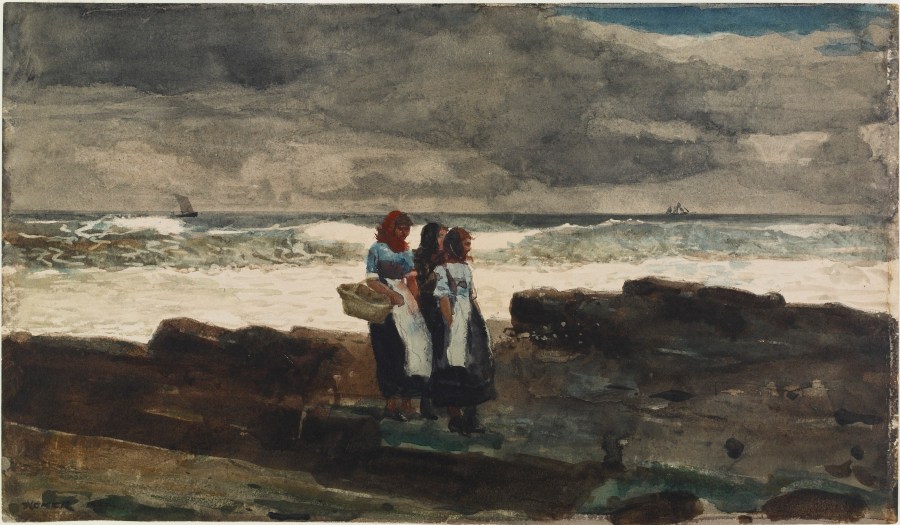
Girl with the Red Stockings

By Julie Hassett

Featured Art: The Red Kerchief by Claude Monet

after a painting by Winslow Homer, Boston MFA

Blue skirt a bell, percussive
on her calves, basket full of mussels,
unable to quell the surge,
red hair a banner,
she glares at a ship which lifts,
smacks the swell.
Spumes geyser over hull.
Black shoes plant on granite,
root to her core,
a ballast that will not crack
no matter the force
of gusts from the north,

a gush that rushes her sternum,
alone, again, by the ocean.


Read More

Sisters Peeling

By Julie Henson

Featured Art: A Fisherman’s Daughter by Winslow Homer

Late in the night after my father’s memorial service, my sisters and I stopped our small caravan at a Speedway in the stretch of US-40 between Greencastle and Indianapolis. It was early November.

“Come with me,” my sister Emily said, leading me to the back of her car and opening the trunk. She pointed to a box in the corner. “You want some?” she asked sounding like a drug dealer, which at one point she had been. I saw her slipping back in easy—my dad’s ashes were valuable and sort of dangerous—I felt like it may have even been against Indiana state law to have them, let alone scatter them, though I never checked. When I said nothing, she prodded, “You want even just a little? There’s so much to go around.” Sarah, our oldest sister, was waiting in the passenger seat—she had already been dealt her ash-inheritance. It was late and it was cold; I wanted to go to sleep. Emily looked at me intently. The way the gas station lights slanted cast a shadow across the top of her face, and I could not make out her expression.

“No,” I finally said. “I’m trying to quit.”

The nozzle on the gas pump clicked, and she sighed, shut the trunk.

Read More

Talking to My Dead Mother About Dogs

By Stephanie Gangi

Featured Art: Dog with pups by India, Rajasthan, Ajmer, probably Sawar school

          That damn dog.
Which one, Ma?
          The first one.
There is no first one, there was always a dog, Ma.
          The shepherd, the one who kept the baby
          from rolling in to the road down the hill in front of the house.
That was me, Ma. I was the baby.
          I know that. Rex. Rex.
          And what about your father’s, who jumped
          out the car window at a toll booth, headed for the hills. Skippy,
          ungrateful mutt.
          Then we got Duchess, because of Lassie on television.
          Duchess was weak. Duchess didn’t last.
          The toy poodle came in a hat box. She matched the décor!
          I swear to god, she did.

Your chateau phase.
          What about your dogs?
My dogs? My dogs, Ma?
The fear biter who darted in the dark at the ankles of my bad choices?
The herder who swam himself spent, circling me circling me when I was at sea?
The too-happy dog, who I couldn’t keep, I forget why?
Now this one, the big one, this horse of a dog who braces himself
so I can stand? Who, the slower I go, the stronger he gets?
Who can’t rest until I rest? This dog, Ma?
This last one? Ma?


Read More

At the Columbarium

By Jackie Craven

Featured Art: Edge of the Woods Near L’Hermitage, Pontoise by Camille Pissarro

“We’d invite you in,” my mother said, “but where
would we put you?” I must have seemed enormous
squatting before her door, third drawer from center.

If not for the marble nameplate, I might’ve seen
a diorama of Jacobean chairs, tiny forks and spoons,
and my stepfather’s bonsai.

“There’s barely enough room for the two of us,”
my mother went on. Deep inside the granite walls,
my stepfather growled, “I blame the Realtor.”

Dogwoods fluttered, casting stained blossoms
into the fountain. Down the hill, a procession of bagpipes
let out a skirl. “She promised us a view,” my mother shrilled.

I think my parents imagined themselves still
at the retirement home, rolling along a tulip-edged path
from the Independent Wing, past Assisted Living,

over to Memory Care, where the Admissions Lady
touched my arm and whispered, “Don’t worry.
We’ll help them downsize.”

Read More

After the Funeral

By Holly Day

Featured Art: A Funeral by Jean-Paul Laurens

When my father was ten, his mother died
and he went outside into the street after her funeral and screamed
at God. He said, “Take me,
you fucker!” to God, and his younger brother, my
uncle, was so scared he ran
into the room they both shared and hid. Later, when
my father came back, my uncle asked him what Hell was like,
why God had let him come back, if he had seen
their mother, what she was wearing.


Read More

An Evolution of Prayer

By Stephen Dunn

Featured Art: Genesis II by Franz Marc

As a child, some of his prayers were answered
because he prayed out loud for a kite or bike,
which his mother would overhear, and pass on
to her husband, his father, the Lord.

Later, he understood that when he prayed
he was mostly talking to himself—albeit a better,
more moral part of himself—which accounted
for why he heard nothing back from the void.

Lord, he’d begin, because he was afraid
to alter the language of prayer, Lord, deliver
me from envy and mean-spiritedness,
allow me to love people as I love animals.

Then his father died, and he became the sad Lord
of himself, praying for pleasures immediate and grantable.
Let me tango the night long with Margot the receptionist,
he’d say to no one. Let me do unto others.


Read More

Rock Harbor

Selected as runner-up for the 2015 New Ohio Review Fiction Contest by Maud Casey

By Susan Finch

Featured Art: Early Morning After a Storm at Sea by Winslow Homer

When Bob Miller slipped and fell from the rooftop deck of his ex-wife’s houseboat into the inky black of Rock Harbor, it almost appeared as if he’d done it on purpose. The fall took him feet over head, his flailing arms tightening into a V like he was performing a cartwheel. His fingers spread open in sunbursts, his legs stretched wide and long like a dancer’s, and his toes tensed into sharp points. As he tumbled the twenty-five feet into the shadowy water, his whole body seemed to expand and explode into a star.

The entire party saw Bob’s fall or, at least, when the police conducted the official investigation, partygoers would claim they had. And in truth, the spinning and twisting of Bob Miller’s body end-over-end was so spectacular that in hearing the story later in whispers passing across the marina from slip to slip, everyone felt they had seen it. Those who knew Bob assumed he’d been dared to do it. He had always been a bit of a showoff and couldn’t say no to a challenge. When he was thirteen, he’d purchased a dirt bike and had performed stunts for his friends on the weekend, vaulting over a campfire, navigating the narrow wall between the cornfield and the river, and once, after a double-dog-dare, he’d launched the bike from the hayloft of his father’s dilapidated barn and taken a nasty spill on the landing, fracturing his femur.

Read More

Gray Whale

By Sally Bliumis-Dunn

Featured Art: Submarine Series Introductory Lithograph by Eric Ravilious

When they read the metal tag
on her pectoral fin—
a surprise of dark Cyrillic letters

on this Gray Whale
who had swum some fourteen thousand miles,
inter-braiding continent

with continent—
strange that I think of you now, father
though you too had lived

mostly below a surface,
the breadth of which we could not know—

until they read her tag,
the cetologists had thought
the gray whales off the coast of Baja

were of a different species
from the ones in Minsk.

When I found your lacquer boxes,
so small they fit into my hand,
with their depictions of our home,

the pots above the stove,
their odd discolorations,
the cheerful curtained window

that looked out at the pines,
I felt sad I had not known your heart
would swim such distance for us—

you had never shown us one.
And how small you had to make yourself
to see each scene and paint it

like an ant stepping carefully along
one of those dark passages
in its hill of dirt that nobody sees inside.


Read More

Aesthetics to Change the Way You Live

By Sally Bliumis-Dunn

Featured Art: The Burning of the Houses of Lords and Commons, 16 October 1834 by Joseph Mallord William Turner

“Aesthetics to Change the Way You Live”
—Growth Magazine

For instance wabi sabi,
a Japanese view of life
that celebrates the imperfect,

the light-hearted sound
of the two words
like figures balanced on a seesaw,

behind them, cloudless sky,
and in the spread, the photograph
of nicked and tarnished silver spoons

arranged in rows on lilac velvet—
how perfectly imperfect.
But separate from the printed page,

the air around me darkens—
and then the sound
like thunder pressing closer

as I think of my own flaws—
and then they all
come charging toward me

like a herd of bison,
so dense it’s hard to see
from all the kicked-up dust.

So loud I cannot think.
How much easier to be won over
by a living room’s worn rug,

the reds and blues, faded,
even threadbare in those places
I have most often stood.


Read More

Plato and You

By Christopher Flannery

Featured Art: Reading by Berthe Morisot

I was reading Plato

and thinking about you.

So I wasn’t really reading.

I was thinking.

And I wasn’t thinking about reading,

if you get the idea.

And that’s the thing.

With Plato,

it’s all about the idea.


Read More

This Contract is Complete

By Kyle Norwood

Featured Art: Crescent Moon from Album of Paintings by the Venerable Zeshin by Shibata Zeshin 柴田 是真

    “This contract,” this machine with knobs
to be pulled, buttons to be pushed, inexorable gears
leading from
A to B, but so easily sabotaged,
mucked up by a fallen coin or shirtsleeve or
dangled lock of hair caught in the works


    “is complete,” encompasses entirely the world
of its transaction, has an inside but no outside,
everything else is forever foreign and beneath notice
in the penumbra of this dazzling light,

    “and all promises, representations, understandings,
and agreements,” theories, whispered assurances,
messages in code, three-martini lunchtime conversations,
husky-voiced proposals to meet in back of the bank by moonlight,

“have been expressed herein, and all prior negotiations

    and agreements are merged herein,” forgotten, a haze,
only this document remembers, everything else is indistinct.
Nonetheless,
“no change, modification, or assignment hereof”
shall surprise the sociologists, or Erda the earth-spirit
who knows how all things end,

    and no contract, no music or poem worth the paper,
no valedictory address or deathbed testament,
no blood sacrifices, voodoo rituals, fire sales,
or promises spoken out of a burning bush,
no house finch spilling its enthusiasm into the gutters,
no final snow covering the earth like a last sigh,

“shall be binding against the Company unless in writing
and signed by one of its officers.”


Read More