From the Archive: “Audition”

by Leslie Rodd

Originally published in New Ohio Review Issue #20

San Francisco, 1969

Outside the jazz club where I’ve been audience, player, and piano tuner over the years, it’s quiet at this sunstruck ten o’clock, and I have a shivery thought of a guitar and a girl that began inside my head last night. No rocking, no rhythm, no foot-stomping or window-shaking. Only the fifty measured strides I’ve counted from the corner where the 30 Stockton dropped me off, past the police station to the alley, the dip in the pavement and the sloping rise, the manhole cover to my left, yes, here it is, the last of my landmarks, reassuring me I’m in the right place. A thought of a girl, who used to make my music glow.

Read More

2018 Winter Exclusive

Featuring stories by Caro Claire Burke, Daniel Paul, Jonathan Durbin, Frankie Barnet, and Gunnar Jaeck, and poems by Kateri Kosek, David O’Connell, Christopher Brean Murray, Dylan Loring, Lance Larsen, Cody Wilson, and Susan Ramsey.

Dark Matter

By Caro Claire Burke

1.

The mother and father received the news on a Friday afternoon and were in the car driving south an hour later. They drove until midnight, then checked into a Courtyard Marriott for five hours before hopping back onto the road at dawn to cover the last hundred miles. They were silent in the car, which was strange: in their twenty years of marriage, they had never run out of things to talk about. There were, of course, things to talk about now—perhaps more than ever before—but neither the mother nor the father could find the words to start the conversation. By the time they navigated through the college town and parked at the police station where their son was held, they were both exhausted, irritable, and fit to burst with all the questions they’d swallowed on the way down.

The police officer behind the desk looked up as the entrance bells went off. “You must be the boy’s parents.”

The father stepped forward to shake the police officer’s hand. “That we are. Where is he?”

The officer was jovial to a fault. “Just down the hall a ways.” He turned toward a door in the back and waved an arm at them to follow. But the mother and father were silent, almost frozen, and at that silence the police officer turned around, his hand on the doorknob. “Hey, now,” he said. “Now’s not the time for that. Your boy is pretty shook up. He could use some support. Between you and me, these cases happen all the time. My guess? Your boy will be out of here in no time, clean record and everything.”

Read More

2018 Summer Exclusive

Featuring stories by Mari Christmas, Scott Koenig, LaTanya McQueen, JH Bond, Tamar Jacobs, and Traci Sauce, and poems by Mark Williams and James Lineberger.

A Non-Orientable Surface

By Mari Christmas

My husband manages a cheap hotel off the interstate five days a week, and every Wednesday night he visits the community center pool. Some days I meet him there. I like to watch him push the water around. It helps with the arthritis, he says, sculling the surface, making frog legs. He believes I deserve an office job, something that allows me to move between cities while wearing a thin blouse. We hardly speak. This is because of all the guilt. I look out across the pool. Children shiver in wrinkled suits, sucking their hair. Inside, it is airless, hazy, the windows fogged. The water a dark tangle of rope. Even though I cannot see him, I know he is there.

*

After swimming my husband will stay in his small room, equipped with a desk and a plastic lamp, and berate his romantic Romanian pen pal over the phone. He feels the need to give important looks, to demonstrate his rigor over a crowded table, and so forth, even internationally. “If you piss in the corner, I piss in the corner,” he tells her, speaking in English. For two bars of chocolate a month she puts up with all of that. He refuses to learn her language, as he cannot be bothered with the gender of specifics.

Tonight, he comes into the kitchen with the phone saying he wants a son, one he will name Atilla. Atilla? I think. Like Atilla the Hun? I marvel at my attraction to this bareheaded man, whose age has a secure density to it, like a landmark, and how this makes me feel intimately bound to him. “Something that does not weaken the spirit. Nothing that gives him an ironic existence,” he explains to his girlfriend, and then retreats down the hall, padding softly, his shirt untucked. Through the walls I hear him say the name ennobles mankind and something about plundering a northern province. He is never done. He talks and talks. Another blind Milton dictating to his poor daughter. The top of my head says, at least they’re not sleeping together, but I no longer believe in any of that.

Read More

Special Days

By Scott Koenig

It’s so bright even though the blinds are closed. Streaks of white light gash the wall. The wall Dad painted blue last month. Your favorite color is red but you like blue, too. There’s the humming of lawnmowers in the distance. Open those blinds.

Out there it’s green everywhere.  Up above, it’s blue. There’s a white car in your driveway, too. Not our car, you think. Whose car is that. Green grass down here, around the strange little white car, and blue sky up there. The colors are so pure it kind of hurts.  It’s nice, though. Do your eyes hurt? You could open the window to smell the grass but Dad got mad last time. Up on the hill where green turns into blue are big brown houses. If you squint they look like blobs of oatmeal raisin cookie dough when Mom lines them up on a baking sheet. And between the houses are thin lanes of grass where the older kids go sledding on snow days. The older kids with the colorful backpacks and the best Pokemon cards. Andy said one of the Meyer boys had three holographic Charizards. There’s no way. You aren’t allowed to go sledding on the hill yet. You just got allowed to ride your bike up to the black mailbox. The green mailbox after that is too high, too far up the hill, too dangerous, Mom always says. You know you can do it but you aren’t allowed.  But soon you’ll be allowed to go all the way up – to the top of the hill. Then back down super fast into the coldy sack. Like how the older kids do.

The man across the street is bent over by a bush, the man whose house is white and black and pointy and looks like a castle. He’s bent over by a bush using those big shiny scissors. The scary ones. The kind Dad uses a lot. Is Dad outside?  Look down into your part of the green.  Dad isn’t in your part of the green yet. Maybe later. There’s still the humming. Humming is an outside activity, Mom always says. Sometimes she hums but she does it quieter than you. And mostly outside. Her humming is nicer than lawnmower humming. Especially because when there’s a bunch of different lawnmowers all at once it sounds like buzzing. Like bugs, kind of.

Read More

Bit

By LaTanya McQueen

Because of her own curiosity she said yes when he asked her to put the bit on him. The bit, or gag, was an iron mask shaped like half a moon with a hook that went around the front of a person’s head. A spiked collar connected to the mask through a lock at the back of the neck.

He collected historical artifacts like these, the iron bit and scold’s bridle women were once punished with wearing, the shackles and chains forced upon slaves, items all from a not-too-distant era. When she asked him why, he told her he had a fascination for history long forgotten.

“Forgotten?” she asked and he shrugged in response.

She was used to men wanting things like this from her, to be blindfolded with her wrists cuffed and legs tied. She’d been expecting a day to come when he’d ask her if she would wear the bit, because hadn’t their relationship been leading up to this? Men, both white and black alike, were always asking in various ways to put her in this position, one of servitude, of serving. They wanted her on her back with her legs spread, body motionless, a mouth open only for moaning or what he’d force in. So many of them held this secret desire within themselves but eventually, with time, they always found a way to tell her.

She picked the bit up. As she felt its weight, she imagined what her fore-bearers must have experienced as the iron was fastened on. “Where did you get this?”

“eBay,” he said. The simplicity of his answer made her laugh. She asked him if it was real.

“I think so. Go ahead. Put it on,” he urged, and she did.

Read More

Roses and Begonias; Or, Things That Can Crush You

By J.H. Bond

We’re in a bathroom at McDonald’s and it smells like pee and I’m helping my dad put his makeup on. It’s his eyebrows that he struggles the most with. They’re supposed to arc like dark rainbows high up on his forehead. He can’t do them in the mirror—they look like mountains.

“Get ’em even, Mitchell,” Dad tells me, as he kneels down, eye-level.

I’m always drawing pictures. Now I’m drawing one on my dad. His real eyebrows are gone, lost under a mask of white. I give him some new ones with a makeup pencil, then paint the tip of his nose bright red.

He pulls on his stockings. Zips up his yellow-gold jumpsuit. I hand him his giant shoes and ask how come they’re so big. Goofy factor, he says.

He fits on his wig and it blazes like fire.

“How do I look?” he asks me.

“Like a clown,” I say.

*

Dad’s got three parties this afternoon. I count eight kids at the first and I don’t know any of them. Dad’s trying to make a wiener dog balloon and I’m at a table in the corner, drawing pictures of the motel I’ve been living in with my mom.

I sort of hate the kids Dad entertains. He gives this boy with braces the wiener dog balloon and a freckle-faced girl a turtle. They’re all cracking up and happy like Dad’s a good clown, but he’s not. Every time he tries to juggle he splatters an egg. Kids laugh, but still. He can’t do tricks. He doesn’t tell jokes. He just falls down and spills stuff, and slips in the stuff he spilled.

Read More

Sidekicks

By JP Gritton

I guess you’re wondering how I ended up with a woman like Syrena, in the first place. Truth is, it’s Mike’s fault. He’s the one to blame. Or to thank, I don’t know which. It was Mike Corliss who turned to me on this too-hot afternoon beginning of September. The four of us ought to go out sometime. Double Dutch, I mean. And I remember him smiling at me while my guts turned somersaults.  He was a different man those days, full of piss and vinegar. He had a smart mouth on him, and he wasn’t afraid to use it either, which is why Laughton Starbuck kind of had it out for Mike.

“Where’s your protective eyewear, Corliss?”

“My protective eyewear?”

“That’s what I asked you.”

“My protective eyewear’s protecting the dashboard of Sheldon Cooper’s truck. That’s where I left it this morning.”

Sheldon, he used to call me, ’cause he knew it got on my nerves. To everybody else I was Shelley.

I was just a journeyman carpenter back then. I drove Lij’s truck to work and home every day, give my best friend Mike Corliss a ride. Half the time, he’d forget something on the dash: that blue bandana, that pack of smokes, that pair of goggles.

I guess I looked up to Mike, who was a couple years older than me and besides that had a way about him. He told a story better than anybody I know, though you never knew how much was true and how much he’d half-made up. He told me how a honeybee flies through the rain, missing every drop. He told me nobody’d ever saw a giant squid, but even so scientists know they exist ’cause sometimes, he said, a whale or a shark will wash up on the beach, a great big bite took out of it.

Read More

At Bay

By Tamar Jacobs

I was chopping peppers when Ronnie came home. I’d been thinking to go to Safeway to see if there were any open bags of candy I could take from, or maybe walk down to the water to feed my birds, but then I saw him and all those ideas went up like smoke from my head. I hadn’t seen him in two years. He got out of the car and stepped into the sun, one whole big part of his skin a new lake of blue. I saw later up close it was all made of little tattoos lifting and blending together, but from behind my side of the kitchen window that day, it looked like he’d been afflicted with some kind of blue sickness. Down his arm and up his neck and some up on his forehead right above his eyebrows and a little trickle from just one eye. He’d gone away, got dipped in color and come back. I found this extraordinary and mysterious, and it kept me up at night thinking about it, touching my own skin wondering what it might feel like to go blue.

After Ms. Eva got done bumping into everything around her with her car like always when she parks, and they slammed their doors closed and went inside her house, I squeezed my eyes shut and chopped as fast as I could, felt tiny sharp prickles of cold pepper water punching into my fingers. I could not look down, because if I did the pepper water became the licking tongues of snakes trying to kiss me away from my knife, trying to slither out from under the blade I was hacking on them with. But as hard as I could I refused to see and they gave up moving and I heard Ms. Rose roll over the loud spring on the couch and I tried even harder because I could not let her hear me chopping in a crazy-sounding way or she would know I’d been skipping pills again. I would not feel sorry about those snakes. Would not, would not, no, I told myself.

I would not then, but when I sleep, I can’t stay as careful about my thoughts as when I am awake. That night while I slept feelings began to creep in about those snakes I killed. They were just being themselves. Being snakes. And there I had been chopping them to pieces trying to pretend I thought they were peppers.

Read More

マ I 克 (ma-i-ke)

By Warren Decker

Mike came to Japan because he was tired of being Mike. He was the only guy in the dorm who would never take lime Jell-O vodka shots, and would get mad if his roommate woke him up— stumbling drunk through the door, and turning on the florescent light, before passing out snoring in the lower bunk, fully clothed, wearing shoes filthy with mud and wet grass clippings from the university lawns. Mike would climb down from his top bunk and turn off the light but he could never get back to sleep, and his morning study routine would be disrupted.

Mike preferred Chinese characters to people, specifically the kanji characters used in Japan. He had already worked his way through the bright red “First 500 Kanji Workbook,” and was halfway through the light blue “500-1000 Kanji Workbook,” while some of the other freshmen were still struggling with the phonetic hiragana characters. His teachers praised his diligence, but for Mike it was very simple: he preferred Chinese characters to his roommate but he also preferred Chinese characters to Mike. If he spent an hour carefully memorizing the stroke order of a kanji like 鬱, then Mike—with all his doubts, his unfounded sadnesses, and fears—would be somewhere far away.

In his junior year, he arrived at Kyoto University as マイク (ma-i-ku). When people spoke, he could quickly associate the syllables of sound with a specific kanji, and decipher the meaning within a few seconds. The other exchange students were still fumbling around with “ohayo gozaimasu.” Within a month マイク had lost his virginity in his single-occupancy dorm room with Reika, an English major, who wore huge sunglasses and had long hair that was dyed a dark shade of reddish-brown.

Read More

The Red Bird

This story originally appeared in New Ohio Review 8. Here, Joanne Serling, author of the new novel, Good Neighbors, reads for our NOR Audio feature.

Illustration by Devan Murphy.


First Date

By James Lineberger

In the sixth grade I asked
Sissy Morgan
if she would go to the picture show with me
on what was supposed to be
my first date but when I said it her eyes got wide
and her mouth fell open and she just backed off till she ran into
a chair and had to sit down and didn’t say a word.

But during recess I could see her at the swings
giggling and whispering to her girl friends
and all of them staring at me
but if it was a trick or what I didn’t know
cause while I was waiting for the school bus
she came up to me and said
well all right but she would not go to
the Paramount which all
they showed was double-feature westerns with people like
Sonny Tufts or Charles Starrett
and if there was anything she could not abide it was Charles Starrett doing
The Durango Kid.

But when I told mama she said not
to worry because
we could go see Forever Amber at the Visulite
with Linda Darnell and Cornel Wilde
which was kind of like Gone With The Wind mama said
and the name was because of the color
of her eyes which ought to be just the kind
of story that a little girl would go for
and what we will do
mama said was I will drive y’all to the Visulite
and meet you out front again when
it is over.

Read More

Hurricane, 3rd Day

By Melissa Studdard

We hid in the belly of porcelain. The world 
sang sirens overlapping, the sound of wind

taking gates from the hinge. That whistling, yes.
Whistling and whipping, the world the cry 

of a cow caught in the spin of a twister and lifted. 
Water creeping to the back door like a thief. 

It wanted the jewels of our eyes.

In the house next door, a woman breastfed 
another woman’s baby, the thin-sweet milk.

Across the street, a man wrote social security numbers
on his kids’ arms with a Sharpie—a game, he said. 

And in our tub we held the news in our palms:

forty dogs from a kennel rescued by boat, a guy
on paddleboard heaving toddlers from a window, one

by one. And trapped across town, a shop full
of bakers sleeping on flour sacks, baking all day—

they slept and baked, slept and sprinkled.
For whoever might need. Not even sampling

or licking a finger. Once, I thought humankind 
brutal and nature benign—foolish child

with my frog in a box, my holey lid. 
Once, before, I asked to be delivered.

O sugar-hungry God, the world 
has been dredged and is waiting.


Read More

Love Story in an Alternate Universe in Which Small Talk Is Answered Honestly and in Detail

By Daniel Paul

I run into her on the street. We haven’t seen each other in a few years. “The weather is really nice today, especially for winter,” I say.

“I know,” she says. “It’s been so gray and depressing lately that I’ve been thinking a lot about how much I hate living here. Or at least I hope I hate living here. Otherwise it means that I just hate living in general.”

“No,” I reassure her. “I’m sure you just hate living here; this city is terrible.”

“I feel a bit better today,” she continues, “though it’s probably only warmer outside because of climate change, which makes me feel like enjoying a day like this is stealing joy directly from future generations . . . which I guess is okay, because I don’t want to have children: babies look like aliens, and I can’t even keep a houseplant alive; honestly, sometimes I don’t even want to keep the plant alive; I’d rather lord over it with my power to decide its fate, though that’s probably just a way of rationalizing the fact that even if I did want to keep a plant alive—to feel like I was contributing to the cycle of life and warmth even if just in my living room—I’m sure I would fail somehow and it would die anyway.”

Read More

Surfacing

By Kateri Kosek

When copyediting the small-town monthly, things press in.

Chair yoga. Croquet. Bears that pull laundry off clotheslines.

Someone following GPS drives onto the dam,
slips off the narrow bridge.

Someone unscrews his neighbor’s porch light, gets caught on surveillance.
He said the light was annoying at night but promised to stop doing it.

(Why live here, if you can’t see the stars?)

Fire alarms.

Unattended fires.

Every month more news of the lake’s battle with Eurasian milfoil—
who will come to study it, to harvest it, to keep the lake from clogging up.
How to keep it from fragmenting, spreading.

(I don’t know Eurasian milfoil from the next lake weed
but I’ve given up worrying about them.
I swim on the surface, don’t put my feet down.)

I learn:  the cereus plant, a desert native, blooms just one night a year
and has an exquisite scent.

Spider wasps encase their prey in mud; their larvae
eat spiders for a week then spin a silk cocoon to spend the winter in.

Petrichor is a husband-wife duo who will be exploring the sound world
of the musical instrument digital interface.

More importantly, it’s the word for the smell of the forest just after it rains.

The school is closing (hardly any school-age children!).
The historical house is holding a swanky fundraiser.
Guests will have a marvelous time while enjoying the stunning poolside views.

Read More

Parliament Lights

By Jonathan Durbin

It is too early to be up when the girl rises to pack. Winter rain taps the window but otherwise outside the street is silent and dark. No joggers or dog walkers or idling delivery trucks. No cars, not yet. No sign of Mike Lavoie.

The girl wishes for a cigarette but there isn’t time enough to smoke. She isn’t allowed anyway. There is no smoking in the shelter, the boy made that clear. If she smokes there they’ll be forced out and then where will they stay? Her mother’s? Nowhere is safe. Not anymore. The boy rolls onto her side of the bed, his hair thick with night grease, and mutters into her pillow. It sounds like You know better.

Their luggage lies open on the rug at the foot of the bed. The girl and the boy agreed to take just the one suitcase. Any more luggage and they’d be weighed down, that’s what he said. They might have to leave the shelter in a hurry. But the suitcase is half-full and they’ve barely the things they’d want for a long weekend. A fraction of their socks, a sampling of their underwear. A small quota of tees and jeans and hooded sweatshirts. Her things and his things thrown together, mixed up inside.

They argued about this last night, like they argued about it the night before and the night before that too. The girl cannot imagine how they will pack everything into a space so small. Fear of mistakes has led her to dither and ask the boy’s opinion about silly things. Which Nalgene bottle he prefers. If they should buy instant coffee or grounds. If it’s all right for her to bring whiskey.

Stop worrying, he has told her again and again. The shelter is equipped to last a long time. Months, maybe a year. Mike Lavoie has stocked it with tins of tuna and bags of salt-cured pork, iodine tablets and a generator and fresh batteries for flashlights. Oxygen canisters and Ibuprofen and cases of disinfectant wipes. Two motorcycles with full tanks of gas, and all the bullets and rifles they’ll need to hunt or defend the land.

Read More

Told You So

By Craig Bernardini

If I had a choice
between being wrong
and the world dying—
you know, the oceans
turning into lemon juice, the air
to Lysol, the forests
cinder, tundra
swamp, shipping lanes
jammed with dead
polar bears, Manhattan
a gondola, the world,
a Gondwana of dengue—
I would, of course, choose
the latter.
And maybe, just maybe,
clinging to the last
antenna of the last
skyscraper to be swallowed
by the waves, pointing
my big fat finger
at the dead world,
and at all the mother-
fuckers who did it,
shouting, Told you so,
Told you so—maybe,
as the water was closing
over my mouth, I’d understand
how we got into this mess
in the first place.


Read More

In the Borderlands

By Kateri Kosek

Today on the back-roads, where Connecticut
and Massachusetts bleed together unnoticed—
the large, gangly silhouettes of two llamas
weaving across the road ahead of me, not
where they are supposed to be, where I always
pass them, stoic and shaggy amid a spread
of crumbling outbuildings.

A young woman has stopped.
She gets out of the car and I stop too,
and more llamas rush out from the broken gate,
ears erect like horns on their pert pedestal heads.

I wonder for a moment, could they hurt us?
These animals we usually see standing still,
chewing dumbly while we gawk?
We forget their long legs, forget
they can move.

But they head for the field
and there’s something exhilarating
about their sudden temporary glory,
the larger world asserting itself
in the form of llamas on the loose, llamas
spreading through a whitened February field
and no one around who can stop them.
I should mention, I had been crying.

Starting for the door of the farmhouse,
I hear someone coming out.
Fucking cocksuckers, he drawls, this older man
we can’t see, as if the llamas plotted this breakout
on a regular basis. Jesus Christ Almighty—
adding a new dimension to my image of the cluttered
farmyard, hushed and exotic, too much to take in
though I always slow down, riveted
as I am now, but I drive away
and leave him to it, lifted.


Read More

National Pastime

By Daniel Paul

Walking in the West Village, I stop at the park on Clarkson Street to watch some little league baseball. I lean against the chain-link fence and am grateful for how its curves accept my weight without comment or judgment (as I imagine the inside of a whale might). A man is standing near me; he speaks in easy platitudes, and I nod along, not so much because I agree with him—for example, he says the weather is perfect, and all I can think of is how one of the clouds looks like you and the other looks like Nixon and how I’m in no state to rank omens in terms of their relative inscrutability—but rather because I really like nodding: as with launching a satellite, once you’ve done the work of getting your head to the top of its apogee there is a pleasing feeling of submission to a higher power in letting gravity complete the act. The man, who I decide to name Bubba (because I have never met a Bubba and fear if I do not take this opportunity, I never will) tells me that its been a crazy year for the team, though I don’t know which team he is referring to (one is in blue, the other green, and I wonder if I’m the only one who is bothered by the fact that the team whose shirts do not have piped collars is the one sponsored by a local plumbing concern).

It’s been a crazy year for all of us, I say, unsure of what a “sane year” would look like.

Oh yes, he answers, lots of ups and downs for the squad.

Don’t I know it? I say, and with each nod I become more emotional about the (no doubt unjust) obstacles that the team has faced as they have tried to do nothing more than live their lives and play some baseball on Saturday afternoons.

Bubba does not look at me as he speaks, keeping his eye on the field (and I wonder if he is actually talking to someone on his other side instead of me, and, by extension, what percentage of the conversations I’ve ever had did not actually require my involvement). He says that the team has struggled with fundamentals.

Read More

The Roots of Phobia Lie in History

By David O’Connell

I hate their tiny hands, the silent-screen-villains’ way they have
of rubbing them together, chest-high, as they squat on countertop

or wall and stare me down with gas-mask goggle eyes.
Hate how they materialize from clear blue sky to picnic, to garbage,

to shit. It’s their disregard. Their monotonous, dull thudding—wings
to window—so persistent that it bullies my attention. As does

that intermittent buzz, somewhere in the house, taunting me to try
and stalk it down. In swarms, if possible, I hate them more. Despise

their ganged-up arrogance, the lazy way they rise—helicopters
from midtown—when I approach each mutilated victim of the cat.

But it’s more than that. If not a full-blown phobia, my aversion’s
on the spectrum. And I believe them, those psychiatrists

who guess true phobic hate (blistered, crippling) may indicate
that terror’s being leeched from something other than experience,

that, right now, somewhere in my genome’s mud, there lies
a clutch of rusting drums leaking grim ancestral memories: flies

inside the suppurating wound, flies on the gangrene rot, flies
alighting on the child too weak—or worse—to brush them off.

And if that’s true, wouldn’t it account for why I sweat
when I catch sight of one upon my pillow or hear its stuttering hum?

No. Not entirely. Terror’s well delves deeper. Its waters seep
from hollows in the Id infested with the blind, albino worms of nightmare.

And more than suffering, more even than the thought of the loved body’s
eventual decay, its stench a honey drawing clouds of flies to mate

and lay those eggs that, hours after death, make cold skin pulse,
then writhe—more than this, it’s what comes after that fuels phobia.

Read More
A History of Clouds

By Christopher Brean Murray

You can think while walking, running,
washing the dishes, reading, grocery shopping,
or sleeping. Driving across Nevada at night
breeds thoughts—they leap from sagebrush
like jackrabbits into your high beams.
Most people can’t think while writing.
They have ideas, yes, but not thoughts.
Anyone can snatch an old idea out of the dust
and show it around. Trying to think
will invariably prohibit thought. I thought
of writing this poem while driving to work
this morning. I made sure not to
think about it much. The wind swayed
a stoplight until it turned green.
A man in a yellow tank top leaned
into the window of a parked car.
It was not yet 8 a.m. Wisps of cloud
coursed though the sky over Houston.
Someone should compile a book
called A History of Clouds. It could be,
among other things, an anthology
of descriptions of clouds, from novels,
from the love letters of exiled princes.
Shakespeare’s “pestilent congregation
of vapors” speech would appear, as would
Mayakovsky’s “A Cloud in Trousers.”
Clouds aren’t mentioned much in the Bible.
God did, however, call to Moses from inside
a cloud. Enoch speaks of “the locked reservoirs
from which the winds are distributed.”
Crane’s “To the Cloud Juggler” and
Stevens’ “Sea Surface Full of Clouds”—
and that passage from Gogol where
a cloud slithers over Nevsky Prospect.
It stretches and coils and becomes an intestine
embracing the anxious protagonist until we realize
he’s being suffocated by his thoughts.
Somewhere Rilke speaks of “vast, ruined
kingdoms of cloud.” That, from the love letter
of another exiled prince.


Read More

A History of Clouds, film by Caitlin Morgan

Christopher Brean Murray’s poems have appeared or are forthcoming in Colorado Review, Copper Nickel, Epoch, jubilat, Pleiades, Plume, and Quarterly West. He lives in Houston.

Caitlin Morgan is an independent filmmaker. She splits her time between New York City and Michigan.


Mexican Standoff

By Dylan Loring

This summer afternoon on the blacktop
of an elementary school playground
Steve and Rachel have their guns pointed at each other,
as tends to happen every once in a while
between two people who have dated for months,

that is, until Chet shows up brandishing his revolver at Steve,
causing Rachel to complete the triangle by shifting her gun
toward Chet, at which point, Steve says, “Well lookie here.
Seems like we have ourselves a Mexican standoff!”
which makes Rachel say, “Wuh? None of us are Mexicans.”

“I could call my bud, Raul, if you put your guns away,” Chet says.
“That would ruin our Mexican standoff!” Steve says.
“Adding a Mexican to our Mexican standoff
would ruin our Mexican standoff?” Rachel asks.
“Have you ever even been to Mexico?” Chet asks.

“A Mexican standoff,” Steve says, “occurs when each person
in a given vicinity has both a gun pointed at himself
and his gun pointed at someone else.”
“Or herself and her,” Rachel adds.
“Sounds to me like a gun deadlock

or a James Bond-high-stakes-poker-thingy,” Chet says.
“Mexican standoff is just what it’s called,” Steve says.
“I could sure go for some Mexican food
after this . . . Mexican standoff,” Rachel says.
“Are you sure it’s called a Mexican standoff?” Chet asks.

“It sure sounds either made-up or racist or both.”
“It’s not racist, it’s just what we call it,” Steve says.
“You mean like how we call the Washington Redskins
the Washington Redskins? Because that’s still racist
even though it’s the name of our local football team,” Rachel says.

“Go Redskins!” Chet adds. Chet is an avid football fan.
“The Mexican part of the Mexican standoff
is literally the least important part,” Steve says.
“You probably mean figuratively.
People almost never mean literally,” Chet says.

Read More

Aphorisms for a Lonely Planet

By Lance Larsen

1

Conception, gamete meeting gamete, cells dividing and differentiating. Who wants to imagine themselves coming into the world this way? Instead think of your parents as amateurs lying down in the enchanted dark and rising up as seasoned weavers of light.  Picture fire, with sparks flying off. One was lucky enough to catch—and now pulses inside you.  Listen to yourself breathe.

2

Like a rolling billiard ball we touch the world one green millisecond at a time.

3

A good story possesses its own magnetic north, to which every vibrating sentence must point.

4

To live is to doubt.

5

At the exit of the Paris catacombs, which houses the remains of six million sleepers, the guard looked me over, then fanned a flashlight into my backpack: Any bones, any bonesNo, I said, then smuggled my skeleton into the morning.

6

Should I read Descartes or listen to Motown? Depends whether I want to interrogate my doubts or slap them on my feet and dance them under the table.

7

The young are young. The old are young and old at the same time. You have to be old to know this—that’s the problem.

8

Seek labor which both tires and renews.

Read More

Box in a Closet

By Faith Shearin


Slutty Rush

By Frankie Barnet

All throughout my girlhood it was my primary ambition to be as dumb as possible. My father was a professor of mathematics who attempted to teach me algebra at age nine and preached discipline and rationality above all else. My mother was a reform Hutterite who cut her own hair. He once bought her a Costco membership for Christmas and she went only once, finding the experience gluttonous.

I had a best friend in this youth, a girl named Kelly who lived down the block. At her home I tried many foods for the first time: sushi, avocado, specialty cheese. I once saw her parents dancing without any music playing on my way to the bathroom while she and I watched It Takes Two in the basement.

Yet still, despite these differences in our home lives, Kelly shared my dream: to be weightless from a lack of knowledge. To float up and up and up. Away and free.

Our favorite thing to do together was to play a game in which we imitated two girls from our grade at school who were so dumb it was impossible. Their names were Stacey and Sasha. In addition to being idiots they were also sluts, a not uncommon pairing Kelly and I both coveted. “Like, totally,” we’d say, pretending to be them. “Like, oh my gaaaawd.” “Like, like, literally like.”

During the summer between ninth and tenth grade, Kelly and I walked through the river valley playing our game (“So oh my God, what did you, like, do last night?” “So I like literally boned Matt G. soooo bad!”) when we spotted an injured rabbit just off the path and decided to pick it up. Dumb, right? Just the kind of thing we, as them, loved to do.

“He could be, like, our baby.”

“Let’s take him home, like, literally.”

“Oh my God, because I’m pregnant, like, from boning all the time.”

“Totally pregnant, and I don’t literally know who did it to me.”

Read More

ASL on Memory

By Cody Wilson

Here is the sign for remember:

With one thumb, pull a line
from the spool in your forehead and set to tether
on the cleat of your other thumb.

Now the hull of your head can stay
docked to this thought.

Here is forget:

 Wipe your forehead with fingers
—the sign of relief—then pull
them into your palm.

Except your thumb. That sticks up,
like there is something good about this.

(Click “Read More” to see this poem signed by Kirsten Pribula)


Read More

from Real Things

By Nicole Hebdon


Fugitive

By Susan Blackwell Ramsey

Knowing everything fades—youth, love—doesn’t excuse
using red lake in a painting you plan to sell.
Red lake is the bad boyfriend of pigments;
red lake invented ghosting. That bastard Whistler
would use it, take the money, then ignore
the outraged complaints that rained down later
when the red faded away without a trace.
Colors that don’t last are called fugitive.

So many ways to make pigment—dirt, rocks, bugs
plucked from cactus and crushed. If pigment, then art.
We so want to believe that art preserves.
Oh, over the centuries art may lose a nose,
an arm or two. “Very fragile, penises,”
Alice Neil said, sitting below the statue,
but the medium itself, the stone, the paint,
shouldn’t be the agent that betrays.

Some betrayals are worse than others. Poor Seurat,
with his complicated theory of optics,
where the brain blends tiny dots of color.
Its demonstration, his La Grande Jatte masterpiece,
used, for its intensity, zinc yellow.
Within a few years it faded to dull ochre,
passion to affection to indifference.
By that time, mercifully, Seurat was dead.

Pigments that last may come from minerals
ground to powder. Lapis lazuli,
only found in the mountains of Afghanistan,
is expensive, cinnabar can poison you
with mercury. Other pigments, red lake, for one,
are organic and we know the problem there
all too well, don’t we, being organic ourselves.

Seurat didn’t know, and Whistler didn’t care.
But Van Gogh? Paintings of iris and of roses,
three of each, those six paintings the whole exhibit.
White roses on a blue tablecloth, blue iris
against a white wall. Yet that tablecloth,
that wall, were pink, the roses shot with red,
the iris were purple. The red lake is gone.
Surely he didn’t know? But there’s a letter:
“Paintings fade like flowers,” he wrote to Theo.
“All the more reason to boldly use them too raw,
time will only soften them too much.”
Where is your first love today? Your second?


Read More

Lower

By Gunnar Jaeck

Featured Art by Emma Hamilton

Two men watched fireworks from a rooftop on the night that the alien landed. One man was Scott, who had inherited the house from his father, who had built it with his own hands and, according to his will, had been buried in its basement. Scott thought that was kind of weird, but those were the man’s last wishes, and last wishes are what they are. The other was Lucas, who had brought over the cooler full of Duvel, which the alien’s landing pod incinerated. After the alien slithered, skittered, or shivered out of the pod (it depended on which section of the alien’s body was exiting the hatch), the pod lifted off on its own and zoomed back up into the boom, crackle, and hiss.

Scott and Lucas backed up until they reached the edge of the roof. The alien waved feelers and glowed red from sucking orifices as it came closer. Scott had a feeling that the alien wanted to communicate, but its appearance was so terrifying he couldn’t think of anything to say. Lucas had some ideas of things to say but also thought the alien might be dangerous. Like, just look what it did to the beer.

Here was first contact with intelligent life from beyond our world, the most important event that had ever happened to anyone ever in the entire history of everything, but both men kind of wished it was other than it was. The alien sensed this telepathically, and obliged them by skithivering down from the roof into the attic, where it wove a cocoon for itself. Scott and Lucas climbed down the ladder after it.

The cocoon hung from the ceiling and throbbed accommodating shades of blue and turquoise with calm, floral scents. When it was done, the cocoon split open, unraveling to the floor like a spilt flag, and when the last alien folds fell away, a man Scott remembered from the war stood before them.

Read More

The New Yorker Cartoon Caption Contest

By Mark Williams

It is better to write of laughter than of tears,
for laughter is the property of man.
                      François Rabelais

Monday

I’m stumped. A man angel with a giant halo
is talking to a woman angel with an average halo.
They appear to be a few feet apart,
but since they’re standing in the clouds,
they could be miles apart, in which case
they are giant angels and the man giant angel
has a ginormous halo and the woman giant angel
only has a giant halo. Either way,
I have no idea what the man angel is saying,
but I have six-and-a-half days to figure it out.

Possibly, cartoonist, Will McPhail, had an idea
when he drew the angels for this week’s contest: #526.
Or maybe he was Sullivan in search of a Gilbert.
I thought I was a Gilbert when, in response to #520,
Corey Pandolph’s drawing of a banana peel
slumped on a psychiatrist’s couch,
I had the psychiatrist saying,

Depression, heart palpitations, fatigue?
     You could be low in potassium.

Still, you have to hand it to first place winner, Michelle Deschenes
of Fort Collins, Colorado, who wrote,

It’s normal to feel empty after a split.

Tuesday

He never used one word when ten would do … 

is what I’d write if someone were to draw my tombstone.
I can see why everyone might think
the angels got me thinking about my tombstone,
but I’ve been thinking about my tombstone
ever since the banana peel in #520 when,
before I came up with

Depression, heart palpitations, fatigue? et cetera,

Read More

At the Edge of Everything

By Traci Skuce

For the past hour, Alli had been sitting against the small oak, her eighteen-month-old son latched to her breast. His molars had finally—thank God—broken through, and now he suckled, cheeks sticky and eyes lolling with pleasure. Alli had hoped another mom would show up. Jeannie was off visiting her parents in Vancouver and Clay, well he was just plain off, so she hadn’t had an adult conversation in days. She wanted someone, anyone, to gab with about the impossibility of lost sleep, errant husbands, and teething. But there were only the crows, waddling around the rim of a garbage can, diving in for pizza crusts then flying off across the playground to the giant cedar.

Alli’s daughter, Tavia, looked at the birds from under her floppy sunhat, and then dumped a handful of sand onto an accumulating pile, patted it down. Alli mimed eating, mumbled yum-yum as she had been since they’d arrived. “Do you like it Mommy?” Without waiting for an answer, Tavia ran back to the production center beneath the slide.

Jack continued suckling. Both breasts were drained and she’d become a giant pacifier. His eyelids fluttered and his blond feathery hair stuck to his forehead, ear crusted with milk and peanut butter. She picked at it, and he swatted her, still sucking hard. Enjoy them while they’re young, people said, but she couldn’t wait to toss these days onto the slag heap of motherhood.

Read More

New Ohio Review Issue 25 (Originally Published Spring 2019)

Newohioreview.org is archiving previous editions as they originally appeared. We are pairing the pieces with curated art work, as well as select audio recordings. In collaboration with our past contributors, we are happy to (re)-present this outstanding work. 

Issue 25 compiled by Nate Wilder Hervey

Work in Progress

By Lance Larsen

Featured Art: “Holy Family with Saint John the Baptist” by Perino del Vaga

Use what’s handy color pencil shavings
dirt maybe bug parts cat hair also saliva

lots of it no paint or collage nothing
modern just a smudgy finger on textured

paper grind the colors in or swoosh
them around like a muskrat in mud

no pattern at first till wet scratches
turn chance into sky fear into a face

yours and not yours call this turmoil time
and materials call this a case of falling

feelingly if stuck have your beloved spit
on the dry parts pop failures in the oven

let divinity simmer let the making
unmake you every doubt an inky wing


Read More

Compost

By Lance Larsen

I sing the dreck we make a feculent muck
of saving the kingdom come of clipped

grass whirligig leaves and deadheaded
daylilies Parrot Moon kissing Primal Scream

all mixed with the god forbid of kitchen scraps
corn cobs like the chewed legs of pigs

tomatoes sluicy with vegetal roe the mosh-pit
hair of pineapples topped and here a scatter

of artichoke leaves like a dismembered
armadillo fortune cookies minus the fortune

enough cat kibble to punctuate Ezekiel
sumpy cantaloupes ripe as betrayal

not to mention spent tissues sopped in sneezes
and nosebleeds Sunday papers fat

with want ads and exposés here an au pair
who tutors trig and scrubs bidets here a hung

jury jiggered by bribes all of it layered
with bales of peat trucked from Alberta bogs

each week I turn it each week I lift my pitchfork
to decay the ripeness almost intestinal

I’m making a bed for Osiris all things reeky
folded together stars falling nightly

from myth into loam in the shaded heat
of this plot a pair of salamanders twining

striped with fire moist as adultery
steam rising with what is buried like plumes

of heat escaping the dead how do I channel
such desire now I kneel and now

I warm my hands in this funk solstice
and dross offal and equinox if only

this sweet god of rot would hold her breath
if only she’d stop panting my name


Read More

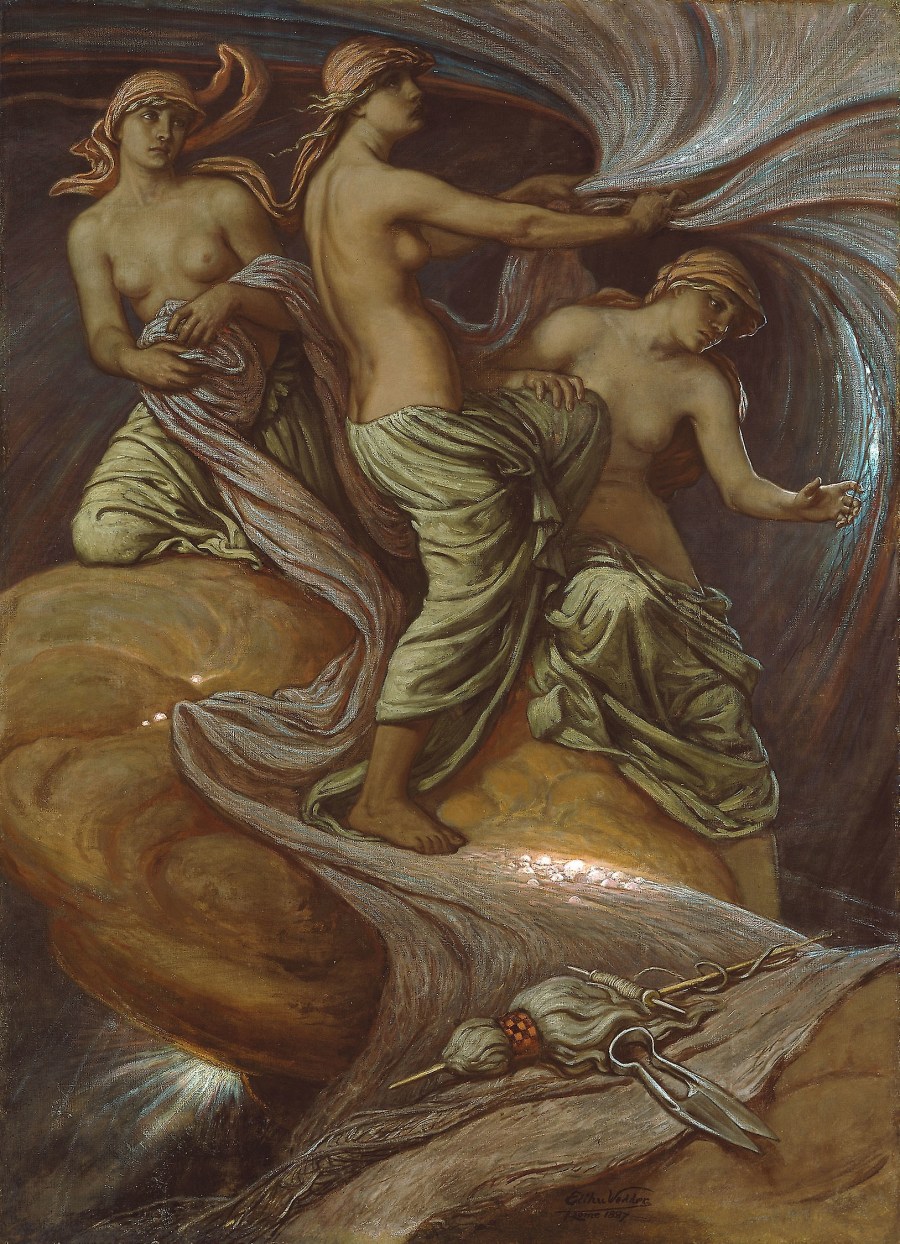
No blueprint,

By Mary Jo Firth Gillett

Featured Art: “Fates Gathering in the Stars” by Elihu Vedder

no plan, no agenda, rather call it pulse and impulse,
zest and precipice, the mind mindful as a volcano

spilling over, or the sometimes bliss of the fisherman
dropping a line into the waters, the welters, the winds

of whatever may come from the twist and coil
of gray matter and what matter that it’s pure delusion

or that it’s—print it!—sensate escape, if it be a stay
against the onslaught of despot, tsunami, flight

of refugee, of sanity—and yes, print it flounder
in murky water, not the fish but struggle for the lure

flash and shimmer just out of reach. Or else shift
the metaphor to the heart, a steed wild for wilderness,

bucking the known reigns, the towers of Babel,
confusion of tongues. Print it hard but true,

the what’s-the-matter sudden matters of health,
the sharp word given or received, and who cares

what garb—bathrobe, hip boot—in this dream state
dangling on the edge of disaster, of paradise, each letter

a bodily sound held in the mouth, each spark a jumble
of luck and pluck, both zoo and zoom, design bucking

certain decline, a dive into the deep Sargasso of eel,
whale, syllable, tangle of seaweed, wrangle of word.


Read More

Poem for the Peony

By Mary Jo Firth Gillett

                                                                                    Not one is dissatisfied, not one is demented
                                                                                             with the mania of owning things,
                                                                                   . . . Not one is respectable or unhappy over
                                                                                             the whole earth.
                                                                                                                                 —Walt Whitman

Peonies open their untutored hearts as if to write
a treatise on passion.

The raw and sensuous peony was mentor
to Marilyn and Mae.

A magnum opus,
the peony bloom unfolds, page upon page.

The peony, one with water, knows nothing
of river.

Oscar Wilde admired the peony:
“Nothing succeeds like excess.”’

Does the opening peony write odes to the ant
or vice versa?

Martha Graham, Josephine Baker, even Elvis,
studied the moves of peony blossoms in the wind.

In the presence of the peony, fake flowers—
plastic or silk—
wither.

The dawdling schoolboy presents a peony blossom.
“Tardy” is expunged from the dictionary.


Read More

Landscape with iPhone

By Emily Mohn-Slate

Featured Art: The Sick Child by Edvard Munch

I don’t want to tweet this thought that comes to me as I’m
changing my daughter’s diaper—don’t want to pull my phone
out of my pocket—my phone is growing a tree right now
with an app called “Forest” that rewards me for not looking
at my phone—and what I want is for a thought to enter,

to hold it in my head, spin the words over and around
until they’re smooth, but I should tweet soon, I haven’t tweeted
in days, and now my daughter needs me to be here with her. Still,
I want to hold a thought like an orange, peel it in pieces,
which I can’t do while I’m circling

a Band-Aid around her finger either, kissing her hand, swiping
the notification, scrolling, scrolling—Mama, watch me! Look at me!
I’m looking but my phone is a hot siren in my pocket, I touch it
but—my digital tree: its roots are thickening now, its pixel flowers

blooming, white petals, yellow center—I want to watch
my daughter learn to hold a crayon—three fingers making
a little house, a splotch of pine, her mind unfolding.
And where is my thought? It slipped out the window

of my daughter’s new house, its comet tail vanishing.
What distracted animals we are—wanting loud, wanting now.
But how do I ignore all the shine when it arrives?
Can’t it be enough to be alive with my daughter
in our dry winter skins in April, surviving until we slip

our feet sockless into sandals, when I can witness,
thinking or not, her giant puddle-jumps, her
whoops of joy? Yes. And I will grow this tree
in my pocket, and I will look at her. I will.


Read More

Roost

By Janice N. Harrington

Featured Art: Nude Figures by Cape Creus by Salvador Dalí

Circling above bare limbs, like Dalí’s wild and articulate capes,
black wings undulate. Raucous hundreds settle and splat
their stench. A murder of crows, a give-a-fuck mob,
stirs the air above ash and oak and hackberry, milling
and loud with news: day heralds, unwelcomed Cassandras.
Dawn light pinched by a crow’s beak, pieces of light falling
everywhere, bright meat that the crow pecks, strips away.

The crows know my neighbor’s face. Knowledgeable birds,
they know the way I hurry each morning, the way my eyes try
to read their dark signs: articulate smoke, curtains
of a confession booth. Blessing? Pardon? Mercy?
The stories say that crows suffer scorched wings, that they
are cursed for stealing from the gods. But the stories, as always, err,
wind-running, wings wide, a-glide on a slide of air,
black bodies, bituminous-black, cosmos-black rising to soar.
There is no damnation in their dizzying speed, the break-wing
improvisations of their flight. God–blessed and black,
their sharp notes strike my skull like hailstones or chunks
of sky, dark bodies that lift my eyes and scorn gravity, a lesser law.


Read More

Selling

By Judy Kronenfeld

Featured Art: Unfinished Monster by Hugh Laidman

Heads thrown back after one
bubbly sip—the young in soft drink commercials
seem as lavishly happy
as lottery winners. They look
the way we imagine ourselves
on the stages of our dreams—glamorous,
anointed, spotlit—our luck about to spill
into graciousness.

And even in ads for walk-in bathtubs,
incontinence pull-ups, stair chairs,
dementia care, the actors don’t merely grin
and bear it, but almost chortle,
like Cheshire cats who just
swallowed these amazing canaries,
though the old they represent
are more like expiring birds.

But the worst soft pitch: the “personal” Christmas
pictures taken in the dementia wing
of my father’s “retirement home.”
In another life, his face would say
This is ridiculous, even if he played along,
and sat in the appointed armchair
by the tree, and hugged the enormous white
teddy bear prop, as instructed.
But he is in this current life,
and guilelessly presses his warm cheek
against the bear’s fuzzy one,
and stabilizes the bear’s plump feet
with his free hand, as if they were a child’s.


Read More