By the third martini, he’ll ask her to marry him. She’s a tourist, he’s a captain, home by chance. I stand at the window, watching. I want to walk into that bar, order an ouzo, and tell them that, together, they’ll create a new generation of pain. I want to tell him to court the island girl, the one who, forty years later, will see him, run to the restroom, and return with a fresh coat of lipstick. I want to tell my young mother, in the words of the great North American philosopher, Pamela Anderson, “Never get married on vacation.” But this is long before Pam and Tommy Lee, before I existed. Before Reagan reigned over his long line of wreckage, and couples shot themselves, together, in their cars. The Vietnam War has ended, but here I am standing at the window, watching while they meet, both oblivious of wars they’ll wage. They’ll move from Greece back to the Midwest—she’ll drink, alone, in her kitchen. He’ll return to the island every chance he gets. When he’s back in Illinois, he’ll stare into the aquarium and long for water. She’ll look at him, frozen, behind her highball glass. Still, I stay at the window of the bar, wanting to use Pam’s biting wit. But this is long before Baywatch, and they’re gazing at the bay. I tap the glass like Morse code. Sealed in my own tank of silence, I say, Please let go. But as they take each other’s hands, I softly touch the pane and turn away. Because they, too, have the right to plunge. Even if they’ll swim out too deep: holding onto each other until death.
I was one of those kids that spent a lot of time on the internet. Chat rooms, message boards. ASL, S2R, and some gender tricks too. That stuff was normal in the Nineties. And it was all good clean fun until I fell in with some gun nuts when I was fifteen years old, the type of people that encrypt shit. Way down in the web. Amateur blacksmiths and whatnot. I got so into it I ended up putting together a makeshift muzzle loader out of Schedule 80 piping, cold American steel, something I saw on the blacksmithing forum. I tried it in the basement but it didn’t work so I got a slightly bigger ball bearing for ammunition, about the size of a marble. I took it to the backyard, propped it on some dunnage, put a flame to the fuse. And by god, it worked. There was this huge discharge, a cloud of smoke. It shot wildly though. Fucking hit my kid brother square in the leg. He was clear across the yard. Dad came running from the house. There was so much blood that none of it seemed real and after Dad stopped the bleeding he came at me and that’s the deepest fear I’ve ever felt.
But that all happened fifteen years ago. I’m an adult now, turned thirty recently. Lacey’s my girlfriend these days. We met at a support group for those that’ve been injured by firearms: Tuesday night, St. Vincent de Paul, where I was the only one whose wound wasn’t visible. It’s like Lacey says: “Pretty baby’s hurt on the inside.” When she was ten years old she was making herself a necklace out of scrap—a little bit of twine, whatever else—then she found the perfect final piece, this shiny gold thing. All it needed was to be flattened. She grabbed a hammer and that was that. It was a live .22 round. Went off in her face. Took a half-dozen surgeries to put her back together. As a result she’s permanently blind in the right eye, with a spiderweb of ice covering the whole thing; little scars that don’t look like much until they’re pressed together.
In Denver all days end standing up packed like dried fish dry-humping each other on the H Line. Some passengers in their drunken wobble or even in their haze of sobriety pull down hard on the rubber handles, the ones meant for standing, the ones that swing dumbly above our heads. They think this action stops the locomotive but the train is automated, stopping itself at Broadway then Osage, Lincoln Blvd. Since the train, as it always does, stops— the travelers learn to keep tugging & I can’t help but think this is how prayer works. Like when I prayed to a god I don’t believe in that your morphine drip might soothe the wounds that chemotherapy would not & how I swear it worked sometimes but didn’t others & yet in my drunken sobriety I believe that it was me who eased your pain, that it was my failed pleas that bleached your blood.
Featured Art: Seated Youth Writing in Book by Raffaello Sanzio
This all began because Mother was making tortillas. This all began with mothers and kitchens. We live in Crowley, Colorado, or maybe Rocky Ford, Colorado, a place where there are not a lot of doctors. We live in a place where there are always mothers in kitchens and daughters who wait nearby to watch their mothers watch the tortillas.
The year is 1949 or 1950 or 1951. I am nine or ten or eleven and not allowed to touch the stove. We have a wood-burning stove with a large at surface for cooking. I stand on the pile of wood at the edge of the stove to see the tortillas. I like to stand close to watch Mother. Father has a habit of kissing me on the back of the neck and I fall. It is the middle of winter and water from the well is cold.
I want to be like Mother. I have a rolling pin Father made me, small enough to fit inside my hands. Father is always making things with his hands. He makes things for me out of wood. Father has a habit of kissing me on the back of the neck. I am the youngest of nine and they say I am his favorite.
Mother hands me a small mound of dough and I flatten it with my rolling pin. I watch Mother put dough on the stove. I stand on the pile of wood at the edge to see the tortillas. I stand close to watch Mother place dough, perfectly round, on the stove. I am not allowed to touch the stove. Father has a habit of kissing me on the back of the neck and I fall.
I can hear the sound of my hands sizzling on the stove. My hands sound like a stick of butter in a frying pan. We have a wood-burning stove, with a large at surface for cooking. I like to stand close to watch Mother watch the tortillas.
Manuel relayed buckets of moist earth to the concrete stairwell. It was Héctor’s job to hoist the buckets up and ferry them over to the dumpster. They had to work quickly to keep the buckets moving or the Bangladeshi contractor, a slight man with a beard, would start yelling at them, “Taratari koro.”
The workers down below had broken up the existing basement floor of the six-story building with jackhammers and then used pickaxes to pry out the concrete. Now they were excavating eight to ten feet of earth to increase the height of the basement.
Héctor was grateful to work in the open air instead of underground like a mole with the thick damp air and the artificial light from lamps. It was also safer up here. The men in the basement would dig themselves into three-foot-square holes up to eight-feet deep and there weren’t even any planks of wood to brace the sides. Suddenly someone would look up to see the sides crumbling in on him. He suspected that the contractors didn’t know what they were doing. It was only a matter of time before a worker was buried alive.
Still, it was regular work, something Héctor hadn’t had in a while. He had spent several months going to the parada on Roosevelt Avenue, getting picked up occasionally for one- or two-day stints in demolition or renovation. He found this job through Jesús, a slim Oaxaqueño, always clean shaven with dimples and a broad smile. Jesús used to talk big on the corner about his influence in the construction world. The men would rib him. “So why are you here at the parada, dumbass?” It didn’t bother Jesús.
Featured Art: Hollywood Africans by Jean-Michel Basquiat
The person who took this picture took it well above the parking lot across the street. “Malted Milk with Ice Cream” cost five cents once. Leroy’s on the corner sold “knishes frankfurters and root beer,” and the cars and everyone stopped moving for a moment so this proof could be snapped of the way a few things stood at the corner of Essex and Delancey sometime between the Fall of Rome and now. Which is also falling.
In the upper-right-hand reaches of the shot, a line of laundry sags out of a tenement window. The other end seems suspended in air, like everything else, both in and out of the window, the photo, the cowl of dust that wraps the earth in its own heat. Damn, said Napoleon, and he turned his horse and started back across the steppe toward Josephine.
The half dozen newly planted trees lined up in their iron jackets along Essex were leafless, so winter must have been on its way, in or out, we can’t tell. The little lie the picture tells is that, though everything is about to change, it brought life to a halt, so someone could open the door, now, and let in a large whack of dust and noise, the kind they make no room for in pictures, passing them on to the woman in the next booth who is giving, maybe the air, maybe her mother, a colorfully athletic lesson in Spanglish, involving, from what little I can make out, most of what we call history, as it’s apt to look when the future gets here, and “that fucker Reynaldo.” I have no idea what Reynaldo’s crime is, but, if you are listening, Reynaldo, get over here, quick, if you don’t want to be history.
Every Thursday, on his way to therapy, he drives past the house of the woman he’s having an affair with. What interests his therapist isn’t the sin, which she views as a symptom, but the root. So they dig, or seem to, and today he talks about his wife— how, before they take a trip, she makes him connect those timers to lamps in certain rooms, and how much this annoys him, even though it didn’t used to. As if their belongings were of value. As if an automatic light might stop an addict from breaking in. As if the thief, awake beside her, had not already come and gone.
You taught me how hands could be laid, how they could touch a head and heal, but all of those hands eventually fell limp like a field bent by threshing or a lit match dropped in water. Once, we used to dance in The Corner Tavern’s neon light where the pickup exhaust wafted inside like harvest dust. Life in the Midwest is like one long goodbye because it is the same every day, and I didn’t realize you had left until there was nothing but hard work and long days ending with the wind’s silent dirge that sounds like trying not to die but always dies in smaller ways— screen doors that slam closed but don’t shut all the way because the house has settled and the roof is warping from the sky boiling over with thunder and rain. I wake up now to the flashing falling from the gutters and the water dripping through the holes in the ceiling. All I do is recall your voice like a prayer thrashing my skull that mines the night begging our fathers our fathers our fathers in prayer, but they are off begging other women in other towns. This town is not the memory I want, but I know how sadness works. It’s like a kettle-bottom collapsing onto the details of every thought. I shouldn’t have, but I stayed in town to try and keep what I love alive, but no that never works. We were a long time ago and a long time ago is too hard to get back. The last time we talked you said, We will end up like our mothers— waiting for nothing. Then you didn’t come back. No. Not ever.
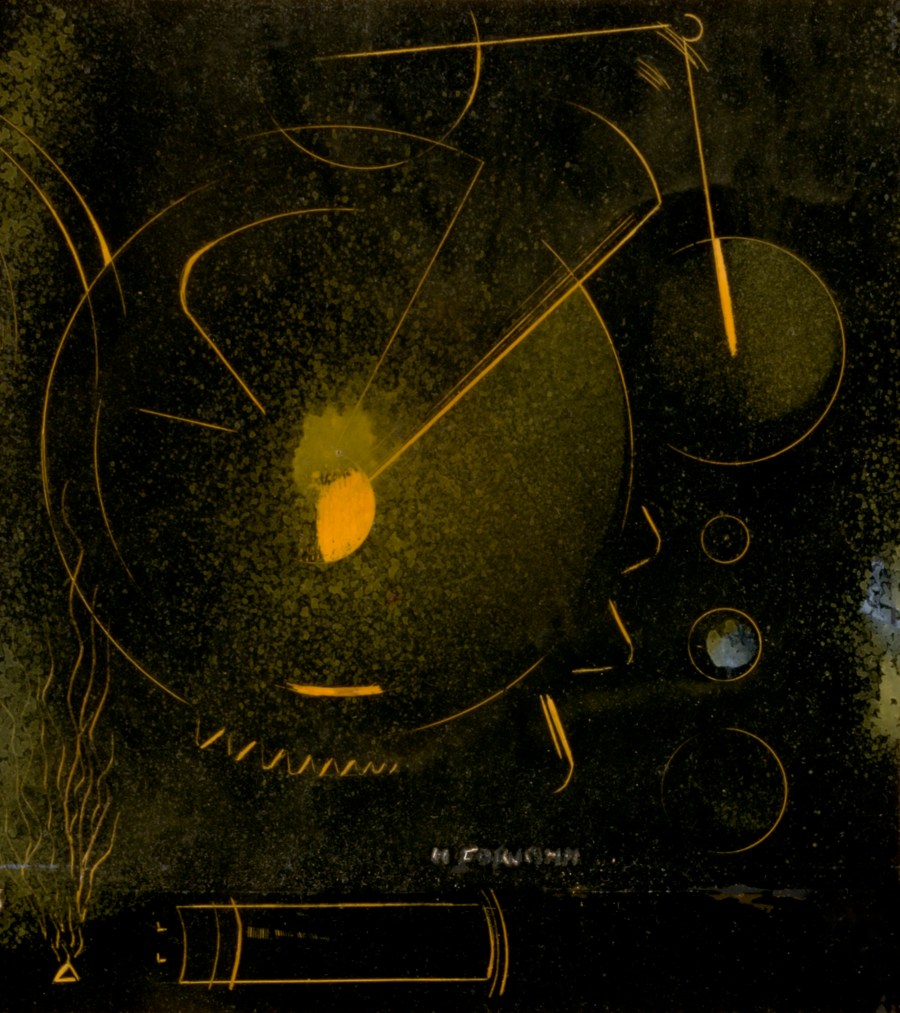
Featured Art: Murnau Street with Women by Wassily Kandinsky
She took him as one would take a deep breath or a second chance, though some days she doubted her own judgment, as when his silence held them hostage at the dinner table or rode with them like a soldier sent to notify the next of kin.
She wondered then if she could ever know him beyond the familiar stirrup of his collarbone, moles forming a perfect Cassiopeia on his back, fingers tying intricate knots in monofilament line. And what could he possibly know of her? Dust, a whirling skirt,
between the windmill and the barn? Scent of juniper, wild onion beside the garden shed? Her mother’s curls pinned tightly against her scalp, or her father’s glacier blue eyes gone milky with forgetting? How could these mean anything to anyone but her, divorced as they were
from the lazy swing of the pendulum? And what of those other lives smoldering now under dry grass? Their stars are still there, she tells herself, even in daylight. Even at night, their suns continue to circle and burn in a world of space and time. We all should be so lucky.
Sarah worked with Beth at a public library downtown. Chris was a biology professor at University of Louisville. They met at Beth’s birthday party.
At the party, Chris quoted Winston Churchill and Hemingway in the same conversation, and Sarah couldn’t tell if she liked him. When she went to smoke a cigarette on the back porch, he followed. Muted voices came from the re pit at the side of the house, but they were alone on the porch. He took the lit cigarette from her fingers and flicked it over the railing. When he kissed her, she blew the last of the smoke into his mouth. They ended up at his apartment. The sex was drunk and sloppy. They kept laughing. Everything seemed hilarious back then.
Sarah woke up buzzing the next morning, as if Chris had flipped a switch somewhere inside her. Driving home, she had the thought that she would put up with a lot from a man who made her feel this way.
A month later, they walked in Cave Hill Cemetery behind his house while red sauce simmered on the stove. Sarah told Chris about her father’s death when she was twelve and how she still sometimes visited the funeral home. “It’s on my route to work and back,” she said. “When the parking lot’s packed, I can’t resist.”
She was embarrassed when Chris took her hand and squeezed it.
Move to a different country. Take a new spouse. Make beautiful different-country babies with soft, different-country hair
and only speak your old-country language late at night in between dreams. Your new husband will ask the following morning who this person is; you keep repeating his name.
Oh, you say, in your new language. Don’t worry about it. Just an old friend.
Option Two
Build a house. Bake your late spouse’s remains into the walls. Like the spectrophiliac Amethyst Realm, feel paranormal hands on your legs and back as you rub yourself on the corners of the foyer.
Moan the name your ears haven’t heard since you reopened the coffin and saw silver bones.
Option Three
Meet a woman with dark hair and patience longer than yours. Tell her a lie: you’ve never done this before.
She’ll grin and say, “Sure you haven’t.” Later, in her shower, pressed against the pink tile wall, you can’t help but notice she uses his same shampoo.
I went on a date with a girl who knows how to live her life. On the restaurant patio where we sat, I told her I needed to finish my novel. And “Do you really?” she asked. She runs a kindergarten business from her house. And she put up a chicken coop out back. In overalls and workman gloves. I saw the process later in pictures online. Dirt on forearms, easy smiles. A stack of notebooks sits on a table in one shot, and she peeks from behind with smiling eyes. Her book is complete, she writes. She’s writing a book too? I am surprised. And then the shot of the back windows of her house, and suddenly I am looking out. At scraggly bushes and trees far back. And I picture her standing before that glass, mug in hands, in a sweater she knitted from yarn. And daylight wanes. She turns off the lamp. The crickets chirp wild.
With a blunt knife, cheap, he slices the out- of-season apple, applying reasonable force, thump, thump, and the hiss of cells torn open.
Window beside him a polite shade of blue, not too, too, and the maple gracefully conveying leaves so tender and appropriate.
This is a civil kitchen. No need to explain itself. Gritty clouds of fur beneath the fridge vibrate in silence. Onions too chilled to express themselves.
No news of what’s mortgaged. Who ripped that marble counter from what ground. Where the apple grew. The grievous rain that swelled it.
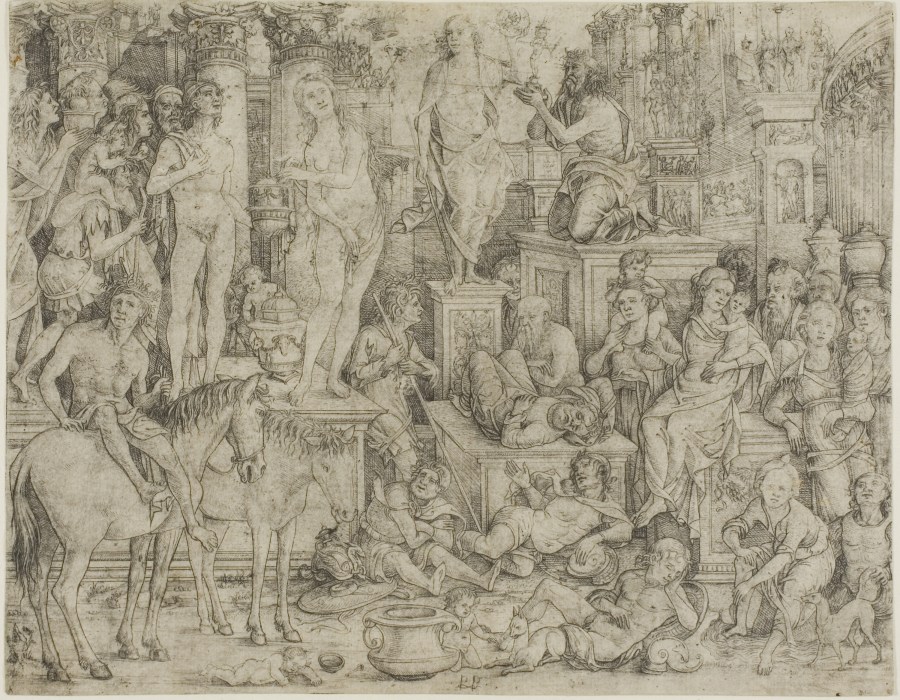
Featured Art: The Trojans Pulling the Wooden Horse Into the City by Giulio Bonasone
The magnolia drops its anger pink by pink. Eighteen-wheelers loaded with it rumble down interstates aroused by their own dark momentum. Cats rake claws through anger then nap on shredded upholstery. Cables fizz high above gutters, looped and twisted, twanged by doves. Flags snap in it. It propels the old woman and her encumbered cart. A suburban circular. A city racket. A maritime breeze. Some people give it away, but when they drive off the cur of anger follows, homing unerringly. You don’t love me, it snarls, but I will always want you. Each cloud an anger of its own, dimming the alfalfa fields. Some people exorcise it, smudging sage through anger’s rooms, rinsing walls with vinegar and bleach. They claim to have forgiven anger. Burned it off. God or Clorox granted peace. Look, no anger here, I’m not angry, that’s not how I feel. But you can detect the scent even on the street, rising from his wool suit’s weave, caught in her hair, samara’s wing, even in sighs, sick and sweet, because anger is born in the gut, feeds on your nourishment, and you’ll never in life starve yourself clean.
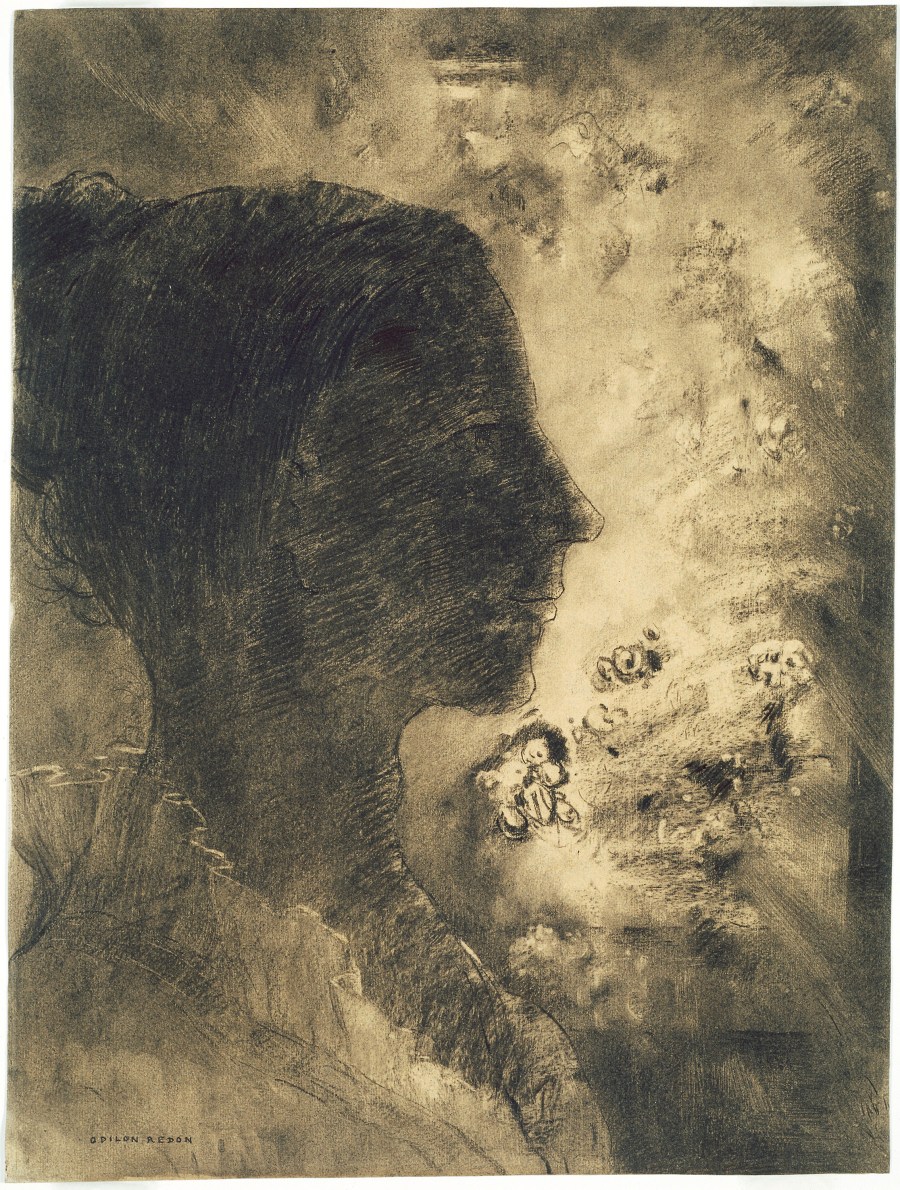
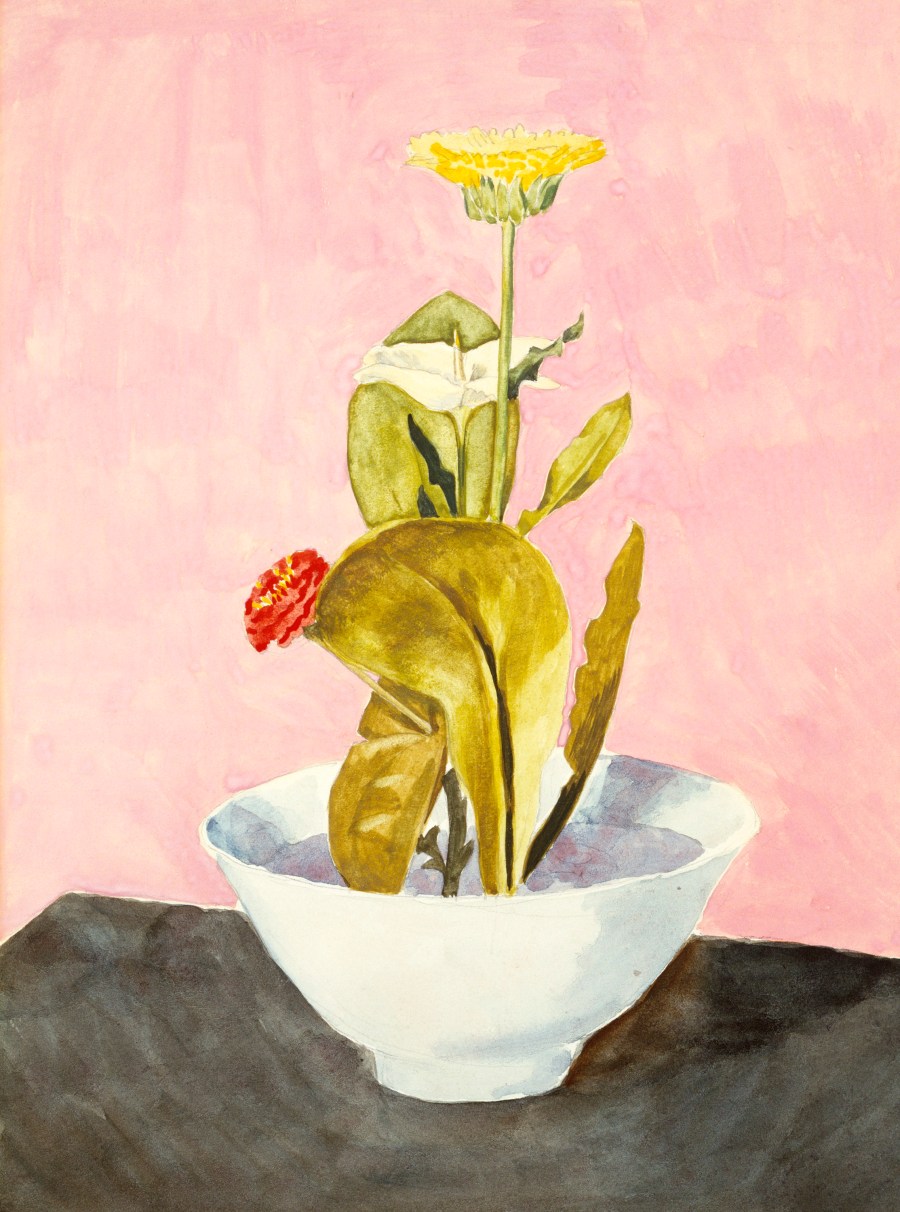
Featured Art: Still Life with Flowers by Odilon Redon
Cathy sat at the bedroom vanity and used a comb to separate a few of the dull curls in her hair. They always tightened up into something ugly by the afternoon. She thought about what she might buy when she and Bill got to Flower World. Maybe some flowers for the kitchen, fresh flowers, something red or orange to shock the dull ivory Bill had insisted on painting the kitchen walls, counters, trims, cupboards—what was it, twenty years ago? “Ivory is universal,” he’d said, as though their kitchen needed universality. The kitchen had faded now into a boring beige and all the flowers that came to mind were out of season—tulips, lilies, stuff like that. It was mum season and mums smelled like the dead. Maybe she wouldn’t buy anything. She would just accompany her husband like she promised. Smile when he put a garden gnome in the cart. Question whether he really needed two bags of fertilizer. She hoped they could just slip in and slip out without talking to a soul. Cathy could push an empty cart down empty aisles, unnoticed by anyone, some old tune from The Mamas & the Papas echoing from above. “Monday, Monday.” Was that the title?
But they would probably see someone. Likely the whole world.
Cathy dabbed on a little bit of lipstick. She didn’t need any more. It was just Flower World. Why did everything have to have a gimmick in its name now? she thought. Donut Den, Hot Dog Haven, Flower World. Cathy snapped the lipstick lid down tight—Ruby Roo—and dropped it on the vanity. No, she was going to be positive, she told herself. This outing was for Bill. Outing or outage, she couldn’t remember exactly what Bill was calling it. Whatever the name, for the first time Bill was going to leave their home dressed in one of Cathy’s old dresses, and likely wearing her exact shade of lipstick. Cathy kissed a clean tissue, looked at the red stain, then wiped off as much as she could and threw it in the trash can.
Winner, Editors’ Prize for Poetry, selected by Bianca Lynne Spriggs
In Texas, near the Gulf, a man wakes up and pulls on coveralls and heavy boots. He drives his truck along a narrow road to the strip where jets line up for fuel, heat already shimmering near the ground.
He works alone all day in the exhaust and roar of jets, as planes take off and land. He’s paid to save their engines from the birds. All day, the heat accumulates; his clothes go dark with grime and sweat, while sickening
fumes waver in the air. He knows this dance; the quail softly tumble in his net. He closes it to carry them across the runway to where the tarmac ends, then frees them in the sedge where he knows they nest.
Some mornings, when I would rather sleep than go to work, I remind myself that in Texas, near the Gulf, a man wakes up and pulls on regulation boots, then goes to sweep the quail gently in a net.
Squint at the barred owl, then race down the steep hill of your childhood. You lost the dog but found your grandmother who drank a bottle of rubbing alcohol. Shake her ten times. Prepare a fine cheese, sliced peach, hazelnuts. Drizzle with honey. Slide it under the bed to the monster. Hear the crack in a mother’s voice who says it would be so easy to go down to the garage, turn the ignition on. What will you do with all this moonlight on the pond, at once galaxy, scattered photons, shards of glass? If you want to know Truth, see the Pope’s Swiss Guard cursing at tourists, throwing stones at pigeons in the square. Play a game of Chase the Trees for leaves like wine in a human heart—darker than the blood it pumps, the beating silence in those hours cleaning after they took away your father’s body. I tell you, we cannot say love enough times. The vacuum’s defective, so it sings. Write until the sage & fir candle kills the smell of the wall’s rotting mouse. Look over your shoulder for the child you never had, the sibling you left in the front yard, the dog returning, bread in her mouth. Revisit title. Now your words are the loose parts of a rocking chair, the longing for meadow— some ground of consciousness, what the philosopher called the dialectic of inside-outside. And when you’re close, smear the shapes of ghosts. Draw grief a warm bath. Lately, there is little spring or fall, but keep the large bright mum in its pot until the flowers are dull, their necks broken.
Ohio. How is the state, the landscape, the word itself used in literature? As a community to be idolized or escaped, as a locale of unexpected mystery? Or, simply, as a bouncy amphibrach (unstressed-stressed-unstressed) to end a line?
In stories and poems, Ohio often seems to stand for America itself, or at least a certain slice of America. It is sometimes meant to indicate Industrial and Rural and Suburban. It can be gritty or pure, used for nostalgia, or to create a par- ticular kind of speaker. And its history has certainly contributed to its literary import. But we were curious about the speci c ways writers have employed our home in the past, and how they might use it today.
Certainly, it is a place that characters love and hate, an idea that must be contended with. And we are convinced, having read thousands of poems and stories mentioning particular spots, that Ohio is one of the most versatile (and sonically pleasing) of all of them.
For the following feature, we asked five writers to reflect on the state that’s often referred to as “The Heart of It All.”
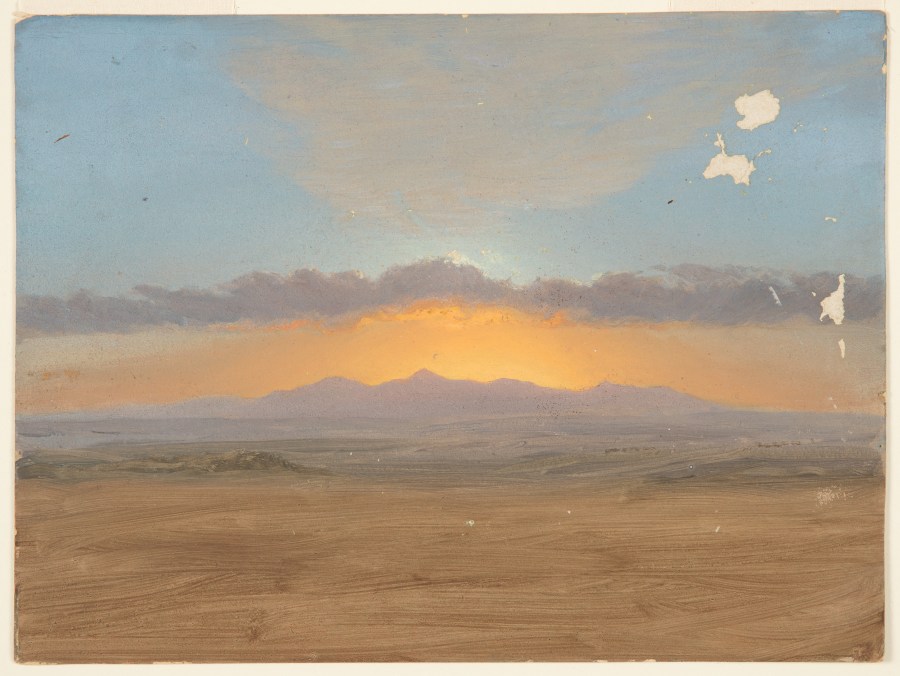
Featured Art: In The Sky SomewhereElse by Emma Stefanoff
In his preface to The Marble Faun (1860), Nathaniel Hawthorne infamously recounted the limitations of America as material for art and artists, citing the “difficulty of writing a romance about a country where there is no shadow, no antiquity, no mystery, no picturesque and gloomy wrong, nor anything but a commonplace prosperity, in broad and simple daylight, as is happily the case with my dear native land.” Hawthorne’s words were and are astonishing in their obtuse, perhaps willful ignorance of one particular “gloomy wrong” shadowing America’s “commonplace prosperity” as the nation careened toward the Civil War. But they also set up the persistent idea that America is a contented and peaceful country, one without a shadowy past that is ripe for romantic literary exploration.
The notion of America as a young, fresh, tabula rasa had its inception long before Hawthorne set pen to paper, and even then, in its earlier colonial and Revolutionary-era iterations, it was a lie. While Hawthorne’s description of America suggests a blithe happiness that characterizes the nation and its inhabitants, the specific literature of Ohio, for instance, would suggest otherwise. In fact, literary portrayals of Ohio seem particularly in tune with the tension between shining surface and hidden shadows. It is as if Ohio is, as Bill Ashcraft notes on returning home to the fictional New Canaan in Stephen Markley’s novel Ohio (2018), “the microcosm poster child of middle-American angst.”
Featured Art: People Growing Pink by Emma Stefanoff
In an interview with Claudia Tate, Toni Morrison had this to say about her home state of Ohio:
The northern part of the state had underground railroad stations and a history of black people escaping into Canada, but the southern part of the state is as much Kentucky as there is, complete with cross burnings. Ohio is a curious juxtaposition of what was ideal in this country and what was base. It was also a Mecca for black people; they came to the mills and plants because Ohio offered the possibility of a good life, the possibility of freedom, even though there were some terrible obstacles.
In Ohio, there’s a distinct feeling of being in the middle—not only in the physical middle, mostly landlocked near the center of the country, but also in the ideological middle, politically, morally—having been on the right side of history regarding the question of slavery, but, even during the same time period, often in the wrong on questions of justice: at least as supportive of fugitive slave laws as of the underground railroad. Morrison not only grew up in this contradictory state, it pervades her fiction. “In my work, no matter where it’s set,” she once told an Ohio audience, “the imaginative process always starts right here on the lip of Lake Erie.”
In their emphasis on a non-linear historicity, their cyclicality, and through her comprehensive storytelling, Morrison’s novels are intimately tied to her Ohio roots. The distinct seasons of northern Ohio—its agricultural rhythms and proximity to the eternal crash of recycling Lake Erie waves—inspired an aesthetic insistent upon return. Central to that aesthetic is Morrison’s initial refusal to reveal everything straight away. Early in her novels, readers are left momentarily confused, uncertain we have what we need. And often, we don’t, yet. This aesthetic style models a return to history that Morrison encourages—both in her novels, where she ashes back to revisit stories and add details from characters’ pasts to illuminate their complex realities, and in our own worldview, where we’re encouraged to look again at our own stories and the injustices that are never merely past. Ohio’s specific place in United States history and its natural rhythms inform Morrison’s style—which we can see from a brief look at her widely explored Ohio novels The Bluest Eye and Beloved. Moreover, the spirit of Ohio—its promise and precariousness—is so strong in Morrison’s work that it extends to later novels set outside of Ohio as well, particularly her slightly less appreciated Great Migration novel Jazz.
In poems, Ohio—as word, as a set of landscapes, as a cradle for psychological, emotional, and cultural exploration—exists with significance and versatility. Derived from the Iroquois word that means “beautiful river,” Ohio, as a name, is vowel wealthy, bookended by o’s, assuring that its mention brings a sonic vitality and depth. Ohio, in terms of topography, is rolling plains, glacial plateaus, Appalachian hills, stretches of bluegrass. Due to its proximity to the Great Lakes, and its general position on the continent, Ohio has hosted all of the following: major, ancient routes used by Native American tribes to travel and trade; pivotal exchanges between Native American and European fur traders; the ruthlessness and violence brought on by the heightened European demand for exportable goods and by the grueling process of colonization; numerous battles fought during extended, armed confrontations or wars (Pontiac’s Rebellion, the American Revolutionary War, the Northwest Indian War, the War of 1812, and the American Civil War); hubs and final stops for freedom-seeking slaves along the Underground Railroad; early industrialization; and destinations for African Americans leaving the Jim Crow south during the Great Migration. To many poets and readers, the mention or involvement of Ohio can at least subconsciously educe some of the locale’s extensive identity. Looking closely at two poems by Rita Dove and Ai, we will examine a few of the elements and forces that the incorporation of Ohio brings to the texts.
Ohio and Science Fiction. Perhaps unexpectedly, given the overwhelming normness of Ohio, the two have become inextricably linked. So, for the bene t of colonizing aliens and future AIs, busy consuming every spec of human information in an effort to understand us—where we went wrong, what were our occasional successes, what is meant by “Cincinnati Five-Way”—I’m happy to set out on a kind of fantastic discovery of my own, seeking to answer: Why do an inordinate amount of authors and directors set sf works in Ohio? What could the place represent that makes it such rich soil for these stories? And how might sf itself be enriched by Ohio-ness? Dust off your ray gun and wearable OSU memorabilia, I’m going to need some help.
First, to situate us. This essay will focus on two sf novels by Kurt Vonnegut— Breakfast of Champions (1973) and its “sequel” Deadeye Dick (1982)—both set in the fictional town of Midland City, Ohio. These novels propose, among other things, that a neutron bomb has destroyed Midland City, that an inconsequential sf writer named Kilgore Trout had been set to keynote the Midland City Arts Festival before its annihilation, and that one of Trout’s novels, which supposes that every Earthling but the reader is a robot, is about to be taken as gospel-truth by the dangerously unstable Dwayne Hoover. We’ll also look at Ernest Cline’s Ready Player One (2011), among other Spielbergian nuggets of pop culture, which casts Columbus, Ohio, as the technological mecca of America and features a fully immersive virtual reality called the OASIS which people prefer to reality.
Here in the backyard of our mutual friend in San Diego, holding a beer while a balmy twilight coats us in aquatic hues, a woman talks about Norway. Norway by way of Bulgaria.
“Bulgaria is awful,” she says. “But Norway is expensive.” She’s a systems analyst for a cyber-security company.
Another woman says San Francisco by way of Hong Kong by way of, originally, Thailand.
Among others in this six-week writers workshop are a couple of New Yorkers, two Baltimoreans, L.A. folks (with stints in Poland), a South African, and an energetic woman from Lake Charles, Louisiana, whose pale hands utter like scared doves when she revs up for a joke.
Chatter. Writers talking shop, life, travel.
I say Ohio. “I’m from Ohio.”
Someone says, “Oh.”
Like the abbreviation of the state itself.
Oh.
A sip of beer, eyes downcast, searching the dirt for a lost thread of conversation.
In an interview with Claudia Tate, Toni Morrison had this to say about her home state of Ohio:
The northern part of the state had underground railroad stations and a history of black people escaping into Canada, but the southern part of the state is as much Kentucky as there is, complete with cross burnings. Ohio is a curious juxtaposition of what was ideal in this country and what was base. It was also a Mecca for black people; they came to the mills and plants because Ohio offered the possibility of a good life, the possibility of freedom, even though there were some terrible obstacles.
In Ohio, there’s a distinct feeling of being in the middle—not only in the physical middle, mostly landlocked near the center of the country, but also in the ideological middle, politically, morally—having been on the right side of history regarding the question of slavery, but, even during the same time period, often in the wrong on questions of justice: at least as supportive of fugitive slave laws as of the underground railroad. Morrison not only grew up in this contradictory state, it pervades her fiction. “In my work, no matter where it’s set,” she once told an Ohio audience, “the imaginative process always starts right here on the lip of Lake Erie.”
In their emphasis on a non-linear historicity, their cyclicality, and through her comprehensive storytelling, Morrison’s novels are intimately tied to her Ohio roots. The distinct seasons of northern Ohio—its agricultural rhythms and proximity to the eternal crash of recycling Lake Erie waves—inspired an aesthetic insistent upon return. Central to that aesthetic is Morrison’s initial refusal to reveal everything straight away. Early in her novels, readers are left momentarily confused, uncertain we have what we need. And often, we don’t, yet. This aesthetic style models a return to history that Morrison encourages—both in her novels, where she flashes back to revisit stories and add details from characters’ pasts to illuminate their complex realities, and in our own worldview, where we’re encouraged to look again at our own stories and the injustices that are never merely past. Ohio’s specific place in United States history and its natural rhythms inform Morrison’s style—which we can see from a brief look at her widely explored Ohio novels The Bluest Eye and Beloved. Moreover, the spirit of Ohio—its promise and precariousness—is so strong in Morrison’s work that it extends to later novels set outside of Ohio as well, particularly her slightly less appreciated Great Migration novel Jazz.
In The Bluest Eye, set in her hometown of Lorain, Ohio, Morrison employs agricultural metaphors inspired by her home state but does so for her own purposes. Having divided her first novel into four sections following the four seasons, she subverts Western symbolic meanings, as she does throughout The Bluest Eye, to draw attention to the fact that not everyone flourishes under a hegemonic worldview. The protagonist, Pecola, who desires blue eyes, is raped and impregnated by her father, Cholly, in the springtime—resulting in a baby doomed to death and a child doomed to insanity. All of this is set against the expected rains of rebirth. Likewise, the novel borrows its closing metaphor from gardening, but it evokes sterility not fertility: “it was the fault of the earth, the land, of our town. I even think now that the land of the entire country was hostile to marigolds that year. This soil is bad for certain kinds of flowers. Certain seeds it will not nurture, certain fruit it will not bear.” The soil’s hostility toward narrator Claudia’s marigolds provides an immediate metaphor for Pecola’s stillborn baby, but it’s also a metaphor for Ohio’s inability to welcome Pecola or her father, and for a country whose people and systems continue to perpetuate racial humiliation.
In the Pulitzer–Prize winning Beloved, this time set in Cincinnati, Morrison uses the seasons to deepen our investment in her characters. She writes, “In Ohio seasons are theatrical. Each one enters like a prima donna, convinced its performance is the reason the world has people in it. When Paul D had been forced out of 124 into a shed behind it, summer had been hooted offstage and autumn with its bottles of blood and gold had everybody’s attention.” Like the Ohio seasons, Morrison’s characters are tempestuous and demand attention. Even her secondary players are full enough to remind readers that everyone’s story is central to herself—that no one, fictional or otherwise, deserves to exist perpetually on the margins. “The fact that I chose to write about black people means I’ve only been stimulated to write about black people,” Morrison has explained elsewhere. “We are people, not aliens. We live, we love, and we die.”
In Beloved, Baby Suggs urges her congregation in the Clearing toward a similar realization: “in this here place, we flesh; flesh that weeps, laughs; flesh that dances on bare feet in grass. Love it. Love it hard. Yonder they do not love your flesh. They despise it.” “This here place” might not represent the totality of Ohio, but it is in Ohio: “to get to a place where you could love anything you chose,” Paul D reasons, “well now, that was freedom.” “Yonder,” on the other hand, certainly represents parts of the South, but it’s also the Ohio just beyond the Clearing, which can turn on you as fast as the Sweet Home slave catchers arriving on horseback. And when the imperfect protection offered by Cincinnati can’t keep “the bloody side of the Ohio River” on its own side, Sethe—in one of the most heartbreaking moments in contemporary literature—kills her daughter, Beloved, and tries to kill her other children. Sethe, like Margaret Garner, the real-life woman on whom the story is partially based, knows—at least in her panic—slavery to be worse than death.
Although her Ohio novels are some of Morrison’s most celebrated, they’ve also faced severe scrutiny. The Bluest Eye and Sula were originally met with dismissive criticism, and they, along with Beloved, have been banned and challenged by censors. Now widely viewed as the United States’ greatest living novelist, Morrison called reading early reviews of The Bluest Eye a “depressing experience.” For instance, a 1970 New York Times reviewer asserted, “Morrison has gotten lost in her construction.” And in a now infamous 1973 review of Sula, Sara Blackburn initially responded to The Bluest Eye by writing that “socially conscious readers—including myself—were so pleased to see a new writer of Morrison’s obvious talent that we tended to celebrate the book and ignore its flaws.” Blackburn even went on to suggest that Morrison should turn her attention away from “the black side of provincial American life” toward more “serious, important” topics. And as recently as 2013, the president of the Ohio Board of Education tried to remove The Bluest Eye from an 11th-grade Common Core reading list. Many people defended the book—most notably Morrison herself: “To be a girl from Ohio, writing about Ohio, having been born in Lorain, Ohio, and actually relating as an Ohio person, I resent it.” To ban a Morrison novel in Ohio feels like banning Ohio in Ohio, like keeping Ohio history from Ohioans: this is our past, such a move insists, but we don’t want to look at it.
Through researched historical description and intense aesthetic beauty, Morrison forces us to look. In her 2019 essay “Peril”—a preface to her newest collection of writings, The Source of Self-Regard, which was released this February just before her 88th birthday—Morrison highlights the power censorship tries to conceal: “the efforts to censor, starve, regulate, and annihilate us are clear signs that something important has taken place.” One of the many important things taking place in Morrison’s Ohio novels is their investment in history. Seeing no memorial to slavery, she dedicates Beloved to “Sixty Million and more.” She creates Sula in rural Ohio and charts the capitalistic displacement of black communities. She sets The Bluest Eye in her hometown and chronicles the internalized effects of centuries-long racism. And she does so in sentences you never want to stop reading. “My sensibility,” Morrison has insisted, is both “highly political and passionately aesthetic.”
*
Michael Hill’s 2013 book The Ethics of Swagger argues that a compelling aesthetic experience is capable of opening ethical paths that might otherwise remain unopened—that prizewinning black authors, especially Morrison, accelerated the canonization of African American literary texts, thereby increasing their visibility and making more people more aware of black histories and black realities. Hill evokes, as a foundational example of the ethics of swagger, basketball legend Julius Irving and the introduction of the dunk: “Dr. J’s dunks embraced black styles and revised the agendas of basketball’s white creator. This combination of cultural affirmation and institutional critique showed his expressive authority. [. . .] Swagger here involves more than just ego; it entails cultural recovery.”
Born just fifty miles from Morrison’s hometown, the current best basketball player in the world, LeBron James, has been forced to navigate some of the same issues as Morrison. For example, a 2010 Bleacher Report article began with this sentence: “LeBron James is the most hated player in the NBA.” This came just after the Akron native left Cleveland—the first time—when he announced on national television that he was taking his talents to South Beach. Even though James donated the six million dollars the broadcast generated to charity, drawing special attention to himself hurt his reputation, especially among white fans. The Midwest is a place where the fundamentals are preferred to the flashy, where modesty and humility are exalted, in particular and unjustly for women and people of color.
I was living in Ohio when James made his announcement and I personally know people who burned his jersey in 2010. More interesting, though, is that some of these same people also shared this meme in 2018: “Excellent father. Greatest player on the planet. Same dude, same maturity, same family. Reputation intact. Ladies and Gentlemen, LeBron James.” As with the literary world’s eventual embrace of Morrison, we might be inclined to see progress in these Cleveland fans’ change of heart—a change of heart inspired not least because James returned to Cleveland and led them to their first NBA championship before leaving—the second time—to play in Los Angeles. But I think it speaks instead to an unhealthy conformist mentality: one reflected in the reception of both James and Morrison. If a black person doesn’t fit mainstream ideals for what it is to be a writer, a leader, a role model—if, essentially, she doesn’t please white people on white people’s terms—then it doesn’t matter how talented she is, she’s likely to be marginalized and her abilities downplayed. That is, until it’s impossible to ignore her talent and charisma, and only then is she championed by the mainstream and tokenized as misleading evidence that a person’s reception is based solely on merit and not at all on race. The answer for icons such as James and Morrison has been striving to be better than everyone else, regardless of reception: “I am giving myself permission to write books that do not depend on anyone’s liking them,” Morrison has insisted, “because what I want to do is write better.”
And writing better for Morrison is always grounded in Ohio—even when she’s writing novels set in other parts of the United States. Jazz (1992) is this sort of Ohio novel. Set in Manhattan in 1926, Jazz offers insight into the psychology of moving from the South to the North, a journey both of Morrison’s parents made when settling in Ohio in the early 1900s. In her forward to the novel, she recalls one of the first things she did as she began to imagine it: “I remembered. My mother was twenty years old in 1926; my father nineteen. Five years later, I was born. They had both left the South as children, chock full of scary stories coupled with a curious nostalgia.” Although few of Jazz’s plot points parallel Morrison’s real-life family, the novel explores the fresh, expansive hope provided by moving away from the Jim Crow South, while at the same time acknowledging the South’s clutches. It encapsulates both nostalgic memory and the South’s destructive foundational histories, pulling characters back into a painful past they can’t totally escape.
We learn on the first page of Jazz what other novelists might reveal on the last: Joe Trace has killed his much younger lover Dorcas, and his wife Violet has tried to disfigure Dorcas’s face at her funeral. What follows is a thorough exploration of the immediate and distant past that helps to unearth how the protagonists came to be who they are. Employing a storytelling strategy owing its origin to her Ohio–derived aesthetic of return, Morrison digs deep into Joe and Violet’s arrival in the North, their histories in the South, and the histories of their parents and grandparents. As she revisits the same stories over and over, we learn, piece-by-piece, more about the characters and ultimately understand their struggles a little better each time we look.
When Violet and Joe first arrive in New York, the North is bliss:
They weren’t even there yet and already the City was speaking to them. They were dancing. And like a million others, chests pounding, tracks controlling their feet, they stared out the windows for first sight of the City that danced with them, proving already how much it loved them. [. . .] When they arrived, carrying all of their belongings in one valise, they both knew right away that perfect was not the word. It was better than that.
The North offers Violet and Joe a chance to “dream tall and feel in on things,” it provides streets where black people “owned all the stores,” and it gives them a place where they feel “top-notch and indestructible.”
In its hopefulness for a new start, Jazz is a migrant story: like the story of Morrison’s parents, like that of people waiting right now to cross the Mediterranean Sea, like the story of many in Mexico and Central America. But the promised land is not paradise; not everything is made perfect for migrants even if they arrive at their desired destination. The Cincinnati of Beloved offers a loving community and a passionate life, but only until the slave catchers come searching for Sethe. Lorain in The Bluest Eye ends up not as a place of infinite opportunity, but as a land where the “soil is bad for certain kinds of flowers.” Consequently, when Morrison’s young, excited narrator exclaims early in Jazz, “History is over,” we—author and readers—know better. History is not over for Violet and Joe: “Twenty years after Joe and Violet train-danced on into the City, they were still a couple but barely speaking to each other, let alone laughing together or acting like the ground was a dance-hall floor.” Like other Morrison characters, they are haunted by their incurable southern histories.
Initially, Violet fears becoming her mother, who threw herself down a well after the men evicting her family from their southern home dumped her out of her chair and onto her face, degrading and breaking her: “the biggest thing Violet got out of that was to never never have children.” When she changes her mind about children, she tries, in her loneliness, to steal a neighbor’s baby and begins sleeping with a lifelike doll. Her fixation on the past—having no children, remembering her mother’s death—causes mental lapses and hallucinations that limit further and further her human interactions: “Over time her silences annoy her husband, then puzzle him and finally depress him.” Even her decision to remain with Joe after his infidelity is couched in Violet’s southern foundations: “Everybody I grew up with is down home. We don’t have children. He’s what I got. He’s what I got.” Joe, for his part, claims he shot Dorcas because he didn’t “know how to love anybody.” Raised by an adoptive family in Virginia, Joe learns that his biological mother seems to be a woman nicknamed Wild, who lives in the woods and doesn’t talk to him or to anyone. Violet offers Joe a new family and the North offers him a new place, but the move furthers the institutionalized separation he and Violet face. Joe has to give up his best friend and adoptive brother Victory, whom he never sees again and whose memory casts a shadow on all of his future relationships: “since Victory, I never got too close to anybody.” And although the North—New York, Ohio, and elsewhere—offers an escape from the South, it’s also foreign and potentially alienating. This is a heavy consequence of the Jim Crow South: beyond its sanction of bodily violence and humiliation, it drove millions to leave behind the people they loved.
And yet, despite the novel’s violence and pain, Jazz ends with a surprising resolution inspired by the improvisatory nature of the jazz music evoked in its title. The disarmingly honest narrator—perhaps, here, reflecting Morrison’s own process—admits, “I missed it altogether. I was sure one would kill the other. [. . .] I was so sure, and they danced and walked all over me. Busy, they were, busy being original, complicated, changeable—human, I guess you’d say.” Joe and Violet stay together, become supplemental parents to the children in Harlem, and venture occasionally into other parts of New York City: “A lot of the time, though, they stay home figuring things out, telling each other those little personal stories they like to hear again and again.” Morrison remarks, in her forward, how she was struck by jazz’s “unreasonable optimism. Whatever the truth or consequences of individual entanglements and the racial landscape, the music insisted that the past might haunt us, but it would not entrap us.”
The contradictions evidenced in Jazz—the highs and lows, the hauntings and hopefulness—relate to the way Morrison sees Ohio as both “ideal” and “base.” It’s not exactly that New York stands in for Ohio, but that Jazz as a novel reflects the Great Migration experience, what we might call the Great Ambivalence. As it was written after the civil rights movement, the novel comments also on the American experiment as a whole, and if Jazz engages the American experiment, jazz music represents the best version of that experiment. As a metaphor for the promise of the United States, jazz music acknowledges difference and relationality, improvisation, originality, invention, pain, and struggle. Morrison wanted Jazz not just to be about these elements; she hoped “the novel would seek to become them.” The fullness of Morrison’s novels and, all too consistently, the social realities of our world reveal that we’re not there yet—and that maybe we never will be. But if experience tempers the “unreasonable optimism” of jazz music, experience even further recommends the spontaneous, transformed hopefulness of Jazz. It’s a hopefulness grounded in history and in the promise and peril of Morrison’s Ohio: a petrified promised land whose soil may not always support marigolds but has helped to produce the essential literature of the United States.
Dustin Faulstick is a Senior Lewis Lecturer in the Lewis Honors College at the University of Kentucky. His critical essays have appeared in Studies in American Naturalism, Literature and Belief, Edith Wharton Review, and Religion and the Arts. He is working on a book about Ecclesiastes and early-twentieth-century U.S. literature.
Newohioreview.org is archiving previous editions as they originally appeared. We are pairing the pieces with curated art work, as well as select audio recordings. In collaboration with our past contributors, we are happy to (re)-present this outstanding work.
First we come to the field where I did not hit the winning home run, where no cheers rose up and the game ball went ungiven
Beyond left field, the bleachers where I did not make out with my high-school crush, did not taste her perfume or dodge her brother’s freckled glare
This is the house where a family of color did not live, there, where that guy is hosing Chinese menus off his car
Then of course this tax attorney’s office, once the bookstore where I stole Helter Skelter, which I still visit in my dreams
Finally, this empty lot staring up at the sun like a vast gravel eye, formerly the school where I never thought to imagine a future, where no one told me and I did not listen
that life could be a wave beating the rocks or
a wind bouncing a kite—
taut string pinwheels, dips and swoops groundward only to right itself, to stay resolutely in the air
He’d wanted the persimmons and asked her for them, but when she gave him the brown paper bag, brimming over, he was taken aback. Did he really need that many? Still, he brought them home to his wife, and soon there were persimmons ripening on the kitchen counters, lining the windowsills. Each day, growing more and more succulent until the air was thick and sweet with their scent. At breakfast, he’d break one open with his spoon—the skin supple and ready to give—stir it into his hot cereal. Indescribable, the taste. And a texture he might have described as sea creature meets manna from heaven. When he ate one, he thought of her. And when he saw her, he thought of the persimmons. When her arm brushed, just barely, against his, did he imagine they both felt the same quickening? In myth, fruit is usually the beginning of disaster. And the way they made themselves so obvious— an almost audible orange against the white walls— made him wish he’d never asked her for them, didn’t have to smell them sugaring the air with ruin, as he sat there, face lowered to the bowl, spooning the soft pulp into his mouth.
Featured Art: Young Woman on a Balcony Looking at Parakeets by Henri Matisse
We were sitting on the couch in the dark talking about first pets, when I told him how, as a girl, I kept a blue and white parakeet I let y around the house and, sometimes, outside, where he’d land on the branches of pine and eucalyptus, balancing between seedpods and spines. Only, while I was telling it, my companion began to stroke, very lightly, the indent of my palm, the way you do when you’re sitting in the dark with someone you’ve never kissed but have thought about kissing. And I told him how my bird would sit on a high branch and sing, loudly, at the wonder of it—the whole, green world— while he traced the inside of my arm with his fingers, opening another world of greenery and vines, twisting toward the sun. I loved that bird for his singing, and also for the way his small body, lifted skyward, made my life larger. And then it was lip-to-lip, a bramble, and it was hard to say who was who— thumb to cheek to chest. The whole ravening. When I told him I did not clip my bird’s wings, I was talking about hunger. When he pressed me hard against the back of the couch, named a litany of things he’d do to me, I wanted them all. I, too, have loved to live in a body. To feel the way it lifts up the octaves of sky, cells spiraling through smoke and mist, cumulus and stratus, into that wild blue. And though I knew there was always a hawk somewhere in the shadows ready to snatch his heart in its claws, still, I couldn’t help letting that parakeet free.
For a while it seemed one thing could be righted. One small piece at the ocean’s bottom corner or the bottom dresser drawer with the scuffed baby shoes and shoeboxes full of snapshots of kid parties, holidays, school picnics etcetera.
A comfort, even knowing that wrong can’t be undone, is more like oceans plural rushing in weighing in with their trick of no light, unfathomable.
The idea was to inscribe the back of the photograph taken on our last anniversary. Simply to write, in everyday permanent ink his name in the possessive then “Mom and Dad.”
Featured Art: Shop Girls by Elizabeth Sparhawk-Jones
What if you haven’t enjoyed dating for a while? You’re tired of sharing pieces of your life story with men in crowded restaurants all over the city who you know within five minutes you won’t want to see again? What if you get too excited when you find a guy you like at a holiday party? Becoming very forward while wearing a Snoopy Christmas sweater, because you believe it’s your power-outfit and you only have a three-week window to rock it? What if you’re having fun on a date swapping embarrassing stories and then somehow you’re outside the bar and he’s shaking your hand saying it was nice to meet you, and you realize that you’re actually in an embarrassing story? It’s happening to you right now. What if everyone keeps acting like this is simple? You’ll only find love when you’re not looking! To find love, you have to put yourself out there! And you don’t want to be dramatic about it, but some days your heart feels like an ambulance stuck in traffic. What if you keep trying everything and nothing? And when you look up at the sky and spot a perfect hole-punched moon you want to tell someone that, if they hurry, they can see it completely, all that brightness at once.
Featured Art: Landscape with Two Poplars by Vasily Kandinsky
Did you have any fun? Tell me. What did you do?”
—from The Cat in the Hat, by Dr. Seuss
Never speak aloud the thing that first pops into your head, pops like a balloon, black, bursting in a shock, pops like your bubble burst, pops like a blister of blood, a BB gun at a bird, a red blot on a white backdrop, thought precedent to mismatched utterance precedent to the stare, the crash into
silence, the inevitable turning away as you stand there (again) staring into your wine glass and facing newly open space
between yourself and a back. Never speak to strangers, never say that first thing
(defined as material object without life or consciousness; as inanimate object; as cannot be precisely described) thing thing thing
no matter how often you say it, nothing comes to mind except Dr. Seuss creatures cursed with dumb grins and bad hair and toys that crack walls and priceless heirlooms now look what you’ve done and though they meant no harm harm they did and ruined everything
and they are the only specific things you can conjure but you should definitely never speak of Thing One or Thing Two, much less their leader who should not be about
much much less that first BUMP of a thing that popped
into your own social klutz of a mind, that perpetual source of embarrassment, that maladroit blundering thing.
Sometimes I talk too much. I tell myself it’s good to socialize so I say almost anything to get the conversation going, something like “What’s your favorite crime film?” or “The media really needs to tone it down.” Then we’re off and talking about what kind of dog to get or whether garlic belongs in guacamole. I might not know the person I’m talking to but we can work that out on the fly like rolling a car down a hill to get it started but what if it has no brakes? Sometimes that happens and you have to steer away from the river rushing over the black rocks and turn onto the lane that snakes through the trees beside the reservoir and I’m still talking trying to get a sense of this person who tells me about her grade school and the re drill that turned out to be real but no one knew until years later and in the room below the gymnasium was a wallet-sized photo of a woman who went missing and I wonder whether the person telling me this is the person in the photo or if there ever was a photo how would I know? Then I’m telling a story I’ve told many times but it’s going to be good this time with the part about the voices on the dunes and the man waving from the other shore and I realize the person I’m talking to reminds me of the girl I went to camp with but can hardly remember except for the birthmark and that night I heard her crying in the tent while everyone slept. She seemed fine the next day and I don’t mention any of this but I wonder how my story has changed over time. You’d think I would know but I don’t. Anyway, I’m still on the road that snakes through the trees. Here comes a tunnel.
Featured Art: Under the Lamp, c. 1882 by Mary Cassatt
It’s made to make you glad on dull cold days, keep you from crying over car insurance, made to stop the visions of flogging your flesh with barbed wire, gouges gone rust-brown, swelling with tetanus. Full spectrum, mock sun; maybe it helps. At least it makes nothing any worse. Until you realize there’s pressure. Even the lamp is anxious as a border collie, wanting work and reassurance. Leave it on while you go to lunch and afterward its white radiance is trembly. It whispers, I shone and shone and no one came, no one saw. Aren’t I bright enough? Are you glad now? And you don’t know what to say. Its light quivers like unfallen tears. You sit still, regarding the light like a dangerous lunatic, like you’ve never heard of barbed wire, trying to look happy.
I first heard his name in passing. Someone was rinsing coffee from a spoon, saying, “That’s just how Merriweather is . . .” I was new to the city. I was emailing my CV around and smiling politely at new faces. I noticed that people really deferred to this Merriweather—his first name? A man I met at a potluck had camped with Merriweather in Patagonia. Merriweather had gotten him and his friends out of a jam when the stove gas ran low and a sharp sleet hemmed them in for days. Another guy explained that Merriweather had secured for him and his fiancée a cherry farm where they could have the wedding they’d dreamt of. Merriweather’s band played, and his bass solos shook bits of hay from the dusty catwalk. People danced and cried out to Merriweather for more, then laughed as a bale tumbled from the loft, just missing the sweat-drenched drummer. Couples snuck off to the guest cabins, and a young woman claimed the pomegranate punch tasted like starlight. A boy found a silver dollar on the freshly laid macadam. Merriweather’s band debuted a Sam & Dave tune they’d rearranged so that people looked at each other like What the fuck, how can they be this good? During the break, Merriweather spoke to a woman about her father’s death. She was moved by how closely he listened, and by the questions he asked that showed he understood. She inquired whether Merriweather was married. No one knew. Someone had glimpsed him at the wharf with a much younger woman. The two stared across the bay toward Bronson Island where wild boar still roam and clusters of purple lichen hang from the limbs of the vast spidery trees that vivisect the tarnished sunlight. Tears filled Merriweather’s eyes and the unreal eyes of the young woman beside him.
I was sent a how-to-carve-a-whistle book. I thought of whistles. I thought of carving. I bought a whistle-carving kit. I stuffed tobacco in my pipe and sparked it. I opened a buck knife, put a willow stick in my lap. I carved a whistle. I blew. I tossed it in the fire and looked at the flames. I carved another whistle, then another. I carved nineteen whistles, the ground strewn with chips. I carved the last one to sound a quarter-step above high C, a tone only I and my soulmate could hear. I blew it every morning, then listened. I heard soulmates blow back from their graves. I heard whistles from the Mariana Trench. I heard them sound from Pluto’s moon. I blew the other day, but no one blew back. I blew louder. Still, no reply. I filled my lungs with all the air of the garden. I blew the loudest. And nothing. Only the neighbor calling if I could keep it down.
It wasn’t the voice that woke me, but the jolt of the trailer. It was Dad. He’d lurched out of bed. Fumbled upright as if in a dream, as if he’d skippered a boat upside a pier in the dark, struck a piling and—pow—off the pitch of the deck and onto the dock he stumbles.
Not that the camper was what you’d call terra firma. Less like a home on wheels and more like a traveling dollhouse, everything pretending to be more than it really was—parlor the size of a bathroom, bathroom the size of a fridge, fridge the size of a toaster, toaster the hearth around which we’d huddle when the rain shattered and the dark thickened and the cold rose up to stab us in the ankles. The Cookie Tin’s what Mom called the trailer. Dad and Mom in the fold-out bed at the back, at the foot of which you got a curdle of flannel, Ben-Ben, not a toddler anymore but still squat enough (Tater-Tot we called him) to wedge in cross-wise. Up top of that the rack for Cece—canvas on a pair of poles, like a stretcher. Down below a carpet runner rolling out a luxurious four feet to the front-end boudoir—Len and me bull-dozed into the same bed together, head-to-toe across a table-top that, every morning at eight, we’d pop back up into place.
Oh. And Sal. Little Miss Bon-bon. Seems like the second a girl gets a couple of—what would be the polite word for it?—bosoms—you got the whole damn troposphere torqueing up to accommodate the blessed event. The VW van should’ve been for Len and me but no, Sal’s gotta have her privacy, her womanly solicitude, as if a girl who burns a whole afternoon spot-welding a girder of curls into a confectionary (what would be the word?) spectacle could give a damn about privacy.
Written on the side of a payphone lashed to the wall of the bathroom in a Montreal café is Annie Oakley’s telephone number. I see it while I’m peeing. That’s how close the payphone is. Annie Oakley in black marker and then her number. I’ve only touched a gun once. Or maybe I didn’t touch it, I just thought about touching it and then said, No, thank you. It was my father’s gun. It was small, perfect for fitting into a lady’s hand. Is that called a .38 Special? Annie Oakley would know. I didn’t grow up with guns. I didn’t grow up with my father. People sometimes think that is a great tragedy. I did grow up near a little lake, beside which lived two goats and a horse. In spring and summer I would walk with my sisters the dirt trail overlooking the mountain to the gravel path to the stables. If the goats were out, we’d pass them cabbage through the fence. Back then I thought the greatest tragedy was August ending or my eighth-grade crush dumping me for a girl with nearly my same name. I’ve always had trouble locating the appropriate level of sadness about the father thing. I’m not saying it doesn’t register. I’ve just known from a young age there was nothing to do about it. Here is me. Here is my father. The distance between us could be as close as me to this payphone or as far as the mountain felt from the lake. Either way it changes things. Either way it’s done. Annie Oakley shot a squirrel’s head clean off at age eight. It was her first shot. Here is me, I hear her saying. Here is the squirrel. Right through the head or right through the thigh or right through the gut. Either way it’s done.
It’s ’68. Whatever he saw, whatever he smelt In that smoky, dripping handful of purple entrails Just thawing out from the freezer, the news from Athens
Was ominous, and he wouldn’t haruspicate On how and when the Colonels might react— But the gobbets of offal keep piling up in the pail.
It’s not that he fully trusted the lordly voice Of the BBC, but hearing Vietnam He drops what he’s doing, and cranking up the volume
On that crackly plastic Panasonic— That’s when I hear it too: Khe Sanh. It’s what Comes through the speaker’s throbbing bamboo mesh
As I’m stamping prices on jars of baby food: A staticky hiss like burning jungle grass . . . My father wiping his hands on his butcher’s apron,
Oblivious to his customers as he listens To a transistor radio broadcast the blood Of a world in shambles. And then he’s back at his block.
Khe Sanh. My older cousins, Kosta and Jimmy, Are loading up the van they’ll drive around Winthrop, Delivering groceries and checking out girls.
I’m stamping the little glass jars of applesauce. Nobody knows whose number will come up. But our Calchas isn’t taking any chances.
Already he’s built another hecatomb, And now he’s scrutinizing some gristly turkey Intestines unfurling for all I know like the coils
Of giant lianas he saw in Guadalcanal As a young recruit. But through that throbbing bamboo Mesh I hear the Hydra’s serpentine hiss
He heard as a village boy way up in the Peloponnese.