
Category: Uncategorized
The End of the World
By Susan Browne
A woman was killed by a car as she jogged across an intersection.
A friend of hers I play tennis with said, “Can you believe it?”
I put my arms around her as we stood on the court & she cried into my shoulder.
I didn’t tell her my mother died in a car crash after buying towels on sale.
You’d think we’d be used to death coming out of the blue like lightning
striking on a sunny day, but we’re always surprised.
Then my mother’s accident became a story I told so many times
as if that could bring her back. The story was like the St. Christopher medal
tucked safely in her purse that a policeman found in the middle of the freeway
& that I carried in my pocket until who knows what happened to it.
I traveled all over Europe & even went to a place, if you can believe it,
The End of the World in Southern Portugal on the Vicentine Coast,
stood on cliffs 200 feet high & looked at what explorers thought was the edge
of the flat earth & I could understand why.
I was thousands of miles from home wandering beaches & piers, going into stone
churches when no one was there, lighting candles although my belief in God flitted
around like a bat in the rafters before it folded its wings & disappeared in the darkness.
At night in my hostel room, I ate sardines out of the tin & read the Tao Te Ching,
staining the pages with red wine & oil. The idea of the Tao was consoling:
An empty container that can never be emptied & can never be filled.
Darkness within darkness, the gateway to all understanding.
What in the world did that mean,
but it was like a kind of hope without hope so I could believe it.
A man I dated once or twice in California came to visit.
We had a beautiful time in bed. He was confused when, after a week,
I wanted him to leave. At the airport I apologized & kissed him goodbye
& we kept kissing. He said, “Why am I leaving, I can’t believe this.”
A few years later I realized it was because no one he loved had died.
The universe is forever out of control. The world is sacred.
I went to see my father.
In the restaurant the dining room was dark even though it was lunchtime,
the little candle on the table trying hard.
It had been over a year since we’d seen each other or talked or talked about her.
My father’s eyes were sober & clear. He said, “How’s the sandwich?”
We were surrounded by velvet paintings on the walls of the hobo clown,
Emmett Kelly, his red nose, his sad mouth, his crushed bowler hat.
In one of the paintings a monarch butterfly rested on the hat’s brim. I decided
to take that as a sign for whatever—whether I could believe it or not—happened next.
Read More
29th Anniversary
By Susan Browne
Kenneth’s elbow
have I ever seen it
I mean really looked at it
I’ve been away on a trip &
I would like to see his elbow
& other parts
I miss his smell
sometimes cinnamon & cumin
sometimes dirty socks & popcorn
I used to think love was a coma
my mother was in a coma
from a car accident then gone
my father was in a bottle
stuffed with suicide notes
I met Kenneth a few years after
he was from Denmark
I heard a beat of a noble heart
but also like Hamlet
he said he was going to the bottom of his life
there was nothing more attractive
unfortunately I was in therapy
I said good night sweet prince centuries passed
we met again
was it fate was it chance
did you go to the bottom of your life I asked
yes he said then offered me his arm let’s dance
his arm had blond hairs I felt them like furry
light all over my body
his elbow how important it is
it curved his arm around me
& I woke up for the first time
for all this time
Read More

Circus School
By Cassie Burkhardt
Featured Art by Ashura Lewis
Every Wednesday I unzip motherhood,
leave it balled up in the minivan and grab hold
of an aerial hoop suspended from the ceiling,
hoist and straddle upside-down,
mount the moon and swing. I’m new
at the circus and it feels like hopping
a train inside myself, metal hoop
in the void, fantasies playing out—
Pretzel Roll, Amazon Swing, Gazelle,
Guillotine. So often,
I cannot express the loneliness
of my days, life of a grocery store
tumbled through, skin losing its elasticity,
laundry basket of socks and more socks.
But when Maria says, “Ok, now,
straddle-back Wild Child into Wineglass,”
I am more than mother—a concept now:
Dragonfly, Bird’s Nest, Mermaid Roll-up,
Madame X, Back Balance—
a spine that remembered it’s a rainbow.
Read More
I Am No Beekeeper
By Arya Samuelson
Selected as winner of the 2023 New Ohio Review Nonfiction Contest by Barrie Jean Borich
My housemate sleeps all day, makes art all night, and paints giant bees. “I want people to feel my paintings,” she says, stroking the palm of her hand against a still dripping head-to-toe canvas.
I keep my hands in pockets. We’ve only been at the art residency for a week, and she has already transformed her garage studio into a whimsical world of texture and wonder and touch. My art is trapped inside me. Weighs down my womb with rocks.
Read MoreOn Our Way Home
By Jill Michelle
Selected as winner of the 2023 NORward Prize for Poetry by a panel of previous poetry contributors
We speed down the expressway in funeral-thick silence
miles increasing between us
and the hospital, its doctors and nurses
our son, his too tiny body.
Lost in a one-way argument with a god
I can’t quite believe in anymore
flinging how-could-you, how-could-you-nots
at the windshield’s low-slung clouds
I don’t hear my husband ask at first
Where would you like to go?
and when it registers, picture the baby
things, waiting on our dresser at home
that rubber ducky hat I couldn’t resist
the stack of bunny onesies, Christmas presents.
Anywhere but there, I think but ask instead
How about the Starbucks drive-thru by work?
And that is how I end up a grenade
at the intersection of MetroWest and Kirkman
biting my pin of a tongue
while Neil slides into the straight lane
instead of the more efficient left-turn one.
We toddle past the corner BP, take a left
at the tire shop, another left onto a feeder street
where I see what I wouldn’t have
if we’d gone my way—
Meaghan, the Comp. II student from Valencia
the one who’d answered the icebreaker question
one thing she’d do on her last day on Earth
Kiss my son’s ultrasound picture,
tell him, I’ll see him soon.
There in the Starbucks window
where I didn’t know she worked
was the only woman I knew who’d lost her baby
after twenty weeks
who knew without me saying a word
wrapped me in her arms on sight
and while it was far from the miracle we wanted
it was the one we got.
Read More
Why I Don’t Want to Be Young Again
By C. O’Sullivan Green
Learning the swoop of a lowercase a,
an egg with an axial tilt, tail that could
wag or stand on end.
The school bus arriving for the first time,
coming from an unknown place, driven
into the nebulous world.
Being small enough to be uprooted
and repotted.
Compounding educations, division,
language, and time—how sixty can be
as remote as seventeen.
That mercurial metal, the trust-fall,
which can support or fail with
equal surprise.
Seeing animals I couldn’t take in, but that I
hoped would escape to find me in my backyard.
The evolving and lengthening definition
of consequence, how far is too far,
in distance as well as boundaries.
The succession of small
choices in file that loll
around the corners of days:
will I go down the driveway
on my skates,
can I say a swear
to ask what it means,
how much
of myself will I compromise
to fit in?
Fit in, better translated, to
survive within an ecosystem
(of which there are many,
school, home, peers, self).
Adolescence, the thinning middle age of
childhood. Middle ages of fiefdoms,
of gossip and lore.
The slow and glitch-prone renaissance
of the late teens.
Discovering the machines
and machinations of industry,
its comforts and unregulated
sins.
The pain of learning how to yearn
and how to become.
Living the unknown answer
to the question that is your life.
Read More
Avenue of Soviet Heroes
By Andrew Payton
It is eight years now
and I still think of how you did not ask
that I look away
when you stripped sweat-soaked polyester
after our games of badminton, or how
you hefted the weight of the couch
onto your haunches while I rested
a hand underneath,
pivoting uselessly, or how
on the mountain you took
my blistered heels into your hands
and wrapped the wounds, replaced
my socks with your own, or how
before dinner you went into the basement
for a bottle of that Czechoslovak vodka
you bought in cases the November when students
flooded Prague, little water
you called it, and then
you inventoried forest biomass in Poland
and cheeks reddened with drink
theorizing
there were not enough trees for the furnaces, and,
touching the wool of your blue
peacekeeping beret, you
speak of the Serb who
served coffee from his porch in the morning
that was a smoldering crater by afternoon,
always you say goodbye you say in
the English you learned on Ohio construction sites
which never quite lost the pneumatic pop
of a nail driver, or how
the evening before I would leave
your wife threw me against the wall and bit my ear,
and I thought how
over the years with you
she must have forgotten to fuck
with anything
but violence.
Read More
Encounter
By Xingzi Chen
Featured Art by Ashura Lewis
The first thing Su met at the new school was a closed gate.
That day, she arrived earlier than the time agreed before and could not get through the school office number. The HR lady who had been arranging things for her was also not there. That left her waiting at the front entrance until a man stuck his head out from the guard shack to ask who she was.
Read MoreSelf-help
By Andreas Nussbaumer
Forget everything you know
about contract law and the Chesterfield skink.
Continue to reframe every piece of art
you encounter in the bordello (replace
the last word with imbroglio and ditch
any diction associated with almanacs).
It’s important to hold yourself
to impossible standards. Embrace loved ones
often via ambush—with surprise on your side
you can’t lose. When in doubt
collect your old love letters and
if you don’t have old love letters then spill ink
like it’s milk—level of requitedness is irrelevant,
it’s the exercise itself that matters. Search frantically
for the deed of your house. If you don’t
own a house then buy one now. If you can’t
afford a house then make more money.
If you can’t make more money then get a better job.
If a better job eludes you then enter into organized crime.
I know a guy named Jimmy, he’ll set you right up.
Just tell him I sent you and thank me later.
Read More
Potentially Anyway
By Matt Hart
Featured Art by Mike Miller
Potentially, anyway, there is more
to the presence of the tree limb crews
on our street than the way they’re cutting
around the wires and sapping the trees
with their uninspired angling. To be sure,
I am not thinking. I am looking
seriously and deeply in invisible ways
at invisible things—the circulatory systems
of the men with their saws and the blood
going around inside a closed system—
and at visible ones—the squirrels with green
berries and the robins on the awnings—and
it occurs to me in this moment that none of them are
thinking, for example, about mitochondria. I mean,
I don’t know that for certain, but I can be pretty
certain—or certain enough—and it’s obvious
that none of them are looking at me looking
at their hearts beating palpably, the men
and the squirrels and the robins now flown
from the awnings and onto the mailboxes
with the red flags up. Mail is outgoing as the air
in my lungs. How did I drift into this? Potentially,
anyway, I sat up and noticed more than wind
in the trees, and I knew it meant something
sentimental to me, because everything is
if one sees it that way, and I do see it that way,
because that is how I’m wired in the middle
of a life, for better and worse. And yes, I am okay,
and I am not okay both—thanks for asking—
but I do, when I can, wish to overflow and bury
myself in the azaleas of the next world.
Right now, however, I am somewhat content
to feel that the other beings I’m watching
are also feeling things. Some of them are
conscious of this and others probably not,
but everything that moves moves wisely
if you watch, or if you see it that way.
There is something inside us that shows
through our motion. I don’t know for certain,
but I feel pretty sure, or I want to anyway.
Sentimental, I squint until my eyes become
stars, potentially or possibly, I can feel it
Read More
That Evening Sun
By Kate Fox
“The best line of iambic pentameter is not in classical
poetry but in W. C. Handy’s ‘St. Louis Blues.’”
—Elizabeth Bishop
Let me end this song on a not-so-minor note,
rest my head on this 1926 Gibson, sing goodbye
to every lyric I have ever learned: the one about the boat
that can carry two and the lonesome picker, the one
about how Louise rode home on the mail train
and how walking is most too slow. And, of course,
the one about riding down the canyon that, even after
forty years, recalls my father on a Saturday night
wrapping the fingers of his left hand with adhesive tape,
swaying and slapping an upright bass in some
small-town dance hall while my mother waltzes
across a floor strewn with corn meal, and my brother
and I fall asleep among coats piled high on folding chairs
against the wall. He once told me music was the one thing
he could count on, married, as he was, in 1929,
his first child, a girl, born and buried a year later,
a life of lung trouble that finally sent him out West
to either die or get well. At thirty, I took him
at his word, picked up the guitar he gave me,
the one around whose neck he wrapped my fingers,
and taught me songs that survive on breath alone:
how the water is wide, how I won’t be worried long,
how I hate to see that evening sun go down.
Read More
Questions for the Singer of the Last American Folk Song
By Matthew Thomas Bernell
Featured Art: 2130, Site Study by Brooke Ripley
Does the last chorus include a rose
or heart-shaped Armageddon
dust cloud? How tender
was your lover’s touch,
if ever? Do you stay up,
fireside, listening for a howl
or yip with which to tune your beat
Gibson, sooty fingers twisting
tarnished tuners slowly, scared
a snap will be the end
of it all? No more strings, no
more accompaniment. Or
are you about to upload yourself,
the last embodied homo sapiens,
levitating, tinkering with a vintage
synthesizer one note at a time?
Have incandescent whirring
contraptions replaced mixers
and interfaces except in robot-guided
music museums? Have we reached
the singularity? Or are you cut
by a lonely glass shard wind
from the bent, grim
horizon? When your jaw opens
and the vocal cords start
to vibrate, what
is the first word? Something short,
heartfelt? Like Don’t or Oh?
Read More
Feature: Ohio Stories II
Ohio. How is the state, the landscape, the word itself used in literature? As a community to be idolized or escaped, as a locale of unexpected psychological mystery? Or, simply, as a bouncy amphibrach (unstressed-stressed-unstressed) to end a line?
In stories and poems, Ohio often seems to stand for America itself, or at least a certain slice of America. It can be gritty or used for nostalgia. It can indicate Industrial and Post-Industrial and Rural and Suburban.
We continue to be curious about the specific ways writers have used our home in the past, and how they might use it today. Following up on our feature from Issue 25, we asked seven writers to reflect on Ohio, the 45,000-square-mile concept that’s often known as “The Heart of It All.”
- Rachel Rinehart on Ohio rurality and mortality in Mary Oliver’s “The River Styx, Ohio.”
- Therese Gleason on Ohio River trauma in James Wright’s “On a Phrase from Southern Ohio” and “Ohio Valley Swains.”
- Molly Rideout on the meaning of her grandfather’s monograph about Sherwood Anderson and Anderson’s novel Winesburg, Ohio.
- Caitlin Horrocks on Midwestern hipness and family dynamics in Michael Cunningham’s “White Angel.”
- Michael O’Connell on the “Great Ohio Desert” in David Foster Wallace’s first novel, The Broom of the System.
“Enduring Mystery” and the Ferryman Farmer in Mary Oliver’s “The River Styx, Ohio”
By Rachel Rinehart
Abandoned barns and houses are a common feature of farm country in Ohio. It’s not unusual to see them far back off the highway—two-story clapboard colonials with doors missing or ajar, an oak tree growing out of a roofless silo or vine-choked milkhouse. These places are, as Mary Oliver presents them in her poem “The River Styx, Ohio,” extinct portals to the underworld, places where a connection has been severed, where old ways of knowing and suffering are buried.
Read More
“Above the River”: James Wright’s Ohio “Bloodroots”
By Therese Gleason
Featured Art by Claire Bateman
The Ohio River runs through James Wright’s oeuvre, a throughline leading back to the hardscrabble community of his youth. It’s a region ravaged by strip mining, extractive industry and labor practices, and dead-end factory jobs resulting in generational poverty. Yet despite his professed hatred of and determination to escape his native Martins Ferry in the Appalachian foothills, Wright returns again and again in his poems to the banks of the river he grew up exploring. This boundary between Ohio and West Virginia, between water and land, is haunted by the ghosts of drowned childhood friends, miners “dead with us” in the gorges, and memories of violence witnessed—and perpetrated—in his youth. But the sacred and profane river—with its “bare-ass beach” that is “supposed to be some holiness”—is also his “Muse of black sand.” “How can I live without you?” he writes. “Come up to me, love, / Out of the river, or I will / Come down to you.”
Read MoreElegies for Home: An Interview with Amit Majmudar
conducted by Betsy K. Brown on July 11th, 2023
Betsy K. Brown: Today, we will be hearing from poet, novelist, and doctor Amit Majmudar. Majmudar is the author of seventeen books, with three more forthcoming this year. He also served as the first poet laureate of Ohio.
As a fellow Ohioan and poet, I’m particularly curious about how Ohio has influenced your writing.
Read MoreOhio Geometry: Hanif Abdurraqib and the Shape of Home
By Vrinda Jagota
Throughout my 20s, when romances have fizzled or my career trajectory has felt unmappable, my deep passion for my home of New York City and my belief that I will always live here has been an emotional anchor. But in reading poet and essayist Hanif Abdurraqib’s writing about his home state of Ohio, I’ve reconsidered what a hometown is and how we can relate to these places.
Read MoreA Writer in America
By Molly Rideout
It wasn’t until I had to move from Iowa to Columbus that I finally sat down to read Sherwood Anderson. When my father’s father downsized his book collection for the move to the retirement home, he took with him thirteen copies of Winesburg, Ohio, the most famous title of this now less-than-famous author. Thirteen doesn’t count the twenty-one volume complete Anderson published in Kyoto, Japan, or the scholarly publications devoted to Anderson’s novel-in-stories. It doesn’t include the 1962 issue of Shenandoah, wherein my grandfather argues that, while Anderson’s “hard, plain, concrete diction” paints superficial impressions of Ohio, what truly interested the author was the “dark, unrevealed parts of the personality like the complex mass of roots that, below the surface of the ground, feeds the common grass above in the light.”
Read MoreOhio Hip: In-betweenness in Michael Cunningham’s “White Angel”
By Caitlin Horrocks
One of my all-time, hands-down, desert-island favorite short stories begins like this: “We lived then in Cleveland, in the middle of everything.” The narrator does not mean the middle of the action. “One of the beauties of living in Cleveland,” he later explains, “is that any direction feels like progress.” We’re in the middle of the country and also the middle of the Twentieth century, just after Woodstock but “before the city of Cleveland went broke, before its river caught fire.” We’re four sentences in and Cleveland’s not looking too good. It’s looking like a placeholder for either midwestern boredom or rustbelt squalor.
Read More
“An Other for Ohio’s Self”: David Foster Wallace’s Great Ohio Desert
By Michael O’Connell
Featured Art by Claire Bateman
David Foster Wallace is often discussed as a regional writer; critics have focused on the ways his fiction and nonfiction depict both the northeast (in Infinite Jest) and the midwest, primarily his sometime-home of Illinois. But what is often overlooked is that his first novel, The Broom of the System, is an Ohio novel. Although Wallace didn’t have any concrete ties to the state (he grew up in Illinois, and was living in Massachusetts when he first drafted the novel), he chose to set the book in the Cleveland area, for the same reason that so many writers use Ohio as a setting—because it serves as a synecdoche for America itself. Shortly after the novel’s release, he told an interviewer that he had never actually been to Cleveland, but as “a middle-westerner. . . he wanted a heartland city that he could imagine instead of describe.” In Wallace’s imaginative vision of the “heartland,” Ohio is, as one character describes it, “both in the middle and on the fringe. The physical heart and the cultural extremity.” He goes on to claim that “we feed and stoke and supply a nation much of which doesn’t know we exist. A nation we tend to be decades behind, culturally and intellectually.” This is a division that Wallace explores in much more depth and detail in many of his nonfiction pieces, such as “The View from Mrs. Thompson’s,” “Getting Away From Already Being Pretty Much Away From It All,” and “Derivative Sport in Tornado Alley,” all of which use the midwestern locale to interrogate what it means to be a true American.
In Broom, Wallace uses the heartland setting to explore many of the thematic elements that are central to his later writing (some more successfully than others—it is very much an apprentice work). The central plot, such as it is, revolves around 24-year-old Lenore Beadsman, who must negotiate being surrounded by a variety of hideous men (including her boyfriend/boss, her landlord, and her therapist), while searching for her great-grandmother, a former student of Wittgenstein, who has escaped from her Shaker Heights nursing home. The novel also interrogates the idea of what constitutes reality; Lenore in particular is worried that she is just a construct of language, and that “she had no real existence, except for what she said and did and perceived and et cetera, and that these were . . . not really under her control.” Wallace later distanced himself from the novel, calling it “a sensitive little self-obsessed bildungsroman” written when he was “a young 22.” Michiko Kakutani accurately described Broom as “an unwieldy, uneven work—by turns, hilarious and stultifying, daring and derivative.” She notes how Wallace takes on “serious philosophical and literary discussions” while also getting sidetracked by “repetitious digressions, and nonsensical babbling that reads like out-takes from a stoned, late-night dormitory exchange.” This is a fair critique, but as with many a late-night stoner conversation, there are certain elements that can hold up to closer scrutiny in the sober light of day.
Read More
Cheap thrill
By Mike Santora
Featured Art: Chroma S4 Blue River by John Sabraw
I don’t care what the tastemakers say —
you can’t beat nostalgia
for a flightless bird worth riding
a little.
It’s still a hayabusa running the underbelly
of thunderheads or weaving
through the innerbelt.
Or it’s the corner kid
freestyling through a smile
as silly and joyful as a French horn
solo.
What I’m saying is
I’ll run with any good thing,
and now I’m reckless
in my empathy.
I’m more than a budding corpse in the wild
waiting to be born
into this ceremony of dust.
For tonight,
my heart’s the size of a wedding
and I’m in league with the last
of the lamplighters
because my son
is still alive
and nothing’s coming for his lungs
as I slow dance
him to sleep.
Read More

Twenty-pound flower
By Mike Santora
Featured Art: I Will Be Gone, But Not Forever by John Sabraw
O Rafflesia, why so down
in the canopy?
Let’s see anything else
toil for nine months
in the Sumatran jungle and come out
smelling like a rose.
You, cater the tree shrew cotillion.
Just ask the sly monks in Thailand.
Whether your medicine is gospel
can be argued in a lab until
pencils snap,
but in peninsular Malaysia,
you clot the bloodbath
after another girl handles
a birth by herself.
Where were the roses then?
I know that I am petal-less
but what are you doing
for the next Millenia?
You could have me,
if you’d have me.
After I’ve died,
you can attach yourself to my breast.
I’d like to wear my last parasite
on the outside, like a corsage.
Or is it that you
are wearing me,
and it’s my turn
to live something
like a flower?
Read More
Garage sale bible opened to the Book of Genesis
By Mike Santora
But for me it’s on the swelling
lip of Lake Maracaibo,
in an august before Augusts
where the old lightning
astonished the coast
and made us.
You and me and the New World
warblers, the tyrant flycatchers,
and all lucky thirteen species
of true vireos.
Yesterday, they sang
that it’s okay,
it’s okay.
Grief and grind are so close
in soul and bones.
And as they sang
the rain was just the earth
reading our alluvial fortune.
Look at us, so confident
in our station —
young diamonds in Islay,
unworked Spanish jet.
Read More

Air Guitar at Goblin Hills
By T.S. McAdams
Featured Art: Will O the Wisp by John Sabraw
Whether Todd Schultz ever ate cold refried beans for baby food, I don’t know. That’s something people said. I didn’t think his family was all that poor. He drove to work, so I guess they had an extra car. He said Goblin Hills had turned him down the year before. In a suburb with a big amusement park like that, it’s everyone’s first job. They always needed people, and your application was pretty much your address and your grades. You knew kids were tanking at school when Goblin Hills didn’t want them, but Todd got in the next year, at seventeen, and luck or some good or bad fairy godmother got him assigned to Casa Picante.
Read More
Bandits
By Terry Dubow
Featured Art: Day 4 by John Sabraw
When the phone rang at two in the morning, Michael leapt out of bed so as to not wake Natalie, his exhausted wife who’d been working far too much and far too late for a fifty-three-year-old. In the hallway outside his bedroom, Michael looked down at the screen of his phone and saw his son’s face staring at him. It was a photo of Ezekiel as a little boy, which was how Michael liked to picture his son, who was no longer little. He was actually quite tall. Six foot two at least. And old as well. Nineteen with a flop of uncombed hair and a tattoo on his forearm that he still tried to hide from his mother even though there were few if any secrets among them.
Read MoreLove is a Kingdom of Obsidian
By Andrew Hemmert
So now my neighbor’s twelve-foot skeletons are all-season haunts,
this February morning holding huge pink balloon hearts
and grimacing against the freezing fog. I like them
this way, memento mori-ing my Tuesday commute,
though who really needs to be reminded of their own death
these days? In the shed we found a mouse corpse hollowed out
by weather and time. The body otherwise left intact—
a kingdom of obsidian abandoned in a jungle.
Love, I think, is a kingdom of obsidian I have
thus far refused to abandon to death’s jungle, though there
of course is time for everything to go wrong, or more wrong,
or wrong enough. Ice on the road, another driver running
the red, the sky a white sheet over my body. Until then
the skeleton in me is offering you its balloon heart.
Read More

Coins
By Lorenza Starace
Featured Art: Polar Chroma Butterfly by John Sabraw
She is born too early. The c-section was scheduled for July, but the last ultrasound shows that something isn’t quite right, the baby’s heartbeat is slightly off, and one morning in June a girl is forced into life in a hospital close to the sea. The black-haired baby who is given to the parents once the mother wakes up from the anesthesia has a high, large forehead that seems to compress the rest of her face down to the chin. The mother almost feels the need to stretch it out, to pull the girl’s neck as to give her face more room to accommodate all of that flesh. Laughing, and yet embarrassed, the mother tells the dad, She’s quite ugly, isn’t she? He chuckles, and nods. To be ashamed of what they are not meant to notice is a feeling that accompanies them for the rest of June, for most of the girl’s childhood.
Read MoreI Want to Explain
By Justin Rigamonti
how it felt to see the city worker
sawing off her branches, though
pronouns aren’t the way. Not her,
not bound by any human
construct. How alien they
seem to us, anyone who stands
outside our understanding. Except
she didn’t, the willow, flanked
as she was by two soaring columns
of our city’s green steel bridge.
But even green is construct—as if one word
could capture both bridge
and the luster of her leaves.
A single strand still clings to the human
discourse she endangered when
wind-weary, rain-weary, addled
by the warming climate, she tipped
into electrical wires. I wish
I’d been there in the dark. I wish
I’d stood with her between the cold
pillars and pressed my hands against
time. Told the soil to keep on
holding. Told the wind
to stop for a moment, or blow
backwards. But the wind can’t
hear me, can’t understand,
and you might never feel
what I felt about her personhood.
That she was a person—as much
as you or me or the dog
sprawled out between my feet.
Our world is made of people,
and why not her? Not her, no—
but there she was, every night
for over sixty years, lifting her
desires like a feathered lantern:
more light and dark, more rain and sun,
more sparrows, robins,
people in her branches.
Read More

Keno King
By Dwight Livingstone Curtis
Featured Art: Static and Distance by John Sabraw
The tweakers who live in the tent next door are looking for something. I can hear him opening and closing zippers, and she’s whispering at him and getting angry. I hope they find it soon.
It’s like this every night. Quiet hours in the tent city are from 10pm to 6am, but the tweakers don’t care. The overnight security guard, Sean, has stopped enforcing the rules. When the tent city opened in January of last year they had a day guard, a night guard, and a social worker from the Poverello Center. Now it’s just Sean. He spends the nights outside the fence, ignoring the awful sounds that come from within our borders.
Read More
History of Desire
By Lisa C. Krueger
Featured Art: Day 7 by John Sabraw
I.
In the photograph
my mother is ten;
she poses in a ruffled dress
and hand-me-down coat
that swallows her arms
the way shame swallows
people whole.
Lost in the oversize. Standing
near a clapboard porch.
She knows she is poor,
one of the poorest; her shoes
are too tight. Other children
tease her about the key
around her neck.
My mother makes drawings
of what she can’t buy;
it will take years, and
thousands of dollars,
for her to learn that money
does not make her happy.
In the photo, my mother smiles
upward like the glamorous people
in magazines. She tapes sketches
of stars to her wall, studies them
before she falls asleep.
II.
My grandmother sews clothes
for my mother; she doesn’t
need patterns, she has learned
to make things on her own
from what her mind can see.
My grandmother is a bank teller,
on her feet all day; tellers
are not allowed to sit. Only night
belongs to her. My mother
hears the machine, an animal
that growls in the dark.
III.
My mother’s walls are rich
in the way my daughter’s walls
will be, covered in desire.
My daughter will labor
over vision boards, collage
pictures of people and places
to help dreams come true,
what vision boards can do.
My daughter will stack magazines
by her bed, take scissors
to girls playing sports
with those beautiful bodies,
magnificent boys with interested eyes.
Picnics – dances – all the weddings –
cut out –
IV.
Sometimes, awake
with my own futility,
what I can’t do for my child,
I will picture the grandmother
I never knew,
bent over small light,
laboring. How many hours
to stitch ruffles?
V.
Standing, my mother crosses
her legs, an awkward pose,
perhaps one she has seen
in a star. Balanced forever.
Pinned to a wall.
Read More

The Country Husband
By Jared Hanson
Featured Art: No End To The Desert by John Sabraw
The lobby of the midtown hotel, packed with disheveled travelers asleep on loose rows of waiting room chairs, or fidgeting next to their rolling suitcases in line for the electronic kiosks, resembled nothing less than a Greyhound bus station. Otto cut briskly over the unmopped floors, spinning out into the livelier air over the sidewalk on Seventh Avenue, jogging across the standing traffic and merging with the crowd onto the escalator that carried him down into Penn Station to catch the 3:13 Amtrak Keystone to 30th Street Station. Leaving his conference early, buoyed by the prospect of improved surroundings, carefully weighing his snack and magazine options, he was warily eyeing a copse of NYPD officers and their German Shepherd on a leash, when he heard the pattering of the first shots.
Read More
A Little Longer
By Matthew Thorburn
Featured Art: Polar Chroma Midnight by John Sabraw
“Tickets, please,” he calls out, “Tickets!”
and I think, Hang on, I know him,
the conductor who shuffles toward me
down the aisle, this big guy, pink-
cheeked, coppery buttons on his dark
blue suit, his blue cap with a short
sharp brim jammed down over reddish
hair, shirt collar disappearing
beneath his curly red beard, look how
he keeps his feet set wide like
a sea captain, sways in the nonplace
of our constant motion, as I heard a French
philosopher call it, the steady-as-she-goes
of this racketing NJ Transit train,
his ticket nippers going click-click,
click-click, poor morning light catching
the pixie dust of ticket snips sprinkled
behind him as he calls out again,
“Tickets, tickets,” coming closer now,
not asking but naming what he wants,
and there’s something I want
to tell him after this shock of recognition,
startled awake by a world
made strange again, but is this
really the place to say, You know,
you look just like Joseph Roulin the postman,
Van Gogh’s friend, his neighbor he painted
five or six times back in 1889 and you
can go see down in Philly at the Barnes,
then relate how Roulin sorted the mail
each day at the train station in Arles
where Van Gogh used to go to send
paintings home to Theo, how Roulin
cared for him when he cut himself,
wrote letters to his family, welcomed him
into his own, made Van Gogh’s life
a little better, probably a little
longer, though the conductor I imagine
is not a son of Arles, though maybe
of Manalapan, but up close I see
his badge says JOE, his sapphire eyes
are filled with delight, filled with
deep light, just the way Van Gogh painted
them, as I’d like to tell him
in this moving moment we share
when he says “Tickets” once more and
then—Click-click—punches mine
and then—“Here you go”—hands it back
since I’ll need it to board the AirTrain
at Newark, but because this train
keeps rattling along, he keeps walking,
calls out again, clicks his nipper
once, twice, just because, and that’s when
I spot it, there at his coat hem, how
it glints and burns in the dusty light,
that smudge of sunflower yellow.
Read More

Balloons
By Catherine Uroff
Featured Art: Polar Chroma Squall by John Sabraw
We’re waiting for a hot air balloon ride up by the old Warren County airport, in the middle of an open field, nothing around us but the long airport shed and a guy with a bushy beard sitting on the flatbed of a truck. Kent’s talking to the pilot about the weather, asking about refunds because it’s a little windy out. The pilot laughs. White teeth flashing in the middle of all that dark hair on his face.
“It’s a breeze,” he says. “You’ve got nothing to worry about.”
Sherri calls me then. She’s lived across the street from us for years. She’s a gossip, telling me things that she shouldn’t, like who in the neighborhood is fighting over money, whose child is questioning, whose husband needs a lawyer. Last year, she asked my daughter, Aimee, to babysit for her while she played tennis. Apparently, Aimee turned on the television almost instantly and forgot to feed the kids their lunch and by the time Sherri came home, the house was wrecked and the children were stunned from all the shows they’d watched, and a boy was coming down the stairs, tucking in his shirt.
Read MoreScavengers
By Mark Neely
I could do without these turkey buzzards
hunched like crash victims
on the water tower’s whitewashed railing
red skulls
poking from the ratty blankets
of their wings. A county over
two taxidermied buzzards hang
from another tower. Their sickly talons
sway in the breeze—
the only thing we’ve found that really works
says the mayor in the local paper.
September. Heat rises in shimmery waves
from the asphalt. The black holes of their eyes
trail me as I sweat through a sluggish run.
They don’t stir, don’t so much as turn their heads.
A few frayed feathers shiver against the sky.
Remember newspapers? They were useful
when we lived with the delusion
we might need each other—under city
bridges the destitute spread
them over heating grates.
I’m guessing water towers will last longer
and vultures, who only eat the dead. I read somewhere
their stomach acids allow them to ingest
meat so rotten it would kill another animal. Like poets
I said, though no one else was there.
I’m always reading things, storing them away
for later. I’m always
chasing down my youth. So far he’s unimpressed.
He prances along in sleek shoes, pays me about as much
mind as groups of jostling teenagers pay me on the street.
I fear these old birds
have a thing or two to say, like grandmothers
warbling behind screen doors. One drops
flaps twice, rides a thermal
traces three wobbly ovals
over the train tracks where the road crumbles
into gravel. I remember the lines
from “At the Fishhouses,” about the seal who visits
evening after evening
a playful opening
in the vast, inhospitable sea.
He shrugs off Bishop’s silly hymns, vanishes,
reemerges elsewhere, making it clear
he’s in his element. Here
streets run down toward the river, houses shrink
their porches falling in
until they finally collapse. My buzzard veers
over the dog groomer’s, the green-shingled nursing home
the Bahá’í temple—no more than a rundown ranch house—
then swoops high above the dentist’s billboard, a fearsome maw
of gleaming teeth. Earlier, Son House came on the radio:
woke up this morning feeling so sick and bad
thinking ‘bout the good times I once had had
I could see him banging his foot
on the juke joint floor, then withering
in a seedy hospital.
Well, we got that over with,
my mother-in-law likes to say
after the parade winds down
or the last guest pulls away.
You like to run? she asked me once, baffled
by any exercise that isn’t useful. I like to have run
I answered, stealing a line from a novelist I heard once, talking
about his labors, the endless straining for the right word
as opposed to the almost right one, which Mark Twain said
was the difference between the lightning bug
and the lighting. A few cars flash in the distance
as I cross over onto the greenway, a gray path
winding along the river like Ariadne’s thread—
she helped a man who didn’t love her
find his way. Sound familiar?
Sometimes I catch myself
wishing the day would end. Or try to leap
whole years, even as they spool away.
We used to call this human nature.
Bishop thought of knowledge
as a kind of suffering
a dark expanse
we can only skirt the edges of…
Inside the tower’s globe, an ocean
waits for another emergency—
metallic, unthinkably heavy
drawn impossibly into the sky.
One morning I watched three buzzards
huddled by the road, tearing at the pink entrails of a possum
knocked into the ditch as it scuttled through the night.
Curious, bathed in blood
incapable of mercy, they bowed like monks
over the body.
As they tore at the animal, one fixed me
in her stare.
Look here, she seemed to say.
I wanted to conflate carrion
and carry, to imagine an airy chariot
ascending from the corpse.
A delivery truck rattled around the corner
and startled the birds into flight, where they joined the host
swirling above.
Carnal, of course
is the word I was looking for—
Read More
Empty Chamber
By Mark Neely
Featured Art: Ageless Darkness by John Sabraw
the newspaper tells
the childrns story
the mayors heart
swells and then explodes
near the end of the parade
I read Dickinsn
as flies flash drkly
against the blue wall
in spring my blood runs dank
I have these lttle spells
shout back at the news
cast pills
into my throat
sin my high school song
disappear into the moated
rooms the shooters eyes
sink forever in my memry
my kids hold signs first
grade fourth grade class
of twnty twnty too
class of those
who God held in the light
though we did nothing to deserv
though we didn’t believe in hem
Read More

Come as You Are
By Ryan Shoemaker
Featured Art: Delta Bloom by John Sabraw
“Bruises on the fruit, tender age in bloom.”
— Kurt Cobain, “In Bloom”
“He walked out the back door of Exodus and climbed the six-foot wall … over the next two days, there were scattered sightings of Kurt.”
— Charles R. Cross, Heavier Than Heaven: A Biography of Kurt Cobain
Thursday, March 31, 1994, my eighteenth birthday. That was the day Scotty and I helped Kurt Cobain out of a tight spot and then jammed with him in my basement. I know what you’re thinking — I’d have thought the same if it hadn’t happened to me. But it did. This was back when I played guitar and Scotty drummed, back when we had this crazy idea, like a million other kids drunk on the grunge zeitgeist, that all we needed to be rock stars were some ratty jeans, a thrift-store cardigan, three guitar chords, and enough repressed angst to pen the next great teenage anthem. But that was years ago, six days before Kurt put a shotgun in his mouth, before Scotty really did become a rock star, and before I stopped caring about all of it. That day I met Kurt, that changed everything.
Read MoreReview: “What is our calling, after all, if not to be astonished?” Deni Naffziger’s Strange Bodies
By Bonnie Proudfoot
The initial poem of Deni Naffziger’s second full-length collection of poetry, Strange Bodies, can be seen as an introductory prelude. In it, readers sense a larger project, a way of making meaning that raises profound questions yet refrains from overstatement. “How fortunate for a leaf,” Naffziger writes, “to drop like wisdom/ from the arm of its mother/ to land without foresight or fear having lived only / ever /in the present.” Deftly, the poem moves from leaf to self, from self to consciousness, introducing ideas of wisdom, inheritance, time, awareness, choice, consequences. “How I am learning / that knowing is not real knowing /nor ignorance either / How choosing is a choice I’d rather not make sometimes / How not choosing/ is a choice I don’t know I’m making / How like the leaf I often land/ without intention/ but not without consequence.”
Read More
Front Page
By George Bilgere
Featured Art: I wish I knew You When I Was Younger by Lucy Osborne
The family—the father and mother and two (cute) kids—
got into their private plane at the airport near the lake
and lifted off into the snowy night, into the weather,
and now here’s this picture of the four of them
at Disneyland, and the picture is on the front page
of today’s newspaper which is on our dining room table
where the four of us—father, mother, two (cute) kids—
are having pancakes on a late Sunday morning,
the snow falling outside, burying the deck chairs.
And I think of how it must have felt as the lake
came swimming up ravenously from the night
to devour them, the pale blue instruments
in the cockpit whirling, bleating in terror,
the father and mother working very hard
in the last clarifying seconds to formulate a phrase,
an utterance of sufficient magnitude,
a shouted finale involving love, that beautiful
old word that had rescued them so many times
before, and then the impossible shock,
the cold and darkness, and now their photograph
with the smiling mouse on our dining room table
which my grandparents bought when they married,
my wife and I at the controls, steering this
sturdy, well-built wooden craft through the snow,
the blinding snow that pushes at the windows,
while the kids dribble their syrup on the front page
and my wife is trying to be stern with them
but she can’t stop laughing.
Read More
Insult to Injury
By George Bilgere
I find an old air gun
and a can of ammo
down in the basement
in a cardboard moving box,
along with some other stuff,
flotsam from previous lives.
A teenager, a long-expired
me, used it to polish off
tin cans in the backyard,
and once a bright, golden
oriole, shot in mid-song,
blowing a hole through me
as it fell. Holding a pistol
is like shaking hands
with death. What the hell,
let’s see if the damn thing
still works. In the same box,
a volume of poetry, slim,
but not slim enough,
by a poet I never liked—
all smoke and mirrors—
a poet utterly, brutally
forgotten, although a blurb
on the back still calls his book
“an astonishing debut.”
I prop it against the wall,
pump, load, cock, and Blam
goes the gun as it hasn’t
in half a century. I inspect
the astonishing debut.
The pellet, as it happens,
made it farther than I ever did,
stopping on page sixty-two,
just deep enough to dimple,
not tear, a sonnet on the guy’s
divorce, how his wife ran off
with his best friend, how terrible
the betrayal, how deep his grief.
How losing her tore out his soul.
And now this.
Read More
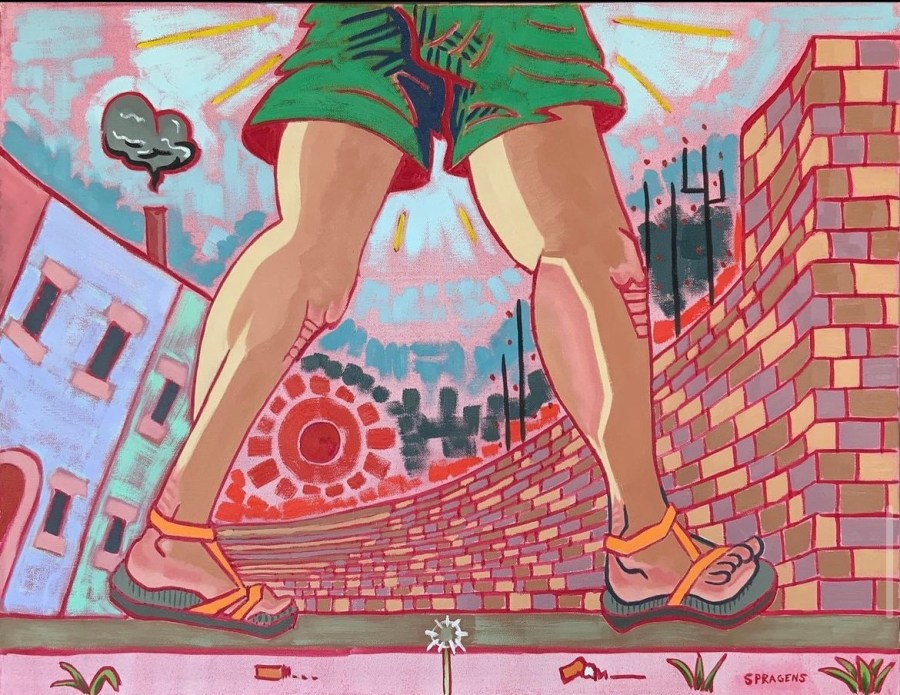
Nine
By George Bilgere
Featured Art: Noon to Dusk by Alex Spragens
I am standing by the pop machine
at the gas station, drinking a root beer.
It cost a dime, my whole allowance.
My bike—a J. C. Higgins three-speed—
looks cool: I just washed it
and waxed the blue fenders.
Grownups are moving around me
in kind of a fog. Actually I feel sorry
for grownups, with their neckties,
their dark jackets and serious talk.
I am wearing low-top Keds.
Their shoes are hard and gigantic.
Try climbing a tree in those shoes.
How am I supposed to know
that an old, white-haired guy,
a grownup, is watching me
from his desk in the future,
writing down every move I make?
Why would anybody even do that?
If there’s one thing I don’t like
it’s writing. Writing and division.
This root beer is actually excellent.
It’s a hot day. My fenders are waxed.
Read More
Women Alone in Cars
By Pamela Davis
Do you see us? We park in our cars
all over town. Enjambed between jobs
and laundry at home, we stop time.
Toe-off shoes. Fan our bare toes. Exhale
the poisons of the day. Somewhere
in the car, there is chocolate. Aretha,
Mrs. Dalloway. Men pass staring hard
as cops. One asks if we’re okay. Sorry,
we mutter for the hundredth time.
Beyond the dashboard, the sun stalls
before sinking the ancient way.
An open road is ripe. One summer night
in the Sixties my Dad drove home from Vegas
in a gold convertible he bought playing craps.
Cheerios went limp in our bowls
the morning he came back, presenting
Mother with the car keys. Choking them
in one fist, she slammed out, gunned
the engine’s 385 powered horses
and thundered off. It became her way.
We were always left listening for the Pontiac’s
brakes to screech at the end of our street.
Tonight I point my car north and turn up
“Respect.” City lights leak out my rearview mirror.
I’ll be gone an hour or half the night.
Virginia was wrong. A room isn’t enough.
Read More
Heist
By Chris Greenhalgh
Featured Art: Immersion by Lucy Osborne
I told them I’d retired, that I didn’t have it in me.
I repeated I was happy now.
Still they insisted, “One last poem.”
My love wept, “But you promised.”
I said, “You don’t know these people.”
“Are a duelling scar and doctorate not enough?”
My gut clenched. The darkness pressed.
I wanted the world to hold fast but it
wouldn’t. The rain told me that much.
From the outside the job looked impossible—
words secure in vaults with a time code, and
an alarm tripped by the whiff of a cliché.
One hundred drafts to achieve a felt life.
I rearranged the apparatus of my thinking.
Voice recognition software, the geometry
of broccoli florets, the right amount of
messiness to bring the world into being.
Light spilled from the margins, lines slid
into place, each faceted like a jewel.
You can read it HERE behind the paywall,
sustained on the page, a miracle.
Read More
What I Am Telling You, Jessica, Is That Those Chickens Are Fine
By K.T. Landon
For Jessica Jacobs
You say that a poem that contains a fox
and a henhouse must, at some point, include
a slaughtered chicken, that the rifle on the mantel
must go off in Act Three. But what I am telling you
is that my neighbor has built his coop to last
and surrounded it with a sturdy double fence
of chicken wire, and that that fox is out of luck
this time. And I know that good news for the chickens
is bad news for some vole or field mouse or hapless
housecat. So maybe all I’ve done is point that gun
in another direction or into another poem, but this
is a poem in which no chickens will die. A rabbit
will bound across the road and the car will slow
in time. The fox will discover the trampoline behind
the house next door and with it the wonder of flight.
Everyone I love will live and call me after supper
to say goodnight. My neighbor is a good man,
a minor god who has brought forth a paradise
for chickens. And I know those chickens, clucking
contentedly in their self-important obliviousness,
are too foolish to be a metaphor for hope
(though isn’t hope always foolish?) but in this poem
the chickens stand for joy—for feed scattered
with a free hand and fresh water in the trough,
for a swept house and a warm nest, for the sun
and the breeze and friends to admire your glorious,
feathered self and this single, glorious day.
And we’re in pretty deep now, aren’t we,
speculating about the Inner Life of Chickens,
but can you doubt, watching them watching us,
that they have one? That they, too, understand
the urgency of this still and incandescent moment
that is here and leaving already? I know
it’s not always this way. The gun goes off
eventually. One night the latch will fail to catch
or a hinge will rust through, and the fox will bring
terror and death, as foxes do. Every story ends
with a corpse. But, Jessica, it’s not Act Three yet.
My neighbor, the chickens, the fox, you, me—
we love what we love for as long as we can.
Right now, in this blue and breathing hour
that shines inside us all, those chickens are fine.
Read More
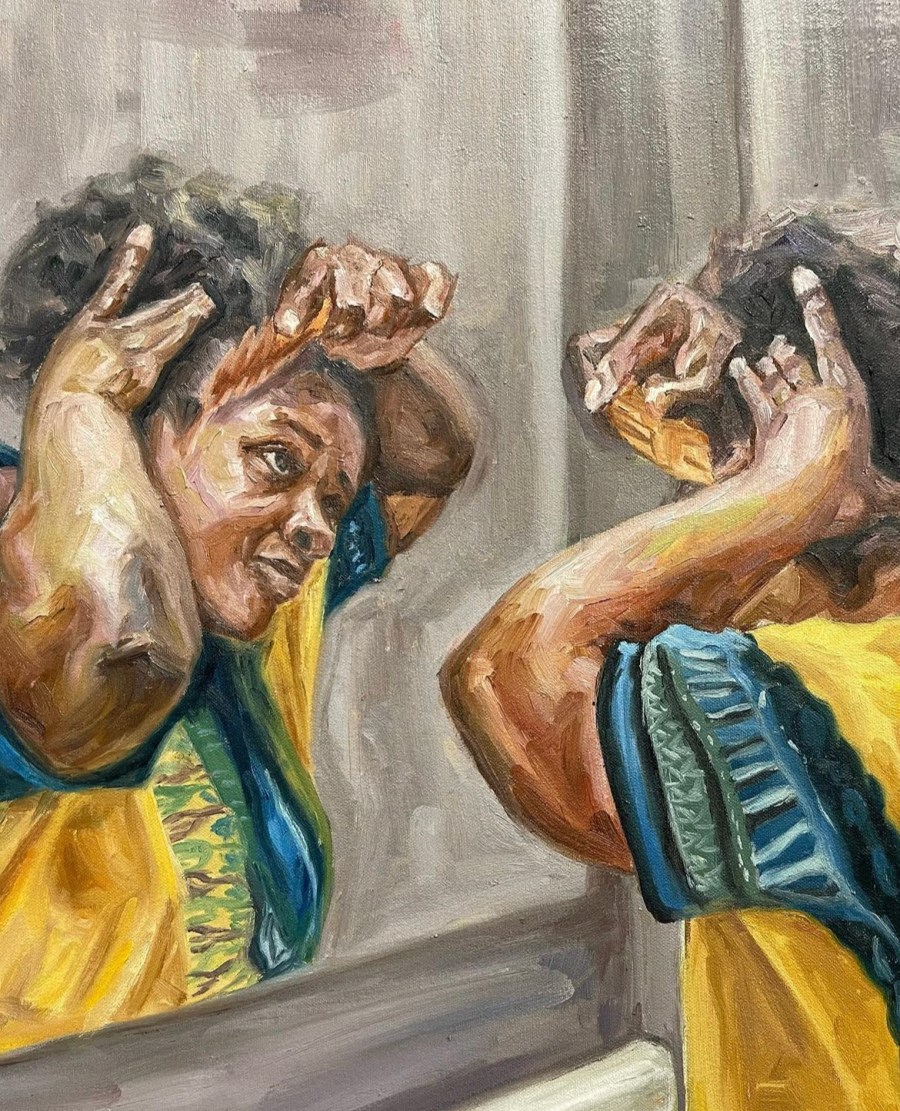
Dependable Lies
By Isaac George Lauritsen
Featured Art: Untitled by Amina Toure
I’m sorry I couldn’t make it
to your dinner party.
In the process of developing
a mango sorbet
the machinery spun so fast
that a black hole came into existence
at the bottom of the bowl
and put my kitchenware into orbit
forcing me to utilize a butterfly net
to return the room to normalcy.
I’m sorry I couldn’t join you
for an afternoon at the beach.
After I put on my newly bought
swim trunks, my house swarmed
with brand ambassadors, so I spent all day
shooing them away with air horns
and last season’s bottle rockets.
Also, I’m sorry I couldn’t make it
to your godson’s confirmation.
On my way there, I drove into a fog
but the fog stayed surrounding the car
for what felt like twelve years
so I stopped driving and considered
what I couldn’t understand
such as the many unanswerable questions
that accompany existence
and as I started to choke up
the fog choked up too
with a bit of perspiration.
I couldn’t tell if I was being
empathized with or mocked
which caused me to question
every friendship I’d ever had.
Seriously. I’m so sorry I couldn’t make it
to your grandma’s b-day get-together.
As I was dressing in formal attire
my hair became sentient
and rebellious, rearranging itself
out of the mousse I’d used
to command it. Every time I felt
my hair snaking about in its mischievous
way, I returned to the mirror
to find a new shape.
At times, my hair was abstract
and chaotic. At other times
it represented better things:
towers, trees, a range of
mountains with follicles of
birds arcing over my head’s horizon.
At one point, my hair became
your grandma who informed me
that I looked like an absolute
ragamuffin. I didn’t feel like explaining
irony to your grandma-who-was-
my-hair, so I went back to sleep.
Finally, I’m sorry I couldn’t make it
to your absolute rip-roaring banger
of a potluck. I wasn’t myself that night.
It’s just that I was the lemon rind
curved to the lip of the martini glass
that had become my life.
Read More
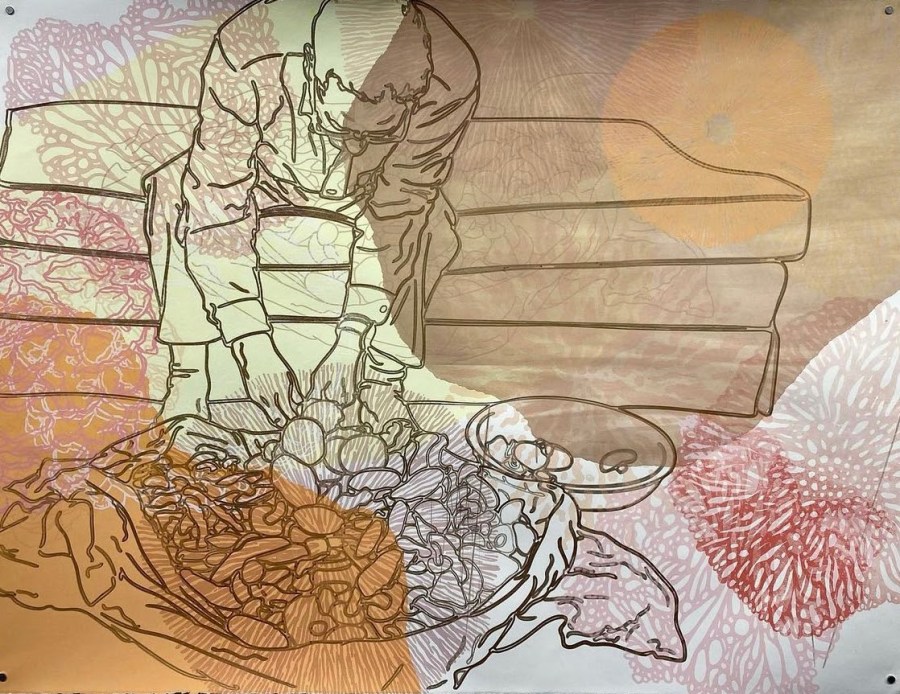
Unspirit
By Matt Hart
Featured Art: Funghi by Nina Battaglia
Today his family is driving
to Cincinnati from Philadelphia
to start packing up his things
and taking some of them away.
Not a lot of people know
that Dean was living here (because
that was how he wanted it), but
we were spending a lot of time together
with beer or scrambled eggs,
though usually not both
at the same time, same juncture,
same hootenanny-creature-feature.
He seemed lighter and lighter,
sometimes almost clear. But then
he got sick—wasn’t taking care
of himself, wouldn’t see a doctor.
And it still doesn’t add up—how
happy he was and how desperate—
but that day at the hospital
it was the intensity and the LEDs
of his eyes I watched expire
in a surge of tangled wire.
And now, I am a torrent of crystal sadness
that looks like stars and fades
like an old jean jacket that gets
agitated and spun out with all the rips
in time and space, which are just people
arriving on the scene and then
vanishing—but everywhere I look,
there they still are
and by “they” I mean him,
and yeah, it’s kind of stupid
all these months later, but I am
kind of stupid all these months later,
and today I’ll go over to what used to be
his apartment and clean a little
the bedroom, the bathroom, and
the kitchen, so I can feel
like I’m doing something useful
in the void, but also so it’s ready
for his family to find him, cosmic
and still raving, his pockets
full of poems.
Read More
Gown
By Dobby Gibson
In the end I imagine
it’s the only thing
they’ll dress us in
if we can reach the place
where the others
have been waiting
last night I dreamed
you were the one
who found a way
to email me from there
with more of the poems
that never stopped arriving
when you were alive
in my dream you wrote
never use gown in a poem
unless you really mean it
and when I woke
I knew I shouldn’t wait
to say I miss you
my brilliant and difficult friend
you were haunting me all along
when I reached out
my hand it passed through
without touching the scar
I should have known
the way cats followed you
everywhere like words
I didn’t know the meanings to
the way someday I’ll learn
it’s finally my turn
to reach for what hangs empty
from the silver hook
on the back of the strange door.
Read More
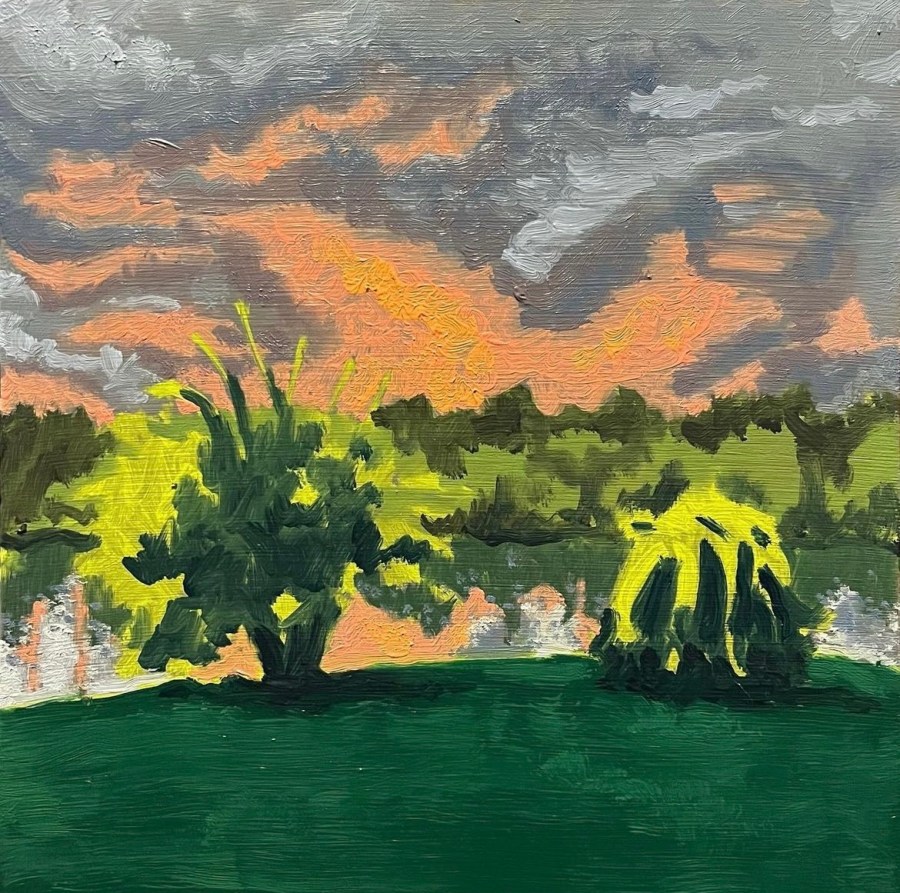
Sometimes it feels so animal-
By Alice White
Featured Art: Schuylkill Sunset by Alex Spragens
the peach tree trunk breaking our fence in half
to make room for itself, wisteria
reaching its fingers into the windows
when we look away. Waist-high nettles lie
in wait at the property line, a field
of them, teeth bared. The trail through the valley
disappears in summer under brambles
that catch and tear our clothes and skin. I chose
to have kids. To replicate myself, spread—
that’s what life does, from the most innocent
forget-me-not to the knotweed we fought
for years, painting poison onto each leaf
in spring. Of course life wants to keep living,
wants to live so much it will kill for it.
Read More


Costumes
By Carlee Jensen
Featured Art: Paralyzed by Abby Pennington
It was Halloween, and all the ladies from the front office had dressed as Wonder Woman. I spotted them as I crossed the parking lot: in matching red go-go boots and lamé headbands, tight Lycra dresses that framed their tits in gold. There was something dazzling about the sight of them, standing shoulder-to-shoulder at the head of the carpool line, tiny skirts ruffling in the October breeze.
“It’s quite a spectacle,” said Claudia Palmer, surveying the scene while she waited for me to swipe my key card at the front door. Claudia was too dignified for costumes, but like all teachers of a certain generation, she owned a vast collection of appliqué vests and novelty jewelry, which she trotted out for special occasions to the delight of her fourth-graders. As she waddled through the door, burdened by her many tote bags, I admired the twin kernels of candy corn hanging from her ears and the gap-toothed jack-o’-lantern brooch perched at the apex of her ample chest.
“I’m glad they’re confident,” she went on. “Even Mrs. Ward, at her age. But is this really the example we want to set for our young women? Your outfit seems much more appropriate, Valerie.”
I was a cat. I had been a cat every Halloween of my teaching career, with the same fuzzy ears from the grocery store seasonal aisle and the same greasy whiskers drawn in eyeliner on my cheeks. A hole had opened in the armpit of my overextended black T-shirt, revealing stipules of untended hair whenever I raised my arm. I liked Claudia—she was the kind of teacher I could imagine myself becoming in a few decades, an old-school bitch who inspired devotion in the students she tortured with handwriting practice and multiplication quizzes—but it seemed awfully rich to suggest that I was any kind of example.
Still, she wasn’t the kind of person you contradict. “It is a bit on the nose,” I admitted, gesturing through the window at Mrs. Ward. She was hamming it up, striking Lynda Carter poses for the approaching cars. “Like, I’m a teacher! What’s your superpower?”
Read MoreThe Triple Goddess with a Bird’s Head, on My Dad’s Side
By Sue D. Burton
“. . . she circled the battlefield as a conspiracy of ravens to carry away the dead”
—Gregory Wright, Mythopedia.com
There were trainloads of us, my daddy said, heading
to “Hillbilly Heaven”—up to Akron in the 30s and the 40s—
lured by Tire & Rubber, but we were open-shop snakes (cheap)
to anybody who already worked the factories up there, though
of course once we got active in the union, we got dissed
for that, oh, it goes on and on—homesick—
the rubber bust—.
It’s what now we call the Great Appalachian Migration—
but by the time all that went down, we pretty much forgot
the Morrígan, that ancient Celtic goddess of battles and doom
who crossed the Atlantic with us and spent the next how-many-years
dirt farming in West Virginia. And the Morrígan, too, got
pretty much tamed down, though sometimes she just shows up,
on your doorstep, like the baby my friend gave up,
who thirty years later tracked her down.
And didn’t have a pretty story.
But why should the Morrígan—a feisty old gal
with the head of a raven—have a pretty story? My dad said
the Scotch-Irish (we Celts) had a fightin’ reputation.
Though now they say if you eat vegan, your microbes or
whatever are in sync and you pass for middle class.
I never went to war.
But I would like a bird’s head.
I’d like to think I had some magical mythical legacy, other than
Wonder Bread and bad-years Goodyear Tire. Though to what end?
I told my nice bourgie dentist once I wanted a gold front tooth.
I don’t think that’s a good idea, Sue, he said.
Read More
The Numbers
By David Dodd Lee
I counted eight cygnets (and two adult swans) on the river in May but then counted four
cygnets in late June and today the four have turned into three. My next-door neighbors
went from two to no persons then back to two after the deceased
couple who’d lived there’s daughter and husband moved in, then up to five
after the woman’s sister, her sister’s boyfriend, and their child
joined them. A note written on lined notebook paper that I assumed
(on what basis?) was written by the woman’s sister blew into
my yard. It said I want out of this life and I love you Jesus I do
but I don’t care anymore I’m sorry but for now they’re still five.
My house is one and sometimes two, especially on weekends, add
one cat and it goes up to three. I grew up in a house of six and then
there were five and then six again for a while and then five. My
sisters ended up in houses of six, five, and four eventually, I in houses
of two, four for about eight years, two again, now usually one . . .
The eight, four, then three cygnets take all summer to become close to
indistinguishable from their parents and then by spring each relocates
to a different pond river lake where they become two, then four, five, six, seven, etc.,
something you can count until counting no longer seems to matter anymore.
Read More
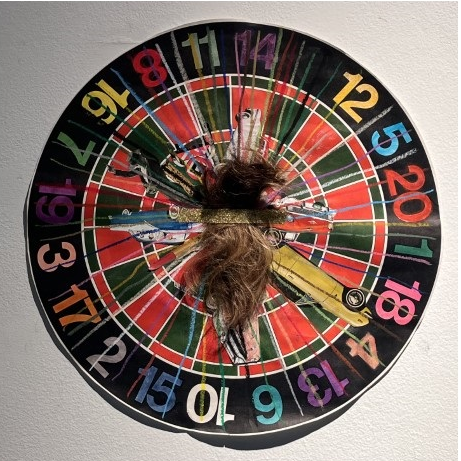
8 Ball at Sportsmen’s Bar & Grill
By John Bargowski
Featured Art: Time Lime Rhyme by Mary Popa
Road-trip thirsty, barely out of our teens
and passing through on our way home
from a cross-state friend’s, we took
every game from the pair of locals
we faced at this circus-lit hillbilly joint
in the knobby hills off I-80,
and maybe it was the booze queued up
for us at the bar as payoffs,
or maybe the skinny brunette in a brushed
Lady Stetson and skintight Wranglers
helping us drop coin in the slot of the juke
for triple plays between wins,
but something lit their fuses, so after JC ran the
last six striped balls of a double
or nothing, then sank the 8 in a corner
pocket with a bank shot, the English
on the cue ball spinning it so near the lip
a hip bump could’ve knocked it in,
that’s when the first pool stick shattered
across the table, skittered past the two-steppers
on the parquet then trip-switched the stools
to spin round, ejecting every good-timer
from their seats at the bar onto the floor
as we did the math, cut past the banjo clock
and out the swinging double to the Olds,
wheel-rutted the gravel and tore asphalt
back to the interstate, slapped in Waylon
and blasted some tonk out of the box.
Read More
In the Red Vinyl Booth of the Horseshoe Cafe
By Carol Tiebout
We traded Harvey Wallbangers, Velvet Hammers, and straight-up tequila,
kicked Nixon and Agnew around and came up with a board game
about Camp David that would use lacquered walnut shells and peas as markers.
When the acid slid in, clipping all the edges in clear light, we fell out
into the late-night street now stuffed with one hundred thousand
points of cool fog that wrapped the curbs and thinned under the lamps
into a series of three-foot worlds. A drunk appeared below us, limbs curled up
waving like a crab that had been tossed onto its back from its rocking bed to hard
granite while still holding the comfort of the sea. He looked up at me
with baby-kissed blue eyes and asked, “Are you an angel?” I thought for a moment
maybe I was, maybe in the realm of infinite possibilities, it could be there on certain
Tuesdays, my name in the index of Alan Watts’ book under A.
Fifty years later the sky opens up, raindrops the size of cats singing
the hood of my car as it curves past the turnoff to town
and in a loud whooosh, deafening as a splashdown, I no longer
understand why I would hold back any longer from
whatever walks into this minute
from the deep seams of the world.
Read More

The Happening
By Josh Luckenbach
Featured Art: Birds of Freedom by Kourosh Nejad
Things went on right up until the moment of it—
the hummingbirds whirred at the trumpet honeysuckle,
and the aphids scaled the ivy on the brick wall
facing out toward the new construction across the road
and the mountains and highways beyond
where the people in cars traveled distances near or far
with their usual haste or leisure to sit in offices
or to attend the weddings and the births
which, it seemed, were more and merrier than ever before;
and afterward, the strangest part was that things
went on then too—the packages arrived on time,
the lights turned on and off at the flipping of the switch,
the goldfinches returned in late morning to flit
among the zinnias near the deer netting, and the clouds
drifted as they had the day before in the same ageless sky
that often feels too vast for us to have a place in it,
and yet, for the time being, we do, as now I occupy
this patch of grass and tell my hand to move and it does.
Read More

Aubade
By Josh Luckenbach
Featured Art: i.dissociation. paranoia. by Ahneka Campbell
Up all night shuffling from chair
to bed to couch to floor
and only the flustered trilling
of the soul at its own failing,
decades funneling to this:
narrow opening, fissure
in my hope’s remaining rot
which I had thought
to step through
would mean to surrender to
the dull world (and it would,
though not in the way that I’d feared)—
tunnel-visioned and mourning
the loss of meaning,
up all night and no god; I lost
years like this, hope long since gale-tossed.
Meanwhile whatever it was that was
going to happen never did. Now, finally this—
hot coffee on the front stairs
at daybreak, windswept hair—
this auroral calling forth from night’s
void as mundane as it gets.
That’s it. It’s a deal.
I’m clearing my schedule.
Read More
Their Every Yellow Leaf
By Sarah Sarai
Jacinth looks at the pig and
asks what she did in another lifetime
to be so beautiful.
Maybe not everyone would see it
but she’s perfect.
I am not everyone. I agree.
Alice is perfect,
a hippopotamus made compact.
I stroke her dark hide and feed her
fruit cup from breakfast.
Cauliflower and a toasted bagel.
Plum jam.
With the pig, Jacinth and
I break bread.
Jacob, who is new to this poem,
buries his cigarette in a late-fall lawn
to take a call from Quebec.
In bright sunlight Alice considers
eternally recycling life. Is my guess.
Jacinth has no interest in me or Jacob
and praises only the pig, who is complete.
Is her guess. The heart gets lonely
some days. Is Jacob’s guess.
Feeding Alice renders longing and irritation
irrelevant, without obliterating either.
Aspens snap their every yellow leaf.
The trees expected we’d be gone by now.
Their every yellow leaves don’t guess.
Read More
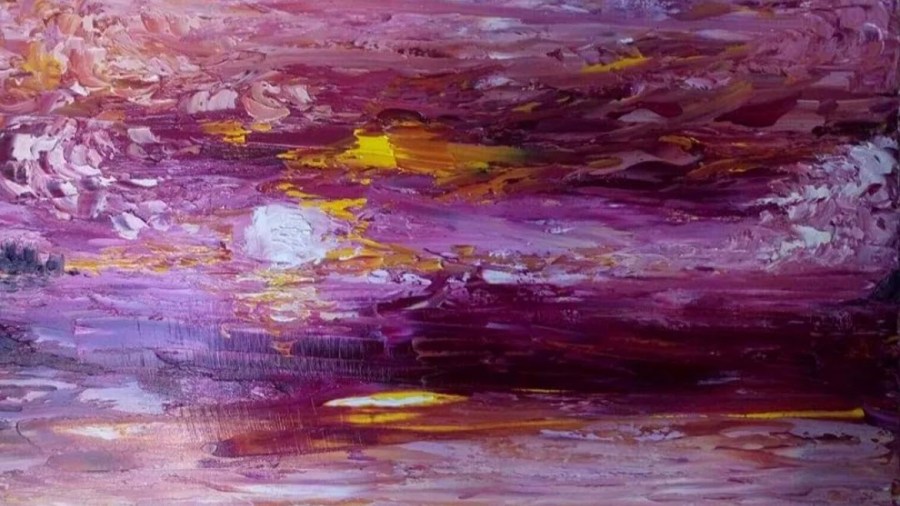
The End of the Story
By Damen O’Brien
Featured Art: Atardecer rosa by Rubi Villa
I climbed down into Wonderland following the paths of my memory.
Old playing cards ruffled like leaves, but his burrow was empty. It was
a shivering day, a pale sun peeking briefly into his cold warren. He was
long gone. Soft crumble of soil, colorless straw. He had vanished,
popping the buttons of his waistcoat on the far paddock’s fence.
All those years ago and we’d lost touch. One rushed note in 20 years,
apologies for not visiting, complaints of lateness, and then nothing.
No phone number, no address. He has joined the ranks of the Missing,
shutting the last yellow doors of Wonderland, boarding the windows,
battening down the root cellars, scrambling across the checkerboards
of desperation. He’s a gray exposure photograph on a billboard
of the lost. He’s a file note numbered amongst the renditioned, the
compromised and betrayed, standing in a hopeless queue somewhere,
waiting for his portion of grass. We give the past away in exchange
for the future. We foreclose the titles on our fairy tales for a handful
of beans, until they’ve all gone, hitching out in the huddled back of
rusty trucks, bussed in to the Big Smoke for a carrot or two, a cardboard
sign seeking work, selling our heirlooms for a passport, lying unmarked
and misremembered in a thorny field. It’s been such a long time. I was
a little girl with mud on the hem of my petticoat, but I always knew
the world would one day come to Wonderland. He has gone on the last
flight from the embassy’s roof, hiding his face from the government’s
algorithms, sleeping in subways. I barely remember what he looked like.
A twitchy nose, a neat tail, a pocket watch. If I were asked to identify him,
I would say, he was a White Rabbit. He was always having to leave.
Read More
Patience as a Crocodile
By Damen O’Brien
Seven hours under
bubbles to breakfast,
practicing his terminus
while they slap water
with the fowl’s carcass rag
and tempt him to spring-
loaded striking at 1 p.m.,
to the matador’s applause
each hot weekday and
twice on Saturday, but
he must only win once,
tangent to his target,
a holy investiture,
sacred digestion, and
every zookeeper has
one absent moment,
so he’ll wait forever
like the best missionaries,
for the one chance of faith
to find its grim purchase,
when in the coughing dark,
a child’s fever breaks
and prayer can be praised,
so one heedless heel
too close to the water,
then matter of fact,
not with any animus,
not out of revenge,
a final punctuation
for the slow god
of limitless perseverance,
cold-scaled leviathan,
to take and roll and roll
until the silent ripple of
dismay which is
a crocodile’s patience.
Read More
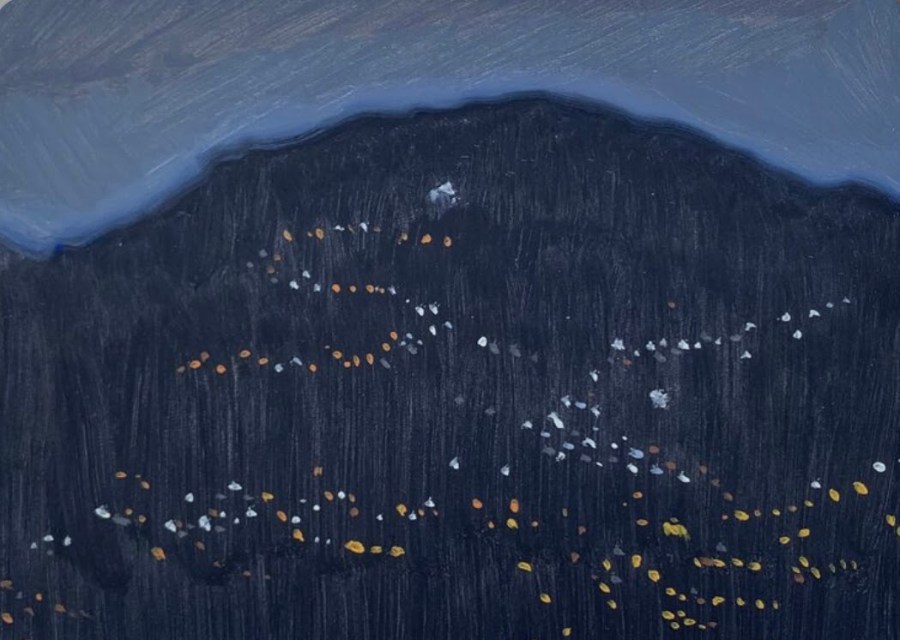
Wolf
By Julia Strayer
Selected as the winner of the 2022 New Ohio Review Fiction Contest by Madeline ffitch
Featured Art: Monte Constantino, Night by Alex Spragens
I lost her the night of the squalls, when wind raged hard enough to rip trees from the ground—my husband helping neighbors with a collapsed roof, and me with blood that wouldn’t stop and wouldn’t stop. I carried her for four months. I had imagined her face.
I walked the dark house alone, not wanting to sit, hearing crying that wasn’t mine while the moon trailed after me. I searched out the front window for my husband’s headlights because it wouldn’t feel real until I could tell him, but my breath fogged the glass, and I couldn’t see. Finally, I slept because I was too tired to do anything else.
Empty and quiet. My body. The house. Except for the walls, which were run through with mice and scratching.
They say children choose their parents. What does that say of me? What does that say?
In the wild, a wolf mother will carry a dead pup around in her mouth, showing the body to the rest of the pack, before she buries it.
Read MoreOncology
By Corinne Wohlford Mason
It was winter solstice. As day faded,
we drove to the appointment
through our city and over the river,
a circuitous route, the golden light
ennobling the derelict brick, the industry
of the river, the winter hawks perching
on the floodplain. The news was
not that bad, but still, bad enough.
We had options. We drove home
toward one bright star against the pink
spill of sunset. Look at this light,
we kept saying. Here is a neighborhood
we have never seen before. The sky shifted
sapphire to black. We floated
premises; they floated away. We would
choose later, let the longest night
take its time. We would do this right.
Read More
Leaving
By Kevin Boyle
As retirement began in May, I placed my little reminders
around the house, “Every third thought shall be my grave,”
and for the first week I was dutiful, losing track of
my lists of groceries or my dog’s empty bowl, thinking
of my grave easily a third of the time, keeping a running tab
of each idea on my phone, sometimes unsure of when
a thought might end and another begin, was the Carolina
wren’s call only one thought, and the white-throated sparrow’s another,
if so, then as I dug my garden with my rototiller
that hurt my bones, I would certainly consider my grave
just then, the rectangle clearly a visual reminder and the soil,
only the treated lumber borders threw me off, so I thought of the pecans
so late to arrive in leaf, would they produce this year
those beautiful kernels, and then by early June I bumped it up
to every fifth thought, which allowed me to prepare to collect
on my investments, thinking it through without giving way
to tears, thinking of the garlic bulbs I planted, the scapes—
those green leaves—I ate in a frittata with salmon, line-caught,
very pure, innocent, and by the time the zinnias arrived
in July, the shortest in the front, the largest in the back
like a choral group arranged by range, I said, Damn it,
I shan’t be buried at all, I’ll amend my dying will to request
a cremation “ceremony,” and I went around the house
like in mid-January taking down every Christmas detail
including the manger with the unmoving donkey and lamb
who I might try to outstare, but now I searched for my grave
mnemonics, my construction paper cutouts, my calligraphy
that was poor penmanship, my silly arithmetic reminders
of death, and I could go eight, on a weekend, maybe ten thoughts
without a single visual of my body gone, my mind that knew
a thing or two just emptied like a bin or the compost jar
that I sometimes just toss right into the ground, not caring about
time, until the zinnias called it quits in early November,
the grass stopped growing and gave some color away to charity,
and the birds, the birds felt something coming and shipped out
sometimes in great flocks of chattering that were frightening,
or sometimes, just a single bird that flew south, though
I knew and called out to it, Actually, you’re heading north,
I yelled at it, and still it sailed on, maybe a breeze was showing it
the quickest way to leave, or just the least painful,
until its speck must have entered a cloud.
Read More
Rabbit
By Kevin Boyle
I missed it on holiday by a mile
or so, collapsing at hilly
Sacré-Coeur—calling out,
My hips, my knees,
my wife answering,
My hibiscus, my hydrangea,
darling, though I wish
I had marched farther on the Parisian butte
like a Communard, braving
it to see the song-and-dance bar beautifully
named Lapin Agile, the agile
or nimble rabbit who would enjoy
the cruel, rugged landscape,
and while there, I’d hoist a tankard
to toast the artist Utrillo
who painted the bar a hundred times,
a thousand, always from the outside,
perhaps because he loved drink too much
and inside were the drams and drafts
and cups and absinthe, and outside
there was weather and next door
a cemetery where he would later lie.
Perhaps it’s best for me to see the bar
framed, hanging on a wall, and not to toast,
from inside, the melancholy Utrillo—
why toast an alcoholic?—
but to focus on his focus, the repetition
that always changes
somewhat, an idée fixe that lets you see
the seasons that are colors and leaves
or no leaves at all. I don’t need to travel
since I can see what there is to see
(life!) here in my sleepy and flat zero-ass town.
Read More
Job Interview: Where do you see yourself in five years?
By Carrie Shipers
If I said “Dead” you’d want me to describe
the cause and circumstances, promise
my demise is unrelated to my work,
which I don’t know for sure. Most days
I’m awake to my impending doom,
but the details remain dim. “In your seat”
would sound arrogant and also isn’t true.
I much prefer a cubicle to losing
my weekends or leading folks like me.
I may be surrounded by robots, but I bet
they’ll need a human standing by in case
they walk into a corner and get stuck, request
a reboot to erase having learned their tasks
are stupid and endless. Given you’re
a decade my senior—or else really
fatigued—“Retired” might offend
by rubbing in you’re nowhere close.
Too much focus on the future strikes me
as futile. Once the apocalypse begins,
we’ll probably all do things we can’t
imagine now. If I asked you the same,
I wonder if you’d have an answer prepared,
be flattered someone cared, or if you’d
be upset by goals you haven’t met.
Experience suggests I’ll be performing
this same show for a new audience,
either because the company’s at risk
of shutting down, or because I’m so frustrated
I can’t bear to stay. I’m tempted to say
“Standing on the roof,” then allow
an awkward pause before explaining
there’s also a DJ and champagne
to help us celebrate my latest great idea,
which I won’t reveal until after I’m hired.
I wish this question had come sooner
on your list. I don’t want the words
I leave you with to ruin our rapport,
but the longer we sit here the more
my vision narrows to the door,
the relief I’ll feel when I walk out of it.
Read More
The Hiring Committee Makes Its First and Final Offer
By Carrie Shipers
Featured Art: untitled by JC Talbott
We don’t negotiate salary because we’re already certain
what you’re worth. It may be less than you’d hoped,
but it’s enough to live on if you’re practical. We don’t
negotiate benefits because we think you’re lucky
to get any. The single therapist is prone to naps and lousy
metaphors, but you’re so sad that you’ll keep going back.
We don’t negotiate duties because the job ad was crafted
to include everything that we don’t want to do, and then
revised again when we got sued. Belonging to a group
always requires sacrifices: someone has to do the dirty work
for which no credit is received, take on difficult tasks
where failure means you’ll probably get fired, and it’s not
fair for you to skip your turn. We don’t negotiate
vacation time because we’re angry it exists. You’re also
not allowed to work from home unless you’re quarantined—
we tried it once and were so drunk by noon we answered
our email with kitten pictures. We don’t negotiate
office space because you’ll be assigned a cubicle,
bottle of bleach to combat creeping mold. If you choose
to decorate, make sure all items fit into a single banker’s box,
which allows for ease of exit if you suddenly get fired.
And should you have requests we haven’t covered,
the answer’s No to those as well. We know winning
a small concession would increase your confidence,
make you feel truly wanted. But honestly you weren’t
our best or favorite candidate. You were the one
we settled for because you seemed most likely to say yes,
and the fact that you’re still listening suggests
we were correct. Regardless of your reasons for taking
this job—debt, despair, misguided optimism—
we think you’ll fit in fine as long as you remember:
We don’t negotiate because there is no need.
Read More
Questions for the Tech Founder
By Carrie Shipers
If I said solutionism was the greatest challenge
facing us today, how many whiteboards
might you fill before the irony hit home?
Was your attempt to privatize the Post Office
short-lived because it was too hard to disrupt
real objects, or because Jeff Bezos told you
to back off? Are you more embarrassed by
the bubbling sinkhole stinking up your campus
quad, the fence that fails to block its view,
or the studies stating that the Valley’s so-called
“pipeline problem” is merely a myth you’ve built
around a rigged system? Given the resulting
poor publicity, do you regret deciding to:
use live endangered animals to illustrate ideas,
spend millions on a bonding trip at which
most of your staff contracted STIs and salmonella,
compete pants-less at the all-hands sack race?
Relatedly, what percent of the lawsuits
you’ve had to settle might’ve been avoided
by investing in HR before a second helicopter?
Are you aware the word “founder” also means
to sink or fail utterly? If yes, do you ever dream
you’re drowning and wake up afraid,
and does this perhaps explain your interests
in sea-steading and extreme longevity?
If I suggested several of your famous Principles,
e.g., Be Boldly New, seem cribbed from
other companies, would your benign
but somewhat flat affect pivot toward rage
so fast I’d feel dizzy? Did you agree
to this meeting in the hope that seeming
open, honest, and sincere would counteract
your current image as a greedy genius
hooking users on their own abuse? Or because
a public busy judging your ethics, humor
and haircut is less likely to notice or object
to your real work, which is not the thing
you’ve gotten famous for? Assuming
the latter, are you sorrier I’ve caught on
or flattered by the depths of my alarm?
Read More
Hair of the Dog
By James Sullivan
Featured Art: Prositabhartruka Nayika by Kripa Radhakrishnan
The kids call him Smash Dad when it happens. “Smash Dad, Smash Dad!” chant six-year-old Kevin and Kylie, voices still almost indistinguishably high-pitched. “Ha ha ha.” Robert forces a smile, squinting to repel the enemy light. I can only imagine the gouging pains and gushing nausea he describes because, while we both like to drink, only he gets these hangovers.
He’s never belligerent or weepy when he drinks. At the worst, he’s increasingly amorous, which is no trouble for me once the kids are in bed. We have a grand time, sampling this and that, lots of reds from Sonoma especially. Sometimes, even knowing what it does to him, he’ll indulge in some Californian IPAs: “Gonna let the gorilla hammer me,” he says, releasing the hop aroma. It’s one of the things that maintains the continuity of our university romance as we’ve entered the house-and-kids phase. I remember him carrying my vodka-smashed body like a bundle of loose logs after a post-exam party, performing Matrix bends to protect my head from cabinets and doorknobs. At parties a couple times a year where I choose to over-indulge, I like to relive that old marriage of tenderness and danger by making myself his unwieldy patient, the only one he takes home from the hospital. Later we sip Pedialyte in bed, and I tease him about his least favorite Beatles song (and my favorite physician, “Doctor Robert”) until our new life demands we get up and fix twin breakfasts.
But even his hangovers are atypical, never the balled-up-in-agony, stay-in- bed-all-day kind. It’s more like someone has gently popped loose his brain case, as if opening up the back of a watch, then swirled a paintbrush around in gray matter, dabbed a little of the juices over here, mixed in some tannins and grape skins, and adjusted the dial on the left, producing a new arrangement of my husband’s faculties. Picture George Martin, alcohol surgeon with a slapstick sense of humor. Parts and labor $20, rebate if you recycle the bottles.
Me, the worst I lose is some REM sleep. But Smash Dad, my remixed Robert, better a Bob in this state, he goes haywire. The man lumbers like a Sixties Toho robot (MechaDad is one of my names for this character), neck stiff and limbs clumsy like a 50-meter city destroyer. He inadvertently thumps and elbows into cupboards and door frames and hunts for the jar of pickles, cheeses and mustards and cartons of eggs spilling to the floor as he fumbles: “I know they’re in here, but they’re not in here!” I sense in these moments anger at the end of a long road of banal frustration. Like a hemorrhaged eyeball on a dopily grinning face.
Read More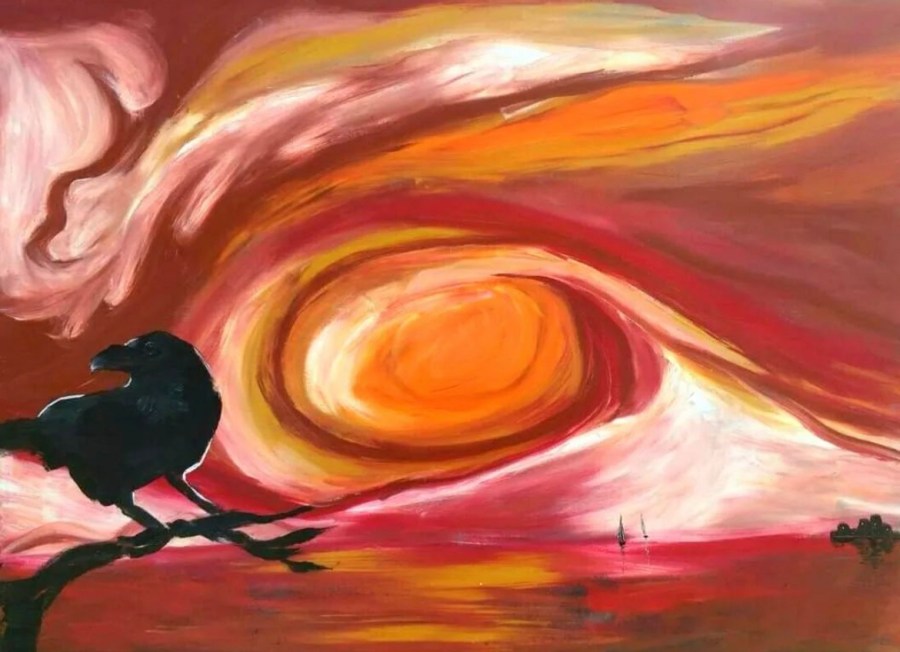
Omen
By Sydney Lea
Featured Art: Cuervo de Jupiter by Rubi Villa
Wingbeats at the window
snap me out of the torpor
of my minor springtime sorrow.
A blast of desire, not wholly
carnal, not wholly not,
suddenly overcomes me:
I’m almost 80—and lovestruck.
What can that have to do
with a cardinal’s frenzied attack
on his likeness there in the pane?
Bright bird, I see that you’re jealous
—of what? You’re at it again,
enraged. Small wonder you’re scarlet.
Listen: you’re only alone.
Aloneness. Somehow I feel it.
A small bird’s futile ardor
brings on a premonition.
My love’s in the bedroom, dear reader,
and I picture my world’s perdition.
Read More
Halfway to Vermont
By Owen McLeod
Featured Art: Clown Hair by Emily Rogers
I tell my wife
my old friend Tom
is in the car
right under my seat in fact
she says not funny
I say I’m not joking
then reach down
and fish around
until I produce
the small blue padded envelope
that contains
the portion of Tom’s ashes
his half-brother
mailed to me from Alabama
five months ago
I explain my plan
to scatter them
on the shore
of Lake Champlain
where we’re going
to spend a week
doing nothing
it’s fair to say my wife
who grew up in China
with beliefs and customs
about death
very different from mine
freaks out at this point
and asks that I get Tom
out of the car
the sooner the better please
I take the next exit and
look for a halfway
decent spot
but it’s just a Sunoco
in the middle
of nowhere
we pull in
and while my wife
goes inside to pee
I walk to the edge
of the parking lot
and pour Tom’s ashes
on a struggling patch of grass
which strikes me as not
altogether inappropriate
given that Tom
spent his entire adult life
drunk
and unable to fulfill
his great promise
as a poet
in the few moments
I have at the edge
of the parking lot
I try to remember
the good poems
he wrote before
he couldn’t write anything
and I feel guilty
about cutting him off
years ago
but I just couldn’t
continue watching him
drink himself to death
and it grieves me
that I never truly thanked him
for introducing me
to poetry in the first place
but it’s time
to say goodbye
so I say goodbye
to the ashes in the grass
and walk back to the car
where my wife
greets me with a hug
and a bottle of cold water
and says yuàn tā ānxí may
he rest in peace
and then to the sky
above the Sunoco sign
xièxiè
xièxiè
xièxiè
thank you
thank you
thank you
Read More
The Exaltation
By Ronald Okuaki Lieber
In dry season in equatorial Chad, the Sahel is so hot the soil
Chars to red dust, the grass to a blond bristle, heat bearing down like affliction
And because the land blisters and coastal Africa is forested, humid and cool, air
Is sucked easterly, darkening the horizon with fury into which a man, tending
The village flock stares, a wave so sudden and massive the Dogon has little time
To corral the sheep before the air erupts with stinging needles. The storm
Sweeps across the continent until in the Atlantic thunderheads and wind
Marry the doldrums, and a hurricane is born. Its updraft plunges the ocean, and swells
Spiral westward across the open sea to loom large on beaches lining the American
Eastern seaboard as in Montauk Long Island where surfers
Scan the near horizon for the shadowed lines their kind read. It’s what they have prepared for
The summer afternoons and cool September dawns before work, that one stirring
Pitched perfect just where a surfer waits, and he paddles to catch the lip, a chthonic uprise
Heaving him high to which he surrenders, riding the rollinglevel underneath
Into rapture that I as a ten-year-old in the thick of the Ozarks heard in the treetops
Swaying back and forth, a thousand miles away. The shepherd stokes the charcoal
Embers with dry twigs, the surfer packs his board, and the hurricane makes landfall
In Kill Devil Hills, splintering wooden homes. I am joined.
Read More
 New Ohio Review