Around the last week of April in 1944, farmers around the country received a letter from the DeKalb Ag seed company.
Twelve common kernels of corn would mean nothing to you, but the kernels in this envelope are far from being common. In fact, they are special seed kernels of a new DeKalb hybrid variety. […] Put them in safe keeping until you plant corn. This seed will produce a hybrid which neither you nor your neighbors have ever seen.
Stapled to the letter was a small envelope containing twelve seeds.
* * *
A seed is an embryo. Every farmer and gardener since the Mesopotamians chose seeds to save and replant the following year. This allowed people to stop roaming around looking for food in the wild. We passed seeds from hand to hand every year in a chain of nearly 450 generations. Parents and grandparents died, but the seeds continued. If the seed was lost, we were lost.
Featured Art: Stephen Reichert, Untitled, 2013. Oil on canvas, 12″ x 12″. “Cirlce” series.
The jarring shriek of the alarm clock slapped Srinath into wakefulness. Fumbling through the tangled mosquito net, he wrestled with the timepiece, finally silencing its insistent bickering. Delicate strokes of sunlight filtered through the louvered windows, painting soft stripes across his cramped hostel room floor. He lay still, his heart thudding as fragments of last night’s dream clung to his mind like cobwebs on the peeling paint above. It was always the same dream.
The clock read 6:00 a.m. Gupta-ji, the boss, had demanded an early start. Srinath could almost smell the polyester and sweat from the Mickey Mouse suit waiting for him at the store. But first, there would be shelves to stock, floors to mop.
Lakey Sturgis took a palmful of margarine from the brown plastic tub between her feet and ran it over the cheekbones of her grandson’s face. She smeared the pale-yellow spread across the boy’s sloped forehead, deep into the wrinkles of his ears, working her way down the turkey skin of his throat to his bare chest, then beyond.
Just a little more, she said to Peep, who batted long, effeminate eyelashes back at her. Nuggets of the margarine stuck to them, and for a second, Lakey was reminded of nights long past when she lived in Greenpoint and Hans was still living. She looked into her grandson’s globby lashes and saw her twenty-year-old self going to bed without caring to wipe away the makeup she spent so long painting on for nights of swing dancing and manhattans at Truffani’s. That was before Hans’ job brought them to the desert, before their daughter was born. Now Lakey was sixty-six and dying, far from any place she called home.
Ruth Ann doesn’t drive that way anymore. She doesn’t have a car but if she did, she wouldn’t. She has no reason to go to that side of the hill anyway. All that’s left of the Alstead farm is a small sliver of land on the dark side of the hill, just big enough for Ruth Ann’s double-wide trailer. Her daddy’s old place—the parts bought by the flatlanders—sits on the sun side of the hill, empty aside from ski season or leaf-peeping. Ruth Ann heard they razed the old farmhouse and put up a new lodge, all logs, meant to look old, yet nothing like what folks used to build. She heard someone else taps their sap lines and runs their sugar house too, but they still put their name on the syrup. She would not drive to that side of the hill for a thousand dollars. Well. Hundred.
“Time, lovey.” Haley doesn’t want to go to school. She pouts, sticky fingers on the cheap screen, knowing she can test Ruth Ann. Ruth Ann reaches out and tries to paw it off the girl, her arms jiggling as she stretches, yellowed nails like sloth claws. Haley jumps up quick and they play their game, the two of them moving in the trailer like slow-motion ninjas, knowing every corner by heart, how to avoid every precarious pile of stuff or mound of dirty laundry. Ruth Ann soon stops to catch her breath. She steadies herself, hand on her knee, palm on her heart, neither body part built for such a heavy body or small space. Haley relents quick, eyebrows knitting as she tosses the screen and roots around for a bottle of stale water. Ruth Ann smiles when she takes a sip even though it hurts. “Come now. Bus will be here.”
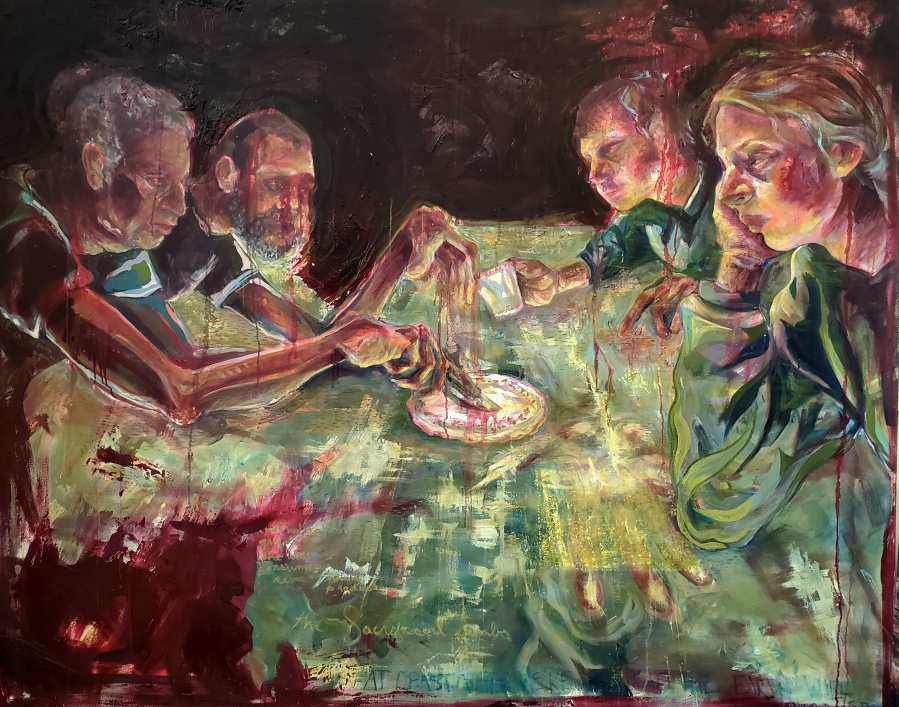
Featured Art: The Sacrificial Lambs by Brooke Ripley
Lucy said You need something to do and handed me this bag of trash, which is barely half-full, it’s like a hobo bindle. I’m not one to take orders, or demands really, especially not from her, but the tone she took—it was so dismissive—got me extra riled so I grabbed the bag without even thinking and went out the back door and wound it around a few times and slung it over the deck railing like a softball pitcher really clocking one in. I shot it upward though and it hit the overhang and fell straight down on someone’s moonroof. Quality bag, it didn’t break. Just sort of stuck there on the car like it was full of diapers or something. I went down the three flights and retrieved it. Maybe one of the neighbors was peeping but I didn’t really care. Lucy’s up there with the rest of them. Her dad’s hospiced in the front room, cancer of the esophagus, can’t even eat, they feed him with a syringe. And I was getting in the way. Buck, can you find a hobby, she’s always saying. Surely when I dump this thing, when I have to kick open the sticking gate and brush the snow off the dumpster and I toss this wad in and walk back up the steps in my wet slippers, when I open the door and stamp the wet off, Lucy will be there in the kitchen and she’ll say, Buck, the door. Please. She’ll add that because she knows me after thirty years. The TV will still be going, the Bears, and they’ll all be in the dining room because her dad’s in the front room and they’ll all be talking about him like he’s not right there in earshot and that the absolute very last thing he wants is to be lying in his pajamas in his daughter’s front room drowning in pity and the horrid smell of green bean casserole, all decorum gone to the wind, everyone pretending he’s not farting, eating their dogfood, and meanwhile the toilet’s been running for three days, something he could fix in half a minute and then get back to his stool in the basement. Lucy saying Ha ha Dad would hate this and one of the others going Ha ha I know.
Whether Todd Schultz ever ate cold refried beans for baby food, I don’t know. That’s something people said. I didn’t think his family was all that poor. He drove to work, so I guess they had an extra car. He said Goblin Hills had turned him down the year before. In a suburb with a big amusement park like that, it’s everyone’s first job. They always needed people, and your application was pretty much your address and your grades. You knew kids were tanking at school when Goblin Hills didn’t want them, but Todd got in the next year, at seventeen, and luck or some good or bad fairy godmother got him assigned to Casa Picante.
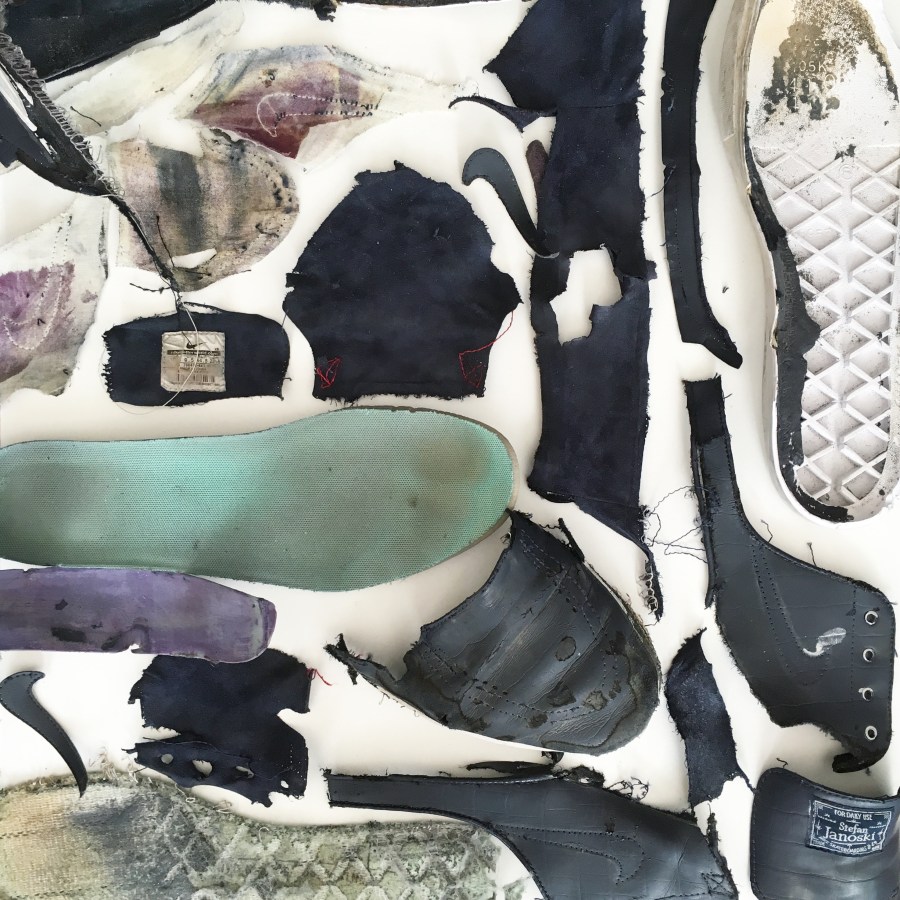
Featured Art: Janoski (Deconstructed), by John Schriner
Welcome to the museum of secondhand savings. The journey starts like this: when something is donated to The Thrift Store, the attendants at the store decide whether to sell it there or send it to my department to sell online. In each of the 13 stores in our district, there is a list of items that are always to be sent to us. We get all the jewelry, every musical instrument, any expensive-looking art, all video games, computers, clothes with tags over $75. All brand-name purses, every vinyl record, typewriters from certain years and countries. American Girl Dolls, vintage Barbies, Pokémon and Yu-Gi-Oh! and baseball cards. Stamp collections. Fur coats. LEGOs. Cameras, digital and film. It goes on.
We are walking along the dunes at Corn Hill Beach with my grandfather, Baba. The sun is broiling our backs, and there aren’t any clouds. We smell like suntan lotion and laundered clothes. Baba breathes heavily as he walks. He wears clean sneakers with white socks pulled halfway up his calves. I have a new pair of flip-flops in one hand, my toes seeping into the sand. My brother runs ahead, an inflatable red lobster tucked under his arm.
We were supposed to leave the Cape a week ago to go back home to our mother, but we are still here. At night, after we’ve been bathed and fed, my grandparents fight about what to do with us. The day camp with the dreadlocked artist has ended; neither of us did well with tennis.
Wyatt is eight, and I am ten. We sleep in bunk beds in my grandparents’ renovated wing. When I close my eyes, I hear large ice cubes fill my grandmother’s glass, the freezer open and close. We have a whole dresser of new clothes they’ve bought us, some colorful toys in a wicker basket. If they yell at each other loudly enough, Wyatt sniffles and cries. “Be quiet,” I try to tell him, but he doesn’t understand. On my back, I lie as still as I can be in the top bunk, pretending I’m frozen in glass. If my grandmother hears my brother cry and peeks into the room, she’ll think that I’m asleep.
“Over here,” Baba says, and we move toward the water. He’s packed a cooler with Goldfish and Milano cookies, juice boxes, and cans of Coke. His white hair sneaks out the back of his baseball cap. Wyatt throws his shirt off and runs into the water, thrashing wildly in the waves. Baba takes off his shoes and socks carefully. He looks far out into the ocean, his soft skin glistening in the sun. The waves crash onto the sand, and the wind twirls through my hair.
Last week, when I asked my grandmother why we weren’t going back home to our mother, she wouldn’t give me a straight answer. “Your mother is busy,” she said. She was staring at herself in the mirror of her bathroom, fluffing her hair. “She’s writing a paper for her Statistics class.” My grandmother sprayed perfume on her wrists and then rubbed them together. Her gold bracelets slid down her arm. “She needs more time.”
“Don’t you want to go in the water?” Baba says.
The truth is I am afraid of swimming, but I get up and walk slowly through the thick sand, sitting down at the water’s edge. Wyatt is pretending to be a shark, flapping his hands like fins and growling. We are two different islands; we almost can’t see each other.
I guess you’re wondering how I ended up with a woman like Syrena, in the first place. Truth is, it’s Mike’s fault. He’s the one to blame. Or to thank, I don’t know which. It was Mike Corliss who turned to me on this too-hot afternoon beginning of September. The four of us ought to go out sometime. Double Dutch, I mean. And I remember him smiling at me while my guts turned somersaults. He was a different man those days, full of piss and vinegar. He had a smart mouth on him, and he wasn’t afraid to use it either, which is why Laughton Starbuck kind of had it out for Mike.
“Where’s your protective eyewear, Corliss?”
“My protective eyewear?”
“That’s what I asked you.”
“My protective eyewear’s protecting the dashboard of Sheldon Cooper’s truck. That’s where I left it this morning.”
Sheldon, he used to call me, ’cause he knew it got on my nerves. To everybody else I was Shelley.
I was just a journeyman carpenter back then. I drove Lij’s truck to work and home every day, give my best friend Mike Corliss a ride. Half the time, he’d forget something on the dash: that blue bandana, that pack of smokes, that pair of goggles.
I guess I looked up to Mike, who was a couple years older than me and besides that had a way about him. He told a story better than anybody I know, though you never knew how much was true and how much he’d half-made up. He told me how a honeybee flies through the rain, missing every drop. He told me nobody’d ever saw a giant squid, but even so scientists know they exist ’cause sometimes, he said, a whale or a shark will wash up on the beach, a great big bite took out of it.




 New Ohio Review