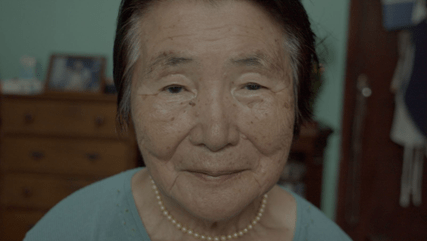
I shrink the size of the image. Now I feel that it reveals too much, even though that was precisely my intention when I photographed my grandmother. It is her daughter, who died when I was only 5 years old, who I wanted to find through this face. For a while I’ve started searching for my mother and decided to start with hers. I wanted to get as close as possible to this person who, to me, is distant and silent.
I’ve never known the name of the city where she was born, who her parents were, or how old she was when she emigrated to Brazil. I don’t know what it was like for her to raise six Brazilian children, all born in a Japanese colony where she lived and worked for 40 years. We’ve exchanged a few words, especially about her second daughter. I think about this silence and wonder whether it is the generations, the languages, the apprehension, or the loss that separates us.
“Fie on the witch!” cried a merry girl, As they rounded the point where Goody Cole Sat by her door with her wheel atwirl, A bent and blear-eyed poor old soul. —from “Wreck of Rivermouth” by John Greenleaf Whittier
By Matt Miller Featured Art: “Close Up – Spatial Neighborhoods” by Alex Brice
The world will work to twirl girls into witches, or they will twirl themselves into witches, or they will twirl and turn away from the witch they could be, would be if not for the world saying no, the world saying that their lives are their own fault. Goody Cole, the witch of Hampton, walks the marshes, haunts the dune grasses, watches the ships from the granite perch above the Atlantic shoreline of Little Boars’ Head. She is looking for her name.
“I can’t back,” my father said and so I thought this was a story about my father. In the old stories, every father is an ogre, an ogre of absence or an ogre of presence. Today he was present and being pulled out into the Atlantic, borne upon his own currents.
My fourteen-year-old daughter lounges atop the Queen-sized bed wearing pink nylon hiking shorts, woolen socks, and nothing else. Torso, out. Boobs, out. I’d been in the bathroom for three minutes and now, somehow, this. Arms folded behind her head, she smiles, a sly tilt in her expression that signals danger. My husband faces the wall of the cramped hotel room, his back to her, like she ordered him to stand in the corner. Whatever this is, he’s losing. Lately, we’re all losing.
Jake pivots to me. “Try to convince her that wearing a shirt in front of her father isn’t too much to ask.” As though he’s the only one being victimized here.
Emma studies her nails like a Cartel boss deciding our fate. “You don’t have a shirt on. You never have a shirt on. Why should I have to wear a shirt when it’s hot out? You have nipples, do you not?” Her father is, indeed, shirtless.
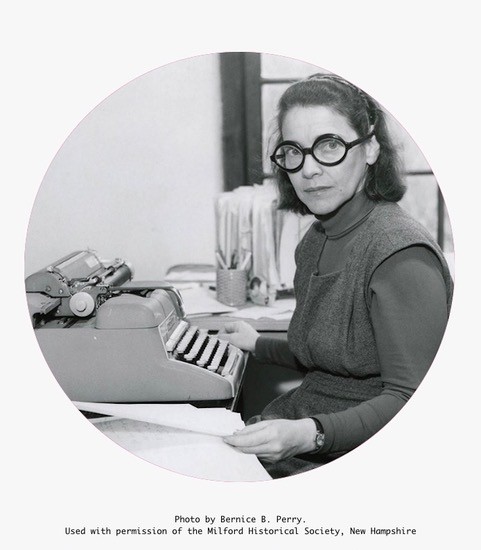
In Elizabeth Fisher’s 1970 story, “A Wall Around Her,” published in Aphra (Volume 4, Number 4), the main character pounds on the locked door of a house where she’s rented a room. As she waits for someone to respond, she is overcome by crushing loneliness and futility. “I never was in, never was and never will be, always outside, always trying to get in, beating with my fists, pleading, ‘Let me in. Let me in.’ Why don’t I just give up the struggle, stop trying to reach people, to be a human being.”
Elizabeth Fisher was a writer, editor, translator, publisher, teacher and feminist, but these days, she is best known—and unknown, it turns out—for sparking Ursula K. Le Guin’s 1986 essay, “The Carrier Bag Theory of Fiction,” republished after Le Guin’s death as a tiny book (Ignota, 2019). It’s safe to say that now, thousands of people have seen her name in print—Le Guin names her right there in her resurging essay, along with a partial title of Fisher’s book, Woman’s Creation (though the publication date is wrong)—in which she puts forth “The Carrier Bag Theory of Evolution.”Since Le Guin’s essay was reprinted, new writings about her essay have proliferated. Nearly all mention Fisher. But people don’t seem to know anything about her. There’s all this stuff out there about carrier bags and Ursula Le Guin, but what about Elizabeth Fisher? What about her life?
Featured Art: Stephen Reichert, Untitled, 2014. Snow in alley, Baltimore. “Cirlce” series.
It was a cold Thursday in April and frozen leaves slipped along the ground. Easter was over, the southern hemisphere was descending into winter, we were hunkering down for the darker, colder months. I was walking around the lake, like I did most days, wondering if I should visit my mother that afternoon. My father had been dead for six weeks and I had only seen her once since the funeral. The sun was cold but golden. Currawongs sang their pyramid of song, the soundtrack to every morning of my life.
The man was standing at the back of the toilet block. The ground was dirt around his feet. He was standing with his hands in his pockets, his eyes on the ground, but not on the dirt. He wasn’t contemplating the lack of grass. His eyes were on the body.
She was on her stomach, legs splayed, greyed hair splayed, fingers splayed. She was splayed. He was standing. He was staring. The sun had risen fully and offered light but no heat.
The graffitied brick of the toilet block had hidden the sound of my approaching footsteps. Frozen leaves were scattered at my feet and I didn’t move, afraid of their crunch.
He crouched near one splayed foot. He ran a finger along the inside arch. When he whistled, the currawongs paused for a moment, then restarted with gusto. He looked into the branches of the surrounding trees and whistled again. Again, they called back. The splayed woman didn’t move.
I inched my phone from my pocket and dialled triple-0 without looking. His finger was tracing the arch of her foot, his head was back, his whistle faltered.
‘I’ve already called the police,’ he said. He could have been speaking to the splayed woman. ‘They’re on their way.’ He stood, his hands sliding back into his pockets. The currawongs’ calls were growing louder, more ferocious, like they were distressed by the absence of his whistle. ‘She’s been here all night,’ he said.
Your mother haunts the hardest; that’s what Selah’s told whenever she starts to whine: why hasn’t she come yet to pick me up?
Her mother haunts the hardest, so Selah is at the care center the whole day long, so long that Ms. Drae takes pity on her and gives her second servings of afternoon snack. The other kids trail after their parents up to the parking lot and off to home and there’s Selah again, all alone in a playground full of nobody, or at least nobody that she can see isn’t it possible that she’s got her own ghosts? Oh, get out of your head and get onto those swings, Ms. Drae tells her; then her eyes sink back down to her phone.
Selah swings, she jumps, she slides. Lady-like, please, Ms. Drae calls when Selah’s robe slips up by her thighs, but Selah ignores her. Let the world see her underwear; if only there were someone to look. She takes a clump of dirt and rubs it onto her leg. Look! she says, running up to Ms. Drae, A bruise! But Ms. Drae only rolls her eyes and shoos her away rather than tell her (again) what of course she already knows: you can’t have bruises if you don’t have blood.
“Echo-Delta,” his wife shouted from the dining room. “Can you order Chinese?”
Ed sighed and checked his watch. He’d given up begging Tanya not to speak this way. Tango, as she’d taken to calling herself,spoke in the NATO phonetic alphabet now: a side-effect of her new life mission, to change the medical-insurance-industrial complex one military letter at a time. Ed waited the last seconds until his office clock read 5:00 before leaning his hands into his desktop, where a client’s financial records were arrayed, and pushing himself up.
He grabbed his cane and made his slow way to the kitchen, wincing at the jolt of pain in his left leg, pain that poked a shaming finger. Since the pandemic, his accounting firm had allowed him to work from home, which was convenient given how the accident had left him.
1.) You Sound Drunk, You Probably Shouldn’t Leave the House Today
We never speak of the reasons for her drinking, though her husband was in the navy overseas, a high-ranking officer, leaving her alone at home. When I was a child, whenever her husband was away, my neighbor would visit my mother, stumbling into our house, reeking of whiskey and crying about her husband, not wanting to be alone at night. She was the type of woman other women called a doll. Pretty, slender, elfin-faced with no children, she was youthful and kind with an aura of fragile, feminine innocence nurtured like a pet in a well-swept house with caramel aluminum siding and wooden shutters painted sunny-sky blue. A divorced woman also abandoned by a man, my mother felt sorry for our neighbor and asked me to stay over with her to keep her company, since my mother had to watch my baby sisters and had work in the early morning as a secretary at the meat-packing plant. I packed my tattered overnight bag and skipped over to the neighbor’s neatly decorated house, where I slept in crisply laundered paisley bedsheets in her husband’s place as she attempted to fall into a drunken sleep, shivering, curled against my back, spooning me. Sensing her dreaming, I woke in the dark with her hands on me. I was thirteen when it started, fifteen when it ended with her fingers creeping inside me. I pretended to sleep. At sunrise, she cooked me a breakfast of burnt buttered toast dusted in cinnamon sugar while warning me about men. She watched me eat as she sucked her fingers while sipping bourbon-spiked tea.
I see him when I look in the mirror, my father, the coach of my 5 a.m. 800-meter runs, who sacrificed to finance my education and once presented a twenty-five-slide PowerPoint on how to live my college life in the U.S. He carried a black-and-white photo of our family in his wallet. People say we look the same.
He was the first in his village to go to college after China’s Culture Revolution. He brought honor to and redeemed his once politically shamed family. By his mid-thirties, he already made tenure and was named vice president, the youngest in his university’s history. I remember him waking up in the middle of the night, drenched in sweat, punching the air and yelling, “You can’t get me!” My mother once gave me a peek into his childhood: being hung up-side-down to the ceiling with a rope tied to his ankles while my grandfather beat him until he had broken all three broom sticks. Wrinkles cover my father’s face now, his temples all gray, sharp shoulder bones gathering under his shirt. At my wedding, he hugged me long and tight, with tears of joy and pride, though I had walked down the aisle by myself and never asked him for the honor. I freeze-frame this minute. It was the moment I want to see him in and remember.
Selected as winner of the 2023 New Ohio Review Nonfiction Contest by Barrie Jean Borich
My housemate sleeps all day, makes art all night, and paints giant bees. “I want people to feel my paintings,” she says, stroking the palm of her hand against a still dripping head-to-toe canvas.
I keep my hands in pockets. We’ve only been at the art residency for a week, and she has already transformed her garage studio into a whimsical world of texture and wonder and touch. My art is trapped inside me. Weighs down my womb with rocks.
Selected as winner of the 2022 Editors’ Prize in Fiction by Patrick O’Keeffe
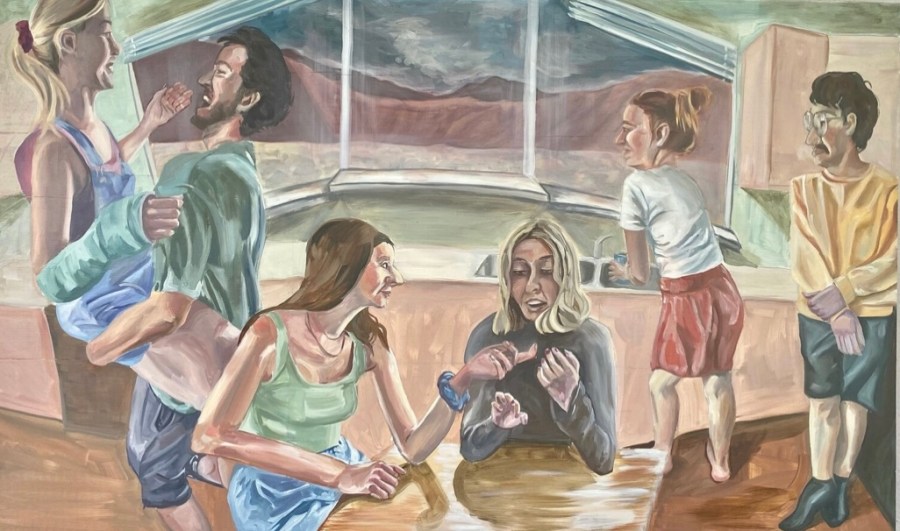
Featured Art: When Lunches Synch Up by Mallory Stowe
In a shingled house at the edge of the Berkeley Hills—near campus with its bulletin boards covered in smeary flyers for an upcoming Angela Davis lecture and another of a white woman toting a machine gun, and close enough to the Greek Amphitheater that the roar of a concert reverberated through the thin windows—Jane Gardener sat with six other women at a kitchen table. This was a dinner party. She’d forced herself to go with the intention of socializing. Yet she couldn’t stop thinking about how, though Lori said these dinners were about learning from other women in the restaurant industry, her presence felt like a charity. The stench of feet persisted despite the hand-dipped incense wafting in the corner. How could Lori purport to care about food, yet burn out her nose with cheap nag champa?
All of them were restaurateurs, except for Eartha, the German woman Jane employed as sous-chef at Dîner, whom she had invited to help her survive the affair.
“Isn’t spending time with friends supposed to be enjoyable?” Eartha had asked.
They weren’t her friends, though. Not really. Once, there had been more women in this coterie, some she’d actually liked. But, one by one, they had married and turned their attention to their home lives.
The first package contained a light blue pair of Nike Huaraches, size 8. I took this as a sign that I should keep stealing packages: my son laced them up, and they fit perfect. He started jumping around, walking on air. We both laughed until our sides hurt, and then I cooked a box of macaroni for dinner, made with water and oil instead of milk and butter, But who cares, my son said, lifting up his feet to admire his shoes.
I only took packages from the porches of nice houses, but not nice houses with fancy doorbells. Some of the doorbells had cameras and attached to smartphones. I could see the older style cameras, so I avoided those packages as well. Everything had to line up perfectly for me to steal a package.
I drove a Ford transit van delivering flowers for a flower shop, which is how I came to realize that there were neighborhoods in my town that I never even knew about, full of nice houses with packages on porches. Some of these neighborhoods were gated, to keep people out unless they belonged.
I also delivered flowers to neighborhoods like my own with old houses falling into disrepair or bought up and cheaply brought to code by slum lords. There were widening gaps between the houses where condemned houses had been demolished by the city. Every once in a while, Habitat for Humanity would slap a cute little bungalow in one of the empty lots. But I never took a package from neighborhoods like my own. It didn’t seem right.
In the mornings, I clocked in to work and looked at the flower arrangements that were going out for delivery that morning. They stood in the cooler in the flower shop, and I read each tag before deciding on my route. Then I loaded the vases into the back of the van and drove off. Sometimes I had to gas up the van or air the tires or stop at the grocery store to pick up fruit for a fruit basket. Then after my deliveries, I helped process the flowers in the shop, while the designers put together bouquets for the next day. That was it, the entire job. Sneaking the packages from the van to my car was easy. I never took anything larger than a shoebox, and I slipped it into the backpack I kept on the passenger seat.
The dryer was making a monstrous sound. The repairman stood with his hand resting flat on top.
“I feel the vibration,” he said. He was a fat man with a three-day stubble sprouting in uneven patches on his face. His uniform shirt was belted into his trousers around the front and haphazardly untucked in the back. Hazel could see his milky eyes shifting rapidly through smudged glasses. She hated him a little.
Hazel nodded. “And you can hear it, too.”
He squinted his eyes, then squeezed them tight, concentrating.
Hazel decided that she hated him a lot.
“The grinding sound,” Hazel said, straining to make her voice heard above the din. “It’s quite obvious, really.”
“Ah, yes. The grinding. I hear it.”
Hazel’s cell phone chimed then, and she looked at the screen. The name Walt appeared in white letters, glowing.
By the time Nicole arrives at the clinic, the parking lot is already full of folks waiting to drop off their pets before hightailing it out of town, out of the path of the hurricane. All morning she’s been battling that crampy twinge in her hand—dystonia, Dr. Epstein calls this, involuntary muscle contractions—and she hoped that she would be able to spend most of today hiding in her office. A foolish hope, considering that all of the pet-friendly hotels within a 100-mile radius have already sold out. Unlocking the front doors, she marshals a smile as the sleepy-eyed clients slump into the lobby with their cat carriers and their leashed dogs.
Inside, she leaves the receptionist to check everyone in while she goes around the building flicking on lights. In the kennel at the back of the building, she feeds and waters the dozen or so animals already boarding and begins taking the dogs outside one by one. Technically, this is a job for the assistants, but as owner Nicole takes a sheepish sort of pleasure in micromanaging. A canopy of clouds hangs low in the sky, the wind already churning ominously. By tomorrow afternoon, the rains will be here, thick and driving. Initial projections had the hurricane cutting west, into the Gulf of Mexico. Perhaps Nicole shouldn’t have been surprised when the projections abruptly shifted, the storm now expected to hook northeast, right through the Carolinas. That’s her life in a nutshell, isn’t it? A sudden change in trajectory, something to brace for. You’re just feeling sorry for yourself, her mother might scold, caustic old bird that she was, and she would be right. But her mother is long gone, and so who cares if Nicole is feeling a little morose this morning? It’s her clinic, she can feel whatever she wants.
She waits until all the other dogs have been walked before taking out the rottweiler that Animal Control dropped off yesterday. It was found near the airport, a scrawny female with patchy fur and a missing chunk of ear. Upon being hustled into the van, the animal bit one of the officers on the hand. “Fucker cost me three stitches,” the fellow said when he dropped the dog off, holding up his bandaged hand for Nicole to see.
By Susan Finch Winner, Editors’ Prize in Prose: selected by Mandy Berman
Featured Art: Woman in Silver V-neck Long-sleeved Dress by Inga Seliverstova
As bachelorettes, we solemnly promise the next forty-eight hours will include three brunches, two happy hours, fifteen moderate disagreements, one unforgettable fight, eight matching T-shirts, one bar crawl, one pedal tavern, one sprained wrist, three twisted ankles, sixteen hangovers, too many tearful promises to count, and one sober regret. We are the bachelorettes and we insist.
We must begin with brunch, and in order to fit three brunches into forty-eight hours, we will congregate Friday morning. After all, brunch is the most important meal of the day. We can eat French toast and French fries, and getting tipsy or emotional (i.e., Lydia has too many feelings after bottomless mimosas) will not be frowned upon. Not every restaurant serves brunch on Friday, so we must select carefully, find a place that has an all-day breakfast menu, and really, why shouldn’t a restaurant serve breakfast food all day. It’s not so hard to whip up a couple of poached eggs, is it? We will reserve the table for 10:30; the proper time to eat brunch is 11, but we already know that some of our bachelorettes will be late—particularly Tara, the bride’s sister. She’s a musician and runs on her own schedule, and of course, Felicia. She hasn’t been able to get anywhere on time since the new baby.
Event attire is outlined in the invitation—brunches are for sundresses or rompers paired with cute cowboy boots or wedge sandals. We do not do flats—flats are for business casual events or maybe if you’re trying to let someone down easy. Matching T-shirts will be provided for the pedal tavern that begins promptly at four. The shirts may be knotted at your hip or tucked in with a cute belt, but please do not leave your shirt untucked. Evening wear will have two themes: Friday red and Saturday sparkle, and the bride, of course, will wear white. No one else should plan to wear white or anything white adjacent —no cream, no ivory, no pearl, no silver, no soft grays, no misty light blues or sugary beige. Don’t pack it. Don’t even think about it. We don’t want anyone to steal the bride’s thunder. After all, we are the bachelorettes, and it is our job to insist.
By Terri Leker Winner of the 2019 New Ohio Review Fiction Contest, selected by Claire Vaye Watkins
The coyotes moved into the woods behind my house just after I learned I was pregnant. On a quiet June morning, while my husband slept, I pulled on my running shoes and grabbed a leash from a hook at the back door. Jute danced around my feet on her pipe-cleaner legs, whining with impatience. It would have taken more than this to wake Matt, but I hushed her complaints with a raised finger and we slipped outside. A light breeze blew the native grasses into brown and golden waves as we wandered, camouflaging Jute’s compact frame. She sniffed the dirt, ears telescoping as though she were asking a question. When we reached a shady thicket of red madrones and live oaks, I unclipped the leash and wound it around my wrist.
It was over with Richard, had been since I’d found out about the baby. Anyway, I had come to believe that adultery sounded more illicit than it actually was. Between managing my schedule with Matt and making time to rendezvous with Richard, an affair often seemed more about time management than sexual gratification. I was meticulous with the calendar, but I would have known that the baby was Matt’s regardless, because Richard’s sperm could not locomote. He had told me so early on, while showing me the master bedroom of his faithfully restored North Oakland Victorian. His unexpected disclosure had interrupted my admiration of the exposed brick walls, so unusual for the earthquake-conscious Bay Area. Matt was having dinner just then with friends, thinking I was helping my mother set up her new television (she would be dead within a few months, but we all pretended to be optimists then), so he was eating eggplant parmesan at the Saturn Café as I lay with Richard on his king-sized bed, hearing words like motility and capacitation. Richard’s sober tone had suggested that I might comfort him in his sterility, which I did, if the definition of comfort was a passionate encounter that lasted as long as one might spend unboxing a 48-inch HDTV and connecting it to both Netflix and Hulu. But Matt and I had tried to have a baby for three years, so I took the pregnancy as a sign to recommit myself to my husband, who, predictably, jumped up and down on our unmade bed when I shared the news, attempting, in his white-socked excitement, to pull me up with him, not realizing that doing so might judder the bundle of cells loose, delivering me back to Richard and a childless but aesthetically pleasing life.
Featured Art: Fisherman’s Cottage by Harald Sohlberg, 1906
We see him first at the reservoir, a middle-aged man with an oval of fur on his chest, nipples like button eyes, and blue swim trunks with yellow Hawaiian flowers. We are swimming, and he regards us from the shore in that way we are learning to expect from a certain kind of man.
Like every day in Tennessee, it is hot, and in the early afternoon, we walk from the stone campus of this small college to the lake. We are at a summer music camp, our fingertips sore from strings, our backs sticky with sweat, and when we reach the lake we shed our summer dresses and leap from a boulder into the water, which is deep and clean. Around the lake, tall pines and the heavy hum of Southern bug life. We float on our backs, conscious of how our breasts protrude from the water, pleased that we are sixteen, except for Caisa who is seventeen and over-proud of it. For her birthday, she buzzed her head. Her cheekbones are sharp and high, and even if she were not older, she would be our leader because she walks with confidence and draws checkers on the white rubber of her Converse in ballpoint pen, cheap ink that shimmers like oilslick. We wish we could go home and buzz our heads, draw on our shoes, but our faces are round, we like our sneakers white, we like our mothers happy.
The man doesn’t jump into the water. He walks down the wooden stairs to the dock, sits, then eases himself into the water as if it pains him. Though we don’t say anything, we cease floating on our backs, tucking ourselves under the surface, our heads and shoulders bobbing in a circle.
Featured image: Edvard Munch. The Girl by the Window, 1893. The Art Institute of Chicago.
It’s Vegas and I’m sixteen years old. I’ve been playing in the arcade for hours; I’m leaning on the console of Mortal Combat, pushing the quarters my stepdad has given me into the slot one after another, wearing the tips of my thumbs down with their ridged edges. I’m bored as hell and my parents have abandoned me in this wasteland, I can practically see the tumbleweeds and hear western music as I walk across the patterned carpet. I pass all the men and women with their heads almost touching the bright lights of the slot machines, their hands like lobster claws around the levers, as if they’re waiting for the secrets of life to come pouring out when they hit the right combination. The secrets must be what they see on billboards, what they see in magazines. The arcade smells like the sweat of children and sounds like broken glass.
Starting at the Excalibur, a gaudy Disney imitation that should have been torn down years ago, I walk from casino to casino, reveling in the transition from air-conditioning to the surreal heat that cloaks everyone who ventures outside in a thin layer of plastic wrap. I stare back at the men who gawk at me on the sidewalk as I walk past them, men who are over twice my age and probably have daughters half my age. They must give their daughters baths and put them in their pajamas at night, patting their heads as they tuck them into bed. I can’t remember one time my father actually tucked me into bed. He left when I was two.
Feature image: Henri de Toulouse-Lautrec. The Passenger in Cabin 54—The Cruise, 1896. The Art Institute of Chicago.
It’s called the “verbal tip.”
You’re the greatest waitress we’ve ever had. We’re going to ask for you every time we come here. We had such a good time because you were our waitress. Yada yada.
Then they leave, like, three dollars on a thirty-dollar ticket.
Like I was going to call up the electric company and tell them they were the greatest electric company I’d ever had.
When I got divorced, my ex-husband was supposed to give me the Jeep. That’s what we agreed. My plan was to sell it if I couldn’t find a job right away in Phoenix. Instead, he wanted me to have the Acura. He was being generous, because it was a better car, practically new. Except that he never signed the title over to me. So I couldn’t sell it, and I couldn’t drive it, because I couldn’t afford insurance or gas. I was living in a godforsaken studio and buying food for one day at a time, stealing toilet paper from the bathrooms at the mall, with a twenty-three-thousand-dollar car parked under my window.








 New Ohio Review