Announcing the Winter Online Exclusive

The latest winter online exclusive from New Ohio Review is now available! Scroll down to read.

The issue includes art by Leo Arkus, Jordyn Roderick, and Zelda-Thayer Hansen; poems from Baylina Pu, John A. Nieves, Matthew T. Birdsall, Elisabeth Murawski, James Lineberger, Johnny Cate, John Wojtowicz, Shelly Cato, Joanne Dominique Dwyer, Erin Redfern, Dustin Faulstick, Madalyn Hochendoner, Michael Derrick Hudson, and Annie Schumacher; fiction from Mary Cross, Ellen Skirvin, Matt Cantor, Noah Pohl, and Teresa Burns Gunther; essays from Jill Schepmann and Lesa Hastings; reviews of work by Anna Farro Henderson, Ron Mohring, Betsy Brown, and Matthew Cooperman by Jenna Brown, Kate Fox, Tessa Carman, and Sarah Haman; and interviews of Jodie Noel Vinson, Joanne Dominique Dwyer, Allegra Solomon, Johnny Cate, Dustin H. Faulstick, Arya Samuelson, and Noah Pohl conducted by Clare Hickey (Vinson, Solomon, and Samuelson), Rachel Townsend, Cam Kurtz, Parker Webb, and Shelbie Music.

We hope you enjoy.

Thanks for reading,

-The Editors

(a)rs poet(i)ca 

By Baylina Pu

Featured Art: “Stolen Beautyby Leo Arkus

I have been looking at images 
of AI-generated art all day. Something about 

the control in the brushwork 
mimics the delirium of a real artist, 

though what “real” means anymore 
I can’t exactly say. Lately I’ve been 

eating rice crackers at midnight 
while solving logic problems for fun, 

a bad habit.  There is something 
such that, if it is wet, then 

everything is wet.  I tell the robot 
to paint “Dream of the Red Chamber,” 

and it gives me a roomful of blood. 
How many photos did it dissect before 

it could make that? I mean paintings 
garbled into code, the way a prism 

reassembles light? I ask the machine 
to show me the fifth dimension: what I receive 

is a door. Its surrounding walls are made 
of something like stained glass, which spreads 

lattice-like across the floor and ceiling, 
like the brain of something more beautiful 

than a living thing. The colors shine metallic, 
though if you look closely the shapes 

appear distorted, confused. What is the robot saying, 
I wonder. Everything it knows, it learned from us. 


Read More

Aural Projection

By John A. Nieves

I used to believe in the tang of orange
Tic-Tacs—that it had anything to do
with oranges. That three bright sugar

pills in my child-hand could shine
up a dark morning. And they did. What
little magic. What’s so easy to miss

so much. I believed rainbows on
window dew hid tiny treasures, that sneezing
while saying someone’s name meant

they were thinking of me, that everything
I loved would stay forever if I took
care of it, if I did my part. I have almost

none of that now: the purple stuffed
rabbit, my two pet Siamese cats, my best
friend across the way, my whole

family. I used to believe music could
change the weather. I’m lying. I still
do. I still believe people attach themselves

to songs they love, creep into their choruses.
This may be literally true in the science
of memory. This may also make me

superstitious. But, O, when I sing
you, I can almost reach. There is no way
there is nothing there.


Read More

SHASTA GIRL 

By Noah Pohl

Featured Art: “Bumblebee” by Leo Arkus

(March 27) 

Today, I came to work eleven minutes late. My co-worker Lenny said he didn’t know if he could cover for me, even though he thought I was “cool” and “down to Earth” and “pretty for twenty-four,” whatever the fuck that means.  

Lenny is sweaty. He sweats near the hot dogs sometimes, and that’s not cool. I try to avoid Lenny when he’s in one of his moods. He cries loudly in the Target bathroom because of his impending divorce, but he’s also extremely hairy and his eyebrows are out of control. Since his wife left him, he kind of resembles a giant, lumbering piece of sage. I know because I smudged my apartment last night to keep the bad spirits away. 

I also made sure my Target Pizza Hut uniform was clean ’cause I dumped Alfredo sauce on myself yesterday like a total dope. It smelled like hot garbage. Then I got quarters from one of the girls at the registers so I could do my laundry. No more free laundry.  

I mean, I feel like that’s a metaphor for something, I just don’t know what. 

Read More

 Trying Not to Lump Together More Unknowns

By Matthew T. Birdsall

       “We know what we are, but know not what we may be”
                        -Ophelia, Hamlet, Act IV, Scene 5

Uncertainty looms heavy before sunrise.
Dark driving, she calls it, at 5:00 AM
to the hospital for her surgery,
when she mentions losing our dog,
Penny, a few months ago—
anxiously lumping together unknowns—
and I had trouble focusing
but I tried to turn the conversation around
with compliments—her outfit, hair, shoes—
but I shut down when she said,
It’s okay, Dad, I know that living is dying

Stuck in the white shock of her wisdom
I wanted to say something to redirect us
but I couldn’t decide whether
she was that conscious of her own mortality
or if she was just being a child—
redirecting gravity away from her upcoming operation
toward something more certain.

At the last minute, the operation was canceled.
As we walked out, my daughter took my hand
because she knew I needed it telling me she felt good.
She said she still missed Penny,
and she would miss her as long as she was alive
me too I said but holding back on diving deeper
trying not to lump together more unknowns,
as we headed home with just enough sun
to get all the way there without headlights.


Read More

Mrs. Love  

By Elisabeth Murawski

Featured Art: “Mr. Love” by Leo Arkus

An adult neither liked 
nor disliked, 

she taught music 
appreciation, 

played 78s of Verdi  
and Bizet. 

Teens in letter 
sweaters, we were 

the children 
she didn’t care 

to know. A thin 
gold band on a red- 

nailed finger 
declared she’d snagged 

a Mr. Love 
so long ago we  

weren’t even born. 
She seemed resigned 

as our parents were 
to not going  

anywhere, tapping  
her black shoe 

like a metronome 
while reckless Carmen 

goaded Don Jose, 
Radames and Aida  

smothered 
in the tomb scene. 


Read More

today which is hotdog day 

By James Lineberger

today which is hotdog day
at forest hill methodist i ran into
my old high school lit teacher
from the tenth grade
one of the great influences in my life and it really got to me
while i was waiting in line
to put in my order
and i thought about all the other
teachers i used to have who lived and died maybe never
realizing how much they
had meant to their students and here was
a perfect opportunity
to express my gratitude and not to just any teacher
but miss ruby herself but then huh oh
all of a sudden i thought ohmygod what if
my eyes were playing tricks on me
and it was just some little old lady
that somewhat resembled her so just to make sure
i went over to another former student
wanda she used to be wanda yow
i forget who it was she married but wanda
was one of the volunteers
who was bringing food to people’s tables and i said
wanda is that her is it really her
and wanda said oh yeah that’s ruby all right don’t she
look wonderful but she’s
deaf in one ear i think the good one
is her left but you better hurry
if you want to speak to her she’s already
called her grandson
to come pick her up so i left
my order with wanda and circled around
behind ruby’s table
hoping i could surprise her and leaned down
from the left side
with my face just barely touching her hair
which smelled my god like violets
a really refreshing smell
and there was something else some kind
of perfume from elsewhere and
i don’t know how it happened but i was already starting
to weep it was such a profound
moment for me
and my feelings damn near overtook me
but i managed to get it out even
though my voice was shaking when i said miss ruby
until i had you for a teacher
i didn’t know
what great literature was and i—
but then
i just ran out of words and out of breath
and as i started
to pull away
she reached her hand back and slapped
me right in the face
turning around
with a stare like she had seen a ghost
saying oh goodness jimmy is that you i thought it was
a brown recluse


Read More

Flying into Darkness 

By Mary Cross

Featured Art by Jordyn Roderick

Sometimes in the middle of the summer when it was so hot that the tar on the road stuck, like Juicy Fruit gum, to the bottom of my tennis shoes, I’d see a mirage in front of me and think of my grandmother—imagine her a painting. She loved the heat in the summer, and she told me that she even chewed a hunk of tar when she was a little girl. I’d imagine her head was a wide stripe of white across a green-colored canvas, and her hips were shimmering shades of red and caramel; but the craziest of all were her lips—they were yellow buttons, the same kind on my spring coat. At night in our room we shared, I’d think of this painting when I’d watch her remove her Junior Petite coffee-colored stockings, rub her shins with the clinical expertise of a practiced masseuse at the Y, then rest her feet in a bucket of Epsom salts, while I studied the gap between my front teeth with her compact mirror. She’d repeat the story about her sixteen-year-old daughter who died; “Molly, there is nothing worse than losing a child.” She kept a lock of her daughter’s hair in the second drawer of her dresser, along with fortunes from Ray’s Chinese takeout. On the night table, her top teeth sat in a jelly jar painted with the outline of Fred Flintstone. Without her dentures, she sounded as if her tongue were swollen. 

Read More

The Skater

                                                                                                                                    —for Bam Margera
By Johnny Cate

Modus operandi: grace cut with chaos, every
drop-in a death sentence he’d somehow
skirt and skate off to nollie another day. 

If we got our hands on a burned Bam DVD
we’d play it until the player was hot to touch,
until every trick was etched into the mind’s 

fish-eye and we were sketched up
with strawberries trying to land one like him.
The kids who by high school couldn’t hit  

a heater pitch for shit or cared to run suicides
found a home in the sheet metal half-pipe,
a new American pastime and a hero in  

an unhinged prodigy. Jackass came later—
what mattered first was the skating, each
varial and crooked grind a live creative act 

that left like a vandal Michelangelo, bank
rails marked with paint, curbs darkened
with candle wax. But the rebellious aesthetic 

was just that—aesthetic. A sly disguise for the
same glory, the guttering flame of a single
God-breathed second. Under Bam’s feet,  

the deck spun like a plywood electron,
elemental and holy: 360 degrees of don’t-care
that would carry him to self-destructive stardom. 

Now, hardly a day goes by that TMZ wouldn’t like
to eat him alive, so I’m pulling up the tape,
posted by a stranger, just to see what I saw  

years ago on those long-gone discs: a man
risking blood and bone with total nonchalance,
his soul sliding recklessly, breathlessly diagonal. 


Read More

Down Jersey

By John Wojtowicz

Featured Art: “Pebbles vs. the world” by Leo Arkus

As a kid, I spent Saturday nights  
underneath this boardwalk, poking a dollar bill  
between cracks, pulling it back  
after luring unsuspecting tourists. 
Now I’m back around, fixing up a friend’s beach bungalow: 
paint-peeling and porch-rotting    
on the bay side of town.  
I’ve only walked the boards a few times 
mostly forgoing views of the ocean 
for beer-drenched nights at the Shamrock. 
Tonight, a thunderstorm rolls in  
and the preacher at the boardwalk chapel 
offers shelter to all but those  
with a still lit cigarette. 
Zombie Crusher and Terrordactyl  
don’t let lightening stop them  
from barreling over jumps made of beach sand 
but the amusement rides have ceased to amuse. 
The tram car watches me. 
I like riding the Sea Serpent with its upside-down  
and backwards thrills; 
how for that 1 minute & 48 seconds 
it’s hard to think about anything  
other than staying alive.  
I like the monster trucks too.  
The way they flatten.  
I put out my Marlboro and take shelter  
in the wood-paneled chapel  
next to a handlebar-mustached-man  
sporting a throwback Hulk Hogan  
t-shirt: Hulkamania is running wild, Brother. 
I think about how Dolly Parton  
made a spoof music video  
in which she married Hulk Hogan 
after reading in a tabloid  
that she was having an affair with a professional wrestler.
He’s got a headlock on my heart, 
it was a take down from the start.” 
For Dolly, it’s all fertilizer; she’s a western- 
wigged buddha two-stepping through life.  
For me, it’s been more of a hot-coal-  
hop-skip. The rain slows, thunder booms. 
I have no special someone for whom  
to buy a pair of custom booty shorts.  
I grab a beer before the concessions close,  
toss rings on bottles, land quarters  
on plates. The unbridled ocean  
gives me chills. I think about how sailors  
wore earrings worth enough  
to cover the cost of their return and burial,  
salt-slicked mariners 
with no need for gold hoops.  
I bend down to pick up a dollar that disappears
before my fingers can grasp it. 
I think I want to be buried at sea too;  
being decomposed by sea lice  
seems more exotic than earthworms. 


Read More

Like Communion

By Ellen Skirvin 

My dad warned us that aliens were watching him before he disappeared. He also had checked himself into a psychiatric hospital five times throughout my sixteen-year lifetime. During his last visit to the hospital, the doctors said he vanished in the night. His clothes were left in his dresser. The framed photo of my sister and me left on his bedside table. None of the night nurses saw him leave. There were no tied up sheets found dangling outside his open window. The doctors reminded our family that my dad had admitted himself voluntarily and was free to leave at any time. There was nothing they could do. My mom didn’t seem worried at first. He’d left and come back before. One time he left for almost a week and returned with a pet frog that died the next day. Another time he traveled halfway across the country to tour a NASA museum. He needed space; he’d tell us later. Most of the time he checked himself into the hospital for a long weekend, casually packing his car as if he were leaving for a fishing trip.  

Read More

IN THE DAYS OF CHILDHOOD AND VIOLENCE —

By Shelly Cato

Featured Art: Notes and sketches from “Life as distraction as practice as discovery” by Zelda Thayer-Hansen

⠀⠀⠀⠀⠀⠀⠀⠀⠀⠀⠀⠀One Morning Before School

A tricorn hook pierced a night
       crawler before
       entering a boy’s
       thumbnail—
       the bone

At the same moment
      a grain of grit shifted
      into his mother’s left eye
      which remained to stick—
      twitch

On her cutting board
       apple peelings wilted—
       and the hound
       outside jowled
       ham fat 

Behind a shed
       seldom used for skinning
       the boy waited  
       for his school bus—
       nursed blood

from his thumb—believed
       in the way his mother
       arranged his lunchbox—
       believed he would live
       to open his lunchbox

that day


Read More

Tilting

By Matt Cantor

It’s been a full year, now.  

It’s October 7th. 

I stand at the platform at Kenmore, waiting for a D-train so I can get home to have dinner with my parents. I’m not waiting very hard. They’re going to ask all sorts of questions about what I’ve been working on.  

Don Quixote,”  I’ll tell them.  

“Hasn’t somebody already written that?”  they’ll ask me.  

“Lots of people have already written lots of things.”—like it means anything, or makes any sort of difference in the direction that I want it to.  

Read More

Featured Art

Detail of “I Carry Our Weight: Artifact” by Zelda Thayer-Hansen, photo by Bee Huelsman

Hymenoptera

By Joanne Dominique Dwyer

This is not a poem about insects of the family Hymenoptera.
It’s not a poem about pounding nails.
It’s not a poem about flashlight tag.
It’s not a poem about famous writers addicted to laudanum.
This is not a poem about the burial of a baby raccoon.
This is not a poem about the core of the sun becoming unstable
   and everything going black and cold.
This is not a poem about the definition of Hymenoptera.
Hymenoptera: derived from the ancient Greek words
hymen and pteron—membrane and wing.
This is not a poem begun in silence.
Before dawn the wolf dogs howling inside the pen.
And a 5:30 am text from a man who says another man
entered his bedroom while he slept—
   and a threat of beating the intruder to death.
This is not a poem about cannonball splashing.
This is not a poem about the softening and weakening of bones in children.
It’s not a poem about parachutes
It’s is not a poem about being born in a field of horses.
This is not a poem about oxygen.
It is a poem about the migration
   of ruby-throated birds and the effects
of artillery on tongues.


Read More

Acquainted with the Night  

By Erin Redfern

Featured art by Jordyn Roderick

At the all-girls school they taught us  
don’t fight back: the rapist might get mad.  

Against my will, I remember this  

when I need to take a walk to clear my head.  
When I fear the sound of feet, a distance  

closing. When I drop my eyes in passing,  

my neck for decades bending. On the train  
a man asks me what I’m reading. Show me  

the Great American Writer; I’ll show you  

a man who finds by walking out alone 
what freedom is,  

and, so, America, I want to be  

the kind of woman who walks into night,  
a fine rain, her own thoughts.  

If at dusk I hear a clutch of cries 

and rush of wings from powerlines.  
If I love a spread of stars, dark wind in trees. 

If walking is a bodied way of thinking. 

If I love a subway map, a screech of trains. 
If walking out and back intact is luck. 

If I have been a long time without thinking. 

If I wanted to go there by myself

thinking. If I just wanted to go somewhere.  


Quoted phrases and lines are from Robert Frost, “Acquainted With the Night”; Judy Grahn, “A Woman Is Talking to Death”; Kim Moore, “On the train a man asks me what I’m reading”; June Jordan, “Power”; Lisa Shen, “Sixteen Seconds”  


Read More

Flights

By Jill Schepmann

Featured Art: “Spring Returns and So Do I” by Leo Arkus

I walk out of class, my mis-spoken and fragmented explanations of the day racing. A greatest hits of my unworthiness as a teacher. I think of earlier in the day, walking around the lake with a friend. The building I’ve just left is called Lone Mountain, which stands on a hill, in a city of hills, dramatic, grand. And I trick myself again into believing that I belong here. Sometimes, Lone Mountain makes me witness the fog coming off the Pacific to swallow San Francisco’s avenues. Sometimes, the glass buildings downtown. Once, on a rainy, windy day, I looked out my classroom window to see two giant cypress trees grown as one split and fall away from each other, their branches pointed skyward until they came to rest in sudden-found angles, fossilized insects on their backs. 

As I descend the mountain, I think of going home to my new girlfriend in Oakland. Oakland is also new to me. Susannah is making pasta for us. This caretaking, too, is new. I walk a little quicker thinking of the way she comes to unlock the door when I’m too long finding my keys. Her warm lips. Cupping her elbow in my palm. Her cheek resting against mine. I quicken. I quicken. 

Read More

The Registry

By Dustin Faulstick

They had been together ten years when they decided to get on the registry. They had been to a wedding over Labor Day weekend and realized that all of their stuff was shit. They decided, as anyone would, that they might as well collect what they deserved. It started as an adventure. One of them wanted a knife holder. One of them wanted a blender. They had always both wanted a cast-iron skillet. It went on like this until one of them wanted a kitchen organizer. We don’t need a kitchen organizer; we’re not toddlers, one of them said. That one removed the kitchen organizer from the registry. The other one removed the down comforter from the registry: it was a tit-for-tat. It went on like this. Occasionally an item was added, but mostly items were removed: the electric drill; the waffle maker; the geometric-patterned area rug, one of those coffee cups that keeps itself warm. Once there was nothing in the registry, they started in on the stuff they already owned: a broken-down bicycle, a Don Quixote-themed fork-and-spoon wall decoration, a plastic Adirondack chair held together by duct tape. This, too, became a      tit-for-tat: an Ikea shelf from one of their sister’s college dormitories, license plates from the states where they used to live, their hospice plants on life support. It went on like this until there was nothing left. 


Read More

It’s Better This Way

By Madalyn Hochendoner

When a potato you’re frying
hops out of the pan
into the unknown space
between the wall
and the oven
you know it’s gone
forever.
And sure you could
get the broom
and do a blind sweep,
see if you could rustle-up
more than a disturbing
amount of hair,
but you won’t.
At least not today, but really
not ever
because you’ve already moved on.
The phone rings, it’s your dad
telling you you need
to pick up
the snowshoes
for your trip
and he’s making
white bean soup
with the ham hock
he’s been saving
in the freezer
for this moment
said he thought
he could throw it in
whole
but mum said no
no you need to cut it off the bone
and he sees now how right she is
sees now that it’s better this way
like the beans he soaked overnight
you still have to cook them he says
I say yes, I know, the soaking
only reduces the cooking time
but what I think he means is
separately, you still have to cook them
separately from the rest of the soup
which is another truth. Now,
it’s tomorrow and I’m thinking
I need to ask him how
the soup turned out.


Read More

Ground Control

By Lesa Hastings

Everyone has to start somewhere. I began as a child stalker, or rather an accomplice to my mom’s propensity for stalking.

We first saw the man we called “Tony 86” parked in the dirt lot rest stop adjacent to the motel my dad would go to after fighting with my mom. After he left us, it became the meeting point for my parents to exchange me and my brother for the occasional weekend. Mom called it a fleabag motel for lowlifes.

“Late as usual,” Mom said. Dad was late enough I wondered if he was actually coming. He was late a lot, but this time he was really late. I’d never stayed in a motel before and made up stories about the people we’d see coming and going while waiting for Dad. Minutes passed as I watched a couple argue on the second-floor balcony, then embrace in a farewell, the woman walking away with the man holding her hand as long as her arm would stretch, until she moved out of reach. Mom had stopped nagging about Dad being late, distracted by something.

Read More

Blood Moon Blues

By Johnny Cate

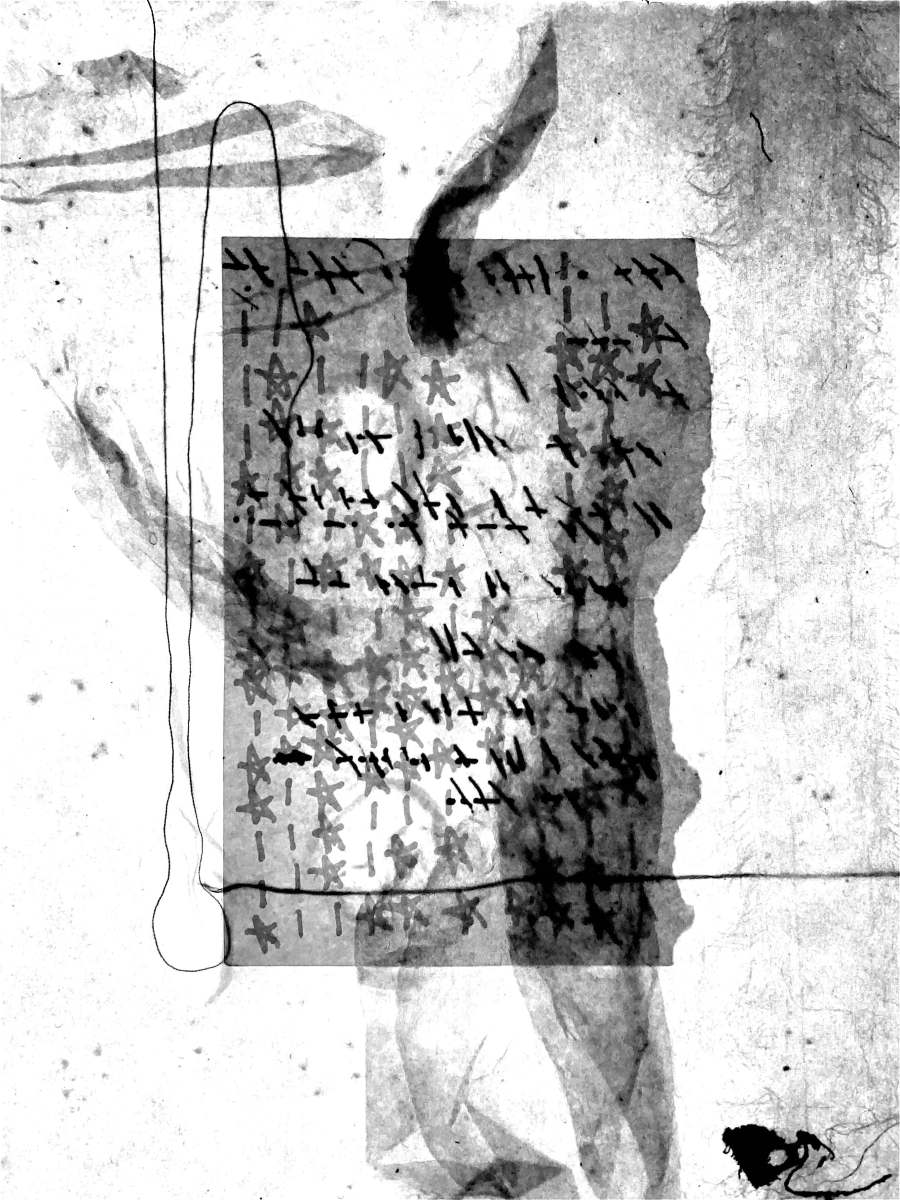
Featured Art: “Choreographic Translation,” black and white scan of choreographic
notation encapsulated in hand-made paper, by Zelda Thayer-Hansen

    Post-punk November puts on
  her black lipstick in the year’s mirror.
Eye shadow and zygomatic rouge

    give time that Bauhaus cool: we’ve all
  got it coming—who cares?
Death’s inevitability

    means as much to me
  as the bone-dry bottle of pinot noir
I drained solo under the blood moon—

    gonna die and soon, soon.
  So what? You won’t see me cry.
I’m deep six, baby—crystal-iris wastoid

    in a white feather bed, voices in my head,
  yeah, born doomed but it’s no
business of mine. I’m

    drawing the blinds,
  thinking about a girl in leather,
last name Jett slash first name Joan—

    throw out your lame zodiac, loser,
  and repeat after me: I don’t give a damn
’bout my bad reputation.


Read More

Feeling Sorry for Myself After Failing to Tame a Unicorn 

By Michael Derrick Hudson

At first it was sublime, all her medieval tapestry qualities,
her plangent, gracile profile against a field

of heraldic green, the silvery trill of her neighs. My life
has purpose now, so I told myself happily

shoveling fodder and greasing the tackle. An obligation
to myth and legend, so I told myself, 

is worth the hassle. So I showered and shaved every day, 
expelled vulgarity and embraced the necessity

for an orderly household. And yet she still craps the halls,

and crap is crap even when it shimmers like the rainbows
on an oil slick and smells an awful lot

like butterscotch candy. She’s moody! And an incurable
insomniac keeping me awake gobbling stardust and

moonbeams in the middle of the night, her dainty hooves
clip-clop-clip-clopping across the kitchen tiles. 

She leaves the refrigerator door open half the time, uses up
the ice cubes. Every day it’s something, poking

her narwhal horn through the porch screen or another divot
gouged out of the drywall. Come the weekend,

she inevitably lays her head in the laps of my lady visitors, 
pestering them to scratch her ears and 

pat her dazzling pure white withers while she knocks over
beer cans and ashtrays. Some Knight Errant

or another is always pounding on the front door demanding
proof of her existence, as if I’m the Fairytale Ogre

keeping her locked away. Ha! She hides the whole time
in her bedroom like a teenager, ear pressed

against the door. Everything I say mortifies her. She plays
the same sad Joni Mitchell song over and over

on her little portable record player and mopes at suppertime

and smudges eyeliner all over the vanity. And each morning
she reproaches me over waffles with her doleful 

little nickers, and I still have no idea how I got this so wrong.


Read More

Covenant 

By Baylina Pu

We were making mojitos 
in the kitchen when we found 
a  mortar and pestle made of 

Marble. With them, I crushed mint leaves 
and later, slices of lime 
four or five at a time. My friend 

Mixed in sugar, the water 
we’d carbonated ourselves, and 
white rum with a wooden spoon 

In a stainless-steel bowl. 
That evening, the sun was 
setting through the Japanese maple 

By the porch, and leaves 
had slid down the car windshield 
like paper cut-outs. I felt 

Grown up, a real woman. At dinner, 
there were eleven of us crowded 
around the table, beside 

A glass door which looked out 
over the lake, still unfrozen 
even in November. We licked brown 

Sugar off the rims of our glasses. 
My hands could still feel the weight 
of that marble mortar, an invention of 

The Stone Age. Even as early 
as then, happiness had already 
been discovered: simple movements of 

Grinding and stirring. Somewhere, desire 
was calling, but we were so deep 
in the woods nobody heard it. 


Read More

PORTRAIT OF LUCI (ON FRIDAY NIGHT)

By Johnny Cate

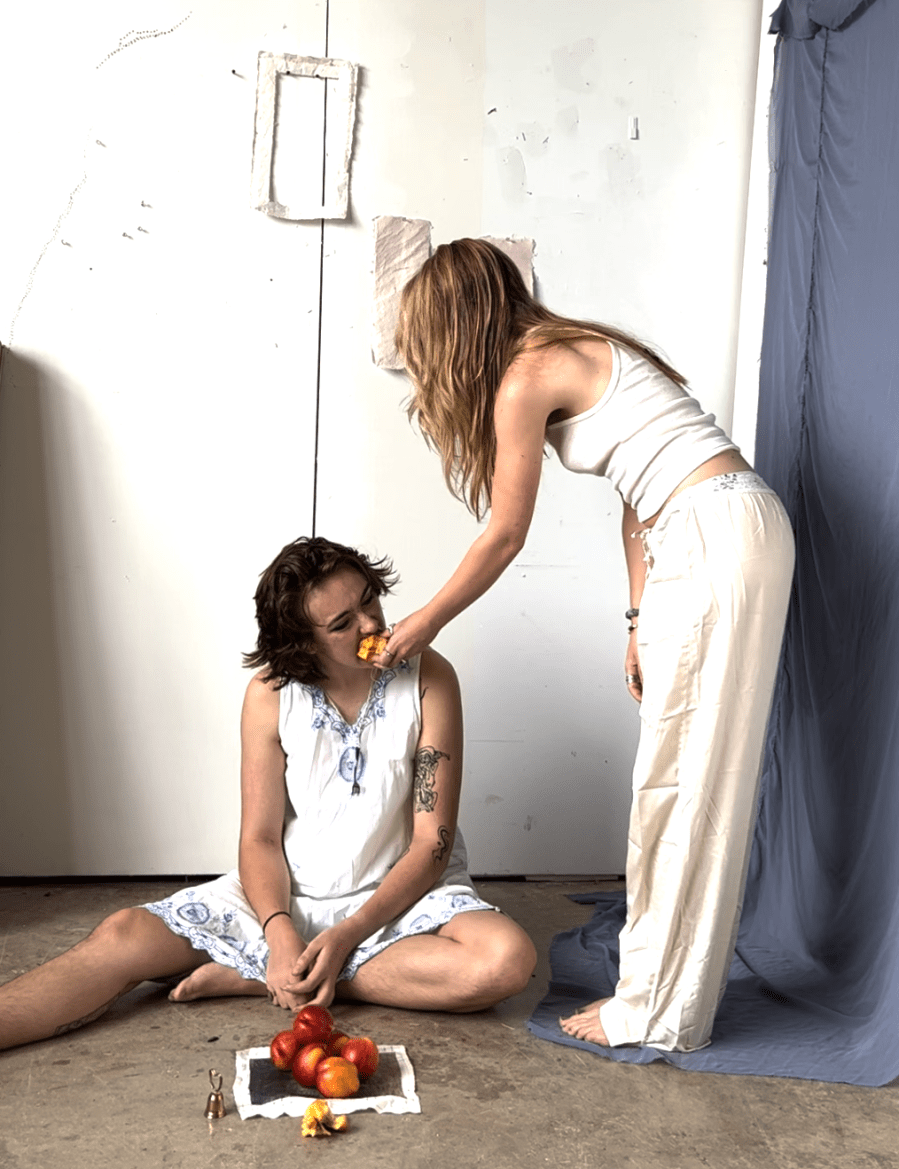
Featured Art: Still from “feed me stone fruits”, by Zelda Thayer Hansen,acollaborative performance with Isabella DeRose

She’s driving buzzed
but the PSAs call that drunk.
Soft swerve under a gibbous moon
ripe as a white bleb
ready to pop, subs banging
College Dropout. Baby blue
cardigan over a hot pink bra—
call it cotton candy Bubblicious,
messy pony strobing
in the passing streetlights.
Crimson lip’s been her thing
since something like eighth grade,
and in the dash-glow
it’s the deepest red imaginable,
catching the light as she raps
every word to every verse.
This is pretty girl privilege shit,
sweater riding up the small
of her back shit, black
and white rattlesnake boot shit.
If all beauty is truth and truth
beauty, her body’s sola
scriptura—spritzed with
“God is a Woman”, the latest
Ariana Grande eau de parfum.
The right tire grazes the rumble strip:
kiss of death but it’s a butterfly,
a literal vibe, and subtly
the whole car shudders, touched. 


Read More

Baby Shower 

By Annie Schumacher

Featured Art by Jordyn Roderick

We drive six hours to a San Diego swimming pool.  
A padded bikini top adorns a deer  
trophy, buoys balance on the mantle.  

Blue balloons, stuffed pheasants  
in a fishing net. I place a gift bag 
on a blue tablecloth. After rehab,  

my brother smiles with ease,  
skewering meat on the other side 
of a screen door. Star spangled   

diaper cake, blue M&Ms in a wide- 
mouthed jar, gun safe in the bedroom.  
Kitchen towels from Camp Pendleton. 

Proud USMC Wife, Proud Mother,  
Proud Unborn Baby, Proud Australian Shepherds.  
My hair in the frosting,  

my hair in the fishing net.  
I follow the nameless dogs  
through blue wrapping tissue, 

decide on divorce with 
a paper plate in my hand.  
The baby, a murmur,  

folded in his mother.  
He will be named after a type of metal.  


Read More

Echo-Delta

By Teresa Burns Gunther

“Echo-Delta,” his wife shouted from the dining room. “Can you order Chinese?” 

Ed sighed and checked his watch. He’d given up begging Tanya not to speak this way. Tango, as she’d taken to calling herself, spoke in the NATO phonetic alphabet now: a side-effect of her new life mission, to change the medical-insurance-industrial complex one military letter at a time. Ed waited the last seconds until his office clock read 5:00 before leaning his hands into his desktop, where a client’s financial records were arrayed, and pushing himself up. 

He grabbed his cane and made his slow way to the kitchen, wincing at the jolt of pain in his left leg, pain that poked a shaming finger. Since the pandemic, his accounting firm had allowed him to work from home, which was convenient given how the accident had left him.  

Read More

A Kind of Terroir: Anna Farro Henderson’s Core Samples

By Jenna Brown

Amid a climate crisis—hurricane after hurricane in the Gulf Coast, flooding in the Sahara Desert, and bleaching coral reefs—Anna Farro Henderson’s Core Samples (University of Minnesota Press, 2024) attempts to redefine our interconnectedness with the Earth in its intimate writing style.

Published in late-2024, Core Samples follows Henderson’s experience as she balances motherhood, writing, work as a climate scientist, and her time as an environmental policy advisor to Minnesota Senator Al Franken and Governor Mark Dayton. Weaving together scientific findings, stories of misogyny in the science field, and anecdotes of foibles in governmental systems, Henderson creates a captivating memoir that screams at the top of its lungs, “carpe diem” (but also “fuck carpe diem”).

Henderson begins her narrative with a notebook, the “first tool” she obtained as a scientist. “While some people see art and science as opposites,” she writes, “for me, they are a braided river, each strand and flow an approach to wonder.” Climate change primarily has not been a main political concern, her writing implies, because of the inaccessibility of climate science literature (i.e. scholarly publications, journals, and studies). Through memoir, Henderson makes the climate crisis approachable, framing our interaction with the Earth’s systems as a relationship, an ongoing story.

Read More

Review: The Boy Who Reads in the Trees by Ron Mohring

By Kate Fox

In a 1967 interview with Time magazine, Elizabeth Bishop said of the Confessional Poets, who were her contemporaries, “You just wish they’d keep some of these things to themselves.” Having secrets of her own, she kept her own poems cool and distant, cerebral and succinct. What is interesting, though, is that she didn’t use the term “confessional” to describe these poets. Instead, she referred to the work of Sylvia Plath, Anne Sexton, W. D. Snodgrass, her close friend Robert Lowell, and others as the “School of Anguish.” After reading Ron Mohring’s The Boy Who Reads in the Trees (The Word Works, 2024), I would place these poems firmly in that category. 

“Confessional” implies that someone needs to confess—that they’ve done something wrong or shameful. Bishop seems to have sensed that the term was all wrong. These poets weren’t confessing things they’d done; they were in anguish about things that had been done to them: Bullying. Neglect. Homophobia. Physical, emotional, and sexual abuse—and the depression, alcoholism, addiction, suicidal thoughts, and other mental maladies that might naturally result from such treatment.  

Read More

Review of City Nave by Betsy Brown 

By Tessa Carman

A good guide welcomes her charges into a new building, book, or idea, and prepares them for encounter, perhaps struggle, and for unexpected delight. She pulls open doors previously locked, unveils portraits, and leads the group up balustrades, through vaults, and up turret stairs, peering into transoms, calling attention to cornices and corbels and rayonets. But she never gets in the way of the encounter; she arranges, interprets, but ultimately steps aside so that they can see for themselves. 

A good teacher is a guide, who has also been the seeker, the asker of questions, and remains so, even as she becomes someone who inspires others to see, to seek and question, and then to make their own songs, sculptures, portraits, craft. 

Betsy Brown is that kind of docent, and her debut poetry collection, City Nave (Resource Books, 2024), is structured like a cathedral, comprising four sections: “Stairs” leads us to the “Narthex,” a sort of waiting room before entering the sanctuary, the “Nave,” at the center, within which we find the “Altar.” 

I love showing Betsy Brown’s poems to my students. There’s a quality to the poetry that makes it an especial joy to share her with young people on the cusp of adulthood. Hers is a wise and winsome voice that has that golden quality of a good teacher. She respects the intelligence of her students, her audience. And she passes on the fruits of her own keen attention, inviting them in to see better—sometimes by asking them with her lively language to stand on their heads while they look.

Read More