Peanuts work for earplugs. Motor oil’s dandy warpaint. Hammer yonder socket screw. Let, for birdsong, boulevard suffice, its springtime putsch of blathered whoosh. Try disorganized religion. Whereas one yellow, freshly sharpened pencil expedites the trach, deep blue in place of black seldom works. Socks in place of sanitary tissue is a trick I learned in proximity to a mosh pit. For accolade try: While the jury commends your recent submission to our sculpture exposition, concerns persist regarding the capacity of guano, liverwurst, and gypsum to withstand the realities of summertime Chicago. My mother pierced her ears with a sharp object and ice, that trick from way back in the Pleistocene Epoch when our ancestors substituted bona fide desire for Neanderthals which must have been a hoot. For Perikles, try sprinkles. For mope, try poem. For readjust, just read. For that hornet nest you’ve tried all summer to locate and found now in, yikes, your front maple whose leaves turned a very specific color and then with little fanfare fell immediately to the gutter try your heart. For love, try anything.
Lakey Sturgis took a palmful of margarine from the brown plastic tub between her feet and ran it over the cheekbones of her grandson’s face. She smeared the pale-yellow spread across the boy’s sloped forehead, deep into the wrinkles of his ears, working her way down the turkey skin of his throat to his bare chest, then beyond.
Just a little more, she said to Peep, who batted long, effeminate eyelashes back at her. Nuggets of the margarine stuck to them, and for a second, Lakey was reminded of nights long past when she lived in Greenpoint and Hans was still living. She looked into her grandson’s globby lashes and saw her twenty-year-old self going to bed without caring to wipe away the makeup she spent so long painting on for nights of swing dancing and manhattans at Truffani’s. That was before Hans’ job brought them to the desert, before their daughter was born. Now Lakey was sixty-six and dying, far from any place she called home.
I sat across the desk from the hospital administrator.
On the desk, reflected in her glasses, I could see a photo of her husband and kids.
Having the photo there must have kept her from feeling lonely at work. Or it fortified her in trying moments. Or both of those things.
Pens were on the desk, and a phone with many extensions.
The hospital administrator must have been in her fifties. She wore her hair short, but we’re not talking Terry Gross short. More like Meg Ryan in the nineties—only the administrator didn’t look like Meg Ryan. She didn’t look like anyone. She was wholly her own person, and I respected that.
Human under observation is suffering from an “insult”— a verbal exchange with another human that has inserted a nugget of dark information firmly into one of the sub-surface personality cores.
Interestingly, the insult has, on the quantum level, a shape related fractally to the central pieces used in the game called “darts.” Pointy and missile-shaped. Capable of lodging deeply, if aimed with skill.
Upon pointy end of insult it should be noted there are “barbs,” similar to those on hooks used for fishing (these enable ease of entry and difficulty of removal).
After several observations, I note that the most effective insults are those that are true. False claims are much more easily processed by the ego’s immune system, and dumped from memory.
Specifically, this human was told he is “dumb.” Note that this insult referred to his lack of intelligence
rather than its older meaning-layer of non-speaking (although it could be interesting to at some point analyze the connection, if any, between stupidity and muteness).
This human suffers internally because he was assigned the word dumb and the word matched lock-and-key with the fact that he is indeed dumb.
Upon observing him again some days later, he has failed to discover the hidden intelligence boost contained within the quantum dart of the insult.
I will spend no more time observing this specimen; he is sad, entropic.
My mother and I were driving home at dusk on a two-lane country highway following one of our visits to the fire station where her newish boyfriend was posted. It was Memorial Day, a couple of months ahead of my eleventh birthday. A pair of vehicles were bearing down on us, their headlights filling up the rear and side view mirrors of our Toyota. The trailing drivers had already twice veered over the center line and gunned their engines, with ambitions of sling-shotting past. My mother responded by pressing hard on the accelerator, threatening a head on collision from traffic traveling in the opposite lane. Even though an 18-wheeler was now headed our direction a few hundred yards in the distance, both trailing vehicles tried again to pass. My mother floored it, forcing the drivers back into our lane or risk being entombed within thousand-pound accordions.
“They’ll have to wait until I’m ready for them to drive on by, Billy.”
Ruth Ann doesn’t drive that way anymore. She doesn’t have a car but if she did, she wouldn’t. She has no reason to go to that side of the hill anyway. All that’s left of the Alstead farm is a small sliver of land on the dark side of the hill, just big enough for Ruth Ann’s double-wide trailer. Her daddy’s old place—the parts bought by the flatlanders—sits on the sun side of the hill, empty aside from ski season or leaf-peeping. Ruth Ann heard they razed the old farmhouse and put up a new lodge, all logs, meant to look old, yet nothing like what folks used to build. She heard someone else taps their sap lines and runs their sugar house too, but they still put their name on the syrup. She would not drive to that side of the hill for a thousand dollars. Well. Hundred.
“Time, lovey.” Haley doesn’t want to go to school. She pouts, sticky fingers on the cheap screen, knowing she can test Ruth Ann. Ruth Ann reaches out and tries to paw it off the girl, her arms jiggling as she stretches, yellowed nails like sloth claws. Haley jumps up quick and they play their game, the two of them moving in the trailer like slow-motion ninjas, knowing every corner by heart, how to avoid every precarious pile of stuff or mound of dirty laundry. Ruth Ann soon stops to catch her breath. She steadies herself, hand on her knee, palm on her heart, neither body part built for such a heavy body or small space. Haley relents quick, eyebrows knitting as she tosses the screen and roots around for a bottle of stale water. Ruth Ann smiles when she takes a sip even though it hurts. “Come now. Bus will be here.”
I couldn’t wait to leave town when I was young. After that, I’m not sure I have much of a story. It’s true I met someone. We had a child together. In between I walked across a frozen lake. I drove over a frozen mountain. I ran up a hill to find a pay phone. I closed down the city for extended action scenes to the tune of 290 million dollars. No— I’m thinking of the latest Mission Impossible movie with Tom Cruise. I get confused. I should be writing domestic poetry, but I don’t want to. What more do you need to know? Our family of three live in a third floor apartment. Sometimes we also meet up outside. I guess leaving town is still the most exciting thing I’ve done. The other day I asked another mother on the playground how to clean bathroom grout. I said Stephanie, what’s your secret? Then we ripped off our latex masks, revealing our true identities. No— that mask thing happened in the first Mission Impossible movie, the one I saw with my friend Michelle. I leaned over to say something snarky, but she was fast asleep. It must have been the whirring of the helicopter blades. There’s nothing duller than an overblown action sequence. The secret to having an exciting life is the people you meet. The secret to battling a helicopter in a tunnel is explosive chewing gum. The secret to cleaning grout is a magic eraser from Mr. Clean.
I was supposed to go on vacation to a National Park, but I don’t vacation. I mean, I did go, but I came very close to not seeing anything at all, because here is how I am accustomed to seeing: There are windows in my home office, but my desk does not face them, so light enters from the side. I am obliquely aware of the day. Sometimes I twist my body to see if the sun has risen, whether fog covers or wind stirs the big green shrub outside. In this small room in my house, I face three computer monitors and their glowing non-sun. I do a real-time job. Creation and consumption of the product are simultaneous; I make live captions for people to read on the Internet, like a stenographer does in court. I do it for seminars and webinars and legal proceedings, in Zoom or Teams or Chime or the platform du jour. My job is to listen and talk at once. What I do is called Voicewriting. It is a job of ears and mouth, an occupation more physical than cerebral, though I’m very stuck at a desk. I receive an audio feed from a remote source and say aloud what I hear as I hear it. Voice recognition software instantly converts my speech to text, which appears in a unique URL, or onscreen in a meeting platform. Someone I don’t know, someone far away or near, reads it as it unfurls. The job is sweaty and live. I’ve parroted defense contractors, nuclear regulators, pastors and poets. It’s echo, not interpretation.
There is no time to fall behind. A dropped word can be fatal to sentence meaning, a dropped sentence is dereliction. Tethered to my laptop by a web of cords, in my black microphone-headset, I resemble an air traffic controller. When a meeting has weak audio, I jack the volume up, and with my palms I press the headphones to my skull, so I am filled with sound and its vibration, then quickly I move my lips and tongue. If I get a very speedy talker, I close my eyes to eliminate all extraneous stimuli. The trick of the job is to tune out your own noise, to be a channel of syllables divorced from sense.
The Featured Art is “The Illusion of Memory” by Greta Delapp
You drive to Cassadaga not because you really believe in psychics and spiritualists, but because you’re thirty-eight and feel like you’re running out of options. Because it’s January fourth and you just spent another holiday season alone while your family asks about the absent husband.
The was-never-present in-the-first-place husband. The would-rather-fuck-the-eighteen-year-old-dog-walker husband.
He’s been gone for two years, and good riddance. You pull a cashmere cardigan over your shoulders, a Christmas present from your aunt bought half-off at JCPenney, because it’s one of the few days out of the year where Central Florida dips below sixty degrees. Angels and bloated polar bears dance over crabgrass-infested lawns. Plastic icicles hang from gutters, though it hasn’t fallen under freezing here in three decades.
The Featured Art is “Dead or Dreaming?” by Greta Delapp
Month 1: June
“Promise me you’re not gonna die,” my eight-year-old Ellie said.
It was a simple request during her bedtime tuck-in. All she needed was a one sentence guarantee that the operation to remove my brain tumor would go well. I couldn’t do it. What if something went wrong—a spinal fluid leak, paralysis, even death? Ellie’s arms formed a vice-grip around my body. I kneaded Ellie’s pillow, worried that she’d never be able to trust an adult again if I promised success and then something bad happened.
With twelve hours to go before I went under the knife, I resorted to chanting the same thing I’d been saying since my diagnosis one month earlier: that my surgeon, Dr. T. was “the best of the best.” It had worked well up until now.
I am reading my book manuscript to my mother in her backyard. She tells me that was probably a catbird I saw earlier. She tells me bleach is the real way to get stains out of grout. The narrative urge is a strong one, she says. She had an invisible horse, but never said she wanted to be one. On that last point, we disagree. Perhaps it was only a feeling I had when we were watching horses in a field. That blurring of beings. Like the colors in a Vuillard painting. A dress turning into a table or an orchard. My college painting teacher said edges are important, but never explained how best to create them. I wanted us to be old ladies together, I say to my mother, meaning me and her. Now we know it isn’t going to happen. But she says she was dreading it—she didn’t want to be here to see me grow old. We decide death comes too soon, in the second section of my manuscript— And speaking of death, how can the deck chair cushions still have a cat hair side, I ask her, now that the cats have been dead for years. Because we’re disgusting old people, she replies with a laugh, meaning herself and my stepfather. Though the truth is I’m the sloppy one. This redbud tree is a new redbud tree and I didn’t even notice. I didn’t notice the new flowers she potted either, lined up with their brilliant blossoms, waiting to be put on the front porch. It’s all one to me: the backyard, the flowers, my mother, me. How can any of it exist without the rest? We agree that I’ve written too many poems, and they don’t go together.
A Friday afternoon, late March of 1990, suburban New Jersey. A second-floor apartment in a series of two-story brick buildings. In the living room there is a slumped brown couch, a scarred coffee table, and a television with dial controls and bunny-ear antenna that stick out garishly from a lop-sided wicker shelving unit strewn with artificial flowers. Beside the shelves is an unshaded window. Outside, the branches of a close maple tree bud neon green. It is almost evening. The light is warm, crepuscular.
Two girls laze on either end of the couch, sleek as seals on a dock, stretched out as far as they can be without touching one another. The television blazes. Cassie is ten. Franny is eight and has been suspended from school. Not for the first time.
The mole was the color of charcoal, shaped like a raindrop sliding down a car window. Mona had gotten the call from her dermatologist in the bathroom stall of a dive bar. Two women were arguing at the sink.
“I can’t tell where his opinions end and yours begin,” said one.
“What are you talking about? I’ve always hated neoliberalism,” said the other.
“Unfortunately, we’ve detected melanoma,” said the dermatologist. “The good news is, we caught it early.”
But Mona hadn’t heard her above the whir of the hand dryer. She plugged one ear with her finger. “Sorry, could you repeat that?”
“We caught it early,” said her dermatologist. “And that’s helpful with melanoma.”
The word cut through the bathroom din like an un-tuned chord. Mona looked down at her bare thighs on the toilet seat.
I escaped the religion of my youth by moving five hundred miles from Ohio to Virginia. There, I refused to pray as I drifted off to sleep, and I never roused for church on Sunday morning. I lived in a tiny broken-down ranch on a quarter acre lot, a single oak tree in the front yard and the world’s worst neighbor to my side. Wayne Bishop was his name, and he spent his afternoons in his driveway, under the shade of my oak, his feet propped on an upturned milk crate, empty beer cans lined up next to his lawn chair. He looked like a toad with a rosacaed face and giant turned-out lips. He called me over to help with his projects, and each time I’d internally debate just drunk or personality disorder. He’d enlist me to help him cut crown molding or install paneling, then he’d hover and insult my handiwork and calculations while he drank his beer. He was also breathtakingly litigious, prone to staying up all night authoring lawsuits that he asked me to copy edit before he filed. I picked random sentences and inserted commas—he never had enough commas—to placate him, so he didn’t sue me like he did his former employer, every doctor who tried to help him, and his own brother. I always helped because I was lonely, and it seemed prudent to stay on his good side.
I used to have no name-mates but I never took my birth name back and now two other Linda Bambers sometimes get my mail. Texas and Kansas, I call them
to tell them apart. One is the author of a perennially best-selling textbook on accounting; the other wears crossed pink ribbons in images online. I trust them both and plan to be in touch.
If all 8 billion of us had one name would no one ever start another war?
Nigel Smith, a pub owner in Worcestershire, England once threw a ‘Nigel night’ expecting maybe half a dozen name-mates. Four hundred thirty four showed up, he exulted, including one from Colorado crowd-sourced for the trip.
Ni GEL, Ni GEL, Ni GEL they all shouted when they’d had enough beer.
All these Nigels, crowed the host, were really keen to talk and share their lives and come together in a kind of Nigel community.
Tanya says Hollis beat a boy last night. Tanya says the boy crawled through the girl’s bedroom window and good thing Hollis caught him. He beat that boy so hard he soiled himself, Tanya goes on, taking a drag from her cigarette. She saw it with her own two eyes, heard all the whooping and hollering, then the boy curled up beneath the window, jeans streaked with shit. We’re at work when Tanya tells me this. She’s standing near my desk, her back against the easel where I lay out the company newsletter. I’m twenty-three, she’s thirty-eight. She works in purchasing. I’m in PR. Her cubicle is catty-corner to mine. As she talks Tanya adjusts the underwire in her bra with long, tapered fingernails painted the color of strawberry frosting. My boobies are sagging by the minute, she says, Hollis used to spray ‘em all over with whipped cream then slurp up every last bit, but now he never touches them let alone glances their way.
It embarrasses me when she talks like this, but I keep a straight face, so she’ll tell me more. I like to know what’s coming down the pike. She has a young son, Hollis Junior, and a daughter named Mercy who just turned fourteen. Mercy is the one with the window in her room that the boy crawled through.
The summer after ninth grade, I had my first kiss. All school year, I’d been on a mission to no longer be “prude”—the kissing equivalent of a virgin. It seemed other girls were always talking about their conquests. Who they had kissed, and where, and whether the boys felt them up over or under the bra. I longed to be part of these conversations, to offer my own tale of triumph, to sagely weigh in on others’ dilemmas. Instead, I stood to the side, quiet, fiddling with my razr flip phone. That summer was the Summer of Death: Michael Jackson, Walter Cronkite, Farrah Fawcett, Billy Mays. Others, whose names I didn’t recognize. I was fourteen years old, and death was no deterrent to my desire.
I wondered if my lack of suitors had something to do with my appearance. Through middle school, I had sported frizzy curls cropped into an unfortunate bob. Every day, I wore a Life is Good T-shirt or a hoodie or both. Adidas track pants. I had what my well-intentioned cousin once called “only a little bit of a mustache.” When high school started, I made an effort. I traded my swishy pants for jeans, my shapeless T-shirts for fitted tops from Old Navy. I got my ears pierced. I kept the bob, though I began styling it with John Frieda mousse that came in a tall silver can. It was my cousin who showed me how to apply the mousse. He was my age, also curly-haired, had been kissing girls for years.
half-heartedly, not like the one last April— fierce, protecting pear-green goslings. But this year, no little ones.
It’s been so long since I have seen a baby— even seen one—not to speak of holding one, or watching a tiny face reflect my smile.
I’m not demented yet, not like the woman who begged to see her stolen babies as they loomed above her, grown.
I’m not asking to be young again, back in the tent with everyone asleep but me and the baby at my breast— warm baby in the chill of night— or in the back seat
of my daughter’s Ford Escape— the “baby-whisperer” she called me as I gentled her son to sleep.
I tell myself there are advantages to being old: no longer wondering
if God exists, or what life’s meaning is (He does, there’s none), acquiring bits of wisdom
such as everything takes longer than you think except your life.
Let Our Bodies Change the Subject, Jared Harél’s latest poetry collection, is an invitation to reckon with what it means to steward life, your own as well as others’, to hold on to its preciousness while also taking stock of its dear costs. It calls to mind Emily Dickinson’s exhortation to “tell all the truth, but tell it slant.” The language and the subjects of Harél’s poems are plainspoken and familiar, yet the truths they hold have the power to devastate.
Consider the first line of the first poem, “Sad Rollercoaster”:
My daughter is in the kitchen, working out death.
Harél situates us first with his daughter, establishes kinship in the kitchen, that place of nourishment, labor, and loaded emotions. The sentence is matter-of-fact and utterly relatable until we get to the word, “death,” that lightning strike of truth. Even in the comfort of a kitchen, even with a beloved child, we face mortality. This movement between ease and confrontation, this “working out” of being human, will carry on throughout the collection as Harél takes us through the various places and phases of his life as a son, a husband and a parent in the 21st century in the U.S.
In Rise Above the River Kelly Rowe writes about her brother, whose Huck Finn boyhood–building rafts and climbing trees–was shattered when a teacher sexually abused him. Gone is the boy who cries “the world goes on forever–- // and I’m the king!” Instead we get a man in free fall, ramifying trauma outward. He wrecks cars, he steals his dying mother’s morphine, he drives right from her funeral to the bank to get his share of the inheritance, and then disappears. Eventually he commits suicide after a stint in prison.
By Susan Finch Winner, Editors’ Prize in Prose: selected by Mandy Berman
Featured Art: Woman in Silver V-neck Long-sleeved Dress by Inga Seliverstova
As bachelorettes, we solemnly promise the next forty-eight hours will include three brunches, two happy hours, fifteen moderate disagreements, one unforgettable fight, eight matching T-shirts, one bar crawl, one pedal tavern, one sprained wrist, three twisted ankles, sixteen hangovers, too many tearful promises to count, and one sober regret. We are the bachelorettes and we insist.
We must begin with brunch, and in order to fit three brunches into forty-eight hours, we will congregate Friday morning. After all, brunch is the most important meal of the day. We can eat French toast and French fries, and getting tipsy or emotional (i.e., Lydia has too many feelings after bottomless mimosas) will not be frowned upon. Not every restaurant serves brunch on Friday, so we must select carefully, find a place that has an all-day breakfast menu, and really, why shouldn’t a restaurant serve breakfast food all day. It’s not so hard to whip up a couple of poached eggs, is it? We will reserve the table for 10:30; the proper time to eat brunch is 11, but we already know that some of our bachelorettes will be late—particularly Tara, the bride’s sister. She’s a musician and runs on her own schedule, and of course, Felicia. She hasn’t been able to get anywhere on time since the new baby.
Event attire is outlined in the invitation—brunches are for sundresses or rompers paired with cute cowboy boots or wedge sandals. We do not do flats—flats are for business casual events or maybe if you’re trying to let someone down easy. Matching T-shirts will be provided for the pedal tavern that begins promptly at four. The shirts may be knotted at your hip or tucked in with a cute belt, but please do not leave your shirt untucked. Evening wear will have two themes: Friday red and Saturday sparkle, and the bride, of course, will wear white. No one else should plan to wear white or anything white adjacent —no cream, no ivory, no pearl, no silver, no soft grays, no misty light blues or sugary beige. Don’t pack it. Don’t even think about it. We don’t want anyone to steal the bride’s thunder. After all, we are the bachelorettes, and it is our job to insist.
Sarah worked with Beth at a public library downtown. Chris was a biology professor at University of Louisville. They met at Beth’s birthday party.
At the party, Chris quoted Winston Churchill and Hemingway in the same conversation, and Sarah couldn’t tell if she liked him. When she went to smoke a cigarette on the back porch, he followed. Muted voices came from the re pit at the side of the house, but they were alone on the porch. He took the lit cigarette from her fingers and flicked it over the railing. When he kissed her, she blew the last of the smoke into his mouth. They ended up at his apartment. The sex was drunk and sloppy. They kept laughing. Everything seemed hilarious back then.
Sarah woke up buzzing the next morning, as if Chris had flipped a switch somewhere inside her. Driving home, she had the thought that she would put up with a lot from a man who made her feel this way.
A month later, they walked in Cave Hill Cemetery behind his house while red sauce simmered on the stove. Sarah told Chris about her father’s death when she was twelve and how she still sometimes visited the funeral home. “It’s on my route to work and back,” she said. “When the parking lot’s packed, I can’t resist.”
She was embarrassed when Chris took her hand and squeezed it.
The girl from Zurich is deathly quiet. But even in a king-sized bed her presence prickles me awake. Her fetal body rises, falls, a pillow wedged between us. A natural end approaches now; I’m sure she knows it too. We met six months ago, flotsamed onto the misfit table at a Chinese wedding. There was nothing to do but drink, and seven wines into the night we decided to go slumming at Orchard Towers—Singapore’s neon throwback of tacky sleaze. Sailors go there for the prostitutes, and bankers for the irony, but for her it was the Filipino bands. I love to dance to them, she said, they always try so hard. But she wouldn’t go there without a man, and so, still in my suit at 4 a.m., I held her as she cried on the sticky dancefloor. Cried with drunken empathy for the Indonesian whores she was dancing with. At their age I was still in school, she said, And they have to sell themselves to these fucking men. She feinted at the sweaty marines, bewildered with Burmese whisky and shore leave, and she had me at that. I’ve always been a sucker for compassion—it doesn’t always serve me well.
Then as she sniffed into the smoky bathroom I texted her something about goodness—I don’t remember what—which showed up as her Facebook status the next day. But like the young marines, she was shipping out in the morning, her company posting her to Paris. And it wasn’t until her stint was up—four months later—that we got to meet again. And all that texting and mailing and chatting online, it didn’t serve to warn us that after just a few weeks it wouldn’t be working the way we’d hoped. And now it’s coming to an end—no relish of redemption here—my thoughts rise on a sleepy surge of affection. The girl from Zurich: I’ll remember her—I will.
Featured Art: Unfinished Study of Sheep by Constant Troyon, 1850
It’s the manipulations that end you. I was told this by Sam Shaw after he learned he’d been promoted to the inside. We were on the outside of the outside in the designated smoking area. I was smoking. Sam Shaw said, “What’s suffering worth?” He broke off the shards of animal blood that had froze to his overalls.
I shook like I was caught in electric wires. The cigarette butt hissed when I let it drop into a snowdrift. I could hardly feel myself living, felt like I was alive as a series of smoke breaks.
Sam Shaw said, “Nothing’s dead-end as it seems.”
“Easy for you to think,” I said. “You’re on the inside now.”
I warmed my hands with the heat of the conveyor’s gear motor, clenched and unclenched until my circulation was good enough that I could reach for my cutter and hand it off to Sam Shaw without either of us losing a precious something. Sam Shaw cut into a plastic clamshell that contained a dress shirt and tie combo. He pulled the tie too tight. I told him he couldn’t breathe. He called himself a real professional. I lined up the next group of animals.
“You ain’t dressed for this no more,” I said.
Sam Shaw looked at me and then the cutter. “Take it easy on me,” he said, taking an animal by its pit, cutting it with no regard for the stainlessness of the shirt.
Featured Art: Death: “My Irony Surpasses All Others” by Odilon Redon, 1888
Michael, you are gone, and in this house where you once were there is an antique telephone as black as your coffin. Heavier than it looks, it is as full as the hole the men dug for you, early one morning, as they talked about summer and things they saw on TV.
Old things weigh more than they look—dead, leaden things like you and the black telephone.
You have been gone three weeks, and now my mother is gone, too. When she left for Providence she left me here with Michael, whom you left behind like a copy of yourself when you went. He doesn’t ask where you are anymore. Instead he says, nine times a day, that he’s going to call you on his telephone.
He found it at the flea market where my mother took him, to take him off my hands and take me off of his.
When I’m not looking, he lifts the receiver and talks to you. He doesn’t say your name, and I don’t ask who is on the line. I know it’s you.
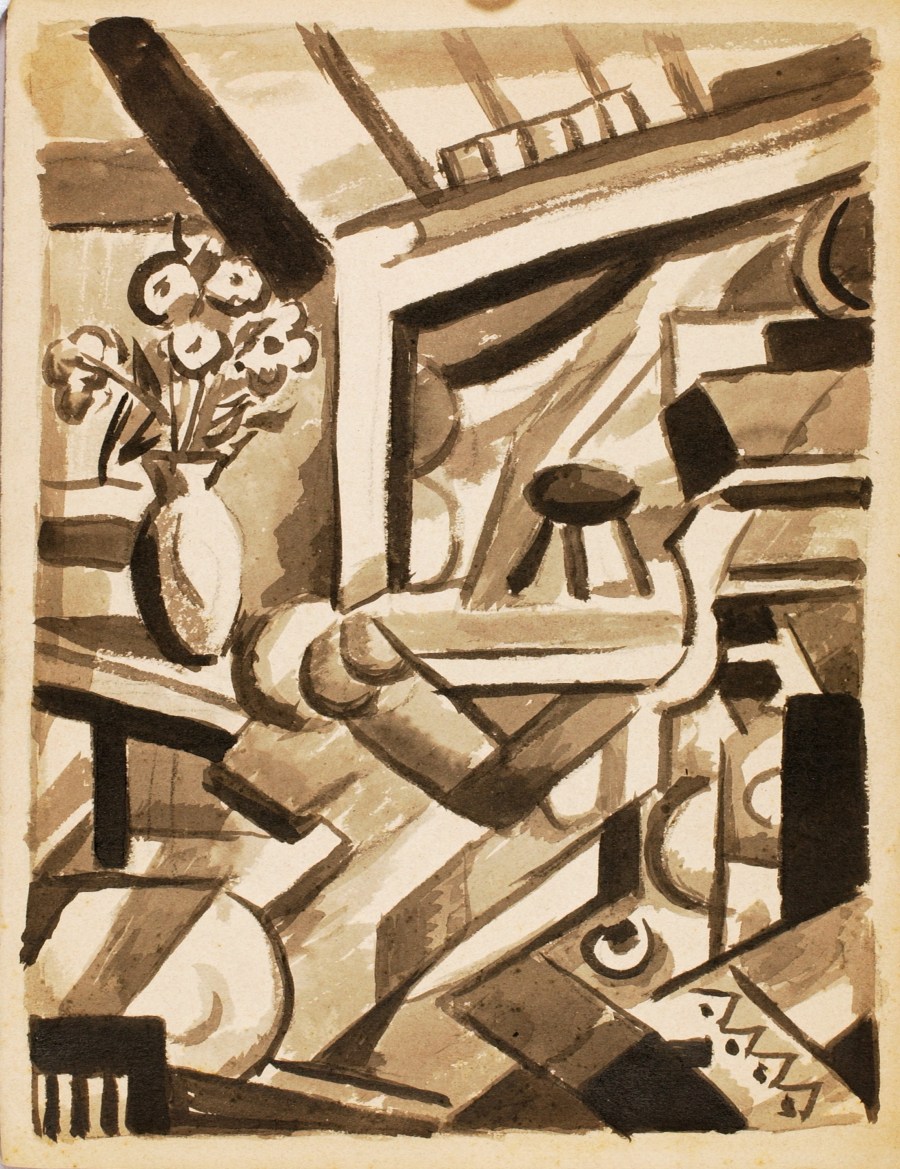
Featured Art: Abstract–Flowers in the Left by Carl Newman
My Mexican boyfriend cannot tell me if he’s ever killed a person. This is not because of a language barrier on either side. I asked my question clearly enough, and he is a good conversationalist with a decent English vocabulary. Still, Raf furrows his dark brows for a long moment, apparently needing time to puzzle through the facts as he knows them. Finally he frowns. “I’m not sure.”
When I ask my American boyfriends if they’ve killed someone, they laugh the way that they’re meant to laugh. Then, while they’re busy being surprised or trying to work up a clever response, I can worry about the papers I have to grade or how much longer the sliced pineapple in the refrigerator will last before I have to give it to the orioles in my backyard. That’s why you ask about death in the first place. It’s supposed to buy conversational elbow room, but Rafael has done the unexpected and provoked my attention instead of letting it drift away. It is not until later, in the dark of my bedroom, that he is relaxed enough to explain his crime.
Feature image: Henri de Toulouse-Lautrec. The Passenger in Cabin 54—The Cruise, 1896. The Art Institute of Chicago.
It’s called the “verbal tip.”
You’re the greatest waitress we’ve ever had. We’re going to ask for you every time we come here. We had such a good time because you were our waitress. Yada yada.
Then they leave, like, three dollars on a thirty-dollar ticket.
Like I was going to call up the electric company and tell them they were the greatest electric company I’d ever had.
When I got divorced, my ex-husband was supposed to give me the Jeep. That’s what we agreed. My plan was to sell it if I couldn’t find a job right away in Phoenix. Instead, he wanted me to have the Acura. He was being generous, because it was a better car, practically new. Except that he never signed the title over to me. So I couldn’t sell it, and I couldn’t drive it, because I couldn’t afford insurance or gas. I was living in a godforsaken studio and buying food for one day at a time, stealing toilet paper from the bathrooms at the mall, with a twenty-three-thousand-dollar car parked under my window.
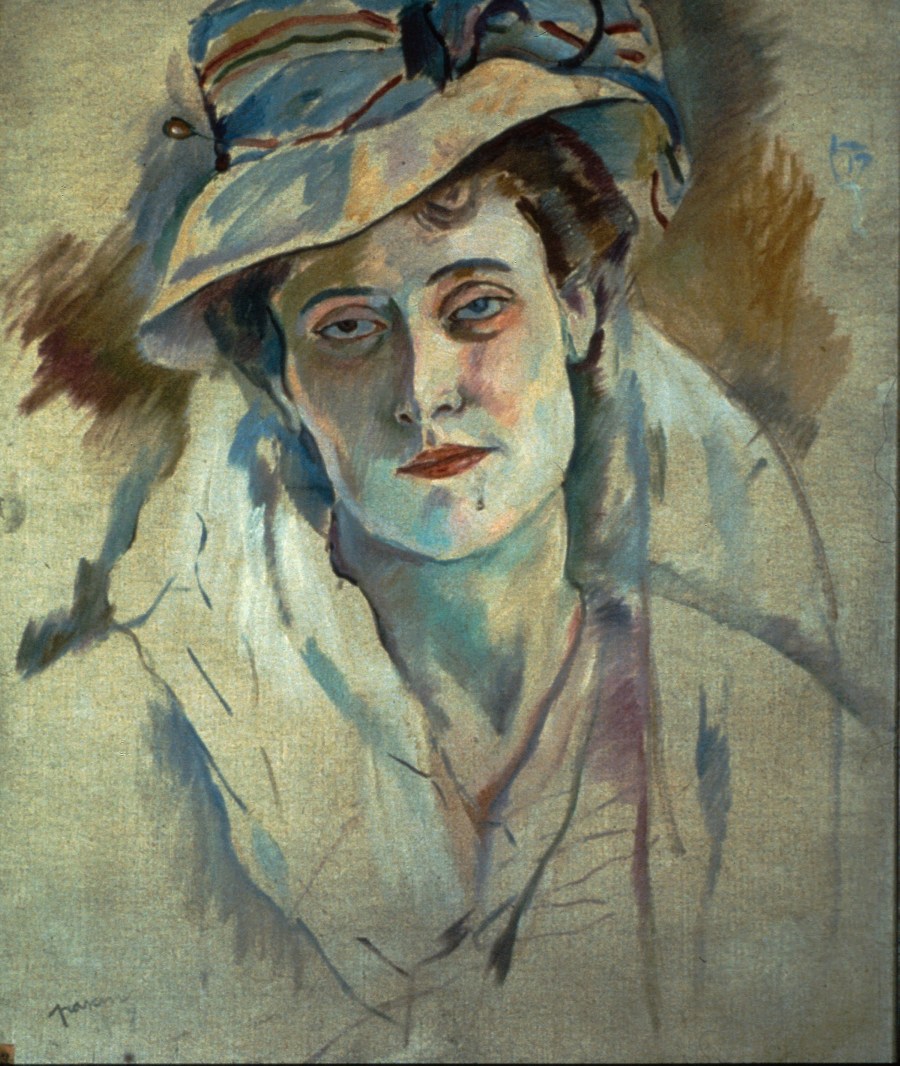
Feature image: Jules Pascin. Hermine David, 1907. The Art Institute of Chicago.
I didn’t know what to do with my breakfast tray. I’d gone through the line, had just spooned scrambled eggs onto my brisk white plate when I noticed two of the tables were already full and I’d have to sit alone. Alone. I’d only been at this artists’ colony for fourteen hours, but inevitably the old thought seeped in, “I’ll never be asked to sit with the popular group.” Now I stared not at the writers and artists dawdling over sectioned grapefruit and blueberry pancakes, but at the shiny surface of the coffee urn.
Nonsense! I nodded to my distorted reflection. What could really be wrong with eating your eggs alone at 7:30 in the morning at a table for eight? I’d eaten alone many times in the last ten years at my home in Iowa. And I was way too mature—too old, I didn’t dare say—for these sudden fits of inadequacy. I shifted my gaze to the window where light shimmered above the crepe myrtle, where, in the distance, horses grazed and cows lumbered across the driveway. As I turned to pick up a glass of orange juice, I heard a trill of laughter from one of the tables and all my newfound certainty slipped again: sitting alone was a curse.
Any normal person would have assumed that being “new” to the group, you should give yourself a few days to acclimate, to get to know people, to talk to the tall, gregarious composer dressed in plaid shirts and khaki shorts and the small, clever woman with red hair who spoke so softly. Any normal person would have plunged into small talk, would have laughed when others laughed. Instead, anxiety charged through my body, wreaking havoc with my girlish hopes for friendship while an abject loneliness loomed above the coffee cups. What would I do? How would I survive?











 New Ohio Review