Murmuration

By Joyce Schmid
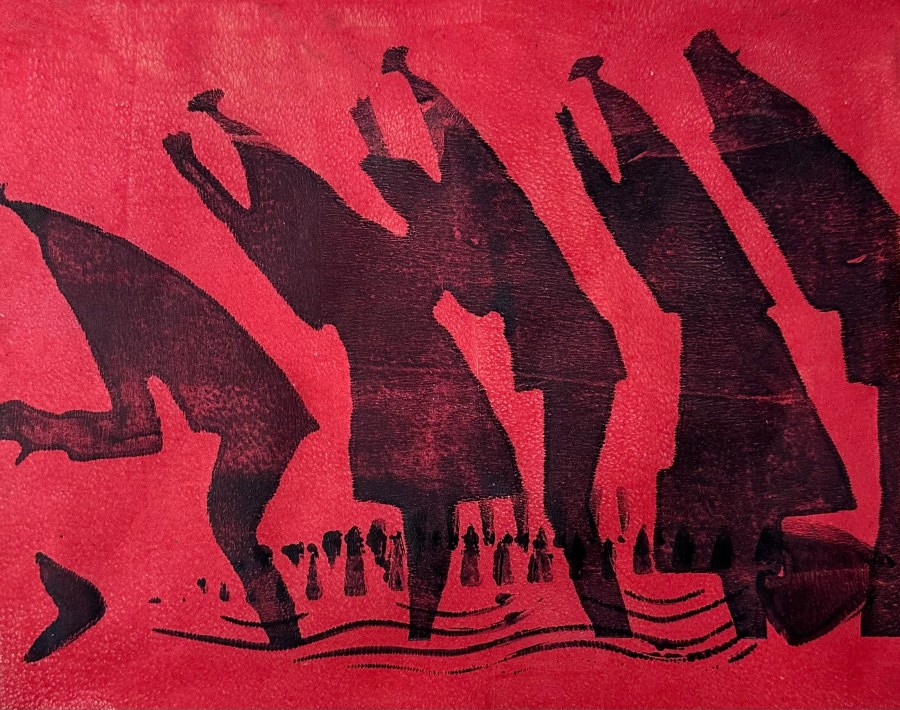
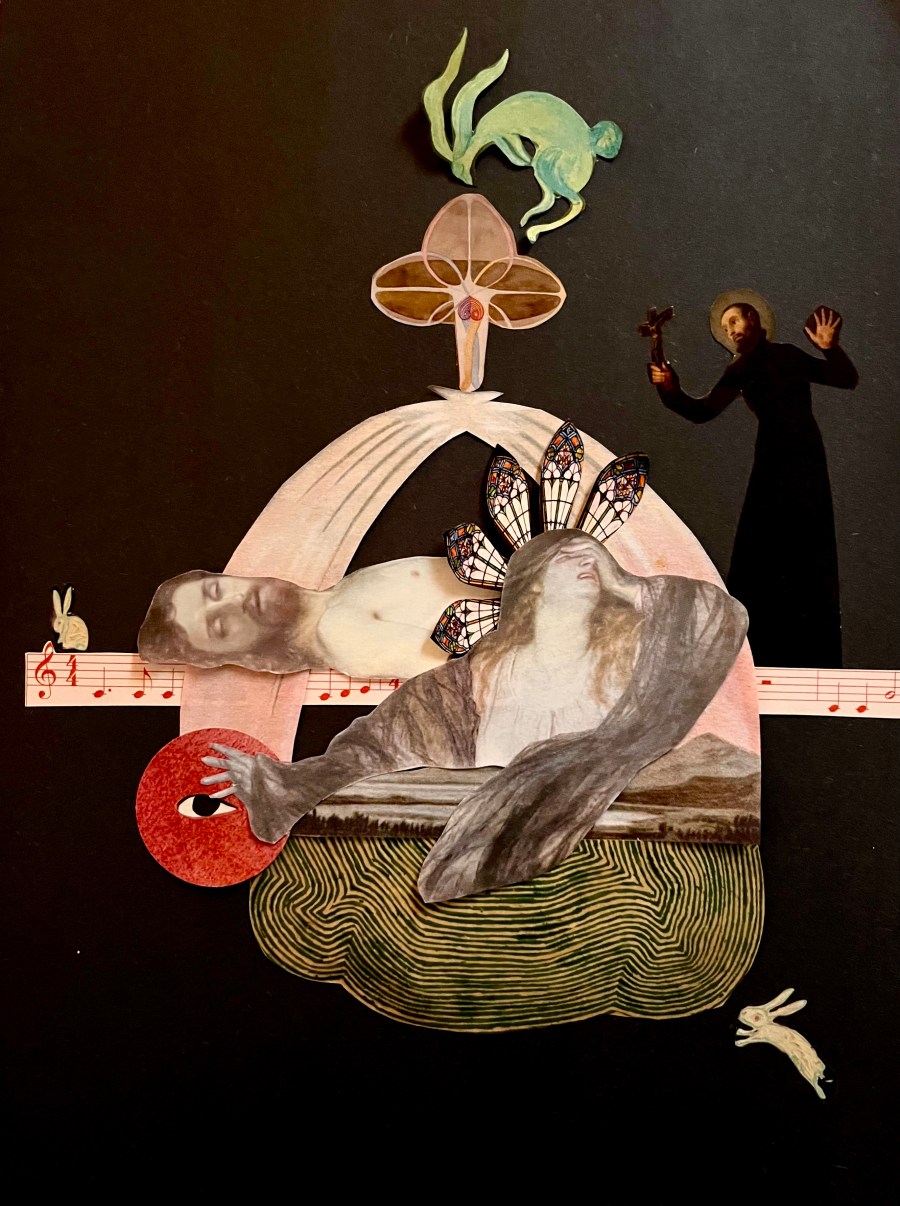
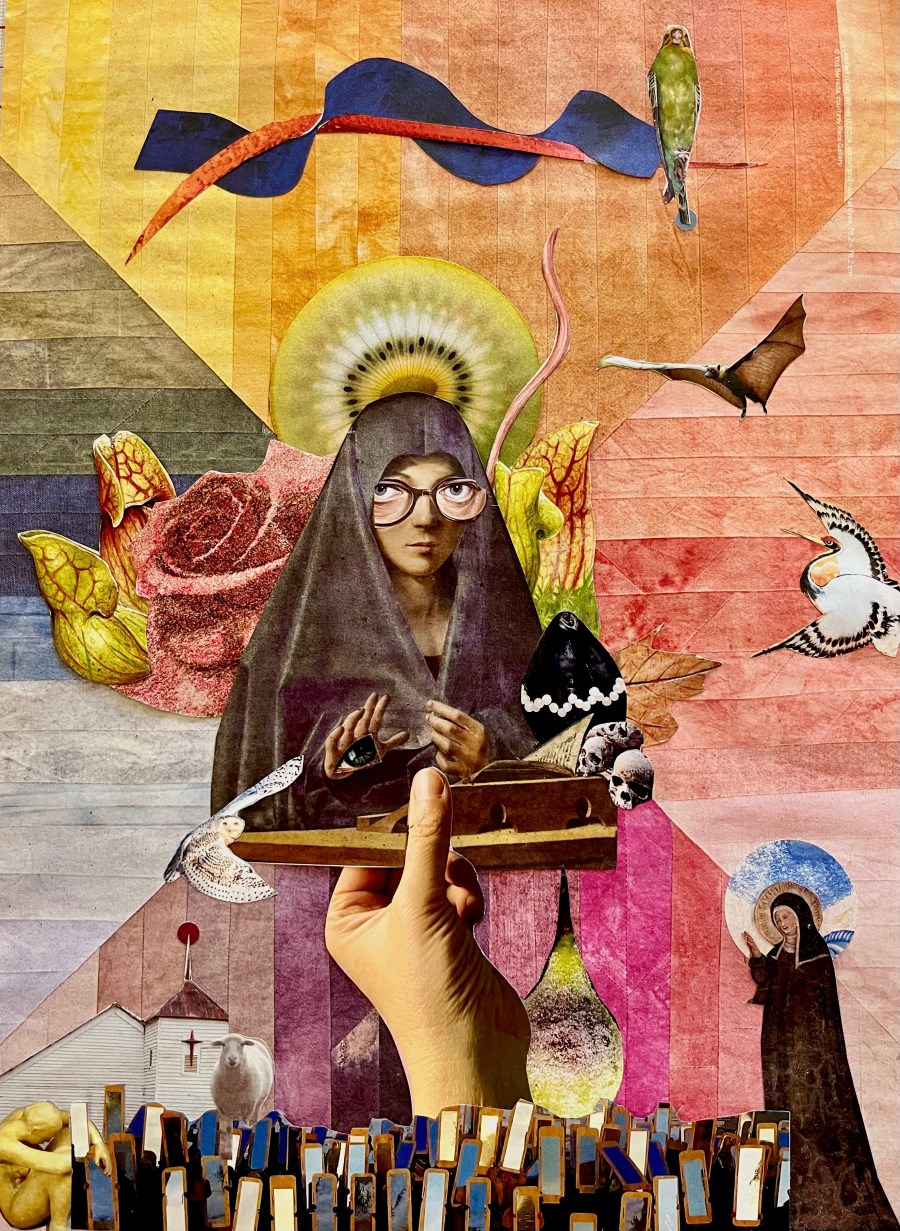
Featured Art: “The Call” by Lesley Weston

When Rock ‘n’ Roll was all sh-boom, 
my best friend rocked around the clock  
and I did too  
in my attempt to be a teen— 
just three chords, 
tonic, dominant, subdominant— 

but what I really loved 
was Debussy— 
inchoate like the early earth, 
like me. 

At eighty-three, I love Bach fugues— 
a single theme repeated 
through a piece as tightly woven  
as a Miwok basket capable of holding water, 

though in German, “Bach”  
means brook or stream— 
flow, uncontained—  
no certainty on earth  
except, and momentarily, in art— 
the kind aspiring to certainty and form, 
not trying to reflect the way things are— 

my friend shape-changing 
like a flock of starlings 
from a biker on a ten-speed in the morning 
to a wheelchair patient 
barely strong enough to speak, 
to a hiker on the cover  
of his own memorial,  
his right hand on the guardrails  
of a wooden bridge, 
his left hand resting easy on his hip, 
white water under him. 
He stands a moment, 
with the whole high country at his back, 
then turns, 
heads into it.  


Read More
all i know about slow burning love

By T.W. Sia

crabgrass. syphilisflower. 
the clap then boom. earth with its crust bitten off. 

some lesions are slow and beautiful. going home after dark.  

forearms. drawing the bow back, meteors shower on the sky.
new year’s eve. kiss again and again  

on the last week of summer camp. 

the word “crush” means it sits in the center of your chest.  

i am trying to measure out crush on my kitchen scale. 
i want enough. i want in fistfuls. 

the first baby tooth comes out. then all the teeth keep coming out, 
like confetti from the mouth. 

all i know about love begins long ago. my father dancing 
in the nightclub. fingers spread the air. confetti rains down. 

my mother would have married the man she loved. she could tell me
how it feels to kiss when you’re dying. 

i said, all i know about love begins long ago. in 1998, steve michael 
lays to rest in front of the white house. 

his mother walks him down lafayette park before sending him off. down the aisle. homebound.  

i was shaped from the language of hands. holding. AIDS memorial quilt. 
lying down together in churches. confetti. throwing parties to the wind. 

i said, all i know is that i’m in love with forever. 
exploding slowly. my ancestors need me  

to dance around my bedroom in my ratty underwear with holes. until dawn 
i’m king of prussia. i’m the forever. 

waiting for you to light up my phone. rockets coming home. fireworks 
in a long, drawn-out absence. angels gleaming in the gutter. 

i’m in forever. supine on the side of a hill. english daisies bloom 
through my body like gummata. i am burning up without consequence. 


Read More

I’ve been thinking about aisles and every version of me in them

By T.W. Sia

I love getting married up and down the narrow aisles
of the gas station, peach rings on all my fingers. My gown
trailing behind me like slug juice, as if to say I was here

And I love getting up to pee on the plane. Hallways of hands
brushing at my sides like tall ferns. We were all sitting
at the same refectory table in a distant life. Ada asserts that the joy 

of living in the city is to be near many bookstores, each with aisles 
designed by someone else. Your favorite is the one with the most people 
in transit with you. I picture all of us walking slowly  

with our mouths ajar, fingertips brushing on spines. Before sunrise,
I feed wool into a spinning wheel, wood clicking as it turns 
in the grand passage of time. Passing is why I became a poet. I keep conjuring  

the wind, sweeping over orchards I remember. 
The walk to the apartment lined with olive trees, green and fruiting 
in the summer. My father waiting his turn at the stop light.  

I understand lineage years later at the same light. 
A lineage of waiting our turn. Unstoppable lineage. The wet way 
blood goes from the heart. Water dripping from cupped palms. There,  

I’ve seen my reflection change over the years. I keep growing 
into these wrinkles. My father laughed like me too. I have our face
generations have fallen in love with. I want to talk to myself gently. It’s true 

I like my memories without shape, just passing through. Dancing 
like joss paper as it burns. Moving prayer beads in bed.
I dream when I rest, a door creaks open above me,  

the route to find me in every life. Shimmering above every crack 
in the sidewalk, pushing a cart at the Dollar Tree,
staring out the bus window home. Find me there.


Read More

Anthropocene 

By Martha Newman
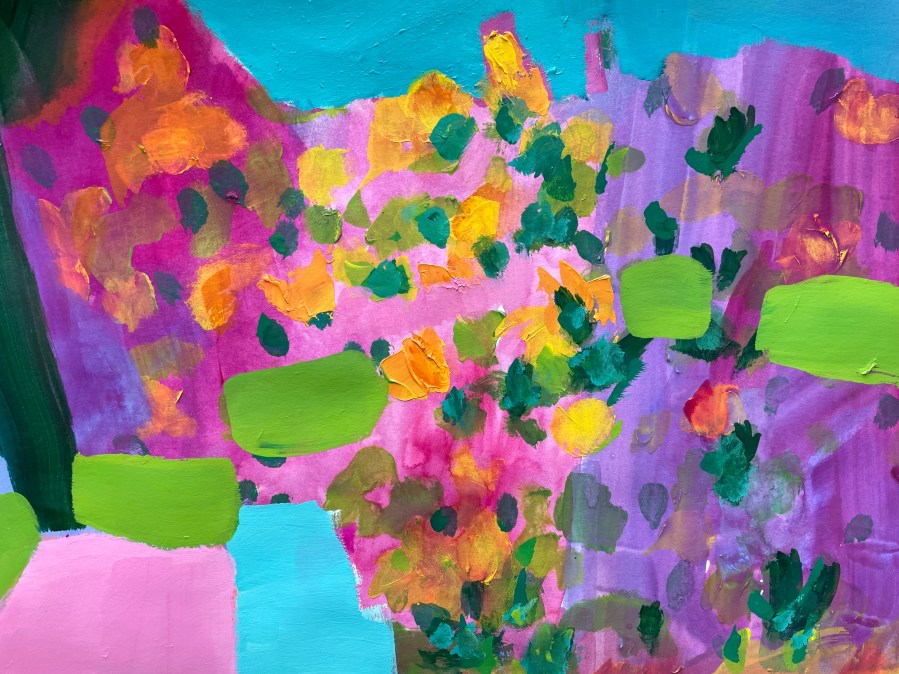
Featured Art: “Transfer Station” by Lesley Weston

“That fucking cunt,” Nancy snarls, glaring out my vibrating kitchen window at the washed-denim sky. “First he puts a car in space and now he wants to colonize Mars.” My windows are being rattled by recurring sonic booms, and so are my nerves. Every time a test flight takes off, and our local billionaire gets one step closer to the Red Planet, I fight off the urge to take cover under the kitchen table like our dog, quivering and gnawing on a table leg.  

Nancy takes a sip from the sweating glass of lemonade in her hand, leaving a waxy, red smile on the rim. “All going to hell,” she says, “to hell in a handbasket.” 

Read More

you dangle a lure off the pier & the ocean goes feral. 

By Lizzy Ke Polishan

a corner of the ocean gets stuck 
inside a cave with  
a squid who can conceal her own shadow  

with, you think, a sick combo      of instinct & bioluminescence. 

you have zero survival instincts. 
you have a spinning pink lure & yellow boots that keep your feet 

safe from the rain.        the smoke. 

               the darkness 
will crack open & yield a tiny pearl but you’ve got to beg  

a little first,              okay?          wade out to your waist 
in the bathwater turquoise.        thermometer the salt. 

you dip mason jar after mason jar into the ocean & still come home  
without a wave. 

where’s an epithalamion when you need one? 
where are all the birds?  
               it’s okay. 

yesterday a man with a dog followed your bootprints down to the dock 
and lingered near where you stood,  

               watching time freezing light. 

   the sky was starting to melt 

               like an orange popsicle. 

your mother called to you out her car window: don’t you need a ride home? 


Read More

Fore

By Merridawn Duckler

Usually I’m all Emily’s got her problems and I’ve got mine. But sometimes I feel really bad she never found love, or she did find love but rejected it, or she had no idea what she was missing, or it was all about some Majesty. I wish I could’ve helped her, I really do. Genius is mad lonely, and truth-telling is always a sad end game for us bitches. Don’t we all die a little if some poor sod isn’t willing to stand up for that world? I mean be all in. In my spare time (haha) I’ve tried to do some checking around to see if there’s any legal options or a podcast, a campaign of some sort so I don’t just sit around doing nothing. But I’m not a school marm (sic) who has time to cross check like a million diary entries written in teensy tiny handwriting that looks like it was written with miniature crab hands. That is not my skill set. My skill set is having my whole universe rocked by a genius and wanting to acknowledge the source. I’m the first to say: People, give back. Reach out. It’s just a big challenge when everyone is dead. You kinda hit a brick wall there with how much you can do. I mean, I’m not stopping entirely. They say every time you read a thing and bow to the genius of the creator you’re one step closer. The question is to what.  


Read More

Curve Before Interlude

By S. Lieto

fast rain those blurry reds streamed our front dash 
though the car was steam & comfort as we entered the curve 

gliding inside the rotary when a produce truck one of those  
long ones cut ahead of us & a horn belted from my palm’s own  

force my own hand & my foot a harsh hard brake & look there  
was no accident but I felt every clearcut tree through  

a window deep inside me & the truck’s wheels sliding just-past  
the hood & just look at how I yelled fuck off & no one heard  

me but my lover who caught herself on the whim of a taut  
seatbelt & I felt like a child again thrumming ready  

for that argumentative wake within me & waiting for the right 
exit & look there was no accident just adrenaline’s face  

alongside my face & silence & a lover beside me touching  
the back of my neck at my hairline asking: do you want me 
 
to clean it up later? my hair was growing out & I wanted  
so many things & I eased my grip on the wheel. yes, I must 
 
have answered her just as we passed the place I was born  
shining out as reflective letters on a highway sign. 


Read More

Spirit of Elijah

By Michelle I. Linder
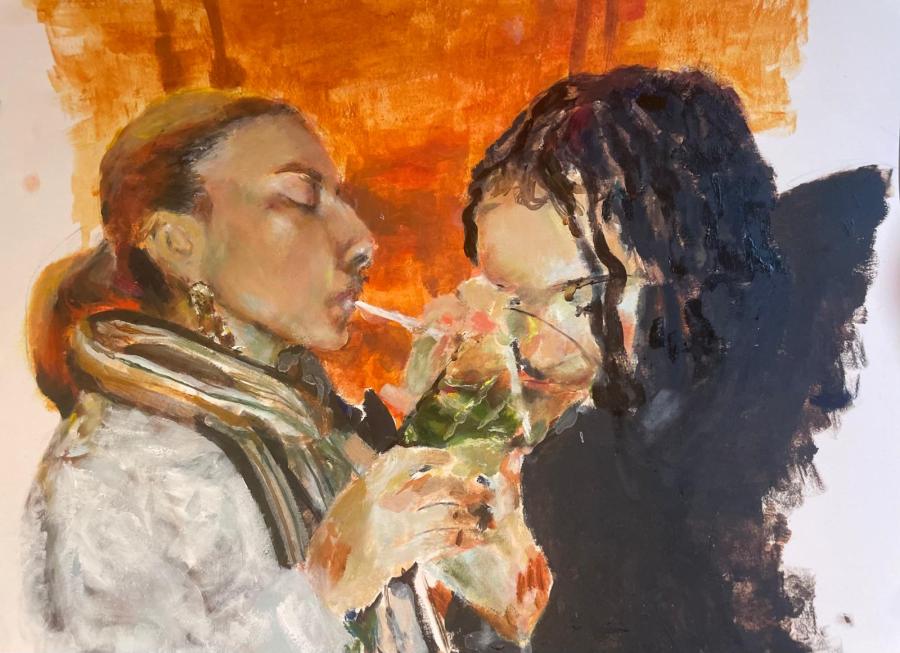
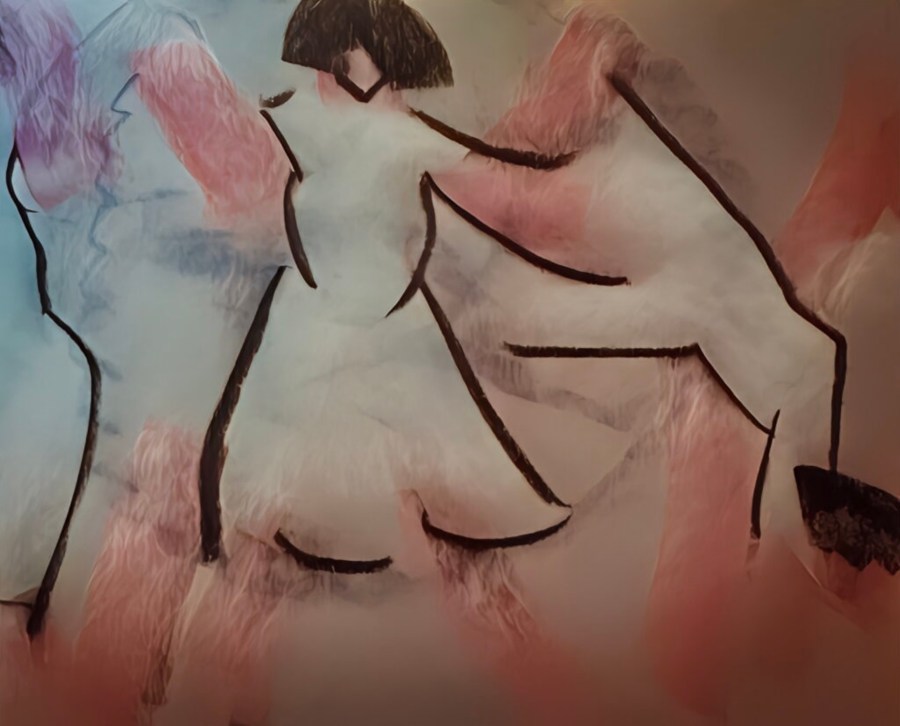
Featured Art: “Butoh” by Elowyn Frey

It’s Saturday night. The sun is almost down but not quite. Like the sky’s getting ready for bed but taking its time about it. Just letting a few streaks of color show up here and there. Maybe God accidentally left a red sock in with the whites and turned the whole thing pink. Pink is our favorite color. 

We spent the entire afternoon putting our hair up and painting our nails neon orange and bright green at Leeandra’s house. There’s another word for that color, called chartreuse. Leeandra’s mom taught us that word. She likes French things. Champagne and croissants and she even went to Paris once. She has a whole album of pictures and when she has too much to drink, she cries while she flips through it, the tips of her manicure shaking. 

While we were doing our nails, one of the neighbors was blasting a radio through an open window. The preacher thundering about how the devil himself walks amongst us. Exactly as the Good Book hath foretold. He is called the Devil and Satan and we know him because he has the mark of the beast. But the preacher said his power is nothing compared to ole’ Elijah: “And he will go on before the Lord, in the spirit and power of Elijah, to turn the hearts of the parents back to their children.”  

Their hearts got turned away. Adults never understand that part. 

Read More

coyote girl

By Angela Tharpe
Featured Art: “Busy Season” by Gabriela Denise Frank

I am not a city girl 
I am not a city girl  
I live in the city 
moved here last week  

I went to a slam poetry mic &  
did not read slam poetry & 
now everybody wants to know 
where I’m from  

where I’m from  
you can pay 10 bucks  
to feed a coyote 
from your car 

it is all very  
unregulated  

in the city 
I say hi  
to everybody I pass 
on the street 
out of habit  
when I smile 
they frown  

they want to know  
where I’m from  

where I’m from  
you can pay 10 bucks 
to watch a guy  
ride a bull 

inside a bar  
beer in one hand 
bull in the other 

it is all very 
unregulated  

here  

on the subway 
I thought a guy was talking to me 
he was talking on the phone 
I responded for longer 
than I should have  
he didn’t ask  
but he probably wants to know  

where I’m from  

where I’m from  
everybody knows  
which hotels have bed bugs  
& which ones are fine 
all you have to do  
is ask  

if you ask me  
where I’m from  
I’ll tell you  
I can’t go back there 
for long 

it is all very 
unregulated  

but if you ever 
wanna 
feed a coyote 
just say the word  


Read More

Pounds per Square Inch

By Melissa Strilecki

Once, I wrote a single poem 
to expunge a relationship—it ranged and roved.  
Five poems in with you and there is always  
one last thing to say. I met your brothers  
and their wives, and I hear you all had a laugh. 
You’ve always liked brunettes in tennis shoes, 
and I, vaguely blonde, wore a dress.  
I catalog every slice that breaks  
the skin—see all the places you got in? 
Every link, every image I send anyone, 
my phone still thinks I want to tell you.  
There should be a way to measure  
the weight on my breastbone. Once, loving you  
was a privilege. Your card arrived—cold  
and polite. Beside the mailbox, 
I licked the envelope. I can’t tell you,  
so I tell everyone else. When you called me  
to say, “My dad wants you at the party,”  
I tried on everything I own. 


Read More

Birches

By Michael Carson
Featured Art: “Off Road” by Arlene Tribbia

We had a line of them on the right side of our property. When raking leaves, my dad would occasionally touch their sides as if bringing them closer for an embrace. I didn’t want to be out there in the cold and found his tenderness toward what I considered to be un-climbable trees, and therefore pointless trees, a little embarrassing. 

My best friend at the time didn’t. His dad would kill himself in a few years. He hadn’t yet, but he would, and the older I get the more I am convinced that time moves backward as well as forward, and what will happen can be felt in what hasn’t.  

Read More

Runaway Cars

By Nancy McCabe

Later it became one of those stories you tell at parties, embellishing: how I’d forgotten that my 1976 orange Hornet was prone to rolling if I didn’t put on the parking brake, how I parked it at the top of a hill that sloped sharply down to Highway 71, which bisected Fayetteville, Arkansas, and hopped out to fetch my neighbor. How I returned to find my car gone. 

“Someone stole your car?” my neighbor asked incredulously, meaning, who would steal that car, with its ceiling that drooped like a tent’s, with an orange finish that had dulled and turned mostly black because, at 25 and in graduate school, I never had the time or inclination to wash it? 

A pickup truck chugged up the street. “Are you looking for a car?” the driver called out the window. “It turned thataway.” He pointed. I ran. 

Read More

Ford Bronco

By Parker Logan

The moon hangs over the bayou in a way 
   that would make Linda Ronstadt yearn for a place 
that never existed  

   when I see my employer’s brand new,  
formerly-sky-blue, Ford Bronco bump off towards 

the city, tires still clean after two and a half weeks  
   of sitting stashed a thousand feet away from the dumpster  
filled with animal waste and saw dust,  

   not a single spit of dirt whipped up 
on the now-silver-wrapped four doors 

   I haven’t been able to look away from: 
I thought they were filming a movie, 
   that cream colored dream of a vehicle 

      parked over the lines in the placard 
spaces where all the big bosses park, 

   right next to the mechanic’s No Parking door. 
      I’m full-body pig-squealing  
and I’m not sure why. I know 

   people make money at my job, 
mix drinks and don’t get hang overs, 

   swim in the sea lion pool on storm watch, 
and I don’t even own a car, don’t wanna spend 
      the rest of my summers worrying 

about a promissory note when we’re all broke 
   except for my bosses, apparently, 

      but that’s not a surprise: I work  
at the fucking zoo, which is like a circus,
 
   and there’s always a clown with a big red 
nose at those things, only ours 
   swindles millions in the name 

of community outreach, neighborhood improvement, 
   big developments, exciting new construction projects 
      to make the city more contiguous, baby, 

   grimey cash, and why the fuck 
did he paint the car millenial greige like my old coworkers 

at the library liked: what was that guy thinking, 
   dropping money on a beauty 
just to knock its teeth in? Even I know 

it’s sin to take a song bird’s wings 
   and clip them 

      or sell a work horse in its prime 
to make glue. Look: all I’m saying is 
   I’ve been eyeing things and coveting 

others material possessions, fondling  
   my little life in my right hand and the world 

in my left, and ever since kindergarten 
      I’ve been a southpaw 
swinging like a mad clown, myself, on the playground. 

I’ve been counting my nickels, 
   saving my dimes,  

and nothing I own looks so cool 
   as that besmirched automobile in the moon light, 
      desire wading deep in the water. 


Read More

Etc.

By K. A. Polzin
Featured Art: “Walking On Fish Bones” by Lesley Weston

“Etcetera, etcetera, etcetera!” Tiny called to me from the loading dock. 

Me: “Okay, I’m coming, etcetera!” I ditched my forklift and hustled over.  

Tiny grabbed his car keys, and we headed out. He knew I knew that today was Taco Truck Day. So he didn’t need to say the words. Every Tuesday and Thursday at lunch: the taco truck.  

Tiny drove. In the car, he said, “You hear that? That’s my stomach actually growling. Audibly. I’m so fucking etcetera.” 

“Me etcetera,” I said. 

At the taco truck, I got carnitas. Tiny got al pastor. Against worksite rules, we both got a Modelo.  

Ramón from the truck usually threw in some kind of freebie. Today was corn salad. We were good customers.  

When we finished, Tiny wiped his face with a napkin and said, “Etcetera?” 

I stood up. “Yeah. Etcetera, I guess.” 

He drove us back to work. 

Tiny, getting out of the car: “Etcetera those pallets that came in this morning.” 

Me: “Yeah, I know. Fucking etcetera.” 

There was only one job on the loading dock: moving pallets. Putting them on trucks, taking them off of trucks. So Tiny could only mean one thing. No need to specify.  

Read More

The Horse

By Morgan Hamill

You’ve seen the corn grow tall twice already. The goats drop kids.  
The carpenter bees drill their holes and die. July stops 
feeling sultry; then it’s winter. You’ve been back to visit the city,  

where you recall the three a.m. dawn chorus,    a cacophony 
    set to streetlights, sun nowhere in sight.  
Out here, in the country, with no trees  
          on your property, 

mornings are silent.     Every morning is silent. 
Each morning, in your head, all that’s left  
is to make coffee,   go to work,     and keep working.  

You’ve done this before, had this idea  

that you have no ideas   
no words   
        that you’re trapped 
and might as well get off the horse. 

But  

here’s the thing: the horse knows to stop when you’re asking too much. 
it throws you off. 

And 

this is not how 
you’d meant to quit 

(you’d meant to quit 
but not like this) 

but here it is 
and here you are 

held by the hush that comes 
not because there is  silence  
but because everything listens. 


Read More

Culture

By Paul Christiansen
Featured Art: “The Passion of Alice” by Gabriela Denise Frank

Culture comes down to pressing the fish 
into sauce with their guts intact 

or sliced out. Always the part in the story 
where the captain must abandon the riches, 

18 months of silk or pepper or whale oil  
sinking while the crew makes for the lifeboats. 

Always the part where the immigrant child is mocked 
for the fragrance of the lunch their mother packs. 

In times of war, the price of live whales plummets, 
the price for whale meat soars. 

Every day is a day during war.  
This lazy anxiety, the waves of large inland lakes. 

The water stain streaking my bedroom ceiling 
resembles the Sino-Soviet split. 

Snow leopards are not leopards,  
they’re more closely related to tigers—

what does this knowledge get me? 
Over a spread of seafood, Dạ Ngân scolds me. 

I can say I enjoy eating the shrimps’ heads, 
but should not say that I enjoy eating the shrimps’ souls. 

It’s unclear if this is because we don’t know 
where a shrimp’s soul is, or if shrimps have them. 

Or maybe, we shouldn’t admit 
to enjoying the eating of souls. 


Read More

Interview With Maya Jewell Zeller

By Anna Chotlos
Featured Art: “Traffic Garden” by Arlene Tribbia

Raised by Ferns (Porphyry Press, 2026), a memoir by Maya Jewell Zeller, maps a journey through the sometimes-strange wildernesses of self, from her upbringing among ferns, wild blackberries and public libraries to a literary life as a professor, navigating the comforts and discomforts of a suburban environment. Zeller’s prose offers close attention to “the transportable treasures of a shifting, unpredictable world” (213). (Poets always write the best memoirs.) Rendering the rural Pacific Northwest of her childhood and ongoing questions of identity and belonging with nuance and tenderness, Zeller writes “against easily categorized notions of what poverty and privilege mean” (166) and toward complexity and capacity.  

In addition to Raised by Ferns, Maya Jewell Zeller’s recent books include The Wonder of Mushrooms and out takes / glovebox. Zeller’s poetry and prose appear widely, including in New Ohio Review, where her poem “Craiglist” was selected by Billy Collins as the winner of the 2012 New Ohio Review Poetry Contest.  

(This interview has been edited for length and clarity.)

Anna Chotlos: One of the first things I noticed about Raised by Ferns was form—the HOA regulations in “The Privilege Button,” the USDA fire rating system in “Poverty Fires,” SAT questions in “Complete the Sentence,” and the way you’re bringing those forms into your essays. In your writing process, which comes first, the form or the content? How do you think about the relationship between the two? 

Maya Jewell Zeller: As someone steeped in a lot of genres, I’m interested in form as a challenge and also as a container. I come from the land of poetry before prose, and I’m very interested in what Denise Levertov describes as organic form in her essay “Some Notes on Organic Form.” In that essay, Levertov refers to the poet Gerard Manley Hopkins’ concept of inscape [the unique, internal identity of an object expressed through its outward form]. Likewise, whether I’m writing poetry, essay or fiction, my form tends to follow the emotional inscape or the intellectual and emotional inscape of the piece. 

Read More

There’s the Sky and She Isn’t Empty

By Rebecca Brock

“We are not human beings having a spiritual experience. 
We are spiritual beings having a human experience.” 

— Pierre Tielhard De Chardin 

Two vees of wild geese merge as the sun shrieks 
color the way sunsets out west burn 
when the land burns. It must be the hurricane, 
states away yet. Here, in Virginia, I am waiting 
again, at the high school, for my son 
who won’t talk the whole ride home. 
Is this what they mean? What doesn’t kill you— 
and something about the pressure 
it takes to form a diamond: your land burns, 
your home floods, but just look at that sky! 
I text three friends:  Go outside. See the sky. 
My therapist says my need to connect  
can feel like aggression. I can’t help  
but think that the threat of mutually assured 
destruction keeping us safe seems less solid  
these days, less tightly wound. 
In the car, waiting, I feel like an eye 
of a great storm—or the source 
of unseen damage. I cannot say, son, 
talk to me, please. So I wait  
too long in the car, in case he’s out early, 
I wait and listen to the marching band 
practice, watch the sky work its palate, 
and if anyone walked up to the car window 
and asked me who I am or where, 
I might say, I am the child’s mother
When I see his slouch 
and angle, the sky expands 
and contracts like the rib cage 
when breaths are deep enough. 


Read More

He Goes to Sleep to Survive This

By Rebecca Brock

We aren’t ready for how the intake’s face
falters when I say why we are here,
for how quickly a guard and an orderly
take us back, past normal hospital rooms,
to a holding block, a two-room cell— 
three rooms if you count the nurse’s station  
where they sit in shifts, watching.  

The walls are pocked and scarred
with wounds and messages.
The door only locks from the outside.
He cannot keep his notebook
because of the spiral binder.
He can keep a pencil but not a pen.
The nurse locks all our phones in a locker.  

He says his pain is at a seven,
tucks himself sideways on the hospital bed, 
his back to us, his hair a scatter, 
his body a long comma—we wait.
We wait for hours that feel infinite  
and sad. Child, I try to say, or maybe
it’s a prayer: child. 


Read More

How We Are Called

By Todd Campbell
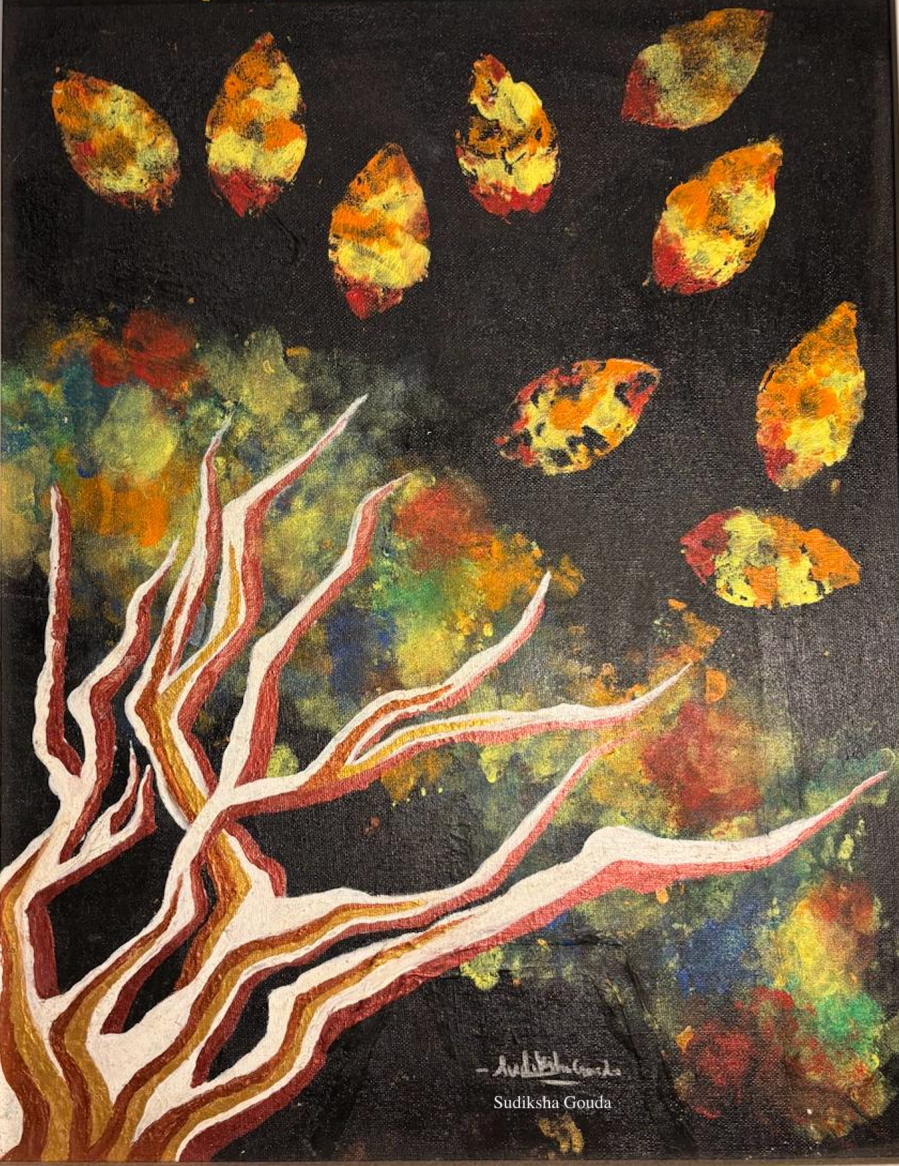
Featured Art: “Derealization” by Sudiksha Gouda

1.

At the airport where I kill time
standing in a long line to order
coffee and a muffin, I’m stopped short
by the young woman on the other side
of the counter who asks me what’s a good name?
She’s called Crystal according to the tag
pinned to her chest and I have never liked
my name, its harsh aspirated opening T
and the leaden Ds at the end that land
with a thud. Unpleasant to the ear
for romance language speakers, unnatural
to pronounce in many Asian tongues.
Subtract one letter from the end
and it’s the German word for death. 

2. 

But what’s a good name? When my son
was little, I took pleasure in teaching him
names for the living things we ran across—
orca, osprey, crocosmia, trillium, possum,
raccoon, juniper, weeping willow. I believed
I was making a gift of the world to him,
one name at a time. Until one day, on a drive
through rolling hills past pear orchards
and fields of alfalfa, where redtail hawks
circled in the sky, his mother turned to me
and insisted, with surprising vehemence,
that I stop this naming of everything.
As if to name a thing is to capture it,
to possess it in some selfish way.  

3. 

For a time I frequented a tiny restaurant
with a counter where eight people watched
the chef transform that day’s ingredients
into handrolls that came three to a plate
for twenty dollars and were as close
to sublime as anything I have eaten.
He named the ingredients in each one
as he set it before his customers. One day
a man sitting next to me said, Yellowtail?
Isn’t that supposed to be called Hamachi?
Why not, the chef said with a grin.
The fish don’t really care what we call them. 

4. 

As a matter of record, what I’m called
is not really who I am. My birth certificate
lists my father’s name first. Not once
did my parents summon me that way,
or yell at me, or praise me. Which is fine.
I liked his name even less. But I have spent
years explaining to teachers, doctors,
bank tellers, customs officers, airlines,
and departments of licensing why I appear
to not be who I say I am. What’s a good name?
Crystal asks again. Todd’s fine I guess,
I say, though I’m still at a loss.  


Read More

Some Birds Are Far Away

By Jennifer Powers

My oldest son Finn became obsessed with birds when he was two years old.  He remained obsessed for two years.  Bedtime stories about talking trains and farm animals were replaced by negotiations over how many plates we could look at from the “Field Guide to The Birds of Costa Rica.” 

It surprised me that he didn’t gravitate to the flashy and colorful birds like the toucans and hummingbirds that attract me. He often lobbied to visit the much drabber pages on owls or wading shore birds.  

As a newer mother determined to nurture my son’s budding interest in birds (and perhaps no doubt motivated by the secret desire that he eventually become a field biologist like me), I invested in a pair of kid-friendly binoculars.  They were yellow and made of plastic.  They had a flimsy strap to hang around your neck, but they did magnify the world and bring distant birds a little closer into view. 

Now came the hard part.  How do you explain to a two-year-old what binoculars are for and how to use them? 

Read More

Molting

By Henrick Karoliszyn
Featured Art: “Friends” by Mia Broecke

Janice tells me about the bearded dragon. She explains that Melvin, wheat-yellow with the face of a perpetual grump, stopped eating crickets. As he’s lazing about under his heat lamp, she swears his outer layer is transforming into a shade of brown right before her eyes. She calls it “emotional molting,” though I don’t think that’s a thing, and I didn’t know what feelings would cause the reptile to change colors. 

Janice is my sister, but she doesn’t feel like my sister. She feels like a stranger in a train car issuing favored life updates (her pet changing skin tone). She talks about the weather in Chicago (“shrinkage-level-emergency” cold) and the weather in her apartment (“boiling toad in pot” hot), and a trip she planned for Saint Kitts (“Henry Cavill” degrees in December). She talks about disappointing politicians in clipped, bumper sticker fashion. She talks about the disappointing Cubs in long-winded run-on sentences. She talks about the disappointing Netflix series based on a book she loved like it was a false prophet.  

She doesn’t talk about Mom anymore. 

Read More

No Kelp Root Ever Burned With Retroactive Shame

By Susan Blackwell Ramsey

for Ursula Vernon 

The caption reads, in its entirety, 
 “The kelp root serves no absorbent function. 
It serves only as an anchor.” Only. 

Well, pardon kelp roots for doing one thing well,
 for not multitasking, for failing to walk 
the center line, backward, on one foot, juggling plums.  

You’d think anchoring a keystone species might be enough. 
 Those amber cathedrals swaying toward the light 
are able to harbor, nourish, filter because 

of single-minded, undistracted roots 
 who have mastered their craft, anonymous, 
remarkable only for sticking to one job. 

Some of us ultra-absorbers frankly envy 
 those kelp roots. They never feel compelled 
to tell perfect strangers why Charles Steinmetz 

was more brilliant than Nikola Tesla, and by the way 
 had friends who called poker night “The Society 
for the Redistribution of Salaries.” No kelp root 

ever burned with retrospective shame 
 at having delivered a monologue on Sham, 
the second-fastest horse to run the Derby, 

losing to Secretariat by a third
 of a second and who has dwindled to a footnote 
though no horse ever ran that fast again. 

Sure, it’s rough to be passed over, your one talent
 for tenacity dismissed as merely stolid, 
but it is preferable to being the frog 

chomping water beetles who realizes
 ”she’s swallowed a Regembartia attenuate 
again, feels it resist digestion, walking 

steadily through her convoluted gut, and knows 
 from experience that the beetle’s going to stroll 
irresistibly into another day. 


Read More

Luckspotting

By Susan Blackwell Ramsey

There’s a pear-shaped pearl so perfect it has a name, 
     “La Peregrina,” and a history of luck. 
The slave who found it traded it for his freedom. 
      Spanish queens wore it, French kings took it home.
So heavy it slipped its setting, lost in a sofa  
     at Windsor Castle, at a Buckingham Palace ball, 

always found. Burton bought it for Elizabeth Taylor
    and when she realized it was gone again 
she scuffed barefoot and terrified through the shag carpet 
     in their Caesar’s Palace suite, until she heard  
one of the puppies chewing on something and fished
     it out of the tiny mouth, not even scratched. 

Big luck is what most people mean by luck
  the lottery win, the ground ball bouncing fair, 
the chunk of change from a cousin you never knew. 
  But big luck’s cumbersome, its gravity 
so great it attracts an asteroid belt of envy,  
  a malice moon. And big luck tends to have
a flip side for someone—that understudy only
  gets her break when the star’s leg breaks, too. 

So in real life I’m fond of a finer focus,
   noticing motes of luck as they catch the light,
before they land and are swept away by the daily.  
  This approach is like birding—not for everyone, 
but possible to practice everywhere, added facet  
  of pleasure improved by practice. Any lifelist  

is personal, whether trainspotting, eclipses, or operas. 
    Another person might only be satisfied 
by a purple gallinule, a roseate spoonbill. 
     I’m more like the birder who kept a list  
of birds seen from her backyard, and if that meant
    standing with one foot on the garbage can, 
one braced against the back fence, leaning to see 
     the sharp-shinned hawk down the block—my list, my rules. 

Luckiest of all might be a gift
  for recognizing your luck, its ebb and flow, 
its magnify and shrink, its bloom and furl. 
 When that maple fell and filled our yard, 
but barely kissed our window with thinnest twigs 
  my sister told me “You have good bad luck.”  

No one wants constant fireworks. Better to have  
  luck like fireflies’ unpredictable winks. 
North America has one hundred forty six species  
   of fireflies punctuating our summer nights. 
There are fifteen species just in Kentucky.
 Fifteen species—that’s what I call lucky. 


Read More

Chunky Monkey

By Julie Teixera

It was Chloe’s first day of first grade, and she insisted on wearing an embroidered linen blouse with a pair of swishy athletic shorts. The outfit reminded Gina of a mullet: business on top and a party on the bottom. But despite Gina’s pleading, Chloe refused to change. Gina took pictures of her daughter in that strange outfit, pictures of her smiling so wide it looked like her jaw might unhinge. Chloe’s doe-eyed optimism made Gina’s heart tighten.  

Please, she thought. Please let her make friends

Read More

Butterscotch

By Carlene Moore
Featured Art: “Partner Pitching” by Lesley Weston

Nine 

The night my dad walked out was two weeks before Halloween. My mom and I had finished my costume, a porcupine, that afternoon and I was so excited to show him. But I stopped short in the hall when I heard my mother shriek. “You smell like perfume. Perfume.” 

“What are you on about?” My dad’s words were soft like caramel. He had been drinking.  

“Who is she? You know I’ll find out.” 

“I was twenty when you got pregnant. That was too early. A man needs to sow his seeds. It’s only natural.” 

My mom’s laugh probably tasted as bitter as it sounded. “Because I’m the only one responsible for that pregnancy?” 

“I didn’t want it. And then you went and did it again two years later.” 

“If you don’t want it, then go.” 

I don’t think she thought he’d leave. But he did. He stormed right past me, my quills scraping the wall when I backed up to let him through. He didn’t even notice or comment on the fact that his daughter was “spectacularly spikey” as my mom had said earlier that day.  

I chased him into the driveway. “Dad. Dad! Don’t you want me?” 

His eyes met mine above the hood of his car. “Aw kitten,” he said, shaking his head. But I wasn’t a cat. I was a porcupine.  

My house filled with tears and shame and cursing for a few years after that. During which I learned that being wanted, above all else, is the key to happiness. There’s a power in it. 

Read More

Preparing a Feast alla Louis Prima 

By Caroline Laganas

If I could serve you a buffet worthy  
   of Italian American musician  
      Louis Prima and keep you returning, 
   then I’d dig my fingers into the ground  
beneath your feet to plant the seeds to grow  
   grapes, plums, pomodori, donut peaches,  
      string beans, and a shiny rainbow of onions,  
   because as soon as they ripen I’d toss them  
in an insalata and antipasto  
   to go with a tray of exotic cheeses 
      that smell as tantalizing as God’s feet—
   except Casu Marzu from Sardinia  
because sadly we’re not allowed to import  
   sheep’s milk fermented with insect larvae—
but what do I know about the law 
other than voir dire means “to speak the truth” 
and it’s essential for potential jurors  
   to answer every question truthfully 
      to see if they can serve impartially, 
   so I might as well confess to you now 
that I can see us drinking whiskey 
   and getting frisky off a mint julep 
the same way Prima did in that one song,  
   then we can decant the super-duper 
Tuscan to let it breathe and catch our breath  
   before pairing it with steak pizzaiola,  
      cutlet parmesan, and chicken cacciatore—
   then we’d share a dish of sunshine and ravioli   
before eating a spread of baked ziti, macaroni,  
   chop suey, chow mein, and minestrone, 
      with braised fillets of baccalà on polenta—  
   but I could never stand by the stovetop  
stirring cornmeal for an hour nonstop, 
   especially when I could watch your lips 
      pucker up to the spoon I now envy, 
   brimming with steaming pasta fazool— 
I admit I could be a fool for you 
   but not enough to go to carpentry school    
      to learn how to build a bigger table  
   that could display platters of spumoni  
and cannoli, or the banana split  
   Prima dedicates an entire tune to, 
      you know the one with whipped cream piled high  
   as the Eiffel Tower topped with cherries,  
nuts, a pepperoni pizza for fun,  
   drowned in an infinity pool of hot fudge—
      and with me, you’d never be left hungry, 
   so by the time we devour our feast  
and the insatiable jazz band can’t feed off  
   the sizzling crowd for one more encore to end the night, 
      our empty plates could become a lifetime of full moons. 


Read More

You Gotta Give Back

By Eric Rasmussen

Apparently the after-school club meets in an old Chinese restaurant? Colin parks out front, takes a deep breath, and tries one more time to tie the tie Heather gave him. It’s a lost cause. The fabric is too slippery or something, so he balls it up and throws it in the back. It’s fine. He’s not interested in any of the kids who would find such attire appealing, anyway. 

The entryway features a big gold Buddha, and just past an empty fishtank, under a mural with mountains and dragons, about twenty children sit at tables, doing their homework or coloring. A few of the older ones stare at their phones. A woman in a blue Buddies 4 Life t-shirt meets Colin at the hostess station. “Can I help you?” 

“I hope so,” he says. “Otherwise I’m fucked.” 

Read More

Cock Robin Sonnet

By Kevin Grauke
Featured Art: “Santa Cronica” by Gabriela Denise Frank

I hate how bored I am now by robins, 
but so many appear here each April and May, 
as the green reveals. Little redbreasts in leafing 
trees, little redbreasts hopping on the sprouting  
soil. In their ubiquity, they rival dun sparrows, 
but they deserve more, our heralds of spring, 
though I do wish their inspiration to sing might 
come a little later than right before first light.  
I once saw them mostly in Little Golden Books, 
with delicate worms curlicuing from their beaks, 
but now I read nothing but memos and reports, 
where no birds flutter. Mornings find me grid- 
locked, caffeinating, listening to new bad news. 
From above, they shit on me intermittently.  


Read More

Of Petty Complaint

By Kevin Grauke
Featured Art: “Tunnel” by Jean Wolff

I’ll eventually be nothing but a name on a headstone  
to be mispronounced by a goth couple making out 
on a funereal tryst in a moonlit cemetery—unless,  
that is, I choose fire over dirt, ash over black humus. 
                                                         ↑
Are you like me? Do you stumble on this word ↑, too, 
wanting always to pronounce it like the pureed paste  
of chickpeas? Good! I’m glad to hear I’m not alone. 
And thank you for being honest. So many would lie, 

afraid to ever seem even slightly less than better than.      
I hate people like this, so insecure they have to claim  

to know what they don’t, like the meaning of miserere  
during Quizzo, thus losing our team the brew pub title.  
But I stay quiet, knowing they’ll remind me how auto- 
correct always knows to change my name to Grouchy. 


Read More

Love Locks 

By Leslie Pietrzyk

“It’s a red bird,” Cassie shouts, pointing at a bush ten feet ahead as the startled bird swoops to higher tree branches. Cassie’s constantly shouting or thrashing or bouncing around. Adam wants to appreciate that his daughter’s active and noisy, tries to understand she’ll do well in boardrooms and on teams if she can impose presence. He, himself, started out a quiet boy, an observer, prone to silent, secretive rages. Not until college did he force himself to learn to speak up. Life got better. 

“Yes, a cardinal,” he says. 

“No,” she says. “It was bright red. Like a crayon.” She turned seven last week, and now she’s an expert on everything. That’s what she announced at the party thrown by Beth, her mom, where a dozen squealing girls tore through pizza and a bouncy house shaped like a castle. Before blowing out the candles on her rainbow drip cake, wall-to-walled with pastel frosting roses, Cassie said, “Announcement please! I’m exactly seven years old now, so I’m sure I know everything there is to know.” Boisterous applause from the little girls, but Adam laughed, along with the two moral-support moms dragged in to help. Beth radiated simmering anger at him, scooping Cassie into her arms. “My sweet and smart little beanie-bean,” she said, holding the pose for pictures, which Adam dutifully took with Beth’s phone. 

“Yes,” he repeats. “A red bird is called a cardinal. Want to know why?” 

Read More

In The Paint

By John Pring

Early evening and snow falls silent  
as grief. I had been learning to leave  
ajar the door of the aviary, the one  
shadowing the small gardens 
of my chest. When you turned up,  
freezing and exhausted, you had brushes 
tucked under your arm. It isn’t happening 
you said, I don’t know what I’m doing.  
By morning I have cleaned your squirrel 
hair, licked clean the maple  
and the alder. I want to ask if you love  
me the way you used to, but you are  
already leaving. It has to happen in the paint,  
you said, or it doesn’t happen at all.  


Read More

Farsi

By Karen Tolui
Featured Art: “Re Centered” by Gabriela Denise Frank

I could go on and on about 
my adopted language, 
how Farsi sometimes misses the point, 
like ‘missing you’ my heart is tight, del tang, 
And then, the heart 
means also the stomach, 
and I don’t know where to point 
when I’m hungry for love. 

And sometimes you’d say 
you could eat my liver 
and thought I’d take joy 
in that, but meanwhile 
you had swallowed me whole. 

I remember that night 
at Sambo’s in Eugene.
Your question rang in my head 
like thunder I couldn’t hear 
because the language has no word
for the sound of thunder. 

We had filled our hearts
with banana cream pie, 
so what else could I do 
but say yes, from the bottom 
of my guts, when I should have said 
khak bar sar, or 
dirt on your head.


Read More

Quad Stunt

By Michael Lutz

When dad first explained the stunt to me, I didn’t understand it. I acted like I did, but I could tell he knew the truth. He left the dining room, came back with a piece of paper and a pencil and started drawing.  

“See, I’ll be riding the quad coming this way, hit the ramp here,” he said, drawing the way with a line, “And you’ll be laying down here, where this x is, in the ditch. And I’ll jump through the air over you. The best part is, we’ll do it right when mom is pulling into the driveway to pick you up, so she’ll get to see it.” 

I looked at dad’s drawing of the ATV—which was always what mom called it, for some reason. I imagined it flying over me, the metal frame and handlebars and motor and 4 big tires. We had just finished eating my favorite dinner, peanut butter and jelly crackers, which normally makes me happy, but dad talking about the stunt made my stomach feel sick. “I don’t think mom would like that.” 

Read More

Post-Divorce Aches & Pains 

By Heather Phelan
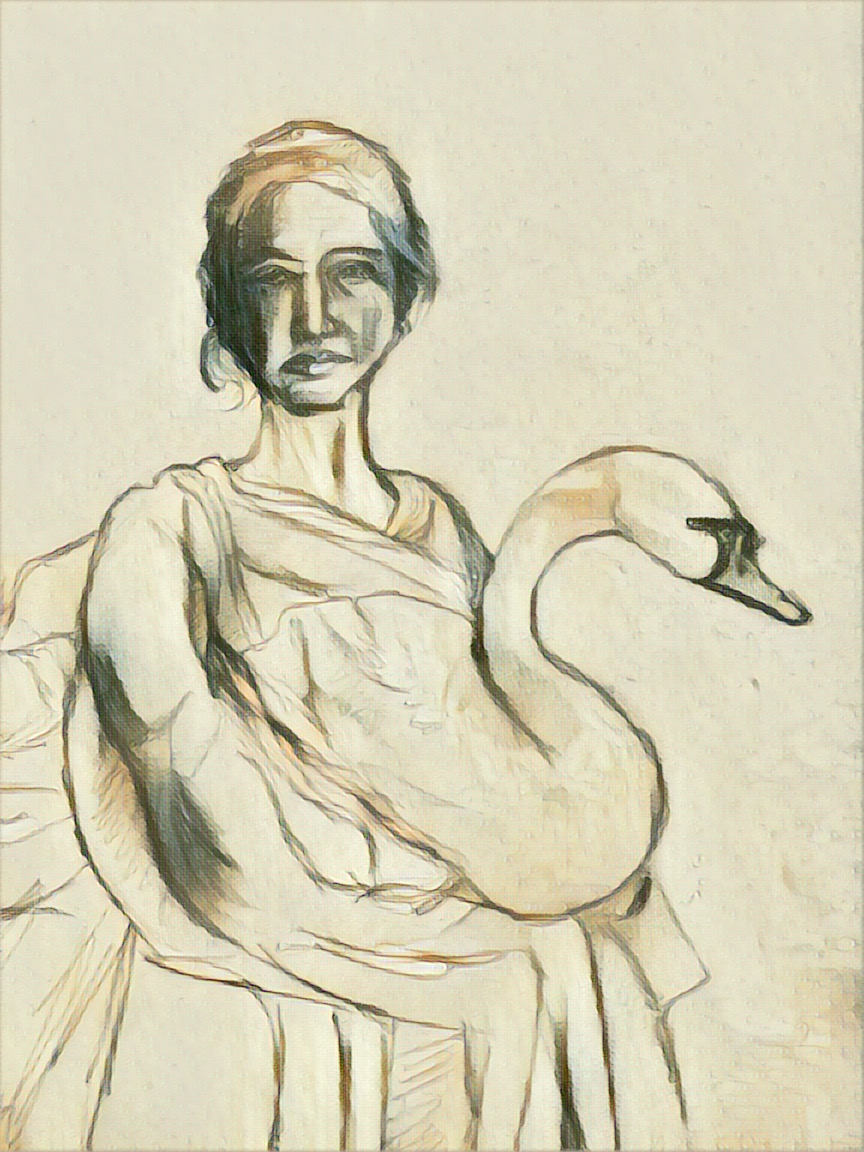
Featured Art: “Leda” by Lesley Weston

My left hip moans, complains 
about my femur, who complains 
about some restricted range 
of motion. Two forces that used 
to glide unaware of the other, 
free floating in synovial fluid. 

I roll over to my right side, but 
nothing feels right. I stretch 
my left heel toward the bottom 
of the bed, hoping for relief, 
but my right shoulder can’t bear 
the weight, and I have to use 
my left palm to push onto my back. 

My friend tells me the same 
thing happened to another 
friend and that I may need 
a hip replacement. The internet 
says I may need hormone 
replacement therapy. 
My daughter tells me I just 
need a new mattress. I know 

I likely need all three, but 
my daughter’s suggestion 
is the one I try first. I tell 
myself it’s the lowest-lying 
fruit, but that turns out 
to be a lie I don’t realize 
I’ve told myself until I’m alone 

on the tester mattress in the store, 
my head on a disposable 
pillow protector. Staring up 
at the popcorn panels 
and fluorescent lighting, 
ignoring the families running 
from bed to bed, I close my eyes, 
breathe in, hold it for a moment, 
and push the air back out 
over my tightening throat. 


Read More

What Stays, What Goes

By Ruth Bardon

I want to believe that pleasure leaves 
a light stain on the bones. 

They say the body remembers pain; 
they never mention joy. 

I know that pain accumulates,  
fattens like a tick. 

I want to believe 
in a quiet shine, 

some ruffled fur, a subtle scent, 
a sprinkling of light. 

I told myself repeatedly 
when she was busy dying 

that our little celebrations 
would have to do her good, 

would have to leave a fingerprint, 
a residue of gladness, 

and now that you and I repeat 
the steps we took before, 

the visits and the guided tours 
as if we’d never been there, 

I have to hope that even though 
I know we won’t remember, 

the strange delights will mark our bones  
and metamorphosize, 

and nourish something in our blood 
to help us at the end. 


Read More

New Year

By Jiachen Wang

Every morning our father went under the bridge to collect the coal scattered along the railroad tracks. On a good day, he could fill three sacks and sell them for twenty yuan. On Sundays, he brought me and my brother with him. Sometimes the pieces I put in my sack were no good, and he had to pick them out one by one. It was very difficult for him to bend down, and this made me think that perhaps everyone in this world had some kind of clockwork inside their bodies, except that the one inside our father had not been oiled for a long time. That’s why it’d become so rusty.  

The three of us lived in a warehouse. It belonged to the government but had been mostly unoccupied. As time went by, it became filled with cardboard boxes and rat shit, like how when a garden stopped having children poisonous weeds started to grow. Every month, Old Liu from the train station would receive something from our father (in a good month, a carton of cigarettes; in a bad month, two bottles of baijiu), and he’d let us live here rent-free. Behind the warehouse stood a garbage mountain that looked like Kilimanjaro in winter but smelled terrible in summer. The inside of the warehouse was similar to a deep well. When we talked it sounded as if we were underwater. At the end of the storage racks was a little room with two plank beds and no light except for a lamp I used to do homework. That was where we lived. After dark, my favorite thing to do was climb up the pipe to the rooftop. Standing there I could always recognize, from the lights afar, the Ferris Wheel in South Lake Park.  

Read More

Total

By Alex Mouw

She said, kiss my shoulder. 
I kissed each one hundred times. 

The moon rolled across the window 
as she drew her hair, like a curtain, to one side. 

I don’t care about money, she said  
when I bought a loveseat knit with ten thousand green threads. 

To prove we are an adventure in the clouds, 
I lay down and took three pictures 

of her easing to a cliff’s edge, 
not the mist settling on stripped mountains. 

She advertised for an agency, a university, a corporation. I filled  
ten notebooks with black ink. We came to want a statement sink. 

She asked me to count the greeting cards we’ve set 
on the shallow counters of eight apartments.  

I wanted rings stretched to orbit 
without a planet’s mass.  

For her I cracked hard fingertips on a guitar as now 
I burn them over butter and pearl onions, stuffing bird legs in a pot. For me 

we bought a second car. Do you want more?  
I asked for three Decembers, meaning, like a hairdresser, 

can I take more, 
it will be beautiful? 

She tweaked the lampshade and tried on dresses. 
Nearly naked—seven times! Fourteen when I counted the mirror. 

Were we a calendar reading FIRST RED LEAVES,  
TWO JARS OF HONEY SHATTERED IN THE STREET, 

are we the kind of flight to blaze orange-winged, thinner than stained glass, 
or shrivel to a dusty moth?  

Love the hunger—unyielding and, once fed, asleep— 
or love the house we built around it, the concrete troweled to the edges of a pit.  

I held a key to her. She slid it 
on a ring with seven others. 

She said, kiss my shoulder. 
I kissed each one hundred times.  


Read More

The Unbelieving Yelp of Prey

By: Shanley Poole

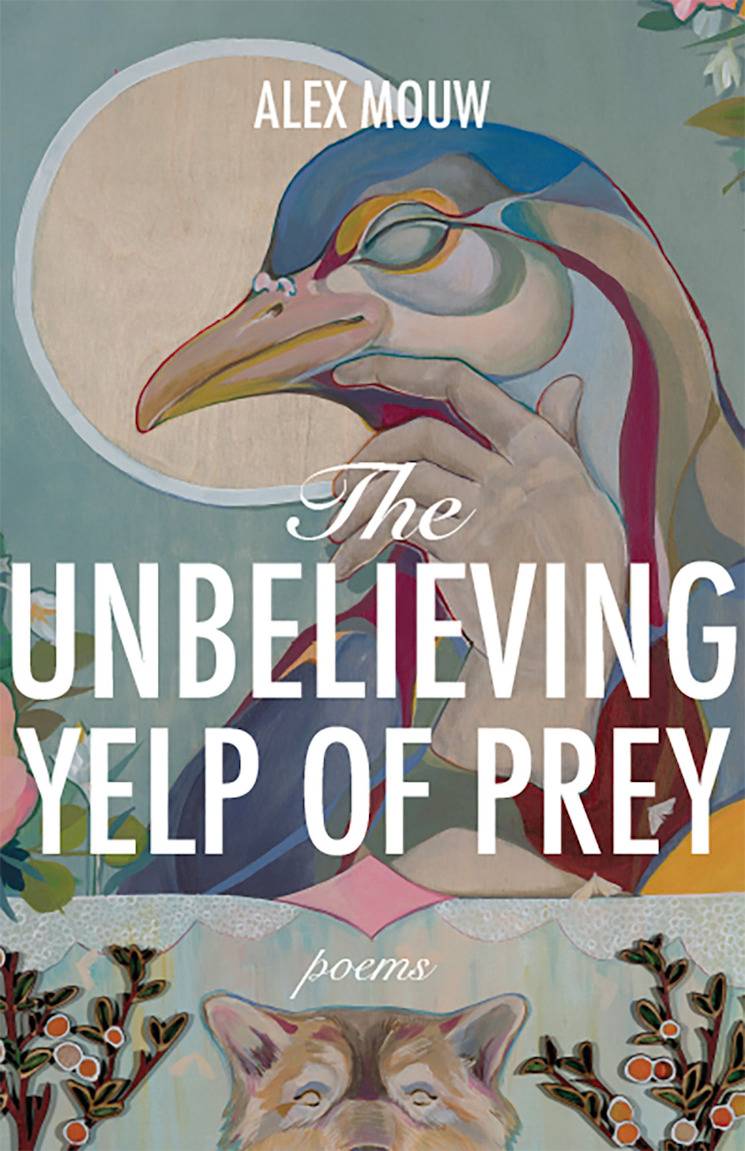
The Unbelieving Yelp of Prey by Alex Mouw offers readers a refreshing lexicon for the divine—one which exchanges pewed hymns for roadside vespers and finds the common thread between nettles and seminarian beads. Mouw excavates his knotted, religious roots in Midwest Protestantism, gently untangling them before tucking them back in the earth.  

The first poem introduces readers to “a kid / engrossed in sci-fi novels / during math. Small minded,” and while the speaker of the poem clarifies this is not who he is, a reader becomes skeptical and enchanted by the very presence that the speaker resists embodying. These paradoxes exist throughout the collection, befitting as Mouw both exonerates and questions the paradoxes of Christianity. 

Mouw refuses the stale pretense that a strong faith is an unwavering one; instead, the poet pendulums between doubts and epiphanies. The final two poems serve as a lasting gesture of this. In “Last Address to the Lord,” a speaker seeks out divinity: 

   Sick with waiting 
I checked the lake 

   even stirred 
the water with a cattail    made beautiful

ripples that were not    forthcoming 
               found termites 
in a maple 
but never you 

Read More

Staying in the Room: Emotional Courage in Danusha Laméris’s Poetry 

By Dion O’Reilly

I am regularly told my poems are too intense, that they vividly present the wound but not the cure, that they lack tenderness. This used to simply hurt me. Now it makes me think. 

Initially, I suspected that what’s called intense is sometimes just honest, and what’s called soft or quiet is just safe. But I’ve also had to ask whether the criticism contains something true—whether my poems deflect, not into softness, but into bluntness and brutality, which is its own kind of armor. Maybe I avoid the deeper thing by beating on the surface. 

Years ago, I taught art in an elementary school. Invariably, with each new assignment, the little artists would ask, “Can I be done?” But, in most cases, to create a more complete work of art, they still needed a few more brush strokes or scissor cuts. We want to be done. We want to hold our work to the light and see it’s good. Most poets, especially early in their development, are unconsciously looking for that exit—an ironic twist, an image that displaces feeling, the philosophical reframe, the sudden zoom out to landscape, history, cliché, or abstraction. These moves feel like sophistication because they resemble what sophisticated poets do. But in less skilled hands, and sometimes in skilled ones, they are escape hatches. 

Read More

Halves Holding Tight: On Anna Lena Phillips Bell’s Might Could (Waywiser Books, 2026)

By Jennifer Schomburg Kanke

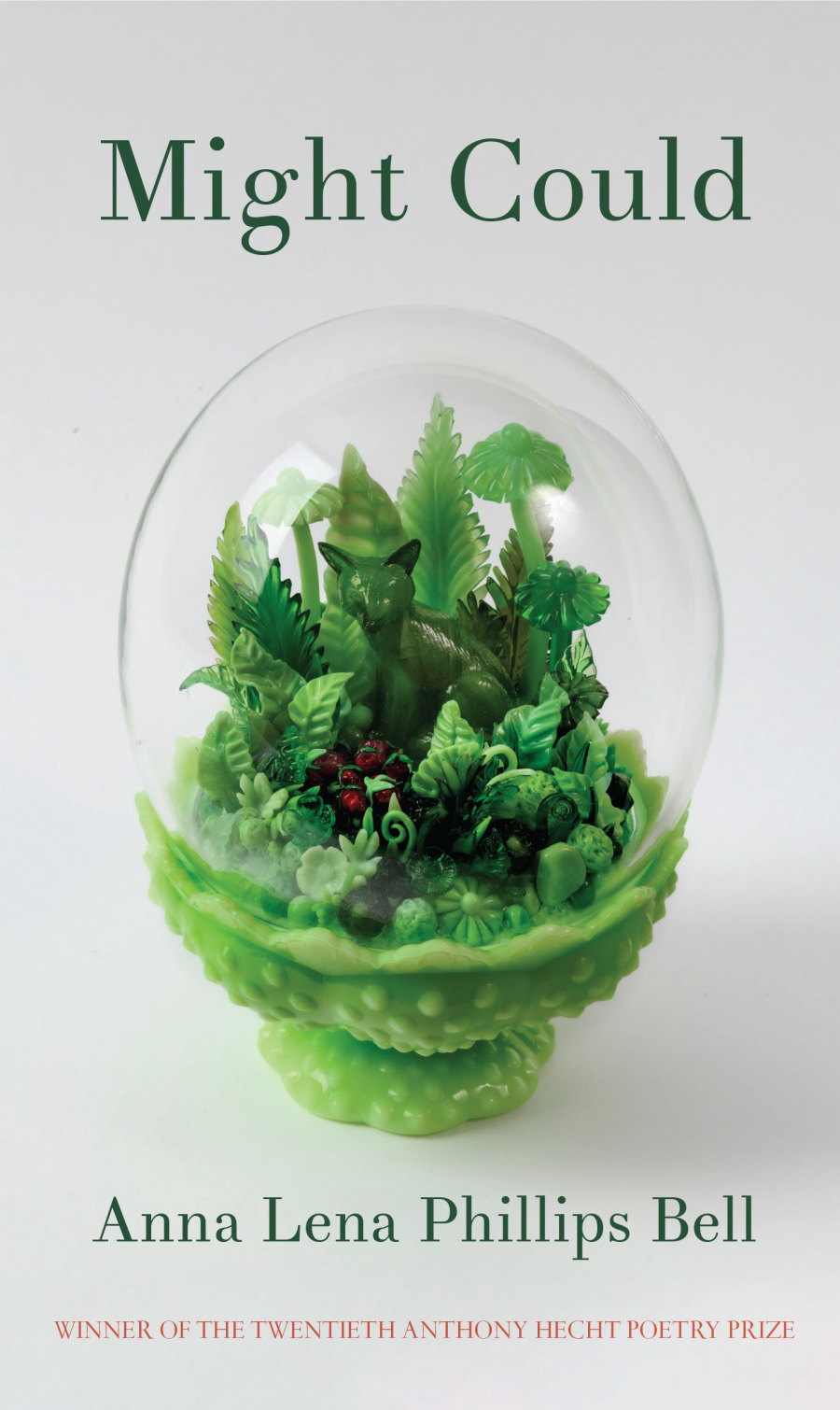
Before I get too far into reviewing Anna Lena Phillips Bell’s latest collection, Might Could, I need to disclose my bias. The minute I looked at the table of contents, I knew I was going to love this book, because on page 33, there is a poem called “Turkeytangle Fogfruit.” This plant has many names, as the epigraph to the poem points out by listing over thirty different names for it. Yes, all 33 and, yes, all in the epigraph (it’s sort of like a little bonus list poem before the poem itself begins). I call it frogfruit and it’s my favorite groundcover. It’s not flashy like creeping phlox. Its flowers are small and unassuming, but butterflies and bees love them and it takes light foot traffic and mowing. It’s lovely because of its stability and practicality, not in spite of it. The same might be said for the poems in Might Could which ground the reader with a clear-eyed, yet lyrical, vision of the natural world.  

Read More