Cheap thrill

By Mike Santora

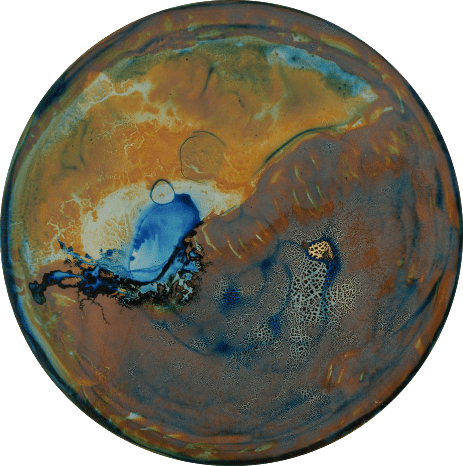
Featured Art: Chroma S4 Blue River by John Sabraw

I don’t care what the tastemakers say —
you can’t beat nostalgia
for a flightless bird worth riding
a little.

It’s still a hayabusa running the underbelly
of thunderheads or weaving
through the innerbelt.
Or it’s the corner kid
freestyling through a smile
as silly and joyful as a French horn
solo.

What I’m saying is
I’ll run with any good thing,
and now I’m reckless
in my empathy.
I’m more than a budding corpse in the wild
waiting to be born
into this ceremony of dust.

For tonight,
my heart’s the size of a wedding
and I’m in league with the last
of the lamplighters
because my son
is still alive
and nothing’s coming for his lungs
as I slow dance
him to sleep.


Read More

Twenty-pound flower

By Mike Santora

Featured Art: I Will Be Gone, But Not Forever by John Sabraw

O Rafflesia, why so down
in the canopy?
Let’s see anything else
toil for nine months
in the Sumatran jungle and come out
smelling like a rose.
You, cater the tree shrew cotillion.
Just ask the sly monks in Thailand.
Whether your medicine is gospel
can be argued in a lab until
pencils snap,
but in peninsular Malaysia,
you clot the bloodbath
after another girl handles
a birth by herself.                        
           Where were the roses then?
I know that I am petal-less
but what are you doing
for the next Millenia?
You could have me,
if you’d have me.
After I’ve died,
you can attach yourself to my breast.
I’d like to wear my last parasite
on the outside, like a corsage.    
   Or is it that you
       are wearing me,
               and it’s my turn
to live something
              like a flower?


Read More

Garage sale bible opened to the Book of Genesis

By Mike Santora

But for me it’s on the swelling
lip of Lake Maracaibo,
in an august before Augusts
where the old lightning
astonished the coast
and made us.

You and me and the New World
warblers, the tyrant flycatchers,
and all lucky thirteen species
of true vireos.

Yesterday, they sang
that it’s okay,
it’s okay.
Grief and grind are so close
in soul and bones.
And as they sang
the rain was just the earth
reading our alluvial fortune.
Look at us, so confident
in our station —
young diamonds in Islay,
unworked Spanish jet.


Read More

Air Guitar at Goblin Hills

By T.S. McAdams

Featured Art: Will O the Wisp by John Sabraw

Whether Todd Schultz ever ate cold refried beans for baby food, I don’t know. That’s something people said. I didn’t think his family was all that poor. He drove to work, so I guess they had an extra car. He said Goblin Hills had turned him down the year before. In a suburb with a big amusement park like that, it’s everyone’s first job. They always needed people, and your application was pretty much your address and your grades. You knew kids were tanking at school when Goblin Hills didn’t want them, but Todd got in the next year, at seventeen, and luck or some good or bad fairy godmother got him assigned to Casa Picante.

Read More

Bandits

By Terry Dubow

Featured Art: Day 4 by John Sabraw

When the phone rang at two in the morning, Michael leapt out of bed so as to not wake Natalie, his exhausted wife who’d been working far too much and far too late for a fifty-three-year-old. In the hallway outside his bedroom, Michael looked down at the screen of his phone and saw his son’s face staring at him. It was a photo of Ezekiel as a little boy, which was how Michael liked to picture his son, who was no longer little. He was actually quite tall. Six foot two at least. And old as well. Nineteen with a flop of uncombed hair and a tattoo on his forearm that he still tried to hide from his mother even though there were few if any secrets among them.

Read More

Love is a Kingdom of Obsidian

By Andrew Hemmert

So now my neighbor’s twelve-foot skeletons are all-season haunts,
this February morning holding huge pink balloon hearts
and grimacing against the freezing fog. I like them
this way, memento mori-ing my Tuesday commute,
though who really needs to be reminded of their own death
these days? In the shed we found a mouse corpse hollowed out
by weather and time. The body otherwise left intact—
a kingdom of obsidian abandoned in a jungle.
Love, I think, is a kingdom of obsidian I have
thus far refused to abandon to death’s jungle, though there
of course is time for everything to go wrong, or more wrong,
or wrong enough. Ice on the road, another driver running
the red, the sky a white sheet over my body. Until then
the skeleton in me is offering you its balloon heart.


Read More

Coins

By Lorenza Starace

Featured Art: Polar Chroma Butterfly by John Sabraw

She is born too early. The c-section was scheduled for July, but the last ultrasound shows that something isn’t quite right, the baby’s heartbeat is slightly off, and one morning in June a girl is forced into life in a hospital close to the sea. The black-haired baby who is given to the parents once the mother wakes up from the anesthesia has a high, large forehead that seems to compress the rest of her face down to the chin. The mother almost feels the need to stretch it out, to pull the girl’s neck as to give her face more room to accommodate all of that flesh. Laughing, and yet embarrassed, the mother tells the dad, She’s quite ugly, isn’t she? He chuckles, and nods. To be ashamed of what they are not meant to notice is a feeling that accompanies them for the rest of June, for most of the girl’s childhood.

Read More

I Want to Explain

By Justin Rigamonti

how it felt to see the city worker
sawing off her branches, though

pronouns aren’t the way. Not her
not bound by any human

construct. How alien they
seem to us, anyone who stands

outside our understanding. Except
she didn’t, the willow, flanked

as she was by two soaring columns
of our city’s green steel bridge.

But even green is construct—as if one word
could capture both bridge

and the luster of her leaves.
A single strand still clings to the human

discourse she endangered when
wind-weary, rain-weary, addled

by the warming climate, she tipped
into electrical wires. I wish

I’d been there in the dark. I wish
I’d stood with her between the cold

pillars and pressed my hands against
time. Told the soil to keep on

holding. Told the wind 
to stop for a moment, or blow 

backwards. But the wind can’t
hear me, can’t understand,

and you might never feel 
what I felt about her personhood.

That she was a person—as much
as you or me or the dog

sprawled out between my feet.
Our world is made of people,

and why not her? Not her, no—
but there she was, every night 

for over sixty years, lifting her 
desires like a feathered lantern:

more light and dark, more rain and sun, 
more sparrows, robins, 

people in her branches.


Read More

Keno King

By Dwight Livingstone Curtis

Featured Art: Static and Distance by John Sabraw

The tweakers who live in the tent next door are looking for something.  I can hear him opening and closing zippers, and she’s whispering at him and getting angry.  I hope they find it soon.

It’s like this every night.  Quiet hours in the tent city are from 10pm to 6am, but the tweakers don’t care.  The overnight security guard, Sean, has stopped enforcing the rules.  When the tent city opened in January of last year they had a day guard, a night guard, and a social worker from the Poverello Center.  Now it’s just Sean.  He spends the nights outside the fence, ignoring the awful sounds that come from within our borders.

Read More

History of Desire

By Lisa C. Krueger

Featured Art: Day 7 by John Sabraw

I.

In the photograph
my mother is ten;
she poses in a ruffled dress
and hand-me-down coat
that swallows her arms
the way shame swallows
people whole.

Lost in the oversize. Standing
near a clapboard porch.
She knows she is poor,
one of the poorest; her shoes
are too tight. Other children
tease her about the key
around her neck.

My mother makes drawings
of what she can’t buy;
it will take years, and
thousands of dollars,
for her to learn that money
does not make her happy.

In the photo, my mother smiles
upward like the glamorous people
in magazines. She tapes sketches
of stars to her wall, studies them
before she falls asleep.

II.

My grandmother sews clothes
for my mother; she doesn’t
need patterns, she has learned
to make things on her own
from what her mind can see.
My grandmother is a bank teller,
on her feet all day; tellers
are not allowed to sit. Only night
belongs to her. My mother
hears the machine, an animal
that growls in the dark.

III.

My mother’s walls are rich
in the way my daughter’s walls
will be, covered in desire.
My daughter will labor
over vision boards, collage
pictures of people and places
to help dreams come true,
what vision boards can do.   

My daughter will stack magazines
by her bed, take scissors
to girls playing sports
with those beautiful bodies,
magnificent boys with interested eyes.
Picnics – dances – all the weddings –
cut out –

IV.

Sometimes, awake
with my own futility,
what I can’t do for my child,
I will picture the grandmother
I never knew,
bent over small light,
laboring. How many hours
to stitch ruffles?

V.

Standing, my mother crosses
her legs, an awkward pose,
perhaps one she has seen
in a star.  Balanced forever.
Pinned to a wall.


Read More

The Country Husband

By Jared Hanson

Featured Art: No End To The Desert by John Sabraw

The lobby of the midtown hotel, packed with disheveled travelers asleep on loose rows of waiting room chairs, or fidgeting next to their rolling suitcases in line for the electronic kiosks, resembled nothing less than a Greyhound bus station. Otto cut briskly over the unmopped floors, spinning out into the livelier air over the sidewalk on Seventh Avenue, jogging across the standing traffic and merging with the crowd onto the escalator that carried him down into Penn Station to catch the 3:13 Amtrak Keystone to 30th Street Station. Leaving his conference early, buoyed by the prospect of improved surroundings, carefully weighing his snack and magazine options, he was warily eyeing a copse of NYPD officers and their German Shepherd on a leash, when he heard the pattering of the first shots.

Read More

A Little Longer

By Matthew Thorburn

Featured Art: Polar Chroma Midnight by John Sabraw

“Tickets, please,” he calls out, “Tickets!”
and I think, Hang on, I know him,
the conductor who shuffles toward me
down the aisle, this big guy, pink-
cheeked, coppery buttons on his dark
blue suit, his blue cap with a short
sharp brim jammed down over reddish
hair, shirt collar disappearing

beneath his curly red beard, look how
he keeps his feet set wide like
a sea captain, sways in the nonplace
of our constant motion, as I heard a French
philosopher call it, the steady-as-she-goes
of this racketing NJ Transit train,
his ticket nippers going click-click,
click-click, poor morning light catching

the pixie dust of ticket snips sprinkled
behind him as he calls out again,
“Tickets, tickets,” coming closer now,
not asking but naming what he wants,
and there’s something I want
to tell him after this shock of recognition,
startled awake by a world
made strange again, but is this

really the place to say, You know,
you look just like Joseph Roulin the postman,
Van Gogh’s friend, his neighbor he painted
five or six times back in 1889 and you
can go see down in Philly at the Barnes,
then relate how Roulin sorted the mail
each day at the train station in Arles
where Van Gogh used to go to send

paintings home to Theo, how Roulin
cared for him when he cut himself,
wrote letters to his family, welcomed him
into his own, made Van Gogh’s life
a little better, probably a little
longer, though the conductor I imagine
is not a son of Arles, though maybe
of Manalapan, but up close I see

his badge says JOE, his sapphire eyes 
are filled with delight, filled with
deep light, just the way Van Gogh painted
them, as I’d like to tell him
in this moving moment we share
when he says “Tickets” once more and
then—Click-click—punches mine
and then—“Here you go”—hands it back

since I’ll need it to board the AirTrain
at Newark, but because this train
keeps rattling along, he keeps walking,
calls out again, clicks his nipper
once, twice, just because, and that’s when
I spot it, there at his coat hem, how
it glints and burns in the dusty light,
that smudge of sunflower yellow.


Read More

Balloons

By Catherine Uroff

Featured Art: Polar Chroma Squall by John Sabraw

We’re waiting for a hot air balloon ride up by the old Warren County airport, in the middle of an open field, nothing around us but the long airport shed and a guy with a bushy beard sitting on the flatbed of a truck. Kent’s talking to the pilot about the weather, asking about refunds because it’s a little windy out. The pilot laughs. White teeth flashing in the middle of all that dark hair on his face.

“It’s a breeze,” he says. “You’ve got nothing to worry about.”

Sherri calls me then. She’s lived across the street from us for years. She’s a gossip, telling me things that she shouldn’t, like who in the neighborhood is fighting over money, whose child is questioning, whose husband needs a lawyer. Last year, she asked my daughter, Aimee, to babysit for her while she played tennis. Apparently, Aimee turned on the television almost instantly and forgot to feed the kids their lunch and by the time Sherri came home, the house was wrecked and the children were stunned from all the shows they’d watched, and a boy was coming down the stairs, tucking in his shirt.

Read More

Scavengers

By Mark Neely

I could do without these turkey buzzards
hunched like crash victims
                      on the water tower’s whitewashed railing

                                                       red skulls

             poking from the ratty blankets
             of their wings. A county over

two taxidermied buzzards hang
from another tower. Their sickly talons
sway in the breeze—

            the only thing we’ve found that really works
            says the mayor in the local paper.

September. Heat rises in shimmery waves
from the asphalt. The black holes of their eyes
trail me as I sweat through a sluggish run.
They don’t stir, don’t so much as turn their heads.

                                    A few frayed feathers shiver against the sky.

                                                Remember newspapers? They were useful
                                                when we lived with the delusion
                                                we might need each other—under city
                                                bridges the destitute spread
                                                them over heating grates.

             I’m guessing water towers will last longer
             and vultures, who only eat the dead. I read somewhere
             their stomach acids allow them to ingest
             meat so rotten it would kill another animal. Like poets

                                                 I said, though no one else was there.

I’m always reading things, storing them away
for later. I’m always
chasing down my youth. So far he’s unimpressed.
He prances along in sleek shoes, pays me about as much
mind as groups of jostling teenagers pay me on the street.

             I fear these old birds
             have a thing or two to say, like grandmothers
             warbling behind screen doors. One drops

                                    flaps twice, rides a thermal
                                    traces three wobbly ovals
                                    over the train tracks where the road crumbles
                                    into gravel. I remember the lines
                                    from “At the Fishhouses,” about the seal who visits

                                                       evening after evening

              a playful opening
              in the vast, inhospitable sea.

              He shrugs off Bishop’s silly hymns, vanishes,
              reemerges elsewhere, making it clear
              he’s in his element. Here

streets run down toward the river, houses shrink
their porches falling in
until they finally collapse. My buzzard veers
over the dog groomer’s, the green-shingled nursing home
the Bahá’í temple—no more than a rundown ranch house—
then swoops high above the dentist’s billboard, a fearsome maw
of gleaming teeth. Earlier, Son House came on the radio:

                        woke up this morning feeling so sick and bad
                        thinking ‘bout the good times I once had had

I could see him banging his foot
on the juke joint floor, then withering
in a seedy hospital.

                                           Well, we got that over with,
                                           my mother-in-law likes to say
                                           after the parade winds down
                                           or the last guest pulls away.

You like to run? she asked me once, baffled
by any exercise that isn’t useful. I like to have run
I answered, stealing a line from a novelist I heard once, talking
about his labors, the endless straining for the right word

as opposed to the almost right one, which Mark Twain said
was the difference between the lightning bug
and the lighting. A few cars flash in the distance
as I cross over onto the greenway, a gray path
winding along the river like Ariadne’s thread—

                                    she helped a man who didn’t love her
                                    find his way. Sound familiar?

              Sometimes I catch myself
              wishing the day would end. Or try to leap
              whole years, even as they spool away.

                                             We used to call this human nature.

Bishop thought of knowledge
as a kind of suffering
a dark expanse
we can only skirt the edges of…

                                    Inside the tower’s globe, an ocean
                                    waits for another emergency—
                                    metallic, unthinkably heavy
                                                        drawn impossibly into the sky.

            One morning I watched three buzzards
            huddled by the road, tearing at the pink entrails of a possum
            knocked into the ditch as it scuttled through the night.

                                                Curious, bathed in blood
                                                incapable of mercy, they bowed like monks
                                                over the body.

As they tore at the animal, one fixed me
in her stare.

                                   Look here, she seemed to say.

            I wanted to conflate carrion
            and carry, to imagine an airy chariot
            ascending from the corpse.


A delivery truck rattled around the corner
and startled the birds into flight, where they joined the host
swirling above.

                                   Carnal, of course
                                   is the word I was looking for—


Read More

Empty Chamber

By Mark Neely

Featured Art: Ageless Darkness by John Sabraw

the newspaper tells
the childrns story
the mayors heart

swells and then explodes
near the end of the parade
I read Dickinsn

as flies flash drkly
against the blue wall
in spring my blood runs dank

I have these lttle spells
shout back at the news
cast pills

into my throat
sin my high school song
disappear into the moated

rooms the shooters eyes
sink forever in my memry
my kids hold signs first

grade fourth grade class
of twnty twnty too
class of those

who God held in the light
though we did nothing to deserv
though we didn’t believe in hem


Read More

Come as You Are

By Ryan Shoemaker

Featured Art: Delta Bloom by John Sabraw

“Bruises on the fruit, tender age in bloom.”
Kurt Cobain, “In Bloom”

“He walked out the back door of Exodus and climbed the six-foot wall … over the next two days, there were scattered sightings of Kurt.”
Charles R. Cross, Heavier Than Heaven: A Biography of Kurt Cobain

Thursday, March 31, 1994, my eighteenth birthday. That was the day Scotty and I helped Kurt Cobain out of a tight spot and then jammed with him in my basement. I know what you’re thinking — I’d have thought the same if it hadn’t happened to me. But it did. This was back when I played guitar and Scotty drummed, back when we had this crazy idea, like a million other kids drunk on the grunge zeitgeist, that all we needed to be rock stars were some ratty jeans, a thrift-store cardigan, three guitar chords, and enough repressed angst to pen the next great teenage anthem. But that was years ago, six days before Kurt put a shotgun in his mouth, before Scotty really did become a rock star, and before I stopped caring about all of it. That day I met Kurt, that changed everything. 

Read More

Review: “What is our calling, after all, if not to be astonished?” Deni Naffziger’s Strange Bodies

By Bonnie Proudfoot

The initial poem of Deni Naffziger’s second full-length collection of poetry, Strange Bodies, can be seen as an introductory prelude. In it, readers sense a larger project, a way of making meaning that raises profound questions yet refrains from overstatement. “How fortunate for a leaf,” Naffziger writes, “to drop like wisdom/ from the arm of its mother/ to land without foresight or fear having lived only / ever /in the present.” Deftly, the poem moves from leaf to self, from self to consciousness, introducing ideas of wisdom, inheritance, time, awareness, choice, consequences. “How I am learning / that knowing is not real knowing /nor ignorance either / How choosing is a choice I’d rather not make sometimes / How not choosing/ is a choice I don’t know I’m making / How like the leaf I often land/ without intention/ but not without consequence.”

Read More