Not Now

By Ivy Goodman

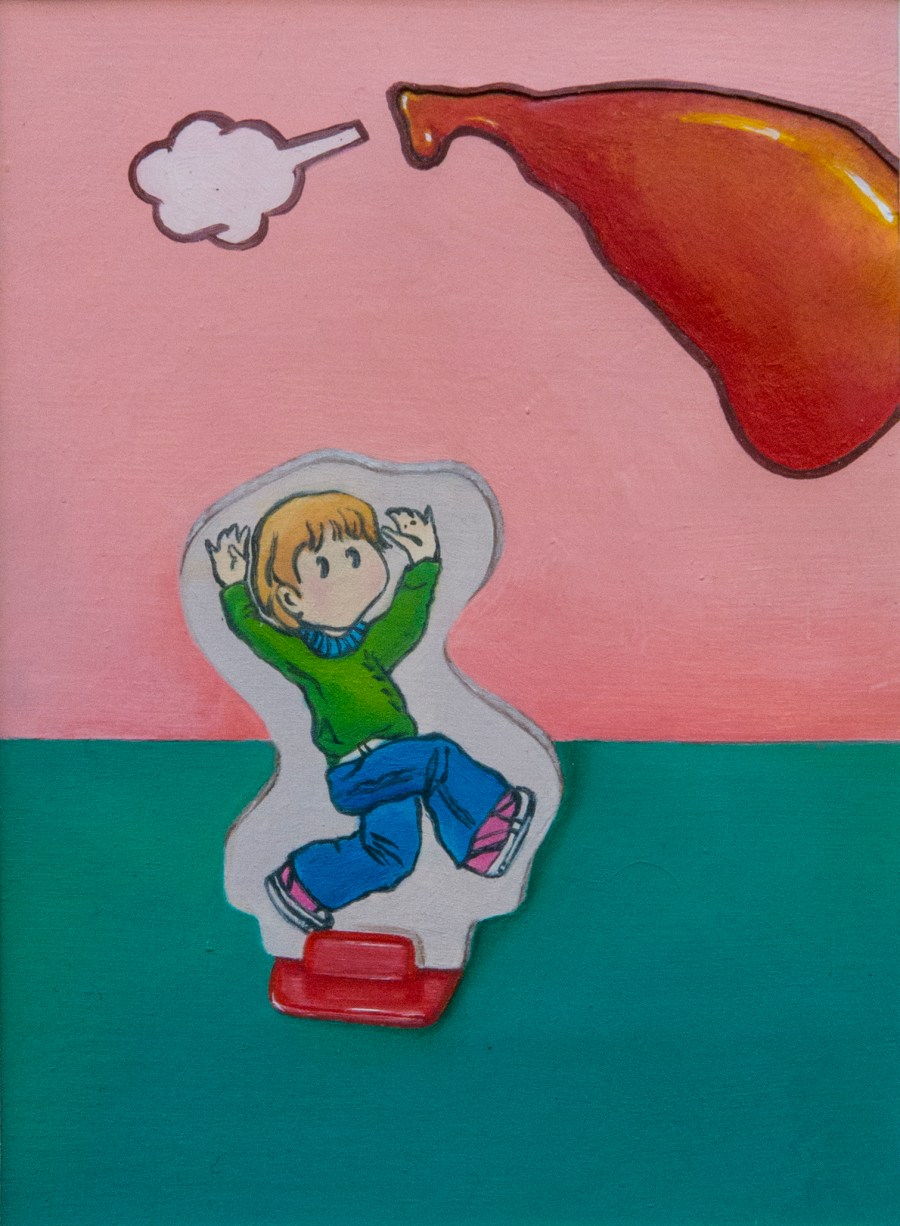
Featured Art: Stephen Reichert, Untitled, 2011. Oil on canvas, 18″ x 12″. “Cirlce” series.

It was a late season game on a warm Saturday approaching summer but not yet humid, overcast, so that clouds gave shade, and if the rain started, good, then the seemingly interminable might end sooner.

Boys, aged nine and ten, were playing baseball.

The game was real, with real uniforms, equipment, jargon, and rules, but it also seemed as momentous as make-believe. I understood make-believe far better than team sports. Oh, I understood sports, but I didn’t. I couldn’t. Like the color blind or the tone deaf, I was somehow incapable. While other parents followed the game, I stared at the players’ families more than I should have.

In our family, there were three of us, my husband, myself, and our son, and we had moved to the area just months before. Newcomers, we were late to register, and our son was assigned to a team with room for stragglers. We still didn’t know quite where we were, what was this place, who were these people? For me the quandary wasn’t just who in general or in particular, but also that deeper puzzlement I often felt, not who but what. What were people? I’d been staring at them my entire life.

Read More
Flying Objects

By Daryl Ogden

My mother and I were driving home at dusk on a two-lane country highway following one of our visits to the fire station where her newish boyfriend was posted. It was Memorial Day, a couple of months ahead of my eleventh birthday. A pair of vehicles were bearing down on us, their headlights filling up the rear and side view mirrors of our Toyota. The trailing drivers had already twice veered over the center line and gunned their engines, with ambitions of sling-shotting past. My mother responded by pressing hard on the accelerator, threatening a head on collision from traffic traveling in the opposite lane. Even though an 18-wheeler was now headed our direction a few hundred yards in the distance, both trailing vehicles tried again to pass. My mother floored it, forcing the drivers back into our lane or risk being entombed within thousand-pound accordions.

“They’ll have to wait until I’m ready for them to drive on by, Billy.”

On the road, my mother didn’t take any crap.

Read More

The Stick-Up

By Dwight Livingstone Curtis

I had on Pawn Stars, Man Vs. Wild, and Diners, Drive-Ins, & Dives, which is not a bad lineup for a Tuesday afternoon.  Though, I’m not supposed to watch the TV behind the bar, since it means I’m not facing the customers.  Even if, for instance, a customer wants to draw my attention to something happening on TV.  In that case I’m supposed to look at the far TV, or in the mirror.  This way, if someone walks into the bar, I’ll be facing the right direction.  McIlhaney feels strongly about this.  But there was no one here except me.  The only other person working was Arsenio, who was in his car in the parking lot FaceTiming with his daughter. Read More

16 Days of Glory

By Jill Rosenberg

After our parents left for Vermont, Ruby and I spent most of our time waiting for the Olympics. The world is coming to Los Angeles! the commercials told us, and the announcer’s tone was so excited and serious it seemed to imply that every American should prepare.

That summer was going to be a turning point for our family. We were in the final stages of a move to rural Vermont, where my parents were rebuilding a house they planned to have ready by the start of the school year. Once the house was inhabitable, even barely so, we’d all move in and complete the finishing touches as a family. We’d already chosen the stencils we’d use on the walls in each of our bedrooms. Mine was going to be silver, turquoise, and black.

In the meantime, my job—mine and Ruby’s—was to have the fun summer that my mother said we’d earned. We could contribute to the house by holding down our current fort, a converted garage in the Philadelphia suburbs. The beauty of the garage apartment was that it looked like a mini-version of the other houses in the neighborhood. My mother liked to point out that you could look at a picture of the garage and a picture of a real house, and you couldn’t necessarily tell which one was which.

But Philadelphia’s Main Line was only a stepping-stone in our journey. The goal was to educate ourselves in multiple ways, and the four years of high-class learning we’d done in the suburbs—in one of the best school districts in the country—was coming to an end. It was time for us to learn from the land, to shed our unscuffed shoes and make ourselves interesting.

Read More

National Pastime

By Daniel Paul

Walking in the West Village, I stop at the park on Clarkson Street to watch some little league baseball. I lean against the chain-link fence and am grateful for how its curves accept my weight without comment or judgment (as I imagine the inside of a whale might). A man is standing near me; he speaks in easy platitudes, and I nod along, not so much because I agree with him—for example, he says the weather is perfect, and all I can think of is how one of the clouds looks like you and the other looks like Nixon and how I’m in no state to rank omens in terms of their relative inscrutability—but rather because I really like nodding: as with launching a satellite, once you’ve done the work of getting your head to the top of its apogee there is a pleasing feeling of submission to a higher power in letting gravity complete the act. The man, who I decide to name Bubba (because I have never met a Bubba and fear if I do not take this opportunity, I never will) tells me that its been a crazy year for the team, though I don’t know which team he is referring to (one is in blue, the other green, and I wonder if I’m the only one who is bothered by the fact that the team whose shirts do not have piped collars is the one sponsored by a local plumbing concern).

It’s been a crazy year for all of us, I say, unsure of what a “sane year” would look like.

Oh yes, he answers, lots of ups and downs for the squad.

Don’t I know it? I say, and with each nod I become more emotional about the (no doubt unjust) obstacles that the team has faced as they have tried to do nothing more than live their lives and play some baseball on Saturday afternoons.

Bubba does not look at me as he speaks, keeping his eye on the field (and I wonder if he is actually talking to someone on his other side instead of me, and, by extension, what percentage of the conversations I’ve ever had did not actually require my involvement). He says that the team has struggled with fundamentals.

Read More

Coach O

By Robert Hinderliter

Featured Art: by Owen Jones

Coach Oberman watched from his office window as a group of students prepared the bonfire by the south end zone. Two kids stacked tinder while another knelt beside a papier-mâché buffalo they would throw on the fire at the end of the pep rally. Oberman couldn’t wait to watch it burn.

He’d just gotten off the phone with Mike Treadwell—coach of the Ashland Buffaloes—who’d called to wish him luck in tomorrow’s game. Mike had been Oberman’s assistant for three years before taking the job at Ashland High. And now, after back-to-back state titles in his first two years, he’d been offered the defensive coordinator position at Emporia State University. This would be the last time they’d face off.

“I’ll miss seeing you across the field,” Mike had said. “Although I sure won’t miss trying to stop that Oberman offense.”

This was pandering bullshit. In their two head-to-head contests, Mike’s Buffaloes had routed Oberman’s Hornets by at least four touchdowns.

“I just wanted to say thanks,” Mike had said. “I couldn’t have gotten this far without you.”

He’d said it like he meant it, with no hint of sarcasm, but Oberman knew there was venom behind those words. In Mike’s two years as assistant, Oberman had treated him badly. Mike had a good mind for the game, there was no denying that, but he was a scrawny wuss with thick glasses and a girlish laugh. He didn’t belong on a football field. Oberman had banished him to working with the punter and made him the butt of jokes in front of the players. When Mike’s brother-in-law became superintendent at Ashland and handed Mike the coaching job, Oberman had scoffed. And now Mike was moving on to a Division II college while he was stuck muddling through another losing season with an eight-man team in Haskerville. He knew the irony wasn’t lost on either of them.

Read More

Bodies That Drift in the River Flow

By Scott Gould

Featured Art: by Oscar Bluemner

Sometimes you know things before you know things. Mrs. Tisdale comes to the door, and I know something is wrong. I know. From the top bunk of my bed, I watch her coming up the sidewalk, walking fast but walking like a woman who is already lost, her skirt moving quickly around her, like a wave to anyone who spies through the window.

I know the doorbell won’t ring. She is not a bell person. She is too good a friend of my mother’s to announce herself that way. She knocks once and opens the door. What she doesn’t know is the bell doesn’t work anyway. It is shorted out somewhere along its line and my father has never pulled the wires and traced down them to find the problem. I hear Mrs. Tisdale’s voice flow up the staircase, so faint I can barely make it out, strained and pitched higher than normal. Her voice sounds like an animal she is trying to keep on a leash, trying to make it heel. Because her voice wants to run away from her. I hear my mother fall back on her nurse’s voice, that healing tone. I climb off the top bunk and move closer to the doorway.

“Now, Roberta, we shouldn’t jump to conclusions,” my mother says. “Let’s not worry until we have something to worry about.”

“Something’s gone wrong,” Mrs. Tisdale says. “I feel it.”

Read More

The Rush of Losing

by Daniel Larkins

Selected as winner of the 2011 New Ohio Review Fiction Contest by Don de Grazia

Featured image: Henri de Toulouse-Lautrec. At the Moulin Rouge, 1892–1895. The Art Institute of Chicago.

10. The race is over before it ends.


7. Tim leans forward. His blue dress shirt is untucked, unbuttoned, and his stomach shoves the undershirt out of his pants. When he loses it’s like a win, because when he wins he doesn’t want to keep on betting. Losing answers the question, Why continue? When he loses, he likes to think he can parlay that into a victory, persevere to make up for the loss.

All the TVs are muted. In his shoes he can feel the rumble of Holland Tunnel traffic from a couple blocks away. His twin boys are twelve and his fingertips are black. His nails are short and dull. His wife Meg used to have monthly manicures and the designer kitchen she wanted, but no more would she get a stupid room for hanging pots and pans and whatever else she liked to hang from racks and nails.

Tim leans forward. He has a hangnail, and it bleeds and stings, and his left hand balls into a fist on his thigh and his other wraps around a rolled-up Racing Form. It’s a tool, a bat, a weapon.

Read More