Providence

By Logan McMillen

i. Kansas City, Missouri— 1983

Every morning before the store opened, Rubén tempted George into smoking a cigarette by the loading docks—which had a clear view of the highway and the sunrise. Today was no different.

“You’re the devil,” George said—with his lighter already pulled out.

George owned the home improvement store where Rubén worked.

The missionaries were quick to find a job for Rubén. And even though it wasn’t in his field of study, or anywhere near his relatives in New Jersey—Rubén liked it. It gave him a casual sense of purpose.

“We don’t really follow that one,” Rubén said. “Do we?”

Rubén often pretended that he didn’t know anything about Mormonism, even though he’d been “practicing” for over two years. He thought of the religion mainly as a way to stay social in an unfamiliar place. That and he felt like he owed the missionaries something. If they wanted his soul, so be it.

Read More

A Woman, Splayed

By Alison Theresa Gibson

Featured Art: Stephen Reichert, Untitled, 2014. Snow in alley, Baltimore. “Cirlce” series.

It was a cold Thursday in April and frozen leaves slipped along the ground. Easter was over, the southern hemisphere was descending into winter, we were hunkering down for the darker, colder months. I was walking around the lake, like I did most days, wondering if I should visit my mother that afternoon. My father had been dead for six weeks and I had only seen her once since the funeral. The sun was cold but golden. Currawongs sang their pyramid of song, the soundtrack to every morning of my life. 

The man was standing at the back of the toilet block. The ground was dirt around his feet. He was standing with his hands in his pockets, his eyes on the ground, but not on the dirt. He wasn’t contemplating the lack of grass. His eyes were on the body.  

She was on her stomach, legs splayed, greyed hair splayed, fingers splayed. She was splayed. He was standing. He was staring. The sun had risen fully and offered light but no heat. 

The graffitied brick of the toilet block had hidden the sound of my approaching footsteps. Frozen leaves were scattered at my feet and I didn’t move, afraid of their crunch.  

He crouched near one splayed foot. He ran a finger along the inside arch. When he whistled, the currawongs paused for a moment, then restarted with gusto. He looked into the branches of the surrounding trees and whistled again. Again, they called back. The splayed woman didn’t move.  

I inched my phone from my pocket and dialled triple-0 without looking. His finger was tracing the arch of her foot, his head was back, his whistle faltered.  

‘I’ve already called the police,’ he said. He could have been speaking to the splayed woman. ‘They’re on their way.’ He stood, his hands sliding back into his pockets. The currawongs’ calls were growing louder, more ferocious, like they were distressed by the absence of his whistle. ‘She’s been here all night,’ he said. 

Read More

Can Mickey Dance?

By Sayandev Chatterjee

Featured Art: Stephen Reichert, Untitled, 2013. Oil on canvas, 12″ x 12″. “Cirlce” series.

The jarring shriek of the alarm clock slapped Srinath into wakefulness. Fumbling through the tangled mosquito net, he wrestled with the timepiece, finally silencing its insistent bickering. Delicate strokes of sunlight filtered through the louvered windows, painting soft stripes across his cramped hostel room floor. He lay still, his heart thudding as fragments of last night’s dream clung to his mind like cobwebs on the peeling paint above. It was always the same dream.

The clock read 6:00 a.m. Gupta-ji, the boss, had demanded an early start. Srinath could almost smell the polyester and sweat from the Mickey Mouse suit waiting for him at the store. But first, there would be shelves to stock, floors to mop.

Read More

SHASTA GIRL 

By Noah Pohl

Featured Art: “Bumblebee” by Leo Arkus

(March 27) 

Today, I came to work eleven minutes late. My co-worker Lenny said he didn’t know if he could cover for me, even though he thought I was “cool” and “down to Earth” and “pretty for twenty-four,” whatever the fuck that means.  

Lenny is sweaty. He sweats near the hot dogs sometimes, and that’s not cool. I try to avoid Lenny when he’s in one of his moods. He cries loudly in the Target bathroom because of his impending divorce, but he’s also extremely hairy and his eyebrows are out of control. Since his wife left him, he kind of resembles a giant, lumbering piece of sage. I know because I smudged my apartment last night to keep the bad spirits away. 

I also made sure my Target Pizza Hut uniform was clean ’cause I dumped Alfredo sauce on myself yesterday like a total dope. It smelled like hot garbage. Then I got quarters from one of the girls at the registers so I could do my laundry. No more free laundry.  

I mean, I feel like that’s a metaphor for something, I just don’t know what. 

Read More

Like Communion

By Ellen Skirvin 

My dad warned us that aliens were watching him before he disappeared. He also had checked himself into a psychiatric hospital five times throughout my sixteen-year lifetime. During his last visit to the hospital, the doctors said he vanished in the night. His clothes were left in his dresser. The framed photo of my sister and me left on his bedside table. None of the night nurses saw him leave. There were no tied up sheets found dangling outside his open window. The doctors reminded our family that my dad had admitted himself voluntarily and was free to leave at any time. There was nothing they could do. My mom didn’t seem worried at first. He’d left and come back before. One time he left for almost a week and returned with a pet frog that died the next day. Another time he traveled halfway across the country to tour a NASA museum. He needed space; he’d tell us later. Most of the time he checked himself into the hospital for a long weekend, casually packing his car as if he were leaving for a fishing trip.  

Read More

Ground Control

By Lesa Hastings

Everyone has to start somewhere. I began as a child stalker, or rather an accomplice to my mom’s propensity for stalking.

We first saw the man we called “Tony 86” parked in the dirt lot rest stop adjacent to the motel my dad would go to after fighting with my mom. After he left us, it became the meeting point for my parents to exchange me and my brother for the occasional weekend. Mom called it a fleabag motel for lowlifes.

“Late as usual,” Mom said. Dad was late enough I wondered if he was actually coming. He was late a lot, but this time he was really late. I’d never stayed in a motel before and made up stories about the people we’d see coming and going while waiting for Dad. Minutes passed as I watched a couple argue on the second-floor balcony, then embrace in a farewell, the woman walking away with the man holding her hand as long as her arm would stretch, until she moved out of reach. Mom had stopped nagging about Dad being late, distracted by something.

Read More

The Strange Situation

By Valli Jo Porter

Featured Art by Tristen Luken

I escaped the religion of my youth by moving five hundred miles from Ohio to Virginia. There, I refused to pray as I drifted off to sleep, and I never roused for church on Sunday morning. I lived in a tiny broken-down ranch on a quarter acre lot, a single oak tree in the front yard and the world’s worst neighbor to my side. Wayne Bishop was his name, and he spent his afternoons in his driveway, under the shade of my oak, his feet propped on an upturned milk crate, empty beer cans lined up next to his lawn chair. He looked like a toad with a rosacaed face and giant turned-out lips. He called me over to help with his projects, and each time I’d internally debate just drunk or personality disorder. He’d enlist me to help him cut crown molding or install paneling, then he’d hover and insult my handiwork and calculations while he drank his beer. He was also breathtakingly litigious, prone to staying up all night authoring lawsuits that he asked me to copy edit before he filed. I picked random sentences and inserted commas—he never had enough commas—to placate him, so he didn’t sue me like he did his former employer, every doctor who tried to help him, and his own brother. I always helped because I was lonely, and it seemed prudent to stay on his good side.

Read More

I Am No Beekeeper

By Arya Samuelson

Selected as winner of the 2023 New Ohio Review Nonfiction Contest by Barrie Jean Borich

My housemate sleeps all day, makes art all night, and paints giant bees. “I want people to feel my paintings,” she says, stroking the palm of her hand against a still dripping head-to-toe canvas.

I keep my hands in pockets. We’ve only been at the art residency for a week, and she has already transformed her garage studio into a whimsical world of texture and wonder and touch. My art is trapped inside me. Weighs down my womb with rocks.

Read More

Winter

By Faith Shearin
Selected as winner of the 2021 New Ohio Review Nonfiction Contest by Jerald Walker

The last day of my old life, the one in which I knew my own identity, was Halloween 2018. I was out walking our dog, Wookiee, a small, flat-faced shih tzu with an underbite, through the streets of our Massachusetts neighborhood, when I felt the presence of my husband, Tom, though he was away, on a business trip in Colorado. It was evening and I was flanked by children wearing masks, capes, and wings, all of them carrying paper sacks of candy. I paused beneath a maple tree decorated with cloth ghosts, near a lawn littered with fake tombstones, and the dog sniffed the air where my husband’s apparition formed. I saw Tom materialize for a moment and he was young again: slender and dark, his hair a mass of black curls; he was opening the window of his dorm room at Princeton; I felt as if he was trying to show me something; I was aware of a rush of velvet air and the full intensity of his love before he vanished again, into the blowing leaves, and pumpkins, and the sounds of children knocking on doors. I was expecting him to fly home in a few hours and thought perhaps he had fallen asleep on a plane and begun dreaming of me; he sometimes came to me in dreams. But when I checked my phone I found no text; instead, there were a series of phone calls from a number I didn’t recognize, which turned out to be a hospital in Colorado, the last from a chaplain who said: your husband has had a heart attack and is being prepared for emergency surgery. I do not know if Tom was awake or under anesthesia when his ghost found me; I don’t know if he was fully alive or if his spirit was already seeping away. All night his Australian colleagues held vigil in the hospital, sending texts while fashioning boomerangs from coffee stirrers. By the following day, Tom’s sisters and mother and I converged in a waiting room, along with his friend Bob, who had flown home to Virginia from the Denver conference, then back again, when he heard Tom was in surgery.

Read More

Stomach Pains

By Danie Shokoohi

When the doctor found the tumor in his brain, when the surgery was first scheduled but not yet scalpeled, before the poorly fitted tracheostomy tube which introduced the sepsis, your father forbade you from coming to Connecticut. He didn’t want you to see him like that, he said. That when your grandfather died, your father could only picture him ill and threadbare in a hospital bed. He did not want that for you, if he didn’t make it. 

“No.” You lifted your laptop from the coffee table and clicked your internet browser. “Absolutely not. I’m pulling up Delta.” The ticket would be expensive from Iowa City, but you would pay anything to be there.

He told you that you could visit when he was well again, for Thanksgiving, maybe. “Look, Kimmy,” he said. “I got some bad apples, but we can still make applesauce out of them. It’ll be okay. The surgeon’s good. I’ll have to do some PT, but I won’t lose any cognitive function. That’s pretty good applesauce.”

You wanted to tell him there was nothing applesauce about a brain tumor. That you didn’t care how small, or how easy the recovery, or how experienced the doctor. You wanted to tell him that twenty-two was too young to be fatherless. If it was your Iranian mother, you would have had permission to scream and rip hair from your scalp and weep. But he wasn’t one for big sentiments, your father. He was American. So you laughed because you knew he wanted you to laugh.

After the phone call, you drove to the grocery store and picked out a jar of applesauce. It sat in your cupboard through his entire sickness, and you ate a spoonful a day as if it could keep him safe.

Read More

Before He Made Love He Made Light

By David Lerner Schwartz

The reverend kept talking about Christ, how he’d died for this and that. Seated
in the farthest pew, I only thought about the dancer. I both wanted her and
wanted to ruin things. We hadn’t boned yet. Did that make me a sinner or not?

My days were listless—I had just moved to a new city to teach history. I cried
most mornings. After the gym. Something about lifting weights, or hurting. A
release? Or a punishment. I don’t know. I guess people believe we can be saints.
I have blond hair and blue eyes, and when had that hurt anybody? I could
probably at once punch my own face gone and raise an abused kid into a happy
adult. What matters deep inside is a rolling boil.

The campus church was small but beautiful. Since it was an Episcopal high
school, the faculty and students were required to attend each morning. I woke
up early and got into a routine: the gym, a good cry, chapel, class. Toward the
end of the sermon, I studied the old stained-glass skylight behind the cascading
wooden beams. They’d put a mosaic bird in one of the panes for a kid who had
died. Apparently, at his funeral, a swift flew into the church and perched on his
casket. Jesus.

The organ, then the reverend again. He had such a shitty voice. This was a
world of too much talent, so why did he have to sing? He strained when he had
to go high, and his voice had little bass, so it got swallowed by the low notes. We
ended on “Come Down, O Love Divine.” I waited until the third verse, which
was my favorite. The first two were bullshit. My only friend here—Carter, an
English teacher—agreed, and we locked eyes across the sanctuary. “And so the
yearning strong,” I sang, “with which the soul will long, / shall far outpass the
power of human telling.”

Read More

There Will Be Salvation Yet

By Tania De Rozario
Winner, New Ohio Review Nonfiction Contest: selected by Ira Sukrungruang

Featured Art: The Last Supper By H. Siddons Mowbray

1993. That’s when it happens. Two months after your twelfth birthday. It’s a sweaty afternoon. This day which blisters with possibility. This day you learn that there are demons inside of you.

You’re on your way home from school. You know something is wrong the minute you get off the bus. Your mother waits at the bus stop, teary-eyed. Your relationship has grown monosyllabic, but the tears feel like a warning, so you ask.

What’s wrong?

It is when she smiles that something inside you unravels. You realize hers are happy tears. But her smile is vacant. Placid. A Stepford Wives smile. The tears fall but there is nothing behind them. She’s a mannequin crying on command. A talking-doll with electronics scrambled.

You don’t have the language for this yet.

She grabs you, holds you tight: Nana has been saved!

Read More

Promised Lands

By Christie Tate

Winner, New Ohio Review Nonfiction Contest: selected by Kiese Laymon

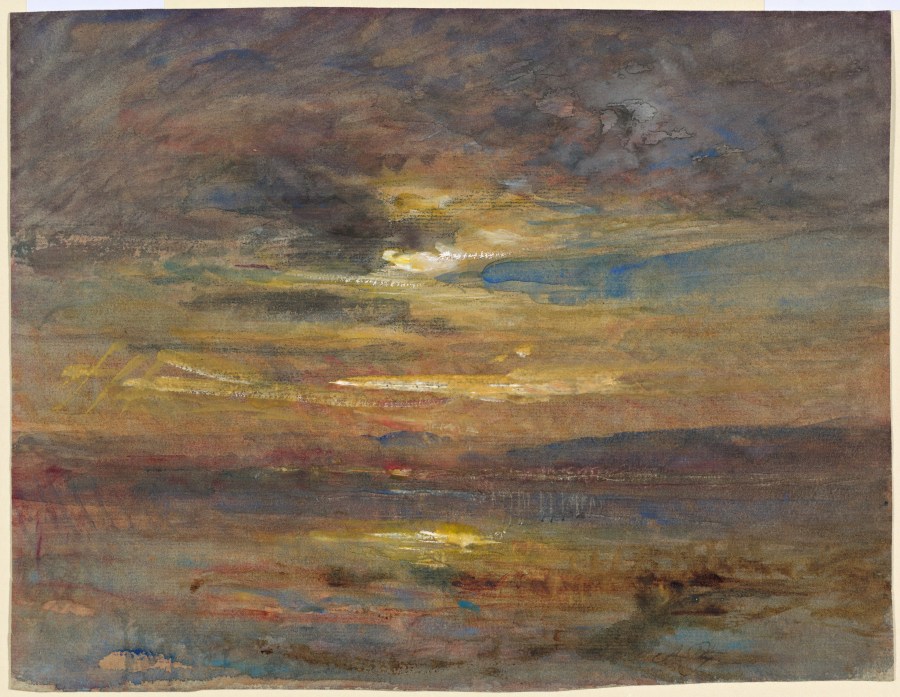
Featured Art: Sunset over a Pond, c. 1880 by François-Auguste Ravier

I.

The first time I walked into Grandma’s church, I was a little girl in white Stride Rite leather sandals and a pale yellow dress with a sash. The First Baptist Church of Forreston, Texas. There was no parking lot, so Grandma, like a dozen others, steered her big blue Chevy off the road into the grass in front of the sign welcoming all worshippers.

The white clapboard building looked like the school-church from Little House on the Prairie. Simple wooden porch with four steps. Plain white steeple. Two long skinny windows. Our regular church in Dallas was three times larger, had bells that chimed every hour, and its thick walls held colorful stained glass depicting Jesus carrying the cross, falling, dying.

My older brother and I trailed behind Grandma, who hung her big leather purse in the crook of one arm and used the other to grip the wooden rail to steady her arthritic knees. My brother and I jockeyed to sit next to her because we wanted to plumb her treasure-filled purse. Doublemint gum. A map of the highways crisscrossing the Texas plains. A keychain with a long plastic placard with her name blazed across it. Virginia. Same as the state. I liked to run my finger along the raised white letters.

Before we opened the door, we could hear voices singing “What a Friend We Have in Jesus.” I shot a look at my brother. We were late—something we were never allowed to be on Sunday mornings with our parents at Holy Trinity. My brother shrugged. I grabbed Grandma’s free hand and let the rush of air and music pour over me as she opened the door and led us to the back row.

Read More

The New Yorker Cartoon Caption Contest

By Mark Williams

It is better to write of laughter than of tears,
for laughter is the property of man.
                      François Rabelais

Monday

I’m stumped. A man angel with a giant halo
is talking to a woman angel with an average halo.
They appear to be a few feet apart,
but since they’re standing in the clouds,
they could be miles apart, in which case
they are giant angels and the man giant angel
has a ginormous halo and the woman giant angel
only has a giant halo. Either way,
I have no idea what the man angel is saying,
but I have six-and-a-half days to figure it out.

Possibly, cartoonist, Will McPhail, had an idea
when he drew the angels for this week’s contest: #526.
Or maybe he was Sullivan in search of a Gilbert.
I thought I was a Gilbert when, in response to #520,
Corey Pandolph’s drawing of a banana peel
slumped on a psychiatrist’s couch,
I had the psychiatrist saying,

Depression, heart palpitations, fatigue?
     You could be low in potassium.

Still, you have to hand it to first place winner, Michelle Deschenes
of Fort Collins, Colorado, who wrote,

It’s normal to feel empty after a split.

Tuesday

He never used one word when ten would do … 

is what I’d write if someone were to draw my tombstone.
I can see why everyone might think
the angels got me thinking about my tombstone,
but I’ve been thinking about my tombstone
ever since the banana peel in #520 when,
before I came up with

Depression, heart palpitations, fatigue? et cetera,

Read More

Moksha

By Alexander Weinstein

Featured Art: Street at Saverne by James McNeill Whistler, 1858

I.

Rumor was you could still find enlightenment in Nepal, and for cheap. There were back rooms down the spider-webbed streets of Kathmandu where they wired you in, kicked on the generator, and sent data flowing through your brain for fifteen thousand rupees a session. It was true, Jeff from the coop had assured Abe, though passport control could be a bitch when you returned to the States.

“They pulled my buddy when we hit Newark,” Jeff had said, sipping maté from a gourd. “But he was showing. His third eye was completely open and he wanted to hug everyone. Just think about porn and you’ll be fine.” Jeff had handed Abe a crinkled business card. Namaste Imports. “Go to this place.”

So Abe had saved his money, bought the ticket, and traveled the endless hours, numbed by bad sleep and bland airline food, to find himself in Kathmandu. Finding Namaste Imports, however, had proved impossible. The streets had no names, and looking up, all Abe saw was a tangle of electrical wires and lights blinking on in the dusk. Around him, masses of tourists, heavy with backpacks and vacant looks, milled about. And amid all this churned a perpetual stream of cars and mopeds, nudging their way around pedestrians, honking, yelling out of windows, and raising endless dust. It all seemed far from enlightenment.

Read More

The Devil’s Best Friend

By Vincent Poturica

Featured Art: View of the City and London Bridge

About nine or ten years ago when I was not yet twenty, my friend Carlos asked me if he should sell his soul to the Devil’s best friend in exchange for a better world—I am not kidding, son. I told Carlos that selling his soul sounded a little hardcore, even for him, and that he should probably meditate on the potential consequences for at least a week. I also suggested that he contemplate his motives, i.e. whether or not he was really doing it for a good cause—though I confessed that I distrusted anyone who thought they knew what was best—or because he felt desperate regarding the recent death of our dear friend Ivan. I then told him—and he agreed—that he also probably needed to consider whether the Devil’s best friend was the best person or demon to sell his soul to, whether the Devil’s best friend was even certified to buy his soul—I admitted that I had never heard of someone selling their soul to the Devil’s best friend, but I was, of course, ignorant of many things. I then questioned the extreme subjectivity of better world, encouraging Carlos to make sure to specify as much as possible the criteria for what made this world better, for instance its natural resources, its climate, its historical record of oppression, among other factors, before he signed any contracts with his blood or whatever you did these days to officially seal transactions involving that most precious and contested conception of the self.

Read More

Three Sacraments

By Brooke Champagne

Featured Image: The Dogana and Santa Maria della Salute, Venice by Joseph Mallord William Turner, 1843; Courtesy National Gallery of Art, Washington

                                                                                             The Eucharist, although it is the fullness of sac-
                                                                                             ramental life, is not a prize for the perfect but
                                                                                             a powerful medicine and nourishment for the
                                                                                             weak . . . Frequently, we act as arbiters of grace
                                                                                             rather than its facilitators. But the Church is not
                                                                                             a tollhouse; it is the house of the Father, where
                                                                                             there is a place for everyone, with all their prob-
                                                                                             lems.
                                                                                                             —Pope Francis, “The Joy of the Gospel”

                                                                                             The true vision and knowledge of what we seek
                                                                                             consists precisely in not seeing, in an awareness
                                                                                             that our goal transcends all knowledge and is
                                                                                             everywhere cut from us by the darkness of in-
                                                                                             comprehensibility.
                                                                                                                       —Gregory of Nyssa, Life of Moses

Holy Unction

I’m nine years old the day my mother dies and comes back to life and, if I ever believed at all, it’s the day I give up on Christ.

The reverse might be expected—miracles, the power of prayer—but when I make my final judgment, I don’t know yet, won’t know for a long time that she has died and returned. At that point, I’m only told she is pregnant and there are complications. The baby, my would-be half-sister, is gestating at twenty-three weeks and because my mother is sick, must be delivered. Everyone waits and prays. Doctors work and pray.  At school, my teacher’s hand on my shoulder  a few seconds too long in that comforting way, her eyes say: I’ll pray for you. Before bed I press my hands into a teepee and try earnestly at first, then only pretend to pray.

Read More

Kickboxing with God

By Jeffrey H. MacLachlan

Featured Art: Vendémiaire, plate 34 from Alcools by Louis Marcoussis

On my way home from an empty happy hour, God shoved me so I punched his
chin with a half-formed fist. He laughed and asked me if I knew who snapped
dinosaur tails like breadsticks. God was all effort like old dudes at pick-up
games. Leg-kicks striking thighs and elbows to the windpipe. My uppercut let
out a Hallelujah choir from the sky. He punched my liver and said I should get
some rest for once. You can’t keep this lifestyle forever. He pointed to his chin
and dodged a knockout swing. Why not go visit your kids? God headlocked me
like Mom’s boyfriends did after parole. I’m behind schedule so just fix your life.
He was right but that didn’t stop the stomping he had coming for not showing
up till that night.


Read More

Reverend Tyree (excerpted from the novel Haints)

By Clint McCown

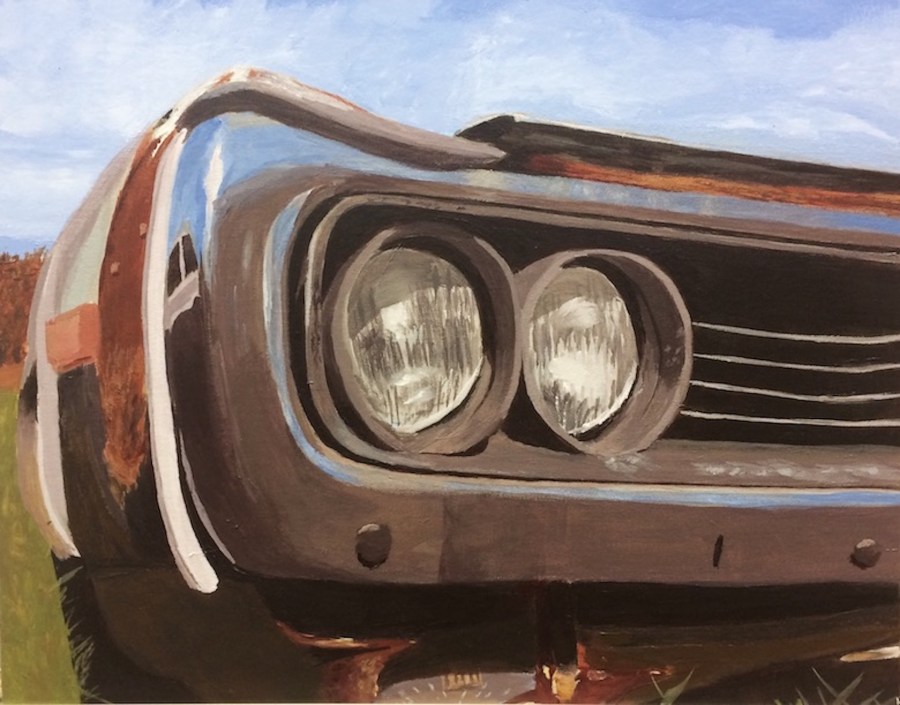
Featured Art: Rusty Car by Ellery Pollard

As Reverend Tyree settled himself onto the torn front seat of his rust-spotted DeSoto and turned the ignition, he had a brief moment of hope. The motor sputtered, coughed, and whirred without catching. He turned the key again, with the same result. The old rattletrap was trying to give him a night off, it seemed. One more failed attempt and he would be justified in staying home with Mildred and his mother and listening to the radio for a change. And why shouldn’t he stay at home? The clean-up crews hadn’t fully cleared the streets after the tornado, so driving could be dangerous, especially on the side of town where the county jail was located. The inmates wouldn’t care if he skipped a visit. But when he turned the key a third time, the engine caught, and that was it, he was trapped for yet another Saturday night.

He dreaded the jailhouse even more than the hospital. The hospital was relatively cheerful, especially in the evenings, and he had learned that if he made his rounds about an hour after dinnertime, many of the patients he was supposed to visit would have already drifted off to sleep. Then he could sit by their beds and read magazines. He would always leave evidence of his visit—a printed card with a picture of Jesus on it and a passage from St. Luke: Rejoice, because your names are written in heaven.

Read More