Everyone in Shirttail called her Familiar. Not because that was her name, no one knew her name. And not because eventually the men of Shirttail would become as familiar with Familiar as the inside of their own palms. No, they called her Familiar because she felt familiar to them despite not being born in Shirttail or spending a day of her short life there before arriving unannounced to squat in the late Larson Boucher’s chicken coop.
That trashy little blank-faced girl over at Larson’s place sure seems familiar, got shortened to, that familiar-sorta-girl living in Boucher’s old meat bird coop, got shortened to, that familiar girl, and within five days they had talked her over so hard she was whittled down to Familiar.
The meat bird coop was twenty-three paces east of Larson Boucher’s twobedroom house, which was set behind Boucher’s Gas & Garage. The station had died years before the man. Wild Turkey brought premature death to them both in equal measure. Boucher’s Gas & Garage was on the south end of town, spitting distance from the “Welcome to Shirttail” sign, erected by the Rotary Club. Proximity to that marker made Familiar an outskirts problem, not an intown scandal. Still, “town” wasn’t but three blocks away, and the residents of Shirttail watched from the sides of their eyes and talked out the sides of their mouths.
By Jessica Jo Staricka Featured Art: “Nope” by Alex Brice
One night twenty years later, among cardboard boxes fuzzy with dust in the basement of my mom’s final house, I find a tennis racket. I’m puzzled. We never played tennis. Maybe the racket was trash left behind by a previous renter that we accidentally packed and brought with us on one of our many moves. Maybe Gladys and I begged a dollar off our mom to buy it at a garage sale and made up our own game pitching pinecones to each other in one of the back yards.
But when I pick it up, its exact heft and balance rush me out of this basement and twenty years back, to the perfume of white pines and the prick of their needles through the holes in my sneakers, to the gravel yards and dandelion lawns and empty horse corrals and collapsing barns of the half-dozen ramshackle farmhouses we rented growing up, to their living rooms on summer nights, where Twins games played on TV, where I tinkered with salvaged arts and crafts, where my sister Gladys played an out-of-tune piano if the house happened to come with one, and where a bat appeared in the corner of the ceiling.
Featured Art: Stephen Reichert, Untitled, 2014. Oil on canvas, 12″ x 12″. “Cirlce” series.
I first saw her aboard the JADE PRINCESS, a cruise ship several miles off the coast of New Hampshire. She wore ribbons in her hair and a leather choker around her neck that read GIVE ME A REASON. The two of us made up the entire wedding party. I played the roles of daughter and maid of honor and she, her father’s best man. The other guests were staff on their dinner break and a couple gamblers, vying for a seat at the blackjack table.
The captain kept the ceremony short (on autopilot like his ship). Ma had already been married twice, yet for Husband #3, she still felt giddy and hopeful. Where I saw folding chairs and a wrinkled backdrop, she saw romance. Where I saw a cardboard cutout of her last boyfriend, she saw the love of her life. When the time came to exchange vows, I handed Ma the wedding band for her five-second fiancé, a mood ring from LOST & FOUND that glowed black in my sweaty hands. The best man gave her father a light-up jelly ring and our parents sealed it all with a kiss.
“Faye,” she introduced herself at the reception, my stepsister before I learned her name.
David Foster Wallace is often discussed as a regional writer; critics have focused on the ways his fiction and nonfiction depict both the northeast (in Infinite Jest) and the midwest, primarily his sometime-home of Illinois. But what is often overlooked is that his first novel, The Broom of the System, is an Ohio novel. Although Wallace didn’t have any concrete ties to the state (he grew up in Illinois, and was living in Massachusetts when he first drafted the novel), he chose to set the book in the Cleveland area, for the same reason that so many writers use Ohio as a setting—because it serves as a synecdoche for America itself. Shortly after the novel’s release, he told an interviewer that he had never actually been to Cleveland, but as “a middle-westerner. . . he wanted a heartland city that he could imagine instead of describe.” In Wallace’s imaginative vision of the “heartland,” Ohio is, as one character describes it, “both in the middle and on the fringe. The physical heart and the cultural extremity.” He goes on to claim that “we feed and stoke and supply a nation much of which doesn’t know we exist. A nation we tend to be decades behind, culturally and intellectually.” This is a division that Wallace explores in much more depth and detail in many of his nonfiction pieces, such as “The View from Mrs. Thompson’s,” “Getting Away From Already Being Pretty Much Away From It All,” and “Derivative Sport in Tornado Alley,” all of which use the midwestern locale to interrogate what it means to be a true American.
In Broom, Wallace uses the heartland setting to explore many of the thematic elements that are central to his later writing (some more successfully than others—it is very much an apprentice work). The central plot, such as it is, revolves around 24-year-old Lenore Beadsman, who must negotiate being surrounded by a variety of hideous men (including her boyfriend/boss, her landlord, and her therapist), while searching for her great-grandmother, a former student of Wittgenstein, who has escaped from her Shaker Heights nursing home. The novel also interrogates the idea of what constitutes reality; Lenore in particular is worried that she is just a construct of language, and that “she had no real existence, except for what she said and did and perceived and et cetera, and that these were . . . not really under her control.” Wallace later distanced himself from the novel, calling it “a sensitive little self-obsessed bildungsroman” written when he was “a young 22.” Michiko Kakutani accurately described Broom as “an unwieldy, uneven work—by turns, hilarious and stultifying, daring and derivative.” She notes how Wallace takes on “serious philosophical and literary discussions” while also getting sidetracked by “repetitious digressions, and nonsensical babbling that reads like out-takes from a stoned, late-night dormitory exchange.” This is a fair critique, but as with many a late-night stoner conversation, there are certain elements that can hold up to closer scrutiny in the sober light of day.
…I am re-begot Of absence, darknesse… Things which are not. —John Donne
1
Now they’re standin’ in a rusty row all empty And the L & N don’t stop here anymore. —Johnny Cash
Winter’s first fuel came cheap, scrap wood, free for the taking, piled along the road next to the sawmill half a mile back toward town from my house. Lying in bed—borrowed mattress on a patched linoleum floor—I listened to wood fires pop and snap taking night chill off my two rooms. Light from the yellow flames pierced through slots in the iron stove’s iron door and danced in reflection across the inside of my front window.
In September, Mother Annie told me to go get wood at the sawmill. I had no running water, only a well with a handpump and an outhouse at the place I rented. I had electricity and cooked on a hotplate. The potbellied stove stood cold in the center of my front room for two months.
When copyediting the small-town monthly, things press in.
Chair yoga. Croquet. Bears that pull laundry off clotheslines.
Someone following GPS drives onto the dam, slips off the narrow bridge.
Someone unscrews his neighbor’s porch light, gets caught on surveillance. He said the light was annoying at night but promised to stop doing it.
(Why live here, if you can’t see the stars?)
Fire alarms.
Unattended fires.
Every month more news of the lake’s battle with Eurasian milfoil— who will come to study it, to harvest it, to keep the lake from clogging up. How to keep it from fragmenting, spreading.
(I don’t know Eurasian milfoil from the next lake weed but I’ve given up worrying about them. I swim on the surface, don’t put my feet down.)
I learn: the cereus plant, a desert native, blooms just one night a year and has an exquisite scent.
Spider wasps encase their prey in mud; their larvae eat spiders for a week then spin a silk cocoon to spend the winter in.
Petrichor is a husband-wife duo who will be exploring the sound world of the musical instrument digital interface.
More importantly, it’s the word for the smell of the forest just after it rains.
The school is closing (hardly any school-age children!). The historical house is holding a swanky fundraiser. Guests will have a marvelous timewhile enjoying the stunning poolside views.
Selected as runner-up for the 2013 New Ohio Review Fiction Contest by Stuart Dybek
Featured Art: Decorative Study: Satyr by Aubrey Vincent Beardsley
In the spring of 1985, Ben lived with his friend Marco in a second-floor apartment near the college where they were sophomores. For fun they watched girls sunbathe down in the small back yard across the alley. They kept a potted ficus by the window to obscure their faces.
One day, while they were staring at the girls through the ficus leaves, Marco said he had an idea. He went down the hall and came back holding the VHS camcorder Ben got for Christmas and kept beneath his bed.
Marco said they should use the camcorder to film the girls. “That way we can watch them on the VCR at night,” he said, “when it’s more fun to watch sexy stuff.”
“No way,” Ben said.
“But we can pause it and look really hard.” Marco described in loving detail the way the girls’ bikini bottoms pinched their thighs and the way their breasts drooped to the sides when they lay on their backs.
Ben liked that stuff too, but he wondered if filming the girls didn’t make him and Marco weirdos. Instead of explaining this to Marco he said, “Don’t touch my stuff. Camcorders are expensive.”
Winner of the 2009 New Ohio Review Prize in Fiction (selected by Peter Ho Davies)
By Christine Nicolai
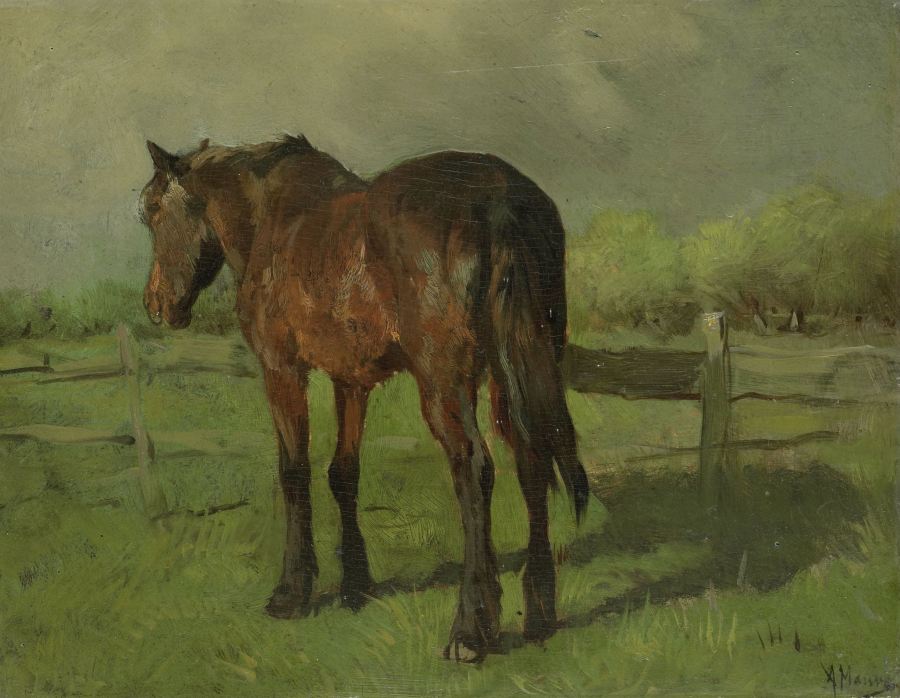
Featured Art: Paard by Anton Mauve
It was close to midnight when Vic heard a shotgun echoing somewhere nearby. If Sue were still around, he’d have put on his boots and stomped out to the porch in his bathrobe, scanning the front yard and street in the twilight. If she were here, he’d have seen that it was all clear and come back to bed where she’d have been frozen under the blankets, breathing those shallow, rabbitty breaths, like she was flattened in a clump of weeds, waiting for the fox to move on. Without Sue, Vic told himself it wasn’t a shotgun he’d heard, because shots at midnight usually meant someone was doing something they shouldn’t.
This was midsummer, humid and hot. Even though it was long after the fourth, the noise could have been an M-80 or Salute, picked up from the reservation. Every couple of weeks one of the guys at the restaurant complained about kids lobbing cherry bombs into front lawns and tearing off down the street, yelping at the stars. That was an explanation he could almost hold in his hand, except that he knew it was the sharp-edged sound of a shotgun that had crackled through the night. His jeans were on the floor. He put them on in the dark and went to check the doors, sticking his head out the back, trying to make out more than just the outline of the barn against the dark sky. The gate leading to the back pasture appeared to be shut, which meant that Toby, the gelding Sue had left behind, should be all right. He closed the door.




 New Ohio Review