Essay: Far From a Mother 

By Madeline Simms
Featured Art: “Eye of Horus” by Ryan Davis

It is a Wednesday when I ask for help in the kitchen, a Tuesday night for my mother.  Winter flirts with spring as she sends a photo of the Monkey Bread recipe across the Atlantic. It reaches me and my dry bones in the wet grey of Ireland. I am looking for anything sweet—  

She sends a good night text when I send Good morning, alongside a picture of Rian and Jonah climbing over my groggy body. We laugh countries apart. Day or night, it is winter-dark wherever we are. I send her a video of the boys licking my face as if they are dogs, and we laugh counties apart. Our well-wishing is a promise of rising, be it the sun, the bread. I think of the day ahead of me filled with Hot Wheels, dropping off the boys at school, picking them up, snacks, spills, a likely tear or two—author unknown.  

During the past few months as an au pair, I’ve grown closer to my mother. She sends me suggestions for sneaking veggies onto the boys’ picky tongues, fun games to fill our long days together. I can’t help but wonder if she feels this too, comradery despite the distance. 

Read More

Animal Control

By Anna Sheffer
Featured Art: “The Bride” by Alex Brice

The buffalo’s tail swished. Clumps of sod mashed around in its mouth. Dana watched through the sliding glass door, safely hidden behind the curtains. If she wasn’t so afraid, it would have been funny, spying on this creature demolishing their yard as if it were an inconsiderate neighbor. But the welcome pamphlet had said these animals were unpredictable—not to be approached under any circumstance—so she was on hold with the nature preserve, listening to jazz flute riffs while wrapped in the curtains she had bought less than a month ago.  

Libby materialized, round four-year-old stomach protruding in front of her. A plastic horse figurine dangled by its mane from her closed fist. “Mommy, what are you doing?” She had been playing quietly in front of the TV just minutes ago; why couldn’t she go back to whatever she’d been up to?  

Before Dana could reply, Libby peeked around the curtain and let out a delighted squeal. “Look, mommy, a buffafwo! Did you see it?” 

Read More

Not Now

By Ivy Goodman

Featured Art: Stephen Reichert, Untitled, 2011. Oil on canvas, 18″ x 12″. “Cirlce” series.

It was a late season game on a warm Saturday approaching summer but not yet humid, overcast, so that clouds gave shade, and if the rain started, good, then the seemingly interminable might end sooner.

Boys, aged nine and ten, were playing baseball.

The game was real, with real uniforms, equipment, jargon, and rules, but it also seemed as momentous as make-believe. I understood make-believe far better than team sports. Oh, I understood sports, but I didn’t. I couldn’t. Like the color blind or the tone deaf, I was somehow incapable. While other parents followed the game, I stared at the players’ families more than I should have.

In our family, there were three of us, my husband, myself, and our son, and we had moved to the area just months before. Newcomers, we were late to register, and our son was assigned to a team with room for stragglers. We still didn’t know quite where we were, what was this place, who were these people? For me the quandary wasn’t just who in general or in particular, but also that deeper puzzlement I often felt, not who but what. What were people? I’d been staring at them my entire life.

Read More

The Tooth

By Colton Huelle

One morning, as he was filling up the electric tea kettle, Lev Bradley discovered a khaki-colored tooth in the corner of his kitchen sink. Mistaking it at first for a pebble, he plucked it up with a bemused chuckle. That was when he noticed the few spots of pearly sheen and the distinctly tooth-like dimples on the upper surface. A shock of revulsion shot down Lev’s spine. He flinched and flicked the tooth back into the sink, where it struck a brown diner mug with a shrill ping.

When the initial shock subsided, he peered once more into the sink to confirm what he had seen. It looked somewhat small for a tooth, but what did he know? He retrieved a pair of yellow dish gloves and, steeling himself with a deep breath, once again picked up the tooth.

“Where did you come from, little guy?” he asked it.

Read More

Mothers in the World Above and Below

By Abby Horowitz

Featured Art: “Persona-03” by Mateo Galvano

Your mother haunts the hardest; that’s what Selah’s told whenever she starts to whine: why hasn’t she come yet to pick me up?

Her mother haunts the hardest, so Selah is at the care center the whole day long, so long that Ms. Drae takes pity on her and gives her second servings of afternoon snack. The other kids trail after their parents up to the parking lot and off to home and there’s Selah again, all alone in a playground full of nobody, or at least nobody that she can see isn’t it possible that she’s got her own ghosts? Oh, get out of your head and get onto those swings, Ms. Drae tells her; then her eyes sink back down to her phone.

Selah swings, she jumps, she slides. Lady-like, please, Ms. Drae calls when Selah’s robe slips up by her thighs, but Selah ignores her. Let the world see her underwear; if only there were someone to look. She takes a clump of dirt and rubs it onto her leg. Look! she says, running up to Ms. Drae, A bruise! But Ms. Drae only rolls her eyes and shoos her away rather than tell her (again) what of course she already knows: you can’t have bruises if you don’t have blood.

Read More

Go Seek

By V. F. Cordova

Paula has some thoughts about what happened at the playground. There are spooky things with children, she says. Kids holding conversations with unseen ghosts, kids with memories of dead people’s lives, siblings with totally opposite versions of childhood memories. It’s theoretically possible in a multiverse scenario, Paula says, that a child could be in both one place and an infinite number of places at the same time, time itself moving simultaneously backward and forward.

I suggest that Paula write a paper on this. I picture her snickering, face illuminated by her phone’s glowing rectangle. The Phenomenology of Freaky Shit, she texts back. I smile.

Or was I just wasted? You. Were. Not.

That she wasn’t there, that she’s not a mother, is no impediment to Paula’s theorizing. But if she’s expert in anything, it’s the outer-bounds of my alcohol tolerance. She’s gotten drunk with me more times than anyone. Our college years were one long rumspringa from our repressive all-girls Catholic school days. Later we both got serious and left town for our doctorates—hers philosophy, mine history—but we kept up weekly phone dates to “wine and whine.” For years we worked as adjuncts in obscure towns, bitching to each other about the apathetic students and the bad take-out and how the drive to the closest airport would be as long as the flight back home. We got tenure-track positions around the same time. Paula’s still at hers, across the country in California. It’s hard to find the time to call now, but we have this text-chain going that, printed out, could bridge the distance.

Read More

Acting Out

By Caroline Koopford

A Friday afternoon, late March of 1990, suburban New Jersey. A second-floor apartment in a series of two-story brick buildings. In the living room there is a slumped brown couch, a scarred coffee table, and a television with dial controls and bunny-ear antenna that stick out garishly from a lop-sided wicker shelving unit strewn with artificial flowers. Beside the shelves is an unshaded window. Outside, the branches of a close maple tree bud neon green. It is almost evening. The light is warm, crepuscular.

Two girls laze on either end of the couch, sleek as seals on a dock, stretched out as far as they can be without touching one another. The television blazes. Cassie is ten. Franny is eight and has been suspended from school. Not for the first time.

Read More

Bandits

By Terry Dubow

Featured Art: Day 4 by John Sabraw

When the phone rang at two in the morning, Michael leapt out of bed so as to not wake Natalie, his exhausted wife who’d been working far too much and far too late for a fifty-three-year-old. In the hallway outside his bedroom, Michael looked down at the screen of his phone and saw his son’s face staring at him. It was a photo of Ezekiel as a little boy, which was how Michael liked to picture his son, who was no longer little. He was actually quite tall. Six foot two at least. And old as well. Nineteen with a flop of uncombed hair and a tattoo on his forearm that he still tried to hide from his mother even though there were few if any secrets among them.

Read More

Coins

By Lorenza Starace

Featured Art: Polar Chroma Butterfly by John Sabraw

She is born too early. The c-section was scheduled for July, but the last ultrasound shows that something isn’t quite right, the baby’s heartbeat is slightly off, and one morning in June a girl is forced into life in a hospital close to the sea. The black-haired baby who is given to the parents once the mother wakes up from the anesthesia has a high, large forehead that seems to compress the rest of her face down to the chin. The mother almost feels the need to stretch it out, to pull the girl’s neck as to give her face more room to accommodate all of that flesh. Laughing, and yet embarrassed, the mother tells the dad, She’s quite ugly, isn’t she? He chuckles, and nods. To be ashamed of what they are not meant to notice is a feeling that accompanies them for the rest of June, for most of the girl’s childhood.

Read More

Balloons

By Catherine Uroff

Featured Art: Polar Chroma Squall by John Sabraw

We’re waiting for a hot air balloon ride up by the old Warren County airport, in the middle of an open field, nothing around us but the long airport shed and a guy with a bushy beard sitting on the flatbed of a truck. Kent’s talking to the pilot about the weather, asking about refunds because it’s a little windy out. The pilot laughs. White teeth flashing in the middle of all that dark hair on his face.

“It’s a breeze,” he says. “You’ve got nothing to worry about.”

Sherri calls me then. She’s lived across the street from us for years. She’s a gossip, telling me things that she shouldn’t, like who in the neighborhood is fighting over money, whose child is questioning, whose husband needs a lawyer. Last year, she asked my daughter, Aimee, to babysit for her while she played tennis. Apparently, Aimee turned on the television almost instantly and forgot to feed the kids their lunch and by the time Sherri came home, the house was wrecked and the children were stunned from all the shows they’d watched, and a boy was coming down the stairs, tucking in his shirt.

Read More

What Will Kill Them

By Christina Simon

Featured Image: Untitled by Tanner Pearson

We were staring at a snake eating a rat.

At my son Kyle’s 12th birthday party, about fifteen boys in the pool stopped swimming long enough to look up. Ten feet away, up on the hill, a brown snake’s mouth was wide open, and a large rat looked like it had been stuffed head-first down the snake’s throat. Its pale pink legs and tail hung out of the snake’s jaw, which was clamped firmly on the rat’s plump midsection. The rat was not moving.

“Get my phone, I need a photo,” shouted Kyle, scrambling out of the pool. The rest of the boys followed him. Within seconds, they were watching the snake, snapping photos, mesmerized by the surreal scene. My husband joined them, along with a few of the boys’ parents.

“Can anybody save the rat?” I yelled frantically. I stood by the pool, looking up at the snake but I wouldn’t get closer. The snake was perfectly still, its mouth stretched wide open to hold onto the rat which dangled out of its mouth, limp. The snake looked about 5 feet long, with a thick body, teeth bared and eyes deadly.

Read More

What is Mine

By Claire Robbins

Featured Image: Untitled by Tanner Pearson

The first package contained a light blue pair of Nike Huaraches, size 8. I took this as a sign that I should keep stealing packages: my son laced them up, and they fit perfect. He started jumping around, walking on air. We both laughed until our sides hurt, and then I cooked a box of macaroni for dinner, made with water and oil instead of milk and butter, But who cares, my son said, lifting up his feet to admire his shoes. 

I only took packages from the porches of nice houses, but not nice houses with fancy doorbells. Some of the doorbells had cameras and attached to smartphones. I could see the older style cameras, so I avoided those packages as well. Everything had to line up perfectly for me to steal a package. 

I drove a Ford transit van delivering flowers for a flower shop, which is how I came to realize that there were neighborhoods in my town that I never even knew about, full of nice houses with packages on porches. Some of these neighborhoods were gated, to keep people out unless they belonged. 

I also delivered flowers to neighborhoods like my own with old houses falling into disrepair or bought up and cheaply brought to code by slum lords. There were widening gaps between the houses where condemned houses had been demolished by the city. Every once in a while, Habitat for Humanity would slap a cute little bungalow in one of the empty lots. But I never took a package from neighborhoods like my own. It didn’t seem right.

In the mornings, I clocked in to work and looked at the flower arrangements that were going out for delivery that morning. They stood in the cooler in the flower shop, and I read each tag before deciding on my route. Then I loaded the vases into the back of the van and drove off. Sometimes I had to gas up the van or air the tires or stop at the grocery store to pick up fruit for a fruit basket. Then after my deliveries, I helped process the flowers in the shop, while the designers put together bouquets for the next day. That was it, the entire job. Sneaking the packages from the van to my car was easy. I never took anything larger than a shoebox, and I slipped it into the backpack I kept on the passenger seat. 

Read More

How to Peel an Orange

By Stephanie Wheeler

Featured Art: Peeled II by Samantha Slone

The dryer was making a monstrous sound. The repairman stood with his hand resting flat on top.

“I feel the vibration,” he said. He was a fat man with a three-day stubble sprouting in uneven patches on his face. His uniform shirt was belted into his trousers around the front and haphazardly untucked in the back. Hazel could see his milky eyes shifting rapidly through smudged glasses. She hated him a little.

Hazel nodded. “And you can hear it, too.”

He squinted his eyes, then squeezed them tight, concentrating.

Hazel decided that she hated him a lot.

“The grinding sound,” Hazel said, straining to make her voice heard above the din. “It’s quite obvious, really.”

“Ah, yes. The grinding. I hear it.”

Hazel’s cell phone chimed then, and she looked at the screen. The name Walt appeared in white letters, glowing.

Read More

La Malinche, La Llorona, and Cristine Ortiz

By Michael Leal García

On that nightmare afternoon at Plaza Mexico, Aaron never saw the gunman open fire. He just heard a series of pops—something he would only later recognize as gunfire—before Cristine knocked him over, their four-month-old son in his arms. After checking that Lil Aaron was fine—the boy still fast asleep—he felt a weight roll off his legs. There, Cristine lay motionless. Read More

To Do

By James Lough

Featured art: Yin and Yang by Mariama Condé

It seems I’m to blame for my three-year-old son’s conversion to religion. It begins around five o’clock on a warm autumn afternoon at an open window. I am bent over, tidying up his Thomas the Tank Engine pieces scattered on the rug. Simon is standing at the tall, open window, a window hung low in the wall, its sill even with his knees. He’s watching the low, golden light play off the grass. Outside the window is a twenty-five foot drop. He presses his little palms against the screen and leans in for a closer look.

I panic and shout. “Simon Simon no no no get back!” Read More

The Terms of Agreement

By Patrick J. Murphy

Featured art: Untitled by Sue-Yeon Ryu

It was getting late and her grandson Buddy wasn’t back, so Vera decided to brave the heat and go with Alicia to find him. She’d wanted to talk to her daughter in private, anyway, but when she stepped outside, though the sun was low, the light still bounced with a glaring intensity off the pale houses, the plastered walls. Vera felt her skin growing damp, the small shock as the heat hit her body. It just took time to adapt to a Florida retirement, she thought, and remembered Little Rock and the parks along the river, the evening fireflies above deep grass.

It irritated her that Alicia, walking placidly beside her, didn’t seem to mind the climate, or much of anything else. Her daughter was overweight and wore long, black, wrinkled cotton dresses. Her left ear was pierced in five places, and she sometimes wore a silver ring through her right eyebrow. She was making a statement, she said, and didn’t care what anyone thought.

“Then why bother making a statement?” Vera asked once, only to meet with an uncomprehending stare.

Read More

The Tour

By. Erica S. Arkin

It occurred to Dennis six hours into the road trip that he might have made a terrible mistake. His daughter Natalie sat on a fold-down seat in the back of his pickup’s not-so-extended cab, plugged into her Discman and propped against the small window behind the empty passenger seat. She was reading a magazine with a cover that said something about Bedroom Tricks to Blow . . . Dennis only caught a glance when she’d pulled it from her backpack at the last rest area. He was glad he couldn’t see the whole thing in the rearview mirror.

Read More

Recovery

by Max Bell
Story originally published in New Ohio Review Issue 25
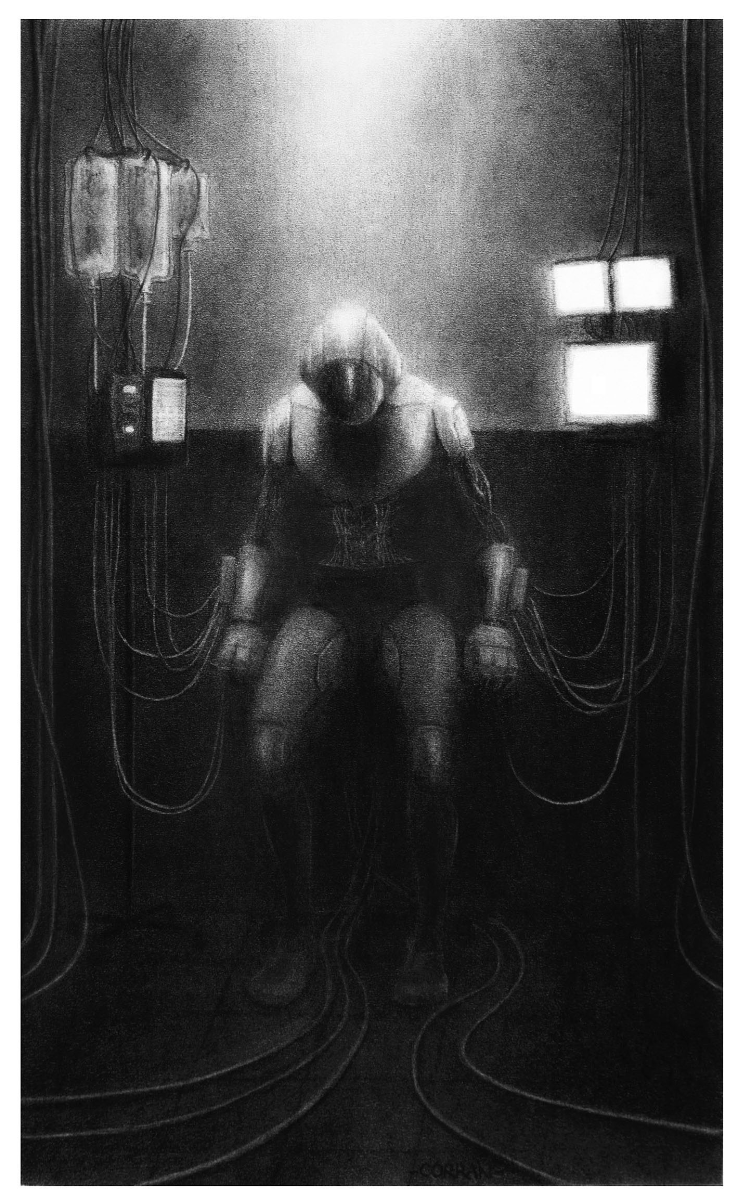
Featured Art: Recharge by Corran Brownlee


Two Weeks 

Lisa left when the droid arrived. There was no period of transition, no time for Richard to adjust. After she signed for it, she carried it into the living room, set it down in front of him on the worn shag, and began saying her goodbye. Like the stitches in his hip, she was disappearing, dissolving in front of him. He did not, however, rejoice in the knowledge of her impending absence. Read More

Dark Matter

By Caro Claire Burke

1.

The mother and father received the news on a Friday afternoon and were in the car driving south an hour later. They drove until midnight, then checked into a Courtyard Marriott for five hours before hopping back onto the road at dawn to cover the last hundred miles. They were silent in the car, which was strange: in their twenty years of marriage, they had never run out of things to talk about. There were, of course, things to talk about now—perhaps more than ever before—but neither the mother nor the father could find the words to start the conversation. By the time they navigated through the college town and parked at the police station where their son was held, they were both exhausted, irritable, and fit to burst with all the questions they’d swallowed on the way down.

The police officer behind the desk looked up as the entrance bells went off. “You must be the boy’s parents.”

The father stepped forward to shake the police officer’s hand. “That we are. Where is he?”

The officer was jovial to a fault. “Just down the hall a ways.” He turned toward a door in the back and waved an arm at them to follow. But the mother and father were silent, almost frozen, and at that silence the police officer turned around, his hand on the doorknob. “Hey, now,” he said. “Now’s not the time for that. Your boy is pretty shook up. He could use some support. Between you and me, these cases happen all the time. My guess? Your boy will be out of here in no time, clean record and everything.”

Read More

The Red Bird

This story originally appeared in New Ohio Review 8. Here, Joanne Serling, author of the new novel, Good Neighbors, reads for our NOR Audio feature.

Illustration by Devan Murphy.


At the Edge of Everything

By Traci Skuce

For the past hour, Alli had been sitting against the small oak, her eighteen-month-old son latched to her breast. His molars had finally—thank God—broken through, and now he suckled, cheeks sticky and eyes lolling with pleasure. Alli had hoped another mom would show up. Jeannie was off visiting her parents in Vancouver and Clay, well he was just plain off, so she hadn’t had an adult conversation in days. She wanted someone, anyone, to gab with about the impossibility of lost sleep, errant husbands, and teething. But there were only the crows, waddling around the rim of a garbage can, diving in for pizza crusts then flying off across the playground to the giant cedar.

Alli’s daughter, Tavia, looked at the birds from under her floppy sunhat, and then dumped a handful of sand onto an accumulating pile, patted it down. Alli mimed eating, mumbled yum-yum as she had been since they’d arrived. “Do you like it Mommy?” Without waiting for an answer, Tavia ran back to the production center beneath the slide.

Jack continued suckling. Both breasts were drained and she’d become a giant pacifier. His eyelids fluttered and his blond feathery hair stuck to his forehead, ear crusted with milk and peanut butter. She picked at it, and he swatted her, still sucking hard. Enjoy them while they’re young, people said, but she couldn’t wait to toss these days onto the slag heap of motherhood.

Read More

Return

Winner, New Ohio Review Fiction Contest
selected by Mary Gaitskill

By Analía Villagra

He was gone for eleven years, and Jackie is still getting used to the idea that Victor is out. Exonerated. His release had warranted a few sentences on the local NPR station, so Jackie knows that he has been at his mother’s place, three blocks away, for a week. She has not yet run into him on the street. Each time she leaves her apartment she scans the sidewalks, and when he does not materialize she feels equal parts relief and disappointment. Thursday afternoon she goes out of her way to walk past his building, willing him to be on the front steps or looking out the window. She slows down. Would he even recognize her now? Her hair is short, with a few stray glints of gray, no longer halfway to her waist and shimmering black. Her eyes have shadows beneath them. Her hips have spread. She’s thirty years old, in good shape she thinks, unless you’ve spent a decade fantasizing about a nineteen-year-old body. Jackie blushes. This is the first time she’s admitted to herself that she wondered—hoped? assumed?—that Victor thought about her while he was away. Eleven years. Maybe he’ll recognize her, maybe he won’t. She can’t decide which is worse, so she stares down at the sidewalk and hurries past the building.

She goes to the Y to pick her daughter up from camp. Graciela is running around the outdoor play area with a group of other kids, their hair wild, their clothes and faces filthy.

“Mama!” Grace shrieks when she sees her.

Jackie waves. She locates the teenagers wearing staff T-shirts, and they hand her the sign-out sheet without pausing their conversation. Jackie half-listens to the latest counselor drama while Grace gathers her things.

Read More

Black Telephone

By Robert Long Foreman

Featured Art: Death: “My Irony Surpasses All Others” by Odilon Redon, 1888

Michael, you are gone, and in this house where you once were there is an antique telephone as black as your coffin. Heavier than it looks, it is as full as the hole the men dug for you, early one morning, as they talked about summer and things they saw on TV.

Old things weigh more than they look—dead, leaden things like you and the black telephone.

You have been gone three weeks, and now my mother is gone, too. When she left for Providence she left me here with Michael, whom you left behind like a copy of yourself when you went. He doesn’t ask where you are anymore. Instead he says, nine times a day, that he’s going to call you on his telephone.

He found it at the flea market where my mother took him, to take him off my hands and take me off of his.

When I’m not looking, he lifts the receiver and talks to you. He doesn’t say your name, and I don’t ask who is on the line. I know it’s you.

Read More

Necessaries

By Tina Tocco

Featured Art: Still Life by Earl Horter

We’re in Omaha when I know. You’re out bootlegging—running, you call it—for that man from Tinker’s, a deacon at First Baptist, he says, though his name is Kinsky. I curl on a cardboard cot imagining my quilt from Pomeroy’s when the big Chicago woman, hair steam-strung from the laundry pots, stands downwind. “Only two reasons to stay with a man, but only one to stay with a man like that.” She has brought the necessaries. They clink in a feed sack the pattern of girls’ dresses. There is not much for me to do, but I do it quietly. It’s one jug of Tinker’s mash for quietly. The Boston girl, she warns, paid three.


Read More

The Abandoned

By Chaitali Sen

Featured Image: [Landscape with Cottage] by Marie-Charles-Isidore Choiselat, 1844

The husband is still explaining it on the day of the parent-teacher conference, and the wife still carries on as if she doesn’t understand. The twins will be home early, their school day shortened so their teacher can meet with parents all afternoon.

“Is the school too difficult?” she asks.

“How do I know? That’s why we talk to the teacher.”

Their appointment is at three o’clock, and it will take almost an hour to get there. He will be away from the shop too long. When is she supposed to start dinner? She can carry on for as long as she wants, he says, but on this he has to be insistent. This reversal of roles must reverse back. She is the mother, the one who should know the details of her children’s schooling.

Read More

The Lady from TV Is Coming

By Sabrina Jaszi

Featured Art: Dance of the Trojans by Henri Fantin-Latour

Every Sunday my daughter calls from California. “Church today, Mom,” she says, not a question: a truth. Every Sunday I mimic her tone. “DanceCraze at the Lautner Center,” I say, and every Sunday Angelie lets out a tunnel of sigh, long, and black at the edges. Today is like every Sunday. At Messler High this week, I’m teaching orbits: the sun, the moon, and the Earth all moving around each other in perfectly predictable ways. I feel like telling my daughter about it, but I don’t have time. DanceCraze starts at eleven. Usually it’s free, except for next week, when the lady from TV is coming.

Today, as always, Robert snorts as I pass him in my tights and sneakers. I walk the six blocks to the Lautner Center and push through its double doors just a couple minutes early, in time to get my spot in the back but after the chitchat. The clock on the wall is ticking toward eleven and everyone starts marching in place. Lila C. is up on stage between the two droopy flags, with the emergency exit behind her. The crowd today is about one-half oldies, one-quarter hoochies, and the rest children and miscellaneous. Miscellaneous, that’s me.

Read More

But it Moves

By D.J. Thielke

Featured Art: Ely Cathedral: Galilee Porch from Nave by Frederick H. Evans

Science is nothing to be scared of, I promise my eighth-graders. Science, I say, is what gives us words for what the earth, the universe, already know in a language of cells and change.

They are busy copying my name off the board.

I tell them to think about time, think about how we talk about the abstract idea of it like something physical: a road we’re traveling on. The road of life, we say. Moving past something, leaving it behind; or stepping into the future, looking forward to something. The future is ahead, the past behind, this is how we place ourselves.

But, I say, earlier cultures spoke about time as a road that you walked backwards on. They faced the past, its landscape visible and familiar, while taking tentative, shaky steps into the unknown behind them. The future, a darkness over the shoulder they had to carefully, fearfully move toward.

My students are quiet for a moment.

Then one says, So, life is a highway?

Read More

What You Find, If You Find It

By Jeff P. Jones

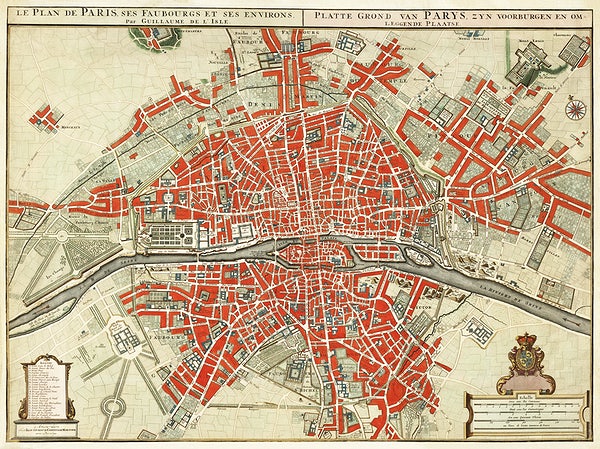
Featured Image: “Paris Map in Dutch” by Guillaume Delisle

As a letter carrier, she delivered non-urgent messages to people’s houses. Her work brought her past gates, across yards, onto porches, into foyers. She never looked in windows or rang doorbells but on request would hand mail to a resident encountered outside as she exchanged small talk. She would then move on, readying the next house’s letters and advertisements, imagining fingertips releasing sealed flaps, creases tearing, messages sliding into waiting hands.

Each week her teenaged son caused some new havoc. One night he stole her car and was stopped by police forty miles away, coursing a college town’s streets with three friends and a bottle of vodka. The four boys cleaned her gutters the next weekend as she grilled hamburgers and made jokes about her prematurely gray hair.

She sipped her morning coffee and pretended to read the paper as she watched him eat toast.

In his last year of high school he had to transfer schools because of attendance problems. He brought home a stray mutt that he forgot to feed. He began to take phone calls from a man with a comically gravelly voice named Staff Sergeant Thigpen. The son carried the receiver into his room and shut the door. Posters of grimfaced warriors appeared on his walls. He exterminated the squirrels and birds from the backyard with an air rifle. He rarely answered her in a full sentence. In the summer she drove him to the airport. He wore a new pair of running shoes and carried no suitcase.

Read More

Strapless

By Z.Z. Boone

Featured Image: “Breton Girls Dancing, Pont-Aven” (1888) by Paul Gauguin

I don’t know what happened, but last night I just lost it. Just fucking lost it.

It’s eleven o’clock at night, I’ve been doing inventory in my store all week, I’ve barely made a dime, and this is when my fourteen-year-old daughter decides it’s a good time for defiance.

“You have no idea what it’s like!” she screams.

I’m lying on my still-made bed, full dressed except for my shoes, and she’s standing with a hand on each side of the doorway as if to prevent my escape. I’m not going anywhere. I’m just trying to hear the TV, trying to get the news about how screwed up the rest of the world is, but I can’t make out a word.

Read More

On the Strand

by Dave Kim

Feature image: Edgar Degas. Beach at Low Tide (Mouth of the River), 1869. The Art Institute of Chicago.

My mother’s boyfriend was a man named Bang. I never learned his first name. He’d been an officer in the Korean army before coming to the States, and he would yank me out of bed at six-thirty every morning to do jumping jacks. I was a doughy nine-year-old and he was trying to make me leaner and tougher. If I got angry, he would dare me to hit him and stand up for myself, get it out of my system. On Sundays we’d go to his boxing gym to watch the men pound each other to pieces, which terrified me at first and then made me dream of days when I’d be big enough to put on gloves and whomp Bang in the gut. I needed a good ass-kicking, he would tease me in his throaty Korean. Anytime I wanted, I could challenge him. Mom didn’t get involved.

The three of us went to Santa Monica Beach one Saturday afternoon to ride our bikes on the Strand. Bang would take me fishing on the pier sometimes and when we rode past it that day, I thought about how much I would rather be out there with a basket of calamari and a cherry Icee, watching our poles nod on the railing. It was one of those perfect afternoons when the California coast looked way better in real life than on the glossy postcards they sold on the boardwalk. Couples were stretched out on the sand, half-hidden under candy-colored parasols. The sky was ablaze in orange light. But I didn’t care about the scenery. All I really saw was this endless bike path and its dashed yellow divider. The back wheel on my hand-me-down Schwinn was grazing the brake pad with every rotation and I lagged at least a hundred yards behind.

Read More

July 4th, 1984

By Maggie Mitchell

Featured art: Figures by Benjamin F. Berlin

Maddy is thirteen, almost fourteen. Her chest is as flat as a boy’s and she does not own a pair of Jordache jeans.

“I hate Fridays,” she tells her mother. What she means is that she hates everything.

“I know you do,” says Jude, understanding perfectly. “I’m not sure what you want me to do about it.”

“It feels like I’m in prison. There aren’t any windows in there.” She’s referring to her room behind the bar, to which she is more strictly confined than usual on Friday nights: Jude insists that she stay out of the way when it’s crowded. “I can hear people but I can’t see them.”

“Why would you want to see them? They’re adults at a bar.”

“But that’s all there ever is,” Maddy rails, not even caring if she makes sense. “Adults at a bar. I wish we could be normal.”

“That’s what you keep saying. You tell me what normal is, and I’ll see what we can do.”

Maddy whirls around and storms into her room behind the bar, daring to slam the door. She knows only what normal isn’t.

Read More