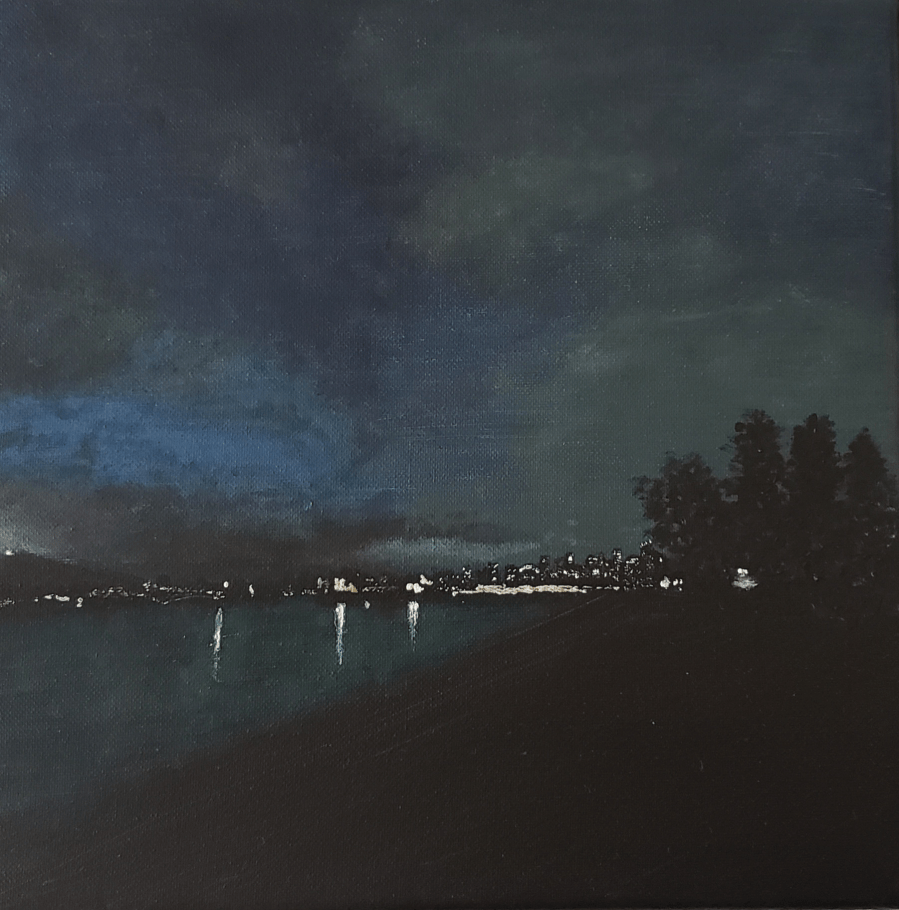
By Sofie Llewellyn Riley Featured Art: “Before Sunrise Locarno Beach” by Thad DeVassie
Autumn in Minnesota doesn’t look so different from Ohio. The trees are the same color, the farms the same distance from the cities. The congestion and construction are the same consistency, slowing traffic to a mucus-like crawl. If I were to close my eyes in the park beside the Mississippi River, I would hear birds that sounded like the starlings that sat on the pine branches in my childhood backyard. This is a trick I play on myself sometimes, to try and feel as though I am near where I am from.
“Biological sex,” “birth sex,” and “sex” mean the biological indication of male and female, including sex chromosomes, naturally occurring sex hormones, gonads, and nonambiguous internal and external genitalia present at birth, without regard to an individual’s psychological, chosen, or subjective experience of gender. [ . . .]
“Gender-related condition” means any condition where an individual feels an incongruence between the individual’s gender identity and biological sex. “Genderrelated condition” includes gender dysphoria.—Ohio House Bill 68 [Emphasis always mine]
Abandoned barns and houses are a common feature of farm country in Ohio. It’s not unusual to see them far back off the highway—two-story clapboard colonials with doors missing or ajar, an oak tree growing out of a roofless silo or vine-choked milkhouse. These places are, as Mary Oliver presents them in her poem “The River Styx, Ohio,” extinct portals to the underworld, places where a connection has been severed, where old ways of knowing and suffering are buried.
The Ohio River runs through James Wright’s oeuvre, a throughline leading back to the hardscrabble community of his youth. It’s a region ravaged by strip mining, extractive industry and labor practices, and dead-end factory jobs resulting in generational poverty. Yet despite his professed hatred of and determination to escape his native Martins Ferry in the Appalachian foothills, Wright returns again and again in his poems to the banks of the river he grew up exploring. This boundary between Ohio and West Virginia, between water and land, is haunted by the ghosts of drowned childhood friends, miners “dead with us” in the gorges, and memories of violence witnessed—and perpetrated—in his youth. But the sacred and profane river—with its “bare-ass beach” that is “supposed to be some holiness”—is also his “Muse of black sand.” “How can I live without you?” he writes. “Come up to me, love, / Out of the river, or I will / Come down to you.”
Betsy K. Brown: Today, we will be hearing from poet, novelist, and doctor Amit Majmudar. Majmudar is the author of seventeen books, with three more forthcoming this year. He also served as the first poet laureate of Ohio.
As a fellow Ohioan and poet, I’m particularly curious about how Ohio has influenced your writing.
Throughout my 20s, when romances have fizzled or my career trajectory has felt unmappable, my deep passion for my home of New York City and my belief that I will always live here has been an emotional anchor. But in reading poet and essayist Hanif Abdurraqib’s writing about his home state of Ohio, I’ve reconsidered what a hometown is and how we can relate to these places.
It wasn’t until I had to move from Iowa to Columbus that I finally sat down to read Sherwood Anderson. When my father’s father downsized his book collection for the move to the retirement home, he took with him thirteen copies of Winesburg, Ohio, the most famous title of this now less-than-famous author. Thirteen doesn’t count the twenty-one volume complete Anderson published in Kyoto, Japan, or the scholarly publications devoted to Anderson’s novel-in-stories. It doesn’t include the 1962 issue of Shenandoah, wherein my grandfather argues that, while Anderson’s “hard, plain, concrete diction” paints superficial impressions of Ohio, what truly interested the author was the “dark, unrevealed parts of the personality like the complex mass of roots that, below the surface of the ground, feeds the common grass above in the light.”
One of my all-time, hands-down, desert-island favorite short stories begins like this: “We lived then in Cleveland, in the middle of everything.” The narrator does not mean the middle of the action. “One of the beauties of living in Cleveland,” he later explains, “is that any direction feels like progress.” We’re in the middle of the country and also the middle of the Twentieth century, just after Woodstock but “before the city of Cleveland went broke, before its river caught fire.” We’re four sentences in and Cleveland’s not looking too good. It’s looking like a placeholder for either midwestern boredom or rustbelt squalor.
David Foster Wallace is often discussed as a regional writer; critics have focused on the ways his fiction and nonfiction depict both the northeast (in Infinite Jest) and the midwest, primarily his sometime-home of Illinois. But what is often overlooked is that his first novel, The Broom of the System, is an Ohio novel. Although Wallace didn’t have any concrete ties to the state (he grew up in Illinois, and was living in Massachusetts when he first drafted the novel), he chose to set the book in the Cleveland area, for the same reason that so many writers use Ohio as a setting—because it serves as a synecdoche for America itself. Shortly after the novel’s release, he told an interviewer that he had never actually been to Cleveland, but as “a middle-westerner. . . he wanted a heartland city that he could imagine instead of describe.” In Wallace’s imaginative vision of the “heartland,” Ohio is, as one character describes it, “both in the middle and on the fringe. The physical heart and the cultural extremity.” He goes on to claim that “we feed and stoke and supply a nation much of which doesn’t know we exist. A nation we tend to be decades behind, culturally and intellectually.” This is a division that Wallace explores in much more depth and detail in many of his nonfiction pieces, such as “The View from Mrs. Thompson’s,” “Getting Away From Already Being Pretty Much Away From It All,” and “Derivative Sport in Tornado Alley,” all of which use the midwestern locale to interrogate what it means to be a true American.
In Broom, Wallace uses the heartland setting to explore many of the thematic elements that are central to his later writing (some more successfully than others—it is very much an apprentice work). The central plot, such as it is, revolves around 24-year-old Lenore Beadsman, who must negotiate being surrounded by a variety of hideous men (including her boyfriend/boss, her landlord, and her therapist), while searching for her great-grandmother, a former student of Wittgenstein, who has escaped from her Shaker Heights nursing home. The novel also interrogates the idea of what constitutes reality; Lenore in particular is worried that she is just a construct of language, and that “she had no real existence, except for what she said and did and perceived and et cetera, and that these were . . . not really under her control.” Wallace later distanced himself from the novel, calling it “a sensitive little self-obsessed bildungsroman” written when he was “a young 22.” Michiko Kakutani accurately described Broom as “an unwieldy, uneven work—by turns, hilarious and stultifying, daring and derivative.” She notes how Wallace takes on “serious philosophical and literary discussions” while also getting sidetracked by “repetitious digressions, and nonsensical babbling that reads like out-takes from a stoned, late-night dormitory exchange.” This is a fair critique, but as with many a late-night stoner conversation, there are certain elements that can hold up to closer scrutiny in the sober light of day.
Featured Art: Birds by Jonathan Salzmanand Tibetan Monks visiting Passion Works Studio
Ohio
We sit in the car, my mother and I, outside a large white barn with black trim. It’s a pretty barn—less than a mile from our home—and my sister Maura keeps her horse here. The horse is Culotte. His previous owner called him “Just Cool It,” but Dad said that was too much of a hippy name. He is a proud Republican. During the last election, I picked up one of the dropped campaign buttons outside the voting booths. You aren’t allowed to wear the buttons inside. The vote is private, sacrosanct.
We have stopped, as we do each morning, for Maura to feed Culotte. In March 1972, I am nine. In five minutes or ten minutes, when Maura comes back to the car, Mom will drive me to the William E. Miller Elementary School. She will drive Maura to the parking lot of the A&P, where Mrs. Besaunceny and three other students meet every day to drive to Columbus School for Girls, an hour away. CSG has no room for me in the fourth grade class. I’ll join the fifth graders next year.
Our breath is frosty in the car. I ask my mother to repeat her question.
“If your Dad and I ever got a divorce, who would you want to live with?”
Featured Art: In The Sky SomewhereElse by Emma Stefanoff
In his preface to The Marble Faun (1860), Nathaniel Hawthorne infamously recounted the limitations of America as material for art and artists, citing the “difficulty of writing a romance about a country where there is no shadow, no antiquity, no mystery, no picturesque and gloomy wrong, nor anything but a commonplace prosperity, in broad and simple daylight, as is happily the case with my dear native land.” Hawthorne’s words were and are astonishing in their obtuse, perhaps willful ignorance of one particular “gloomy wrong” shadowing America’s “commonplace prosperity” as the nation careened toward the Civil War. But they also set up the persistent idea that America is a contented and peaceful country, one without a shadowy past that is ripe for romantic literary exploration.
The notion of America as a young, fresh, tabula rasa had its inception long before Hawthorne set pen to paper, and even then, in its earlier colonial and Revolutionary-era iterations, it was a lie. While Hawthorne’s description of America suggests a blithe happiness that characterizes the nation and its inhabitants, the specific literature of Ohio, for instance, would suggest otherwise. In fact, literary portrayals of Ohio seem particularly in tune with the tension between shining surface and hidden shadows. It is as if Ohio is, as Bill Ashcraft notes on returning home to the fictional New Canaan in Stephen Markley’s novel Ohio (2018), “the microcosm poster child of middle-American angst.”
In poems, Ohio—as word, as a set of landscapes, as a cradle for psychological, emotional, and cultural exploration—exists with significance and versatility. Derived from the Iroquois word that means “beautiful river,” Ohio, as a name, is vowel wealthy, bookended by o’s, assuring that its mention brings a sonic vitality and depth. Ohio, in terms of topography, is rolling plains, glacial plateaus, Appalachian hills, stretches of bluegrass. Due to its proximity to the Great Lakes, and its general position on the continent, Ohio has hosted all of the following: major, ancient routes used by Native American tribes to travel and trade; pivotal exchanges between Native American and European fur traders; the ruthlessness and violence brought on by the heightened European demand for exportable goods and by the grueling process of colonization; numerous battles fought during extended, armed confrontations or wars (Pontiac’s Rebellion, the American Revolutionary War, the Northwest Indian War, the War of 1812, and the American Civil War); hubs and final stops for freedom-seeking slaves along the Underground Railroad; early industrialization; and destinations for African Americans leaving the Jim Crow south during the Great Migration. To many poets and readers, the mention or involvement of Ohio can at least subconsciously educe some of the locale’s extensive identity. Looking closely at two poems by Rita Dove and Ai, we will examine a few of the elements and forces that the incorporation of Ohio brings to the texts.
Ohio and Science Fiction. Perhaps unexpectedly, given the overwhelming normness of Ohio, the two have become inextricably linked. So, for the bene t of colonizing aliens and future AIs, busy consuming every spec of human information in an effort to understand us—where we went wrong, what were our occasional successes, what is meant by “Cincinnati Five-Way”—I’m happy to set out on a kind of fantastic discovery of my own, seeking to answer: Why do an inordinate amount of authors and directors set sf works in Ohio? What could the place represent that makes it such rich soil for these stories? And how might sf itself be enriched by Ohio-ness? Dust off your ray gun and wearable OSU memorabilia, I’m going to need some help.
First, to situate us. This essay will focus on two sf novels by Kurt Vonnegut— Breakfast of Champions (1973) and its “sequel” Deadeye Dick (1982)—both set in the fictional town of Midland City, Ohio. These novels propose, among other things, that a neutron bomb has destroyed Midland City, that an inconsequential sf writer named Kilgore Trout had been set to keynote the Midland City Arts Festival before its annihilation, and that one of Trout’s novels, which supposes that every Earthling but the reader is a robot, is about to be taken as gospel-truth by the dangerously unstable Dwayne Hoover. We’ll also look at Ernest Cline’s Ready Player One (2011), among other Spielbergian nuggets of pop culture, which casts Columbus, Ohio, as the technological mecca of America and features a fully immersive virtual reality called the OASIS which people prefer to reality.
Here in the backyard of our mutual friend in San Diego, holding a beer while a balmy twilight coats us in aquatic hues, a woman talks about Norway. Norway by way of Bulgaria.
“Bulgaria is awful,” she says. “But Norway is expensive.” She’s a systems analyst for a cyber-security company.
Another woman says San Francisco by way of Hong Kong by way of, originally, Thailand.
Among others in this six-week writers workshop are a couple of New Yorkers, two Baltimoreans, L.A. folks (with stints in Poland), a South African, and an energetic woman from Lake Charles, Louisiana, whose pale hands utter like scared doves when she revs up for a joke.
Chatter. Writers talking shop, life, travel.
I say Ohio. “I’m from Ohio.”
Someone says, “Oh.”
Like the abbreviation of the state itself.
Oh.
A sip of beer, eyes downcast, searching the dirt for a lost thread of conversation.
In an interview with Claudia Tate, Toni Morrison had this to say about her home state of Ohio:
The northern part of the state had underground railroad stations and a history of black people escaping into Canada, but the southern part of the state is as much Kentucky as there is, complete with cross burnings. Ohio is a curious juxtaposition of what was ideal in this country and what was base. It was also a Mecca for black people; they came to the mills and plants because Ohio offered the possibility of a good life, the possibility of freedom, even though there were some terrible obstacles.
In Ohio, there’s a distinct feeling of being in the middle—not only in the physical middle, mostly landlocked near the center of the country, but also in the ideological middle, politically, morally—having been on the right side of history regarding the question of slavery, but, even during the same time period, often in the wrong on questions of justice: at least as supportive of fugitive slave laws as of the underground railroad. Morrison not only grew up in this contradictory state, it pervades her fiction. “In my work, no matter where it’s set,” she once told an Ohio audience, “the imaginative process always starts right here on the lip of Lake Erie.”
In their emphasis on a non-linear historicity, their cyclicality, and through her comprehensive storytelling, Morrison’s novels are intimately tied to her Ohio roots. The distinct seasons of northern Ohio—its agricultural rhythms and proximity to the eternal crash of recycling Lake Erie waves—inspired an aesthetic insistent upon return. Central to that aesthetic is Morrison’s initial refusal to reveal everything straight away. Early in her novels, readers are left momentarily confused, uncertain we have what we need. And often, we don’t, yet. This aesthetic style models a return to history that Morrison encourages—both in her novels, where she flashes back to revisit stories and add details from characters’ pasts to illuminate their complex realities, and in our own worldview, where we’re encouraged to look again at our own stories and the injustices that are never merely past. Ohio’s specific place in United States history and its natural rhythms inform Morrison’s style—which we can see from a brief look at her widely explored Ohio novels The Bluest Eye and Beloved. Moreover, the spirit of Ohio—its promise and precariousness—is so strong in Morrison’s work that it extends to later novels set outside of Ohio as well, particularly her slightly less appreciated Great Migration novel Jazz.
In The Bluest Eye, set in her hometown of Lorain, Ohio, Morrison employs agricultural metaphors inspired by her home state but does so for her own purposes. Having divided her first novel into four sections following the four seasons, she subverts Western symbolic meanings, as she does throughout The Bluest Eye, to draw attention to the fact that not everyone flourishes under a hegemonic worldview. The protagonist, Pecola, who desires blue eyes, is raped and impregnated by her father, Cholly, in the springtime—resulting in a baby doomed to death and a child doomed to insanity. All of this is set against the expected rains of rebirth. Likewise, the novel borrows its closing metaphor from gardening, but it evokes sterility not fertility: “it was the fault of the earth, the land, of our town. I even think now that the land of the entire country was hostile to marigolds that year. This soil is bad for certain kinds of flowers. Certain seeds it will not nurture, certain fruit it will not bear.” The soil’s hostility toward narrator Claudia’s marigolds provides an immediate metaphor for Pecola’s stillborn baby, but it’s also a metaphor for Ohio’s inability to welcome Pecola or her father, and for a country whose people and systems continue to perpetuate racial humiliation.
In the Pulitzer–Prize winning Beloved, this time set in Cincinnati, Morrison uses the seasons to deepen our investment in her characters. She writes, “In Ohio seasons are theatrical. Each one enters like a prima donna, convinced its performance is the reason the world has people in it. When Paul D had been forced out of 124 into a shed behind it, summer had been hooted offstage and autumn with its bottles of blood and gold had everybody’s attention.” Like the Ohio seasons, Morrison’s characters are tempestuous and demand attention. Even her secondary players are full enough to remind readers that everyone’s story is central to herself—that no one, fictional or otherwise, deserves to exist perpetually on the margins. “The fact that I chose to write about black people means I’ve only been stimulated to write about black people,” Morrison has explained elsewhere. “We are people, not aliens. We live, we love, and we die.”
In Beloved, Baby Suggs urges her congregation in the Clearing toward a similar realization: “in this here place, we flesh; flesh that weeps, laughs; flesh that dances on bare feet in grass. Love it. Love it hard. Yonder they do not love your flesh. They despise it.” “This here place” might not represent the totality of Ohio, but it is in Ohio: “to get to a place where you could love anything you chose,” Paul D reasons, “well now, that was freedom.” “Yonder,” on the other hand, certainly represents parts of the South, but it’s also the Ohio just beyond the Clearing, which can turn on you as fast as the Sweet Home slave catchers arriving on horseback. And when the imperfect protection offered by Cincinnati can’t keep “the bloody side of the Ohio River” on its own side, Sethe—in one of the most heartbreaking moments in contemporary literature—kills her daughter, Beloved, and tries to kill her other children. Sethe, like Margaret Garner, the real-life woman on whom the story is partially based, knows—at least in her panic—slavery to be worse than death.
Although her Ohio novels are some of Morrison’s most celebrated, they’ve also faced severe scrutiny. The Bluest Eye and Sula were originally met with dismissive criticism, and they, along with Beloved, have been banned and challenged by censors. Now widely viewed as the United States’ greatest living novelist, Morrison called reading early reviews of The Bluest Eye a “depressing experience.” For instance, a 1970 New York Times reviewer asserted, “Morrison has gotten lost in her construction.” And in a now infamous 1973 review of Sula, Sara Blackburn initially responded to The Bluest Eye by writing that “socially conscious readers—including myself—were so pleased to see a new writer of Morrison’s obvious talent that we tended to celebrate the book and ignore its flaws.” Blackburn even went on to suggest that Morrison should turn her attention away from “the black side of provincial American life” toward more “serious, important” topics. And as recently as 2013, the president of the Ohio Board of Education tried to remove The Bluest Eye from an 11th-grade Common Core reading list. Many people defended the book—most notably Morrison herself: “To be a girl from Ohio, writing about Ohio, having been born in Lorain, Ohio, and actually relating as an Ohio person, I resent it.” To ban a Morrison novel in Ohio feels like banning Ohio in Ohio, like keeping Ohio history from Ohioans: this is our past, such a move insists, but we don’t want to look at it.
Through researched historical description and intense aesthetic beauty, Morrison forces us to look. In her 2019 essay “Peril”—a preface to her newest collection of writings, The Source of Self-Regard, which was released this February just before her 88th birthday—Morrison highlights the power censorship tries to conceal: “the efforts to censor, starve, regulate, and annihilate us are clear signs that something important has taken place.” One of the many important things taking place in Morrison’s Ohio novels is their investment in history. Seeing no memorial to slavery, she dedicates Beloved to “Sixty Million and more.” She creates Sula in rural Ohio and charts the capitalistic displacement of black communities. She sets The Bluest Eye in her hometown and chronicles the internalized effects of centuries-long racism. And she does so in sentences you never want to stop reading. “My sensibility,” Morrison has insisted, is both “highly political and passionately aesthetic.”
*
Michael Hill’s 2013 book The Ethics of Swagger argues that a compelling aesthetic experience is capable of opening ethical paths that might otherwise remain unopened—that prizewinning black authors, especially Morrison, accelerated the canonization of African American literary texts, thereby increasing their visibility and making more people more aware of black histories and black realities. Hill evokes, as a foundational example of the ethics of swagger, basketball legend Julius Irving and the introduction of the dunk: “Dr. J’s dunks embraced black styles and revised the agendas of basketball’s white creator. This combination of cultural affirmation and institutional critique showed his expressive authority. [. . .] Swagger here involves more than just ego; it entails cultural recovery.”
Born just fifty miles from Morrison’s hometown, the current best basketball player in the world, LeBron James, has been forced to navigate some of the same issues as Morrison. For example, a 2010 Bleacher Report article began with this sentence: “LeBron James is the most hated player in the NBA.” This came just after the Akron native left Cleveland—the first time—when he announced on national television that he was taking his talents to South Beach. Even though James donated the six million dollars the broadcast generated to charity, drawing special attention to himself hurt his reputation, especially among white fans. The Midwest is a place where the fundamentals are preferred to the flashy, where modesty and humility are exalted, in particular and unjustly for women and people of color.
I was living in Ohio when James made his announcement and I personally know people who burned his jersey in 2010. More interesting, though, is that some of these same people also shared this meme in 2018: “Excellent father. Greatest player on the planet. Same dude, same maturity, same family. Reputation intact. Ladies and Gentlemen, LeBron James.” As with the literary world’s eventual embrace of Morrison, we might be inclined to see progress in these Cleveland fans’ change of heart—a change of heart inspired not least because James returned to Cleveland and led them to their first NBA championship before leaving—the second time—to play in Los Angeles. But I think it speaks instead to an unhealthy conformist mentality: one reflected in the reception of both James and Morrison. If a black person doesn’t fit mainstream ideals for what it is to be a writer, a leader, a role model—if, essentially, she doesn’t please white people on white people’s terms—then it doesn’t matter how talented she is, she’s likely to be marginalized and her abilities downplayed. That is, until it’s impossible to ignore her talent and charisma, and only then is she championed by the mainstream and tokenized as misleading evidence that a person’s reception is based solely on merit and not at all on race. The answer for icons such as James and Morrison has been striving to be better than everyone else, regardless of reception: “I am giving myself permission to write books that do not depend on anyone’s liking them,” Morrison has insisted, “because what I want to do is write better.”
And writing better for Morrison is always grounded in Ohio—even when she’s writing novels set in other parts of the United States. Jazz (1992) is this sort of Ohio novel. Set in Manhattan in 1926, Jazz offers insight into the psychology of moving from the South to the North, a journey both of Morrison’s parents made when settling in Ohio in the early 1900s. In her forward to the novel, she recalls one of the first things she did as she began to imagine it: “I remembered. My mother was twenty years old in 1926; my father nineteen. Five years later, I was born. They had both left the South as children, chock full of scary stories coupled with a curious nostalgia.” Although few of Jazz’s plot points parallel Morrison’s real-life family, the novel explores the fresh, expansive hope provided by moving away from the Jim Crow South, while at the same time acknowledging the South’s clutches. It encapsulates both nostalgic memory and the South’s destructive foundational histories, pulling characters back into a painful past they can’t totally escape.
We learn on the first page of Jazz what other novelists might reveal on the last: Joe Trace has killed his much younger lover Dorcas, and his wife Violet has tried to disfigure Dorcas’s face at her funeral. What follows is a thorough exploration of the immediate and distant past that helps to unearth how the protagonists came to be who they are. Employing a storytelling strategy owing its origin to her Ohio–derived aesthetic of return, Morrison digs deep into Joe and Violet’s arrival in the North, their histories in the South, and the histories of their parents and grandparents. As she revisits the same stories over and over, we learn, piece-by-piece, more about the characters and ultimately understand their struggles a little better each time we look.
When Violet and Joe first arrive in New York, the North is bliss:
They weren’t even there yet and already the City was speaking to them. They were dancing. And like a million others, chests pounding, tracks controlling their feet, they stared out the windows for first sight of the City that danced with them, proving already how much it loved them. [. . .] When they arrived, carrying all of their belongings in one valise, they both knew right away that perfect was not the word. It was better than that.
The North offers Violet and Joe a chance to “dream tall and feel in on things,” it provides streets where black people “owned all the stores,” and it gives them a place where they feel “top-notch and indestructible.”
In its hopefulness for a new start, Jazz is a migrant story: like the story of Morrison’s parents, like that of people waiting right now to cross the Mediterranean Sea, like the story of many in Mexico and Central America. But the promised land is not paradise; not everything is made perfect for migrants even if they arrive at their desired destination. The Cincinnati of Beloved offers a loving community and a passionate life, but only until the slave catchers come searching for Sethe. Lorain in The Bluest Eye ends up not as a place of infinite opportunity, but as a land where the “soil is bad for certain kinds of flowers.” Consequently, when Morrison’s young, excited narrator exclaims early in Jazz, “History is over,” we—author and readers—know better. History is not over for Violet and Joe: “Twenty years after Joe and Violet train-danced on into the City, they were still a couple but barely speaking to each other, let alone laughing together or acting like the ground was a dance-hall floor.” Like other Morrison characters, they are haunted by their incurable southern histories.
Initially, Violet fears becoming her mother, who threw herself down a well after the men evicting her family from their southern home dumped her out of her chair and onto her face, degrading and breaking her: “the biggest thing Violet got out of that was to never never have children.” When she changes her mind about children, she tries, in her loneliness, to steal a neighbor’s baby and begins sleeping with a lifelike doll. Her fixation on the past—having no children, remembering her mother’s death—causes mental lapses and hallucinations that limit further and further her human interactions: “Over time her silences annoy her husband, then puzzle him and finally depress him.” Even her decision to remain with Joe after his infidelity is couched in Violet’s southern foundations: “Everybody I grew up with is down home. We don’t have children. He’s what I got. He’s what I got.” Joe, for his part, claims he shot Dorcas because he didn’t “know how to love anybody.” Raised by an adoptive family in Virginia, Joe learns that his biological mother seems to be a woman nicknamed Wild, who lives in the woods and doesn’t talk to him or to anyone. Violet offers Joe a new family and the North offers him a new place, but the move furthers the institutionalized separation he and Violet face. Joe has to give up his best friend and adoptive brother Victory, whom he never sees again and whose memory casts a shadow on all of his future relationships: “since Victory, I never got too close to anybody.” And although the North—New York, Ohio, and elsewhere—offers an escape from the South, it’s also foreign and potentially alienating. This is a heavy consequence of the Jim Crow South: beyond its sanction of bodily violence and humiliation, it drove millions to leave behind the people they loved.
And yet, despite the novel’s violence and pain, Jazz ends with a surprising resolution inspired by the improvisatory nature of the jazz music evoked in its title. The disarmingly honest narrator—perhaps, here, reflecting Morrison’s own process—admits, “I missed it altogether. I was sure one would kill the other. [. . .] I was so sure, and they danced and walked all over me. Busy, they were, busy being original, complicated, changeable—human, I guess you’d say.” Joe and Violet stay together, become supplemental parents to the children in Harlem, and venture occasionally into other parts of New York City: “A lot of the time, though, they stay home figuring things out, telling each other those little personal stories they like to hear again and again.” Morrison remarks, in her forward, how she was struck by jazz’s “unreasonable optimism. Whatever the truth or consequences of individual entanglements and the racial landscape, the music insisted that the past might haunt us, but it would not entrap us.”
The contradictions evidenced in Jazz—the highs and lows, the hauntings and hopefulness—relate to the way Morrison sees Ohio as both “ideal” and “base.” It’s not exactly that New York stands in for Ohio, but that Jazz as a novel reflects the Great Migration experience, what we might call the Great Ambivalence. As it was written after the civil rights movement, the novel comments also on the American experiment as a whole, and if Jazz engages the American experiment, jazz music represents the best version of that experiment. As a metaphor for the promise of the United States, jazz music acknowledges difference and relationality, improvisation, originality, invention, pain, and struggle. Morrison wanted Jazz not just to be about these elements; she hoped “the novel would seek to become them.” The fullness of Morrison’s novels and, all too consistently, the social realities of our world reveal that we’re not there yet—and that maybe we never will be. But if experience tempers the “unreasonable optimism” of jazz music, experience even further recommends the spontaneous, transformed hopefulness of Jazz. It’s a hopefulness grounded in history and in the promise and peril of Morrison’s Ohio: a petrified promised land whose soil may not always support marigolds but has helped to produce the essential literature of the United States.
Dustin Faulstick is a Senior Lewis Lecturer in the Lewis Honors College at the University of Kentucky. His critical essays have appeared in Studies in American Naturalism, Literature and Belief, Edith Wharton Review, and Religion and the Arts. He is working on a book about Ecclesiastes and early-twentieth-century U.S. literature.



 New Ohio Review