Abandoned barns and houses are a common feature of farm country in Ohio. It’s not unusual to see them far back off the highway—two-story clapboard colonials with doors missing or ajar, an oak tree growing out of a roofless silo or vine-choked milkhouse. These places are, as Mary Oliver presents them in her poem “The River Styx, Ohio,” extinct portals to the underworld, places where a connection has been severed, where old ways of knowing and suffering are buried.
The Ohio River runs through James Wright’s oeuvre, a throughline leading back to the hardscrabble community of his youth. It’s a region ravaged by strip mining, extractive industry and labor practices, and dead-end factory jobs resulting in generational poverty. Yet despite his professed hatred of and determination to escape his native Martins Ferry in the Appalachian foothills, Wright returns again and again in his poems to the banks of the river he grew up exploring. This boundary between Ohio and West Virginia, between water and land, is haunted by the ghosts of drowned childhood friends, miners “dead with us” in the gorges, and memories of violence witnessed—and perpetrated—in his youth. But the sacred and profane river—with its “bare-ass beach” that is “supposed to be some holiness”—is also his “Muse of black sand.” “How can I live without you?” he writes. “Come up to me, love, / Out of the river, or I will / Come down to you.”
Betsy K. Brown: Today, we will be hearing from poet, novelist, and doctor Amit Majmudar. Majmudar is the author of seventeen books, with three more forthcoming this year. He also served as the first poet laureate of Ohio.
As a fellow Ohioan and poet, I’m particularly curious about how Ohio has influenced your writing.
Throughout my 20s, when romances have fizzled or my career trajectory has felt unmappable, my deep passion for my home of New York City and my belief that I will always live here has been an emotional anchor. But in reading poet and essayist Hanif Abdurraqib’s writing about his home state of Ohio, I’ve reconsidered what a hometown is and how we can relate to these places.
It wasn’t until I had to move from Iowa to Columbus that I finally sat down to read Sherwood Anderson. When my father’s father downsized his book collection for the move to the retirement home, he took with him thirteen copies of Winesburg, Ohio, the most famous title of this now less-than-famous author. Thirteen doesn’t count the twenty-one volume complete Anderson published in Kyoto, Japan, or the scholarly publications devoted to Anderson’s novel-in-stories. It doesn’t include the 1962 issue of Shenandoah, wherein my grandfather argues that, while Anderson’s “hard, plain, concrete diction” paints superficial impressions of Ohio, what truly interested the author was the “dark, unrevealed parts of the personality like the complex mass of roots that, below the surface of the ground, feeds the common grass above in the light.”
One of my all-time, hands-down, desert-island favorite short stories begins like this: “We lived then in Cleveland, in the middle of everything.” The narrator does not mean the middle of the action. “One of the beauties of living in Cleveland,” he later explains, “is that any direction feels like progress.” We’re in the middle of the country and also the middle of the Twentieth century, just after Woodstock but “before the city of Cleveland went broke, before its river caught fire.” We’re four sentences in and Cleveland’s not looking too good. It’s looking like a placeholder for either midwestern boredom or rustbelt squalor.
David Foster Wallace is often discussed as a regional writer; critics have focused on the ways his fiction and nonfiction depict both the northeast (in Infinite Jest) and the midwest, primarily his sometime-home of Illinois. But what is often overlooked is that his first novel, The Broom of the System, is an Ohio novel. Although Wallace didn’t have any concrete ties to the state (he grew up in Illinois, and was living in Massachusetts when he first drafted the novel), he chose to set the book in the Cleveland area, for the same reason that so many writers use Ohio as a setting—because it serves as a synecdoche for America itself. Shortly after the novel’s release, he told an interviewer that he had never actually been to Cleveland, but as “a middle-westerner. . . he wanted a heartland city that he could imagine instead of describe.” In Wallace’s imaginative vision of the “heartland,” Ohio is, as one character describes it, “both in the middle and on the fringe. The physical heart and the cultural extremity.” He goes on to claim that “we feed and stoke and supply a nation much of which doesn’t know we exist. A nation we tend to be decades behind, culturally and intellectually.” This is a division that Wallace explores in much more depth and detail in many of his nonfiction pieces, such as “The View from Mrs. Thompson’s,” “Getting Away From Already Being Pretty Much Away From It All,” and “Derivative Sport in Tornado Alley,” all of which use the midwestern locale to interrogate what it means to be a true American.
In Broom, Wallace uses the heartland setting to explore many of the thematic elements that are central to his later writing (some more successfully than others—it is very much an apprentice work). The central plot, such as it is, revolves around 24-year-old Lenore Beadsman, who must negotiate being surrounded by a variety of hideous men (including her boyfriend/boss, her landlord, and her therapist), while searching for her great-grandmother, a former student of Wittgenstein, who has escaped from her Shaker Heights nursing home. The novel also interrogates the idea of what constitutes reality; Lenore in particular is worried that she is just a construct of language, and that “she had no real existence, except for what she said and did and perceived and et cetera, and that these were . . . not really under her control.” Wallace later distanced himself from the novel, calling it “a sensitive little self-obsessed bildungsroman” written when he was “a young 22.” Michiko Kakutani accurately described Broom as “an unwieldy, uneven work—by turns, hilarious and stultifying, daring and derivative.” She notes how Wallace takes on “serious philosophical and literary discussions” while also getting sidetracked by “repetitious digressions, and nonsensical babbling that reads like out-takes from a stoned, late-night dormitory exchange.” This is a fair critique, but as with many a late-night stoner conversation, there are certain elements that can hold up to closer scrutiny in the sober light of day.
When the phone rang at two in the morning, Michael leapt out of bed so as to not wake Natalie, his exhausted wife who’d been working far too much and far too late for a fifty-three-year-old. In the hallway outside his bedroom, Michael looked down at the screen of his phone and saw his son’s face staring at him. It was a photo of Ezekiel as a little boy, which was how Michael liked to picture his son, who was no longer little. He was actually quite tall. Six foot two at least. And old as well. Nineteen with a flop of uncombed hair and a tattoo on his forearm that he still tried to hide from his mother even though there were few if any secrets among them.
“. . . she circled the battlefield as a conspiracy of ravens to carry away the dead” —Gregory Wright, Mythopedia.com
There were trainloads of us, my daddy said, heading to “Hillbilly Heaven”—up to Akron in the 30s and the 40s— lured by Tire & Rubber, but we were open-shop snakes (cheap) to anybody who already worked the factories up there, though of course once we got active in the union, we got dissed for that, oh, it goes on and on—homesick— the rubber bust—.
It’s what now we call the Great Appalachian Migration—
but by the time all that went down, we pretty much forgot the Morrígan, that ancient Celtic goddess of battles and doom who crossed the Atlantic with us and spent the next how-many-years dirt farming in West Virginia. And the Morrígan, too, got pretty much tamed down, though sometimes she just shows up, on your doorstep, like the baby my friend gave up, who thirty years later tracked her down. And didn’t have a pretty story.
But why should the Morrígan—a feisty old gal with the head of a raven—have a pretty story? My dad said the Scotch-Irish (we Celts) had a fightin’ reputation. Though now they say if you eat vegan, your microbes or whatever are in sync and you pass for middle class.
I never went to war. But I would like a bird’s head. I’d like to think I had some magical mythical legacy, other than Wonder Bread and bad-years Goodyear Tire. Though to what end? I told my nice bourgie dentist once I wanted a gold front tooth. I don’t think that’s a good idea, Sue, he said.
It is a brisk sun-swept morning, two days before Mardi-Gras, and I am eating paçzki, pronounced pounch-key, from a stubby Parma bakery that sells it in red, white, and blue flavors like Piña Colada or S’mores. As I pour my coffee, caramel-creamed, I watch boys who look like my brother die on television.
ii.
War is grey playgrounds and Cyrillic on faded billboards, letters I used to trace out in notebooks — Now I can read my name, nothing else. Slava Ukraini, heroiam slava. It’s not my language anyways, not my patch of once-Russian earth that’s thrashing like a sick dog before the shotgun. Still, I should cry for it. My mother does. She’s cut from Youngstown cloth, bread-lines for bedtime stories, so curses follow — Blood grudges bubbling, burning over after years in suburban veins. The tanks roll in after sunset.
iii.
I should learn Polish in solidarity, or attempt Lithuanian. I should clip in the too-blonde extensions and glittered plastic eyelashes, Sell the girl that American men like to order online. I should ask Nana about her family and write down the answers, tie a square scarf on my head, learn to bake kolache. I should stop making death half the world away about myself, for God’s sake — Take up smoking, or Lenin, or going to Mass.
iv.
My friends spend lunch giggling. They would dodge the draft, of course, in case you were wondering. World War Three before winter formal? It’s just too much! It’s funny. I laugh myself to tears.
New Ohio Review editor, David Wanczyk: I’m speaking today with Kari Gunter-Seymour, a 9th generation Appalachian, and the current Poet Laureate of Ohio. Her new anthology, I Thought I Heard a Cardinal Sing: Ohio’s Appalachian Voices, will be published in March 2022. Kari, welcome. Can you tell us about the project generally and more specifically about your hopes for what it will bring to light about Appalachian poetry?
Kari Gunter-Seymour: I would love to do that, David. My hope is that people will become aware that Ohio is part of Appalachia. Because some people don’t know, and a lot of people forget that a quarter of the state of Ohio rests in Appalachia proper, and there are pockets of Appalachian families throughout Ohio, even in major cities throughout Ohio, that still practice those teachings and learnings from their Appalachian heritage and their culture. And so this book is all about bringing notice to that.
I think of us as being Central Appalachians. With roots deep in South and North. You know we had those who came up during World War II and the Great Depression to find work. To seek out the steel mills. We have to remember there was lots of coal and iron mining in Ohio early on, too. And so this book is specifically my dream of being able to give these voices an opportunity to sing. Because they’re different. We’re a little bit different.
We’re more of a mixing pot, I think, here in Ohio, because we are, as we’re finding out, Central. We’re not necessarily North; we’re not necessarily South, but we’re a really good mix of it all.
Featured Art: Open Lock, Akron, Ohio by James Henry Moser
complain about the weather. wait five minutes watch the boys you grew up with outgrow you bury your cousin. go sledding on the tallest hill you can find keep a family warm until their son thaws out of prison ice skate between the skyscrapers downtown inherit an emergency exit sign from your father spray-paint your best friend’s brother on a t-shirt daydream your way through a semester-long funeral watch jeans and sleeves and family portraits unravel play soccer with the black boys who almost evaporated with the icicles. kick it outside with the skeletons from your childhood. go to columbus and pretend to be a grown-up. spend a weekend at kalahari resort and call it a vacation. go back home. leave. shoot dice with the dead boys playing dress up. stay long enough to become a tourist attraction in a city nobody stops in mount bikes and ride until the sun dribbles out of the sky’s mouth. wade through the oatmeal july makes of morning air. swim in a public pool where everyone is drowning and no one knows how to survive what happened last month. stop runnin in and out unless you got somethin’ on the gas bill. seal yourself with cold air while the trees melt. bet the boy down the street, who’ll have the best first day fit. come out amid orange leaves lookin fresher than all the food in a five-mile radius of granny’s house. eat jojos from rizzi’s on sunday after pastor guilt trips you on your way past the pulpit. dream about a city where headstones don’t show up to dinner unannounced where fried chicken isn’t on speed dial and diabetes isn’t the family heirloom. where grief isn’t so molasses root for lebron in whatever he’s wearing. become an athlete as a way out of corner sales. never escape. start a pickup game that never ends. rake leaves with a rusted afro pick your older brother left you in his will. let the leaf bags melt into the chimney on the side of the house. play basketball with the ghosts who don’t know what year it is volunteer at your local funeral home. open a cemetery across the street from the playground. mow green. cut ties with your grass-seller. survive the summer.
Featured Art: Birds by Jonathan Salzmanand Tibetan Monks visiting Passion Works Studio
Ohio
We sit in the car, my mother and I, outside a large white barn with black trim. It’s a pretty barn—less than a mile from our home—and my sister Maura keeps her horse here. The horse is Culotte. His previous owner called him “Just Cool It,” but Dad said that was too much of a hippy name. He is a proud Republican. During the last election, I picked up one of the dropped campaign buttons outside the voting booths. You aren’t allowed to wear the buttons inside. The vote is private, sacrosanct.
We have stopped, as we do each morning, for Maura to feed Culotte. In March 1972, I am nine. In five minutes or ten minutes, when Maura comes back to the car, Mom will drive me to the William E. Miller Elementary School. She will drive Maura to the parking lot of the A&P, where Mrs. Besaunceny and three other students meet every day to drive to Columbus School for Girls, an hour away. CSG has no room for me in the fourth grade class. I’ll join the fifth graders next year.
Our breath is frosty in the car. I ask my mother to repeat her question.
“If your Dad and I ever got a divorce, who would you want to live with?”
Featured Art: In The Sky SomewhereElse by Emma Stefanoff
In his preface to The Marble Faun (1860), Nathaniel Hawthorne infamously recounted the limitations of America as material for art and artists, citing the “difficulty of writing a romance about a country where there is no shadow, no antiquity, no mystery, no picturesque and gloomy wrong, nor anything but a commonplace prosperity, in broad and simple daylight, as is happily the case with my dear native land.” Hawthorne’s words were and are astonishing in their obtuse, perhaps willful ignorance of one particular “gloomy wrong” shadowing America’s “commonplace prosperity” as the nation careened toward the Civil War. But they also set up the persistent idea that America is a contented and peaceful country, one without a shadowy past that is ripe for romantic literary exploration.
The notion of America as a young, fresh, tabula rasa had its inception long before Hawthorne set pen to paper, and even then, in its earlier colonial and Revolutionary-era iterations, it was a lie. While Hawthorne’s description of America suggests a blithe happiness that characterizes the nation and its inhabitants, the specific literature of Ohio, for instance, would suggest otherwise. In fact, literary portrayals of Ohio seem particularly in tune with the tension between shining surface and hidden shadows. It is as if Ohio is, as Bill Ashcraft notes on returning home to the fictional New Canaan in Stephen Markley’s novel Ohio (2018), “the microcosm poster child of middle-American angst.”
Featured Art: People Growing Pink by Emma Stefanoff
In an interview with Claudia Tate, Toni Morrison had this to say about her home state of Ohio:
The northern part of the state had underground railroad stations and a history of black people escaping into Canada, but the southern part of the state is as much Kentucky as there is, complete with cross burnings. Ohio is a curious juxtaposition of what was ideal in this country and what was base. It was also a Mecca for black people; they came to the mills and plants because Ohio offered the possibility of a good life, the possibility of freedom, even though there were some terrible obstacles.
In Ohio, there’s a distinct feeling of being in the middle—not only in the physical middle, mostly landlocked near the center of the country, but also in the ideological middle, politically, morally—having been on the right side of history regarding the question of slavery, but, even during the same time period, often in the wrong on questions of justice: at least as supportive of fugitive slave laws as of the underground railroad. Morrison not only grew up in this contradictory state, it pervades her fiction. “In my work, no matter where it’s set,” she once told an Ohio audience, “the imaginative process always starts right here on the lip of Lake Erie.”
In their emphasis on a non-linear historicity, their cyclicality, and through her comprehensive storytelling, Morrison’s novels are intimately tied to her Ohio roots. The distinct seasons of northern Ohio—its agricultural rhythms and proximity to the eternal crash of recycling Lake Erie waves—inspired an aesthetic insistent upon return. Central to that aesthetic is Morrison’s initial refusal to reveal everything straight away. Early in her novels, readers are left momentarily confused, uncertain we have what we need. And often, we don’t, yet. This aesthetic style models a return to history that Morrison encourages—both in her novels, where she ashes back to revisit stories and add details from characters’ pasts to illuminate their complex realities, and in our own worldview, where we’re encouraged to look again at our own stories and the injustices that are never merely past. Ohio’s specific place in United States history and its natural rhythms inform Morrison’s style—which we can see from a brief look at her widely explored Ohio novels The Bluest Eye and Beloved. Moreover, the spirit of Ohio—its promise and precariousness—is so strong in Morrison’s work that it extends to later novels set outside of Ohio as well, particularly her slightly less appreciated Great Migration novel Jazz.
In poems, Ohio—as word, as a set of landscapes, as a cradle for psychological, emotional, and cultural exploration—exists with significance and versatility. Derived from the Iroquois word that means “beautiful river,” Ohio, as a name, is vowel wealthy, bookended by o’s, assuring that its mention brings a sonic vitality and depth. Ohio, in terms of topography, is rolling plains, glacial plateaus, Appalachian hills, stretches of bluegrass. Due to its proximity to the Great Lakes, and its general position on the continent, Ohio has hosted all of the following: major, ancient routes used by Native American tribes to travel and trade; pivotal exchanges between Native American and European fur traders; the ruthlessness and violence brought on by the heightened European demand for exportable goods and by the grueling process of colonization; numerous battles fought during extended, armed confrontations or wars (Pontiac’s Rebellion, the American Revolutionary War, the Northwest Indian War, the War of 1812, and the American Civil War); hubs and final stops for freedom-seeking slaves along the Underground Railroad; early industrialization; and destinations for African Americans leaving the Jim Crow south during the Great Migration. To many poets and readers, the mention or involvement of Ohio can at least subconsciously educe some of the locale’s extensive identity. Looking closely at two poems by Rita Dove and Ai, we will examine a few of the elements and forces that the incorporation of Ohio brings to the texts.
Ohio and Science Fiction. Perhaps unexpectedly, given the overwhelming normness of Ohio, the two have become inextricably linked. So, for the bene t of colonizing aliens and future AIs, busy consuming every spec of human information in an effort to understand us—where we went wrong, what were our occasional successes, what is meant by “Cincinnati Five-Way”—I’m happy to set out on a kind of fantastic discovery of my own, seeking to answer: Why do an inordinate amount of authors and directors set sf works in Ohio? What could the place represent that makes it such rich soil for these stories? And how might sf itself be enriched by Ohio-ness? Dust off your ray gun and wearable OSU memorabilia, I’m going to need some help.
First, to situate us. This essay will focus on two sf novels by Kurt Vonnegut— Breakfast of Champions (1973) and its “sequel” Deadeye Dick (1982)—both set in the fictional town of Midland City, Ohio. These novels propose, among other things, that a neutron bomb has destroyed Midland City, that an inconsequential sf writer named Kilgore Trout had been set to keynote the Midland City Arts Festival before its annihilation, and that one of Trout’s novels, which supposes that every Earthling but the reader is a robot, is about to be taken as gospel-truth by the dangerously unstable Dwayne Hoover. We’ll also look at Ernest Cline’s Ready Player One (2011), among other Spielbergian nuggets of pop culture, which casts Columbus, Ohio, as the technological mecca of America and features a fully immersive virtual reality called the OASIS which people prefer to reality.
Here in the backyard of our mutual friend in San Diego, holding a beer while a balmy twilight coats us in aquatic hues, a woman talks about Norway. Norway by way of Bulgaria.
“Bulgaria is awful,” she says. “But Norway is expensive.” She’s a systems analyst for a cyber-security company.
Another woman says San Francisco by way of Hong Kong by way of, originally, Thailand.
Among others in this six-week writers workshop are a couple of New Yorkers, two Baltimoreans, L.A. folks (with stints in Poland), a South African, and an energetic woman from Lake Charles, Louisiana, whose pale hands utter like scared doves when she revs up for a joke.
Chatter. Writers talking shop, life, travel.
I say Ohio. “I’m from Ohio.”
Someone says, “Oh.”
Like the abbreviation of the state itself.
Oh.
A sip of beer, eyes downcast, searching the dirt for a lost thread of conversation.
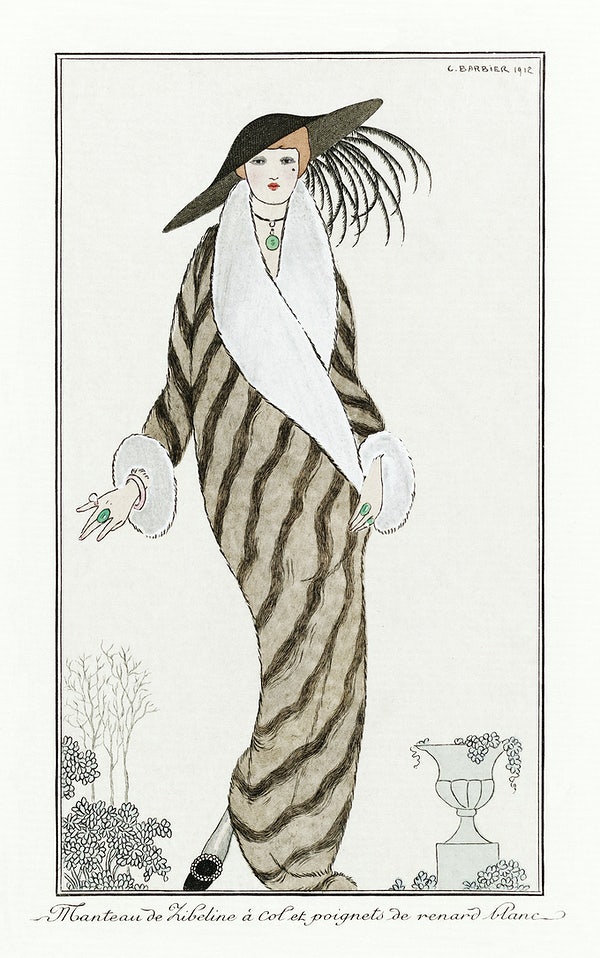
Featured Art: Costumes Parisiens by Manteau de Zibelin
What does she tell me, wind? —Louis Aragon
My grandmother is a Louis Vuitton model. Though she will never see the streets of Île Saint-Louis or pose along the Seine clutching a Monogram Canvas Petite Malle iPhone case, she does drift through grainy nostalgia like Sora Choi; she does stare beyond the moment like Sasha Lane, who yearns to wear soigné dresses and be admired near rue de la Femme-sans-Tête.
My grandmother is a flâneuse of Youngstown, shuffling near the faded edges. In the middle of the road, she stops traffic because she is elegance: the wind rippling her white robe around her as she looks over her shoulder, gazing at an audience—drivers, police, grandchildren, and daughters— she no longer understands and at the seasons forever lost.
By George Bilgere Featured Art: Long Exposure Coupleby Jr Korpa
I walk past Erin’s house at dusk and there she is at her kitchen table, working on her book about the Reformation.
She needs to finish it if she wants to get tenure, but it’s slow going because being a single mom is very difficult what with child care and cooking dinner and going in to teach her courses on the Reformation, which I can see her writing about right now, her face attractive yet harried in the glow of her laptop as she searches for le mot juste.
Meanwhile Andrew, her nine-year-old son, shoots forlorn baskets in the driveway under the fatherless hoop bolted to the garage by the father now remarried and living in Dayton, as Andrew makes a move, a crossover dribble, against the ghost father guarding him, just as I did when I was nine, my daddy so immensely dead, my mother inside looking harried and scared, studying thick frightening books for her realtor’s exam.
And although I hardly know Erin, I feel I should walk up, knock on her door, and when she opens it (looking harried, apologizing for the mess) ask her to marry me. And she will smile with relief and say yes, of course, what took you so long, and she’ll finish her chapter on the Reformation and start frying up some pork chops for us
as I walk out to the driveway and exorcise the ghost father with my amazing Larry Bird jump shot, and tomorrow I’ll mow the lawn and maybe build a birdhouse with the power tools slumbering on the basement workbench where the ghost father left them on his way to Dayton.
I will fill the void, having left voids of my own, except that my own wife and son are waiting down the street for me to come home for dinner, and so I just walk on by, leaving the void unfilled, as Erin brushes her hair from her face and types out a further contribution to the body of scholarship concerning the Reformation, and Andrew sinks a long beautiful jumper in the gloom.
Featured Art: Twilight in the Wilderness by Frederic Edwin Church
Our joke was either Molly sells a kidney—under the radar, off the books, $40,000 cash up front in England we discovered online, no questions asked, wink-wink, and also, I came to this understanding in my bones, not really all that funny as an option—or reality was we hock our gold.
We hocked it.
Okay, Molly did. Her gold. Every last effing piece of it Molly’s. Earrings. Necklaces, long and dangly and three-tiered, one of them leaf-like, all the chains intertwined and hard to separate. You know how they get twisted up in their boxes like they have a secret life. None of the jewelry rolled or washed gold. Molly did her online research at the library. Brooches, one an open hand, palm out, standing for generosity and giving, one a butterfly whose catch was missing. It had been her mother’s. There was a heart Molly liked to wear on her sleeve. Only one ring. Her grandfather’s on her father’s side. It had a pair of serpents circling an in-set ruby. Brewster was his name, and he had been an M.D. The kind of G.P. parents named their newborns after. The man part of a long line of doctors stretching back to the Civil War. Molly had photos back home in Ohio. The old-timers a bunch of bearded hacksaws, grim butchers.
Featured Image: Blasted Tree by Jasper Francis Cropsey
name this particular spot after me. I don’t know where I was going with that. I have a tendency to lose track of things, as Mom used to say. I think it’s just impossible to focus and live in Laudanum at the same time. Laudanum’s the name of my town, not that you’ve ever heard of it since it is mostly just the one intersection of Chillicothe and Route 87 out in Ohio Amish country. No ones calls it Route 87, they call it Boulevoux Road, after some guy named Boulevoux, whom I never met. The rest of the town is Amish people and strip malls and the two rarely conflate. I stand next to the Marathon station and across from the Dairy Queen, 197 feet from where Boulevoux’s daughter died, and I am positioned so that when five-speeds come off a red light they down-shift as they pass me, as if I’m the catalyst for their propulsion instead of just a cow, or a guy in a cow suit with a high school diploma and a sign that reads Ranchero’s Restaurant in lazy letters.





 New Ohio Review