One eye of the only bream we caught that day still hangs on a fishhook. Far down in green light, the barb juts from the pupil. The yellow iris glares.
—And here comes one of that bream’s late descendants: hovering in close on tiny high-speed pectoral fins. It glares back, eye to eye, as if it hated this alien pod, for being so dead, and seeing nothing. As if there were nothing here.
But here we both are, Joe, our adolescent faces, engraved inside this eye you gouged out for bait and payback, after the bream’s warier smarter friends had nibbled and stripped our last worm. We two god-damned them all to hell. You opened your pocketknife as the eye watched.
Not the fish, but to you, ’68 Plymouth convertible, lingering now, rust-rimmed, dusty, in our abandoned barn, your once-blue enameled body now the color of a mud-stirred pond, your roof cracked and peeled. Or is that our youth hunkered there like a hibernating bear? Every now and then I run my hands across the pitted hood. A new valve job, a set of tires, a coat of paint and you could be humming again, my husband and I high school seniors, cruising the streets, top down, friends waving as we pull in in front of the drugstore hangout, saunter up to the counter, where we’re greeted with a high five. If I touch you now, I can sense that other life beneath the hood: days without budgets, appointments, and childcare. Some car! If I could rev your Super 383 Commando engine, I would hear it: immortality, one tank of gas away.
We traveled to the theater destination, an entire town dedicated to Shakespeare, and saw not one play. What to blame? A plague. A heatwave. A tremendous bout of wildfire, white sky snowing ash. Instead, we ate in the shade of an oak, lay back for long facials, and saw a movie about atomic explosions. Later, a refund promised, we packed up and left, each going in separate directions, one north, one south, the way we have been going since I moved from our shared hometown, our friendship torn, our time an attenuated wire, strong but slim, we no longer thirty and forty but sixty and seventy, old women, changeless but changed, we not paired by work or avocation but by habit and love. But there you are on our last walk, gray hair dotted by what the fire ate, what the fire took away. You pressed one hand against your mouth, laughing anyway.
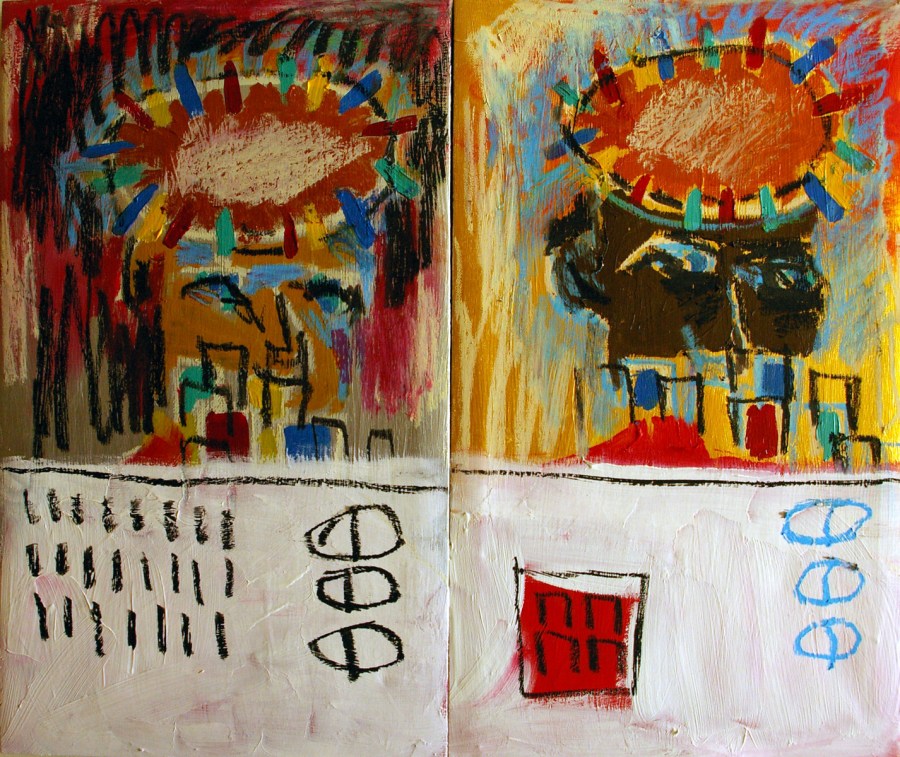
By James Davis May Featured Art: “Jesus Diptych” by Christopher Shoust
Jumbled in a box buried under a sediment of obsolescence— busted luggage, boxes of VHS tapes, tubs stuffed with old baby clothes—they’ve suffered
a second extinction, their snarls and scowls all petrified in a kind of afterlife: not damnation, exactly, more of a removal, an excommunication
from the child who made them lunge and jump, growl and roar, loving them like a god obsessed with entertainment. Then one day, a lid eclipsed the light
like an indifferent ash cloud and did not lift again until just now, when looking for something else, I found their box instead and slid it from the stack.
Even coughing from the dust, I’m surprised by how happy I am to see them, and place one, the triceratops, in my palm, holding it up
to the bare lightbulb to study the gray pebbled skin, the beak opened in what looks like shock. She once believed those horns could fight off any danger,
but all they do is scratch me from inside my pocket as I climb the stairs back into time, answering that voice that at least for now still calls for me.
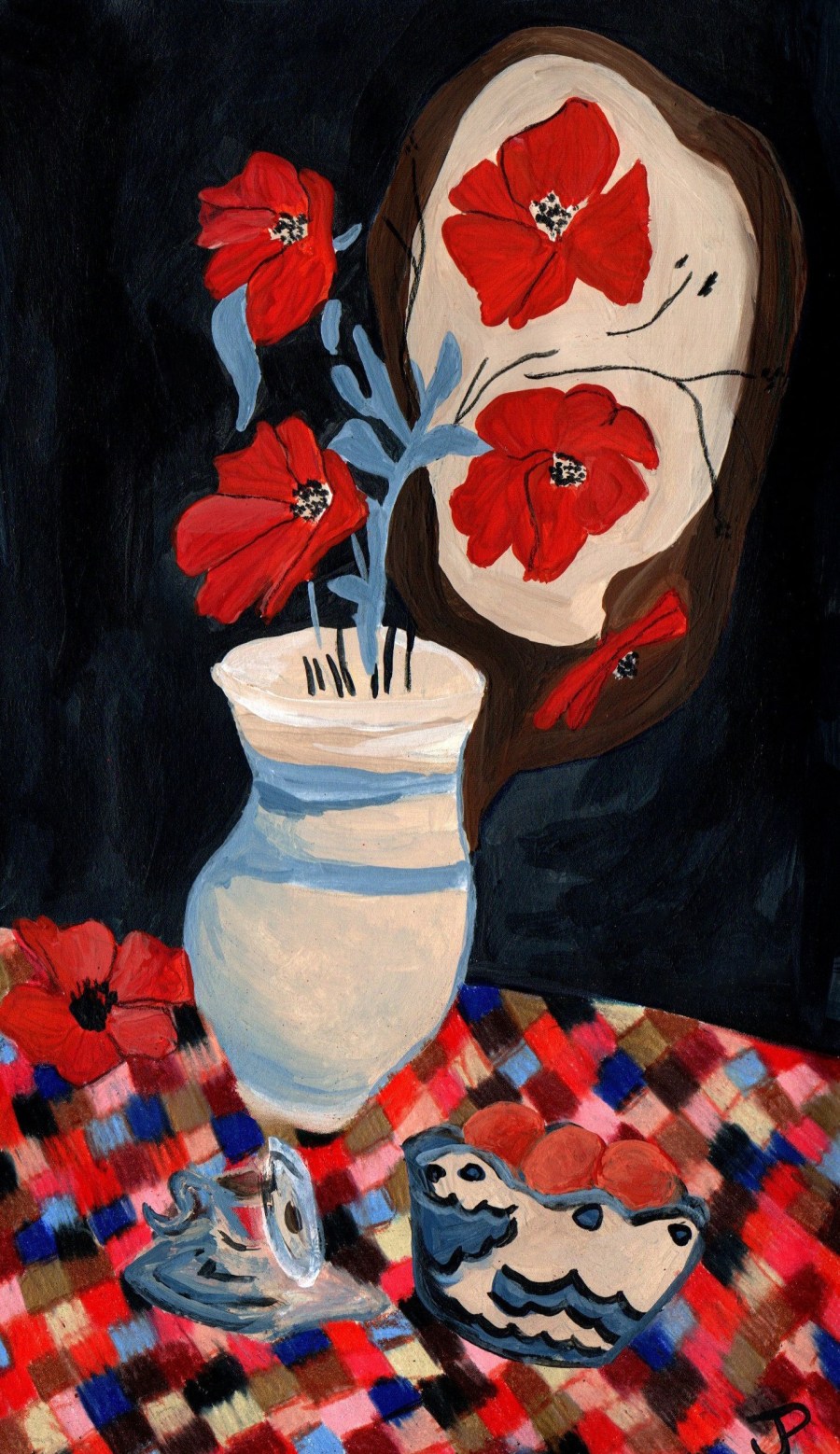
By Mark Kraushaar Featured Art: “Poppies” by Jenn Powers
Where’er you walk cool gales shall fan a glade. Trees where you sit shall crowd into a shade . . . —G.F. Handel, “Semele”
These are some friends from years ago: car buff and cyclist Carla Breese, and Danny Leblanc, ninth-grade teacher of science at his desk, legs crossed, good-hearted, chewing his pen.
This is Agnes Cummins, Roxanne Watson, Bob Mulvahill, and Donny O., and I picture them together but I picture them alone and lost to me. All my friends from years ago. This is Margot and Peter and here’s Mike C. and Mike D. who died, both in twelfth grade and both in their cars. And this is Jack Fraze at work in his shop a pre-fab one-car garage, his ace-in-the-hole and his anchor to windward: hot plate, mini fridge, pea-green plastic lounger junk-picked or boosted he never remembers. Jack Fraze who’d fix anything and everything, mowers to toasters, broken or no.
And this is Bob York whose dream it was to drag his sad sagging motorhome from Mobile, Alabama, straight to Alaska. How clearly I see him, powdered donut on the bandsaw, greasy quilt, and cat box, chipped plaster Jesus over the drill press. This afternoon I let Bob stand for everyone I’ve known. I let that rusting Winnebago stand for certain uncertainty and I let Alaska stand for Eden, Bob’s route and arrival in Nome.
There’s a lot of hullabaloo in the woo woo circles about this Super Blue Fruit moon, so rare we won’t see the next one until 2037. My astrologer friend counts on her fingers seven celestial bodies in retrograde: Mercury, Venus, Saturn, Uranus, Neptune, Pluto, and Chiron. A celestial goo of retrospect and rehashing, a muck of revisiting old stories, exes, holidays and birthdays fuzzy on the why but clear on what wasn’t there, who didn’t show up, what we missed. Wheels spinning under a tree. What was plucked too small, hard and green. Reconnecting with your inner child, still wanting to play, to be held. Still dreaming of some freedom attainable with gobs of money or super hero powers or sheer will. The planets rotate in reverse, earth shifts in its nook in the universe. We look back.
Riding my scooter after teaching a late class, I stop at the light. I am not young anymore. I shiver in sweaty yoga tights, chilling in night air. Once I make it home, I will have fulfilled responsibilities of all three jobs, another 12 hours devoted to maintaining shelter and food. A young man pulls up next to me on his Kawasaki, dirty carburetor popping with every wrist crank. He waves smiling under midnight metallic helmet. In the other lane, a Harley’s deep throat rumbles as its bandanaed rider revs the V-twin crankpin engines. We wait for green, a small symphony of crankpins and cylinders and buzz and backfires under a freeway overpass. I point to the moon, full and free as a peach, Saturn in conjunction hovering just above, still spinning. The riders flip their thumbs up. Just some kids on bikes lapping up all the juicy bits they can get.
today which is hotdog day at forest hill methodist i ran into my old high school lit teacher from the tenth grade one of the great influences in my life and it really got to me while i was waiting in line to put in my order and i thought about all the other teachers i used to have who lived and died maybe never realizing how much they had meant to their students and here was a perfect opportunity to express my gratitude and not to just any teacher but miss ruby herself but then huh oh all of a sudden i thought ohmygod what if my eyes were playing tricks on me and it was just some little old lady that somewhat resembled her so just to make sure i went over to another former student wanda she used to be wanda yow i forget who it was she married but wanda was one of the volunteers who was bringing food to people’s tables and i said wanda is that her is it really her and wanda said oh yeah that’s ruby all right don’t she look wonderful but she’s deaf in one ear i think the good one is her left but you better hurry if you want to speak to her she’s already called her grandson to come pick her up so i left my order with wanda and circled around behind ruby’s table hoping i could surprise her and leaned down from the left side with my face just barely touching her hair which smelled my god like violets a really refreshing smell and there was something else some kind of perfume from elsewhere and i don’t know how it happened but i was already starting to weep it was such a profound moment for me and my feelings damn near overtook me but i managed to get it out even though my voice was shaking when i said miss ruby until i had you for a teacher i didn’t know what great literature was and i— but then i just ran out of words and out of breath and as i started to pull away she reached her hand back and slapped me right in the face turning around with a stare like she had seen a ghost saying oh goodness jimmy is that you i thought it was a brown recluse
I don’t remember her name. It was Adrienne. She lived with her parents in an apartment on Cedar, the road that split school districts. So when she threw a party, she invited kids from both. Feeling shy in her crowded living room, I sat on Mark Shore’s lap while he sat on the lap of a comfy chair. We laughed and laughed, my giddiness netting me two new boyfriends I didn’t want or seek and whose interest waned anyway as soon as they found I was fun only when perched on Mark Shore’s lap. I loved abstractly then, all in my head, divorced romantically from anyone real. Mark and I were just friends, with all of just’s implications. So we remain, though he passed away a while ago. That night I felt protected on his lap where I could gaze upon the social sea secure, even when he worked his arm up the back of my blouse, until his hand emerged at my collar waving to those in the room and, in this ebb-time, to you.
In the photograph that my father has me take of him with the woolly mammoth, he’s pointing to himself. He asks
to see the selfie. I don’t correct his terminology. Next, the triceratops, then the sabertooth tiger. He takes the same stance
throughout the Extinction Exhibit. With the 4000- year-old beetle, 300-million-year-old coelacanth, the dodo. She was beautiful,
he sighs at the butterfly, and I get the sense he’s thinking about Mom. Earlier, in his kitchen, he posed with a jar of mayonnaise
with the expiration date from 1998, also pointing to himself. At the cemetery, he stands on his plot, next to my mother, because I refuse to let him
lie down. Back at his apartment, he says it’s nice to have some company. I know he’s referring to his defunct card game, so we go
down to the game room. He sits at their once regular table and points around the empty chairs, Billy, Dick, Harold, Nat, Frank, hey Joe. He deals
them in. I take the picture of him squinting at the cards, fanned tight to his chest. He tosses a chip to the center of the felt. In the shot, it really looks like
With the thumb and first finger make an L. L is for loser. It’s a thing anymore. Now think of 8th grade. There was King of Detention Jimmy Ramish. There was Too Tall Eunice Bugg, plus Kitchen Tom plus Clyde Skopina who’d said his father was an astronaut— he was lying and Brenda Kleefish let him know we knew it too. Glide, she’d called him, meanly, Glide away, she’d say and wave. There was dummy Aldo Krull and there was fatso Mitchell Beacham, Beachball, he was called, of course. And Annie Friebert? Annie’s winter colds were worst and left a criss-crossed slug trail up her parka sleeve. Achoo we’d say, achoo, achoo. Hey Annie drop your hankie? Ha, ha, ha, ha-choo. She was a neighbor and our folks were friends. But with Clyde Skopina came a certain desperation, nothing anyone could name, leastwise not me— it’s just I wish I’d looked out a little for him. In the lunch line once, believing we were friends, touching my arm, and smiling hard to trick the facts, he said, My dad can lift a car.
A year after my brother died, I told my daughter about the toad that once lived in the hollowed-out knot of an apple tree in the center of my childhood driveway. My brothers and I liked to visit it after school, but the tree came down in a snowstorm, and my parents graveled-over that spot. When my daughter asked what happened to the toad, I explained that it probably moved under a rock, or to the woodpile along the side of the house. “Or,” she responded, “it died.” Then, she skipped into the house and left me outside.
Suzie, I want to tell you how frequently I pass the apartment behind the supermarket where we street-danced to the Doobie Brothers,
light shifting as the fog lifted, front-yard roses iridescent in the salt-gray seaside morning.
You died, what, ten years ago? Not at once, really, though pills took you quickly. It began, I think, when we were children: without knowing why, we wanted out
of that rural beauty—the narrow valley and gleaming stream, summers spent diving off crumbling cliffs, as if nearness to death was the closest we came to leaving
your stepdad’s beery fingers, my Mother who loved to touch the sweaty chests of her daughters’ teenage lovers.
Nowadays, everything is a different kind of dangerous: rain stays away. June mist sucks away too soon, sunlight breaks through before it should.
What I want to say, Suzie, is a moment, gone fifty years, is just a moment, but you’re still here, unfleshed in brightness—elfin, jittery, wan—
our arms looped as we turn tight circles, round and round, your eyes locked on mine.
My mother used to say that only old people read them. Now, I get an email about a classmate from high school, Someone I might not have recognized over fifty years ago, Much less today. I could call my friend Richard to ask, Who was the guy who just died? And, Richard could tell me. But the truth is that I don’t want to keep track of acquaintances Beneath the ground—or above it. The cemetery in Shreveport Was just down the block from a drive-thru liquor store that Didn’t ask for IDs. The ability to turn the steering wheel and Press the gas pedal was apparently good enough. On the same Street, a fried chicken place sold onions pickled in jalapeños And vinegar. They went down well with Jack Daniel’s On summer weekends when we’d play penny-ante poker In someone’s garage. Back then, almost none of us were dying.
with two new creases in my forehead. Deep creases. The night before, my hair stylist tells me she wants to get some lift because a man once told her she would not have to worry about lines. Just gravity. So I think about the dermatologist who said Now you look so young after he convinced me to treat some scars when I was twenty-four, when I looked fourteen. I fall asleep reading a poem by a woman who mourns her youth and another elegy nostalgic for beauty someone fears she’s lost. My girlfriend hates her lines. Hates her freckles. She asks me to dye the gray from her hair before she confesses she got Botox before our first date. I eat dinner with a friend in his early forties; as he sips some whiskey, I remind him he’s attractive and he smirks, That ship has sailed. Another friend is going through a divorce and she’s afraid no one will want to date her. Later, I google the poet who feels men don’t want her anymore because she’s no longer young. She’s gorgeous. During my birthday weekend, I sheepishly share some photos from my twenties. I see a sad young woman struggling to smile perfectly for the disposable camera. If that’s the ship, let it float away. I’ll blow it kisses while I walk to the coffee shop. I’ll blow my beautiful friends kisses. I’ll blow the lamenting poets kisses. And here is a kiss for our poor brains. And this kiss is for my heart when the barista smiles and says, It’s on me.
Fifty years ago, a tramp came to our door. I didn’t see him, just heard the rumor ascend the stairs with my clamoring brothers; by the time the three of us thundered down again, there were only wet footprints leading from door to kitchen and back. My mother had fed him, a woman alone with six children in an alien land, wisteria dripping from the porch roof, a green April rain drenching everything. It is the grape-like must of blooming wisteria, its decadence, and the dark empty house, and those glistening tracks that I remember, and the woman with her fierce, generous heart, so that when my doorbell rings today and a large man looms on my porch with his empty belly and full story, I do not hesitate.
Outside, a few gray snowflakes fell, a truck rumbled onto 290, and the cold seeped through our windows. Our landlord had rigged our thermostat so we couldn’t turn up the heat. But that day, the four of us nailed a bag of ice to the wall over the sensor, and when the heat kicked on, we let it pump until we’d shed our sweatshirts and flannels. Leaning back on our futon, we shared a joint, invincible in our underwear and T-shirts, laughing and laughing. Twenty years ago now, before we knew loss and grief, when we sang along to our DVD of The Last Waltz and didn’t notice the steady drip of the ice melting.
I couldn’t wait to leave town when I was young. After that, I’m not sure I have much of a story. It’s true I met someone. We had a child together. In between I walked across a frozen lake. I drove over a frozen mountain. I ran up a hill to find a pay phone. I closed down the city for extended action scenes to the tune of 290 million dollars. No— I’m thinking of the latest Mission Impossible movie with Tom Cruise. I get confused. I should be writing domestic poetry, but I don’t want to. What more do you need to know? Our family of three live in a third floor apartment. Sometimes we also meet up outside. I guess leaving town is still the most exciting thing I’ve done. The other day I asked another mother on the playground how to clean bathroom grout. I said Stephanie, what’s your secret? Then we ripped off our latex masks, revealing our true identities. No— that mask thing happened in the first Mission Impossible movie, the one I saw with my friend Michelle. I leaned over to say something snarky, but she was fast asleep. It must have been the whirring of the helicopter blades. There’s nothing duller than an overblown action sequence. The secret to having an exciting life is the people you meet. The secret to battling a helicopter in a tunnel is explosive chewing gum. The secret to cleaning grout is a magic eraser from Mr. Clean.
I don’t care what the tastemakers say — you can’t beat nostalgia for a flightless bird worth riding a little.
It’s still a hayabusa running the underbelly of thunderheads or weaving through the innerbelt. Or it’s the corner kid freestyling through a smile as silly and joyful as a French horn solo.
What I’m saying is I’ll run with any good thing, and now I’m reckless in my empathy. I’m more than a budding corpse in the wild waiting to be born into this ceremony of dust.
For tonight, my heart’s the size of a wedding and I’m in league with the last of the lamplighters because my son is still alive and nothing’s coming for his lungs as I slow dance him to sleep.
I’m an Appalachian beauty queen, a capable kitten with smooth birthing hips. Applaud the cinema kitty cat caught in the smoke ring.
I rule over Kentucky junkyards, zoom in as I sit on refrigerator thrones, play pianos by the highway, cigarette-thin fingers give a tinkle tankle of a tune perking ears that belong to someone twenty years ago. The honeysuckle sweetness of my fingertips, syrupy sweet on the dirt keys, greasing up the notes, F, E, B & so on.
Underneath the toasters & the books from all those rummage sales sits some hot ghost of a memory. Smitten kitten, the smell of trash makes me think of our place & the breeze outside is the same one I feel at night when trains go by.
Stack the broken binds of hymnals for a stage, wrap, rip, some leaves, some dirt, pack, perch, pack it all in, real tight, until the only clumps to fall from my deciduous crown are intentional. A tap dance for you, a finale with hula-hooping hubcaps & juggling light bulbs. I sing in a rusty tune, decaying notes in the keys of D, C, G & so on.
It became possible to say anything: that was the delusion. A melting tree, a painted deer—the books sat useless as guides to understand such thoughts.
Holes at the elbows quickly drew attention, but bothering to bother seemed no longer worth the trouble. With walls and brooms folks got better acquainted.
A summer of branches joining field and sky swelled with lost promise. It was good to stay, that’s how it felt. People got older and younger. They’d sit
composing elaborate salad plans. “Forget about tomorrow” became a common phrase, but few took comfort in what it meant. Distance fraught
with waiting, a blank consistency, infused the hours as if each day had been left on the table to fill the house, rising through the rooms like steam. Read More
Featured Art: Yliaster (Paracelsus) by Marsden Hartley
Before it all goes wrong. Before the bell is rung. Before the ship has sailed. Before the perfect storm begins to brew. Before the term perfect storm goes viral. Before anything goes viral. Before the fall. Before the crash. After effective sanitation, before Ronald Reagan. Before that sixth grade school photo is taken. Before one friend’s accident, another’s illness. Before the first massacre or environmental disaster. Before the first loss of liberty. Before the prequels. Before the sequels. Before the remakes. Before guns. Definitely before Columbus. After your son learns to say he loves you. After the invention of childhood. Before the police state. Before the nation state. Before the interstate. After modern medicine. After modern art. After animated GIFs. After the discovery of fire, of penicillin, of Spandex. After you meet the love of your life, but before you meet your first miserable boyfriend. After the Internet, but before we become information. Before your cousin dies, before your classmate dies, before anyone anywhere dies. It’s important to avoid your grandfather, and also the Middle Ages. Remember the Nineties sucked, and so did the Eighties. Maybe that moment when the dog stole pancakes off your plate. Your parents laughing as the card table shook. Just after the Big Bang.
You should have seen me then, under those yellow stadium bulbs, my lips so full they’d burst in your fingers. I had this top on: a floral print and ruffles, red, to match my lips, and my tight Levi jeans. And my sun-kissed cheekbones and the sun-kissed bridge of my nose. And my smile was just like America—like a cornfield stunned by its own golden beauty—my gorgeous delight! I went braless, wore no makeup. It rained and the grass was slick. The way it goes is that something happens next. It happens by a lake or in a parked car. You take one look and know I’ll never survive it. My teeth were like a horse’s. A feeling they mistake for a girl. A feeling they write songs for. The kind of songs that played in pickup trucks and there’s me standing in the bed of one, hurling my top into traffic. Could be a hitchhiker. Some guys carry knives. What is it about blonde girls and America? Blonde girls and wherever? I was so all–American. So cute I could have murdered my own goddamn self. What is it about a blonde girl that breaks the world’s heart? I miss those days. Not Bobby or Leo or James. Just miss that particular ache, which was not unlike a bulge in shorts, that summer rage that could break my chest apart and hurl my beating heart into the bleachers. Like them I could not keep myself. There is the stadium again. There is Bobby, cheering. Isn’t that how it happens in America? Topless in Texas. My little red shorts. In the back of a pickup, again. The window breaks. In Tennessee? In Indiana? The sound of a power drill, a chainsaw. The sound of summer. The bleachers, those bright white lights waiting to throw my shadow to the ground, and there I am, arriving, and it’s always like what happens to me next has everything to do with every one of us.
The form asked, “What is your favorite past time?” So I wrote how I loved the 1947 Technicolor American comedy classic Life with Father. Whereas home to me as a kid felt like the morning after a trip to the emergency room, William Powell’s brood lived on the brink of a joy omnipresent in the wealthy brownstones of Gay Nineties New York, and in Meet Me in St. Louis, which opens on Mary Astor and Marjorie Main making ketchup, Judy Garland’s face in repose always seemed baffled by love. And who knew ketchup could be made?
Then, I peeked and saw my neighbor’d written “tennis.” The guy on the other side, “tailgating.” I noted that the question before was favorite color, the one after, what would you do with an unexpected day off. (Blue, by the way. And, of course, watch whatever’s on Turner Classic Movies.)
Suddenly, I was tired. I longed for the time before I was ever asked this question. I crossed out my answer and drew an arrow to the bottom where I wrote
“When I was twenty and my body was a blossom trembling to shake itself from the vine.”
Featured Art: Johnny Dunn’s Sandwhich Shop by Walker Evans
You want to go back is the name of your car, the make, the model, the name you give the swaying trees, the rustle of leaves before a thunderstorm as sun gives way to clouds and quiet falls on a meadow of grass and clover. You want to go back and ask the question. Or you dream it. Or it’s a movie with Walter Huston, the rumor of a movie at MGM, killed before shooting began. Nothing was written down, no minutes of the meetings, nothing but a few scraps of papyrus, of vellum, of cuneiform carved into stone, baffling translators. Or typed on onion skin, brittle and cracked in a box in the basement of the first house you ever bought, along with a fund-raising letter from Dwight Eisenhower, then president of Columbia University, and a water-stained circular from the Bulletin of Atomic Scientists warning of the danger of a full-scale atomic war. The temperature is dropping, the wind is erratic, swift and then calm. You want to go back.
Before going for a walk, I open the day’s newspaper. NASA releases detailed photos of Charon, Pluto’s largest moon. In a marketplace in Diyala Province, Iraq, a suicide bomber kills one hundred and twenty. On this day in 1959, Billie Holiday died handcuffed to her hospital bed. My horoscope tells me I will be extremely serious and earnest in my emotions, that I will suffer from the ailments of birds.
Hard to believe half of my life is just some thing that used to be.
On my walk I stop at the corner of Maple and Elm, watch the sun sink behind the station, I think about Charon, orbiting Pluto, and the Charon who ferried the souls of the dead to the underworld. Maybe he delivered the people killed in the marketplace, or Lady Day. Instead of a coin for passage she sang Baby why stop and cling to some fading thing that used to be. Her lilting voice trailing off as they reached the far shore.
She says it feels like flowers blooming in her veins. The lilies watch her, unmoved in the window. She becomes the petals’ white polyester sheen, its rigid spine, slumped posture leaning against the rim of an old coffee mug filled with week-old cigarette butts. This is how I will remember her: bottles of pills, the walls scumbled yellow, a flower blooming in her veins, her gray breath rising
in a haze thirty years ago the way she placed each plastic flower away from the sun, the sting, anything that could touch the color of the petal as if the light could drag each one into the white, worn sky, make it fade before her eyes. What else is beauty for? but to be spun, set on a window sill curtains drawn, petals hugged in dust, as she slept, no sun to tell her if it was day or night, the three of us kids trying to keep still, feeling our way through the dark dreamt room, unable to understand that this was the tick-tock of time. This was what it meant to live forever.
Only nothing lives forever. The perfect moment—
the gardenias in full bloom chatter staggering through a promenade, the quivering flit of sparrows chasing the listless light of noon until suddenly even this ends, until suddenly a car alarm ruins everything, the chatter dissolves into people screaming over each other, birds fleeing, the owner trying to turn the damn thing off.
Maybe there were too many moments that could never stay quiet or whole in her hands like the day we took our first steps, said our first words, or the day she fell in love, slept all night in his open arms, dreamt of the way he looked at her as the ocean wind tossed her floral dress, dreamt of the way time could stop, only to wake up and find every living thing changed in some way
Featured Art: Art Institute of Chicago by Thomas Struth
Opens its doors one Sunday a month in winter. The queues back up for decades.
If you’re lucky and your number’s called you can have any tour: Your Charmed Life, Your Regrets, The Prodigal You, every second slip-road at the intersections of the possible.
The exhibits are stark and infinite under strip neon, long hallways of lost opportunity, slow clocks, stopped clocks, rooms where even now a thought might wither: the attic storeroom is out-of-bounds to all but the curators, though artifacts are still donated by the hour.
Standing in line is no guarantee of admission: some days word spreads that when you reach the queue’s head, pass through the double doors, it’ll be stripped out, even lightbulbs, with only packing materials and discarded drapes left. Yet critics insist The Multiple-Choice Foyer, The Roads-Not-Taken Gallery, The Back Burner Café are stunning.
Every room’s a tasteful shade of apple-white apparently. Waxworks and living statues rehearse at intervals for The Balcony Scene, The Shining City, The Reconciliation, over and over, night by night. As in the finest operas.
Featured Art: Café Concert (The Spectators) by Edgar Degas
When Peter Byrne of the 80s synthpop duo, Naked Eyes, played for me his acoustic cover of k.d. lang’s “Constant Craving” in his studio over-looking Los Angeles, the peacock—not the NBC peacock but a real peacock among the many on the grounds—opened his fan as if the music were a potential mate. He strutted and shirred. He shimmied his many eyes. He’d been drawn to the music, then spotted himself in the sliding glass doors. He leaned in and turned for us like a Vegas show girl. He brought tears to my eyes. When the song was over I could barely muster, “What a tender version, Peter,” though tender wasn’t the word for the primitive if aimless seduction on the lawn.
was never large enough even for a B movie though I think I’ve felt as deeply as Brad Pitt. No one I grew up with ever became famous or notorious on that spit of land that ended in the sea. But we became as adept at reading storm warnings in the muscle and color of water as we did in a face.
In the cold-war doldrums of the 50s, all my teachers hated teaching. We were such little shits back then I thought who could blame them, and became a teacher so I could show these younger versions of myself how to open their hearts and enter into a different, richer kind of darkness that exists in them.
We were an obstinate desert people given a single animal which we rode and milked and roasted and skinned. The stories strangers told us about fabulous places we’d never get to taught us how to open a door in rock and go inward, how to widen our hearts with longing and a song and bang along on a drum skin and a string.
Featured Art: Woman at Her Toilette by Edgar Degas
Now, as the popular girl walks among us with the microphone, most of the stories are about loss, or include exquisitely precise medical and pharmaceutical details, as if the words could suture the wounds, or save us even one last breath. I came here to dance with the Puerto Rican women of my class of 1967, and to remember a few pals lost in the war, who had been so beautiful, you were happy just to look upon them, and one more lost to his own drunken wildness under a moon who doesn’t remember us. It’s not a going back we long for, but a staying still for one incomparable moment, all the lost loves’ faces spinning in the mirrored ball.