The hardest part of losing her mother in 2020

By Nancy Miller Gomez

was after the memorial, her laptop propped on the table
cluttered with half-empty teacups and books
as her mother’s body was buried two time zones over

in Louisiana. After the eulogies and prayers,
and the few people standing graveside walked away
and all the others clicked off, there was nothing to do.

But she couldn’t bring herself to close the screen.
So she sat a long time watching her own face
looking back, and imagined she was her mother,

and watched to see what her mother would have seen
if she’d been there, and in her expression
she could see the love she knew her mother had felt

that last time they’d talked. And then she was crying
and watching herself cry—as if she was her mother,
and the connection was like a counterweight

she could carry, as though an infinity mirror
had opened inside her. It didn’t matter then,
if she hit the red button that said “End.”


Read More

My Family

By Nancy Miller Gomez

I used to keep old black-and-white photos in my wallet.
They weren’t people I knew, just snapshots of strangers

fished out of a shoebox at a junk store: dark-eyed men
in bomber jackets leaning against muscle cars, or sitting

astride a tractor wearing khakis and an undershirt, a pencil
of mustache above their lip. Women with cat-eyed glasses,

dressed up in feathered hats for a night of gin rickeys,
arms draped across each other’s shoulders and angling

for the camera. Even in grayscale I could see their cheeks
were rouged and their lips were slick with lipstick.

Sometimes I would take these people out and show them
to someone I’d just met. This is my family, I’d say

and watch as they shuffled through the pile of strangers
politely noting how nice-looking they were.

I don’t know why I did this. But it felt good
that all anyone could ever know of me was what I was

willing to show them. This heavyset blonde posing
on the steps of a California bungalow wearing a fur coat

in the obvious heat of summer. These children splashing
in a kiddie pool on a lawn cluttered with beach balls

and hula hoops, a spray of water suspended mid-air
as the camera clicked on the girl’s congenial scream,

her brother’s swashbuckling grin, while father watches
from a folding chair, a beaming fat baby on his lap.

I keep them ready, these people I don’t know. That’s me
I say, pointing at the fat baby. I was happy then.


Read More

Cultural Appropriation

By Nancy Miller Gomez

a mi esposo

I appropriate your tongue,
your lips, your teeth, the smooth
inner skin of your cheek.

I appropriate your rolled r’s,
and soft v’s, the way you say
wolf without the letter L

(the plural of which is wooves).
I claim the patch of hair
in the small of your back,

your brown skin, your mother’s molé.
I appropriate your mother,
rename her La Loca. I appropriate

your appropriators, the conquistadors
who came with their archangels
and saints, Our Lady of Guadalupe

with a chisel of moon
at her feet. I descend the ladder
of your lineage, past missionaries

and rancheros to inhabit your ancestors’
ancestors, the Nuhuatl gods
with feathered names I’ve learned

to pronounce. Coatlicue, the mother
of mortals, Huiztlilopotchli—
the hummingbird patron of War,

Tialoc—he who makes things sprout.
I appropriate sugar skulls and mezcal,
Día de los Muertos. Your pyramids

and painters, your Kahlo and Orozco.
Your poets, Octavio and Carlos.
I take your lowriders

and La Raza, the happy/sad
ting of mariachis singing.
I appropriate each sweet bite

of pan dulce and tres leches
and eat your street tacos
smothered with guac and tapatía.

I’ll take la plaza with its bandstand
and white ibis, the man selling
balloons and churros. And words,

nights filled with appropriated
besitos y sonrisas. Abrazos
and the rest of the Mexican lexicon,

all mine. I’ll take your lime and salt,
your fire and fault lines. And our son,
see where I have appropriated

your blood, your eyes, your love
of basketball, the sport you say
your people created, a game

played by the victors
with the decapitated heads
of their victims.


Read More

Siren Song

By Nancy Miller Gomez


A songbird mimicking the sounds
of emergency sirens has been
caught on video . . . —CNN

A starling has taught himself to sing
like an ambulance. Now the air is filled

with emergencies. Whee-o, whee-o, high and low,
a fire truck rides out of a mockingbird’s mouth.

Grackles impersonate police cars. They dive-bomb
the precinct parking lot, bashing their beaks

into the rearview mirrors of their rivals.
The magpie knows a lovely air raid. Now

she trills like a helicopter, next a chain saw,
then an AK-47. The quail stop, drop

and cower. Take-CO-ver they cantillate.
Whee-o, whee-o, high and low. Juncos,

pass to Vireos. Catbirds steal the flow.
The chickadees have gone on lockdown.

They bore like bullets through the bleeding bark
of the cedars. Crows reload from rooftops.


Read More

Watching the Wind

By Roger Mitchell

Featured Art: Wind by Mikhail Gordeevich Deregus

Lift a small shovelful of snow
               without a shovel
off the stubborn blanket of it
               in the field
and throw it completely away,
               quickly, too,
so quickly you couldn’t find it ever
               crawling
on your hands and knees, calling
               out its name,
puff of purest cloud, smoke
               of frozen fire,
wind’s breath, you,
               with no shovel
and a handful of white air.


Read More

After Petrarch

By Emily Wheeler

A romance developed in my sixtieth year,
which gave me hope, perhaps inane,
surely extreme, especially in my verse,
and affirmed principles of affection and cheer.

My lover was tender, our love serious, useful.
It was as if in the afternoon, gray, crepuscular
an angel had arrived! And we both so secular!
Of course we never spoke of death, its easeful

nest, or the unlikelihood we’d ever alight
together in the tall trees or, quivering,
fly off at the same moment, but that was alright,

because, whenever new or found or at least not lost,
desire adds a drop to the earth’s thousand rivers
and briefly greens the grave, its bed of moss.


Read More

The Missing Poem

By Emily Wheeler

Less a description of a Thanksgiving
I remember than an invitation
to a party that asks many people,
some alive, some dead,
to fill the front hall
of the old house
with such loud joy
at faces long unseen
that few can reach the quieter
fire-lit room at the back
where cheese and bread await,
and raise glasses of the most delicious,
deepest red wine.
No war, no plague, no economic
collapse deflate the mood.
I make a beeline for my favorite aunt
in the corner looking out the window
at the black river. There I join her
bringing the news that the river
doesn’t mean what it used to mean,
now it’s behind her, not ahead.


Read More

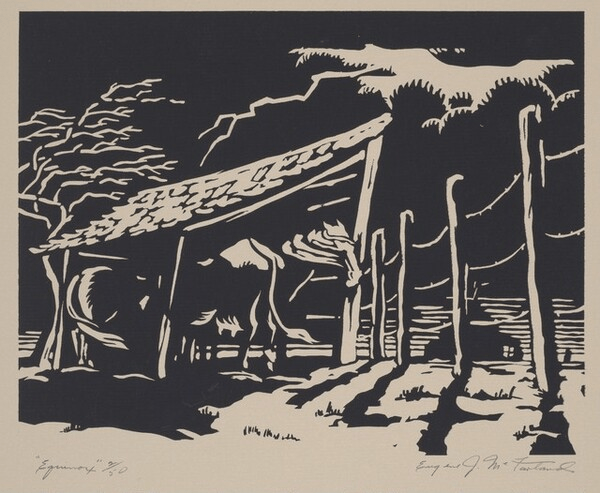
Vernal Equinox

By Kari Gunter-Seymour

Featured Art: Equinox by Eugene James McFarland

I’ve been thinking about last times
I never knew were the last—
grandma cooing me unconscious,
daddy whistling me home to supper,
my toddler’s toothless grin, tiny fingers
clenching wildflowers, the last time
I prayed, desperate for those departed,
how they flit ahead of us, flying.

Tonight the Big Dipper balances
on its handle. Tepid tree frogs peep
songs of resurrection. One morning soon,
I’ll eat a good breakfast, fill a water bottle,
pack a book, walk the fencerow into the holler,
rest beneath the eagles’ favored perch,
shake off this inexplicable sadness,
two cinderblocks where lungs ought to be,
let spring hold on to me for a while.


Read More

“When We Talk About Mountains, We Talk About Memories”: a Conversation with Ohio Poet Laureate Kari Gunter-Seymour

New Ohio Review editor, David Wanczyk: I’m speaking today with Kari Gunter-Seymour, a 9th generation Appalachian, and the current Poet Laureate of Ohio. Her new anthology, I Thought I Heard a Cardinal Sing: Ohio’s Appalachian Voices, will be published in March 2022. Kari, welcome. Can you tell us about the project generally and more specifically about your hopes for what it will bring to light about Appalachian poetry?

Kari Gunter-Seymour: I would love to do that, David. My hope is that people will become aware that Ohio is part of Appalachia. Because some people don’t know, and a lot of people forget that a quarter of the state of Ohio rests in Appalachia proper, and there are pockets of Appalachian families throughout Ohio, even in major cities throughout Ohio, that still practice those teachings and learnings from their Appalachian heritage and their culture. And so this book is all about bringing notice to that.

I think of us as being Central Appalachians. With roots deep in South and North. You know we had those who came up during World War II and the Great Depression to find work. To seek out the steel mills. We have to remember there was lots of coal and iron mining in Ohio early on, too. And so this book is specifically my dream of being able to give these voices an opportunity to sing. Because they’re different. We’re a little bit different.

We’re more of a mixing pot, I think, here in Ohio, because we are, as we’re finding out, Central. We’re not necessarily North; we’re not necessarily South, but we’re a really good mix of it all.

Read More