Handwriting

By Kathleen Lee
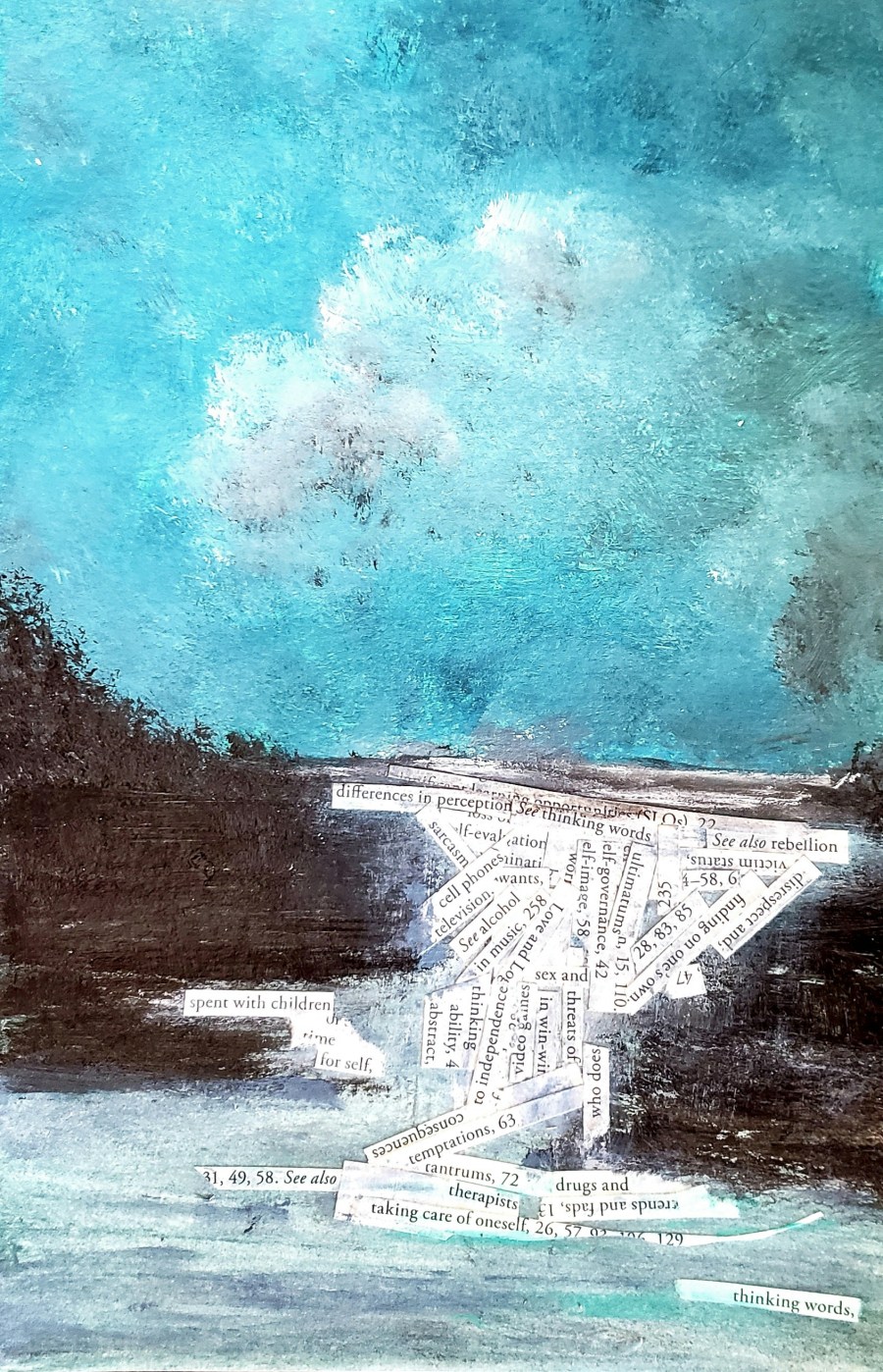
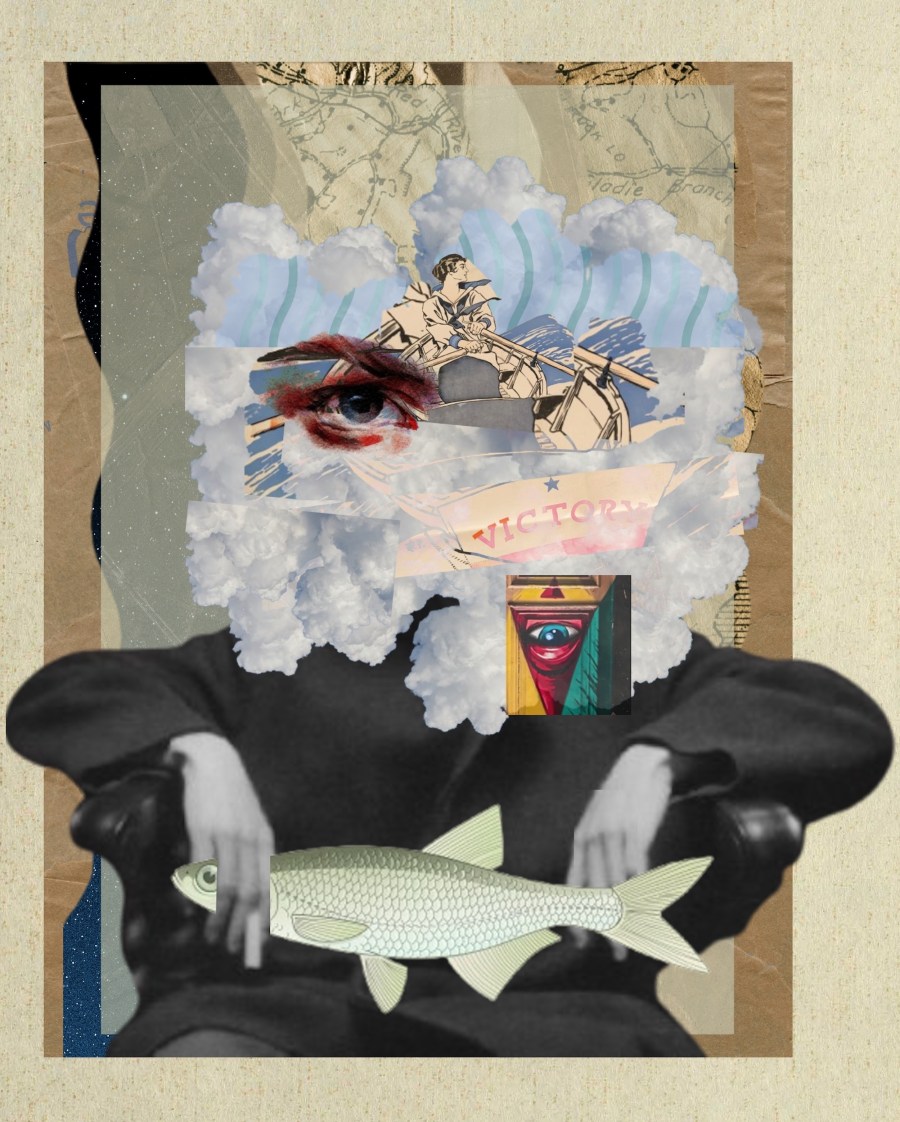
Featured Art: “Thinking Words” by Thad DeVassie

Nothing quite like the feel
of pen in hand moving across paper,
letters and words following like ducks
slipping into water. Back and forth,
margin to margin, emptying
please, my mind. The whole raucous mess:
complaints, general; also issues,
first with one person then another,
some, it’s true, already dead,
also, my self, hapless on the witness stand
wondering how it’s come to this. Until
at last, the relief. Darkness cleared,
the world flares: man with his dog
draped across his shoulders
ordering a triple espresso,
whiff of patchouli, barista calling,
Fern! Iced latte.


Read More

Somewhere, Anywhere

By Kathleen Lee

Bought a bus ticket to the wrong village
and the next morning wandered in circles
before finding the internet place where I read
in an email that my old friend P was dead
and all this time—a few years or more—
I’d imagined his healthy happy life,
his love of Scotch & his daughter,
his dark wit, the way he considerately
blew his cigarette smoke away from others—
while actually he’d been entangled in illness,
occupied with dying, and now—in a dingy
basement surrounded by boys slumped asleep
over their keyboards—I reckoned with how wrong
I was and when I emerged onto the dirt road
which I would never again walk in this life,
I couldn’t tell if the road was flat,
ascending, or descending and although the sun
was up and the air warm it felt like dusk
and it’s true I might never have
seen P again even were he alive
though I’m wrong about so much
(where I am, the correct way to pronounce
cesuo, how to live), a fact which
made me sad and irritated and free.


Read More

Schnitzel Wants the Good Stuff

By John Jay Speredakos

Schnitzel is my cat. He wants the good stuff.
He wants to sink his wobbly canines into the flank
of a fleeing caribou and bring it down personally.
He wants to choke lightly on the late-afternoon dust
kicked up by the flailing hooves of his desperate prey.
Not for him the aluminum aftertaste of the Open Can.
The kidney-friendly, renal-supporting, veterinarian
recommended swallow of bland that constitutes
the diet of the challenged, the compromised, the one
foot in the grave. To strip a carcass down to its essence,
down to a splinter of bone, a whiff of intestine, a fragment
of its former self. A shadow of what was, and will never be again.
To ingest, digest, and divest. That remains his all-consuming
goal. And a cat should have goals. Beyond a well-groomed
sternum and a perfectly manicured footpad. And of course
the requisite twenty-three hours of quality slumber. A cat should
devour for the sake of devouring all that can be devoured.
All warmth and joy, laughter and light. Everything bright, vital,
and alive, destined to be none of the above.
That is a goal for a cat. And Schnitzel, resplendent in his
Maine Coonness, understands. For life is to be swallowed whole.
Regurgitated if necessary, consumed in installments if required,
but most definitely swallowed whole, kicking and screaming,
in all its bloody, sweaty, glorious, and temporary self.


Read More

When I Played You “The Wreck of the Edmund Fitzgerald”

By John Jay Speredakos

And all that remains is the faces and the names
of the wives and the sons and the daughters

—Gordon Lightfoot, “The Wreck of the Edmund Fitzgerald”

As we drove through Wyoming and
your eyes closed just a bit while
the sunlight slanted through the moonroof,
or maybe it was moonlight through the sunroof,
and it could have been Montana,
and you wondered if Gordon Lightfoot was an actual Indian.
You didn’t know that a Great Lake was really an ocean
with a chip on its shoulder, and an ore freighter
could be a coffin in certain Novembers.
Daughters can be like that: full of speculation that makes you doubt
what you already know. But I know this—
your hand drummed on your thigh and your head nodded in time and
for a few moments those sailors were back on deck
breathing sweet oxygen, instead of Lake Superior.
Such is the power of a tune to restore the dead.
And your eyes blinked, and a week went by, your hand waved
and a month disappeared; you bobbed your head for a year or so.
And when the song ended, you were a young woman
about to sail away yourself.
And I thought of the depth of loss and how it’s relative,
some can never come home, some can never go home
again. Why do stories of drowned sailors always cut so deep?
Something about the going away and the not coming back.
The not being here, but not elsewhere either.
I don’t know the particulars, but I do know the future—
how the freighter will founder, the sunshine diminish
in a howl of seething froth. And me still poised on the pier,
eyes on the horizon. When the church bell chimes
those twenty-nine times, I’ll mourn it all, all the sailors,
all the daughters, all the souls that won’t come back.
But for now, in Colorado I think it was,
we drifted in our little ore ship,
bobbing on the only sea that mattered,
ignoring the storms that always gather,
always smother and smite and threaten
the future, but never the now.
Like a vessel on the swelling waves—
some come back, some don’t
even know they’ve left.


Read More

The Last Photograph of Laura Before We Found Out She Was Autistic

By Kim Farrar

She turns twenty-seven tomorrow
so I set the old photo on my desk
to look into her blue eyes and guess.

She’s standing next to the park bench
and peering directly into the camera; what they say
about eye contact was never true in her case.

Her fingers gently grip Elmo’s well-loved neck
but he’s looking backwards at the swings
where younger mothers plot secret parties.

Perhaps they didn’t appreciate
how I had to yell a thousand times
for Laura to stay out of the mud.

The breeze lifts blonde strands above her ears,
her home-cut bangs tousled, a few wisps
curving upward at the top of her head.

The leaves must have rustled
as I snapped the picture.
That easy wind with the future on its tail.


Read More

Without a Net

By Nick Norwood
Featured Art: “Untitled” by Josiane Kouagheu

Bored, sluggish in the gray air
of a downtown office tower,
we three “junior associates”—Chris,

Ray, and I—absconded to a park
in the middle of the afternoon.
Amid the murdering heat of mid-July

it was deserted, and we slipped out
of our cheap suits and into shorts
and T-shirts in the public bathroom,

retrieved, from the backseat, a worn
Spalding, started pounding the rock
on cracked cement, balling the jack

in a kamikaze game of cutthroat.
And when, late in the action, faces
red as blisters, Chris—who would

make it to “senior associate” only
to grow glioblastoma, call me out
of the thin blue thirty years after this

epically random afternoon and
a month later greet me at his door
in Minnesota, bald head gripped

by tentacles ending in electrodes—
this same Chris, at 25, three years out
of college and still untried, untested,

unsure, cut hard toward the basket
and pulled up to hoist a rainbow
jumper. Ray—who would disappear

from our lives, reemerge, disappear
again—like myself, stopped, panting,
half-dead, to follow the ball

in its immaculate trajectory,
its slow-motion backspin, rising
and rising toward a haloed instant

of solar eclipse, then falling, falling
toward the netless iron hoop, and
passing through in perfect silence.

Or did it? Good? Or no good?
Game winner, or brick? Passing,
as it did, through nothing but air.

In memory of Christopher B. Vanatta


Read More

For My Mother, Who Detested Sports All Her Life but Became in Her Final Years the University of Minnesota Men’s Basketball Team’s Most Devoted Fan

By David Thoreen
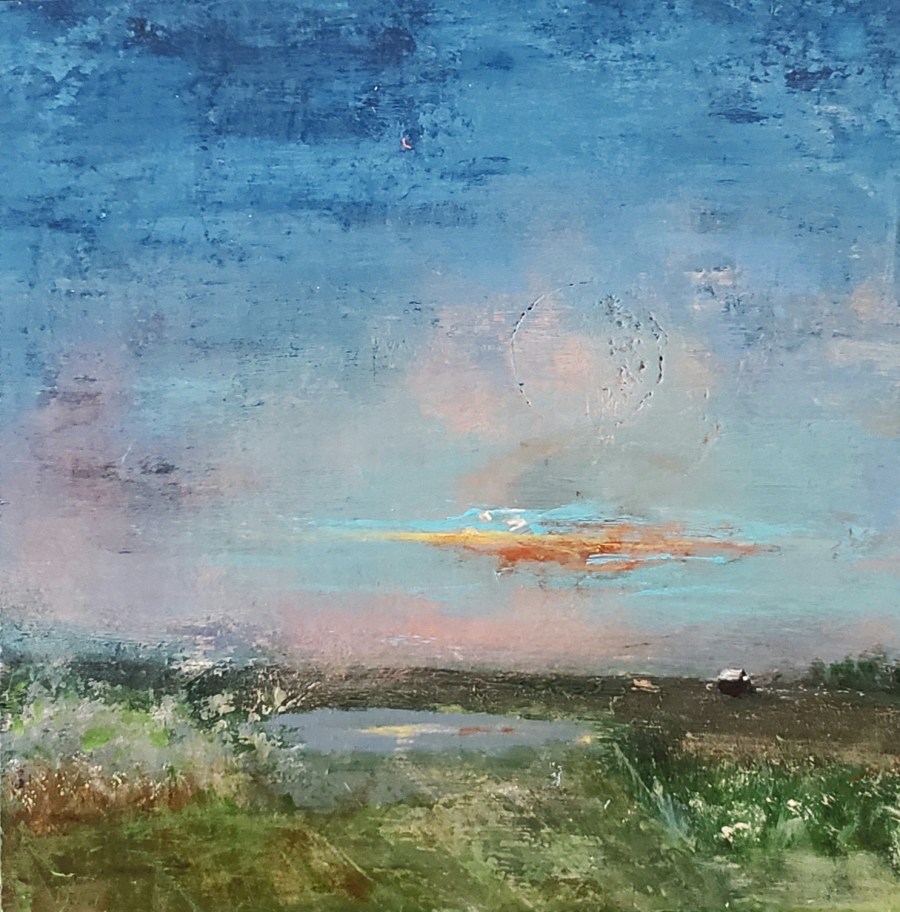
Featured Art: “Field Within a Field” by Thad DeVassie

For her, by then, the news was nonsense, names
she did not know, public policy proposals she
could not follow. Ugh, the weather girl, she’d say,
before she stopped talking altogether. What
are windows for?
She still sat with a book in her lap
but rarely opened it. Why basketball, I wondered,
until I watched her watch a game. There was no plot,
no morally murky postwar setting, no confusing
characters, no Monsieur Poirot, no Miss Brodie,
no exposition, no dialogue filled with subtext
and subterfuge, no metaphors or motifs. No past
and no future, only this: ten men running full tilt
coast to coast, one catching a pass and spinning
at the top of the key, stuttering, feinting right,
then driving and in three quick steps rising and floating
to the rim, a flick of his fingers releasing the ball
that spins just so against the backboard and drops
through the hoop, riffling the net.

She couldn’t remember her husband or grown children,
but when the Golden Gophers scored and the screen filled
with close-ups of anonymous fans draped maroon
and gold, pumping fists, blowing kisses, waving their beer,
she knew it was her turn to cheer.


Read More

Sports Illustrated

By Joshua Boettiger

All the great middleweights. Hagler–Duran, both times.
Sugar Ray and the HitMan. Duk-koo Kim dead in Vegas
after being knocked out by Ray Mancini.
Ten years old, waiting by the mailbox every Thursday.
Marcus Allen, the last of the balletic backs, glides past
the Washington secondary in Super Bowl XVIII.
The Swimsuit Issue in February—Christie Brinkley
at magic hour in Captiva, a sky of seagulls.
Night games in the graveyard with the Hogan kids.
They call it Smear the Queer. Their father drives a Cadillac,
stares at me when a ground ball goes through my legs
and I mutter, Jesus Christ.  What’d you say, son?
I go on Mike Hogan’s paper route with him. The last stop
the apartment of the man with elephantiasis and the sour smell.
We go up the narrow stairs silently then hold our breath,
take turns walking in and handing him the paper.
Touching the sacred while it is still in motion.
Kim and Mancini fought as lightweights, both 5’6’’.
They stood toe-to-toe and pummeled each other for 14 rounds.
Mancini would later say, “I knew him better than his mother.”
After the fight, having just heard that Kim might not make it,
Mancini is brought by his handlers to Sinatra’s late show
next door on the Strip. Between songs the spotlight finds him
and he stands to applause, raises his right fist weakly.
Sinatra waits for it to quiet down, says, How ya feeling, champ?


Read More

The Fool’s Vow

By Joshua Boettiger

Sibylle gave a toast at our wedding—
May your beloved always be like a stranger to you.
So we practiced, took turns being the hitchhiker.
It was a turn-on, but it was also a risk—
strangers can be so cruel.

I know a man who says, I don’t know,
to every question he is asked, even questions
he knows the answer to (especially those).
It’s not like I’m ignorant.
I know that every six seconds
another word is dropped from the lexicon.
I know there are tables that mark the tides—
High, then low, then high, then low.
I’d like to be that weatherman.

But better than that would be
standing here at roadside’s bend

as you come around the turn
holding the wheel with one hand,
shocked by the suddenness of me.

I remember the first day of kindergarten
crying outside the door of the classroom
in my mother’s arms. I don’t know
what we are going to learn
, I wailed.
Shhh, she said. That’s why you’re here.
No one knows.

You and I took the fool’s vow—
better to believe
than to be left flat-footed
when the ram’s horn blasts.

But this, too, is a strategy.


Read More

The Dans

By Molly Reid
Featured Art: “Frederick” by Denise Loveless

We arrived at Alex’s with our phones tucked discreetly away, each of us carrying something: dip, wine, flowers. I brought my famous seven-layer Jell-O salad. It took all day to make; each of the seven layers had to set before adding another: lime / banana / cherry / grape / strawberry / blueberry / raspberry. But the labor was worth it—translucent rainbow squares that were neither too pretentious nor too generic. Retro. Low in calories. 

Alex had laid out games and cocktails. There were candles burning, a record playing—she knew just how to woo us.  

We sat around sipping our first drink—something Alex mixed especially for the occasion, a bright green concoction that tasted like candied Christmas trees—catching up on what we’d missed in each other’s lives over the last few months. The lost and gained jobs, the shows and movies we’d binged, the microdosing of mushrooms—or cannabis or K or LSD—the Pilates routines and intermittent fasting. Melissa bought a house—the first of us to own property. A twitch of jealousy moved through us all, though we were enthusiastic in our congratulations. It had a pool. 

Read More

Miracle-Proof

By Emma de Lisle
Featured Art: “PBSF Wi” by Thad DeVassie

A few of the stories were good: Lazarus, Cana, the adulteress. Who doesn’t love a stoning? Or picturing him balancing on that dark sea, feet peeping over the waves that some hand ground down out of those purples and black-blues, phthalo blue, and Egyptian, something iridescent crushed in to sign what you can’t see below. Nacre, maybe. Like a salamander in a flash-photo. Oil on the water like skin. Or like that pearly interference stretched over a raw muscle, its meat-cells cut against the grain. Light-struck. Divided. And the angel. I can hear it. Not a swishing sound, like you’d expect, or a rushing, or anything with such a shhhh. Hush. We’ll be interrupted. I’ll be hyperextended and impossible—this strange star of limbs and hinges like something that could stand up on its own, yanking double-handed on all my cords and tendons, yellow-white if you bite into them, popping, those rickety rubber stalks full of the code that makes me go. Code that opens my mouth. Speaks me. Is it miracle-proof? God sent a messenger to say, Believe her. And would do it again, would do it in a heartbeat. All we do is stay in the foreground, we bend low, we write it down.


Read More

Watch Out

By Avra Wing

At Rusk, the PTs said don’t look down,
keep your eyes on where you’re headed,
but you know where you’re headed if you
do—the sidewalk fraught, swelling up from
tree roots trapped beneath them, the edges
of the concrete slabs mismatched by inches,
even fractions of inches, the corner cuts
necessitating a change in the angle of your step.
Fear holds on tight: the wild driver ahead
of you on Flatbush Saturday night, weaving
through traffic, or when you take the crazy
curves on the narrow Jackie, neck and neck
with another car. It’s always anticipating the
thwack of impact. Knowing what can happen
because it has happened—to you, your buddies
in rehab, the names in today’s news—that it
could happen to people you love and you can’t
protect them. You couldn’t save your mother,
your puny attempts to help your sister went
nowhere. You tick off another birthday of the
man who lies beside you, who you check for
every morning—the one you tell slow down,
watch out, red light
—compare his age to the ages
of his parents when they died. It’s the fear of the
loneliness if he wasn’t there, that you’ll live on
till 93 like your father, unless something else happens,
some horror you won’t name, that you can’t survive.


Read More

KA-BOOM

By Lane Devers

I will be the first to admit that I don’t understand
   how the Wi-Fi router connects us to the internet, how disease spreads,
why we can’t just print more money, abolish holiday cards. In my nightmares

all the deer in the field get sick and become hunter-deer, meaning
     they hunt us in orange vests, hold their crossbows
between their black hooves. We gallop in packs on all fours to hide in our kitchen

cabinets which they cannot quite open with their deer hands. They pry
          and pry, and we die there, frozen in place, people in headlights.
Call me dramatic, but I know that our time as predators is dwindling.

Look, we call them “Martians” even if we don’t believe in them; we put them in our cartoons.
           We give Marvin the Martian a spaceship and a gun, laugh at his attempt to explode
the earth. There are things that are too terrible to know: what might the world look like

Read More

Origin Story

By Dean Marshall Tuck

I fell into a vat of acid at the chemical plant.
I got stung by the wrong wasp in Indonesia.
From a glacial crevasse I was rescued by an Indigenous tribe and nursed in an ice cave for forty days
           and nights, in which time I was administered a daily regimen of a strange concoction of
           organic material I could not describe.
My father was a boxer, my mother was a trapeze artist, they were murdered, and then avenged by a
           tyrannical man who had me adopt his cynical worldview where human kindness is
           concerned.
I discovered ancient alien tech in my backyard when digging a hole to bury a time capsule that was
           filled with prayers scribbled onto tiny fortune cookie scrolls. I became more machine than
           man that day.
A sinister archeologist orchestrated the smuggling of an Indian jewel from a traveling exhibit and the
           implanting of the fabled stone into my chest cavity somewhere.
A meteorite zipped through our roof, into the living room, and down through the floor; I touched it
           before it had finished cooling, while it still pulsed its bright purple light; it singed away my
           fingerprints; when I cooled them in the bathroom sink, I looked to the mirror, only to find,
           the thing you see before you now.
I volunteered for an experimental electroshock treatment that would build walls around certain
           memories, but instead did the opposite and more.
I wasn’t always this way.


Read More

At the Dry Cleaner’s

By Lora Keller

Gallowed to metal
hangers shawled in tissue,
oodles of men’s button-down shirts
striped and paisleyed
tremble with
starch and steam.

Draped on each
one, a lucent shroud

not quite water. Spreadsheets
ordain their owners’ P&L routines, but
today, they damn their

S-Corp, derivative,
cash flow ways. Today, they
account for nothing. They
ride this trolley with my
executive chambrays,

my spider satin, my
eyelash knit, my minx

merino, my chiffon
uh-oh. And on this wanton
carousel, I phantom
hoochie coo with them all.


Read More

My Foreman Reaches

By Lora Keller

I am lost in his tinseled labyrinth,
in a forest of silver studs. I follow
what he abandons. Screws. Dust.
A Carhartt glove. He climbs a ladder
to the second story through a rectangle
cut in the ceiling and reaches his palm
to me, creased and cupped like a worn
baseball mitt. We sit at the hole’s edge.
Our legs dangle, a shoe chandelier.
Hard hats below bump and glide.
In this liminal place I want him, I
don’t want him, to build
a staircase here.


Read More

Bourbon Street, Deuces Wild

By Kathleen Loe
Featured Art: “Pat (she/they)” by Jemma Leigh Roe

Back to Mr. B’s with husband number three,
the low, bistro light releasing everyone’s week
into spicy seafood and high spirits. We’re parked
at the glossy mahogany bar getting lacquered,
two righteous triangles of gin biting
our lips and tongues with the urgency of teenagers
in the backseat of some dad’s Buick. We’ve come to love
the soigné bartender’s deft way
with our placemats—his glissando of ivory
linen atop the bar like piano keys
playing for supper—listen! A sizzling Satchmo riff
of barbecued shrimp, burnished
and golden with enough butter to get arrested.
Garlic sharp as Lenny Bruce, juices escaping
down the uneven highways of our faces,
seams deepened by the bad beats
and misses of the past, but here in the middle
of the delicious din of a full house
in the French Quarter on Friday night,
I can still feel . . . lucky. Have I been
finally dealt a royal flush or is it just the gin?
I want it to be him, this tender man, stealing
the last olive from his cocktail into mine, a small
almost silly kindness you could build a future on.
I’m all in, again.


Read More

I Learned the Small-Town Stuff

By Kathleen Loe

of trading okra for clear-eyed bass,
passed through Miss Judy’s truck window
still smelling like lake,

and of nicknames and namesakes like when Bubba’s
shut down on the blunt edge of town, the new guy
reopened as Wuz Bubba’s—what Mama called

a honky-tonk, shifting her cigarette and Scotch
for a quick spin around the kitchen with my father—
who had switched on the Glenn Miller Band

in his head. Her immaculate manicure in his
rough rancher hands, rougher with the cornmeal
and bits of fried catfish—their inspiration making us all

a little tipsy, sweeping us up in the abundance
and supper had to simmer itself for a minute.
Is it fair to say it was a setup?

All their barefoot jitterbugging and kissing
in the kitchen, late-night laughing to the light riff
of ice tinkling in their drinks. It looked . . . so easy

that rowing away from the mirror-surface
of their marriage, not without its dark spots,
its chipped silvering of drink and debt.

I never saw the mists rising—risky water
has its warnings—but tipped rock-blind over
and over the lusty falls. Still, they danced

at all three of my weddings, shimmering
in beautiful new clothes, holding
their flutes high, determined bubbles rising

behind their eyes, tired from smiling at everyone, again.


Read More

Midway

By Elizabeth Wiley

An Oklahoma county fair, in case you’ve ever wondered, pretty much comes down to strippers and livestock and sad-eyed freaks and Jesus, all of it thrown into a deep fryer and scooped out hot and dripping. It was a lot going on for a town where normally nothing did, but the fair always made me dizzy. Not just the Scrambler and the Bullet or the drooping strands of yellow lights, but more like the spirit of the place.

Mama didn’t see it that way. She called this annual traveling road show an atrocity and said the rides were half-bolted together by half-wit vagrants, which was true enough. And yet each November it seemed like we ended up going anyway, just like everybody else in town. What else is there to do once football is over and basketball hasn’t yet started?  She did at least insist we go on Thursday, when the crowd wasn’t as big and the trash wasn’t quite as trashy. Tickets were half-price the first night too, which was probably her real reasoning.

But what Mama said went, so we showed up on a Thursday, just as it was about to get dark. For the first few minutes, when the haze of daylight still lingered, I could sort of see what she’d meant. Because if you looked at it closely, the fair wasn’t much. The carousel squeaked and the man selling candy apples had dirty fingernails and the prizes in the midway were made out of paper and tin. Kevin and Daddy headed straight for the livestock tent. Mama went to the baking competition, which was sort of a torture for her since the oven in our trailer didn’t even turn on, forcing her to make whatever she could on the cooktop. And I found myself alone to wander the midway, unfettered for the first time in my life.

Read More

Ode to a Barracuda

By Suellen Wedmore

Not the fish, but to you,
’68 Plymouth convertible,
lingering now,
rust-rimmed, dusty,
in our abandoned barn,
your once-blue enameled body
now the color
of a mud-stirred pond,
your roof cracked and peeled.
Or is that our youth
hunkered there
like a hibernating bear?
Every now and then
I run my hands across
the pitted hood.
A new valve job,
a set of tires,
a coat of paint and you
could be humming again,
my husband and I
high school seniors,
cruising the streets, top down,
friends waving as we pull in
in front of the drugstore hangout,
saunter up to the counter,
where we’re greeted with a high five.
If I touch you now,
I can sense that other life
beneath the hood: days
without budgets, appointments,
and childcare.
Some car! If I could rev
your Super 383 Commando engine,
I would hear it: immortality,
one tank of gas away.


Read More

Ode to My Curls

By Sally Bliumis-Dunn

I could sense their coveted power
from my mother’s daily devotions
to her thin straight hair, the pink foam
curlers she’d clip tight with white pins
until she looked less herself,
and more like an awkward
flower, her green robe like a stem.
Was this when I began to feel her
envy’s invisible rain
fall in every room? My head
was covered in curls.
I could slip a restless fingertip
into one of their magic tunnels
or straighten a stray ringlet
like the corkscrew cord on a telephone.
Scientists believe curls
grew from our early hominid heads
and cooled the scalp so the prehistoric
brain could enlarge to human size.
To this day, I am swept through
with an electric charge after a shower
as I stand before the mirror
in the wash of their waves,
the ghost of my mother’s envy
still rising from the tiled floor
in spirals of steam.


Read More

Spinoff

By Bill Hollands
Featured Art: “Untitled” by Sherry Pollack Walker

Your kooky upstairs neighbor best bud
bolts to the Big Apple and hails a cab
in her wedding dress, then your neurotic
Swedish landlady frenemy’s invisible
husband kicks the bucket and San Fran
beckons. Your gruff but lovable
amusingly alcoholic father-figure boss
forgets he’s comic relief and finds himself
in an earnest weekly one-hour drama
while your beloved bald work husband
morphs into a genial cruise ship captain
and takes to the high seas. Like losing
a limb, each one. A child. It’s time
for a change: you ditch the studio
apartment with the foldout sofa bed
for a snazzy one-bedroom in a high-rise
downtown. You throw one of your famous
dinner parties and wait for the hilarious
disaster but the replacement sidekicks
never quite click and the ratings
continue to slide. When the guests depart
(Goodbye! Goodbye!) you find the perfect
spot on the wall for that decorative
yet symbolic first letter of your name.
You measure, you hammer, you hang,
but it’s always just a little bit off.
No one can tell but you.


Read More

Old Friend

By Jessica Barksdale

We traveled to the theater destination,
an entire town dedicated to Shakespeare,
and saw not one play. What to blame?
A plague. A heatwave. A tremendous
bout of wildfire, white sky snowing ash.
Instead, we ate in the shade of an oak,
lay back for long facials, and saw a
movie about atomic explosions.
Later, a refund promised, we packed
up and left, each going in separate
directions, one north, one south, the way
we have been going since I moved
from our shared hometown, our
friendship torn, our time an attenuated
wire, strong but slim, we no longer thirty
and forty but sixty and seventy, old women,
changeless but changed, we not paired
by work or avocation but by habit
and love. But there you are on our last
walk, gray hair dotted by what the fire ate,
what the fire took away. You pressed
one hand against your mouth,
laughing anyway.


Read More

The Worst Scene

By Jessica Barksdale

One minute, I was minding my own grief
and rearranging the pantry, and the next

I was in the duct with Captain Dallas from Alien,
both of us searching for what might kill us.

The captain wanted to destroy the alien, and I wanted
to find a male companion with whom to travel

into old age. Both Dallas and I were passengers on an aging
spaceship with an obvious destination. But now, such

difficult tasks, the spaceship rumbling into disaster,
with urgency, a monster headed our way. It’s moving

right toward you, the crewmates yelled, and there
was no denying the darkness with gnashing teeth

looming closer. Dallas urged me forward, though
we could feel the cold metal sweat of the beast

behind us. Get out of there, the crewmates screamed,
but really, no matter what, there was only one exit

and behind us, nothing but jaws and acid and
certain destruction. Hang on, Dallas whispered,

even as the creature grabbed us both, even
as the journey ended the way it was supposed to.


Read More

Ways to Wear It

By Melissa McKinstry

Put your arms through the sleeves of this Bauhaus swirl.
Let it drape from your shoulders, a shawl of distraction
in abstraction: Kandinsky’s Dominant Curve. Feel the fine seams
of your private mourning, the silky sway of teabag brown,
sage green. Let yourself be satin amidst bisecting
angles and arcs. You might find a hidden pocket.
You might hold onto what isn’t. When my son was young,
no one knew why the toggle of his genes didn’t fit.
I kept slippering down hallways to brush my teeth in fluorescence,
the smell of hospital soap deep in my skin. Each day
a moving staircase of dread with a hair’s breadth handrail, a repeating
pattern of unpredictability, cut on the bias, selvedge edged.
His small misshapen head, tiny useless feet curved like lyres,
little hands always infant-dimpled. When he died
26 years later, he was still surreal, but let me tell you about his eyes:
blue riders, blue mountains, blue roses. He was the dominant curve
of my life. Somehow Kandinsky painted it all, so I clipped a jigsaw
of it together over and over after the after. The dining room table
like a wall at the Guggenheim. This canvas my favorite kimono.
If this piece feels soft and worn to you too, pull it closer, shrug it up
around your neck. It’s quiet inside these colors, a place you can hear
how things were. All those sharp pins and needles tacked
these shapes together to be basted then stitched, hemming in
what I couldn’t believe: I was going to live a life
impossibly imperfect. Full of chaos. Full of not knowing.
Full of my son’s suffering. I was going to live a life designed
by a dominant curve. Kandinsky said, Everything starts from a dot.


Read More

Dear Yara

By Siamak Vossoughi
Featured Art: “Mirage in the Sky” by Gina Gidaro

Dear Yara,

I figure you ought to know something about the year you went from two to three, and how I would go quiet sometimes when we were playing or reading or walking somewhere together. Some days I’d see the kids in Gaza in you and I’d take the moment we were in and hold it as the last moment one of them had before being killed. I’d breathe through it, telling myself to do two things, as evenly as I could, fifty-fifty: Stay in the moment with you, because you deserved that. And recognize it was true, that each one of them had, in the moments just before, been just as alive as the aliveness in you. And something would happen to the moment with you then. It would hold all of who you were, and I would come as close as I could to touching that. I’d get as close as I could to understanding the thing the mothers and fathers there had lost. 

Keep breathing, keep breathing, I’d tell myself. As big as the feeling of the death of children was, it was important to stay small. It was wonderful to stay small with you, because there was plenty that was still big. There would be days that year when I would be reading about Gaza just before you came home from daycare with your mother, and it would seem like a long way to travel to go from where children were dying to playing with you, but when I got it right, it wasn’t a long way at all. It was love both ways. If those children deserved to live, then let’s you and me see what kind of funny business Blue Bunny and Ruffles the Dog can get up to. Those children were in our games all that year. They were there because I was thinking that someday I would tell you about them the same way I was telling you stories of the animals who were lining up for school. I didn’t know when that would be. This was also the year that you started having nightmares. You’d wake up early and tell us that a scary monster had been chasing you. I would quietly admire your ability to articulate your fear. But I’d wonder too if you were getting it from me. I’d wonder if you could tell the way I was carrying around the kids I was reading about at the same time that I was playing with you. If you were, that seemed like a decent way to start having nightmares. I remember when I was nine and the men who I’d learned had tortured my father in prison in Iran replaced monsters in my dreams. I said goodbye to monsters then. Now you were saying hello to them, but your bravery made me wonder if you knew the world could be worse.  That year we tried to let you in on it as carefully as we could. Back in November, we went to a family peace march on Beacon Hill, led by Jewish Voices for Peace. We taught you what peace meant. There were kids there holding up signs saying Stop Bombing Children. I knew you might be one of them in a few years, and I didn’t mind that I’d have to tell you about war by then. It was the same as sharing a lot of beautiful things with you that day, like the view of the Cascade Mountains from the top of the hill and the circle of people gathered outside the library. I thought about how to have the right balance between anger and sadness when I told you. I looked forward to your anger because there is a time in a person’s life when anger can rightly feel like strength, and five, six, seven, or eight is right about in that sweet spot. It’s because anger is likely to be an appropriate feeling at that age, at least the kind that’s just discovered the foolishness or ugliness of the world. But I looked forward to your sadness too, because sadness carried me farther than anger did. There were more stories to come out of it for me. There was more singing too. I thought about how I was going to have to pay close attention to how sadness or anger helped or got in the way when you learned about war and everything else, but the nice thing was knowing that if I ever wasn’t sure which one you needed, I could always ask.

Read More

Dinosaurs in the Basement

By James Davis May
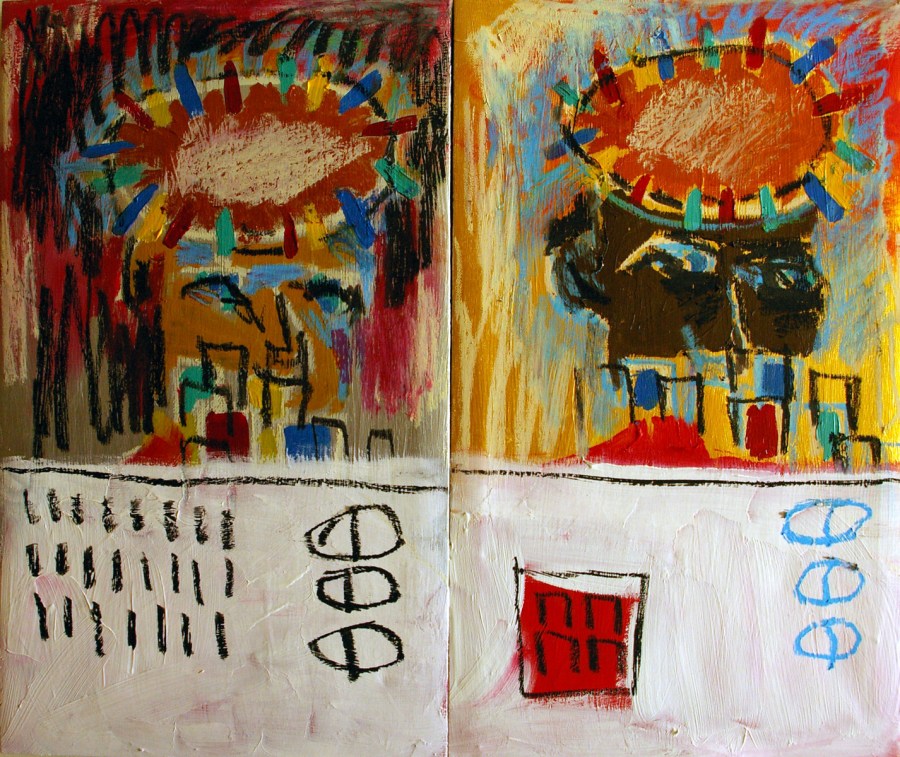
Featured Art: “Jesus Diptych” by Christopher Shoust

Jumbled in a box buried under a sediment
of obsolescence—
         busted luggage, boxes of VHS tapes,
tubs stuffed with old baby clothes—they’ve suffered

a second extinction, their snarls and scowls
all petrified
         in a kind of afterlife: not damnation,
exactly, more of a removal, an excommunication

from the child who made them lunge and jump,
growl and roar, loving them
                            like a god obsessed
with entertainment. Then one day, a lid eclipsed the light

like an indifferent ash cloud and did not lift again
until just now,
                  when looking for something else,
I found their box instead and slid it from the stack.

Even coughing from the dust, I’m surprised
by how happy I am
         to see them, and place one,
the triceratops, in my palm, holding it up

to the bare lightbulb to study the gray pebbled skin,
the beak opened
        in what looks like shock.
She once believed those horns could fight off any danger,

but all they do is scratch me from inside my pocket
as I climb the stairs
         back into time, answering
that voice that at least for now still calls for me.


Read More

How to Use This Book

By Christopher Brean Murray
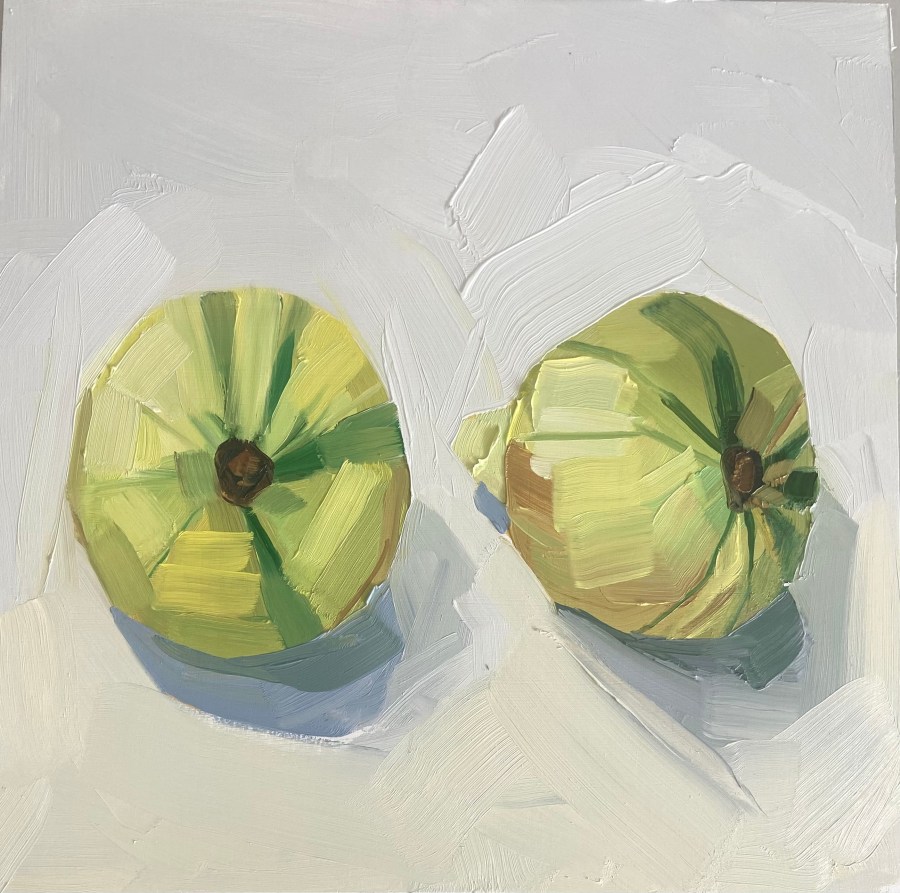
Featured Art: “Summer Figs” by Sherry Pollack Walker

Don’t read it aloud
at the harvest festival.
Never search for a curse word
in its index. Tell the helmsman
the whole thing’s symbolic
from the nickel in the chalice
to the pinecone beside
the Nile. If you travel
by train, see the image
on page 9. Never place a pear
in the volume’s vicinity.
Don’t walk your dog
on the eve of its release.
Know that its title
is a piece of underworld slang
spliced with a Serbian maxim.
Don’t read the passage set in Khartoum
unless you’ve put your house in order.
If you find a beetle in your drawer
switch one bookmark
for another. Blossoms
on your steps mean
your interpretations
are fruitful. A crash in the distance:
implications have been ignored.
Should you record your reactions
in a journal? If moonlight bathes
a steel bridge in April.
Will the story be made
into a film? Only when figs
write novels. Direct other questions
to the telescope’s designer.
Never shut the tome on a fly.


Read More

The Predicament

By Christopher Brean Murray

I was 200 feet tall. I’d been so
for hours. My cabin was in ruins.
My doctor hung up. I wouldn’t be
attending the banquet, nor did
my socks fit. I couldn’t read
the missive’s minute script.
Washing in the river was futile—
it trickled over my toe. I shattered
the oak I’d climbed as a child.
How would I live? Someone
gave me some tiny turnips.
My towering hunger made them
sublime. In the valley where I slept,
the leaves were my clothes.
I dreamt I was restrained
by a miniscule mob. They peeped
in a language I couldn’t fathom.
I swatted at clouds, kicked over
trees, and plucked a jet from the sky.
I pleaded with the passengers, but
they just screamed. I flung them away
and set out for the city . . .


Read More

True Account

By Christopher Brean Murray
Featured Art: from “Check the Mail for Her Letter” by Amy Parrish

At the trail’s end, I glimpsed
a humming nook of activity.
It wasn’t metallic, yet it shined.
Not liquid, yet it sloshed
and gurgled. A squirrel approached it
and stood on hind legs
before darting away over needles.
It produced an intoxicating odor.
The sound it made was soothing
like a hand smoothing sanded wood.
Then the whole thing shook,
flickered, and morphed into a voice
formulating a bewildering sentence.
There were pauses, and in them
other voices arose, some critiquing
the primary one, others elaborating
on ideas only suggested by the initial oration.
I took no notes. I couldn’t keep up.
New voices had coiled around
my own interior monologue. I felt
like a blimp lost in a system of caves
delving deep into the earth
as a spotlight scans the walls
scrawled with bison and deer
and the visage of a hunter
whose concerns are divorced
from our own. Even those caves
filled with voices: inquisitive, morose,
plaintive, shrill, consoling, and dismissive.
Irate iterations and blanket condemnations
strove to eclipse terse pronouncements
of enduring wisdom. Infantile babbling
percolated amidst the gossip of fools.
One voice said, “Confess,” as if into
a well of wastrels. Another recited
terms and conditions without end.
The voices melded into an intolerable buzzing,
a mandala of jabber, an encyclopedia
of interruptions, an anthology of blog posts
scat-sung over the crimes of a distracted quintet.
Eventually, the noise dissipated. I wiped
the drool from my chin. The squirrel eyed me
from a branch. I’d somehow lost my watch.
I needed to go. I was late for a lecture.


Read More

I Try Not to Die Every Chance I Get

By Rebecca Boyle

Wave, say goodbye to the small figure getting smaller,
to all who get very still then back away slowly:
We only paint large pictures now. The night
we decide we’re moving is the night
we are due for a breakdown—that corner there
calling me. We invade your house, fill it
with beautiful people, total hope.
I like forever, I like this location. Nothing looks better
in factory settings, every person I meet a rising star
in a waiting room. It’s too easy to say everything is a death
of another small city. What I’m looking for exists
somewhere in papertowns, night shifts
in Minnesota, all the people in those houses
with dreams once. See them make their hands into guns,
say, “You got it,” wink, and look away. Tomorrow, pin this ghost
town an awakening in the underpainting, the flowers
still bright at this elevation, the motorcycles
a dotted line to cut along the mountaintop.
I admit all I ever wanted was a common picture,
open country in some new image, past versions
you vaguely recognize, a feeling somewhere between
“I learned to read in this room” and “I have something to say
in big streets.” I’m not worried when you draw a blank
face or a mirror where my face should be. Just paint
a big enough picture, so I can move and still be in it.

Note: This poem alters a phrase from Mark Rothko’s short artist statement, “I Paint Very
Large Pictures” (1951).


Read More

Turtles

By Celeste Amidon
Featured Art: “Olwyn (she/they)” by Jemma Leigh Roe

Sylvia was a waitress at the Desert Jewel Casino in Scottsdale, Arizona. She wore a little black dress with a white bowtie to work every night, where she served food and drinks—pork dinners and Tequila Sunrises and cheddarstuffed meatballs and Irish car bombs—to bachelors and addicts and men with catheters snaking down their legs. 

She had just graduated from the University of Arizona Sierra Vista with a 2.4 GPA in psychology. Not knowing what else to do, she moved into her parents’ basement with the blind cat and the washing machine. Her mother said she was welcome any time, but her father wanted her to pay rent, so she got a job at the casino. When she wasn’t working, she was playing solitaire or combing the cat’s fur with a pink brush from the dollar store. Sometimes, she tried to meet people, at a live music event or on an internet date, but those nights always ended so miserably she could not eat the following day. She hated Scottsdale—the dialysis centers and the nursing homes and the golf courses and the dry heat—but she liked her job. She liked working the graveyard shift and sleeping all day. She liked how men stared hungrily at her from across the room. She liked how the black nylons made her legs look. She liked the endless music box noise of the games. 

Most of all, she liked Wes. Wes worked as a slot attendant. He had long blond hair and tiny diamonds in his earlobes and a blue sea turtle tattooed to his forearm. She liked to watch him walk on the casino floor, how he played the drums with his fingers in the air as he went. She liked to watch him in the break room, the way his shoulder blades hooked over the backs of the plastic chairs like bat’s wings.

Read More

Tornado

By Theo Jasper

Let’s start with something good. The summer sticky
    on our fingers, quarters sweating on the washing machine.

You were different from my friends at school, those rich girls,
    their hopscotch and honeysuckle. I was more like you,

the soles of our feet painted with a thin casing of dirt.
    Before puberty, I felt genderless. We were the same.

One summer day, we gathered coins from our trailers &
    rode our bikes to the gas station,

slushies were victory bells. This reclamation of self against
    my father drunk at home, his sad way of being.

I loved you. I think I did. Once, there was a tornado, and we hid
    in your bathtub. Behind you, there was a window.

The bright flashes of lightning made me squint. But you,
    you were facing me.

That night, a tree fell on my father’s trailer. A crack in the ceiling over the living room.
    Water couldn’t get through. He never repaired it.

I think, now, how the world is like this: a series of lightning strikes,
a sheet of frosted glass. And you,

    you, don’t make me say this,
      you taught me to grieve myself
on the trailer floor, how to exit the body
      and it’s called girdling, when a tree’s roots suffocate its own trunk

and I could not move and I could not look anywhere
    but the window behind you, always behind you
      and I knew then that we were not boys together but now only

      this: the flashes of lightning he could not see,
the crack in the ceiling that still hasn’t been fixed.


Read More

Somerville, Winter 1976

By Mark Kraushaar

I’d been going to shovel for days.
Pine Street in Somerville this was and I’d
stepped outside to begin with the stairs
when I heard a door close
and, in a minute, two boys passed,
brothers or friends with their backpacks
and parkas followed by a girl, someone’s
sister I guessed, younger I thought, ten or eleven.
I can’t recall the landlord now, or even
the name of that strange, gentle neighbor
who’d wave from his porch.
I can’t remember the day and I can’t
say why I watched them either anymore,
me with that blue plastic shovel
and my flimsy black shoes.
There’d been the sudden soft
thud of a door and in the moment before
someone’s mother calling goodbye
with a final reminder.
Life was like it is now,
or it mostly was, with the future,
friends and the weather.
We’d rented a place near Boston,
Harvey the artist, Ruth who loved music,
and Jimmy and me and Doris who boosted half
our food from the A&P until she moved back to Queens.
And all this is the past, another country and we were
different in it—
it just seems we always
want to know what’s coming and when.
Or, we do and we don’t.
But one night before she left
Doris took a long breath and leaned
toward me and Ruth.
We’re here, she said.
We’re here, we do stuff
and we’re gone.

         For LC (1946—2024)


Read More

Among the Paths to Eden

By Mark Kraushaar
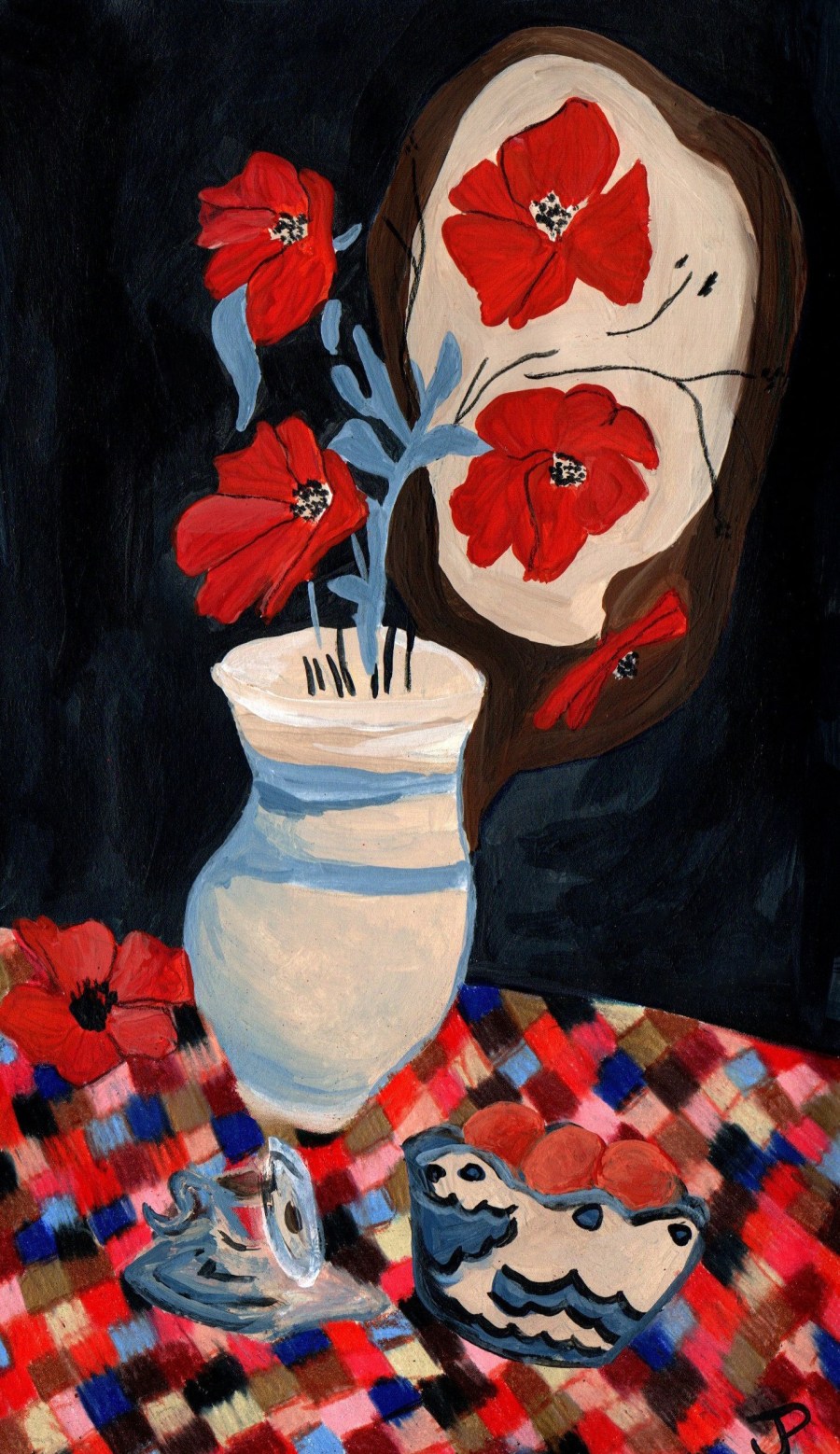
Featured Art: “Poppies” by Jenn Powers

Where’er you walk cool gales
shall fan a glade.
Trees where you sit shall
crowd into a shade . . .

—G.F. Handel, “Semele”

These are some friends from years ago:
car buff and cyclist Carla Breese,
and Danny Leblanc, ninth-grade teacher
of science at his desk, legs crossed,
good-hearted, chewing his pen.

This is Agnes Cummins, Roxanne Watson,
Bob Mulvahill, and Donny O., and I picture them together
but I picture them alone and lost to me.
All my friends from years ago.
This is Margot and Peter
and here’s Mike C. and Mike D. who died, both
in twelfth grade and both in their cars.
And this is Jack Fraze at work in his shop
a pre-fab one-car garage, his ace-in-the-hole
and his anchor to windward: hot plate, mini fridge,
pea-green plastic lounger junk-picked
or boosted he never remembers.
Jack Fraze who’d fix anything
and everything, mowers
to toasters, broken or no.

And this is Bob York whose dream it was to drag
his sad sagging motorhome from Mobile,
Alabama, straight to Alaska.
How clearly I see him, powdered donut
on the bandsaw, greasy quilt, and cat box,
chipped plaster Jesus over the drill press.
This afternoon I let Bob stand for everyone I’ve known.
I let that rusting Winnebago stand for certain
uncertainty and I let Alaska
stand for Eden, Bob’s route
and arrival in Nome.


Read More

Pinball Wizard

By Gregory Lobas

Well, I was never going to get a letter sweater for it,
    was I? But, hey, I did have a song
written just for me.
    Did I say song? I meant Rock Anthem.
      Oh, wait. Did I say Rock Anthem? I meant

           >> ROCK OPERA <<

        No, I wasn’t a deaf, dumb, and blind kid,
            but I didn’t let that stop me.
          I could sure play a mean pinball.
              I could time the flippers,
            ignite the rocket ship.
 When the target lit up with concentric flashing circles,
            I smacked the bull’s-eye,
  popped the silver ball right into the dragon’s mouth.

        So naturally, I figured
  everything else would pretty much fall into place.
           Right?

But when I first heard you laugh
    the dingers dinged
in my amyg dadah-dala
  the ca-chunkers of my pituuuuuuitary
ca-chunked,
    and spinwheels spun
  in my cerebubblegum.

That whole medial forebrain bundle thingy lit up
   like a midway on the Fourth of July.

Aglow in the spectrum
    of anomalous propagations,
  uncontrollable situations,
        disjointed inspirations,
  you played me
        like a double-ball,
  bonus round of “Carnival Night.”

    So yes, I guess
  I do believe
in love at first sight.


Read More

Contemplative on the Train

By Thalia Geiger
Featured Art: “Jordan (she/her)” by Jemma Leigh Roe

I am wearing my leopard pants when I enter
the train. I tell a girl how much the book hurts
that she holds beside her. There is Pink
Whitney in a flask in my purse and punk
rock trickling through the buds in my ears.
I sit and read, too, a poetry book about gay
intimacy. Nothing I know. The world stretches
sideways as we roll through the clearing
in the trees past Washington Lane, past
Germantown. I am stuck in my ways of loving
things from afar. It is all I know how to do.


Read More

Displacement and Other Sins of the Flesh

By Sofie Llewellyn Riley
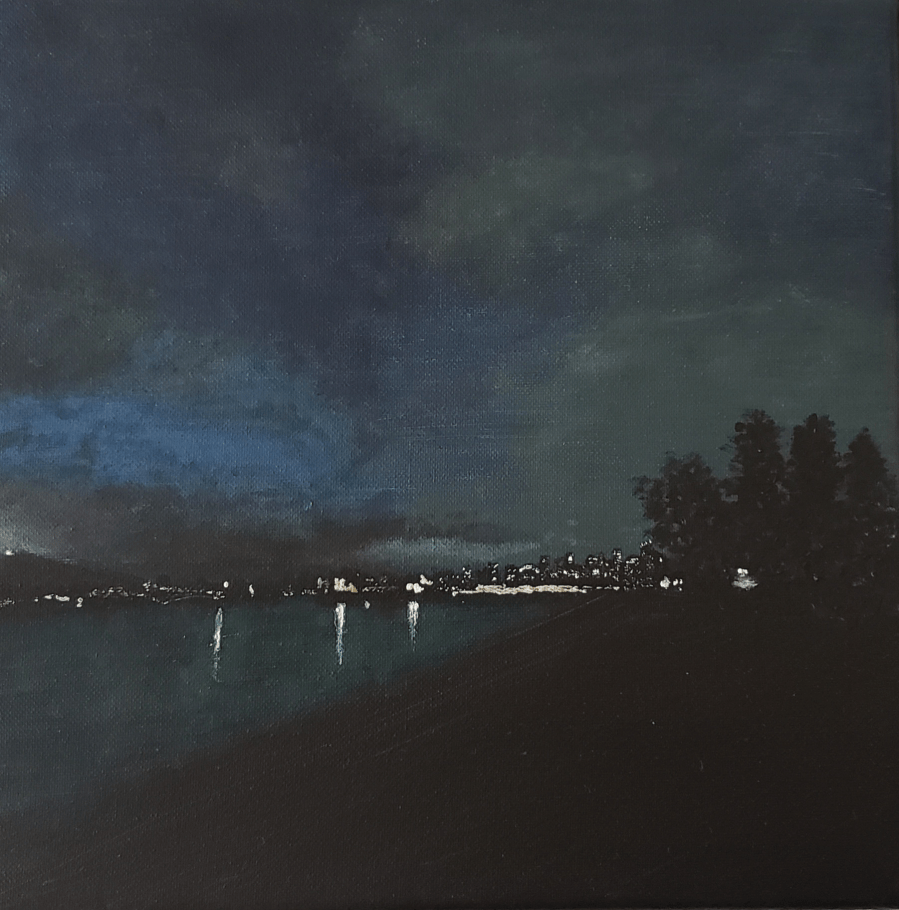
Featured Art: “Before Sunrise Locarno Beach” by Thad DeVassie

Autumn in Minnesota doesn’t look so different from Ohio. The trees are the same color, the farms the same distance from the cities. The congestion and construction are the same consistency, slowing traffic to a mucus-like crawl. If I were to close my eyes in the park beside the Mississippi River, I would hear birds that sounded like the starlings that sat on the pine branches in my childhood backyard. This is a trick I play on myself sometimes, to try and feel as though I am near where I am from.

“Biological sex,” “birth sex,” and “sex” mean the biological indication of male and female, including sex chromosomes, naturally occurring sex hormones, gonads, and nonambiguous internal and external genitalia present at birth, without regard to an individual’s psychological, chosen, or subjective experience of gender. [ . . .]

“Gender-related condition” means any condition where an individual feels an incongruence between the individual’s gender identity and biological sex. “Genderrelated condition” includes gender dysphoria.—Ohio House Bill 68 [Emphasis always mine]

Read More

[Philosophy Is a Way to Find Out . . .]

By William Archila

Philosopy is a way to find out god left long time ago. Correction.

Philosophy is a way to catch on we are the only gods left. Death
is an endless war against philosophy. Correction. Death is a reminder
we’re already dead. Is history what we forget but are reminded
again & again? Is religion a different method to talk to our future
selves. Darkness is a joy to find out anything is better in the dark.

Colonization is to put the land in a casket then sell it to another cop.
Let me try again. My professor says colonization is what colonizers
did to his mama. A migrant caravan is a ship of settlers seeking land
& jobs. Repeat. A migrant caravan is a ship with white sails seeking
a bed & a good shower. Americans are anyone born in the continent
named after Amerigo Vespucci. Yes, Nicaraguans are Americans, too.
Disappearance is to live inside a skull that is too small for the mind.

There are people very good at that. I don’t know what else to tell you.


Read More

Somewhere North of Extinction

By Phillip Schultz

Well, here we are again,
on our treadmills,
deep within a hospital’s cardiac center,
two fellow rehabbers,
accountants I believe,
on either side of me,
watching Fox News while discussing
tax-free Caribbean vacations,
organized, I imagine, by Dante.
My silence, I assume they assume,
implies equal pleasure in seeing
noisy ideas being crucified.
My TV, tuned to the History Channel
by a previous tenant, shows
a jubilant Darwin wandering curiously
among incurious tortoises,
who, apparently, have no idea
what being naturally selected means,
other than, perhaps, having somehow adapted
to their new and surprising
personalities. In any case,
the surrounding clamor is triumphant,
we’re all still here, after all,
on the treadmill of evolution,
somewhere north of extinction,
sweating happily, contemplating
our complex, peculiar strivings
toward the rewards of indefatigability,
one dogged assumption, cranky idea,
and tax-free holiday at a time.


Read More

To My New Synchronizing Pacemaker

By Sydney Lea

Machine, the oddest things still appeal—
like the tick of my old truck’s engine
when I shut it off and pause at the wheel

to think what I’ll say inside—or do.
Then the chirp on snow of my boot soles,
lamplight indoors, the woodstove’s glow.

So tick on, machine—at a dignified pace.
I feel no hurry at all
to get where we’ll go. No reason to race.

I need to pause at least now and then
to take in the world that’s blessed me.
I still need to watch the sunset turn

the sky above our ridge to crimson,
though I’ve seen it a thousand times.
Weather allowing, I never miss it.

Sometimes thunderstorms pock our pond,
and I savor their whiff of ozone.
Help me stand on the porch a while and look on.

Particulars, countless, big and small—
they shore up anyone’s story.
Most of mine can prompt a recall

of affection, thanks to men and women
who’ve helped me on my way,
to an all-forgiving wife and children,

to friends, some of whom pace no more.
Let’s you and I meander.
May the right people know what in younger years

I may have been too rushed to let on:
I love you. My heart skips a beat.
How I missed you each day you were gone!


I’m not ashamed to risk the maudlin.
Time now for candor. Onward,
heedless of that old clock in the kitchen

in favor of you, new steadfast gizmo.
The clock will win, to be sure,
but why surrender until we have to?


Read More

Europe

By George Bilgere
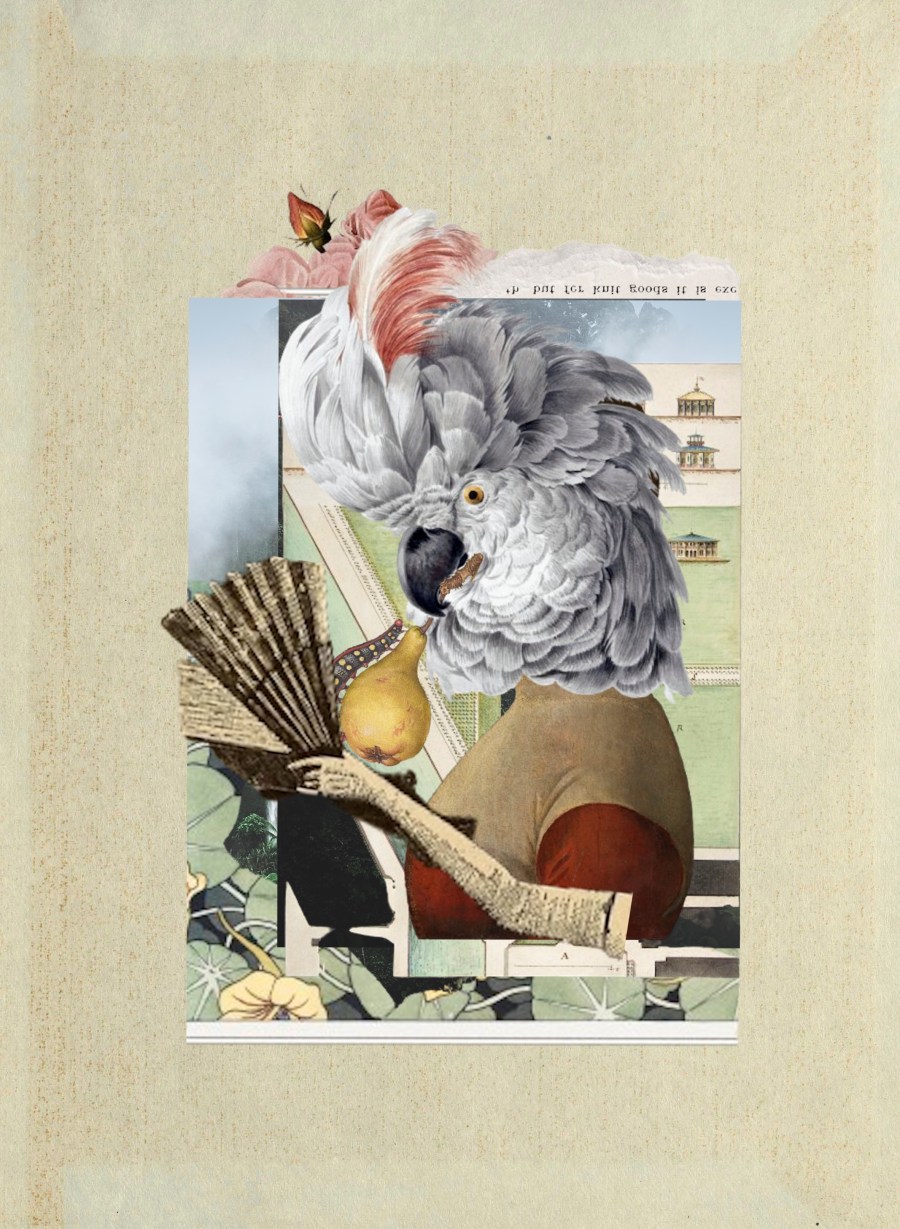
Featured Art: “Lady Perroquet” by Ana Prundaru

I love this picture of Michael
and Alex on our visit to Scotland,
what, three, four years ago? Alex
is missing his front teeth, so I think
that makes him four, or five.

They’re standing with my wife
before a palace in what
I now realize is Düsseldorf,
not Edinburgh, although
it might also be outside Lyon,
I forget the town’s name
and the name of the palace,

but an 18th century king
built it as a gift for his wife,
who was mad—or no, the king
was mad, or possibly
they were both mad, although
it could be I’m thinking
of a palace we saw in Copenhagen,

as I recall there was something
about the way the turrets
were constructed, or the battlements,
that identify it as Danish,
I forget what century,
but I do remember

the cozy little restaurant
we stopped in afterwards,
how cold the wine was,
how delicious the mussels,

back when the boys were little
and we were all together
that sunny, long-ago afternoon
in now I’m thinking Amsterdam.


Read More

Deference

By Rebecca Foust
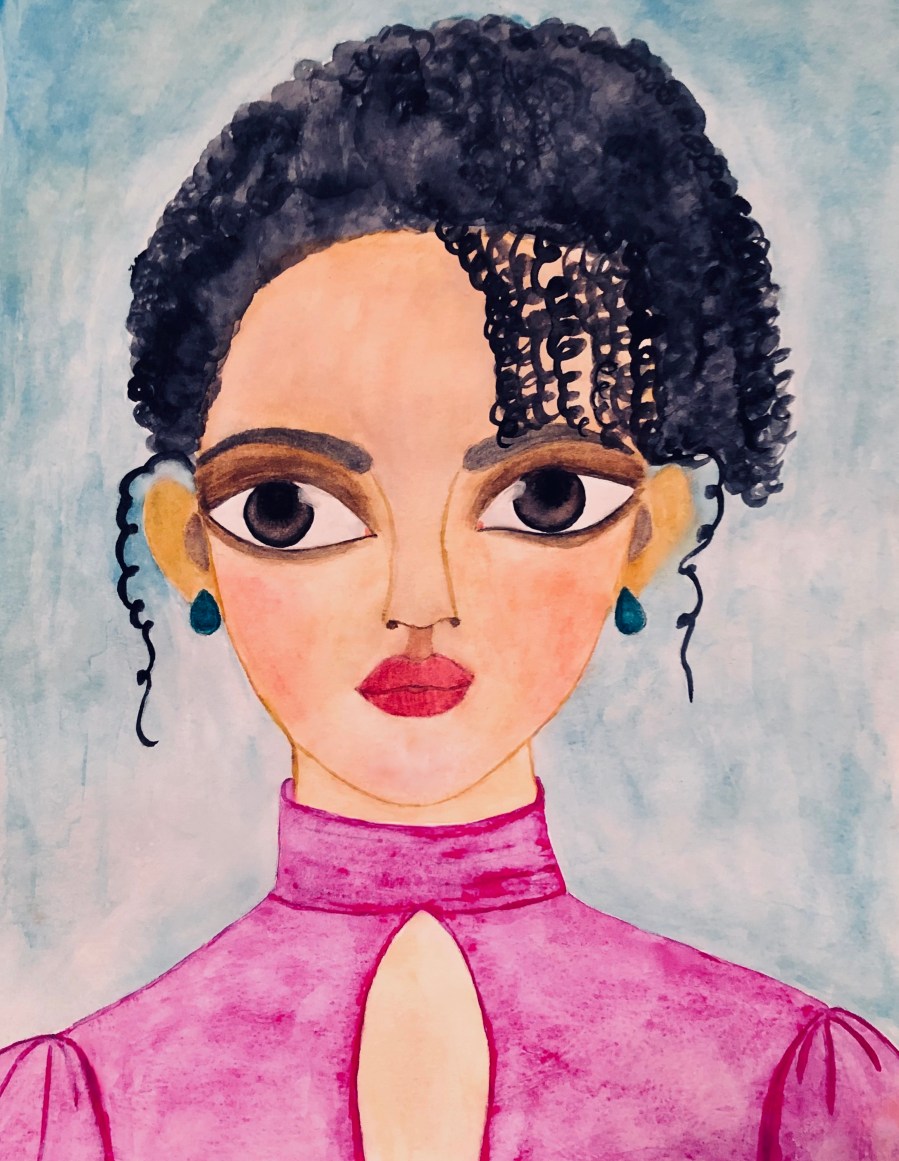
Featured Art: “Clare (she/her)” by Jemma Leigh Roe

in deference & abject homage
     to your late
     & i mean a lifetime-late
     barrage of attention
i have forsworn   underwear
     ever wearing it   i hope   again
& all manner of constricting things
     shoes early bedtimes chores
     obligatory wearing of rings
     & more deadlines than i care to count
i can’t help myself & that’s the point
     i could not erase you if i would
     & i never would

here i am dejected   low
here i am   hatching crazy plans
     to blow town  or  up  everything
here i am living half my life   below
     the ground  or am Lear
     wild upon the moors   wearing
     nothing   but a heather crown

here i am most abjectly yours
     writing what i’d rather say & do
     always in deference to
     flown-away   stupidly-squandered time
& always    Love—to you


Read More

Not too bad either

By Ada Lowenthal

Of course I’m grateful for positive things—sunflowers’ petaled, oversized eyes, my size
on the rack at TJ Maxx, the surrealist lyrics of Beck’s “Hotwax”—but even on a Monday,
I say ¡Olé! for negatives, which aren’t too bad either: my non-criminal children, my non-
biting dog, my non-stick pan frying drunken noodles, my chronic kidney condition
remaining non-fatal. One page of my dictionary boasts six tiny-font columns of “non-”
words that are, in fact, words. So it’s a non-issue. And certainly I’m safer with a non-
slip mat in the bath, probably healthier with non-fat milk in my glass, and undoubtedly
thankful for non-addictive Wellbutrin and all classes of statins. When I spell non sequitur,
you know I speak French, non-toxic masculinity is tender and trenchantly fresh, inspiring
plaudits for non-violent protests, despite repeat beatings, concomitantly saluting brave
U.S. non-coms, like my late (toxic) father, and though Connecticut’s steeples skew Protestant,
on non-denominational town greens non-combatants hallow the fallen with monuments,
and at heaven’s gate, with the gods non-committal, maybe my mother won’t need to reproach
me, if at least, just this once, I’m non-confrontational, while on the far side of the yard rise
furious rows of sunflowers, each green stalk a tall cluster column, each potent head
richly stippled with seeds, sundials under the sun.


Read More

Ghee

By Trent Lewin

Heated ghee crackles in a pan. Smell of soft fat circulates through the kitchen.

Upstairs, Bakshi opens the window and smokes. Across the street, an ice cream van sits in a driveway, same place it’s been for ten years. The decals on the side are fading.

When the ghee is hot, add wheat flour. I cook the mixture until it’s golden. Water comes next, then sugar.

When I was young, in the gurdwara, I would sit at the back of the hall, unwilling to be the child that gave out napkins to the cross-legged people. Just hand each person a napkin and move on, my father would tell me. But why is this necessary? I’d ask. Why do they need napkins? 

Because prasad is full of fat. It’s greasy. And it’s holy. Don’t forget that it’s holy.  

In the gurdwara, you do not drop prasad. It is a holy food when made in a holy place, and if you drop some on the carpet or on your clothes, you pick it up and eat it, whether it’s dirty or not. 

Read More

Congratulations! Your Grief Is About to Stop Being Relevant!

By Bridget Bell

It’s been months since a neighbor rang the doorbell with a
quiche or lentils or a bag full of fat purple grapes doomed
to rot into mush on the counter 

the mail slot silent, the last card long ago shoved
through its brass mouth and you are thankful
in a way because the worst is over 

your beloved is dead and yes, you know, there are things that are worse
than death but still you keep thinking of another line but you can’t find
the right page 

somewhere in the rural dust of Dorothy Allison’s
Bastard Out of Carolina where a daughter’s husband has died and
the mother tells her, face held in her hands, 

this is your face now
this is the oldest your face will ever look, you look at
the photos of his face, you bone-pick them bare, 

you’d eat the pictures if it’d make him
a permanent part of you and the world
has moved on.


Read More