Newohioreview.org is archiving previous editions as they originally appeared. We are pairing the pieces with curated art work, as well as select audio recordings. In collaboration with our past contributors, we are happy to (re)-present this outstanding work.
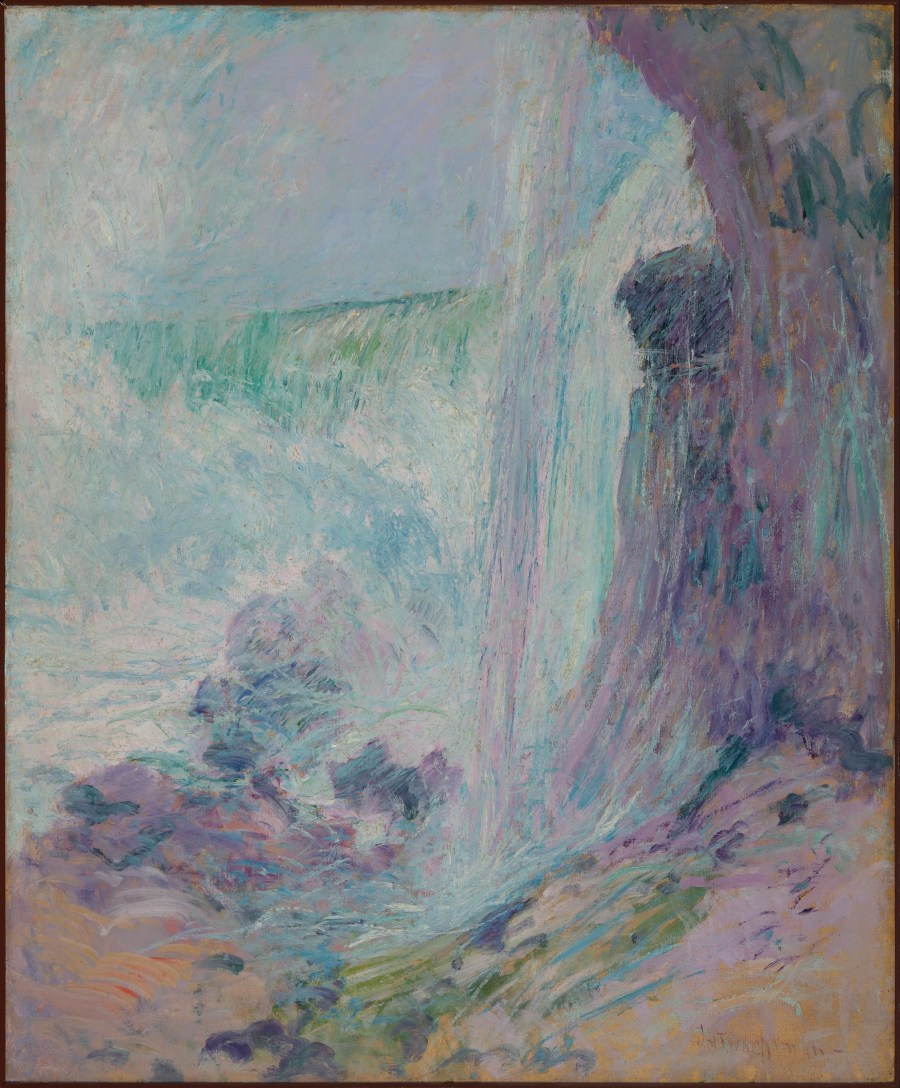
Featured Art: Niagara Falls by John Henry Twachtman
Break it, you own it. Honestly, though, it was always broken, which is the whole point, that is to say, when this world first whirled and popped into existence out of nothing’s sticky grasp,
the ur-broken thing, when it had wings that glinted wildly in the suffused and charged plasma, when it cascaded off the cliff of itself a mountain waterfall in native sunlight; when the newly minted honeybees, still smoking a little from the tiny forges that made their immaculate and fragile bodies, shook the pollen dust of a violet, left a telltale film on the velvety atoms of air,
when the first honeybees so insisted upon new life they went flower to flower—back when this world wanted to be called Volcano of the Lilies, not Rage Monster or Resentful Lover, not Plague Addict or Reservoir of Ashes, even then, broken, yet fresh with new blooms, it was yours.
An equal and opposite burst expanding from the same particle but in reverse. Where peaches unripen in the family orchard. A mom-and-pop deli replaces the condos on Second Ave. OutKast never breaks up. They only get back together.
My sister is getting smaller by the day her outfits like pastel pythons swallowing a doe. In the other big bang, we start with all the knowledge we’ll ever know then forget it piece by piece.
So even after my grandmother’s brain stitches itself whole, vanquishes the plaque that shows up like coffee stains in scans, still she becomes more unknowing by the day.
But we all become naïve with her. Everyone communes over fears of growing young: how we’ll tie our shoes, cross the road alone. I am planning an expedition. One day I hope to have never known you yet.
Reading Accompanied with Music By: Laszlo Slomovits
While I was away the world went on without me— a spider completed its web under my plant stand, dust from an unseen wind settled in all the hard-to-reach places, light drifted across the walls. The ceiling fan dipped its oars in stillness. Zinnias in the vase went from Technicolor to hand-painted antique postcard hues. The world’s bad news got worse, the good news, better than expected. Letters and bills fought for room in the mailbox. Mold helped itself to the food I hadn’t eaten, and a late rose bloomed in the garden. I watched myself considering each thing, thinking, this is how it will be.
Featured Art:Figure with Guitar II by Henry Fitch Taylor
I was startled it was death I’d been singing all morning under my breath, scrambling the eggs, steeping Earl Grey for breakfast with my wife, death I’d been carrying like a jingle or Top 40 chorus, its melody infinitely catchy, insistent, vaguely parasitic, its lyrics surfing rhythm, slotted into rhyme, over and over, a half hour or more, all Saturday ahead of us, the morning sun shining when Julie protested with a quick laugh, though wincing too—no, please, I just got that out of my head.
Oh, that’s right—because I’m going to die. Sometimes I forget. More often than not. And then, that’s right! I’m going to, sometime. Because . . . I’m going to. Forgetting, but only sometimes, that’s how this works more than not. And then we wake to snow,
*
quite unexpected, the whole neighborhood quite, you know. And you say to me, yes, that’s right, cream, two sugars. Sometimes I forget. Or these days, more often, because, you know, that’s how this works. And now I remember we’re going to. Both of us. And there’s the car
*
snowed under, looking so unlike itself. It takes an easy faith to see it. What it truly is. I believe this morning the whole neighborhood is a fact refuting last night’s forecast. I’m predicting this icicle by evening will stretch down past the window, which reminds me—yes, that’s right,
*
last night, 2 or 3 a.m., I woke to the whole house moaning in the wind. And I felt warmer beside you surrounded by this sound, our house, and maybe the whole neighborhood, the neighborhood houses and the neighborhood trees all moaning. It was snowing, but I didn’t know. Sometimes, I forget this
*
is how it is with us. Just as I, at times, forget I, we, are going to, you know. They’re saying now more is on the way by evening. It almost hurts to look out there’s so much sun. I’m going out to prove the car’s still here. You remind me, yes, of course, coffee. How could I ever forget?
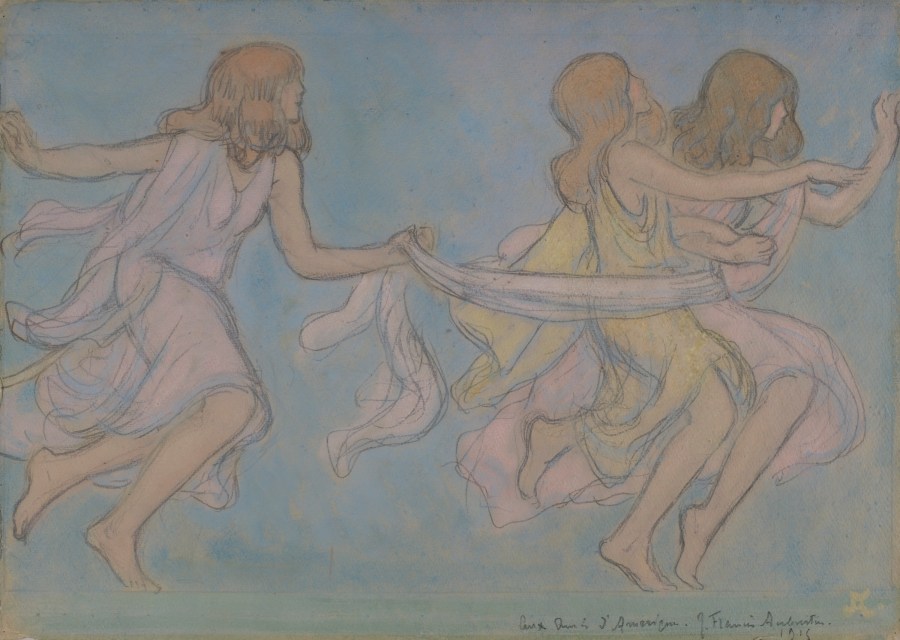
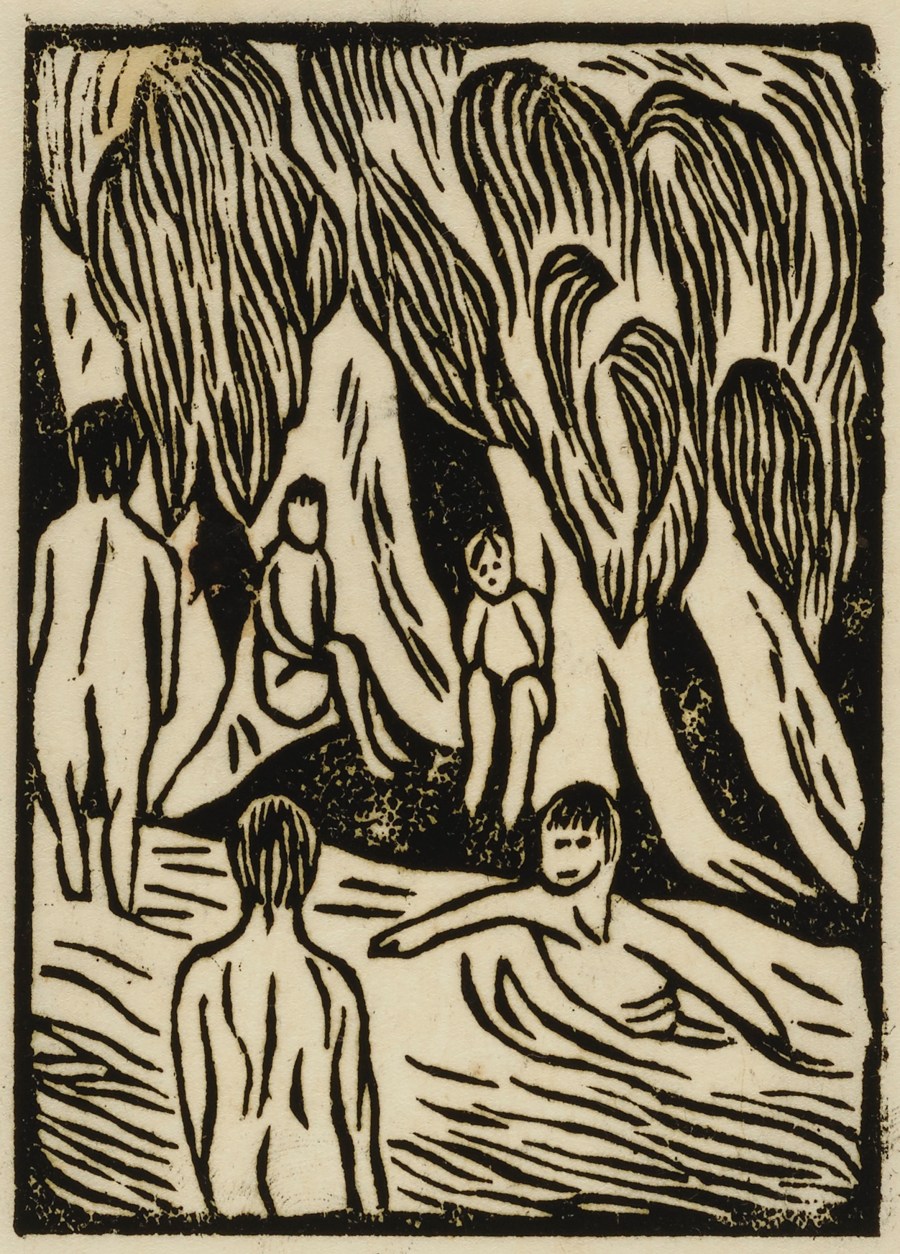
Featured Art: Children at Play by Jean-Francis Auburtin
leaning back in our lawn chairs, the August constellations crowded by a crush of stars, the Milky Way in soft focus like a glamour shot. A couple and a couple at the end of the day watching our kids zip sparklers back and forth across the lawn like satellites or meteors. It’d been a story in the paper, evidence of a supermassive black hole, and so we throw it back like tequila shots and wade past our depth—me, deflecting to Kubrick’s Star Gate sequence, those long light smears on Bowman’s helmet, Julie, pulling both cords of her sweatshirt taut, saying our bodies would be stretched to angel hair if we were yanked into that hole. Then Janet’s telling us how she imagines this supermassive black hole is like the hole at the end of a vacuum cleaner. And right now—Saturday evening, our kids growing restless, minutes from boredom, then, maybe, those nudging arguments of who found who, who was safe, and for us, at least, the hour’s drive home, I-95 congested by the night-shift roadwork just beginning, Julie and I talking quietly in front, reviewing the evening, overwhelmed by the obvious, how we’ve all changed, how we won’t ever be as young as we were, our daughter, grass-stained, her hair wild with static, slouching down in the backseat pretending to sleep as she listens in just as I did at seven, those long drives to Maine, picking up things half-understood in the language of grownups—this black hole, says Janet, is Hoovering up stars and planets like so many pretzel crumbs ground into the shag. We’re full. Everything off the grill is hitting the spot. And Mark, back to Kubrick’s Star Child, is leaning in to share his fanboy theories of what it all means, though I’m not listening, not really, because it seems right, that vacuum, because I, too, have plucked stray fuzz clinging half in, half out of the attachment’s rim—and yes, this is how it feels, year-by-year, to be drawn to the irresistible thing.
By Nicole VanderLinden Winner, New Ohio Review Fiction Contest: selected by Lauren Groff
Featured Art:Beach Scene by James Hamilton
Vanessa had wanted the luau, something extravagant—never mind that we were a moon away from our original budget. But that was Vanessa, always doubling down. She swam in mountain lakes; she was the only person I knew who’d been arrested for playing chicken. “We’re in Maui,” she said, letting geography make its case. “It’d be fun for the kids.”
This wasn’t all true, because our youngest, Chloe, dreamed of puréed bananas. She was barely a toddler. She’d never tasted salt, and bubble baths made her shriek. It was the other kid my wife had been alluding to, the child of our concern, our Anna.
Vanessa bought tickets to the luau. I was suggestible—there were so many things I was trying to save then, money the least precious among them. We returned to the cool of our room by three so we could shower and put calamine lotion on our burns, our sun-chapped faces. Vanessa took Chloe with her and got dressed in the bathroom, where she’d laid out various makeup cases and where the tub had jets, and I waited for Anna, who was twelve and who, when she was ready, spun for me in a white sundress lined in eyelet lace.
At the luau, we inched toward the entrance on the resort grounds, entertainers beating drums and offering drinks made with canned pineapple juice. Chloe sat on her mother’s hip with her wild, straight-up ponytail and gave everyone her skeptical face, the one that prefaced an opinion you couldn’t predict. “Drum,” she said seriously, as if naming objects for the first time. “Drink.” Anna had put on a dark hoodie, though it was still hot, and shuffled ahead of us all.
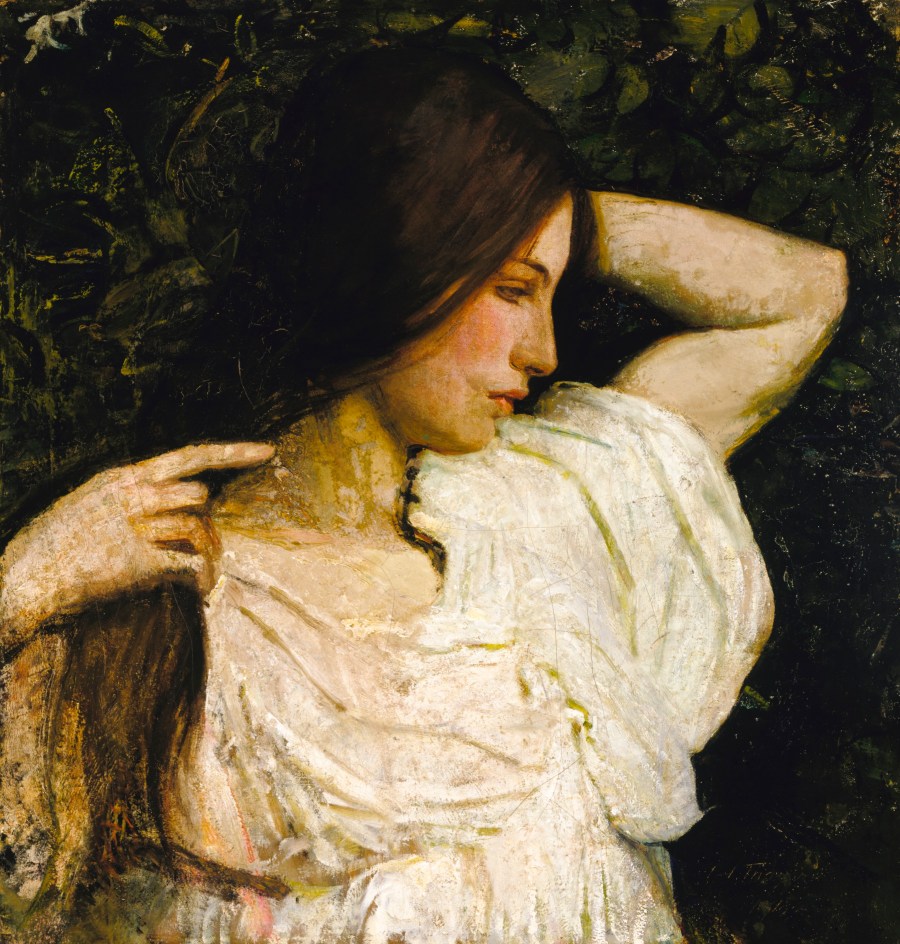
Featured Art:Girl Arranging Her Hair by Abbott Handerson Thayer
The woman in the Oldsmobile was awfully young to have a kid, her kid would have said, if she’d had a voice not just a body jittery inside her precious cotton dress with ducks stitched in the smocked bodice flat across her washboard chest. A woman’s hand was every bit as flat when she had to slap somebody’s face, so it wasn’t best sometimes to have a voice in case you asked the woman one too many times how Seguin was different from Saigon or where the dad had gone or who was gonna fix the swing or when can we get a collie or what’s the matter with twirling a lock of hair around your index finger all day long it felt so smooth & cool spooled round your finger & released & caught & wound again, secured. What’s wrong with messing with this living little bit of you, a darling little thing. You couldn’t stop it even if you wanted to.
Featured Art: Open Lock, Akron, Ohio by James Henry Moser
complain about the weather. wait five minutes watch the boys you grew up with outgrow you bury your cousin. go sledding on the tallest hill you can find keep a family warm until their son thaws out of prison ice skate between the skyscrapers downtown inherit an emergency exit sign from your father spray-paint your best friend’s brother on a t-shirt daydream your way through a semester-long funeral watch jeans and sleeves and family portraits unravel play soccer with the black boys who almost evaporated with the icicles. kick it outside with the skeletons from your childhood. go to columbus and pretend to be a grown-up. spend a weekend at kalahari resort and call it a vacation. go back home. leave. shoot dice with the dead boys playing dress up. stay long enough to become a tourist attraction in a city nobody stops in mount bikes and ride until the sun dribbles out of the sky’s mouth. wade through the oatmeal july makes of morning air. swim in a public pool where everyone is drowning and no one knows how to survive what happened last month. stop runnin in and out unless you got somethin’ on the gas bill. seal yourself with cold air while the trees melt. bet the boy down the street, who’ll have the best first day fit. come out amid orange leaves lookin fresher than all the food in a five-mile radius of granny’s house. eat jojos from rizzi’s on sunday after pastor guilt trips you on your way past the pulpit. dream about a city where headstones don’t show up to dinner unannounced where fried chicken isn’t on speed dial and diabetes isn’t the family heirloom. where grief isn’t so molasses root for lebron in whatever he’s wearing. become an athlete as a way out of corner sales. never escape. start a pickup game that never ends. rake leaves with a rusted afro pick your older brother left you in his will. let the leaf bags melt into the chimney on the side of the house. play basketball with the ghosts who don’t know what year it is volunteer at your local funeral home. open a cemetery across the street from the playground. mow green. cut ties with your grass-seller. survive the summer.
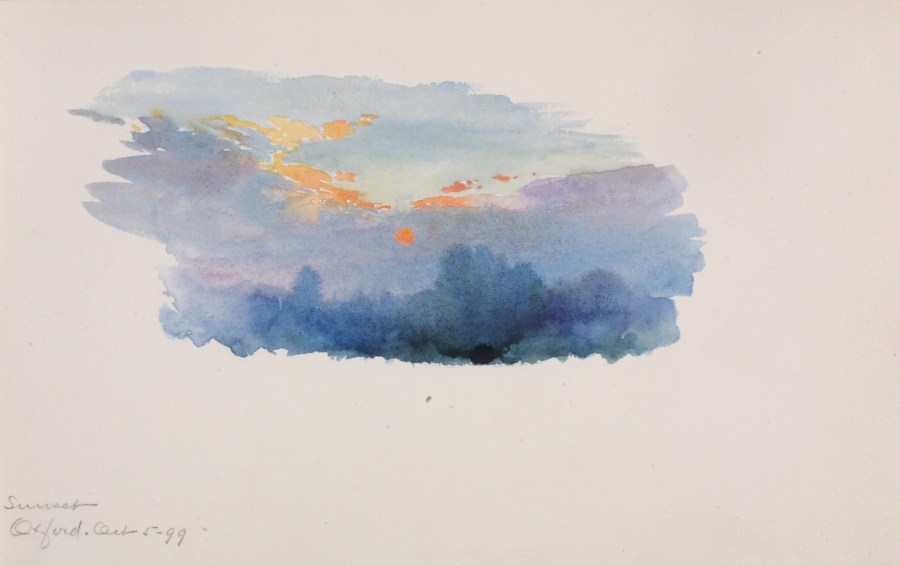
Featured Art: Sunset, Oxford by George Elbert Burr
I was driving. The sky was pink with sunrise or sunset. The road banked left. We drove straight—through the guardrail and over a valley with gray houses stacked on a hillside.
You were so calm. I didn’t understand at first that we would die. This was much worse than forgetting to pay the phone bill.
Then you were driving. The car soared. We looked out the windows. Around the houses, people trimmed hedges and hung laundry.
You changed gears. I don’t remember the landing. I think there was music. We held hands. I’ve never understood forgiveness, but this is what it must feel like.
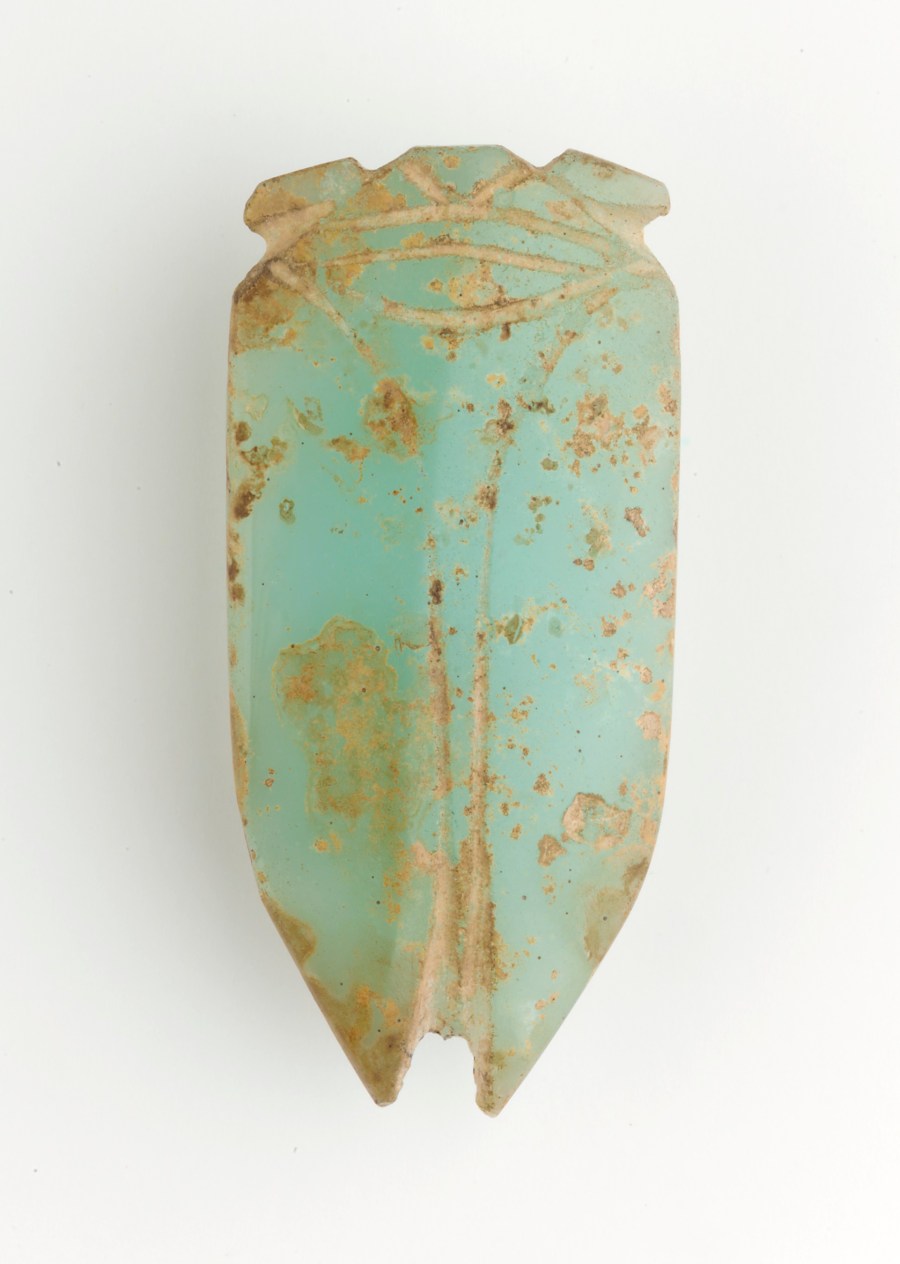
Featured Art:Tongue amulet in the form of a cicada (hanchan) by Unknown
My limp body lulls through the hot, humid days like a lukewarm dog’s tongue hanging off the edge of time, begging for disaster, for that rotten stench of nostalgia to drift away & be buried in the brain’s contemporary fiascoes. Night after night, caught gaping out the window in the same chilled, sterile room. Only the shadows of bats flitter into view, and the dark, lush limbs of American elm trees groping toward evidence of further tangibility with a desperation akin to worship. Something in me must cherish the sound of cicadas feeding off each other in their suburban, summertime mania, like the soulless, asinine chorus of a fraternity chant. The girl at the 7-Eleven in the purple hijab restocks the Cheetos and the world goes on devouring itself for no other reason than something must be devoured if we are to continue loving one another in this crudely selective fashion. It’s terrible but it’s true, all heartache inevitably resolves in that surreptitious method pain can only accomplish with the brain’s private blessing. I know now what I did, I did to destroy you. I know, too, that I’m the one who’s destroyed. But somehow that still feels like forgiveness.
They come, like the dishwasher, with the house. “No trouble,” swears the seller, and—presto change-o— for handfuls of Layena every morning, the pair of hens trade one or two brown eggs. The chick, if we approach with proper coos, will let itself be stroked. This we learned from our new bible, Chickens in Your Backyard. Like neighbors of a different faith, we practice tolerance, let them grub among the bulbs, ignore the way their droppings singe the mulch.
Meanwhile, we are intent on our own nesting. My husband paints the nursery; I quilt a golden goose with pockets shaped like eggs. We hardly register the added squawking from the coop or look for more than tribute when we rob the nesting boxes. Then one dawn, I’m roused by what can only be a cock-a-doodle-doo. And in the breaking light, our chick-turned-rooster struts, ruffed as Raleigh, shaking his noble scarlet comb. What waits
inside me to astonish like this male? Such sudden majesty, sudden red.
Not the baby but the baby’s clothes defeat me— the cunning socks, the piles of onesies. A descant to the washer’s thrum, the strains of Pagliacci drift in from the study, dislodging a memory: a stormy weekend stranded at my cousin’s, the window wells filling with snow like the heaps of dirty laundry my aunt was sorting in the other room. Around us spread the scraps of paper dolls we’d wangled in the market, peeled now, and finished like our tangerines. We’d tired of mimicking Corelli whose whooping rose above the drone of the dryer where my aunt and uncle’s shirts embraced. “There isn’t anything to do,” I whined until my aunt emerged, a bar of Naptha gripped in her raw hand. What struck me was not her slap, nor even the stunned giggle before my cousin got hers like a portion, but the tenor’s voice dissolving in sobs, and the Clorox, smelling as a perfume might, if she had splashed it against her wrist.
This poem has already been written. The nausea, familiar. You’ve been left, bobbing bereft, in water, watching flames eat home and hearth. Or vicariously felt that dread suck of time elongating the slim barrel of a gun. You’ve picked your steps through a landscape of corpses, fumbled through each level of grief. This poem, your companion.
But who will read this poem? Not the ones with the guns. Nor the ones cheering them on or silently assenting to their menace. Not even the ones who are carrying their children away from their fears toward your fears of what you know about this country. This poem does not traffic in saviors.
At ten, I meet myself in the mirror of my sister’s vanity, squeezed into the tiny corset of her pale blue dress, Cinderella’s image printed on the breast like a brooch. My little-boy pecs puff out like cleavage. The tulle skirt brushes against my thighs, rising above the knee, billowing around my Fruit of the Looms as I prance down the staircase to the dining room where my mother lights a candle before dinner. She laughs to see me skip across the hardwood floor, turning and twirling on the ball of my socked foot—and when she does, I know I want to keep her laughing. I’m not sure why, but I speak in a higher voice, with a lisp, and she laughs harder, and as I’m preening, brushing my cheeks with the back of my hand, leaping into the air like the hippos in Fantasia, I notice the tears— how they run down the corner of her nose, wetting her upper lip. I don’t know why she’s crying—maybe I’m really that funny. So I keep dancing.
autumn leaves glitter in their brittling someone plays the french horn on the shore beneath the blue flame of sky the sound like silver glinting across air like tinder
dear california when I’m gone will you still be here will there still be a shore
someone stomps out of the reeds holding a fishing pole commands the horn player to stop I walk by into silence
missing the music wondering what else I want on this hot november day a cloud spilling rain
a voice that’s kind not so many demands not so many desires I imagine mother earth is tired
our tumult & trash our french horns & fishing poles our eyelashes & elbows our hands wanting to hold
dear humans beautiful & dangerous what will we do next I keep thinking about love
about a man who wrote to me years later to say he was sorry for loving badly
After our son died, my wife found him in coincidences—sightings of hawks, mostly, at the oddest of times and places, and then in a pair of redtails that took up residence, nesting in a larch above our barn, and how their low, frequent sweeps just a few feet above us before rising over our kitchen roof made it seem as if they were looking in on us. In a way, it all made sense, our son so at home in high places—the edges of mountain trails, walking on a roof, or later, after he became a house painter, at the top of a forty-foot ladder. So many mornings we woke to the redtails’ jolting screeches and, even if I was a casual believer, their presence multiplied my love for the ordinary more every day. We never thought, of course, any of those hawks was our son— who would ever want that?—but, once, watching one rise and rise on a draft of air, I thought of Icarus soaring toward the sun— as if an old story could provide the distance I needed—waxed and feathered, his arms winged, and remembered a babysitter’s frantic call to come home, immediately, after she’d found our ten-year-old nearly forty feet up in an oak tree. I can almost hear him again, laughing high up in the sky, throned on a branch, his feet dangling, knowing nothing but the promise of heights as he waved to me— and I must have looked very small calling up to him, staying calm so falsely as I pleaded with him to come down, to come down now.
A cerulean warbler scrambled up and down the shaggy spine of an elderly bitternut hickory whose reach darkens half of my backyard and I tried to follow it, but it became impossible as the bird vanished and appeared in the shadows numberless— the futility of finding the bird again sharpened my focus because I’ve always longed to experience the impossible
because looking for the impossible in blotters of LSD during high school classes and staring out the window at the animated, neon leaves on oak trees didn’t just make me look at leaves differently, it made me want to whisper tales of anarchy in the waxy ears of greedy marketing majors, to digitally protest the World Bank, to distribute loose doobies at Christian chemo clinics, to dole out dollops of ranch dressing at the homeless shelter on Saturdays, to slide in and out of varied segments of society looking for pieces of my dull brain
searching for winding, mossy ways to get into the Hegelian principle far enough to see the overarching irony of oppositions and how they are the mortar between the bricks of what I really want to say since mostly my truth is tucked into an ellipsis holding together fast-flying flippant phrases,
however, my focus fled when a red-shouldered hawk alighted on an adjacent ash tree and I lost the warbler entirely, but I still readied myself for another round of watching the viewless fringe of fantasy and chasing shadows I imagined only Keats and I could see, because O, John, I want to hold on to my trippy teenage faith that there is fractally-hued life beyond interpretation, to believe in full-throated ease and sunburnt mirth, that I’m awake and above ground, which is only possible until it isn’t.
One week after the clock in your chest clenched and froze forever at half past fifty, a crow careened through the door, grazing my temple like a stray bullet. In the aftermath of shock and startle, irony registered bitter in my craw. I used to think a bird crossing the threshold was a harbinger of death, but by the time this transgressor cut a crooked line through the living room, our windows were already draped in black crepe. The old wives, their feathered omen arrived late, clucked their tongues and rent their garments.
I’m up at 6 A.M. to write, but all I do is stare at the rain and the trees and watch the wind strip away what remains of November’s leaves. Somewhere in Virginia, my father is dying. Not on the sidewalk of a sudden heart attack from shoveling snow, or in a hospital room monitored by nurses and beeping machines, but at home, alone, and almost imperceptibly from a sluggish, inoperable form of cancer. That man was never satisfied with anything. When leaves were green he wanted them red, when red then brown, when brown then fallen and gone. Once, after making me rake them into a curbside pile, he tossed in a cinderblock meant for the local punk who’d been plowing his 1982 Camaro through the heaped up leaves of our neighborhood. Two days later, the kid blew through our pile without suffering a scratch. My father didn’t realize that I, fearing for him as much as for the boy, had fished out the brick and chucked it in the ravine behind our house. As punishment, I had to climb down in there, retrieve the cinderblock, and bury it in the leaves after I’d raked them back into a mound. My dad said that was nothing if I dared to take it out. I can still see him, stationed at the window, watching and waiting for that boy to return— but he never did, because I tipped him off the next day after spotting him at 7-Eleven. Decades later and hundreds of miles away, a malignant brick buried deep inside him, my father still waits at the living room window, listening for the death rumble of that blue Camaro.
Sundays they’d meander down from surrounding hills to the watering hole just south of French Creek, where it joins the Allegheny, maybe twenty, thirty on a good day in summer, the fog in no hurry to lift off the river, & if I were visiting, my father-in-law would take me along, because this was the rhythm of Venango County men, week after week, season on season, for the members who hadn’t lost wives to dementia, cancer, or a cheating heart, a chance to get away from the women, bullshit, maybe win some money in the big drawing,
the Iron City flowing & Wild Turkey, not yet noon, a thumb-flicked Zippo, cover clicking back, scratchy rachet of the wheel, flame-sputter, flame, head bowing, a face sudden, illuminated, the long fhhhhhhhhhhh, with smoke stream, & a story would begin:
an Army jeep bouncing into a bombed-out Rhineland town, & in an old church cellar, great shattered wine casks, you drank as you sloshed through it, dark, fuck-cold; someone’s uncle down the Mon Valley, the Gold Gloves boxer who lost an arm; a lieutenant’s first whorehouse. That was the talk, and everything was Eddie, almost whispered, a shibboleth: duck boots, fly rods, the Eddie Bauer Ford Bronco—Elks Masonic to the nth degree.
Laugh, move among them, wear the flannel, stand them a round—still, I carried the scent of a distant country. One slight shift of wind & heads would lift, the circle tighten.
Arthur is, look, you don’t want to, fine; and Bee’s, good, I’m glad.
It’s about a billion degrees out. They’re on a clothing-optional beach. Arthur had to practically drag her.
He gets up and walks away, which makes her mad. She’s all about how men retreat to their caves. Arthur stops and puts his hands on his hips and looks out over the Atlantic Ocean. There’s a half dozen guys on blankets to the left and behind him chattering. They’re all young and nude, built like Greek gods. One guy’s putting sunblock on another guy like he’s practicing the art of sensuous massage. Next to them’s what looks like a straight couple, the girl’s young, topless, with a bikini bottom. She looks good. She’s in fact gorgeous. The guy’s probably at least twice her age, well into his forties. He’s tanned a golden bronze and built solid, stretched out, arms under his head, got on one of those skimpy bathing suits Olympic divers wear. No belly at all if not quite a six-pack. The girl’s sitting up looking off at the horizon, her hand wrapped around his kneecap like she’s holding a stick shift. Arthur goes back to their blanket.
You’re back.
Look, if you don’t want to, okay, but I’m going to.
I get a whiskey. I do not call my father back. I text you. I try on my new dress in the bathroom among the western decor. I get another whiskey. I write a poem about cowboys. I text you. I finger out the cherry from the glass. I take the cherry the bartender offers me, red-glow-glop in a bare palm. I don’t text you for 24 minutes (I count it). I let someone down. I smoke a cigarette. I think of my mother smoking: outside restaurants, department stores, in the kitchen on Sunday mornings, late-at-night while typing, the cigarette dangling from her mouth with its long, tender arm of ash. I order a whiskey. I don’t answer my phone. I ask the bartender for another cherry but I’m way ahead of you, he says, offering a dish of alien jewel-fruit. I like the dish: shaped like a cowboy hat, porcelain. I am being trusted with breakable things. I joke: I don’t need to eat dinner now thanks to all these snacks. I know I’m not joking. I don’t text you. I write a poem in which I am the cowboy and you are the O.K. Corral and I make good choices and my father is sober and my mother remembers me. I smoke another cigarette and the bartender joins me. I know what this is. I say it out loud: I know what this is. I pretend I mean something different from what I mean. I order a whiskey. I listen when he explains his tattoo. I text you. I let him touch my shoulder. I go to the bathroom and change into my dress. I ask him to clip the tags from the hem. I write a poem in which I know exactly what I’m doing though I don’t know it yet, do you?
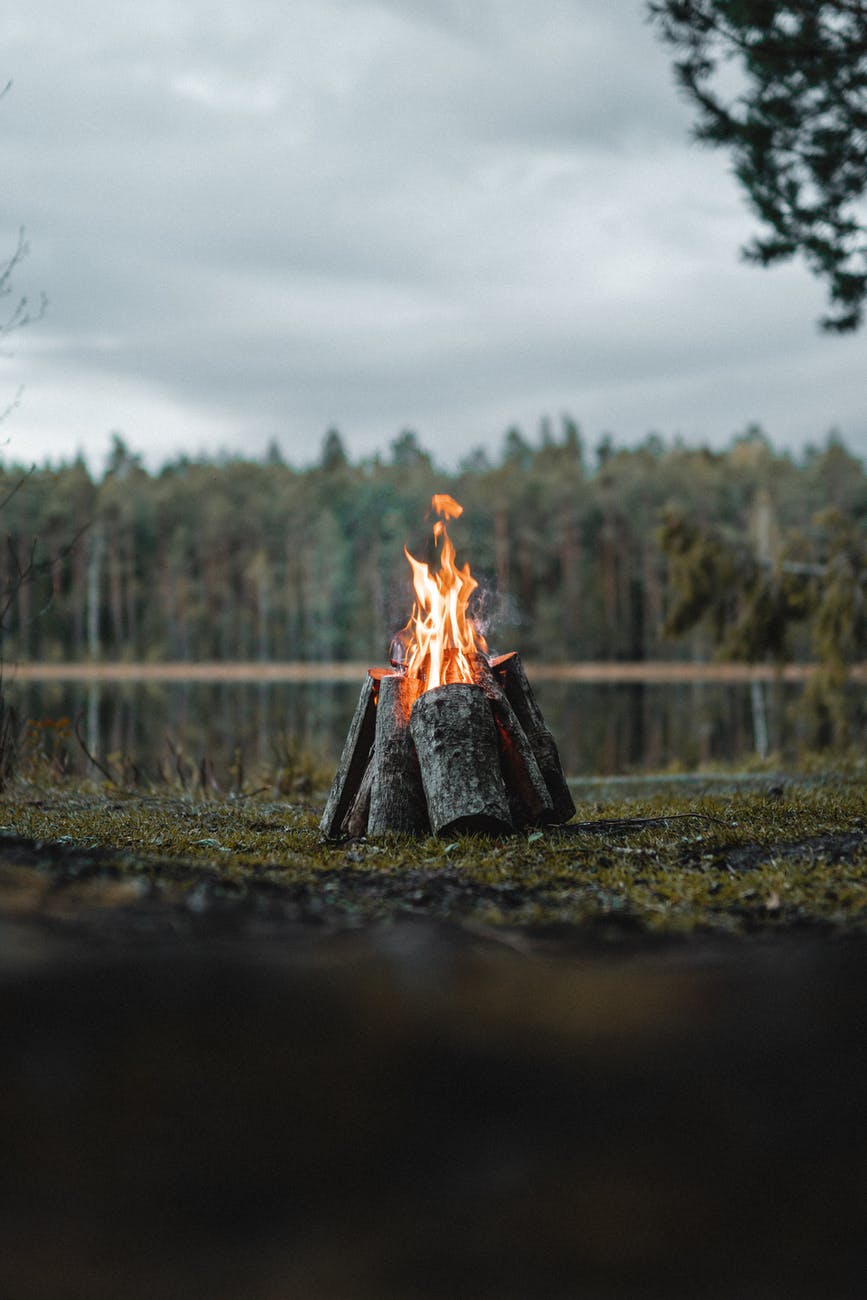
Featured Art: Bonfire on Green Grass Field by Gantas Vaičiulėnas
I can’t promise you I know how to sit across from a man, as he lights his campfire heart, without letting it warm me. And I won’t pour water over it before it glows down to embers in the lambent hours of the morning. As shadow flames sashay across my face, I might throw in the branches I’ve gathered from my forest. Make it blaze.
Featured Art: Colorful carpets hanging on wall by Meruyert Gonullu
The Lucky store a few towns over is going out of business. That doesn’t seem so lucky to me. Every year, my husband and I hit their After Christmas sale. We try on jeans with zippers that tell us— Lucky You! when the teeth unclench. I once got a sweater with LUCKY that stretched across my breasts. We pile clothes in dressing rooms facing each other. Yay or Nay outfits. With conjugal knowledge, we are ruthlessly honest. Whoever finishes first takes a seat and watches the other model consider and reconsider. The other day, a woman I barely know told me how much she loves my husband, the way he always refers to our life experiences with “we.” We have decided. We went there. We bought that. She tells me how lucky I am. When my husband and I leave the store, we clutch shopping bags, we are satiated. Sometimes we hold hands, if we have one free.
When he read it out loud in the small orange basement on the street lined with old trees that fell too early in storms, the wind lost its breath, the molten core of the earth slowed slightly, and someone poured a Slurpee down at the 7-Eleven. It might have been just a poem meant for the whole group, who all playfully fanned themselves and over-swooned after he’d lipped the last word— but she sat knowing that everything she’d done had brought her to this beige suede basement couch to hear, to embody, to take these words and press them into her—first shaking, but later softly and with more force. Until they walked, ran, and flew with her. So when she rose above that suburban town, its baseball fields and slate-gray schools, on the days when the screaming and demands and the mac-n-cheese dinners became too much, they would be with her. He would be with her, whether she wanted him or not.
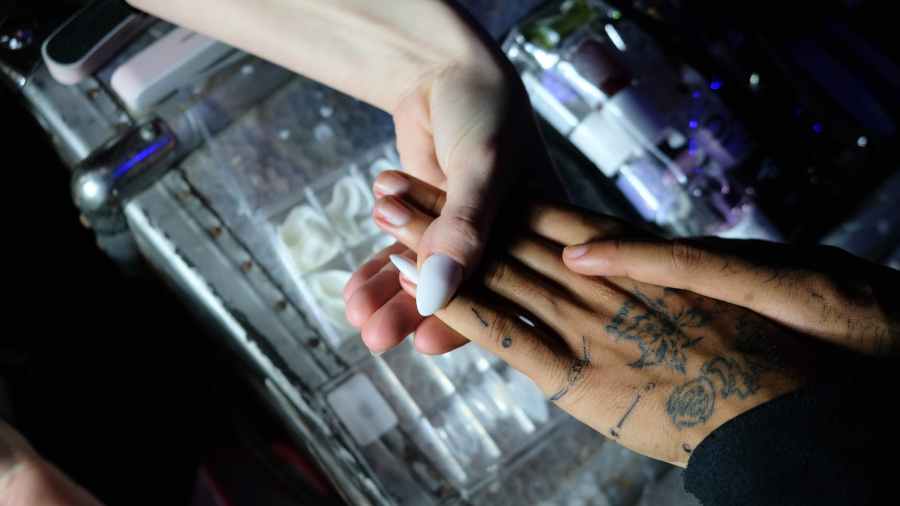
Featured Art: Female making manicure to ethnic woman with tattoos by Skylar Kang
See how I clasp it to me, thunderclap my way through. Oh constant invisible, oh emperor of the unruly, tell me— do I consume you or you me? Downcast, you stain me indigo but I love the blues—lapis lazuli and Billie Holiday and the neon tetra’s iridescence—is it biology?— I the algae, you my luminescence? But no, that’s too much— a fleshless excuse for excess. Hyper heart, you tattoo me, every inch of skin inked, but you are not indelible— see how I embrace the pleasure of erasure, the fleeting this, then this, the smudge and blur, the quickening pulse of swerve, of word, the veiled, the reviled, the revealed. And so, lost song of nightingale, swoop of lark, you are the ghosts of night, the smidgen of hope, the low-hanging, the high-flying— my wisteria, my hysteria, my gilt-edged book, my glint in the dark.
Their fights had always been drawn-out and passionate, thrilling in their possibility. The subjects of their arguments ran the gamut; Malcolm and Clare could employ almost anything as flint to spark the heat between them, setting their hearts leaping and their sharp tongues running wild: the empty soda can rolling around the Subaru, the knife marks grooved in the laminate countertop, the lack of remaining hot water in the morning, or that time, years ago, when the dog bowl had been left dry on a sultry day. The rhythm to their relationship was marked by peaks of tension, a pulse that proved their marriage was still alive—unlike those of some of their friends, whose flatlined politeness was so painfully false, resentment straining up beneath pert compliments and cute smiles. Malcolm and Clare were authentically in love, four years married and still willing to weather the turbulence of melding two lives together. Yet it was also true their latest fights seemed rote, their jibes more personal. The cause was lack of material, Clare felt. She blamed their unchanging surroundings.
“Your manner of blinking,” she said, interrupting Malcolm as he sat reading the golf report in his favorite recliner one February morning. “It’s bothersome.”
He glanced up, eyes fluttering, bewildered. “Excuse me?”
Clare set her turmeric milk on the coffee table. “There’s some kind of stutter to the way you blink.” She flicked her fingers off her thumb in two short bursts. “Like this,” she said. “I’m not sure you’re aware. It’s making me anxious.”
Clare spoke from her heart—she was genuinely bothered by Malcolm’s mannerisms, more so with each passing day. He’d developed a habit of repeatedly clearing his throat in the mornings that made her grab fistfuls of her dark hair and pull until her scalp felt strained. Just last week she’d noticed new strands of gray growing in along her part.
“I see,” Malcolm said. He creased the paper, eyes now flat and focused, strained wide.
Clare didn’t want this—she didn’t want him to suffer.
Featured Art: Faceless ballerina resting on floor with shade by Khoa Võ
Next to the Lost and Found, our church basement folding chair circle. Ten of us, week to week, scratch words in workbooks, read copies of How to Survive the Loss of a Love.
We pass or fail stages of grief. Video clips from the other side: a smiling blonde manages her checking account, living debt-free; gray men navigate dating and children.
Stories cycle in Share Time: Billy the missionary served 25 years with Kazakhstani orphans— one day, home on furlough, his wife drove to Walmart, never returned.
Dan’s wife ran off with the superintendent, and Sharon’s husband left her at Denny’s eating Moons Over My Hammy. She hasn’t had an egg since. I don’t know why, they said. Blame always a stick to be thrown.
Not your fault, we agreed. But maybe the fault was mine, the unsupportive wife, the wastrel. I drove 1700 miles, and still his voice, obscured by barroom backnoise,
Insufferable woman, come home. Each week I shift seats on the circle’s farthest curve. I’ve lost the knack for talking, afraid the other eyes will shinny up my face then flick away.
At Trader Joe’s, before group, while cashiers flip French bread into paper bags like a magic trick, I practice words. How to say I’ve left him, that he was mean to me. So I will be believed.
My sister says I greeted the swarm along the backyard slope, crawling, fat mouth slack, sodden Pampers saggy with supplication. Evidently, she scooped me up while they chased us through our father’s lavender azaleas where he dropped his shears and smashed yellow jackets against my skin, yanking off the diaper and waving it around his head like a lasso. We won’t get spanked again until winter. Everyone watches my sister declaim the tragic tale at family gatherings for decades as if she’s Dame Judi Dench. They love her nuanced performance, the lively hand gestures and operatic voice, how she tousles my hair before her triumphant finale: I got stung on my mouth, but he got stung in his asshole! I’m always grateful Dad isn’t here to witness this, or my marriage, or my career, or my incompetent gardening, the limp cosmos. I can’t believe you, a cousin smiles, shaking his head. Me neither, I reply. I don’t even know what I did.
Featured Art: Light Inside Library by Janko Ferlic
it will be the day after our fifteenth anniversary
we started late, so we were already middle-aged at the start so after fifteen years we’ll be what others call old
we will have lasted a solid fourteen years, ten months, and most of a day longer than I expected and so for fourteen years, ten months, and most of a day I’ll have been confused by our continuing existence
how will you go through fifteen years and most of a day without realising what a fuck-up I am?
during that time you’ll have been to more book launches than you ever expected you would, and since you never thought you’d ever be at a book launch your showing up at each of them will be a personal gift; you loiter at the back of the room with a bottle of whatever cold beer is your current choice, maybe Heineken that day; you don’t say much to the other people there, you sit quietly through the post-launch celebratory dinners when I’m buzzed and hyper or exhausted and freaked out and we hold hands under the table; once we get home we strip down and have sex and you still look at me like I’m the best thing you’ve ever seen
I won’t watch a single rugby game but I ask who won and if the All Blacks did alright, if it was a good game, and you give me your thoughts in a surprisingly detailed yet concise analysis because you know this shit bores me and from time to time I even remember one of the players’ names and you smile at me like you would a child trying to show off their knowledge of the alphabet despite always misplacing the q
we still live in separate houses because I’m smart enough to have figured out that living with someone isn’t something I can cope with; we spend time at each other’s homes but more at yours, even though your kids hate it when they drop by unannounced and we’re naked on the kitchen floor or I’m sucking you in the living room or you’re going down on me on the dining table
so your kids always knock on the door, loudly, then wait fifteen seconds before walking in
Featured Art: Children Playing on the Beach (1884) by Mary Cassatt
As I get you down from the closet shelf and unwrap the brown shipping paper to the square white box inside I lift the lid for the first time and stick my fingers deep inside you / What does she feel like Barbara says and I say go on see for yourself but she shushes me and leads the way out back to where the creek used to run and we just do it quickly without any words because words are a foolish way of asking forgiveness for these five years we’ve left you up there stacked amid the empty shoe boxes and children’s playthings / But now with both hands I swing the box like sand in a pail and scatter you into the overhead cave of the old Judas tree where your tiny parts glow for a flickering moment like early snow / And Barbara whispers yes Patsy I know still trying to find your way home again just like the whole rest of your life without somebody’s arm to hold on to
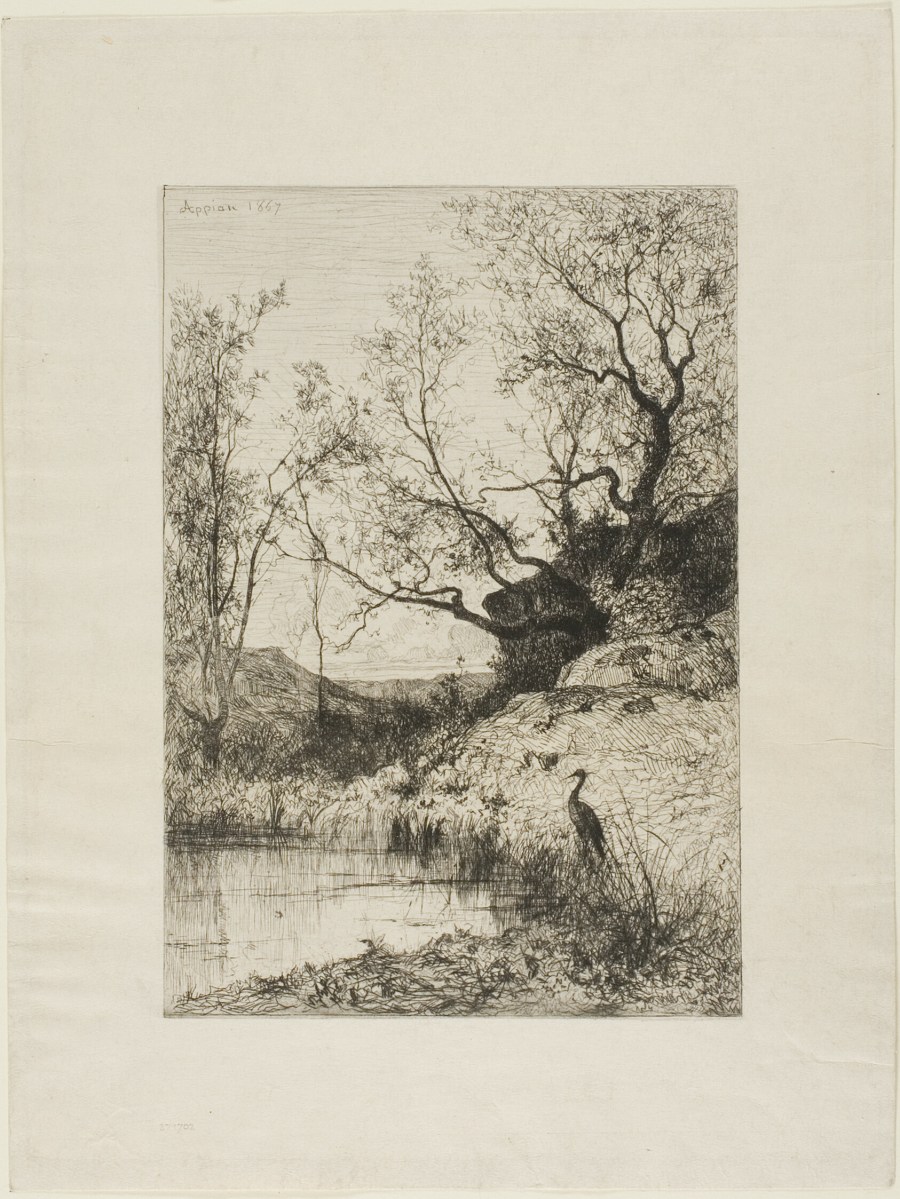
Featured Art: A Pond Near Rousillon by Adolphe Appian
it glows in frozen streaks each of its feathered limbs curved gently upward and i find myself pausing at the edge of the drive to stand very still in the needles of rain as if anchored here too stretching my arms overhead like some arthritic unpainted mime not because i need to make a statement about anything just that every now and then like the silent unfolding wings of the tree something stirs within me trying to say it believes
Featured Art: Green Fish About to Eat the Fish Hook Wall Art by The Lazy Artist Gallery
William Merritt Chase painted numerous versions of fish still lifes, many of which were quickly purchased by museums across the country. Because of the popularity of these works, the artist worried that he would be remembered only “as a painter of fish.” —placard, Art Institute of Chicago
The real thing rots. Corrupts, Decays, time-lapses, hollow to holes.
But yours—immortal, silver-scaled, so round— (Why should its roundness be wrenching?)
Realer than the real.
You were afraid this was what they’d remember you for. Afraid—as if there were somehow more than this.
Here one sees, forever, how it could fill the hand— How it would feel, filling one’s hand.
By Susan Finch Winner, Editors’ Prize in Prose: selected by Mandy Berman
Featured Art: Woman in Silver V-neck Long-sleeved Dress by Inga Seliverstova
As bachelorettes, we solemnly promise the next forty-eight hours will include three brunches, two happy hours, fifteen moderate disagreements, one unforgettable fight, eight matching T-shirts, one bar crawl, one pedal tavern, one sprained wrist, three twisted ankles, sixteen hangovers, too many tearful promises to count, and one sober regret. We are the bachelorettes and we insist.
We must begin with brunch, and in order to fit three brunches into forty-eight hours, we will congregate Friday morning. After all, brunch is the most important meal of the day. We can eat French toast and French fries, and getting tipsy or emotional (i.e., Lydia has too many feelings after bottomless mimosas) will not be frowned upon. Not every restaurant serves brunch on Friday, so we must select carefully, find a place that has an all-day breakfast menu, and really, why shouldn’t a restaurant serve breakfast food all day. It’s not so hard to whip up a couple of poached eggs, is it? We will reserve the table for 10:30; the proper time to eat brunch is 11, but we already know that some of our bachelorettes will be late—particularly Tara, the bride’s sister. She’s a musician and runs on her own schedule, and of course, Felicia. She hasn’t been able to get anywhere on time since the new baby.
Event attire is outlined in the invitation—brunches are for sundresses or rompers paired with cute cowboy boots or wedge sandals. We do not do flats—flats are for business casual events or maybe if you’re trying to let someone down easy. Matching T-shirts will be provided for the pedal tavern that begins promptly at four. The shirts may be knotted at your hip or tucked in with a cute belt, but please do not leave your shirt untucked. Evening wear will have two themes: Friday red and Saturday sparkle, and the bride, of course, will wear white. No one else should plan to wear white or anything white adjacent —no cream, no ivory, no pearl, no silver, no soft grays, no misty light blues or sugary beige. Don’t pack it. Don’t even think about it. We don’t want anyone to steal the bride’s thunder. After all, we are the bachelorettes, and it is our job to insist.
By George Bilgere Winner, Editors’ Prize in Poetry: selected by J. Allyn Rosser
Featured Art: Mounted Model of a Polar Bearfrom United States National Museum Photographic Laboratory
A father died heroically in some Alaskan park while trying to save his kids from a polar bear.
Long ago, when his mother gave birth one summer afternoon in Bakersfield, California, could anyone have prophesied, as in an old myth, that the baby crying at her breast would one day be killed and partially eaten by a polar bear?
Has anyone from Bakersfield, California been killed and partially eaten by a polar bear? Yet her son was. He looked up from making camp, pitching the tent or lighting his Coleman stove, and there it was, white and immense. His fate.
And he died heroically and was partially eaten.
Of course, the bear had to be killed. The rangers shot it, which makes sense. You can’t have polar bears running around in the wilderness! The wilderness is a place for dads and kids and Coleman stoves. Polar bears just . . . they just kind of ruin the whole thing.
As for the bear, it didn’t die heroically. It just got shot and fell over and was sent to a lab for testing.
My son slipped on the concrete by the pool and smacked his head. Blood cauling on his small shoulders. The doctor stitching him whole. Three years on, after a haircut, the scar still rises, a quarter moon a woman will ask about as they lie there one night, her fingers in his hair, her voice in his ear, the secret delight of him—a bit like burnt toast—in her nostrils as she takes his strangeness into her. What she won’t know is how the frail, Phidian skull I held that day in my hands resounded on the hot concrete. It echoed all summer, less like an egg cracking in a bowl, or a world breaking, than the wild knocking of love against my heart. Dear girl who will one day win him, that part of the boy is mine.
Featured Art: Scott Catalogue USA PC7 from National Postal Museum
A half-eaten waffle, syrup-logged in a plastic takeout container, dropped in the middle of the street. Bald man in a blue truck slows down, cranes his head out the window to get a closer look. Suited folk
coming home from church swerve. It’s finally cool enough, after 37 days of dry heat, to turn off the air conditioning, open windows. Hooting and hollering from the apartments as someone on TV scores a touchdown.
Last night a friend came over. She has 16 pets, most of them rescue animals: dogs, cats, rabbits, and ducks. She installed a heated pond in a spare bedroom. She’s worried about how to transport them when she moves to Maine as a climate refugee.
A grandmother and grandkids carrying leftovers in Styrofoam walk past the waffle. Dark feathers brush across the storm-swift sky. A car drives over it, wheels straddling the soggy breakfast. Something exciting happens in the game:
Yeah! Then clapping. My friend with 16 pets has no hope life on earth will get better. If you think we have an immigration crisis now, wait until Mumbai is uninhabitable, she says. Everyone on the planet is moving to Canada.
I think of a fable where a rich man buries a bag of gold in the middle of the road and covers it with a boulder. Then he watches. Some people are angry. Some ignore it and walk around it. Only one boy
thinks to move the stone. My friend thinks that by 2050 the high desert will be too hot to survive. We’ll run out of water. She thinks we are hurtling ourselves out of the habitable zone. But I think of pyramids and vaccines and walking on the moon.
Humans adapt. Imagine, all of us trying to fit in the northernmost region of North America. She thinks it’s impossible because the rich are already buying up all the land and building homes there.
A girl in a striped shirt and red pants walks a dog with an upcurled toffee-colored tail. The dog stops to sniff as thunder growls across the valley. Four teenagers on bicycles. Another couple with three dogs, hair and fur rising
in gusts. Wind rhythms the chimes, thunder drums closer and the first sweet slaps of rain hit burnt tips of leaves, brown grass, dried lily stalks. Smell of wet cement. Soon, a miniature river bounces in the gutter.
Clatter of rain drowns out the game. A neighbor checking his mail—leopard-print kimono sticking to his long legs, arms waving wildly to shoo the storm, yelling out as if in pain— bends to pick up the waffle. Raindrops plinking like millions of silver coins.
Upon a hill, a house. Upon the house, a roof. On the roof, a bird. The bird— oiled feathers, beak like an awl—grooms the roof’s moss, subsists on ticks and silverfish. Inside the house, a man without a tongue and a woman who loves him. The woman grooms the house, subsists on potatoes and rice and whatever rodents roam the slope. The man hunts every day until noon. Every day he returns empty-handed, his shoulders tense as flywheels, his jaw the floor of a collapsed cave, crowded with everything he cannot say. She brews his tea. She washes the corners of the house. She chases the bird away. At sundown the man leaves again, hunting. Upon another hill, another house. Another woman waits inside. The man without a tongue feasts on rabbit she trapped in a pit. From fireplace ashes she makes lye and scrubs his back. She fills his canteen with it. By the time her sister misses him, his body has sunk to the bottom of the pond.
By Tania De Rozario Winner, New Ohio Review Nonfiction Contest: selected by Ira Sukrungruang
Featured Art: The Last Supper By H. Siddons Mowbray
1993. That’s when it happens. Two months after your twelfth birthday. It’s a sweaty afternoon. This day which blisters with possibility. This day you learn that there are demons inside of you.
You’re on your way home from school. You know something is wrong the minute you get off the bus. Your mother waits at the bus stop, teary-eyed. Your relationship has grown monosyllabic, but the tears feel like a warning, so you ask.
What’s wrong?
It is when she smiles that something inside you unravels. You realize hers are happy tears. But her smile is vacant. Placid. A Stepford Wives smile. The tears fall but there is nothing behind them. She’s a mannequin crying on command. A talking-doll with electronics scrambled.
You don’t have the language for this yet.
She grabs you, holds you tight: Nana has been saved!
Featured Art: Jesus Christ, the Virgin and St. John the Baptist with Saints Paul and Catherine, ca. 1520 designed by Raphael, printed by Marc Antonio Raimondi
I was eighty-two again and Jesus came perched like an angel on top of my fridge, his palms spread open.
Almost old enough to be comfortable going, I wondered if he had come to take me. “Are you here for me?” I asked him.
I was eighty-two and my eyesight was dimming, but I was in good health for my age. And in my good health
I saw how lovely Jesus was, how physically lovely, and I felt like kissing his stomach. Not even where it was whipped
or wounded, or where the vinegar dripped onto it as it overflowed from the taunting sponge, but just
his belly, carefully haired, divinely flat and strong and hungry and disciplined. May I May I May I, I prayed,
and when finally he said I could I pulled the stepladder out from under the sink and gathered myself on top of it.
Then I kissed the stomach of Jesus. It tasted like the steam that arises from dry ice. I kept the wind at bay,
but it was difficult to do so, what with the howling just then picking up and all.
I am two vowels strung twenty years long. My life a ransom letter written by a cardiogram, tympanic as traffic & the lights of traffic
that renew the tercets of Esso stations standing violent as macaws in the ululative night. I need lithium or language, nurse.
I need words to fall like ricin from an envelope. Clearly, my synapses need seeing to. So, please, repo the verb of me.
Conduct me swiftly through the conjunction of Tennessee where nouns loiter like limbs languid with Quaaludes, where daylight breaks
like a mouthful of fentanyl over the teeth of a country that cares not for such news. Should a poem be the pill or the pharmacy?
Should I pledge myself to this business as if it were Gerard Manley Hopkins or Jesus Christ? Here I am, Lord, earnest as a rice cooker, lively as Superman
in his leotard, my spiritual fizz empirical as Pepsi & just as cheap. Jesus, Gerard— who will irrigate these ears from error?
Who will whisper that in the empire of swans the black cygnet is Elvis? All around me the malady of my unmaking
unmans me: roadside trash, unrecycled recyclables, my shadow laid like a new suit over the bus bench & birds behind it. All this urban tumbleweed,
all these words for worse. When whoever’s kingdom it is comes calling for it will the last televangelist of grammar go angled like an angel in the direction
of their god? Or will America just eat my opioids as it like Nemo poisons its seas to peace?
When I was a verb I thought as a verb so I did as a verb, just like the police. Tonight the moon slouches in its straitjacket of stars. There’s a multinational
wind afoot, some merry beast loose, all pronoun without surcease. What rooky woods will it rouse first? What islands will it make of our bodies yet?
We live in green depths of trees planted by those who grew old and died or moved away our children play in yards theirs left behind and sleep in rooms that held two or even three until they grew our children too are growing in summer we box outgrown clothes repaint the walls new tiles for the bath new shingles the trees don’t seem to change though of course they must the backyard beech and oaks that will outlast us casting a deeper shade the front yard holly reaching farther over the drive we pull in and out of always in a rush someone running back for what they forgot the trees keep some other kind of time spend whole seasons taking in their sustenance strange food without substance every summer a feast of light



















 New Ohio Review