Newohioreview.org is archiving previous editions as they originally appeared. We are pairing the pieces with curated art work, as well as select audio recordings. In collaboration with our past contributors, we are happy to (re)-present this outstanding work.
First we come to the field where I did not hit the winning home run, where no cheers rose up and the game ball went ungiven
Beyond left field, the bleachers where I did not make out with my high-school crush, did not taste her perfume or dodge her brother’s freckled glare
This is the house where a family of color did not live, there, where that guy is hosing Chinese menus off his car
Then of course this tax attorney’s office, once the bookstore where I stole Helter Skelter, which I still visit in my dreams
Finally, this empty lot staring up at the sun like a vast gravel eye, formerly the school where I never thought to imagine a future, where no one told me and I did not listen
that life could be a wave beating the rocks or
a wind bouncing a kite—
taut string pinwheels, dips and swoops groundward only to right itself, to stay resolutely in the air
He’d wanted the persimmons and asked her for them, but when she gave him the brown paper bag, brimming over, he was taken aback. Did he really need that many? Still, he brought them home to his wife, and soon there were persimmons ripening on the kitchen counters, lining the windowsills. Each day, growing more and more succulent until the air was thick and sweet with their scent. At breakfast, he’d break one open with his spoon—the skin supple and ready to give—stir it into his hot cereal. Indescribable, the taste. And a texture he might have described as sea creature meets manna from heaven. When he ate one, he thought of her. And when he saw her, he thought of the persimmons. When her arm brushed, just barely, against his, did he imagine they both felt the same quickening? In myth, fruit is usually the beginning of disaster. And the way they made themselves so obvious— an almost audible orange against the white walls— made him wish he’d never asked her for them, didn’t have to smell them sugaring the air with ruin, as he sat there, face lowered to the bowl, spooning the soft pulp into his mouth.
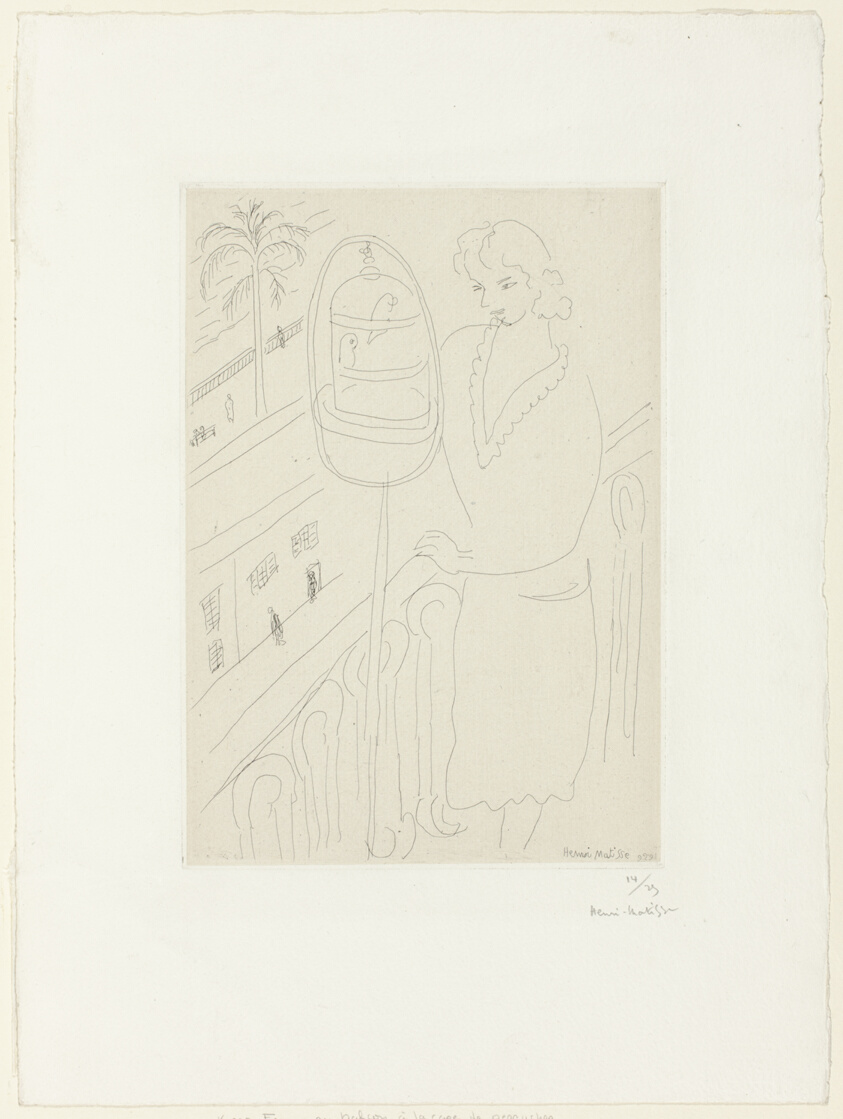
Featured Art: Young Woman on a Balcony Looking at Parakeets by Henri Matisse
We were sitting on the couch in the dark talking about first pets, when I told him how, as a girl, I kept a blue and white parakeet I let y around the house and, sometimes, outside, where he’d land on the branches of pine and eucalyptus, balancing between seedpods and spines. Only, while I was telling it, my companion began to stroke, very lightly, the indent of my palm, the way you do when you’re sitting in the dark with someone you’ve never kissed but have thought about kissing. And I told him how my bird would sit on a high branch and sing, loudly, at the wonder of it—the whole, green world— while he traced the inside of my arm with his fingers, opening another world of greenery and vines, twisting toward the sun. I loved that bird for his singing, and also for the way his small body, lifted skyward, made my life larger. And then it was lip-to-lip, a bramble, and it was hard to say who was who— thumb to cheek to chest. The whole ravening. When I told him I did not clip my bird’s wings, I was talking about hunger. When he pressed me hard against the back of the couch, named a litany of things he’d do to me, I wanted them all. I, too, have loved to live in a body. To feel the way it lifts up the octaves of sky, cells spiraling through smoke and mist, cumulus and stratus, into that wild blue. And though I knew there was always a hawk somewhere in the shadows ready to snatch his heart in its claws, still, I couldn’t help letting that parakeet free.
For a while it seemed one thing could be righted. One small piece at the ocean’s bottom corner or the bottom dresser drawer with the scuffed baby shoes and shoeboxes full of snapshots of kid parties, holidays, school picnics etcetera.
A comfort, even knowing that wrong can’t be undone, is more like oceans plural rushing in weighing in with their trick of no light, unfathomable.
The idea was to inscribe the back of the photograph taken on our last anniversary. Simply to write, in everyday permanent ink his name in the possessive then “Mom and Dad.”
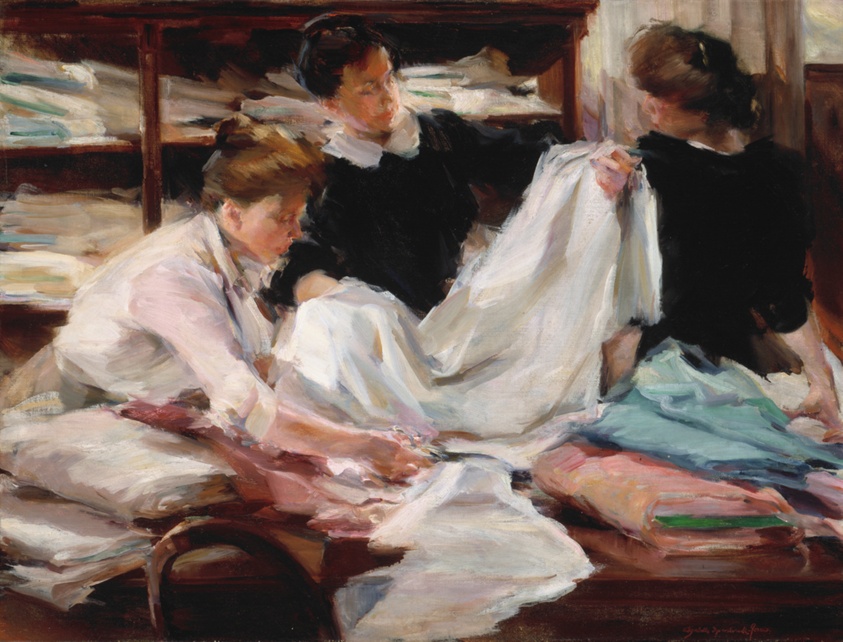
Featured Art: Shop Girls by Elizabeth Sparhawk-Jones
What if you haven’t enjoyed dating for a while? You’re tired of sharing pieces of your life story with men in crowded restaurants all over the city who you know within five minutes you won’t want to see again? What if you get too excited when you find a guy you like at a holiday party? Becoming very forward while wearing a Snoopy Christmas sweater, because you believe it’s your power-outfit and you only have a three-week window to rock it? What if you’re having fun on a date swapping embarrassing stories and then somehow you’re outside the bar and he’s shaking your hand saying it was nice to meet you, and you realize that you’re actually in an embarrassing story? It’s happening to you right now. What if everyone keeps acting like this is simple? You’ll only find love when you’re not looking! To find love, you have to put yourself out there! And you don’t want to be dramatic about it, but some days your heart feels like an ambulance stuck in traffic. What if you keep trying everything and nothing? And when you look up at the sky and spot a perfect hole-punched moon you want to tell someone that, if they hurry, they can see it completely, all that brightness at once.
Featured Art: Landscape with Two Poplars by Vasily Kandinsky
Did you have any fun? Tell me. What did you do?”
—from The Cat in the Hat, by Dr. Seuss
Never speak aloud the thing that first pops into your head, pops like a balloon, black, bursting in a shock, pops like your bubble burst, pops like a blister of blood, a BB gun at a bird, a red blot on a white backdrop, thought precedent to mismatched utterance precedent to the stare, the crash into
silence, the inevitable turning away as you stand there (again) staring into your wine glass and facing newly open space
between yourself and a back. Never speak to strangers, never say that first thing
(defined as material object without life or consciousness; as inanimate object; as cannot be precisely described) thing thing thing
no matter how often you say it, nothing comes to mind except Dr. Seuss creatures cursed with dumb grins and bad hair and toys that crack walls and priceless heirlooms now look what you’ve done and though they meant no harm harm they did and ruined everything
and they are the only specific things you can conjure but you should definitely never speak of Thing One or Thing Two, much less their leader who should not be about
much much less that first BUMP of a thing that popped
into your own social klutz of a mind, that perpetual source of embarrassment, that maladroit blundering thing.
Sometimes I talk too much. I tell myself it’s good to socialize so I say almost anything to get the conversation going, something like “What’s your favorite crime film?” or “The media really needs to tone it down.” Then we’re off and talking about what kind of dog to get or whether garlic belongs in guacamole. I might not know the person I’m talking to but we can work that out on the fly like rolling a car down a hill to get it started but what if it has no brakes? Sometimes that happens and you have to steer away from the river rushing over the black rocks and turn onto the lane that snakes through the trees beside the reservoir and I’m still talking trying to get a sense of this person who tells me about her grade school and the re drill that turned out to be real but no one knew until years later and in the room below the gymnasium was a wallet-sized photo of a woman who went missing and I wonder whether the person telling me this is the person in the photo or if there ever was a photo how would I know? Then I’m telling a story I’ve told many times but it’s going to be good this time with the part about the voices on the dunes and the man waving from the other shore and I realize the person I’m talking to reminds me of the girl I went to camp with but can hardly remember except for the birthmark and that night I heard her crying in the tent while everyone slept. She seemed fine the next day and I don’t mention any of this but I wonder how my story has changed over time. You’d think I would know but I don’t. Anyway, I’m still on the road that snakes through the trees. Here comes a tunnel.
I first heard his name in passing. Someone was rinsing coffee from a spoon, saying, “That’s just how Merriweather is . . .” I was new to the city. I was emailing my CV around and smiling politely at new faces. I noticed that people really deferred to this Merriweather—his first name? A man I met at a potluck had camped with Merriweather in Patagonia. Merriweather had gotten him and his friends out of a jam when the stove gas ran low and a sharp sleet hemmed them in for days. Another guy explained that Merriweather had secured for him and his fiancée a cherry farm where they could have the wedding they’d dreamt of. Merriweather’s band played, and his bass solos shook bits of hay from the dusty catwalk. People danced and cried out to Merriweather for more, then laughed as a bale tumbled from the loft, just missing the sweat-drenched drummer. Couples snuck off to the guest cabins, and a young woman claimed the pomegranate punch tasted like starlight. A boy found a silver dollar on the freshly laid macadam. Merriweather’s band debuted a Sam & Dave tune they’d rearranged so that people looked at each other like What the fuck, how can they be this good? During the break, Merriweather spoke to a woman about her father’s death. She was moved by how closely he listened, and by the questions he asked that showed he understood. She inquired whether Merriweather was married. No one knew. Someone had glimpsed him at the wharf with a much younger woman. The two stared across the bay toward Bronson Island where wild boar still roam and clusters of purple lichen hang from the limbs of the vast spidery trees that vivisect the tarnished sunlight. Tears filled Merriweather’s eyes and the unreal eyes of the young woman beside him.
Featured Art: Under the Lamp, c. 1882 by Mary Cassatt
It’s made to make you glad on dull cold days, keep you from crying over car insurance, made to stop the visions of flogging your flesh with barbed wire, gouges gone rust-brown, swelling with tetanus. Full spectrum, mock sun; maybe it helps. At least it makes nothing any worse. Until you realize there’s pressure. Even the lamp is anxious as a border collie, wanting work and reassurance. Leave it on while you go to lunch and afterward its white radiance is trembly. It whispers, I shone and shone and no one came, no one saw. Aren’t I bright enough? Are you glad now? And you don’t know what to say. Its light quivers like unfallen tears. You sit still, regarding the light like a dangerous lunatic, like you’ve never heard of barbed wire, trying to look happy.
I was sent a how-to-carve-a-whistle book. I thought of whistles. I thought of carving. I bought a whistle-carving kit. I stuffed tobacco in my pipe and sparked it. I opened a buck knife, put a willow stick in my lap. I carved a whistle. I blew. I tossed it in the fire and looked at the flames. I carved another whistle, then another. I carved nineteen whistles, the ground strewn with chips. I carved the last one to sound a quarter-step above high C, a tone only I and my soulmate could hear. I blew it every morning, then listened. I heard soulmates blow back from their graves. I heard whistles from the Mariana Trench. I heard them sound from Pluto’s moon. I blew the other day, but no one blew back. I blew louder. Still, no reply. I filled my lungs with all the air of the garden. I blew the loudest. And nothing. Only the neighbor calling if I could keep it down.
It wasn’t the voice that woke me, but the jolt of the trailer. It was Dad. He’d lurched out of bed. Fumbled upright as if in a dream, as if he’d skippered a boat upside a pier in the dark, struck a piling and—pow—off the pitch of the deck and onto the dock he stumbles.
Not that the camper was what you’d call terra firma. Less like a home on wheels and more like a traveling dollhouse, everything pretending to be more than it really was—parlor the size of a bathroom, bathroom the size of a fridge, fridge the size of a toaster, toaster the hearth around which we’d huddle when the rain shattered and the dark thickened and the cold rose up to stab us in the ankles. The Cookie Tin’s what Mom called the trailer. Dad and Mom in the fold-out bed at the back, at the foot of which you got a curdle of flannel, Ben-Ben, not a toddler anymore but still squat enough (Tater-Tot we called him) to wedge in cross-wise. Up top of that the rack for Cece—canvas on a pair of poles, like a stretcher. Down below a carpet runner rolling out a luxurious four feet to the front-end boudoir—Len and me bull-dozed into the same bed together, head-to-toe across a table-top that, every morning at eight, we’d pop back up into place.
Oh. And Sal. Little Miss Bon-bon. Seems like the second a girl gets a couple of—what would be the polite word for it?—bosoms—you got the whole damn troposphere torqueing up to accommodate the blessed event. The VW van should’ve been for Len and me but no, Sal’s gotta have her privacy, her womanly solicitude, as if a girl who burns a whole afternoon spot-welding a girder of curls into a confectionary (what would be the word?) spectacle could give a damn about privacy.
Written on the side of a payphone lashed to the wall of the bathroom in a Montreal café is Annie Oakley’s telephone number. I see it while I’m peeing. That’s how close the payphone is. Annie Oakley in black marker and then her number. I’ve only touched a gun once. Or maybe I didn’t touch it, I just thought about touching it and then said, No, thank you. It was my father’s gun. It was small, perfect for fitting into a lady’s hand. Is that called a .38 Special? Annie Oakley would know. I didn’t grow up with guns. I didn’t grow up with my father. People sometimes think that is a great tragedy. I did grow up near a little lake, beside which lived two goats and a horse. In spring and summer I would walk with my sisters the dirt trail overlooking the mountain to the gravel path to the stables. If the goats were out, we’d pass them cabbage through the fence. Back then I thought the greatest tragedy was August ending or my eighth-grade crush dumping me for a girl with nearly my same name. I’ve always had trouble locating the appropriate level of sadness about the father thing. I’m not saying it doesn’t register. I’ve just known from a young age there was nothing to do about it. Here is me. Here is my father. The distance between us could be as close as me to this payphone or as far as the mountain felt from the lake. Either way it changes things. Either way it’s done. Annie Oakley shot a squirrel’s head clean off at age eight. It was her first shot. Here is me, I hear her saying. Here is the squirrel. Right through the head or right through the thigh or right through the gut. Either way it’s done.
It’s ’68. Whatever he saw, whatever he smelt In that smoky, dripping handful of purple entrails Just thawing out from the freezer, the news from Athens
Was ominous, and he wouldn’t haruspicate On how and when the Colonels might react— But the gobbets of offal keep piling up in the pail.
It’s not that he fully trusted the lordly voice Of the BBC, but hearing Vietnam He drops what he’s doing, and cranking up the volume
On that crackly plastic Panasonic— That’s when I hear it too: Khe Sanh. It’s what Comes through the speaker’s throbbing bamboo mesh
As I’m stamping prices on jars of baby food: A staticky hiss like burning jungle grass . . . My father wiping his hands on his butcher’s apron,
Oblivious to his customers as he listens To a transistor radio broadcast the blood Of a world in shambles. And then he’s back at his block.
Khe Sanh. My older cousins, Kosta and Jimmy, Are loading up the van they’ll drive around Winthrop, Delivering groceries and checking out girls.
I’m stamping the little glass jars of applesauce. Nobody knows whose number will come up. But our Calchas isn’t taking any chances.
Already he’s built another hecatomb, And now he’s scrutinizing some gristly turkey Intestines unfurling for all I know like the coils
Of giant lianas he saw in Guadalcanal As a young recruit. But through that throbbing bamboo Mesh I hear the Hydra’s serpentine hiss
He heard as a village boy way up in the Peloponnese.
They’re so meticulous, aren’t they? They take such care that I am ashamed for my country, that impatient farm boy, that factory hand with the sausage fingers. First there’s the fragile object itself—vase, jewel, ornament—then tissue, stiff paper, bubble wrap, tissue again, tape, a beautiful bag made from something more like gift wrap than the stern brown stuff we use here in the States, then the actual carry bag
that has a little string handle but which is, in many ways, the loveliest part of the package except for the object you can barely remember, it’s been so long since you’ve seen it. In America, we just drop your trinket in a sack and hand it to you. Oh, that’s right. We have cars in this country: whereas Stefano or Nathalie has to elbow his or her way down a crowded street and take the bus or subway,
you get in the car, put the bag on the seat next to you, and off you go, back to your bungalow in Centralia or Eau Claire. Of course, this doesn’t mean you’re culturally inferior to Jacques or Magdalena just because, as Henry James said in his book-length essay on Hawthorne, we have no sovereign in our country, no court, no aristocracy, no high church, no palaces or castles or manors, no thatched cottages,
no ivied ruins. No, we just do things differently here: whereas Pedro and Ilsa take the tram or trolley, you have your car, and now you’re on your way home to Sheboygan or Dearborn, probably daydreaming as you turn the wheel, no more aware of your surroundings than 53-year-old Michael Stepien was in 2006 when he was walking home after work in Pittsburgh, which
is when a teenager robbed him and shot him in the head, and as Mr. Stepien lay dying, his family decided “to accept the inevitable,” said his daughter Jeni, and donate his heart to one Arthur Thomas of Lawrenceville, NJ, who was within days of dying. That’s one thing you can say about life in the U.S.: we have great medicine. Mr. Thomas recovered nicely
after the transplant, and he and the Stepiens kept in touch, swapping holiday cards and flowers on birthdays. And then Jeni Stepien gets engaged to be married and then thinks, Who will walk me down the aisle? No cathedrals in America, says Henry James, no abbeys, no little Norman churches, no Oxford nor Eton nor Harrow, no sporting class, no Epsom nor Ascot.
Indianapolis, Indiana. Somewhere near Keystone Avenue and 62nd Street my iPhone pings. A college student from Hyderabad, India. He is pleased when I tell him he’s my first customer. He tips me two dollars.
*
I pick up my second customer in front of a bar in Broad Ripple. He gets in the front seat. His hair is grown to thigh length, and he is on some kind of party drug that makes him want to touch things.
“Please stop rubbing my arm,” I say.
He apologizes.
Near Rocky Ripple, he takes off his shoes and socks and rubs his bare feet on the windshield.
His feet leave little rabbit marks. He is a large man with very tiny feet. When I drop him off at the donut shop, he doesn’t leave a tip.
Featured Art: The Poet’s Garden by Vincent van Gogh
Swept up so suddenly in parabolic spasms like a starling flock or curtain swelling, billowing out while all along the edges this or that leaf frays from the pack the force keeps driving forward over the courtyard bricks—
while in ear muffs and face mask he points the havoc this way and that as if to see what happens because he’s in no hurry, he’s peaceful, calm, Laplace’s Demon out for a stroll, cool source of all that whirling, lost in
contemplation of the incalculable force of every movement from the greatest body to the smallest atom, holding it all in mind— working it out, in ear muffs and face mask following behind what whirls before him, fleeing, which is why he strolls.
Since my dad was blind by then, when David and I led him from his apartment to the tee of the shrunken one hole golf course that served as kitschy courtyard for the complex of retirees only well-off enough for this unironic aping of the rich, it was by habit only that he looked down at the ball he couldn’t see, then up and out into the void of stunted fairway and green while first this foot then that foot patted the fake grass, almost kneading it cat-like till the tight swing arced the ball up high
as the second-story windows and I swear it was like a trick ball the pin on an invisible line reeled in straight down into the hole—his first and only hole in one, on the last swing of a club he ever took, though we didn’t know this then, and how we whooped my brother and I as we jumped and capered throwing the other balls up into the air while the old man baffled said what? what happened? what? already wistful for this best moment of a life it was his luck the blindness made him miss.
And now it’s my luck, isn’t it just my luck, to be the last one remembering, as if I’m not just there with them but also far removed above it all and watching as through the block glass of an upper-story window high enough for the ruckus not to reach me but too low not to see the filmy blur of bodies hugging one another pumping fists as arm in arm the three of them head out across the fake grass of that single hole.
How the great closer—when the batter lunged and swung through the curve for strike three— turned his back to the plate as if there were no batter, and his one concession to the moment (that there even was a moment) was to hitch one shoulder as if to shrug off a slight annoyance while his face unbothered by expression measured its mastery by what it wouldn’t feel, or show, was like and not like us, our faces, lips, how, when I tried to kiss yours, they shut tight against what up to then, it seemed, they’d opened to so eagerly I never thought they ever wouldn’t or imagined you might ever turn away not just as if I wasn’t there but never had been. And weren’t we, maybe, like the batter too, and not, the way he flipped the bat and caught it and as he strolled back to the dugout, holding the bat up, seemed to study it with such rabbinical amazement you could almost think he’d failed on purpose so he could finally see within the bat whatever lack the bat, not knowing it was lacking, had hidden in the grain to show him now.
Wind hits the cliff face and climbs the palisade as three men at a slatted table play cards. Two wear hats. A third faces the sun and smokes. All three are gray-haired, but none is my father. He wouldn’t have played without scotch on a Sunday or sat on a park bench, anyway.
2.
A man holding a child speaks to her in Mandarin as he touches a small seat attached to the back of a bike. He pats handlebars and points to spokes, saying bike every twenty words or so, then taps the front wheel gently, the way you would touch the shoulder of an old friend.
3.
Some Sundays even if I’m not near the bay, I imagine my father playing solitaire at a slatted table as I lean over the cliff rail, watching waves that grapple with the beach as they leave it.
On the bike path below, grit spins under a stream of cyclists as a man wipes a child’s tear with the edge of his sleeve and speaks to her in a language so soft and low the bay curves like an ear to hear it.
Slipping through the shadow of trees at dusk to the old strip mine, we took off our clothes under the wide catalpa’s strung slender pods. The lake shone with the last evening light, cicadas casting their long call over the water.
We both dove and you didn’t come up for a while. Then, you broke out, fist first, and shouted for me to come look. I sheared the dim surface with dark strokes and found you gripping a watersnake that curled and whipped your wrist.
You were delighted, and I tried to imagine the impulse, impossible for me, that made you grab the slither against your ribs underwater. And the jolt you rose with, the triumph of your quick hands, and the body with which you felt the world.
Lorna tells her fiancé that we met in the cemetery. “Chloe was writing a paper on the War of 1812 graves,” she says. “And I was taking photos for my photography class. It’s a haunted site. Paranormal investigators have looked into it and everything.” This is partially true.
The Riverside Cemetery is known for disappearing children and hovering orbs, but I wasn’t writing a paper. I was writing an article for the supernatural edition of the school magazine.
And we didn’t meet there.
Lorna’s fiancé, Caleb, tells us how he and Lorna met, and she folds her hands in her lap, like a child at Sunday school. Whenever one of Lorna’s roommates stands to get a wine cooler, or giggles purposelessly, he starts his sentence over, so I’ve heard his story approximately three-and-a-half times when he finally lets someone else talk.
They met in high school. They met in high school. They met in high school. They met . . . Lorna and I met at an abandoned mini-golf course. The castle’s peak looked like a crumbling monument, and I was sure it would lead me to another gravesite for my article, but past the thick cattails, there were toppled bridges, a sputtering stream that emptied into a square-shaped pond and Lorna wearing a university T-shirt.
It’s dead August, a go nowhere night, and I take Mom’s Chevy Monza, pick up a girlfriend, head down to the Nu-Pike amusement park at the shore. We’re sixteen and sunburnt, peasant blouses, short-shorts, ready.
Dad taught me to swim in the park’s domed pool, ankles glitter-kicking past mosaic tile, but only the Cyclone Racer’s left now, a tattoo booth, dime-toss swindles, some freak shows. Mary Lee says the senior boys hang out by the roller coaster
and heads that way. A hand holds me back by the arm, hoarse voice coaxes Hey girlie, wanna see a man hard as a rock?
Shoved from behind—I stumble—almost fall onto a body, ageless, naked, diapered like a baby on a table. It’s airless as a crypt. His face narrow. Is he real? The barker’s dank breath, a nudge toward the table, Touch him.
I reach my finger to the dry, shinydrab thigh. Nothing moves but a black electric clock jerking second-to-second, hands vacuuming time from the room. The carny demands a dollar, I pull
a crumpled one from my pocket, back out like a low-slung cat. The Bearded Woman leans against a wall, cigarillo loose on her bottom lip. She spits, Look, it’s the girl who touched the Petrified Man.
I’m sixteen, sunburned, picking my way along the gritty beach, screams falling from the shuddering coaster. The moon stares me down, the sand swallows my steps, and the tide rushes forward, slick with neon.
Parked next to its German cousins, the van’s a message to the office bourgeoisie: Hey look, not me. I’ve got a 4-cylinder pop-top escape pod back to 1983 with a picnic table in back, motherfuckers. I could be a tortoise, tent in shell, ambling away from a mortgage. The kind of tortoise that shows up in Tallahassee after ten years of grazing on roadside dandelions. Driving home, I keep an eye out for Gandalf like maybe he’ll have his thumb out at the city limit sign. If I saw him I would stop like it’s no big deal and tell him to throw his staff in back. I need to believe there’s still time for me to take a bro trip in a van with a wizard. No questing anymore. No destination. Mount Doom’s done its thing. Sauron’s dead. Just a sort-of-old guy and a wizard in a VW van, sharing a bag of Cheetos and a Dos Equis six-pack. Maybe we’d drive back East where things are still green this time of year. It could be a little like rewinding time, headlights unwinding the two lanes up ahead, “The Grey One” pointing out a barn owl flashing through the highbeams. Maybe after three beers and a full moon I’d finally see the really big picture— how we’re all just hydrogen squashed into other stuff by stars. It could be the KLUV-in-the-desert- Jesus-is-your-friend-drive-until-dawn road trip. All my life I’ve tied my ties, polished my shoes, said my vows, then let my people down. But Gandalf doesn’t care. The road trip would be all honesty and wonder: The you’ve-made-your-bed-and-slept-in-it-for-too-long- now-drive-away-with-it-in-a-van road trip. Road trip of acceptance. My arches have collapsed and occasionally I shave my ears. Who cares? No one’s coming to rescue us because we’re way past rescuing. I loved you. I hurt you. I changed the tire and drove away in a VW van. And maybe just before dawn, the wizard would elbow me and point with a shrug to a Waffle House like why the hell not? Inside, the night-shift waitress would be taking off her apron and moving to a window to watch the sun come up. Maybe she’d call me Love and serve me bad coffee in a chipped mug. Maybe her name would be Grace. And maybe she’d pull off her hairnet and take out the bobby pins one by one, shaking her head, letting her long hair down at last.
To adopt a highway, say between Kettleman City and Coalinga, you don’t need to love the shorn stockyards or the Holsteins drowsing in the haze of their own stink. But it helps.
You don’t have to sing to the rows of uprooted almond trees next to the angry sign about the “Dust Bowl” Congress has created. You don’t even have to believe “Jesus Saves.”
To adopt a highway, you need only walk its shoulder, bending from time to time for a plastic lid skewered by its straw, a pair of pantyhose with reinforced toes and a crotch thicket of goat head thorns.
When you come upon a ruptured suitcase at the center of its galaxy of intimates sprayed across two lanes, look both ways before stepping onto the scarred asphalt to harvest the cloth pieces, worn soft on a stranger’s skin.
To adopt a highway, say between Avenal and Chowchilla, you don’t have to listen for the inmates on their side of the gun towers or even remember their names, the ones whose sins you spoke aloud to cover your own.
If you walk the shoulder long enough, stepping over roadkill gore and tire carcasses, your face may dry up and Haggard may rise from the heat shimmer to sing his creosote songs; and still you need not let the lonely in.
But it helps. To adopt a highway you must walk through the fumes of a spent afternoon looking for its leavings. And if you’re lucky a red-tail will swoop ahead of you in the dusk, a hawk-flame lighting post after post.
Oh blind digger, furred borer, miner of nothing at the end of a tunnel to nowhere. My nocturnal brother, I can report up top the screech owl sounds like he’s ripping holes in a paper sky. Tonight’s scent salad: honeysuckle-jasmine served under a thin glaze of starlight. Nothing between me and Venus but goosebumps. What gets you through the long hours down there? Now and then when I go inside to pour coffee or smash graham crackers in warm milk, I read a few lines of William Carlos Williams who can get high on open scissors, or a waste of cinders sloping down to the railroad. I’m looking for things to tie myself to. Maybe the chain-link backstop that, right now, is making diamonds of the backlit clouds, or the trembling peppercorn tree. Anything to stay topsoil-side for a few more decades. Do you fear the sky as much as I fear the press of earth? Do you stay awake imagining the unbearable lightness of air? The imagination, intoxicated by prohibitions, rises to drunken heights, says Williams, and I walk outside again. Everywhere new leaves, so thin the moon shines through. My neighbors cling to each other in their sleep. A three-legged stray totters out from shadow to beg with a lopsided wag. Dig oh warm-blooded rodent. Bore your tunnels though no one sees their dark patterns. Come morning, the three-legged dog will hobble from fresh mound to fresh mound, quivering at the scent of your passage.
And they did all eat, and were filled: and they took up the fragments that remained, twelve baskets full. —Matthew 14:20
Today, my people—the people Jesus loves— are shopping at Costco. Membership checked, we’ve entered the light-drenched Kingdom of More. We’re sampling Finger Lake Champaign Cheddar morsels nested in tiny paper cups. We’re watching golden chicken carcasses ride a Ferris wheel to nowhere. Our carts are full to overflowing with applesauce squeezes and shrink-wrapped Siamese twin Nutella jars. Take. Eat. Take some more. But it’s not enough. Here you can buy a theme park for your master bath, on credit. You can buy buckets of pain killers, boxed sets of princesses, a Rebel 4-Pack of Star Wars Bobbleheads. The crushed-ice battlements of the seafood kiosk frame Wild Cooked Red King Crab Legs so big it looks as if a dragon has been dismembered by retirees in hairnets and aprons. Though abundance assumes satisfaction, maybe this is a place of famine. But why shouldn’t a miracle happen at Costco? Up the frozen-food aisle now comes a woman on her electric “Amigo Value Shopper” with a cow-catcher-sized basket up front and an orange safety flag in back.
Like the dry, hot winds of Santa Ana itself, the sound came in waves. Pop-pop- pop-pop-pop. Weanie Tender didn’t know from where. Weanie Tender didn’t know from what. Staccato bursts of varying lengths and speed, then brief respites. Now, however, is a different story. There’s a constant vibrato. Take any moment—take this moment—Weanie can hear it, by God. Pop-pop-pop-pop- pop. He can feel it. He need only focus his mind to detect what’s on the order of a cosmic palpitation. Pop-pop-pop-pop-pop. Weanie is a low-level PO. He wants to be a detective someday.
“Force’s under attack,” says his partner, Dom, wolfing Chick-n-Minis from his own private 20-tray, steaming up the cruiser. Bag-of-bones Weanie is crumpled in the passenger seat.
“You hear it now?” says Weanie, drawing in a sharp, short breath.
He and Dom are on break outside the Chick-fil-A on Bristol. Weanie can’t sit still lately. He jiggles his legs and wrings his hands, listening, deeply, to what he’s now thinking must be an engine running—that’s it, an engine running rough, like an outboard motor, and snappy, pop-pop-pop-pop-pop. But that would require a boat, and water. And the city, the entire county, is landlocked. And the seismic index is low. Weanie checks daily.
I shudder when I think of the giant beavers— tiny-brained, squinting Pleistocene thugs— they bared rotting incisors longer than a human arm, they infested ponds and rivers, smothered gasping sh with their acid-spiked, toxic urine, they slapped their murderous tails—bleating, they dragged themselves up the riverbank, spied sweetgrass; they charged the crawling babies, the tiny baby bones, trampling, they didn’t care— hurray for the naked, fierce, yelling Stone Age grannies— they dropped their hammer stones, they grabbed sharp sticks. Who can forget their skinny, bouncing breasts? They beat the giant beavers, they speared; they smeared hot, thick beaver blood over each other’s faces, their bony, serviceable buttocks—who can forget the grannies—
Our fathers never spoke to us of their wars. Each morning, they girded their loins with tool belt and slide rule, according to their appointed trades. In the summer, as they backed out our driveways, we ran after them. In the winter, they left, whistling, as we slept. They created Japanese–style goldfish ponds, built backyard gazebos, sang barbershop harmony and strummed the ukulele, but they refused to call themselves makers of beauty. They woke us at midnight to see the Aurora Borealis, carried us out to the rose and white light-waves streaming, named for the goddess of dawn who brings life, and the god of the north wind who brings death. Our fathers grew restless. They started to pace, walked outside to gawk at the stars. When we asked, Can we come, they said, No. When we asked Why, they said, Hush. Our fathers stopped kissing our mothers. They came home midday: red, laid-off, warned for swearing at the foreman, said they were sick unto death. They slammed screen doors, bedroom doors, storage shed doors. They started to drink. They stood up from couches, pushed dogs that nosed them, stumbled outside, yodeling. Said they felt bigger than the sky. They drank in bomb shelters, at the Legion Post, watching TV. They drank driving us to Scouts, bottles between their knees. They drank when we begged them not to and when we tried to ignore them. Sometimes they slammed us against walls, sometimes said they were sorry. One by one, they left: in their sedans, vans, the pick-up, walking to the bus stop. They left in the morning as we sat, silent, at the kitchen table, eating cereal before school. We watched them leave with their suitcases. They left a goodbye note for us to find after track practice. They left at night after fights. Some stayed, but stopped talking, or faded fast, eyes rolled back, clutching their heart. Others left over time, from their wasting diseases. They said they would never forget us. Our fathers said they loved us, and we believed them.
Woman is not yet capable of friendship: women are still cats and birds. Or, at best, cows. —Nietzsche
Love, I’m sorry for the time we were walking home with groceries in our arms—you carried the chicken and potatoes and I held the chocolate. As we
laughed about something I can’t remember, our dog barked at someone, and I just bolted, ran off. Also, love, there were all
those mornings you’d wrap your arm around me—your hand spread across my spotted stomach. Good morning, you’d whisper
and I’d reply, Moo. I’m sorry for that. I also hope you’ll one day forgive me for the time you were weeping, your mom had just died,
and I charged as though you were red. Love, I regret all the evenings I’d drive home from work and open the door to smell
roasting squash and garlic. We’d sit at our tiny kitchen table, and you’d say I love you, but then I’d regurgitate the ratatouille. I’m sorry about that, too.
Love, I apologize for my aversion to leather and how we’d snuggle on the sofa, my nose in your neck, but then you’d cry, Ah, my back
because unfortunately, I weighed 1,000 pounds. And Love, what remorse I have for leaving you, for wandering away to graze in another pasture.
Our parson to the old women’s faces That are cold and folded, like plucked dead hens’ arses. —Ted Hughes
An old woman thought her face was a dead hen’s arse. Maybe it was all the years of plucking and waxing. The woman had no idea what would make her think her face was a dead hen’s arse and not a live hen’s arse, and why the arse and not the beak, but she did. It couldn’t be my age, the woman thought.
It couldn’t be the men, not when everyone knows men love older women, especially much older, especially with all the grandma porn, all the old women sex costumes, all the men who ogle elderly women in walkers. She had read so many books where men longed for older women, where old women seduced helpless wide-eyed men. She saw billboards where old women modeled teenage clothing, modeled Brazilian bathing suit bottoms. And she knew the trend: folding wrinkles into one’s face using a Dumpling Dough Press.
People would stop her and take selfies. You look like a movie star, they’d say. They wouldn’t leave her alone. She’d shrug. Maybe it was the way she’d sometimes cluck when she made love to her husband? This could be the reason he’d whisper, One day I may trade you in for an older model. Or maybe it was all the eggs she ate. Or her penchant for feathers. Or how her mother used to call her my little chickadee. The woman was unsure why she thought her face was a dead fowl’s feces-extruding cloaca. She only knew she was tired of seeing twenty-year-old men with women who could be their grandmothers, old women who treated the men like so many dimpled birds.
Coach Oberman watched from his office window as a group of students prepared the bonfire by the south end zone. Two kids stacked tinder while another knelt beside a papier-mâché buffalo they would throw on the fire at the end of the pep rally. Oberman couldn’t wait to watch it burn.
He’d just gotten off the phone with Mike Treadwell—coach of the Ashland Buffaloes—who’d called to wish him luck in tomorrow’s game. Mike had been Oberman’s assistant for three years before taking the job at Ashland High. And now, after back-to-back state titles in his first two years, he’d been offered the defensive coordinator position at Emporia State University. This would be the last time they’d face off.
“I’ll miss seeing you across the field,” Mike had said. “Although I sure won’t miss trying to stop that Oberman offense.”
This was pandering bullshit. In their two head-to-head contests, Mike’s Buffaloes had routed Oberman’s Hornets by at least four touchdowns.
“I just wanted to say thanks,” Mike had said. “I couldn’t have gotten this far without you.”
He’d said it like he meant it, with no hint of sarcasm, but Oberman knew there was venom behind those words. In Mike’s two years as assistant, Oberman had treated him badly. Mike had a good mind for the game, there was no denying that, but he was a scrawny wuss with thick glasses and a girlish laugh. He didn’t belong on a football field. Oberman had banished him to working with the punter and made him the butt of jokes in front of the players. When Mike’s brother-in-law became superintendent at Ashland and handed Mike the coaching job, Oberman had scoffed. And now Mike was moving on to a Division II college while he was stuck muddling through another losing season with an eight-man team in Haskerville. He knew the irony wasn’t lost on either of them.
Why had I not noticed them before? The women in treatment on every block, it seems, leaving the library, walking their dogs. Once they hid themselves beneath wigs, fashionable hats in the city, or entered softly in Birkenstocks and baseball caps, stayed out of the way. Now they show up, unannounced. In offices, in waiting rooms, in aisle seats with legs outstretched, the women in treatment flip the pages, reach the end, bald, emboldened. One outside a florist today arranges lantana in time for evening rush. A bright silk scarf around her pale round head calls attention to her Supermoon. And one woman my own age, in my own town, takes up a table right in front. She nurses a chai latte in a purple jacket, her hair making its gentle comeback. What she pens in a small leather notebook: a grocery list? Ode to her half-finished French toast? The kind of poem living people write.
We’re waiting for our copying jobs at Staples, so she starts chatting me up, says she’s a retired math teacher. When I tell her I taught English, she says that English teachers are the worst and she always kept her mouth shut at the book club because they always wanted evidence and she just wanted to talk, have a cup of tea, what’s the big deal? And I’m being too nice as usual making it clear to her I’m not one of those book bitches.
Now I’m hearing about the math museum in New York and I can tell she wants someone to go with. I’m brainstorming excuses but it’s my turn to say something so I say how much I like zeros and that I even tried to read a book about them.
Now she’s telling me how she used to prove to her students that she can get 2 to equal 1 and keeps saying, Let A=B and it’s like God’s saying it, but now she’s saying, Anything can be anything and this is starting to sound like patent bullshit and she’s droning on and I’m so glazed out I can only nod and say hmmm like I’m Bertrand Russell finally grasping the true nature of mathematics when all she wants is some tea and company and it’s her bad luck that it had to be me she ran into, the Queen of Zero.
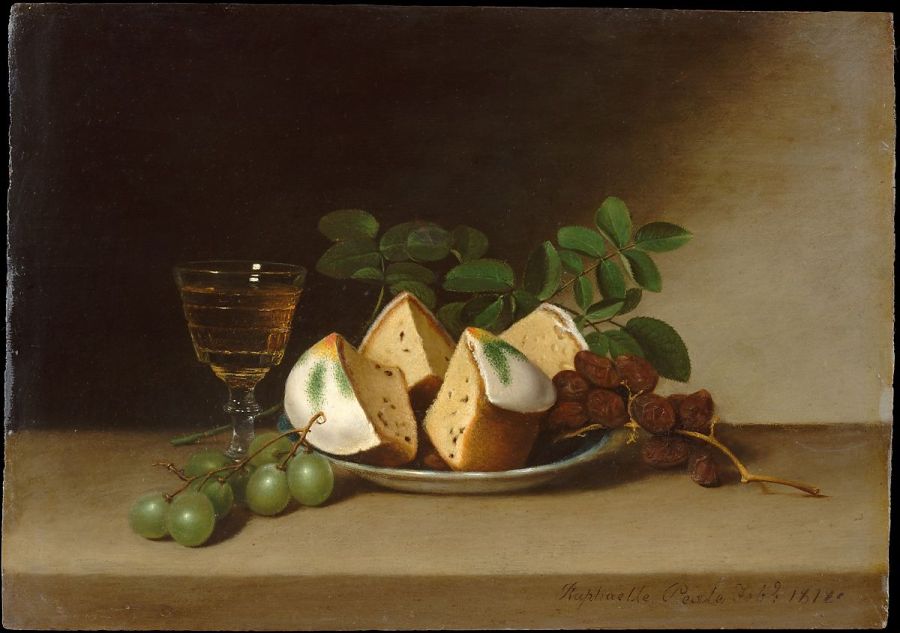
Featured Art: Still Life with Cake by Raphaelle Peale
It was spring and I walked the streets in the late afternoon with the best poet I knew. She was tall with a severe face like an early New Englander. Her ancestors survived genocide. We didn’t discuss our work, only the weather, how the blossoms were upsetting. The war was on. We bought a hefty slice of cake and walked slowly under a murder of crows back to my apartment. This seemed too evocative, almost to the point of embarrassment. The cake was coconut. We split the slice, sitting at the small table in my living room, away from the sun. At the time, it was the present. Here in the future, I sometimes forget to breathe, waiting for the next catastrophe. That cake was pure in its sweetness, the poet alive with me, her eyes scanning my face, both of our histories neatly bound in our throats. I wanted to ask if she was frightened by living, by the change in the light. Instead, she slid the plate across to me, a Ouija planchette, insisting I take the last bite.
So, as I understand it, none of your children have died?
They die all the time, she says. Over and over.
The doctor, young as ever-dying sons, suggests a short course of medication and refers her to someone who might help her to change her thoughts.
On the way home her walk’s different: rocking, dodgy. This is how the embarrassed go. Shanks’s pony won’t trot nice: one two, onetwo, no, one, two, for God’s sake. She keeps a Bonaparte hand to pat the phone in the pocket of her shirt, there, there; can’t let it lie at the bottom of her bag, roofed over by crap and the birthday card for Lance. Her middle lad hasn’t answered the text she sent from the doctor’s reception area: he’s got an away game today, rugby, that bloody rugby; he must be injured, quadriplegic, on a ventilator, brain dead. How can she go on? She smoothes out the prescription in her hand, crosses the road to the chemist.
A text comes as she waits for the tablets to be dispensed. Her son is fine, all good, they won. She pictures him downing celebration pints, shots, being a daft sod, succumbing to fatal blood alcohol levels. She makes the pharmacist bide there for payment, stood like a plum, while she texts back. Well done son but mind you go canny x. As soon as the first text has gone she sends another to say on the coach journey home he should sit in a middle aisle seat opposite the driver’s side for she’s heard it’s the safest place in the event of a crash.
Words in an old notebook prove (I was twenty-ish, then) that mind-mud and dismally tangled brain material have causes other than old age or illness. At the time, they might have been explained by the rum or beer in mind- blowing excess the night before. I don’t remember. But surely those episodes of binge and babble are far outnumbered by drier spells of helplessness: me, frozen over the neat rectangular form of a blank page, compelled to write totus to avoid writing nothing. It’s reason enough for terror or self-pity, the thought that those very things—the booze- blasts and blackouts—were then and are now the efficient cause of wex and taggle: furrows of gray matter, tilled for art and wisdom, laid waste, and the flood of those young insults cascading still. But no, I’ve heard that it’s very common: this empty gaze, the pen loose between a finger and a thumb, its tip hovering over absolutely nothing. And so, as tragic as it all may be, finally, I won’t let it bother me too too much. Why taggle over wex totus? I’ll pour myself a glass of wine and see what comes spilling out.
Nobody, speaking of fluency, would remember that party where I told the young woman seated on the floor: this food tastes good. Nothing untoward. She surprised me by crawling on all fours, her blouse fairly open at the top by way of happy gravity, to gently take the food from my hand with her teeth; alarmed me because I was not young and what could she be thinking by doing that?
Around us on sofas and out under the trees hummed the language I would not understand after years of trying and also of trying to understand why I couldn’t, an easy-to-employ tongue with few options and simple structure but when they speak to each other it’s unintelligible, a giggle-babble, a bubbly stream of what I guess are words, vain emptying of thought from one head to another, like all language, really.
Why not give it up and run silent miles through the mud and rice paddies with my jogging buddies, or ride miles on a motorbike alongside a mute, jiggling citizenry, my face contained and content behind its polycarbonate shield, my mouth behind its filter mask, and who on the back not speaking, only chewing?
Winner, New Ohio Review Fiction Contest selected by Mary Gaitskill
By Analía Villagra
He was gone for eleven years, and Jackie is still getting used to the idea that Victor is out. Exonerated. His release had warranted a few sentences on the local NPR station, so Jackie knows that he has been at his mother’s place, three blocks away, for a week. She has not yet run into him on the street. Each time she leaves her apartment she scans the sidewalks, and when he does not materialize she feels equal parts relief and disappointment. Thursday afternoon she goes out of her way to walk past his building, willing him to be on the front steps or looking out the window. She slows down. Would he even recognize her now? Her hair is short, with a few stray glints of gray, no longer halfway to her waist and shimmering black. Her eyes have shadows beneath them. Her hips have spread. She’s thirty years old, in good shape she thinks, unless you’ve spent a decade fantasizing about a nineteen-year-old body. Jackie blushes. This is the first time she’s admitted to herself that she wondered—hoped? assumed?—that Victor thought about her while he was away. Eleven years. Maybe he’ll recognize her, maybe he won’t. She can’t decide which is worse, so she stares down at the sidewalk and hurries past the building.
She goes to the Y to pick her daughter up from camp. Graciela is running around the outdoor play area with a group of other kids, their hair wild, their clothes and faces filthy.
“Mama!” Grace shrieks when she sees her.
Jackie waves. She locates the teenagers wearing staff T-shirts, and they hand her the sign-out sheet without pausing their conversation. Jackie half-listens to the latest counselor drama while Grace gathers her things.
I do not know which to prefer, The beauty of inflections Or the beauty of innuendoes, The blackbird whistling Or just after. —Wallace Stevens
1. The Beauty of Innuendoes
Meaning in poems comes and goes like a car speeding down a tree-lined road sun-shade-sun-shade-sun-shade . . .
Poems’ secret places: fleeting, hidden, close.
Closer yet I approach you, Whitman warmly says; and then, We understand, then, do we not?—never saying what it is we understand. As I understand a poem by my friend but mustn’t tell him what about the poem makes me feel so not alone.
2. The Beauty of Inflections
Yesterday I called my friend. He was in a peaceful mood (which he would be the first to say is kind of rare). As if bubbles of CO2 some clams or scallops had exhaled were calmly rising
in a steady/wavering surface-seeking
kind of way
up through his contentment effortlessly rose some words of praise for me. Plain
and unadorned; clear; direct. The blackbird whistling,
you might say. In fact,
if my friends didn’t tell me plainly that they
love me sometimes, I wouldn’t understand a single thing I try to read at all.
We were seated near the back of the Chinese restaurant, and waiters were rushing in and out of the swinging doors to the kitchen. At the time we had not as yet so much as brushed shoulders. Resting on the formica table top, my hand began to feel odd. Not bad-odd; but most unusual. Trees in early March, aroused, their branches slightly reddened by the slightly stronger sun, may feel something similar. They have a new sense of their importance in the scheme of things; they remember (if I may say so) they are divine. He was looking at my face, not my hand, so I don’t know how my hand, resting near the remains of the General Gau’s chicken, intuited its sudden access of significance; but it did. It had aura you could cut with a knife.
—For Chris Bullock (in memoriam) and Carolyn Bernstein
In that world people are not discussing The End of the American Experiment.
Yo soy de los Estados Unidos. ¿De dónde es usted? (I am from the United States. Where are you from?)
In that world people are not in a rage at their relatives for voting wrong and sticking to it.
¡Tu hermano se parece más a tu abuelito que a ti! (Your brother looks more like your grandpa than you!)
People there are not tortured by thoughts of what they should have done to prevent this; they do not endlessly analyze the causes of the disaster; or notice how many of their friends are independently coming up with the metaphor of a tsunami wiping away what is precious from the past and has been defended by their devoted work.
No llame a la policía. No es una emergencia. (Do not call the police. It’s not an emergency.)
In that world they do not sit glumly when friends excitedly tell of recent protest marches; they are not thinking, “Great, feel inspired; meanwhile, they’ve got all three branches of government.”
¡Me encantaría que me dejaras accompañarte a la esta de Pablo! (I would love it if you would let me accompany you to Pablo’s party!)
People there are not suddenly crossing the border into Canada in the snow with children in their arms; or trooping out of Jewish Community Centers on a Tuesday because of death threats; or writing emergency numbers on their children’s forearms in indelible ink in case Mamacita doesn’t come home from work that day.
Every morning I cross the border into Mango Languages, my ticket to oblivion. “Loading your adventure,” says my computer when I boot it up. Every ten minutes a woman’s joyful voice says, “Isn’t this easy?” to encourage me, and I admit I feel encouraged.
Córtalos en pedacitos y échalos al agua que está hirviendo. (Cut them in little pieces and throw them in boiling water.)
They are speaking of nothing more precious than carrots and onions; not, for example, the Constitution or the Bill of Rights. We are learning to use the imperative mood, that’s all; and today we are making soup.
Featured Art: A Rocky Coast by William Trost Richards
De Sandro’s café with the orange tablecloths wades into the one stone street without tourists, all the Venetians pushing their big delivery carts at first of morning. From what I understand of it, the shouting is voluble, happy, glad to be alive, almost never without reference to anatomy.
Nine years after your death it is still your birthday. I’m treating you to cappuccino and showing off my lacework of Italian. Ecco, I cry, pointing to the beautiful faces, the beautiful things.
Everything was outlandish to you. Nothing is to me. In that way balance is achieved across the long years.
But I think you would like these people. They would pull out the orange chairs, sit down, listen to what you have to say. You would be old and wise in a city old and wise, and that would be enough.
I’d better think of something else before the mood turns heavy and hard to carry over the Rialto Bridge with the shops just opening. All those selfie-taking children, all that brightness bearing down.
Happy birthday, I want to say, from the last place on earth, where the earth dissolves and the crazy towers lean out over watching for what comes—sinuous, flowing, unexpected—next.













 New Ohio Review