These People

By Anele Rubin

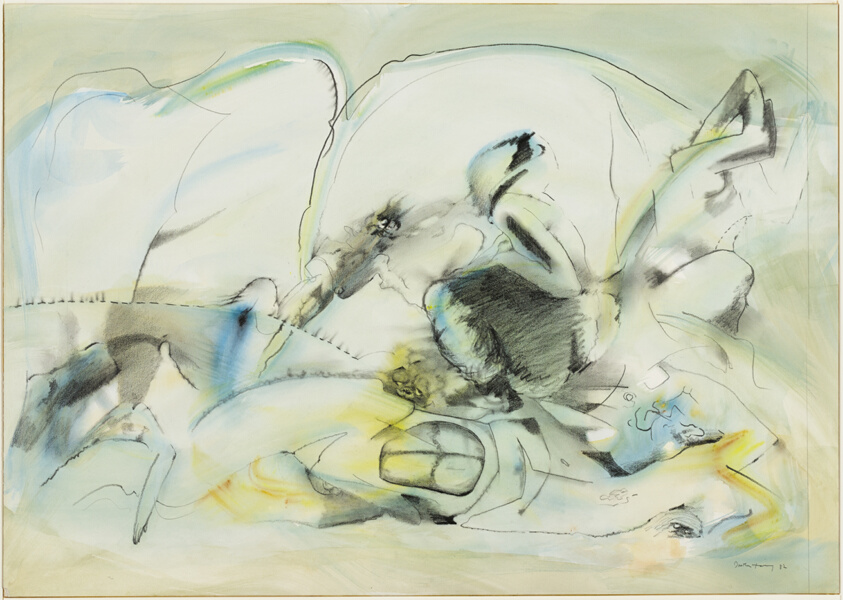
Featured Art: Green Park by Dorothea Tanning

These people strolling through the park
with baby carriages and frisbees
have no idea
my sister choked to death
on a sausage
after being released
from a mental hospital down south
but they may know I’ve been crying
and wonder what I’m writing
in my little yellow book
sitting in the grass next to the only dandelion
left in the park
with my big black dog
whose fur is shaven on one side
and they may notice
I’m wearing yesterday’s clothes
and my gray hair hasn’t been combed lately,
but maybe not,
because a young woman with a child
stops before me,
asks where the duck pond is
and waits, smiling,
as I explain the best route
and her little girl
looks right in my face,
asks if she can pet my dog
and what his name is, says
he’s pretty.


Read More
Timeless Beauty

By Brian Hall

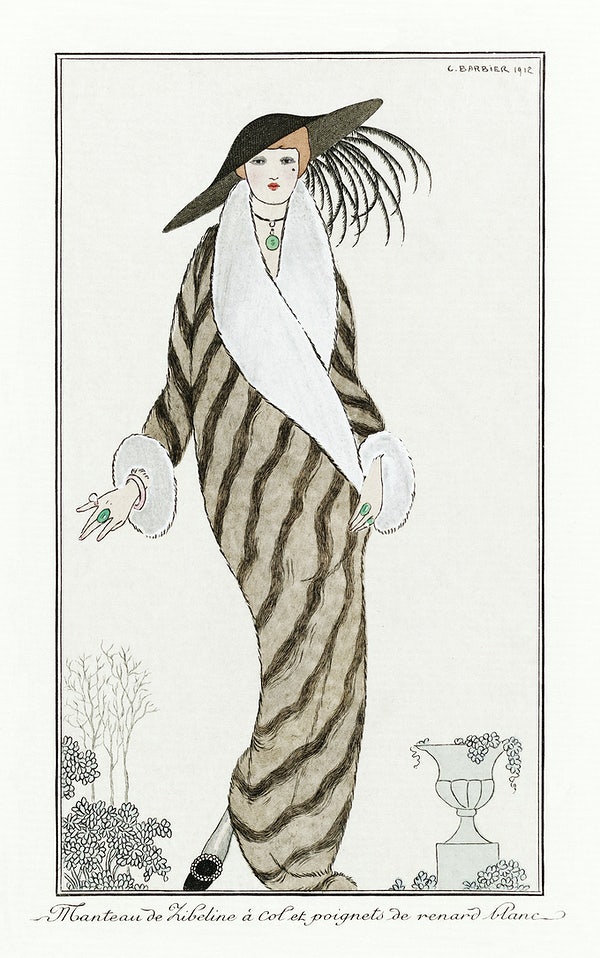
Featured Art: Costumes Parisiens by Manteau de Zibelin

What does she tell me, wind?
—Louis Aragon

My grandmother is a Louis Vuitton model.
Though she will never see the streets
of Île Saint-Louis or pose
along the Seine clutching a Monogram
Canvas Petite Malle iPhone case,
she does drift through grainy nostalgia
like Sora Choi; she does stare beyond
the moment like Sasha Lane, who yearns
to wear soigné dresses and be admired
near rue de la Femme-sans-Tête.

My grandmother is a flâneuse of Youngstown,
shuffling near the faded edges.
In the middle of the road,
she stops traffic because she is
elegance: the wind rippling
her white robe around her as she looks
over her shoulder, gazing
at an audience—drivers, police,
grandchildren, and daughters—
she no longer understands
and at the seasons forever lost.


Read More

Black Sesame

By Adrienne Su

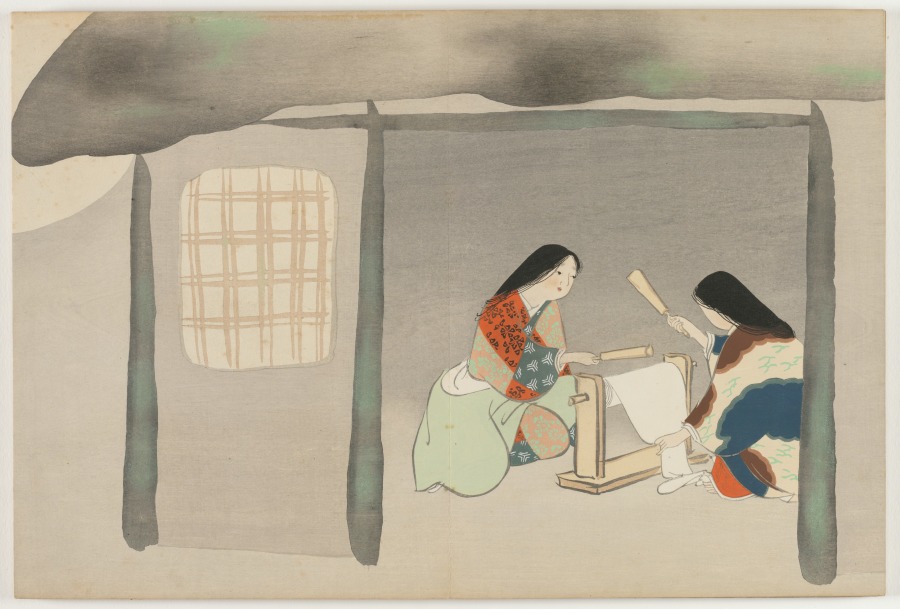
Featured Art: Flowers of a Hundred Worlds (Momoyogusa): Fulling Silk (Uchiginu) by Kamisaka Sekka 

Had I stayed in touch with black sesame,
much would have turned out differently.

For years I forgot the late nights with my mother,
the small bowls of hot sweetened water,

porcelain spoons, and white dumplings
with almost-black black-sesame filling

dwelling somewhere between dessert
and snack, erasing the not-quite hunger

that holds off sleep. At that hour
their strangeness didn’t register:

no one else could see them; the notion
of soup as dessert could be taken

for granted; the lack of an English
name caused no confusion. Packaged,

frozen, easy to heat, they could be served
within minutes of craving, all records

of indulgence swept away as quickly.
Perhaps it was this simplicity,

decades later, that made me feel at peace
in a void. It didn’t feel like sacrifice

to forgo a confection
I had left to oblivion.

What finally reminded me
that I had made myself lonely

was black sesame’s coming into fashion—
cakes, gelato, pastry—the recognition

a mild punch to the abdomen
like that moment in a museum

when a terracotta soldier, a Frida Kahlo,
or an archaic torso of Apollo

turns what you thought was satiety
into a quest for family.


Read More

The News of Touch

By Craig van Rooyen

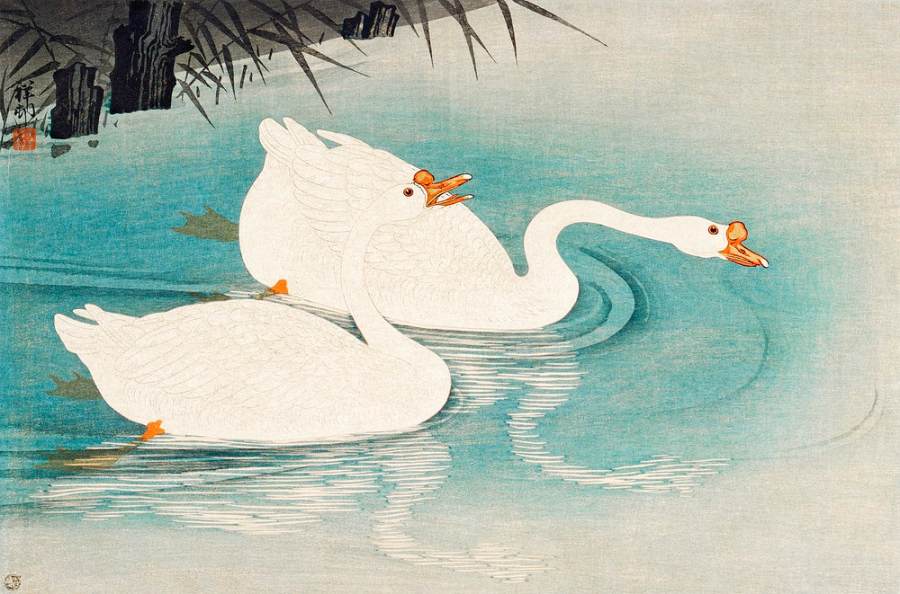
Featured Art: Geese amid Reeds by Ohara Koson

Since his illness, my father feeds
the crook-necked goose every day.
He walks to the pond on diabetic feet,
careful as the path pitches and rolls under him
like a swinging bridge.
He wears suspenders over sloped shoulders,
the shirt tucked over a sagging belly.
Of course he would share with me,
if I didn’t stay away. There’s enough seed
in his bag for both of us. But I’d rather pull weeds
two towns over than see his shaking.
They greet him with a mighty honking,
wings flapping and dripping with light,
then surround him, hoarse with need.
A preacher, he is used to feeling loved
for what he has in his pocket for the flock.
But his pulpit days are long over.
He pulls out his bag of seed
and teeters toward the water’s edge.
A tremor shakes his hand
and the seed spills beneath
writhing necks and thrashing wings.
When the honking stops and the birds leave,
he goes down on one knee, though it costs him.
There is enough seed left to cover a palm.
His good hand steadies the other, and he waits
for the crook-necked gander. Alone also,
the bird finally appears from bulrushes.
This is their agreement:
my father will save a shaking handful
for the crook-necked goose, and in return
the goose will touch him,
pushing its bill across his palm, nuzzling
his fingers long after the grain is gone.


Read More

A Small Prayer

By Craig van Rooyen

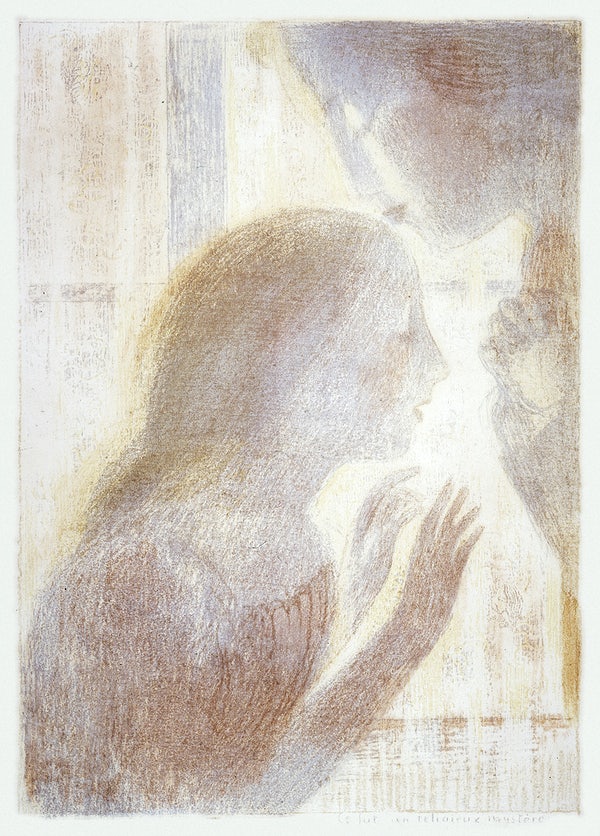
Featured Art: Ce fut un religieux mystère by Maurice Denis

—After Ada Limon

Behind the rotting fence in their first house,
my mom and dad are eating canned mushroom soup
over buttered toast in a one-bedroom Kentucky clapboard
where a turntable spins the same Bill Gaither Trio record,
“Because He Lives,” until they go almost mad
with their stained Formica floor and overflowing toilet
and their longing for heaven, and I love them so.
She is crying at the stove because today
she crashed the rusted Dodge Dart and he has no way
to drive the circuit of his churches in the morning—
preaching at each about the Second Coming
and how to get right with Jesus. I want to offer
her a beer, but there I am in her womb,
kicking to be noticed among their other troubles
and, in any event, she has never had a drink.
He is thinking about his sermon,
the one that will end in an altar call because
he knows people need to walk toward something together
after they have walked away from each other all week long.
First the white church, then the black one across town.
And my father is going to save the country, and then the world
by baptizing its citizens one by dripping one.
Nights, they watch the news on a black-and-white
Magnavox, wrestling with the rabbit ears
to see, through the snow of static
what the world is becoming, believing
it will end in the best way possible.
During the week, she delivers babies
in her starched white uniform, knowing,
in these last days, they will never die.
Years later, some might say their hope
was not a hope, or was not the right kind of hope,
but rather a sort of escape from the reality of their time,
but I want to tell you some hope is better than none.
Look at them there, on their knees, praying
their small prayer. Not for the healing
of the nation, or for an end to the war,
but something more manageable, more
imaginable—for a car to start, for something
in its crushed innards to turn over and catch fire.


Read More

Feature: Gems of the 21st

Editors’ Note:

If, at the turn of the 22nd century, there is still such a thing as an anthology. If readers of poetry continue to entertain the sometimes troublesome idea that ten or twenty poems can reflect whole movements, schools, trends. If the looking-back literati—skeptical of Automaticism, 2101’s prevailing poetic tendency—seek some sense of our long-gone zeitgeist . . . If all that. Then what poems will be read as representative of the early 21st century? Say, from 2001 to 2018?

We asked some of our collaborators to take their best guess.

We suggested that, first, they consider poems that are great own their own—devastating, voicy, gut-busting. But, second, we wanted to hear about poems that address the Big Issues—or what might be remembered as the Big Issues—of our day.

Adrienne Su, Emily Mohn-Slate, Anders Carlson-Wee, Tony Hoagland, Chiyuma Elliott, Keith Kopka, Veronica Schuder, and Mario Chard took up the challenge. Here are their choices:

                                        “The Woman in the Moon,” by Carol Ann Duffy • “The Kind of Man
                                        I Am at the DMV,” by Stacey Waite • “Among the Prophets” and
                                        “Breakers, before the Feds shut it down,” by Essy Stone • “Statue
                                        of Liberty,” by Ann Killough • “Since You Ask,” by Carl Phillips •
                                        “Epithalamion Ex Post Facto” by Joshua Bell • “A Small Gesture of
                                        Gratitude,” by Mark Bibbins • “Another Poem on Blue,” by Claire
                                        Bateman • “Love at Thirty-Two Degrees,” by Katherine Larson •
                                        “Look,” by Solmaz Sharif

These are poems, to borrow from Mario Chard’s title, that see the present deeply. They’re some of the Gems of the 21st.


Art Is Long, Planets Short: The Lasting Power of Carol Ann Duffy’s “The Woman in the Moon”

By Adrienne Su

I have mixed feelings about my belief that Carol Ann Duffy’s “The Woman in the Moon” is likely to endure well into and beyond the 21st century. The happy side is aesthetic: it has disciplined quatrains, playful alliteration, inconspicuous rhymes, and a cascade of clear images that are of the immortal kind. Its metrical dexterity nods to centuries of poetic convention, and while free verse has been more popular than formal for some time now, contemporary poets of enduring power, like Duffy, readily deploy elements of unfree verse even when not writing in strict forms, making poems as musically precise as they are creative and intellectual—the point of poetry. The reason I am unhappy that the poem is likely to be representative of this era is thematic. It’s a piece about patriarchal power and the destruction of the planet, and its message is urgent.

“The Woman in the Moon” in the poem speaks in place of the archetypal “man in the moon,” recasting that character as a woman who is irritated by the human assumption that this figure of legend must be male. In the wry voice of your most opinionated aunt (who always turns out to be right), she tells the inhabitants of Earth—addressed as “Darlings”—her thoughts on observing them through the ages. Affectionate and annoyed, she sympathizes with their struggles (our struggles) yet bemoans their abuse (our abuse) of the planet; and the poem’s final sentence laments its destruction. Along the way, the speaker shows herself to be a force not only of nurturing watchfulness but also of literary mastery. She is not only talking; she’s writing to us, it seems, and this woman in the moon is not just any writer. She is demonstrably a poet.

Read More

“Gender’s Tidy Little Story”: On Stacey Waite’s “The Kind of Man I Am at the DMV”

by Emily Mohn-Slate

On July 1, 2016, Mississippi HB 1523 was signed into law.  One of its provisions states, “Male (man) or female (woman) refer to an individual’s immutable biological sex as objectively determined by anatomy and genetics at time of birth.” This bill codifies discrimination toward anyone whose gender does not  fit the sex they were assigned at birth. How can a poem best speak to HB 1523, and to our daily lives as gendered beings?

Stacey Waite’s “The Kind of Man I Am at the DMV” (Butch Geography, Tupelo Press, 2013) dives headfirst into this question as the speaker encounters a boy in a Midwestern DMV:

Read More

What Essy Stone Done to Us

By Anders Carlson-Wee

Essy Stone: write it down if you have to, but don’t forget the name. Her poetry  is voice-driven, deeply rooted in place, narrative in all the best ways, and tough as fuck. It’s also weirdly inviting. Many of her poems are dramatic monologues, addressing the reader directly, and her work is musically deft, grotesque, grotesquely funny, and a total pleasure to read. Sitting in a café the other day, I found myself smiling while rereading her debut collection What It Done to Us; I handed the book to a friend, who burst out laughing within seconds. The collection was selected by Gary Copeland as winner of the 2016 Idaho Prize and published by Lost Horse Press in 2017. (Get yourself a copy.)

Stone builds much of her thematic tension through cinching together seemingly disparate forces: God and domestic violence; the Devil and homesickness; Christian testimonials and hotel blowjobs. In “Among  the Prophets,” which was originally published in The New Yorker, she takes on religion, sex, deception, poverty, small-town life, Southern conservatism, the KKK, and what it’s like to love and hate a father who wishes his daughter were a son. It’s a prose poem that paints a portrait of the speaker’s dad, who, people say, is “possessed by the spirit of King Saul.” Stone makes clear that the gossipers are “in town,” and with those two words, she quickly positions the speaker and her family outside the town, in the country, the outskirts. The poem goes on to describe the speaker’s father like this:

Read More

“Arch-Talk” and the Postmodern Gall of Josh Bell and Mark Bibbins

By Keith Kopka

The term “postmodern” is tossed around a lot in the 21st century and has become an enigmatic umbrella. Visual art, architecture, television, and online media have all embraced the idea of the postmodern, and poetry is no exception. However, because of our culture’s ontological zeal to define things, postmodernism can often feel like a catchall. Any rough poetic beast that questions the formal order or unhinges its jaw around an “accepted” version of discourse has everyone running to sound the postmodern alarm bell.

But what does this label really mean for the poems to which we assign it? And what are the characteristics of successful postmodern poems that help them to stand out against the backdrop of modernity? Perhaps the lack of definitive answers to these questions is part of the used-car-salesman charm that is post-modernity. Still, this doesn’t stop writers from engaging with our cultural landscape to create voices and arguments in their work that would have seemed unlikely only twenty-five years ago.

However one feels about the idea of defining things by their temporal relationship to “modernity,” what can’t be denied is that this idea, despite all the debate, has become a quintessential aspect of the 21st century, and the poems that are the gems of this age handle their postmodern baggage with skill and grace. Two examples of this are Josh Bell’s “Epithalamion Ex Post Facto” (No Planets Strike, 2008) and Mark Bibbins’s “A Small Gesture of Gratitude” (They Don’t Kill You Because They’re Hungry, They Kill You Because They’re Full,  2014). Doing more than simply rejecting the cultural hierarchies constructed by poets like Pound and Eliot, these poems, with their expert craftsmanship, leap between disparate thought and cultural interrogation: the poems play tennis with our expectations about what a poem should be.

Read More

The Present Deeply: The 21st-Century Love Poem

By Mario Chard

All the poems in new films set in the future are still the old poems. It means our visionaries of film are still looking to the past and not the present for lasting texts. And perhaps that says more about canonical texts needing time to rise above or drown in sand like Shelley’s “Ozymandias” (the poem turned 200 this past January). But it also says something about the need for forums like this feature—space to speculate on those 21st-century poems bound to last. Here are two that I prophesy will make the list—Katherine Larson’s “Love at Thirty-Two Degrees” and Solmaz Sharif’s “Look.” Prophecy, I once heard a theologian say, is not about glimpsing the future. True prophecy is about seeing the present deeply.

First, the past (briefly): Shelley died four years after “Ozymandias” was published: 1822. That same year, Matthew Arnold was born—and so goes the cosmic balance. But today, Arnold’s most anthologized poem, “Dover Beach” (it turned 150 last year), more closely resembles Ozymandias the statue reduced to “trunkless legs of stone” than it resembles “Ozymandias” the poem. One reason why: Arnold follows his famous thesis that “The Sea of Faith / Was once, too, at the full” but is now “withdrawing” and “retreating” with a sentimental turn he’d telegraphed earlier: “Ah, love, let us be true / To one another!” In this poem of existential desperation, where two stand “as on a darkling plain” over which “ignorant armies clash by night,” the poet turns dramatically back to his love. But although the line and its move to stay destruction by the declaration of love are memorable, it can also read as a prop, a staged expression of passion to make a poetic point. But is there something else that troubles us?

Read More