“This Time I’m Going to Fool Somebody”: Willie Stark and the Politics of Humiliation

By Dustin Faulstick

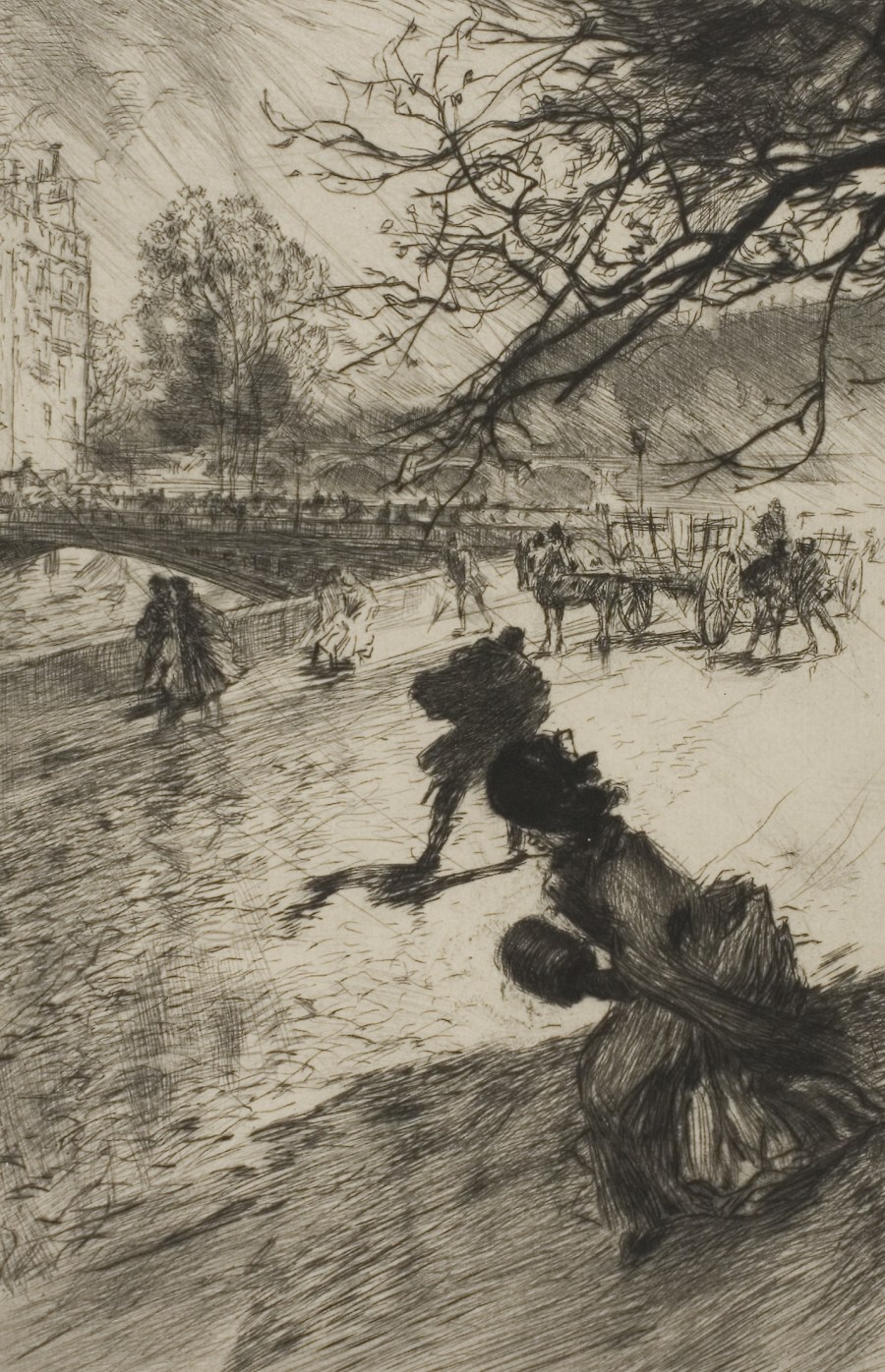
Featured Art: The politician’s corner by Honoré Daumier, 1864

“Folks,” roars Willie Stark on the eve of his impeachment trial, “there’s going to be a leetle mite of trouble back in town. Between me and that Legislature-ful of hyena-headed, feist-faced, belly-dragging sons of slack-gutted she-wolves. If you know what I mean. Well, I been looking at them and their kind so long, I just figured I’d take me a little trip and see what human folks looked like in the face before I clean forgot. Well, you all look human. More or less. And sensible. In spite of what they’re saying back in that Legislature and getting paid five dollars a day of your tax money for saying it. They’re saying you didn’t have bat sense or goose gumption when you cast your sacred ballot to elect me Governor of   this state.” From his colloquial diction and insults to his collegial banter with   his own supporters, from his invocation of corruptly used tax money to his reference to the sacredness of the ballot, Stark identifies himself as one of the people. Before neurosurgeon Ben Carson or business moguls Carly Fiorina and Donald Trump, farm-boy-turned-lawyer Willie Stark was the ultimate political outsider.

Read More
New Ohio Review Issue 20 (Originally printed Fall 2016)

Newohioreview.org is archiving previous editions as they originally appeared. We are pairing the pieces with curated art work, as well as select audio recordings. In collaboration with our past contributors, we are happy to (re)-present this outstanding work.

How to Survive on Land

By Joy Baglio

Featured Art: Playful Mermaid by Henri Héran, 1897

Let me tell you about my mother, a mermaid: For years, despite her handicaps, she embraced land life in Okanogan, Washington—the drizzly winters and sun-soaked summers—with a steadfastness both impressive and exhausting. She read us stories with the ardor of a human mother; bagged our lunches; brushed our hair. For years, she was just Mom: Mom who snuggled up to us on the couch with a book; Mom who packed Tupperware containers full of watermelon and whisked us away to the town pool on humid summer days; Mom who cooked themed meals (Tuna Tuesdays, Waffle Wednesdays); Mom with her perpetual ocean smell and unruly laughter. Of course, there were harmless omens of her first loyalties: shellfish for breakfast, kelp pods strewn like confetti around our living room, the shrill whale-speak whines that filled our house in the mornings, our Nereid names and Mom’s insistence that my sister Thetis and I explain to every curious land-dweller our sea-nymph heritage. (My name, Amphitrite, means Queen of the Ocean, after all.)

Read More

Bobcat

By Andrew Cox

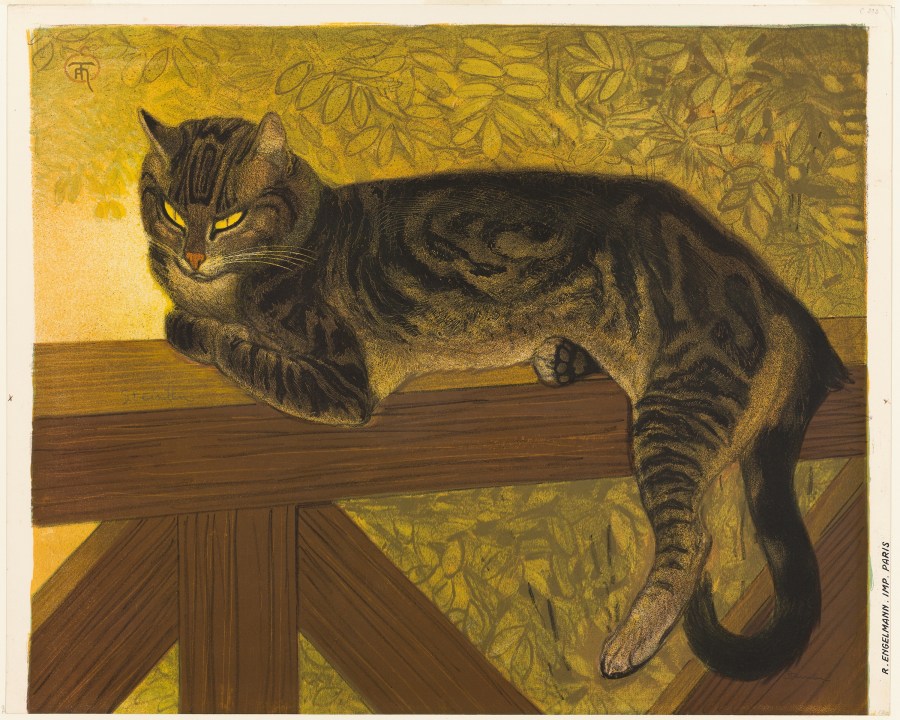
Featured Art: Summer: Cat on a Balustrade by Théophile-Alexandre Steinlen, 1909

–For Jerry Lee (1934-2016)

There are bobcats in the neighborhood
Said the woman in the decked-out SUV
Do you have a whistle
As I walked off my grief in Texas
Where I came to see my mother die
And when I saw the bobcat
Come from the drainage system
And stare at me with black pupils
Drilling into those yellow eyes
I knew it wanted me to sit down and listen
Love your mother the bobcat asked
Not enough I said
I could have visited more
It said man hands on misery to man
One of your kind wrote that I think
Yes I said the poem is never enough
And neither are the sentences it hissed
They fail in situations like this
Yes I said punctuation doesn’t help
Nothing helps
Remember the bobcat said
You are no longer a son
You had one shot and the pistol is empty
I understand I said though I did not want to
I have two hearts it said
The one they will find when they cut me open
And the one I use to live forever
Think about that
Think about that face those hands her eyes
And it disappeared down the slit
Now I knew where my mother was
In the bobcat’s second heart
The one it uses when it growls into the night
And puts everything in its place
That face those hands her eyes
On the hunt until dawn
Only ready to sleep
When the rest of us are ready to wake


Read More

Reno Redux

By Ansie Baird

Featured Art: Man holding a horse by the bridle by Dirck Stoop

My father flew to Reno, Nevada, sixty
solemn years ago to sue for a divorce.
I had no idea where Nevada was or
why my parents were divorcing.
In the mail arrived a shiny photograph,
my father sitting tall on a horse.
I had no idea he knew how to ride.
He carried a rifle across his lap and
on his head he’d set a cowboy hat.
He was smiling like all-get-out.
I had no idea what there was to smile about.

He stayed away six weeks, at some
dude ranch where rattlesnakes curled
and lurked in the underbrush. I lived
in a cluttered city house without
rattlesnakes or a father. My mother
packed up all our winter coats and boots
and sold the house. We moved into a flat.
After that, everything was touch-and-go.

Reno was a place I planned to boycott.
Sixty years later, I’m at the Reno airport
waiting for a connection,
uncertain when it’s taking off.
All of us seem to be divorced.
Slot machines clack at my elbow,
crowds of men in cowboy hats lurk
in plush corridors, looking like they
might be someone’s father.


Read More

Chino, California

By Darla Himeles

Two crows claw down to cement
between the outer and inner fences—

beaks like swords, backs slick,
slashing wings and talons.

I watch them fight from my car today
as I watched my parents as a child: clutching

a book in my lap. I cannot read
the crows or my father, for whom I wait

in my locked car, his bag of belongings
in the back seat beside the maps I printed

to find him. At once, a line cuts
from one building to another: orange

jumpsuits shocking under smoggy, industrial sky.
I pinch my lip, examine their faces, their gaits.

Not my father, not my father—maybe? No,
not my father.

Hours pass, the crows disperse.
The prison yard empties.

Two hours after the designated release, a small
group of men gathers at the gate.

Escorted by officers, they wear stiff beige chinos,
white canvas loafers, and baggy T-shirts

to greet the other side. I see him
shaking his gray head to an officer, No,

there’s nobody here for me—must be a mistake
Sir, I need the bus fare promised me.


Read More

Certain Things

By David Brendan Hopes

Featured Art: Tinker with His Tools by Camille Pissarro, 1874/76

For the sake of my father, certain things
must be done in a certain way:
tightening of bolts, of nuts around threads;
coiling of hoses; firm, instant replacement of lids;
spreading of seed from the hand held just so,
in furrows dug to the joint or the knuckle, depending;
wash it when you use it, never put it up wet;
don’t be opening and closing the screen door
as if you were a cat.
Be grateful for a job, a meal, a leg up.
All that.
In the seasons set aside for such emotions,
of course I hated him.
All things, even hatred, wear away.
In the season set aside I became him,
doing what he did in the way he did it,
hiding the injured heart the way he hid it.
Waking so many hours before full day
from the dream
that something certain’s gone astray.


Read More

She-Monster Gets Fired

By Kim Farrar

Here you are again, running from the villagers
with their torches and pitchforks. You thought
you finally fit in. You filed down
your neck-bolts, got rid of your high-waters.
You watched Oprah, kept a dream diary,
a gratitude journal, pictures of your thinner self
on the fridge. You tried to keep your need
for electricity minimized: licking the outlets,
rubbing your hair with a balloon for just a crackle.

You knew it would happen. Every morning—
the affirmations, the meditation, the positive thinking.

You longed for lightning and rain.
You did everything right to escape
the old ways of staring into the well.
It took years of practicing the right laugh.
You did your best. Married up.
Got a job teaching ESL. Now and then,
a grunt would slip and
crickets     crickets     crickets.

People liked you. You were funny.

But one day you found refuge
eating flies in the faculty lounge;
soon you stopped hiding
your green undertones with foundation.
You missed being the girl
who loved her square head,
touched her thick-stitched scars like Braille.

The villagers yell, Kill her! Kill the monster!

You’re barreling through the woods,
nettle whips your ankles as you soar
over logs in your clodhoppers.
You’re filled with the old familiar joy
of being free and incredible.


Read More

Why It’s Hard to Write About My Brother

By Kim Farrar

Because he called me numbnut
            now no one calls me numbnut
Because in therapy I learned the word infantilize
            and stopped asking him if he was all right
Because I want to recite the titles of his paperbacks instead
             Dune       Silent Spring       Slaughterhouse-Five
Because he showed me how to give the finger when I was six
             and then I showed Mom
Because I listened to him curse in the bathroom
             after Dad buzz-cut his hair
Because at 54 he could still bruise the same spot
             with a knuckle-punch
Because we discussed the etymology of kerfuffle
             but never mentioned emphysema
Because the last time he lit a Marlboro to rest
             I joined him
Because he taught me Sudoku
             but said he couldn’t help with counting to ten
Because they took him away in a midnight body bag
Because he could pinch open the beak of a baby robin
             to feed it drops of milk
Because he once touched me and I cooperated
Because to wreck cars, to drive drunk, was a form of apology
             for being a disappointing son
Because he comforted my worry that his tetras were bored
             They have no memory, numbnut,
             each swim back is a new ocean
             and then I envied them
Because his longest relationship was with a club-footed lovebird
Because I’d ask about the impossible physics
             of the hummingbird’s flight to spin the conversation
             away from troubles
Because he said I couldn’t get good at Sudoku
             because he had to beat me at something
Because he drove me around the city
             to point out the cement he’d poured,
             the flagpole at the post office, the Kroger’s sidewalk
Because he said the one thing he liked about the job
             was leaving something permanent
Because his ashes are in a box and I worry about moisture
Because our last day together at Newport Aquarium
             we watched sharks swimming overhead
Because he would withdraw for months
             but I left messages anyway
Because he loved my dream of him


Read More

At the Threshold

By Marilyn Abildskov

Featured Art: Dilapidated House, 1811

She hesitates, then opens the unlocked door. The house is not hers. It’s nobody’s yet. That’s why she’s here. To walk on red tiles in the empty entryway. To see if there’s carpet yet in the bedrooms. To touch the smooth white marble fireplace that reaches the ceiling in the living room. To wander empty rooms before the rooms are filled.

Here in the entranceway of the new empty house she says out loud—hello hello—and listens for something, a spirit maybe, to say something back.

Nothing. Not even an echo.

From the kitchen window, she can see her home, the tip of a modernist triangle roof. In the distance, she can hear her mother playing the piano, lost in the music. Her shoes squeak against the floorboards of the hallway. No carpet. Not yet.

Read More

My Good Brother

By Young Smith

Featured Art: Two Boys Watching Schooners by Winslow Homer, 1880

If I had a brother, he would be called Enoch or Ephraim—
a name alive with the wisdom of some long forgotten past.
Though older than me, there would be no gray yet in his beard.

There would be no lines on his face, and his full hair—
not thinning yet, like mine—would be brown as the wings
of a thrush. He would whisper Roethke in his sleep,

my brother Ephraim or Enoch, and his poetry would lift
the weight of old bruises from my eyes. He would visit
our father’s grave and feel none of my dark anger there.

He would sing the dead man’s favorite songs, recalling
only his happiest hours. He would have learned to live gently,
my brother, and would teach me that secret with nothing more

than a nod or a warm arm across my shoulders. You, Enoch; you,
Ephraim—how I long for the cool press of your hand on the back
of my neck, my good brother, my quiet companion of cruel nights.


Read More

Here There Was a Stool with a Crippled Leg

By Young Smith

Featured Art: The Chair from The Raven by Édouard Manet, 1875

There are no ghosts in her rented house—
only the shadows of objects

removed by other tenants long ago.
Here there was a stool with a crippled leg,

here a bookshelf filled with fat Russian novels,
here an upright piano with wine-stained keys.

These furnishings have vanished, but their shapes continue—
like spots on the retina after looking at the sun . . .

Though she can find no path from one door
to the next where the shades of their sofas

don’t stand one within the other, of the former
tenants themselves, very little can be said . . .

The mirrors have collected the pale stories of their eyes,
but the glass is too crowded to tell them clearly—

yet even now, among the wraiths of hat trees
and recliners, where the dust of their voices

drifts like smoke along the baseboards,
she can often feel their sorrows, breathing

slowly in the corners, still alive
with a helpless longing to sleep.


Read More

Gorilla

By Young Smith

“Sullen” only begins to describe it—
his all too lucid, all too human stare.

His mate sits nursing an infant behind him
in the mouth of an artificial cave, while,

just to busy his hands, it seems, he strips
leaves from a twig of bamboo. His gestures

are slow and deliberate, but as his fingers work,
his eyes never leave us, moving in turn

from one face, from one camera to the next.
This, of course, is what holds us at the rail—

that he watches back, like no other animal
in the zoo—and there is only one way

to understand his expression: he has little
hope for the health of our souls.


Read More

Moksha

By Alexander Weinstein

Featured Art: Street at Saverne by James McNeill Whistler, 1858

I.

Rumor was you could still find enlightenment in Nepal, and for cheap. There were back rooms down the spider-webbed streets of Kathmandu where they wired you in, kicked on the generator, and sent data flowing through your brain for fifteen thousand rupees a session. It was true, Jeff from the coop had assured Abe, though passport control could be a bitch when you returned to the States.

“They pulled my buddy when we hit Newark,” Jeff had said, sipping maté from a gourd. “But he was showing. His third eye was completely open and he wanted to hug everyone. Just think about porn and you’ll be fine.” Jeff had handed Abe a crinkled business card. Namaste Imports. “Go to this place.”

So Abe had saved his money, bought the ticket, and traveled the endless hours, numbed by bad sleep and bland airline food, to find himself in Kathmandu. Finding Namaste Imports, however, had proved impossible. The streets had no names, and looking up, all Abe saw was a tangle of electrical wires and lights blinking on in the dusk. Around him, masses of tourists, heavy with backpacks and vacant looks, milled about. And amid all this churned a perpetual stream of cars and mopeds, nudging their way around pedestrians, honking, yelling out of windows, and raising endless dust. It all seemed far from enlightenment.

Read More

Bluebirds Are Cavity Nesters

By W. J. Herbert

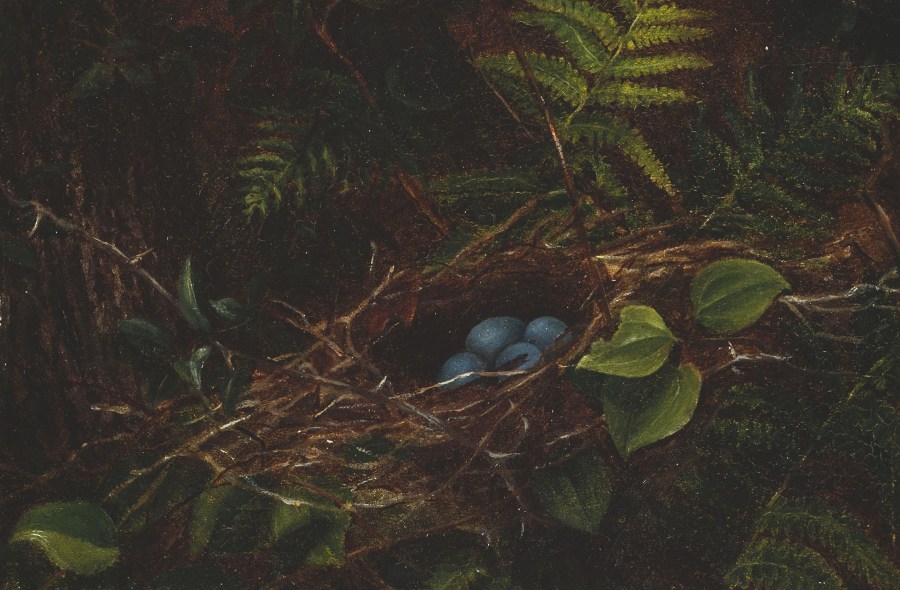
Featured Art: Bird’s Nest and Ferns by Fidelia Bridges, 1863

Cement truck crushing stones
at 3 a.m. on a Flatbush side street?
No, must be the double bass player
grinding his seven-foot case along broken sidewalks,
as if inside his sarcophagus
whose fist-sized wheels are screaming
there’s a mummy dressed in lead,
and it’s so hot again my ceiling fan’s blade
is a soldier’s lame leg that is drooping
and each time he turns,
it drums on the inverted edge of the light bowl
while someone upstairs
drops the booted foot he just cut from a corpse,
but he keeps cutting and dropping,
cutting and dropping,
so it must be a dozen corpses, or
maybe it’s a frozen hen landing again and again,
as though my landlady’s niece, still drunk,
has made up a game in which you get ten points if,
when you drop it from the top of a ladder,
the hen lands on her severed neck.
I can’t sleep. Even if Sialia sialis
relies on dead trees for nest sites,
it’s smart enough to live deep away from the world.


Read More

Anniversary Gift

By Robert Cording

Featured Art: Peacock and Dragon by William Morris, 1878

After reading that hummingbirds
are so light eight of them can be mailed
for the price of a first-class stamp,
I close my eyes and see them, fully revived,
rising out of some envelope of old memories.
I’ll name them again as we once did
so long ago—Rufous, Anna’s, and Broad-tailed—
darting to and from the feeders, sipping,
then retreating, flying jewels
the Spanish called them, and now I recall
how one of the Anna’s, its garnet head
and throat glowing in the misted air,
hung like a jewel at your ear.

Here they are, or the memory of them.
Remember that trying-too-hard-to-be-hip
B&B in Telluride, a hot tub on the roof;
above the water, crisscrossing strings
decorated with Japanese lanterns
and four red heart-shaped feeders that brought
close the ebullience of the hummingbirds.
They surged around us, their kaleidoscope
of iridescent colors lightening
the cool, rainy day and helping us forget
the fogged-in, dim presence of the Rockies
we had come for and couldn’t see.
Curtained in the tub’s steaming air,
soon enough our eyes were in love
with birds we couldn’t stop looking at,
their scintillant existence drawing
jeweled lines we swore we could see.

Which is why I’m bringing back the past,
those tiny birds disappearing
into all the years behind us now,
but today returning all at once,
as if some blessing had been conferred
without my asking; and so
I offer them to you, hoping these words,
even though they dim the colors as they must,
will draw for you their sweet transport.


Read More

The Cave

By David Gullette

Coming back from Escamequita past the curve at the peak
there was the valley of Carrizal with its steep mountain rising above it.

What’s that up there? I asked. Looks like the entrance to a mine.
Oh, the old man said, That’s the Cueva de los Duendes.

I knew the word from Lorca’s great essay
but he meant some dark flamenco trance when strummed sheepguts
and a shout beyond reason jam in our ears the mesmerizing song of death.

Here in the back woods of Nicaragua it just means little people,
fairies, minor local deities, trolls, semi-domesticated goblins.
Or witches. Things that rustle the bushes after the moon rises
or borrowing feathers shriek in the sky above your chickens.

Why do I feel this perverse relief that something remains here
to challenge the cult of the soft Galilean and his stay-at-home Mom?
Some trace of the pre-Columbian, or something from the hills and caves
of Spain, smuggled in with the priests and horses?

Once I was in Yucatan: An afternoon storm was brewing
and when the thunder shook the limestone world
the Mayan lady at the kiosk looked up and said “Xac!”
The old god of lightning, rain, and fertility.

Remember how Wallace Stevens’ Crispin, hearing
a rumbling west of Mexico fled, and knelt in the cathedral
with the rest? The thunder unleashed a self possessing him,
some quintessential fact that was, he says, not in him in Connecticut.

My idle thought passing through Carrizal was to find a way to climb the hill,
enter the giant portal of the cave, probe the interior with my LED.
But “to know a thing is to kill it,” says Lawrence,
and I’m too old to court more disenchantment,

so back to town: a little rum, check the banality of the Internet,
news of winter’s vacancy back in Boston, a little European music
to sprinkle on the sizzling red snapper . . . How easy to live it,
this our minimal unhaunted twenty-first-century life.


Read More

Still

By Alison Jarvis

Featured Art: The Artist’s Sitting Room in Ritterstrasse by Adolph Menzel, 1851

Somewhere up in the Bronx,
in rented space I’ve never seen, seven
rooms of the old life, waiting
in storage. Shrouded wing chairs,
Persian rugs, your mother’s
engraved silver, nesting and spooning
in a mahogany box. Racks
of your oils. The body of the grand piano
had to be separated from its legs
so everything could fit—

     I miss our music.

Sunday, on the little radio
I heard Lotte Lenya sing
that song about searching, her urgency
tilted the room, I was that
off-balance

and dying to hear it again,
even in my own voice. The ether
offers up dozens of versions, none
the one I wanted. One night,
years into your illness—I was whirling—
singing “Pirate Jenny”
when you calmed me—Wait
sweetheart, you said, Lenya
is perfectly still
when she sings that
in the movie
.

It’s true. This morning, the light
a slit in the blind, I finally found it
on YouTube. Her body
never moves, only her eyes
and even they stop
near the end. Rapt,
I watched it for hours—

Typed your ghost email,
pressed send.


Read More

A Creature, Stirring

Winner, New Ohio Review Nonfiction Contest
selected by Elena Passarello

By Gail Griffin

Featured Art: The Kitchen by James McNeill Whistler, 1858

It is Christmas night—or, more accurately, two in the morning of December 26th. I am on the small porch at the side of my house. My cat is in my lap. The door to the living room is closed. Every window inside the house is wide open, because the house is full of smoke—a vile, stinky smoke. The porch is winterized, but I have opened one window about six inches because of the smoke escaping from the house. And what I am saying to myself is Well, at least the temperature’s up in the twenties.

The cat is unusually docile. He knows that something fairly strange is going on, and he is cold. I murmur to him that we’ll be all right, over and over. With sudden, crystalline clarity I know that I am absolutely alone in the universe, except for this small animal.

Will it reassure you or just make the whole scene weirder if I tell you that the smoke is from burnt cat food?

Read More

November 1st

By Chanel Brenner

Dia De Los Muertos was Riley’s favorite holiday.

He loved smelling the sugar skulls.

Didn’t mind that he couldn’t eat them.

My husband asks what we should do with Riley’s bicycle.

Who wants a dead kid’s bike?

He puts it in the alley for someone to take.

He rummages through boxes in our garage like we are having a fire sale.

He finds my dead father’s rare coins in a sock, a card from my dead grandmother.

Many believe the dead would be insulted by sadness.


Today, I realized sugar skulls have a space on the forehead for a name.

November 1st is marked as a day to honor lost children.

I open Riley’s closet and look at his clothes.

It is silent, and airless as a church.

My husband runs back out to get Riley’s bike.


Read More

January 12th

By Heather Bowlan

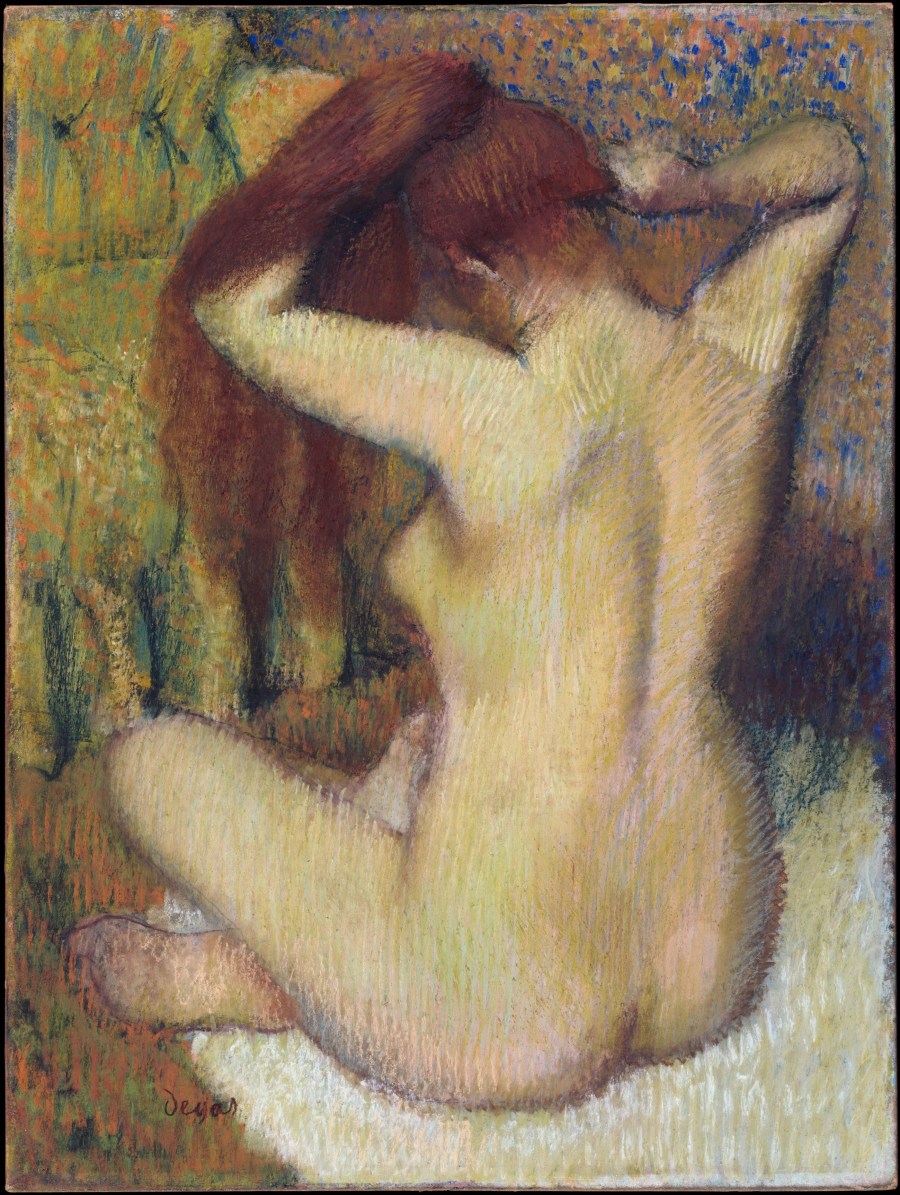
Featured Art: Woman Combing Her Hair by Edgar Degas, 1888-90

the day I told M
I loved her, we were at her new Dom’s
midcentury modern
in Hollywood, the one
with the surprisingly small bedroom.
I always pretend the best version
is what really happened, so I pretended
I didn’t need the wine, didn’t drink
myself to floating while we texted him
photos of our cheery breasts
and matching cherry-bordered
aprons for his birthday, that I wasn’t hungry
for her, that kissing for the camera, lips
open, waiting for him to come
home from work was just a great story for later—
which it is. And she said she would never
love me and I said no chance, really none, never?
and she said no. M always said
L.A. was her town, her true home, and she tiptoed
naked onto the terrace later that night,
a ballerina watching the traffic lights change
on Santa Monica, and I want to pretend
we glided a grand jeté entrance onto
some carcinogenic highway, quick-fast away
from every bare inch of that small room
out into her great city, one I almost knew,
city of spaces, boulevards, exits, of sun
and shifting ground, valleys
and parking lots, an algorithm of streets and
lanes that open out and don’t stop
opening, a mirage city of merges, a city
I nearly loved when its skyline framed the arch
of her neck—even now I see it, I speak it, that sailing
second, it’s the moment I wake up to
every morning I’m in the world.


Read More

Facebook Friends

By Lisa Badner

Fran is my Friend on Facebook.
In the 90s, Fran and I were roommates, then girlfriends.
Dina is my Friend on Facebook too.
I cheated on Fran to be with Dina.
It was in Jerusalem and very dramatic.
Fran can see that I am Friends with Dina on Facebook
because Dina is on my list of Friends.
I Friend Fran’s new girlfriend Ellie,
since we are all pretty friendly.
Ellie Friends Dina. Ellie doesn’t know Dina,
but Ellie Friends all of her Facebook Friends’ Friends.
Ellie is Friends with Alan.
Alan and Ellie were boyfriend and girlfriend in the 80s,
before Ellie was gay.
Alan Friends me. I have never met Alan,
but I was girlfriends with his first wife, Deb,
when Deb was still dabbling.
We weren’t very friendly after that.
Alan and Deb are Friends on Facebook,
though I hear Deb may have recently died.
Fran and Ellie and Dina are also Friends with Deb on Facebook.
Tomorrow I’m going to Friend Deb too.


Read More

Parent/Teacher Conference

By Lisa Badner

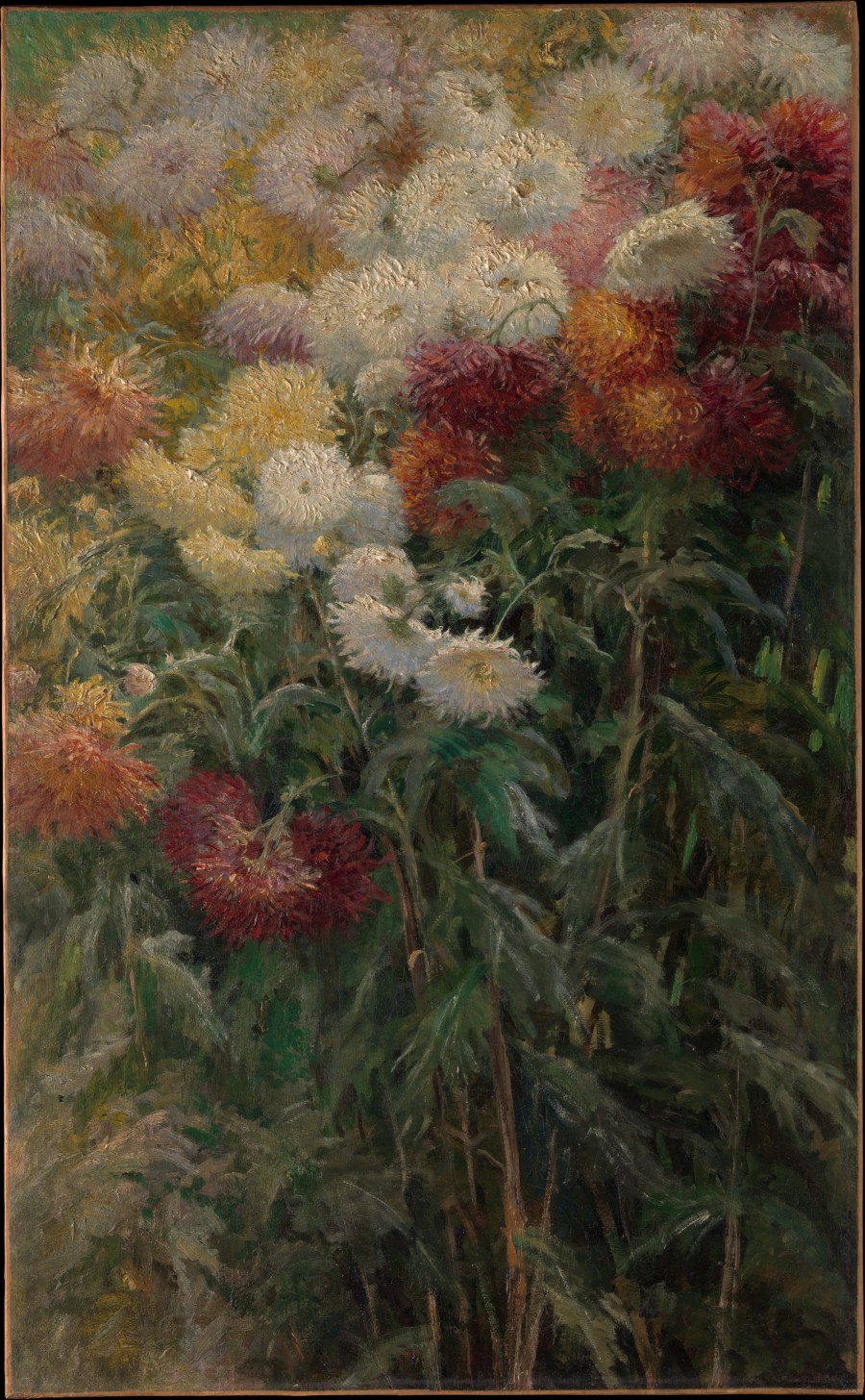
Featured Art: Chrysanthemums in the Garden at Petit-Gennevilliers by Gustave Caillebotte, 1893

My son’s third grade music teacher
was the girlfriend of my piano teacher
in nineteen eighty-three.
I was a teenager.
She was hip and grown-up with long hair.
She has no clue we ever met.
But I remember her.
I remember hearing her scat sing
while I walked up the stairs.
She also doesn’t know
that I had sex with her thirty-something boyfriend,
rather—that I let him have sex with me—after she’d leave
and after I played the Bach French Suites—
in their Bleecker Street walk-up.
I was desperately trying to be straight
(it didn’t work).
We are sitting on little-kid chairs
and she is discussing my son’s musical prowess,
in spite of his bad behavior in chorus.
She still has long hair, now dyed blonde.
She tells me my son is a little lost,
struggling to find his place.
I know from lost—I want to yell out.
This conference is about my son.
So I nod and smile thinking
about being sprawled out numb
in nineteen eighty-three.
I want to talk about me.
I want to curl up into her arms
and go to sleep.


Read More

This Is Not an Obituary

By Lisa Badner

Featured Art: The Funeral by Edouard Manet, 1867

–For Claudia Card

Claudia, you asked me (in advance) to write your obituary.
You gave me your 37-page single-spaced CV.
Now the time has come,
I have not written an obituary.

After the biopsy results last year
You said I would inherit your music library.
I used to play piano.
I stopped playing piano in 1984.

You nominated me for a graduate fellowship.
You said I would have been a good philosopher.
I got the fellowship. Thank you.
Then I dropped out.

I went back to New York, eventually to law school
to pursue a mediocre career. After your lung surgery
you told your other visitors that I was a judge.
You seemed so proud. Claudia, I kept telling you, administrative judge.

In the 90s I took you on a walking tour
all over Manhattan.
You developed plantar fasciitis
from the hard city pavement.

I took your Ethics class in 1984. You held the chalk like the cigarettes
you used to chain-smoke. Your mother died of lung cancer.
You told me your family was so poor she barely went to the doctor—
the lung tumor protruded from her chest by the time she got someone to look at it.
So in 1989 I lied when you asked me if I smoked.

I still have the coat and blazer I bought
the day I gave you plantar fasciitis.
I don’t have the letters you wrote and the papers you sent me.

The last time I ever saw you,
I hugged you goodbye when my taxi arrived to take me to the airport.
You were in bed, cancer in your brain, maybe your spine.
My heavy backpack fell over me onto your abdomen.

When they moved you to hospice
you said you’d rather I come see you again at this new facility
than come to your funeral.
I didn’t see you at hospice.
I didn’t go to your funeral.


Read More

Response to Medical Questionnaire Furnished by Mount Sinai

By Graham Coppin

I had chicken pox as a child. Rubella and the mumps.
My tonsils came out when I was three. I am not currently
under a physician’s care for any ailment or injury although
see below. I have lived outside the United States because
I was born outside the United States. My left ring toe has
a callus, same spot same toe as my father. He passed away
of bladder cancer and a broken heart. My mother before him
died of stomach cancer and a broken heart. I used to smoke.
Quit years ago and took up other things much worse for me.
I drink when I can’t. I am allergic to penicillin. At least
that’s what my mother told me. One of the many things
I was taught would be my undoing. I am undetectable.
Genvoya keeps it that way. I take Doxepin when I can’t sleep
or need to sleep. I sleep on average seven hours a night.
Today I have high creatinine. Ask me again tomorrow.
Yes, I use a seat belt. My uncle Michael is a schizophrenic
and survives in a state institution. My uncle Mervyn developed
adult onset diabetes and got both legs amputated, leaving me
to carry him up the stairs at my parents’ fiftieth. His wife
my aunt Betty is still going strong spending the money that
there’s no need to bequeath to anyone especially me. She’s barren
my mother used to whisper. I inject testosterone cypionate once
a fortnight into my ass to combat low T. I don’t eat red meat.
I exercise. Pray mostly. My father’s father died of lung
cancer. His wife my grandmother Flo went of dementia,
breathing her last in a pool of her own waste in a home
that used to be a hotel when I was a teen. The hotel where
an older man once lured me to his room and did things.


Read More

The Killing Square

By Michael Credico

Featured Art: Unfinished Study of Sheep by Constant Troyon, 1850

It’s the manipulations that end you. I was told this by Sam Shaw after he learned he’d been promoted to the inside. We were on the outside of the outside in the designated smoking area. I was smoking. Sam Shaw said, “What’s suffering worth?” He broke off the shards of animal blood that had froze to his overalls.

I shook like I was caught in electric wires. The cigarette butt hissed when I let it drop into a snowdrift. I could hardly feel myself living, felt like I was alive as a series of smoke breaks.

Sam Shaw said, “Nothing’s dead-end as it seems.”

“Easy for you to think,” I said. “You’re on the inside now.”

I warmed my hands with the heat of the conveyor’s gear motor, clenched and unclenched until my circulation was good enough that I could reach for my cutter and hand it off to Sam Shaw without either of us losing a precious something. Sam Shaw cut into a plastic clamshell that contained a dress shirt and tie combo. He pulled the tie too tight. I told him he couldn’t breathe. He called himself a real professional. I lined up the next group of animals.

“You ain’t dressed for this no more,” I said.

Sam Shaw looked at me and then the cutter. “Take it easy on me,” he said, taking an animal by its pit, cutting it with no regard for the stainlessness of the shirt.

Read More

Horse on a Plane

By Joyce Peseroff

Featured Art: Horses Running Free from The Caprices by Jacques Callot, 1622

A horse on a plane is a dangerous thing
if the box he’s persuaded to enter shifts
like a boulder or a coffin fragrant with hay
but no exit and midflight he decides no way,
time to bomb this pop stand, burst out
of his lofty corral into a tufted field
asway with timothy, feathers, and prance.
You ask a horse—you don’t tell him—to trot
or whoa, easy there fella, and cross-tie him
with a knot meant to fail if he pulls back.
When the plane bucks, a horse can launch
steel shoes through aluminum, the hiss
of oxygen dropping down the masks.
Then his groom must place a pistol barrel
in the nearest ear and whisper, Easy;
carried on with apples, sugar, and oats,
the gun follows the horse on every flight.


Read More

Ammo

By Marc Tretin

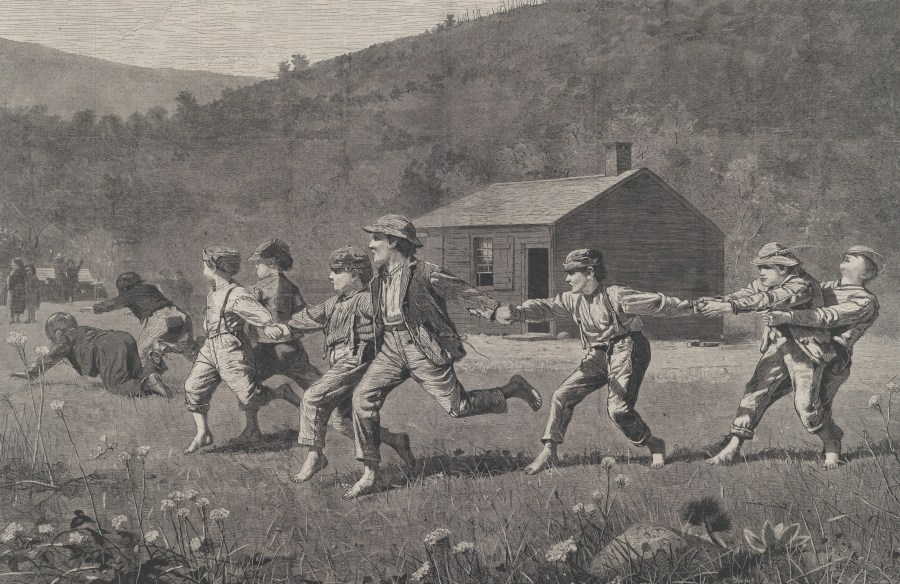
Featured Art: Snap-the-Whip by Winslow Homer, 1873

In ’69, to avoid the draft, I taught at Mt. Tryon
Boarding School for Troubled Boys and there
I hit a child. Afterward I imagined
I was on top of an explosive ammo truck
manning a gun, squeezing off bullets
at young bodies of boys who’d tried
to run to the back of our truck to soft-toss
a grenade that could blow us into
strips of meat. It seemed better to be scared
in that V.C.-controlled village I’d
never been to than to think of squeaky-voiced
and fat Gerry, who at thirteen, threw chalk
at me, hit a younger boy,
and always grabbed that kid’s crotch.

I was in charge of him and ten others. For punishment
they’d have to sit without making a sound, but Gerry
sang, “Try to shut me up. Try to shut
me up.” I was afraid the others would join him.
My hands felt like clubs. Then
I swung and his nose spurted surprised
blood that dripped to his shirt from his chin.
The principal came from the main office.
I was gone.

                       So this is why, my son,
when you, at thirteen, said,
“I don’t know who I am. I don’t know
who I am!” I said, “Be glad you
haven’t done anything that makes you choke
on who you are,” and I put up
my paper to read about how, somewhere,
a soldier was shooting civilians.


Read More

Princess Summer-Fall-Winter-Spring

By Charles Harper Webb

What serpentine producer snuck her past the censors
to corrupt the Peanut Gallery boys? Oh Princess
of the Tinka Tonka tribe, I loved you more than Dolores
at the swimming pool, Janey next door, or Bobbi Jo,

the best baseball player on my block. I loved
the beaded buckskin dress that couldn’t hide your curvy
hips and thighs. I loved your black braids, your dark
eyes that shocked me through the new TV, smudged

by my lips. Indian girl with skin as pale as mine—
birds and butterflies flocked to your singing drum.
Native royalty, whose name evoked School’s Out /
Trick or Treat / Santa Claus / Home Run Derby—

daughter (I guessed) of Big Chief Thunderthud—
you dumped Howdy, and left me to stomp
the flowers I plucked for you, and shred
the blue-jay plume I’d saved to slide behind your ear.

Starring with Elvis in Jailhouse Rock, you helped
to crown him King before you married a loser
named Lafayette who, driving through Wyoming
(near where Tinka Tonkan warriors ruled?) hit a car

towing a trailer that sliced your car and you in two,
ten years before Jayne Mansfield lost half
of her head the same way. The stone that bears
your white-girl name, Judy Tyler, says you were 25.

Elvis skipped your funeral, wanting (his mother said)
to remember you alive. I would have gone.
But no one told me. And I was still (“Thank God,”
my mother would have said) too young to drive.


Read More

Audition

Winner, New Ohio Review Fiction Contest
selected by Charles Johnson

By Leslie Rodd

Featured Art: Nymphs and Satyrs Playing Musical Instruments by Claude Lorrain

San Francisco, 1969

Outside the jazz club where I’ve been audience, player, and piano tuner over the years, it’s quiet at this sunstruck ten o’clock, and I have a shivery thought of a guitar and a girl that began inside my head last night. No rocking, no rhythm, no foot-stomping or window-shaking. Only the fifty measured strides I’ve counted from the corner where the 30 Stockton dropped me off, past the police station to the alley, the dip in the pavement and the sloping rise, the manhole cover to my left, yes, here it is, the last of my landmarks, reassuring me I’m in the right place. A thought of a girl, who used to make my music glow.

I rap the metal tip of my cane against the partly opened steel door, the tradesman’s entrance.

“Easy does it there, fella,” a man calls out to me.

“Jimmy McGee,” I identify myself.

He says, in a voice that’s smoother than Roscoe’s, “Come on in, Jimmy. Mustafa Monroe, at your service. Roscoe’s on-again bass, as of yesterday.”

Read More

Watching Nature on PBS

By Angela Voras-Hills

The caribou calf is separated from the herd, pursued
by the wolf. Unless it slips up, the calf could escape,
outrun it. The toddler grows restless and runs to the window,
watching the garbage truck back up, lift bins, and dump
our trash into itself. I don’t redirect her. My own childhood
window looked into a tree. All year, there were branches. Sometimes
covered in leaves, but by winter, they were bare. I often prayed
for a way out. I once spoke directly to God, said: “God, if you know everything,
what am I thinking now?” And I tried to think the opposite of anything
he’d expect me to think. Another time I said, “God, if you help me
leave this place,” but could think of nothing worth giving in return.
No matter how much we bargained, I never asked God to save our house
from fire, even after a house on our block burned down. I didn’t
ask him to spare us from cancer, Alzheimer’s, any other death. I believed
there was a reason for everything. When my mother asked me
to blow into her cup of dice for luck before she rolled them onto the bar,
I didn’t wonder what it meant if she didn’t win. Then, in high school,
a classmate was found dead in her bed. Her mother had gone to wake her,
but her heart had stopped beating. The parenting books say it’s good
to establish rituals. I run a bath, wash peanut butter from the toddler’s hair.
I rock her, sing folk songs about birds, and she sits up, pointing to a spider
climbing the wall. I watch it as I lay her in the crib, still singing
as her eyes close. I wait until she falls asleep.


Read More

Full Disclosure

By Emily Sernaker

When someone says a mental math problem
I usually act like I’m trying to solve it but secretly

wait it out until someone else does the work.
I tend to think of today’s date in the announcer’s voice

from The Daily Show. I sometimes sit next to handsome
men in coffee shops, pretend we’re together reading

different sides of the same newspaper. My family
loves watching 24 reruns. Dad yells “there’s no time,”

accuses my mother of being a Russian spy. When I’m
let down I feel like a game of Jenga with a log taken out.

I can feel myself tumbling. I don’t like people who
over-use the word “obviously.” I got a month-to-month

lease so I could leave Washington D.C. any time.
The Lincoln Memorial steps are still the best place to sit.

I could learn to pack a better snowball. Could save M&Ms
in trail mix for someone good. I have a sneaking

suspicion the man I end up with will own a Ghostbusters
T-shirt. I’d like to know more about Saint Francis.


Read More

History Will Remember

By David O’Connell

Featured Art: Showers by Louis Auguste Lepère, 1890

maybe not today, but this July,
surely, the way the city wakes up
to brunch, the café windows

thrown open to foot traffic.
It rained overnight. But now sun.
Or if not this July, certainly the skyline,

the bar graph of midtown, the Empire
State Building, the Chrysler, all that was
accomplished. And that we were?

Not we, as in you and me,
but we all? Impossible
that the record could be garbled

beyond translation. Centuries on,
careers will be made retelling
what’s . . . sorry, a cabbie’s honking

at a bike messenger, and the newsstand
on the corner’s glossy with everything
you’d ever need to know

about red carpet nip slips, double
truffle burgers, how soon the West
Antarctic ice sheet’s likely to collapse.

I’ve got weekend plans. My wife’s
friend’s rented a place in the Hamptons
we could never afford. She doesn’t buy

she says, because it’ll be under water
in a decade. I’m hoping, like last year,
for clear nights. We’re crossing through

the Perseids, that annual shower
of meteors: traces of a comet’s tail
that flared some time ago.


Read More

Black Telephone

By Robert Long Foreman

Featured Art: Death: “My Irony Surpasses All Others” by Odilon Redon, 1888

Michael, you are gone, and in this house where you once were there is an antique telephone as black as your coffin. Heavier than it looks, it is as full as the hole the men dug for you, early one morning, as they talked about summer and things they saw on TV.

Old things weigh more than they look—dead, leaden things like you and the black telephone.

You have been gone three weeks, and now my mother is gone, too. When she left for Providence she left me here with Michael, whom you left behind like a copy of yourself when you went. He doesn’t ask where you are anymore. Instead he says, nine times a day, that he’s going to call you on his telephone.

He found it at the flea market where my mother took him, to take him off my hands and take me off of his.

When I’m not looking, he lifts the receiver and talks to you. He doesn’t say your name, and I don’t ask who is on the line. I know it’s you.

Read More

The Potter’s Field

By Amit Majmudar

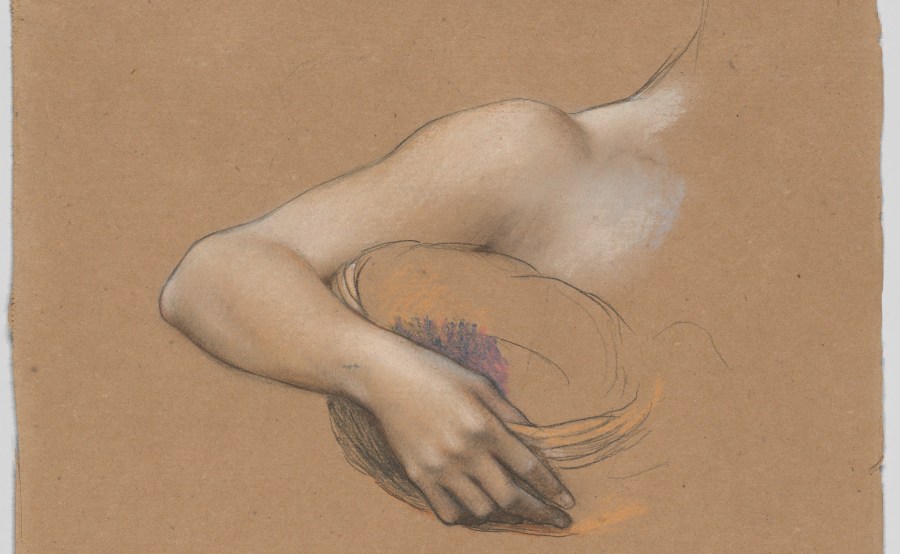
Featured Art: Study of Arms for “The Cadence of Autumn” by Evelyn De Morgan, 1905

Something lumpen, something slapped
Wet on a wheel, cupped and spun,
Sculpted; something hollowed, bellied,
Shapely; something held, watered,
Coaxed into a poised amphora.

Soiled hands smooth their own prints
Like still winds pressed to the spinning earth.
Brittle even after the fire,
The vessel is what it holds:
Ashes, ouzo, roses, olive oil.

I never understood your choice,
Or what that haggard savior held
For you, until you told me the part
Of the cemetery where the dirt poor
Returned their poverty to the dirt,

Repossessed, anonymous,
No grave-goods but a prayer,
Used to be called the potter’s field—
Barren furrows, fruitful now with clay
Scooped and pulsing in your hand.


Read More

The Skeleton in My Grandfather’s Closet

By Peter Schmitt

Featured Art: The Print Collector by Honoré Victorin Daumier, 1857/63

hung in their bedroom
for years after he died,
my grandmother dutifully dusting
the yellowing lifesize model
from his surgical days.
Who can say

if she ever let time settle
on the stack of letters
she found from the nurse—
but she took my father with her
(he was six) from Brooklyn
to Oakland on the Zephyr,

booking so late
every berth was reserved.
The nerve of that woman,
she might’ve muttered, and How
could he bring them home?
Unsure she’d bring herself

home, or their son.
Sleeping upright was no bargain
while he roamed the observation car,
a storm out over the Rockies
lighting up the glassed-in deck
like an x-ray.

By the time the Bay
washed into view, sun burning
through fog, she saw how it was,
and penned my grandfather a letter
of her own—one he saved
only he knew where—

because it saved him.


Read More

Checkup

By Daryl Jones

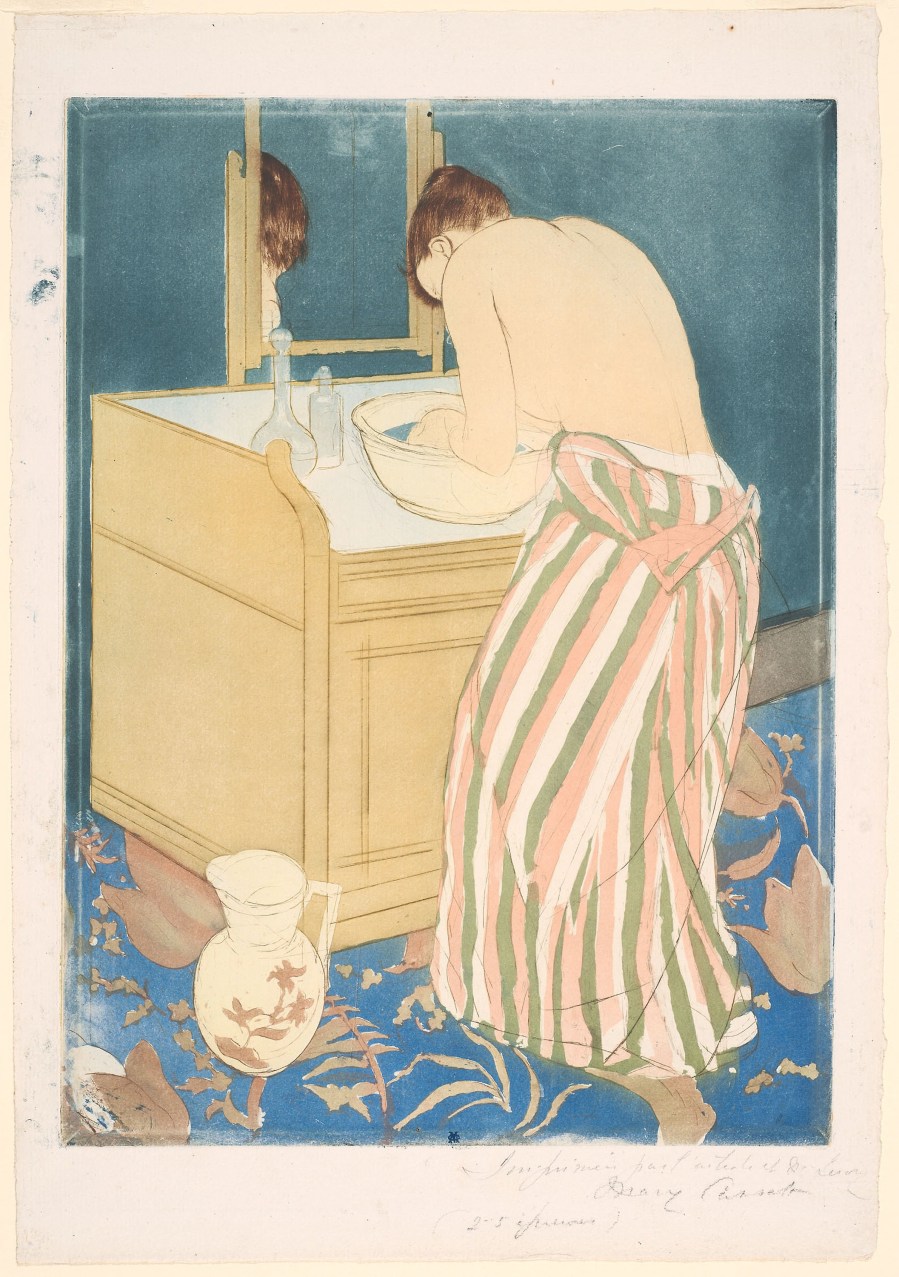
Featured Art: Woman Bathing by Mary Cassatt, 1890–91

Two weeks they didn’t speak,
my father sleeping on the couch
and rising early, spooning cold cereal
into his mouth like a metronome,
while my mother stood at the stove
in her white nightgown, back turned,
stirring the silence. And all because
the handsome new doctor, I’d gathered
from muffled shouts through the wall,
had asked her, at her annual checkup,
to take off all of her clothes
and she did. Every day at school,
the words chalked on the blackboard
all spelled DIVORCE, and I figured,
homeless, I’d grab my paper route cash
stashed under my socks in the dresser
and thumb my way west
to Frisco, jam out on bop and poetry
like Sal and Dean, eat
chocolate-covered ants and sip
jasmine tea, maybe smoke some Mary Jane.
But who would take care of my dog? Read More

Bag It, Box It, Haul It Away

By Jay Leeming

What’s the matter? Stuff is the matter and our basement
       is filthy with it, our ignored understory grown lumber-
cluttered and impossible so my wife and I descend
       to wrestle with the rusted-out wheelbarrow festering

tilted beside the unstartable lawnmower and the extra

freezer, the two of us tangling with moldy drywall, broken
       bicycles and that heap of gray peeling stair treads
their half-pulled nails all askew like arrows fired
       at ten different targets. Matter is mother, is milk crates

a-clatter with extra faucets and so in a faded T-shirt

and ragged jeans I go huffing the leftover porcelain
       toilet top, cracked desk drawer and crate of tile down
the low corridor up three battered stairs then out
       under the sky, each trip a rebirth, a bringing of things

to light, the shadow-world made conscious but like dreams

remembered later they seem silly, unimportant now.
       Two previous owners plus our neglect means multiple
jelly-jars full of nails, a bucket of gravel, a torque-
       wrench and a rusty alternator, every clogged caulk-gun

and bent window screen witness to dramas unknown, mute

Read More

Black-Eyed Susan

By Lisa Bellamy

I just cannot bloom endlessly, you know—this is November, I’m
pale, a dry stalk—I can barely stand, I’m shaking, I need Me time,
I need to center myself—this summer was horrific: It was all about
the aphids, crawling, depositing God knows what without my
permission, from who knows what hollows of slime; it was all about the
jays—“by mistake” they smashed into me, to try to grab
the crickets—I had to hear the swallowing, I had to see the bulging
gullets; it was all about the bees, their selfishness and their overall
lack of tenderness. Oh, bees are sly—they say they buzz for
beauty, for splendor, and they preen, like debutantes in frilly
hats—people, it’s a racket, a con job—they trampled on my
privates, they scurried back, mobsters with their booty (my pollen!)
to their dank, little clubs, their “hives.” This summer was all about
the deer, their nibbling, their slobbering, ticks crawling in and out
of their noses—sweet Jesus, a sight no one should have to
endure—and who, in the meadow, ever thought to pause, ever
thought to kiss my petals? People, I’m on my own here—I need T-L-C.
Look, dormant does not mean down-for-the-count, I will re-
seed myself—I am a brilliant genius of reinvention, the hardiest of
the hardy perennials—but I need to be pumped from below, long
and slow, with the cool water brimming under the meadow—I
need the slathering, the mud pack sliding into my flowerets, the
wet leaves—damnit someone needs to soothe my pistil.


Read More

Our Family Walks

By N. R. Robinson

Featured Art: A Window Seen Through a Window by Theodore Roussel, 1897

“Y’all are hungry,” Mama said, no question in her downcast whispery voice. “I’ll be back quick.” There was something definite behind the distraction in Mama’s careless hair, and in her careless face, and in the blue-veined hands that wandered as she spoke. Too young to understand, Cookie’s puzzled brown eyes darted back and forth between Mama and me. Cookie was weeping that day because I was.

That autumn of 1963 people were walking, and we were among them. But our walks, at the time, seemed purposeless. Or perhaps I did not see then their purpose. I barely knew it, but ’63 was a dangerous time to be wandering the heat- and frost-blazed roads of America. Over the months surrounding what would be our last family trek across D.C., a quarter million folk marched on Washington, protesters were beaten in Birmingham, a U.S. President was assassinated in the street.

When Mama called our aimless ambles anything, they were Our Family Walks. We strolled that September day, just weeks after my seventh birthday, Mama on one side, five-year-old Cookie on the other.  It was late afternoon when Mama crooned—face demure, fragile, resolute—“Don’ worry babies, th’ angels are beside y’all,” then walked away. Because I’d learned it was useless to protest, I pulled Cookie to the sidewalk curb. Snarling cars and trucks belched heat and grit in our direction as we watched Mama flicker and fade down North Capitol Street. Before she left, I’d searched her eyes. She was telling the truth, I decided. I promised Cookie, “Mama comin’ back this time.”

Read More

Ancient Stone Coin, Diameter Six Feet

By Claire Bateman

In dreams it escapes its keepers,
rolls away, accelerating
as though trying to leave
its huge ungainliness behind,
sensing a destiny of shrinkage
through millennia of metals,
feeling its way toward pure ideation
so it can flow freely between hosts,
reunited with thought itself
from which it was first
thrust into the world
to thicken into matter.


Read More

The New Loneliness

By Claire Bateman

Featured Art: Rocks in the Forest by Paul Cézanne, 1890s

Remember how it was before thought balloons,
when we all pondered in one huge lumpish murk,
a supercontinent of undifferentiated cognitive matter
floating just above our heads?

Remember the era before alphabets were sorted,
hieroglyphics and cuneiform all jumbled up together,
characters resembling machine parts
tangled with runes like forked and flaming branches?

Remember life before quotation marks,
when anything could be attributed to anyone,
so there was never a distinction
between generosity and return?

Not only is the world tidier these days,
but there’s no limit to what we may accomplish
now that each of us is equipped to take things personally.


Read More

Cake-o-Rama

By Claire Bateman

Featured Art: Still Life with Cake by Raphaelle Peale, 1818

You can never speak of the cake that rises up
without implying the cake that sinks into itself,
languorous as liquid glass;

the cake that’s all scaffolding and prestidigitation,
so precisely calibrated,
you must not even whisper in its presence;

and the inversely incendiary cake,
candles ablaze in its hollow center.

To attempt to do otherwise
would be like trying to extricate
taste from the tongue,
duration from time,
the world from the world.

This is not to say, however,
either that all cakes are one,
or that there is only one cake,

for each, sculpted out of
everything it is not,
embodies a largesse
particular to itself,

especially the event-horizon cake
that the fork never reaches,
known also as the cake
of ineluctable sweetness.


Read More

We Handle It

By Gwen E. Kirby

Featured Art: Fisherman’s Cottage by Harald Sohlberg, 1906

We see him first at the reservoir, a middle-aged man with an oval of fur on his chest, nipples like button eyes, and blue swim trunks with yellow Hawaiian flowers. We are swimming, and he regards us from the shore in that way we are learning to expect from a certain kind of man.

Like every day in Tennessee, it is hot, and in the early afternoon, we walk from the stone campus of this small college to the lake. We are at a summer music camp, our fingertips sore from strings, our backs sticky with sweat, and when we reach the lake we shed our summer dresses and leap from a boulder into the water, which is deep and clean. Around the lake, tall pines and the heavy hum of Southern bug life. We float on our backs, conscious of how our breasts protrude from the water, pleased that we are sixteen, except for Caisa who is seventeen and over-proud of it. For her birthday, she buzzed her head. Her cheekbones are sharp and high, and even if she were not older, she would be our leader because she walks with confidence and draws checkers on the white rubber of her Converse in ballpoint pen, cheap ink that shimmers like oilslick. We wish we could go home and buzz our heads, draw on our shoes, but our faces are round, we like our sneakers white, we like our mothers happy.

The man doesn’t jump into the water. He walks down the wooden stairs to the dock, sits, then eases himself into the water as if it pains him. Though we don’t say anything, we cease floating on our backs, tucking ourselves under the surface, our heads and shoulders bobbing in a circle.

Read More

Cooking with Fire

By Cady Vishniac

Featured Art: Hunters resting in a forest at night by Kilian Christoffer Zoll, 1830–60

At the Retreat for Warriors at the Blundsheim Nature Reserve, Pete watches Dave shoot one of the docile young Blundsheim bucks square in the chest with his crossbow, and the buck falls neatly on the spot. Deer, Dave tells Pete, are like women—even though this particular one was actually male—because they’re skittish and must be wooed with a hunter’s silence.

Pete doesn’t get it. The warriors haven’t been especially silent, and women, in his experience, like to be talked to. Still, he nods. Dave is the Elder in this Circle of Responsibility, and Pete’s father-in-law. This is Pete’s first Retreat.

Another man in the Circle jokes that he hopes the deer was a feminist, but Dave ignores the guy, instead looking at Pete directly and saying, “We are harvesting this animal, like a farmer with an ear of corn.” He’s always tossing out these nuggets of homespun wisdom, which, Pete thinks, are annoying enough to explain why his wife, Pete’s mother-in-law, left him. Maybe Dave wasn’t silent enough.

Read More

Henry’s Horses

Winner, New Ohio Review Poetry Contest
selected by Tony Hoagland

By Michael Pearce

Featured Art: In the Valley of Wyoming, Pennsylvania (Interior of a Coal Mine, Susquehanna) by Thomas Addison Richards, 1852

The old barrel warehouse across the street
had a ceiling so high there was weather inside.
Henry Gutierrez lived there—they said
he’d been there since before the war,
though they never said which war.
He worked at Anger’s garage all day
rebuilding engines, then came home
and slept a few hours, and when
he woke up after dark he’d knock back
a bowl of cereal and a couple beers.

If you looked over there at midnight you’d see
brilliant flashes coming from inside,
silent explosions, like lightning
trapped in a thunderless cage.
But it was only Henry’s arc welder,
he worked all night fusing together
sheets and scraps of steel until
they seemed to breathe and shake
and prance and strike a noble pose.
He built animals, mostly horses,
and he said he knew he’d finished one
when he found himself talking to it.

One time Uncle Jack, my father’s brother,
invited Henry to his church, the one
where they forgive you for anything
as long as you let Jesus into your heart
and drop a twenty in the basket.
But Henry knew there was no forgiving
his sins, and it made him sick
to talk about the people he’d injured
then listen to the other craven souls
tell him he was absolved. He said
he had his own way of atoning that
was mostly about wrestling with steel.

Read More

The Pale Man

By Michael Pearce

Featured Art: We Both Saw a Large Pale Light, plate 2 of 6 by Odilon Redon, 1896

Last time I saw my dad was at
the cemetery on Pilgrim Hill,
pale as a ghost but he wasn’t dead.
He stood over the grave of his grandfather,
the hero of our family.
I called out to him and waved and
he turned my way—he looked sad
and then he looked ashamed and
I felt bad for him until I understood
that his shame was directed at me.

No point in pondering his disappointment,
I know I’m a failure in his eyes and
there’s no way back to the sunshine of his pride—
the boy of great promise is long dead and here I am.
And there he was—he turned away from me
and peered right through the gravestone
and into a glorious dream of the past
where a brave man stood against the mob
and brought reason to our torn-up town.

I tried to smile because I love him so much
and because I know he’ll be the next to go—
that’s why he was there on Pilgrim Hill
and in fact as I stood there watching
he got even paler and I could see
the silhouette of a fencepost behind him,
dim x-ray of a thick dead spine.

A full moon rose in the afternoon sky.
Oh Daddy, said the scream inside my head,
oh Papa, please don’t go without giving me
your blessing, the sweet sneeze of your blessing.
And then I knew that he didn’t have it in him
and never had, that he was too faint and frail
and too scared to issue blessing or curse.
And I forgave him, I did my best to forgive him
and when I wake up on these fullmoon nights
that’s what I do, I forgive him as best I can
because now I can’t see him anymore
that’s how pale he’s gotten but I know
he’s alive and still walks this town.


Read More
The Boy on the Ridge

By Michael Pearce

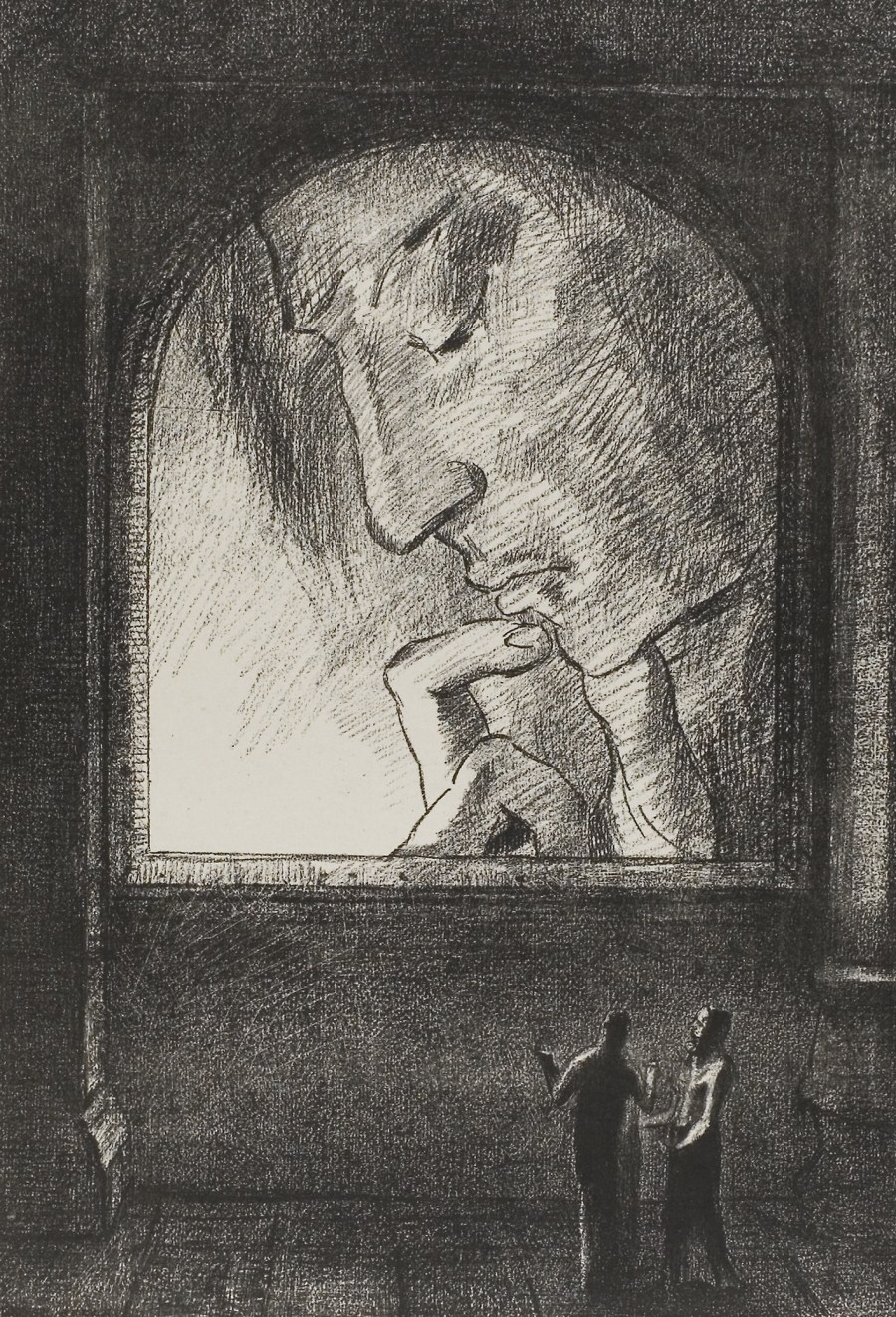
Featured Art: Precarious Glimmering, a Head Suspended from Infinity, plate 3 of 6 by Odilon Redon, 1891

I rode my bike down from Pilgrim Hill
toward the river that splits our town.
Along the way I waved to Sheriff Roy
and Mildred Floss, then wondered what
they were saying about me and my family.

It was fall and the road was littered
with goose shit and hyena shit and
shit-shadows shrinking in the rising sun,
and Estelle was bringing milk and muffins
to Mayor Bob’s bedside and pretending
his soul was alive inside its doltish husk
and my Noni was sitting in the bathtub
like a pile of wet clothes while Grappa
lay in bed dreaming of blood-hungry Cossacks
cruising the Steppe on thundering horses
and the town was still quiet enough
that you could hear the river’s bashful giggle.
I was headed to my shop
to build a desk for McElroy.

Up on Pilgrim Hill my mother’s voice
had spoken to me from her grave
in the Jewish section, had told me
about a little boy of few delights
and many sorrows who roams the high ridge
where Dorsell Quivers chases fox and deer.
My mother’s voice said only she
can see that little boy right now,
but he’ll saunter down and climb into
the belly of a comely maiden
as soon as I’m ready to be his dad.

I don’t want a boy of many sorrows,
I was such a boy and my heart
isn’t big enough to bear another,
to blaze the cul-de-sac of his youth
or watch his terror of his own hungry body
and the other demons of his undoing
hound him from his destiny.

Read More
Night Dodge

By Jill Leininger

Every philosopher I haven’t read is drunk and arguing
             in the same Dodge Chrysler. I swerve
to miss them, blinded in their sublime 60-mile-an-hour
             wake along the dotted divide. Looking back,
how odd! There was no way to distinguish one pipe from
             the other, Spinoza from Kant, yet I knew,
in the sudden, smoky fervor of that car, who they were:

in aggregate, the thoughts I haven’t formed, books skimmed
             and come alive, unified recklessly
behind headlights to make me pull off under the half-lit
             letters of this truck stop, Esso $3.89.
In the time it takes to remember the phrase “burn and dodge”—
             in fact, to misremember it—they’re gone.

I wake up hungry, of course, grasping for the words I’d heard
             in my head as the reel of the almost-
crash replayed. But in the dissolve of daylight I find only
             one image: a license plate, which someone had tied
to the bathroom key and, if memory serves, cleverly elided.


Read More
Abandoned Settlement

By Christopher Brean Murray

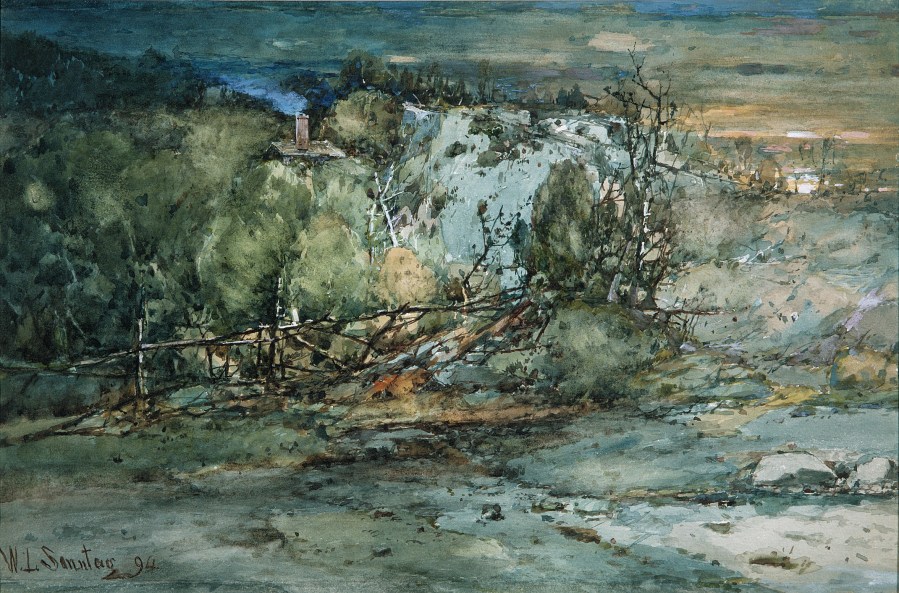
Featured Art: Frontier Cabin by William Louis Sonntag, 1894

We came upon it at midday. We were in need
of a rest. Our rucksacks were heavy,
and the trail we’d navigated wove serpentine
through mountain crags. It laced figure-eights
though fields of stone before tracing the lips
of cliffs that hung over the gaping abyss.
Eagles cried and soared through the cloudless
expanse. A violet lizard stared at us
before vanishing. Vegetation was sparse:
only trailside scrub and grass-clumps.
Yet, at the settlement we found shaggy spruces.
Aspen leaves flickered in the breeze.
The odor of Douglas fir streaked the air.
We advanced into the enclave, offering
a polite greeting to our anticipated hosts.
No answer. I kicked open the door of a cabin—
it smelled of urine. On dusty floorboards lay
a collapsed soccer ball and some thumb-tacks.
Pinned above a soiled bunk, a picture of
a sable-skinned seductress spreading her sex.
She wore high purple boots and a white derby.
Mouse shit speckled the floor. Otherwise,
the cabin was empty. We walked a trail
that hugged a creek into which someone
had hurled a mini-fridge. Did we hear music? Read More

Buzz Can Happen Here: Sinclair Lewis and the New American Fascism

By Michael Mark Cohen

Featured Art:

The exquisitely named Berzelius Windrip, known to all as “Buzz,” is the fictional politician and “Ringmaster Revolutionist” who ousts FDR from the Democratic ticket in 1936 and gets himself elected dictator in Sinclair Lewis’s speculative novel It Can’t Happen Here. No uniformed buffoon like Italy’s Il Duce, nor an awkward, vegetarian mystic like Adolf Hitler, President Buzz Windrip is a decidedly American kind of fascist.

Published in October 1935, in the sixth year of the Great Depression, It Can’t Happen Here was a major literary and political event. Not only was Sinclair Lewis famous for being the first American to win a Nobel Prize, in 1930, but this novel gave both name and narrative to Americans’ growing fears of whatever “It” was. Critics praised the book, written over the course of one summer, for its journalistic immediacy, and Lewis was so committed to capturing this sense of urgency that he insisted on changing the text at the printers after the September 10th assassination of Senator Huey Long.

After Hollywood spiked a film version (a decision made by the conservative head of MGM studios at the request of the German foreign office), Lewis wrote a play for the Federal Theater Project. On October 27, 1936, 21 companies in 18 cities debuted local productions of It Can’t Happen Here. “Out in Denver” reported the New York Times, “dictatorship came to a small Colorado town, and in Detroit it captured the factory district.” Companies performed in Yiddish in New York City, Spanish in Tampa, and an all-black cast focused on racial issues in Seattle.

Read More

Take Me to Your Lady Leader

By Kristen Lillvis

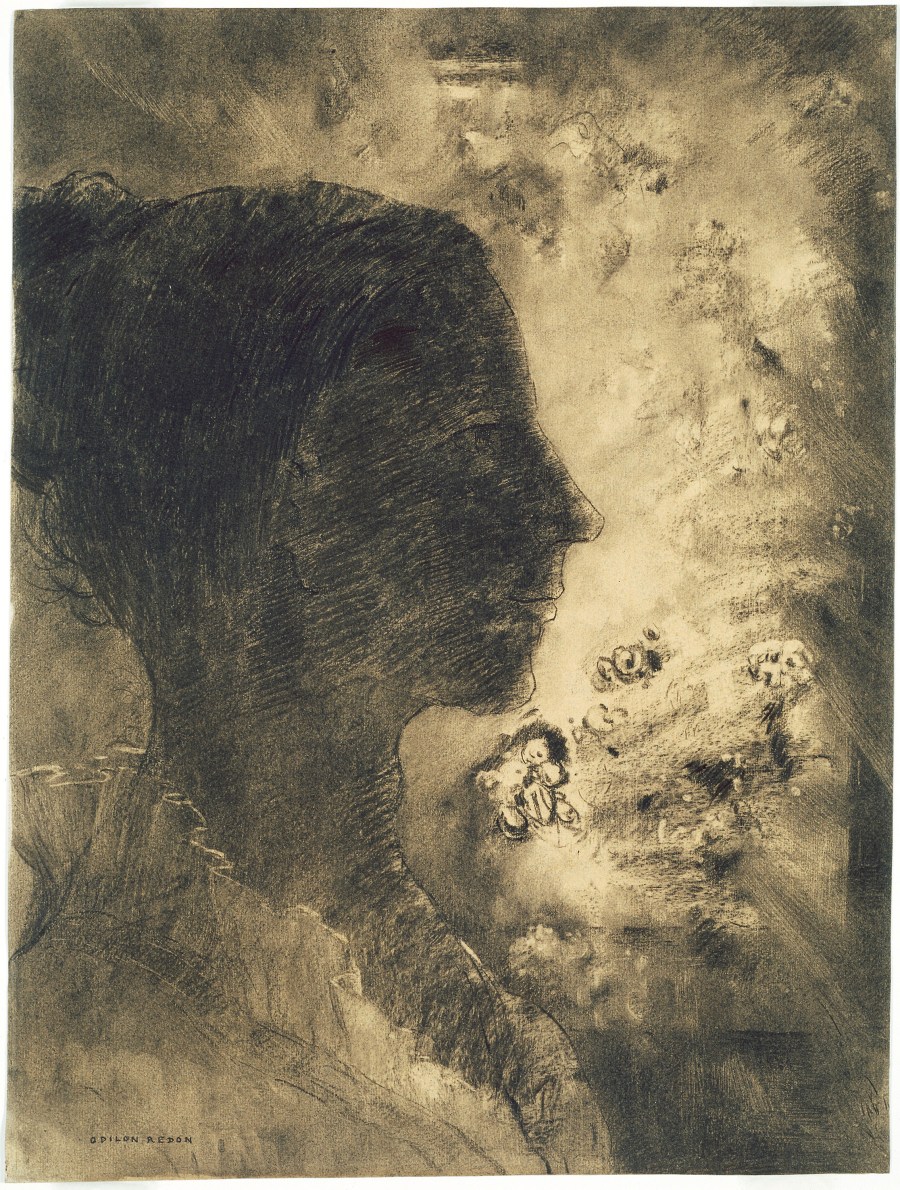
Featured Art: Profile of Shadow by Odilon Redon, 1895

Contact, Carl Sagan’s best-selling 1985 science-fiction novel, tells of alien shape-shifters, wormhole-traveling spacecraft, and—perhaps the most fantastical element of the bunch—a female president. Yet Contact’s protagonist, Eleanor “Ellie” Arroway, compares President Lasker to her predecessors with no acknowledgment of their gender difference, noting that Ms. President demonstrates an appreciation for science seen in “few previous American leaders since James Madison and John Quincy Adams.” Despite her tie to the presidential establishment—and regardless of Sagan’s attempt to make her gender unremarkable—President Lasker still fulfills the function particular to women world leaders in literature. Whether she erodes or extends existing gender stereotypes, the female president operates as a sign of the apocalypse or, at least, a harbinger of the unfamiliar, a reminder to readers that they have entered a world drastically different from their own.

Read More