My Mouth Versus Your Mouth

By Devon J. Moore

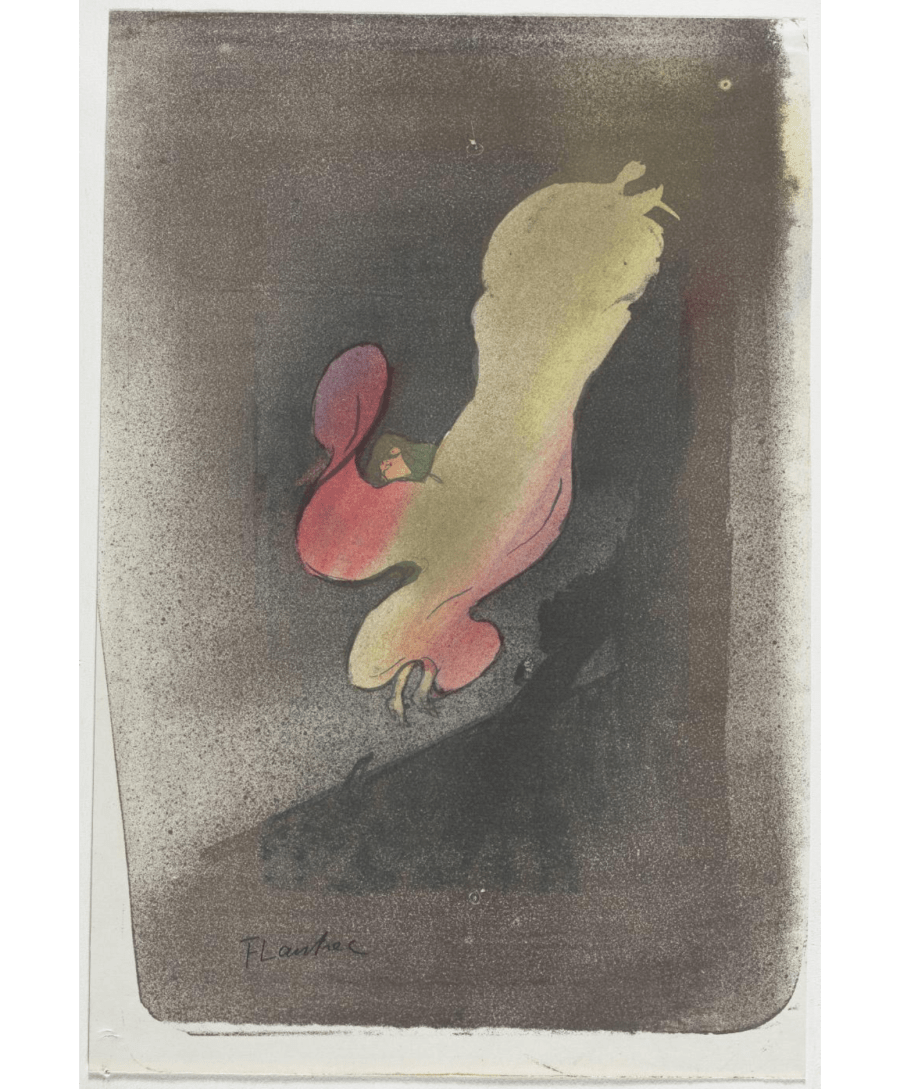
Featured Art: Miss Loïe Fuller by Henri de Toulouse-Lautrec

Gwyneth Paltrow is on the air again
saying something about the difficulty of being
a mother on set is more difficult than being
a mother in an office, on a train, commuting
to those 9 to 5s. She says you have it easier
when your life is synchronized to the needs of mouths
that are not your mouth, to the needs of bosses
that don’t know your name. You have it easier when
you’re alone in a room with a baby,
when the sun hasn’t risen and your chest is dripping milk
and you wonder if today is the day the paycheck
or the 7 o’clock bus or the sun won’t come.
Gwyneth, I don’t have a baby,
but my dread is bigger than your dread,
my breasts are bigger, heavier, than your breasts.
Do you still feel the need to compare?
How about this? My cat would be cuter than your cat
if it hadn’t been for that sick neighbor and his box cutters.
My lover left and his back got smaller,
more quickly, than your lover’s back.
My dad dying sucked more than your dad dying sucked.
I could do this ridiculousness all day. But, Gwyneth,
the memory of my mother needs me
to say, that novel she always wanted to write
never got written. I was a needy daughter,
maybe even needier than your daughter.
I demanded
she look at me instead
of a book or the movie on the TV,
and maybe, Gwyneth, you were
in it, being thinner than my mother
but not prettier. There were days
my pretty mother didn’t look at me
because she couldn’t see past the dark
space in herself and I hated her.
There was a day my mother cried in the laundromat
when a woman, another mother, asked her what she did
for a living, and when my mother said she was a home
health care aide, the woman said that meant
my mother was nothing
but a maid.
The color of blood is more vivid and harder to clean
in my daydreams than in your daydreams,
and a powerless life is harder to describe to the powerful
than the sound of my mother crying on the rug.
But I’ll try.


Read More

Grace

By Craig van Rooyen

Featured Art: Pine Tree by Giovanni Segantini

The History Channel’s playing “The Gold Rush” again.
All those bearded men looking at reflections
of themselves on the surfaces of creeks and rivers and lakes.
They’re so beautiful coming out of ramshackle cabins,
thumbs tucked into suspenders, wading into streams
the color of cheap whiskey. That golden light
on their shoulders, in their beards, dripping
from the brims of their hats, high on
“howdy” and “rough and ready,”
around every bend in the river, expecting
life to begin. The flash of light in a silver pan
full and overflowing. All that hope. Out of
the river, there’s always more earth.
There’s always the scooping and sifting and
throwing away. Everything left behind—out of
frame: The women in their calico, waving goodbye.
The steaming cows in their barns. Now just
the sloshing desire of this moment and the next.
Sure, you have to be willing to kill a few Indians.
But as long as you’ve got a pan and a river
to dip it in, you can forget the rest.
At least that’s what I tell myself before the first
commercial break. Before those attractive
late-middle-aged people clutch each other
in honey light and the baritone voice-over tells me
to go to the emergency room if I experience
an erection that lasts more than four hours. I wonder
if anyone ever panned for gold in terrycloth—
my fabric of choice for watching “The Gold Rush”
in bed at 10 a.m. on a Wednesday. I wonder
if any of those bearded men had a bottle of
Prozac back in the cabin next to the straight-blade
razor underneath the cracked mirror—something
to take the edge off all that failure, something
to dull the regret of walking out on their women
and cows. Of course they’d have another name
for Prozac, like maybe “nerve pills,” as in:
“Durn near forgot to take my nerve pills this morning, Jake.
Christing Jesus, sure don’t want to start sawing
at my wrists again, now do I?” I love the way
there’s no word for shame in the language
of gold miners. All that hope is contagious.
In fact, I believe if I really tried, I could get up
and shuffle to the bathroom and brush my teeth
during the next commercial break. I love
the History Channel! It’s so inspirational.
Right now, the sad banjo music is playing—
the plinking of catgut string over doe-skin,
a sound so Californian it makes you weep for
the all-night diner in Auburn where it’s 6 a.m.
and the sun is lighting up the foothills and
the American River is still frothing to get wherever
it’s been trying to go all night long. All the gold’s dug out
of the hills but the waitress is calling you “love” as she
puts down a cup of awful coffee and sits in your booth—
night shift done. It’s as if she knows you. As if she’s
made the same mistakes and she’s telling you it’s okay.
Now she’s taking out a bobby pin.
Now she’s letting down all that golden hair.


Read More

Lost

By Craig van Rooyen

Featured Art: Flowers of a Hundred Worlds (Momoyogusa): Wisteria (Fuji) by Kamisaka Sekka 神坂 雪佳

In a strange city this afternoon, I looked for myself
on a cart of bargain books. I recognized
my mother’s faith and thrift in “Macrame for Dummies,”
and bought the book for 50 cents.
I recognized my father’s dark devotion
in a tattered copy of “My Utmost For His Highest.”
I fanned the pages with a thumb, felt
the dank breath of the Holy Ghost,
and put it down. I was not there. Not in
“Seven Habits Of Ecstatic Gurus.” Not in
“How To Pick Up Pretty Women With An Ugly Dog”
or “Twitterpated: An Instruction Manual
For Self-Discovery In 140 Characters Or Less.”
On the corner, a quartet of starving students played
“Let’s Get Lost,” faking it in the way of the talented young
winking with their instruments at the business casuals
waiting for a bus. Art is about loss,
they seemed to play. Can you dig it, man?
And I can—suddenly 47 and away from familiar signs,
too old to be discovered; too young to be invisible,
sitting in Union Square under
the lifted tail and muscular haunches of
George Washington’s horse—its neck arched under rein,
fighting to cross East 17th to Forever 21.
Valley Forge behind, knowing not
where he’s going next, our country’s father
(in this bronzed moment) is surely unable to predict
his journey’s end: in bed with a cold, bled to death
by four doctors earnestly trying to save him.
I’m happy to sit in his moon-shadow for now,
park lamps blinking on, smell of goat cheese and ganja
finding my nose, trying not to listen to the soft clicking
next to me as two young people introduce
their oral piercings in the dark. Across the way,
the girl with the Mohawk stops playing her bongo drum
to tell a friend about a rainbow brother who saved her
in the Bronx. Took me in and we smoked a bowl—
no questions asked, no strings attached.
On the corner,
a street preacher finds his voice, improvising his holy rant
on a theme of goats and sheep, dividing us into lost and saved.
We’re all both, I want to tell him, cycling through a life-long
game of hide and seek. Even me—sitting under Washington’s
horse’s ass, smoking the flare of my guilty Marlboro
to the filter and feeling the city turn on around me—
a lost coin burning to be found.


Read More

Conversation with Amy Bloom

By James Miranda

JM: One of the things I’ve always admired in your fiction is the way you’re able to use taboo and transgression so deftly and intelligently as a source of narrative tension. From your earliest stories in Come to Me (such as the much anthologized “Silver Water” and the gutsy “Sleepwalking”) right up through your complicated protagonist Lillian in Away, or Iris and Rose in your newest book Lucky Us, you seem to have an intense interest in characters that push the bounds of what is socially acceptable. Yet their acting out never feels contrived or overdone. The prohibited takes on a sacredness that’s always palpable and quite beautiful in your writing. Are you conscious of the place that taboo and transgression have in your fiction? Do you find such socially constructed forces to be great fodder for compelling narrative?

AB: I don’t really ever think of myself as breaking taboos and transgressing. It’s also true that although good manners matter to me a lot social norms do not. Good behavior is not usually a subject that fascinates me.

Read More

Conversation with Marie Howe

By Brad Aaron Modlin

Brad Aaron Modlin: In the past, you have written in the persona of both Eve and Mary the Mother of Jesus. While Eve speaks anachronistically—of driving a car on ice, for example—Mother Mary does not clearly do so. In the new poetry, Mary Magdalene does. When you (re)write a pre-existing character, how do you know when to stick to what we’ve already heard and when to change it? What do you hope to add to these characters?

Marie Howe: Midrash is a form of rabbinic literature, a storytelling that fills in the gaps in stories from the Torah. I always wished that Christian literature encouraged that kind of imagining. Growing up with the characters of Eve, Mary, and Mary Magdalene, I was moved by the deep silences within their stories. These are women in extremity, and also women who go on living, through those extreme states, into days and months and years—as we all do. What is their experience? And what is it the day after? And the day after that?

Many others have written through these voices—Rilke in his “Life of Mary,” W.H. Auden in his Christmas Oratorio called “For The Time Being,” Eliot, and recently so many women have brought their consciousness to these stories: Lucille Clifton, Jorie Graham, Brenda Hillman, many women writers. Each writer receives the poems according to her sensibility.

Read More