THE CANYON OF UNKNOWN WATER

By Kent Nelson
Featured Art: “Close Up – Spatial Neighborhoods” by Alex Brice

Henry shoved his drift boat from the trailer into the river, unhitched the winch line, and wedged the anchor into a crack in the cement ramp. He drove his Tundra and boat trailer up the ramp to the parking lot. He’d already loaded his gear into the boat—fishing rod, all-time favorite foods, stove, lantern, camping crap. He put his parking permit on the dash, locked the cab, and pocketed the key—no sense letting people steal what his daughter could use. He’d sent Catherine the spare key and a note that said the truck was at the Spring Creek put-in on the South Fork of the Snake River, which, given his habits, wonts, and desires, was the place he loved most in the world.

The note went out in the mail Wednesday morning, August 17th, from Idaho Falls. Catherine wouldn’t get it in L.A. until at least Friday or Saturday, if she checked her mail, but probably Monday. The truck wasn’t going anywhere without a driver.

Read More

Come as You Are

By Ryan Shoemaker

Featured Art: Delta Bloom by John Sabraw

“Bruises on the fruit, tender age in bloom.”
Kurt Cobain, “In Bloom”

“He walked out the back door of Exodus and climbed the six-foot wall … over the next two days, there were scattered sightings of Kurt.”
Charles R. Cross, Heavier Than Heaven: A Biography of Kurt Cobain

Thursday, March 31, 1994, my eighteenth birthday. That was the day Scotty and I helped Kurt Cobain out of a tight spot and then jammed with him in my basement. I know what you’re thinking — I’d have thought the same if it hadn’t happened to me. But it did. This was back when I played guitar and Scotty drummed, back when we had this crazy idea, like a million other kids drunk on the grunge zeitgeist, that all we needed to be rock stars were some ratty jeans, a thrift-store cardigan, three guitar chords, and enough repressed angst to pen the next great teenage anthem. But that was years ago, six days before Kurt put a shotgun in his mouth, before Scotty really did become a rock star, and before I stopped caring about all of it. That day I met Kurt, that changed everything. 

Read More

The Last Innocent Moment

By Janine Kovac

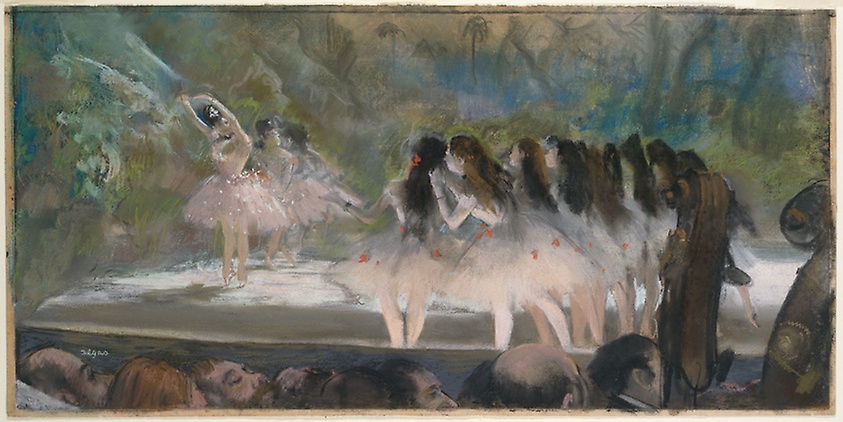
Featured Art: Ballet at the Paris Opéra by Edgar Degas

Today we are a cozy family of three—Daddy, Mama, and daughter. We are taking a road trip from our home in Oakland, California to a town called King City so Daddy can perform his signature role as the Sugar Plum Fairy cavalier. It’s our last trip together before the twins are born and Chiara-Noelle has told me in her three-year-old way that she is not pleased about this pregnancy. She wanted a sister, not two brothers and she can’t understand why we can’t just make what’s growing inside me be something else. Read More

Flight Lessons

By Barbara Ganley

Featured Art: “Holy Holy Holy” by Yan Sun

Because it’s Thursday, nearing five o’clock, Lucie is well into a doozie of a headache. Every week at this time little Jenny Baker hands her one as they sit side by side in the dining room and Jenny busily tortures the piano. She’s a narrow slip of a thing with a distracting, gum-baring smile made stranger today by a drift of tiny metallic stars sweeping across her cheeks like cosmic freckles.

Her orange high tops smack the stool’s taloned feet bapbap as she bludgeons the keys in an apparent heavy-metal version of “Long Long Ago.”

The piano, old and patient, takes it. Lucie, who is neither of those things, says, “A bit slower and softer now. See if you can find the melancholy.”

She uses her hands to play a phantom keyboard floating in the air. She must look ridiculous. “Sing the words if you like. I find that helps.” She is ridiculous.

Jenny, clearly having the same thought, grins at the keys, speeds up and hammers away. She doesn’t sing. She never sings.

What ten-year-old doesn’t sing?

But of course Lucie is confusing children with birds, Jenny with Bacchus, her grandfather’s sidekick and belter of sea shanty and Broadway schmaltz. Since moving back home, she has learned far more about thirty-year-old African grey parrots than about ten-year-old humans. Prefers them, too, if truth be told, even if they do bite. Lucie understands that people would find that small of her. But this ten-year-old human next to her couldn’t care less. A look of near madness flashes across the girl’s starry face. Her thin hair switches about her neck like an agitated tail. She’s seeing herself onstage, adoring fans at her feet. Next she’ll be peeling the stars from her face and tossing them to the crowd.

Read More

Audition

Winner, New Ohio Review Fiction Contest
selected by Charles Johnson

By Leslie Rodd

Featured Art: Nymphs and Satyrs Playing Musical Instruments by Claude Lorrain

San Francisco, 1969

Outside the jazz club where I’ve been audience, player, and piano tuner over the years, it’s quiet at this sunstruck ten o’clock, and I have a shivery thought of a guitar and a girl that began inside my head last night. No rocking, no rhythm, no foot-stomping or window-shaking. Only the fifty measured strides I’ve counted from the corner where the 30 Stockton dropped me off, past the police station to the alley, the dip in the pavement and the sloping rise, the manhole cover to my left, yes, here it is, the last of my landmarks, reassuring me I’m in the right place. A thought of a girl, who used to make my music glow.

I rap the metal tip of my cane against the partly opened steel door, the tradesman’s entrance.

“Easy does it there, fella,” a man calls out to me.

“Jimmy McGee,” I identify myself.

He says, in a voice that’s smoother than Roscoe’s, “Come on in, Jimmy. Mustafa Monroe, at your service. Roscoe’s on-again bass, as of yesterday.”

Read More

Play it by Ear

By Claudia Peirce

Featured Art: The Big Red Ball by Ellen Lanyon

Recently I’ve become a “regular” at an especially sub-standard diner called Sam’s World. Although I have no special fondness for the soggy potatoes, greasy burgers or limp lettuce leaves they dish up, Sam’s World is within walking distance. This is important because I have no car and my apartment has no kitchen. There is an old, barely functioning refrigerator in the narrow hallway between the bathroom and the only other room. I don’t hold out much hope for this refrigerator since I can’t bring myself to defrost it. A solid block of ice has formed over the opening to the freezer, and at some point I expect the whole thing will just blow up.

One day I might be out of debt and able to afford an apartment larger than one hundred and fifty square feet. Then again, I may not. When I consider the size of my indebtedness I realize I could quite easily be dead before I pay it off.

Anyway, it’s Tuesday evening at Sam’s World; I’m not very hungry but am in need of comfort so I decide to skip actual food and have ice cream and coffee.

BUM fired me today but then he changed his mind. He said I didn’t really have to leave but if I wanted to it would be all right. Then he went back to our mail-sorting session as if nothing unusual had occurred. I would guess an episode like that does not bode well for job security.

Read More

Influence

By Sydney Lea

Featured Image: Study for “Music” by Francis Augustus Lathrop 1894

Those who know me know that I’ve long been deeply in love with what Roland Kirk called “Black Classical Music,” especially of that era whose great practitioners include Monk, Rollins, Davis, Jackson, Roach, among others; and I’m frequently and unsurprisingly asked about the influence of jazz on my poetry. Although I want to avoid any glib answer here, whenever the question is posed, I’m never entirely able. The interplay between the music and the poems I write is likely beyond words. Indeed, it may be the thing that I as a poet have, however furtively, long been trying to find words for.

That said, one of the surer things I can surmise is that as more or less a formalist poet, I like feeling the chafe of language against the limits of received (or invented) structure. There is no moral nor even aesthetic stance here: I dislike the formalist/free verse debate, because it too often sounds like a pair of parties elevating what they do and can do into virtue and debasing the things they can’t and don’t do into vices. As a rule, the accompanying arguments are downright ill thought out: the free versers, for instance, associate formalism with elitism and political reaction . . . which makes one wonder where the great practitioners of Delta blues and its musical derivatives would stand. Equally vapid arguments—free verse suggests sloppy poetics and fuzzy thinking—are too often trotted out on the other side.

Read More

Homer and Jazz

By Ralph M. Rosen

Featured Image: George Gershwin Self-portrait by George Gershwin 1934

Homer enjoys an unquestionably privileged status in our own time as one of the grand cultural legacies of antiquity, so it can come as a surprise to realize that his greatness was not always unchallenged. Even in antiquity there were signs that Homeric poetry did not suit all tastes and aesthetic standards, and some readers today still find various features of Homeric style jarring. His great works, the Iliad and Odyssey, often feel “different” from other literature—a bit “primitive,” perhaps, less self-consciously “literary” or “literate” (whatever we mean by these terms exactly), with roots in folk and mythological traditions that complicate, at least, their stature as icons of high culture.

In American cultural history of the past century, we can trace a curiously parallel aesthetic dilemma in the case of jazz music, which, to this day, occupies an unstable, culturally fraught position between the high and low, the “serious” and “popular.” I’d like to suggest that the aesthetic “problems” ascribed to each art form, Homeric epic and jazz, have much to do with the compositional and stylistic techniques idiosyncratic to each genre—techniques that rely first and foremost on memory, and only secondarily, if at all, on literacy (whether verbal or musical). Poetry or music that is essentially composed during the course of a performance, as is the case for the Homeric epics and many forms of jazz, simply look and sound different from poetry and music composed in advance and fixed as text before a performance. It is not surprising, therefore, that such art forms will sit uncomfortably in a culture such as ours which has come to privilege the literate and literary over the spontaneous and improvisational.

Read More

Opera, or: Longing

By Natania Rosenfeld

Opera has the power to warn you that you have wasted your life. You haven’t acted on your desires. You’ve suffered a stunted, vicarious existence. You’ve silenced your passions. [Y]ou have used only a fraction of your bodily endowment and your throat is closed.

Wayne Koestenbaum, The Queen’s Throat: Opera, Homosexuality, and the Mystery of Desire

From the time I was twelve, my father, a German professor at a small college, took a group of students to Germany every three years for the spring semester,  and my mother and I stayed behind in Ohio. My mother was too big,  too inwardly alive and desirous, for our small town, and I was filled with the itchiness of puberty. Two restless females, we entertained ourselves together as best we could. Sometimes we drove out into the country just to get away from home. We’d leave our little town to coast through the landscape of cornstalks and flat brown fields. We talked about life. Sometimes we drove past a collapsing gray barn that said “Ma ouch obacc” in faded letters. On a bright day you could make out the missing “il” and “P” from “Mail Pouch Tobacco.” A boy I was in love with lived on the same road as the Ma ouch barn. His father was an air-traffic controller and his mother was an Asian war bride, and Phil was a pimply beautiful boy with a sad face, who trapped animals on the weekend and shot them. When I gazed at him in the school hallway, I felt he was meant for some other destiny, and I wanted to rescue him from his life of dreariness and violence. The problem was that he ignored me completely, was only dimly aware of my existence, my great longing.

On Saturday afternoons, my mother and I always listened to the live Metropolitan opera broadcast on the radio. We’d turn it on in the car and continue listening when we got home. We hated to miss any parts of the program, and were particularly fond of the quizzes and synopses between acts. “I re- member the opera in Vienna when Papa and I were students,” my mother told me more than once. “He wouldn’t spend a schilling on seats, and we had to stand the whole time. Afterward I wanted to buy marroni—roast chestnuts— from one of the old men selling them in the winter streets, but he always said we couldn’t afford them.” My mother was ashamed of having given in to my father, and couldn’t stop resenting him for making her feel like a beggar. In my mind, I saw him with a long, unhappy face, unable to splurge even a little after watching Mimi die of tuberculosis for two hours. “Let’s try to guess the answers to the quiz,” I said, to cheer her up; and I was amazed at how many of them she got right.

Most of all, I remember the applause at the end of the final act, the continuous shouts of “Bravo!” or “Brava!” with a long, triumphant, trailing emphasis on the second syllable—and the announcer saying, “Now Dame Sutherland has picked up a bouquet of roses. Smiling, she holds her arms out to the adoring audience.” The diva blew kisses, and the applause went on and on like a great dark sea. My mother and I quivered and turned up the radio just for  the applause; we were still weeping for the noble, self-sacrificing, gorgeous lady who had just died—who had gone down singing, her very sobs sublime music—and now we wept for the singer, and for the joy of the audience. Singer and audience merged together, their satiety filling our house those gray Ohio Saturdays.

Thirty years later, my mother and I finally attended the Metropolitan Opera in New York City. We were such different people by then! No longer girl and frustrated grown woman, now two women, one elderly, the other verging on middle age. Both of us had brushed against death; we’d been laid open and operated on within six months of one another, each visiting the other’s bedside. We’d traveled to Italy in December of 2001, when no other Americans were traveling, and reveled in the artistic and culinary offerings of Florence. Now we were going to realize a long-held dream. Because my mother’s plane was late—she was coming from Ohio, I from Illinois—we missed the first act of The Marriage of Figaro. We watched what was left of it on the little television downstairs, drank champagne and toasted one another. When we got into the

hall at last, we squeezed hands in frissons of delight. Cherubino singing of   his multiple loves—poor polymorphic, adolescent Cherubino, who cannot go near a woman without trembling all over—made us laugh and cry at once. The duchess singing “Dove Sono”: oh, we’d been there! The opera’s triumphant finale, with its reconciliation of all opposing parties, filled us with joy—yes, it can be that simple, joy! Afterward, we walked up Broadway in a light, warm rain, sharing an umbrella, looking up at the lights, gazing at the people who passed us, planning our next days in the city.

Two nights later, we went to see the bizarre French opera La Juive, cited in Proust whenever Marcel encounters his friend Saint-Loup’s mistress, the Jewish prostitute Rachel. Produced by a Viennese company, the piece was staged awkwardly, tendentiously, and rather stupidly. The bizarrerie of that opera and that production deserves its own chapter, which perhaps someone has written elsewhere. My mother and I were a little tired, and I was annoyed by her strong breath and her continual uncomfortable shifting in her seat; it is quite possible she was annoyed by me, as well. I am well past supposing children aren’t as irritating to parents as parents can be to children, and adult love is often an exercise in toleration. In short, it was an unromantic night at the opera. Instead of a sublime eighteenth-century fol-de-rol, we had nineteenth-century Jewish self-hatred in all its knotty mess, and we felt messy ourselves. The audience around us, at least a third Jewish I’m sure, was confounded. As far as we could tell, Vienna’s black-and-white notions about staging the Gentile-Jewish conflict were not appealing to anyone. The music was pretty, but lacked depth. Only one aria bowled us over, the famous “Rachel, quand du seigneur,” in which the father figure, a Barrabas, sings of his mixed feelings toward his daughter: should she die as a Jewish martyr, or should he reveal her true identity as his adopted Gentile daughter and thereby save her from the burning cauldron? Diva-like, Neil Shicoff had let it be known at the start of the performance that he had a slight cold and would not be singing up to par—and succeeded in making the entire audience feel, “If this is singing below par . . . !” We fulfilled our ultimate fantasy then: shouting “Bravo!” with full throats, weeping with excitement, surrounded by a sea of ecstatic listeners. Not cut off, not insulated in a car in the cornfields, or lonely in a Midwestern house; not far, far away from the world, but in the world, at last. Again, we walked home in the rain, talking this time about all the thorny questions the opera had raised—and again, planning the full days and nights in the week that remained to us.

It seems to me that if opera is about anything, it is about longing—longing for the place where life truly happens (“Moscow!”), for the exotic lover, the husband who will bring us the golden fleece, or at least pour marroni in our laps; or for possession of a singular talent. My mother and I are divas disguised as professors at provincial colleges. When we stand—in her case, stood—before the classroom, sometimes an eloquence pours from our mouths that disconcerts the students. They sit in silence, and I can see on their faces, Where did this come from?

Unappeasable longing. And now, these brown fields of Illinois.


Natania Rosenfeld is an associate professor of English at Knox College and the author of Outsiders Together: Virginia and Leonard Woolf (Princeton, 2001). Her poetry, fiction and essays have been published widely in journals, and she is the recipient of an Illinois Arts Council Literary Award for her prose poem, “Bodies,” published in Another Chicago Magazine in 2007.

Originally appeared in NOR 8.