What Stays, What Goes

By Ruth Bardon

I want to believe that pleasure leaves 
a light stain on the bones. 

They say the body remembers pain; 
they never mention joy. 

I know that pain accumulates,  
fattens like a tick. 

I want to believe 
in a quiet shine, 

some ruffled fur, a subtle scent, 
a sprinkling of light. 

I told myself repeatedly 
when she was busy dying 

that our little celebrations 
would have to do her good, 

would have to leave a fingerprint, 
a residue of gladness, 

and now that you and I repeat 
the steps we took before, 

the visits and the guided tours 
as if we’d never been there, 

I have to hope that even though 
I know we won’t remember, 

the strange delights will mark our bones  
and metamorphosize, 

and nourish something in our blood 
to help us at the end. 


Read More

The Last Photograph of Laura Before We Found Out She Was Autistic

By Kim Farrar

She turns twenty-seven tomorrow
so I set the old photo on my desk
to look into her blue eyes and guess.

She’s standing next to the park bench
and peering directly into the camera; what they say
about eye contact was never true in her case.

Her fingers gently grip Elmo’s well-loved neck
but he’s looking backwards at the swings
where younger mothers plot secret parties.

Perhaps they didn’t appreciate
how I had to yell a thousand times
for Laura to stay out of the mud.

The breeze lifts blonde strands above her ears,
her home-cut bangs tousled, a few wisps
curving upward at the top of her head.

The leaves must have rustled
as I snapped the picture.
That easy wind with the future on its tail.


Read More

Without a Net

By Nick Norwood
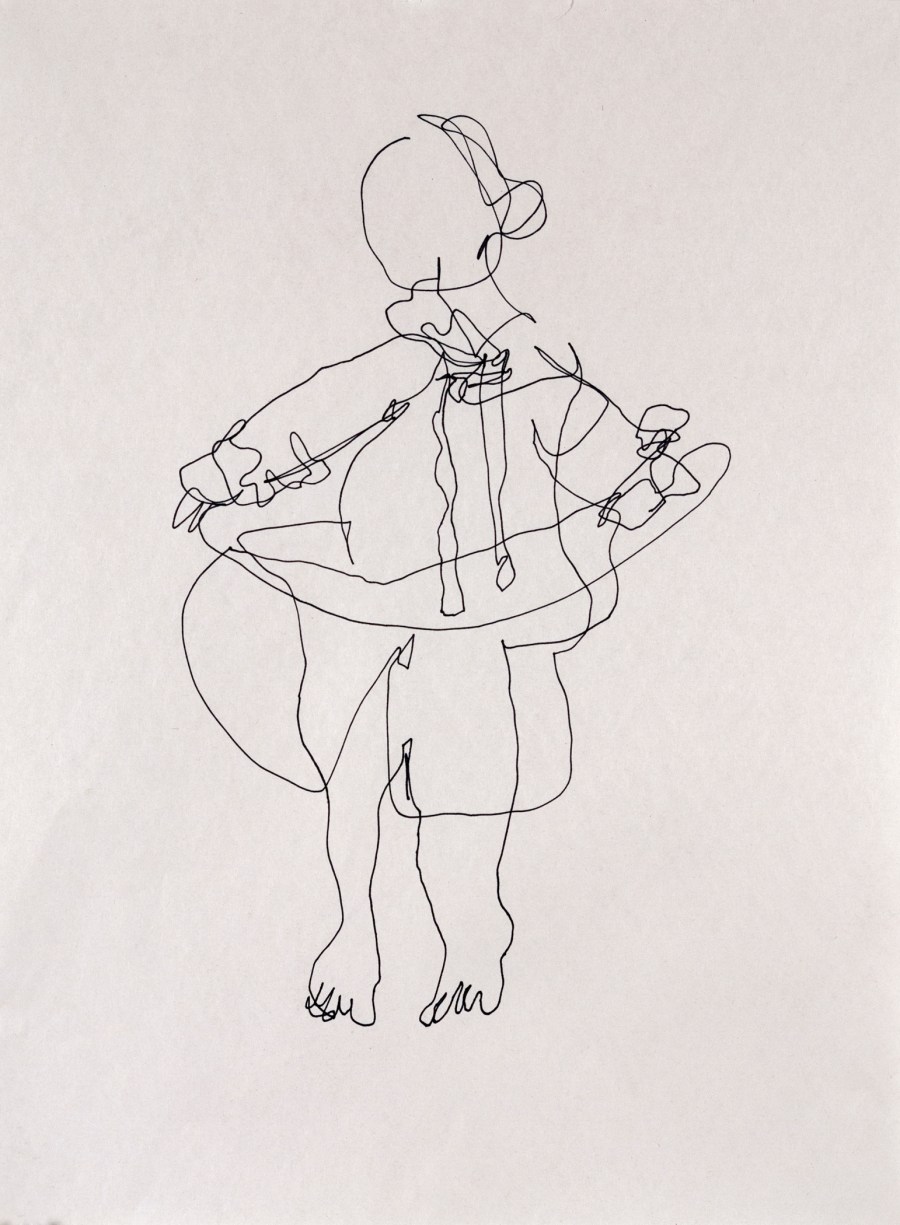
Featured Art: “Untitled” by Josiane Kouagheu

Bored, sluggish in the gray air
of a downtown office tower,
we three “junior associates”—Chris,

Ray, and I—absconded to a park
in the middle of the afternoon.
Amid the murdering heat of mid-July

it was deserted, and we slipped out
of our cheap suits and into shorts
and T-shirts in the public bathroom,

retrieved, from the backseat, a worn
Spalding, started pounding the rock
on cracked cement, balling the jack

in a kamikaze game of cutthroat.
And when, late in the action, faces
red as blisters, Chris—who would

make it to “senior associate” only
to grow glioblastoma, call me out
of the thin blue thirty years after this

epically random afternoon and
a month later greet me at his door
in Minnesota, bald head gripped

by tentacles ending in electrodes—
this same Chris, at 25, three years out
of college and still untried, untested,

unsure, cut hard toward the basket
and pulled up to hoist a rainbow
jumper. Ray—who would disappear

from our lives, reemerge, disappear
again—like myself, stopped, panting,
half-dead, to follow the ball

in its immaculate trajectory,
its slow-motion backspin, rising
and rising toward a haloed instant

of solar eclipse, then falling, falling
toward the netless iron hoop, and
passing through in perfect silence.

Or did it? Good? Or no good?
Game winner, or brick? Passing,
as it did, through nothing but air.

In memory of Christopher B. Vanatta


Read More

The Fool’s Vow

By Joshua Boettiger

Sibylle gave a toast at our wedding—
May your beloved always be like a stranger to you.
So we practiced, took turns being the hitchhiker.
It was a turn-on, but it was also a risk—
strangers can be so cruel.

I know a man who says, I don’t know,
to every question he is asked, even questions
he knows the answer to (especially those).
It’s not like I’m ignorant.
I know that every six seconds
another word is dropped from the lexicon.
I know there are tables that mark the tides—
High, then low, then high, then low.
I’d like to be that weatherman.

But better than that would be
standing here at roadside’s bend

as you come around the turn
holding the wheel with one hand,
shocked by the suddenness of me.

I remember the first day of kindergarten
crying outside the door of the classroom
in my mother’s arms. I don’t know
what we are going to learn
, I wailed.
Shhh, she said. That’s why you’re here.
No one knows.

You and I took the fool’s vow—
better to believe
than to be left flat-footed
when the ram’s horn blasts.

But this, too, is a strategy.


Read More

I Learned the Small-Town Stuff

By Kathleen Loe

of trading okra for clear-eyed bass,
passed through Miss Judy’s truck window
still smelling like lake,

and of nicknames and namesakes like when Bubba’s
shut down on the blunt edge of town, the new guy
reopened as Wuz Bubba’s—what Mama called

a honky-tonk, shifting her cigarette and Scotch
for a quick spin around the kitchen with my father—
who had switched on the Glenn Miller Band

in his head. Her immaculate manicure in his
rough rancher hands, rougher with the cornmeal
and bits of fried catfish—their inspiration making us all

a little tipsy, sweeping us up in the abundance
and supper had to simmer itself for a minute.
Is it fair to say it was a setup?

All their barefoot jitterbugging and kissing
in the kitchen, late-night laughing to the light riff
of ice tinkling in their drinks. It looked . . . so easy

that rowing away from the mirror-surface
of their marriage, not without its dark spots,
its chipped silvering of drink and debt.

I never saw the mists rising—risky water
has its warnings—but tipped rock-blind over
and over the lusty falls. Still, they danced

at all three of my weddings, shimmering
in beautiful new clothes, holding
their flutes high, determined bubbles rising

behind their eyes, tired from smiling at everyone, again.


Read More

Ode to a Barracuda

By Suellen Wedmore

Not the fish, but to you,
’68 Plymouth convertible,
lingering now,
rust-rimmed, dusty,
in our abandoned barn,
your once-blue enameled body
now the color
of a mud-stirred pond,
your roof cracked and peeled.
Or is that our youth
hunkered there
like a hibernating bear?
Every now and then
I run my hands across
the pitted hood.
A new valve job,
a set of tires,
a coat of paint and you
could be humming again,
my husband and I
high school seniors,
cruising the streets, top down,
friends waving as we pull in
in front of the drugstore hangout,
saunter up to the counter,
where we’re greeted with a high five.
If I touch you now,
I can sense that other life
beneath the hood: days
without budgets, appointments,
and childcare.
Some car! If I could rev
your Super 383 Commando engine,
I would hear it: immortality,
one tank of gas away.


Read More

Excerpts from Falling in Love

By Bridget Bell

The snow folded a halcyon hush over Jersey City, and I
could still make a map of all the places where we fell in
love, the snow in high drifts on the sidewalks 

where I’d later find my lost keys, shiny and heavy,
a brass-toothed life on display in a wet circle of
leftover blizzard skin: 

the bar, the press, the P.O. Box, car, apartment.
Praise the lord. I wouldn’t have to tell my bosses.
We laughed at my luck 

back then when we could still laugh at things
like that because there is so much promise in
the opening. 

Barely off the main trail, we tore off our pants could
not waste the time it would take 
to cut deeper into the Pine Barrens, and later, more laughter, 

a tick on my ass. This started with two
barstools dragged close, my knee pressed into
your knee, the pull so steel-strong 

as my fingers swam beneath a shield of sticky counter to find
your fingers. And up against the steering wheel, my old car
parked at a scenic Utah lookout, 

and after each bar shift,
I fought sleep, drove north out of the city to crash next to you
on a blowup mattress in the basement

surrounded by your parents’ packed up Xmas decor, 
my beloved dog not even allowed 
upstairs in the mornings, remember how she whined  

at the basement door while we fried  
eggs for breakfast? And now, Sweet Violet, how sorry I am.  
I hated to lock you down there; it hurt my heart, but, god, don’t you know,  
I would have done anything for him.


Read More

Unaccompanied Minors

By Chelsea Rathburn

—San Francisco to Miami, 1951 

My father recalls nothing of the flight itself, only
arriving, dazed, to meet the mother 

he hadn’t seen since he was still in diapers.
He doesn’t know how they left the foster home, 

or if his father was there to say goodbye,
or who paid for the tickets, only that they 

flew alone, he and his sister, arguing
over just whose Ami they were headed for. 

On the tarmac twelve hours later, he heard
two strangers yelling: his mother and new father, 

shouting a name they’d coined for him. They seemed
surprised, even angry, he didn’t know 

to answer to it. His memory stops there,
in that moment. Their anger never ended. 

His sister swears now there was an engine fire
that she spotted, then an emergency landing. 

More likely she remembers the stop in Dallas
to refuel, but my father’s given up correcting her.


Read More
Blue-handled Grabber

By Maura Stanton

Before her stroke, my mother used it to grab
a fallen tissue, or the newspaper crossword
when it slipped off her lap. Now it’s mine,
sitting in my study near an artist’s easel
unfolded for years. Squeeze the handles
and the grabber’s bite picks up anything light,
even a paperclip, with its magnetic lip.
Don’t want to stoop? The grabber pulls underwear
out of the dryer, or lifts the catch-and-release
mousetrap so I can see if it’s still empty.
It swipes the ceiling cobwebs, or picks up
an M&M or a grape rolled under the fridge.
On autumn walks I could use the grabber to yank
more yellow leaves off the trees to let me see
the architecture of winter below the froth,
or maybe, sitting by a window some dark night
I might grab a distant star out of the sky,
one of those little pinpricks from a galaxy
far from our own, where life’s more cheerful.
The tiny star would tremble on its way,
gleaming and giving off blue sparks as I pulled
it down with the grabber, and made it mine.


Read More

Lunch with Heron

By Maura Stanton
Featured Art: “Black Barn, Adjacent Land” by Thad DeVassie

After the rain, a heron’s stalking the stream,
lifting its delicate knees, neck outstretched,
and just as I pass by, it dips its sharp beak—
flash of silver—and swallows a small fish.
Shocked, I stand on the bank as the fat bulge
moves down the gray throat and disappears. 

But it’s not the fish, it’s the bit of silver
that’s stung me—and then I see it—
the job committee that took me out to lunch
when I was desperate for any sort of work.
Unwrapping a big, foil-covered burrito,
chatting brightly to the closed faces,
I didn’t notice foil stuck to my first bite
until I tasted metal. Then the sharp edge
cut my throat, and I coughed and coughed,
sputtering beans and salsa as I choked.
Someone slapped my back, but I had to reach
inside my mouth with my fingers to get it out
while my hosts looked aghast at the silver bit.
Another job I wasn’t going to get, I thought,
and ordered a beer, though I wasn’t drinking.


Read More

Boxes

By Rodd Whelpley
Featured Art: “Random Toothpicks #4” by Thom Hawkins

On the top shelf are coffee cups
from which I never drank
and, next to all the ghosts
of passwords, sits a stout list
of dog names I will never use.
Life is a short place, littered
with vital, misremembered notions,
riddled with porcelain shards—
spoiled gifts from a son at summer camp
or souvenirs from crispy-aired mountains
where slow steam curled past the lips
of eco-friendly paper cups. Careful boys,
careful how you finally pack my house. 
Don’t miss that stuff that isn’t there.


Read More

The federal government banned lead paint in 1978

By Caroline White
Featured Art: “Untitled” by Josiane Kouagheu

but, like an outlaw, that does not just make it
disappear: the act of searching, of hunting
down becomes something like adoration—
riding on horseback through the night only to
catch a glimpse of him, to describe again the
color of his hair. And so with two hands on
the roller we sealed in the lead paint with the
boombox in the center of the room, the disc
gliding around and around like Saturn’s ring.
My father painted wide and calculated
stripes. The room felt special when it was
empty, like a museum—our voices touched,
echoing into each other. This is how it feels
to be the first figurines in the snow globe
before they drown you. Before the snow falls
and won’t stop falling. It was a soft green. I
was painting flowers and leaves and then
they were sinking into the rest of the paint,
hidden; the lead, layers away from us and
dormant. Sealed off like unspeakable
memory, somewhere deep in there, the tiny
flecks staining a ripped sweatshirt. I have
lost so much inside myself. I have forgotten
what music was playing.


Read More

Basketball

By Christopher Shipman

Mark was two years younger.
He was 10 to my 12. But Mark had a hoop
with a chain net, the post
planted right in his backyard, its slick metal
gleaming among his mother’s azaleas
and lilyturfs. It didn’t matter
that on our block two years meant
two lifetimes. We were fast friends anyway.
Had to be. The park wasn’t
too far but it was farther than I wanted.
Besides, his mother made the best
sweet tea and gave us all we could swallow.
That summer I honed my skills.
I’d finally have the chops
to take Jimmy Blake to the hole
the next season. That was my only thought
at the top of the key. Then the next
season started and I was 42
and living in another state, married
for going on 13 years, father to a daughter
who just celebrated her 10th birthday,
her smile gleaming among
three bouquets of assorted flowers adorning
the dining room for the occasion.
I can’t even remember what Jimmy Blake
looked like. The new season
will start up soon with or without him.
With no Mark nearby, I’ll air up an old ball
in the shed, head for the park.  


Read More

Duplex (Gray-blue Staircase) 

By Theo Jasper

I feel small at the bottom of the gray-blue staircase, 
the one where she didn’t die, even when I visit it in my memory. 

Even when I visit it in my memory, the duplex where she tried to die, 
I can never reach the top of that staircase. 

The light hits the blood on the floor, (why can’t God see the staircase?) 
and my childhood cat has escaped, like she knew what was coming. 

And in my memory I have escaped because I know what is coming. 
But memory is not reality and the reality is this: there was blood on the windowsill. 

Memory is whichever wine goes down the easiest. Reality is the staircase, the windowsill. 
In a duplex on Orange Street, there’s blood all the way up the stairs. 

In a duplex on Orange Street, I never move from the bottom of the stairs. 
Maybe God sees me. Maybe he doesn’t. But in my memory, I never go up. 

I keep my head bowed. My blood is like wine. I never, ever grow up. 
I stay small at the bottom of the gray-blue staircase.


Read More
Lesson Plan

By Kim Farrar
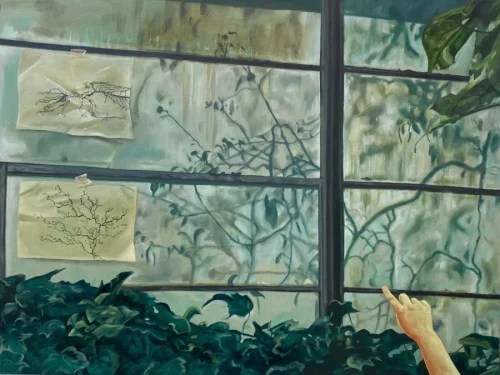
Featured Art: “Greenhouse” by Mallory Stowe

What is your name’s botanical source? 
I see mangroves and root forests whenever I pronounce it.   
Tell me about your superpowers.  Tell me about being small and frightened. 
What do you stare at to disappear?  
Describe the sound of a push broom on stairs.  
Describe your hair.   

Do you draw those hatch marks on your notebook as a nervous habit 
or is it a trapdoor to your mind’s netherworld? 
I like to pretend my brain is a landscape 
with silt, snow drifts, and an aurora borealis. 
I like cartoons where a lion sees a man’s head turn into a giant ham steak. 
I love it when the aroma becomes a beckoning finger.
 
What three adjectives would your friends use to describe you? 
Use a thesaurus.  Use it like a Ouija board, 
run your divining fingers down the page. Feel the grain. 
Instead of answering—let’s call out fun words to say, 
like schlep or kerfuffle

What is your favorite book? Why? 
I’ll confess my least favorite book: 
Wuthering Heights.  There. I said it.  
I didn’t read it once in high school and twice in college. 
Heathcliff was a candy bar. 

What is your dream job? 
Mine is describing the universe in mathematical formulas. 
What about staring? So undervalued in today’s marketplace.

What qualities are most important to be a successful student? 
This is a trick question because our hope is the same: 
to get some credit in the face of our limited choices. 
None of the above is never, rarely, sometimes, often, 
always the best answer. 


Read More

Drink it up, buttercup

By Natalie Taylor

                                                             Blue Fruit Moon: August 30, 2023

There’s a lot of hullabaloo in the woo woo
circles about this Super Blue Fruit moon, so rare
we won’t see the next one until 2037. My astrologer
friend counts on her fingers seven celestial bodies
in retrograde: Mercury, Venus, Saturn, Uranus,
Neptune, Pluto, and Chiron. A celestial goo
of retrospect and rehashing, a muck of revisiting old
stories, exes, holidays and birthdays fuzzy on the why
but clear on what wasn’t there, who didn’t show up,
what we missed. Wheels spinning under
a tree. What was plucked too small, hard
and green. Reconnecting with your inner child,
still wanting to play, to be held. Still dreaming
of some freedom attainable with gobs of money or super
hero powers or sheer will. The planets rotate in reverse,
earth shifts in its nook in the universe. We look back.

                                       Riding my scooter after teaching a late class, I stop
                                   at the light. I am not young anymore. I shiver in sweaty
                                      yoga tights, chilling in night air. Once I make it home,
                                             I will have fulfilled responsibilities of all three jobs,
                                        another 12 hours devoted to maintaining shelter and food.
                                          A young man pulls up next to me on his Kawasaki, dirty
                                          carburetor popping with every wrist crank. He waves
                                         smiling under midnight metallic helmet. In the other lane,
                                                                    a Harley’s deep throat rumbles as its bandanaed rider
                                                                     revs the V-twin crankpin engines. We wait for green,
                                                                  a small symphony of crankpins and cylinders and buzz
                                                       and backfires under a freeway overpass. I point to the moon,
                                                                 full and free as a peach, Saturn in conjunction hovering
                                                                                               just above, still spinning. The riders flip
                                                                                            their thumbs up. Just some kids on bikes
                                                                                             lapping up all the juicy bits they can get.


Read More
Wall of Clocks

By Kathleen McCoy

“We rarely hear ‘truth and reconciliation’—just ‘truth and justice.'”
—David Park, author of The Truth Commissioner

On this wall tick your childhood and mine, your loves
    and mine, your regrets, cacophonies of memory

and harmonies in your ear, coagulations of unuttered grief,
    relentless news from a grittier Belfast, our cousins

going at each other in the streets, Molotov cocktails and hurled
    rocks. Rifles. Truth without whisper of reconciliation.

But this is not the Belfast we have read about. Now the streets
    are clean, the bricks new. Twenty-seven percent check
the “no religion” box. Yet boxes there still be. With Barry’s tea
    I toast a thing that is not a thing, a thought that is not

singular beneath rolling gray clouds that siphon the self,
    that challenge perception, angle and taste, domesticity,

violence, numinousness. Dozens of clocks stand at attention,
    unseeing eyes fixed on the observer, no two declaring

the same time. None advance; all compel stares: one moon-
    faced grandfather clock painted blue, grannies’ broken

clocks, wooden clocks with cats or hens or roosters or sheep or
    horses or farmers and their wives with mice that once spun

in small circles to children’s delight, oak clocks, clocks of ivory
    irony, aluminum alarm, plastic grace, yellowed whites

like tired eyes, grays like boards left out too long in rain—all stand
    in pleasing array—but this signpost points in thirty directions.

No wonder I never know what time it is!
    This liminal Belfast in earliest glimmer of spring

wriggles into the raincoat and, despite its bloody past,
    could be nearly anywhere within the body or the earth.

Sitting before this monument to time, its silent mellifluence of green,
    its threat or promise of birdsong or the sound of striking, I note

how milky tea grows cool, limbs warm. In my absence, here. I am.

Read More

MY WIFE, IN HER ELEMENT

By Jeff Worley

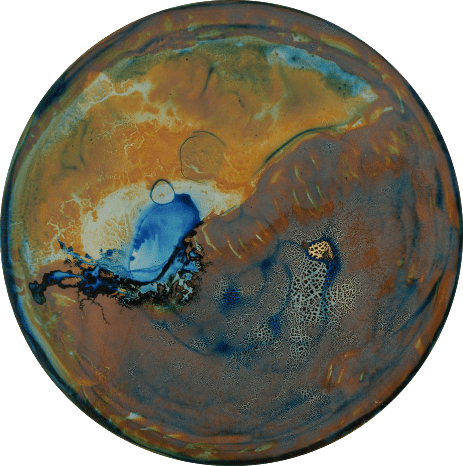
Featured Art: Stephen Reichert, Untitled, 2012. Oil on canvas, 12″ x 12″. “Cirlce” series.

(for Linda’s birthday, 9/5/2023)

You were a human otter,
who loved to roll and roll
in every body of water you found
waiting. Friend’s backyard pool,
Cave Run Lake (an easy walk
from our cabin), tumultuous waves
off Ambergris, all there for you.
               In Kokkari, 1981,
the Greek boys watched
every step you took from the frothy
Med because you hadn’t bothered
with a swimsuit, flinging beads
of turquoise water from the tips
of your raven hair. You laughed,
sputtering water, nearly breathless,
smiling at me taking this shot with the Nikon
from our Daisy Duck beach towel.
               Does life
get any better than this? Not for me,
I thought then. Not for me, I think now.

 (for Linda Kraus Worley, 1950–2021)


Read More

Kids Running After a Car

By Hee-June Choi

after the Korean War

Asphalt covered half the street; the rest was
overgrown with sunberries we ate. At the sound of a horn,
we ran to the car; in its bluish smoke, we saw
our future like a 3-D film. When my friend

JC tied his feet to the back bumper of a jeep
to sneak a ride, its engine started;
market people screamed as his bleeding head
was dragged for a hundred yards.

Our most daring venture was to the mountain cave
to dig out bullets for spinning tops’ axles.
But we had to cross locals’ territory––my forehead
still bears the scar of a thrown stone.

These road brawls ended when someone
in the cave shouted: Corpses!—soldiers in a mass grave.
Yet, those were carefree days. Dropping by any house
at mealtime, I ate with them if they laid me a place

—if not, I played next to their dinner table.
House doors were left unlocked:
what thief would steal an empty bag of rice?
In summer, we slept in the public pool’s storage shack,

no parents looking for us.
It was the children’s utopia: what we didn’t have,
we didn’t need. Even now, walking my suburban street
late at night, I snoop around for remnants of those days:

that sour tailpipe smoke must be a shimmer
in the air somewhere on Earth.


Read More

Thinking About My Father’s Erector Set from 1948

By Jen Siraganian

Rarely, my father speaks of the slow rubble piling,
before months sped hotter than his parents expected.
They thought it would pass, unaware of what aches
appear later. He was eight. This was before
walls, checkpoints, talk of two states.

Let’s focus on one wound at a time. I can only tell
a story diluted. I’ll try more softly—my father had toys,
then he didn’t. He had a childhood, then he didn’t.

Here is me at a sunlit kitchen table in California,
doubling as American and something like coarse salt.

How often I hear “it’s complicated” when I mention
my father grew up in Palestine, went to school in Palestine,
immigrated to the U.S. as a Palestinian refugee.

His voicemail last week—don’t post anything online.

For years, he lived in no-man’s-land, and I,
half-Armenian, half-daughter of a man
from half of a land that is half of me.

When I visited, could I call the wall beautiful, but only
the painted side? My grandmother’s friend spit on
for shopping on the wrong street in Jerusalem.
Jews walk on one, Muslims the other.
She’s neither. I started paying a man to do the errands.

Seeing my father’s childhood home, its walls
adorned with sniper fire and a gravity of collisions.
It consumed me, bullet holes as common as commas.

In the Armenian Quarter, the pottery store owner
said he would close before things worsened.
Palestine his home, until it wasn’t. Truths stitched
into my grandmother’s embroidery. Did I tell you
she left that too? Here is an echo no one asked for,
singing of a home in Jerusalem before Armenians evaporated.

At the airport, I, though not yet vapor,
say nothing to the Israeli passport agent.
Not telling him I visited Palestine. Not asking
for the return of the toys my father left behind


Read More

Aural Projection

By John A. Nieves

I used to believe in the tang of orange
Tic-Tacs—that it had anything to do
with oranges. That three bright sugar

pills in my child-hand could shine
up a dark morning. And they did. What
little magic. What’s so easy to miss

so much. I believed rainbows on
window dew hid tiny treasures, that sneezing
while saying someone’s name meant

they were thinking of me, that everything
I loved would stay forever if I took
care of it, if I did my part. I have almost

none of that now: the purple stuffed
rabbit, my two pet Siamese cats, my best
friend across the way, my whole

family. I used to believe music could
change the weather. I’m lying. I still
do. I still believe people attach themselves

to songs they love, creep into their choruses.
This may be literally true in the science
of memory. This may also make me

superstitious. But, O, when I sing
you, I can almost reach. There is no way
there is nothing there.


Read More

Down Jersey

By John Wojtowicz

Featured Art: “Pebbles vs. the world” by Leo Arkus

As a kid, I spent Saturday nights  
underneath this boardwalk, poking a dollar bill  
between cracks, pulling it back  
after luring unsuspecting tourists. 
Now I’m back around, fixing up a friend’s beach bungalow: 
paint-peeling and porch-rotting    
on the bay side of town.  
I’ve only walked the boards a few times 
mostly forgoing views of the ocean 
for beer-drenched nights at the Shamrock. 
Tonight, a thunderstorm rolls in  
and the preacher at the boardwalk chapel 
offers shelter to all but those  
with a still lit cigarette. 
Zombie Crusher and Terrordactyl  
don’t let lightening stop them  
from barreling over jumps made of beach sand 
but the amusement rides have ceased to amuse. 
The tram car watches me. 
I like riding the Sea Serpent with its upside-down  
and backwards thrills; 
how for that 1 minute & 48 seconds 
it’s hard to think about anything  
other than staying alive.  
I like the monster trucks too.  
The way they flatten.  
I put out my Marlboro and take shelter  
in the wood-paneled chapel  
next to a handlebar-mustached-man  
sporting a throwback Hulk Hogan  
t-shirt: Hulkamania is running wild, Brother. 
I think about how Dolly Parton  
made a spoof music video  
in which she married Hulk Hogan 
after reading in a tabloid  
that she was having an affair with a professional wrestler.
He’s got a headlock on my heart, 
it was a take down from the start.” 
For Dolly, it’s all fertilizer; she’s a western- 
wigged buddha two-stepping through life.  
For me, it’s been more of a hot-coal-  
hop-skip. The rain slows, thunder booms. 
I have no special someone for whom  
to buy a pair of custom booty shorts.  
I grab a beer before the concessions close,  
toss rings on bottles, land quarters  
on plates. The unbridled ocean  
gives me chills. I think about how sailors  
wore earrings worth enough  
to cover the cost of their return and burial,  
salt-slicked mariners 
with no need for gold hoops.  
I bend down to pick up a dollar that disappears
before my fingers can grasp it. 
I think I want to be buried at sea too;  
being decomposed by sea lice  
seems more exotic than earthworms. 


Read More

Covenant 

By Baylina Pu

We were making mojitos 
in the kitchen when we found 
a  mortar and pestle made of 

Marble. With them, I crushed mint leaves 
and later, slices of lime 
four or five at a time. My friend 

Mixed in sugar, the water 
we’d carbonated ourselves, and 
white rum with a wooden spoon 

In a stainless-steel bowl. 
That evening, the sun was 
setting through the Japanese maple 

By the porch, and leaves 
had slid down the car windshield 
like paper cut-outs. I felt 

Grown up, a real woman. At dinner, 
there were eleven of us crowded 
around the table, beside 

A glass door which looked out 
over the lake, still unfrozen 
even in November. We licked brown 

Sugar off the rims of our glasses. 
My hands could still feel the weight 
of that marble mortar, an invention of 

The Stone Age. Even as early 
as then, happiness had already 
been discovered: simple movements of 

Grinding and stirring. Somewhere, desire 
was calling, but we were so deep 
in the woods nobody heard it. 


Read More

Baby Shower 

By Annie Schumacher

Featured Art by Jordyn Roderick

We drive six hours to a San Diego swimming pool.  
A padded bikini top adorns a deer  
trophy, buoys balance on the mantle.  

Blue balloons, stuffed pheasants  
in a fishing net. I place a gift bag 
on a blue tablecloth. After rehab,  

my brother smiles with ease,  
skewering meat on the other side 
of a screen door. Star spangled   

diaper cake, blue M&Ms in a wide- 
mouthed jar, gun safe in the bedroom.  
Kitchen towels from Camp Pendleton. 

Proud USMC Wife, Proud Mother,  
Proud Unborn Baby, Proud Australian Shepherds.  
My hair in the frosting,  

my hair in the fishing net.  
I follow the nameless dogs  
through blue wrapping tissue, 

decide on divorce with 
a paper plate in my hand.  
The baby, a murmur,  

folded in his mother.  
He will be named after a type of metal.  


Read More

Visiting the Natural History Museum with My 97-Year-Old Dad

By Michael Mark

In the photograph that my father has
             me take of him with the woolly mammoth,
he’s pointing to himself. He asks

to see the selfie. I don’t correct
             his terminology. Next, the triceratops, then
the sabertooth tiger. He takes the same stance

throughout the Extinction Exhibit. With the 4000-
             year-old beetle, 300-million-year-old coelacanth,
the dodo. She was beautiful,

he sighs at the butterfly, and I get the sense
             he’s thinking about Mom. Earlier, in his kitchen,
he posed with a jar of mayonnaise

with the expiration date from 1998, also pointing
             to himself. At the cemetery, he stands on his plot,
next to my mother, because I refuse to let him

lie down. Back at his apartment, he says it’s nice
             to have some company. I know
he’s referring to his defunct card game, so we go

down to the game room. He sits at their once
             regular table and points around the empty chairs,
Billy, Dick, Harold, Nat, Frank, hey Joe. He deals

them in. I take the picture of him squinting at the cards, fanned
             tight to his chest. He tosses a chip to the center
of the felt. In the shot, it really looks like

he’s waiting for someone to call his bet.


Read More

The World as It Is

By David O’Connell

Some believe the new math
proves reality is actually

a hologram. And who am I
to argue when I don’t know

the language? I speak pig math.
At times, finger count. Failed

this week to help my daughter
with her fractions. Don’t worry,

you’ll never use it in real life,
remember? But now it seems

this math has always been
presiding over smoke-filled

back rooms of the universe,
invisible mover and shaker

knowing what we want
are answers, and that we want

them now. Outside, the street
is darker for the light rain,

and I’ve cracked the window
to catch the scent of earth

kicked up by water falling
back to us. Nothing is lost,

explained the talking head
last night, asking that we picture

clapped erasers raising
clouds of dust. The math

he detailed says it’s possible
for every molecule of chalk

I smacked out in angry
plumes beside St. Mary’s

one afternoon in 1982
to reverse and gather again

upon the board—faint, then
clearly remaking each mistake

I’d scrawled that day in class.
Implausible, but not. An act

the nuns would’ve taught us
wasn’t math but miracle

on par with the angels
that appeared—like, what?

if not holograms—to trumpet
what they knew was right.


Read More

Driveway Toad

By Rob Cording

A year after my brother died,
I told my daughter about
the toad that once lived
in the hollowed-out knot
of an apple tree
in the center of my childhood
driveway. My brothers and I
liked to visit it after school,
but the tree came down
in a snowstorm, and my parents
graveled-over that spot.
When my daughter
asked what happened
to the toad, I explained that
it probably moved
under a rock, or to the woodpile
along the side of the house. “Or,”
she responded, “it died.”
Then, she skipped into the house
and left me outside.


Read More

Obituaries

By George Franklin

My mother used to say that only old people read them.
Now, I get an email about a classmate from high school,
Someone I might not have recognized over fifty years ago,
Much less today. I could call my friend Richard to ask,
Who was the guy who just died? And, Richard could tell me.
But the truth is that I don’t want to keep track of acquaintances
Beneath the ground—or above it. The cemetery in Shreveport
Was just down the block from a drive-thru liquor store that
Didn’t ask for IDs. The ability to turn the steering wheel and
Press the gas pedal was apparently good enough. On the same
Street, a fried chicken place sold onions pickled in jalapeños
And vinegar. They went down well with Jack Daniel’s
On summer weekends when we’d play penny-ante poker
In someone’s garage. Back then, almost none of us were dying.


Read More

Any Single Thing

By Meryl Natchez

A week past the twenty-ninth anniversary of your death
I read Seamus Heaney’s poem about the kite,
and my first thought is to show it to you.

So I stumble again
into the hole death leaves,
unfillable.

Another morning
of a day that promises
to be beautiful
without your presence
except for this faint ache
because you loved kites,
their unpredictable dialogue
with the wind
transmitted to your hand.

That hand gone
and gone again
each time
I reach for it.


Read More

LinkedIn Said Your Dad Visited My Profile

By Chrys Tobey

Maybe he wanted to ask about our cats
and dog. Maybe he was curious about how many
colleges I now teach for, curious about my job prospects
as a poet in a pandemic. I didn’t send him a message—
didn’t tell him I saw you on the beach this summer
walking with your new partner, didn’t tell him how
you looked somewhat happy, how I felt excited for you—
I almost ran up to say hi, but I was in my bathing suit
and it was our anniversary, or what would have been
our anniversary, anyway. Maybe I should write
your dad, I’m okay. I don’t know if he would care that our
old man cat is dying, that I give him IV fluids, or that I finally fell
in love with someone, but she broke like the coffee
cup I once threw on the kitchen floor in front of you.
Perhaps he’d like to know that I had a biopsy in my vagina
and even though I felt like a plank of wood was on my chest
with someone standing on it while I waited for the results,
it came back fine. I could share how some days
I feel this sadness that can make it difficult
to bake a potato or how, once, I almost burned your ear
with a wax candle or how I still think about the time
you gave me a bag of socks with grips on the bottom
because I kept falling down our bedroom stairs.
You were so afraid I’d break my leg or hit my head
or worse, especially after I bruised my butt purple,
but love, I knew then what I’d tell your dad now—I’ll be all right.


Read More

The Grandmother Tree

By Pam Baggett

My sister named this venerable maple
growing at the edge of the mountain’s gravel road,
main trunk long broken, pocked with holes,
a once-mighty tree now slowly failing.
She’s lost her apical dominance, I say, meaning
that when the top broke off, side branches
shot up past the injured trunk like raised arms.
On the left, one wide kind eye, an open mouth
framed by credible lips. Step right, a second eye
squinted shut, mouth twisted up, as if she’s yelling
at us the way our father’s mother did: imagined slights,
our insufferable rudeness, which she thought
should be spanked out of us. Mom never laid a hand,
which says a lot about her mother, gone too soon
for my sister and me to have known. Grandma Baggett
and her snarling chihuahuas gone, too, when our parents divorced.
No wonder my sister imagines a tree could be a grandmother;
she’s been hiding in stories since we were small.
I anchored to the safety of science, to cold fact: Trees break.
A grandmother can call you Sugar one minute,
rage at you the next. Can die without you ever once
hearing her voice.


Read More

College Days

By Rob Cording

Featured Art by Stephen Rounthwaite

Outside, a few gray snowflakes fell,
a truck rumbled onto 290, and the cold
seeped through our windows.
Our landlord had rigged our thermostat
so we couldn’t turn up the heat.
But that day, the four of us nailed a bag of ice
to the wall over the sensor, and when
the heat kicked on, we let it pump
until we’d shed our sweatshirts and flannels.
Leaning back on our futon, we shared a joint,
invincible in our underwear and T-shirts, laughing
and laughing. Twenty years ago now,
before we knew loss and grief, when we sang along
to our DVD of The Last Waltz and didn’t notice
the steady drip of the ice melting.


Read More

What It Looks Like

By Emily Wheeler

Featured Art by Glenna Parry

Returning from emptying 
compost out back,
I’m stopped 
by a praying mantis.
Don’t you look fabulous,

I hear my mother’s voice,
Dressed to kill and
to blend in, with just
a flash of emerald 
on your lower wing. 

I hear her say, 
Your feelers, are they new,
or are you parting 
them differently?  
Also, great figure!

I see her swooning
over its eyes that pop 
without any makeup,
and the way its face 
comes to a point 

at its delicate chin: 
really quite special.
To me, the mantis 
just stares, nods, 
possibly politely.

My mother appreciates
many kinds of beauty
and the bug’s elegant 
plus alluring look
but I know

its brown egg sac 
is hard as cement to protect 
the eggs from heat, cold, 
even the occasional maternal 
appetite for its young.


Read More

Should You Choose To Accept It

By Emily Blair

I couldn’t wait to leave town when I was young.
After that, I’m not sure I have much of a story.
It’s true I met someone. We had a child together.
In between I walked across a frozen lake.
I drove over a frozen mountain.
I ran up a hill to find a pay phone.
I closed down the city for extended action scenes
to the tune of 290 million dollars. No—
I’m thinking of the latest Mission Impossible movie
with Tom Cruise. I get confused.
I should be writing domestic poetry,
but I don’t want to. What more do you need to know?
Our family of three live in a third floor apartment.
Sometimes we also meet up outside. I guess leaving town
is still the most exciting thing I’ve done. The other day
I asked another mother on the playground how to clean
bathroom grout. I said Stephanie, what’s your secret?
Then we ripped off our latex masks,
revealing our true identities. No—
that mask thing happened in the first Mission Impossible movie,
the one I saw with my friend Michelle. I leaned over
to say something snarky, but she was fast asleep.
It must have been the whirring of the helicopter blades.
There’s nothing duller than an overblown action sequence.
The secret to having an exciting life is the people you meet.
The secret to battling a helicopter in a tunnel
is explosive chewing gum. The secret to cleaning grout
is a magic eraser from Mr. Clean.


Read More

The lone wild goose sticks out his tongue at me

By Joyce Schmid

half-heartedly, not like the one last April— fierce,
protecting pear-green goslings. But this year, no little ones.

It’s been so long since I have seen a baby—
even seen one—not to speak of holding one,
or watching a tiny face reflect my smile.

I’m not demented yet, not like the woman who begged to see
her stolen babies as they loomed above her, grown.

I’m not asking to be young again, back in the tent
with everyone asleep but me and the baby at my breast—
warm baby in the chill of night— or in the back seat

of my daughter’s Ford Escape— the “baby-whisperer” she called me
as I gentled her son to sleep.

I tell myself there are advantages to being old:
no longer wondering

if God exists, or what life’s meaning is
(He does, there’s none),
acquiring bits of wisdom

such as everything takes longer than you think
except your life.


Read More

Has this happened to you

By Rebecca Foust

Selected as winner of the 2023 New Ohio Review Poetry Contest by Denise Duhamel

Featured Art by Claire Bateman

You realize you know something
you didn’t know you knew,

like in what modern-day country
lie the ruins

of ancient Troy, or the name of the boy
Achilles loved, or the Trojan

who speared him, or the former Beatle
or first drummer for The Stones

or your sister’s first flame, who drank
milk straight from the carton,

whose name she now—60 years later
& brain-wiped by ALZ—

cannot herself recall. He was a strapping,
young crewcut man, who came

to court my sister & then left with her more
winsome twin—our other sister

now in an ICU after swallowing a full vial
of Tylenol. I knew

before it happened, it would happen like this
& nothing to be done.

There is foresight, & then, its impotence.
Anyway, it was Pat Nicodemus

who courted my sister, not to be confused
with Patroclus, Hector,

Pete Best or Tony Chapman, each doomed
in their way as my sisters are,

as we all are doomed, but each name still
a small ping of pleasure

when I blurt it out, surprising everyone,
especially me, still playing

the game. In the days before Google,
it felt powerful & oracular,

what we didn’t know we knew welling up
on our tongues,

coursing its way out & through, like the body
of a baby after the head is born.

Aristotle demanded surprise & recognition
from good writing,

plus pity & horror, much of which presumes
foreknowledge,

for a time occluded but still operating behind
the scene, unseen,

as a kind of sixth sense, or is it non-sense,
like when you know

without knowing your husband is cheating
again, or what sometimes

pulls your pen across the page like automatic
writing, or your cribbage peg home

ahead of the rest when you’ve all along been,
with immense concentration,

wondering did I close those car windows?
now that you’re hearing rain.

How unknown are we to ourselves, unreadable
code in the end. I never thought

that after nine years of drought it would rain
like the Amazon inside my car,

nor that one sister would wind up living every
hour of every day in the same

Bonanza rerun, nor another so enwombed
in despair, nor that I’d be the one

to leave my marriage after four decades of fear
my husband would leave,

but somehow, I was not surprised
that my car, a sauna inside,

would continue to run, even after I found
that floormat profusion

of mushroom, each pink cup turned up
& open like a wish

or a tiny satellite dish set to receive.


Read More

Étude en douze exercices, S.136

By Weijia Pan

*
In Liszt, I hear an old man stumbling across the fields to meet me.
He starves to save bits of bread for my pocket.
*
My own grandpa is different in a senior home in Shanghai:
He’s polite. Asking about my age & name & marriage & age.
*
Time’s time’s timestamp. Which means that time keeps its own records
like a metronome, or a fountain blooming every 25 seconds
*
unlike the skyline that fades when the clouds loom large,
a flock of your imagination dropping on a book’s dead pages.
*
In the early 19th century, Japanese samurais from the South
would gather every spring to discuss insurrection. Now! they would say,
*
finally; it was 1868, the Americans were banging on the door
& the last shōgun, a bony young man, would wisely concede.
*
Being an introvert, I concede every day to my own messiness.
I read in my study. I love the fact that you’re out there, reader.
*
But glad you were not here is not what a poet should tell another poet, as if
to imagine the world, we should only write about selfhood, the feathers of birds
*
on parchment, & cold, 13th-century nights. How destructive
were Stalin’s pencils, marked in blue ✘s & ✔s on death warrants,
*
a color not visible when photographed?
He started off as a poet. A job I now have.
*
I remember another poet in Flushing, NY who told me
that I shouldn’t let my poems end too easily, how I’d always
*
despised him a little, yet accepted when he rummaged for cash
& broken English, a fatherly way to say stay alive and goodbye.


Read More

Empty Chamber

By Mark Neely

Featured Art: Ageless Darkness by John Sabraw

the newspaper tells
the childrns story
the mayors heart

swells and then explodes
near the end of the parade
I read Dickinsn

as flies flash drkly
against the blue wall
in spring my blood runs dank

I have these lttle spells
shout back at the news
cast pills

into my throat
sin my high school song
disappear into the moated

rooms the shooters eyes
sink forever in my memry
my kids hold signs first

grade fourth grade class
of twnty twnty too
class of those

who God held in the light
though we did nothing to deserv
though we didn’t believe in hem


Read More

Ode to My Father’s Body

By Jeri Theriault
Selected as winner of the 2022 NORward Prize for Poetry by a panel of previous poetry contributors

Featured Art: Lost Moment by Mallory Stowe

I lose my way in the low-note harmonica
of my father’s absence & unfold the map
of his body in the big window of his barbershop

at the corner of Summer
& Gold    where he    slow    stood all-day
poised to conduct    the chorale    clip-clip

of his trade    shears    razor    hot-towel
talc    brush & tonic    Red Sox radio
my father vaguely tidy & distant    not

dissonant. My everyone-knew-him father.
My year-round-bicycle father. My father’s
body at school nights

or Sunday mass    silent    always
silent but singing in the cellar attic
garage & whistling    as he built back-yard

swing-set    lean-to    edged
garden rows    or hosed night after sub-zero
night    the ice rink where I soothed

afternoons    cold & would-be
wild.    His body hunched in the chair
of my mother’s hospital room that time

we thought she would die    thirty years after
they divorced. My father’s corpuscles
& liver    shins & scapula

his semper fi     tough-guy body    his ear
his good eye my self-taught father in the city
of his body my beige & pastel checked-shirt

father in serviceable shoes & trench coat    who left
his copy of Camus’ The Stranger face-down
on the bed in English though his tongue

his lips    his throat    were French.    He left    too
his body    that night    left
what was left of his body    left

his Iwo Jima    his broken birth family
left his untold    his mystery    left me
his daughter    the wilderness

of my own body    that is to say    left me
half-him left the quiet why or who he was
might have been    what he most

loved    so that sometimes    I still walk
the hallways of my father’s body
half the doors gone    half of them still here.


Read More

Cursing Lessons

By Jackie Craven

Featured art: look, quick by Emma Stefanoff

I am learning to bake curses
the way my mother did
with paprika and clotted cream.
Her recipe book lists fifteen steps
and she’s added three more,
her instructions scrawled
on pages brittle as phyllo dough. 
I trace my fingers over every word
and try to understand the significance
of Simmer on Low. I’ve heard
that if you heat a kettle gently,
a frog can’t feel the water boil. But
what to do about the grumble
from the dining room, the hungry command
to hurry up? Nothing my mother served
could please my father,
who poured Tabasco into a slow-cooked stifatho
and called her a stupid cow.
I lean against the round shoulders
of the old refrigerator and listen
to her murmur. I’m grown now
and married and need to know––
When is it time to whisk, when to fold,
when to toss with newts and toads?


Read More

Reminiscences

By Matthew Valades

Featured art: Sunflowers by Janet Braden

It became possible to say anything:
that was the delusion. A melting tree,
a painted deer—the books sat useless
as guides to understand such thoughts.

Holes at the elbows quickly drew
attention, but bothering to bother seemed
no longer worth the trouble. With walls
and brooms folks got better acquainted.

A summer of branches joining field
and sky swelled with lost promise.
It was good to stay, that’s how it felt.
People got older and younger. They’d sit

composing elaborate salad plans.
“Forget about tomorrow” became
a common phrase, but few took comfort
in what it meant. Distance fraught

with waiting, a blank consistency,
infused the hours as if each day
had been left on the table to fill the house,
rising through the rooms like steam. Read More

The Other Big Bang

By Mason Wray

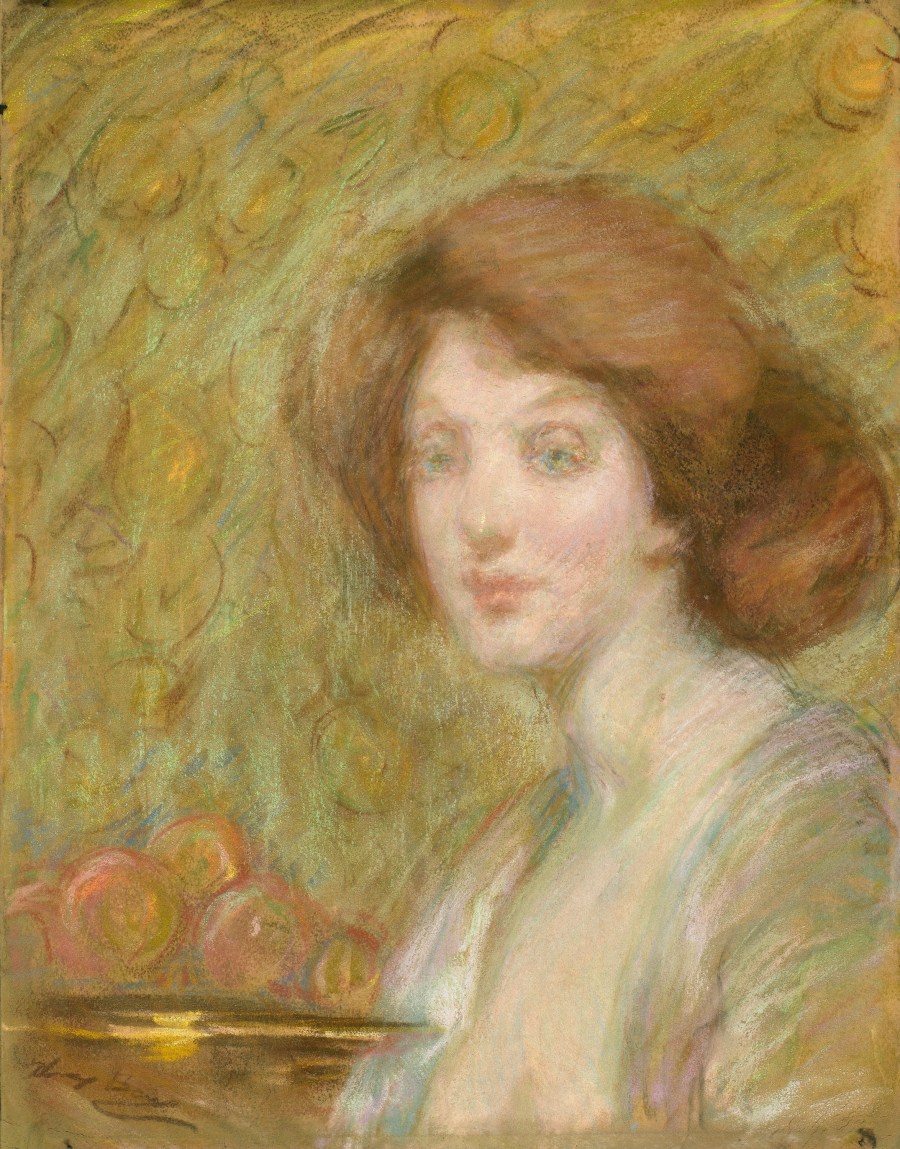
Featured Art: Peach Bloom by Alice Pike Barney

An equal and opposite burst expanding
from the same particle but in reverse.
Where peaches unripen in the family orchard.
A mom-and-pop deli replaces the condos on Second Ave.
OutKast never breaks up. They only get back together.

My sister is getting smaller by the day
her outfits like pastel pythons swallowing a doe.
In the other big bang, we start
with all the knowledge we’ll ever know
then forget it piece by piece.

So even after my grandmother’s brain
stitches itself whole, vanquishes the plaque
that shows up like coffee stains in scans,
still she becomes more unknowing by the day.

But we all become naïve with her. Everyone
communes over fears of growing young:
how we’ll tie our shoes, cross the road alone.
I am planning an expedition. One day I hope
to have never known you yet.


Read More

Love Song

By David O’Connell

Featured Art: Morning Haze by Leonard Ochtman

Oh, that’s right—because I’m going to die.
Sometimes I forget. More often than not.
And then, that’s right! I’m going to,
sometime. Because . . . I’m going to. Forgetting,
but only sometimes, that’s how this works
more than not. And then we wake to snow,

                              *

quite unexpected, the whole neighborhood quite,
you know. And you say to me, yes, that’s right,
cream, two sugars. Sometimes I forget. Or
these days, more often, because, you know,
that’s how this works. And now I remember
we’re going to. Both of us. And there’s the car

                              *

snowed under, looking so unlike itself. It takes
an easy faith to see it. What it truly is. I believe
this morning the whole neighborhood is a fact
refuting last night’s forecast. I’m predicting
this icicle by evening will stretch down past
the window, which reminds me—yes, that’s right,

                              *

last night, 2 or 3 a.m., I woke to the whole house
moaning in the wind. And I felt warmer beside you
surrounded by this sound, our house, and maybe
the whole neighborhood, the neighborhood houses
and the neighborhood trees all moaning. It was snowing,
but I didn’t know. Sometimes, I forget this

                              *

is how it is with us. Just as I, at times, forget
I, we, are going to, you know. They’re saying now
more is on the way by evening. It almost hurts
to look out there’s so much sun. I’m going out
to prove the car’s still here. You remind me,
yes, of course, coffee. How could I ever forget?


Read More

The Measuring

By Veronica Corpuz

Featured Art: Vintage notebook among photo cameras on table by Rachel Claire

A married life is measured:
each grain of rice, coffee bean, and tea leaf,

ice cubes crackling in a glass of water upon the nightstand,
even the pinheads of steamed broccoli,

every hour of sleep lost when the baby is born
each hour you slept in before him,

the time you say, I am going to remember this walk forever
the neon color of lichen after a long, hard winter,

how your son wobbles, falls down,
how you swoop him off the ground.

Until you walk into the Social Security office,
until you see the words printed in dot matrix—

the date your marriage begins, the date your spouse dies—
until you see what you did not know declared in writing,

then, you have new language for this feeling—
how your heart has become a singularity:

Your marriage has ended in death.


Read More

As Always

By Robert Lynn

on the first not quite warm day of March the park filled with the delusion of spring       

our friends napped by the half dozen against a tree           dogs gathered loose             

bikini tops from sunbathers made maenads by 53 degrees          we gave time away        

in handfuls to the ducks              pairs of men emerged from winter to wave lures        

at the water an excuse to love each other without looking       I read your        

cheekbones’ anger at how I got more time than you before the good earth was       

over     fed you grapes the closest I could get to an apology for something I didn’t         

choose      someone sitting at our tree and very high asked Is this the Golden        

Hour?    and the light answered with yellow silence the way it does all questions        

so obvious       later walking you home I told a story how my parents fell in love       

first drunk then again sober only after I existed              I didn’t think you were         

listening until the moment you stopped mid path mid sentence a way of making       

me turn around        you told me There isn’t time to do anything twice        How        

come?     you let the light give its yellow reply      I don’t want the world to end        

you said     when it does I will remember it this way     the sun picking mulch from        

your backlit hair      your fresh burnt shoulders making the gesture for All this?        

and I give up at the same time       this last first day before the good earth was done        


Read More

The World We Wanted Shone So Briefly

By Gail Martin

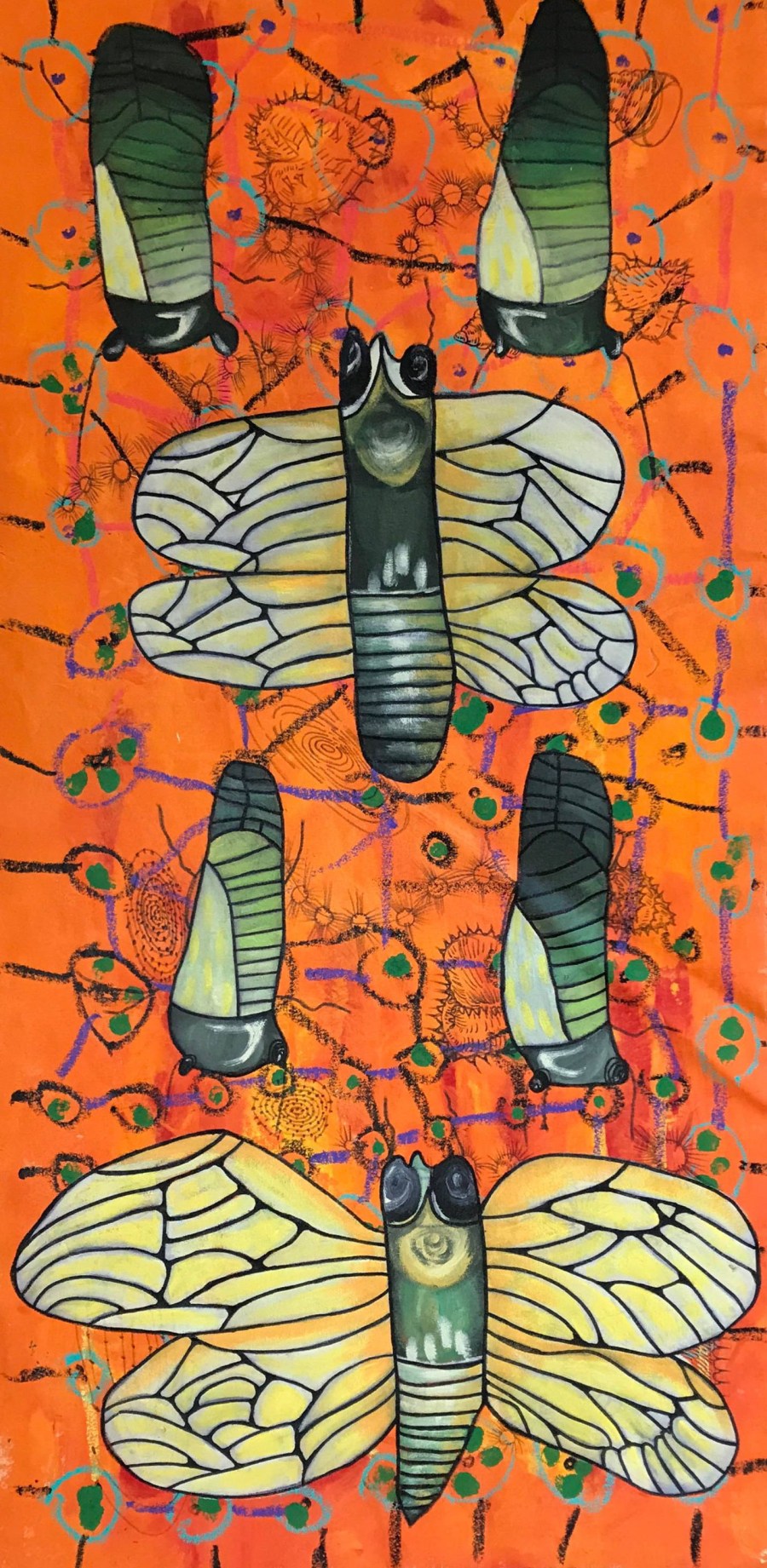
Featured Art: Cicadas by Scott Brooks and Wendy Minor Viny

Real life was finally about to begin.

Remember the romance of the silver cigarette case

in college? The integrity of your firstborn’s eyelashes?


We discarded alternate destinies like tired cards

in the Flinch deck.  We were only looking forward.


Of course, like the teeth of beavers and horses, there

are parts of the past that never stop growing.

Garage – tree house – vacant lot kinds of cruelty–

how we took turns being mean.


And later, some serrated evenings, dinners

of bluster and recoil, dodge. Flowers sent

or not sent to someone’s funeral.


Mostly there are the years you watch

your neighbors’ cars slide in and out of their garage.

Between blue herons and tumors, you change

the sheets.


We were all surprised to find ourselves old

but really the signs were everywhere, and we

acknowledge we’d been told. Name one

important thing that has not already happened.


Read More