Elegy with Two Portraits

By Dan Clark

Featured Art: “Basa de Maya” by Madara Mason

The priest swings a thurible. Incense,

swirling and nebulous, encircles the cremation urn.

A few feet away, a husband weeps.

He’s not thinking how Oregon came to fill the ocean

of itself, how island arcs docked like icebergs

against the Idaho shore, where Mesohippus,

diminutive proto-horse, grazed beneath the juniper.

He’s not considering how Oregon drifted through

several versions of itself—savanna, jungle, desert—

then settled for a time as a placid, inland lake.

Instead, he’s remembering forty years ago,

a dance floor, a promise emerging,

all red-haired and smile, in the same way Da Vinci

painted Ginevra, young woman in three-quarter view,

whose eyes engaged like none before,

the part of her braided hair revealing noble forehead,

the background a green halo of juniper.

And he’s not considering how the continent

has yet to finish arranging itself—Pacific plate

subducting from the west, Sierras

pressing north, rotating Oregon like a cogged wheel.

Yet he finds himself in the second pew, rearranging:

how that red-haired promise faded into

the drinking, the stolen meds, the swerving

between fallen arms of railroad crossings,

this version of her unrecognizable

like Willem de Kooning’s Woman I,

full-frontal view: terrible, Paleolithic,

brandishing eyes of knives, breasts challenging,

margin of her body dissolving into background.

The priest swings incense, swirling and nebulous.

Twenty miles above Earth, Hubble steadies its gaze

the way he studies the pink of his thumbnail.

He watches himself in the pew,

feels himself disappearing—

he cannot hold the red-shifts steady, cannot keep

the margins from dissolving to ground.


Read More

After Hours

By Maria Nazos

Featured Art: “Illusion of My Studio” by Yan Sun

When I exited the stall, she was standing at the sink.

I knew her best from one night at the bar, when she’d said

my ex was handsome. Then asked whether I’d mind if she

called him later that night. I’d pressed my lips together

and said, go ahead, certain she held an unspoken malice

which young women carry into small towns. I’d moved

to the Cape to escape from my talent for tearing through

love, only to follow a trail of broken glass into every bar.

Only to find every fisherman with a penchant for failed

marriages and pot, and myself, again,

staying up too long and late.

As I stood beside her in the bathroom, washing my hands,

I thought of another night when she’d told me, as if casually

draping a dark blouse across a stool, that her father had just died.

I’d squeezed her hand. She pushed her blonde hair off her face,

said, that’s okay. But I’d seen her at the bar every night since,

drinking with a red-haired fisherman who’d tried to strangle

his ex. I shook my hands dry. Tear my shirt, she urged, interrupting

my reverie. Why? I asked. Did she want to show off

her seashell-curved cleavage or simply feel something

besides her heart splitting down the middle?

Read More

Mexican Standoff

By Dylan Loring

This summer afternoon on the blacktop
of an elementary school playground
Steve and Rachel have their guns pointed at each other,
as tends to happen every once in a while
between two people who have dated for months,

that is, until Chet shows up brandishing his revolver at Steve,
causing Rachel to complete the triangle by shifting her gun
toward Chet, at which point, Steve says, “Well lookie here.
Seems like we have ourselves a Mexican standoff!”
which makes Rachel say, “Wuh? None of us are Mexicans.”

“I could call my bud, Raul, if you put your guns away,” Chet says.
“That would ruin our Mexican standoff!” Steve says.
“Adding a Mexican to our Mexican standoff
would ruin our Mexican standoff?” Rachel asks.
“Have you ever even been to Mexico?” Chet asks.

“A Mexican standoff,” Steve says, “occurs when each person
in a given vicinity has both a gun pointed at himself
and his gun pointed at someone else.”
“Or herself and her,” Rachel adds.
“Sounds to me like a gun deadlock

or a James Bond-high-stakes-poker-thingy,” Chet says.
“Mexican standoff is just what it’s called,” Steve says.
“I could sure go for some Mexican food
after this . . . Mexican standoff,” Rachel says.
“Are you sure it’s called a Mexican standoff?” Chet asks.

“It sure sounds either made-up or racist or both.”
“It’s not racist, it’s just what we call it,” Steve says.
“You mean like how we call the Washington Redskins
the Washington Redskins? Because that’s still racist
even though it’s the name of our local football team,” Rachel says.

“Go Redskins!” Chet adds. Chet is an avid football fan.
“The Mexican part of the Mexican standoff
is literally the least important part,” Steve says.
“You probably mean figuratively.
People almost never mean literally,” Chet says.

Read More

You Are My Sunshine

By Bobbie Jean Huff

Let me begin by offering my condolences, I said,
holding out my hand. She shook out her umbrella
and placed it open, just beside the altar. They thought
it was an ulcer, she said. They gave him some tablets.
Did he have any special requests? I asked. Favorite
hymns? Or something for Communion, like maybe
Water Music? He was worse by Christmas, she said.
He couldn’t manage the pumpkin pie. He always loved
my pumpkin pie. The King of Love is nice, I said. I
opened the book to page 64. As an alternate to Crimond,
you know. Most people don’t recognize it as the 23rd
Psalm. In January his feet turned black, she said. Toe by
toe. It took exactly ten days. The shadow of a branch
moved slowly back and forth behind the stained glass.
I thought: When I get home I’ll check my toes. Will
there be Communion? I asked, finally.

The last three days he started to hiccup, she said.
He wouldn’t take any water. It never stopped, the
hiccupping. Not once, not one minute until he went. I
could play Pachelbel’s Canon. That’s very popular now.
There’s no reason it can’t work at funerals as well as
weddings. At the very end, she said—then stopped, her
eyes squeezed shut behind her glasses—as if the
rejected water, each wretched hiccup, and every
blackened toe formed a chain she could use to haul
herself back to September, when she would claim
him, finally whole again.
She reached for her umbrella and frowned. Play
what you like, she said. He was never fond of music.
Not hymns, anyhow. Only once in fifty-three years
did I catch him singing. You are My Sunshine, I
believe it was.


Read More

I Go Back to Mykonos 1976

By Maria Nazos

Featured Art: “Mykonos” by Maria Karalyos

                                                                             —after Sharon Olds’ “I Go Back to May 1937”

By the third martini, he’ll ask her to marry him.
She’s a tourist, he’s a captain, home by chance.
I stand at the window, watching. I want to walk
into that bar, order an ouzo, and tell them
that, together, they’ll create a new generation
of pain. I want to tell him to court the island girl,
the one who, forty years later, will see him, run
to the restroom, and return with a fresh coat
of lipstick. I want to tell my young mother,
in the words of the great North American philosopher,
Pamela Anderson, “Never get married on vacation.”
But this is long before Pam and Tommy Lee, before
I existed. Before Reagan reigned over his long line of wreckage,
and couples shot themselves, together, in their cars. The Vietnam War
has ended, but here I am standing
at the window, watching while they meet,
both oblivious of wars they’ll wage. They’ll move
from Greece back to the Midwest—she’ll drink, alone,
in her kitchen. He’ll return to the island every chance
he gets. When he’s back in Illinois, he’ll stare
into the aquarium and long for water. She’ll look
at him, frozen, behind her highball glass. Still, I stay
at the window of the bar, wanting to use Pam’s biting wit.
But this is long before Baywatch, and they’re gazing at the
bay. I tap the glass like Morse code. Sealed in
my own tank of silence, I say, Please let go.
But as they take each other’s hands, I softly touch
the pane and turn away. Because they, too, have the right
to plunge. Even if they’ll swim out too deep:
holding onto each other until death.


Read More

Thief

By Owen McLeod

Every Thursday, on his way to therapy,
he drives past the house of the woman
he’s having an affair with. What interests
his therapist isn’t the sin, which she views
as a symptom, but the root. So they dig,
or seem to, and today he talks about his wife—
how, before they take a trip, she makes him
connect those timers to lamps in certain rooms,
and how much this annoys him, even though
it didn’t used to. As if their belongings were
of value. As if an automatic light might stop
an addict from breaking in.
                                                  As if the thief,
awake beside her, had not already come and gone.


Read More

In Dog Dreams

by Karla K. Morton
Featured Art: 

I run,
palms like paws on the earth,
muscles, long and sinew.

I smell wet clover,
the musk of home,
cooking meat.

I do not think about tomorrow
or yesterday,
but I remember the cactus
and the snake,
and the music of your voice
even when language fails.

And when I wake, I roll
to the nest of your shoulder.

Your arm does not reminisce
when it first wrapped my waist,
yet it comes to me;
heals even as you sleep.

I feel the peace of gravity;
the subtle spin of planet;
the rise of the mountain.

In Dog Dreams,
I have known no other hand;
no other time
when I wasn’t yours,
or you, mine.

Whoop! you call in the deepening forest.
Whoop! my descant back.

Read More

Confirmation

By John McCarthy

You taught me how hands could be laid, how they could touch
     a head and heal, but all of those hands eventually fell limp
like a field bent by threshing or a lit match dropped in water. Once,
     we used to dance in The Corner Tavern’s neon light
where the pickup exhaust wafted inside like harvest dust.
     Life in the Midwest is like one long goodbye because it is the same
every day, and I didn’t realize you had left until there was nothing
     but hard work and long days ending with the wind’s silent dirge
that sounds like trying not to die but always dies in smaller ways—
     screen doors that slam closed but don’t shut all the way
because the house has settled and the roof is warping from the sky
     boiling over with thunder and rain. I wake up now to the flashing
falling from the gutters and the water dripping through the holes
     in the ceiling. All I do is recall your voice like a prayer thrashing
my skull that mines the night begging our fathers our fathers
     our fathers in prayer, but they are off begging other women
in other towns. This town is not the memory I want, but I know
     how sadness works. It’s like a kettle-bottom collapsing onto
the details of every thought. I shouldn’t have, but I stayed in town
     to try and keep what I love alive, but no that never works. We were
a long time ago and a long time ago is too hard to get back.
     The last time we talked you said, We will end up like our mothers
waiting for nothing. Then you didn’t come back. No. Not ever.


Read More

If Your Spouse Dies First

By Stephanie Johnson

Featured Art: Lady Lilith by Dante Rossetti

Option One

              Move to a different country.
              Take a new spouse.
              Make beautiful different-country babies
              with soft, different-country hair

and only speak your old-country language
late at night in between dreams.
Your new husband will ask the following morning
who this person is; you keep repeating his name.

              Oh, you say, in your new language.
              Don’t worry about it. Just an old friend.

Option Two

Build a house. Bake your late spouse’s remains
into the walls. Like the spectrophiliac Amethyst Realm,
feel paranormal hands on your legs and back
as you rub yourself on the corners of the foyer.

              Moan the name
              your ears haven’t heard
              since you reopened the coffin
              and saw silver bones.

Option Three

              Meet a woman with dark hair
              and patience longer than yours.
              Tell her a lie:
              you’ve never done this before.

                             She’ll grin and say, “Sure you haven’t.”
                            Later, in her shower, pressed against
                            the pink tile wall, you can’t help but notice
                            she uses his same shampoo.

Read More

Trouble

By Danusha Laméris

Featured Art: by Clara Peeters

He’d wanted the persimmons
and asked her for them, but when
she gave him the brown paper bag,
brimming over, he was taken
aback. Did he really need that many?
Still, he brought them home
to his wife, and soon
there were persimmons ripening
on the kitchen counters, lining
the windowsills. Each day,
growing more and more succulent
until the air was thick
and sweet with their scent.
At breakfast, he’d break one open
with his spoon—the skin supple
and ready to give—stir it into
his hot cereal. Indescribable,
the taste. And a texture he might
have described as sea creature
meets manna from heaven. When
he ate one, he thought of her.
And when he saw her, he thought
of the persimmons. When her arm
brushed, just barely, against his,
did he imagine they both felt
the same quickening? In myth,
fruit is usually the beginning
of disaster. And the way
they made themselves so obvious—
an almost audible orange
against the white walls—
made him wish he’d never asked
her for them, didn’t have to
smell them sugaring the air
with ruin, as he sat there,
face lowered to the bowl, spooning
the soft pulp into his mouth.


Read More

Bird

By Danusha Laméris

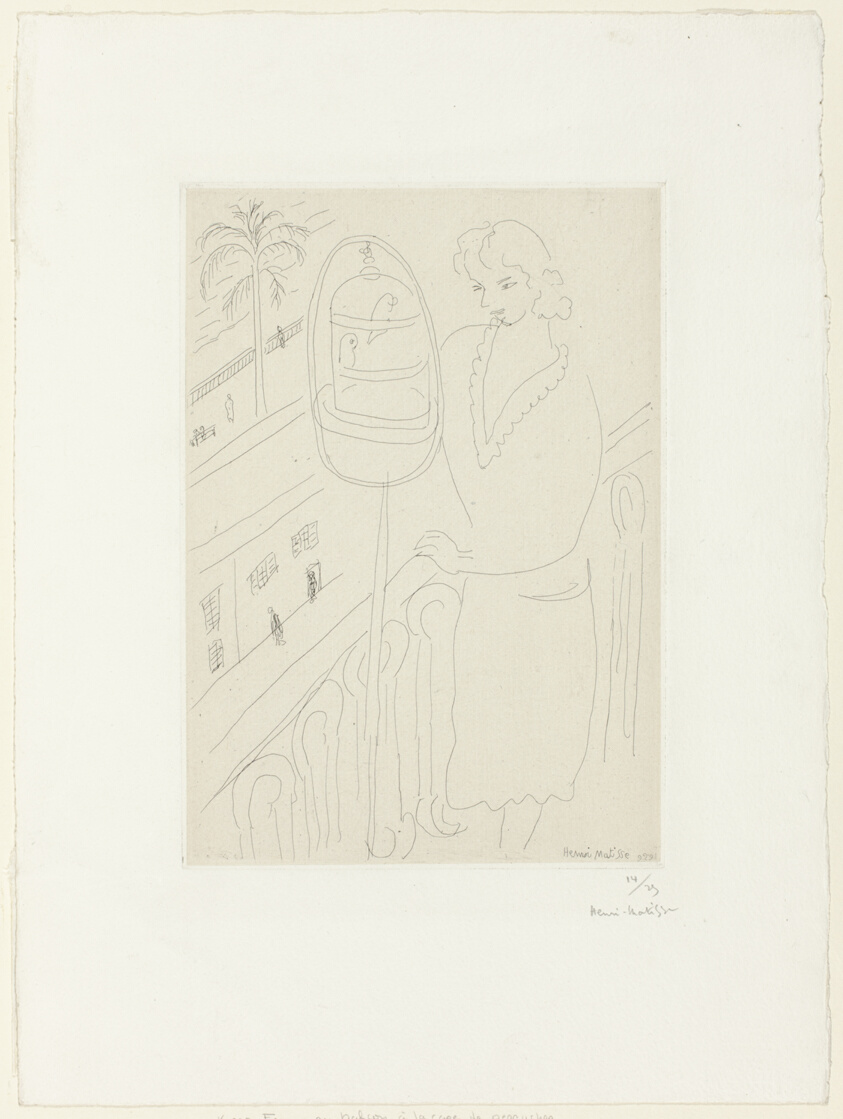
Featured Art: Young Woman on a Balcony Looking at Parakeets by Henri Matisse

We were sitting on the couch in the dark
talking about first pets, when I told him how,
as a girl, I kept a blue and white parakeet I let
y around the house and, sometimes, outside,
where he’d land on the branches of pine
and eucalyptus, balancing between seedpods
and spines. Only, while I was telling it,
my companion began to stroke, very lightly,
the indent of my palm, the way you do when you’re
sitting in the dark with someone you’ve never kissed
but have thought about kissing. And I told him
how my bird would sit on a high branch and sing,
loudly, at the wonder of it—the whole, green world—
while he traced the inside of my arm with his fingers,
opening another world of greenery and vines,
twisting toward the sun. I loved that bird for his singing,
and also for the way his small body, lifted skyward,
made my life larger. And then it was lip-to-lip,
a bramble, and it was hard to say who was who—
thumb to cheek to chest. The whole ravening.
When I told him I did not clip my bird’s wings,
I was talking about hunger. When he pressed me
hard against the back of the couch, named a litany
of things he’d do to me, I wanted them all.
I, too, have loved to live in a body. To feel the way
it lifts up the octaves of sky, cells spiraling
through smoke and mist, cumulus and stratus,
into that wild blue. And though I knew
there was always a hawk somewhere in the shadows
ready to snatch his heart in its claws, still,
I couldn’t help letting that parakeet free.


Read More

Not the Wolf but the Dog

By Jacqueline Berger

Featured Art: Two Human Beings. The Lovely Ones by Edvard Munch

Not the zebra but the horse;
not buffalo but cows,
maybe camels,
who traded the wild for the stable,
a stall lined in straw,
the house with wee gables and eaves,
their name over the door—
Biscuit, Coco. Snowball, Ranger.
Traded the hunt for the daily bowl and dish,
predators for owners, collar and leash;
agreed to be a tool—plow or cart
or confidant—to breed in captivity.

So when the man in the elevator
at the Venetian holding his cardboard
tray of coffees and muffins
heading back to his room
says to no one in particular,
but most likely to the other man,
the three of us strangers,
I better get something in return for this, 
he means fetching breakfast
so his wife can sleep,
I better get something for all of this, 
gesturing with his head,
meaning the hotel, the dinners and shows,
I think about women
who prowl the midnight streets
in their staggering heels,
breasts like missiles
because they’d rather be feral than kept.
And about men who gave up
wilding to name their offspring,
their known code continuing on forever.

I’m carrying my own tray
of coffees and muffins,
will soon press the card against the lock,
open the room, rip off my clothes,
throw back the three hundred
thread-count sheets, waking
my husband. He’s met someone new
and now wants both
of his lives at once.
He can sleep later. These untamed
weeks, we’re savaging,
flesh against flesh, ravishing
our marriage.

Read More

Heart 2. Kathryn Cowles. Mixed media (tuning forks, megaphones, windmill, catapult, volcano, bathtub, confettied heart, tissue-paper flowers, flamethrowers, pianos, etc.) 2014

By Kathryn Cowles 

after The Way Things Go, by Peter Fischli
and David Weiss

I give the boot on a stick a push.
                                                          The boot circles round and kicks the light switch on, which, as the open bulb grows hot, melts the balloon full of red red paint, which drips down to fill up the glass precariously balanced until it tips over and breaks, tripping a wire on its way down,
                                                                                                                            and the wire sends a spoon attached to a little weighted car down a ramp, and the spoon hits against strategically placed tuning forks in different notes as it travels down, and the tuning forks are each pointed toward a red and white megaphone set at full volume, and the megaphones serve to amplify the little 12-note tune that I can’t get out of my head,
           and when the spoon car gets to the bottom of the ramp, it smacks into a striped target, which knocks a red bowling ball onto an oversized inflated black plastic bag, which releases its air into a long silver tube in a burst, causing the white canvas windmill at the other end of the tube to turn, which tips the wooden seesaw structure so that it releases its 1,000 one-inch rubber balls in various shades of red and pink and gray and black down a 25-foot wooden plank, and then into a metal chute, where they line up and twist and turn their way, roller-coaster-like, to the bottom of the track, picking up speed all the while,
                                                                                                                                                                   and at the bottom, they split into two tracks and collect in two separate tubs attached to two separate strings that will only pull once enough balls have accumulated in the tubs, given enough weight, one string attached to a trip wire attached to an oversized match, which quickly strikes against its measure of sandpaper and lights on fire, and the other string attached to the safety catch of a tightened, loaded bow above it,
                                                                                                                                                                   and the string slowly, slowly, as the waiting match burns down, as the tub fills with one-inch balls, slowly pulls at the safety catch until it, quite suddenly,
                                                                releases, letting loose the paraffin-soaked arrow, which passes through the flame of the oversized match and lights up as it shoots just feet above the heads of the seated spectators in the outdoor garden of the art museum, over, across the open space, grazing on the other side of the crowd a wick attached to the paraffin-soaked cardboard mannequin,
                                                                                                                                        which bursts into a flame that lights all the attached oversized sparklers from their shortened bases, and they burn in reverse, outward, and the mannequin sags, and the mannequin gets infinitesimally lighter, as the sparklers drop their ash to the ground and as the chemicals react and burn away, so that the enormous and sensitive scale holding the sparklered mannequin on one side becomes outweighed by the enormous pile of inflated red balloons on the platform on the other side of the scale and slowly lifts into the air,
                                                                                                                               and a metal ball rolls in a track along the edge of the platform and catches in a pocket on one end of a wooden plank,
                                                                                                                                                        causing the giant catapult full of red-dyed baking soda on the other end of the wooden plank to fling its contents in the air and, upon hitting the vat of red-dyed vinegar in the center of the giant papier-mâché model of a volcano, to bubble up over the edge and through a rugged papier-mâché channel painted to look like rock on the side of the volcano,
                            and the fake lava flows into a water wheel, which turns and turns, and the turning untwists a 50-foot length of rope from around a pole high above the crowd, out on the end of a crane,
                                                                                                                                                                    and the pole is attached to the side of a bathtub full of confetti made from hole-punching-to-pieces every letter or postcard you ever sent me every photograph I have of you every scrap of film every original thing every only-copy-that-exists and that might hurt to lose,
                                                                                         and the bathtub turns,
                                                                                                   and turns on its pole,
                                                                                                                       and upends its contents onto the crowd
as 12 pianos each tuned to a single note drop in succession,
                                                                                                         a literal kind of surround
sound,
          playing the little tune I can’t get out of my head,
                                                                                           as confetti cannons shoot red
tissue-paper flowers into the air,
                                                    as the tissue-paper flowers pass through the blaze
of the four flamethrowers, strategically placed,
                                                                                    as they light one after the other and burn completely to ash before landing gently and harmlessly alongside the confetti on the heads and shoulders of the crowd in the art museum garden 50 feet below.


Read More
Convocation

By James Lineberger

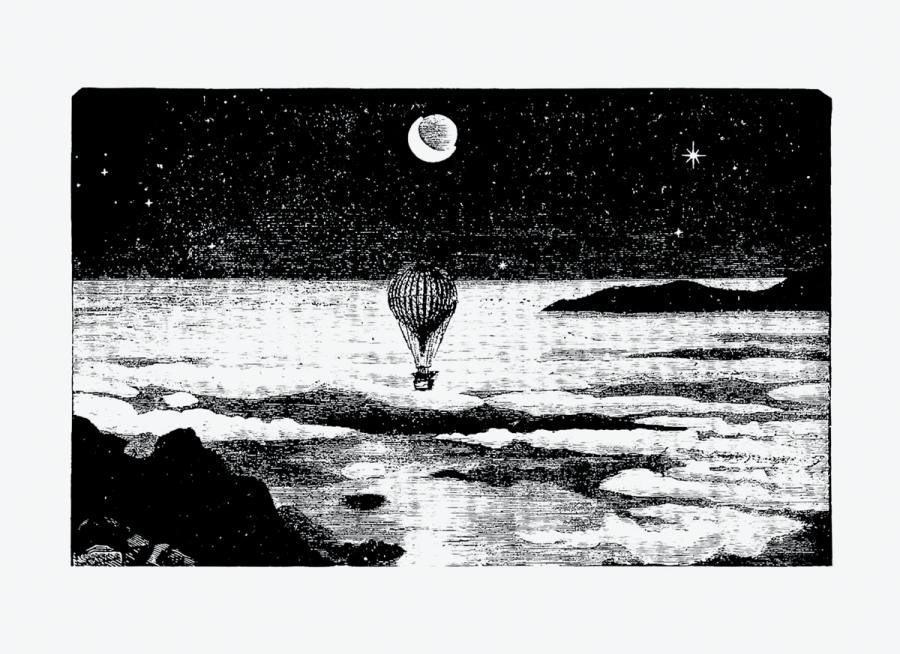
Featured Art: Hot air balloon by James Nisbet & Co.

Perhaps you’ll find it strange
you no longer appear in my dreams,
but on the other hand
it may serve
to fuel your belief that I never loved you
at all, that we were little
more than a scattering of pixels
in the ether,
the kind of momentary disturbance
a thrush will make
stabbing its bill into the leaves
and tossing them
about in search of food, shaking its head
to clear away the debris
and take whatever sustenance the god of thrushes
has promised
before the world settles back again,
asleep in the wake of a need
more primal than heaven and hell;
yet even when I think of us in that sense, as only
the leftovers at some Olympian event where we were not guests,
but mere canapés, nibbled at
and tossed aside,
left in the dead grass for worms to eat,
still it seems that even
birds and grubs, yea, our very comminuted dust, are cursed
with the memory
of a time when nothing could ever
go wrong,
and we knew all the words to every song.


Read More

Maintenance

By David Gullette

Listen,
            while you were over ogling ogives and trefoils,
                                                                                           chancels and bays,
the things you left behind were quietly giving up,
flying to pieces, falling apart almost together.
            That grinding whine up front you thought was brakes failing?
It was, but that’s not all:
            the last shred of resistance is gone from the shocks,
            every bump is now like the thump of a flawed heart,
but that’s not all:
            the tires have gone slick and bland in your absence,
            unevenly worn like the martyr that marries a slob,
wait, there’s more:
             not only can’t you stop at will, you can’t get started,
             the juice is dead
             some slackness in belt or disc
            something not flowing
            the black box caked with inertia.
Listen,
            you cried at the Royal Wedding and swallowed the cream,
meanwhile the tube lost its sight: snow, garbled snow in its face
            and a twisting of speech unknown in Babel, O
things have been going to pot,
            the paint peeling off your house,
            leprous, obscene, what about that?
The food has vanished under the weed,
the path has forgotten where in the world it was headed,
the mower that might begin to set things aright
is all smoke and flame and missing parts,
shorn of its function.
            Maybe you thought as you turned away toward exotic joys
            the objects you’d secretly started to hate
            would await your return unchanged
            loyal and fixed in their whatness?
You forgot the revenge of decay, you forgot
how even immobile things, unloved, blindly careen and plummet,
how care is a constant curing,
our bulletin first last and always: Aid.

Okay
            you’re back: the fat and languor are through.
The wind has shifted to pelt what’s left of the garden.
Strange birds are swarming the shorter days.
            You dreamed and the world dissolved
            but already the perfumes of distant sugars
            begin to escape from your larder,
            and you open your eyes to the list of your derelictions,
            whelmed with the staggering costs of restitution.
It is time you accept your share in the damage
and spend what needs to be spent.
Repair.


Read More

Red Beans and Rice

By James Sprouse

Featured Art: ‘Modes et Manières de Torquat

The medium said you were not coming back.
So I ate my red beans and rice
same as on our wedding day
down in Algiers, Louisiana.

The next day you rode
off with the Russian, Porshenokov,
in a little MG, your long straw hair
whipping in the streets

in the wind of the French Quarter
and down on the bayous, where it’s
too hot to sleep. The cemetery on Ramparts
was a forest of stone, the dead

above ground. On account of
the hurricanes, they said, and high water
on the Mississippi that stirs underneath
and raises them up.

That time you came back,
in heat, in sweat, with cotton-mouth
and juju. The South was our
time to be hot.

Next day you shipped out
lithe as a dolphin
rolling and tumbling down to the delta
on whiskey and water we called our lives.

Beautiful dreamer, awake unto me . . .
on Lake Pontchartrain, in the boat
of our nights, your prodigal smile
alive with fabulous poison.


Read More

Bank Shot

By Greg McBride

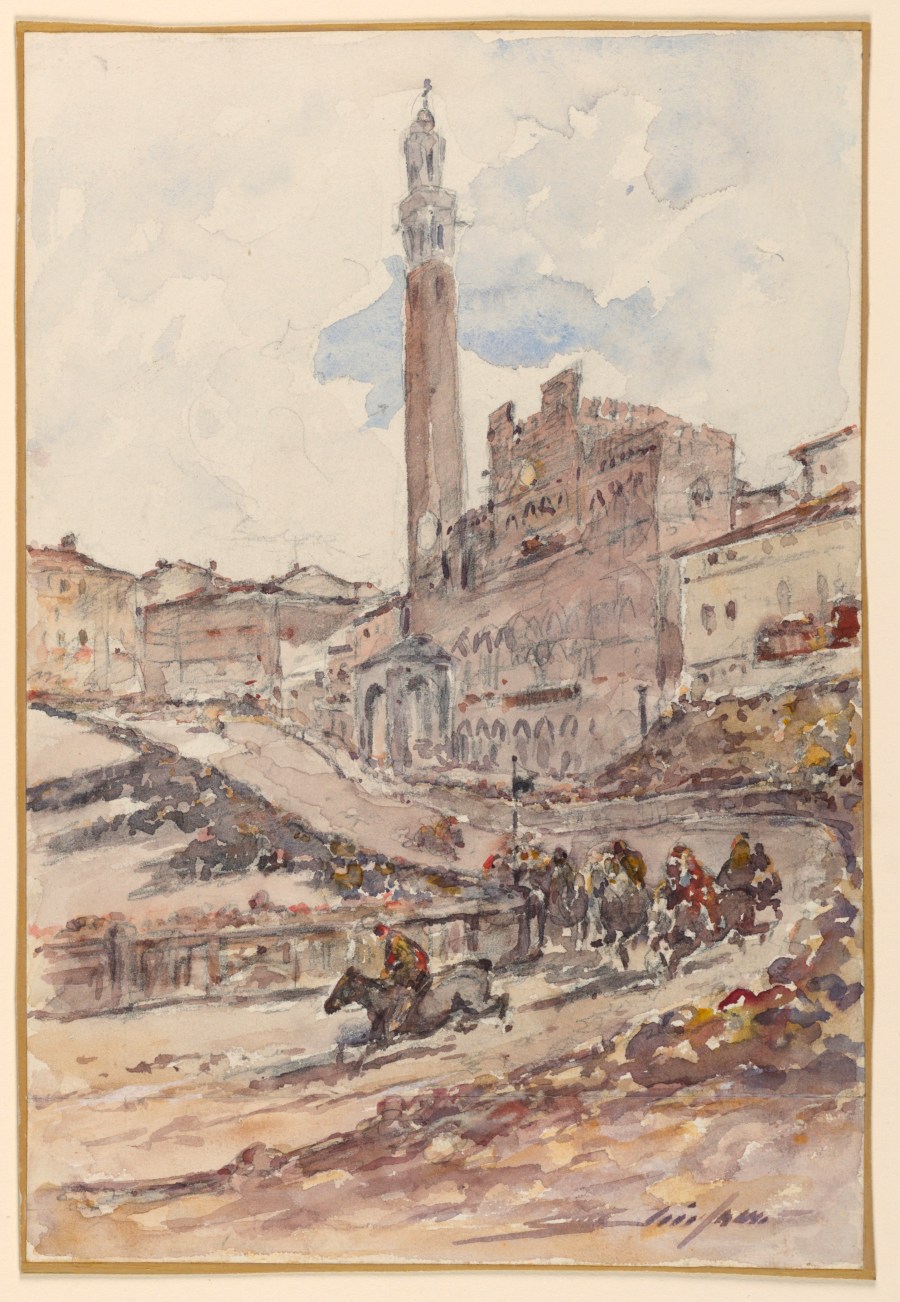
Featured Art: Horse Race, Siena, Italy by Walter Shirlaw

I asked about the old days, when they
were my age—my mother scrambling eggs,
Dad and I at the table. He aimed a glance
sidelong at her, then took a shot toward me:

             We’ve been very lucky, Son.

He must have meant their gamboling, teenage
marriage after weeks of jitterbug jokes
and getting-to-know-you’s in the Abilene
Lady Luck pool hall in 1941.

Her silence like the hush of a tournament
match, the cue’s tip skittish at the ball,
probing for angle and spin, velocity,
the all-important leave and follow-on.

By now—both gone so long, both unlucky—
I understand his game, how words can
travel in disguise, their spin covert,
as on that morning when his mumbled plea

caromed off me—sharply, as off
a felted cushion—and spun toward her,
determined at the stove:

             Come on, Honey, let’s play.
             Let’s keep the run alive.


Read More

Believe that Even in My Deliberateness I Was Not Deliberate

By Gail Mazur

Featured Art: Butterfly by Mary Altha Nims

Believe that even in my deliberateness I was not deliberate
—The end words form this line from Gwendolyn Brooks’
poem, “the mother”

We’d be calm, we’d be serene, as long as we could believe

in the blue dragonflies and balletic monarchs that

hovered near us in a kind of peaceable kingdom even

while my love’s illness menaced the peace in

the summer yard, in the fragile house, in the air I breathed in my

deliberateness. My only stratagem, deliberateness:

to accept our lot in that pathless time. I

thought I’d know what he’d want; what I’d want was-

n’t any different. Wouldn’t it be, wouldn’t it finally be, not

to consider how finite our August? Not to deliberate?


Read More

A Theory of Violence

By Jennifer Perrine

Selected as runner-up of the 2014 New Ohio Review Poetry Contest by Alan Shapiro

In the museum of sex, the video loops
its cycle of common bonobo behavior:
penis fencing, genital rubbing, whole groups

engaged in frenzied pairs, their grinds and shrieks
playing for the edification of each patron
passing through the room. We all summon

our best poker faces. One woman speaks
softly, reads from the sign that describes
all the various partner combinations,

the multitude of positions, how relations
lower aggression, increase bonding within tribes.
We linger over this way of making peace,

wonder to each other if we would cease
our litany of guns, bombs, missile strikes
if we spent more time in wild embrace.

The exhibit doesn’t mention our other cousins,
chimpanzees, who form border patrols, chase
strangers in their midst, leave mangled bodies as lessons.
That’s the story we already know

and want to forget through the release
of these erotic halls, where we seek the thrill, the bliss

of these animals who hold us captive
while we lament what traits we’ve found adaptive.


Read More

Patina

By Mark Cox

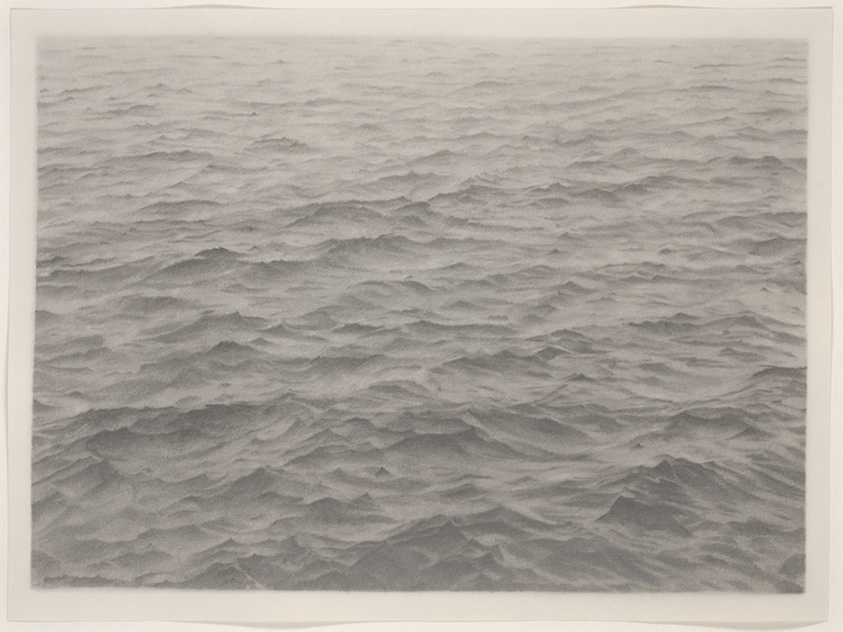
Featured Art: Untitled by Vija Clemins

In your prime, shape presents itself first,
the angle and curve of one thing,
the size of something else,
or the way her hair flows volcanically

along each subtle slope and swell.
It is crazed, intense, super-heated,
even the soles of your boots feel sticky,

because she’s entered you, you know this,
she charts the very map of your blood,
and that eyelid twitch you have going,
they’ll claim is stress and dehydration,

but it’s her, pal, all her, she floods places
you’ve never named in yourself,
she proffers the pulse, the duende, the élan,
that jackhammer of lust
outside the Fiesta Ware outlet. . . .

But one day, it just happens,
a man’s eyes cloud and change,
you don’t feel with the same ardor
the way she moves, her confident posture,

no, suddenly it is color you notice,
the grays, the yellows, the bruised surfaces
tinged with a silver-green, almost a tarnish,
as if her skin were a metal,

and not such a precious one, either,
more like pewter or the common alloys
of soot-smudged medieval artisans,
something to be re-shaped, hammered thin,
become useful and used.

Read More

Bobcat

By Mikko Harvey

Featured Art: Forest by Werner Drewes

Walking through the woods / at midnight / we were on our way / to the pond / where we
would skinny dip / when two yellow eyes / appeared on the path / we froze / they didn’t
blink or move / the body was / hidden by the dark / there was something / sinister in its
stillness / we turned back / you said it was probably / a bobcat / but better not / to take
that chance / we shared a bed / untouching as usual / you fell / asleep first and I wondered
what kept us / apart really / that night / and the others / the distance between us / maybe six
inches / felt like a shadow / I couldn’t step out of / my two open eyes / the only light
in the room / I thought of the animal / blocking our path / and it occurred to me / she was
only a hostess / welcoming us / to the world of risk / smooth and lovely / water hugging
your naked body / the animal said / are you ready / but we walked away / I had an urge
to shake your body / awake and take you back / to the animal and say / confidently yes
table for two / but instead I just lay there / in the perfect / quiet / country / darkness / and
imagined the outline / of your chest rising / and falling / rising / and falling as you slept.


Read More

My Father’s New Woman

By Fleda Brown

Featured Art: Fruit and Flowers by Orsola Maddalena Caccia

My father has a new woman. He’s 93, the old one is worn out.
They used to hold hands and watch TV in his Independent Living
cottage, but now there is the new one, to hold hands. The old
one is in Assisted Living not 50 feet away but barely able
to lift herself to her walker. He sits in her room after dinner,
her mind wandering in and out. What if she escapes
and comes over while my father is “taking a nap”
with this new one? My mother is two miles away beneath
her stone, relieved. I bring artificial flowers to her with my sister,
who likes to do that when we visit. I am not much for
demonstration. I would just stand there and say, oh, mother,
he’s at it again. And she’d say, I am sleeping, don’t bother me
with him anymore. And we’d commune in that way that knows
well enough what we’re not saying. And I’d be lamenting
my self-righteous silence in the past, my smart-aleck-motherjust-
go-to-a-therapist talk. What I should have said was, was,
was, oh, it was like a tower of blocks. Pull one out and all
would fall. She would get a divorce and a job and marry some
balding man like her father, who would be my ersatz father
and would take her dancing and let her wear her hair
the way she wanted, and she would cut it short and get it
permed and life would quiet down and my father, to her, would
morph into the handsome and funny Harvard Man he was
in the old days, the way he posed her for his camera, tilting
her head to the light with his devouring-passion fingertips
and her days would begin to feel like a succession
of pale slates to scribble on and erase before the new husband
came home from work, while my father would spin off
after whoever would “put up with him,” as he says,
and would follow his new one around carrying her groceries
and complaining that she spends too much, but biting his tongue
and thinking how soon she would let him, well, you know,
and I would be, what? The same as now, writing this down
so that none of the shifting and sifting could get away
cleanly without at least this small consequence.


Read More

Speed of Light

By Mark Irwin

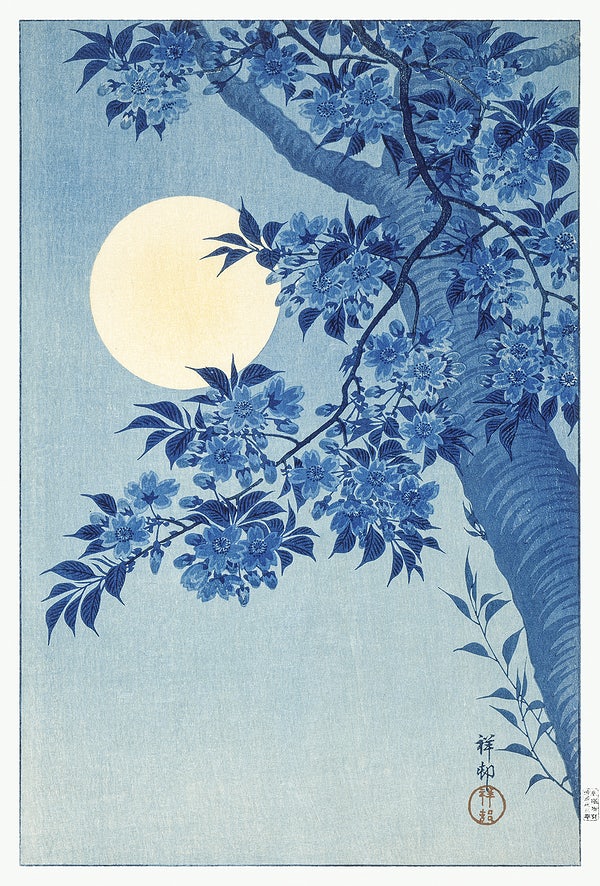
Featured Image: “Blossoming Cherry on a Moonlit Night” by Ohara Koson

Married in Beijing, they had their names carved on
a grain of rice. Mai wore a yellow silk gown. He wore
a black suit. Embraced in the photo turned sideways
they resemble a tiger scrambling through strewn mums.
That evening they ate salted mango and shrimp. He
can still taste that, see the tortoise-shell clip sun-
splintered in her hair. That evening continues, stalled
like the sea-filled drapes in their room. For twenty
years he worked at a lab that accelerated protons. Here
are photographs of their two girls on Lake Michigan,
then in Zermatt, standing before the Matterhorn,
whose moraines, cirques, and ravines resemble those
through two names magnified on a grain of rice, or
of that shadow looming through the CAT scan of her brain.


Read More

When It’s That Time for Piranhas

by Michael Derrick Hudson

Featured image: Utagawa Hiroshige. Swallow and Wisteria, mid-1840s. The Metropolitan Museum of Art.

Everything has already blossomed: my neighbor’s wisteria
has gone hog-wild across the ragged frontier of
our mutual fence, the soft green tendrils
of it violating international borders

and breaking treaties. Achtung! So let me tell you about

my neighbor’s wife: she’s delicious! And every morning
I hear all the birds in Fort Wayne, Indiana, go

Yippee-yee! Yippee-yee! Which is how spring jibber-jabbers
while her husband blows the leafy detritus

off their depilated lawn. Something’s missing. I want to be
indigenous with her, something somehow prehistoric—

I want her in Brazil. I want a quiver full of spindly arrows
to fetch our breakfast’s blue-tailed skink or

supper’s three-toed sloth. I want ritual scarification, coherent
rites of passage. I want grandpa’s thighbone
whittled down to a splinter

and dangling around my neck.
I want to help her stitch banana leaves, scorch
grubs against a rock. I want her to smile at me like a jaguar,

each incisor filed to a point. I want poisonous frogs, seashell
currency, enemies who make sense, a copper
plug through my lip. I want

a shameless squat. I want mumbo-jumbo witches to shun and
screeching ghosts to appease. I want her to take me

down to the river where we’ll knot and
inch our way across. I want her to trust me to be the lookout

for piranhas. I want to know when it’s that time for piranhas.


Read More

Owen and Paul

by Angie Mazakis

Selected as runner-up of the 2011 New Ohio Review Poetry Contest by Nancy Eimers

Feature image: Sir John Everett Millais. Study for the Head of the Rescuing Lover in Escape of the Heretic, 1857. The Art Institute of Chicago.

It’s any two strangers’ conversation.
The proportions of the tall one’s face
make him look like an Owen.
The other one, easily a Paul.
Owen makes a face, a gesture—
his forced half-smile squints one eye,
as he barely shrugs in a way that falsely
means tentative, in a way that pejoratively
leans and says, I’ll give you that much,
a gesture which says entirely,
You know, it’s like this. Maybe I’m wrong,
but it’s something to think about.
The maybe I’m wrong suggested by some
softening of his eyes that kept him from
a face that said, nice try or dubious—
something he had to lose.

I catch my eye just beginning to imitate
the gesture, try it out, here in this coffee shop.
Maybe I’ll start wearing this look after saying things like,
Yeah, I’m pretty sure that’s the city rock ‘n’ roll was built on.
Or after anything ending in most people don’t know that.

Read More

At the Mall

By Carl Dennis

Featured art: Youth by Frederick Carl Frieseke

It’s a long time now since the cedar tree
That you and Martha Spicer inscribed
With your twined initials was reduced to shingles
For a house later torn down to make way
For the Northtown Mall, the very mall
You walk now on rainy mornings.
In a few more weeks of the exercise program
Prescribed by your doctor, you should feel the strength
Lost with your triple-bypass finally returning.
Then you’ll confront the years still left you
With the zeal they merit, or the fortitude.
Be sure you’re in line when the mall doors open,
Before the aisles fill with serious shoppers
Intent on finding items more sturdy
Than their bodies are proving to be.
Could Martha Spicer be among them?
What you felt for each other back then
Didn’t survive the separation of college,
Though now it seems careless of you
Not to have kept in touch. Maybe you’ve passed her
Unrecognized as she’s looked for gifts
To make her grandchildren curious
About the world they live in, a book, say,
Devoted to local trees. On the cover
A cedar stands resplendent, the very kind
She carved her initials in long ago
With a boy whose name may be resting now
On the tip of her tongue. Try to imagine her
Hoping he hasn’t wasted his time on wishes
That proved impractical, like her hill house
Bought for its vista that proved in winter
Inaccessible to a snowplow. If he made that mistake,
Let him move back to town as she did
And focus like her on keeping her windows open
So a fragrance blown from afar can enter
When it wants to enter, and be made welcome.


Read More

Chefs

By Claire Bateman

Featured Art: The White Tablecloth by Jean-Baptiste-Siméon Chardin

So there the world was, right smack up against the proverbial edge of time. No one was surprised that some people were leaping from skyscrapers while others were attempting pointless last-minute conceptions of offspring; & that in every city & town, acts of extraordinary altruism & vindictiveness had become so common as to go unreported. And no one was surprised that there was a spike in the number of couples suddenly eager to be married, but the spike was so dramatic, in fact, & the usual officials (rabbis, priests, justices  of the peace, notaries public, & ships’ captains) were so beleaguered, that a squadron of kamikaze chefs had to be deployed to perform emergency nuptials for the multitudes of entities & identities demanding official union before the end of all things. Everyone knew someone who was calling for the chefs, those professionals capable of creating the alchemical events these transformations required, some of which would almost certainly release such molecular & ontological ferocity as to create titanic conflagrations, thus depriving some of the chefs of their precious last few weeks of life.

Read More

Constant Craving

By Kathy Fagan

Featured Art: Café Concert (The Spectators) by Edgar Degas

When Peter Byrne of the 80s synthpop duo, Naked Eyes, played for me his acoustic cover of k.d. lang’s “Constant Craving” in his studio over-looking Los Angeles, the peacock—not the NBC peacock but a real peacock among the many on the grounds—opened his fan as if the music were a potential mate. He strutted and shirred. He shimmied his many eyes. He’d been drawn to the music, then spotted himself in the sliding glass doors. He leaned in and turned for us like a Vegas show girl. He brought tears to my eyes. When the song was over I could barely muster, “What a tender version, Peter,” though tender wasn’t the word for the primitive if aimless seduction on the lawn.

Read More

The Last One

By Bruce Weigl

Featured Art: Two Plant Specimens by William Henry Fox Talbot

The anonymous brown song bird
        is annoying in her insistence
             on repeating the same three syllables
in exactly the same way, endlessly.

        She must know something
             about inevitability,
                       to sing so long,
        no one else in sight.

        The persistence of nature;
         the blind and infinite dedication to a thing
                       in the face of emptiness and silence
        that won’t let you believe that you are the last.


Read More

Watchman, Tell Us

By Michael Chitwood

Featured Image: Mountain Brook by Albert Bierstadt

The thief was none other than the wind.

The thief was the color of nickels.

The thief hummed in the downspouts, around corners.

I’ve already told you.

You should know better.

Mister Know-it-all. Mister Hands-in-your-pockets. Mister Sleep-for-the-morning-is-coming.

The thief had the cinnamon of fallen leaves on his breath.

The thief put a tear in our eyes.

Read More

Heroine in Repose

By Rick Bursky
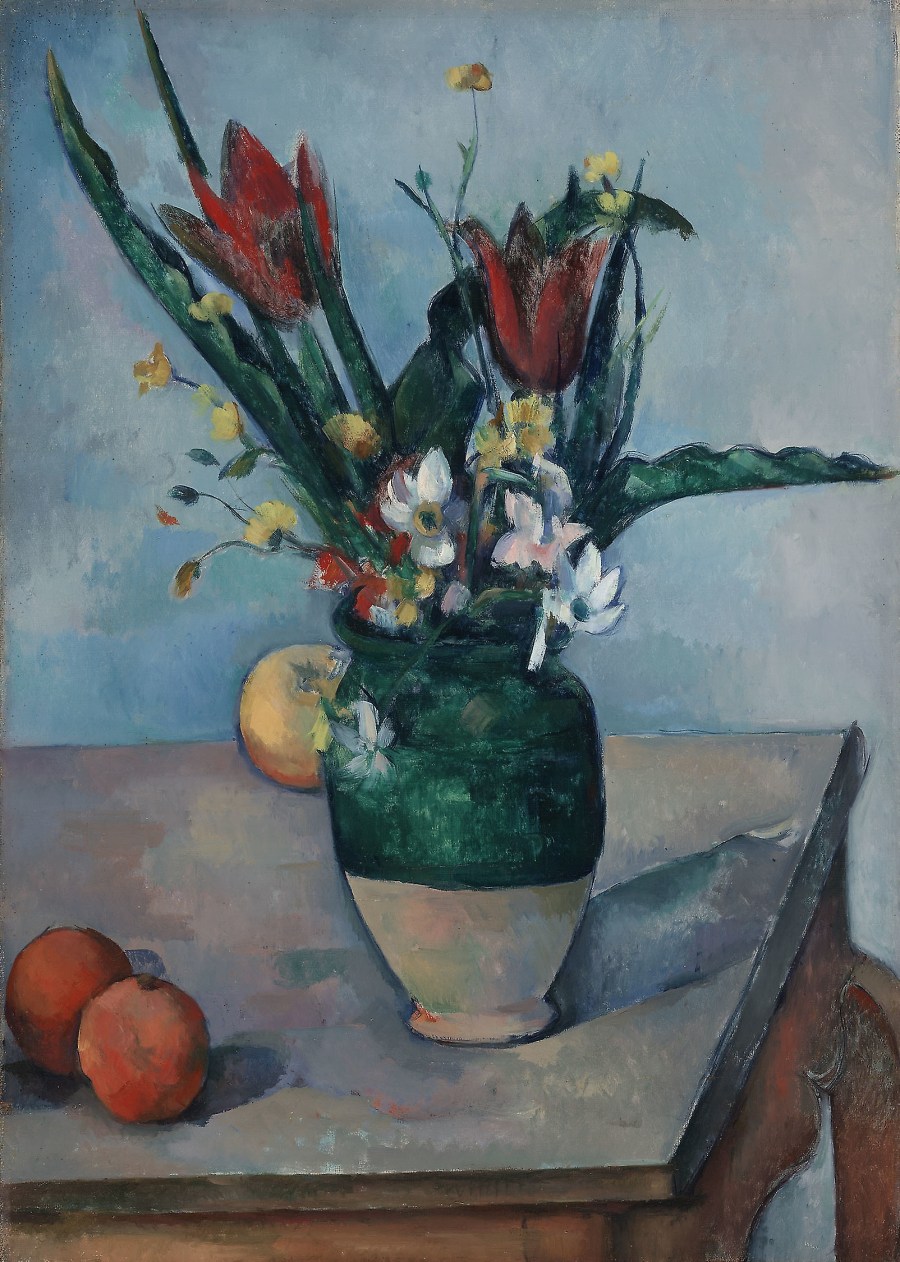
Featured Image: The Vase of Tulips by Paul Cézanne

I wasn’t sure if she kissed me
or simply used her lips
to push my face away. Yes,
the moist warmth was enjoyable,
but when my head was forced
back over the top of the sofa
the intention grayed.

Earlier that day I planned
to quit my job and pursue
a career writing romantic novels
that would be confused with memoirs.
But if I couldn’t distinguish
between a kiss and a push
what chance do I have
of writing romantic novels
that would be confused with memoirs?

After the kiss, and I prefer
to think it was a kiss,
she sank back into the pillows
and watched me
out of the corner of her eye.


Read More

The Night I Proposed

By Peter Stokes
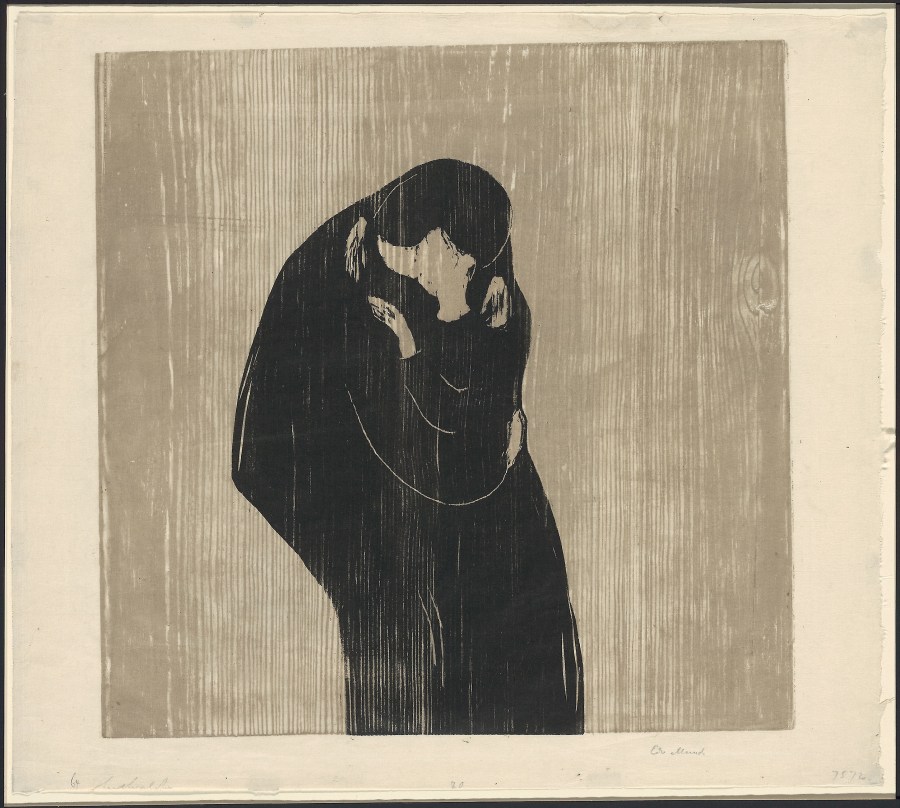
Featured Image: The Kiss IV by Edvard Munch

This is a whole new world to us, and
We drove up to some rooftop parking garage
To look out on the Western night
There up above the Terminal Bar & Grill
And later moving on down darkened East Colfax
Past all the whores with their narrow old asses
And bars wide open with their doors bent back
I thought I saw Bo Diddley
At the wheel of a cream-colored Cadillac
Like out of some wet dream from my Visions of Kerouac
And I knew that at last we had arrived.

Read More

Haircut Talk

By Peter Stokes
Featured Image: Baby (Cradle) by Gustav Klimt

Lenny’s elbows jut from the sleeves
Of his blue barber’s shirt
And carve the air about my head
In a series of unreadable signs
That I trace in the glass of his square barber’s mirror
Where I watch myself watching his face give expression
To the subtlest whir from his scissors and comb.
Or we talk for a moment
About a change in the weather
And I realize for the first time
That Lenny is gay.
“So how’s married life?”
He says through the silence,
The strange edge in his voice
Like a barb on a wire
In the point-blank talk of our new acquaintance,
And I smile a smile that communicates nothing
And it’s suddenly clear that Lenny is drunk.
How much, then, I wonder, does he want to know
About my wife in the hall
With the bread knife in her hand,
Or the one about me,
It was midnight at Tim’s place,
Falling down drunk from the top of the stairs,
Or the sub-zero talk in the car outside Lena’s
And making her cry until 3:00 a.m.
And I talk to myself,
Three speeches in the silence,
And all of this world,
On the still point of a pin,
Spins through the minutes
With nobody talking
As we confess to ourselves
Everything we conceal
And the hair from my head just falls to the floor.


Read More

The Bad Wife

By Elizabeth Powell

The door’s made of gingerbread that the rats have eaten through.
You finger your record albums like cold, frigid women.
You could be more silent than silence without much of a fight.
I float, a birthday party balloon you let go into the deepening sky.
How I once felt my life against yours, two pieces of burnt toast.
The town had zoned me for you, now I’m a wetlands—
You can’t run your cable under my land anymore.
There’s nothing wrong with you, just as there is nothing wrong with the sky.
At my core, a humming gas heater, rusted, though still useful.
Nothing loves the world as a mortal soul can.
Yet the very word domestication sounds like a zoo for housewives.
Let’s see—what prayer was it we were saying?
Yes (of course), the one that got us here.
Once I loved you madly, like a girl pirate,
Now I use my sword to pick up moldy, low-loft towels from the floor.
Now we wear headsets because we can’t hear our own music.
Once I was your bride, now nothing more than a mermaid nun,
And the sea is so choppy, torrential, wild, biblical with sadness.
Oh, once you smelled of mint, of truth.

Read More

Longing

By Natania Rosenfeld

Featured Art: by Creative Commons

I’m not sure what it has to do with length, but it makes sense to think of them together. For longing by definition has no end.

The O.E.D. gives as one definition, the cravings of women in pregnancy. Those objects can be had, though some are quite unhealthy. But cravings are concrete, and they come to substitute for longings. Krunch Kones at the Dairy Land instead of scintillating talk, achievement, the limelight. Whiskey instead of love.

Perhaps “longing” suggests the power of the want, not its unattainability. Perhaps I confuse “longing” with “pining,” which is a word containing pain. To pine is to long with pain for something you’ve lost and can’t have back, ever, or for a very long time: home, or a lover. (The pine tree strained at the sky, stripped, attenuated, its trunk graying.) But I think you long for something you’ve never had, that’s always just beyond the horizon. At the end of a long road whose end is invisible.

Read More

The Immortals

By Rick Bursky

In the painting of the young couple kissing
on a bench in a museum hallway
I’m the subject of the portrait
hanging on the wall behind them.
I’m wearing the blue velvet jacket
of an eighteenth-century Prussian cavalry officer
standing beside a white horse that’s too large to be accurate.
Though I’m rendered with lifelike precision. Obviously,
I couldn’t have served in the eighteenth-century Prussian cavalry.
I don’t speak German, and was born centuries late.
I’m not the first person to pay
a famous artist to be in a painting.
Though I wanted to be the man being kissed.
Unfortunately, my famous artist didn’t believe
a girl that lovely would kiss me in public.
I offered photographs of previous lovers
but unless one was kissing me on a bench
in a museum hallway his answer was no.
That’s unfair. Otherwise I’m pleased
with the painting. The couple kissing,
I suspect, also paid to be in the painting.
Though I’m certain they were strangers.
Her eyes are open, peering at where
we might stand admiring the painting.
Instead of resting on his cheek, the palm of her hand
is pushing, proving that while she desired
to live forever in art, her desire didn’t include him.
I once fell thirty-seven feet
from a railroad bridge into a river.
Riding the ambulance to the hospital
is when I decided to pay a famous artist
to put me in a painting.
What brought the woman to the painting
is something I’ve often fantasized about.
The oxygen mask’s elastic strap
pinched the back of my neck.
I kept the discomfort to myself.


Read More