Essay: The lines, the borders

By Julia Ferry

  1. Beginning 

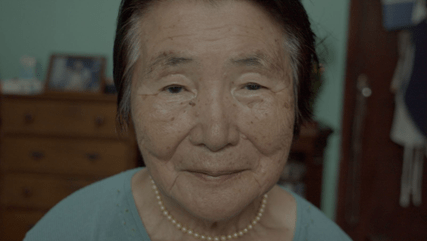
I shrink the size of the image. Now I feel that it reveals too much, even though that was precisely my intention when I photographed my grandmother. It is her daughter, who died when I was only 5 years old, who I wanted to find through this face. For a while I’ve started searching for my mother and decided to start with hers. I wanted to get as close as possible to this person who, to me, is distant and silent. 

I’ve never known the name of the city where she was born, who her parents were, or how old she was when she emigrated to Brazil. I don’t know what it was like for her to raise six Brazilian children, all born in a Japanese colony where she lived and worked for 40 years. We’ve exchanged a few words, especially about her second daughter. I think about this silence and wonder whether it is the generations, the languages, the apprehension, or the loss that separates us. 

Read More

Echo-Delta

By Teresa Burns Gunther

“Echo-Delta,” his wife shouted from the dining room. “Can you order Chinese?” 

Ed sighed and checked his watch. He’d given up begging Tanya not to speak this way. Tango, as she’d taken to calling herself, spoke in the NATO phonetic alphabet now: a side-effect of her new life mission, to change the medical-insurance-industrial complex one military letter at a time. Ed waited the last seconds until his office clock read 5:00 before leaning his hands into his desktop, where a client’s financial records were arrayed, and pushing himself up. 

He grabbed his cane and made his slow way to the kitchen, wincing at the jolt of pain in his left leg, pain that poked a shaming finger. Since the pandemic, his accounting firm had allowed him to work from home, which was convenient given how the accident had left him.  

Read More

The Self-Correcting Language

By Claire Bateman

Featured Art by Claire Bateman

Almost everyone was happy when the bioengineers released it into the population, even editors and grammarians whose jobs were rendered obsolete, their pure-hearted love of accuracy transcending their own self-interest. It’s true that a few alarmists were concerned about the way it consumed all other languages as it crackled through the population’s synapses, but against such ferocity and speed, what recourse could there be?

Read More

Mr. Cosmos

By Jill Christman

It matters not who you love, where you love, why you love, when you love or how you love, it matters only that you love.”

~ John Lennon

This morning I made a single-cup drip coffee and poured too much water through the small yellow cone. When I lifted the cone to peek, strong, black coffee filled my white mug to the brim. 

Nay, not the brim, I thought. Past the brim. I hung onto the edge of the counter and brought my eyes down level with the top of the mug, marveling at the way in which the coffee arched up out of the mug, a bitter mountain, the strength the surface tension pulling the coffee molecules beyond what seems possible. I would like to die on a coffee mountain, I thought, straightening my legs. I hadn’t yet had even a sip. Maybe it was time. The house was so quiet I could hear the muted ticking of the wall clock in the kitchen, thumping her plastic hands around inside her plastic face, bearing witness to the wonder of the coffee rising up and out of the mug, ticking off the seconds of our lives. 

This is when I heard another voice in my head. Mr. Cosmos, my fifth-grade science

teacher at the round school in Newbury, Massachusetts circa 1980. He’d given us all big cups full of water and little cups full of nothing and told us to pour water into our little cups until our cups runneth over. That’s the way Mr. Cosmos talked. Children, he’d say as if we were attending boarding school in mid-century England, Children, are you ready? Pour. Pour your water. Pour your water out—and let your cups runneth over.

Read More

マ I 克 (ma-i-ke)

By Warren Decker

Mike came to Japan because he was tired of being Mike. He was the only guy in the dorm who would never take lime Jell-O vodka shots, and would get mad if his roommate woke him up— stumbling drunk through the door, and turning on the florescent light, before passing out snoring in the lower bunk, fully clothed, wearing shoes filthy with mud and wet grass clippings from the university lawns. Mike would climb down from his top bunk and turn off the light but he could never get back to sleep, and his morning study routine would be disrupted.

Mike preferred Chinese characters to people, specifically the kanji characters used in Japan. He had already worked his way through the bright red “First 500 Kanji Workbook,” and was halfway through the light blue “500-1000 Kanji Workbook,” while some of the other freshmen were still struggling with the phonetic hiragana characters. His teachers praised his diligence, but for Mike it was very simple: he preferred Chinese characters to his roommate but he also preferred Chinese characters to Mike. If he spent an hour carefully memorizing the stroke order of a kanji like 鬱, then Mike—with all his doubts, his unfounded sadnesses, and fears—would be somewhere far away.

In his junior year, he arrived at Kyoto University as マイク (ma-i-ku). When people spoke, he could quickly associate the syllables of sound with a specific kanji, and decipher the meaning within a few seconds. The other exchange students were still fumbling around with “ohayo gozaimasu.” Within a month マイク had lost his virginity in his single-occupancy dorm room with Reika, an English major, who wore huge sunglasses and had long hair that was dyed a dark shade of reddish-brown.

Read More