Directions

By Matthew J. Spireng

Featured Art: Village Street by Alice Pike Barney

This time, giving directions to a place
I have never been, an address
I have only passed so I could tell another where

it is, I have explained: across the street from,
a few blocks down from, between this
cross street and that, a little yellow awning

across the front, the name in big letters above it,
and if it is dark, will there be
light on the awning, or will its color be gone,

indeterminate? Tell me, will you, if I arrive
first and find a better way to describe, how
can I reach you, or must the first suffice?


Read More

Fantaisie

By Donald Platt

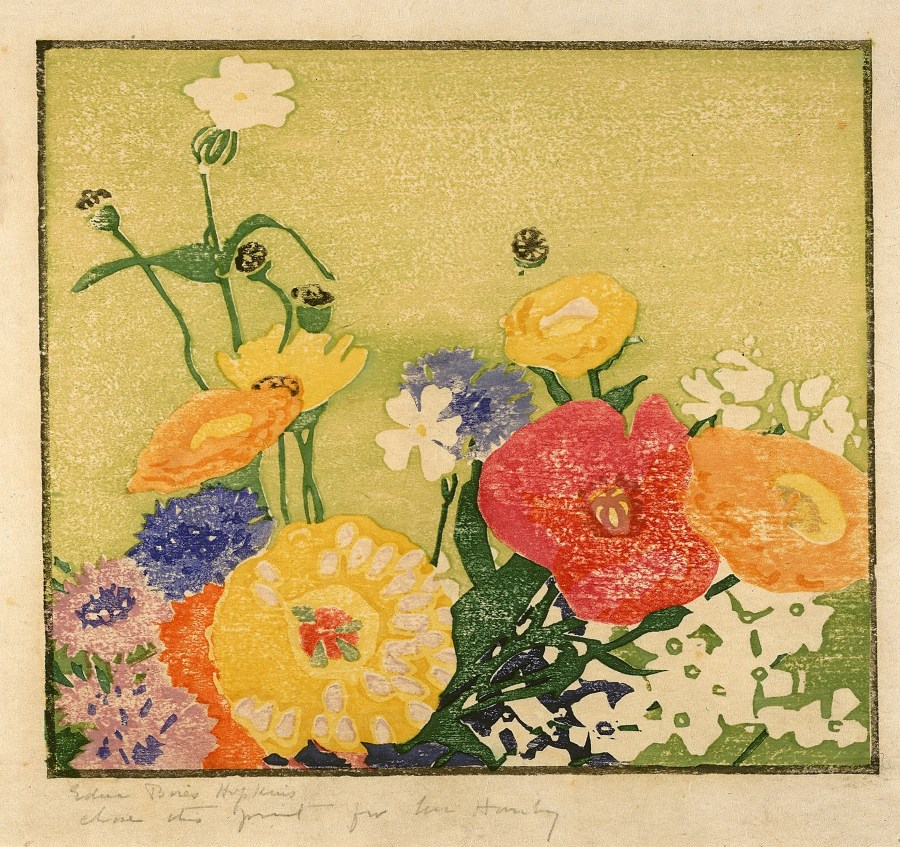
Featured Art: Garden Flowers by Edna Boies Hopkins

                               Each person is
a solar system, the bits of birth’s Big Bang orbiting
                               some sun that both attracts

and repels. Elliptically, my mother orbits her own death,
                               that great shining
ball of fire I cannot look directly at. She draws closer to it,

                              then pulls away. She rotates
as she revolves. Together we write her obituary. Born.
                              Schooled. Worked as.

Married to. Gave birth. Resided. Retired. Is survived by.
                               The old story
we all get to write if we’re lucky, or one that will willy-nilly

                              get written for us.
I leave the day she’ll die blank. She gives me the notes
                              she wrote last night:

“Funeral in Christ Church and Bill Eakins to preach.
                              Ask Women’s Guild
to serve a simple refreshment. Give $100 to organist.

                              Give $5,000
to church. Give $500 to Bill Eakins. Give $1,000 to women.
                              Give $250

to soloist. No calling hours. Only the church service.
                              Nobody
getting up and saying nice things about me. Everyone

                              has their own
memories—good, bad, and indifferent. Chief purpose
                              of a funeral

is to pray for the departed. Also to give comfort
                              to those who grieve.
Call Hickey Funeral Home.” As an afterthought, she added

                              “Ask Charlene
to play Saint-Saëns’ Fantaisie for violin and harp.
                              You’ll need to find

a harpist.” Everyone needs a harpist to accompany her living
                              and her dying.
No one to turn to but the seated, marble harp player

                              at the Metropolitan Museum
of Art, early Cycladic, eleven and a half inches high
                              He embraces

the D-shaped instrument, whose top is ornamented
                              with the head
of a waterfowl. Against his right thigh and stone shoulder, he rests

                              the weight
of the instrument. It has no strings. His raised right thumb plucks
                              five thousand years of silence.


Read More

NOR 19 Feature: Manipulating the Reader

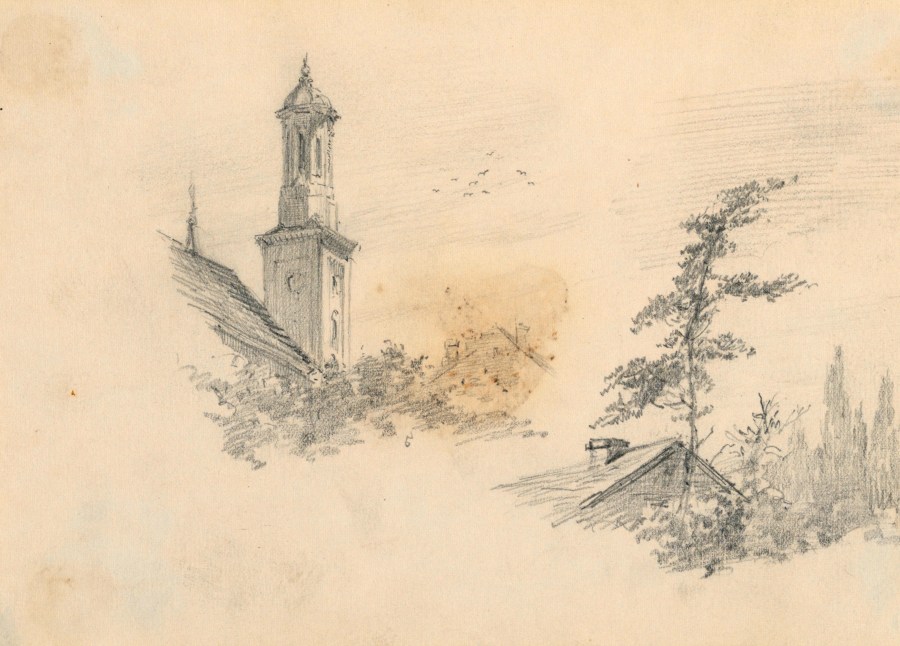
Featured Art: Sketch of Church Tower and Roof Top by Arnold William Brunner

We often say that a story, a movie, a song, or even a commercial about sad dogs is “emotionally manipulative.” We use this phrase not only to discount a particular piece, but to condemn it. What, though, constitutes literary emotional manipulation? Is there such a thing as a benign manipulation, a justifiable heart- tugging? And what specific moves can we identify that make the difference between effective and ineffective narrative manipulation, between a moving poem and a mawkish one?

We asked five writers—Rebecca McClanahan, Debra Marquart, A-J Aronstein, C.L. Dallat, and Matthew VanWinkle—to respond to those questions.


I Second That Emotion

A few years ago, I attended a literary gathering and heard four poets and memoirists read from their work. They were all accomplished writers, varied enough in their approaches to evoke laughter, sighs, nods of acknowledgment, a collective gasp at one point, and, toward the end of the evening, some tears as well. Tears are not uncommon at readings, of course—I have cried at several—but in this case the tears came not from audience members but rather from one of the readers, who had warned us that she might “choke up” because of the emotional content of the autobiographical piece she was about to read. Her introduction, followed by a tearful presentation, suggested either that the work was too new to share publicly or that she had planned her reaction and was intentionally manipulating us. As she spoke, I sensed listeners growing more and more uncomfortable, as I was. Some leaned back into their chairs, some crossed their arms. The more emotional the reader’s performance became, the less effect bit seemed to have, an unfortunate outcome, especially given that the work was potentially moving in and of itself. But it was as if the writer did not trust the work, or perhaps did not trust us to do our job as listeners: to bring our own emotional response to the work.

As I listened, I kept thinking of Chekhov’s advice to a writer who had sent him a story: If you “want to touch the reader’s heart, try to be colder . . . As it is, your heroes weep and you sigh.” John Gardner has a similar take on this issue in The Art of Fiction. “In great fiction,” Gardner writes, “we are moved by what happens, not by the whimpering or bawling of the writer’s presentation of what happens. That is, in great fiction, we are moved by characters and events, not by the emotion of the person who happens to be telling the story.” Certainly Chekhov and Gardner are not suggesting that the writer herself be unmoved by events and characters, but rather that she allow the reader the space to complete the transaction her words set into motion. For isn’t that what readers of literary fiction, poetry, and nonfiction want the chance to do? To, in the words of that Smokey Robinson hit, “second that emotion”?

Read More

Tell it Cool: On Writing with Restraint

By Debra Marquart

Featured Art: Hill with Trees by Eleanor Harris

For years, I’ve encouraged students to “tell it cool” when narrating a tale that is harrowing or emotional. A cool narrator can be a buoy in rough waters. I’ve always thought this advice came from Hemingway, but at this moment as I search my bookshelves for the place where Hemingway said it, I can’t put my finger on the quote. I know it’s in there somewhere, likely in one of the letters (bossy letters full of unsolicited advice and signed “Papa” when friends were just writing to ask for money).

In A Moveable Feast, Hemingway famously wrote about knowing what to leave out. In his discussion of the short story, “Out of Season,” for example, he remarks that he left out a key event connected to the real story: “I had omitted the real end of it which was that the old man hanged himself.” According to a letter that Hemingway wrote to F. Scott Fitzgerald in 1925, the story was “an almost literal transcription” of an experience he’d had while traveling in Europe with his first wife, Hadley.

Read More

Staying with Argos: Odysseus and His Dog

By A-J Aronstein

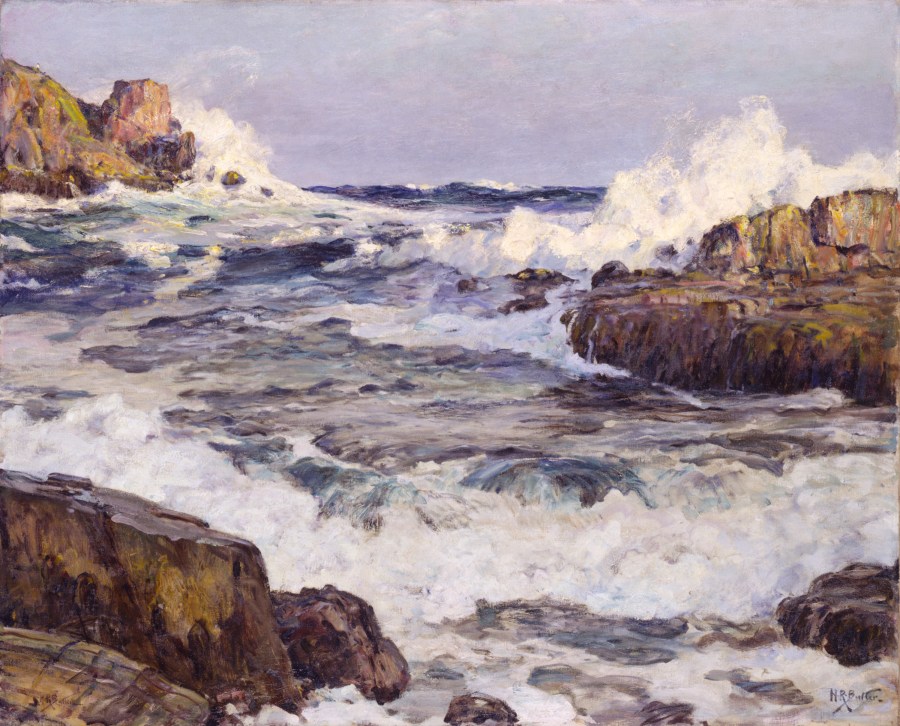
Featured Art: Clearing after September Gale–Maine Coast by Howard Russell Butler

Argos, the loyal dog of long-suffering, well-tanned, always-oiled Odysseus, appears only once in The Odyssey. At the sight of Odysseus, who returns to the island kingdom Ithaca after 20 years, Argos dies. Bam! Kaput. Struck down by a Zeusian thunderbolt. At this point in Book 17, no one other than the reader knows the true identity of the disguised and smelly Odysseus, who dresses like a beggar. Escorted by his loyal swineherd Eumaeus, Odysseus pauses to observe Argos from the distance of a few steps. But he can’t even pet the pup before steering back toward his wife’s suitors, whom he’ll slaughter in due course. Argos dies almost immediately after Odysseus turns away. Though the encounter takes fewer than one hundred lines, its brevity should not trick us into thinking about Argos’s death as a merely sad aside. A closer reading reveals how Homer manipulates his audience before the final act, using Argos to orient our empathy toward Odysseus. Moreover, if we stay with Argos a little longer, he reveals something essential about fiction’s capacity to wrap epic emotions into even the tiniest moments.

To see a doggie’s demise in any medium will always make us blubber. So too will reunions between pets and soldiers. Witness the strange phenomenon of YouTube compilations documenting first meetings between dogs and American troops returning home from Middle Eastern war zones. These clips depict pure cathartic joy. Fido or Georgie or Lady jump and drool all over their patriotic owners, howling with disbelief, filmed by someone holding an iPhone that trembles with the cinematographer’s barely-constrained sobs. Music swells, the major cries, and before we have time to think about the trauma lurking in the background, we cut to another dog jumping into the arms of another deep-eyed master in fatigues. These are fragmented blips of pure joy. They don’t ask us to think: They constitute a conveyor belt of emotive force.

Read More

Yeats and Heaney: The Poetry Without the Pity

By C. L. Dallat

Featured Art: Genip Tree in the Mountains, Jamaica by Frederic Edwin Church

When W.B. Yeats dismissed Wilfred Owen’s World War I poetry as “all blood, dirt & sucked sugar stick” (and omitted Owen, Sassoon, and Rosenberg from his 1936 anthology), he was making a powerful statement, not just about dis- taste for sentimental language and the role of pity in poetry, but about the poet’s duties and limits. He had already excluded writing war poetry from his own list of obligations in 1915’s “On Being Asked for a War Poem,” but only later became more coherent on the abjuration of pity as an unfit subject.

This is, of course, the Yeats whose career started in the mists and myths of a Celtic twilight amidst a flurry of pre-Raphaelite sentimentalism and romance, who wrote of tragic heroes, of “The Pity of Love” and “The Sorrow of Love.” So before reaching for his famous poem, “Easter 1916,” where Yeats does appear to address war and politics, we should take a momentary look at that early work.

Read More

Designs Less Palpable: Emotional Manipulation and Even-Handedness in Keats

By Matthew VanWinkle

Featured Art: Flowery Meadow by William Henry Holmes

In a February 3, 1818 letter to his friend Reynolds, Keats rejects a reading experience that he associates primarily with Wordsworth: “We hate poetry that has a palpable design upon us—and if we do not agree, seems to put its hand in its breeches pocket.” The reproach is so scathing because it acutely observes how rapidly the poetry’s interest in its audience cools, from the importunate heat of the design to the indifferent withdrawal to the pocket. Keats is fuming primarily at Wordsworth’s dogmatism and propensity for self-congratulation, as we hear earlier in the letter, where Keats complains of being “bullied into a certain Philosophy engendered in the whims of an Egotist.”

At first glance, this might seem like a rarefied chafing, a protest against an intellectual irritation or an effusion of rivalry peculiar to talented writers. Yet the kind of readerly hatred that Keats memorably articulates becomes more comprehensible when we think of art that has palpable designs not on our ideas but on our feelings: the swelling soundtrack that jerks at our tears, the so-cute cartoon kitty kitty that beguiles us into wuv. Every reader has caved in to this sort of appeal at one time or another, and many readers look back on such acquiescence abashedly, or worse. How to admit, even in hindsight, to having been manipulated, to having feelings that can be summoned and practiced upon with such infuriating confidence?

Read More