Newohioreview.org is archiving previous editions as they originally appeared. We are pairing the pieces with curated art work, as well as select audio recordings. In collaboration with our past contributors, we are happy to (re)-present this outstanding work.
Selected as winner of the 2013 New Ohio Review Fiction Contest by Stuart Dybek
Featured Art: Chinese Garden by Cooper Hewitt
Outside the bride’s village, I lean against the side of a silver Audi with Mr. Wu, my boss’s businessman friend. I thought we were going to his wedding, where I will be his best man, but I guess as per Chinese custom, we are going to the bride’s house first. We have traveled twenty-five minutes into the Chinese countryside, where we wait for the rest of the wedding caravan. The second half of the dancing lion is late, and the head walks around with its neon-red body dragging behind, a giant mutant worm.
On the ride over, tall buildings gave way to dingy shops. The road narrowed, going from the usual off-white tiled apartments to the old-timey black-tiled Chinese roofs— the tops curved into crescent moons. Smoke spewed from small factories and then green patches of farms appeared, pieces from two different puzzles jammed into one another’s edges.
Death: at least it’ll give me a chance to catch up on my sleep. No more tossing and turning worrying about what’s going to happen next. Unless of course my dreams of dancing girls and hookah parties come true. In which case it’ll give me a chance to catch up on all the fun I missed being too tired from lack of sleep. A win-win situation. Unless of course the dancing girls turn out to be my former lovers, flitting before me with vengeful or disdainful expressions on their still painfully lovely faces. In which case I can go on writing the poems of failed love that failed to make me famous when I was alive. A suitable way to while away eternity. Unless of course the hookahs are filled not with tobacco but with heavenly peyote, (food of the gods the gods left for us) in which case it’ll give me a chance to catch up on the deathless bliss of boundless mystical oneness my fear of death always kept me from fully experiencing here and now.
Everything was better back then. Even my nostalgia was better, more piercing, more true. I miss missing things that much, but not as much as I missed missing things back then. Even my anxieties about the future, which have indeed come to pass, were more vivid back then, more real. Reality itself seemed more real back then—this clanking stage-play only a fool could find convincing—I fell for it all, and it killed me, again and again. Ghosts of myself wander the cities I’ve lived in, thinking of other cities, imagining me here imagining them. We nod to each other across the years, the way the last line of a poem will sometimes look back, wistfully, at the first.
Featured Art: Abstract Landscape by H. Lyman Saÿen
They sit like lumps at the kitchen table covered by a worn and graying cloth, milkdregs ghosting the glass of two tumblers. Their four feet dangle inches above the floor as Opa sucks his horehound. They can hear it slopping around, see it burrowing there behind his potato jowls. They smell the burnt-tire funk of it. It’s July and the brothers are long enough out of school that their stretched and empty afternoons have become kind of boring, they say. Nowadays, the two are mostly bored. Opa’s fat hand claps the table. He tongues his candy to the far end of the mouth and cries nonsense. There is no mostly, he tells them. No kind of. Either you are bored or you are not and if you are it is only you who is to blame. From the other room come the strangled words of their mother shouting at her mother. Opa nudges the boys out to the front porch. There he lowers his flanks onto a teak rocker. There’s an oomph and a curse and the old man begins to teach the boys a game.
Featured Art: New York Street, 1902 by Childe Hassam
In his leather snap cap & undertaker’s suit of shiny polyester black, one of those resisters of the transmitted order—an aging Marxist lost boy— alarm all over his shyly determined, axe-sharp face, tho a shadow falls upon that face, a gloom cast by the screen flash of corporations gaming the go-flo of dollars & broadband—he stands with umbrella outside Starbucks & silently hands out pamphlets, shucked by cold tourists. Does he have set rounds at subway stations and parks full of volatile sleepwalkers? Maybe he haunts the doorway of Filene’s at tag end of Presidents’ Day sales? Does he have a day job? wife or boyfriend? For change of pace does he sit in his kitchen obsessively scanning the box scores of road trip double-headers? Or is he always thinking how the world should be honorable, justice at hand?—like my old teacher in the dim Boston University lecture hall Howard Zinn—your life, he said, drives history—you can’t be neutral on a moving train— he died yesterday at 87 but left with his view still alive & intact of liberation possible for all.
Phil Rizzuto, shortstop, the Yankees’ Scooter & play-by-play announcer & The Money Store’s man of a certifiably trustworthy nature, but invented for me first in war stories told by my father— on a South Pacific island naval air station maybe it’d be fun to put Scooter in the game, brass thinks a sports star visitor to war zone great theater of operations P.R.— but basketball, not civilization-beating baseball, basketball my father’s game— “I could take him, he couldn’t get by me”: sayeth Norman Rivard, testimony of a former All-State point guard 1942 season Mass state champs team captain Durfee High School Fall River; his torpedoed destroyer sunk by a two-man Japanese sub (a sake brewers’ assistant & an Imperial War College ensign?), a few days earlier their suicide mission had sent my father to the base, rescued just in time for Scooter’s morale boosting visit, the two together on an asphalt court in cosmic time Holy Cow! an immortal, lucky accident— but will, pride, intensity count more for Norman—“don’t depend on luck OK, why don’t you just apply yourself?” my father’s question, frustrated by his distracted, blurry son— apply yourself, stay on track, stick to it, that’s the thing, you’ll adhere successfully to whatever you want (not sure I know what the wanting is for even now), you can be an architect, trial lawyer, oncologist, surveyor, if only you apply yourself— like a wing decal on the model of a Mustang P-51 Fighter or whiskey dried in a glass-sized ring on a liquor cart?— skim the ear wax off your eardrums, Dad—here is your poet, & here is your poem.
Featured Art: Red Parrot on the Branch of a Tree by Ito Jakuchu
When the parrot took the cracker I offered, it said:
“Thank you, my friend. You’re the first person to give me anything to eat in decades. There is no a priori order of things. I thought I had been living the good life, but what did I know? The poet fell sick, traveled to the capital, needed words, painted his curtains bright green. A sumptuous village girl threatened me with a cheap lighter. Night after night watching the corpses of rodents turn to bone. I remember when my mother took me to the city, remember how her perfume gave me a high. After that it took me years to find a mate. Night work. Elocution lessons. A treatise on Gorgias’ Encomium of Helen. I kept to the plan I started with. Death is not an experience, food is.”
Then it fell from its perch with a thump, and from its beak an ant exited soaked in the parrot’s blood.
with a singular total probity he fantasizes about women in our building the actual social interaction is nil or rather minimal and centers around coffee lines the young coffee lady at the corner stand he calls Casmira her real name is Dishwava but he doesn’t like that name Diswaba the deck he says and the large-hair customer at the IHS stand he calls Ingrid and the willowy customer on the HR floor he names Karen you can imagine his surprise when he found out Karen’s real name is Karen subconsciously now he thinks there’s a mind connection the world yet a more beautiful place there are single women in our office attractive and even affable why don’t you pay some attention to them I ask he says he read somewhere how an in-office relationship is bad very bad if one is looking for happiness
about the new guy? this is the thing he misappropriates as in you’ve seen my banana-label collection stickers on bananas I have the original collection that exists in the office he saw what I was doing and he copies it he has a collection now and I assure you it is not as extensive as egregious as mine although I am wondering how he got so many different Ecuadors but how can you be civil with someone essentially a thief other than that he’s all right
I mean the excitement level was just about in negative numbers as my sister’s basketball team lost its seventh straight and after it the girls are jumping up and down in total glee genuine happihappihappiness the reason? they broke the magic number ten in the losing score they didn’t actually break it but they finally made it to that number no sense of perspective in art too you have to see my sister’s painting of the flour mill with water wheel the central subject of which is a frog amidst the water lilies
What follows is by way of explaining what happened last Sunday, when I had more of a brush with sex than I’ve had in the five years since my divorce. What follows may explain my disappointment.
You see, the first man I fell in love with turned out to be gay and hanged himself from a tree along Highway 1 in California.
The second left me when I got pregnant. He was much shorter than me but had lovely lips and gentle eyes.
The third seemed promising: great sex, red-gold hair, tall. We met in a magical way. At a certain time on a certain day of the week, we passed each other going opposite directions on the campus of the University of Kansas. This was the sidewalk near the Student Union, which was burned down by hippies in 1972. I may have known one of the people who did it but I’m not positive about that. If it was the person I’m thinking of, he’s now an executive at an insurance company in Florida, with two kids.
Featured Art: Augustus Saint Gaudens II (Saint Gaudens and his model) by Anders Zorn
As if you rose out of your coffin—as if my heart was your coffin—you rose yesterday in the sapphire faceted light of syringes, hospital sheets, and toxic Niagara mist you painted into a glossy forever. I felt again your weight upon me that Manhattan night in our quasi-childhood. You moved lovelessly upon me, almost angry— anger I almost allowed myself to know— as we lay on a borrowed floor trying to make what might be called love. You broke each spell. The way Proust discovered love in captured rats squealing as the hat pin probed their vital organs. I was a slow student, I learned dumbly, blindly. And graduated to my own destructions. The white rats scamper through your landscapes of pill bottles and blood, chopped trees and massacred Adirondack deer and I dream of knocking all the books off my shelf so that in the light breaking from those pages I might behold, not hold, your broken face.
My mother had been failing for several years, slowly, but minimized the signs. We, her five grown children, were not to worry or be diverted from our lives. When it came, the time of her dying seemed to open of its own accord, its span neither too short nor too long. We had several weeks to talk, to tie up loose ends before the illness closed in and became a kind of weather we could no longer work around. On December 14, l997 she died at home in the company of her children and grandchildren. Snow was falling in Keene Valley, the small town in the Adirondack Mountains where she had lived for thirty-five years.
Emily Neville, my mother, was a well-known writer for young adults, and my relationship with her, as the oldest, a daughter, and also a writer, is complicated. Sometimes it seems like a difficult poem I have memorized but don’t yet understand. During her lifetime I was wary of such a strong, capable figure so close to me. My Aunt Mary, the sibling closest to my mother in age, once remarked, “As a child there was no point in doing anything—Emily could always do it better.” But she was a gentle person with no heavy-handed ways an oldest child could legitimately dispute, though I did resist her increasingly as I entered my teens. Since she was almost universally liked and respected my opposition put me at odds, not only with my mother, but with everyone I knew.
There’s no easy way in, or out, warned the LPN who buzzed us past the locked double doors, led me and my wife down the corridor to the nurses’ station where a handsome man, tall, and maybe sixty, wrung his hands while he stood over our daughter’s desk repeating her name— the way we had at her birth when we were listening in it for the ring of a bell— begging her to walk him back to school because he feared the bullies who’d tripped him and washed his face with snow when he’d delivered papers on his Ferry Street route, and before our daughter uncovered the steaming dish we’d brought, she took his hand, walked him around the floor past wandering patients and whirring machines then back to his room to help him search for his galoshes and gather his school books while his wife stood outside his door reading the little wishes in the greeting cards taped to his tinseled and holiday-lighted door frame, the hem of her velvet pants dripping and salt-stained from the parking lot slop, her Gloria hair-clip with streaking star and tarnished angel’s trumpet blowing silvery notes sideways through the frizz coming loose from her perm.
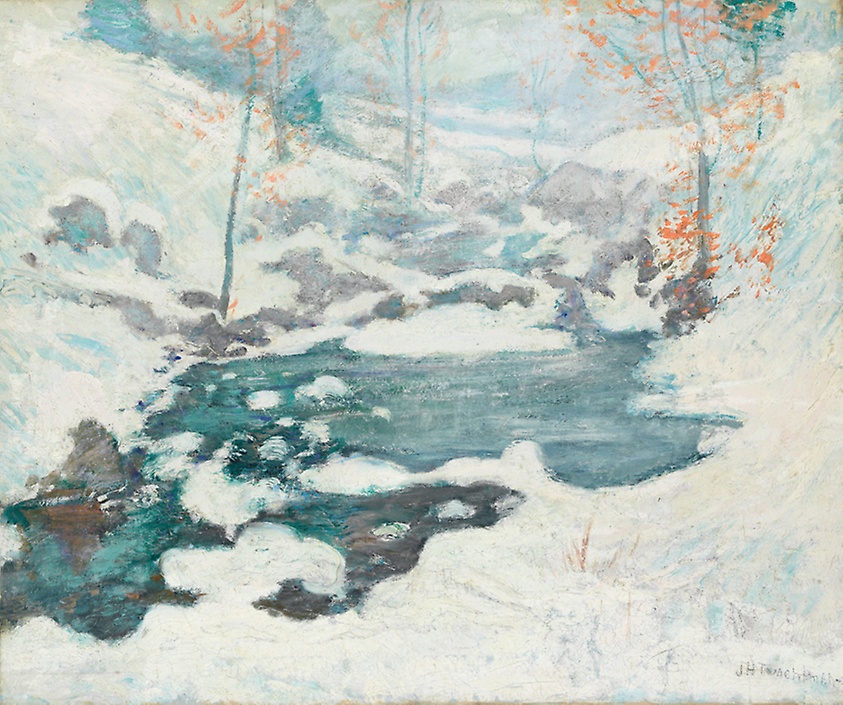
Featured Art: Winter Scene in Moonlight by Henry Farrer
His father limping from his stroke, throwing his lunch pail into the back of his pickup like some stubborn, gimpy shot putter, then driving off to the job they gave him after his rehab: steering a hi-lo through the greasy plant
after Danny died
one day recovering on the porch he hollered for the ice-cream man to stop, then bought us all popsicles
after Danny died
because his son—Vietnam—and so, and so. He had a cough that could maul a lion but he wouldn’t stop smoking
Featured Art: The House on the Edge of the Village by Théophile-Alexandre Steinlen
Leaves twitch. A wren flits. A rope between trees sags. By the well-head a few stranded dandelions. Rain opens stones so they shine. A crow calls with the voice of a hammer. The rain stops. The sun enters with the voice of a crow. Heat turns day to distraction and the trapped mind wilts. A hawk calls and small mammals dive for cover. Sky goes carillon, dwindles, cooling off until the moon fills windows and stains rooms. A door swings and things go strange as if they had to. If you hear a voice you hear a voice. I walk through the empty house, carefully, a cat’s whisker. When I get to the top floor, over the moonlit roofs I can see the prison and the small zoo. They must be able to see me here where I’m training the self to lose itself, the way the stream ignores the stream.
In the novel I’m writing there are no people, no “characters.” And if you expect a plot you’ll be sorely disappointed. There’s little to count on and precious little to critique. Beautiful language is absent; there is almost no language of any sort so you won’t see any reviews praising its style or humanity. In my novel, each place is the same as any other place so there can be no confusion about where you are. The novel builds to no denouement because there is no nouement. And there are no epiphanies unless the reader realizes that not having one is something of an epiphany in itself. Symbols are everywhere these days so there are none in my novel. The storyline consists simply of turning a page which can be thought of as a narrative in itself. If the novel has more than a page this could present something of a problem. And if you’re looking for something that passes for wisdom this isn’t the place, though I do think I have retained a sense of adventure simply as a consequence of sequence. So here goes, though my novel, unlike any other novel I can think of, is very short so as not to test the reader’s powers of concentration and patience. As I said, there are no characters. The world is overpopulated as it is, so why make matters worse? Perhaps I should stop right here. There may be too many people, but there are certainly too few trees.
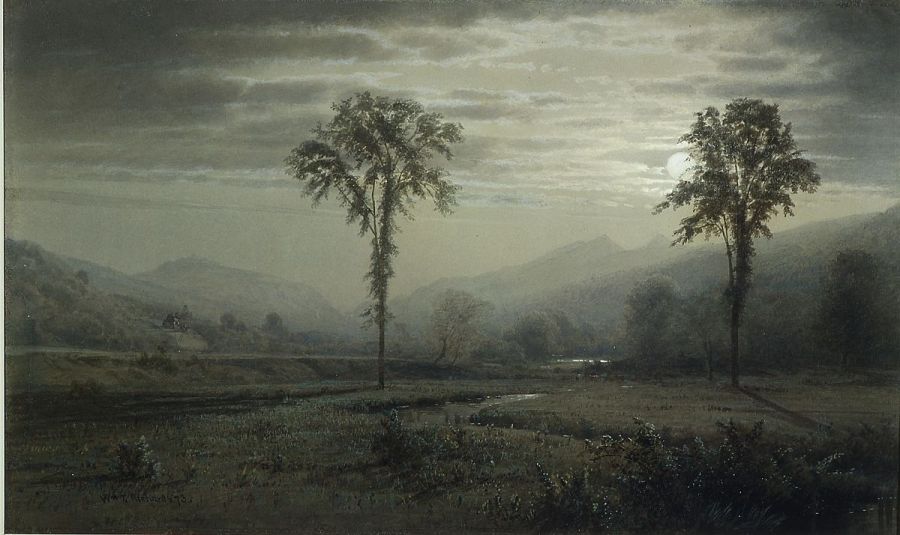
Featured Art: Moonlight on Mount Lafayette, New Hampshire by William Trost Richards
Just because I’m dead now doesn’t mean I don’t exist any more. All those eulogies and the obituary in the corner of the newspaper made me feel more vibrant than ever.
I’m here in some fashion, maybe like a gust of wind that disturbs the upper leaves, or blows a hat around a corner, or disperses a little cloud of mayflies over a stream.
What I like best about this is you realizing you can no longer get away with the things you used to when it would be ten o’clock at night and I wouldn’t know where you were.
I’m all ears, you liked to say when you couldn’t bother listening. And now I’m all eyes, looking in every direction, with one eye always open just for you.
Featured Art: Willows and White Poplars by Jean Baptiste Camille Corot
In the shower she takes a swig of beer, sets the bottle on the edge of the tub, and begins prying leeches, flat and large as house keys, from her cold toes, the top of her foot, her ankle. She places three in a line next to the bottle, where they lie motionless, though alive. Thinned blood threads over her feet. When she and Neil moved to the country four years ago, miles downriver from his family’s farm, he taught her to peel off leeches rather than douse them with salt, which he said might make them vomit and spread disease.
An hour ago, when she capsized, she didn’t feel the leeches take hold. She was alone. It was dusk. She looked up to greet a pair of bats when the kayak teetered, hit a tree recently fallen from the riverbank, and flipped. After a long moment, she surfaced. Sputtering, dog paddling, adrenaline-jarred, skin-tightened, throat splicing eddies, heels churning mud. She held the kayak and wrestled to free it from the current and the willow it was pinned against. She imagined herself the puny accident bystander who suddenly has the strength to pull a giant, unconscious passenger from the wreckage. Even so, she worked half an hour to bring the kayak ashore, roll and empty it. Near dark, she returned for the paddle. More splashing, spitting, gulping, sinking in mud. More leeches latching on.
Featured Art: Forêt de Compiègne by Berthe Morisot
I gave Saul a room. Two years prior, he had left me for Utah. He left me for the wild, for backcountry slopes. He wanted to be in glossy magazines and have his ponytail flowing out behind him in pictures, carving some mountain, dropping through powder. He spoke like this, dropping through powder. I tried to tell myself I couldn’t be too mad: he paid more attention to skis and skiing forums than he did to me. In Utah, he grew his hair long and beautiful and got in some of those magazines, though mainly he just put up pictures of himself on the Internet. I know, I looked at them all, wondering if he was thinking of me when he was hiking up the slopes, skis on his back, or whether he might get a distant glimpse of our life together when he was on top of one of those mountains and looked east. He was gone for two years, but to me it seemed a lot longer. I often thought about all the other girls he probably had sex with and how people probably loved him and how he was living this wild, free life, and I was still in East Tennessee with my brother and mother and the probably comparatively lame Blue Ridge. So when I found out he was coming back because he had seriously injured himself and could no longer carve or ride or hike or otherwise put his health in danger in backcountry powder, I was happy and told him he had a room waiting. I wanted him to come back in the same state he had left me in: miserable and alone.
She says, I think you think too much when you talk dirty.
They are, in fact, having sex when she says this— he’s above her and had just kissed the inside of her ankle, which now rests on his shoulder. He asks what she means.
I mean, you’re too, I don’t know, exact, like you’re trying to not sound stupid even though that’s what you should sound like— you shouldn’t be thinking.
He slows down, almost stops but doesn’t. It’s the sort of comment, he thinks, that would make a passionate person stop and leave the room, then the house, viciously dressing while cursing. He doesn’t want to and isn’t even that hurt, more perplexed, really: how does one make a conscious effort to become unconscious?
The clouds were curtains that parted onto the show of sky above the scar of 89. Oh, the big blue screen of autumn days and score that featured mainly strings. Oh, the epic Something, Then Nothing that opened as a matinee but played into the night on a single reel inside the room that housed the machine. I drove with one eye open and the other closed. I couldn’t tell if the things I was seeing— broken line, blinking light, leaping deer—were live or frozen frames. Were on the road or in my mind, into which I’d also driven at a dangerous speed. I was bearing down in the passing lane inside the theater of my Chevrolet. I was seeing myself through the lens of a windshield in the opposite lane. I could smell the sky with the windows closed. I could hear her voice from every cloud, “Come home, my love. Come home.” I believed there was still a way, despite my fame as the man who flies, to return as myself some day and give her the keys.
Selected as runner-up for the 2013 New Ohio Review Fiction Contest by Stuart Dybek
Featured Art: Decorative Study: Satyr by Aubrey Vincent Beardsley
In the spring of 1985, Ben lived with his friend Marco in a second-floor apartment near the college where they were sophomores. For fun they watched girls sunbathe down in the small back yard across the alley. They kept a potted ficus by the window to obscure their faces.
One day, while they were staring at the girls through the ficus leaves, Marco said he had an idea. He went down the hall and came back holding the VHS camcorder Ben got for Christmas and kept beneath his bed.
Marco said they should use the camcorder to film the girls. “That way we can watch them on the VCR at night,” he said, “when it’s more fun to watch sexy stuff.”
“No way,” Ben said.
“But we can pause it and look really hard.” Marco described in loving detail the way the girls’ bikini bottoms pinched their thighs and the way their breasts drooped to the sides when they lay on their backs.
Ben liked that stuff too, but he wondered if filming the girls didn’t make him and Marco weirdos. Instead of explaining this to Marco he said, “Don’t touch my stuff. Camcorders are expensive.”
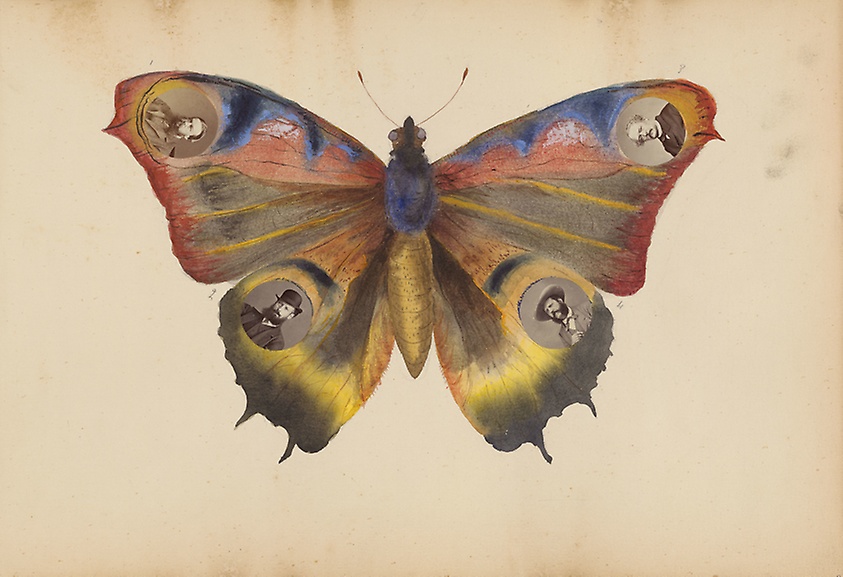
Featured Art: The Madame B Album by Marie-Blanche Hennelle Fournier
We don’t show these family slides much, in part, because the projector overheats, but also because we miss my father’s litanies of the dead and their diseases: congestive heart failure; cirrhosis; even gangrene— their ravaged, cancer-eaten, over-stressed organs recalled in official diagnoses, each dry account closing while the next was ratcheted into place, dad pressing the remote control as if it were the release button on a bomb sight.
To counterbalance, we kids attend less to people than to things: the Coleman cooler intact after twenty-seven years; the spangled (barely) red felt stockings in which we still stuff memory cards and batteries; the untouched Hai Karate cologne; the flight jacket Mom’s threatened for fifty-five years to toss. It’s funny, self-deprecatory, even vaguely reassuring until we get to the chilling reverse family portrait in which we sat on the same couch we’re now watching from, looking forward to ourselves, some new upholstery, and a smaller dog at our feet. There’s just enough time for a last inside joke, for recognizing the hard candy in its dish, pretending to spit out the piece now diminishing in my mouth, before the tone is torqued flush with our mortality.
In this faded family photo— Horton, Kansas, ’36— they are just two farmhands in overalls, kept, by a bowed velvet cordon, from some gala event. Except it’s a rattlesnake strung between them, five, perhaps six feet in length and thick as my young father’s outstretched arms. One might think his pride, that is, anticipation of us, would dictate looking at the camera, but he seems to be eyeing the slick, intricate patterns of risk now relaxed in his hand. Then again, given his uneasy, strained half-smile, he could be checking my grandfather’s grip, the snake so freshly dead, making sure any reflex is under control— suspecting the undulant weight of it, that he could never really let go.
When I’m feeling down about the human condition, that is, my human condition, I consider all the crappy jobs I could have had in another life. An executioner, say, or worse, the one to cart the bodies away—there are more difficult things than poetry, aren’t there, I remind myself, what if I’d been a mummy maker, with a desiccation degree, that would be no cakewalk, mummifica- tion was an industry, thousands of ibises and sacred cats, bulls even—those whoppers took 40 days in the sun to dry and speak- ing of meat, sacred or no, the smell was awful (those long days under the blood-orange Egyptian sun, you never got used to it, when you went home your wife refused to make love with you), but it was an important job, this populating the afterlives of oth- ers, providing guard animals, and pets, not to mention massive quantities of foodstuffs, none of which could you sneak home, the guards always patting you down, Ra forbid your old lady should be grateful enough to give an inch or you should live even a little of the afterlife you made for others. No, it is your lot to cater that picnic in paradise, never to partake of it, you have to be committed, as I tell my students, it is a way of life. The priests, they did the people, they didn’t really get it, what it entails to mummify a goddamn bull or 15-foot crocodile—they were fuck- ing huge—and the baboons, you had to yank their canines, house- break them dentally, before putting them down. No, it is no small job to populate the afterlife, it takes a brutal tenderness, atten- tion to life’s cruel details, all that moisture in which we live, the very lubricant of our mobility, drawn out molecule by molecule, though we didn’t think so micro then, and there you were lacing up your sandals, grabbing some rice cakes and dates for lunch, leaving for work, which, though worse than poetry, as fates go, could have been truly horrific—you could be quarrying stone for temples (long hours on barges, mosquitoes big as dung beetles, no hazard pay)—No, you had your own role to slave over, supply- ing pharaohs and courtesans a kind of Noah’s ark of totems and sacrifices, right down to the royal cock fights, so who could blame you for amusing yourself with the occasional mummy joke—the kitten placed in the sarcophagus of a lion, an ibis in a crocodile, a fish inside the ibis, a scarab inside the fish. It got you through those long-ass days while the sweat was drawn out of you gram by gram or iota by iota or however by whatever they measured it, and for what? What was waiting at home? A woman who couldn’t bear the stink of death on you, who probably spent most of her day rubbing olive oil into some noble’s feet, and so you get home and heave yourself down on a grass mat and say there just has to be a better way than this, than this life I am living and your wife says quit your bitching, this once, I’ll get the oil, and here you are, back in your hut of baked mud and palm thatching, your staff and sandals propped by the front door and it is cooler here out of the sun, out of the way, a moment’s pause, an eddy in the Nile, and it doesn’t matter if your sweetheart has been anointing other men’s feet or polishing their silver till her hands blackened, or the Papyrus Monthly won’t publish your work—you are together now, in this life, in this moment and the sleeping baby has your nose and the over-pounded, unleavened, tooth-shattering bread is warm, so quit your whining, you could be humping pyramid blocks through sandstorms, you’ve got it good, you can’t even smell yourself anymore, you are golden, here, have a fig.
What’s your next book going to be called, Demolition Work Still Sucks But Here I Am Again? —John (on the job site)
There is no larger truth here that has found me helping John and Ken again, to tear out the master bathroom of this wealthy couple in Washington Twp., except that work, hard labor, has overtaken me again— no matter how many tricks I’ve used to throw it off the scent— and I am not at all happy about it, and I am not all that used to it, my blood on the shards of tile and grout we’re prying from the shower.
But luckily there is this bucket for me to sit on while we take lunch in silence. My silence says I’ll be back to my classroom in a couple more days; theirs says the next job is tomorrow. Together they say There is nothing waiting for us there, on the other side of a back-spasming day of work except a paycheck—and the fact that though we wake to another day of the same grueling, tired sentence, wake in fact we do.
Featured Art: The Pearls of Aphrodite, 1907 by Herbert James Draper
From the clear vein a stream immortal flow’d Such streams as issues from a wounded god. Pure emanation! Uncorrupted flood, Unlike our gross, diseas’d terrestrial blood… – Pope’s Iliad, Book 5
Diomedes in his rampage cuts a hundred Trojans Down into the dust, a bulldozer Knocking over pines for another subdivision.
He is chainsaw, IED, a six-foot spinning razor, An Ugly Customer. In a helmet topped with boar-bristle, He’s hacking men to bits, his sword a red blur
& then he spies his prey, already spread-eagled, For a fellow Greek has flung his spear into the hipbone Of Prince Aeneas himself; its point burrows to marrow.
Spurting arterial blood, face against the dust, Aeneas moans & the blackness, Death’s imperious Stygian cloud, inevitable now, settles everywhere over him.
What can you do then but call out to mother, begging to die in her arms? Diomedes strides forward in his fury. This is what he came here for—to finish off a prince.
Selected as runner-up of the 2013 New Ohio Review Poetry Contest by Barbara Hamby
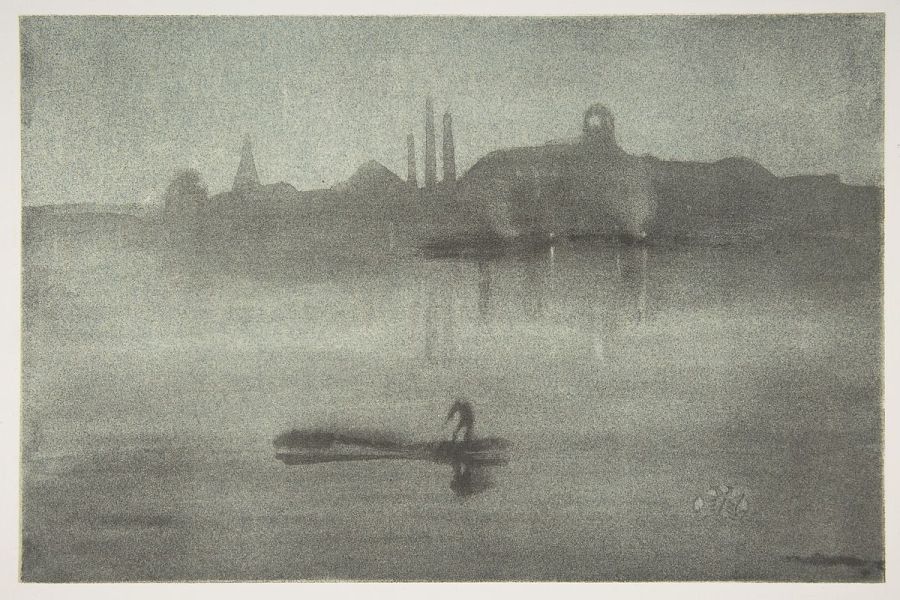
Featured Art: The Artist in His Studio by James McNeill Whistler
My parents were never crazy about Cavafy— They didn’t know much about poetry, at all, And barely had time to read anything but the papers;
Though sometimes a poem they liked would appear in their Beloved Hellenic Voice. (A poem that was always In rhyming stanzas, and deeply nostalgic.) Or else
I’d show them one of the Modern Greek poets that I Was trying to translate, and ask for their advice About a line. “Is this for school?” they’d say.
My parents were never crazy about Cavafy— To them he was too refined, too ALEX-AN- DRIAN, and they were only peasants, xhoríates.
And there was no Ithaka for them to go back to. When I’d beg them to read the Greek, they’d balk when they got To his purist kátharévousa diction—they just
Couldn’t stomach its formalist starch. His poems were never Demotic enough, never trapέzeiká: Songs to be sung across the kitchen table.
And if I read them Elytis, Odysseus Elytis Too was too elitist to trust, too drunk On the island sun of his own Ionian vision.
To people for whom elevation meant being raised In the steepening shadows of Peloponnesos. (“The great Odysseus,” my father would chide.)
And if Yannis Ritsos spoke their working-class language, And his poems weren’t hard to follow, still, once they heard That Ritsos was Marxist that’s all they needed to know.
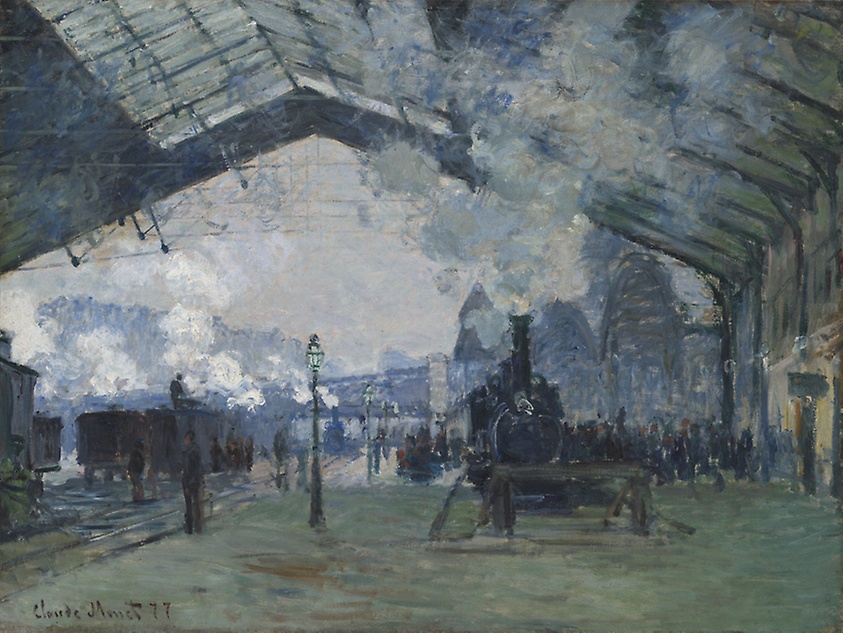
Featured Art: Arrival of the Normandy Train, Gare Saint-Lazare by Claude Monet
The Station A train has rolled in. Car after car stands here, but no doors are opening, no one’s getting off or on. Are there any doors at all? Inside, it’s teeming with closed-in people milling back and forth. They’re staring out through the unyielding windows. And outside, a man walks along the train with a maul. He’s hitting the wheels, a faint ringing. Except right here! 7 Here the sound swells unbelievably: a lightningstroke, 8 a cathedral bell tolling, a round-the-world sound 9 that lifts the whole train and the region’s wet stones. 10 Everything’s singing! You’ll remember this. Travel on!
In Tomas Tranströmer’s poem, “The Station,” from his ninth poetry collection, The Wild Market Square (1983), the ordinary scene of a train at the platform becomes a metaphor for something far from ordinary. The sound of the struck wheel widens beyond this singular everyday experience to contain the great mystery that surrounds our existence, a mysteriousness that, for a brief instant, feels as accessible as it does out of reach. This brings to mind Robert Bly’s often-cited remark about Tranströmer’s poems being “mysterious because the images have travelled a long way to get there.” “They are a sort of railway station,” he says. And quite literally so in “The Station,” where images arrive from vastly different points of origin and briefly stand together in the same place.
Featured Art: Sunset on the Sea by John Frederick Kensett
The challenges of translating from one language to another are well discussed and lamented. These challenges increase when poetry is involved: not only must the meaning emerge, but the product must sound like something that could count as a poem. When working in a native American language, these problems are, frankly, insuperable, but we are not thereby let off the hook. I am a linguist and scholar of the Choctaw language who comes to translation indirectly.
It is not clear that native Americans composed much poetry. (How would we know? What’s the difference between a war chant and a poem?) One group that, to my reckoning, clearly composed lyrical poetry was the Uto-Aztecans. The southern tribes, the Mixteca, had writing, after all, and we have a bit of the stupendous lyrical literature that was left unburned when the Spanish chose to rid humanity of indigenous cultural artifacts.
Surrealism was an art of serendipity. Its aesthetic and philosophy revolve around such elements as surprise, chance, marvel, and what the French call la trouvaille, the discovery, the treasure happened upon. André Breton argued repeatedly that the point of automatic writing—Surrealism’s first and most celebrated tool— was to provide Surrealism not with an exciting new literary technique but with a method of research, a doorway into unexploited mental processes that were within everyone’s reach. As he rather cheekily put it in the first Manifesto, “Language has been given to man so that he may make Surrealist use of it.”
The thing about serendipity, of course, is that it implies a fair amount of spontaneity and blind luck. You can’t plan chance occurrences. It’s one thing if you’re sitting at your favorite café table, paper at the ready and pen poised to take flight. It’s quite another if you’re trying to recreate, in another language, someone else’s experience of that flight, and this is where translation and automatic writing begin speaking at cross-purposes. The trick here, in other words, is that we’re dealing with a text composed (supposedly, at least) in a trance-like flow, in which one word or phrase begets the next, begets the next. The first challenge is to make the translation sound as if it was composed in the same way, but there’s more to it than that: there’s also a psychological element. The mental process that might generate a flux of words in French is rarely the same as the process in English.
One of the most difficult works I have translated from Russian is Hamid Ismailov’s The Railway. This novel has a huge geographical sweep, taking in not only most of Soviet Central Asia, but also Iran, Afghanistan and parts of European Russia and western Europe. It incorporates a great deal of twentieth-century political and cultural history. It comprises many separate stories, often linked together only tangentially. It is full of unfamiliar real-life detail—Soviet, Muslim, and (most bewilderingly of all) Muslim-with-a-Soviet-veneer-to-make-it-acceptable-to-the-authorities. And there are at least 137 different characters. How could I make all this not only comprehensible to people from another world but also interesting and enjoyable for them? One approach would be to simplify. The publishers of the French translation omitted about half the chapters, leaving out everything that did not relate to the story of the novel’s central family. I have no doubt that this stripped-down version has its merits, but this is not the way I wanted to go myself. The Railway is exuberant and Rabelaisian, full of slogans, spells and curses; Hamid (the author and I are close friends, so I shall refer to him by his first name) is deeply aware of the power of fantasy, of the way words beget words and stories beget stories, of the power of language to create reality. I did not want to sacrifice this exuberance.
Featured Art: Head of a Woman with Bent Head by André Derain
Tuk-tuks, manga as literature, onomatopoeia, Valentine’s Day
My wife and I climb with light luggage into the back of a three-wheeled Thai taxi, a tuk-tuk. As we drive off, city lights and a pink sunset blend marvelously together. Our tuk-tuk weaves through traffic as I see a gold adorned Buddhist pavilion, a Burmese-Mexican burrito restaurant, and then a Yamaha motorcycle dealership. It is, incidentally, from the land of Yamaha that we have just arrived by airplane.
Far away from our home in Tokyo, I’ll spend the week finishing an English translation for Wisut Ponnimit, Japan’s celebrated Thai author and illustrator. Wisut, who learned Japanese as an adult and now writes in the language, happens to be holding a joint art exhibition in Bangkok with Tokyo-based photographer Kotori Kawashima. Before attending the gallery show and conferencing with Wisut, there are a few difficulties to resolve with translating his manga book, Him Her That.
Wiesław Myśliwski’s magisterial 1984 novel of Polish village life Stone Upon Stone (Kamień na kamieniu) is a text in which language plays a central role. The entire novel reads like a magnificent sustained spoken monologue; Myśliwski’s gift for conveying the pithy, unsentimental wisdom of peasant language is apparent in every sentence, and it is language, not story, that ultimately drives the narrative and makes the book the masterpiece it is.
In the more than five-hundred pages of this astounding book, no word is more central than ziemia. Yet at the same time, no word is more untranslatable into English—despite the fact that ziemia is a seemingly ordinary, everyday word. The problem is that ziemia, unremarkable as it is, occupies the semantic space of several equally ordinary, overlapping notions in English. Foremost among these English meanings are: earth, in meanings such as that of one of the four classical elements, contrasted with air, water, and fire (it is, for example, the name of our planet in Polish); land, as in something one can farm, and that is measured in acres—it also appears in Polish in phrases such as “homeland” and “promised land,” and in this meaning is used in a phrase like “on land” to contrast with “on the sea”; ground, for instance in a phrase such as “lying on the ground” or “the ground under one’s feet”; and soil, the actual material in which one grows things.
Featured Art: Green and Blue: The Dancer by James McNeill Whistler
Άγε, ω βασιλεύ Λακεδαιμονίων
Δεν καταδέχονταν η Κρατησίκλεια ο κόσμος να την δει να κλαίει και να θρηνεί· και μεγαλοπρεπής εβάδιζε και σιωπηλή. Τίποτε δεν απόδειχνε η ατάραχη μορφή της απ’ τον καϋμό και τα τυράννια της. Μα όσο και νάναι μια στιγμή δεν βάσταξε· και πριν στο άθλιο πλοίο μπει να πάει στην Aλεξάνδρεια, πήρε τον υιό της στον ναό του Ποσειδώνος, και μόνοι σαν βρεθήκαν τον αγκάλιασε και τον ασπάζονταν, «διαλγούντα», λέγει ο Πλούταρχος, «και συντεταραγμένον». Όμως ο δυνατός της χαρακτήρ επάσχισε· και συνελθούσα η θαυμασία γυναίκα είπε στον Κλεομένη «Άγε, ω βασιλεύ Λακεδαιμονίων, όπως, επάν έξω γενώμεθα, μηδείς ίδη δακρύοντας ημάς μηδέ ανάξιόν τι της Σπάρτης ποιούντας. Τούτο γαρ εφ’ ημίν μόνον· αι τύχαι δε, όπως αν ο δαίμων διδώ, πάρεισι.»
Και μες στο πλοίο μπήκε, πηαίνοντας προς το «διδώ».
Come, O King of the Lacedaimonians
Cratisicleia did not deign to allow the people to see her weeping and grieving; she walked in stately silence. Her serene demeanor revealed nothing of her sorrow and her torments. But even so, for a moment she couldn’t contain herself; and before she boarded the hateful ship for Alexandria, she took her son to Poseidon’s temple, and when they were alone she embraced him and kissed him, who was “suffering grievous pain,” says Plutarch, “in a state of conturbation.” But her strong character fought back; and regaining her self-composure, the magnificent woman said to Cleomenes, “Come, O King of the Lacedaimonians, when we come out of here, let no one see us weeping or acting in any way unworthy of Sparta. For this alone is in our power; our fortune will be only what the god might give.”
And she boarded the ship, heading for that “might give.”
Featured art: Two Pupils in Greek Dress by Thomas Eakins
When I translated Jenny Mastoraki’s prose poem “The Unfortunate Brides” (1983) I drew on the beat and even the syllabic count of the Greek to create a rhythm that was legible, but new in English:
. . . the way a roóster lights up Hádes, or a gílded jaw the speéchless night, a beást jángling on the rún, and the ríder búbbles up góld.
For Anglophone readers, the four phrases make up a recognizable stanza, though somewhat unusual with two long beats in the first two phrases and three shorter, faster ones in the last two. Newness arose not simply from the surreal imagery, but from the sound on which it rode.
To focus on the sound of the source text is to run counter to the dominant translation strategy, which focuses on meaning. This is true more generally, but also in the case of Modern Greek poetry. Translations such as those by Edmund Keeley and Phillip Sherrard introduced the poetry of C. P. Cavafy, George Sef-eris, Odysseas Elytes and Yannis Ritsos in an idiom that reads easily in English and makes the living tradition of myth and history readily available to an Anglophone audience.














 New Ohio Review