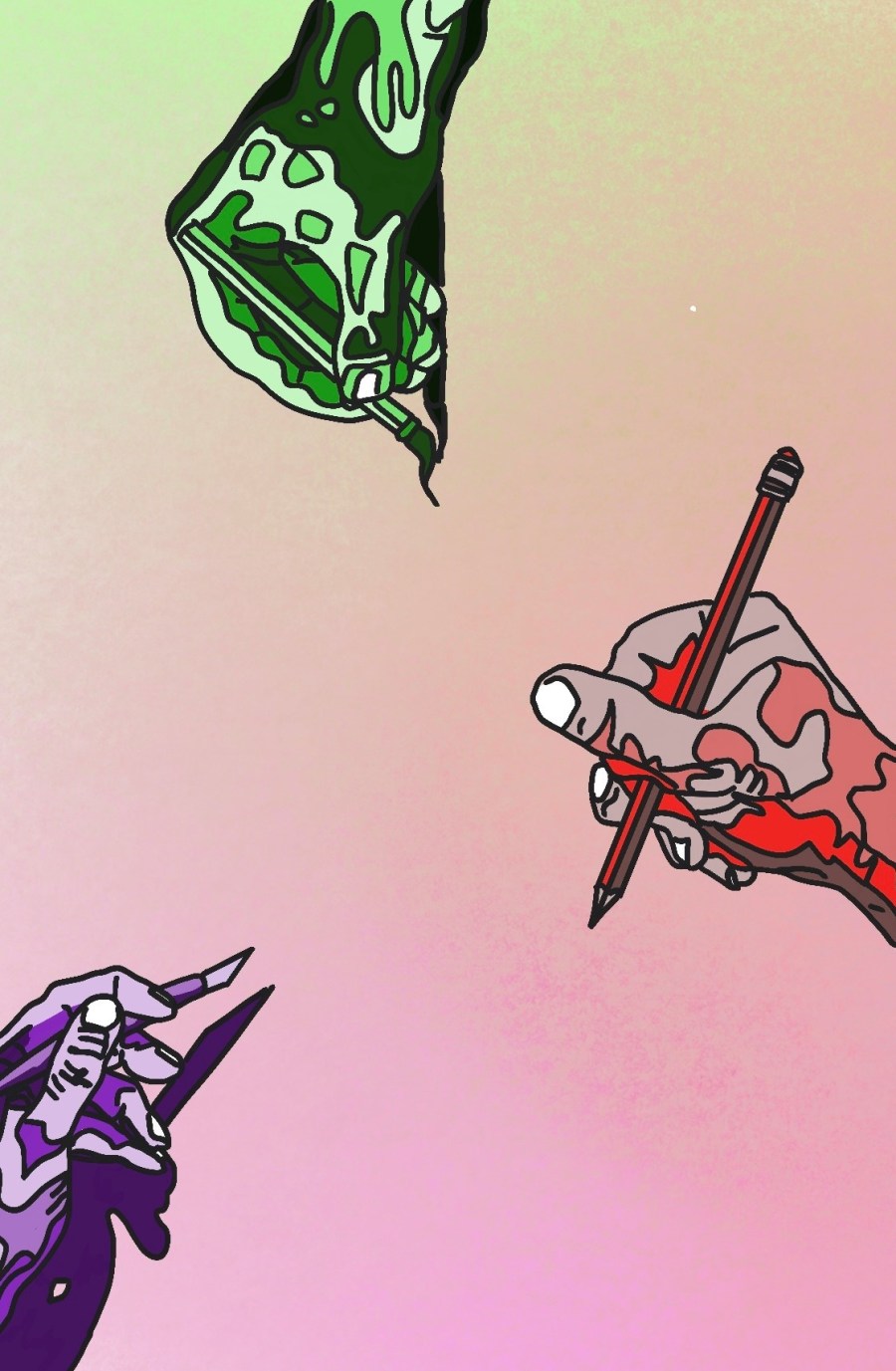
Mask 13

By Annemarie Neary
Featured Art by Rachel Hall

They had barely finished the introductions when he asked about the war. The endgame, the likely victor, things no Ukrainian cared to discuss with strangers.  

‘I wish I knew,’ she said. Usually that was enough. 

‘But what do you think?’ 

She managed to keep her tone level. ‘I try not to think. But I’ll do a good job here regardless.’  

She didn’t like his smile any more than she liked his question. But she did want the job. A friend who was still in Kyiv had spotted the ad online. These things are almost never advertised, so Olena emailed right away with her CV.  

Read More

How to Test White Guys

By Paloma Martínez-Cruz

The first is named Steve Stahl. You have no claim on him; the concept is beyond imagination. Enjoy quiet contentment as you color your tree trunk brown using a box of crayons that sits between you. Steve surprises you the day he announces, “I brush my teeth” and pecks you on the cheek making a smacking sound with his lips.

This means something.

For the end-of-year dance recital, the teacher’s aide pairs you with Juan, a dark brown boy who speaks only Spanish. The teachers choreograph a preschool version of the Mexican hat dance, and you see that a blond girl has suddenly materialized to be paired with Steve Stahl. Had she been in your class the whole time? How is everything about her so yellow? Steve Stahl gets right down to the business of dancing with her, which is just as baffling as her sudden appearance. How is he unwilling to boycott the dance or at least throw a crayon at the teacher’s aide in an act of defiance?

Read More

Providence

By Logan McMillen

i. Kansas City, Missouri— 1983

Every morning before the store opened, Rubén tempted George into smoking a cigarette by the loading docks—which had a clear view of the highway and the sunrise. Today was no different.

“You’re the devil,” George said—with his lighter already pulled out.

George owned the home improvement store where Rubén worked.

The missionaries were quick to find a job for Rubén. And even though it wasn’t in his field of study, or anywhere near his relatives in New Jersey—Rubén liked it. It gave him a casual sense of purpose.

“We don’t really follow that one,” Rubén said. “Do we?”

Rubén often pretended that he didn’t know anything about Mormonism, even though he’d been “practicing” for over two years. He thought of the religion mainly as a way to stay social in an unfamiliar place. That and he felt like he owed the missionaries something. If they wanted his soul, so be it.

Read More

Encounter

By Xingzi Chen

Featured Art by Ashura Lewis

The first thing Su met at the new school was a closed gate.

That day, she arrived earlier than the time agreed before and could not get through the school office number. The HR lady who had been arranging things for her was also not there. That left her waiting at the front entrance until a man stuck his head out from the guard shack to ask who she was.

Read More

To the Israeli Soldier—

By Emily Franklin

Featured Art: Sur La Plage, by John Schriner

I believe it’s possible to know someone’s name and have them be a stranger. I know you are Ihran, but in this world of being able to locate anyone (elementary school bully, heartbreaker, former colleague), I cannot find you. There’s the cruelty of having you Un-Googleable and also the relief of you receding in the rearview mirror of my past.

France. Summer, 1988. I’m an American studying in Villefranche-sur-Mer; a teenager unmoored, supposedly learning to be more fluent in French, but really gathering intel—where to buy oversized icy beer down the hill in the dark, a shack where the old French men gather in stained overalls and barely register me—seventeen and desperate to keep from being fully seen. I tuck my face behind a swathe of blonde hair and order beers—ten francs each—for me and the friends I’ve made. Anandi is Canadian-Indian, Caroline is Korean-American, Everly is from the American South with the drawl to prove it.  I’m just blue-eyed and blonde, a master at sourcing beer or soft cheese or finding the hidden beach where we wind up the following day.

Read More

Lonely, Lucky, Brave

By Jillian Jackson

When I hit on the scratch ticket I was at Castle Island with Hannah. We used to go there every Friday. After Hannah finished walking dogs and I finished up my shift at the café, we liked to pack a lunch and watch the planes flying into Logan airport. We always ate turkey sandwiches that I stole from the café and drank wine out of cans. We finished a family-sized bag of salt and vinegar chips.

That afternoon Hannah was wearing my favorite cardigan, a Good Will find, pink and covered in sparkles. She had on pink lipstick that had smudged a little bit on her bottom lip. We were watching the planes, our bare feet in the cold sand. It was April and we were glad we could sit there without our jackets on, even though we were a little cold when the wind picked up.  

“It’s time,” Hannah said. She reached into her bag and dug out the tickets. She dealt them like cards at a poker match, back and forth, one and one. All ten.                     

Read More

Zuzanna Ginczanka Biographical Note

By Joanna Trzeciak Huss

Any biography of Zuzanna Ginczanka (1917-1944), however short, should attempt to speak to her desire to define herself and her refusal to be defined by others. For her, social and artistic identity was something to be chosen and cultivated, but in the times in which she lived, identity ascribed by others was a matter of life and death.  Born Zuzanna Polina Gincburg in Kiev in 1917, she fled shortly after the Russian Revolution with her family to the border town of Równe in Volhynia (present day Rivne, Ukraine), which was at one point part of the Polish-Lithuanian Commonwealth and was about to become Polish again in 1920.  The destination was not accidental: it was the town where her Russian-speaking maternal grandparents were well-ensconced.  Yet this provincial capital proved too confining for her parents, who abandoned her to the care of her grandmother: her father leaving for Berlin when Ginczanka was three and her mother for Pamplona, Spain after she remarried.  Równe, a multi-ethnic city, was Ginczanka’s childhood home and it was there she attended a French pre-school and Polish elementary school and high school.  She adopted the name Ginczanka, and though Russian was her native tongue,  chose Polish as her language of poetic expression. Yet she was never able to obtain Polish citizenship and remained stateless throughout her life.

Read More

マ I 克 (ma-i-ke)

By Warren Decker

Mike came to Japan because he was tired of being Mike. He was the only guy in the dorm who would never take lime Jell-O vodka shots, and would get mad if his roommate woke him up— stumbling drunk through the door, and turning on the florescent light, before passing out snoring in the lower bunk, fully clothed, wearing shoes filthy with mud and wet grass clippings from the university lawns. Mike would climb down from his top bunk and turn off the light but he could never get back to sleep, and his morning study routine would be disrupted.

Mike preferred Chinese characters to people, specifically the kanji characters used in Japan. He had already worked his way through the bright red “First 500 Kanji Workbook,” and was halfway through the light blue “500-1000 Kanji Workbook,” while some of the other freshmen were still struggling with the phonetic hiragana characters. His teachers praised his diligence, but for Mike it was very simple: he preferred Chinese characters to his roommate but he also preferred Chinese characters to Mike. If he spent an hour carefully memorizing the stroke order of a kanji like 鬱, then Mike—with all his doubts, his unfounded sadnesses, and fears—would be somewhere far away.

In his junior year, he arrived at Kyoto University as マイク (ma-i-ku). When people spoke, he could quickly associate the syllables of sound with a specific kanji, and decipher the meaning within a few seconds. The other exchange students were still fumbling around with “ohayo gozaimasu.” Within a month マイク had lost his virginity in his single-occupancy dorm room with Reika, an English major, who wore huge sunglasses and had long hair that was dyed a dark shade of reddish-brown.

Read More